
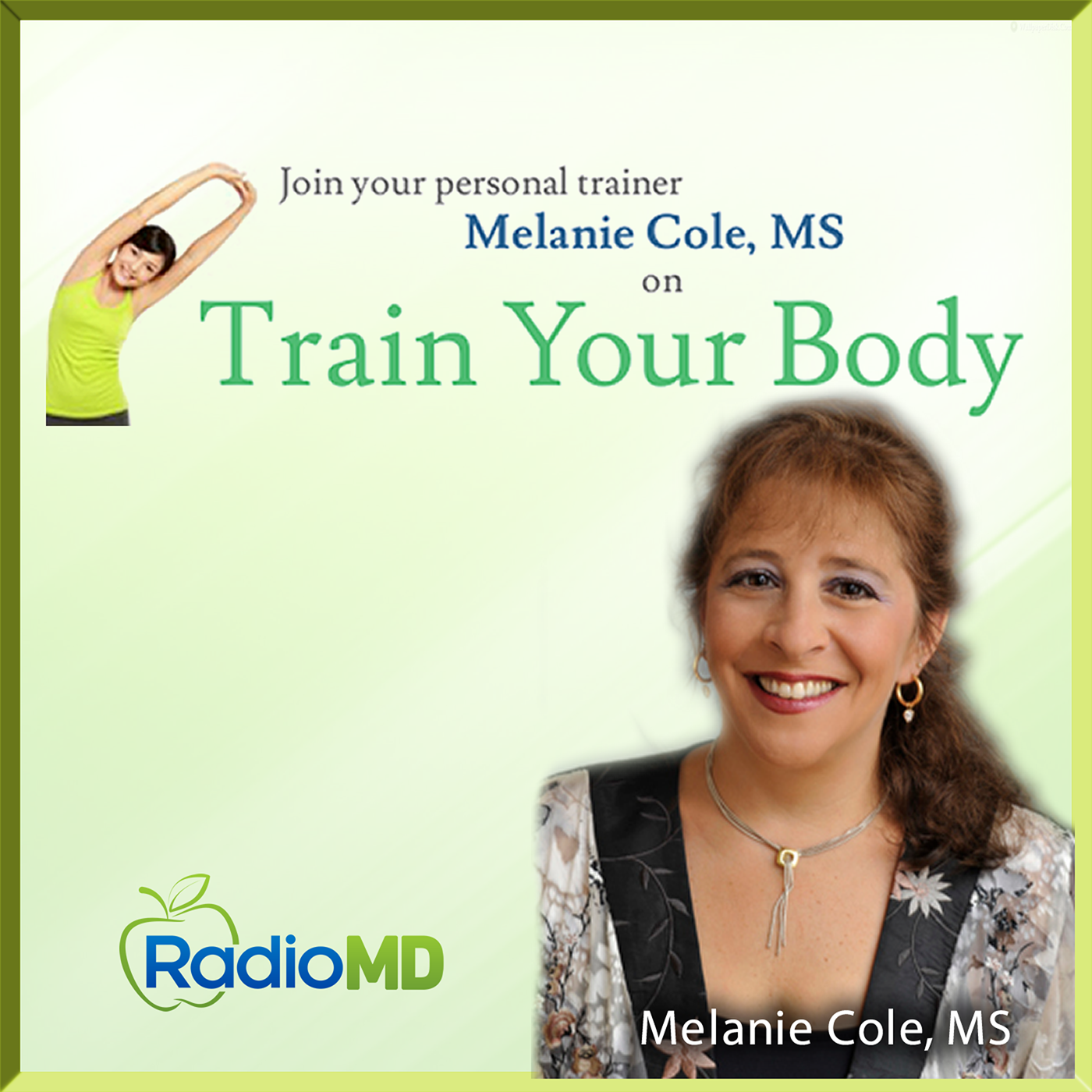
PODCAST · health
Train Your Body
by DoctorPodcasting.com
Hosted by exercise physiologist and personal trainer, Melanie Cole, MS. Guests are provided by the American College of Sports Medicine (ACSM) and are experts in all arenas of fitness, nutrition, athletics, and sports medicine. This show appeals to both fitness buffs AND beginners. Fitness trends, workout techniques, preparing for your marathons, and so much more – it’s all covered on Train Your Body.
-
150
Love & Marriage: Improving Health
A recent study showed that those who were married were more likely to recover after a heart attack. They also had a shorter hospital stay by about two days.The overall benefit of marriage outweighs the risk if it is a reasonable marriage.Married folks tend to live longer, have less depression and are healthier than those who don't socialize. Socializing isn't based on your number of social media buddies. It's based on people you interact with face-to-face.Knowing you have the support around you during a health event will help your recovery. If you're not married, a great group of friends will provide comfort and support.Listen in as Dr. John Higgins shares how marriage can help your health.
-
149
Sleep Restriction Harms Athletic Performance
A recent study examined the performance of cyclists who were going on reduced sleep. One group had 8-10 hours sleep, while the other got only four hours of sleep per night. Not surprisingly, the sleep deprived cyclists were exhausted sooner and had less power.You need sleep. It affects concentration, learning, and performance of muscle fibers. Sufficient sleep can also help prevent chronic disease.Muscle recovery, replacement, repair and rebuilding takes place when you are sleeping.Get at least eight hours of sleep per night. Try to get 10 hours when you've put your body through a big workout. Train your body to expect sleep when you hit the sack.Dr. John Higgins advises on how to be a top notch athlete with plenty of sleep.
-
148
Increasing Fruits & Veggies in Your Diet
Fresh fruits and vegetables are fantastic for skin health. The fibers within are great for you digestive tract. They contain the kind of carbs your body craves. How can you branch out from the bag of salad and sack of apples to stay excited about eating produce?You can buy pre-washed and pre-cut produce and use it in stir fry, soups and salads. There are options for all levels of convenience: fresh, frozen, canned, dehydrated. You can visit farmer's markets and farm stands. Take the kids to a grove or farm where you can pick your own produce.Make your produce easy to eat. Fresh smoothies supply fiber. Wash and roast root vegetables. Prepare your fruits and veggies so your kids will snack on them, which may mean you're cutting and blanching that broccoli before putting it in a container in the fridge. Cut fun shapes with a spiral slicer or garnishing knife. Be sure you wash delicate berries like red and golden raspberries right before consumption.Listen in as Dr. Felicia Stoler advises on how to get more produce in your diet this summer.
-
147
Healthy Summer Cocktails & Mocktails
Summer is here and hitting some parts of the country with a vengeance. To stay cool and hydrated, you can create some delicious and nutritious cold drinks.Make your own simple syrups to mix into your drinks. Using sugar, agave nectar or stevia, you can make an herb-infused simple syrup. Mix this simple syrup with tea, club soda or juice. Grenadine is pomegranate simple syrup, which you can also make at home.To get the fiber from your fruit and vegetables, make easy smoothies in your blender. Combine fruit and/or vegetables, ice and water.Add veggies to your bloody marys. Get even more health benefit by using pickled vegetables as garnish. Use fresh frozen fruit or flavored ice cubes in your drinks.You can add alcohol to any of these drinks for a little kick. Keep an eye on your calorie intake from booze. Have a glass of water between your cocktails. Vodka and gin have the least calories and pack the most punch. Tonic has as many calories as regular soda, so try sparkling water as a substitute.Listen in as Dr. Felicia Stoler shares tips for healthy cocktails and mocktails to keep you cool this summer.
-
146
American Fitness Index 2016: Bottom of the List
Every year the American College of Sports Medicine releases the American Fitness Index. This report ranks the fitness of several cities in the United States.Indianapolis bottoms out the list. They've been working steadily to improve walkability and opportunity for physical activity. It takes time to make change. The benefits from the changes they've made will not be evident in the report for years. They rank 50th in personal health indicators. They fall short of the goal for physical activity. Many Southern cities round out the bottom ten. Oklahoma City is number 49. Louisville, Kentucky is 48th. These cities don't spend as much on parks per resident. Older cities that have been around for hundreds of years aren't as driven for change. Many of the cities are working on initiatives to make it easier for these cities to be physically active. The changes that are taking place are too small to move these cities up to the next ranking.Money drives a lot of the priorities for improving community assets. Many cities have low scores. Rural communities and depressed economies cannot afford the same improvements as other areas. These places can still improve by encouraging more physical activity for children in schools and providing opportunities for community members to engage in fitness. Many churches have built gyms and walking trails on their properties to prompt changes. Community members can form coalitions to take small steps to increase physical activity. Taking initiative for small changes can make a huge difference.Listen in as Dr. Barbara Ainsworth discusses with Melanie Cole, MS, the bottom of the AFI list and how to make improvements in your community.
-
145
American Fitness Index 2016: Top of the List
Every year the American College of Sports Medicine releases its American Fitness Index (AFI). The AFI ranks the fitness of communities across the country based on extensive research.The AFI analyzes research from various agencies to determine the overall health behavior of a population. Physical activity, level of smoking, and adherence to eating guidelines are all contributing factors to the score a community receives for personal health indicators. The community and environmental indicators include the amount of park land in the city, number of farmer's markets per million, number of pools and recreational resources, and how many people bicycle to work. These scores are combined to determine a city's rank.The top ten cities were high in their walk score, provision of farmer's markets and proportion of the population that lives near a park. There are plenty of places for people to receive some physical recreation. The proportion of people who are physically active exceeds the goal set by ACSM. Washington D.C. tops the list with the personal, community and environmental indicators. Personal health was 81.7 of 100 (#2 on the list). Community and environmental was 74.2 (#3 on the list), leading to the highest composite score. There are lots of parks in Washington D.C., giving an advantage for walking opportunities. Minneapolis comes in second with a walking track near the airport. Denver is number three, coming in first with personal health and eighth with environmental health.Where does your community fall on the list?Dr. Barbara Ainsworth joins Melanie Cole, MS, to discuss the top cities on this year's report.
-
144
High Protein Diet Can Help You Sleep
Adults need at least eight hours of sleep per night. You need the energy from that rest and you need sleep support to make healthy food choices.A recent study of 14 obese adults over a few weeks examined the effects of protein on weight loss. Both groups had the same caloric intake, but one group ate low protein diets and the other high. The weight loss in both groups was the same, but high protein participants had better quality sleep and more energy.Protein contains tryptophan, an amino acid you hear mentioned at Thanksgiving as the catalyst for post-dinner napping. Tryptophan converts to serotonin, making you feel happier and giving you energy. The serotonin then converts to melatonin, making sleep easier.If you have a hard time getting to bed, be sure you have some protein at dinner.Dr. John Higgins joins host Melanie Cole, MS, to discuss how protein can help you sleep.
-
143
Perk Yourself Up with Exercise
Exercise makes you feel happy.A 15-minute exercise session each day is enough to boost mood and endorphins, get your heart rate up, improve your stress levels, and help regulate your hormones. It also puts stress on your brain so it's able to handle life better.A recent study assessed the effect of exercise on mood. One group exercised and the other didn't. The two groups watched emotional film scenes. The exercisers felt less sad and could shake sadness sooner after the downer film clips. They also felt happier longer from comedic clips.People don't crash from naturally-created hormones, so you don't have to worry about coming down from your exercise high. In fact, the feelings created by exercise can be addictive and make you want more.If you're feeling down, hop on your exercise bike or go for a jog. You can stimulate hormones to make you feel less funky.Dr. John Higgins joins host Melanie Cole, MS, to discuss how exercise can perk you up.
-
142
Weight Training: Heavy vs. Reps
It’s important to have weight training as part of your workout regimen. But, you may wonder which technique is better. Should you stick with light weights and a lot of reps? Maybe you should use heavy weights and use fewer reps. How do you know what’s right for you?You have to look at your personal weight training goals. If you're just getting started, you might stick with lighter weights and more reps. Light weights are good for endurance and toning.If you're working on your strength or building muscle, work with heavier weights and fewer reps.If you regularly lift, you can vary your workouts. Do 8-12 repetitions with moderate to heavy weights some days for major change. Work out with lighter weights in fitness classes. Listen in as fitness experts, Grace DeSimone and Neal Pire, discuss which weight training technique is best for you.
-
141
Are Your Loved Ones Keeping You Unfit?
You know it’s important to exercise so your body stays healthy. You really need to move your body if you spend eight-hour days at a desk. The difficulty is coming home, taking care of a family and staying motivated to get that workout done. Bless their hearts, your family members may be holding you back from getting fit.How can you get fit despite these setbacks?You can recruit your family and friends into your workout routine. When you have a workout buddy, you're more likely to complete your exercise regimen. They will learn the importance of your fitness firsthand. They'll benefit from the workout while spending time with you.Self-care is important. If you take care of others, you must schedule time to take care of yourself as well. Fitness is great for your physical and mental well-being.Listen in as fitness experts, Grace DeSimone and Neal Pire, share how to get fit when your loved ones get in the way.
-
140
Fitness Rx with the Exercise is Medicine Program
In years past, doctors would always ask patients about physical fitness. Getting the body moving is not only great for general health, but it also helps fight chronic disease. Wanting to elevate it to a vital sign, the Exercise is Medicine Program was born.Now, Exercise is Medicine is in 50 countries. Doctors prescribe physical activity as part of treatment plans. Some prescriptions are disease-based so the patients can address chronic disease issues before they worsen.You are your best health advocate. Speak with your doctor about how fitness can improve your health.Dr. Pam Peeke discusses the Exercise is Medicine Program.
-
139
Baby Steps to Getting Active
Everyone has to start somewhere with physical fitness. If you're just getting going for the first time or returning after some time off, becoming active doesn't have to be a daunting task.Start by taking five minutes to do something. Make it easy on yourself by finding an exercise that interests you and do it for five minutes.Break the ice with baby steps. Show yourself you can pull it off and then go a little further. Get into a routine on a gradient.You may have to make an appointment in your calendar as you make fitness a habit. You can also use an app to help track your progress.Branch out and try different fitness classes that catch your interest. If you hate them, you don't have to return. You may just find something you love that keeps you motivated.Dr. Pam Peeke joins host Melanie Cole to share tips to get your body moving.
-
138
Soccer for Silver Foxes
A recent study showed that men 65-75 had fitness success by playing recreational soccer. Older folks don't always get into traditional fitness programs (jogging or gym), so soccer is a wonderful alternative.Playing soccer helps with overall fitness. It improves bone density and muscle mass. It's great for endurance and cardio health.More importantly, having fitness buddies helps keep you on track. The men from the study continued playing with the same people a few years after the study ended. For these silver foxes, it was more about fun than it was about winning. Teams would swap players so no one would always be on the lowest-scoring team. Recreational soccer was so popular with these fellows that there were always willing participants on the bench. If a player on the field got tired, one of the men from the bench would tag in for him.Dr. John Higgins joins host Melanie Cole, MS, to discuss how recreational soccer is great for fitness in aging folks.
-
137
Activity Equivalent Food Labeling
Many restaurants now disclose how many calories each menu option contains. The idea is for diners to weigh their options with caloric value in mind. If you know you should only have 1500 calories a day, you might decide to go for the 500-calorie salad and skip the soft drink instead of the 560-calorie burger and 500-calorie fries.All calories are not created equal. Your body will process 200 calories of lean meat differently from 200 calories of candy. The caloric labeling on menus is a step in the right direction, but it doesn't disclose what it takes to utilize all of the calories you're consuming.An activity equivalent labeling system would disclose how much physical activity is necessary to burn off different meal choices. Would you still choose the burger and fries if you knew it would take two hours of high-impact aerobics to work them off? Would you choose something better for your body?Dr. John Higgins joins host Melanie Cole, MS, to discuss the usefulness of an activity equivalent labeling system.
-
136
Take It Outside: Fun Outdoor Workouts
Spring is in the air, and it’s the perfect time to move your workout into the great outdoors. There are many benefits to taking your workout outdoors. You may find yourself exercising for longer and not feeling your workout as much because you’re distracted by blooming flowers and chirping birds. You may burn more calories from the resistance that nature provides. Nature doesn’t require gym fees. And, you can get more vitamin D and rejuvenating fresh air by exercising in the elements.Listen in as fitness experts, Grace DeSimone and Neal Pire, discuss how to take your workout outside.
-
135
Your Fitness Tracker: Friend or Foe?
Wearable fitness trackers are great for getting you moving. Your fancy new device will have you motivated and interested in your fitness, at least for a while. You’ll check your steps and calories burned for a bit, hopefully using your device to improve your activity.But, in the end, is your fitness tracker worth the expense? Do you really need all the bells and whistles it claims to have? How reliable is the information it tracks? What is your wearable really telling you?Listen in as fitness experts, Grace DeSimone and Neal Pire break down the pros and cons of fitness trackers.
-
134
Walk with a Doc
Sometimes you need a little extra encouragement to get your body moving. Even the thought of taking a short walk can be exhausting when you aren't used to it. Typically, those who have the least desire to become active are the ones who need it most.Dr. David Sabgir founded Walk with a Doc to encourage people to get active. People can join up with walking groups around the world to get moving in a very welcoming environment. Walkers range from joggers to people with walkers to families with dogs.Dr. Sabgir joins Melanie Cole, MS, to share how Walk with a Doc is changing lives.
-
133
Get Moving: Benefits of Moderate Physical Activity
You might think that you need to spend hours and hours in the gym each week to maintain or improve your health. While strength training and gym activities provide their own benefits, you can help your body with just 20 minutes of moderate physical activity per day. Brisk walking is great for those who are not physically prepared to kick things up a notch. Start slowly and build in intensity. If you have a chronic health condition, it’s best to consult with your doctor before undertaking physical activity outside of your norm.Dr. David Sabgir joins host Melanie Cole, MS, to discuss the benefits of moderate physical activity.
-
132
Accuracy of Wearable Health Devices
Technology has improved by leaps and bounds when it comes to health tracking. Old school pedometers that would reset if you jumped are now a thing of the past. Cell phones and wearable devices can track heart rate, calories burned and more.However, the accuracy of these wearable devices is questionable. The varying results between devices is okay for tracking workouts. The inconsistency between devices is not ideal for medical purposes.Dr. John Higgins joins Melanie Cole, MS, to discuss how reliable health devices are for tracking health data.
-
131
Get Off Your Butt: Benefits of Standing Desks
The average desk worker spends almost six hours a day sitting at a desk. The break from sitting is usually for a trip to the water cooler or the copier. Sitting all day for years at a job contributes to chronic diseases, like obesity, heart disease, diabetes and cancer. A quick trip to the gym after work doesn’t balance out the hours of sitting. The commute home, also spent sitting, may even be just as long as that workout at the gym. Standing desks get desk workers on their feet. Standing burns up to 50 more calories per hour than sitting. It activates the metabolism. Most importantly, standing makes movement easier. Staying active at your standing desk is more beneficial than just standing all day.Dr. John Higgins joins host Melanie Cole, MS, to discuss the benefits of standing desks.
-
130
Quick & Dirty or Steady in 30?
Should you be doing High Intensity Interval Training (HIIT) or Low Intensity Steady State Cardio (LISS)? It depends on what you’re hoping to accomplish with your workouts. High Intensity Interval Training (HIIT) requires you to execute a certain exercise at maximum physical effort for a minute or two. You then rest for two to three minutes. This cycle repeats with different exercises until you are exhausted, which is roughly five times. HIIT includes exercises like burpees, mountain climbers, and jumping jacks. Low Intensity Steady State Cardio (LISS) is aerobic exercise that requires you to operate at 60-70% capacity for at least 20 minutes. The intensity does not change through the entire workout. LISS exercises include walking, cycling, jogging, and swimming. HIIT burns more calories, takes less time per workout, and builds lean muscle mass. There is greater chance of injury, and you can’t do it every day. LISS improves cardiovascular health without building muscle mass, has a shorter recovery time, and is great for beginners. However, it can get boring and repetitive.Listen in as fitness experts, Grace DeSimone and Neal Pire, discuss these two styles of cardio.
-
129
Venus vs. Mars: Can Women Strength Train Like Men?
All adults should strength train at least twice weekly. Women and men can use the same strength training techniques, but the results will differ. Men typically see greater muscle mass gains than women. Men are also less susceptible to injury, due to increased tendon strength from exercise. Men and women both respond similarly to muscle endurance conditioning. Two to four sets of 10-25 reps, with 30-60 seconds rest between, will improve endurance. Workouts for strength and size are the same for men and women, even though men see greater muscle mass gains. For volume, try one to three sets of 8-12 reps, with one to three minutes for rest between sets. For strength, try one to three sets of 8-12 reps, or two to six sets of 1-8 reps, with one to three minutes of rest between sets.Listen in as fitness experts, Grace DeSimone and Neal Pire, share the he-said/she-said perspective on strength training.
-
128
Do You Really Need Protein Supplements?
The recommend amount of daily protein for Americans is 10-35% of calorie intake. That's roughly 46 grams for women and 56 grams for men.It's not difficult to get the daily recommendation for protein if you consume two to three servings of protein-rich food each day.However, you may find you need to supplement your diet with extra protein, especially if you're exercising at a moderate or intense level.Felicia Stoler, PhD, shares how to get enough protein on a daily basis, as well as if you need to supplement your current diet.
-
127
Updated Dietary Guidelines: Will the Changes Affect You?
Every five years, the Department of Health and Human Services releases updated Dietary Guidelines. This report contains the government's thoughts on how Americans should be eating.What recent changes have been made to the Dietary Guidelines? Cut back on animal protein. This is especially recommended for men and teen boys, largely because they are not consuming enough produce. Cut added sugars. The report recommends cutting sugar intake to 10% of your daily calorie intake. This means cutting added sugar from coffee and limiting sweets. No need to limit cholesterol. There is no longer a limit of 300 mg of cholesterol per day, but the report recommends looking at what foods are providing your cholesterol. Omelets and avocados are preferred to cheeseburgers and pizza. Felicia Stoler, PhD, discusses these new Dietary Guidelines and how it may impact the way you feed yourself and your family.
-
126
Resolution Pit-Stop
It’s mid-February... the time when so many fall off the fitness wagon. It's not too late to get back to those goals and make progress.How can you stay on target with your 2016 fitness goals?Listen in as fitness experts, Grace DeSimone and Neal Pire, share some tips that will keep you on target, help you achieve your goals, and prevent you from becoming a victim of the six-week slip.
-
125
Training with Your Better Half
With Valentine’s Day around the corner, you might be considering ways to spend more time with your partner. You might also want your partner to be more active, so why not work out together?But, is that really a good idea? Should you train with your partner?Listen in as fitness experts, Grace DeSimone and Neal Pire, share the he-said/she-said perspective on training with your better half.
-
124
Cardiorespiratory Fitness in Young Adults Prevents Early Death
A recent study that was posted by JAMA Internal Medicine found that young adults who participated in cardiorespiratory fitness had lower chances of developing cardiovascular disease and avoided the potential for early death. Researchers looked at 4,872 adults who were between the ages of 18 and 30. The study involved the participants using treadmill exercises from March of 1985 to June 1986, as well as 2,472 individuals who were tested seven years later. What did the researchers find? Out of the 4,872 participants, 273 died and 193 experienced cardiovascular disease during the follow-up tests. Among the 273 deaths, 200 were non-cardiovascular. How can cardiorespiratory fitness help young adults?John Higgins, MD, explains the study and discusses why fitness is so important to heart health, especially in young people.
-
123
Overweight & Obesity Early in Life Increases Risk of Cardiac Death
A study recently published in JACC: Clinical Electrophysiology found that being overweight or obese while in adulthood contributed to an increased risk of sudden cardiac death. Researchers used data from the Nurses’ Health Study, which looked at 72,484 women during a 32-year span (1980 to 2012). Researchers looked at the relation between body mass index (BMI) and weight gain and the risk for sudden cardiac death, death from coronary heart disease, and non-fatal heart attacks. What did the researchers find? Over the 32-year period of the study, researchers found 445 cases of sudden cardiac death, 1,286 cases of fatal coronary heart disease, and 2,272 non-fatal heart attacks.John Higgins, MD, joins Melanie Cole, MS, to discuss the study and how being overweight and/or obese can cause an increase of cardiac death.
-
122
Weight & Exercise Affect Children's Cognitive Development
Healthy development is crucial for your child. A recent study conducted by Medical College of Georgia at Georgia Regents University found that your child's weight and activity level has an impact on his or her's ability to think.Researchers looked at 45 normal-weight children that were between the ages of seven and 11. Of these children, 25 were active and 20 weren't.What did researchers find?Results showed that children who were lean and active scored better on cognitive tests than the inactive and overweight children.What else did the researchers find?John Higgins, MD, shares more details of the study and explains why weight and exercise matter when it comes to your child's cognitive health.
-
121
Got Obesity? Get Fitbit & Stay Motivated
According to the Centers for Disease Control and Prevention (CDC), one-third (78.6 million) of U.S. adults are obese.A recent study conducted by the University of Wisconsin Madison found that using a Fitbit can help postmenopausal obese women stay motivated to lose weight.The participants included 25 overweight or obese postmenopausal women, and each received a 16-week technology-based intervention that used the Fitbit physical activity tracker and website.The overall study's goal was for 150 minutes/week of moderate and intense physical activity; however, individual goals were reset after week four based on progress.What were the results of the study?John Higgins, MD, joins Melanie Cole, MS, to discuss the study and how a Fitbit or other wearable device can help you stay motivated.
-
120
Just ONE Energy Drink May Boost Heart Disease Risk in Young Adults
When you're running on five hours of sleep and the long list of things you need to get done isn't getting any shorter, it can be extremely tempting to reach for an energy drink to boost your energy levels.However, just one energy drink comes with a risk.According to a study by the American Heart Association, drinking one 16-ounce energy drink boosts blood pressure and the stress hormone responses in young, healthy adults.What else did the research find?Listen in as John Higgins, MD, shares information from the recent study, including this new-found link between energy drinks and the risk for heart disease.
-
119
Popping Champagne? Health Benefits of Bubbly
Whether you're celebrating at a wedding, or toasting to the New Year, champagne might be your go-to drink.It turns out that there may actually be some health benefits from popping bottles. For example, while a glass of wine usually contains 120 calories, a four-ounce glass of champagne contains only 90 calories.A recent study also found that drinking one to three glasses of champagne a week can help delay the onset of dementia and memory loss.Will you be toasting to good health this year?Listen in as John Higgins, MD, shares the health benefits of drinking champagne.
-
118
Handling Holiday Stress with Exercise
During the months of October to January, you're at an increased risk of gaining weight and losing sight of your health and fitness goals.In fact, during the holiday season, the average person gains one to two pounds and people who are already overweight can gain close to five pounds.What are some tips to help avoid weight gain and to stay on track during the holidays?Listen in as fitness experts Grace Desimone and Neal Pire share the best fitness strategies for the holiday season.
-
117
Don't Let the Holidays Sabotage Your Health & Fitness
Throughout the holidays, it can be extremely tempting to just embrace the food and alcohol that surround you. You may think you can give yourself a break and that you'll start "fresh" in the New Year.Even though this plan sounds appealing, it could actually backfire and set you back further in your health and fitness goals.You might also be thinking the extreme opposite, pushing yourself at an unhealthy rate. Working out constantly while not getting enough food can be dangerous and unhealthy.How can you find a balance and not sabotage your health and fitness during the holidays?Listen in as fitness experts Grace Desimone and Neal Pire share tips on how to stay healthy throughout the holiday season.
-
116
Exercises You Can Do at the Airport
When you're traveling and are expected to be somewhere at a certain time, it can be extremely frustrating when your flight has become delayed.To pass the time and help ease stress, you might want to consider doing some exercises. In fact, many airports offer exercise rooms and health clubs for passengers waiting for their flights.What are some exercises you can do while stuck at an airport?Listen in as Christopher George Berger, PhD, shares simple yet effective workouts you can do in an airport if you have some time to kill.
-
115
Holiday Travel: How to Stay Healthy Up in the Air
During one of the busiest times of the year, getting sick at an airport might be the last thing you want to worry about.You may try to avoid getting sick while traveling by taking care of your health before you take off. But, with airborne illnesses, new environments, and typically unhealthy foods, it can be difficult to prevent.How can you stay healthy during your holiday travels?Listen in as Christopher George Berger, PhD, shares how you can stay healthy while traveling during the holiday season.
-
114
Top Features to Consider in a Heart Rate Monitor
Heart rate monitoring can be extremely beneficial for your overall health. For example, high resistance intervals are an effective method for improving the aerobic qualities of fast twitch fibers through constant oxygen delivery to your muscles.However, before buying a heart rate monitor, there are some things you need to be aware of. What are some of the features you should look for when purchasing a heart rate monitor?Listen in as George Centeio, MA, shares the benefits of heart rate monitoring, as well as what you should look for when you buy a heart rate monitor.
-
113
Heart Rate Monitoring 101: Learn the Basics
Within the past few years, heart rate monitoring has become a popular fitness trend.Monitoring your heart rate can be used to measure how hard you're working during an exercise, and track changes in your fitness level. Cardiac intervals are a high-intensity option for increasing the power of the cardiac muscle and its mitochondrial density.Why would you want to consider using this method of fitness?Listen in as George Centeio, MA, shares the basics of heart rate monitoring.
-
112
Top Fitness Trends in 2016: Apps, Wearable Tech & More
The annual survey of worldwide fitness trends is now in its 10th year, and this go-around has some very surprising results.Back in 2014, high-intensity interval training (HIIT) took over the number-one spot, which was previously long-held by educated, certified, and experienced fitness professionals (in that position since 2008 and now at number five).Body weight training took over the number-one spot for 2015 but fell to number two in 2016 behind newcomer wearable technology.The 2016 ACSM Worldwide Survey of Fitness Trends continues to support previous trends, with two additional trends appearing in the top 20: flexibility and mobility rollers and Smartphone exercise apps.What are the most popular Smartphone exercise apps?Listen in as Walt Thompson, PhD, shares the most popular Smartphone exercise apps, as well as the other fitness trends of 2016.
-
111
Top Fitness Trends in 2016
If you're trying to lose weight or transform your life into a healthier one, you might have thought about using a wearable device that tracks your running mileage, calories burned, and your average heart rate.The American College of Sports Medicine (ACSM) has announced its annual fitness trend forecast, and, for the first time, exercise pros say wearable technology will be the top trend in fitness. The results were released in the article "Worldwide Survey of Fitness Trends for 2016: 10th Anniversary Edition" published in the November/December issue of ACSM's Health & Fitness Journal®.What can you expect for the months to come as trends in fitness?Listen in as Walt Thompson, PhD, shares the top fitness trends for 2016.
-
110
Burning Questions You're Dying to Ask Your Trainer
Whether it's losing weight before a big event (class reunion), or just trying to get back in the swing of working out, you may have hired a personal trainer to help you with your specific goals.You may be dying to ask your personal trainer certain questions, like how quickly will you be seeing results?Listen in as fitness experts Grace Desimone and Neal Pire answer the most common questions that you may want to ask your personal trainer.
-
109
Work, Pedal & Be Happy
You might have heard how bad sitting can be for your health. Unfortunately, you might be spending most of your time sitting at work, and you might find it difficult to stay active throughout the workday. What if there was a way to get some exercise in while you were at the office?By providing workers with a portable pedaling device, researchers have discovered that inspiring office employees to be active at work could be as easy as pedaling a bike... and they don't even have to leave their desks.Listen in as John Higgins, MD, discusses what a portable pedaling device is and how it can help you stay active throughout the work week.
-
108
Activity Trackers Not as Accurate for Some Activities
If you're trying to lose weight or keep better track of your calorie intake and how many calories you're burning, fitness trackers can be great.Activity trackers can provide a good overall estimate of calories burned, but a new study finds they're less accurate when measuring certain activities, such as strength training.Listen in as John Higgins, MD, shares why your activity tracker could be great for monitoring certain activities, but not strength training. He also discusses if there is a way to accurately measure your activity level during strength training.
-
107
Meat & Cancer: What's the Real Risk?
Meat can be a great source of protein, B vitamins and minerals like iron and zinc. However, the World Health Organization (WHO) is suggesting that eating red meat and processed meat can increase your risk for cancer.The WHO indicated in their report that 50 grams of processed meat a day can increase your chance of developing colorectal cancer by 18 percent.Processed meat is labeled as such when something has been added to the meat product in order to extend shelf life or change the taste (for example, when a meat is smoked, cured, or has added preservatives).What else did the WHO find in their research?Listen in as Felicia Stoler, PhD, shares the latest findings from the WHO on meat and your cancer risk.
-
106
Adult Halloween: Non-Candy Treats
Halloween isn't just for kids; adults also can participate in the fun festivities that take place every October.Whether dressing up in costumes, watching scary movies with festive foods, or having parties with their friends, most people enjoy Halloween.However, Halloween can also be the beginning of a failing dieting plan.In fact, Americans eat approximately 24 pounds of candy every year. How can you enjoy Halloween without the dent in your diet?Felicia Stoler, PhD, shares the non-candy treats that are surprisingly healthy and won't cause your diet to go haywire.
-
105
Eat Slow, then Fast
What you eat is an essential part of achieving and maintaining good health. What you may not know is that when and how you eat can be just as important. This is especially true if your goal is to lose weight.Here are two ways that changing the way you eat can help you lose weight and keep it off:First, eating more slowly can help you limit the amount of food you eat. In addition to controlling how much food you consume, eating slower is a good way to enjoy meals -- both the food and the company -- more fully.There is a physiological reason to slow down, too. Your appetite is regulated by a host of factors, including the act of eating and the presence of food in your stomach. As you eat, your stomach fills. This triggers the release of hormones that signal your brain to reduce your appetite. The result is that as your stomach fills, you feel less hungry.The combination of what, when, and how you eat can make an important difference in how much you eat, the key to losing weight and keeping it off. As you try to make healthier food choices, consider eating more slowly and making dinner the end of your eating day.Brian Parr, PhD, joins Melanie Cole, MS, to discuss how eating slow can be used as a successful way to lose weight.
-
104
Breaking the Diet Chain
Making changes to diet and exercise habits for weight loss or to improve health and fitness can be one of the most difficult behavior modifications to undertake.Making lasting changes (think years, not weeks or months), means that these behaviors must be maintained, and success depends on much more than simply following a diet or exercise program.Perhaps the most important tool for promoting long-term behavior changes is preventing a slip-up from happening. For example, a bad day or bad week of sticking to your diet is considered a slip-up, or even a relapse.No one is perfect, so lapses will naturally occur. It's important not to beat yourself up about it but rather move forward and make a note of what could have caused that lapse to happen.What are the ways you can prevent a lapse from happening?Listen in as Brian Parr, PhD, shares how you can break the diet chain and finally reach your weight loss goals.
-
103
Can Social Media Motivate You to Exercise?
Even though you may not like how obsessed our society has become with social media, a new study shows that it might actually be beneficial when it comes to your health.A study conducted by researchers from the University of Pennsylvania and published in the journal Prevention Medicine Reports found that social networks can actually help you stay motivated to work out, especially during cold months.In a randomized controlled trial, researchers created a website where 217 graduate students enrolled in free exercise classes. Some of the participants received promotional messages (including motivational videos and infographics on fitness tips), while the other participants did not receive anything.What did the researchers find after the 13-week study?Walking coach, Michele Stanton, shares how social media networks can help you stay motivated to work out.
-
102
How to Stay Motivated for Winter Workouts
When the weather gets a little colder, it's easy to find any excuse to stay curled up on the couch and skip your workout.The American College of Sports Medicine (ACSM) recommends a minimum of 30 minutes of moderate-intensity physical activity, five days per week, and 8-10 strength training exercises (with 8-12 repetitions of each) twice per week to maintain good health.During the winter, you can either opt for walking at an indoor track, using a gym for stationary bikes or treadmills, or work out inside your home.Michele Stanton, Walking Coach, joins Melanie Cole, MS, to discuss how you can stay motivated to work out throughout the colder months.
-
101
High-Intensity Training: Good for Men, Not Women?
High intensity interval training (HIIT) is often recommended as a way to improve cardiovascular fitness in men and women.However, studies on these exercise regimens have focused on younger subjects. Researchers looked at whether HIIT effects were the same for older males and females as those noted in younger adults and found significant differences in the results in men and women.What are some exercises that women can do to achieve results?John Higgins, MD, discusses why HIIT might work better for men than for women, as well as other exercises women can do to achieve results.
No matches for "" in this podcast's transcripts.
No topics indexed yet for this podcast.
Loading reviews...
ABOUT THIS SHOW
Hosted by exercise physiologist and personal trainer, Melanie Cole, MS. Guests are provided by the American College of Sports Medicine (ACSM) and are experts in all arenas of fitness, nutrition, athletics, and sports medicine. This show appeals to both fitness buffs AND beginners. Fitness trends, workout techniques, preparing for your marathons, and so much more – it’s all covered on Train Your Body.
HOSTED BY
DoctorPodcasting.com
Loading similar podcasts...
URL copied to clipboard!