
EPISODE · Mar 28, 2026 · 23 MIN
BLUF: Smart Brevity Communication Works
from Culture Coalition Podcast
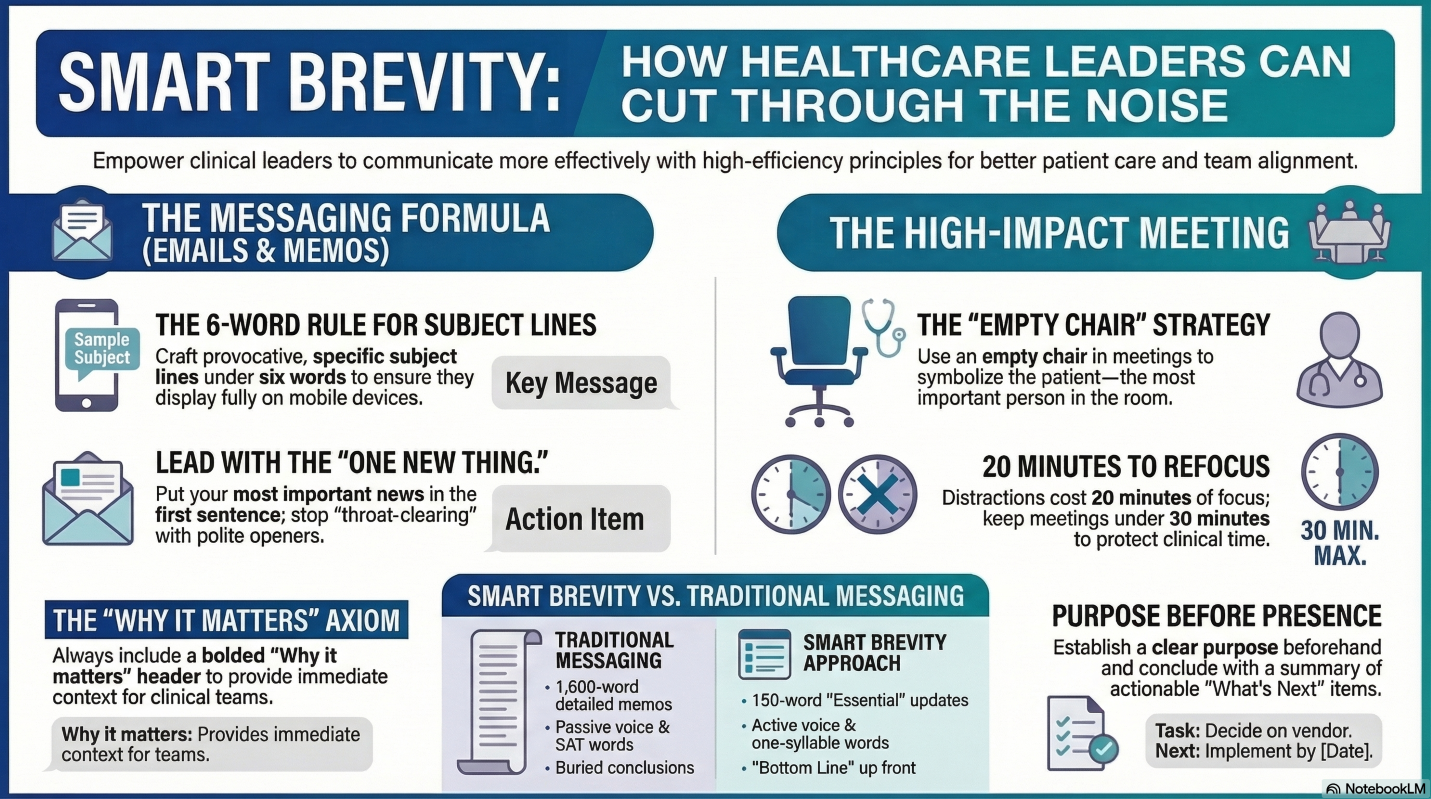
Reclaim the Clinical Minute: Leading Through Radical BrevityAs members of the Culture Coalition, we are committed to transforming our communication to better serve our teams. Today’s healthcare leaders are drowning in a digital firehose, receiving 75 more emails per day than a decade ago. Every second spent wading through wordy clauses is a second stolen from patient care. We must embrace radical brevity to reclaim our focus.The "Elevator Door" Rule for Clinical UpdatesResearch shows that even when a reader deems a message important—as seen in studies of university students—they offer only 26 seconds of attention. You must tell your team what they need to know before the "elevator door" closes. For example, instead of "I hope you are well, I am writing to say the team finished the draft," write: "First draft is ready for your review.""Give people the one new thing they need to know in a strong first sentence and say it in as few words as possible."Use "Axiom Headers" to Signal ValueUse "Axiom headers" like Why it matters, The impact, or The bottom line to act as attention magnets. These signal immediate value to skimmers, providing the "dopamine blast" of a clear idea that buys you a few more seconds of a clinician's time. Break up dense, four-paragraph emails with bold text and bullets to ensure your core message isn't buried.The Empty Chair: Keeping the Patient in the RoomJeff Bezos famously uses an "empty chair" in meetings to symbolize the customer. For healthcare leaders, that chair represents the patient—a crucial symbolic counterweight to the administrative "digital firehose." This visual keeps teams aligned with our primary mission, motivating them to do the impossible even amid daily chaos.Write Like a Human, Not a ProfessorProfessionalism does not require complexity. Use "active voice" (Who did what) to drive energy. Say "The Board approved the staffing budget" rather than "The staffing budget was approved." Aim for one-syllable words to ensure your message packs a punch. Don't say "prevaricate," say "lie." Don't call it an "elongated yellow fruit," call it a "banana.""The greatest gift that you can give yourself and others in this cluttered world is their time back."A Challenge for the Modern LeaderSmart Brevity is not about being "short"—it is about being essential. By prioritizing the reader's time, you ensure your leadership sticks in a distracted world.The Challenge: If you only had three seconds before the elevator door closed, what is the one thing your team absolutely needs to know today? Hosted on Acast. See acast.com/privacy for more information.
What this episode covers
Reclaim the Clinical Minute: Leading Through Radical BrevityAs members of the Culture Coalition, we are committed to transforming our communication to better serve our teams. Today’s healthcare leaders are drowning in a digital firehose, receiving 75 more emails per day than a decade ago. Every second spent wading through wordy clauses is a second stolen from patient care. We must embrace radical brevity to reclaim our focus.The "Elevator Door" Rule for Clinical UpdatesResearch shows that even when a reader deems a message important—as seen in studies of university students—they offer only 26 seconds of attention. You must tell your team what they need to know before the "elevator door" closes. For example, instead of "I hope you are well, I am writing to say the team finished the draft," write: "First draft is ready for your review.""Give people the one new thing they need to know in a strong first sentence and say it in as few words as possible."Use "Axiom Headers" to Signal ValueUse "Axiom headers" like Why it matters, The impact, or The bottom line to act as attention magnets. These signal immediate value to skimmers, providing the "dopamine blast" of a clear idea that buys you a few more seconds of a clinician's time. Break up dense, four-paragraph emails with bold text and bullets to ensure your core message isn't buried.The Empty Chair: Keeping the Patient in the RoomJeff Bezos famously uses an "empty chair" in meetings to symbolize the customer. For healthcare leaders, that chair represents the patient—a crucial symbolic counterweight to the administrative "digital firehose." This visual keeps teams aligned with our primary mission, motivating them to do the impossible even amid daily chaos.Write Like a Human, Not a ProfessorProfessionalism does not require complexity. Use "active voice" (Who did what) to drive energy. Say "The Board approved the staffing budget" rather than "The staffing budget was approved." Aim for one-syllable words to ensure your message packs a punch. Don't say "prevaricate," say "lie." Don't call it an "elongated yellow fruit," call it a "banana.""The greatest gift that you can give yourself and others in this cluttered world is their time back."A Challenge for the Modern LeaderSmart Brevity is not about being "short"—it is about being essential. By prioritizing the reader's time, you ensure your leadership sticks in a distracted world.The Challenge: If you only had three seconds before the elevator door closed, what is the one thing your team absolutely needs to know today? Hosted on Acast. See acast.com/privacy for more information.
NOW PLAYING
BLUF: Smart Brevity Communication Works
No transcript for this episode yet
Similar Episodes
Mar 26, 2026 ·1m
Jan 2, 2026 ·47m
Dec 21, 2025 ·46m