
EPISODE · Mar 28, 2026 · 20 MIN
Change Management is Necessary for Innovative Execution
from Culture Coalition Podcast
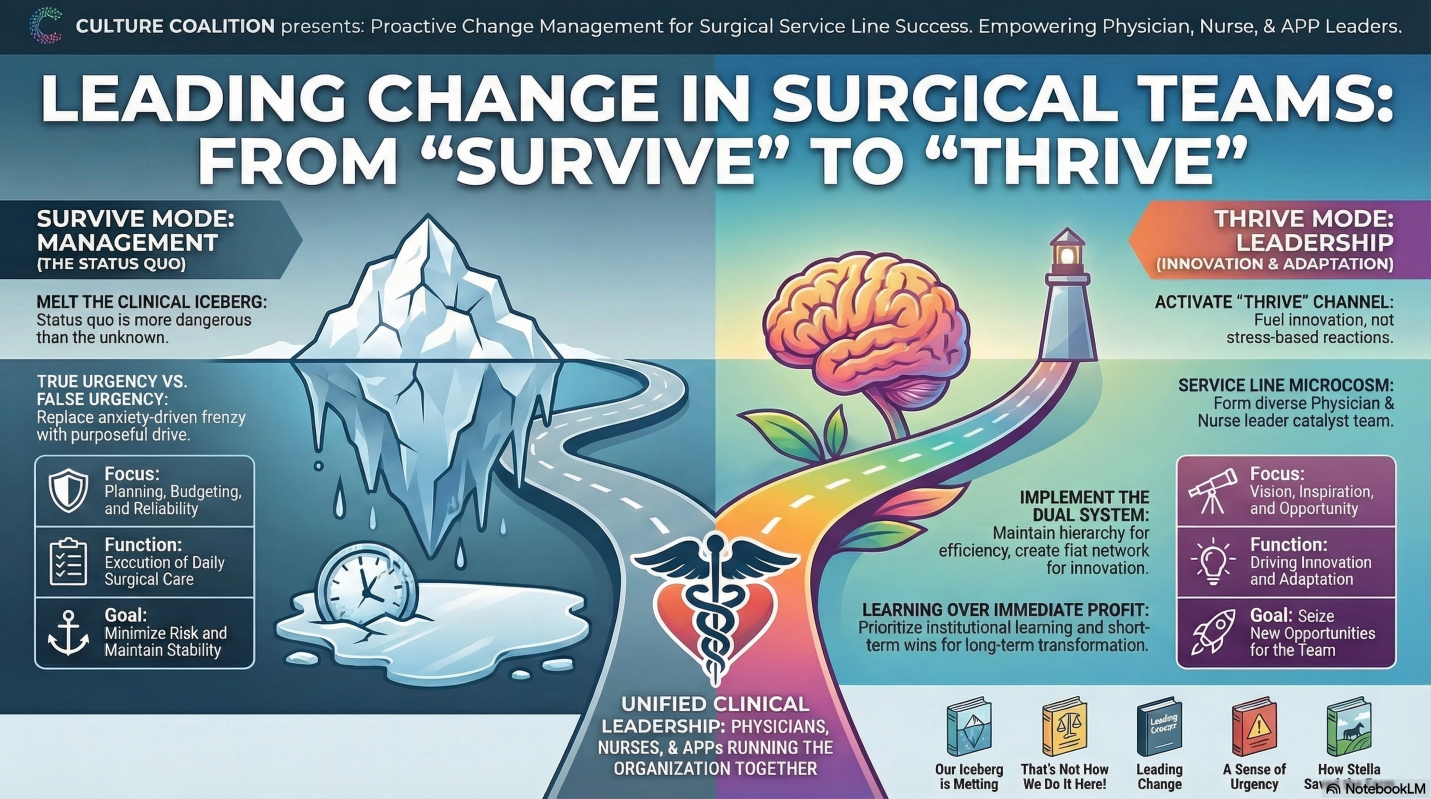
Precision Under Pressure: Deploying Strategic Change in Service LinesSurgical excellence requires more than clinical precision; it demands strategic agility. Clinical leaders—physicians, nurses, and APPs—often struggle to drive transformation while maintaining high-stakes reliability. The Culture Coalition recently synthesized the work of John Kotter (Leading Change, Change) and Vijay Govindarajan (How Stella Saved the Farm). We must deploy these insights to evolve our service lines into adaptable microcosms of the larger healthcare system.Distinguishing True Urgency from False UrgencyIn surgery, the "Survive" brain system is perpetually active. We frequently mistake the frenetic "racing" of clinical emergencies for organizational urgency. This is "false urgency"—driven by anxiety and stress. True urgency is a proactive response to opportunity. Without it, strategic initiatives fail before they begin."What do people often do besides [raising urgency]? They appoint a task force... They take two or three smart people... and go off into a room... The problem is if you don't get urgency up first, it's almost like you don't create a solid basis." — John KotterThe "Dual System"—Balancing Reliability and InnovationTo balance safety with evolution, we must lead a "social movement" within a Dual System. We maintain a Hierarchy for standardized operative reliability, but we must also activate a Network—a flat, agile space for innovation. We should foster "volunteerism" here, empowering staff to pilot improvements outside the sterile field without Disrupting essential protocols.Learning Must Precede ProfitSurgical innovation requires a "Learning First, Profit Next" mindset. When testing new technology, expect "protests" from those invested in the status quo. As a strategist, evaluate your leadership by how effectively you control the experimental effort and the lessons captured, rather than immediate ROI or margin.Avoiding the Trap of Past SuccessPast success is a dangerous teacher. In high-performing teams, "conventionality" breeds complacency. Statements like "we’ve always had low infection rates" become the very "iceberg" that blinds us to melting conditions. We must drive teams out of their comfort zones before the environment shifts beneath them."Executives sometimes underestimate how hard it can be to drive people out of their comfort zones." — John KotterConclusion: A Forward-Looking ReflectionTrue transformation requires activating the "Thrive" channel in our teams. We must evaluate our leadership by how well we mobilize the many, not just the elite few. Ask yourself: Is your service line’s current iceberg melting in ways you’ve been too successful to acknowledge? Hosted on Acast. See acast.com/privacy for more information.
What this episode covers
Precision Under Pressure: Deploying Strategic Change in Service LinesSurgical excellence requires more than clinical precision; it demands strategic agility. Clinical leaders—physicians, nurses, and APPs—often struggle to drive transformation while maintaining high-stakes reliability. The Culture Coalition recently synthesized the work of John Kotter (Leading Change, Change) and Vijay Govindarajan (How Stella Saved the Farm). We must deploy these insights to evolve our service lines into adaptable microcosms of the larger healthcare system.Distinguishing True Urgency from False UrgencyIn surgery, the "Survive" brain system is perpetually active. We frequently mistake the frenetic "racing" of clinical emergencies for organizational urgency. This is "false urgency"—driven by anxiety and stress. True urgency is a proactive response to opportunity. Without it, strategic initiatives fail before they begin."What do people often do besides [raising urgency]? They appoint a task force... They take two or three smart people... and go off into a room... The problem is if you don't get urgency up first, it's almost like you don't create a solid basis." — John KotterThe "Dual System"—Balancing Reliability and InnovationTo balance safety with evolution, we must lead a "social movement" within a Dual System. We maintain a Hierarchy for standardized operative reliability, but we must also activate a Network—a flat, agile space for innovation. We should foster "volunteerism" here, empowering staff to pilot improvements outside the sterile field without Disrupting essential protocols.Learning Must Precede ProfitSurgical innovation requires a "Learning First, Profit Next" mindset. When testing new technology, expect "protests" from those invested in the status quo. As a strategist, evaluate your leadership by how effectively you control the experimental effort and the lessons captured, rather than immediate ROI or margin.Avoiding the Trap of Past SuccessPast success is a dangerous teacher. In high-performing teams, "conventionality" breeds complacency. Statements like "we’ve always had low infection rates" become the very "iceberg" that blinds us to melting conditions. We must drive teams out of their comfort zones before the environment shifts beneath them."Executives sometimes underestimate how hard it can be to drive people out of their comfort zones." — John KotterConclusion: A Forward-Looking ReflectionTrue transformation requires activating the "Thrive" channel in our teams. We must evaluate our leadership by how well we mobilize the many, not just the elite few. Ask yourself: Is your service line’s current iceberg melting in ways you’ve been too successful to acknowledge? Hosted on Acast. See acast.com/privacy for more information.
NOW PLAYING
Change Management is Necessary for Innovative Execution
No transcript for this episode yet
Similar Episodes
Mar 26, 2026 ·1m
Jan 2, 2026 ·47m
Dec 21, 2025 ·46m