
EPISODE · Mar 28, 2026 · 21 MIN
Competitive Strategy for Health Systems
from Culture Coalition Podcast
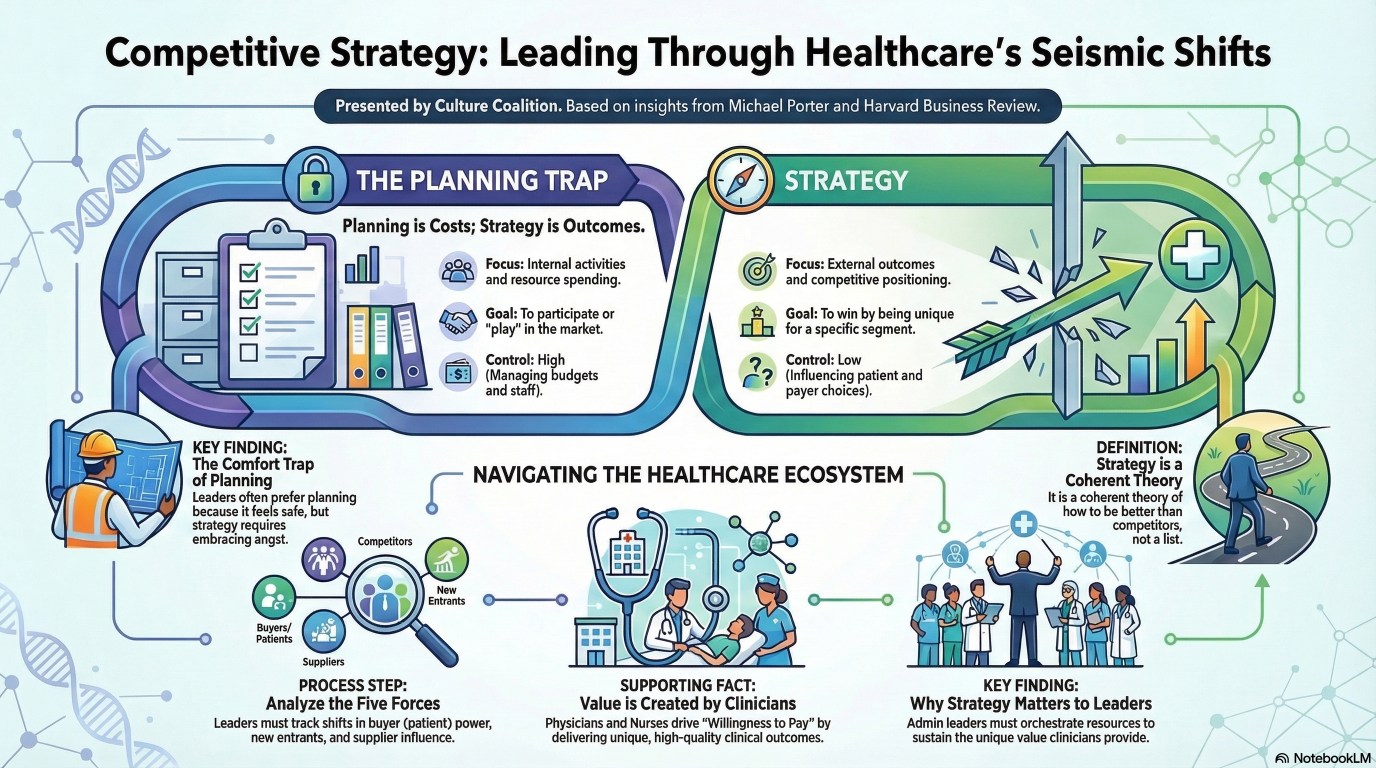
Escaping the Planning Trap: Why Healthcare Leaders are Losing the Strategy GameThe national healthcare ecosystem is fracturing under seismic shifts. Recent Culture Coalition discussions highlight a critical "sickness" in leadership: the tendency to confuse a robust "to-do list" with a strategy. As a consultant, I often see clinical leaders use activity lists as a psychological defense mechanism against market uncertainty. But as Michael Porter and the Harvard Business Review remind us, being busy is not the same as winning.A Plan is Not a Strategy (The Comfort Trap)Roger Martin observes that planning is a "comfort trap." Leaders find solace in budgets and hiring because they control the costs. Strategy, however, focuses on outcomes you don’t control: the patient and the market."Strategy is an integrative set of choices that positions you on a playing field of your choice in a way that you win. It is a theory." — Roger MartinTrue strategy requires the "angst" of the unknown. We see this in surgical departments that obsess over efficiency (planning) while ignoring a competitor’s new care model (strategy).Competitive Forces are Not Just for BusinessUnderstanding Porter’s "Five Forces" is the difference between "playing to play" and "playing to win." To diagnose your position, analyze:Buyer Influence: The shifting power of payers and price-sensitive patients.Supplier Influence: The clout of specialized labor (nursing unions/physicians) and pharma.New Entrants & Substitutes: Tech disruptors and digital health alternatives.The "Value Stick" and the Staffing CrisisStrategic value is the gap between Willingness to Pay (patient delight) and Willingness to Sell (WTS). In our current staffing crisis, WTS is the "floor"—the minimum conditions a clinician will accept to stay. Improving the work environment is a strategic lever to lower that floor, widening the value gap and creating margin. This isn't "soft HR"; it is high-level value creation.The "Truck Driver" Test for ImplementationOnce value is identified, it must be communicated. Many leaders rely on isolated "strategic threads"—mundane tactics like "being a first mover"—wrapped in buzzwords like "pre-eminent" or "best-in-class." Simon Sinek argues that strategy must pass the "Truck Driver Test." If your language is too "scientific" for a front-desk admin to grasp, it will fail. Simple, clear language drives execution.Conclusion: From Tactics to TransformationStrategy is a practice, not a static plan; it is a continuous dance with the systems around us.Is your current strategic plan actually positioning your team to win, or are you just efficiently managing your own decline? Hosted on Acast. See acast.com/privacy for more information.
What this episode covers
Escaping the Planning Trap: Why Healthcare Leaders are Losing the Strategy GameThe national healthcare ecosystem is fracturing under seismic shifts. Recent Culture Coalition discussions highlight a critical "sickness" in leadership: the tendency to confuse a robust "to-do list" with a strategy. As a consultant, I often see clinical leaders use activity lists as a psychological defense mechanism against market uncertainty. But as Michael Porter and the Harvard Business Review remind us, being busy is not the same as winning.A Plan is Not a Strategy (The Comfort Trap)Roger Martin observes that planning is a "comfort trap." Leaders find solace in budgets and hiring because they control the costs. Strategy, however, focuses on outcomes you don’t control: the patient and the market."Strategy is an integrative set of choices that positions you on a playing field of your choice in a way that you win. It is a theory." — Roger MartinTrue strategy requires the "angst" of the unknown. We see this in surgical departments that obsess over efficiency (planning) while ignoring a competitor’s new care model (strategy).Competitive Forces are Not Just for BusinessUnderstanding Porter’s "Five Forces" is the difference between "playing to play" and "playing to win." To diagnose your position, analyze:Buyer Influence: The shifting power of payers and price-sensitive patients.Supplier Influence: The clout of specialized labor (nursing unions/physicians) and pharma.New Entrants & Substitutes: Tech disruptors and digital health alternatives.The "Value Stick" and the Staffing CrisisStrategic value is the gap between Willingness to Pay (patient delight) and Willingness to Sell (WTS). In our current staffing crisis, WTS is the "floor"—the minimum conditions a clinician will accept to stay. Improving the work environment is a strategic lever to lower that floor, widening the value gap and creating margin. This isn't "soft HR"; it is high-level value creation.The "Truck Driver" Test for ImplementationOnce value is identified, it must be communicated. Many leaders rely on isolated "strategic threads"—mundane tactics like "being a first mover"—wrapped in buzzwords like "pre-eminent" or "best-in-class." Simon Sinek argues that strategy must pass the "Truck Driver Test." If your language is too "scientific" for a front-desk admin to grasp, it will fail. Simple, clear language drives execution.Conclusion: From Tactics to TransformationStrategy is a practice, not a static plan; it is a continuous dance with the systems around us.Is your current strategic plan actually positioning your team to win, or are you just efficiently managing your own decline? Hosted on Acast. See acast.com/privacy for more information.
NOW PLAYING
Competitive Strategy for Health Systems
No transcript for this episode yet
Similar Episodes
Mar 26, 2026 ·1m
Jan 2, 2026 ·47m
Dec 21, 2025 ·46m