
EPISODE · Mar 28, 2026 · 19 MIN
Crucial Conversations: Mastering High-Conflict Discussions
from Culture Coalition Podcast
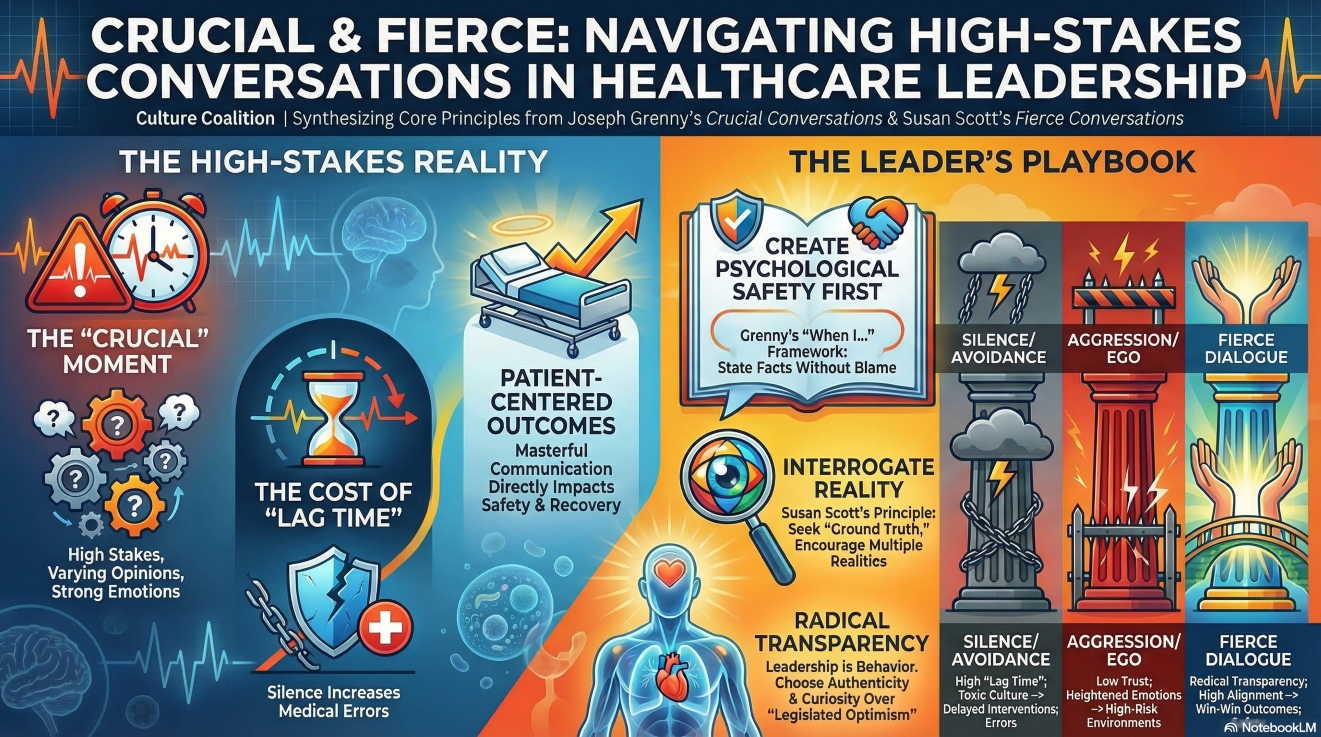
The Diagnostic Error of Silence: Operating on the Gap in Clinical LeadershipIntroduction: The High-Stakes Culture of CareIn high-velocity medicine, communication is more than a professional courtesy; it is a vital sign of organizational health. For Physicians, Nurses, and APPs, the pressure of complex cases often creates a "diagnostic error" in leadership: the failure to speak. The Culture Coalition utilizes the frameworks of Joseph Grenny’s Crucial Conversations and Susan Scott’s Fierce Conversations to bridge this gap. Our thesis is clinical: the quality of your team’s dialogue directly dictates the quality of your patient outcomes.The High Price of "Lag Time"Grenny defines "lag time" as the gap between identifying a problem and discussing it. In a hospital, a long lag time creates a "default future" of compromised care. Remember: "Silence isn't truly silent; it is acted out in behavior." When clinical disagreements or performance issues are avoided, they are acted out through passive-aggression or avoidant behavior, which significantly increases the risk of medical errors.Apply the "Matching Principle" DiagnosticEffective leaders utilize Charles Duhigg’s "Matching Principle" to align with their team. Before responding to a colleague, use this diagnostic tool: Do they need to be helped, hugged, or heard?Practical (Helped): Seeking solutions and facts.Emotional (Hugged): Needing empathy after a traumatic shift.Social (Heard): Needing their identity and expertise validated. If you offer a practical solution to a colleague who needs a social hearing, the conversation will fail. Use the "When I..." framework to invite dialogue: "When I see X, I tell myself a story that Y... help me see the whole picture."Prioritize Safety Over ContentClinicians do not become defensive because of what is said (content), but because they feel unsafe (condition). When safety is breached, we play "Dodgeball"—protecting our ego, license, or expertise instead of the patient. If your team is silent, you must "prime the pump" by guessing their hidden concerns: "Are you worried this new protocol is just about the bottom line?" By owning your own "story" and lowering the temperature, you build a safety net for radical transparency.Why This Matters to Every StakeholderLeaders (MDs/RNs/APPs): Mastering these dialogues reduces the "emotional wake" that leads to burnout and increases operational efficiency.Patients: Clear, unblocked communication ensures that clinical errors are intercepted before they reach the bedside.Conclusion: A Forward-Looking ThoughtLeadership is not a title; it is the courage to have the conversation you have been avoiding.What is the one conversation standing between your team and the next level of patient care? Hosted on Acast. See acast.com/privacy for more information.
What this episode covers
The Diagnostic Error of Silence: Operating on the Gap in Clinical LeadershipIntroduction: The High-Stakes Culture of CareIn high-velocity medicine, communication is more than a professional courtesy; it is a vital sign of organizational health. For Physicians, Nurses, and APPs, the pressure of complex cases often creates a "diagnostic error" in leadership: the failure to speak. The Culture Coalition utilizes the frameworks of Joseph Grenny’s Crucial Conversations and Susan Scott’s Fierce Conversations to bridge this gap. Our thesis is clinical: the quality of your team’s dialogue directly dictates the quality of your patient outcomes.The High Price of "Lag Time"Grenny defines "lag time" as the gap between identifying a problem and discussing it. In a hospital, a long lag time creates a "default future" of compromised care. Remember: "Silence isn't truly silent; it is acted out in behavior." When clinical disagreements or performance issues are avoided, they are acted out through passive-aggression or avoidant behavior, which significantly increases the risk of medical errors.Apply the "Matching Principle" DiagnosticEffective leaders utilize Charles Duhigg’s "Matching Principle" to align with their team. Before responding to a colleague, use this diagnostic tool: Do they need to be helped, hugged, or heard?Practical (Helped): Seeking solutions and facts.Emotional (Hugged): Needing empathy after a traumatic shift.Social (Heard): Needing their identity and expertise validated. If you offer a practical solution to a colleague who needs a social hearing, the conversation will fail. Use the "When I..." framework to invite dialogue: "When I see X, I tell myself a story that Y... help me see the whole picture."Prioritize Safety Over ContentClinicians do not become defensive because of what is said (content), but because they feel unsafe (condition). When safety is breached, we play "Dodgeball"—protecting our ego, license, or expertise instead of the patient. If your team is silent, you must "prime the pump" by guessing their hidden concerns: "Are you worried this new protocol is just about the bottom line?" By owning your own "story" and lowering the temperature, you build a safety net for radical transparency.Why This Matters to Every StakeholderLeaders (MDs/RNs/APPs): Mastering these dialogues reduces the "emotional wake" that leads to burnout and increases operational efficiency.Patients: Clear, unblocked communication ensures that clinical errors are intercepted before they reach the bedside.Conclusion: A Forward-Looking ThoughtLeadership is not a title; it is the courage to have the conversation you have been avoiding.What is the one conversation standing between your team and the next level of patient care? Hosted on Acast. See acast.com/privacy for more information.
NOW PLAYING
Crucial Conversations: Mastering High-Conflict Discussions
No transcript for this episode yet
Similar Episodes
Mar 26, 2026 ·1m
Jan 2, 2026 ·47m
Dec 21, 2025 ·46m