
EPISODE · Jan 21, 2026 · 21 MIN
Germany's World War I King is Reborn
from Cary Harrison Files · host CARY HARRISON
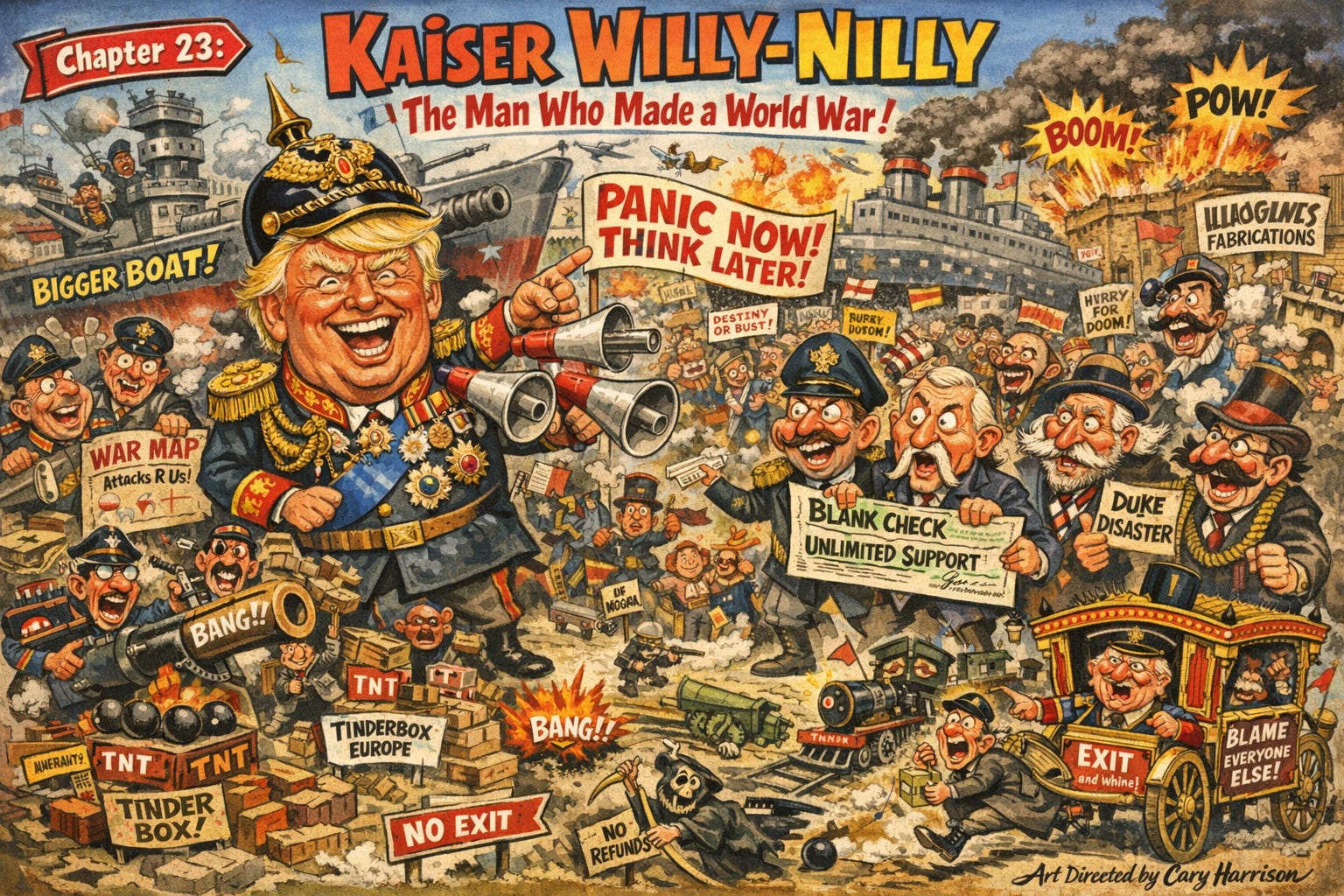
Disclaimer: Side effects may include laughter, anger, historical recognition, and sudden distrust of people who say “this is for your own good.” Not approved by wellness gurus, congressional committees, or anyone who believes discomfort equals virtue. Read or watch at your own risk.Speaking to reporters in Davos ahead of the World Economic Forum, CA governor, Gavin Newsom, compared Trump to a T-Rex that “you mate with him or he devours you.”(Small Money, Big Damage - Early drafts, cartoons, heresies included)Many people think there’s a similarity between Germany of 120 years ago and the leadership that we see today. But let’s go back over 100 years to the true template for the guy building the giant ballroom, six times bigger then the White House. And we’re still in Germany – no surprise. But it was the last emperor who was almost interchangeable with what we’re seeing today. Kaiser Wilhelm II didn’t accidentally stumble Europe into catastrophe. He strutted it there—chest out, medals clanking, ego wobbling like a loose wheel on a royal carriage.This was a man who confused volume with authority, costumes with competence, and tantrums with leadership. Europe, at the turn of the twentieth century, was already a tinderbox—nationalism, alliances, arms races, the usual historical explosives. What it needed to go up was a spark. What it got was Wilhelm: a human sparkler with a mustache and a navy fetish.Wilhelm didn’t govern. He performed. He loved uniforms the way insecure men love mirrors. Every speech was a dress rehearsal for greatness. Every foreign policy decision was theater—big gestures, loud declarations, and absolutely no follow-through. Diplomacy, to him, was improv, and the rest of Europe was forced to sit in the front row while he forgot his lines.He talked too much. Constantly. To journalists. To ambassadors. To anyone within earshot. He’d announce Germany’s intentions like a drunk at a wedding announcing secrets he barely understood himself. Allies panicked. Rivals armed up. Wilhelm, baffled, took offense—because nothing enraged him more than other countries reacting rationally to the things he said out loud.Then there was the navy. Oh, the navy. Wilhelm wanted ships the way a bored child wants fireworks. Britain had a fleet, so naturally Germany needed a bigger one—not for defense, not for strategy, but for status. This was geopolitics as a pissing contest, and Wilhelm insisted on drinking more water.The result? Britain stopped seeing Germany as a continental power and started seeing it as a threat. An arms race followed. Trust evaporated. The temperature rose. Wilhelm called it prestige. Everyone else called it trouble.Inside Germany, he did what insecure leaders always do: he fired the adults. Experienced diplomats? Gone. Cautious advisers? Replaced. In their place he elevated generals who flattered him, men who spoke in timetables and inevitabilities and worst-case scenarios. Civilian control thinned. Military logic took over. Once the trains were scheduled, reason was no longer invited to the meeting.And then came 1914.A gunshot in Sarajevo. A regional crisis. The kind Europe had handled before. This was the moment for restraint—for quiet pressure, for delayed decisions, for statesmanship.Wilhelm responded by throwing a blank check at Austria-Hungary like a man tipping wildly at a bar he couldn’t afford. Total support. No limits. No exit ramp. It was pure emotion—offended honor, wounded pride, imperial solidarity cosplay.When things escalated, he panicked. He wavered. He tried—too late—to slow it down. But the machinery he empowered didn’t pause for second thoughts. Mobilization rolled forward. Alliances snapped into place. Europe marched.Wilhelm had wanted a moment. He got a world war.Four years later, millions were dead, empires were gone, and Wilhelm fled into exile—still convinced history had misunderstood him. Of course it had. History is terribly unfair to men who believe dressing like a general counts as governing.Europe didn’t fall into catastrophe because fate demanded it. It fell because it handed an unstable system to a man who treated power like a costume rack and diplomacy like a stage cue.And once he pulled the lever, there was no intermission.The Cary Harrison Files is a listener-supported publication. To receive new posts and support my work, consider becoming a free or paid subscriber.Look for my complete book “A MAGA history of the United States” (MAGA: Making Academia Great Again) coming out in the next months. I perform chapters often on my LA public radio show, the Cary Harrison Files”, Fridays at 10 AM Pacific, KPFK 90.7 FM Los Angeles.Copyright Audiences United, LLC – all rights reservedThank you to everyone who tuned into my live video! Join me for my next live video in the app.(Small Money, Big Damage - Early drafts, cartoons, heresies included) This is a public episode. If you'd like to discuss this with other subscribers or get access to bonus episodes, visit caryharrison.substack.com/subscribe
Embed this episode
NOW PLAYING
Germany's World War I King is Reborn
No transcript for this episode yet
Similar Episodes
No similar episodes found.
Similar Podcasts
No similar podcasts found.