
EPISODE · Mar 28, 2026 · 21 MIN
High Reliability Organizations with the Zero-Harm Mandate
from Culture Coalition Podcast
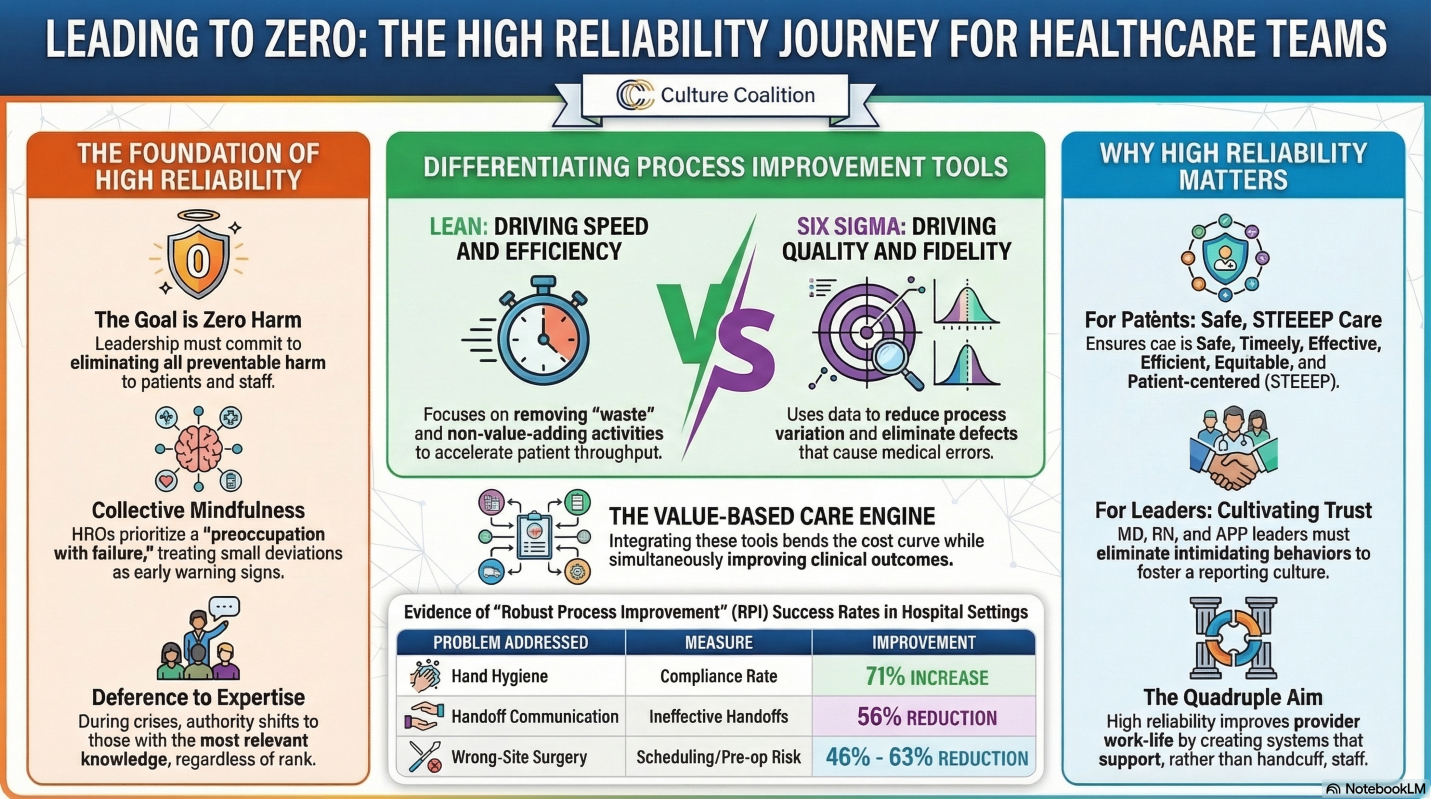
The Zero-Harm Mandate: Why High Reliability is the New Standard for Women’s HealthIn acute emergencies, the margin for error is razor-thin; patient survival depends on precise, rapid intervention. Distilled from the Culture Coalition and the foundational work of Mark Chassin and Don Berwick, these insights prove that "good enough" care is obsolete. High-reliability care is the new, non-negotiable mandate.Obeying Nature’s Law: The Three-Minute RuleDon Berwick invokes the "three-minute rule"—the time nature allows the brain to survive without oxygen—to argue that clinical and social determinants are immutable natural laws. Factors like hunger, housing, and inequity are as critical to outcomes as physiology. He asserts:"Improvement was the right thing to do even in a hospital was... already performing well... response must happen; we do not have the right to repeal nature’s laws by being too busy to act."The Fallacy of Centrality and Deference to ExpertiseMark Chassin’s high-reliability framework identifies the "fallacy of centrality" as a primary threat. This occurs when senior leaders assume their rank ensures they possess all relevant information. In inpatient obstetrics, a senior surgeon’s "centrality" can blind them to subtle safety signals identified by junior team members. High-Reliability Organizations (HROs) counter this by practicing Deference to Expertise, where decision-making authority shifts to the individual with the most relevant knowledge during an emergency, regardless of hierarchy.Uncovering "Invisible Waste" with Lean Six SigmaMichael George’s application of Lean and Six Sigma identifies "invisible waste"—prolonged downtime, unnecessary handoffs, and communication gaps—that erodes value. In service environments, Process Cycle Efficiency (PCE) is often below 10%. By uncovering this waste, organizations can drive significant cost containment and clinical improvement, focusing resources where they impact the patient most.LEADing the Transition to Accountable CareCMS’s LEAD and ACCESS programs provide physicians the flexibility to escape the fee-for-service "straightjacket." These models allow providers to wave co-pays or provide services Medicare wouldn't otherwise allow, facilitating longitudinal care for complex populations. By utilizing the CARA (CMS Administered Risk) component and "add-on payments" as a "ramp," these models level the playing field for rural practices to deliver STEEEP care.Conclusion: A New Compass for the ContinuumThe convergence of high-reliability principles and innovative payment models creates a robust shield for patients. By adopting Robust Process Improvement (RPI), we move toward a culture of total vigilance. Are you personally prepared to take responsibility for Zero Harm in every encounter? Hosted on Acast. See acast.com/privacy for more information.
What this episode covers
The Zero-Harm Mandate: Why High Reliability is the New Standard for Women’s HealthIn acute emergencies, the margin for error is razor-thin; patient survival depends on precise, rapid intervention. Distilled from the Culture Coalition and the foundational work of Mark Chassin and Don Berwick, these insights prove that "good enough" care is obsolete. High-reliability care is the new, non-negotiable mandate.Obeying Nature’s Law: The Three-Minute RuleDon Berwick invokes the "three-minute rule"—the time nature allows the brain to survive without oxygen—to argue that clinical and social determinants are immutable natural laws. Factors like hunger, housing, and inequity are as critical to outcomes as physiology. He asserts:"Improvement was the right thing to do even in a hospital was... already performing well... response must happen; we do not have the right to repeal nature’s laws by being too busy to act."The Fallacy of Centrality and Deference to ExpertiseMark Chassin’s high-reliability framework identifies the "fallacy of centrality" as a primary threat. This occurs when senior leaders assume their rank ensures they possess all relevant information. In inpatient obstetrics, a senior surgeon’s "centrality" can blind them to subtle safety signals identified by junior team members. High-Reliability Organizations (HROs) counter this by practicing Deference to Expertise, where decision-making authority shifts to the individual with the most relevant knowledge during an emergency, regardless of hierarchy.Uncovering "Invisible Waste" with Lean Six SigmaMichael George’s application of Lean and Six Sigma identifies "invisible waste"—prolonged downtime, unnecessary handoffs, and communication gaps—that erodes value. In service environments, Process Cycle Efficiency (PCE) is often below 10%. By uncovering this waste, organizations can drive significant cost containment and clinical improvement, focusing resources where they impact the patient most.LEADing the Transition to Accountable CareCMS’s LEAD and ACCESS programs provide physicians the flexibility to escape the fee-for-service "straightjacket." These models allow providers to wave co-pays or provide services Medicare wouldn't otherwise allow, facilitating longitudinal care for complex populations. By utilizing the CARA (CMS Administered Risk) component and "add-on payments" as a "ramp," these models level the playing field for rural practices to deliver STEEEP care.Conclusion: A New Compass for the ContinuumThe convergence of high-reliability principles and innovative payment models creates a robust shield for patients. By adopting Robust Process Improvement (RPI), we move toward a culture of total vigilance. Are you personally prepared to take responsibility for Zero Harm in every encounter? Hosted on Acast. See acast.com/privacy for more information.
NOW PLAYING
High Reliability Organizations with the Zero-Harm Mandate
No transcript for this episode yet
Similar Episodes
Mar 26, 2026 ·1m
Jan 2, 2026 ·47m
Dec 21, 2025 ·46m