
EPISODE · Mar 28, 2026 · 22 MIN
Languages of Workplace Appreciation
from Culture Coalition Podcast
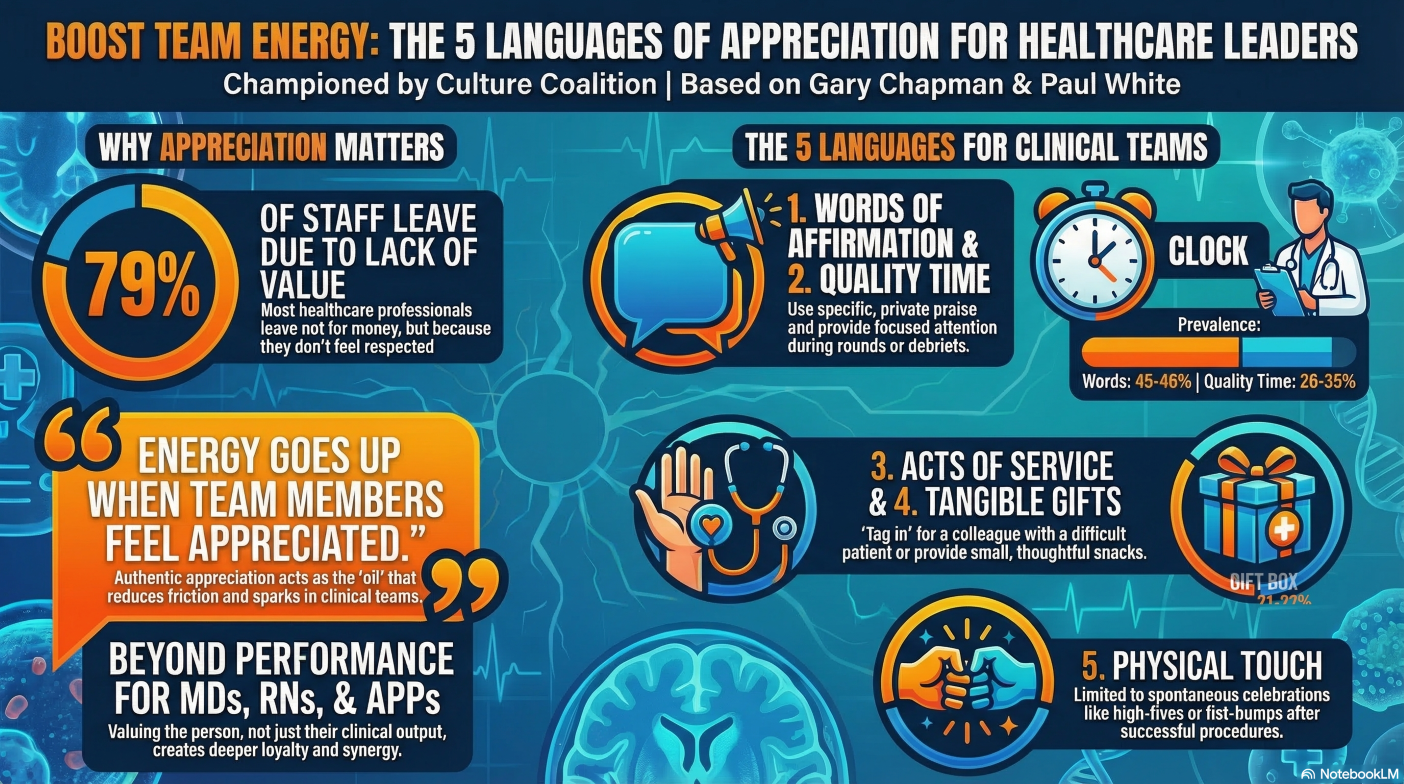
Beyond the Paycheck: Why "Appreciation" is the Missing Vital Sign for Healthcare TeamsIn the high-stakes environment of modern medicine, turnover is more than an HR metric; it is a direct threat to patient safety. The "Culture Coalition" advocates for a paradigm shift in leadership based on the research of Dr. Paul White and Gary Chapman in The 5 Languages of Appreciation in the Workplace. For Physician, Nurse, and APP leaders, the data is stark: 79% of professionals who exit their roles cite a lack of feeling valued and respected as the primary driver—not compensation. Mastering appreciation is no longer a "soft skill"; it is a clinical operational necessity.Appreciation is "Oil," Not a TrophyHospital leadership often confuses Employee Recognition with Authentic Appreciation. Recognition is performance-based, typically targeting the top 10% of "stars." This narrow focus creates a dangerous gap for the "solid middle"—the 60% of the clinical team whose daily reliability forms the unit’s safety floor. When appreciation is person-based rather than production-based, it functions as the "oil" in the clinical machine. It reduces system friction during high-stress handoffs and prevents the human capital erosion that leads to burnout. Treating a clinician as a person rather than a "production unit" is a strategy for long-term shift efficiency and peer-to-peer reliability.Words Aren’t a Universal LanguageBusy administrators often fall into the "efficiency trap" of defaulting to verbal praise. Yet, data from over 375,000 assessments reveals that more than half of the workforce does not prioritize "Words of Affirmation." If you rely solely on the "good job" email, you are missing 50% of your team’s engagement potential. This omission directly impacts the cognitive energy available for clinical cycles. As Dr. Paul White explains:"When team members feel valued and appreciated, energy goes up... creative problem solving goes up because that takes energy." Without this surplus energy, your team lacks the mental bandwidth required for complex medical problem-solving.Acts of Service in the Clinical TrenchesIn the trenches, "words are cheap." For approximately 22% of clinical staff, loyalty is built through "Acts of Service." This involves tactical support to reduce shift-level stress: tagging in for a difficult patient, assisting with administrative "dirty work" during a surge, or helping a colleague "dig out" from a heavy load. Crucially, this is not about rescuing low-performing colleagues—which enables inefficiency—but about proactive support that maintains the unit’s operational flow.ConclusionInvesting in authentic appreciation yields higher profitability, fewer sick calls, and improved patient safety. However, every leader has a "blind spot"—usually the appreciation language they personally value the least. If you ignore it, you create structural silence in your unit. Which language do you personally value least, and how is that omission creating friction in your team today? Hosted on Acast. See acast.com/privacy for more information.
What this episode covers
Beyond the Paycheck: Why "Appreciation" is the Missing Vital Sign for Healthcare TeamsIn the high-stakes environment of modern medicine, turnover is more than an HR metric; it is a direct threat to patient safety. The "Culture Coalition" advocates for a paradigm shift in leadership based on the research of Dr. Paul White and Gary Chapman in The 5 Languages of Appreciation in the Workplace. For Physician, Nurse, and APP leaders, the data is stark: 79% of professionals who exit their roles cite a lack of feeling valued and respected as the primary driver—not compensation. Mastering appreciation is no longer a "soft skill"; it is a clinical operational necessity.Appreciation is "Oil," Not a TrophyHospital leadership often confuses Employee Recognition with Authentic Appreciation. Recognition is performance-based, typically targeting the top 10% of "stars." This narrow focus creates a dangerous gap for the "solid middle"—the 60% of the clinical team whose daily reliability forms the unit’s safety floor. When appreciation is person-based rather than production-based, it functions as the "oil" in the clinical machine. It reduces system friction during high-stress handoffs and prevents the human capital erosion that leads to burnout. Treating a clinician as a person rather than a "production unit" is a strategy for long-term shift efficiency and peer-to-peer reliability.Words Aren’t a Universal LanguageBusy administrators often fall into the "efficiency trap" of defaulting to verbal praise. Yet, data from over 375,000 assessments reveals that more than half of the workforce does not prioritize "Words of Affirmation." If you rely solely on the "good job" email, you are missing 50% of your team’s engagement potential. This omission directly impacts the cognitive energy available for clinical cycles. As Dr. Paul White explains:"When team members feel valued and appreciated, energy goes up... creative problem solving goes up because that takes energy." Without this surplus energy, your team lacks the mental bandwidth required for complex medical problem-solving.Acts of Service in the Clinical TrenchesIn the trenches, "words are cheap." For approximately 22% of clinical staff, loyalty is built through "Acts of Service." This involves tactical support to reduce shift-level stress: tagging in for a difficult patient, assisting with administrative "dirty work" during a surge, or helping a colleague "dig out" from a heavy load. Crucially, this is not about rescuing low-performing colleagues—which enables inefficiency—but about proactive support that maintains the unit’s operational flow.ConclusionInvesting in authentic appreciation yields higher profitability, fewer sick calls, and improved patient safety. However, every leader has a "blind spot"—usually the appreciation language they personally value the least. If you ignore it, you create structural silence in your unit. Which language do you personally value least, and how is that omission creating friction in your team today? Hosted on Acast. See acast.com/privacy for more information.
NOW PLAYING
Languages of Workplace Appreciation
No transcript for this episode yet
Similar Episodes
Mar 26, 2026 ·1m
Jan 2, 2026 ·47m
Dec 21, 2025 ·46m