
EPISODE · Mar 28, 2026 · 22 MIN
Mastering Management Principles with Drucker’s Wisdom
from Culture Coalition Podcast
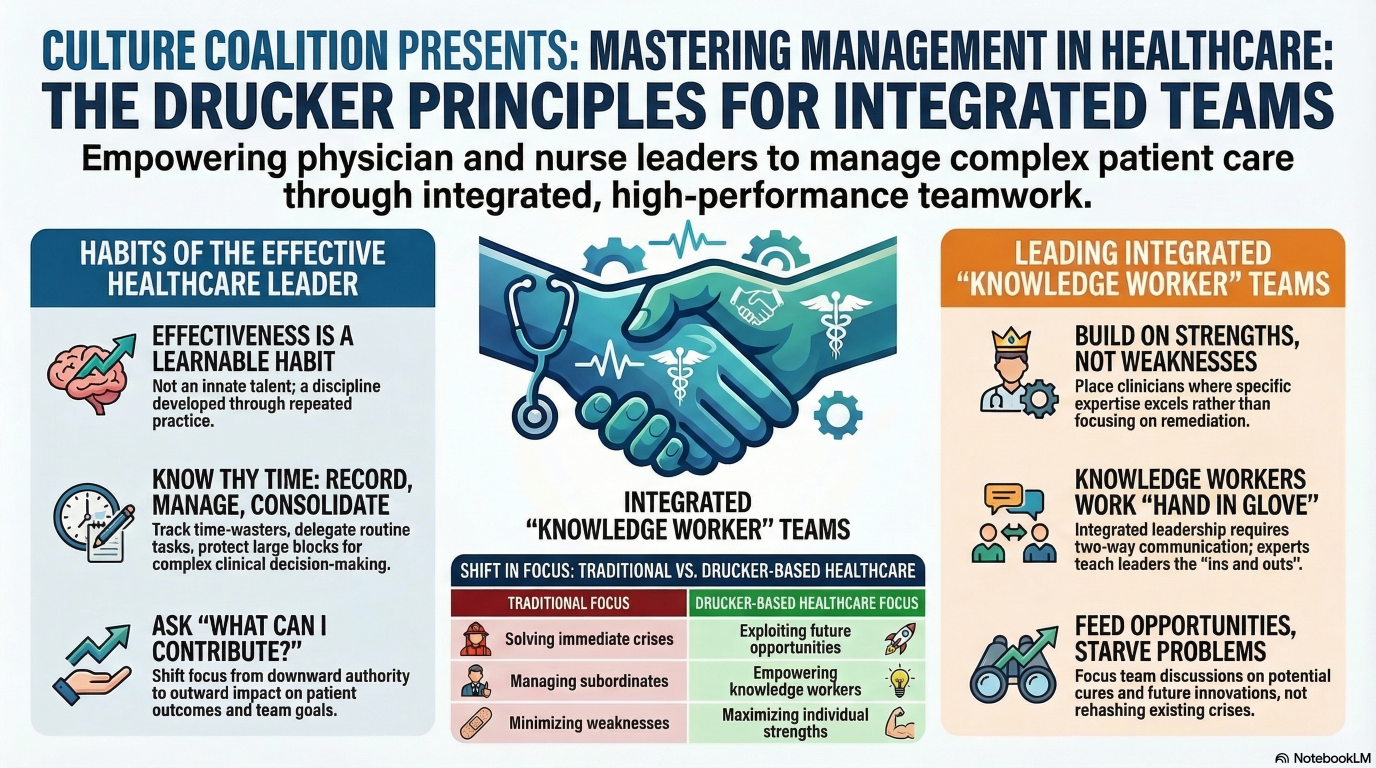
Why Peter Drucker is the Secret Weapon for Modern Healthcare TeamsThe hospital environment is currently navigating a profound complexity crisis, rooted in the manual-to-intellectual transition of clinical labor. As specialized judgment replaces routine task-performance, the Culture Coalition argues that clinical excellence requires Peter Drucker’s systematic management habits. To succeed in integrated health systems, physicians, nurses, and APPs must work "hand in glove" with execution teams, recognizing that they are first and foremost "knowledge workers."You are a "Knowledge Worker," Not Just a Clinician A knowledge worker uses formal education to produce results through autonomous decisions. This identity is vital for MD/RN/APP leaders who now act as administrators of their own expertise. In the modern knowledge society, a clinician often possesses a higher authority in their specific field than their supervisor. Transitioning from "task-performer" to "strategic contributor" requires a conceptual understanding that your primary output is the effectiveness of your specialized knowledge.Prioritize "Outward Contribution" Over Authority Effectiveness is a choice requiring systematic efforts rather than innate charisma. Instead of focusing on downward authority or hierarchy, effective leaders ask: "What can I contribute to the larger goal of patient outcomes?" This outward vision centers on four pillars: communication, teamwork, self-development, and the development of others."An executive who is worried about authority and downward control is an ineffective executive... rather, effective executives focus on outward contributions."Build on Strengths to Manage Complexity Drucker teaches that we can only build on strengths; we cannot build on weaknesses. In multi-disciplinary care, the goal is to make strengths productive and weaknesses irrelevant. To do otherwise is a failure of leadership: "A manager who wants to avoid weaknesses is only going to build a mediocre team." Integrating the unique talents of MDs, RNs, and APPs "hand in glove" ensures the team achieves excellence rather than mere adequacy."Know Thy Time" in a 24/7 Environment Managing time follows a three-step process: recording, managing, and consolidating. Clinical leaders must ruthlessly prune time-wasters—such as unproductive meetings—to protect their discretionary time. Devoting "dribs and drabs" of time to complex cases is insufficient; effectiveness requires consolidating time into significant 30-minute to one-hour blocks to maintain intellectual flow.Leading the Future of HealthcareThe principles within The Essential Drucker bridge the gap between business efficiency and clinical excellence. By treating effectiveness as a learned habit, you transform management into a strategic advantage. How will you apply these principles to your next complex patient round? Hosted on Acast. See acast.com/privacy for more information.
What this episode covers
Why Peter Drucker is the Secret Weapon for Modern Healthcare TeamsThe hospital environment is currently navigating a profound complexity crisis, rooted in the manual-to-intellectual transition of clinical labor. As specialized judgment replaces routine task-performance, the Culture Coalition argues that clinical excellence requires Peter Drucker’s systematic management habits. To succeed in integrated health systems, physicians, nurses, and APPs must work "hand in glove" with execution teams, recognizing that they are first and foremost "knowledge workers."You are a "Knowledge Worker," Not Just a Clinician A knowledge worker uses formal education to produce results through autonomous decisions. This identity is vital for MD/RN/APP leaders who now act as administrators of their own expertise. In the modern knowledge society, a clinician often possesses a higher authority in their specific field than their supervisor. Transitioning from "task-performer" to "strategic contributor" requires a conceptual understanding that your primary output is the effectiveness of your specialized knowledge.Prioritize "Outward Contribution" Over Authority Effectiveness is a choice requiring systematic efforts rather than innate charisma. Instead of focusing on downward authority or hierarchy, effective leaders ask: "What can I contribute to the larger goal of patient outcomes?" This outward vision centers on four pillars: communication, teamwork, self-development, and the development of others."An executive who is worried about authority and downward control is an ineffective executive... rather, effective executives focus on outward contributions."Build on Strengths to Manage Complexity Drucker teaches that we can only build on strengths; we cannot build on weaknesses. In multi-disciplinary care, the goal is to make strengths productive and weaknesses irrelevant. To do otherwise is a failure of leadership: "A manager who wants to avoid weaknesses is only going to build a mediocre team." Integrating the unique talents of MDs, RNs, and APPs "hand in glove" ensures the team achieves excellence rather than mere adequacy."Know Thy Time" in a 24/7 Environment Managing time follows a three-step process: recording, managing, and consolidating. Clinical leaders must ruthlessly prune time-wasters—such as unproductive meetings—to protect their discretionary time. Devoting "dribs and drabs" of time to complex cases is insufficient; effectiveness requires consolidating time into significant 30-minute to one-hour blocks to maintain intellectual flow.Leading the Future of HealthcareThe principles within The Essential Drucker bridge the gap between business efficiency and clinical excellence. By treating effectiveness as a learned habit, you transform management into a strategic advantage. How will you apply these principles to your next complex patient round? Hosted on Acast. See acast.com/privacy for more information.
NOW PLAYING
Mastering Management Principles with Drucker’s Wisdom
No transcript for this episode yet
Similar Episodes
Mar 26, 2026 ·1m
Jan 2, 2026 ·47m
Dec 21, 2025 ·46m