
EPISODE · Mar 28, 2026 · 20 MIN
Navigating Polarities with Paradox Management
from Culture Coalition Podcast
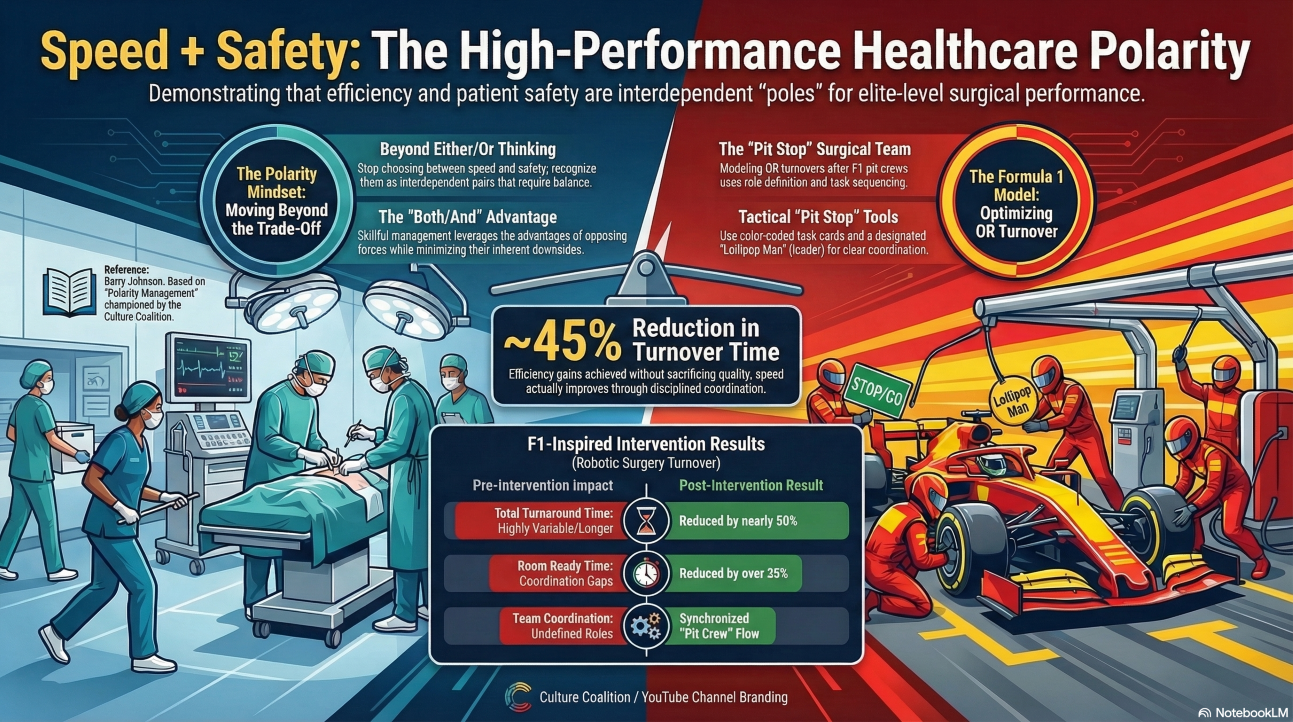
The High-Stakes Balancing Act: In the high-pressure seconds of a crash C-section or the controlled chaos of a post-operative hemorrhage, the clock is a relentless adversary. Clinicians often feel forced to choose between moving quickly and moving safely, viewing them as a zero-sum trade-off. However, insights from the Culture Council’s analysis of Barry Johnson’s "Polarity Management" and Dr. Ken Catchpole’s human factors research reveal that elite teams reject "Either/Or" choices. By adopting a "Both/And" mindset, surgical teams achieve tactical precision where speed and safety reinforce one another. Stop "Solving" Problems That Are Actually Polarities: Barry Johnson’s framework teaches that speed and safety are not "problems to be solved" but interdependent polarities to be managed. When we treat them as a dilemma, we trigger "vicious cycles." We either fall down a "rabbit hole" of overcorrecting for speed—leading to errors—or engage in "trench warfare," where defensive adherence to caution causes dangerous delays. High-performance teams recognize that focusing on one pole to the exclusion of the other is a strategy for failure. Excellence lies in sustaining equilibrium between these conflicting forces. The Formula 1 Model: Tactical Precision in the ORDr. Ken Catchpole’s research applies Formula 1 pit stop mechanics to streamline robotic surgery turnovers. Success in this model isn't about rushing; it is about human factors: structured briefings, decisive leadership, clear role definition, and disciplined task allocation and sequencing. These interventions eliminate the "avoidable movements" caused by cluttered OR layouts.The results of this tactical shift are profound. In robotic surgery turnovers, this model reduced average total time by almost half without compromising safety. As the research demonstrates:"Speed and quality are synergistic, not a tradeoff." Navigating the Tension: The "ABCs and D" of Paradox: To maintain equilibrium during emergencies, Wendy Smith’s framework provides a guide for the paradox mindset:Assumptions: Acknowledge that different truths—high velocity and high caution—can exist concurrently.Boundaries: Set the mission and non-negotiables that serve as safety scaffolding.Comfort: Lean into the excitement and wonder of uncertainty rather than just the fear.Dynamism: Be experimental, embracing serendipity and adjusting behavior based on real-time feedback.A New Standard for Excellence: Mastering paradox management transforms healthcare from a culture of defensive trade-offs into a system of integrated high performance. How would your clinical outcomes change if you viewed your next "trade-off" through a Both/And lens? Hosted on Acast. See acast.com/privacy for more information.
What this episode covers
The High-Stakes Balancing Act: In the high-pressure seconds of a crash C-section or the controlled chaos of a post-operative hemorrhage, the clock is a relentless adversary. Clinicians often feel forced to choose between moving quickly and moving safely, viewing them as a zero-sum trade-off. However, insights from the Culture Council’s analysis of Barry Johnson’s "Polarity Management" and Dr. Ken Catchpole’s human factors research reveal that elite teams reject "Either/Or" choices. By adopting a "Both/And" mindset, surgical teams achieve tactical precision where speed and safety reinforce one another. Stop "Solving" Problems That Are Actually Polarities: Barry Johnson’s framework teaches that speed and safety are not "problems to be solved" but interdependent polarities to be managed. When we treat them as a dilemma, we trigger "vicious cycles." We either fall down a "rabbit hole" of overcorrecting for speed—leading to errors—or engage in "trench warfare," where defensive adherence to caution causes dangerous delays. High-performance teams recognize that focusing on one pole to the exclusion of the other is a strategy for failure. Excellence lies in sustaining equilibrium between these conflicting forces. The Formula 1 Model: Tactical Precision in the ORDr. Ken Catchpole’s research applies Formula 1 pit stop mechanics to streamline robotic surgery turnovers. Success in this model isn't about rushing; it is about human factors: structured briefings, decisive leadership, clear role definition, and disciplined task allocation and sequencing. These interventions eliminate the "avoidable movements" caused by cluttered OR layouts.The results of this tactical shift are profound. In robotic surgery turnovers, this model reduced average total time by almost half without compromising safety. As the research demonstrates:"Speed and quality are synergistic, not a tradeoff." Navigating the Tension: The "ABCs and D" of Paradox: To maintain equilibrium during emergencies, Wendy Smith’s framework provides a guide for the paradox mindset:Assumptions: Acknowledge that different truths—high velocity and high caution—can exist concurrently.Boundaries: Set the mission and non-negotiables that serve as safety scaffolding.Comfort: Lean into the excitement and wonder of uncertainty rather than just the fear.Dynamism: Be experimental, embracing serendipity and adjusting behavior based on real-time feedback.A New Standard for Excellence: Mastering paradox management transforms healthcare from a culture of defensive trade-offs into a system of integrated high performance. How would your clinical outcomes change if you viewed your next "trade-off" through a Both/And lens? Hosted on Acast. See acast.com/privacy for more information.
NOW PLAYING
Navigating Polarities with Paradox Management
No transcript for this episode yet
Similar Episodes
Mar 26, 2026 ·1m
Jan 2, 2026 ·47m
Dec 21, 2025 ·46m