
EPISODE · Feb 8, 2026 · 1H 3M
They’re Not Failing the System. They’re Stripping It for Parts
from Cary Harrison Files · host CARY HARRISON
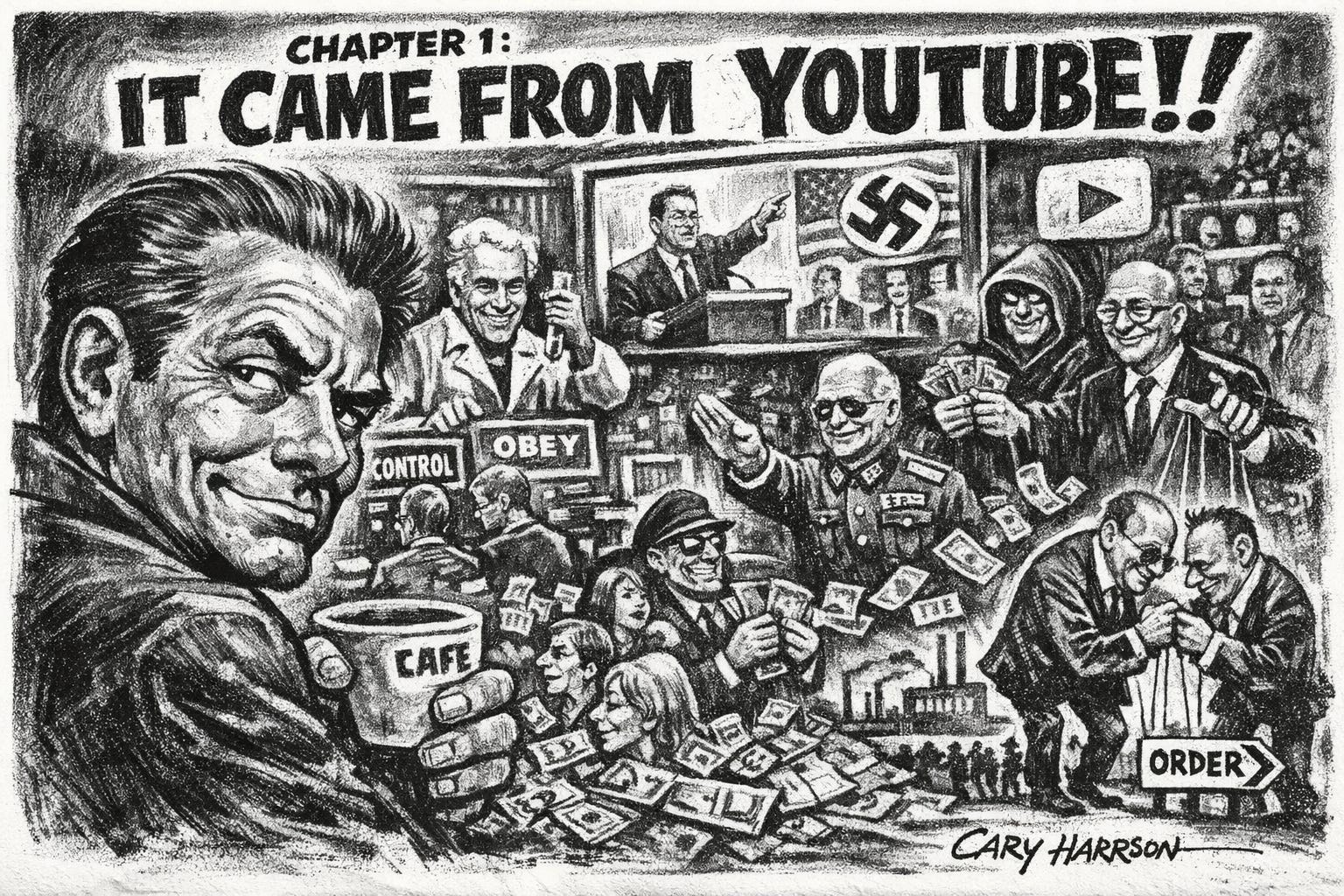
Disclaimer: Side effects may include laughter and/or anger. Read or watch at your own risk.We begin where the wreckage is freshest and the intent is easiest to miss: the newly released Epstein files. Not because they reveal some occult master plan, but because they show—coldly, bureaucratically—how a system processes damage it doesn’t intend to fix.You need to know where everything happening today came from—because it didn’t come from Congress, or a party platform, or some late-night fever dream. It came from YouTube. You’ll want to pay close attention because this is the kind of cool school you can only get on the Cary Harrison files.Beginning in the early 2020s—roughly 2020 through 2022—a cluster of long-form YouTube lectures and podcasts started circulating, calmly and confidently, arguing that democracy was obsolete. Not corrupt. Not misguided. Obsolete. The world, they said, had become too complex, too fast, too dangerous for consent. What nations needed instead was order—national coordination, elite planning, and discipline without debate.They gave it a name: “American National Socialism.”Not socialism for workers. Not equality. Socialism for order. Yes, this is socialism. German war-flavored but with a very modern twist.These weren’t fringe YouTube screamers. They were hours-long presentations with neutral lighting, academic tone, and managerial ambition—treating politics as an engineering problem and citizens as variables. Democracy was reframed as noise. Rights as inefficiencies. Participation as sentimental clutter. The solution was always the same: central coordination, insulated from the public, justified by crisis.This wasn’t a single video or a lone crank. It was a networked ideology—thinkers, funders, podcasters, policy hobbyists—cross-posting, cross-referencing, and refining the pitch. Over time, the arguments hardened. The language cleaned up. The destination stayed fixed.Those videos became the template—the rehearsal space where ideas too naked for policy were normalized, softened, and stress-tested. By the time similar language showed up in politics, finance, and tech, the public had already heard it. The shock was gone. The surrender rehearsed.So when you hear calls for “coordination,” “stability,” “capacity,” and “hard choices,” understand this: you’re hearing YouTube ideas grown up, dressed for work, and walking into power.That’s the origin story.The Cary Harrison Files is a reader-supported publication. To receive new posts and support my work, consider becoming a free or paid subscriber. Read the Epstein files and you don’t see urgency. You see containment. Allegations logged. Credibility quietly hedged. Corroboration requested and never pursued with vigor. The file closes not with justice, but with administrative relief. Not nothing happened—but nothing actionable will happen. That distinction is everything.Because what those files actually document is a skill the modern system has perfected: how to survive scandal without changing structure. How to absorb horror, manage liability, and keep walking. This is not failure. This is training.That’s why Epstein matters—not as myth, not as mascot, but as proof of exemption. Proof that there exists a tier where rules are optional, consequences negotiable, and bodies instrumental. Even his most grotesque, documented fascinations—his talk of heredity, “seeding,” where he would impregnate hundreds of these hostage girls to see the world with improved humans with his DNA… These ideas were never treated as alarms. Mr. Musk has already done this with a number of women. They were treated as eccentricities. As rich-man noise. Not because the ideas were harmless, but because the system had already decided who mattered.This is where the through-line becomes visible.Long before Silicon Valley, before dashboards and APIs, the same impulse wore a different uniform. Classic German eugenics didn’t begin with camps; it began with order. With classification. With the belief that society could be optimized if only the right inputs were elevated and the wrong ones managed. Compassion was inefficiency. Equality was sentiment. Order—order above all—was virtue.That ideology didn’t die. It modernized.It stopped talking about blood and started talking about data. It stopped saying purity and started saying performance. It stopped saying elimination and started saying eligibility. Same hierarchy. Cleaner language.Today it has a respectable name: technocracy.Technocracy claims politics are engineering problems. That society should be run by experts insulated from the public. That outcomes matter more than consent. Democracy, in this frame, isn’t immoral—it’s inefficient. Too loud. Too slow. Too emotional for a complex world.But here’s the pivot most people miss: technocracy does not want to fix democracy. It wants to outgrow it—and then replace it.And to do that, the old system must look irreparable.This is where collapse enters—not as tragedy, but as strategy.Functioning institutions interfere. They create friction. They allow objection. They demand explanation. So they are starved, delegitimized, scandalized, and left to rot in public view. Courts lose trust. Civil service loses capacity. Media drowns in noise. Nothing ever resolves. Everything just… persists.What people experience isn’t confusion. It’s fatigue.Bone-deep civic exhaustion. The political equivalent of being beaten unconscious by a pillow.Exhaust the public long enough and they won’t ask for justice. They won’t ask for reform. They won’t even ask who’s lying. They’ll accept anything—anything—that promises quiet. Not peace. Quiet. The hush you get when the arguments stop because no one has the energy left to argue.This is not an accident. This is the economic precondition.The Germans learned it early. Weimar didn’t fall in a coup; it collapsed under procedural exhaustion. Endless elections. Endless coalitions. Endless crises. Democracy didn’t look evil—it looked tired. By the end, people weren’t dreaming of jackboots. They were dreaming of naps.They didn’t ask for dictatorship.They asked for it to stop.That’s the moment this model waits for—not rage, but the sigh.And now we come to the modern incubator—the place where this demolition plan was first articulated plainly, without filters, before it learned to dress for policy: YouTube.Beginning in the early 2020s, long-form YouTube lectures and podcasts began arguing—calmly, academically—that democracy was obsolete. Not corrupt. Obsolete. The world was too complex for consent, too fast for debate. What nations needed was order.They gave it a name: American national socialism.Not socialism for workers. Not equality. Socialism for order.National coordination without voting. Planning without accountability. Discipline without democracy. Rights as conditional. Participation as optional. Order elevated above everything else—freedom, consent, dignity—because order, they argued, was the prerequisite for survival.Now the profit motive snaps into focus.Because collapse is not just ideologically useful—it’s lucrative.During collapse:· Public assets devalue.· Regulation weakens.· Emergency contracts multiply.· Surveillance and coordination tools become “necessary.”· Ownership consolidates quietly.Demolition clears the land.Reconstruction selects the owners.This is why the system doesn’t rush to repair what’s broken. Broken things are cheap. Broken institutions justify extraordinary measures. Broken publics accept management. And when the dust settles, what rises is not democracy renewed, but order privatized.This is where financiers of infrastructure matter—not because they shout, but because they build. Systems that govern without asking. Software that decides eligibility, access, risk. Governance that no longer needs ballots because it has dashboards.Political translators then sell the transition. They frame abandonment as honesty. They don’t promise justice. They promise quiet.Across the hemisphere, decisions move from ballots into compliance regimes. Citizenship becomes a credential. Dissent becomes inefficiency.YouTube incubates the ideology.Collapse legitimizes the takeover.Software enforces the new order.And profit is harvested from the rubble.This is not a conspiracy. It’s a business model.Destroy the commons.Declare the system obsolete.Install order as infrastructure.Charge rent.And that’s how a society wakes up governed by systems it never chose, rebuilt by people who never believed it should have a choice at all.Not because democracy was overthrown.But because it was demolished on purpose, piece by piece—until selling the replacement felt like mercy.:45 mins in - Rick Hayhurst is a senior leader with ProVisors who focuses on building trusted community during uncertain and often fractured times, bringing together high-level professionals with an emphasis on mindfulness, service, and responsibility before self-promotion. Known for his steady leadership and discretion, Rick helps cultivate environments where experienced advisors support one another not just to do better business, but to act with intention, integrity, and usefulness—recognizing that real networking, especially now, is about showing up for others and strengthening the fabric that holds professional communities together.Made Possible by People Like You—Literally.Copyright Audiences United, LLC – all rights reserved. This is a public episode. If you'd like to discuss this with other subscribers or get access to bonus episodes, visit caryharrison.substack.com/subscribe
Embed this episode
NOW PLAYING
They’re Not Failing the System. They’re Stripping It for Parts
No transcript for this episode yet
Similar Episodes
No similar episodes found.
Similar Podcasts
No similar podcasts found.