
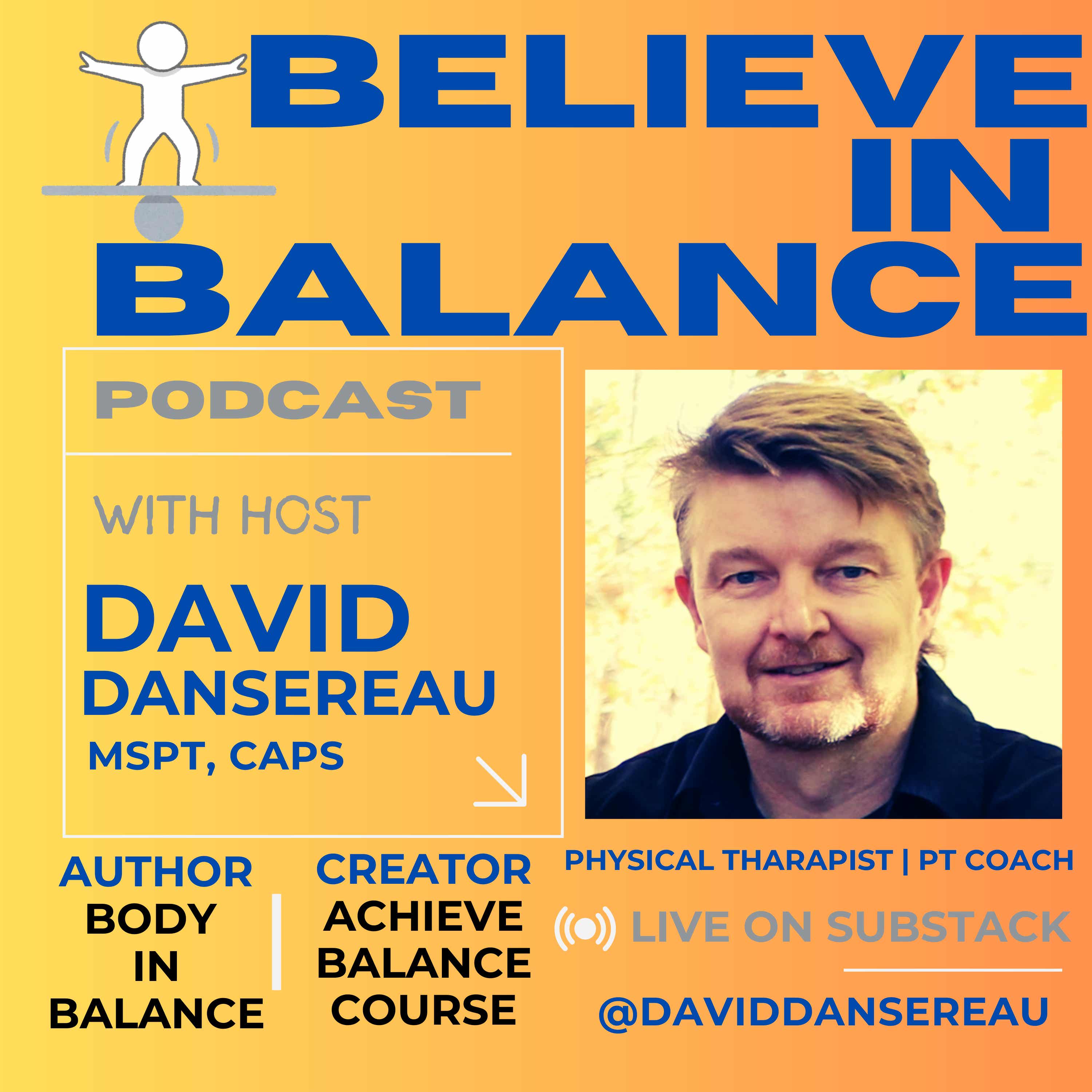
PODCAST · health
Believe in Balance Podcast
by David Dansereau
Audio education on all things health and balance from the Substack for physical therapist David Dansereau's Free and Premium Achieve Balance Newsletter, Course & Coaching Community (intended to enhance learning on the go!) achievebalance.substack.com
-
31
Following Up on Falls After Stroke
Thank you for tuning in! If you missed it live, this was my follow-up to the previous podcast episode entitled, Why Balance Breaks After a Stroke on Episode 25.If you missed any announcements from previous posts or episodes, install the Substack app to connect with Achieve Balance News and the Believe in Balance Podcast. In the app you can also message me through the private chat! I’d like to hear from you.On Episode 26 of Believe in Balance:I covered the 2026 AHA/ASA Guideline for Adult Stroke Rehabilitation and Recovery which outlines nine key priorities for physical therapists including fall prevention:Summary Tips for PT:* Early Mobilization: Progress mobility gradually during the acute stage (24-48 hours). Avoid high-dose, intense exertion in the hyper-acute stage (under 24 hours) to prevent neurological deterioration.* Fall Prevention: Conduct fall-risk evaluations immediately after a stroke and annually thereafter to establish targeted prevention programs.* Assessment Tools: Utilize objective clinical measures (e.g., standardized movement and balance tests) alongside real-world data from wearable sensors to track recovery.* Exercise Prescription: Design individually tailored programs targeting at least 150 minutes of moderate aerobic training per week, plus 2-3 days of strength and balance training.* Walking Training: Prioritize high-dose, task-specific walking training in the subacute and chronic stages. Body-weight supported treadmills and robot-assisted technology do not yield better walking outcomes than task-specific training and incur higher costs.* Foot Drop Management: Functional electrical stimulation (FES) systems are as effective for walking improvements as traditional ankle-foot orthoses (AFOs).* Care Access & Lifestyle: Utilize home-health and telerehabilitation when outpatient clinic access is limited. Support patient engagement in recreational activities to promote social and psychological health.Achieve Balance with SmartMovesPT is a reader-supported publication. To receive new posts and support my work, consider becoming a free or paid subscriber.Mentions:Believe in Balance Course https://achievebalance.substack.com/s/believe-in-balanceClosure After Stroke Book Update This is a public episode. If you'd like to discuss this with other subscribers or get access to bonus episodes, visit achievebalance.substack.com/subscribe
-
30
Why Balance Breaks after a Stroke
In this episode:Welcome back after a long break to complete my new book Closure After StrokeThis episode is about my own balance challenges after my stroke and the 3M system I built in my course Believe in Balance to restore my balance and achieve my goals.For all details and full print transcript of this episode, here’s the link: This is a public episode. If you'd like to discuss this with other subscribers or get access to bonus episodes, visit achievebalance.substack.com/subscribe
-
29
A Deep Dive into the Believe in Balance Course
5 Surprising Truths About Regaining Your Balance (and Independence)In the United States, we are navigating a silent but devastating epidemic. Currently, one in four adults over the age of 65 falls every year. The clinical data is sobering: 50% of those who fall experience a lasting decrease in mobility and a loss of independence, while 25% of those who suffer a hip fracture die within six months. This is no longer just a personal or familial tragedy; it is a national economic crisis. The cost of falls in the U.S. is currently estimated at over $80 billion annually—a figure projected to surge to $100 billion within the next five years.As a physical therapy specialist, I see the “paralyzing” fear of falling as the primary obstacle to recovery. Reclaiming your life requires more than simple leg exercises; it requires a systematic neuromuscular recalibration. The ultimate hurdle I see in my clinical practice is not the physical injury itself, but learning to “believe in balance” again. To prevent becoming a statistic in this hundred-billion-dollar crisis, we must shift our perspective from passive aging to active system maintenance.1-The “Paralyzing” Downward Spiral is OptionalA fall often triggers a “downward spiral” that is as metabolic as it is psychological. When an individual loses confidence in their stability, they instinctively restrict their movement. This self-imposed inactivity leads to a rapid loss of mobility, strength, energy, and independence. This loss of energy creates a feedback loop: the less you move, the less capacity you have to move, which ironically increases the risk of the very fall you are trying to avoid.This psychological barrier is the first clinical hurdle to recovery. Breaking the cycle requires shifting the mindset from a state of paralysis to one of proactive conditioning. As highlighted in my Believe in Balance guidebook:“Whether you think you can’t or think you can, YOU are right.”Recognizing that this spiral is optional—and that mobility confidence is a rebuildable resource—is the essential first step in reclaiming a life of independence.Achieve Balance with SmartMovesPT is a reader-supported publication. To receive new posts and support my work, consider becoming a free or paid subscriber.2-You Can Slash Fall Risk by 40% Without a GymThere is a persistent myth that reducing fall risk requires high-intensity gym routines or specialized equipment. However, the most effective tool in our clinical arsenal is the Otago Exercise Program. Developed in New Zealand and based on extensive research, this home-based strengthening and balance retraining pathway has been proven to reduce falls by 35% to 40% among sedentary older adults. I’m an Otago certified provider and I build my course around the evidence based therapeutic exercises in this program.The program is so effective that it is now a coordinated clinical standard promoted by the CDC, the Patient-Centered Outcomes Research Institute (PCORI), and the Administration for Community Living. The power of Otago lies in its precision. Rather than general “leg days,” it focuses on research-driven movements performed in the home environment, such as:* Front Knee Strengthening (Quadriceps)* Back Knee Strengthening (Hamstrings)* Standing Calf Raises* Tandem Walking (Heel-to-Toe)Achieving a major medical outcome does not require a gym membership; it requires a consistent, evidence-based pathway tailored to your current functional level.3-Balance is a Multi-System “Check-Engine Light”In physical therapy, we view balance not as a single faculty, but as a “check-engine light” for the body’s integrated systems. To address this, the CDC developed the STEADI (Stopping Elderly Accidents, Deaths & Injuries) algorithm—a coordinated clinical tool designed to screen and intervene before a catastrophe occurs. A decline in balance is often a symptom of underlying issues across multiple systems:* Vision and Inner Ear Health: Disturbances in how you process spatial orientation.* Medication Side Effects: Prescriptions that may cause light-headedness or fatigue.* Nutrition: Specifically, how diet impacts “muscle resilience” and “balance performance.”* Postural Hypotension: Sudden blood pressure drops when standing.Clinical screenings using the STEADI algorithm utilize three primary functional tests: the Timed Up & Go (TUG), the 30-Second Chair Stand, and the 4 Stage Balance Test. By using these tools, we move the conversation away from the inevitability of “getting older” and toward proactive system maintenance.4-The Power of the “Exercise Snack”For those grappling with high fall anxiety, a 60-minute workout can feel like an insurmountable mountain. This is why we utilize “exercise snacks”—or mobility breaks—which serve as the essential foundation for beginning to move. These are gentle, short-duration movements that can be performed several times per day as tolerated to reduce muscle tension and relieve stress.The primary snacks include:* Active Neck Rotations: To maintain cervical mobility and spatial awareness.* Seated or Standing Cat-Cow: For spinal flexibility and core engagement.* Cervical Retraction (Chin Tucks): To correct posture and head positioning.* Active Trunk Rotation: To maintain the spine’s ability to rotate safely during daily tasks.These snacks are more sustainable because they integrate into the natural flow of your day. By snacking on movement, you maintain a baseline of mobility that keeps your neuromuscular system primed for more complex challenges.5-Hacking Your Own Recovery is Possible at Any AgeBalance is not a fixed trait; it is a plastic, modifiable skill. I learned this firsthand following a stroke that robbed me of my stability. My recovery was not a linear path of clinical perfection; I had to “hack” my way back through determination, trial, error, and—importantly—many falls along the way. My experience proves that even for a specialist, falling is sometimes part of the process of learning to believe in balance again.To measure this “hacking” progress objectively, I use the 30-Second Chair Stand specifically to measure lower body strength and the Timed Up & Go (TUG) to assess dynamic mobility. These tests provide a clear baseline of your current risk and tangible evidence of your neuroplastic gains. And as far as the 4 Stage Balance, it’s a series of progressive static hold positions in narrow base stances that will challenge even those that think their balance is in check. As a quick litmus test right now, how long can you stand on one foot? Now try the other and be ready to hold on, your balance response here or lack of might be and immediate ‘check-engine’ light you should explore further.“The 100 billion dollar rehab question is, how does someone who has had a fall and has lost mobility confidence believe in their balance again?”The answer is found in treating balance as a skill to be practiced, measured, and reclaimed, regardless of your age or history.A Forward-Looking Pathway to Believe in Balance AgainIndependence is not permanently lost the moment a fall occurs. Through structured, evidence-based pathways like the Otago program and my “Believe in Balance” philosophy, the road to reclaiming your mobility is clearly mapped. By addressing the psychological barriers of the downward spiral, utilizing “exercise snacks” as a foundation, and monitoring your body’s “check-engine light,” you can move from passive aging to active system maintenance.Are you ready to look at your own “check-engine light” and take the first step toward reclaiming your mobility?Also available with purchase of my book Closure After Stroke This is a public episode. If you'd like to discuss this with other subscribers or get access to bonus episodes, visit achievebalance.substack.com/subscribe
-
28
A Deeper Dive: 🎧Achieve Balance Course-Module Two: Know Your Numbers
If you missed module one on audio please start my course here: https://open.substack.com/pub/achievebalance/p/a-deep-dive-achieve-balance-course This will be a paid subscriber benefit when this updated course launches this month and adds to my educational Achieve Course Academy. If you are already enrolled in my Believe in Balance course you’ll also receive audio access to the next Know Your Numbers module with action toolkits when it goes live in Substack.Resources for my Course:This new course was developed from my book Body in Balance which I beta tested over the last 2 years with my health coaching and PT clients over on SmartMovesPT. I’m now bringing it to a larger platform and audience here on Substack while keeping up with the times, including deep dives , new video explainer shorts and a new slide deck and audio education modules like the one you can listen to in this episode. Enjoy!About this episode: Know Your NumbersWe often navigate our health by “feel.” We glance in the mirror, check the number on the scale, and if nothing hurts, we assume the internal machinery is humming along in perfect harmony. However, there is a yawning chasm between the absence of disease and the presence of true health. Beneath the surface, your body is constantly generating a stream of data—hidden metrics that tell the real story of your biological age, long before symptoms ever emerge.Most people are currently operating from an invisible baseline, guessing at their health rather than measuring it. We rely on outdated standards, much like the researchers of the 1940s. When the famous Framingham Heart Study launched, the researchers actually included a budget line for ashtrays in their offices; they were so “pre-knowledge” that they didn’t yet realize smoking was the very thing driving the heart disease they were studying. Today, we are in a similar state of ignorance regarding our own biomarkers, often waiting for a clinical crisis to act.To bridge this gap, we must move beyond the frailty of “Willpower” and embrace “Skill Power.” Skill Power is the proactive application of data to behavior. By identifying the specific metrics that drive your health—your “Lead Dominos”—you can stop guessing and start managing your longevity with the precision of a scientist.The “Lead Domino”: Why Sleep Controls Your BiomarkersIn the hierarchy of health, we tend to view sleep as a luxury to be sacrificed for productivity. However, as synthesis from experts like Andrew Huberman and David Dansereau suggests, sleep is actually the “Lead Domino.” When sleep is ineffective, it doesn’t just make you tired; it causes every other biomarker—from blood pressure to glucose regulation—to tumble in its wake.Prioritizing sleep is a strategic foundation for recovery. It is the period when the brain clears metabolic waste and the body modulates systemic inflammation. If you are struggling to manage your cholesterol or stick to a fitness plan, the root cause is rarely a lack of discipline; it is usually a lack of rest. Without sleep, the rest of your health markers are built on shifting sand.“Sleep is the leading factor for recovery and controlling inflammation. If sleep tumbles, everything behind that falls—whether you are managing blood pressure, blood glucose, or an exercise plan.”The 80% Blind Spot: The Silent Rise of PrediabetesMetabolic dysfunction is the great silent epidemic of our time. According to the CDC, 1 in 3 U.S. adults is currently prediabetic, yet a staggering 80% of them are completely unaware of it. This “blind spot” exists because high glucose doesn’t always hurt—at least, not at first. While it silently damages vital organs, nerves, and blood vessels, the individual feels “fine.”The threshold for prediabetes is a fasting blood glucose level between 100 and 125 mg/dl, with anything 126 mg/dl or higher classified as Type 2 diabetes. This condition is driven by insulin resistance, where cells lose their ability to process sugar efficiently. Regular monitoring is the only way to unmask this silent killer before the damage becomes irreversible.“The danger of high glucose is the impact it has on all your vital organs, your blood vessels, and your nerves. It is one of the top numbers to know.”Your “Movement Age”: The 5-Year PenaltyLongevity is not just about internal chemistry; it is about how you move through your environment. Using the “Smart Movement Screen,” we can calculate your “Movement Age” by evaluating three fundamental patterns: the overhead reach squat, the inline lunge, and the high hurdle step.These movements test whether your muscles are balanced and fit. The scoring is binary: you either perform the movement correctly without pain (a “1”) or you “funk” it. For every point you score below a perfect 10, you must add five years to your chronological age to find your biological movement age. If a 40-year-old scores a 6, they are moving with the structural limitations of a 60-year-old. Our modern “high-tech habits”—the 150 times a day we check our smartphones—are prematurely aging our spines and creating a “body out of balance.”Thanks for reading Achieve Balance with SmartMovesPT! This post is public so feel free to share it.The Independence Metric: Gait Speed and 1.6 MPHPerhaps the most startling biomarker for independence is your gait speed. Clinical research identifies walking speed as a primary predictor of fall risk and long-term autonomy. The critical threshold is 1.6 miles per hour. When your gait speed drops below this level, walking is no longer “automatic.”The 1.6 MPH Threshold: Why Your Walking Speed is a Better Longevity Predictor Than Your ScaleThis has visceral real-world consequences. For instance, intersection lights are timed based on the assumption that a pedestrian can maintain a specific speed; fall below 1.6 mph, and you literally lose the ability to navigate your community safely. This decline is often driven by a slowing Resting Metabolic Rate (RMR) caused by the loss of muscle mass.To combat this, we must maintain our “internal furnace.” I experienced the power of this firsthand after running the Boston Marathon; when I measured my RMR on a metabolic cart the next day, my energy burn was 1,500 calories higher than predicted. This “after-burn” effect is the reward for intense activity and strength training, which protects both your metabolic rate and your gait speed as you age.The Fiber Gap and the “3 F’s” StrategyNutrition is the primary tool for modulating inflammation, which Hippocrates famously noted begins in the gut. We can simplify this through the “3 F’s”: Fluids, Fiber, and Fats. The Standard American Diet (SAD) is notoriously fiber-deficient, with most adults consuming less than 10g per day. To provide your microbiome with a proper defense, you need to target 25 to 50g of fiber.This must be paired with precision hydration—0.5 oz of water per pound of body weight—and healthy fats. Specifically, you should aim for 3 grams of Omega-3s daily from sources like fish, flax, or chia seeds. These three pillars work in tandem to regulate your gut health and prevent the systemic inflammation that leads to chronic disease.Achieve Balance with SmartMovesPT is a reader-supported publication. To receive new posts and support my work, consider becoming a free or paid subscriber.Beyond LDL: The Evolution of Heart HealthFor decades, we were told that as long as our Total Cholesterol was under 200 mg/dL, we were “safe.” Modern science has moved past these historical, oversimplified metrics. While the ratio of HDL (”good”) to LDL (”bad”) matters, proactive “health hackers” are now looking deeper.The measurement of ApoB (Apolipoprotein B) is emerging as a far more accurate predictor of cardiovascular risk than LDL alone, as it directly measures the particles that cause plaque buildup. Furthermore, if you have a family history of heart disease, you should not wait for a standard panel to flag a problem. Pushing for advanced testing, such as a calcium score, provides a definitive look at arterial health that a simple blood test might miss.Your Next Steps: From Awareness to AchievementAction creates momentum. The transition from “guessing” to “knowing” is the single most important shift you can make for your longevity. Whether it is the “5-year penalty” on your movement screen or the 1.6 mph gait speed threshold, these numbers are not just data—they are the roadmap to your future independence.You cannot manage what you do not measure. By identifying your specific “Lead Domino”—whether that is fixing your sleep hygiene, hitting your 3g Omega-3 target, or increasing your fiber—you trigger a chain reaction that brings your body back into balance.Which Lead Domino will you address first?Stay tuned here for the next module on gut health and if you need a coach to help you get started message me!Did You Know?These course toolkits from Achieve Balance will also be released within the resources of my new book, Closure After Stroke! Currently #1 in prerelease orders on Amazon! This is a public episode. If you'd like to discuss this with other subscribers or get access to bonus episodes, visit achievebalance.substack.com/subscribe
-
27
A Deep Dive: 🎧Achieve Balance Course-Module One: Finding Your Why
As I get ready to roll out my Achieve Balance Course to Substack, I wanted to offer an 🎧 audio overview, or new deep Ai dive into Module One: Finding Your Why. This will be a paid subscriber benefit when this updated course launches later this week and adds to my educational Achieve Course Academy. If you are already enrolled in my Believe in Balance course you’ll also receive access to the first new Finding Your Why module with action toolkits when it drops later this week. This new course was developed from my book Body in Balance and I beta tested it over the last 2 years with my health coaching and PT clients over on SmartMovesPT. I’m now bringing it to a larger platform and audience here on Substack while keeping up with the times, including deep dives , new video explainer shorts and a new slide deck and audio education modules like the one you can listen to in this episode. Enjoy!Achieve Balance with SmartMovesPT is a reader-supported publication. To receive new posts and support my work, consider becoming a free or paid subscriber.About this episode: Finding You WhyConnecting with your “Why” means identifying your core motivation for wanting to improve your health and achieve your wellness goals. It is the underlying reason that makes you interested in taking charge of your health, and identifying it serves as a powerful reminder to keep you moving forward when working toward your goals.When you connect with your “Why,” you are taking time to determine what specifically drives you, which can be categorized into the two types of motivation we discussed earlier:* Extrinsic motivation: Being driven by external rewards or avoiding negative consequences.* Intrinsic motivation: Engaging in an activity because it is personally fun or rewarding.Understanding your personal “Why” helps you assess your current stage of behavior change and formulate SMART goals with clear milestones and rewards. While external factors might help you get started, discovering a positive, intrinsically motivated “Why” is crucial; research shows that development-based motivators are much more effective at keeping you actively engaged in long-term behavior change.Listen to this episode to learn how David applied these science based lessons from his book to optimize his own nutrition and physical recovery from stroke.Learn More Resources:David’s Body in Balance Book https://physicaltherapycoach.com/Believe in Balance Course https://achievebalance.substack.com/p/announcement-believe-in-balance-courseSubscribe to Achieve Balance on Substack Next Up in Module Two: Know Your Numbers This is a public episode. If you'd like to discuss this with other subscribers or get access to bonus episodes, visit achievebalance.substack.com/subscribe
-
26
Beyond the Burn: 5 Surprising Truths About Finding Your Body’s True Balance
Welcome to Episode 22 of the Believe in Balance PodcastAbout this episode: Discard the guesswork that leads to the inevitable burnout of most health journeys. Many well-intentioned people start with high energy only to lose steam weeks later because they lack a sustainable blueprint or a powerful enough ‘Why’ to provide their True North. Achieve Balance with SmartMovesPT is a reader-supported publication. To receive new posts and support my work, consider becoming a free or paid subscriber to access our coursesIf you are joining me for the first time here, I’m David Dansereau, MSPT, a Physical Therapist and Nutritionist, Author of Body in Balance and I’ve developed my “Achieve Balance” philosophy, coaching mindset and courses to replace this uncertainty with a strategic approach to wellness. This podcast episode reveals the impactful takeaways from some of my writing and my course curriculum that will shift your perspective from temporary fixes to long-term equilibrium.Ready to get started? Tune in to this episode here or on Apple, Spotify and now streaming on YouTube!Show resources and mentions:Host David Dansereau biosketch and company profile: https://www.smartmovespt.com/david-dansereauBody in Balance Book:https://physicaltherapycoach.comSubscribe for Achieve Balance and Believe in Balance Course Updates:https://achievebalance.substack.com/ This is a public episode. If you'd like to discuss this with other subscribers or get access to bonus episodes, visit achievebalance.substack.com/subscribe
-
25
Google's FitBit Air For Rehab and Recovery?
Thank you for tuning in, watching and listening to Episode 21 of the Believe in Balance Podcast, now on Apple, Spotify, Substack and more! Disclosure: I had a patient need to reschedule so I wanted to jump in to Substack Studio to take some time to inform you of this upcoming new product release from Google with their Fitbit Air (now Google owned). I have no financial disclosures to report with Google.About this episode: This episode reviews on video and audio Google’s latest upcoming product release in wearable tech and I share why I believe it is important for rehab and recovery or simply as an new affordable way to help you or a loved on take charge of your mobility and health monitoring.Important Note and Author Disclaimer: While the Fitbit Air is an excellent proactive partner for tracking overall health, always consult with your neurologist, cardiologist, or physical therapist before starting new post-stroke exercise routines.Episode Resources and Mentions:Based on my latest article on Substack:FitBit Air: A Possible Game Changer for Stroke Survivors Seeking Affordable Wearable Tech for Recovery Insights and Health MonitoringBreakout Moment for Stroke?Reimagining Stroke Recovery Through Performance MetricsFitBit Air Measurement DataQuick Review for Reference on Biometric Data Mentioned in this Episode:* Heart Rate: 24/7 continuous heart rate tracking, including heart rate zones during workouts.* Heart Rhythm (AFib): Background detection for irregular heart rhythms that may indicate atrial fibrillation (AFib).* Heart Rate Variability (HRV): Tracks the variation in time between each heartbeat to help measure stress and training recovery.* Blood Oxygen (SpO2): Uses red and infrared sensors to estimate your blood oxygen saturation levels while you sleep.* Skin Temperature: Tracks your wrist’s nightly skin temperature variations.* Breathing Rate: Monitors your average breaths per minute while resting.* Sleep Analytics: Details your sleep duration and segments your rest into light, deep, and REM sleep stages.* Motion & Activity: Built-in 3-axis accelerometer and gyroscope to track daily steps, distance, active minutes, calories burned, and automatic workout detection.Chime In! What Are You Measuring? This is a public episode. If you'd like to discuss this with other subscribers or get access to bonus episodes, visit achievebalance.substack.com/subscribe
-
24
Rating Consumer Cellular's Iris Ally Medical Alert Device
This is a free preview of a paid episode. To hear more, visit achievebalance.substack.comMy Review of the Iris Ally Medical Alert DeviceThank you for tuning in! If you are listening to this as a bonus educational content from my Believe in Balance Course and Podcast we’ve provided links to both audio and video to take your learning on the go if you are a subscriber. If you need access to this review you can subscribe below.Achieve Balance with SmartMovesPT is a reader-supported publication. To receive new posts and support my work, consider becoming a free or paid subscriber.Why this reviewThere are now literally thousands of medical alert devices and systems found online. Just do a quick Amazon search for “medical alert devices” and you’ll quickly be overwhelmed and confused. Many of my clients start their search for fall detection and emergency alert devices and never order because there are simply too many choices, pressured sales pitches, or requirements to enter too much personal information simply to get a price quote. That’s in part why I advanced my training to become a Certified Age Tech Specialist in addition to my existing Certified Aging in Place Specialist certification to help guide my clients through all the confusing technologies and home safety options. You can learn more about these specialist offerings in a recent podcast episode. Also I offered an overview article on Medical Alert Systems on this platform as well. For a Deeper Dive:I built my course Believe in Balance as an educational offering to cut through all the confusion and provide evidence based solutions and technology assisted knowledge to remain safe and independent in the home.The Review: What is IRIS Ally?IRIS Ally is a lightweight, wearable medical alert device that offers automatic fall detection, GPS tracking, two-way voice communication, water resistance and 24/7 emergency support. It’s easy to use, comfortable to wear and ready to protect you right out of the box.Achieve Balance with SmartMovesPT is a reader-supported publication. To receive new posts and support my work, consider becoming a free or paid subscriber.Think of it as your on-call safety partner. Press the help button or rely on built-in sensors to alert a trained emergency agent—day or night.My Goal in this ResearchI wanted to check for a client whether the Iris Ally Medical Alert Device included a fall detection feature and to the best of my knowledge, it does (see copied description below). The Good* For the prices, especially if you are quoted a special $20/month with a free device*, this is fair pricing and discounted over advertised price. It is especially reasonably priced compared to similar options costing up to $35/month. In addition, some of the top rated vendors charge an extra $10 per month for fall detection.* Unlike other medical alert devices, IRIS Ally is sold exclusively by Consumer Cellular. That means you get their nationwide cellular coverage—and on their website they claim to use the same towers as the big guys. * 24/7 access to trained emergency agents (I’m told Consumer Cellular outsource this part of the service) by a company known for our award-winning, 100% U.S. based customer service.Thanks for reading Achieve Balance with SmartMovesPT! This post is a subscriber bonus offering, so please feel free to join in the discussion and share it.* There is also a belt clip if you don’t like wearing the device around your neck.* Water-resistant so can be used in the shower if needed.The Not So Good* One potential drawback for the device is it does not have a connected app for family and caregivers if that is a feature you’d like.
-
23
SAFE Ways to Build Better Balance
Thank you for tuning in to Episode 20 of the Believe in Balance Podcast!Episode Mentions:About the SAFE Act: The Stopping Addiction and Falls for the Elderly (SAFE) Act (H.R. 1171/S. 2612), designed to enhance fall prevention screenings under Medicare, has not passed into law primarily because it is still moving through the legislative process of the 119th Congress (2025-2026). While bipartisan, the bill has faced the typical hurdles of scheduling, committee review, and competing legislative priorities, having been reintroduced in February 2025 after a previous version stalled in the 118th Congress.Note:The bill is different from the "SAVE Act" (voter identification legislation) that has also been under debate in 2026 amongst part of the ongoing repeated shutdowns from the government’s inability to find balance.Achieve Balance with SmartMovesPT is a reader-supported publication. To receive new posts and support my work, consider becoming a free or paid subscriber to access my Believe in Balance Course along with all other PT care pathways I offer on my platform.Believe in Balance CourseCourse Modules* Module One -Mobility WarmUp* Module Two - Strength and Conditioning* Module Three- Balance ExercisesClosure After Stroke BookThanks for subscribing to Achieve Balance with SmartMovesPT! This podcast episode and video post is public so feel free to share it. This is a public episode. If you'd like to discuss this with other subscribers or get access to bonus episodes, visit achievebalance.substack.com/subscribe
-
22
Is it your shoes that are making you fall?
Thank you for tuning in! This week I wanted to give thanks to all that subscribed and helped me with a successful launch of my Believe in Balance Course here on Substack. It enables me to give back to community programs I support including Homes for Our Troops and StrokeOT. Learn more in this video episode plus my PT perspectives from the clinic and community on footwear and falls, recent falls and balance research, along with what’s next for the Believe in Balance Course!If you missed it: Balance Workshop ReplayIf you want to: Begin Balance Course Module OneThanks for reading Achieve Balance with SmartMovesPT! This post is public so feel free to share it.If you want to: Give to Support Stroke OTIf you want to learn: Latest Balance ResearchNew Australian research has shown that a tailored, home-based program can dramatically cut the number of falls, one of the most dangerous risks faced by survivors of stroke.The “falls after stroke trial” or FAST, published in the British Medical Journal, found a co-ordinated program of functional exercise, preventing hazards around the home and out-of-home mobility coaching reduced falls by 33 per cent over 12 months.Achieve Balance with SmartMovesPT is a reader-supported publication. To receive new posts and support my work, consider becoming a free or paid subscriber.Learn how a brief fall risk training (FRT) intervention significantly improved floor-rise ability and Perceived Ability to Manage Risk (PAMF). This study found integrating FRT into fall prevention programs may reduce long-lie consequences.That’s all for now! Look for my announcement of the next balance course module on cardiovascular fitness in the Achieve Balance subscriber chat.Questions?Reader Poll This is a public episode. If you'd like to discuss this with other subscribers or get access to bonus episodes, visit achievebalance.substack.com/subscribe
-
21
Announcement: Believe in Balance Course
Thanks for reading and supporting Achieve Balance! Subscribe for free to receive new posts and upgrade to a paid subscription when it opens to support my work if you can. Your support enables me to offer my paid courses as scholarships and group presentations to those in need.Did you Miss the Believe in Balance Workshop?No worries, here’s your chance to jump back in and watch the course overview from this replay of the original workshop and beta group that recently finished the course!This free workshop is the best way to learn about how your balance works and help you understand why you might want to start thinking about investing in your balance early. Be sure you read and understand the course and workshop disclaimer at the bottom of this page before proceeding with any activities related to this course. The Fall Risk Assessment mentioned in the workshop can help guide you to determine if you or a loved one might be at increased risk for falls. It is advised you follow-up and contact your health care provider for a comprehensive falls screening if at higher risk.Here’s The Workshop Agenda:During this balance workshop you’ll learn:* The key strength and balance exercises that reduced falls between 35 and 40% for sedentary older adults using the proven Otago research-based balance assessment and treatment pathway. Learn the secrets to performing these quick mobility assessments and exercises!* Which functional measurements are used to quickly screen for your current balance, lower body mobility and strength levels.* Home mobility and fall prevention safety checklist before you get started* New tech tools to remotely assess and engage you in your balance training* Nutrition? Yes, that plays a role in your balance performance for sure and we’ll be talking about it!* Case Studies- 2 spotlights using the program from my clients’ experiences* How you can get started with access to our balance training course foundations program before the official launch of my new book. * Need more support? They’ll be coaching options announced soon to connect with me to guide you through getting started with the program to jump-start your success! * Take my workshop feedback survey to access a 7 day free trial of my SmartMovesPT coaching app.Full Course Coming to Substack for Paid Subscribers. Join my upcoming Live Event course announcement for complete detailsWorkshop and Course Disclaimer: Before you begin this or any health and wellness program, ensure you are ready to become more physically active. It is always advised you consult with your health care professional and make the decision together based on your own health history if you are ready to begin to balance activities or begin any exercises.By reading this disclaimer you hereby acknowledge your awareness, readiness and voluntary participation in this balance workshop offered on this website for use in your home. You knowingly and voluntarily assume all risks and agree to release the presenter, David Dansereau,MSPT, and SmartMovesPT,LLC , as well as their employees and agents from all liability and claims arising out of your participation in this program and screening activities described in this workshop, as well as any videos and resources on our wellness portal, podcasts or on our websites.Questions?Listen to the Believe in Balance Podcast This is a public episode. If you'd like to discuss this with other subscribers or get access to bonus episodes, visit achievebalance.substack.com/subscribe
-
20
The New Horizon: The AgeTech Specialist
Trusted Partners in AgeTechWhile older adults are adopting technology at increasing rates, several significant barriers still prevent widespread adoption. My most recent video helps explain how I use my smart ‘tech-ready’ checklist to help my aging clients and their family members solve both the critical trust and tech readiness care gaps to aging in place.If you missed my last podcast episode 18 I covered the key differences between a Certified Aging in Place Specialist (CAPS) and an Age Tech Specialist. You can listen on Substack via the link below or find it on your favorite podcast players.Trust, Privacy, and Security According to AARP’s 2026 Tech Trends report, data privacy remains the top-rated barrier to tech adoption. Older adults are highly concerned about what personal data is being collected, whether it is secure, and the risks of identity theft. These fears are especially pronounced with new tools like AI, where users worry about AI-generated scams (such as fake phone calls mimicking family members) and the overexposure of their personal information. Tip: A first step in ‘tech safety 101’ with my clients is always keep up with the latest software updates to all the devices they connect with online! The latest AARP report shows that the average 50 plus year old household owns over 7 connected devices, that’s great but it also presents increased safety risks if these devices are outdated.Thanks for reading Achieve Balance! This post is public so feel free to share it.Information Overload and Confusion The pace of innovation can be exhausting. The 2025 Linkage Connect report found that the single greatest barrier for older adults—particularly for women 75 and older—is simply keeping up with the latest technology and not knowing what to buy. Many older adults feel overwhelmed by the sheer number of options available on the market.Lack of Perceived Value Older adults tend to adopt technology based on clear “needs” rather than “wants”. If a device does not meet a practical need, they are unlikely to use it; for example, many skip smart home automation because they simply don’t see the benefit. AARP notes that understanding the relative value of a product—answering the question, “Why should I care?”—has become the second most significant barrier to adoption.One of the consulting roles I take seriously is to keep up with the latest technology trends (see the agetech map below) and help my clients understand why they should care when it comes to home safety and agetech solutions that can keep them thriving and independent in their homes. Finding effective and affordable agetech solutions extends to their families as well, as the latest caregiver report demonstrated the 63 million Americans now provide care to a family member, which has increased over 45% in recent years.Thanks for reading Achieve Balance! Subscribe for free to receive new posts and support my work.Coming Up Next in my Achieve Balance Agetech Series:My SmartMoves Home AgeTech Market Report with a focus on market drivers and health and wellness innovations.See correct answer to this poll in my tip section in this article! This is a public episode. If you'd like to discuss this with other subscribers or get access to bonus episodes, visit achievebalance.substack.com/subscribe
-
19
Let’s Talk Aging Well in the Home
Welcome back to Ep 18 of the Believe in Balance Podcast!I’m your host David Dansereau a physical therapist as well as both a Certified Aging in Place Specialist and a Certified Age Tech Specialist. Today, I’m diving into these specialties because with the different titles it can be confusing. After the last episode when I discussed Digital Frontiers in AgeTech, I was asked by someone at the event curious about my titles what an ‘AgeTech’ specialist does. There are indeed many similarities and it can be confusing so what’s the difference between these two key professionals who help older adults stay independent—the Certified Aging in Place Specialist, or CAPS, and the Certified AgeTech Specialist?While both are focused on improving the lives of seniors, their approaches, tools, and expertise are quite distinct. Understanding these roles is crucial for anyone looking to make informed decisions about home modifications and technology. Listen and learn in this episode!If you are short on time I included a key visual in this episode show notes:Show Mentions: This is a public episode. If you'd like to discuss this with other subscribers or get access to bonus episodes, visit achievebalance.substack.com/subscribe
-
18
Digital Frontiers in AgeTech and Frailty
Believe in Balance Podcast Episode 17Host: David Dansereau, MSPT, CAPSLast week I had the opportunity to attend Digital Frontiers in Frailty: Opportunities for Early Detection and Clinical Action, a hybrid full day workshop hosted by the Massachusetts AI & Technology Center (MassAITC) that brought together clinicians, engineers, researchers, and innovators to reimagine how we detect, monitor, and ultimately acton frailty in aging adults. The following episode and companion article linked below in these show notes is my review and takeaways from the workshop.As a physical therapist deeply invested in preserving independence, functional mobility, and strength across the lifespan for my clients, what struck me most was how consistently movement, exercise capacity, balance integrity, and strength emerged as central themes in every session — not just as outcomes to measure, but as actionable targets for intervention.Enjoy this episode and please chime in over on Substack or leave the show a review on your favorite podcast player!References: This is a public episode. If you'd like to discuss this with other subscribers or get access to bonus episodes, visit achievebalance.substack.com/subscribe
-
17
Do GLP-1s Now Have a New Quarterback and 'Chief Wellness Officer' To Champion Their Use?
If you missed my last episode on The GLP Gold Rush listen to Episode 15 as it will give more context to this follow-up and latest episode on the state of GLP use.Here’s the press release announcement from eMed welcoming Brady as Chief Wellness Officer.I’ll let you know if they get back to me for an interview to help us understand why they are different and why we should all dive in with the GOAT on GLPs.Don’t hold your breath on my update on if Tom will join us, but if you don’t ask the answer is automatically no, so I asked.Mentions:Thanks for reading Achieve Balance and Listening to the Believe in Balance Podcast! This post and audio is public so feel free to share it.Chime In! This is a public episode. If you'd like to discuss this with other subscribers or get access to bonus episodes, visit achievebalance.substack.com/subscribe
-
16
The GLP Gold Rush is Here (Now in Pill Form!)
As the New Year kicks off, so do weight loss resolutions—and right on cue, a new wave of GLP-1 medications has arrived, this time in pill form. Marketed as more convenient, more accessible, and easier than ever, these drugs are poised to open the floodgates for mass adoption. But behind the headlines is a familiar story: a high-stakes race for market share, billions in projected profits, and a pharmaceutical industry perfectly timed to capitalize on our collective desire for a fresh start. In today’s episode, I’m unpacking what the economic costs of GLP-1s really means—for patients, for the healthcare system, and perhaps for the future of weight loss and behavior change. Are we manufacturing a new generation of lighter but weaker adults— in other words an epidemic of “thin frailty.”Stay tuned I’ll unpack it in episode 15 from a PT perspective!This episode is based on my recent article on Substack Read and Listen to More on GLPTom Brady now a GLP ‘Chief Wellness officer’ at eMed-Episode 16 just released with this press announcement. (Oh boy, let’s Go?!?!) This is a public episode. If you'd like to discuss this with other subscribers or get access to bonus episodes, visit achievebalance.substack.com/subscribe
-
15
Protein, Muscle Mass, Balanced Fitness and Contributing to Your Moving Well Longevity 'Retirement Fund'
The research on aging well and utilizing a balanced strength training program to offset sarcopenia (big word for-AGE ADJUSTED LOSS OF LEAN MUSCLE MASS) in our aging population is not new. In fact, the science behind staying strong into our 80s and beyond has been well documented for many years. One this episode: To highlight this fact, I’m going to jump into my ‘PT way back time machine’ to highlight a report on the science I presented while researching sarcopenia and the elderly back in my PT student training days. On this episode I’m reading my report I presented in PT graduate school from back in 2019 and comparing it to a recent podcast on the same topic some 25 years later by popular longevity expert, Dr. Peter Attia. After you listen to this episode, it hopefully begs the question to start thinking about why we aren’t doing more to boost senior fitness and health and longevity IQ.What hasn’t moved on this needle with all this new data is how we build programs to engage and encourage more seniors to contribute to their ‘longevity retirement fund’ (their muscle and strength levels) and get them building instead of breaking down muscle with age. My wish: I hope you listen to understand how to best prepare now to ‘fund’ your own healthy retirement and comment on this episode! We dove deep in to the financial impact of what it costs to remain inactive in retirement on my recent workshop.If you missed it:Here’s the Solution I’m Building to Address The Problem:During my Believe in Balance Workshop you’ll learn:* The key strength and balance exercises that reduced falls between 35 and 40% for sedentary older adults using the proven Otago research-based balance assessment and treatment pathway. Learn the secrets to performing these quick mobility assessments and exercises!* Which functional measurements are used to quickly screen for your current balance, lower body mobility and strength levels.* Home mobility and fall prevention safety checklist before you get started* New tech tools to remotely assess and engage you in your balance training* Nutrition? Yes, that plays a role in your balance performance for sure and we’ll be talking about it, especially your protein needs with aging!* Case Studies- 2 spotlights using the program from my clients’ experiences* How you can get started with free access to our balance training course starter program before the official launch and connect with me to guide you through getting started with the program to jump-start your success!Thanks for reading Achieve Balance! Subscribe for free to receive new posts and support my work.Show mentions:The Drive Podcast by Peter Attia: Rethinking protein needs for performance, muscle preservation and longevityIn this episode both guests make the case for a higher protein intake based on four fundamental tenets. They argued (with evidence) that the current RDA is too low for optimal muscle health, that higher protein intakes are not only better, but likely necessary to build and maintain muscle with age; that higher protein intakes are optimal for physically-active individuals; and that there are no health risks associated with higher protein intakes. Bottom line: Listen to my episode and theirs and make your own decision!Chime in below! This is a public episode. If you'd like to discuss this with other subscribers or get access to bonus episodes, visit achievebalance.substack.com/subscribe
-
14
Build Better Balance
This podcast references an article I wrote many years ago for Stroke Smart Magazine’s Mobility Column. I feel it is appropriate today to share and build on the resources from the recent pre-launch of my new balance course, Believe in Balance.Thanks for reading and listening to the Achieve Balance podcast! This post and podcast episode is public so feel free to share it.Balance, a task we mastered early in life seems simple enough, but as we age or encounter a neurological insult like a stroke or other challenge that impairs mobility, balance often needs to be relearned. This may mean that the brain has to find new pathways, or a new route to learn how to maintain balance. Scientists call this ability of the brain to be constantly reshaped when challenged, neuroplasticity.definition (noun)-The ability of the brain to form and reorganize synaptic connections, especially in response to learning or experience or following injury.Let’s break down that fancy word with a real world examples so you might learn how they can be applied to your current balance abilities.Resources mentioned in this episode:If you missed the first Believe in Balance Workshop here’s a link to learn more about this new program and how to get access to the rebroadcast.If you missed the follow-up live Q and A for questions that came in after the workshop you can access here: This is a public episode. If you'd like to discuss this with other subscribers or get access to bonus episodes, visit achievebalance.substack.com/subscribe
-
13
Q&A: Your Believe in Balance Workshop Questions Answered
Here’s the links mentioned during the Q and A session:Register for the Believe in Balance Workshop replay: https://smartmovespt.com/balanceTake the Workshop Survey to get access to the guidebook and app This is a public episode. If you'd like to discuss this with other subscribers or get access to bonus episodes, visit achievebalance.substack.com/subscribe
-
12
Thank you! Great turnout for today's balance workshop-Believe in Balance
Here’s the video for the free trial offer for my preferred app to access my Believe in Balance Program.Here’s how it works:* Complete the Workshop Survey* Accept the Free 7 Day Trial Offer* Access the complete Believe in Balance Exercise and Conditioning Program through my preferred client app free for one week. * No payment or appointment required. Pay $47/year thereafter if you decide it is working for you! * Allow 48 hours for App access- I had lots of interest!* I will email you or text you in the portal to request payment when free trial expires.Missed All This?Reach out to me in the comments or message me below, I’ll let you know when the rebroadcast goes live!Update: Great News- Workshop Rebroadcast is Now Available through October This is a public episode. If you'd like to discuss this with other subscribers or get access to bonus episodes, visit achievebalance.substack.com/subscribe
-
11
Shutting Down or Building?
If you are not building you are breaking down. Or perhaps shutting down in the case of our government (most likely) today:(But that’s not stopping us, we aren’t shutting down today. In fact we are talking about it on this podcast episode how we are going live in a few hours with our balance workshop.We are still going live in a few hours with our first Believe in Balance Workshop!Thanks for reading Achieve Balance! This post is public so feel free to share it.Here’s Why:Falls are NOT a normal part of aging - and many are preventable. Just like government shutdowns perhaps.Did you know? Preventing falls means more than avoiding injury, it’s about staying independent, confident, and engaged for our family members, patients, communities and ourselves!In this workshop I’ll cover how I’m building resources to support keeping you on your feet and the doors to your life open! I am committed to supporting this vision by making evidence-based program and assessments affordable and partner to offer falls prevention tools and workshops direct to consumer and to everyone who works with older adults.While the government is shutting down, slashing programs, and cutting services to veterans and seniors I’m commited to staying open and offering support.Learn more on my first Believe in Balance Workshop coming October 1st! This is a public episode. If you'd like to discuss this with other subscribers or get access to bonus episodes, visit achievebalance.substack.com/subscribe
-
10
Believe in Balance Fall Prevention Workshop by SmartMovesPT
Thanks for reading Achieve Balance! Subscribe for free to receive new posts and support my work.On this episode I’ll provide and overview of my new Believe in Balance Fall Prevention Course and Conditioning Pathway and Free Launch Webinar October 1stPurposeTo implement an evidence-based, standardized fall prevention pathway that reduces falls, improves patient outcomes, and supports quality reporting across care settings and to empower patients with the knowledge and tools to restore faith in their balance and take charge of their own health.Why It Matters* Falls are the leading cause of injury-related hospitalizations and death in adults >65.* National benchmarks (CMS, Joint Commission, AHRQ) increasingly tie fall prevention to reimbursement, quality, and patient safety and quality of life scores.* Changes to reimbursement patterns and the uncertain federal economic healthcare landscape is allowing falls screening to ‘fall’ through the cracks and is putting seniors at risk.* Evidence-based programs can reduce fall rates 25–40% with proper implementation.Thanks for reading Achieve Balance! This podcast and post is public so feel free to share it.Solution: Believe in Balance Fall Prevention Pathway by SmartMovesPTSmartMovesPT provides a scalable digital course and platform combining clinician training, validated risk assessments, patient education, and digital and print home exercise programs (HEPs) within a guided workflow.Core Elements:* Clinician Education & CEU Courses (STEADI, TUG, Berg, Fall Risk Strategies).* Validated Fall Risk Assessments (TUG, 30s Chair Stand, 4-Stage Balance, SmartMovesPT Movement Screen-from David’s book Body in Balance).* Tailored Exercise Programs (strength, static/dynamic balance, gait training, dual-tasking, functional transfer practice and therapeutic exercises coached by a PT to boost mobility confidence).* Patient Engagement Tools (videos, handouts, adherence tracking, reassessment).* Care Pathway Workflow (screen → assess → intervene → monitor → re-assess).Includes Outcome Reporting (track fall incidence, functional gains, patient-reported confidence and incorporates affordable digital tools to boost engagement and retention).Want to learn more about Believe in Balance?During this live workshop you’ll learn:* The key strength and balance exercises that reduced falls between 35 and 40% for sedentary older adults using the proven Otago research-based balance assessment and treatment pathway. Learn the secrets to performing these quick mobility assessments and exercises!* Which functional measurements are used to quickly screen for your current balance, lower body mobility and strength levels.* Home mobility and fall prevention safety checklist before you get started* New tech tools to remotely assess and engage you in your balance training* Nutrition? Yes, that plays a role in your balance performance for sure and we’ll be talking about it!* Case Studies- 2 spotlights using the program from my clients’ experiences* How you can get started with free access to our balance training course starter program before the official launch and connect with me to guide you through getting started with the program to jump-start your success! This is a public episode. If you'd like to discuss this with other subscribers or get access to bonus episodes, visit achievebalance.substack.com/subscribe
-
9
HealthCare in Rhode Island Is Broken:(
Thanks for reading Achieve Balance! This post is public so feel free to share it.(Tip: Sorry in advance for the slight delay at start of this video-trying to record straight from Substack to video NEVER works on a Mac, don’t try it!)Take 2- The Office Check-inWasn’t sure where to post this video (either at Know Stroke or here on Achieve Balance) since the subject within crosses both themes and content areas I am writing about on Substack.How are we to Achieve Balance when the ‘health care’ systems around us are collapsing in front of our eyes?Please watch the video- I need your feedback and please do send me some hope! Also if you just want to comment about the roads in Rhode Island if you’ve been through our state to head to the Cape or up to Boston recently, chime in below. Here was my original video post before I walked in to the medical office and had thoughts for Take 2.Take 1- The Pre-Checkin and the patient portalAre you using it for help in your own medical management?This was the short video I was going to post as a note to get your feedback how/if you are using your patient portal within your provider’s EMR/EHR. Do You Use Your Provider’s Patient Portal to Help You Stay Well and Achieve Balance?Message me if you found the post it note tip helpful! Thanks!!PollBottom Line: Hope is a good thing, but hope is not a plan. Rhode Island needs a better plan to keep up its’s roads, its medical infrastructure, its payment and reimbursement rates, and its provider incentives to keep talent from leaving the state or the healthcare system will crumble. It’s already heading there fast.Until next time, stay well, keep the faith and keep moving forward.-David This is a public episode. If you'd like to discuss this with other subscribers or get access to bonus episodes, visit achievebalance.substack.com/subscribe
-
8
Trump Reinstates Presidential Fitness Test
Thanks for all the feedback I received on last episode on using medical alert systems or personal emergency response systems (PERS) in your home. Also had a few great comments that came in from ‘Ask The PT’, the episode I did on what I have in my home PT treatment bag and bring to clients homes. I heard this helped a few listeners select home fitness equipment. Thank you! Please keep the feedback coming!In this episode, I hope to make you laugh a bit-we all need it right now!On this episode:I’m offering a satirical piece riffing on the recent ‘executive order’ last week announcing the return of the Presidential Fitness Test under President Trump. It plays with exaggeration, irony, and political commentary, and pokes fun at both the absurdity of the announcement and the disconnect between public health initiatives and political accountability. I even end with my comment that this episode would make great content for a SNL skit if they haven’t done it already. I’m not sure I can’t stay up that late these days but if anyone know Colin Jost or Michael Che, please pass this show note along to them!Here’s the free SNL script below:TV Sketch / SNL Weekend Update About Presidents Fitness Test[Colin Jost]: Big news this week—Donald Trump has signed an executive order bringing back the Presidential Fitness Test in schools. Because when I think of physical health, I think of... a 78-year-old man who considers walking to the podium cardio.[Michael Che]: The test will include mile runs, push-ups, and sit-and-reach. Which is ironic, because the only thing Trump has ever reached for is a second scoop of ice cream.[Colin]: A spokesperson says the program is part of a new initiative called Make America Healthy Again, or MAHA. It replaces Michelle Obama’s “Let’s Move” with Trump’s version, “Let’s Waddle.”[Michael]: There’s now talk of requiring members of Congress to take the test as well. Which would be great—because nothing says ‘qualified to lead’ like watching Lindsey Graham try to climb a rope in a suit.[Colin]: Trump reportedly declined to take the test himself, saying, quote, “I already passed the Presidential Golf Cart Endurance Trial—18 holes, no breaks, very sweaty with heel spurs and a few extra ball drops by my caddy but that’s not cheating kids!”That’s all, have a good night! (and I hope this made you laugh, we all need it right now)!Comments welcome by reaching out below on my Substack Feed! This is a public episode. If you'd like to discuss this with other subscribers or get access to bonus episodes, visit achievebalance.substack.com/subscribe
-
7
Medical Alert Systems
Article by David Dansereau,MSPT,CAPS | SmartMovesPT.comHere’s a fast start guide to help seniors and loved ones evaluate and purchase the best medical alert systems (aka Personal Emergency Response Systems or PERS) for home safety and fall prevention. I’ll be diving deeper into this topic for a new module in my Believe in Balance course and hope to bring in a few experts in this area on a bonus Substack Live. Below is a summary of some of my early research with quick tips to consider when evaluating medical alert systems. Top independently reviewed devices are included with links to learn more and order. Thanks for reading Achieve Balance! Subscribe for free to receive new posts and support my work.Why Consider a Medical Alert System?* Provides 24/7 emergency help at home or on-the-go.* Reduces risk of delayed medical care after falls.* Supports independence and peace of mind for seniors and loved ones.Key Features to Look For* Fall Detection: Automatically alerts help when a fall is detected.* Type of Monitoring: Landline, cellular, or GPS-based for mobile use.* Response Time & Center Quality: 24/7 certified monitoring.* Ease of Use: Simple wearables and easy setup.* Cost & Contracts: Watch for hidden fees and long-term agreements.* Discounts and Benefits: Check Your Insurance Coverage, ie) Medicare Advantage Plans, AARP and possible coverage with Veterans benefitsTop-Rated Systems at a Glance1. Medical Guardian* Why it stands out: Rated Best Overall by NCOA; fast response, long range, diverse device options * Offers home base, mobile pendants, smartwatches, GPS on-the-go.* Monitoring starts around $29.95–$36.95/month, no long-term contract 2. Bay Alarm Medical* Touted for outstanding customer service, price-lock guarantee, and discounts * Basic plan starts at $24.95/month, with fall detection add-on (~$10/month) 3. MobileHelp* Best Value pick: lowest starting cost (~$24.95/month), no hidden fees, 30-day trial * Offers in-home and on-the-go devices; fall-detection pendants; 4G LTE connectivity. Honorable MentionsLively – integrates with Jitterbug phones, offers fall detection pendants ADT Medical Alert – lifetime warranty, no hidden fees, cellular/base range options Action Steps ✅ Decide: Do you need a home system or mobile coverage (for outdoor use)?✅ Prioritize: Fall detection is essential for higher-risk individuals. ✅ Check: Trial periods and avoid long-term contracts. ✅ Review: Compare monthly & upfront costs carefully. ✅ Test: Use trial periods to confirm comfort and reliability.“What about using my Apple Watch with the Fall Detection Feature??”I cover this option and the pros and cons, with costs in my new course. For example, Apple Watch fall detection can be paired with a monitoring service like FallCall and their app on your iPhone.Note on Pairing with Your Own Devices for Falls Alerts and HELPBottom line: You’ll still most-likely need a way to be notified if a loved on falls and will have to connect with a subscription based Falls Alert Monitoring Service like FallCall that has an app based alert response system. Learn more here and use their FAQ chart to see which options are best for your needs. As of the writing of this article most monitoring plans were similar to the other vendors mentioned or slightly less, ranging from $25-35/month.FallCall also has partnerships with other device manufacturers like Trelawear (ALERT spelled backwards) that have pendants that look more like jewelry as show below. Note, these pendants might not help detect falls, and may only have a button to call for help after a fall has occurred. Be sure to look at all product descriptions and FAQ pages before purchasing.Trusted Resources & Reviews* National Council on Aging (NCOA): ncoa.org* SafeWise: safewise.com* Consumer Reports: consumerreports.org* SeniorLiving.org: seniorliving.orgFinal Tips* Best Overall: Medical Guardian — full-featured options and strong support.* Best Value: MobileHelp — affordable and transparent.* Best Budget: Bay Alarm Medical — lowest price with good service.Stay Safe, Stay Independent- Take Charge of Your Health!!Stay on You FeetTake My Balance Course: Now Offered With a Substack Paid SubscriptionTo learn more about my Believe in Balance Course with a comprehensive review of fall detection and medical alert systems subscribe to my Substack and podcast for updates.Thanks for reading Achieve Balance! Subscribe for free to receive new posts, course updates and support my work.For a personalized comparison chart or for local deals get on my list, and always talk with your healthcare provider or reach out to a trusted aging services advisor or Certified Aging in Place (CAPS) professional for best fit for your individual needs.Resources and Disclosures: I am an Amazon associate and the links in this post are connected to my account. This does not affect my evaluation of the products listed. They were all independently tested for 2025 by the reviews mentioned in this article. Purchasing through my links does not change the price you pay, all current offers and pricing are up to date and adjusted for sales on Amazon’s platform by the vendor and reflected here. This is a public episode. If you'd like to discuss this with other subscribers or get access to bonus episodes, visit achievebalance.substack.com/subscribe
-
6
Bright Minds Kids' Stroke Awareness
Believe in Balance Podcast Episode 10Bright Minds: A Campaign to Empower the Next Generation Against StrokeIn 2006, I experienced a life-altering stroke. As a father, nutritionist, and physical therapist, I faced both personal and professional crossroads. What challenged me most in the aftermath wasn’t just my own recovery—it was trying to explain what had happened to me in a non threatening way to my young children who were all under 8 years old at the time of my stroke. I quickly discovered that stroke education for kids was virtually nonexistent, and the materials that did exist were either too clinical or too frightening for young minds to digest.That moment sparked the idea that would later evolve into several iterations of my Bright Minds Campaign. I’ll cover this program in this episode.To learn more about this program check the resources linked below or message me with your thoughts.Resources:Lessons Learned and Video Update on Bright Minds https://knowstroke.substack.com/p/lessons-learned-from-my-bright-minds Main Bright Minds Landing Page https://www.know-stroke.org/brightmindsThanks for reading Achieve Balance! This podcast and post is public so feel free to share it. This is a public episode. If you'd like to discuss this with other subscribers or get access to bonus episodes, visit achievebalance.substack.com/subscribe
-
5
Using Technology to Bridge the Gaps in Stroke Recovery and Help Survivors Restore Function and Achieve Balance
Thanks for reading Achieve Balance! Subscribe for free to receive new posts and support my work.Measuring Outcomes with Tech-Enabled Solutions to Overcome the 'Slinky Effect'The "Slinky Effect," as I described in my last Linkedin article and on my Know Stroke blog, refers to the inconsistent and often regressive nature of stroke recovery, where patients experience periods of progress followed by setbacks often caused by lack of services especially in the later phases of longitudinal care planning and support. This is often where the Slinky bends towards a downward spiral in the rehab outcomes curve I demonstrated in my video. This phenomenon highlights the need for continuous, adaptive, and engaging rehabilitation strategies to maintain momentum in recovery and support survivors throughout their individual recovery journeys. Emerging technologies offer promising solutions to address these challenges, providing innovative approaches to enhance and sustain stroke rehabilitation. The sad reality is, many of these tech rehab solutions will never get to market and when they emerge from university research labs the challenge just begins. Getting these rehab tech enabled solutions into users hands, around their waists, or on their feet, and bringing rehab into their home so they can benefit is an uphill climb. Overcoming these rehab barriers in stroke is something I’ve been writing about and building solutions for during the last half of my career and will be a major theme in my upcoming new book, Closure After Stroke.- David DansereauI’ve been blessed throughout my long health and rehab career to have provided care in many roles, from corporate health, wellness and research, to hospital based skilled inpatient, outpatient and home rehab roles, to owning multiple rehab and wellness private practices, to consulting in rehab tech with founders looking to understand clinical rehab workflows, to a clinical lead role in a university engineering and innovation lab studying wearable technologies in medicine , to teaching and mentoring at university on digital health, volunteering for health advocacy and career mentoring in public schools, to a startup founder with many lessons learned in digital health and telerehabilitation reimbursement, and finally to a forever patient advocate to help my clients get access to these great technologies to take charge of their own health, I’ve seen and tried just about all of it and that’s why I’ll be sharing my lessons learned in my new book and providing a brief summary in this podcast episode on the categories of technologies that have potential to improve stroke care and optimize long term stroke outcomes. Categories of rehab tech highlighted in this episode:* Category 1: Wearable Technology for Home Monitoring and Real-Time Feedback* Category 2. Supported Gait and Robotic-Assisted Therapy* Category 3. Virtual Reality (VR) and Augmented Reality (AR)* Category 4. Functional Electrical Stimulation (FES)* Category 5. Telemedicine and Remote Monitoring* Category 6. Music-Supported Therapy* Category 7. Artificial Intelligence (AI)-Powered Rehabilitation PlatformsBy integrating these technological advancements into stroke rehabilitation programs, we can address the challenges posed by the "Slinky Effect," providing patients with continuous, adaptive, and engaging therapy options that they deserve to promote sustained recovery and improved quality of life.Full chapter deep dive of this podcast episode will be released soon on Know Stroke.Thanks for reading Achieve Balance! Subscribe for free to receive new posts and support my work. This is a public episode. If you'd like to discuss this with other subscribers or get access to bonus episodes, visit achievebalance.substack.com/subscribe
-
4
How the USDA's $1Billion Federal Food Cuts Will Jeopardize the Health of America's Youngest Bright Minds
Believe in Balance Podcast Episode 9By David Dansereau,MSPT Nutritionist, and Volunteer School Health EducatorIn a deeply concerning move last month and policy shift away from ‘Making America Healthy Again', the U.S. Department of Agriculture announced it is cutting $1 billion in funding from two key programs that support schools and food banks in purchasing fresh food from local farms.These programs are the Local Food for Schools Cooperative Agreement Program and the Local Food Purchase Assistance Cooperative Agreement Program. Both initiatives enabled schools and food banks to procure fresh produce, dairy, and meats directly from local farms and ranchers. The termination of these programs is shortsighted, is poised to have detrimental effects on public health, particularly among vulnerable populations, and may lead to increased healthcare expenditures in the long termThis decision threatens to unravel the slow progress schools have made in improving access to nutritious food for underserved communities, especially children.As a healthcare professional, nutritionist, and volunteer school health educator for over a decade also serving on multiple school health and wellness committees in my district to try to bring more opportunities to support the health of young bright minds, I see this as a step backward—not only for public health but for the sustainability of our entire healthcare system.I’ll unpack it all in this episode!Thanks for listening to this Believe in Balance Episode. Join me over at Achieve Balance to chime in! This episode and linked post is public so feel free to share it.Chime in!Connect with me on Linkedin where this article and podcast episode originated!Achieve Balance Article- The USDA’s $1 Billion Federal Food Cuts Jeopardize the Health of America’s Youngest Bright Minds and Our Future Healthcare System This is a public episode. If you'd like to discuss this with other subscribers or get access to bonus episodes, visit achievebalance.substack.com/subscribe
-
3
The Battle For PT Anywhere Has Evolved
Episode 8Did you recently receive a direct mailer to your home from Hinge Health for virtual physical therapy? I’ll break this offer down in this episode of Believe in Balance.If you don’t have time to listen to the full episode, here’s a quick tip. Check out the fine print along with your health insurance benefits plan administrator. Read many patient stories in the social forums to be sure free, really means free or just no copay and billed to your insurance. There’s a big difference.Even if you just want that “free massage gun”.Read my article on Linkedin referenced in this episode: https://www.linkedin.com/pulse/battle-pt-anywhere-david-dansereauChime in! This is a public episode. If you'd like to discuss this with other subscribers or get access to bonus episodes, visit achievebalance.substack.com/subscribe
-
2
Fitness Builds Your Body Armor
Greet Your Day With MovementArticle by David Dansereau,MSPT at Achieve BalanceGreeting your day with movement provides the most valuable return on investment, your improved health.Building fitness is like building your own body armor and the time invested can pay lasting dividends. - David Dansereau, MSPTStaying strong and fit is the most powerful way to prepare your body and mind for the challenges ahead. As a seasoned physical therapist and movement expert, I’ve seen firsthand how intentional morning movement can prime the nervous system, enhance mobility, and fortify resilience against daily stressors.Whether it’s starting the day with a deep breathing ritual, stretching, walking, strength training, or dynamic mobility work, incorporating movement into your morning routine builds a foundation of strength and vitality that lasts throughout the day. Body ArmorI equate starting your day with movement to building your body armor or suiting up for the day ahead with fitness. I’m blessed to be able to work with many clients (I refer to them as my athletes) that are challenged by their mobility and realize how exercise is their lifeline to continued independence. Many of my athletes of all ages have had health challenges and diagnosis that have impaired their mobility. Conditions that include MS, Parkinson's Disease and stroke or other brain injuries and they come to realize exercise is their best medicine to fight back against an unfair set of circumstances.Fitness and continued movement is indeed their body armor and it can be yours too especially if you have been blessed with good health now and desire to continue to thrive and build reliance as you age. Thanks for listening and reading Achieve Balance! Subscribe for free to receive new posts and support my work.In fact on Episode 70 of our Know Stroke Podcast we were joined by occupational therapist, adaptive fitness expert and founder of Fit to Function Recovery Gym, Jenna Muri-Rosenthal who spoke to the power of building fitness as the opposite of sickness. I love her quote heard in this soundbite!“What is really the opposite of sickness? It’s not just wellness, it’s fitness”. -Jenna Muri-Rosenthal of Fit to Function Recovery, Boston MAThe Science Behind Morning MovementYour body is designed to move. After hours of sleep, the body naturally experiences stiffness due to decreased circulation, joint fluid viscosity, and muscular tightness. It’s oftentimes, we are being less active throughout the day that causes this as opposed to blaming it simply on aging and things ‘slowing down’.Either way, movement acts as a reset button at any age, stimulating circulation, oxygenating tissues, and enhancing neuromuscular coordination and good mood enhancing hormones.Here’s what one of my 70 year old intentionally fit clients said recently about how they are using fitness as their best investment to harness their own super powers!I’m no longer ‘faster than a speeding bullet’. And I ‘can no longer ‘leap tall buildings in a single bound’.I realize I am now older. But I’m still pretty good at what I do when I’m called on! -JBHere’s what happens when you greet your day with movement :* Increased Blood Flow & Oxygenation: Movement increases circulation, delivering oxygen and nutrients to muscles, joints, and the brain. * Improved Joint Mobility & Flexibility: After a night of inactivity, synovial fluid (your joints’ natural lubricant) is stagnant. Gentle movement stimulates its production, reducing stiffness and preparing the body for physical activity. * Enhanced Neuromuscular Activation: Morning exercise activates key stabilizing muscles, improving posture, coordination, and balance. * Stress Reduction & Mental Clarity: Exercise releases endorphins and lowers cortisol levels, reducing stress and improving mood. * Metabolic Boost & Fat Burning: Morning movement jumpstarts metabolism, encouraging fat oxidation and improving insulin sensitivity. * Boost BDNF: Exercise has been shown to increase BDNF (brain derived neurotropic factor) levels in the brain, which can have numerous benefits for mental and physical well-being. BDNF is a protein that plays a crucial role in brain health, including neurogenesis (the growth of new neurons), neuroplasticity (the brain's ability to adapt and change), and cognitive function.* Habit Stacking: PT Pro Tip-Get it done early in the day, you’ll have less excuses this way to put it off until you get home when there will be more excuses to ‘do it tomorrow’. These small wins start stacking up into lasting daily habits and exercise is often the gateway to spark other healthy behavior changes!A Simple Morning Routine to Get Started Building Your Own Body ArmorHere’s a Morning Ritual for Better Physical and Mental StrengthStart the day with deep breathing and gratitude (focus on what you are grateful for about your body instead of what is ‘wrong’ or what you may currently dislike-or simply put-be kind to yourself!). Then layer in a bit more movement after this mental warm-up.Repeat affirmations: "This morning, I am getting stronger." "I am building my body armor."Here’s How: You don’t need an hour-long workout—just 5–15 minutes of intentional movement can make a difference. I prefer this done outside if possible and while the sun is rising to greet the day.Try this:* Dynamic Deep Breathing and Stretching (2-3 min) – Neck rolls, spinal twists, and hip circles to loosen up and greet the day.* Bodyweight Activation (5 min) – Squats, push-ups, lunges, and planks for strength.* Cardio Boost (3-5 min) – Jumping jacks, jump roping,high knees, or a brisk walk to elevate heart rate. Combine 2-3 into a repeat circuit if you have more time!SmartMoves PT Final Thoughts:Your morning movement is an investment in your physical and mental resilience. By prioritizing movement, you enhance your ability to take on the day’s challenges with strength, focus, and confidence. Build your body armor—one breath, one step, one stretch, one rep at a time then keep moving forward.Once you get started, you’ll soon find you miss it if you skip a few days! If you need help getting started, reach out to a local PT, we are the movement experts after all.Chime in!What are you doing to build your body armor?Join the conversation! This is a public episode. If you'd like to discuss this with other subscribers or get access to bonus episodes, visit achievebalance.substack.com/subscribe
-
1
What's Your Movement Age??
Our High Tech Habits Are Hurting Our Spines!Thanks for reading Achieve Balance! Subscribe for free to receive new posts and support my work.We are hooked:(The average American spends an incredible 11 hours a day on digital media, including activities like watching TV, and surfing the internet. Then we often sit and ‘game’ at the end of the day to relax or ‘doom scroll’ on social media after coming home from an oftentimes long seated commute in our vehicles.All these extended seated positions can wreak havoc on a person’t posture and put too much stress on different parts of the body, especially the cervical and lumbar spine, in effect aging them prematurely.So What Can We Do About It?Take my Smart Movement Screen! It’s a simple and quantifiable mobility measurement tool used to evaluate your current movement abilities and balance. This is not a comprehensive assessment rather a quick screen and preview from my ‘Exercise-Rest-Recovery Module’ to ‘flag’ which muscles might need attention. On this replay, I’m offering my resource toolkit as well to help you discover your ‘Movement Age” and corrective exercise suggestions if you need help.Think of it as a ‘check engine’ light on your car dashboard warning you when it may be time to schedule service, in this case for your body to get back in balance!Watch the Video Then Try The Smart Movement Screen! Also added bonus see the balance and fall screening assessment I use in practice as part of this movement screening preview!My Mobility Assessment Video is Back Open as a Free Gift from my Achieve Balance Course Module 5 for a Limited TimeAbout Your Course HostDavid Dansereau,MSPTDavid is the author of the Amazon Best Selling Book in Preventive Medicine -Body in Balance. He is also the Founder of SmartMovesPT,LLC and the Co-Host of the Know Stroke Podcast. In this special webinar, David will be opening back up a module from his Achieve Balance Course designed to provide participants with the tools and skillset to take charge of their health and restore their body back to balance. This gift is part of his Smart Movement Screen to help you measure your mobility, before you begin to build a corrective exercise plan.Remember, You Can’t Manage What Your Aren’t Measuring.So Start Measuring Your Mobility Today!Did you know? 80% of smartphone users check their devices within 10 minutes of waking and throughout the day check their devices up to 150 times-It’s no wonder our spines are not aligned!!- David Dansereau,MSPT,CAPS This is a public episode. If you'd like to discuss this with other subscribers or get access to bonus episodes, visit achievebalance.substack.com/subscribe
-
0
Fear of Falling: Let’s talk about the dreaded 'F' word in aging -Falls!
Let’s learn about your remarkable balance system on this episode of the Believe in Balance PodcastThanks for reading Achieve Balance! Subscribe for free to receive new posts and support my work.I feel very confident to discuss this topic with you today- I’m a PT and we Physical Therapists are Experts in Balance, Mobility and Fall PreventionBut with that said I still need to read our disclaimer. This podcast episode and my associated articles and webinars on balance are intended for informational purposes only. I am not providing legal or medical advice and this information offered does not create a provider-patient relationship. Do not rely on this for medical information. Always seek the help of a qualified medical professional who has assessed you and understands your own condition.Episode Notes: I spend a lot of time each week helping my clients learn about their risks for falls and work with them to build back their confidence so they can believe in their balance again. It all begins with education and in this podcast episode I’m expanding my reach to offer you or a loved one more information to help you better understand the essential components of a body in balance.Parts of Balance ControlTo keep ourselves upright in space and prevent falls, we have 3 body systems that all must communicate and interact together:* Visual system* Somatosensory system* Vestibular systemOn this episode, I’m going to describe each system briefly and how they influence our balance.Reach out to me with any questions on your balance!Quick PT tip and takeaway when observing a loved one for possible impaired balance. It may be time to schedule a balance maintenance check up if you notice the following in the example below.Here’s an interesting fact about walking and falls. We’ve known for about 20 years that older men and women who stop walking when a conversation starts are at particularly high risk of falling.Over a six-month timeframe, few of those who could walk and talk at the same time would go on to fall, but 80% of those who stopped when a conversation was initiated ended up falling.This is a casual way to pick up on any concerns you might have for a loved one’s balance by observing them in conversation with you! This is a public episode. If you'd like to discuss this with other subscribers or get access to bonus episodes, visit achievebalance.substack.com/subscribe
-
-1
My Top "Exercise Snack" for Your Back and Core Control
Many of us are pressed for time, and so are most of my clients. So here’s what I advise them to do.If they are going to cut corners on their routine, I advise them not to skip this top “Exercise Snack” in their program. (I use the term ‘exercise snack’ only because it seems to be the fitness buzzword these days- look it up!) In reality however, I would suggest the exercise sequence I will demonstrate in this article should be a staple of your routine, not just a snack, especially if you sit for work or have to drive long distances in a car or plane for travel.What would it be… of course the McGill Big 3! If you haven’t heard of the big 3 you should consider adding these in to your core program. They work! I’ve been doing these for the past 10 years without fail. In fact, I was pressed for time this morning after my run, I stretched and worked in these three exercises in less than 6 minutes.Thanks for reading Achieve Balance! Subscribe for free to receive new posts and support my work.What is the McGill Big 3?I first heard of the work of Stuart McGill during my graduate school training in physical therapy back some 20+ years ago. At the time he was doing interesting work connecting EMG sensors to back muscles to identify which core exercises were safest for disc loading and most effective in recruiting core muscles in spine rehabilitation. Now he’s all over health podcasts and interviews on YouTube, you should look him up for sure. Here’s the Short on Stuart McGillMcGill is a renowned spine biomechanist, developed the "McGill Big 3" core stabilization exercises to enhance spinal stability, reduce lower back pain, and improve performance. These exercises focus on muscular endurance and proper bracing mechanics rather than excessive spinal motion.The Science Behind the McGill Big 3* Core Stability vs. Core Strength* Traditional core exercises often emphasize spinal movement (e.g., crunches, sit-ups), which can increase shear forces and stress on the lumbar spine.* McGill's approach prioritizes spinal stability by activating deep core muscles (multifidus, transverse abdominis, and obliques) to resist movement rather than create it.* The Neutral Spine Concept* Keeping the spine in a neutral position during movement reduces strain on spinal structures.* These exercises train the core muscles to work in coordination to maintain a stable spine under load.* Endurance Over Strength* Research suggests that muscular endurance, rather than maximal strength, is a key factor in preventing back pain.* The Big 3 exercises are designed to build endurance and coordination for sustained spinal support.Here they Are-The McGill Big 3 Exercises1. Curl-Up (Anti-Flexion)* Targets: Rectus abdominis, transverse abdominis* Purpose: Trains the core to resist excessive spinal flexion while engaging stabilizing muscles.* Key Technique:* Lie on your back with one knee bent and one leg straight (reducing lumbar stress).* Place hands under the lower back to maintain a neutral spine.* Lift the head and shoulders slightly off the floor, keeping the neck in a neutral position.* Hold for a few seconds, then lower slowly.2. Side Plank (Anti-Lateral Flexion)* Targets: Obliques, quadratus lumborum, transverse abdominis* Purpose: Strengthens lateral stabilizers, reducing side-to-side spinal instability.* Key Technique:* Lie on your side, elbow under shoulder and feet stacked or staggered.* Engage the core and lift the hips, creating a straight line from head to feet.* Hold, then switch sides.3. Bird Dog (Anti-Rotation)* Targets: Multifidus, erector spinae, glutes, core stabilizers* Purpose: Enhances coordination between the core and hip musculature, resisting rotational forces.* Key Technique:* Start in a quadruped (hands-and-knees) position.* Engage the core and extend one arm and the opposite leg simultaneously, keeping the torso stable.* Hold briefly, return to the starting position, and switch sides.Thanks for reading Achieve Balance! Subscribe for free to receive new posts and support my work.Clinical Applications & Benefits* Reduces lower back pain by reinforcing proper movement mechanics.* Enhances athletic performance through core control and endurance.* Prepares the spine for daily and sport-specific movements by improving bracing strategies.* Ideal for rehabilitation and injury prevention, especially for those with chronic back issues.How a PT like me would progress the Big 3:Progressions & Modifications for the McGill Big 3To ensure safe and effective progression, the McGill Big 3 exercises can be adapted based on fitness level, injury status, and individual needs. Below are beginner, intermediate, and advanced progressions for each exercise.1. Curl-Up (Anti-Flexion Exercise)Beginner Modifications:* Reduce Range of Motion (ROM): Lift head and shoulders only slightly off the ground.* Shorter Holds: Hold for 3 seconds before lowering.* Use Arm Support: Place arms crossed over the chest if lifting is too difficult.Intermediate Progression:* Increase Hold Time: Hold for 5-10 seconds before lowering.* Add Pulses: Perform small controlled pulses while maintaining a neutral spine.Advanced Progression:* Add Resistance: Hold a light weight or plate on the chest.* Perform Alternating Leg Raises: Keep the neutral spine and lift the straight leg a few inches off the floor while holding the curl-up position.2. Side Plank (Anti-Lateral Flexion Exercise)Beginner Modifications:* Knee Side Plank: Instead of balancing on your feet, rest on your knees while keeping a straight line from your shoulders to your knees.* Reduce Hold Time: Start with 5-10 seconds and gradually increase.* Use a Wall for Support: Perform a standing side plank against a wall for core activation without full body weight.Intermediate Progression:* Full Side Plank on Feet: Hold the standard side plank position for 20-30 seconds.* Staggered Feet Position: Instead of stacking the feet, place one foot slightly in front for added stability.Advanced Progression:* Add Hip Dips: Lower and raise the hips in a controlled motion.* Elevated Side Plank: Place the feet on a bench to increase difficulty.* Single-Leg Side Plank: Lift the top leg while maintaining plank stability.3. Bird Dog (Anti-Rotation Exercise)Beginner Modifications:* Reduce ROM: Lift only the arm OR the leg at a time, instead of both simultaneously.* Hold for Shorter Time: Start with 3-5 seconds per rep.* Perform Near a Wall: Press the extended foot against a wall for added feedback and support.Intermediate Progression:* Full Bird Dog: Extend opposite arm and leg simultaneously, maintaining balance for 5-10 seconds.* Add a Resistance Band: Use a light resistance band around the hands or feet for increased core demand.Advanced Progression:* Slow Eccentric Lowering: Lower the arm and leg very slowly to challenge stability.* Bird Dog with Dumbbell/Kettlebell: Hold a light weight in the extended hand to increase difficulty.* Bird Dog Rows: While in a quadruped position, perform a row with the free arm while keeping the core stable.Final PT Tips for Progression✅ Master the Basics First: Before advancing, ensure proper form and core engagement.✅ Increase Time Under Tension Gradually: Extend hold durations and reps as endurance improves.✅ Incorporate Breathing Techniques: Use bracing and diaphragmatic breathing to enhance spinal stability.✅ Listen to the Body: If an exercise causes pain (especially in the lower back), regress to an easier version before progressing.Fit Them In- Here’s How!If you're pressed for time like my clients, the McGill Big 3 can be incorporated efficiently into your routine in just 10-15 minutes per session (less once you’ve mastered your own flow) . Here’s how to work them in based on different schedules and needs to help you eliminate excuses too!1. Quick Daily Routine (10-15 Minutes)💡 Best for: Desk workers, chronic back pain sufferers, and those needing daily core activation* Curl-Up – 3 sets of 6-10 reps (5-10 sec holds)* Side Plank – 2 sets per side (10-30 sec holds)* Bird Dog – 2 sets of 6-8 reps per side (5 sec holds)* Do this daily or at least 5x per week for best results.2. Strength Training Warm-Up (5-10 Minutes)💡 Best for: Gym-goers, athletes, and lifters who want better core activation* Perform one round before lifting:* Curl-Up – 6 reps (5 sec holds)* Side Plank – 15 sec per side* Bird Dog – 6 reps per side* This activates core stability, reducing injury risk and improving performance.3. 3x Per Week Focused Core Session (15-20 Minutes)💡 Best for: General fitness and building core enduranceMonday, Wednesday, Friday Routine:* Curl-Up: 3 sets of 8-12 reps* Side Plank: 2-3 sets per side (20-30 sec holds)* Bird Dog: 3 sets of 8 reps per side* Optional: Add a modified progression (e.g., hip dips, slow eccentrics) as you get stronger.4. Integrated Into Other Workouts (Minimal Time)💡 Best for: Busy individuals wanting to "sneak in" core work* Between Lifting Sets → Do Bird Dog as an active recovery exercise.* During TV Time → Perform a Side Plank while watching.* After a Run or Walk → Use Curl-Ups for post-workout spinal support.Final Tips for Consistency✅ Pair it with an existing habit (e.g., morning coffee, post-gym cool-down).✅ Even just 5 minutes is better than nothing—focus on quality over quantity.✅ Listen to your body—adjust intensity based on fatigue and soreness.If you would like a personalized routine based on your schedule and fitness level, reach out to me , message me below, or jump into my Achieve Balance Coaching Academy! This is a public episode. If you'd like to discuss this with other subscribers or get access to bonus episodes, visit achievebalance.substack.com/subscribe
-
-2
Chronic Disease- It's all the talk lately in Washington DC
In this episode, I offer my two cents about what I’m hearing in Washington related to chronic disease.Spolier alert: I haven’t really heard them talk about real solutions.Proposed solution: Ask health professionals, we’ll tell you what is wrong You won’t get the answers from polititians and lawyers. It would be a smart place to start on the front lines of healthcare.I’ve been working at this and offering an effective alternative to pills and surgeries my entire career.Here’s my Body in Balance book link and course info below if you’d like to message me to get started finding lasting change through effective behavior change.You can build a better body regardless of your age or current fitness level. And regardless if Washington DC can’t figure out how to try to do it for you! This is a public episode. If you'd like to discuss this with other subscribers or get access to bonus episodes, visit achievebalance.substack.com/subscribe
-
-3
GLP-1s
We are all being deluged with some crazy information about GLP-1s everywhere we turn. It’s impossible to browse the web, watch TV, listen to the radio or pick up a magazine in your physician’s office without being bombarded by all kinds of ads for GLP-1 injections or oral semaglutide pills for both diabetes management and weight-loss.With obesity and related chronic diseases on the rise worldwide, GLP-1 receptor agonists (used to treat type 2 diabetes and obesity) – namely Eli Lilly’s Zepbound® and Mounjaro®, and Novo Nordisk’s Wegovy® and Ozempic® – are being hailed as potentially transformative solutions.The ads are very convincing with testimonials from consumers and endorsements from doctors, scientists, etc.And the commercials are convincing with everyone dancing and singing around their new bodies and how they found success with these injections (while all the small print with legal jargon fills the bottom of the TV screen).And, of course, celebrities like Kelly Clarkson, Oprah Winfrey and others add to all the hype, and let’s not forget the recent Oscar’s where it was joked by the host that Ozempic had its own seat there.How the GLP-1 Protocol WorksFull Disclosure: I am NOT against the GLP-1 Protocol for the clinically obese and diabetics who need it. I am vehemently against the blitz marketing campaigns targeted toward consumers who just want to lose a few pounds the “easy way.” It is pure profiteering with total disregard for side effects, risks and potential death.Some don’t even hide the fact that they don’t offer lifestyle coaching or education, because ‘you just need to take the shots’.Plus, there are literally hundreds of “compounded” versions of these drugs (“off brand”) with the same ingredients that can be purchased online and self-injected. Eli Lilly, Amazon and many others like Ro, Hims and Juniper are also all building out their online order filling capacity as fast as they can. Earlier this year, even the American Heart and Stroke Association signed off to include GLP-1s on their list of items they suggest to include for stroke prevention. Much more on this in another post!100% virtual offerings with convenient direct to the user with prescribing physicians standing by online to make it all legal.How GLP-1s workI’ll keep this really simple. GLP-1s basically slow the stomach from emptying. In some cases, it can literally paralyze the stomach causing severe side effects. Watch this videoThus, nutrients that would normally be broken down and distributed throughout the body are not entering the digestive tract as they naturally would (this is why people feel “full” and often nauseous). I posted about this in a note here on Substack.This combination of slowed digestion and non-distribution of nutrients is also the cause of “muscle wasting”. As a PT, there’s a lot more detail to this part on loss of lean muscle mass, but that’s for a different day post. I did previously mention how all these pills are playing out on our declining mobility here.What’s Missing?Who’s really helping GLP-1 patients with a “GLP-1 Lifestyle plan” to help offset these side effects through proper exercise and nutrition?Thanks for reading Achieve Balance! Subscribe for free to receive new posts and support my work.Everything is Affected, Forever??Here’s the other point that concerns me, in this case, there doesn’t seem to be knowledge if using GLP-1s includes a pathway to wean people OFF the GLP-1 injections. It appears it is a lifelong protocol as far as most of the data is showing and for those that have tried to come off there are many reports the weight returns and fast!One way to help GLP-1 patients is to help them UNDERSTAND how EVERYTHING in their bodies including bones, muscles, organs, blood….right down to the cellular level — are synergistically CONNECTED and need to be fed and nourished daily with all the key vital nutrients, many of which are not getting there on GLP-1s.Let’s Follow the Logic…So, if food cannot leave the stomach and enter the digestive tract, it makes sense that nutrients are NOT entering the bloodstream for distribution to those aforementioned bones, muscles organs, etc.And, following that same stream of logic, it makes sense that all kinds of bodily functions become compromised. Some, more than others.I can guarantee that most clients have no idea how their bodies actually function — much less how these bodily functions all work synergistically and how this is impeded on GLP-1s.What can possibly go wrong with this fast track approach to weight loss?The naked truth will reveal itself in due time. In my next post I’ll help explain why GLP-1s should not be the only answer as drug lobbyists work their magic to get them covered for all. Plus, bottom line- why we simply can’t afford them.We Need to Try a Different Approach to Achieve Balance! This is a public episode. If you'd like to discuss this with other subscribers or get access to bonus episodes, visit achievebalance.substack.com/subscribe
-
-4
Believe in Balance Podcast Trailer
Podcast Host David Dansereau's Educational Mission Statement:"I believe there is an athlete inside us all and I believe in enabling all individuals to do the things they never thought possible. I believe understanding your condition through evidence based science and education are vital to your empowerment. I believe in treating the cause of the problem, rather than just the symptom you may feel with a quick fix cocktail of pills or injections.And I believe that nothing should stand in the way of accomplishing ANY goal you have, including your own marathon if you desire. Those are my beliefs as both a practicing physical therapist and nutritionist for the past 30 years where I have been fortunate to help thousands of clients restore their mobility, reach their goals and take charge of their own health to achieve better balance.But I’ll tell you what I share with all my clients, first you must believe in yourself. This is what my latest podcast, Believe in Balance is about. It's offering listeners an extension of the knowledge learned from researching and applying the best evidence from both my best selling Body in Balance Book and my Achieve Balance course. Offered with the intention to enhance your learning on the go at your own pace. So whether you’ve already read my book or taken my courses and simply need a refresher or you are brand new to the idea of considering what balance for you could be like, welcome to the podcast!PS-Finally I believe not everyone and their grandparents should be jumping on the latest quick fix Ozempic and Weygovy bandwagon, at least not so fast until more time passess and the naked truth shakes out on how individuals tolerate these ‘miracle’ treatments over the long term. Meanwhile, I’d suggest don’t buy into the hype so fast. Take more time to learn how your own body works. I’ve been doing this long enough to tell you I’ve seen this all before. Through the history of diets, and ‘miracle weight loss cures’ and with it the ups and downs and eventual shortcoming and side effects there’s one pill we simply haven’t been prescribing effectively. But, It’s really not a pill at all. Beyond the media and the pharmaceutical industry hype, there’s the naked truth.This was how I described it in my book Body in Balance.Body in BalanceBackground: Trailer EpisodeListen to the Naked Truth in this first episode of Believe in Balance from the preface to my book, Body in Balance. This is a public episode. If you'd like to discuss this with other subscribers or get access to bonus episodes, visit achievebalance.substack.com/subscribe
-
-5
My Suggested 'Top 10' Brain and Body Health Book List
Here’s the book list referenced in my video in no particular order. Full Disclosure as I mentioned, these are Amazon links and I am an associate with them so I make a small commission if you purchase through their link. Body in Balance-David DansereauStronger After Stroke- Peter LevineMy Stroke Of Insight- Jill Bolte TaylorWhole Brain Living- Jill Bolte TaylorNever Give Up- Tedy BruschiThe Luckiest Girl in the World- Jamie Coyle and Paul LonardoMindset: The New Psychology of Success-Carol DweckThe Happiness Advantage-Shawn AchorFish!- Stephen LundinKeep Sharp-Sanjay GuptaThe Brain That Chooses Itself-Mike StuderWhat do you think? Please Comment or Add to This List This is a public episode. If you'd like to discuss this with other subscribers or get access to bonus episodes, visit achievebalance.substack.com/subscribe
We're indexing this podcast's transcripts for the first time — this can take a minute or two. We'll show results as soon as they're ready.
No matches for "" in this podcast's transcripts.
No topics indexed yet for this podcast.
Loading reviews...
ABOUT THIS SHOW
Audio education on all things health and balance from the Substack for physical therapist David Dansereau's Free and Premium Achieve Balance Newsletter, Course & Coaching Community (intended to enhance learning on the go!) achievebalance.substack.com
HOSTED BY
David Dansereau
Loading similar podcasts...
Frequently Asked Questions
How many episodes does Believe in Balance Podcast have?
Believe in Balance Podcast currently has 37 episodes available on PodParley. New episodes are automatically indexed when they're published to the podcast feed.
What is Believe in Balance Podcast about?
Audio education on all things health and balance from the Substack for physical therapist David Dansereau's Free and Premium Achieve Balance Newsletter, Course & Coaching Community (intended to enhance learning on the go!) achievebalance.substack.com
How often does Believe in Balance Podcast release new episodes?
Believe in Balance Podcast has 37 episodes. Check the episode list to see recent publication dates and frequency.
Where can I listen to Believe in Balance Podcast?
You can listen to Believe in Balance Podcast on PodParley by clicking any episode. We provide an embedded audio player for direct listening, and you can also subscribe via your preferred podcast app using the RSS feed.
Who hosts Believe in Balance Podcast?
Believe in Balance Podcast is created and hosted by David Dansereau.
URL copied to clipboard!