
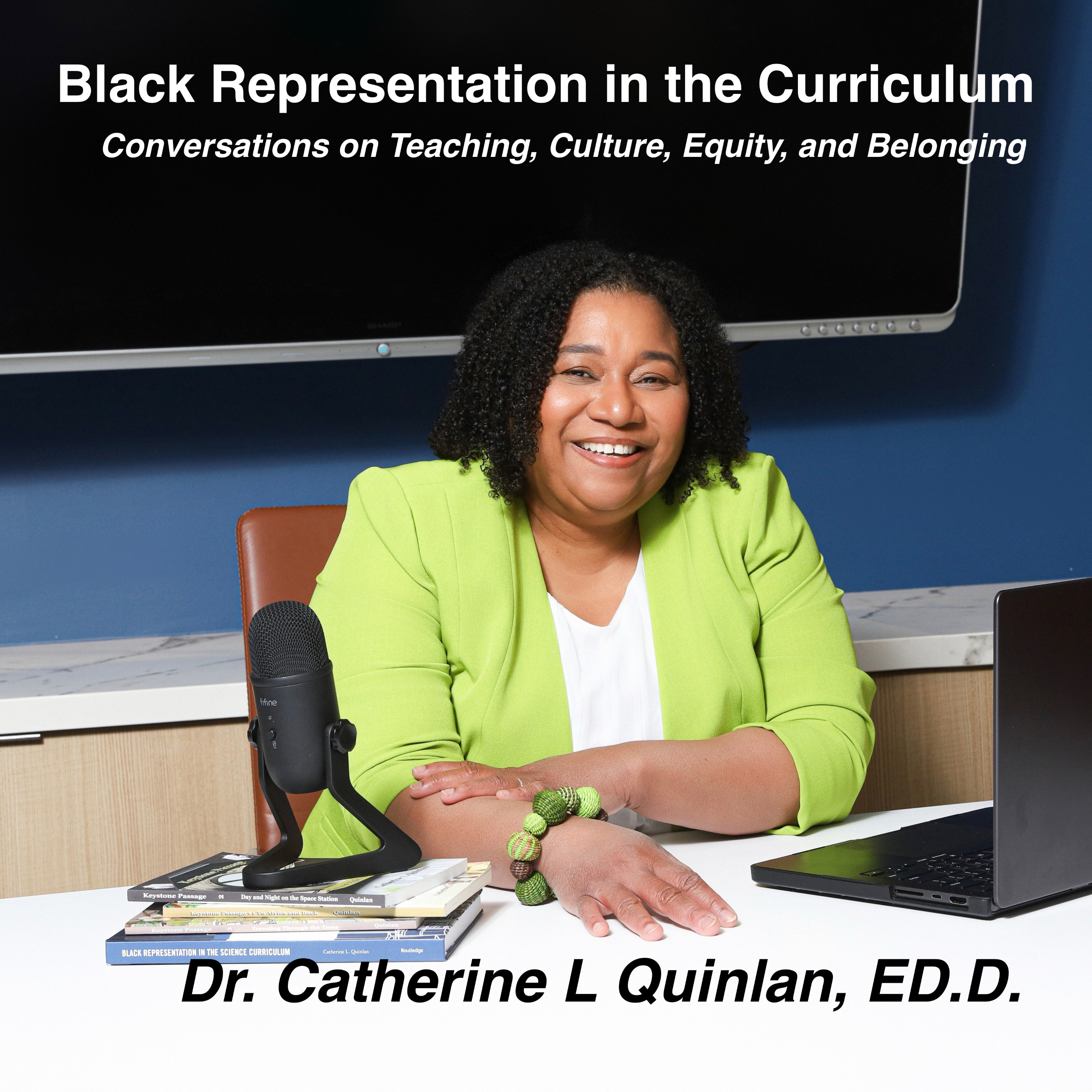
PODCAST · education
Black Representation in the Curriculum: Conversations on Teaching, Culture, Equity, and Belonging
by Dr. Catherine Quinlan
Black Representation in the Curriculum explores how representation shapes learning, identity, and opportunity in schools and society. Hosted by Dr. Catherine Quinlan, curriculum design expert and endowed chair professor in science education, the podcast connects research with real-life experiences to look at teaching, culture, equity, and belonging. Through open conversations with families, educators, school leaders, scholars, and other members of society we highlight real stories and lived experiences to help create learning spaces where Black students are seen, supported, and deeply valued.
-
53
The Power of Marcus Garvey's Philosophy ft. Geoffrey Philp
In this episode of Black Representation in the Curriculum, Catherine Quinlan engages in a deep conversation with Geoffrey Philp about his educational journey, the significance of lived experiences in teaching, and the impact of Marcus Garvey on education. They explore the challenges faced by Black students in the education system and the need for a curriculum that reflects their identities and histories. Philp emphasizes the importance of understanding one's self and the intergenerational struggles that shape the Black experience, advocating for a more inclusive and representative educational framework. In this conversation, Geoffrey Philp shares his extensive experience in education and his dedication to the legacy of Marcus Garvey. He discusses the importance of identity in education, the flaws in the current educational system, and the need for self-reliance and economic empowerment within the Black community. Philp emphasizes the principles of mind, purpose, and perseverance as essential for success, drawing parallels between Garvey's teachings and contemporary challenges, including the impact of AI on the workforce. He also highlights the significance of preparing future generations for these changes and the role of education in affirming identity. In this conversation, Geoffrey Philp and Catherine Quinlan explore the profound influences of Marcus Garvey and Bob Marley on culture and identity, the importance of self-help and mental emancipation, and the complexities surrounding figures like James Baldwin. They discuss the impact of shame on decision-making and the systems of control that often hinder empowerment. The dialogue emphasizes the need for action in discovering one's purpose and the historical context of Rastafari and Garvey's philosophies. In this conversation, Geoffrey Philp and Catherine Quinlan explore themes of empowerment, cultural identity, and the historical context of Rastafari and African unity. They discuss the importance of self-acceptance, the impact of representation on children, and the role of education in fostering inquiry and understanding. The conversation also touches on the idea of mental slavery and the need for a revolution rooted in love and unity, emphasizing the significance of children in liberation movements.About Geoffrey Philp: Geoffrey Philp is a Jamaican-American author, educator, and Garvey scholar. Founder of The Garvey Classroom LLC and the Mabrak Books imprint, he teaches at the Marcus Garvey Education Academy, founded by Dr. Julius W. Garvey. His courses and resources have earned the endorsement of Dr. Julius W. Garvey and Professor Rupert Lewis of the University of the West Indies, Mona. A recipient of the Silver Musgrave Medal in Literature from the Institute of Jamaica, the Marcus Garvey Excellence Award in Education from the Consulate General of Jamaica in Miami, and the Marcus Garvey Community Service Award from the Rootz Foundation, Philp has spent more than three decades building the books, courses, and educational resources that place Garvey's philosophy in the hands of the next generation.Here is the link to The Story of Marcus Garvey: The Story of Marcus Garvey - The Garvey ClassroomBooks & Media: Books & Media - The Garvey ClassroomAbout the Host: Dr. Catherine L. Quinlan, ED.D. I am a researcher, professor, and curriculum design expert.I currently hold the Brenda B. Brodie Endowed Chair for Teacher Education inthe School of Education at North Carolina Central University. Learn more about me and my research on my websites andYouTube channels. For more information visit my websites: Personal Website of Dr. Catherine L. Quinlan: https://drcatherinequinlan.comhttps://visibilityinstem.com/TEDx Talk: The ClarityWe Need For BelongingRecent Academic Book: https://www.routledge.com/9781032757193Keystone Passage Chapter Book SeriesCheck out the podcast: SpotifyYouTubeAppleAmazon MusiciHeart Radio
-
52
Navigating Media in Parenting. The Challenges of Raising Self-Confident Kids ft. Keeana Saxon, Esq.
In this conversation, Catherine Quinlan and Keeana Saxon discuss the unique challenges of raising children with a high self-concept in today's media-saturated environment. They explore the importance of co-watching media, addressing sensitive topics, and the impact of literature on children's values. Keeana shares her experiences with her daughter, emphasizing the need for intentional discussions about media content and the complexities of navigating children's exposure to adult themes. The conversation also touches on the aspirations for Black children and the role of quality programming like PBS in shaping positive narratives. In this conversation, Keeana Saxon and Catherine Quinlan discuss the need for a dedicated platform for Black educational content, akin to a Black PBS. They explore the importance of media ownership, the challenges of maintaining authenticity in artistic expression, and the systemic disparities in society. They emphasize the need for solutions that focus on education and representation for children, particularly through initiatives like Kidogo Productions.About Keeana S. Saxon, Esq. :Keeana S. Saxon, Esq. was born in Washington D.C., raised in Newton, Massachusetts, and currently resides in the Jamaica Plain neighborhood of Boston with her husband and their 10-year-old daughter. She graduated from Spelman College in 1999 (Classical Piano Performance major, French minor). In 2003, she earned her Juris Doctor from Western New England University School of Law.After a decade of practicing law in both the public and private sectors, she was appointed in 2014 by the Mayor of Boston to be a Commissioner on the Boston Licensing Board where she still serves. Ms. Saxon also teaches classical piano to beginner students.She is also the Founder and CEO of Kidogo Productions, an award-winning edtainment startup, closing the representation gap through its preschool learning kits for daycares and families. Kidogo Productions can be found on Youtube, IG, LinkedIn, and FaceBook @kidogoproductions.In May 2023, Ms. Saxon gave a TEDx talk, “A Mother’s Mission Against Anti-Black Bias in Children’s Media.”Kidogo Productions: https://www.kidogoproductions.comTEDx Talk: A Mother’s Mission Against Anti-Blackness in Children’s Media: https://youtu.be/7734jYfdd-U?si=GxTtwlRtvdjZinsdAbout the Host: Dr. Catherine L. Quinlan, ED.D. I am a researcher, professor, and curriculum design expert. I currently hold the Brenda B. Brodie Endowed Chair for Teacher Education in the School of Education at North Carolina Central University. Learn more about me and my research on my websites and YouTube channels. For more information visit my websites: Personal Website of Dr. Catherine L. Quinlan: https://drcatherinequinlan.comVisibility In STEM Education Consultant/Services: https://visibilityinstem.com/TEDx Talk: The ClarityWe Need For Belonging: https://www.youtube.com/watch?v=o3xAD3I3x-M&feature=youtu.beRecent Academic Book: Black Representation in the Science Curriculum: Implications for Identity, Culture, Belonging, and Curriculum Development. https://www.routledge.com/9781032757193Keystone Passage,Chapter Series Book: https://keystonepassage.comCheck out the podcast: Spotify: https://open.spotify.com/show/6IlAjleK06X35gdoGqylGH YouTube: https://www.youtube.com/@drcatherinequinlan Apple: https://podcasts.apple.com/us/podcast/black-representation-in-the-curriculum-conversations/id1785560564Music: https://music.amazon.com/podcasts/649118d6-1db7-4273-aa01-bfd495703f71/learning-for-truth-and-love iHeart Radio: https://www.iheart.com/podcast/269-black-representation-in-th-248725998/
-
51
Legacy and Innovation in Black Education. Healing Through Community ft. Dr. Alexis Riley
In this episode of Black Representation in the Curriculum, Dr. Alexis Riley discusses her work centered on the legacy, innovations, and healing of Black women science teachers. She shares her journey as a first-generation college student, the challenges she faced, and the importance of womanist pedagogy in education. The conversation highlights the need for more Black representation in medicine and the critical role of community in supporting Black educators. In this conversation, Alexis Riley shares her educational journey from a magnet school to her experiences in medical internships, ultimately leading to her transformation from a chemistry major to a sociology major. She discusses the importance of Black feminist theory and critical race theory in understanding systemic oppression and the significance of counter narratives in social justice. The dialogue emphasizes the need for diverse perspectives in academia and the power of storytelling in challenging dominant narratives.About Dr. Alexis D. Riley:Alexis D. Riley, Ph.D. (she/her) is a teacher-educator, writer, and Stevie Wonder enthusiast. She is a Tenure-Track Assistant Professor at New York University-Steinhardt in the Teaching & Learning Department, in the Science Education Program. Originally from South Central Los Angeles, CA, Alexis earned her Ph.D. in Science Education from Teachers College, Columbia University in the Fall of 2021. She received her MS.Ed at Fordham University in 2013 and her B.A. in Sociology from the University of California - Santa Barbara in 2011. Alexis has been faculty at California State University - Los Angeles, Barnard College, and Relay Graduate School of Education as an Assistant Professor and Adjunct Assistant Professor, respectively. Alexis’ research has prioritized the legacy, innovations, and healing of Black women teachers by placing their instinctual and improvisational teaching skills at the center of science education. She has major publications in journals such as Review of Educational Research, the Journal of Research in Science Teaching, the Journal of Science Teacher Education, Cultural Studies of Science Education, and Race Ethnicity, and Education. She served on the Board of Directors for the ASTE, Alexis has used her position to push the science education field to meet the unique realities of teachers and students of color. Her research and scholarship are heavily informed by her decades' worth of experience as a secondary Science and History teacher, and curriculum and instruction specialist in public and charter schools in Harlem and Brooklyn.Link to publications About the Host: Dr. Catherine L. Quinlan, ED.D. Researcher, professor, curriculum design expert.I currently hold the Brenda B. Brodie Endowed Chair for Teacher Education inthe School of Education at North Carolina Central University. Learn more about me and my research on my websites andYouTube channels. For more information visit my websites: Personal Website: https://drcatherinequinlan.comVisibility In STEM: https://visibilityinstem.com/TEDx Talk: The ClarityWe Need For Belonging: https://www.youtube.com/watch?v=o3xAD3I3x-M&feature=youtu.beRecent Academic Book: Black Representation in the ScienceCurriculum: Implications for Identity, Culture, Belonging, and CurriculumDevelopment. https://www.routledge.com/9781032757193Keystone Passage,Chapter Series Book: https://keystonepassage.comCheck out the podcast: Spotify: https://open.spotify.com/show/6IlAjleK06X35gdoGqylGH YouTube: https://www.youtube.com/@drcatherinequinlan Apple: https://podcasts.apple.com/us/podcast/black-representation-in-the-curriculum-conversations/id1785560564 Music: https://music.amazon.com/podcasts/649118d6-1db7-4273-aa01-bfd495703f71/learning-for-truth-and-love iHeart Radio: https://www.iheart.com/podcast/269-black-representation-in-th-248725998/
-
50
Community Connections and Supporting Students ft. Ebony Burnett
In this episode, Ebony Burnett shares her journey from growing up in poverty to becoming a candidate for the Guilford County Schools Board of Education. With over 24 years of experience in education and community engagement, she emphasizes the importance of addressing basic needs, mental health support, and community involvement in education. Ebony discusses the challenges faced by students in Guilford County, including disparities in academic outcomes and the need for safe adults in schools. She encourages community members to support local schools through volunteering and mentorship. In this conversation, Catherine Quinlan and Ebony Burnett explore the systemic challenges faced by underfunded communities, particularly focusing on the historical impact of redlining and the importance of empowering these communities through education and resources. They discuss the role of after-school programs in providing safe spaces for youth, the need for partnerships with educational institutions, and the significance of civic engagement in amplifying community voices. The dialogue emphasizes the necessity of addressing basic needs to foster meaningful participation in local politics and community development.About Ebony Burnett: Ebony Burnett is a passionate community leader, educator, and advocate dedicated to improving outcomes for children and families. With more than 20 years of experience in education, youth development, and community engagement, she currently serves as Vice President of Strategic Partnerships at a local education-focused non-profit in Guilford County. Ebony leads collaborative efforts that connect schools, businesses, nonprofits, and community leaders around student success and economic mobility.A former teacher and longtime YMCA leader, Ebony is known for bringing people together to turn big ideas into meaningful action. Her work has focused on expanding access to high-quality out-of-school time programs, strengthening family and community partnerships, and helping create systems that better support young people from cradle to career.Ebony has received numerous honors for her leadership and impact, including the Community Empowerment Leader Award from the Lieutenant Governor, the Excellence in Leadership Award from the YMCA, and recognition as one of the Triad’s 40 Under 40 Most Influential African Americans.At the heart of her work is a simple belief: every child deserves a champion. When she’s not building partnerships or advocating for students, Ebony enjoys leadership conversations, community events, affordable family adventures, and finding ways to make serious work feel a little more human.About the Host: Dr. Catherine L. Quinlan, ED.D. I am a researcher, professor, and curriculum design expert.I currently hold the Brenda B. Brodie Endowed Chair for Teacher Education in the School of Education at North Carolina Central University. Learn more about me and my research on my websites andYouTube channels. For more information visit my websites: Personal Website: https://drcatherinequinlan.comVisibility In STEM: https://visibilityinstem.com/TEDx Talk: The ClarityWe Need For Belonging: https://www.youtube.com/watch?v=o3xAD3I3x-M&feature=youtu.beRecent Academic Book: Black Representation in the ScienceCurriculum: Implications for Identity, Culture, Belonging, and CurriculumDevelopment. https://www.routledge.com/9781032757193Keystone Passage,Chapter Series Book: https://keystonepassage.comCheck out the podcast: Spotify: https://open.spotify.com/show/6IlAjleK06X35gdoGqylGH YouTube: https://www.youtube.com/@drcatherinequinlan Apple: https://podcasts.apple.com/us/podcast/black-representation-in-the-curriculum-conversations/id1785560564 Music: https://music.amazon.com/podcasts/649118d6-1db7-4273-aa01-bfd495703f71/learning-for-truth-and-love iHeart Radio: https://www.iheart.com/podcast/269-black-representation-in-th-248725998/
-
49
From Street Shooter to Independent Filmmaker: Will Adams' Journey
In this episode of Black Representation in the Curriculum, host Catherine Quinlan engages with filmmaker Will Adams, discussing his journey as an independent filmmaker, the creative challenges he faces, and the inspiration behind his latest project, 'Tube-e Movie'. The conversation delves into the unique aspects of independent filmmaking, the importance of satire, and the influences that shaped his work. Will shares insights into the collaborative process of filmmaking, the significance of representation, and his future projects, emphasizing the need for creativity and authenticity in storytelling. In this conversation, independent filmmaker Will Adams shares his journey in the film industry, emphasizing the importance of being multifaceted as a creator. He discusses the freedom of independent filmmaking, the significance of storytelling, and the empowerment of female characters in his works. Adams reflects on his writing journey, the challenges he faced, and the lessons learned along the way, ultimately highlighting the universal appeal of comedy and the importance of strong narratives. In this conversation, Will Adams shares his unique creative process in filmmaking, discussing how he transitions from TV to film, the influence of his Chicago roots on storytelling, and the challenges faced in the industry. He emphasizes the importance of character development, persistence, and the evolving role of AI in storytelling. The discussion concludes with insights on the future of filmmaking and the significance of being prepared and efficient on set.About Will Adams:Will Adams is an award-winning Chicago filmmaker, director, and producer and the founder of Lokekey Productions, a fiercely independent production company dedicated to bold urban storytelling and amplifying new voices in film.Known for turning limitations into launchpads, Adams has built a reputation for creating high-quality, thought-provoking films regardless of budget or circumstance. His early feature films, Sex Ain’t Love and Step Off the Block, established him as a fearless voice in relationship dramas and urban coming-of-age stories. During the COVID-19 shutdown, he pivoted quickly, launching the viral digital series Plight of the Independent Filmmaker, proving that creative resilience can outpace industry disruption.In 2024, Adams expanded into sharp satire with Tube‑E Movie, a comedy that skewers streaming culture and the “so-bad-it’s-good” movie trend. The film earned festival buzz at the Urban Film Festival and Chicago IndieCon, further solidifying his reputation for culturally relevant storytelling with a comedic edge.Across short films, features, and digital series, Adams blends hard-hitting drama with razor-sharp comedy, consistently platforming underrepresented talent and stories. With multiple projects in development for 2025, he continues pushing the boundaries of independent cinema — proving that visionary storytelling is fueled by perseverance, not permission.https://lokekey.comView 2024 Tube‑E Movie for free on Plex About the Host: Dr. Catherine L. Quinlan, ED.D. I am a researcher, professor, and curriculum design expert. I currently hold the Brenda B. Brodie Endowed Chair for Teacher Education in the School of Education at North Carolina Central University. Learn more about me and my research on my websites and YouTube channels. For more information visit my websites: Personal Website of Dr. Catherine L. Quinlan: https://drcatherinequinlan.comVisibility In STEM: https://visibilityinstem.com/TEDx Talk: The ClarityWe Need For Belonging: Recent Academic Book: Black Representation in the Science Curriculum: Implications for Identity, Culture, Belonging, and Curriculum Development. Keystone Passage, Chapter Series BookCheck out the podcast: Spotify YouTube Apple Podcast Amazon MusiciHeart Radio
-
48
The Cost of Being ‘Strong’: Black Women, Burnout, and Unlearning Everything ft. Dr. Whitley Grant-Goodman
In this insightful interview, Dr. Whitley Grant-Goodman discusses the mental health challenges faced by Black women, including racial trauma, burnout, and identity issues. She shares practical strategies for organizations and individuals to foster psychological safety, set boundaries, and challenge harmful stereotypes, emphasizing the importance of unlearning societal narratives and promoting self-care.About Dr. Whitley Grant-Goodman:Dr. Whitley Grant-Goodman is a therapist, speaker, and organizational wellness advocate dedicated to helping high-achieving Black women navigate burnout, boundaries, relationships, and the pressures of constantly being “the strong one.” With over a decade of experience in mental health and higher education, she specializes in creating conversations around racial trauma, emotional wellness, psychological safety, and sustainable success for Black women in both personal and professional spaces. Through her work as a clinician and speaker, Dr. Grant-Goodman helps individuals and organizations move beyond survival mode and build environments that support healing, authenticity, and well-being. She is passionate about helping Black women redefine success in ways that prioritize rest, community, and mental health without sacrificing ambition. Dr. Grant-Goodman is available for speaking engagements, workshops, panels, and organizational trainings focused on mental wellness, burnout prevention, psychological safety, and the experiences of high-achieving Black women.Whitley Grant-Goodman, PhD | LinkedInCalendar Link: Consult CallWebsite: www.whitleygrantgoodman.comHealing While Black Journal: Healing While Black: A Self-Guided Journal for Navigating Racial Trauma | Whitley Grant GoodmanAbout the Host: Dr. Catherine L. Quinlan, ED.D. I am a researcher, professor, and curriculum design expert.I currently hold the Brenda B. Brodie Endowed Chair for Teacher Education inthe School of Education at North Carolina Central University. Learn more about me and my research on my websites andYouTube channels. For more information visit my websites: Personal Website of Dr. Catherine L. Quinlan: https://drcatherinequinlan.comVisibility In STEM Education Consultant/Services: https://visibilityinstem.com/TEDx Talk: The ClarityWe Need For Belonging: https://www.youtube.com/watch?v=o3xAD3I3x-M&feature=youtu.beRecent Academic Book: Black Representation in the ScienceCurriculum: Implications for Identity, Culture, Belonging, and CurriculumDevelopment. https://www.routledge.com/9781032757193Keystone Passage,Chapter Series Book: https://keystonepassage.comCheck out the podcast: Spotify: https://open.spotify.com/show/6IlAjleK06X35gdoGqylGH YouTube: https://www.youtube.com/@drcatherinequinlan Apple: https://podcasts.apple.com/us/podcast/black-representation-in-the-curriculum-conversations/id1785560564 Music: https://music.amazon.com/podcasts/649118d6-1db7-4273-aa01-bfd495703f71/learning-for-truth-and-love iHeart Radio: https://www.iheart.com/podcast/269-black-representation-in-th-248725998/
-
47
Creating Inclusive School Cultures Through Brain Science ft. Dr. Lisa Riegel
In this episode of Black Representation in the Curriculum, Dr. Lisa Riegel discusses her journey from teaching to leadership in education, emphasizing the importance of neuroscience in understanding student engagement and behavior. She highlights the need for collective identity and belonging in schools, particularly for Black students, and how cultural values impact educational practices. Dr. Riegel advocates for creating safe and supportive learning environments that foster motivation and engagement, while also addressing the challenges teachers face in implementing these changes. In this conversation, Lisa A Riegel and Catherine Quinlan explore the critical themes of self-awareness, teacher effectiveness, parent engagement, cultural sensitivity, and the impact of societal assumptions on education. They discuss the importance of understanding the underlying fears that drive teacher behavior, the need for genuine partnerships between parents and schools, and the significance of adapting educational practices to align with diverse cultural values. The conversation emphasizes the role of brain science in fostering emotional safety and transformative change in educational leadership.About Dr. Lisa Riegel:Lisa Riegel started her career in education, driven by one goal: to help people reach their potential. Over time, she realized that fulfillment—whether in a classroom, company, or community—comes from understanding how the brain drives behavior and how systems shape success.That discovery became the foundation for her life’s work. As an educator, researcher, and author, she has spent two decades helping schools, leaders, parents, and organizations align brain science with human systems—creating cultures where people feel connected, capable, and in control of their growth.Dr. Riegel earned dual bachelor's degrees in English and Secondary Education from Kent State University. She holds a master's degree in curriculum and instruction from Otterbein University and a Ph.D. in Education Policy and Leadership from The Ohio State University. Her work has appeared in peer-reviewed journals and she has authored five books, including her two latest books, NeuroWell, and Aspirations to Operations, focused on brain science and how we can leverage it to help people become happier, healthier, and more successful.Book linksNeuroWellAspirations to OperationsStop Doing What Doesn't WorkAuthor page: https://www.amazon.com/s?k=lisa+riegel&crid=30TTDXLJRNQMO&sprefix=lisa+riegel%2Caps%2C158&ref=nb_sb_noss_2About the Host: Dr. Catherine L. Quinlan, ED.D. I am a researcher, professor, and curriculum design expert.I currently hold the Brenda B. Brodie Endowed Chair for Teacher Education inthe School of Education at North Carolina Central University. Learn more about me and my research on my websites andYouTube channels. For more information visit my websites: Personal Website of Dr. Catherine L. Quinlan: https://drcatherinequinlan.comVisibility In STEM Education Consultant/Services: https://visibilityinstem.com/TEDx Talk: The ClarityWe Need For Belonging: https://www.youtube.com/watch?v=o3xAD3I3x-M&feature=youtu.beRecent Academic Book: Black Representation in the ScienceCurriculum: Implications for Identity, Culture, Belonging, and CurriculumDevelopment. https://www.routledge.com/9781032757193Keystone Passage,Chapter Series Book: https://keystonepassage.comCheck out the podcast: Spotify: https://open.spotify.com/show/6IlAjleK06X35gdoGqylGH YouTube: https://www.youtube.com/@drcatherinequinlan Apple: https://podcasts.apple.com/us/podcast/black-representation-in-the-curriculum-conversations/id1785560564 Music: https://music.amazon.com/podcasts/649118d6-1db7-4273-aa01-bfd495703f71/learning-for-truth-and-love iHeart Radio: https://www.iheart.com/podcast/269-black-representation-in-th-248725998/
-
46
Diving into Research: A Marine Biologist's Journey ft. Dr. Stanton G. Belford
In this episode, Dr. Stanton Belford shares his unique journey from growing up on a Caribbean island to becoming a marine biologist in the United States. He discusses the importance of experiential learning, mentorship, and the role of confidence in engaging with marine environments. Dr. Belford emphasizes the significance of representation in marine science and the need for effective science communication to inspire future generations. His research focuses on coral reefs and the diverse marine life they support, highlighting the interconnectedness of education, research, and community engagement. In this conversation, Stanton Belford shares his journey in marine biology, emphasizing the importance of storytelling, mentorship, and hands-on experiences in fostering a love for the ocean. He discusses the diverse paths that lead individuals to marine biology, the role of parents in shaping interests, and the significance of coral reefs and sea urchins in marine ecosystems. The conversation highlights the need for experiential learning and the impact of research on understanding and preserving marine life. In this conversation, Stanton Belford discusses the culinary delights of the ocean, the economic impact of marine tourism, and the ecological importance of sea urchins and oysters. He emphasizes the role of environmental DNA in marine research and the significance of sustainable practices in preserving marine ecosystems. The dialogue also touches on the connection between past and present in marine science, highlighting the importance of hands-on experiences and sharing knowledge across cultures.About Dr. Stanton G. Belford, PhD:Dr. Stanton G. Belford is an Associate Professor of Biology and Department Head of the School of Mathematics and Sciences at the University of Tennessee Southern. He is in his 13th year at UT Southern, where he teaches lower and upper-level biology courses, such as Ecology, Invertebrate Zoology, Vertebrate Zoology, and General Ichthyology. His research uses DNA barcoding techniques to assist with species identification on coral reefs located in the Caribbean. He also conducts similar research on crayfish species located in Tennessee. He graduated from Auburn University with a PhD. in Secondary Science Education and holds a Master’s degree in Biology from Middle Tennessee State University.Dr. Belford continues to lead undergraduate research by taking students to conduct benthic surveys and molecular analyses that provide valuable knowledge of species biodiversity in the southern Caribbean region. Dr. Belford serves on the board of director for BIMS and is the chair of CADASE.Website: stantonbelford.comInstagram: stan_b_phdLinkedIn: www.linkedin.com/in/dr-stanton-g-belford-98083044About the Host: Dr. Catherine L. Quinlan, ED.D. I am a researcher, professor, and curriculum design expert. I currently hold the Brenda B. Brodie Endowed Chair for Teacher Education in the School of Education at North Carolina Central University. Learn more about me and my research on my websites and YouTube channels. For more information visit my websites: https://drcatherinequinlan.comhttps://keystonepassage.comhttps://visibilityinstem.com/TEDx Talk: The ClarityWe Need For Belonging: https://www.youtube.com/watch?v=o3xAD3I3x-M&feature=youtu.beBook: Black Representation in the Science Curriculum: Implications for Identity, Culture, Belonging, and Curriculum Development. https://www.routledge.com/9781032757193Check out the podcast: Spotify: https://open.spotify.com/show/6IlAjleK06X35gdoGqylGHYouTube: https://www.youtube.com/@drcatherinequinlanApple: https://podcasts.apple.com/us/podcast/black-representation-in-the-curriculum-conversations/id1785560564Music: https://music.amazon.com/podcasts/649118d6-1db7-4273-aa01-bfd495703f71/learning-for-truth-and-loveiHeart Radio: https://www.iheart.com/podcast/269-black-representation-in-th-248725998/
-
45
Uncovering Hidden Histories. The Disconnect from Culture and Its Consequences ft. Dr. Lenora Crabtree
In this episode of Black Representation in the Curriculum, Dr. Lenora Crabtree shares her journey as a teacher educator and her insights on the importance of understanding diverse narratives in education. In this conversation, Catherine Quinlan and Lenora Crabtree explore the intersections of race, culture, and identity, discussing the impact of historical narratives on contemporary society. They delve into the power dynamics of nutrition, the construction of race, and the cultural losses experienced by various ethnic groups. The discussion also touches on the epigenetic effects of harm, the influence of patriarchy on self-perception, and the challenges of raising conscious children in a racially charged environment. They discuss the importance of embracing multiculturalism, the historical context of the Pellagra epidemic, and the socio-political dynamics of the 1920s. The dialogue emphasizes the need for personal responsibility and the liberation that comes from understanding and valuing diverse perspectives. The dialogue emphasizes the challenges of confronting painful truths, the need for change, and the power of learning from one another.About Dr. Lenora M. CrabtreeDr. Lenora Crabtree began her journey as an educator learning alongside high school science students in Gaston County, North Carolina over 25 years ago. In her current position as an Instructor in the Cato College of Education at the University of North Carolina Charlotte, she encourages teachers and teacher candidates to become co-learners with their students. Alongside her work in teacher education, Dr. Crabtree is a science education researcher and curriculum designer whose scholarship explores the potential for justice-oriented science teaching and learning to support the development of critical consciousness and discipline-specific critical science consciousness. Her publications also include a study of the “Gifted Gap” in one school district and its impact on access to STEM education and, ultimately, economic mobility. Beyond her professional work, Dr. Crabtree is a mother, grandmother, and godmother. She and her husband live just outside of Durham, North Carolina with a growing menagerie of chickens, dogs, rabbits, pigeons, and honey-producing bees.GOOGLE DRIVE RESOURCES: Birth of a Movement Case Study: https://drive.google.com/drive/folders/1vOU08VSqhGS4bY3K1Cg9h0uVFSxwCiKt The Epidemic That Didn't Have to Happen:https://drive.google.com/drive/folders/1HX3OKTOFsi-gjE8TbgM2zNvDn1FOTBWyAbout the Host: Dr. Catherine L. Quinlan, ED.D. I am a researcher, professor, and curriculum design expert. I currently hold the Brenda B. Brodie Endowed Chair for Teacher Education in the School of Education at North Carolina Central University. Learn more about me and my research on my websites and YouTube channels. For more information visit my websites: Personal Website of Dr.Catherine L. Quinlan: https://drcatherinequinlan.comVisibility In STEMEducation Consultant/Services: https://visibilityinstem.com/TEDx Talk: The ClarityWe Need For Belonging: https://www.youtube.com/watch?v=o3xAD3I3x-M&feature=youtu.beRecent Academic Book: Black Representation in the Science Curriculum: Implications for Identity, Culture, Belonging, and Curriculum Development. https://www.routledge.com/9781032757193Keystone Passage,Chapter Series Book: https://keystonepassage.comCheck out the podcast:Learning, for Truth and Love: Spotify: https://open.spotify.com/show/6IlAjleK06X35gdoGqylGH YouTube: https://www.youtube.com/@drcatherinequinlan Podcasts https://podcasts.apple.com/us/podcast/learning-for-truth-and-love/id1785560564 Music: https://music.amazon.com/podcasts/649118d6-1db7-4273-aa01-bfd495703f71/learning-for-truth-and-love iHeart Radio: https://www.iheart.com/podcast/269-learning-for-truth-and-lov-248725998/
-
44
Navigating Entrepreneurship and Overcoming Setbacks in the Beauty Industry
In this inspiring interview, Latoya Fry shares her entrepreneurial journey, challenges with a scam company, and her passion for beauty and community. Discover valuable insights on building relationships, overcoming adversity, and the importance of support and mindset in business. Latoya Frye shares her insights on building a successful beauty supply business, the importance of community, and overcoming barriers faced by Black entrepreneurs. Discover practical tips on networking, mindset shifts, and maintaining integrity in business.00:55 Latoya's Entrepreneurial Journey26:18 Faith and Resilience: Overcoming Challenges Together36:15 Embracing Community: The Key to Success45:24 Understanding Hair Health and Client Concerns48:15 The Importance of Knowledge in Cosmetology56:55 Finding Your Passion and Purpose in Business58:57 Hair Care Analogies and Insights01:07:07 The Importance of Reputation in Entrepreneurship01:07:36 Finding Your 'Why' in Business01:11:58 Challenges Faced by Black Entrepreneurs01:14:32 Barriers in the Beauty Supply Industry01:20:53 Inequities in Access to Resources01:29:52 Final Thoughts on Entrepreneurship and CommunityAbout Latoya Frye:Latoya Frye is a wife, mother, entrepreneur, and woman of faith dedicated to purpose, impact, and legacy. Married for over 12 ½ years to her husband and business partner, Etienne Frye, she is the proud mother of one amazing child, Lavarus Frye, who continues to inspire her strength and drive daily.As the co-founder of All Crowns Beauty Supply, Latoya is passionate about empowering her community through beauty, education, and access to quality products. What started as a vision has grown into a purpose-driven business focused on building generational wealth, uplifting others, and creating opportunities for growth in underserved communities.A native of Chicago now rooted in Raleigh, North Carolina, Latoya’s journey has been shaped by resilience, faith, and determination. From overcoming challenges as a young mother to stepping boldly into entrepreneurship and ministry, she carries a testimony of perseverance and grace.Above all, Latoya is a daughter and diva of God’s Kingdom, committed to walking in purpose, serving others, and inspiring those around her to trust God fully even in uncertain seasons.https://www.facebook.com/profile.php?id=61552847571013https://www.tiktok.com/@allcrownsbeautysu?is_from_webapp=1&sender_device=pchttps://www.instagram.com/allcrownsbeautysupply1/About the Host: Dr. Catherine L. Quinlan, ED.D. I am a researcher, professor, and curriculum design expert. I currently hold the Brenda B. Brodie Endowed Chair for Teacher Education in the School of Education at North Carolina Central University. Learn more about me and my research on my websites and YouTube channels. For more information visit my websites: Personal Website of Dr.Catherine L. Quinlan: https://drcatherinequinlan.comVisibility In STEMEducation Consultant/Services: https://visibilityinstem.com/TEDx Talk: The ClarityWe Need For Belonging: https://www.youtube.com/watch?v=o3xAD3I3x-M&feature=youtu.beRecent Academic Book: Black Representation in the Science Curriculum: Implications for Identity, Culture, Belonging, and Curriculum Development. https://www.routledge.com/9781032757193Keystone Passage,Chapter Series Book: https://keystonepassage.comCheck out the podcast:Learning, for Truth and Love: Spotify: https://open.spotify.com/show/6IlAjleK06X35gdoGqylGH YouTube: https://www.youtube.com/@drcatherinequinlan Podcasts https://podcasts.apple.com/us/podcast/learning-for-truth-and-love/id1785560564Music: https://music.amazon.com/podcasts/649118d6-1db7-4273-aa01-bfd495703f71/learning-for-truth-and-love iHeart Radio: https://www.iheart.com/podcast/269-learning-for-truth-and-lov-248725998/
-
43
Unlocking Black Emotional Intelligence. A New Leadership Paradigm ft. Dr. Issac Carter
In this episode, Catherine Quinlan engages in a deep conversation with Dr. Issac Carter about the importance of Black representation in education, the journey to finding one's authentic voice, and the challenges faced within higher education. Dr. Carter shares his experiences transitioning from academia to coaching and discusses the role of hip hop in shaping identity. In this conversation, Issac Carter and Catherine Quinlan delve into the concept of Black emotional intelligence, exploring its foundations in Afrocentricity and its implications for leadership and community. They discuss the importance of emotional sovereignty, the role of Black feminism, and the need to challenge traditional masculinity and violence. In this conversation, Issac Carter and Catherine Quinlan explore the themes of emotional intelligence, particularly Black Emotional Intelligence, and its significance in navigating conflict and fostering community. They discuss the role of music as a universal language that connects people and serves as a metaphor for collaboration and harmony. The dialogue also touches on redefining success beyond monetary achievements, emphasizing the importance of community impact and the contributions of various unsung heroes. Additionally, they delve into the potential of AI in cultural representation and the upcoming coaching initiatives aimed at leadership development.About Dr. Issac CarterIn this conversation, we’re joined by Issac M. Carter, PhD, founder of Coaching Imperative. Issac is an executive leadership coach, educator, strategist, and systems-change facilitator with more than 25 years of experience across corporate, nonprofit, higher education, and civic spaces.His work sits at the intersection of emotional intelligence, cultural intelligence, somatic awareness, and creative practice. He designs leadership experiences and frameworks that draw on ancestral wisdom, lived experience, and musicking to understand how people lead, relate, and move together.At the core of his approach is a powerful belief: when leaders learn to listen more deeply—to themselves, to others, and to the systems they are part of, they unlock new possibilities for connection, performance, and collective well-being.Issac is also the creator of Black Emotional Intelligence, BLKEQ, a leadership framework and way of life rooted in Afrocentricity, relational intelligence, and the practice of being fully human in complex systems.About the Host: Dr. Catherine L. Quinlan, ED.D. I am a researcher, professor, and curriculum design expert. I currently hold the Brenda B. Brodie Endowed Chair for Teacher Education in the School of Education at North Carolina Central University. Learn more about me and my research on my websites and YouTube channels. For more information visit my websites: Personal Website of Dr.Catherine L. Quinlan: https://drcatherinequinlan.comVisibility In STEMEducation Consultant/Services: https://visibilityinstem.com/TEDx Talk: The ClarityWe Need For Belonging: https://www.youtube.com/watch?v=o3xAD3I3x-M&feature=youtu.beRecent Academic Book: Black Representation in the Science Curriculum: Implications for Identity, Culture, Belonging, and Curriculum Development. https://www.routledge.com/9781032757193Keystone Passage,Chapter Series Book: https://keystonepassage.comCheck out the podcast:Learning, for Truth and Love: Spotify: https://open.spotify.com/show/6IlAjleK06X35gdoGqylGH YouTube: https://www.youtube.com/@drcatherinequinlan Podcasts https://podcasts.apple.com/us/podcast/learning-for-truth-and-love/id1785560564 Music: https://music.amazon.com/podcasts/649118d6-1db7-4273-aa01-bfd495703f71/learning-for-truth-and-love iHeart Radio: https://www.iheart.com/podcast/269-learning-for-truth-and-lov-248725998/
-
42
Cultural Knowledge: A Key to Liberation ft. Dr. Joyce E. King
This conversation explores the significance of Black representation in education, focusing on the work of Dr. Joyce E King. The discussion delves into her journey, the importance of cultural knowledge, and the role of HBCUs in fostering rich educational experiences. It also addresses the challenges of dominant narratives in education and the impact of heritage knowledge on curriculum development. The conversation highlights personal journeys and the complexities of identity, including the role of shame in learning. In this conversation, Catherine Quinlan explores the intricate relationship between community, identity, and education, particularly in the context of Black experiences. She emphasizes the importance of community support, the challenges faced by Black parents in the education system, and the need for a constructivist approach to learning. The discussion also delves into the impact of historical narratives on current perceptions and the role of teachers in shaping educational experiences. Additionally, the conversation touches on the future of education in the age of AI and the ongoing need for critical thinking.About Dr. Joyce E. King:Dr. Joyce E. King, (BA, Sociology (with honors); PhD, Social Foundations of Education, Stanford University) serves as the Benjamin E. Mays Endowed Chair for Urban Teaching, Learning & Leadership and Professor of Educational Policy Studies at Georgia State University. She is also affiliated with the Africana Studies Department, the Women’s and Gender Studies Institute, and the Urban Studies Institute. She was the founding Chair of the Mills College Ethnic Studies Department; a visiting faculty member in the Stanford University School of Education; and she was Director of Teacher Education at Santa Clara University for twelve years. Dr. King has held senior academic leadership positions at Medgar Evers College (CUNY) and the University of New Orleans; and she was Provost of Spelman College. As W.K. Kellogg National Fellowship she studies women’s participation in grassroots social change; and she studied higher education leadership as an American Council on Education Fellowship recipient. Dr. King was a member of California’s Curriculum Commission and the National African American Reparations Commission; she is a board member of the Institute for Food and Development Policy (FoodFirst.org), The Marcus Garvey Institute for Human Development, and the Western Institute for Social Research (WISR). Her many awards include Stanford University’s Graduate School of Education Alumni Excellence in Education Award, Georgia State University’s Innovation in International Education faculty award, and the Sheth International Education Award. She founded the Guardians of Heritage international youth civic leadership collaborative. Dr. King is a past-president of the American Educational Research Association and an elected member of the National Academy of Education. Her research has been supported by grants from the Spencer Foundation and the Black Teacher Archive at the Harvard Graduate School of Education. Her widely recognized scholarship includes 9 books, more than 75 publications, and her concepts of “dysconscious racism” and “heritage knowledge” continue to influence research and practice in education and sociology in the U.S. and in other countries.A biography2018 Alumni Excellence Award Ceremony Black Studies Podcast The Talking Drum Podcast About the Host: Dr. Catherine L. Quinlan, ED.D. I am a researcher, professor, and curriculum design expert. I currently hold the Brenda B. Brodie Endowed Chair for Teacher Education in the School of Education at North Carolina Central University. Learn more about me and my research on my websites and YouTube channels:Personal WebsiteVisibility In STEMTEDx Talk Recent Academic Book on Black Representation in the Science CurriculumKeystone Passage, Chapter Series BookPodcast Links:Spotify YouTube AppleAmazon MusiciHeart Radio
-
41
Going Beyond Ceremony in STEM Education
This episode shares a talk I gave on Friday April 9, 2021 titled: Creating and Evaluating a Culturally Representative STEM Curriculum Supported by the Next Generation Science Standards. This presentation shares some of the thinking that went into my curricula products as well as my recent book on Black Representation in the Science Curriculum: Implications for Identity, Culture, Belonging, and Curriculum Development. This presentation highlights some of the predispositions addressed in part 1 of my book and reflects the work in my last academic position. I also share illustrations from my chapter series children’s books throughout this presentation. About thIs talk: Dr. Catherine Quinlan’s presentation focuses on the importance of creating inclusive STEM educational materials that reflect African American culture and heritage. She emphasizes the need to incorporate the experiences and narratives of Black heritage into science education, reposition perspectives on African American contributions, and understand the impact of identity on educational practices. The discussion also highlights the Gullah Geechee community's struggles and resilience in the face of environmental challenges, advocating for a more inclusive and representative approach to STEM education.About the Host: Dr. Catherine L. Quinlan, ED.D. I am a researcher, professor, and curriculum design expert.I currently hold the Brenda B. Brodie Endowed Chair for Teacher Education inthe School of Education at North Carolina Central University. Learn more about me and my research on my websites andYouTube channels. For more information visit my websites: Personal Website of Dr.Catherine L. Quinlan: https://drcatherinequinlan.comVisibility In STEMEducation Consultant/Services: https://visibilityinstem.com/TEDx Talk: The ClarityWe Need For Belonging: https://www.youtube.com/watch?v=o3xAD3I3x-M&feature=youtu.beRecent Academic Book: Black Representation in the ScienceCurriculum: Implications for Identity, Culture, Belonging, and Curriculum Development. https://www.routledge.com/9781032757193Keystone Passage,Chapter Series Book: https://keystonepassage.comCheck out the podcast:Learning, for Truth and Love: Spotify:https://open.spotify.com/show/6IlAjleK06X35gdoGqylGH YouTube: https://www.youtube.com/@drcatherinequinlan Podcasts https://podcasts.apple.com/us/podcast/learning-for-truth-and-love/id1785560564 Music: https://music.amazon.com/podcasts/649118d6-1db7-4273-aa01-bfd495703f71/learning-for-truth-and-love iHeart Radio: https://www.iheart.com/podcast/269-learning-for-truth-and-lov-248725998/
-
40
How Curriculum Shapes Black Children's Identity and Confidence (Part 2 of September 14, 2020 webinar on Cultural Inclusion and Representation)
This episode shares a panel discussion that provides perspectives from Black mothers. In this podcast I share a webinar I gave years ago on September 14, 2020, titled, Cultural Inclusion and Representation in Formal and Informal Settings. This presentation provided a sneak peek into some of the auxiliary products I created to accompany my funded project looking at the lived experiences and narratives of African American Gullah/Geechee in the STEM curricula. This podcast shares the last part of the webinar after Dr. Dawn Dow's presentation on "The Deadly Challenges of Raising African American Boys: Black Mothers Navigating the Controlling Image of the 'Thug.' " In this episode you get a glimpse into the questions asked as well as a panel discussion we had as Black mothers. I encourage you to check out Dr. Dawn Dow's work and her book on Mothering While Black on her website: https://www.dawndow.com/book-mothering-while-blackThese conversations among others were important for informing the direction of my work. AI show notes: This interview explores the persistent racial biases in education and policing, the impact of curriculum on Black children's identity, and strategies for fostering positive racial perceptions. Experts discuss implicit bias, curriculum reform, and community-based approaches to support Black youth.This webinar shares some of my beginning thoughts about this work, which I am sharing out more widely now, as I begin to embark on the next stages of this work. YouTube Channel for Classroom: https://www.youtube.com/@visibilityinstemCurricula Website: https://visibilityinstem.com/About the Host: Dr. Catherine L. Quinlan, ED.D. I am a researcher, professor, and curriculum design expert. I currently hold the Brenda B. Brodie Endowed Chair for Teacher Education in the School of Education at North Carolina Central University. Learn more about me and my research on my websites and YouTube channels. For more information visit my websites: Personal Website of Dr.Catherine L. Quinlan: https://drcatherinequinlan.comVisibility In STEMEducation Consultant/Services: https://visibilityinstem.com/TEDx Talk: The ClarityWe Need For Belonging: https://www.youtube.com/watch?v=o3xAD3I3x-M&feature=youtu.beRecent Academic Book: Black Representation in the Science Curriculum: Implications for Identity, Culture, Belonging, and Curriculum Development. https://www.routledge.com/9781032757193Keystone Passage,Chapter Series Book: https://keystonepassage.comCheck out the podcast:Learning, for Truth and Love: Spotify: https://open.spotify.com/show/6IlAjleK06X35gdoGqylGH YouTube: https://www.youtube.com/@drcatherinequinlan Podcasts https://podcasts.apple.com/us/podcast/learning-for-truth-and-love/id1785560564 Music: https://music.amazon.com/podcasts/649118d6-1db7-4273-aa01-bfd495703f71/learning-for-truth-and-love iHeart Radio: https://www.iheart.com/podcast/269-learning-for-truth-and-lov-248725998/
-
39
Unlocking Student Agency Through African Heritage in Science Curriculum (Part 1 of September 14, 2020 webinar on Cultural Inclusion and Representation)
In this podcast I share a webinar I gave years ago on September 14, 2020, titled, Cultural Inclusion and Representation in Formal and Informal Settings. This presentation provided a sneak peek into some of the auxiliary products I created to accompany my funded project looking at the lived experiences and narratives of African American Gullah/Geechee in the STEM curricula. For purposes of this podcast only the first part is shared in this episode. You'll find some of this work in my recent academic book on Black Representation in the Science Curriculum: Implications for Identity, Culture, Belonging, and Curriculum Development.AI show notes: Dr. Catherine Quinlan shares her NSF-funded research on culturally inclusive STEM curriculum for African Americans, emphasizing the importance of narratives, representation, and hands-on activities like African rock art analysis to foster identity and agency in students. This webinar shares some of my beginning thoughts about this work, which I am sharing out more widely now, as I begin to embark on the next stages of this work. YouTube Channel for Classroom: https://www.youtube.com/@visibilityinstemCurricula Website: https://visibilityinstem.com/About the Host: Dr. Catherine L. Quinlan, ED.D. I am a researcher, professor, and curriculum design expert. I currently hold the Brenda B. Brodie Endowed Chair for Teacher Education in the School of Education at North Carolina Central University. Learn more about me and my research on my websites and YouTube channels. For more information visit my websites: Personal Website of Dr.Catherine L. Quinlan: https://drcatherinequinlan.comVisibility In STEMEducation Consultant/Services: https://visibilityinstem.com/TEDx Talk: The ClarityWe Need For Belonging: https://www.youtube.com/watch?v=o3xAD3I3x-M&feature=youtu.beRecent Academic Book: Black Representation in the Science Curriculum: Implications for Identity, Culture, Belonging, and Curriculum Development. https://www.routledge.com/9781032757193Keystone Passage,Chapter Series Book: https://keystonepassage.comCheck out the podcast:Learning, for Truth and Love: Spotify: https://open.spotify.com/show/6IlAjleK06X35gdoGqylGH YouTube: https://www.youtube.com/@drcatherinequinlan Podcasts https://podcasts.apple.com/us/podcast/learning-for-truth-and-love/id1785560564 Music: https://music.amazon.com/podcasts/649118d6-1db7-4273-aa01-bfd495703f71/learning-for-truth-and-love iHeart Radio: https://www.iheart.com/podcast/269-learning-for-truth-and-lov-248725998/
-
38
Food Adaptations and the Making of Sugar
This video clip is a small part of the work I've done to include the lived experiences and narratives of Black people and Black heritage in the science curricula. You can download a free public report I created to showcase some of this work from this link: https://qubeshub.org/publications/3849/1Classroom link can be found on this YouTube channel: https://www.youtube.com/@visibilityinstemAbout the Host: Dr. Catherine L. Quinlan, ED.D. I am a researcher, professor, and curriculum design expert. I currently hold the Brenda B. Brodie Endowed Chair for Teacher Education in the School of Education at North Carolina Central University. Learn more about me and my research on my websites and YouTube channels. For more information visit my websites: Personal Website of Dr.Catherine L. Quinlan: https://drcatherinequinlan.comVisibility In STEMEducation Consultant/Services: https://visibilityinstem.com/TEDx Talk: The ClarityWe Need For Belonging: https://www.youtube.com/watch?v=o3xAD3I3x-M&feature=youtu.beRecent Academic Book: Black Representation in the Science Curriculum: Implications for Identity, Culture, Belonging, and Curriculum Development. https://www.routledge.com/9781032757193Keystone Passage,Chapter Series Book: https://keystonepassage.comCheck out the podcast:Learning, for Truth and Love: Spotify: https://open.spotify.com/show/6IlAjleK06X35gdoGqylGH YouTube: https://www.youtube.com/@drcatherinequinlan Podcasts https://podcasts.apple.com/us/podcast/learning-for-truth-and-love/id1785560564 Music: https://music.amazon.com/podcasts/649118d6-1db7-4273-aa01-bfd495703f71/learning-for-truth-and-love iHeart Radio: https://www.iheart.com/podcast/269-learning-for-truth-and-lov-248725998/
-
37
Oysters Beds and Tabby Sustainability Practices
This video clip is a small part of the work I've done to include the lived experiences and narratives of Black people and Black heritage in the science curricula. You can download a free public report I created to showcase some of this work from this link: https://qubeshub.org/publications/3849/1Classroom link can be found on this YouTube channel: https://www.youtube.com/@visibilityinstemThe conversation explores the cultural significance of oysters and seashells in Gullah culture, highlighting their historical use as currency and their role in sustainable practices. Catherine Quinlan discusses the construction technique of tabby, made from oyster shells, and reflects on the ecological wisdom of the Gullah people, emphasizing their respect for nature and sustainable living.About the Host: Dr. Catherine L. Quinlan, ED.D. I am a researcher, professor, and curriculum design expert. I currently hold the Brenda B. Brodie Endowed Chair for Teacher Education in the School of Education at North Carolina Central University. Learn more about me and my research on my websites and YouTube channels. For more information visit my websites: Personal Website of Dr.Catherine L. Quinlan: https://drcatherinequinlan.comVisibility In STEMEducation Consultant/Services: https://visibilityinstem.com/TEDx Talk: The ClarityWe Need For Belonging: https://www.youtube.com/watch?v=o3xAD3I3x-M&feature=youtu.beRecent Academic Book: Black Representation in the Science Curriculum: Implications for Identity, Culture, Belonging, and Curriculum Development. https://www.routledge.com/9781032757193Keystone Passage,Chapter Series Book: https://keystonepassage.comCheck out the podcast:Learning, for Truth and Love: Spotify: https://open.spotify.com/show/6IlAjleK06X35gdoGqylGH YouTube: https://www.youtube.com/@drcatherinequinlan Podcasts https://podcasts.apple.com/us/podcast/learning-for-truth-and-love/id1785560564 Music: https://music.amazon.com/podcasts/649118d6-1db7-4273-aa01-bfd495703f71/learning-for-truth-and-love iHeart Radio: https://www.iheart.com/podcast/269-learning-for-truth-and-lov-248725998/
-
36
Visibility In STEM - Native Practices and Plants that Heal
This video clip is a small part of the work I've done to include the lived experiences and narratives of Black people and Black heritage in the science curricula. You can download a free public report I created to showcase some of this work from this link: https://qubeshub.org/publications/3849/1Classroom link can be found on this YouTube channel: https://www.youtube.com/@visibilityinstemAI Summary of video clip for this podcast: This conversation explores the rich tradition of herbal medicine and the knowledge passed down through generations. Catherine Quinlan shares insights into how ancestral practices have shaped modern understanding of medicinal plants, emphasizing the importance of community and indigenous knowledge in healing. The discussion highlights specific plants, their uses, and the intersection of traditional and modern medicine.About the Host: Dr. Catherine L. Quinlan, ED.D. I am a researcher, professor, and curriculum design expert. I currently hold the Brenda B. Brodie Endowed Chair for Teacher Education in the School of Education at North Carolina Central University. Learn more about me and my research on my websites and YouTube channels. For more information visit my websites: Personal Website of Dr.Catherine L. Quinlan: https://drcatherinequinlan.comVisibility In STEMEducation Consultant/Services: https://visibilityinstem.com/TEDx Talk: The ClarityWe Need For Belonging: https://www.youtube.com/watch?v=o3xAD3I3x-M&feature=youtu.beRecent Academic Book: Black Representation in the Science Curriculum: Implications for Identity, Culture, Belonging, and Curriculum Development. https://www.routledge.com/9781032757193Keystone Passage,Chapter Series Book: https://keystonepassage.comCheck out the podcast:Learning, for Truth and Love: Spotify: https://open.spotify.com/show/6IlAjleK06X35gdoGqylGH YouTube: https://www.youtube.com/@drcatherinequinlan Podcasts https://podcasts.apple.com/us/podcast/learning-for-truth-and-love/id1785560564 Music: https://music.amazon.com/podcasts/649118d6-1db7-4273-aa01-bfd495703f71/learning-for-truth-and-love iHeart Radio: https://www.iheart.com/podcast/269-learning-for-truth-and-lov-248725998/
-
35
Exploring Identity and Belonging Challenges in STEM Education
In this podcast I share a talk I gave years ago on July 14, 2022 titled, Getting to Know Yourself and Understand Others. In some ways this talk shares some of the meanings and observations I have been wrestling with for some time and which have influenced my approach to curriculum development and to talking about issues related to equity and diversity. Parts of this talk appear in one chapter of my book which was released in August 2024. I thought it was important to highlight this talk given what we're all experiencing right now. It is important to note that my candidness does not mean I am against anyone or the field, but I do believe that this level of candor without rhetoric has overshadowed that which could lead to real change in our society. Does the field reflect society or does society reflect the field? See poll questionAI Summary Dr. Catherine Quinlan discusses the importance of understanding identity in education, particularly in STEM fields. She emphasizes the challenges of belonging for people of color and the impact of identity on students' self-efficacy and persistence in science. Through personal anecdotes and historical context, she highlights the need for educators to connect with their students and foster an inclusive environment. The conversation also touches on the significance of peer mentoring and the role of discourse identity in shaping educational experiences.TakeawaysMany issues we face today are complex and require integrated approaches.Belonging is particularly challenging for people of color in STEM.Identity in science education is problematic for underrepresented groups.Using identity to connect with students can enhance their sense of belonging.Peer mentoring is crucial for student success and comfort in academic settings.Historical perceptions of identity influence current educational experiences.Discourse identity plays a significant role in how students are recognized and validated.Connection with students can improve overall educational outcomes.Understanding one's own identity can help in connecting with others.Educators should actively seek to connect with students from diverse backgrounds.About the Host: Dr. Catherine L. Quinlan, ED.D. I am a researcher, professor, and curriculum design expert. I currently hold the Brenda B. Brodie Endowed Chair for Teacher Education in the School of Education at North Carolina Central University. Learn more about me and my research on my websites and YouTube channels. For more information visit my websites: Personal Website of Dr.Catherine L. Quinlan: https://drcatherinequinlan.comVisibility In STEMEducation Consultant/Services: https://visibilityinstem.com/TEDx Talk: The ClarityWe Need For Belonging: https://www.youtube.com/watch?v=o3xAD3I3x-M&feature=youtu.beRecent Academic Book: Black Representation in the Science Curriculum: Implications for Identity, Culture, Belonging, and Curriculum Development. https://www.routledge.com/9781032757193Keystone Passage,Chapter Series Book: https://keystonepassage.comCheck out the podcast:Learning, for Truth and Love: Spotify: https://open.spotify.com/show/6IlAjleK06X35gdoGqylGH YouTube: https://www.youtube.com/@drcatherinequinlan Podcasts https://podcasts.apple.com/us/podcast/learning-for-truth-and-love/id1785560564 Music: https://music.amazon.com/podcasts/649118d6-1db7-4273-aa01-bfd495703f71/learning-for-truth-and-love iHeart Radio: https://www.iheart.com/podcast/269-learning-for-truth-and-lov-248725998/
-
34
The Invisible Backpack of Shame: AI Rendition of My TEDx Talk "The Clarity We Need for Belonging"
My TEDx Talk titled, The Clarity We Need For Belonging, was published by TED.com over 3 years ago. This interpretation of my monologue into dialogue form reminds me of the first time my son came home and said they used AI in class to look up something. I was quite disappointed that the task to use AI did not do more than look up something. It’s like using the internet search engine. What a missed opportunity! My Original TEDx Talk: https://youtu.be/o3xAD3I3x-M?si=5oSV4PKUVk8b__nwhttps://www.ted.com/talks/catherine_quinlan_the_clarity_we_need_for_belongingCan you spot the difference? Listen to this 16-minute AI rendition and dramatization using dialogue and compare it with my original 8-minute TEDx Talk monologue. How might you interpret this similarly or differently? Can you identify differences? Which do you prefer? Which resonates with you the most? Which is more vulnerable or shaming to me? How? Why? Overall, despite a few errors, some caused by my omission of a few details and others by limitations to AI, this rendition brings the TEDx Talk home providing a different perspective. Write your reactions and interpretations in the comments. AI Summary: In this TEDx Talk, researcher Catherine Quinlan explores the profound connection between identity, shame, and the sense of belonging. Drawing from her personal life as a mother and her professional work in science education, she illustrates how societal narratives often marginalize Black accomplishments through isolation and shaming. She argues that children internalize these cultural scripts early on, which can lead to a rejection of their own heritage or the devaluing of others. By examining the historical exclusion of figures like Ed Dwight, she highlights how systemic shaming forces individuals to distance themselves from their successes. Ultimately, Quinlan calls for a collective self-reflection to identify and break these cycles of shame. She asserts that true social inclusion is only possible when we achieve clarity regarding how we shame ourselves and those around us.Further thoughts:My recent discovery of this AI tool showed me that as an instructor I need to further re-think which assignments I emphasize in my courses. I am grateful, and in light of current concerns lucky, that I have mainly focused on having students not only apply but also create, execute, and demonstrate what they learn - for example using tasks that requires multimedia artefacts for electronic portfolios. About the Host: Dr. Catherine L. Quinlan, ED.D. I am a researcher, professor, and curriculum design expert. I currently hold the Brenda B. Brodie Endowed Chair for Teacher Education in the School of Education at North Carolina Central University. Learn more about me and my research on my websites and YouTube channels. For more information visit my websites: Personal Website of Dr.Catherine L. Quinlan: https://drcatherinequinlan.comVisibility In STEMEducation Consultant/Services: https://visibilityinstem.com/TEDx Talk: The ClarityWe Need For Belonging: https://www.youtube.com/watch?v=o3xAD3I3x-M&feature=youtu.beRecent Academic Book: Black Representation in the Science Curriculum: Implications for Identity, Culture, Belonging, and Curriculum Development. https://www.routledge.com/9781032757193Keystone Passage,Chapter Series Book: https://keystonepassage.comCheck out the podcast:Learning, for Truth and Love: Spotify: https://open.spotify.com/show/6IlAjleK06X35gdoGqylGH YouTube: https://www.youtube.com/@drcatherinequinlan Podcasts https://podcasts.apple.com/us/podcast/learning-for-truth-and-love/id1785560564 Music: https://music.amazon.com/podcasts/649118d6-1db7-4273-aa01-bfd495703f71/learning-for-truth-and-love iHeart Radio: https://www.iheart.com/podcast/269-learning-for-truth-and-lov-248725998/
-
33
Embracing Beauty. A Journey of Self-Discovery
In this episode, Catherine Quinlan engages with makeup artist Akila (Koko) and brand photographer Brianna Goode to explore the themes of self-discovery, beauty, and empowerment, particularly among Black women. The conversation delves into their personal journeys, the emotional aspects of beauty, and the importance of understanding individual needs and perceptions. They discuss the significance of confidence, the role of color in beauty, and the unique features that make each person special. The episode also touches on the impact of education and cultural appreciation in shaping their perspectives. In this conversation, the speakers explore their diverse backgrounds and experiences, particularly focusing on the cultural melting pot of Trinidad and Tobago and the unique educational environment at Howard University. They discuss the importance of Black history in education, the challenges of perfectionism, and the need for a more inclusive approach to learning that celebrates individuality and encourages exploration. The conversation emphasizes the significance of self-worth, the impact of cultural identity, and the importance of celebrating achievements in both personal and professional life.About Akila:Akila is a certified makeup artist from Trinidad and Tobago, based in Washington, DC, With over 10 years of experience, her infectious personality and keen eye make her the right choice for your next occasion. Whether helping to achieve an everyday natural look, teaching the how-to's of a glam look or supporting a bride on her special day, Makeup by Koko is ready to help you put your best face forward.Website - makeupbykoko.comInstagram - @makeupbykokodTik tok - @makeupbykokodAbout Bryanna Goode:Bryanna Goode is a Maryland-based brand photographer and creative leader passionate about empowering women-owned businesses through captivating visuals and compelling content. Maryland-raised and DMV-traveling, she brings a unique blend of artistry and strategy to help brands tell their stories authentically. To connect with Bryanna, book a consultation, and stay updated on all her work and social media, use the link below.https://linktr.ee/goodevisionsAbout the Host: Dr. Catherine L. Quinlan, ED.D. I am a researcher, professor, and curriculum design expert. I currently hold the Brenda B. Brodie Endowed Chair for Teacher Education in the School of Education at North Carolina Central University. Learn more about me and my research on my websites and YouTube channels. For more information visit my websites: Personal Website of Dr.Catherine L. Quinlan: https://drcatherinequinlan.comVisibility In STEMEducation Consultant/Services: https://visibilityinstem.com/TEDx Talk: The ClarityWe Need For Belonging: https://www.youtube.com/watch?v=o3xAD3I3x-M&feature=youtu.beRecent Academic Book: Black Representation in the Science Curriculum: Implications for Identity, Culture, Belonging, and Curriculum Development. https://www.routledge.com/9781032757193Keystone Passage,Chapter Series Book: https://keystonepassage.comCheck out the podcast:Learning, for Truth and Love: Spotify: https://open.spotify.com/show/6IlAjleK06X35gdoGqylGH YouTube: https://www.youtube.com/@drcatherinequinlan Podcasts https://podcasts.apple.com/us/podcast/learning-for-truth-and-love/id1785560564 Music: https://music.amazon.com/podcasts/649118d6-1db7-4273-aa01-bfd495703f71/learning-for-truth-and-love iHeart Radio: https://www.iheart.com/podcast/269-learning-for-truth-and-lov-248725998/
-
32
Advocacy Strategies for Black Families: Challenging Bias and Stereotypes in Schools
In this conversation, Cheryl Poe and Kathryn Wiley discuss the critical intersection of neurodivergence, advocacy, and racial inequality in education. They share their personal experiences and motivations for advocating for Black neurodivergent children, emphasizing the historical context of educational disparities. They also explore their collaborative research initiatives aimed at raising awareness and fostering community engagement. This conversation explores the importance of race-conscious education and the impact of systemic inequities on Black neurodivergent students. They emphasize the importance of empowering parents with knowledge and resources to navigate the educational system effectively. They emphasize the importance of political power in advocating for educational equity and the necessity for community empowerment through alternative education options like homeschooling. About Cheryl A. Poe, M.A.Mrs. Cheryl A Poe hold a Master’s Degree in Urban Education and Counseling and extensive postgraduate studies in psychology, Mrs. Poe brings a wealth of expertise. Cheryl A. Poe is a nationally recognized special education advocate, speaker, and trainer whose work centers on advancing equity for Black neurodivergent students and their families. As the Founder and Executive Director of Advocating 4 Kids, Inc., a Virginia-based nonprofit, Cheryl leads transformative advocacy and training initiatives that challenge systemic inequities within public education and empower parents to use their voices as agents of change. She is currently spearheading the Advocating While Black™ Research Project in collaboration with Dr. Kathryn E. Wiley of Howard University. This groundbreaking study examines how racial bias and ableism intersect to shape the educational experiences of Black students with disabilities across Virginia. The project not only documents the barriers families face but also uplifts their resilience, data-driven advocacy, and community-led solutions.Through her work, Cheryl has become a powerful voice for dismantling the policies and practices that harm Black neurodivergent youth. Her advocacy blends lived experience, professional expertise, and unapologetic truth-telling—reminding schools, policymakers, and communities that Black children deserve safety, belonging, and the full protection of the law.About Dr. Kathryn E. WileyDr. Kathryn E. Wiley is an Assistant Professor in the Department of Educational Leadership and Policy Studies at Howard University in the School of Education. She is an expert in school discipline, climate, and safety, with a focus on race and educational opportunity. She uses multiple methods and a historical lens to understand contemporary education policies in the context of longstanding racialized inequalities. An avid public scholar, she is passionate about supporting education leaders, advocates, organizers, lawmakers, and students in equity-oriented change. Dr. Wiley’s research has been published in Review of Educational Research, Educational Administration Quarterly, Race Ethnicity and Education, The Urban Review, among others. She perspectives on race, equity, and education policy have been featured in news outlets including Chalkbeat, EdWeek, EdTrust, and Inside Higher Ed.Her recent research projects include the (1) a multi-state study of civil rights advocacy strategies in the Southern U.S. under diminished federal civil rights enforcement (2) the Advocating While Black partnership with Advocating4Kids Inc., a project dedicated to advancing Black parental advocacy within K-12 special education systems and (3) Building racial literacy and civic engagement networks among white K-12 educators. She most recently served as a 2025 Senate Congressional Fellow where she worked on education policy. She has a Ph.D. in Educational Foundations, Policy, and Practice from the University of Colorado Boulder and is a proud Community College Graduate from Dayton, Ohio.
-
31
Navigating the Adolescent Journey with Tewanda Hardy
In this episode, Catherine Quinlan speaks with Tewanda Hardy, a counselor specializing in working with Black youth. Tewanda shares her journey from a corporate career to independent counseling, emphasizing the importance of supporting adolescents during their transition. The conversation explores the rising rates of mental health issues among youth, the impact of social media and comparison culture, and the generational gaps in expectations between parents and their children. Tewanda highlights the significance of addressing shame and vulnerability, advocating for critical thinking, and the challenges of navigating institutional identity versus personal values. In this conversation, Catherine Quinlan and Tewanda Hardy explore the complexities of parenting, identity, and the impact of societal beliefs on young people. They discuss the importance of questioning established beliefs, the difference between controlling and empowering parenting styles, and the role of boredom in fostering creativity. The conversation also delves into the challenges teenage boys face regarding their identity, the influence of media, and the necessity of creating safe spaces for emotional expression. Ultimately, they emphasize the need for simplicity in parenting and the importance of providing support to help young people navigate their journeys of self-discovery.About Tewanda Hardy, BSW, MSW:Founder & CEO, Project Inside Out Teens, LLCTewanda Hardy is a seasoned social worker with over 20 years of experience supporting youth, families, and communities through challenging life transitions. As the Founder and CEO of Project Inside Out Teens, LLC, she is deeply committed to helping teens evolve from the inside out by guiding them toward self-awareness, confidence, and emotional balance.Through private coaching sessions, support groups, and interactive workshops, Project Inside Out Teens empowers youth to see the good in themselves, navigate life’s pressures, strengthen resilience, and build a sense of true belonging.Vision: A world where every teen feels worthy, strong, creative, and connected. Mission: To help teens evolve through self-discovery, reflection, and emotional growth. Values: Confidence | Resilience | Critical Thinking | BelongingConnect with Tewanda here: https://blinq.me/mHcRMfvgoRLaLJK6ATciAbout the Host: Dr. Catherine L. Quinlan, ED.D. :I am a researcher, professor, and curriculum design expert. I currently hold the Brenda B. Brodie Endowed Chair for Teacher Education in the School of Education at North Carolina Central University. Learn more about me and my research on my websites and YouTube channels. For more information visit my websites: Personal Website of Dr.Catherine L. Quinlan: https://drcatherinequinlan.comVisibility In STEMSelected Education Work: https://visibilityinstem.com/TEDx Talk: The ClarityWe Need For Belonging: https://www.youtube.com/watch?v=o3xAD3I3x-M&feature=youtu.beRecent Academic Book:Black Representation in the Science Curriculum: Implications for Identity,Culture, Belonging, and Curriculum Development. https://www.routledge.com/9781032757193Keystone Passage,Chapter Series Book: https://keystonepassage.comCheck out the podcast:Learning, for Truth and Love: Spotify: https://open.spotify.com/show/6IlAjleK06X35gdoGqylGH YouTube: https://www.youtube.com/@drcatherinequinlan Podcasts https://podcasts.apple.com/us/podcast/learning-for-truth-and-love/id1785560564 Music: https://music.amazon.com/podcasts/649118d6-1db7-4273-aa01-bfd495703f71/learning-for-truth-and-love iHeart Radio: https://www.iheart.com/podcast/269-learning-for-truth-and-lov-248725998/
-
30
From Physics to Performance: A Unique Journey ft. Dr. Simone Hyater-Adams
In this engaging conversation, Dr. Simone Hyater-Adams shares her unique journey as a physicist who has navigated the intersection of arts and sciences. From her early influences in a musical family to her passion for astrophysics, Simone discusses the pivotal moments that shaped her career path. She reflects on her experiences in high school and college, the challenges of graduate school, and the importance of mentorship and supportive environments. Throughout the conversation, she emphasizes the significance of identity, particularly as a Black woman in STEM, and the impact of burnout on her journey. Ultimately, Simone's story is one of resilience, passion, and the pursuit of a fulfilling career that embraces both science and the arts. In this conversation, Simone Hyater-Adams shares her journey through academia, exploring the challenges of identity, representation, and the impact of environment on personal and professional growth. She discusses her experiences in predominantly white spaces, the importance of community, and her research on Black representation in STEM. The conversation also delves into her transition from academia to program development, her passion for integrating performance art into education, and her aspirations for the future.About Dr. Simone Hyater-Adams:Dr. Simone Hyater-Adams is a physicist, artist, educator, and researcher with a drive for creating more opportunities for Black STEM students. She received her B.S. in Physics from Hampton University, where she participated in several different research projects. She then pursued her doctoral studies at the University of Colorado Boulder (CU Boulder) where she was an NSF Graduate Research Fellow. Her graduate work used her personal experiences pursuing physics to guide interdisciplinary research examining the connections between performance art and identity for Black Physicists. This work was awarded the Harry Lustig Award from the American Physical Society’s Four Corners Section 2018 meeting. Since graduating, Simone has continued supporting Black and Brown STEM students and finding creative ways to combine her passions for both science and art. She spent time managing the National Mentoring Community at American Physical Society as well as the STEAM education programs at a New York based non-profit, STEM From Dance. Currently, she serves as Director of Academics for the STEM Ed non-profit, Full STEAM Forward, while also running a STEM and Arts Education consulting firm that works with universities and non-profits on research projects and educational programming at the intersection of STEM and Art.Linked in: https://www.linkedin.com/in/dr-saha/About the Host: Dr. Catherine L. Quinlan, ED.D. I am a researcher, professor, and curriculum design expert. I currently hold the Brenda B. Brodie Endowed Chair for Teacher Education in the School of Education at North Carolina Central University. Learn more about me and my research on my websites and YouTube channels. For more information visit my websites: Personal Website of Dr.Catherine L. Quinlan: https://drcatherinequinlan.comVisibility In STEMSelected Education Work: https://visibilityinstem.com/TEDx Talk: The ClarityWe Need For Belonging: https://www.youtube.com/watch?v=o3xAD3I3x-M&feature=youtu.beRecent Academic Book:Black Representation in the Science Curriculum: Implications for Identity,Culture, Belonging, and Curriculum Development. https://www.routledge.com/9781032757193Keystone Passage,Chapter Series Book: https://keystonepassage.comCheck out the podcast:Learning, for Truth and Love: Spotify: https://open.spotify.com/show/6IlAjleK06X35gdoGqylGH YouTube: https://www.youtube.com/@drcatherinequinlan Podcasts https://podcasts.apple.com/us/podcast/learning-for-truth-and-love/id1785560564 Music: https://music.amazon.com/podcasts/649118d6-1db7-4273-aa01-bfd495703f71/learning-for-truth-and-love iHeart Radio: https://www.iheart.com/podcast/269-learning-for-truth-and-lov-248725998/
-
29
From Bench to Advocacy: A Scientist's Journey ft. Dr. Simone Soso
In this conversation, Dr. Simone Soso shares her unconventional journey through STEM, highlighting her early influences, educational experiences, and the challenges she faced as a minority in the field. She discusses her transition from animal science to environmental science, her advocacy for diversity in STEM, and her career development through federal policy engagement. Dr. Soso also talks about her consulting work aimed at supporting minority-serving institutions and navigating the complexities of grant funding. In this conversation, Catherine Quinlan and Simone Soso explore the transition from bench science to advocacy, the importance of community in STEM fields, and the challenges of implicit bias in faculty selection. They discuss the need for change in academia, the complexities surrounding retirement, and the evolving landscape of career paths for millennials. The dialogue emphasizes the significance of personal fulfillment and the necessity of adapting to new realities in professional life.About Dr. Simone B. Soso (Guest):Dr. Simone B. Soso is an animal ecologist, and advocate for inclusion in STEM to build a nationally competitive US workforce. She is the Founder of STEM Futures Consulting. In this position she leads in the development of scientific convenings, grants, scientific publications, and professional development workshops for institutions of higher learning. She most recently served as the Assistant Director of Research & Workforce Development at the MSI STEM Research & Development Consortium (MSRDC), where she guided the development and execution of national, federally funded scientific research projects, professional development trainings, technical assistance workshops, and communities of practice for faculty and students at universities. Her work has consistently focused on strengthening Minority-serving institutional capacity, securing research funding, and advancing equitable participation in federally funded STEM initiatives.Her career has also bridged science and policy. She was awarded the prestigious AAAS Science and Technology Policy Fellowship, where she served at the National Science Foundation, further expanding her expertise in science policy, collaborative partnerships, and systemic change strategies to fill the needs of the U.S. STEM workforce. Beyond her professional appointments, Dr. Soso serves on the Board of Directors of One Health Lessons, where she supports a global volunteer network delivering K–12 education on environmental, animal, and public health. Website: http://www.stemfuturesgroup.comLinkedIn: Simone B. Soso, Ph.D. | LinkedInAbout host Dr. Catherine L. Quinlan, ED.D. I am a researcher, professor, and curriculum design expert. I currently hold the Brenda B. Brodie Endowed Chair for Teacher Education in the School of Education at North Carolina Central University. Learn more about me and my research on my websites and YouTube channels. https://drcatherinequinlan.comhttps://visibilityinstem.com/TEDx Talk: The ClarityWe Need For Belonging: https://www.youtube.com/watch?v=o3xAD3I3x-M&feature=youtu.beBlack Representation in the Science Curriculum: Implications for Identity,Culture, Belonging, and Curriculum Development. https://www.routledge.com/9781032757193Keystone Passage,Chapter Series Book: https://keystonepassage.comCheck out the podcast:Learning, for Truth and Love: Spotify: https://open.spotify.com/show/6IlAjleK06X35gdoGqylGH YouTube: https://www.youtube.com/@drcatherinequinlan Podcasts https://podcasts.apple.com/us/podcast/learning-for-truth-and-love/id1785560564 Music: https://music.amazon.com/podcasts/649118d6-1db7-4273-aa01-bfd495703f71/learning-for-truth-and-love iHeart Radio: https://www.iheart.com/podcast/269-learning-for-truth-and-lov-248725998/
-
28
The Benefits of Personalized Education. A Homeschooling Journey ft. Tara Harrison
In this conversation, Tara Harrison shares her journey into homeschooling, discussing the challenges and benefits of personalized education. She emphasizes the importance of developmental readiness, the need for movement in early education, and the value of field trips for real-world learning. The discussion also touches on socialization strategies for homeschooled children and the significance of self-esteem and identity in education. Harrison advocates for embracing diverse educational paths and highlights the supportive community that homeschooling can provide.Takeaways:Homeschooling allows for personalized learning experiences.Children benefit from learning at their own pace.Developmental readiness is crucial for effective learning.Field trips enhance real-world learning opportunities.Socialization can be achieved through various activities outside traditional schooling.Movement and physical activity are essential for young learners.Self-esteem and identity are important for children's confidence.Homeschooling can provide a supportive community for families.Parents should curate their children's social environments.Diverse educational paths can lead to successful outcomes.About the guest Tara Harrison: Tara Harrison is a mom to one boy. She is an educator and children’s book author. She has over 18 years of teaching experience most of it being on the elementary level; however, she has taught high school, middle school and community college students. Tara currently is the coordinator of a homeschool group and teaches at her son’s co-op. Tara has been homeschooling her son for 4 years. She also tutors students. Tara has written a children’s picture book under the name L.T. Harrison. The book is based on her son’s first year as a homeschooler. The book is currently available on Amazon and as an e-book through Barnes and Noble. You can follow her on Instagram @ltauthor28About the Host: Dr. Catherine L. Quinlan, ED.D. I am a researcher, professor, and curriculum design expert. I currently hold the Brenda B. Brodie Endowed Chair for Teacher Education in the School of Education at North Carolina Central University. Learn more about me and my research on my websites and YouTube channels. For more information visit my websites: Personal Website of Dr. Catherine L. Quinlan: https://drcatherinequinlan.comVisibility In STEM Education Consultant/Services: https://visibilityinstem.com/TEDx Talk: The Clarity We Need For Belonging: https://www.youtube.com/watch?v=o3xAD3I3x-M&feature=youtu.beRecent Academic Book: Black Representation in the Science Curriculum: Implications for Identity, Culture, Belonging, and Curriculum Development. https://www.routledge.com/9781032757193Keystone Passage, Chapter Series Book: https://keystonepassage.comCheck out the podcast: Learning, for Truth and Love: Spotify: https://open.spotify.com/show/6IlAjleK06X35gdoGqylGHYouTube: https://www.youtube.com/@drcatherinequinlanPodcasts https://podcasts.apple.com/us/podcast/learning-for-truth-and-love/id1785560564Music: https://music.amazon.com/podcasts/649118d6-1db7-4273-aa01-bfd495703f71/learning-for-truth-and-loveiHeart Radio: https://www.iheart.com/podcast/269-learning-for-truth-and-lov-248725998/
-
27
Navigating Academia. The Power of Coaching ft. Dr. Pamela Leggett-Robinson
In this conversation, Dr. Pamela Leggett-Robinson discusses her journey into coaching, the distinctions between coaching and mentoring, and the importance of coaching in academia. She emphasizes the need for faculty to have support systems in place to navigate the challenges of promotion and tenure, and how institutions can benefit from investing in the well-being of their faculty. The discussion also touches on the emotional aspects of coaching and the necessity for individuals to understand their own purpose within the academic landscape. In this conversation, Dr. Catherine Quinlan and Dr. Pamela Leggett-Robinson discuss the critical role of coaching and empowerment in higher education. They explore how faculty can better articulate their impact, the importance of empowering faculty and department chairs, and the need for institutions to recognize the humanity of their staff. The discussion emphasizes the necessity of coaching at all levels of academia to foster a healthier, more productive environment. They also touch on the challenges of institutional control and the importance of intentionality in coaching practices.About Dr. Pamela M. Leggett-Robinson (Guest)Pamela M. Leggett-Robinson is the CEO and Executive Director of PLR Consulting, Inc. PLR Consulting, Inc., a boutique consulting firm based in Atlanta, GA., is a trusted partner in empowering organizations and institutions to navigate complex challenges, retain diverse talent, and build sustainable programs that advance equity and excellence in STEM fields through program evaluation, project management, and evidence-based coaching. With more than 20 years of experience in higher education, Dr. Leggett-Robinson is a leader in driving meaningful change within the STEM ecosystem. Her distinguished track record includes success as both an External Evaluator (NSF RCN, IUSE, AGEP, INCLUDES; Google; Grunin Foundation) and as a PI/Co-PI (NSF DMR, PREM, STEP, Racial Equity), with her contributions documented through numerous publications and presentations. As an evidence-based coach, she has guided countless faculty, leaders, program managers, and principal investigators to enhance their leadership acumen, time management, and professionalism. Regardless of the area - evaluation, project management, or coaching - her unique approach integrates actionable strategies with a deep understanding of organizational dynamics, ensuring measurable and impactful results for individuals and their institutions. Dr. Leggett-Robinson holds a Ph.D. in Physical Organic Chemistry, a GSEC Certificate in Evidence-based Coaching, and a Certified Project Management Associate.When It's All Said & Done book bundleDemystifying Tenure & Promotion Amazon linkPLR Consulting websiteSocial media links: Linkedin, Instagram, and FacebookAbout the Host: Dr. Catherine L. Quinlan, ED.D. I am a researcher, professor, and curriculum design expert. I currently hold the Brenda B. Brodie Endowed Chair for Teacher Education in the School of Education at North Carolina Central University. Learn more about me and my research on my websites and YouTube channels. https://drcatherinequinlan.comhttps://visibilityinstem.com/TEDx Talk: The ClarityWe Need For Belonging: https://www.youtube.com/watch?v=o3xAD3I3x-M&feature=youtu.beBlack Representation in the Science Curriculum: Implications for Identity,Culture, Belonging, and Curriculum Development. https://www.routledge.com/9781032757193Keystone Passage,Chapter Series Book: https://keystonepassage.comCheck out the podcast:Learning, for Truth and Love: Spotify: https://open.spotify.com/show/6IlAjleK06X35gdoGqylGH YouTube: https://www.youtube.com/@drcatherinequinlan Podcasts https://podcasts.apple.com/us/podcast/learning-for-truth-and-love/id1785560564 Music: https://music.amazon.com/podcasts/649118d6-1db7-4273-aa01-bfd495703f71/learning-for-truth-and-love iHeart Radio: https://www.iheart.com/podcast/269-learning-for-truth-and-lov-248725998/
-
26
Faith and Education: The Bryant Family's Approach
In this episode, Catherine Quinlan interviews the Bryant family, who share their experiences with homeschooling and the importance of Christian values in their education. The family discusses the benefits of homeschooling, including socialization opportunities and the ability to focus on their faith. They emphasize the significance of teaching Christian values to their children and how faith guides their decisions. The conversation also touches on race, identity, and the message behind their book, which aims to promote inclusion and love. The Bryant family shares inspiring quotes and insights on success, patience, and trusting in God's plan.About The Bryant Family:The Bryants are a homeschooling, Christian family who strongly believe in the power of GOD'S WORD. They are excited to share this message through Trusting Timothy: A Story About Cheating.Our website is: trustingtimothy.com. We can also be followed at: https://www.instagram.com/trustingtimothy_official/About the Host: Dr. Catherine L. Quinlan, ED.D. I am a researcher, professor, and curriculum design expert. I currently hold the Brenda B. Brodie Endowed Chair for Teacher Education in the School of Education at North Carolina Central University. Learn more about me and my research on my websites and YouTube channels. For more information visit my websites: Personal Website of Dr. Catherine L. Quinlan: https://drcatherinequinlan.comVisibility In STEM Education Consultant/Services: https://visibilityinstem.com/TEDx Talk: The Clarity We Need For Belonging:https://www.youtube.com/watch?v=o3xAD3I3x-M&feature=youtu.beRecent Academic Book:Black Representation in the Science Curriculum: Implications for Identity, Culture, Belonging, and Curriculum Development. https://www.routledge.com/9781032757193Keystone Passage,Chapter Series Book (available everywhere books are sold): https://keystonepassage.com Check out the podcast:Learning, for Truth and Love: Spotify: https://open.spotify.com/show/6IlAjleK06X35gdoGqylGH YouTube: https://www.youtube.com/@drcatherinequinlan Podcasts https://podcasts.apple.com/us/podcast/learning-for-truth-and-love/id1785560564 Amazon Music: https://music.amazon.com/podcasts/649118d6-1db7-4273-aa01-bfd495703f71/learning-for-truth-and-love iHeart Radio: https://www.iheart.com/podcast/269-learning-for-truth-and-lov-248725998/
-
25
Empowering Black Boys Through Education ft. Dr. Jomo Mutegi
In this enlightening conversation, Dr. Jomo Mutegi and Dr. Catherine Quinlan explore the critical themes of education, parenting, and community empowerment for Black boys. They discuss the importance of relevant science education, the role of children's literature in representation, and the values that should be instilled in young boys. The conversation also delves into the challenges of navigating technology and media influence, the significance of boredom in fostering creativity, and the need for cultural identity in media representation. Ultimately, they emphasize the importance of community support and critical thinking in raising empowered children. Dr. Mutegi shares his journey in writing children's books that empower and represent Black narratives, while Quinlan emphasizes the need for positive representation in media. Together, they explore the challenges of parenting boys, the significance of virtues, and the necessity of creating opportunities for growth and exploration. The conversation concludes with valuable resources for parents and educators.About Dr. Jomo Mutegi:Jomo W. Mutegi is an Associate Professor of science education at Old Dominion University (ODU), Principal Investigator of the Mutegi STEM Learning Lab, and Past President of NARST (the National Association of Research in Science Teaching). NARST is the oldest, international professional association of science education researchers. Dr. Mutegi’s research aims to (a) examine the science knowledge of students of African descent, (b) understand how racialized experiences help to shape that science knowledge and (c) explore the development and implementation of socially transformative STEM curriculum and its impact on learners of African descent. His work appears in several respected journals including the Journal of Research in Science Teaching, Science Education, Teachers College Record, and The Science Teacher. He is a recipient of 2024 Outstanding Contributions to STEM Education Disruptor Award from the STEM Education Conference Advisory Board. Dr. Mutegi earned a dual bachelor’s degree in chemistry and biology from Gannon University, his doctoral degree in science education from Florida State University, and he completed a postdoctoral fellowship at the University of Pittsburgh. He is a husband and the father of two sons ages 28 and 9.Link shared in video: https://www.es2rp.org/Book: Kamau Njama Discovers Secrets of the Vanguard Order (Available everywhere books are sold)About the Host: Dr. Catherine L. Quinlan, ED.D. I am a researcher, professor, and curriculum design expert. I currently hold the Brenda B. Brodie Endowed Chair for Teacher Education in the School of Education at North Carolina Central University. Learn more about me and my research on my websites and YouTube channels. For more information visit my websites: Personal Website of Dr. Catherine L. Quinlan: https://drcatherinequinlan.comVisibility In STEM Education Consultant/Services: https://visibilityinstem.com/TEDx Talk: The Clarity We Need For Belonging:https://www.youtube.com/watch?v=o3xAD3I3x-M&feature=youtu.beRecent Academic Book:Black Representation in the Science Curriculum: Implications for Identity, Culture, Belonging, and Curriculum Development. https://www.routledge.com/9781032757193Keystone Passage,Chapter Series Book (available everywhere books are sold): https://keystonepassage.com Check out the podcast:Learning, for Truth and Love: Spotify: https://open.spotify.com/show/6IlAjleK06X35gdoGqylGH YouTube: https://www.youtube.com/@drcatherinequinlan Podcasts https://podcasts.apple.com/us/podcast/learning-for-truth-and-love/id1785560564 Amazon Music: https://music.amazon.com/podcasts/649118d6-1db7-4273-aa01-bfd495703f71/learning-for-truth-and-love iHeart Radio: https://www.iheart.com/podcast/269-learning-for-truth-and-lov-248725998/
-
24
Exploring the State of Mathematics Education
In this episode of Learning for Truth and Love, Dr. Kimberly Weems discusses her academic journey and the current state of mathematics education. The conversation explores the influence of family on learning, the importance of external experiences, and the challenges faced by students in the post-pandemic educational landscape. Dr. Weems emphasizes the need for continuous review, the role of group work, and the potential shift towards data science in the curriculum. The discussion also highlights the significance of building confidence in math, maintaining positive attitudes, and the balance between rote learning and understanding. Finally, recommendations for improving mathematics education are provided, focusing on enrichment programs and engaging teaching strategies.Chapters00:00Introduction to Learning for Truth and Love01:19Dr. Kimberly Weems: Academic Journey and Background13:19The State of Mathematics Today17:39Trends in Math Education and Student Preparedness24:33The Importance of Continuous Review in Math Learning25:55Understanding Learning Gaps and Student Frustration27:11The Role of Metacognition in Learning28:12Group Work vs. Individual Study: Finding Balance29:56Trends in Math Education: From Phonics to Data Science31:34Rethinking College Math Courses: Algebra vs. DataScience33:39Integrating Critical Thinking in Math Education35:51The Role of Calculus in High School Education38:05Teaching Strategies: Balancing Understanding and RoteLearning45:01Overcoming Student Challenges in Math Learning46:34Building Awareness in Learning48:38The Importance of Data Science50:53Innovative Approaches to Teaching Math53:18Engagement and Real-World Connections in Math55:42The Role of Class Size in Learning59:09Promoting Positive Attitudes Towards Math01:02:19Enrichment Programs and Their ImpactAbout Dr. Kimberly Weems: Dr. Kimberly S. Weems is Associate Professor and Interim Chair of the Department of Mathematics and Physics at North Carolina Central University (NCCU). She earned a BS in mathematics from Spelman College and an MA and PhD in applied mathematics with a concentration in statistics from the University of Maryland, College Park. Dr. Weems completed postdoctoral studies in the Department of Statistics at North Carolina State University, where she later joined the faculty and served for two years as Co-Director of Statistics Graduate Programs. After moving to NCCU, Dr. Weems provided leadership for the NCCU Bridge-to-PhD program with NC State, designed to equip students with advanced statistical methods for analyzing atomic-scale data. Her primary research interests include flexible statistical models for the analysis of count data. Her service to the mathematics and statistics communities includes the following: advisory board member of the Infinite Possibilities Conference for women of color in mathematics and member of the American Mathematical Society’s Committee on the Profession. Dr. Weems has received teaching excellence awards from NCCU and NC State. In addition, she is a recipient of the Trailblazer Award from the University of Maryland Black Alumni Association.About the Host: Dr. Catherine L. Quinlan, ED.D. I am a researcher, professor, and curriculum design expert. I currently hold the Brenda B. Brodie Endowed Chair for Teacher Education in the School of Education at North Carolina Central University. Personal Website of Dr. Catherine L. QuinlanTEDx Talk: The Clarity We Need For BelongingBlack Representation in the Science Curriculum: Implications for Identity, Culture, Belonging, and Curriculum Development. Keystone Passage, Chapter Series BookLearning, for Truth and Love: Spotify: https://open.spotify.com/show/6IlAjleK06X35gdoGqylGHYouTube: https://www.youtube.com/@drcatherinequinlanPodcasts https://podcasts.apple.com/us/podcast/learning-for-truth-and-love/id1785560564Other platforms
-
23
Navigating the Challenges of Parenting Black Boys ft. Dr. Jomo Mutegi
In this conversation, Dr. Jomo W. Mutegi discusses the complexities of parenting Black boys, emphasizing the importance of virtues, historical context, and resilience. He shares insights on navigating education, societal expectations, and the necessity of hardship for personal development. The dialogue highlights the unique challenges faced by Black families and the critical role of cultural understanding in shaping parenting strategies.About Dr. Jomo Mutegi:Jomo W. Mutegi is an Associate Professor of science education at Old Dominion University (ODU), Principal Investigator of the Mutegi STEM Learning Lab, and Past President of NARST (the National Association of Research in Science Teaching). NARST is the oldest, international professional association of science education researchers. Dr. Mutegi’s research aims to (a) examine the science knowledge of students of African descent, (b) understand how racialized experiences help to shape that science knowledge and (c) explore the development and implementation of socially transformative STEM curriculum and its impact on learners of African descent. His work appears in several respected journals including the Journal of Research in Science Teaching, Science Education, Teachers College Record, and The Science Teacher. He is a recipient of 2024 Outstanding Contributions to STEM Education Disruptor Award from the STEM Education Conference Advisory Board. Dr. Mutegi earned a dual bachelor’s degree in chemistry and biology from Gannon University, his doctoral degree in science education from Florida State University, and he completed a postdoctoral fellowship at the University of Pittsburgh. He is a husband and the father of two sons ages 28 and 9.Link shared in video: https://www.es2rp.org/Takeaways• Dr. Mutegi emphasizes the importance of virtues in education.• Understanding history is crucial for Black children.• Parenting Black boys comes with unique challenges.• Cultural context shapes parenting styles and expectations.• Navigating education requires awareness of systemic issues.• Hardship is essential for personal development.• Risk exposure is necessary for learning and growth.• Perseverance is a key trait for success.• Societal expectations can hinder Black youth's potential.• Embracing hardship can lead to resilience and strength.About the Host: Dr. Catherine L. Quinlan, ED.D. I am a researcher, professor, and curriculum design expert. I currently hold the Brenda B. Brodie Endowed Chair for Teacher Education in the School of Education at North Carolina Central University. Learn more about me and my research on my websites and YouTube channels. For more information visit my websites: Personal Website of Dr. Catherine L. Quinlan: https://drcatherinequinlan.comVisibility In STEM Education Consultant/Services: https://visibilityinstem.com/TEDx Talk: The Clarity We Need For Belonging:https://www.youtube.com/watch?v=o3xAD3I3x-M&feature=youtu.beRecent Academic Book:Black Representation in the Science Curriculum: Implications for Identity, Culture, Belonging, and Curriculum Development. https://www.routledge.com/9781032757193Keystone Passage,Chapter Series Book: https://keystonepassage.comCheck out the podcast:Learning, for Truth and Love: Spotify: https://open.spotify.com/show/6IlAjleK06X35gdoGqylGH YouTube: https://www.youtube.com/@drcatherinequinlan Podcasts https://podcasts.apple.com/us/podcast/learning-for-truth-and-love/id1785560564 Music: https://music.amazon.com/podcasts/649118d6-1db7-4273-aa01-bfd495703f71/learning-for-truth-and-love iHeart Radio: https://www.iheart.com/podcast/269-learning-for-truth-and-lov-248725998/
-
22
Navigating Identity: Raising Biracial Black Boys ft. Dr. Claudia Rankins
In this conversation, host Dr. Catherine Quinlan discusses with guest Dr. Claudia Rankins, the complexities of raising biracial Black boys, focusing on identity, education, and cultural representation. They explore the challenges faced by mixed-race families, the importance of parental involvement, and the subtle forms of racism that can impact children's development. The discussion emphasizes the need for strong Black cultural identity and Black representation in media and education, as well as the role of parents in advocating for their children's needs. In this conversation, Catherine Quinlan and Claudia Rankins explore the complexities of raising children in a racially diverse environment, the importance of character building, and the role of education in shaping identity. They discuss the expectations placed on Black children, the significance of HBCUs, and the challenges posed by modern technology and social media. The dialogue emphasizes the need for awareness and understanding in navigating these issues, particularly in the context of Black representation and the future of Black children.About Dr. Claudia Rankins:Dr. Claudia Rankins is a senior research associate for PRISSEM Academic Services, LLC, where she conducts faculty development and research development consulting activities, specifically aimed towards faculty at Historically Black Colleges and Universities (HBCUs) pursuing National Science Foundation (NSF) funding in STEM and STEM education fields.Dr. Rankins retired from the National Science Foundation where she served as a Program Director in the Directorate for Education and Human Resources. She directed the Historically Black Colleges and Universities Undergraduate Program and the HBCU Excellence in Research program. Prior to this post, Dr. Rankins served at Hampton University for 22 years in a number of capacities, including endowed university professor, chair of the department of physics, assistant dean for research, and dean of the School of Science. She is also a proud HBCU graduate, having obtained masters and PhD degrees in Physics from Hampton University.About Dr. Claudia RankinsDr. Rankins is an advocate for STEM education and research at HBCUs. Her current research interests center around leadership and the history of STEM at these institutions. Her research in theoretical particle physics focused on the development of a model to describe distribution amplitudes and form factors of pseudoscalar mesons. Dr. Rankins is the co-founder of the Society of STEM Women of Color, Inc.Rankins won a gold medal in the 2025 World Masters Track & Field championships in the 4x200 m relay in her age group. Her team holds the American record. About the Host: Dr. Catherine L. Quinlan, ED.D. I am a researcher, professor, and curriculum design expert. I currently hold the Brenda B. Brodie Endowed Chair for Teacher Education in the School of Education at North Carolina Central University. Learn more about me and my research on my websites and YouTube channels. For more information visit my websites: Personal Website of Dr. Catherine L. Quinlan: https://drcatherinequinlan.comVisibility In STEM Education Consultant/Services: https://visibilityinstem.com/TEDx Talk: The Clarity We Need For Belonging: https://www.youtube.com/watch?v=o3xAD3I3x-M&feature=youtu.beRecent Academic Book: Black Representation in the Science Curriculum: Implications for Identity, Culture, Belonging, and Curriculum Development. https://www.routledge.com/9781032757193Keystone Passage, Chapter Series Book: https://keystonepassage.comCheck out the podcast:Learning, for Truth and Love: Spotify: https://open.spotify.com/show/6IlAjleK06X35gdoGqylGH YouTube: https://www.youtube.com/@drcatherinequinlan Podcasts https://podcasts.apple.com/us/podcast/learning-for-truth-and-love/id1785560564 Music: https://music.amazon.com/podcasts/649118d6-1db7-4273-aa01-bfd495703f71/learning-for-truth-and-love
-
21
Navigating Rejections: A Journey of Growth
In this conversation, Dr. Catherine Quinlan discusses the significance of Black representation in education and the challenges faced in advocating for inclusive curricula. She reflects on her personal journey, the rejections she encountered, and how these experiences shaped her perspective on failure and empowerment. Dr. Quinlan emphasizes the importance of viewing setbacks as opportunities for growth and the need for a more inclusive approach to education that acknowledges and celebrates Black narratives.About the Host: Dr. Catherine L. Quinlan, ED.D. I am a researcher, professor, and curriculum design expert. I currently hold the Brenda B. Brodie Endowed Chair for Teacher Education in the School of Education at North Carolina Central University. Learn more about me and my research on my websites and YouTube channels. For more information visit my websites: Personal Website of Dr. Catherine L. Quinlan: https://drcatherinequinlan.comVisibility In STEM Education Consultant/Services: https://visibilityinstem.com/TEDx Talk: The Clarity We Need For Belonging: https://www.youtube.com/watch?v=o3xAD3I3x-M&feature=youtu.beRecent Academic Book: Black Representation in the Science Curriculum: Implications for Identity, Culture, Belonging, and Curriculum Development. https://www.routledge.com/9781032757193Keystone Passage, Chapter Series Book: https://keystonepassage.comCheck out the podcast:Learning, for Truth and Love: Spotify: https://open.spotify.com/show/6IlAjleK06X35gdoGqylGH YouTube: https://www.youtube.com/@drcatherinequinlan Podcasts https://podcasts.apple.com/us/podcast/learning-for-truth-and-love/id1785560564 Music: https://music.amazon.com/podcasts/649118d6-1db7-4273-aa01-bfd495703f71/learning-for-truth-and-love
-
20
The Journey of Truth and Love: Black Representation in Science Education
In this episode, Catherine Quinlan delves into the themes of truth, love, and the importance of representation in education, particularly focusing on Black representation in the science curriculum. She discusses the concept of belonging and social schemas, exploring how these ideas intersect with identity and historical context, especially in STEM fields. The conversation emphasizes the need for open dialogue about uncomfortable truths and the collective impact of individual character on society.TakeawaysCatherine reflects on her journey and the importance of her work.The significance of Black representation in science education is highlighted.Belonging is approached from a unique perspective in the context of identity.Social schemas play a crucial role in understanding belonging and identity.Historical patterns of belonging in STEM are explored.The impact of individual and institutional identity is discussed.Catherine shares narratives from Black scientists to illustrate belonging.The importance of listening to uncomfortable truths is emphasized.Character and its impact on society are central themes.The global nature of social issues is acknowledged.Chapters00:00Introduction and Personal Reflection04:06Exploring Black Representation in Science08:39Historical Context of Belonging in STEM12:54The Role of Character in Society17:07Conclusion and Future DirectionsAbout the Host: Dr. Catherine L. Quinlan, ED.D. I am a researcher, professor, and curriculum design expert. I currently hold the Brenda B. Brodie Endowed Chair for Teacher Education in the School of Education at North Carolina Central University. Learn more about me and my research on my websites and YouTube channels. For more information visit my websites: Personal Website of Dr. Catherine L. Quinlan: https://drcatherinequinlan.comVisibility In STEM Education Consultant/Services: https://visibilityinstem.com/TEDx Talk: The Clarity We Need For Belonging: https://www.youtube.com/watch?v=o3xAD3I3x-M&feature=youtu.beRecent Academic Book: Black Representation in the Science Curriculum: Implications for Identity, Culture, Belonging, and Curriculum Development. https://www.routledge.com/9781032757193Keystone Passage, Chapter Series Book: https://keystonepassage.comCheck out the podcast:Learning, for Truth and Love: Spotify: https://open.spotify.com/show/6IlAjleK06X35gdoGqylGH YouTube: https://www.youtube.com/@drcatherinequinlan Podcasts https://podcasts.apple.com/us/podcast/learning-for-truth-and-love/id1785560564 Music: https://music.amazon.com/podcasts/649118d6-1db7-4273-aa01-bfd495703f71/learning-for-truth-and-love
-
19
From Teaching to Coaching: A Personal Journey
In this episode, Dr. Catherine Quinlan reflects on her journey from teaching to coaching, exploring the transformative experiences she has had in education. She discusses the importance of empowering students, the differences between teaching and coaching, and how her experiences have shaped her approach to education. Catherine emphasizes the need for educators to focus on student engagement and personal growth, alongside content knowledge, rather than just content delivery.About the Host: Dr. Catherine L. Quinlan, ED.D. I am a researcher, professor, and curriculum design expert. I currently hold the Brenda B. Brodie Endowed Chair for Teacher Education in the School of Education at North Carolina Central University. Learn more about me and my research on my websites and YouTube channels. For more information visit my websites: Personal Website of Dr. Catherine L. Quinlan: https://drcatherinequinlan.comVisibility In STEM Education Consultant/Services: https://visibilityinstem.com/TEDx Talk: The Clarity We Need For Belonging: https://www.youtube.com/watch?v=o3xAD3I3x-M&feature=youtu.beRecent Academic Book: Black Representation in the Science Curriculum: Implications for Identity, Culture, Belonging, and Curriculum Development. https://www.routledge.com/9781032757193Keystone Passage, Chapter Series Book: https://keystonepassage.comCheck out the podcast:Learning, for Truth and Love: Spotify: https://open.spotify.com/show/6IlAjleK06X35gdoGqylGH YouTube: https://www.youtube.com/@drcatherinequinlan Podcasts https://podcasts.apple.com/us/podcast/learning-for-truth-and-love/id1785560564 Music: https://music.amazon.com/podcasts/649118d6-1db7-4273-aa01-bfd495703f71/learning-for-truth-and-love
-
18
Building Stronger Communities: A Conversation ft. Dr. Rasheda Likely
In this conversation, Catherine Quinlan and Dr. Rasheda Likely explore the significance of building communities and professional networks, particularly for Black women. They discuss personal experiences of navigating identity, the importance of setting boundaries, and the impact of close networks on broader communities. The dialogue emphasizes the necessity of community for emotional well-being and personal growth, highlighting the dynamic nature of relationships and the choices individuals make in their interactions.About Dr. Rasheda Likely. Dr. Rasheda Likely serves as an Assistant Professor of Science Education in Elementary and Early Childhood Education at Kennesaw State University. She earned both her Bachelors and Masters of Science in Biology from the University of North Florida and her doctorate in STEM Education from Drexel University. Dr. Likely enjoys reimagining learning experiences that reflect and center the brilliance of minoritized students.She wrote a book chapter about the development of her Lotions and Potions curriculum. Here is the citation: Likely, R. (2024). Informed by the Intersections. Antiracist Research on K-12 Education and Teacher Preparation: Policy Making, Pedagogy, Curriculum, and Practices, 167-186.Check out the podcast: Learning, for Truth and Love: Spotify: https://open.spotify.com/show/6IlAjleK06X35gdoGqylGHYouTube: https://www.youtube.com/@drcatherinequinlan/videosApple Podcasts: https://podcasts.apple.com/us/podcast/learning-for-truth-and-love/id1785560564Amazon Music: https://music.amazon.com/identity/who-is-listening?returnTo=https%3A%2F%2Fmusic.amazon.com%2Fpodcasts%2F649118d6-1db7-4273-aa01-bfd495703f71%2Flearning-for-truth-and-loveAbout the Host: Dr. Catherine L. Quinlan, ED.D. I am a researcher, professor, and curriculum design expert. I currently hold the Brenda B. Brodie Endowed Chair for Teacher Education in the School of Education at North Carolina Central University. Learn more about me and my research on my websites and YouTube channels. For more information visit my websites: Personal Website of Dr. Catherine L. Quinlan: https://drcatherinequinlan.comVisibility In STEM Education Consultant/Services: https://visibilityinstem.com/TEDx Talk: The Clarity We Need For Belonging: https://www.youtube.com/watch?v=o3xAD3I3x-M&feature=youtu.beRecent Academic Book: Black Representation in the Science Curriculum: Implications for Identity, Culture, Belonging, and Curriculum Development. https://www.routledge.com/9781032757193Keystone Passage, Chapter Series Book: https://keystonepassage.com
-
17
Beyond Bubble Baths: Self-Care in Academia ft. Dr. Rasheda Likely
In this conversation, Dr. Rasheda Likely and Dr. Catherine Quinlan explore the concept of self-care beyond traditional pampering activities. They discuss the importance of integrating self-care into daily life, especially within the academic context, where pressures can lead to burnout. The dialogue emphasizes the need for emotional well-being, the joy of learning, and the significance of creativity as a form of self-care. They also address the challenges posed by institutional expectations and the necessity of finding personal fulfillment in research and professional endeavors. In this conversation, Catherine Quinlan and Rasheda Likely explore the multifaceted nature of self-care, emphasizing the importance of intentional practices that go beyond traditional notions like bubble baths. They discuss the significance of recognizing one's own genius, the necessity of rest for creativity and healing, and the cultural implications of storytelling. The dialogue encourages listeners to adopt daily self-care routines that are personalized and restorative, advocating for a shift from resistance to restoration in the pursuit of well-being.About Dr. Rasheda Likely. Dr. Rasheda Likely serves as an Assistant Professor of Science Education in Elementary and Early Childhood Education at Kennesaw State University. She earned both her Bachelors and Masters of Science in Biology from the University of North Florida and her doctorate in STEM Education from Drexel University. Dr. Likely enjoys reimagining learning experiences that reflect and center the brilliance of minoritized students.She wrote a book chapter about the development of her Lotions and Potions curriculum. Here is the citation: Likely, R. (2024). Informed by the Intersections. Antiracist Research on K-12 Education and Teacher Preparation: Policy Making, Pedagogy, Curriculum, and Practices, 167-186.About the Host: Dr. Catherine L. Quinlan, ED.D. I am a researcher, professor, and curriculum design expert. I currently hold the Brenda B. Brodie Endowed Chair for Teacher Education in the School of Education at North Carolina Central University. Learn more about me and my research on my websites and YouTube channels. For more information visit my websites: Personal Website of Dr. Catherine L. Quinlan: https://drcatherinequinlan.comVisibility In STEM Education Consultant/Services: https://visibilityinstem.com/TEDx Talk: The Clarity We Need For Belonging: https://www.youtube.com/watch?v=o3xAD3I3x-M&feature=youtu.beRecent Academic Book: Black Representation in the Science Curriculum: Implications for Identity, Culture, Belonging, and Curriculum Development. https://www.routledge.com/9781032757193Keystone Passage, Chapter Series Book: https://keystonepassage.comCheck out the podcast:Learning, for Truth and Love: Spotify: https://open.spotify.com/show/6IlAjleK06X35gdoGqylGH YouTube: https://www.youtube.com/@drcatherinequinlan Podcasts https://podcasts.apple.com/us/podcast/learning-for-truth-and-love/id1785560564 Music: https://music.amazon.com/podcasts/649118d6-1db7-4273-aa01-bfd495703f71/learning-for-truth-and-love
-
16
The Power of Representation in Storytelling ft. Dr. Carolivia Herron’s (Host) EPIC City with Dr. Catherine Quinlan (Guest) Aired 12/26/23 4pm-5pm
This episode features Dr. Carolivia Herron’s Epic City Live Radio Show recording in which I, Dr. Catherine Quinlan was a guest. In this engaging conversation, Professor Catherine Quinlan discusses her journey as an author of children's literature, focusing on the importance of representation and heritage in education. She shares insights from her Keystone Passage series, which aims to connect young readers with their African heritage through imaginative storytelling. The discussion also touches on the significance of addressing themes of belonging and shame in children's narratives, as well as the role of science education in fostering a deeper understanding of cultural identity.Dr. Catherine Quinlan is the Brenda B. Brodie Endowed Chair in Teacher Education in the Department of Curriculum and Instruction, School of Education at North Carolina Central University (NCCU), Durham, NC. You can find out more about Dr. Quinlan's Keystone Passage series on Keystone Passage.com, Available everywhere books are sold. Epic City with Professor Carolivia Herron airs on Takoma Park Radio on Tuesdays 4pm-5pm. https://takomaradio.org/Carolivia Herron is author of several books including: Nappy HairThereafter JohnnieAlways an Olivia: A Remarkable Family History (Jewish Identity)Little Georgia and the Apples: Aunt Georgia's First Catalpa TalePeacesong DC: A Jewish Africana Academic Epic Tale of Washington CityAsenath and the Origin of Nappy Hair: Being a Collection fo tales Gathered and Extracted from the Epic Stanzas of Asenath and Our Song of SongsAvailable Everywhere books are sold.
-
15
The Power of Community in Mental Health ft. Dr. GiShawn Mance
In this conversation, Dr. GiShawn Mance discusses the complexities of trauma, coping mechanisms, and the importance of community in healing. She emphasizes the need for self-awareness and the role of individual therapy in understanding personal triggers. The discussion also highlights various resources available for mental health support, particularly for the Black community, and the significance of collective healing in overcoming trauma.About Dr. GiShawn Mance, PhD:Dr. GiShawn Mance is an Associate Professor of Psychology at Howard University and a Licensed Clinical Psychologist. Her scholarly work focuses on culturally and contextually relevant trauma-focused mental health interventions, community-based participatory research, and adolescent and emerging adult mental health.Stay Tuned For The Link to The Resources About the Host: Dr. Catherine L. Quinlan, ED.D. I am a researcher, professor, and curriculum design expert. I currently hold the Brenda B. Brodie Endowed Chair for Teacher Education in the School of Education at North Carolina Central University. Learn more about me and my research on my websites and YouTube channels. For more information visit my websites: Personal Website of Dr. Catherine L. Quinlan: https://drcatherinequinlan.comVisibility In STEM Education Consultant/Services: https://visibilityinstem.com/TEDx Talk: The Clarity We Need For Belonging: https://www.youtube.com/watch?v=o3xAD3I3x-M&feature=youtu.beRecent Academic Book: Black Representation in the Science Curriculum: Implications for Identity, Culture, Belonging, and Curriculum Development. https://www.routledge.com/9781032757193Keystone Passage, Chapter Series Book: https://keystonepassage.com
-
14
Navigating Mental Health and Trauma ft Dr. GiShawn Mance
In this conversation, host Dr. Catherine Quinlan and special guest Dr. GiShawn Mance explore the intricate relationship between mental health, trauma, and community. They discuss the various forms of trauma, including systemic issues related to race and poverty, and how these experiences impact individuals differently. The dialogue emphasizes the importance of understanding trauma, the role of vulnerability in healing, and the necessity of community support in navigating mental health challenges. They also touch on coping strategies and the need for open conversations about mental health, particularly among marginalized groups.About Dr. GiShawn ManceDr. GiShawn Mance is an associate professor of psychology at Howard University and a licensed clinical psychologist. Her scholarly work focuses on culturally and contextually relevant trauma-focused mental health interventions, community-based participatory research, and adolescent and emerging adult mental health.You are welcome to submit your questions and interests in advance using this submission form.Please join us for part II next Monday 11AM as we discuss coping and the community. Please feel free to submit your questions or comments ahead of time using this link. Preferably you may add your comments below and use the link to indicate which platform you added your comment or question for the next LIVE session. About the Host: Dr. Catherine L. Quinlan, ED.D. I am a researcher, professor, and curriculum design expert. I currently hold the Brenda B. Brodie Endowed Chair for Teacher Education in the School of Education at North Carolina Central University. Learn more about me and my research on my websites and YouTube channels. For more information visit my websites: Personal Website of Dr. Catherine L. Quinlan: https://drcatherinequinlan.comVisibility In STEM Education Consultant/Services: https://visibilityinstem.com/TEDx Talk: The Clarity We Need For Belonging: https://www.youtube.com/watch?v=o3xAD3I3x-M&feature=youtu.beRecent Academic Book: Black Representation in the Science Curriculum: Implications for Identity, Culture, Belonging, and Curriculum Development. https://www.routledge.com/9781032757193Keystone Passage, Chapter Series Book: https://keystonepassage.com
-
13
Navigating Mental Health and its Importance in Society
In this episode, Dr. Catherine Quinlan delves into the significance of mental health, sharing her personal journey and insights. She discusses the importance of understanding mental health, coping mechanisms, and the role of boundaries in maintaining well-being. The conversation also touches on societal impacts, the connection between mental health and personal experiences, and the importance of recognizing oneself. Catherine emphasizes the need for open discussions about mental health, especially concerning children, and expresses her commitment to addressing these topics in her work.Dr. Quinlan is author of recent book Black Representation in the Science Curriculum: Implications for Identity, Culture, Belonging, and Curriculum DevelopmentYou can find a more complete list of her work on her website www.visibilityinstem.com and on https://linktr.ee/catherinequinlan
-
12
The Role of Fear in Our Lives
In this conversation, I, Dr. Catherine Quinlan, delve into the concepts of courage and cowardice, exploring their implications in personal and societal contexts. I reflect on my experiences and the emotional challenges of sharing my work publicly, emphasizing the importance of self-reflection and the impact of fear on decision-making. Through my insights, I encourages listeners to confront their fears and embrace courage in their lives.About the Host: Dr. Catherine L. Quinlan, ED.D. I am a researcher, professor, and curriculum design expert. I currently hold the Brenda B. Brodie Endowed Chair for Teacher Education in the School of Education at North Carolina Central University. Learn more about me and my research on my websites and YouTube channels. For more information visit my websites: Personal Website of Dr. Catherine L. Quinlan: https://drcatherinequinlan.comVisibility In STEM Education Consultant/Services: https://visibilityinstem.com/TEDx Talk: The Clarity We Need For Belonging: https://www.youtube.com/watch?v=o3xAD3I3x-M&feature=youtu.beRecent Academic Book: Black Representation in the Science Curriculum: Implications for Identity, Culture, Belonging, and Curriculum Development. https://www.routledge.com/9781032757193Keystone Passage, Chapter Series Book: https://keystonepassage.com
-
11
From Passion to Profession: Roller Coaster Engineer Gareth Murray's Journey
In this conversation, Mr. Gareth Murray shares his lifelong passion for roller coasters and how it led him to a career in mechanical engineering. He discusses the challenges he faced in college, the importance of time management, and the skills necessary for success in engineering. Mr. Murray also reflects on his experiences working on projects for Universal Studios, emphasizing the significance of problem-solving and creativity in engineering. He offers valuable advice for aspiring engineers, particularly regarding perseverance and the importance of smaller companies for gaining experience.About Gareth MurrayMr. Gareth Murray teaches Roller Coaster Engineering for Kids on Outschool.com. Coming from a family of educators going back over 100 years, he combines this legacy with his engineering background to show students how thrilling and accessible engineering can be. Holding a Bachelor’s degree in Mechanical Engineering from Penn State, his early career took him to Universal Studios, where he helped design the iconic Revenge of the Mummy roller coaster using Linear Induction Motor technology. With over 20 years of teaching experience across private schools, community centers, and international settings, Gareth brings his expertise and enthusiasm for roller coasters to every lesson.Links:Outschool Teacher Page: Outschool.com/teachers/Gareth-MurrayAbout the Host: Dr. Catherine L. Quinlan, ED.D. I am a researcher, professor, and curriculum design expert. I currently hold the Brenda B. Brodie Endowed Chair for Teacher Education in the School of Education at North Carolina Central University. Learn more about me and my research on my websites and YouTube channels. For more information visit my websites: Personal Website of Dr. Catherine L. Quinlan: https://drcatherinequinlan.comVisibility In STEM Education Consultant/Services: https://visibilityinstem.com/TEDx Talk: The Clarity We Need For Belonging: https://www.youtube.com/watch?v=o3xAD3I3x-M&feature=youtu.beRecent Academic Book: Black Representation in the Science Curriculum: Implications for Identity, Culture, Belonging, and Curriculum Development. https://www.routledge.com/9781032757193Keystone Passage, Chapter Series Book: https://keystonepassage.com
-
10
The Cultural Significance of Hair in Navigating Identity
This conversation explores the multifaceted relationship between hair, identity, and societal expectations. The guests, Drs. Heather Lavender, Rasheda Likely, and TaVshea Smith share their personal hair journeys, discussing the cultural significance of hair, the challenges of navigating societal perceptions, and the importance of self-acceptance. They emphasize the need for community and connection through shared experiences related to hair, while also addressing the economic aspects of hair care products and the impact of hair on professional opportunities. Ultimately, the discussion highlights the journey of self-discovery and the importance of embracing one's natural hair as a reflection of identity. This conversation delves into the complex relationship between hair, identity, and societal perceptions, particularly focusing on the experiences of Black women. The speakers discuss the impact of hair on confidence, the importance of embracing natural textures, and the significance of the Crown Act in combating discrimination. They also explore the economic influences on hair care products, the need for education on identity, and the role of representation in media and education. The discussion emphasizes the importance of understanding and respecting personal boundaries regarding hair, as well as the curiosity that often drives interactions about hair.About the guests: Dr. Heather Lavender is an Assistant Professor of Science Education at Syracuse University in Syracuse, NY. With her foundational roots to microbiology, she is the most passionate and a fierce advocate for girls and women's journey towards STEM careers. She does not see these populations as an untapped resource to fulfill a place in STEM but views their necessity in STEM and to equitable access as simply the right and just thing to do.Dr. Rasheda Likely serves as an Assistant Professor of Science Education in Elementary and Early Childhood Education at Kennesaw State University. She earned both her Bachelors and Masters of Science in Biology from the University of North Florida and her doctorate in STEM Education from Drexel University. Dr. Likely enjoys reimagining learning experiences that reflect and center the brilliance of minoritized students.Dr. TaVshea Smith is an Assistant Professor of Early Childhood Education with over a decade of experience in the field. Dr. Smith is dedicated to promoting effective educational practices in diverse learning environments. Her research and advocacy focus on achieving educational equity for all students, with a particular emphasis on early childhood education, early literacy development, and supporting novice educators. Dr. Smith is passionate about working with pre-service teachers and preparing them for successful teaching careers. Her commitment is further demonstrated through her mentorship and various leadership roles within professional organizations.About the Host: Dr. Catherine L. Quinlan, ED.D. I am a researcher, professor, and curriculum design expert. I currently hold the Brenda B. Brodie Endowed Chair for Teacher Education in the School of Education at North Carolina Central University. Learn more about me and my research on my websites and YouTube channels. For more information visit my websites: Personal Website of Dr. Catherine L. Quinlan: https://drcatherinequinlan.comVisibility In STEM Education Consultant/Services: https://visibilityinstem.com/TEDx Talk: The Clarity We Need For Belonging: https://www.youtube.com/watch?v=o3xAD3I3x-M&feature=youtu.beRecent Academic Book: Black Representation in the Science Curriculum: Implications for Identity, Culture, Belonging, and Curriculum Development. https://www.routledge.com/9781032757193Keystone Passage, Chapter Series Book: https://keystonepassage.com
-
9
The Science of Hair: A Journey of Identity ft. Dr. Rasheda Likely
In this engaging conversation, Dr. Rashida Likely shares her journey from a scientist to an educator, focusing on the importance of hair care education for Black girls. She discusses the lack of representation in science curricula and the significance of DIY hair care as a means of teaching scientific principles. The conversation highlights the dangers of chemical hair treatments, the importance of community and family in hair care practices, and the need for decolonizing science education to better serve marginalized communities. Dr. Likely emphasizes the value of hands-on learning and the impact of representation in fostering a sense of identity and belonging among students.About Dr. Rasheda Likely. Dr. Rasheda Likely serves as an Assistant Professor of Science Education in Elementary and Early Childhood Education at Kennesaw State University. She earned both her Bachelors and Masters of Science in Biology from the University of North Florida and her doctorate in STEM Education from Drexel University. Dr. Likely enjoys reimagining learning experiences that reflect and center the brilliance of minoritized students.She wrote a book chapter about the development of her Lotions and Potions curriculum. Here is the citation: Likely, R. (2024). Informed by the Intersections. Antiracist Research on K-12 Education and Teacher Preparation: Policy Making, Pedagogy, Curriculum, and Practices, 167-186.About the Host: Dr. Catherine L. Quinlan, ED.D. I am a researcher, professor, and curriculum design expert. I currently hold the Brenda B. Brodie Endowed Chair for Teacher Education in the School of Education at North Carolina Central University. Learn more about me and my research on my websites and YouTube channels. For more information visit my websites: Personal Website of Dr. Catherine L. Quinlan: https://drcatherinequinlan.comVisibility In STEM Education Consultant/Services: https://visibilityinstem.com/TEDx Talk: The Clarity We Need For Belonging: https://www.youtube.com/watch?v=o3xAD3I3x-M&feature=youtu.beRecent Academic Book: Black Representation in the Science Curriculum: Implications for Identity, Culture, Belonging, and Curriculum Development. https://www.routledge.com/9781032757193Keystone Passage, Chapter Series Book: https://keystonepassage.com
-
8
The Role of African Rock Art Exploration in Education
In this conversation, Dr. Catherine Quinlan discusses the importance of heritage and cultural representation, particularly focusing on African rock art and its connection to heritage, identity, and science. She emphasizes the need for cultural representation in education and shares insights on how to implement African rock art analysis in the classroom. The conversation highlights the significance of understanding and appreciating Black heritage and the contributions of indigenous cultures to art and science. This conversation occasionally includes a presenter and panelist who were a part of the portions of the conversation. This conversation was initially presented as an interactive webinar with slides which are omitted here. The works referred to are included below for your reference and insights. Paper: Link to website with handouts and images from African Rock Art Image Analysis curriculumhttps://www.visibilityinstem.com/africanrockartimageanalysis/Free download of article titled: "Emergent themes and pragmatic research methods for meaningful cultural representation of Blacks in multimedia products for the science classroom"https://www.tandfonline.com/doi/full/10.1080/09500693.2021.1959959An Interdisciplinary Investigation of African Rock Art Images to Learn about Science & Culture: Blending Biology, Geology, History & Ethics https://doi.org/10.1525/abt.2019.81.1.40Select this link for Free download of this articleVideo clips on African Rock Art Image Analysis can be viewed at: https://www.youtube.com/@visibilityinstemAbout the Host: Dr. Catherine L. Quinlan, ED.D. I am a researcher, professor, and curriculum design expert. I currently hold the Brenda B. Brodie Endowed Chair for Teacher Education in the School of Education at North Carolina Central University. Learn more about me and my research on my websites and YouTube channels. For more information visit my websites: Personal Website of Dr. Catherine L. Quinlan: https://drcatherinequinlan.comVisibility In STEM Education Consultant/Services: https://visibilityinstem.com/TEDx Talk: The Clarity We Need For Belonging: https://www.youtube.com/watch?v=o3xAD3I3x-M&feature=youtu.beRecent Academic Book: Black Representation in the Science Curriculum: Implications for Identity, Culture, Belonging, and Curriculum Development. https://www.routledge.com/9781032757193Keystone Passage, Chapter Series Book: https://keystonepassage.com
-
7
The Power of Representation in Education ft. Gregory Grant, Jana De Voe Mason, Dominique Werthing
This conversation explores the significance of Black representation in the STEAM curriculum, emphasizing the importance of cultural narratives, community engagement, and the role of education in shaping identity. Dr. Catherine Quinlan and her guests discuss the Gullah/Geechee heritage, the impact of historical narratives on education, and the necessity of including diverse perspectives in the curriculum. They highlight the importance of storytelling, the intersection of gender roles, and the need for ongoing dialogue about representation in education.Panel Guests include Mr. Gregory Grant who is Curator and Historian at Geechee Kunda Cultural Center and Museum, Ms. Jana De Voe Biggins, a local historian and entrepreneur, and Ms. Dominiqiue Werthing who is an elementary school teacher.To learn more about each participant and the event itself, please visit my website and click on the event at the bottom of the page, to view their full biographies:https://www.visibilityinstem.com/. The “View agenda here” will provide you with the complete agenda and presenters biographies for this past event. However, only selected recordings will be made available.Geechee Kunda Cultural Arts Center and Museum:https://www.geecheekunda.org/The video clips can be found on my YouTube channel:https://www.youtube.com/@visibilityinstem/videosJana DeVoe MasonComing Soon: Look out for:I Follow Up Always -www.Ifollowupalways.comJana DeVoe is a woman of many talents, driven by her faith and passion for helping others thrive in their spiritual journey and personal growth. As aHistoric Tour Guide, Psalmist,Author,Follow-Up Coach,andPodcaster.Jana’s mission is to inspire, empower, and encourage people to live out their God-given potential. Her voice carries healing and hope, her words offer wisdom, and her guidance leads people toward clarity in their walk with God.COMMENTS - QUESTIONS TO CONSIDER:What does representation mean to you?What did you find surprising?What questions do you have?About the Host: Dr. Catherine L. Quinlan, ED.D. I am a researcher, professor, and curriculum design expert. I currently hold the Brenda B. Brodie Endowed Chair for Teacher Education in the School of Education at North Carolina Central University. Learn more about me and my research on my websites and YouTube channels. For more information visit my websites: Personal Website of Dr. Catherine L. Quinlan: https://drcatherinequinlan.comVisibility In STEM Education Consultant/Services: https://visibilityinstem.com/TEDx Talk: The Clarity We Need For Belonging: https://www.youtube.com/watch?v=o3xAD3I3x-M&feature=youtu.beRecent Academic Book: Black Representation in the Science Curriculum: Implications for Identity, Culture, Belonging, and Curriculum Development. https://www.routledge.com/9781032757193Keystone Passage, Chapter Series Book: https://keystonepassage.com
-
6
Empowering STEM Education: Dr. Ti'Era Worsley's Journey
In this episode, Dr. Ti'Era Worsley shares her journey from a curious child who loved to take things apart to becoming a STEM education coordinator. She discusses the challenges she faced as a first-generation college student, her transition from wanting to be a dentist to pursuing engineering, and the importance of community support in her academic journey. Dr. Worsley emphasizes the need for teaching methods that empower all students and validate their experiences, particularly in STEM fields. She also highlights her current role in supporting community college students and fostering their interests in STEM careers. In this conversation, Dr. Ti'Era Worsley shares her insights on the non-linear pathways students often take in their educational and career journeys. She discusses the challenges faced by students in navigating college life, the importance of understanding the emotional labor involved in education, and the need for critical thinking and collaboration in learning. Dr. Worsley emphasizes the significance of empowering students by encouraging them to ask questions and seek information, as well as the value of teamwork in achieving success. The discussion highlights the evolving landscape of education and the importance of adapting to meet the needs of today's learners.About Dr. Ti'Era Worsley:Dr. Ti'Era Worsley is a STEM Education Coordinator at Northern Virginia Community College. Her research has focused on the role of educator-youth interactions in fostering student learning and engagement in STEM. Dr. Worsley’s scholarly interests are deeply rooted in her own experiences navigating STEM from K-12 through postsecondary education. Driven by a commitment to finding her place in STEM, she has forged her own path in the field, shaping her research to explore how supportive learning environments can enhance student success and belonging in STEM disciplines.Link to Dr. Worsley's recent publication: "I'm not giving up on you: Exploring the roles of politicized trust and critical agency in the Scratch coding trajectory of two Black boys" https://onlinelibrary.wiley.com/doi/pdf/10.1002/tea.21992About the Host: Dr. Catherine L. Quinlan, ED.D. I am a researcher, professor, and curriculum design expert. I currently hold the Brenda B. Brodie Endowed Chair for Teacher Education in the School of Education at North Carolina Central University. Learn more about me and my research on my websites and YouTube channels. For more information visit my websites: Personal Website of Dr. Catherine L. Quinlan: https://drcatherinequinlan.comVisibility In STEM Education Consultant/Services: https://visibilityinstem.com/TEDx Talk: The Clarity We Need For Belonging: https://www.youtube.com/watch?v=o3xAD3I3x-M&feature=youtu.beRecent Academic Book: Black Representation in the Science Curriculum: Implications for Identity, Culture, Belonging, and Curriculum Development. https://www.routledge.com/9781032757193Keystone Passage, Chapter Series Book: https://keystonepassage.com
-
5
Breaking the Cycle of Financial Trauma Through Financial Literacy: A Homeschooling Journey ft. Kalecia Simmons
In this enlightening conversation, Catherine Quinlan and Kalecia Simmons delve into the critical importance of financial literacy in homeschooling and parenting. They explore how cultural perspectives shape our understanding of money, the impact of generational financial trauma, and practical strategies for teaching children about finances. The discussion emphasizes the need for transparency and open conversations about money within families, as well as the role of parents in modeling healthy financial habits. Ultimately, the conversation advocates for building a financial legacy that empowers future generations to thrive and for empowering children through financial literacy. You can view resources and connect with Kalecia Simmons at: Homeschool: www.theblackhomeschools.com Business: www.thegoatbusiness.com Instagram: https://www.instagram.com/kalecia_simmons Facebook: https://www.facebook.com/share/1GM2hsF5be/?mibextid=wwXIfrAbout the Host: Dr. Catherine L. Quinlan, ED.D. I am a researcher, professor, and curriculum design expert. I currently hold the Brenda B. Brodie Endowed Chair for Teacher Education in the School of Education at North Carolina Central University. Learn more about me and my research on my websites and YouTube channels. For more information visit my websites: Personal Website of Dr. Catherine L. Quinlan: https://drcatherinequinlan.comVisibility In STEM Education Consultant/Services: https://visibilityinstem.com/TEDx Talk: The Clarity We Need For Belonging: https://www.youtube.com/watch?v=o3xAD3I3x-M&feature=youtu.beRecent Academic Book: Black Representation in the Science Curriculum: Implications for Identity, Culture, Belonging, and Curriculum Development. https://www.routledge.com/9781032757193Keystone Passage, Chapter Series Book: https://keystonepassage.com
-
4
Motivated Thinking and the Intersection of Science and Culture (Gullah)
This episode is part 3 of 3 episodes that delve into the role of motivated thinking. In this conversation, Catherine Quinlan discusses motivated thinking and shares video clips of her prior interview to delve into the intersections of art, culture, and science, particularly through the lens of the Gullah culture. By using prior video clip interviews from her research, particularly her interview with authentic Gullah Artist, Sonja Griffin Evans, she demonstrates the importance of motivated thinking in the role of understandings, spiritual connections, and biases in shaping perceptions, and how cultural narratives can influence education and identity. Through her artistic expressions, Quinlan emphasizes how recognizing and celebrating cultural contributions while addressing historical complexities can add color to the sciences.Please visit her websites to discover and support the works of artist Sonja Griffin Evans: http://www.sonjagriffinevans.com/You can visit my YouTube channel for a clearer and STEM related video recording: https://www.youtube.com/@visibilityinstemAbout the Host: Dr. Catherine L. Quinlan, ED.D. I am a researcher, professor, and curriculum design expert. I currently hold the Brenda B. Brodie Endowed Chair for Teacher Education in the School of Education at North Carolina Central University. Learn more about me and my research on my websites and YouTube channels. For more information visit my websites: Personal Website of Dr. Catherine L. Quinlan: https://drcatherinequinlan.comVisibility In STEM Education Consultant/Services: https://visibilityinstem.com/TEDx Talk: The Clarity We Need For Belonging: https://www.youtube.com/watch?v=o3xAD3I3x-M&feature=youtu.beRecent Academic Book: Black Representation in the Science Curriculum: Implications for Identity, Culture, Belonging, and Curriculum Development. https://www.routledge.com/9781032757193Keystone Passage, Chapter Series Book: https://keystonepassage.com
We're indexing this podcast's transcripts for the first time — this can take a minute or two. We'll show results as soon as they're ready.
No matches for "" in this podcast's transcripts.
No topics indexed yet for this podcast.
Loading reviews...
ABOUT THIS SHOW
Black Representation in the Curriculum explores how representation shapes learning, identity, and opportunity in schools and society. Hosted by Dr. Catherine Quinlan, curriculum design expert and endowed chair professor in science education, the podcast connects research with real-life experiences to look at teaching, culture, equity, and belonging. Through open conversations with families, educators, school leaders, scholars, and other members of society we highlight real stories and lived experiences to help create learning spaces where Black students are seen, supported, and deeply valued.
HOSTED BY
Dr. Catherine Quinlan
CATEGORIES
Loading similar podcasts...
Frequently Asked Questions
How many episodes does Black Representation in the Curriculum: Conversations on Teaching, Culture, Equity, and Belonging have?
Black Representation in the Curriculum: Conversations on Teaching, Culture, Equity, and Belonging currently has 50 episodes available on PodParley. New episodes are automatically indexed when they're published to the podcast feed.
What is Black Representation in the Curriculum: Conversations on Teaching, Culture, Equity, and Belonging about?
Black Representation in the Curriculum explores how representation shapes learning, identity, and opportunity in schools and society. Hosted by Dr. Catherine Quinlan, curriculum design expert and endowed chair professor in science education, the podcast connects research with real-life experiences...
How often does Black Representation in the Curriculum: Conversations on Teaching, Culture, Equity, and Belonging release new episodes?
Black Representation in the Curriculum: Conversations on Teaching, Culture, Equity, and Belonging has 50 episodes. Check the episode list to see recent publication dates and frequency.
Where can I listen to Black Representation in the Curriculum: Conversations on Teaching, Culture, Equity, and Belonging?
You can listen to Black Representation in the Curriculum: Conversations on Teaching, Culture, Equity, and Belonging on PodParley by clicking any episode. We provide an embedded audio player for direct listening, and you can also subscribe via your preferred podcast app using the RSS feed.
Who hosts Black Representation in the Curriculum: Conversations on Teaching, Culture, Equity, and Belonging?
Black Representation in the Curriculum: Conversations on Teaching, Culture, Equity, and Belonging is created and hosted by Dr. Catherine Quinlan.
URL copied to clipboard!