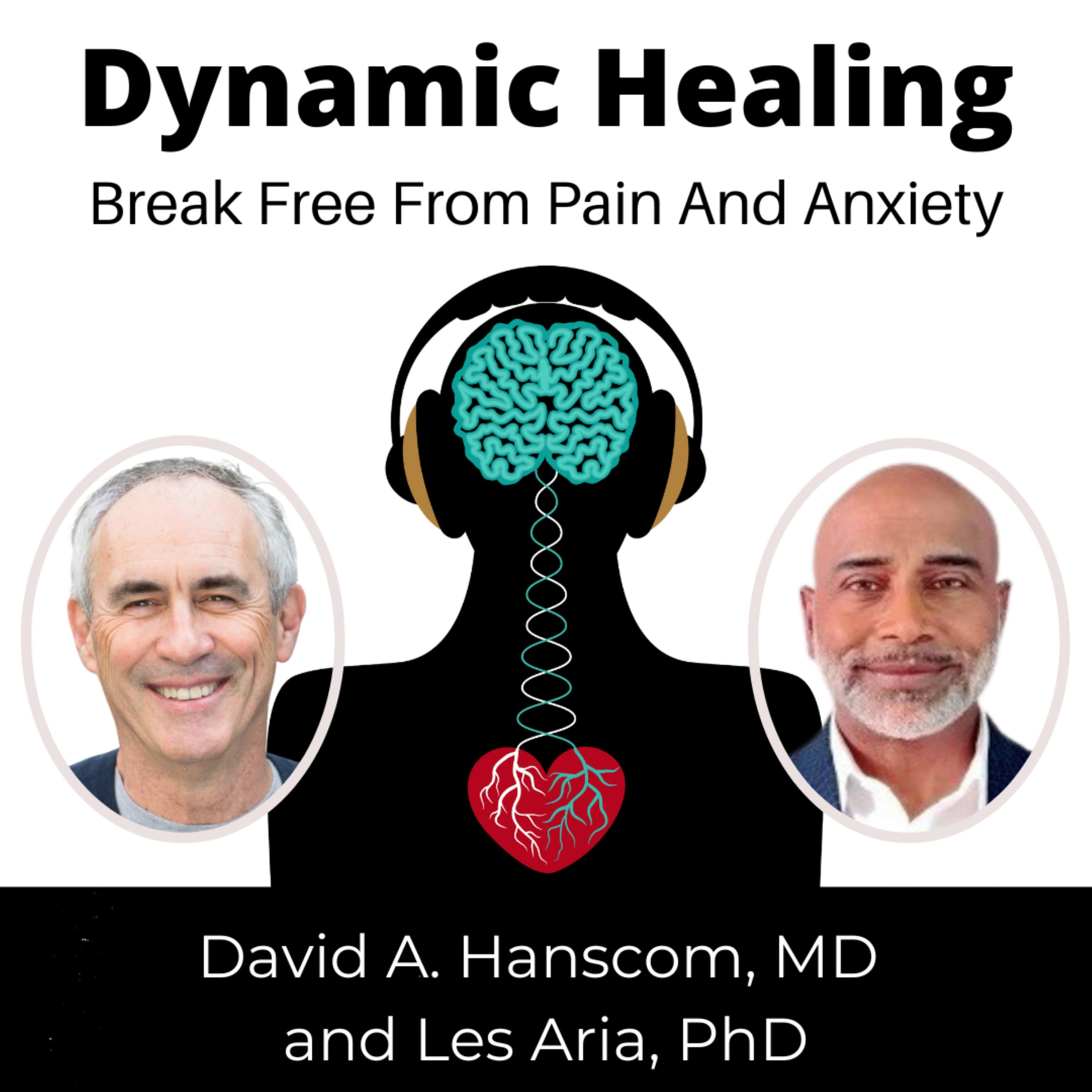
Dynamic Healing with David Hanscom MD and Les Aria PhD
by Mind Body Spirit.fm
It is almost impossible to believe that you can break free from chronic mental and physical pain after years of suffering and disappointments. Learn how your nervous system is the game changer in your pain recovery journey. If you are dealing with the misery of being in relentless pain and want to learn science backed Mind Body information and skills by two leading experts in chronic pain, David Hanscom M.D. and Les Aria PhD, then this podcast is for you!
Episodes
-
Ego – why do we need it, and how does it drive ruminating thoughts?
Why We Pursue a stronger ego to address these three issues. Survival Reactions and Emotional Triggers Our survival responses trigger unpleasant emotions like anxiety and anger to indicate potential threats. In nature, once a danger passes, animals can relax and recover. However, humans often...
-
Emotional vs. Physical Pain
Dr. Les Aria and Dr. David Hanscom explore the intertwined nature of physical and emotional pain, emphasizing their shared neurological pathways, distinct characteristics, and the need for holistic approaches to address both types effectively. Les Aria, PhD – pain psychologist and founding member...
-
"I Wish You Well"
A fundamental concept in neuroscience and human consciousness is that our judgments and views of the world often reflect our internal state. In other words, when we judge others harshly, we are frequently projecting aspects of ourselves onto them. This cyclical nature of self-judgment and…
more -
Defining Mental Rigidity
We tend to view our life view as the correct one and become upset when confronted with conflicting evidence. This perspective becomes embedded in our nervous system with repetition and time, and we develop mental rigidity. Quote: Here are some thought-provoking quotes that address the impact of...
-
Mental Rigidity Trumps Joy
Joy is at the core of living a good and rewarding life. In order to achieve this state you must learn to be vulnerable, which we inherently don’t tolerate well. A major defense against feeling vulnerable (anxious) is mental rigidity. You cannot feel and maintain joy unless you feel safe. Join…
more -
Reprogramming your Brain with Gratitude
This podcast looks at gratitude as a powerful tool in regulating your flight or fight physiology to that of safety. You are allowing your body to heal itself. However, gratitude is not a bypass to counteract threat physiology, which has to be addressed as a separate, but linked effort. To have a...
-
The Healing Power of Kindness
In this episode, Les Aria, PhD and David Hanscom , MD are hosting a special guest, Dr. Michael Stein. Michael Stein, MD is an award-winning author of six novels and four books of non-fiction. He is professor of health policy at the Boston University School of Public Health and executive editor of...
-
The Nightmare of Christmas
Although there are additional demands of the Holiday season there are additional stresses that can contribute to Holiday chaos. Creating an awareness of the triggers allows you to develop strategies to navigate them and enjoy your time with your family and friends. The Holidays are stressful and...
-
Coping with Family Holiday Triggers
Being triggered and stressed is so common during the holidays is so common that it is somewhat normalized. There are many ways to enjoy your family during this time of year regardless of their behaviors and your stresses. It is a season of peace and joy. Keep your perspective! Know you are an...
-
The Physiology of Love – Why Does it Heal
Love is more than a concept. It is a physiological state of safety – profoundly healing. Why? There are many types of love and here are five examples. The common link is being connected to yourself and others. · Passionate love (Romantic love) · Family love · Friendship love · Mankind (human…
more -
Love Leaves When Pain Shows Up – Don’t Share Your Pain
It is common, if not the rule, for people in mental or physical pain to discuss it with anyone who will listen – especially their family. It wears people out and drives them away. An important aspect of healing is nurturing a close support system – connection and love. Discussing your pain blocks...
-
Sharing is Not Caring – Don’t Discuss Your Pain
It is common, if not the rule, for people in mental or physical pain to discuss it with anyone who will listen – especially their family. It wears people out and drives them away. An important aspect of healing is nurturing a close support system. Not discussing your pain is a major step. Find…
more -
What Is Love?
There are many concepts about the meaning of the word, “love.” However, Anthony DeMello, in his book, The Way to Love, condenses it down to one word, “awareness.” Awareness is “being fully present in the moment you are in.” Anytime you are anxious or angry, you are connected to the past and have...
-
The Need for Nurture
All of us need to have a place where we feel safe and nurtured. Home is the place where this needs to happen. How safe do you feel in your own home. How does your family feel? How do your close friends feel around you? But remember, the first place to feel safe is with yourself from your own…
more -
PRT (Pain Reprocessing Therapy) – Choosing Joy
This is the final episode of the PRT (Pain Reprocessing Therapy) series. There are many ways of calming down your nervous system, but the real healing occurs as you train your nervous to move into the life that you want. You can learn to create a felt sense of safety versus fear of your pain –...
-
You Have to Feel to Heal
Unpleasant emotions are painful and no one wants to hurt. So, your brain represses it (unconscious response), or we suppress it (conscious act). You must first train yourself to feel your own pain before you can reprocess it. Quote: “Unexpressed emotions will never die. They are buried alive and...
-
What You Resist Will Persist
This episode is focused on the third component of Pain Reprocessing Therapy (PRT), which gently “leaning into your pain.” We tease out the difference between “mind over matter” compared to “being with your pain.” It is also much different than “accepting your pain.” A central skill in in PRT is...
-
Being Sherlock Holmes for Your Pain
The second component of Pain Reprocessing Therapy (PRT) is gathering and reinforcing personalized evidence for the brain origins and reversibility of pain. One way to combat the belief that there is a “structural”/peripheral cause of the pain is by gathering as much counterevidence as possible –...
-
To Solve Anything, You Must First Understand It
“Medically Unexplained Symptoms” (MUS) is a term that came into use around 2002 that implied that your medical provider knows you are suffering, he or she is not sure why, and they will try to help you live the best you can with the pain (mental/physical). This is a deadly term in that it further...
-
What is PRT? Pain Reprocessing Therapy
Understanding the nature of chronic pain and that mental and physical pain are essentially the same entity allows you to create new circuits in your brain and the pain will markedly diminish or resolve. However, there is a sequence that is important to acquire this knowledge and skill set called...
-
Solving the “Monkey Mind” – Calming the Threat Response
Disruptive thoughts are commonly and somewhat lightly referred to as the “monkey mind.” It is not a joke and has a serious impact on our capacity to enjoy life. Since we can’t escape our thoughts, what do we do? There are three core aspects to calming down your racing thoughts – 1) separating/...
-
Why Do We Suffer from Disruptive Thoughts?
Many people are frustrated by experiencing “unpleasant repetitive thoughts” (URT’s). There does not seem to be an endpoint and we feel trapped. There are three critical aspects of dealing with this perverse trickery of human consciousness. 1. Understand that anxiety is protective but not who you...
-
The Power of Collective Positive Intention with Lynne McTaggart
We are delighted to talk to Lynne McTaggart. She is one of the central authorities on the new science and consciousness, is the award-winning author of seven books, including the worldwide bestsellers The Field, The Intention Experiment and The Power of Eight®. Lynne McTaggart is cofounder of the...
-
Trapped by Your Thoughts - The Need for Mental Control
Disruptive thoughts are universal and part of human consciousness. For many, they can become intense enough to compromise the quality of life. They arise from human’s need for mental control. Between stimulus and response, there is a space. In that space is our power to choose our response.…
more -
Defining OCD and Removing the Label - The Epidemic of Obsessive Thought Patterns
OCD (Obsessive Compulsive Disorder) is a term that has many connotations, and most people feel the term does not apply to them. In fact, many if not most people experience unpleasant and disruptive thoughts that detract from their quality of life. They are a manifestation of chronic anxiety…
more -
You Hurt My Feelings - Emotional Pain Equals Physical Pain
“Sticks and stones will break my bones, but words will never hurt me.” Nothing could be further from the truth and holding onto this concept is damaging. Research has shown that emotional pain is processed in overlapping circuits in the brain, and the physiological response is the same. Thoughts...
-
Accessing the Love Within
Our unconscious brain’s primary function is to protect us. Unfortunately for humans, it is manifested in ongoing self-critical voices. To access our inherent capacity to love, these voices must be de-energized, which requires specific approaches. We have discussed that love = awareness, which…
more -
Love Heals Workshop- Deepen the Definition of Love
Love is a physiological state of safety that promotes regeneration and healing. It is the antithesis of anger, a state of threat, that consumes resources and causes illness and disease. You have a choice of how you want to be at any moment in time. Make it a habit to choose love. Discover how to...
-
Disruptive Thought Patterns-The Curse of Consciousness
Every person has to deal with unpleasant thoughts, and they are problematic in that we cannot escape from them. In light of all the misery connected with pain and many disease states, disruptive thoughts are a major factor that detracts from our capacity to enjoy our life. Even when physical pain...
-
Chronic Stress Hijacks Healing- But Avoiding Stress is Worse
Chronic stress interferes and actually halts the body’s healing process at the cellular level. The problem lies in how you process stress because it is your body’s reaction to it that creates an adverse chemistry. Avoiding stress is even more problematic. Stress is your TOTAL bodily reaction to a...
-
Moving Past the Deadly Trap of Perfectionism
Perfection is often held up as a virtue by our families, peers, society. It is actually a deadly neurological trick and a cognitive distortion, which steadily wears us down. Perfectionism is much different than a “vision of excellence”, which has the energy of accurately assessing your strengths...
-
Rebuilding Your Brain and Body
Over 60% of people are raised in households that are chaotic and over half of have experienced severe trauma. Neuroscience has revealed that persistent pain and trauma share the same neural circuits cause a dysregulated nervous system and damaging body chemistry. The effects last for a lifetime –...
-
No Action in a Reaction – Defusing Anger
Purpose: Similar to anxiety, anger is an even more heightened physiological state. You cannot think clearly, and it is critical to regulate your body’s fight state and get back “on-line” before you take any action. Quote: “Anybody can become angry — that is easy, but to be angry with the right...
-
Vulnerability – The First Step of Forgiveness
There are few rewards in nature for being vulnerable. You won’t survive. Humans also possess this basic instinct, but we also have language and consciousness that allows the possibility of deep relationships. It is a terrible paradox, in that being vulnerable is at the core of enjoyable and...
-
You Can't Move Forward Until You Let Go
You cannot move forward into healing if you are holding onto the past. Some aspect of forgiveness must be manifested in your life daily to truly solve your chronic pain. It is ALWAYS the tipping point. Why? Anytime you are anxious or angry, a current event has triggered something from the past…
more -
Hijack Your Nervous System to Heal
Our thoughts and actions are processed by the nervous system, which sends out instructions to every cell in the body how to respond. If the input is unpleasant or overstimulating, your body will sense danger and produce a stress response. You will feel anxious, agitated, and your pain will...
-
The Power of Choice
You have more say over your quality of life than you might think. The choices you make stimulate neuroplastic changes in your brain that become embedded with repetition. Humans’ brains develop by interacting with other humans. This is a much different programming process than the development of...
-
ACT in Action – Choose
Psychologically flexibility is the opposite of what most of us possess. There is a human tendency to reinforce our views of the world and affirm them. It requires a lot of ongoing energy. ACT teaches you how to become more open to new ideas and creativity. This episode focuses on choose,” which…
more -
ACT in Action – Check
Purpose: In order to stimulate your brain to change (neuroplasticity) you must first know exactly where you are at. The first step is to “catch” and notice that there is a change. Then the second step is, “check” where you recognize what the change is (creating some “space”), and then choose…
more -
ACT in Action - Catch
ACT (Acceptance and Commitment Therapy) is a mindfulness-based behavioral intervention that helps us live in the present moment using values to move towards what matters the most to you in life. You are moving away from pain. It provides practical ways to unhook from the storylines of your mind....
-
Putting ACT into Action for Pain
ACT (Acceptance and Commitment Therapy) can provide you with practical ways to unhook from the storylines of your mind. The approach reduces your suffering from emotional and physical pain. ACT is a mindfulness-based behavioral intervention helping us live in the present moment using values to…
more -
Acceptance and Commitment Therapy (ACT) for Pain Recovery
Emotional and physical pain share neurological circuits in the brain and chronic activation of them is unpleasant. Since we don’t want to feel pain, we suppress it, which fires up the nervous system and your flight or fight response. Over time, we become more and more determined (and rigid) to…
more -
Regrets – Getting Stuck in the Past
Remorse is a factor in keeping you moving forward into the life you want. It is the flip side of FOMO (fear of missing out), both of which are embedded thought patterns and don’t respond well to rational interventions. It is also unique to human consciousness. The Problem Remorse is a common…
more -
Using Values to Keep Your New Year’s Resolutions
Because change is challenging for majority of us, New Year's resolutions often fail to realize change takes time. Like growing something you planted, a fruit tree will take years to mature and consistently bear fruit. Acceptance and Commitment Therapy (ACT) offers solutions to guide us through…
more -
The Destructive Power of FOMO ( Fear of Missing Out)
FOMO (Fear of Missing Out) is a common pattern of thinking in modern times. Why in the face of so much prosperity is it so prevalent? Understanding that is a manifestation of your unconscious self-critical voice and this it is irrational is the first stepping in successfully dealing with it. This...
-
The Pain of Social Isolation
Emotional pain and physical pain have overlapping circuits in the brain. They play off each other. People in pain are more sensitive to social rejection and social rejection makes the pain worse. Loneliness has profound effects on your mental and physical health. This situation is magnified…
more -
Survival Tips for the Holidays - Presence, Pacing, and Boundaries
What truly brings you joy and how can you fully experience it? These tips can enhance your capacity to connect to other people close to you. In this episode, we’ll be discussing the last three tips to help you thrive during the Holidays. · Being in the Present Moment is Key to Being Peaceful o…
more -
Survival Tips for the Holidays-Communicate and Be Realistic
It is ironic that we treasure having major holidays with the spirit of love and giving, yet there are many ways that they can be incredibly draining. Much of the “Holiday Spirit” is created by the marketing world and is not a lot of people’s reality. In this episode, we’ll be discussing the need…
more -
Survival Tips for the Holidays
Learning psychological skills is key to surviving, not just using your breathwork or meditation, or exercise –but using tools that provide effective outcomes to help you be your best and safest this holiday season. Dr. David Hanscom and Dr. Les Aria provide tips on todays episode that will help…
more -
Happy Holidays...NOT
Humans evolved to our current state at the top of the food chain through cooperation. It is one of the main reasons that social connection is so critical. The deeper the connection, the better; except family triggers are the most powerful and destructive. This problem is accentuated during the...
About this show
It is almost impossible to believe that you can break free from chronic mental and physical pain after years of suffering and disappointments. Learn how your nervous system is the game changer in your pain recovery journey. If you are dealing with the misery of being in relentless pain and want to learn science backed Mind Body information and skills by two leading experts in chronic pain, David Hanscom M.D. and Les Aria PhD, then this podcast is for you!
Hosted by
Mind Body Spirit.fm