
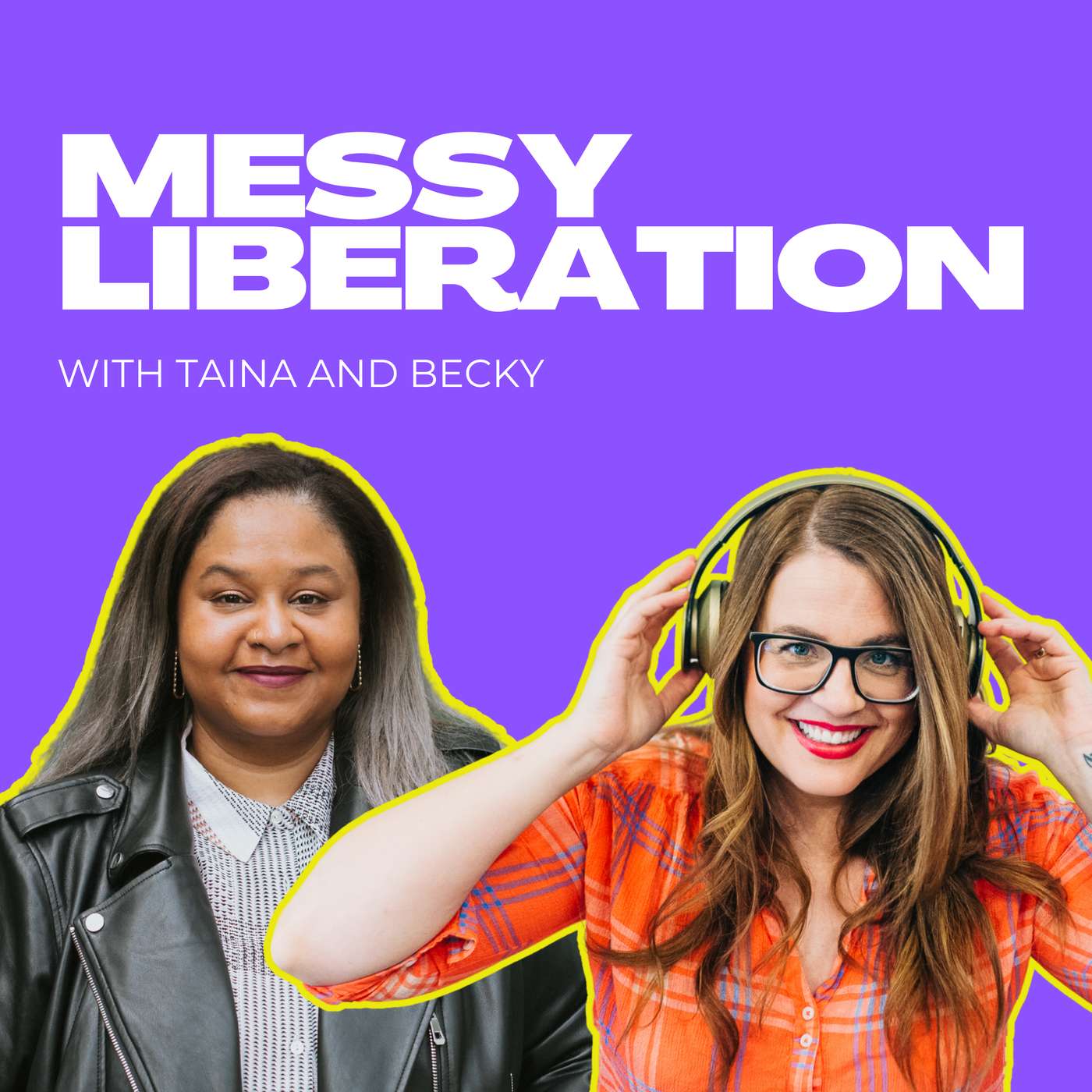
PODCAST · news
Messy Liberation: Feminist Conversations about Politics and Pop Culture
by Becky Mollenkamp and Taina Brown
Join feminist coaches Taina Brown and Becky Mollenkamp for casual (and often deep) conversations about business, current events, politics, pop culture, and more. We’re not perfect activists or allies! These are our real-time, messy feminist perspectives on the world around us.This podcast is for you if you find yourself asking questions like:• Why is feminism important today?• What is intersectional feminism?• Can capitalism be ethical?• What does liberation mean?• Equity vs. equality — what's the difference and why does it matter?• What does a Trump victory mean for my life?• What is mutual aid?• How do we engage in collective action?• Can I find safety in community?• What's a feminist approach to ... ?• What's the feminist perspective on ...?
-
124
There Is No 'Neutral': Macklemore, Pink, Ed Sheeran, and the Cost of Speaking Out
On this episode of Messy Liberation, hosts Becky Mollenkamp and Taina Brown break down Macklemore's public firing from Ed Sheeran's tour after he said "Free Palestine" on stage — and use it to dig into celebrity complicity, white feminism, and the real difference between Zionism and Judaism. From Robert Kraft's stadium pressure campaign to AIPAC's grip on Democratic politics to the actual cost of speaking out against genocide, Becky and Taina unpack what it looks like to choose a side when neutrality was never on the table.In This Episode, We Get Into:Macklemore getting pulled from Ed Sheeran's tour after saying "Free Palestine" to 90,000 people, and reading his response statement liveHow Robert Kraft and other venue owners used stadium access as leverage to force Ed Sheeran's handWhy "I don't take sides" is itself a side, and Macklemore's line: "There is no neutral position between the oppressor and the oppressed"Pink's Instagram statement, her US Open outing with Elizabeth Banks and Amy Adams, and why it's a textbook white feminism case studyWhat celebrities and public figures actually owe their audiences, the parasocial relationship and the responsibility that comes with a platformAIPAC money, the Wesley Bell/Cori Bush congressional race, and how Democrats fall in line on Israel fundingUntangling Zionism from Judaism and anti-Zionism from antisemitism, and why conflating them silences criticsThe 5,000-signature Hollywood letter opposing the word "genocide," and who's cashing checks to stay quietMandy Patinkin, Holocaust parallels, and how dehumanization spreads once a society decides it's permissible for one group"Does Israel have a right to exist?", and a reframe (it exists, so now what?) that matters more than the debate itselfA closing tangent on Jasmine Crockett sharing a stage with Chris Brown, and what it says about who we hold accountableTimestamps:00:21 – Setting up the episode: Macklemore, Ed Sheeran, Zionism, and genocide02:09 – What actually happened on stage: "Free Palestine" and the fallout03:10 – Pink's response and deleted comments04:45 – Reading Macklemore's full statement: "I am not a victim"06:23 – Robert Kraft, Gillette Stadium, and the stadium-owner ultimatum08:27 – "There is no neutral position between the oppressor and the oppressed"11:22 – Power, privilege, and how the GOP consolidates vs. how Democrats splinter12:36 – AIPAC money and the Wesley Bell/Cori Bush race in St. Louis15:44 – Pink at the US Open with Elizabeth Banks and Amy Adams17:20 – Parasocial relationships and what celebrities owe their audience27:28 – The 5,000-signature Hollywood letter denying the word "genocide"30:39 – Mark Ruffalo, Tatiana Maslany, and who's actually showing up33:54 – Holocaust parallels and how dehumanization spreads39:40 – Zionism vs. Judaism: why they're not the same thing41:36 – "Does Israel have a right to exist?" and why that's the wrong question44:39 – Jasmine Crockett sharing a stage with Chris Brown47:27 – Christian nationalism and the same system playing out in the USResources Mentioned:Pink's statement: Macklemore speaks out at Ed Sheeran concert: https://www.instagram.com/reels/Dc_bH4_N1FN/Pink's statement: https://www.instagram.com/p/DdKPJsVTvtl/?hl=enMacklemore's statement: https://www.threads.com/@macklemore/post/DdRduI8mxy9/mediaThe 5,000-signature Hollywood open letter: https://www.creativecommunityforpeace.com/blog/2026/09/08/rejectlieMandy Patinkin's empathetic plea: https://www.instagram.com/reels/DMJWZHVsXdH/Abdul El-Sayed on "does Israel have a right to exist?": https://www.facebook.com/watch/?v=1087558473698955🎤 JOIN US IN THE FEMINIST PODCASTERS COLLECTIVE: http://feministpodcastcollective.com/
-
123
Safe Space Is a Buzzword: What Real Community Actually Looks Like
Becky Mollenkamp and Taina Brown break down what actually makes a group of people a community — not just a paid membership or "safe space" buzzword. On this episode of Messy Liberation, they unpack why comfort and safety get conflated (especially by white women), why "we don't talk politics here" silences the most marginalized voices in a space, and what harm repair and restorative justice look like when done right. Plus: the stories of the best communities they've ever been part of, from a virtual event where a host let Resmaa Menakem rest mid-talk, to a nonprofit that gave staff the day off after a police shooting, to the friends who took Taina in when she was homeless.Timestamps:0:00 – Intro & follow-up from last episode0:34 – Why "community" became a business buzzword1:14 – Defining community: shared vision & culture-making4:46 – Trust, "ride or dies," and the buzzword of "safe spaces"7:07 – Feeling held vs. feeling safe9:00 – Why community isn't about being safe for everyone9:57 – Privilege, comfort, and what "safe" really means11:23 – True crime, privilege, and the illusion of safety12:06 – White women's tears: confusing comfort with safety14:02 – "We don't talk politics here" and who gets silenced18:19 – Threats to privilege vs. threats to safety18:56 – 2016 & 2020: white coaches shutting down callouts24:29 – Harm repair and restorative justice, set up front28:18 – Communities that got it right: affinity spaces & chosen family33:04 – Taken in when homeless: a story of real community34:52 – Black spaces vs. white spaces: the difference in care38:35 – The Resmaa Menakem story: modeling collective care live43:29 – A nonprofit that gave everyone the day off47:05 – The FEO community: emotional labor, race & accountability54:51 – Recap: discomfort isn't unsafe, and harm repair matters57:25 – Outro• "My Grandmother's Hands" by Resmaa Menakem: https://amzn.to/4r3bsMh• Rooted Global Village: https://rootedglobalvillage.com/🎤 JOIN US IN THE FEMINIST PODCASTERS COLLECTIVE: http://feministpodcastcollective.com/
-
122
Nepal Floods, Climate Change, Doomscrolling: How Do We Keep Going?
On this episode of Messy Liberation, hosts Becky Mollenkamp and Taina Brown get real about climate grief, doomscrolling, and the nihilism that creeps in when disaster feels endless, sparked by the catastrophic Nepal glacier flood and reports of billionaires building bunkers to escape the mess they helped create. Becky and Taina dig into the difference between staying informed and staying trapped in trauma, why our brains keep replaying footage that hurts us, and how community, agency, and joy become acts of resistance when the world feels like it's on fire. They close with a tribute to Dolly Parton and what her life proves about choosing love over hate.In This Episode, We Get Into:• Why the Nepal glacier flood hit so hard, and the "disaster movie" desensitization that makes real catastrophe feel unreal• Billionaires building underground bunkers (complete with jails) instead of fixing the climate crisis they're profiting from• The nihilism spiral: "what's the point" thinking and how it shows up differently before and after having kids• The real difference between being informed and being engaged, and where that line gets crossed into doomscrolling• Why our brains compulsively replay traumatic footage, and what that has to do with control and anxiety• Survivor's guilt vs. privilege guilt, and how proximity to suffering (without living it) shapes our response• The "crazy-making" feeling of watching people deny climate change in real time, and why that's a form of gaslighting• Divesting from harmful systems vs. reducing our reliance on them, and what to do with the time and energy that frees up• Surrender vs. submission: how accepting what you can't control can actually restore a sense of agency• Why joy and grief can coexist, and why withholding joy doesn't prove you care more• A tribute to Dolly Parton: her wealth given away, her quiet support of Black Lives Matter and the trans community, and what she proves about hate being a choiceTimestamps:00:00 – Cold open: Becky's Care Bear mug and "which Care Bear are you"02:51 – The Nepal glacier flood and why it feels almost unreal to watch04:16 – Doomscrolling, repeated imagery, and the nihilism it triggers05:14 – Billionaire bunkers (yes, with jails) and what that says about who's "prepared" for collapse07:45 – Becky turns it over to Taina: restoring some faith in humanity08:06 – Taina's approach to news consumption and staying "informed without engaged"09:45 – Unpacking the real difference between informed and engaged11:25 – How having kids changes the emotional weight of climate anxiety12:47 – The compulsion to doomscroll and rewatch disturbing footage16:30 – Why our brains keep seeking control through repetition19:05 – Survivor's guilt vs. guilt born of privilege20:00 – Divesting from harmful systems vs. reducing our need for them21:32 – What you do with the space once you stop doomscrolling22:25 – The "crazy-making," gaslighting feeling of climate denial26:10 – The privilege of being disappointed by people in power27:56 – Community as the antidote: who's in your corner29:03 – Finding agency in the small, controllable things31:07 – Surrender vs. control, and coming back to the present moment33:50 – Acceptance vs. submission — the difference that matters35:13 – Resilience as a practiced, ongoing skill, not a one-time fix35:55 – Giving yourself permission to feel joy without guilt37:52 – Dolly Parton's "rainbows and rain" quote and finding light in the dark41:00 – Dolly's legacy: $600M given away, support for BLM and trans employees decades early44:44 – Why Dolly is proof that hate is a choice45:50 – Closing thoughts and sign-off🎤 JOIN US IN THE FEMINIST PODCASTERS COLLECTIVE: http://feministpodcastcollective.com/
-
121
When DEI Gets Dismantled: Callaway, Target & the Cost of Corporate "Values"
On this episode of Messy Liberation, hosts Becky Mollenkamp and Taina Brown break down two viral advertiser fails (Callaway Golf's domestic-violence "joke" ad and Target's minstrel-show-evoking Halloween costume) to unpack what happens when corporate rooms lack real diversity and accountability. Through an intersectional feminist lens, they dig into DEI backlash, golf's history of racial and gender exclusion, the limits of individual boycotts, and why values that "blow with the wind" were never values at all.In This Episode, We Get Into:• A heartfelt tribute to Dolly Parton and what her life and legacy meant to both hosts• The Callaway Golf ad that turned domestic violence into a punchline — and the immediate backlash from women online• Target's clown/ghost Halloween costume and its uncomfortable echoes of minstrel-show imagery• Why "diverse hires" without power or context don't actually prevent harm• The difference between real values and values that shift with politics or profit• Golf's long, ugly history of excluding women and Black golfers, and what the current participation numbers really show• Whether corporate apology tours ("this doesn't reflect our values") mean anything at all• The limits of individual boycotts vs. collective political power• What small business owners can actually do differently (hint: it's not a fancy DEI program)• Drones, robot armies, and what stripping empathy from warfare has to do with stripping humanity from marginalized peopleResources Mentioned:• OpenSecrets.org• Democratic Socialists of America (DSA): dsausa.org• Working Families Party: workingfamilies.org🎤 JOIN US IN THE FEMINIST PODCASTERS COLLECTIVE: http://feministpodcastcollective.com/
-
120
Hayden Panettiere's Death & Why America Fails Parents
Feminist coaches and hosts Becky Mollenkamp and Taina Brown unpack Hayden Panettiere's death and what it reveals about America's total failure to support new mothers. They dig into postpartum depression, postpartum anxiety, and the maternal mental health crisis this country refuses to treat with any real structural support — and why that failure hits hardest along lines of race and class.In This Episode, We Get Into:• Hayden Panettiere's death, her public struggle with postpartum depression, and what her story reveals about how the entertainment industry treats mothers' mental health (including Neutrogena quietly dropping her as a spokesperson)• Becky's own experience with postpartum anxiety, and why "bouncing back" after birth is a myth nobody should be selling• Why postpartum screening in the U.S. is basically a checkbox on a form — and why that leads to massive underreporting, especially among Black and Latina mothers who have real reason to fear losing custody• The Britney Spears comparison and the impossible bind mothers are put in: too involved is controlling, too little is neglect• The age gap and power dynamics in Hayden's relationship, and how that context matters without villainizing anyone• Why childcare costs in America are a structural crisis, not a personal budgeting problem• How Europe's midwife home visits, paid leave, and universal pre-K show what real support could look like — and why the U.S. keeps moving backward instead• The difference between "making it work" and actually thriving as a parent• Taina's take on evangelicalism, moral hierarchies, and how "empathy is a bad word" rhetoric on the right traces back to Puritan control, not religious freedom• A call to action: what real, tangible community care looks like after someone gives birth or after someone dies — not just showing up once, but showing up for months🎤 JOIN US IN THE FEMINIST PODCASTERS COLLECTIVE: http://feministpodcastcollective.com/
-
119
Why "Protect Women's Sports" Is a Lie
Becky and Taina break down two former NBA players (Enes Kanter Freedom and Royce White) declaring themselves eligible for the 2027 WNBA draft as a bad-faith stunt riding the wave of anti-trans hysteria in women's sports. They trace the manufactured controversy back to comments from Sophie Cunningham and Riley Gaines, unpack the real legislative threat (the Protection of Women and Girls in Sports Act), and connect the dots between "protecting girls," Title IX defunding, eugenics, and control of women's bodies.Timestamps:00:06 – Cold open / catching up00:36 – Setting up today's topic: two ex-NBA men declaring WNBA draft eligibility01:14 – Background: Sophie Cunningham's "protect biological women" comments, Riley Gaines, XXXY Apparel03:05 – Lynx coach Cheryl Reeve's "protect trans children" shirt; Gabby Williams pushes back04:45 – Race dynamics around Caitlin Clark vs. Black WNBA players04:59 – Enes Kanter Freedom formally declares for the WNBA draft06:49 – Royce White follows suit; his failed Senate runs and political motives07:48 – Royce White's "in touch with his feminine energy" routine09:45 – The real legislative threat: Protection of Women and Girls in Sports Act (H.R. 28 / Senate Bill 9) and Title IX11:46 – "They're just dumb": basic biology, every fetus starts genetically female13:35 – The real agenda: control, not trans people — "heterosexual family values"17:10 – Sex is a spectrum: intersex variation explained19:15 – The slippery slope from body-as-utility thinking to eugenics21:37 – Bathroom policing, dehumanization, and the Gaza parallel22:47 – "Protecting girls" via pelvic exams — the Larry Nassar comparison24:23 – Shoutout to Megan Rapinoe; Title IX funding, Heritage Foundation, Project 202533:00 – Sitting with your own fear/bias instead of outsourcing the work to trans people36:39 – Real harm comes from inside the home, not from trans strangers39:04 – Race and the policing of femininity — why this falls hardest on Black women42:12 – Where are the men calling this out? Fragile masculinity43:14 – Declaring draft eligibility means nothing — no team is taking either of them43:48 – Closing thoughts: go meet a trans person; "we love you"🎤 JOIN US IN THE FEMINIST PODCASTERS COLLECTIVE: https://feministpodcastcollective.com/
-
118
Why Everyone's Obsessed with Wicker (And What It Says About Us)
Becky and Taina are back from their summer Everything Is Political series with their regular weekly episode, kicking things off with the internet-breaking trailer for Wicker — the upcoming movie starring Olivia Colman, Alexander Skarsgård, and Peter Dinklage about a woman who marries a man made of wicker. What starts as trailer reactions turns into a wider conversation about the booming romance and "smutty romance" book industry, the trad wife movement's contradictions, media literacy, and who gets conditioned to be curious versus who doesn't.What we discussed:00:00 – Welcome back after the summer Everything Is Political series00:28 – Introducing today's topic: the Wicker trailer01:33 – First reactions to the trailer and the Bookstagram/BookTok buzz04:11 – Breaking down the premise (and the jokes about it)09:52 – "It's all men until it's not all men" — men continuing to fall short10:08 – The wicker husband, village jealousy, and the metal-collar marriage symbolism12:17 – Why this topic: free publicity and the bigger conversation about romance/smut15:39 – Trad wife influencers, rising conservatism, and the contradiction underneath it (Nara Smith)16:54 – Aside on the novel Yesteryear20:16 – Romance publishing stats: 52% revenue growth, $1.44B a year22:59 – Wicker as a modern fairy tale / parallels to Beauty and the Beast24:26 – Entertainment as propaganda: military movies and Hollywood contracts26:14 – Media literacy: why it matters for everything we consume, not just news31:21 – Privilege, curiosity, and who gets conditioned not to question things34:07 – Curiosity as joy; how liberal arts education changed things for Becky36:22 – The power of "why" and "what if" as questions43:00 – Wrap-up and plans to revisit after they've both seen the movie in OctoberResources mentioned:• Wicker trailer: https://www.youtube.com/watch?v=HP0BWBWn14I• "The Wicker Husband" short story: https://www.scribd.com/document/163478512/The-Wicker-Husban1• "Yesteryear" by Caro Claire Burke: https://amzn.to/3TEeLNs🎤 JOIN US IN THE FEMINIST PODCASTERS COLLECTIVE: http://feministpodcastcollective.com/
-
117
Everything Is Political: What We Learned From Our Whole Series
On this episode of Messy Liberation, hosts Becky Mollenkamp and Taina Brown look back on their "Everything Is Political" series — reflecting on agency, systemic bias, and intersectional feminism through conversations on trash and environmental racism, clothing equity, comedy and queer identity, book diversity, AI and data bias, and podcasting access. It's a candid, funny, and grounding recap for anyone trying to hold onto hope while facing systems designed to wear you down.In This Episode, We Get Into:• Why disengaging from online arguments can be an act of agency, not avoidance• The "not my ministry" mindset and choosing which conversations are actually worth your energy• How trash pickup reveals environmental racism and the myth of "universal" utilities• The beautification effect and why cared-for spaces get cared for• How access to clothing that fits shapes self-worth, agency, and daily choices• Becky's deep dive into Universal Standard sizing and why "medium" is doing a lot of political work• What Dahlia Belle's Netflix special Gender Agenda revealed about comedy, pronouns, and survival• Becky's book-tracking dashboard and what it exposed about whose voices she was (and wasn't) reading• Why AI and algorithms only look backward, and what that means for bias and representation• Who gets the mic in podcasting, and why access doesn't always mean equity🎤 JOIN US IN THE FEMINIST PODCASTERS COLLECTIVE: http://feministpodcastcollective.com/
-
116
How Biased Data Is Used to Reinforce Racism, Sexism, and the Status Quo
In this episode of Messy Liberation, hosts Becky Mollenkamp and Taina Brown sit down with data and analytics professional Millie to explore why data is never as neutral as it looks — and why that matters for everyone. From biased medical studies and skewed incarceration stats to the politics of AI, the census, and your personal data being sold without your consent, this conversation connects the dots between numbers on a screen and the power structures shaping our lives.In This Episode, We Get Into:• Why data isn't neutral, and how human bias gets baked in at every stage of collection, analysis, and presentation• How manipulated charts, skewed infographics, and decontextualized research statistics mislead the public• Real-world examples of data bias causing serious harm: medication dosages, Plan B effectiveness, census undercounting, and school funding• The deeply troubling way incarceration data is used to reinforce racist narratives about Black and brown communities• How AI inherits and amplifies data bias, and why "garbage in, garbage out" is a phrase everyone should know• What data literacy actually looks like, and how to become a smarter, more critical consumer of statistics and studies• The GDPR, browser cookies, and why your personal data is already a product being sold without your cut• How to use public open data resources (like NYC Open Data) to engage with information in your community🎤 JOIN US IN THE FEMINIST PODCASTERS COLLECTIVE: http://feministpodcastcollective.com/
-
115
Podcasting Is Political: Who Profits, Who Gets Erased, and What You Can Do About It (with Sarah Heeter)
In this episode of Messy Liberation, hosts Becky Mollenkamp and Taina Brown sit down with Sarah Heeter — podcast producer, strategist, and founder of PodFox Media — to dig into the deeply political nature of the podcasting world. From who gets to profit and who gets erased by the algorithm, to how podcasts are reshaping elections and what your listening habits actually mean, this is the intersectional feminist media analysis you didn't know you needed.In This Episode, We Get Into:• Why podcasting is a political medium, even when the content has nothing to do with politics• The gatekeeping problem: who profits most from podcasting (spoiler: it's mostly white men) and what that means for independent creators• How the 2020 celebrity podcast boom reshaped the entire industry, and who it left behind• The 2024 election strategy of using podcasts as campaign tools, and what that means for democracy and misinformation• The responsibility of podcast hosts and producers to vet guests, set core values, and decide what they put their name on• Why podcast listeners are disproportionately persuadable and what top creators are doing with that influence• How consumers and independent creators can make intentional, values-aligned choices in both what they listen to and who they platform• The power of community resources like the Feminist Podcasters Collective to amplify marginalized indie voices• Why 50 loyal podcast listeners means more than 100K TikTok views, and how to think about audience depth vs. follower counts• The unresolved questions about video podcasting, transcripts, AI, and accessibility that are already shaping who can participate in this spaceResources Mentioned:• PodFox Media: https://podfoxmedia.com/• Big Brave Business podcast: https://bigbravebusiness.com/• Feminist Podcasters Collective: https://feministpodcastcollective.com• Podchaser: https://www.podchaser.com/• Listen Notes: https://www.listennotes.com/🎤 JOIN US IN THE FEMINIST PODCASTERS COLLECTIVE: http://feministpodcastcollective.com/
-
114
The Politics of Who Gets to Be Funny: Trans Comedian Mx. Dahlia Belle Tells All!
In this episode of Messy Liberation, host Becky Mollenkamp sits down with comedian and writer Mx. Dahlia Belle to pull back the curtain on the deeply political world of stand-up comedy. From gatekeeping and blacklisting to biased algorithms and the consent politics of who gets to make jokes about whom, this conversation is an essential intersectional feminist guide to understanding comedy as a site of power and resistance.In This Episode, We Get Into:• How Mx. Dahlia Belle went from writing a viral Guardian piece about Dave Chappelle to appearing on Hannah Gadsby's Netflix special Gender Agenda, and what happened to their career immediately after• Why comedy is a pyramid scheme: how the most powerful comics in any scene control who gets booked, who gets stage time, and who gets shut out• The self-replicating myth that women and trans people "aren't funny," and how internalized bias keeps marginalized audiences away from shows that could change that• How biased algorithms compound gatekeeping, and what it means when a comic's social media following matters more than their actual craft• The nuanced take on punching up vs. punching down, and why Mx. Dahlia Belle's real gauge is whether the joke lands for someone who loves them and someone who hates them• The violence and predation inside comedy scenes, and how it was the women who blew the whistle on abusers who got blacklisted, not the abusers themselves• Why stand-up is uniquely inseparable from the artist's character, and why "separating the art from the artist" doesn't work the same way for comedy as it does for painting or fiction• The concept of consent in comedy: who has the right to tell a joke about a particular identity, and what it means when that consent is absent• Where to actually find queer and alt comedy in your city (and why you should probably boycott your local mainstream comedy club)• Why marginalized people tend to be more creative, funnier, and more imaginative because survival demands itResources Mentioned:• Mx. Dahlia Belle's "Dear Dave Chappelle" piece for the Guardian: https://www.theguardian.com/stage/2021/oct/09/dave-chappelle-letter-trans-comedian-netflix• Hannah Gadsby's Gender Agenda on Netflix: https://www.netflix.com/title/81607199• "The Algorithms of Opression" by Safiya Umoja Noble: https://amzn.to/439nUPL• Comedian Devi Kersh: https://www.instagram.com/devikirsch/• Comedian Sir Lance Edward: https://www.instagram.com/sir_lance_edward_comedy/• Mx. Dahlia Belle on Instagram: https://www.instagram.com/MX.DAHLIABELLE/• Mx. Dahlia Belle on Threads: https://www.threads.com/@mx.dahliabelle/• Mx. Dahla Belle on YouTube: https://www.youtube.com/@mxdahliabelle 🎤 JOIN US IN THE FEMINIST PODCASTERS COLLECTIVE: http://feministpodcastcollective.com/
-
113
The Politics of Your Closet: Body Liberation, Fast Fashion, and What You're Actually Allowed to Wear
In this episode of Messy Liberation, hosts Becky Mollenkamp and Taina Brown sit down with personal stylist and body liberation advocate Dacy Gillespie of Mindful Closet to unpack the deeply political nature of fashion and clothing. From workplace dress codes rooted in white supremacy to the impossible standards placed on larger bodies, the return of "heroin chic," modesty culture, and the radical act of letting your hair go gray — this conversation is for anyone who has ever stood in their closet feeling like nothing fits, nothing's allowed, and nothing will ever be enough.In This Episode, We Get Into:How Dacy's mother organizing workers in a sewing factory planted the seed for her life's work — and why she was raised to believe caring about clothes was shamefulThe way workplace "professionalism" is really just a dress code for "look as much like a white man as possible" — and who pays the price for deviating from itFashion as code-switching: the daily calculation people of color, trans folks, and anyone outside the norm make about how much of themselves to revealTrayvon Martin and the deadly, literal consequences of what you're wearingWhy Dacy won't tell you what's "flattering" — and why her forthcoming book is called UnflatteringThe return of 90s "heroin chic" body ideals and the terror of watching it happen again in the age of GLP-1sSize scarcity: why plus-size people are often left with ten moomoos and good luck — including the callout of Lucy and Yak removing their 4X sizingModesty, the Missouri House's no-bare-shoulders rule, and how women's bodies are treated as a liability in public spacesWhat Chappell Roan at the Grammys has to do with the sexual double standardAging, perimenopause, and the radical act of collecting images of women who actually look like youWhy your mental health and feeling good in your body is always the top priority — even if that means buying from TargetResources Mentioned:• Dacy Gillespie: https://www.mindfulcloset.com/• Dacy's Substack newsletter, "Unflattering": https://dacygillespie.substack.com/• "The Body Is Not an Apology" by Sonya Renee Taylor: https://amzn.to/4uNa3L8• Dress for Success Midwest: https://midwest.dressforsuccess.org/🎤 JOIN US IN THE FEMINIST PODCASTERS COLLECTIVE: http://feministpodcastcollective.com/
-
112
Food Is Political: Diet Culture, Food Deserts & the Systems Keeping You From Eating Well
In this episode of Messy Liberation, hosts Becky Mollenkamp and Taina Brown sit down with registered dietitian and nutritionist Shana Spence — known as @thenutritiontea on Instagram and Threads — to dig into the deeply political nature of food access, diet culture, and nutrition misinformation. From food deserts and SNAP cuts to GLP-1s and white supremacy's grip on body standards, this conversation connects the dots between what ends up on your plate and the systems of power that put it there (or don't).In This Episode, We Get Into:• What a food desert actually is, and why even dense urban areas like New York City and Atlanta have them• How redlining, gerrymandering, and structural racism shape which communities have access to grocery stores• The layered barriers to food access: disability, transportation, language, income, and more• Why "just grow your own food" and other individualist advice is completely disconnected from reality• The explosion of GLP-1 drugs (like Ozempic and Wegovy) and whether we're in pursuit of health or just thinness• How diet culture is rooted in white supremacy and Eurocentric beauty standards• The SNAP cuts in the "Big Beautiful Bill" and the domino effect on food insecurity and health outcomes• Why seed oils have been debunked as harmful, and how nutrition misinformation spreads• Lab-grown food, GMOs, and what a more just food future could actually look like• Shana's core message: how you eat is individual, not a moral failingResources Mentioned:• "Live Nourished: Make Peace with Food, Banish Body Shame and Reclaim Joy" by Shana Spence: https://amzn.to/4e1QlEf• "Anti-Diet" by Christy Harrison: https://amzn.to/4vjQhXj• "Fearing the Black Body" by Sabrina Strings: https://amzn.to/4vhq9MM• "The Body Liberation Project" by Chrissy King: https://amzn.to/4dEzp7O• Shana's Instagram: https://www.instagram.com/thenutritiontea/• Shana's Threads: https://www.threads.com/@thenutritiontea• The Nutrition Tea (Shana's Substack: https://substack.com/@thenutritiontea🎤 JOIN US IN THE FEMINIST PODCASTERS COLLECTIVE: http://feministpodcastcollective.com/
-
111
We Throw Away 40% of Our Food While 40M People Go Hungry
In this episode of Messy Liberation's Everything is Political series, hosts Becky Mollenkamp and Taina Brown are joined by Erica Clahar (founder of Uni Feeds) and Gwen Nolan (founder of Mother Compost) to explore the deeply political world of waste — from food waste and hunger to environmental racism, composting access, and the planned obsolescence built into capitalism. If you've ever wondered why trash is a feminist issue, this conversation will make everything click.In This Episode, We Get Into:• How 40% of the U.S. food supply gets thrown away every year while 40 million people remain food insecure (and why that number is chronically under-reported)• The origin stories of two women who saw a problem and built organizations to solve it, not monetize it• Environmental racism in real time: why landfills, incinerators, and illegal dumping disproportionately harm Black and brown communities• The Coldwater Creek landfill situation in St. Louis as a case study in who bears the burden of waste• The Chester, PA incineration fight, and what it means that Pennsylvania's constitution guarantees the right to clean air and water• Individual responsibility vs. corporate and government accountability, and why both matter, but not equally• Planned obsolescence, consumer culture, and how capitalism designed our throwaway society on purpose• Indigenous and collective wisdom as a model for a caretaking economy — and how white supremacist capitalism broke that relationship• Practical things you can actually do: composting, freezing leftovers, buy-nothing challenges, and sharing with neighbors• Why slowing down and making intentional choices might be the most radical act you can do right nowResources Mentioned:• Umi Feeds: https://umifeeds.org/• Mother Compost: https://mothercompost.com/• ReFed: https://refed.org/• Feeding America: https://www.feedingamerica.org/• Institute for Local Self-Reliance (ILSR): https://ilsr.org/• Drawdown: https://drawdown.org/• "Braiding Sweetgrass" by Robin Wall Kimmerer: https://amzn.to/3Q0j5oG• "The Serviceberry" by Robin Wall Kimmerer: https://amzn.to/4u92BZG• "Emergent Strategy" by adrienne maree brown: https://amzn.to/4fpltjr🎤 JOIN US IN THE FEMINIST PODCASTERS COLLECTIVE: http://feministpodcastcollective.com/
-
110
Why Mental Health Care Is Failing Marginalized Communities (with Dr. Han Ren)
In this episode of Messy Liberation, hosts Becky Mollenkamp and Taina Brown sit down with Dr. Han Ren, a licensed psychologist and author of the upcoming book The Hyphenated Life, to explore why therapy is inherently political. They discuss the systemic barriers to accessing quality mental health care, how politics shapes therapeutic practice, the dangers of pathologizing trauma responses, and why "therapy speak" often reinforces white supremacy. If you've ever struggled to find a therapist who truly understands your lived experience — or wondered why the mental health field feels so disconnected from issues of justice — this conversation is essential listening.In This Episode, We Get Into:Why therapy and psychology have always been political — even when grad school pretends otherwiseHow Dr. Han Ren started creating mental health content on TikTok in 2020 to fill gaps in representationThe exhausting reality of finding a therapist who understands your marginalized identitiesWhy therapists can no longer afford to keep their values "close to the chest" — it's a safety issueHow politics directly impacts what happens in the therapy room (and why that matters)The concept of imposter phenomenon and how it disproportionately affects people from marginalized communitiesWhy pathologizing trauma responses is a form of social controlHow "therapy speak" reinforces white supremacy and individualismThe model minority myth and how different communities are villainized by mental health narrativesWhy healing is for everyone, but therapy doesn't have a monopoly on healingThe role of self-love, community, grief, and "doing the reps" in real healingResources Mentioned:The Hyphenated Life by Dr. Han Ren: https://amzn.to/3RhbmmFBorderlands/La Frontera by Gloria Anzaldúa: https://amzn.to/3PTXnmlDr. Han Ren's website: https://www.drhanren.com/Dr. Han Ren on TikTok: https://www.tiktok.com/@drhanrenDr. Han Ren on Instagram: https://www.instagram.com/dr.han.ren/🎤 JOIN US IN THE FEMINIST PODCASTERS COLLECTIVE: http://feministpodcastcollective.com/
-
109
How to Have Difficult Conversations Without Losing Yourself (with Danielle Marshall)
In this episode of Messy Liberation, hosts Becky Mollenkamp and Taina Brown sit down with equity strategist and executive coach Danielle Marshall to explore the art of having difficult conversations across political and ideological divides. They discuss the limitations of echo chambers, the difference between engagement and community, and why being able to hold multiple perspectives — even when you disagree — is essential for creating real change. If you've ever struggled with whether to engage someone whose views challenge yours, this conversation offers a refreshing framework for navigating disagreement without sacrificing your values.In This Episode, We Get Into:Why echo chambers feel safe but can be limiting — and when that mattersThe difference between engaging with people and bringing them into your inner communityHow to set a clear goal before entering a challenging conversationMarjorie Taylor Greene as a real-time case study in people changing their minds (yes, really)Why we're so afraid to be wrong — and how binary thinking keeps us stuckThe burden of trying to convince everyone to see things your wayHow cancel culture makes it harder to hold space for nuance and changeEverything is political: how even your garbage and clothing choices are political actsWhy "convincing you is not my ministry" might be the most freeing phrase you hear todayHow to ask yourself: Is this perspective serving me — and how is it working for me?Danielle Marshall's website: culture-principles.com🎤 JOIN US IN THE FEMINIST PODCASTERS COLLECTIVE: http://feministpodcastcollective.com/
-
108
100th Episode LIVE
Becky Mollenkamp and Taina Brown celebrate reaching 100 episodes of Messy Liberation, the feminist podcast dedicated to helping listeners understand the world through an intersectional feminist lens. In this milestone live episode, they reflect on two years of consistent conversations about pop culture, politics, social justice, and the power of slow, sustainable activism.IN THIS EPISODE, WE GET INTO:Celebrating 100 episodes and why most podcasts don't make it this farThe origin story: how Becky and Taina met and decided to start a podcast togetherWhat keeps the show sustainable and consistent over two yearsHow personal growth and social progress both require a long-term lensThe power of showing up in your life and relationships, even in small waysWhy "everything is political" and how that framework changes how we move through the worldThe upcoming "Everything Is Political" series covering topics like composting, fashion, data analysis, and therapyHonoring your capacity and burnout prevention in activism and creative workReflecting on monumental personal growth that only becomes visible over timeThe importance of community touchpoints and consistent spaces for learning and connection🎤 JOIN US IN THE FEMINIST PODCASTERS COLLECTIVE: https://feministpodcastcollective.com/
-
107
Punching Up vs. Punching Down: What the Kevin Hart Roast Reveals About Power
Becky Mollenkamp and Taina Brown unpack the controversy around the Kevin Hart roast, exploring why comedy that punches down reinforces harmful power dynamics. They discuss how roasts, jokes about women's bodies, and casual misogyny contribute to a larger cultural moment where rights and representation are being systematically stripped away—and why pushing back matters now more than ever.In This Episode, We Get Into:Why roasts make us uncomfortable (and why that matters)The difference between punching up, punching laterally, and punching down in comedyHow jokes about women's bodies and Black women's intelligence don't exist in a vacuumThe connection between rape culture humor and the loss of reproductive rightsWhy "it's just a joke" is never just a joke when power dynamics are at playHow comedy can either challenge or reinforce oppressive systemsThe importance of asking "what's funny about that?" when jokes cross the lineWhy people with privilege need to be the ones speaking up in rooms where marginalized people are the targetHow cultural moments like this contribute to the normalization of racism, misogyny, and authoritarianismWays to push back without being aggressive—and why it matters🎤 JOIN US IN THE FEMINIST PODCASTERS COLLECTIVE: http://feministpodcastcollective.com/
-
106
Performative Activism, Billionaire Art Shows, and the Myth of Meritocracy
In this episode of Messy Liberation, hosts Becky Mollenkamp and Taina Brown dive into the tone-deaf spectacle of the Met Gala, unpacking what celebrity wealth displays reveal about economic inequality and performative activism. They also explore the myth of meritocracy in higher education, the emotional labor of parenting during high-stakes testing, and how to find joy and rest when everything feels heavy.In This Episode, We Get Into:Why the Met Gala feels like a "let them eat cake" moment during skyrocketing inflation and wealth inequalityThe difference between art as subversion and art as "sucking the dick of power"Performative activism vs. real protest (looking at you, Sarah Paulson's dollar bill accessory)How billionaires like Jeff Bezos hosting the Met Gala undercuts any claim of artistic rebellionThe myth that going to Harvard (or other elite schools) is the secret to wealthHow legacy admissions and cronyism maintain class hierarchies in higher educationSupporting kids through stressful standardized testing without reinforcing toxic achievement cultureProcessing grief, finding dopamine hits in gamified productivity, and giving yourself permission to restThe slow, steady growth of creative projects you do just because you love themWhy we keep showing up for these conversations (and thank you for listening)🎤 JOIN US IN THE FEMINIST PODCASTERS COLLECTIVE: http://feministpodcastcollective.com/
-
105
Finding Agency When the World Is on Fire
In this episode of Messy Liberation, hosts Becky Mollenkamp and Taina Brown dig into Trump's latest authoritarian moves — from putting his face on passports to plastering government buildings with his image. They explore the privilege of leaving the country when things get dark, the importance of staying present when the world feels like it's on fire, and small acts of resistance that help us reclaim agency in impossible times.In This Episode, We Get Into:Trump's plan to put his photo in U.S. passports (and why that's some dictator-level nonsense)The tan suit vs. sitting in your own shit: a study in Republican hypocrisyWhy "just leave the country" is peak privilege and not as easy as people thinkThe emotional toll of coming home from vacation to this dumpster fireHow post-vacation blues hit different when your country is falling apartBecky's "Bring the Magic" challenge: finding agency through small acts of kindnessWhy being present isn't toxic positivity — it's survivalTaina's spring gardening as embodied resistanceFinding ways to control your cortisol when the world is literally on fireChoosing not to have a heart attack while everything burns around you🎤 JOIN US IN THE FEMINIST PODCASTERS COLLECTIVE: http://feministpodcastcollective.com/
-
104
Why Mental Health Days Are Resistance (Not Self-Indulgence)
In this episode of Messy Liberation, hosts Becky Mollenkamp and Taina Brown dive into why mental health days matter more than ever, and why the world won't stop demanding productivity just because you're feeling overwhelmed. They discuss how to recognize when you need rest, navigate guilt around taking time off, challenge capitalist expectations around constant productivity, and build community care into your life even when our culture doesn't make it easy. If you've ever felt like you're supposed to just brush your teeth and go to work while the world is on fire, this conversation is for you.In This Episode, We Get Into:• Why the world feels heavier as we age, and whether things are actually worse now or if we're just more aware• How neuroscience explains why young people make different decisions (spoiler: their frontal lobes aren't fully developed yet)• The real cost of living in a culture that expects "business as usual" no matter what's happening in the world• Why mental health days aren't just about rest; they're about resistance to capitalist productivity culture• The invisible labor of managing a household and why "partnership" doesn't automatically mean equality• How to ask for help even when you feel like you shouldn't have toWhy we've lost the village model of community care, and how to start rebuilding it• Setting boundaries around work, rest, and what you're actually capable of in a given moment• The difference between rest as recovery and rest as a regular practice• Why you need community care whether you're partnered up or notResources Mentioned:• "How We Show Up: Reclaiming Family, Friendship, and Community" by Mia Birdsong: https://amzn.to/41U8M8h• "Liberate Your Business" by Becky Mollenkamp: https://beckymollenkamp.com/book/🎤 JOIN US IN THE FEMINIST PODCASTERS COLLECTIVE: http://feministpodcastcollective.com/
-
103
Wealth, Fame, and White Privilege: Why "Get Rich" Feminism Is Broken
In this episode of Messy Liberation, hosts Becky Mollenkamp and Taina Brown explore wealth, fame, and privilege through an intersectional feminist lens. Fresh off Taina's trip to Paris, the conversation unpacks how capitalism conditions us to believe money solves all problems, why being rich doesn't equal happiness, and how white women need to reckon with the ways whiteness shapes their relationship to money and power—even while experiencing gender-based oppression.In This Episode, We Get Into:Why we're conditioned to believe celebrities and wealthy people have no problems (and why that's bullshit)How anxiety shapes the way we think about money, safety, and accessThe difference between financial security and being rich-rich—and why one matters more than the otherWhat fame actually costs: privacy, safety, constant scrutiny, and never knowing who's around you for the right reasonsWhy having money doesn't erase trauma, PTSD, or the way our brains are wiredHow wealth can buy access to things that lead to happiness—therapy, rest, travel, time with loved ones—without being a cure-allThe isolation and judgment that can come with having more money than the people around youWhy white women need to stop centering their own experiences when talking about wealth and financial liberationHow the "all women need to get wealthy" narrative erases the different lived realities of BIPOC womenWhy it's critical for white women to understand that gender oppression and white privilege can (and do) coexist🎤 JOIN US IN THE FEMINIST PODCASTERS COLLECTIVE
-
102
The Hidden Labor of Traveling While Fat, Queer, and Disabled
Becky Mollenkamp and Taina Brown get into the often-overlooked politics of travel — from queer safety and fat-body accessibility to the colonial mindset baked into Western travel culture. They explore how identity shapes every aspect of a trip, why travel is both a privilege and a political act, and what it actually looks like to show up in someone else's space with humility, curiosity, and respect.In This Episode, We Get Into:How Taina and her wife navigate travel as queer, fat-bodied, disabled women of color — including the research they do before choosing a destinationThe exhausting labor of traveling with multiple marginalized identities: wheelchair assistance, medications, masking, claustrophobia, seatbelt extenders, and moreWhy Europe — despite its appeal — can be deeply inaccessible for fat and disabled travelers, and why the Americans with Disabilities Act is actually one of the US's most important pieces of legislationThe colonial mindset embedded in how Americans (especially wealthy white Americans) show up abroad — from demanding McDonald's in Peru to being obnoxiously loud in spaces that have different cultural normsHow the cost of air travel continues to widen the gap between the haves and have-nots, and what it means when only the most elite get to see the worldThe difference between curating your travel experience and showing up as an entitled American tourist who expects to be accommodatedBecky's life-changing high school trip to the USSR — and why she believes international travel at a formative age is one of the greatest gifts a young person can receiveTaina's experience at a travel company in LA, and some of the most entitled client behavior she witnessed firsthandWhy "different" is a better word than "weird" — and how Becky is teaching her 10-year-old son to navigate cultural difference with curiosity instead of judgmentHow Hawaiians and other communities are pushing back against tourism — and why some destinations are now off Becky's bucket list entirely🎤 JOIN US IN THE FEMINIST PODCASTERS COLLECTIVE
-
101
White Feminism, Power, and Who Gets Left Behind with White Feminism Author Koa Beck
What is white feminism—really—and how does it continue to shape culture, media, and power?In this episode of Messy Liberation, Becky Mollenkamp and Taina Brown sit down with author and journalist Koa Beck to unpack the origins, impact, and ongoing evolution of white feminism.Koa shares how her experience working in mainstream women’s media exposed the gap between “feminism” as a label and feminism as a practice. Together, they explore how white feminism centers privilege, rewards assimilation, and leaves marginalized communities behind.They also get into:• Why feminism isn’t one thing (and never has been)• The difference between adapting to systems vs. changing them• How young people today are engaging with these ideas in more nuanced ways• The role of media, capitalism, and culture in shaping feminist narratives• Koa’s new work on “Valley Girl” culture and what it reveals about gender, race, and power• The deeply flawed foster care system and how systemic inequality shows up in family courtsThis is a conversation about unlearning, discomfort, and telling the truth—even when it costs you.📚 Resources & Mentions• Koa Beck's essay about identity in Salon• "White Feminism" by Koa Beck• Koa Beck’s “Valley Girl” Substack• Koa Beck's Massachusetts Review essay on foster care and adoption🎤 JOIN US IN THE FEMINIST PODCASTERS COLLECTIVE
-
100
The Truth About “Believe All Women” (It’s Not What You Think)
What do you do when someone you know is accused of causing harm, and it doesn’t match your experience of them?In this episode of Messy Liberation, Becky and Taina dive into the messy, uncomfortable space between personal truth and collective reality. From celebrity accountability to corporate boycotts, they unpack how nuance gets lost in a world that craves hot takes and binary thinking.This conversation explores the tension between believing harm, honoring lived experience, and navigating systems that are fundamentally flawed. Because the truth is: most things aren’t either/or—they’re both/and.💥 Discussed in This Episode:• Why saying “that wasn’t my experience” can be harmful—and when it isn’t• The difference between gaslighting and sharing a personal perspective• How power, platform, and identity shape accountability• The reality that most people do know someone who has caused harm• Why personal experience ≠ universal truth• The concept of lowercase truth vs. capital-T Truth• How binary thinking limits our ability to engage with complexity• The role of systemic racism in how harm and accountability are perceived• Why calling the police isn’t always a safe or just solution• What harm reduction and community accountability can look like• Cancel culture vs. actual accountability• Why cancel culture may be more appropriate for corporations than individuals• The limits of boycotts—and how capitalism restricts our choices• The privilege baked into “ethical consumption” conversations• Why no one is fully outside harmful systems (yes, even you)• Holding people accountable without flattening their humanity or talent• The danger of moral superiority in activism spaces🧠 Key Takeaways:• You can hold multiple truths at once, even when they conflict• Believing harm doesn’t require abandoning critical thinking• Your experience with someone is real, but it’s not the whole picture• Systems (like capitalism and policing) shape outcomes more than individual intent• There is no “perfect” ethical choice under capitalism, only more informed ones• Accountability should focus on repair and harm reduction—not just punishmentNuance isn’t weakness—it’s necessary for justice🎤 JOIN US IN THE FEMINIST PODCASTERS COLLECTIVE
-
99
The Manosphere Is Raising Boys Into Fascism (+ "The Bride" review and art talk)
Becky and Taina dig into the rise of the manosphere, toxic masculinity, and the very real pipeline from boyhood insecurity to adult misogyny. What starts as a conversation about a Netflix documentary quickly spirals into a deeper, messier truth: we are watching unhealed men build entire belief systems—and movements—around avoiding their own pain.They unpack how patriarchy, absent or harmful parenting dynamics, and systemic barriers to mental health support shape the men who go on to harm others at scale. This episode also explores the tension between empathy and accountability, the role of parenting in disrupting these cycles, and why “just get therapy” isn’t as simple (but is still necessary).Plus: a powerful conversation about fatherhood, chosen family, and what it means to grow up without the support you deserved—and how people find ways to survive anyway.🧠 Discussed in This Episode:• The Netflix “manosphere” documentary and why it falls short• The manosphere pipeline: from young boys to radicalized men• Why men avoid therapy, and the cultural systems reinforcing that• How trauma, especially around parents, shapes harmful behavior• The tension between understanding harm vs. excusing it• Parenting boys in a misogynistic, algorithm-driven world• The role of YouTube, gaming culture, and online communities• Why representation and intersectionality matter at a systemic level• The myth of the “absent father” narrative and its racist roots• The lasting impact of the Moynihan Report• Fatherhood as a role vs. identity—and who gets to opt out• “Fake dads,” parasocial relationships, and emotional survival• The feminist critique of parenting structures and gender expectations• Art, intention vs. impact, and how we interpret meaning• Film discussion: The Bride and feminist storytelling in cinema🔗 Resources Mentioned:• "Why Does Patriarchy Persist?" by Carol Gilligan and Naomi Snider• The Moynihan Report• The Manosphere on Netflix🎤 JOIN US IN THE FEMINIST PODCASTERS COLLECTIVE
-
98
Eat the Rich: Corporate Greed, Tax Dodging, and Why We're All Paying for It
In this episode of Messy Liberation, feminist coaches and best friends Becky Mollenkamp and Taina Brown dig into the corporate greed crisis, from the Starbucks founder fleeing a state income tax to Oprah's "let them eat cake" energy at Paris Fashion Week. With a sharp intersectional lens, they connect wealth hoarding, stolen women's labor, a broken tax system, and the urgent need to build real community as an act of resistance.In This Episode, We Get Into:The Starbucks founder Howard Schultz announcing he's leaving Seattle for Florida after Washington state passed a new income tax — and what that says about corporate greed in AmericaOprah's out-of-touch social media presence during Paris Fashion Week while the world is literally on fire (including oil refinery disasters in Iran)The jaw-dropping data on CEO pay vs. worker pay — a 1,000% increase since 1978, with top CEOs now making ~285–300x more than their average employeesHow corporations exploit crises (like COVID-era supply chain disruptions) to normalize price gouging and shrinkflationThe real history of International Women's Day as a labor movement — not a "girlboss" celebration — and how women's unpaid and underpaid labor has always been systematically stolenThe pay gap breakdown: 78 cents on the dollar for white women, even less for Black, Indigenous, Hispanic, and Latina women — and how women in care fields don't even have a comparable male wage to measure againstHow the U.S. tax system is deliberately made incomprehensible, who benefits from that confusion, and why 1 in 5 Fortune 500 companies paid zero federal taxes between 2018–2022The red state/blue state tax welfare dynamic — and why blue state taxpayers are effectively subsidizing the tax-dodging rich who move to FloridaWhy U.S. hyper-individualism keeps the kindling from igniting — and how building real community is the counter to late-stage capitalismResource:How We Show Up: Reclaiming Family, Friendship, and Community by Mia Birdsong🎤 JOIN US IN THE FEMINIST PODCASTERS COLLECTIVE
-
97
Living Through Trumpism: How Do You Stay Sane?
The news cycle feels relentless. The politics feel terrifying. And somehow we’re still expected to answer emails, pay bills, and live our lives.In this episode, Becky Mollenkamp and Taina Brown talk about what it’s like living through Trumpism, rising authoritarianism, and the growing sense that fascism isn’t just a history lesson—it’s something people are trying to understand in real time.They unpack the emotional impact of political overwhelm, news fatigue, and political anxiety, especially for people whose privilege once shielded them from the realities many marginalized communities have faced for generations.This conversation explores how systems like white supremacy and authoritarian politics function almost like belief systems—or even cults—and why leaving those systems can feel disorienting, lonely, and scary.Becky and Taina also talk about the role of education, privilege, media literacy, and social media in shaping how people understand politics today. Why do so many online conversations turn hostile instead of productive? What happens when people begin waking up to systems of power they were once part of?Most importantly, they talk about how to cope with political burnout and overwhelm without shutting down completely. Research shows that action—whether activism, community care, or even small personal steps—can help restore a sense of agency when everything feels out of control.If you’ve been feeling exhausted by politics, struggling with the constant bad news cycle, or wondering how to stay engaged without burning out, this episode is for you.Because surviving times like these has never been an individual project. It has always been collective.Topics Covered:Trumpism and rising authoritarian politicsWhat fascism can feel like in everyday lifePolitical anxiety, news fatigue, and overwhelmPrivilege and the moment the “bubble” cracksWhite supremacy as a belief systemSocial media and political discoursePolitical burnout and activism fatigueHow community and collective action help people survive political crises🎤 JOIN US IN THE FEMINIST PODCASTERS COLLECTIVE
-
96
Unpacking Misogyny in Modern Life (State of the Union, The Bride, perimenopause)
Taina Brown and Becky Mollenkamp reflect on the recent State of the Union address, discussing its implications and the notable actions of representatives like Al Green. They delve into the pervasive issue of misogyny in society, exploring its manifestations and the cultural commentary surrounding media representations. The conversation also touches on personal anecdotes, humor, and the importance of diverse perspectives in storytelling, particularly in film and television.Discussed in this episode:• The State of the Union often lacks substance and engagement.• Al Green's actions highlight the importance of making 'good trouble.'• Misogyny is deeply ingrained in societal structures and needs to be addressed.• Media representation matters; diverse voices lead to richer narratives.• Personal anecdotes can provide humor and relatability in serious discussions.• The impact of cultural commentary on societal perceptions is significant.• Women directors bring unique perspectives to storytelling.• The conversation around aging and women's health is often overlooked.• Humor can be a coping mechanism in challenging times.• Celebrating personal milestones can bring joy amidst societal issues.Chapters00:00 State of the Union Reflections02:38 Misogyny and Its Manifestations05:26 The Slippery Slope of Toxic Thinking08:18 The Intersection of Racism and Misogyny11:01 The Role of Women in Film13:54 Anticipating New Cinematic Releases21:14 Exploring New Narratives in Media24:12 The Importance of Diverse Perspectives28:36 Cultural Reflections in Modern Storytelling33:49 Navigating Perimenopause and Aging39:37 Humor and Relationships: A Personal Touch🎤 JOIN US IN THE FEMINIST PODCASTERS COLLECTIVE
-
95
Why Language Matters When Teaching Slavery
In this episode, we unpack a real-time messy situation that started with a classroom conversation about language, and quickly spiraled into social media backlash, reflection, and deeper questions about responsibility. We explore the difference between calling in and calling out, why language matters when teaching history, and what it looks like when people respond to feedback with humility. Along the way, we talk about parenting, educator accountability, online criticism, and the ongoing work of holding nuance in public conversations, plus a lighter detour into Olympic drama and what it reveals about pressure, humanity, and expectations.Discussed in this episode:A messy moment: reaching out to a teacher about languageWhen social media amplifies conflictCalling in vs public accountabilityWhy “enslaved people” vs “slaves” mattersBlack history as shared history and responsibilityEducator responses and learning in publicNavigating trolls and criticismEmotional maturity, pressure, and public scrutinyOlympics tangent: performance, humanity, and expectationsInvitation to practice nuance in hard conversations🎤 JOIN US IN THE FEMINIST PODCASTERS COLLECTIVE
-
94
Why hobbies matter in a capitalist world
In this episode of Messy Liberation, Becky Mollenkamp and Taina Brown start with the cultural moment — unpacking the Bad Bunny halftime performance — and end up somewhere deeper: a conversation about care, creativity, and what it means to live inside systems that don’t value our humanity.They explore revenge bedtime procrastination, why so many of us push the things we love to the edges of our day, and how capitalism teaches us to dismiss anything that doesn’t generate income. Becky shares a personal story about caring for her injured dog and the emotional labor that often goes unseen — especially in relationships — while Taina reflects on creative work, attention, and honoring what matters.Together, they ask big questions:• What if hobbies aren’t frivolous?• What if care work is real work?• What does it look like to honor our emotional lives instead of minimizing them?• And how do we navigate relationships when we experience the world differently?This conversation weaves culture, feminism, mental health, and lived experience into an honest exploration of being human in a productivity-obsessed world.If you’ve ever stayed up too late chasing a moment of freedom… felt unseen in your care work… or wondered why rest feels so hard to claim — this one’s for you.🎤 JOIN US IN THE FEMINIST PODCASTERS COLLECTIVE
-
93
What liberatory coaching actually means (and why it matters right now)
This conversation is specifically for people who practice coaching or run coaching businesses (no certification required). Becky and Taina unpack how well-meaning coaches can unintentionally repeat patterns of harm rooted in capitalism, patriarchy, and white supremacy — even when they genuinely care about their clients.They introduce a framework for building a liberatory coaching practice that centers identity, power, privilege, community, and care — not just goals, outcomes, or productivity. The episode also previews the interactive workshop happening February 25, where participants will begin building their own Liberatory Coaching Manifesto.This isn’t about gatekeeping, hustle, or “fixing” clients. It’s about practicing coaching in a way that expands choice, agency, and humanity — for both coaches and the people they serve.What liberatory coaching actually meansHow coaching can unintentionally reinforce harmful systemsWhy phrases like “limiting beliefs” and “we all have the same 24 hours” can cause harmThe role of identity, power, and privilege in coaching spacesWhy community is essential to sustainable coaching workWhat a Liberatory Coaching Manifesto is — and why you’ll build oneHow to practice coaching without gatekeeping or hustle cultureWhy this work can’t be done aloneBuild Your Liberatory Coaching Manifesto (free, live workshop)February 25 at 12pm Eastern on ZoomReplay available only to those who sign upSign-up for free at messyliberation.com.🎤 PROUD MEMBERS OF THE FEMINIST PODCASTERS COLLECTIVE: http://feministpodcastcollective.com/
-
92
From Snowstorms to Support Husbands: What Mutual Aid Really Looks Like
From neighbors shoveling driveways to the quiet labor of holding community spaces, this episode explores how care becomes invisible, and how naming it can be radical. Becky shares a story about hosting invitation-only “secret salons” and grappling with the discomfort of being compensated for community-building work. Taina reflects on moments when emotional labor was unexpectedly acknowledged—and how powerful that recognition can be.The conversation expands into privilege, power, and relationships: what it means when someone checks their privilege out loud, how that can change the nervous system in a room, and why pretending we’re “past” bias is far more dangerous than admitting it exists. They also talk about gendered entitlement, “support husbands,” emotional safety, and the exhausting reality of always wondering when contempt might surface.What mutual aid looks like in everyday life (and why it’s not charity)Snowstorms, disability, aging, and who gets left behindThe invisible labor of care, organizing, and community-buildingWhy being seen matters as much as being paidEmotional labor, race, gender, and power dynamicsChecking privilege—and why it changes the roomSupportive partnerships vs. entitled masculinityWhy “I’d never do that” is a red flagCapitalism, commodification, and collective responsibilityHow acknowledgment can be an act of liberationResource:"Mutual Aid: Building Solidarity During This Crisis (and the Next)" by Dean Spade🎤 WE ARE PROUD MEMBERS OF THE FEMINIST PODCASTERS COLLECTIVE
-
91
Another show you may love from the Feminist Podcasters Collective
Check out the Season 10 trailer for Here’s What I Learned with Jacki Hayes, a fellow member of the Feminist Podcasters Collective.This season is built around real experiments. Jacki isn’t just talking about ideas. She’s inviting coaches and service providers to assign her an actual experiment from their area of expertise. She runs it in her business, then they come back together to break down what worked, what didn’t, and what the results actually show.If you like practical insight, honest reflection, and learning from real-world tests instead of polished theories, this season is worth a listen.Find the show wherever you listen to podcasts or visit https://www.jackihayes.co/podcast
-
90
The US is falling apart: Collective grief, privilege, and surviving the Trump regime
NOTE: This episode was recorded before the murder of Alex Pretti in Minneapolis. Our hearts are with his family and we share your outrage about his murder. Abolish ICE.In this episode of Messy Liberation, Becky and Taina sit inside two overlapping kinds of grief: personal loss and collective unraveling. Becky names the heavy, destabilizing grief of watching U.S. power erode on the global stage—and what it means to confront the loss of privilege, safety, and certainty in real time. Taina shares the complicated aftermath of her mother’s death, including the anger, relief, and dissonance that come from being told a story about someone that doesn’t match your lived experience.Together, they explore grief as a political and embodied experience, the difference between healthy and harmful anger, and why being “aware” isn’t enough without guardrails, resourcing, and community. This episode is about naming the mess without rushing to fix it—and learning how to stay human when the world makes it very tempting not to.🧠 Discussed in This Episode• The grief of losing global privilege—and why it still matters even when privilege is complicated• Why awareness without action (or guardrails) can keep us stuck• Seasonal depression, political despair, and “who gives a shit” energy• Resource mapping as a tool for emotional regulation and capacity• Healthy anger vs. destructive anger—and why movements can’t survive on rage alone• Parenting, power dynamics, and what under-resourcing does to relationships• Complicated grief after the death of an abusive or estranged parent• The dissonance of hearing glowing stories about someone who harmed you• Relief as a valid response to death—and why that doesn’t mean you didn’t love them• Dehumanization, polarization, and the cost of refusing to seek understanding• Why systems benefit when we fight each other instead of looking up🎤 WE ARE PROUD MEMBERS OF THE FEMINIST PODCASTERS COLLECTIVE: http://feministpodcastcollective.com/
-
89
Sinners vs One Battle After Another: Race, Power, and Who Gets Centered in Hollywood
In this episode of Messy Liberation, Becky Mollenkamp and Taina Brown dive into a layered, messy, and necessary conversation about storytelling, race, motherhood, power, and who gets centered when Hollywood tells “political” stories.Using three recent releases as our jumping-off point — Sinners, One Battle After Another, and His and Hers — we unpack what happens when art claims to be subversive… and whether it actually is.We talk about:Why Sinners feels intentionally campy, unapologetically political, and rooted in Black culture, music, ancestry, and collective survivalHow One Battle After Another leans on harmful tropes about Black motherhood, revolutionary violence, and white male centrality — and why “satire” isn’t a get-out-of-harm-free cardThe racial reframing of His and Hers and how changing the main characters to Black women fundamentally shifts the story’s meaning, stakes, and powerWho gets empathy, who gets invisibility, and who’s expected to carry the labor — on screen and offWhy representation alone isn’t enough, and why who tells the story matters just as much as what story gets toldThis is a spoiler-heavy episode that assumes you’ve either watched these films or are okay hearing the full critique. It’s also an honest conversation about discomfort, trigger warnings, and the exhaustion of watching your lived experience turned into “prestige art” for someone else’s enlightenment.If you care about media literacy, liberatory storytelling, and calling bullshit when “art” punches down — this one’s for you.🎤 WE'RE PROUD MEMBERS OF THE FEMINIST PODCASTERS COLLECTIVE
-
88
America Is the Colonizer (Again): Venezuela, Power, and Empire
Becky Mollenkamp and Taina Brown dig into the U.S. military action in Venezuela, and why calling it “surprising” misses the point entirely. What’s happening in Venezuela isn’t new. What is new is how little the U.S. is pretending anymore.Discussed in this episode:Why the U.S. arrest and removal of Venezuela’s leader is colonialism, not “law enforcement”How oil, capitalism, and empire are always the through-lineThe danger of pretending America is a neutral or moral global authorityWhy “how you do anything is how you do everything” applies to geopoliticsThe direct connection between capitalism, rape culture, and power grabsWhy nuance matters—and why refusing false binaries is not the same as defending dictatorsHow white discomfort gets mislabeled as “lack of safety”Why joking about colonization isn’t harmless (and what listening actually looks like)What it means to be able to critique U.S. actions without claiming expertise over other nationsRESOURCE: Original Sins: The (Mis)education of Black and Native Children and the Construction of American Racism by Eve L. EwingThey also wrestle in real time with fear, grief, learning out loud, and the possibility that America’s increasing global isolation may be both terrifying and inevitable.This conversation isn’t tidy. It’s not optimistic. But it is honest—and rooted in the belief that refusing empire starts with telling the truth about it.Next episode preview: Becky and Taina shift gears (a little) to talk about Sinners and One Battle After Another during awards season—with opinions they already know won’t be universally loved.🎤 WE'RE PROUD MEMBERS OF THE FEMINIST PODCASTERS COLLECTIVE
-
87
Why “New Year, New You” Is Oppressive (And What to Do Instead)
New year, same bullshit? In this first episode of the year, Becky Mollenkamp and Taina Brown tear into the pressure cooker that is “New Year, New You”—and why it’s a capitalist scam designed to make you feel broken so someone else can profit.They talk honestly about aging, bodies, wrinkles, weight loss drugs, and the impossible beauty standards women are asked to carry—especially as hyper-thin culture makes its deeply unwelcomed comeback. Becky and Taina reflect on what it means to age in public, to feel tenderness toward softness, greys, and change, and to reject the idea that looking older is a personal failure.The conversation also widens to business: the pressure to “start fresh” every January, the myth of endless growth, and the exhausting reality that there is no finish line—just maintenance, repetition, and showing up again. They share how they’re approaching the year differently: slower, more collaboratively, more honestly, and more in tune with their actual capacity.This episode is a permission slip to stop reinventing yourself on capitalism’s timeline and start listening to your own body, rhythms, and seasons instead.🎤 WE ARE PROUD MEMBERS OF THE FEMINIST PODCASTERS COLLECTIVE
-
86
New podcast ... Just Rest
Our friend Nicole just dropped the trailer for her new podcast Just Rest — and we're SOOO excited! We’re both part of the Feminist Podcast Collective, and watching this show come to life has been such a joy. Just Rest is for people who care deeply, work hard, and are tired of being told burnout is just the price of caring.This podcast is all about rest as resistance, sustainable change, and staying human in a grind-obsessed world. It’s thoughtful, grounded, and deeply compassionate — the kind of show that feels like a long exhale.Give the trailer a listen, then rate & review if it resonates. It makes a huge difference for indie, values-driven podcasts.🎧 https://justrest.buzzsprout.com
-
85
We’re Aiming for 10% Better in 2026 🤣
As 2025 winds down, Becky and Taina sit with the mess—grief, burnout, political devastation, small joys, and the complicated work of staying human inside it all. This isn’t an episode about toxic optimism or shiny New Year’s resolutions. It’s about telling the truth: some years are brutal. Some losses are enormous. And still, we have to find ways to keep living.In this end-of-year reflection, they talk candidly about personal and collective loss, fluctuating capacity, negativity bias, and the practice of holding multiple truths at once. They explore what it means to scale expectations down (way down), to let “10% better” be enough, and to build rituals that help us remember that not everything is awful—even when the world feels like it is.This episode is an invitation to stop demanding perfection from yourself, to release the fantasy of static capacity, and to enter the new year with honesty, presence, and gentleness.In this episode, we talk about:Why 2025 felt like a year of loss—personally, politically, and collectivelyGrief, privilege, and the discomfort of holding both at the same timeThe myth of static capacity and why fluctuating energy is deeply humanSpoon theory, disability wisdom, and why you can’t “borrow” energy from the futureNegativity bias and why our brains remember the worst moments most clearlyMicro vs. macro living: how daily life is different from the headlinesPractices for tracking how days actually feel (not how we assume they felt)Holding multiple emotions at once—anger and love, grief and joyWhy “10% better” might be the most radical New Year’s intention availableCreating spaciousness during the holidays without disappearing entirely🎤 WE'RE PROUD MEMBERS OF THE FEMINIST PODCASTERS COLLECTIVE: http://feministpodcastcollective.com/
-
84
Burnout, Pain, Grief: What to Do When Everything Feels Heavy
Some days aren’t fixable. They aren’t mindset problems. They aren’t invitations to “reframe.” They’re just heavy, painful, vulnerable days—and pretending otherwise only makes them worse.In this episode, Becky and Taina talk honestly about what it looks like to live inside a bad day instead of trying to hustle your way out of it. From chronic pain and perimenopause to caregiving, grief, financial stress, and the impossible emotional math of deciding when it’s time to let go, this conversation holds the mess without trying to clean it up too fast.This is an episode about asking for help when it feels like failure. About how self-gaslighting drains more energy than rest ever could. About the quiet power of naming your limits—and letting them be real.If you’re feeling raw, overwhelmed, or stretched thin right now, this one’s for you.In this episode, we talk about:• Why some days can’t be “turned around” without doing more harm• Chronic pain, perimenopause, and the emotional toll of living in a body that hurts• The vulnerability hangover that comes after creating something meaningful• How comparison and money talk can activate shame—even in values-aligned spaces• Why asking for help can feel like failure, concession, or loss of power• Parenting, partnership, and the guilt of needing rest• Caregiving grief: loving someone (or a pet) while knowing the end is coming• The impossible responsibility of deciding when to say goodbye• Avoidance, coping, and why comfort isn’t the same thing as denial• Letting a day be bad—and why that can actually prevent a spiralIf today feels heavy, you’re not broken—and you’re definitely not alone. Sometimes the most radical thing you can do is call it a bad day, ask for help, and let yourself rest without earning it.🎧 Messy Liberation is a proud member of the Feminist Podcasters Collective, supporting independent, values-aligned shows and the people who make them. Learn more at: https://feministpodcasterscollective.com
-
83
Grief, Care, Accountability, and Beyoncé (Obviously)
This week’s episode goes straight for the tender spots—disability, guilt, surrender, messy healing, cultural expectations, accountability, and, yes… Beyoncé. It’s one of those conversations that reminds you why we started this show in the first place: to tell the truth about being human in a world that keeps demanding performance.Taina opens with a vulnerable (and infuriatingly relatable) mess about navigating life with a disability while recovering from intense medical trauma, and the complicated guilt that comes with needing care instead of giving it. Becky names what’s underneath it all: grief for the life we thought we’d have. What follows is a wide-open, nuanced conversation about surrender, agency, capitalism’s lies about productivity, and the lifelong work of unlearning parentification. From there, we spiral beautifully into:What accountability actually looks like (BD Wong, RF Kuang, publishing vs. Hollywood power, and why identity + industry shape what’s possible)How nuance gets flattened on the internet, and why that harms marginalized people mostJay-Z and Beyoncé attending a Brandy concert and the absolutely chaotic discourse about whether they “should” have said hi (Ray J… buddy… please log off)Spotify Wrapped: joy, community, surveillance capitalism, FOMO, manipulation, and why we’ll still post ours anywayThe ways pop culture reveals our own longing to belong—and the pressure to be ethically perfect inside systems built on exploitationIt’s tender. It’s political. It’s petty. It’s deeply liberatory. In other words: peak Messy Liberation.🎤 WE'RE PROUD MEMBERS OF THE FEMINIST PODCASTERS COLLECTIVE
-
82
Dismantle Gatekeeping and Embrace Embodied Leadership
We didn't record a new show this week, but we're happy to share this episode of The Empowered & Embodied Show with Taina Brown. It's so good! Enjoy!
-
81
Imposter Syndrome is Real, but This Rumor is Wilder
This week’s episode of Messy Liberation is exactly what the name promises: deeply human, a little chaotic, politically charged, creatively fueled, and threaded with the kind of vulnerability most people only share with their therapist.Becky opens up about the messy joy and stomach-turning self-doubt of writing her first book — including imposter syndrome, fears of co-opting liberatory work, the ethics of citation, and the tension between wanting to be seen and fearing the inevitable rejection that visibility invites.Then Taina dives into her own mess: the viral rumor about Donald Trump allegedly performing a sexual act on Bill Clinton (yes, really), the cultural fallout, the misogyny underneath homophobia, and the horrifying normalization of sexual violence in politics and media.It’s an episode that moves from book-writing anxiety… to Brene Brown… to Epstein… to consent… to cult dynamics… to “underage women” as a media phrase… to slow-burn lesbian jokes… to the existential absurdity of trying to hold nuance in a collapsing empire.In This Episode, We Discuss:The behind-the-scenes process of writing Becky’s liberatory business bookImposter syndrome, power, privilege, and the fear of getting it wrongThe ethics of citation, accountability, and writing through a white lensWhy visibility feels both intoxicating and terrifyingHow to engage in liberatory work without replicating harmThe alleged Trump/Clinton sexual scandal and why it’s blowing up onlineMisogyny, homophobia, femininity-as-weakness, and power dynamicsWhy the phrase “underage women” is a dangerous media trapThe GOP’s terrifying attempt to normalize sexual violenceLaughing at the absurdity as a survival strategyUpdates from last week’s messes (the school-board situation + relationship boundaries)The difference between mess that moves us forward and mess that destroys democracyResources + Mentions"Emergent Strategy" by adrienne maree brownThe Messy Liberation Coaches Circle🎤 Proud members of The Feminist Podcasters Collective; join us if you have a podcast at http://feministpodcastcollective.com/
-
80
Equity, Attraction, and Other Things We’re Not Supposed to Talk About
In this week’s episode, Becky and Taina dive straight into the deep end of real-life mess: school-district politics, equity vs. “equality,” the exhausting reality of advocating inside systems designed to fail kids, and the tender, complicated terrain of queer marriage, desire, and boundaries. This one is personal, raw, a little chaotic, and very us. Becky shares what it’s like preparing to speak at a school board meeting about inequitable resource distribution in her son’s district — while naming the discomfort of doing that work as a white parent in a predominantly white room. Then Taina opens up about the complexities of being pansexual, married to a lesbian wife, and navigating attraction, boundaries, and emotional intimacy when your partner is also your best friend.In This Episode, We Discuss:• The messy reality of advocating for equity in a school system still clinging to “equal” funding• Why diversity in schools matters — and what’s at risk when privileged families leave• The tension of being a group of white moms pushing for equity without falling into saviorism• How to strategically communicate about equity in political spaces• The emotional labor of teachers and staff in under-resou🎤rced schools• Taina’s coming-out journey, late blooming, and the truth about queer identity development• What happens when you marry the first person you date (and why that’s not the red flag people think it is)• Navigating attraction, boundaries, and “is this appropriate to say to my wife?” moments• Why partners cannot and should not be expected to meet every emotional need• Cheesecake, green beans, and other metaphors we’ll never be able to forget🎤 Proud members of the Feminist Podcasters Collective — join us at: https://feministpodcasterscollective.com
-
79
Messy, Not Wrong: Embracing Multiplicity and Liberation in Business (with Portia Michele Osumaré)
This week, Becky and Taina sit down with client experience designer and “business cousin” Portia Michele Osumaré for a liberatory conversation about the beauty of being “messy”—and why it’s not something to fix. Together they explore what it means to live outside the boxes that capitalism, patriarchy, and white supremacy build for us.From being multi-hyphenate creatives to dismantling productivity culture, this conversation dives into queerness, control, and community—and how letting yourself be delightfully, unapologetically human can actually make your work (and your joy) more sustainable.Portia reminds us that liberation isn’t theoretical; it’s something we practice every day—in our businesses, our relationships, and even the way we talk about money, success, and each other.Connect with Portia:The Business Cousins CollectiveFollow Portia on InstagramDiscussed in this episode:Redefining “messy” as freedom, not failureThe power of multi-hyphenate creativityQueerness as a practice of expansion and self-creationHow control, order, and “clean” systems uphold oppressionBuilding liberatory business models rooted in joy and humanityCommunity as a messy, necessary space for collective growthResources mentioned:Lucille Clifton, “won’t you celebrate with me”Maya Angelou, “Be a rainbow in someone’s cloud”Ocean Vuong on how being queer saved his life🎤 WE’RE PROUD MEMBERS OF THE FEMINIST PODCASTERS COLLECTIVE
-
78
Policing, Privilege, and Power (and Why None of It’s Simple)
Becky and Taina try something new in this episode—a looser, more conversational format inspired by their friends from BRB, Crying. Each host brings a “messy situation” to unpack together.Taina starts with a real-life scare: police chasing a man through her backyard in Baltimore. The conversation unfolds into a raw discussion about policing, white conditioning, racialized fear, and what “abolish the police” really means. Together, they pull apart the myths of “good cops” and community safety, tracing policing back to its roots in slavery and exploring what real care-centered community safety could look like.Then Becky brings her own messy topic: a threads debate about whether all landlords are unethical. As a small-scale landlord herself, she wrestles with her own complicity in a capitalist system while still trying to do right by her tenant. The pair examine how housing, like policing, reflects deeper systemic issues—and why nuance matters when we talk about ethics and liberation.The conversation winds into reflections on whiteness, masculinity, and how even our attempts to “opt out” of oppressive systems (like calling yourself a “non-practicing white”) can be another form of avoidance. This one is layered, uncomfortable, and exactly the kind of conversation Messy Liberation is built for.🧠 ThemesThe conditioning of fear and trust around policingHow racialized power shows up even in “liberal” white responsesThe difference between policing and community accountabilityEthical gray areas in housing and capitalismWhy abolition is about care, not chaosReckoning with privilege, whiteness, and the myth of neutrality🔗 Resources MentionedDesigner Terrence WilliamsThe BRB, Crying podcast🎤 WE ARE PROUD MEMBFRS OF THE FEMINIST PODCAST COLLECTIVE
-
77
Your Body Isn’t the Problem: Divorce Diet Culture & Come Home to Your Body with Laura Thomas
Becky and Taina are joined by fitness coach Laura Thomas for a brutally honest conversation about body image, aging, and what it really means to feel at home in your body.They unpack how diet culture is a tool of patriarchy and capitalism, how the “male gaze” shapes even the most “empowering” wellness trends, and how we can start to reclaim movement as a way to care for ourselves rather than control ourselves.This episode invites all of us, especially those socialized as women, to stop outsourcing our worth and start listening to our bodies againDiscussed in this episode:Why gyms can feel unsafe (and how to reclaim movement on your own terms)How diet culture and anti-fatness are rooted in anti-BlacknessDecentering men and re-defining beauty on your own termsThe emotional labor of unlearning body shameHow patriarchy, racism, and capitalism keep us disconnected from our bodiesWhy movement is resistance, not punishmentResources mentioned:“Fearing the Black Body: The Racial Origins of Fat Phobia” by Sabrina Strings“The Body Liberation Project” by Chrissy King“The Body Is Not an Apology” by Sonya Renee Taylor“Why Does Patriarchy Persist?” by Carol Gilligan and Naomi Snider“More Than a Body: Your Body Is an Instrument, Not an Ornament” by Lindsay and Lexie Kite💪 Learn More About Laura ThomasWebsite: laurathomasfitness.comInstagram: @laurathomasfitness🎤 PROUD MEMBERS OF THE FEMINIST PODCASTERS COLLECTIVE
-
76
Two podcasts walk Into a crying session (because feeling deeply is feminist as hell)
What happens when two podcasts built on honesty, healing, and humor come together?In this special crossover between Messy Liberation and brb crying, Becky and Taina sit down with Angela (“Nins”) and Ariana (“Arns”), lifelong best friends and co-hosts of brb crying, for a heartfelt, hilarious, and deeply real conversation about what it means to feel your feelings in a world that rewards suppression.They unpack why crying is a radical act of self-trust, how vulnerability is a muscle that takes practice, and what it looks like to de-armor yourself in a culture that treats emotions like weakness. They also talk about creative rebirth through fan fiction (yes, really), the burnout cycle of podcasting, and how anti-capitalist rest practices can help us find joy again.This one’s equal parts therapy session, slumber party, and masterclass in liberation.Check out brb, crying:Website: https://www.brbcryingpodcast.com/Instagram: https://www.instagram.com/brbcrying.podcastYouTube: https://www.youtube.com/channel/UCB3O5-2SWBN4AYpb061iipgDiscussed in this episode:The power of crying as emotional liberationWhy vulnerability is a practice — not a personality traitCreative healing through fan fiction and rediscovering joyThe burnout cycle of podcasting under capitalismSafety, embodiment, and learning to feel at home in your bodyThe balance between vulnerability and humorPartnership, community, and the importance of feeling seenRest and joy as acts of resistanceHuman Design, astrology, and honoring your energy typeReleasing capitalist urgency and redefining success🎤 PROUD MEMBERS OF THE FEMINIST PODCAST COLLECTIVE: http://feministpodcastcollective.com/
-
75
Taylor Swift, fascism, and determining what's enough in a capitalist world
In this fiery, messy conversation, Becky Mollenkamp and Taina Brown dive headfirst into celebrity culture, capitalism’s endless hunger, and the idea of enough. What started as a chat about Taylor Swift’s latest grift spirals—naturally—into reflections on fascism, fire-hose overwhelm, and why local action matters more than ever.They talk about:• Why celebrity “side hustles” and billionaire branding keep us chasing more• How capitalism turns “enough” into failure• The illusion of American exceptionalism and what fascism actually looks like• Why your local school board might matter more than Congress• What iteration (not hustle) really means for liberation• How collective care—and choosing one or two issues you actually have energy for—is the real resistanceResource mentioned:• Deepa Iyer’s Social Change Ecosystem Map🎤 PROUD MEMBERS OF THE FEMINIST PODCASTERS COLLECTIVE
We're indexing this podcast's transcripts for the first time — this can take a minute or two. We'll show results as soon as they're ready.
No matches for "" in this podcast's transcripts.
No topics indexed yet for this podcast.
Loading reviews...
ABOUT THIS SHOW
Join feminist coaches Taina Brown and Becky Mollenkamp for casual (and often deep) conversations about business, current events, politics, pop culture, and more. We’re not perfect activists or allies! These are our real-time, messy feminist perspectives on the world around us.This podcast is for you if you find yourself asking questions like:• Why is feminism important today?• What is intersectional feminism?• Can capitalism be ethical?• What does liberation mean?• Equity vs. equality — what's the difference and why does it matter?• What does a Trump victory mean for my life?• What is mutual aid?• How do we engage in collective action?• Can I find safety in community?• What's a feminist approach to ... ?• What's the feminist perspective on ...?
HOSTED BY
Becky Mollenkamp and Taina Brown
CATEGORIES
Loading similar podcasts...
Frequently Asked Questions
How many episodes does Messy Liberation: Feminist Conversations about Politics and Pop Culture have?
Messy Liberation: Feminist Conversations about Politics and Pop Culture currently has 50 episodes available on PodParley. New episodes are automatically indexed when they're published to the podcast feed.
What is Messy Liberation: Feminist Conversations about Politics and Pop Culture about?
Join feminist coaches Taina Brown and Becky Mollenkamp for casual (and often deep) conversations about business, current events, politics, pop culture, and more. We’re not perfect activists or allies! These are our real-time, messy feminist perspectives on the world around us.This podcast is for...
How often does Messy Liberation: Feminist Conversations about Politics and Pop Culture release new episodes?
Messy Liberation: Feminist Conversations about Politics and Pop Culture has 50 episodes. Check the episode list to see recent publication dates and frequency.
Where can I listen to Messy Liberation: Feminist Conversations about Politics and Pop Culture?
You can listen to Messy Liberation: Feminist Conversations about Politics and Pop Culture on PodParley by clicking any episode. We provide an embedded audio player for direct listening, and you can also subscribe via your preferred podcast app using the RSS feed.
Who hosts Messy Liberation: Feminist Conversations about Politics and Pop Culture?
Messy Liberation: Feminist Conversations about Politics and Pop Culture is created and hosted by Becky Mollenkamp and Taina Brown.
URL copied to clipboard!