
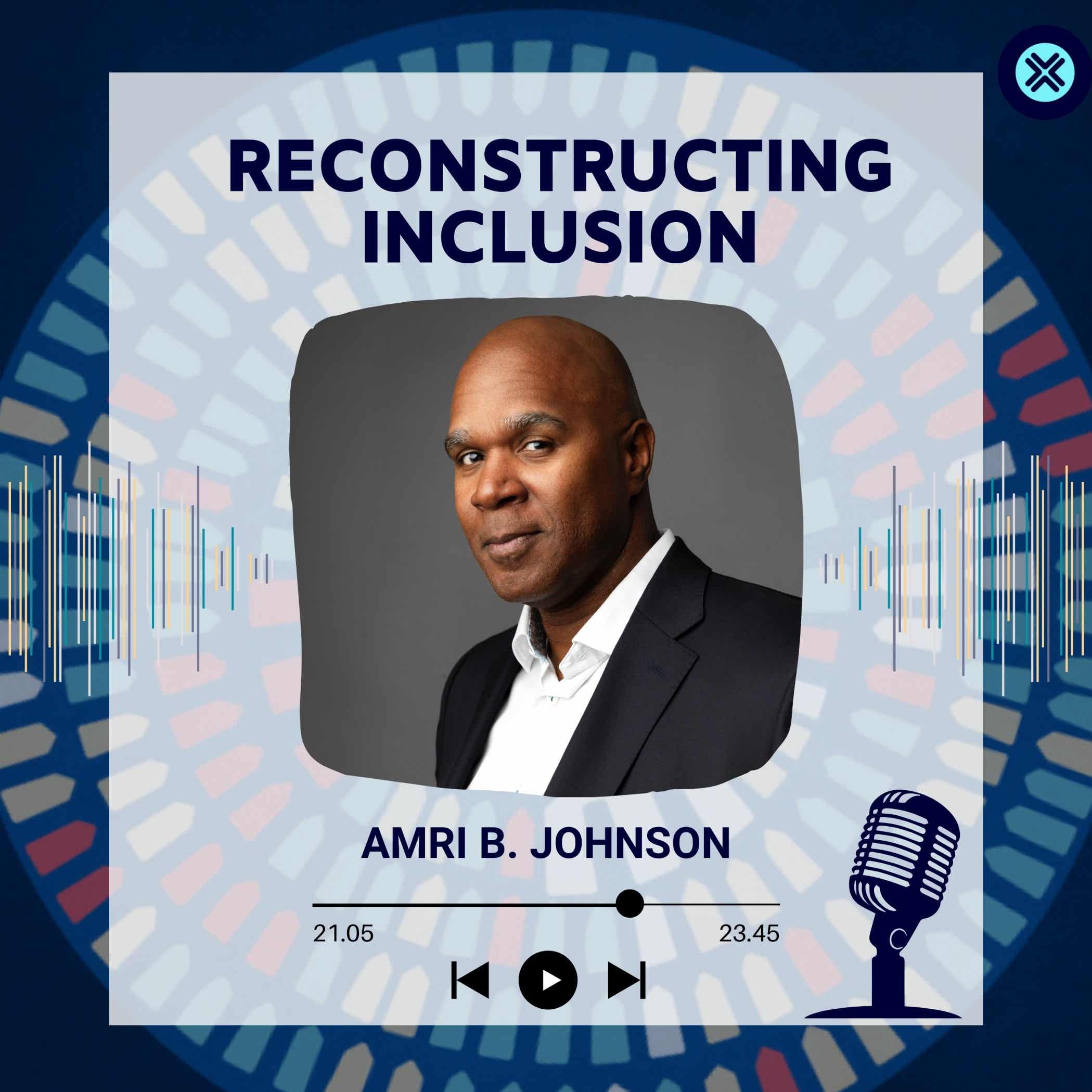
PODCAST · society
Reconstructing Inclusion Podcast
by Amri B. Johnson
The Reconstructing Inclusion Podcast goes far beyond what the host, Amri B. Johnson, considers redundant, how-to diversity, equity, and inclusion dialogues.He aims to create a space to speak the truth and examine context in DEI. This means creating a path forward for everyone to rethink and recognize the benefits of inclusion individually and collectively.Reconstructing in this sense is about creating organizational systems and networks where everyone belongs. reconstructinginclusion.substack.com
-
44
Reconstructing Inclusion S3E10: The Brain Science Behind Why Belonging Matters More Than Diversity Numbers
Welcome to Season Three of Reconstructing Inclusion!Your brain doesn't process exclusion differently from physical pain. Dr. Steve L. Robbins joins Amri to unpack the neuroscience of belonging and why most inclusion work has been measuring the wrong thing.Dr. Steve L. Robbins is a communication scientist, social psychologist, and cognitive neuroscientist who has spent decades studying human behavior. He's worked with Coca-Cola, Disney, Microsoft, NASA, the NBA, and dozens of other organizations. But his entry into this work wasn't academic. It was personal. And this conversation reflects that depth.In this episode, Amri and Steve explore:Why the early diversity movement built itself around the wrong indicator of justice [00:11:00]How the brain reduces every dimension of diversity to one binary: insider or outsider [00:10:00]The neuroscience behind why social exclusion is processed as physical pain [00:21:00]The Ancient Brain vs. Modern Brain model and how it drives reactive behavior at work [00:27:00]The HERO Skills framework: Humility, Empathy, Reflection, and Open-Mindedness [00:29:00]Why reflection is the foundational skill for intentional leadership [00:31:00]The rainbow trout story and what it really means to prepare an environment for inclusion [00:16:00]How storytelling is an underused inclusion technology in organizations [00:38:00]What stands out in this conversation is how Steve bridges hard science with plain language. He doesn't speak in abstractions. He speaks in sports analogies, pond fish, and the cost of walking on eggshells. And somehow, it all lands.Guest: Dr. Steve L. Robbins Connect with Dr. Steve L. Robbins: https://www.slrobbins.com/ If this episode resonated with you, subscribe, leave a review, and share it with someone in your organization who needs to hear it.Let's Connect:https://inclusionwins.com/https://reconstructinginclusion.substack.com/➡️ Subscribe to Reconstructing Inclusion for more unfiltered conversations about the future of diversity, equity, and inclusion (DEI) This is a public episode. If you'd like to discuss this with other subscribers or get access to bonus episodes, visit reconstructinginclusion.substack.com/subscribe
-
43
Reconstructing Inclusion S3E9: The AI-Inclusion Gap Rarely Talked About
Welcome to Season Three of Reconstructing Inclusion!Who's shaping the logic of AI systems — and who gets quietly failed when they work exactly as designed, just not for them? That's the inclusion gap Amri Johnson and Peter Swimm dig into in this conversation.Peter Swimm is the founder and CEO of Toilville and has spent over 25 years in conversational AI, building systems for companies like Walmart, Chipotle, and Lowe's before leading generative AI work at Microsoft Copilot Studio. He's one of the sharpest voices in the industry on where AI gets inclusion right — and where it doesn't.In this episode, Amri and Peter explore why diverse voices in tech need more than a seat at the table — they need actual influence over how systems get built. They get into the "Devon Avenue" framework for thinking about inclusive design, the accountability gap that shows up when AI fails real people, and why AI companies may need us more than we need them.What you'll hear:Why AI hallucinations are less a technical problem and more a people gapThe difference between diversity in hiring and diversity in decision-makingWhat "who's responsible when the decision is wrong?" looks like in practiceWhy building for failure from day one is an inclusion issue, not just an engineering oneThe data leverage argument: what it means that AI companies need fresh human data to stay relevantAbout the GuestPeter Swimm is the founder and CEO of Toilville, a consultancy helping organizations use AI without losing the institutional knowledge and human expertise that make them effective. He co-founded Talkabot, the industry's first dedicated conversational AI conference, and got his start teaching Chicago communities how to use the internet at the public library in 1996. Peter is a vocal advocate for ethical, human-centered AI — arguing that truly inclusive AI requires diverse voices shaping systems from the start, not just auditing for bias after the fact. Find him at toilville.com.#Inclusion #AI #Algorithm #Leadership #OrganizationalDesign #Diversity #Technology #FutureofWork #ConversationalAIIf this episode got you thinking, share it with someone working in tech, HR, or DEI who hasn't yet grappled with what AI means for their work. Subscribe so you never miss an episode of Reconstructing Inclusion.Let's Connect:https://inclusionwins.com/https://reconstructinginclusion.substack.com/➡️ Subscribe to Reconstructing Inclusion for more unfiltered conversations about the future of diversity, equity, and inclusion (DEI) This is a public episode. If you'd like to discuss this with other subscribers or get access to bonus episodes, visit reconstructinginclusion.substack.com/subscribe
-
42
Reconstructing Inclusion S3E8: Your People Belong. But Do They Know They Matter?
Welcome to Season Three of Reconstructing Inclusion!Most inclusion conversations focus on belonging. This episode makes the case that we've been stopping short.Belonging asks: Am I welcome here? Mattering asks: Am I consequential here? You can answer yes to the first and no to the second — and when that happens, something dims inside people that is hard to recover without intentional effort. Amri unpacks this distinction through a real story, research from organizational psychologists, and a practice you can use today.In this episode:00:01:00 Introduction and why this conversation matters now00:04:00 Belonging vs. mattering: the core distinction00:06:00 Zach Mercurio's indispensability test00:08:00 The grasp reflex: mattering as a survival instinct00:10:00 The running faucet metaphor00:15:00 Emotional intelligence as the infrastructure for mattering00:17:00 The self-efficacy gap: awareness vs. agency00:19:00 Cultural intelligence and making mattering portable00:21:00 The EQ-CQ-mattering chain00:23:00 The "If It Weren't for You" practice🔥 Standout Quotes:“Most leaders I work with genuinely care about their people. But anti-mattering is rarely the result of one dramatic moment. It builds slowly, and by the time it shows up as silence or people going adrift or disengagement, the faucet has been running for a long time.” [00:11:48]“I’ve worked with highly self-aware people who couldn’t articulate their strengths clearly and consistently held back in high-stakes rooms. They just went silent, not because they lacked insight, but because they had stopped trusting that their contribution would change anything. The awareness was intact. The agency was not.” [00:17:46]#Inclusion #Leadership #Belonging #Diversity #Mattering #CulturalIntelligence #EmotionalIntelligence #CQ #EQResources Mentioned:Zach Mercurio’s work on mattering, including the “noticed, affirmed, and needed” frameworkIsaac Prilleltensky on mattering as feeling valued and adding valueGordon Flett’s research on anti-matteringDaniel Goleman’s emotional intelligence (EQ) frameworkCultural intelligence (CQ) framework by Soon Ang, Linn Van Dyne, and David LivermoreLet's Connect:https://inclusionwins.com/https://reconstructinginclusion.substack.com/➡️ Subscribe to Reconstructing Inclusion for more unfiltered conversations about the future of diversity, equity, and inclusion (DEI) This is a public episode. If you'd like to discuss this with other subscribers or get access to bonus episodes, visit reconstructinginclusion.substack.com/subscribe
-
41
Reconstructing Inclusion S3E7: Designing Inclusion from the Inside Out with Dr. Jennifer Sarrett
Welcome to Season Three of Reconstructing Inclusion!What if DEI was built the same way curb cuts were — designed for the most excluded and better for everyone as a result? In this episode, Amri Johnson sits down with Dr. Jennifer Sarrett, founder of Disruptive Inclusion, to explore why the inclusion field keeps falling short — and what a proactive, evidence-based alternative looks like.Dr. Jennifer Sarrett brings a rare combination of backgrounds: autism advocacy, bioethics, medical anthropology, and public health. Her methodology, Organizational Culture Design, draws from Universal Design principles to build workplaces where access and belonging are built in from the start — not bolted on after a crisis.🔥 Standout Quotes:“How can we predict where there might be barriers to somebody or a type of person? And go ahead and design to increase accessibility that will funnel down or trickle down to increase accessibility for everybody. Without making it more difficult for anybody.” [00:08:00]“The efforts often aren’t embedded. So they’re training programs, one-off things that aren’t really tracked internally or actually turned into action. The field of DEI isn’t very good at explaining to those in power how it works for them as well.” [00:28:00]In This Episode:[00:02:00] Introducing Dr. Jennifer Sarrett and her background[00:08:00] Universal Design — what it is and why DEI needs it[00:13:00] Reactive vs. proactive inclusion — where the field has gone wrong[00:20:00] Social determinants vs. identity-category thinking[00:28:00] What DEI got wrong about communicating to those in power[00:35:00] Why research has to come before solutionsAbout the GuestDr. Jen Sarrett is the founder of Disruptive Inclusion, an organizational culture strategy firm. With a PhD in Interdisciplinary Studies, her work bridges systems thinking, social science, and public health to solve complex people challenges. She also publishes Science of High Performance, a weekly newsletter on culture design in health and science.Website: disruptiveinclusion.comPersonal site: jennifersarrett.comLinkedIn: Jennifer Sarrett#Inclusion #DEI #Leadership #OrganizationalDesign #Diversity #Neurodivergence Let's Connect:https://inclusionwins.com/https://reconstructinginclusion.substack.com/➡️ Subscribe to Reconstructing Inclusion for more unfiltered conversations about the future of diversity, equity, and inclusion (DEI) This is a public episode. If you'd like to discuss this with other subscribers or get access to bonus episodes, visit reconstructinginclusion.substack.com/subscribe
-
40
Reconstructing Inclusion S3E6: Moving Beyond Legal Defenses to Build Capable Organizations
Welcome to Season Three of Reconstructing Inclusion!In this solo episode, I break down why DEI didn't collapse because of courtroom battles or political backlash. It collapsed because the field stopped evolving. While we were busy seeking legal cover and worrying about what would hold up in court, something more consequential was happening inside organizations: sense-making was deteriorating, trust was thinning, and people increasingly felt replaceable.The question now isn't whether DEI was lawful. The question is whether we're willing to evolve the field or just repackage the last 40 years of work and call it progress.🔥 Standout Quotes:"It's not the Trump administration that took down DEI in its entirety. The Trump administration came when it was politically expedient and then basically threw gasoline on a fire that was already burning." [00:11:00]"Inclusion at its core is about sense-making. About making sense of the world, of each other, of our teams, of our organization. Understanding that the organization is all working in concert to create the conditions for everyone to do their best work and for the organization to fulfill on its mission." [00:17:00]Resources Mentioned:Reconstructing Inclusion by Amri JohnsonHow Equality Wins by Kenji Yoshino and David GlasgowLily Zheng’s “FAIR Framework”The Emergent Inclusion FrameworkIn This Episode:[00:02:00] The damage that's already been done[00:05:00] When sense-making declines[00:08:00] Why we asked compliance to do the work of culture and capability[00:11:00] Trump administration threw gasoline on a fire that was already burning[00:13:00] How disagreement became treated as risk rather than data[00:16:00] Introducing Emergent Inclusion[00:17:00] The four questions[00:22:00] When inclusion works...[00:23:00] The choice: defensible or functional?#Inclusion #DEI #Leadership #OrganizationalDevelopment #Diversity #TrumpLet's Connect:https://inclusionwins.com/https://reconstructinginclusion.substack.com/➡️ Subscribe to Reconstructing Inclusion for more unfiltered conversations about the future of diversity, equity, and inclusion (DEI) This is a public episode. If you'd like to discuss this with other subscribers or get access to bonus episodes, visit reconstructinginclusion.substack.com/subscribe
-
39
Reconstructing Inclusion S3E5: Designing for the Margins: Joy Elizabeth Buckner on Neurodivergence, Education, and Mattering
Welcome to Season Three of Reconstructing Inclusion!Designing for the Margins: Why Neurodivergent Thinkers Need More Than AwarenessJoy Elizabeth Buckner is an educational consultant who's spent 13 years abroad working across 25+ countries to support neurodivergent learners. With dyslexia, Irlen Syndrome, and ADHD, she brings lived experience to her mission of building belonging for neurodivergent thinkers.We explore why educational systems are designed for the "middle," what happens when we build for the margins, and Joy's framework for moving beyond awareness to action: empowered, equipped, voiced, connected.Key Topics: Teaching to the middle, blind spots around neurodivergence, "penguining" and ADHD brilliance, why neurodivergent people need proof they matter, the cost of maskingTimestamps: [00:12:00] From categories to lived experience [00:15:30] Why we're still teaching the same way [00:20:30] Joy's four-pillar framework [00:28:30] Systems that fail neurodivergent children [00:34:30] Neurodivergent people need extra proof [00:37:00] "Penguining" and neurodivergent brillianceResources: "Shantaram" by Gregory David Roberts, The Joy of Neurodiversity Podcast, "Covering" by Kenji Yoshino20-30% of people are neurodivergent. When we design for the margins, everyone benefits.🔥 Standout Quotes:"If you were in my brain and you knew how hard I was trying in class, in school, in life—I was trying so hard just to try to feel normal. That's the thing that I hear again and again. We were lazy, we were defiant, we didn't try hard enough." [00:33:45]"Other people can tell you that you matter. Other people can tell you that you belong. Other people can tell you that you're valued. We need proof. Neurodivergent people need extra proof." [00:34:30]About Our Guest:Joy Buckner is an educational consultant, speaker, and host of "The Joy of Neurodiversity" podcast. She works with parents, teachers, and ministries of education to build belonging and show dignity to the brilliance of neurodivergent thinkers. Based in Dubai, she's worked across 25+ countries reshaping how we understand and support diverse minds.Let's Connect:https://inclusionwins.com/https://reconstructinginclusion.substack.com/➡️ Subscribe to Reconstructing Inclusion for more unfiltered conversations about the future of diversity, equity, and inclusion (DEI) This is a public episode. If you'd like to discuss this with other subscribers or get access to bonus episodes, visit reconstructinginclusion.substack.com/subscribe
-
38
Reconstructing Inclusion S3E4: Defining True Purpose in the Diversity, Equity, and Inclusion Work
Welcome to Season Three of Reconstructing Inclusion!This is my last episode for 2025.If I could go back five years, what would I have changed? This solo episode is my honest accounting of where the diversity, equity, and inclusion field went wrong.The past five years transformed DEI. What started as meaningful change became performance art. Organizations treated inclusion as optics management: do just enough to deflect criticism. But it rarely touched fundamental structures.Now we're living with the consequences. The resistance has erupted. We may have contributed to the very resistance we were trying to overcome.🔥 Standout Quotes:"Instead of enrolling people in a conversation about what organizations structurally needed to change, there was a tremendous amount of energy talking about the structural problem of systemic racism." [00:05:00]"When we see statistical disparities and immediately conclude their evidence of discrimination, without examining all these other factors, we're committing this fallacy. Disparities don't equal discrimination." [00:11:00]Resources Mentioned:Social Justice Fallacies by Thomas SowellIn This Episode:[00:05:00] When optics replaced purpose[00:07:00] Active vs. passive opposition[00:11:00] The three fallacies affecting DEI work[00:16:00] The Richard Bilkszto tragedy[00:22:00] What inclusion work should actually be[00:24:00] Building durable skills[00:27:00] Why this moment holds promise#Inclusion #DEI #Leadership #OrganizationalDevelopment #DiversityLet's Connect:https://inclusionwins.com/https://reconstructinginclusion.substack.com/➡️ Subscribe to Reconstructing Inclusion for more unfiltered conversations about the future of diversity, equity, and inclusion (DEI) This is a public episode. If you'd like to discuss this with other subscribers or get access to bonus episodes, visit reconstructinginclusion.substack.com/subscribe
-
37
Reconstructing Inclusion S3E3: When Empathy Becomes Optional: A Conversation with Maaria Mozaffar
Welcome to Season Three of Reconstructing Inclusion!When Empathy Becomes Optional: A Conversation with Maaria MozaffarWhen did empathy become something we can turn on and off? When did we start deciding which children deserve protection and which ones don't? These are the uncomfortable questions Maaria Mozaffar forces us to confront.🔥 Standout Quotes:"If you are watching that and you think it's just about legalities, should've known better, then I wanna know where your humanity is." [00:16:00]"I don't believe humans have the right to consider other humans less human... I will keep an eye on every interaction and not pass the buck." [00:34:00]"Watch your baby be crushed under buildings. We'll see if you're gonna look for someone to blame or you're gonna put on your backpack and say, let's lift this up." [00:35:00]About Our Guest:Maaria Mozaffar is an attorney, mediator, legislative drafter, and author of More Than Pretty: How to Live a Life of Substance in an Artificial World. For over 15 years, she's been writing human-first policies that center dignity and interconnectedness. In this conversation, she argues that we've turned off our empathy and made it optional instead of essential—and that we have the power to turn it back on.Resources Mentioned:The Fox and the Hound (animated film): A story about friendship, identity, and choosing humanity over what we’re conditioned to believe.More Than Pretty: How to Live a Life of Substance in an Artificial World by Maaria Mozaffar: A book about moving away from distractions and creating a life of substance and impact.In This Episode:- The three camps: happiness, helplessness, and hiding (and why none are serving us)- How ethnocentrism is driving immigration policy- Why we've made empathy optional and how to make it essential again- Why global education is essential for breaking through propaganda- How we've chosen to see some people as less deserving of dignity- The power of one voice and one micro decision- What it means to stop being an NPC in your own lifeLet's Connect:https://inclusionwins.com/https://reconstructinginclusion.substack.com/➡️ Subscribe to Reconstructing Inclusion for more unfiltered conversations about the future of diversity, equity, and inclusion (DEI) This is a public episode. If you'd like to discuss this with other subscribers or get access to bonus episodes, visit reconstructinginclusion.substack.com/subscribe
-
36
Reconstructing Inclusion S3E2: Time to Transcend the Letters: Reconstructing Inclusion Around Humanity, Not Identity Categories
Welcome to Season Three of The Reconstructing Inclusion Podcast!In this episode, Amri Johnson argues that D-E-I as symbols must go, not the principles, but the letters themselves that have become hollow ammunition in a culture war serving no one.Fresh from the LEAD 2025 conference in Milan, he'd been seeing traction emerge from the wreckage, but it looks radically different from what came before. It's less about representation metrics and identity categories, more about humanity and systems change.He opens with a story about his 6-year-old son telling him, "this is just a dream"—a moment connecting to Daoist philosophy that forced him to consider how DEI practitioners have been co-creating the very conditions they now face. The question isn't whether DEI should exist, but whether we're brave enough to wake up from the dream we've been living and create something better.🔥 Standout Quotes:"D, E, and I are not the essence. The essence has been stuffed into these three letters, and it's like writing the word pizza on paper and handing it to you. That's not pizza." [00:06:00]"If social capital isn't present, the floors of businesses are hollow and the ceilings are capped. The only change is downward." [00:14:00]"When we care for the so-called other to help them fulfill their highest potential, that's how we fulfill our own highest potential." [00:20:00]Resources Mentioned:LEAD Network Conference 2025: We’re All InSubscribe to Geoff Marlow on SubstackCultural Intelligence Center - Since 2004, has helped leaders and teams confidently navigate cultural complexity, leading to stronger collaboration, sharper innovation, and more impactful leadership.Atlas at Cultural Infusion - delivers world-first missing data, and empowers teams with an innovative, engaging experience.Time Stamps:Why both anti-DEI and pro-DEI camps have a stake in keeping the letters alive [00:06:00]The "pizza metaphor": How we've been arguing about words on paper while everyone goes hungry [00:06:00]Why social capital trumps financial capital—and what happens when it's absent [00:12:00]The five fundamental shifts redefining inclusion work over the next 12-18 months [00:15:00]Moving from racialization/gender/sexuality as organizing principles to centering humanity [00:16:00]Cultural intelligence as the foundation everyone can build [00:19:00]Care, openness, safety, and trust as relational infrastructure [00:20:00]Sense-making as the organizational superpower AI can't replace [00:22:00]Networks and cognitive diversity as critical survival skills [00:24:00]➡️ Subscribe to Reconstructing Inclusion for more unfiltered conversations about the future of diversity, equity, and inclusion (DEI) This is a public episode. If you'd like to discuss this with other subscribers or get access to bonus episodes, visit reconstructinginclusion.substack.com/subscribe
-
35
Reconstructing Inclusion S3E1: Ingrid Hu Dahl on Finding Belonging in a (Mixed) Racialized World
Welcome to Season Three of Reconstructing Inclusion! This season focuses on opening dialogue about who we are rather than what we ascribe to one another—shifting patterns and practices in the diversity and inclusion space with fresh eyes.In our Season Three premiere, host Amri Johnson sits down with Ingrid Hu Dahl, leadership coach, consultant, and author of a powerful memoir about identity, loss, and living boldly. Ingrid shares her journey from daily "othering" to authentic belonging, exploring how racial categorization creates artificial divisions and why true safety must come from within.🔥 Standout Quotes:"I share that a daily experience with mine, especially growing up in Central New Jersey, in this predominantly white neighborhood, was a reminder that I was different and didn't belong." [00:14:00]"At your funeral. What does the eulogy say if you continue on this path? What are they saying about you if they couldn't read your resume?" [00:26:00]"The most poetic answer to that is after my mother died. That was a really big, big, big, big moment of an unleashing of so much." [00:20:00]About Our Guest:Ingrid Hu Dahl is an author, speaker, and leadership coach. She is the founder of a coaching and consulting business dedicated to empowering the next generation of leaders. With over two decades of experience in learning and development, she brings her expertise to a wide range of industries, from corporate and media to nonprofit and social justice organizations. A TEDx speaker and a founding member of the Willie Mae Rock Camp in Brooklyn, Ingrid has a lifelong passion for amplifying underrepresented voices. Resources Mentioned:Sun Shining on Morning Snow: A Memoir of Identity, Loss, and Living Boldly by Ingrid Hu DahlWorks of Audre Lorde - Influential in Ingrid's understanding of intersectional oppressionAdrian Piper's art and writings - Particularly her piece, "Cornered" Time Stamps:Double Rejection Across Communities [00:11:00]Experiencing othering from both white and Asian communities as a childLoss as Liberation [00:20:00] How her mother's death created a massive opening for healing and authenticityCorporate Identity Crisis [00:24:00] Recognizing how titles and external validation became another limiting categorizationThe Funeral Question [00:26:00] What would your eulogy say if they couldn't read your resume?Global Citizen Experience [00:37:00] Finding belonging internationally where difference becomes an asset rather than otheringRetiring From Race [00:36:00] Discussing Adrian Piper's decision to exist outside racial binaries➡️ Subscribe to Reconstructing Inclusion for more unfiltered conversations about the future of diversity, equity, and inclusion (DEI) This is a public episode. If you'd like to discuss this with other subscribers or get access to bonus episodes, visit reconstructinginclusion.substack.com/subscribe
-
34
Reconstructing Inclusion S2E12: Season Finale | The Sky Is Still Not Falling on DEI
In this episode, host Amri Johnson delivers a powerful season finale reflecting on Season 2's groundbreaking conversations, Johnson challenges core assumptions about diversity work and introduces controversial perspectives on why focusing on racial differences may be counterproductive to anti-racism goals.Key Discussion Points:- Move from cataloging differences to reducing distance between humans- Racialization may perpetuate the foundation of racism itself- Both DEI advocates and opponents use vague rhetoric preventing real dialogue- Practitioners need accountability ("skin in the game") for integrity- Current challenges represent evolution, not rejection of inclusion🔥 Standout Quotes:"The focus we've had on anti-racism in the Kendi and DiAngelo sense wasn't resonating with me for quite some time." [00:07:00]"I have almost 25 years of skin in this game. Skin in the game is about having something to lose when you're wrong." [00:23:00]➡️ Subscribe to Reconstructing Inclusion for more unfiltered conversations about the future of DEI. This is a public episode. If you'd like to discuss this with other subscribers or get access to bonus episodes, visit reconstructinginclusion.substack.com/subscribe
-
33
Reconstructing Inclusion S2E11: Why Ending Race is the Future of Antiracism: Dr. Sheena Mason's Breakthrough Approach to Race/ism
In this episode, I sit down with Dr. Sheena Mason, author of "The Raceless Antiracist: Why Ending Race is the Future of Antiracism," for a conversation that challenged everything I thought I knew about racial justice. Sheena presents her revolutionary "Togetherness Wayfinder" framework—a practical roadmap beyond traditional antiracist thinking toward what she calls "raceless antiracism."This isn't just academic theory. It's a fundamental reimagining of how we approach inclusion, justice, and human liberation that could transform organizations, communities, and individual relationships.🔥 Standout Quotes:"The fiction of race is the dehumanizing apparatus that gets attached to human beings that then allows us to be broken into false hierarchies. And in that way, it's a thoroughly pernicious category and a thoroughly pernicious practice." [00:13:00]"In that shift, the idea is I'm centering the human right. I'm recentering the human. A person, right? A human who gets racialized as... I'm highlighting the external factors that exists in a particular context." [00:17:30]"To my mind, racelessness is synonymous with limitlessness and there are two ways that limits get placed onto us. We internalize limits and then place limitations on ourselves." [00:57:00]About Our Guest:Dr. Sheena Michele Mason is an influential scholar, educator, and advocate for antirace/ism. As an Assistant Professor of English at SUNY Oneonta, she has dedicated her career to dismantling racism through innovative approaches.Sheena holds a Ph.D. in English with distinction from Howard University, specializing in African American, American, and Caribbean Literatures. She is the innovator of the "Togetherness Wayfinder" approach and has authored significant works including "The Raceless Antiracist: Why Ending Race is the Future of Antiracism" (2024) and "Theory of Racelessness: A Case for Philosophies of Antirace(ism)" (2022).Resources Mentioned:"The Raceless Antiracist: Why Ending Race is the Future of Antiracism" by Dr. Sheena MasonThe Togetherness Wayfinder frameworkTime Stamps:[00:07:00] - Introduction to Dr. Sheena Mason and her work[00:11:00] - Her journey from trauma to literature as liberation and life's mission[00:13:00] - Core thesis: Race as a "dehumanizing apparatus" that creates false hierarchies[00:17:30] - Revolutionary language: From "Black person" to "person racialized as Black"[00:20:30] - The Scooby Doo metaphor: How race masks five real categories[00:23:00] - Creolization theory and the controversy over the new Pope's race[00:28:00] - Deconstructing crime statistics and racialized data collection[00:32:00] - Shocking reality: Only 3% of people racialized as Black commit violent crimes[00:43:00] - Historical analysis: Why reconstruction of race has failed since Douglass[00:48:00] - Centering whiteness in the abolition conversation[00:52:00] - Why reform-based antiracism feels "safe" to those in power[00:57:00] - Vision of raceless futures: "Racelessness is synonymous with limitlessness"[01:00:00] - Parenting without racial categories and creating new possibilities➡️ Subscribe to Reconstructing Inclusion for more unfiltered conversations about the future of diversity, equity, and inclusion (DEI) This is a public episode. If you'd like to discuss this with other subscribers or get access to bonus episodes, visit reconstructinginclusion.substack.com/subscribe
-
32
Reconstructing Inclusion S2E10: Transcending Ideology: Making Inclusion an Organizational Superpower
In this episode, host Amri Johnson explores why many DEI efforts have failed to deliver sustainable change and offers a principle-centered framework that thrives even in challenging political climates.Key Discussion Points:- Why the "Chicken Little" mentality has weakened DEI's position - The three keys to effective inclusion: accessibility, actionability, and alignment - How anti-fragile organizations use inclusion as a competitive advantage - Why both proponents and opponents of DEI have "hijacked" the conversation - The difference between practitioners with "skin in the game" versus opportunists - Moving beyond deficit-oriented approaches to create thriving workplaces 🔥 Standout Quote:"Metaphorically, when the kitchen gets hot, the chefs stay. Those who are hobbyist cooks are more likely to move to a place they can be more comfortable and hope the heat dissipates." [00:17:57]Resources Mentioned:Join our free EMERGENT Inclusion Framework virtual event. This isn't another discussion about group identities, allyship, and injustice. While those things have their place, the focus on symptoms rather than diving into the complexity of systems have not unlocked organizational value as practitioners and supporters have hoped for them to. Whether you're a skeptic or champion, your voice matters in this conversation.Time Stamps:[00:01:00] - The concept of "so-called DEI" and why this framing matters [00:03:00] - Making DEI accessible, actionable, and aligned with purpose [00:05:56] - Anti-fragile organizations: bouncing back stronger from challenges [00:07:31] - How DEI has been hijacked by both supporters and opponents [00:09:40] - The power of principles over ideology in the DEI conversation [00:13:42] - Chicken Little and DEI [00:16:44] - Why many activists disappear when leadership is most needed [00:17:57] - "When the kitchen gets hot, the chefs stay" [00:19:39] - How DEI became associated with deficit-oriented approaches [00:22:00] - Highlighting practitioners still doing meaningful inclusion work➡️ Subscribe to Reconstructing Inclusion for more unfiltered conversations about the future of DEI. This is a public episode. If you'd like to discuss this with other subscribers or get access to bonus episodes, visit reconstructinginclusion.substack.com/subscribe
-
31
Reconstructing Inclusion S2E9: 'Three Steps Forward, Two Steps Back': Howard Ross on DEI's Historical Resilience
In this episode, Howard Ross draws on four decades of DEI experience to offer wisdom in today's polarized climate. Howard, who brought me into the DEI field years ago, discusses how today's backlash fits into historical patterns and provides strategic guidance for practitioners navigating political headwinds.Key Discussion Points:- The shift from a "bell curve society" to a "dumbbell curve society"- Distinguishing between performative, symbolic, and transformational DEI work- Why activism and organizational change require different skillsets- Strategic approaches to continuing inclusion work in challenging environments- Finding hope in historical patterns of social progress- Seeing humanity across political divides🔥 Standout Quote:"We've gone from a Bell curve society where most people are kind of in the middle... to a dumbbell curve society where everything's on the end and nothing's in the middle. And the notion of working with somebody across the aisle is considered pretty much by both sides to be betrayal." - Howard RossAbout Our Guest:Howard Ross is a lifelong social justice advocate and pioneer in the field of DEI work. As founder of Cook Ross and author of influential books including "Everyday Bias," "ReInventing Diversity," and "Our Search for Belonging," Howard has consulted with hundreds of organizations worldwide. At 74, he describes himself as "rewired not retired" and continues to be an influential voice in the field. Howard is currently working on a third edition of "Everyday Bias" with his son Jake, focusing on how AI and social media are influenced by bias.Resources Mentioned:Everyday Bias by Howard RossIDEAS Generation - An organization for younger DEI practitioners co-founded by Dan Egol, a former Cook Ross employee.The Fire Next Time by James Baldwin - Mentioned by Howard as a transformative book that changed his worldview when he read it in 1966.Time Stamps:[00:04:00] - Howard's background in civil rights work and how his family's Holocaust experience shaped him[00:08:30] - The concept of "dumbbell curve society" and its impact on DEI work[00:11:45] - The dual nature of DEI backlash: legitimate critique and politically motivated attacks[00:13:50] - The three levels of DEI work: cosmetic, performative, and symbolic[00:15:30] - The critical difference between activism and organizational change[00:33:00] - Thinking strategically versus emotionally about DEI work[00:39:00] - Finding hope in the historical patterns of progress and retrenchment[00:44:00] - The importance of seeing humanity in those with different political views➡️ Subscribe to Reconstructing Inclusion for more unfiltered conversations about the future of DEI. This is a public episode. If you'd like to discuss this with other subscribers or get access to bonus episodes, visit reconstructinginclusion.substack.com/subscribe
-
30
Reconstructing Inclusion S2E8: Escape the Box: The Uncomfortable Truth About Today's DEI Discourse
In this episode, host Amri Johnson challenges us to examine how we put ourselves and others into boxes—especially in the context of identity and inclusion within DEI work. Amri explores the shortcomings of both extreme pro-DEI and anti-DEI positions, revealing how both ends of the spectrum ultimately restrict true inclusion.Key Discussion Points:- Three types of boxes that shape our identities- Why binary thinking in DEI work leads to ineffective outcomes - The "anti-racist" versus "not racist" framework - How today's anti-DEI backlash mirrors the problematic dynamics of extreme DEI approaches from 2020- Creating organizational cultures based on universal principles like dignity, respect, and interdependence- Why intellectual honesty matters more than superficial niceness 🔥 Standout Quotes:"Many home runs in the DEI space, in the anti-racist space, in the social justice space that were hit since 2020 did not win games. In fact, they're creating the opposite effect where others are trying to win a similar game in a very different direction."Resources Mentioned:- Reconstructing Inclusion S1E6: What is Race Abolition?: Illuminating Racialization’s Complexity with Dr. Subrena Smith and Dr. David Livingstone Smith"Stamped: Racism, Antiracism, and You" - Book co-authored by Jason Reynolds and Ibram X. Kendi that explores the history of racist ideas in America.Peter Senge's Definition of Leadership - "Leadership is the capacity for a human community to shape its future." Join our free EMERGENT Inclusion Framework virtual event. This isn't another discussion about group identities, allyship, and injustice. While those things have their place, the focus on symptoms rather than diving into the complexity of systems have not unlocked organizational value as practitioners and supporters have hoped for them to. Whether you're a skeptic or champion, your voice matters in this conversation.Time Stamps:01:00 - The concept of boxes in identity and inclusion02:00 - The three types of boxes that define our identity04:00 - How the dynamics between DEI proponents and opponents mirror each other06:30 - The baseball analogy: anti-racist vs. not racist08:30 - Strategic approaches to inclusion vs. binary thinking10:50 - The current political climate and its impact on DEI13:30 - Self-censoring across different contexts15:00 - Creating organizational culture beyond superficial niceness17:10 - The danger of overcorrection in DEI discourse18:00 - Final reflections on transcending boxes➡️ Subscribe to Reconstructing Inclusion for more unfiltered conversations about the future of DEI. This is a public episode. If you'd like to discuss this with other subscribers or get access to bonus episodes, visit reconstructinginclusion.substack.com/subscribe
-
29
Reconstructing Inclusion S2E7: Drawing Lines, Creating Distance: Fred Falker on What's Really Dividing Us
In this episode, Fred Falker challenges everything we think we know about DEI. Using the famous nine-dot puzzle as a metaphor, Fred explains why our current approach to inclusion might be holding us back – and offers a revolutionary new way forward.Key Discussion Points:- The nine-dot puzzle and invisible limitations- Difference vs. Distance paradigm- Why nature doesn't draw lines?- The problem with current DEI approaches- Moving beyond categories to connection- Measuring real impact in DEI work🔥 Standout Quote:"The drawing of the line is what divides. And when we divide, it brings in appraisal and judgment. It brings in the idea that something could be less than or more than. All of our bias is created by drawing lines." - FredAbout Our Guest:Fred Falker is the President of Falker Consulting Group, Inc., an organizational development consulting and training firm. Over the past twenty-five years, he has developed and introduced a fundamentally new and better approach to diversity, equity, and inclusion. This approach goes beyond today's anti-racism and unconscious/implicit bias training.Resources Mentioned:- Falker Consulting Group- From Difference to Distance: Rethinking Diversity and Inclusion | Fred Falker | TEDxClayton- Ralph Ellison's "Invisible Man" - Dr. Robert L. Williams - Founder of Black Psychology Time Stamps:[00:01:00] - Introduction to Fred Falker and his unique perspective on DEI [00:07:00] - Why Fred initially refused to do diversity training [00:15:00] - The fundamental flaw in how we think about differences [00:19:00] - "Nature does not draw lines" – Understanding constructed divisions [00:34:00] - Why understanding groups doesn't mean understanding individuals [00:37:00] - The distance paradigm: What really separates us? [00:49:00] - Why we need to focus on outcomes, not activities?[00:54:00] - The importance of abandoning old paradigms completely➡️ Subscribe to Reconstructing Inclusion for more unfiltered conversations about the future of DEI. This is a public episode. If you'd like to discuss this with other subscribers or get access to bonus episodes, visit reconstructinginclusion.substack.com/subscribe
-
28
Reconstructing Inclusion S2E6: Moving Beyond the DEI (and Anti-DEI) Bandwagon in 2025
Reconstructing Inclusion with Amri B. JohnsonSeason 2, Episode 6: Moving Beyond the DEI (and Anti-DEI) Bandwagon in 2025📝 Episode Description:In this episode, Amri explores why traditional DEI approaches are failing organizations and introduces the Emergent Inclusion Framework - a new paradigm for creating sustainable, inclusive cultures. Learn how to move beyond bandwagon solutions and build organizations that generate "thick value" and thrive through change.⏱️ Time Stamps:[00:00:00] - Introduction and context of DEI's evolution since 2021[00:01:00] - The transition of DEI consultants and practitioners[00:02:00] - Understanding historical challenges in DEI[00:03:00] - The bandwagon effect explained[00:05:00] - Introduction to "thick value" concept[00:07:00] - The Emergent Inclusion Framework explained[00:09:00] - Relational fitness and organizational change[00:11:00] - Building trust through transparency[00:12:00] - New initiatives and resources announcement[00:13:00] - Special announcement about upcoming project🔑 Key Concepts Discussed:- The bandwagon effect in DEI initiatives- Thick value and its role in organizational culture- Anti-fragility in organizational development- Relational fitness- The Emergent Inclusion Framework- Building trust through transparency- Future-fit organizations📚 Resources Mentioned:Book: "Reconstructing Inclusion" by Amri B. JohnsonBook: "Diversity and Complexity" by Scott E. PageSystemic Inclusion Survey™ - A free diagnostic tool to assess your organization's current inclusion practices and identify areas for improvement.>> Subscribe to Reconstructing Inclusion on Substack here This is a public episode. If you'd like to discuss this with other subscribers or get access to bonus episodes, visit reconstructinginclusion.substack.com/subscribe
-
27
Reconstructing Inclusion S2E5: Beyond Lived Experience: The Case for DEI Competency Standards
In this explosive episode, former legal compliance expert turned DEI strategist Ashanti Bentil-Dhue drops truth bombs about the uncomfortable reality of DEI practice. She reveals why lived experience isn't enough, challenges the notion of "social justice in the workplace," and explains why the $30 billion DEI industry needs serious reform.Key Discussion Points:- Why 90% of self-taught DEI practitioners are a red flag- The controversial truth about "lived experience" as qualification- Why charging more for being Black is undermining the profession- The problem with "changing hearts and minds"- What health & safety regulations can teach us about DEI's future- The 13 core competencies every DEI professional needs🔥 Standout Quote: "If you're saying I, me, my when you're consulting, advising, training, then you're not leading with neutrality." - AshantiAbout Our Guest: Ashanti Bentil-Dhue is the founder of the Competence Centre for Workplace Equity. With a background in legal and financial compliance, she's leading the charge for professional standards in DEI practice.Resources Mentioned:- The Competence Centre for Workplace Equity - "Be Your Future Self Now" by Dr. Benjamin HardyTime Stamps: 04:00 - Ashanti's background in compliance 12:00 - The competency crisis in DEI 15:45 - Debunking 'lived experience' 24:30 - Future of DEI regulation 33:20 - Ethical pricing in DEI 37:00 - Business transformation vs social justice➡️ Subscribe to Reconstructing Inclusion for more unfiltered conversations about the future of DEI. This is a public episode. If you'd like to discuss this with other subscribers or get access to bonus episodes, visit reconstructinginclusion.substack.com/subscribe
-
26
Reconstructing Inclusion S2E4: Drawing Larger Circles: DEI Beyond Political Division
Welcome to the Reconstructing Inclusion Podcast! Today, I’m excited to dive into a timely and challenging topic: navigating the winds of political change while maintaining our commitment to diversity, equity, and inclusion (DEI). As we explore this theme, I’ll share insights on how we can view perceived setbacks as setups for meaningful comebacks. Personal Reflections on Political DynamicsLet me share a personal story that significantly shaped my understanding of political dynamics. In 2016, I had extensive conversations with friends from my hometown in Topeka, Kansas, who were now living in various states like Ohio, Florida, Arizona, and Georgia. What surprised me was their discomfort with Hillary Clinton—not due to her competence but rather a lack of trust in her intentions. These discussions occurred in private settings where people felt safe expressing their true feelings. This experience was so impactful that I predicted Trump would become the 45th president and ultimately left Facebook due to the backlash I faced for sharing my thoughts.“While my perspective on Trump's character didn't change. I still viewed him as a distraction machine who thrives on creating chaos.”Lessons from SwitzerlandMy perspective shifted further when I moved to Switzerland in 2019. Here, people often mentioned Trump with raised eyebrows during conversations, seemingly gauging my opinion about him. While I still viewed him as a chaotic distraction, I became more neutral politically. A profound lesson about governance came from my stepdaughter, who pointed out that certain behaviors simply don’t apply in Switzerland due to clear rules and societal expectations. This reinforced my belief that governance structures shape behavior—not through mandates but through unspoken community norms.“In Switzerland, there's a societal expectation, an unspoken, unwritten code to adhere to the rules, which leads to smoother operations.”The Importance of Nuance in Political DiscourseIn my exploration of political discourse, I’ve been influenced by Zaid Jilani’s writing on Substack. He offers an anti-partisan perspective that encourages nuance over preachiness. Jilani emphasizes that regardless of who wins elections, we must avoid growing angrier at one another based on differing political beliefs. He quotes civil rights activist Pauli Murray, highlighting the importance of inclusivity over exclusion. This resonates deeply with me as I believe our shared identity as Americans should take precedence over divisive politics."I shall draw a larger circle to include them where they speak out for the privileges of a puny group." - Pauli MurrayDefining Anti-Fragile OrganizationsAs we navigate these complexities, I believe we need to create what I call Antifragile organizations with a set of principles that are accessible to all, unambiguously prioritized, and purpose-aligned. Through our emergent inclusion framework, antifragile organizations are characterized by four essential elements:* Dancing with Tensions: Learning to navigate the complexities of similarities and differences.* Fostering Agency: Encouraging individuals to contribute confidently while supporting one another.* Co-active Boundary Stretching: Enhancing communication and understanding beyond identities.* Cultivating Genuine Care: Recognizing our interdependence and wanting growth for ourselves and others."Anti-fragile organizations thrive on the complexities of similarities and differences."Re(de)fining Diversity, Equity, and InclusionLet me break down how I define diversity, equity, and inclusion:* Diversity: Any mixture of similarities and differences along with their respective tensions. (from the work of Dr. R. Roosevelt Thomas)* Equity: Vigilantly identifying fairness gaps and learning what’s needed to close them.* Inclusion: Creating conditions for everyone to thrive and contribute extraordinary value.In my consulting work, I've observed that many DEI initiatives fall short because they rely on a limited toolkit. When you only have a few tools at your disposal—like a hammer—everything looks like a nail, leading to ineffective applications.The definitions I use are reflective of the approach my firm takes. This leads to the outcomes of people thriving and organizations being generative and creating immense value through and beyond their P&L sheet."Diversity is any mixture of similarities and differences; equity is about identifying fairness gaps; inclusion creates conditions for everyone to thrive."Reflections on Trump's PresidencyReflecting on Trump's presidency reveals both positive and negative developments worth examining. While some appreciated economic growth and criminal justice reform during his first term, we cannot ignore the events of January 6th. Witnessing the chaos around the Capitol was jarring; it remains etched in my memory as a shocking moment for our nation. In discussing Project 2025 during this year's campaign, it’s essential to recognize its implications for federal representation and diversity within governance structures. Although some ideas presented may not be new, they reflect a more pronounced transparency associated with Trumpism.Despite many in DEI being worried about our work, the incessant catastrophizing about Project 2025 and fascism, it isn’t a Trump administration that will fell DEI. If it diminishes, it will result from ineffective and dated approaches.A second Trump administration is more of an opportunity to elevate our practice than a warning sign of its imminent demise. What do you think?“This is not the America I love, and I refuse to fall into that mental trap.”A Call for Vigilance in DEI PracticesDespite facing criticism from peers regarding my views on these issues, I remain steadfast in my belief that America will not become more racist or homophobic as a result of current initiatives. Catastrophizing creates unnecessary suffering—most often self-inflicted—and it’s crucial not to fall into that mental trap. The current approach to DEI work frequently relies on outdated orthodoxies that haven’t proven effective over the past 50 years. A clear pivot toward innovative strategies could significantly benefit diversity and inclusion efforts.“For us to create a better America, considering our influence on the world, we must recognize our indivisibility and reconstruct the future together.”ConclusionAs we look forward, it’s vital that we support one another with vigilance and diligence while embracing our similarities and differences. Hope is essential in this journey; as Dr. Seuss wisely said in my book, Reconstructing Inclusion, “It doesn’t matter what it is; what matters is what it will become.” This perspective is crucial for understanding both political changes and our ability to make DEI work effective and impactful. This is a public episode. If you'd like to discuss this with other subscribers or get access to bonus episodes, visit reconstructinginclusion.substack.com/subscribe
-
25
Reconstructing Inclusion S2E3: Trust as a Skill: Dr. Darryl Stickel on Vulnerability, Leadership, Uncertainty, and Inclusion
In this episode of the Reconstructing Inclusion Podcast, host Amri Johnson interviews Dr. Darryl Stickel, a leading expert on trust. Dr. Stickel discusses how modern relationships have become shallow due to social media, emphasizing the importance of building deeper connections. He explores trust in organizational contexts, highlighting the role of vulnerability in leadership and team dynamics. Timestamps01:58 Personal Inspirations and Overcoming Challenges03:28 The Importance of Trust in Relationships10:59 Building Trust in Teams and Organizations18:35 Navigating Trust in an Uncertain World19:29 The Impact of Low Trust in Society22:49 Building and Maintaining Trust in Modern Times25:28 The Importance of Benevolence in Trust28:01 Parenting and Integrity: Lessons from Fatherhood30:30 Living with Visual Impairment: A Journey of Trust31:59 The Strength in Vulnerability Highlights- Discussion of how social media has led to "mile wide, inch deep" relationships- The importance of leaders showing vulnerability to build trust- Trust as a combination of uncertainty and vulnerability- The three key levers for building trust: benevolence, integrity, and ability- How asking for help can actually strengthen relationships and trust ResourcesBook: "Building Trust: Exceptional Leadership in an Uncertain World" by Dr. Darryl StickelWebsite: trustunlimited.com | email: [email protected] About the GuestDarryl is one of the world’s leading experts on trust. He helps high-level and executive leaders cultivate true growth and productivity in their businesses through an action-based practice of modeling vulnerability in order to improve communication and employee investment in their business. Darryl teaches leaders how to find and use their most powerful tool that is always in their control: how to effectively build trust in their relationships. About the HostAs CEO/Founder of Inclusion Wins, Amri B. Johnson and a virtual collective of partners converge organizational purpose to create global impact with a lens of inclusion.His theory of change is focused on building ‘Inclusion Systems.’ Inclusion systems provide direction and momentum in the complexity of organizations that allow them to be antifragile—leaning into and engaging with resistance, stressors, disruptions, and disequilibrium and being stronger as a result of such engagement.His book, Reconstructing Inclusion: Making DEI Accessible, Actionable, and Sustainable outlines how organizations can create inclusion-normative cultures and build approaches to DEI that are designed for and with everyone, unambiguously prioritized, and purpose aligned.Born in Topeka, Kansas (USA), Amri has worked and lived in the U.S., Brazil, and currently lives in Basel, Switzerland, with his wife Martina and their three kids.Reconstructing Inclusion is also on Substack. Subscribe and be part of the conversation! Your support means a lot!Like this episode? We'd greatly appreciate it if you could take a moment to write a review, even if it's just one sentence!Grab a copy of Reconstructing Inclusion: Making DEI Accessible, Actionable, and Sustainable: https://amzn.to/45AYFFPSign up for the Reconstructing Inclusion newsletter on Substack: https://reconstructinginclusion.substack.com/ This is a public episode. If you'd like to discuss this with other subscribers or get access to bonus episodes, visit reconstructinginclusion.substack.com/subscribe
-
24
Rivers not puddles
Imagine a workplace where every employee, regardless of their differences, is set up to thrive. A place where managers are charged not just with hitting targets, but with creating an environment where even those they clash with can excel. Sound like a fantasy? It's not. This is the reality of what I call an "inclusion system," and it's the key to transforming your organization from a fragile puddle into a mighty, enduring river. Let me share a story that illustrates this powerful approach...In a world where businesses often prioritize profit over people, Arie de Geus's book "The Living Company" offers a refreshing perspective on organizational success. As a DEI strategist, I find his concept of "puddle companies" versus "river companies" particularly illuminating. Puddle companies, focused on short-term gains, are shallow and stagnant, eventually drying up under pressure. River companies, on the other hand, are dynamic, life-giving entities that endure through constant flow and adaptation.The book's anecdote about creating conditions for success, even with challenging team dynamics, resonates deeply with the practice of inclusion. As DEI practitioners, our role is to help organizations evolve into "river companies" by implementing inclusion systems. This means moving beyond short-term fixes and creating normative practices that allow for connection through tension, leveraging differences and similarities to achieve organizational purpose. It's about building a culture where managers at all levels understand their responsibility to create conditions for success across the entire human community within the organization.Are you ready to transform your organization from a puddle into a river?Reconstructing Inclusion is a reader-supported publication. If you find this post helpful, consider becoming a free or paid subscriber. Appreciate it!I hope this was helpful. . . Make it a great day! ✌🏿In this episode of the ‘Reconstructing Inclusion’ podcast, let’s revisit ten insightful questions from past podcast appearances. Let’s talk about shifting away from identity-centered approaches to foster an inclusive environment for all, and the importance of evidence-based and principle-centered approaches that are accessible to everyone and aligned with organizational goals. This is a public episode. If you'd like to discuss this with other subscribers or get access to bonus episodes, visit reconstructinginclusion.substack.com/subscribe
-
23
Reconstructing Inclusion S2E2: Shifting DEI Perspectives: Ten Recurring Themes Across Podcasts
In this episode, Amri B. Johnson, host of the Reconstructing Inclusion Podcast, revisits ten insightful questions from his past podcast appearances, offering a comprehensive look at his approach to Diversity, Equity, and Inclusion (DEI). Timestamps01:55 Amri's background and journey into DEI work07:00 Relationship between DEI and anti-racism 10:00 Approach to deconstructing and reconstructing the DEI paradigm15:00 Dealing with resistance to DEI initiatives 17:00 Optimism about the future of DEI efforts 20:00 Defining diversity and inclusion 22:00 Approaching DEI interventions 23:30 Applying 'systems thinking' to DEI 26:30 Perspective on meritocracy in relation to DEI29:40 Impact of AI on DEI Highlights- Amri's early influences, including his father's experience with desegregation in Topeka, Kansas- The importance of creating conditions for sustainable representation in organizations- Fostering dialogue and learning instead of "canceling" those who resist DEI initiatives- The need for DEI to be integrated into all aspects of organizational design- Challenging the notion of meritocracy while recognizing the importance of merit- The potential of AI to enhance DEI efforts when used thoughtfully ResourcesAmri Johnson’s Podcast Guesting Playlist: https://open.spotify.com/playlist/3TP80hBhFdXAkBQSjj7Ir8?si=7cb7742de6514a65 About the HostAs CEO/Founder of Inclusion Wins, Amri B. Johnson and a virtual collective of partners converge organizational purpose to create global impact with a lens of inclusion.His theory of change is focused on building ‘Inclusion Systems.’ Inclusion systems provide direction and momentum in the complexity of organizations that allow them to be antifragile—leaning into and engaging with resistance, stressors, disruptions, and disequilibrium and being stronger as a result of such engagement.His book, Reconstructing Inclusion: Making DEI Accessible, Actionable, and Sustainable outlines how organizations can create inclusion-normative cultures and build approaches to DEI that are designed for and with everyone, unambiguously prioritized, and purpose aligned.Born in Topeka, Kansas (USA), Amri has worked and lived in the U.S., Brazil, and currently lives in Basel, Switzerland, with his wife Martina and their three kids.Reconstructing Inclusion is also on Substack. Subscribe and be part of the conversation! Your support means a lot!Like this episode? We'd greatly appreciate it if you could take a moment to write a review, even if it's just one sentence!Grab a copy of Reconstructing Inclusion: Making DEI Accessible, Actionable, and Sustainable: https://amzn.to/45AYFFPSign up for the Reconstructing Inclusion newsletter on Substack: https://reconstructinginclusion.substack.com/ This is a public episode. If you'd like to discuss this with other subscribers or get access to bonus episodes, visit reconstructinginclusion.substack.com/subscribe
-
22
Reconstructing Inclusion S2E1: Evidence-Based Inclusion: Elevating DEI with Dr. Jonathan Ashong-Lamptey
In this episode, host Amri Johnson welcomes Dr. Jonathan Ashong-Lamptey, founder of The Element of Inclusion, to discuss evidence-based inclusion and its importance in creating more effective diversity, equity, and inclusion (DEI) strategies.Timestamps06:46 Influences and Inspirations: Personal and Professional16:12 The Importance of Evidence-Based Decision Making19:33 The Rhetorical Problem in Diversity and Inclusion22:12 Evidence-Based Inclusion and Emotional Appeals22:36 Unconscious Bias Training: Effectiveness and Critiques23:41 The Role of Credibility in DEI24:50 Understanding Data vs. Evidence25:34 Current State of DEI and Pushback27:37 Challenges in DEI Implementation40:56 Choosing the Right DEI Practitioner Highlights- Dr. Jonathan explains the concept of evidence-based inclusion and its four key areas: research, stakeholder input, organizational data, and professional expertise.- Discussion on the limitations of unconscious bias training and the need for more rigorous approaches in DEI.- Exploration of the "rhetorical problem" in DEI, emphasizing the need for logos (logic) and ethos (credibility) alongside pathos (emotion).- Insights on how evidence-based inclusion can help mitigate negative perceptions of DEI practitioners.- Advice for organizations on selecting qualified DEI consultants and implementing effective strategies. About the GuestDr. Jonathan Ashong-Lamptey, the world-renowned authority on Evidence-Based Inclusion in the workplace, has helped global brands like Conde Nast, Sony and Meta. With a PhD from the London School of Economics, he combines academic rigour with practical insights to deliver impactful solutions. He is also the host of The Element of Inclusion, a popular podcast that informs and educates using applied research and thought leadership.Dr. Jonathan's expertise has been featured in prestigious media outlets like the FT, Bloomberg and the BBC. He is on a mission to help a million people make their workplaces inclusive.Connect with Dr. Jonathan Ashong-Lamptey:Website: https://elementofinclusion.com/LinkedIn: https://www.linkedin.com/in/drjonathan/ Thank you for listening to the Reconstructing Inclusion Podcast. Make it a great day! About the HostAs CEO/Founder of Inclusion Wins, Amri B. Johnson and a virtual collective of partners converge organizational purpose to create global impact with a lens of inclusion.His theory of change is focused on building ‘Inclusion Systems.’ Inclusion systems provide direction and momentum in the complexity of organizations that allow them to be antifragile—leaning into and engaging with resistance, stressors, disruptions, and disequilibrium and being stronger as a result of such engagement.His book, Reconstructing Inclusion: Making DEI Accessible, Actionable, and Sustainable outlines how organizations can create inclusion-normative cultures and build approaches to DEI that are designed for and with everyone, unambiguously prioritized, and purpose aligned.Born in Topeka, Kansas (USA), Amri has worked and lived in the U.S., Brazil, and currently lives in Basel, Switzerland, with his wife Martina and their three kids.Reconstructing Inclusion is also on Substack. Subscribe and be part of the conversation! Your support means a lot!Like this episode? We'd greatly appreciate it if you could take a moment to write a review, even if it's just one sentence!Grab a copy of Reconstructing Inclusion: Making DEI Accessible, Actionable, and Sustainable: https://amzn.to/45AYFFPSign up for the Reconstructing Inclusion newsletter on Substack: https://reconstructinginclusion.substack.com/ This is a public episode. If you'd like to discuss this with other subscribers or get access to bonus episodes, visit reconstructinginclusion.substack.com/subscribe
-
21
Reconstructing Inclusion: Season Two Begins
Amri B. Johnson acknowledges the growing criticism of diversity, equity, and inclusion (DEI) efforts, but argues that DEI remains crucial for organizational success in creating truly inclusive cultures. He believes many current strategies treat inclusion as an add-on rather than fundamentally rethinking systems and cultures, often failing to drive deep systemic change.Season two of the Reconstructing Inclusion podcast aims to move beyond surface-level discussions by featuring contrarian voices to challenge assumptions and re-imagine what authentic inclusion could look like. Key topics will include embracing complexity, exploring cultural intelligence, leveraging data and social capital analysis, examining nuanced identity narratives beyond race and gender, and fostering genuine community across differences. Amri invites listeners to join this journey of deconstructing DEI shortcomings, co-creating transformative human-centered approaches, and continually examining biases for lifelong learning - all in the pursuit of making DEI efforts more accessible, actionable, and sustainable within organizations. About the HostAs CEO/Founder of Inclusion Wins, Amri B. Johnson and a virtual collective of partners converge organizational purpose to create global impact with a lens of inclusion.His theory of change is focused on building ‘Inclusion Systems.’ Inclusion systems provide direction and momentum in the complexity of organizations that allow them to be antifragile—leaning into and engaging with resistance, stressors, disruptions, and disequilibrium and being stronger as a result of such engagement.His book, Reconstructing Inclusion: Making DEI Accessible, Actionable, and Sustainable outlines how organizations can create inclusion-normative cultures and build approaches to DEI that are designed for and with everyone, unambiguously prioritized, and purpose-aligned.Born in Topeka, Kansas (USA), Amri has worked and lived in the U.S., Brazil, and currently lives in Basel, Switzerland, with his wife Martina and their three kids.Your support means a lot!Like this episode? We'd greatly appreciate it if you could take a moment to write a review, even if it's just one sentence!Grab a copy of Reconstructing Inclusion: Making DEI Accessible, Actionable, and Sustainable: https://amzn.to/45AYFFPSign up for the Reconstructing Inclusion newsletter on Substack: https://reconstructinginclusion.substack.com/Connect with Amri on LinkedIn: https://www.linkedin.com/in/amrijohnson/Let's discuss where your inclusion policies are effective and how to overcome challenges by creating an Inclusion System. > https://inclusionwins.com/contact This is a public episode. If you'd like to discuss this with other subscribers or get access to bonus episodes, visit reconstructinginclusion.substack.com/subscribe
-
20
Reconstructing Inclusion S1E15: Listening Alchemy: Lessons on Presence, Context, and Connection with Raquel Ark
In this episode of the Reconstructing Inclusion Podcast, host Amri Johnson interviews Raquel Ark, an expert on the art and science of listening. They discuss the importance of listening for diversity, equity, and inclusion (DEI), and how it can be practiced and improved upon both personally and professionally. Raquel shares insights into her background, growing up between cultures, and how it shaped her understanding of different perspectives and listening. She highlights the experiences that led her to focus on listening, including her work in corporate communications and facilitation. The conversation delves into practical aspects of listening, such as creating 'listening playgrounds,' understanding listening as episodic, and the interdependence of speakers and listeners. Raquel emphasizes the role of listening in high-stakes situations, the need for humility, and the impact of listening on building trust and effective communication. The episode concludes with recommendations for structuring meetings to facilitate better listening and the transformative potential of listening for DEI initiatives. Timestamps00:22 Raquel Ark: A Listening Expert03:15 Raquel's Personal and Professional Journey07:13 The Art and Science of Listening18:34 Listening Beyond Words: Email as a Listening Space23:17 Exploring Listening Playgrounds26:39 The Power of Experiential Learning in Listening27:42 The Science Behind Effective Listening28:25 Interdependence in Communication29:07 Practical Tips for Enhancing Listening Skills29:53 Understanding Listening as an Episodic Process37:17 The Role of Listening in High-Stakes Situations45:23 Practicing Listening for Better Communication45:45 Structuring Meetings for Effective Listening48:02 Conclusion: The Importance of Listening in DEI About the GuestRaquel Ark, MA, CPC, is a podcast host, speaker, mentor, coach and trainer. She has over 25 years of experience in multinational corporations, start-ups, and academia. She is the Founder of listening ALCHEMY, a communication training and coaching organisation including evidence-based listening programs. She is the podcast host of the "listening SUPERPOWER" podcast focused on listening in teams and organisations beyond what we typically consider. She co-authored a best-selling book, "Redefining The Rules” and spoke on the TedX stage. She is the President of the International Listening Association and a university instructor at Fresenius University of Applied Sciences in Germany.You can connect with Raquel at:Email: [email protected]: https://www.linkedin.com/in/raquel-ark-b2067613/Website: https://listeningalchemy.com/ About the HostAs CEO/Founder of Inclusion Wins, Amri B. Johnson and a virtual collective of partners converge organizational purpose to create global impact with a lens of inclusion.His theory of change is focused on building ‘Inclusion Systems.’ Inclusion systems provide direction and momentum in the complexity of organizations that allow them to be antifragile—leaning into and engaging with resistance, stressors, disruptions, and disequilibrium and being stronger as a result of such engagement.His book, Reconstructing Inclusion: Making DEI Accessible, Actionable, and Sustainable outlines how organizations can create inclusion-normative cultures and build approaches to DEI that are designed for and with everyone, unambiguously prioritized, and purpose-aligned.Born in Topeka, Kansas (USA), Amri has worked and lived in the U.S., Brazil, and currently lives in Basel, Switzerland, with his wife Martina and their three kids. Your support means a lot!Like this episode? We'd greatly appreciate it if you could take a moment to write a review, even if it's just one sentence!Grab a copy of Reconstructing Inclusion: Making DEI Accessible, Actionable, and Sustainable: https://amzn.to/45AYFFPSign up for the Reconstructing Inclusion newsletter on Substack: https://reconstructinginclusion.substack.com/Connect with Amri on LinkedIn: https://www.linkedin.com/in/amrijohnson/Let's discuss where your inclusion policies are effective and how to overcome challenges by creating an Inclusion System. > https://inclusionwins.com/contact This is a public episode. If you'd like to discuss this with other subscribers or get access to bonus episodes, visit reconstructinginclusion.substack.com/subscribe
-
19
Navigating Difficult Conversations: Deciphering Intent and Impact
This is a free preview of a paid episode. To hear more, visit reconstructinginclusion.substack.comIn this video, I reflect on the importance of receiving meaningful feedback and its impact on personal growth and professional development. Drawing inspiration from a recent encounter with a client, I discuss the importance of acknowledging praise to foster a positive environment that encourages growth.Why is appreciation and feedback important in nurtu…
-
18
Reconstructing Inclusion S1E14: Iatrogenesis & Agency: How can DEI practitioners/supporters discern and evolve the current state of practice?
In this episode of the ‘Reconstructing Inclusion’ podcast, Amri expresses concerns over the perceived threats to DEI, outlining that the resistance stems from a misunderstanding of what DEI truly signifies, beyond just representation and affirmative action. He explores the concept of 'Iatrogenic effects'—a medical term, indicating a treatment that causes more harm than good. Amri draws parallels between such unintended negative outcomes in healthcare and similar phenomena observed in DEI implementations, where initiatives sometimes inadvertently foster dependency, exclusivity, or counter-productive tensions. Through personal anecdotes and references to scholarly works, Amri makes the case for a reevaluation of DEI strategies, urging a shift towards inclusivity, agency, and a methodical questioning of DEI practices to ensure they foster genuine progress rather than unintended setbacks. Lastly, he encourages DEI practitioners and supporters to see current criticisms not as an attack but as an opportunity to refine and advance their approaches to truly make organizational and societal change. Timestamps:00:15 Understanding DEI and Its Opportunities00:45 The Current State of DEI01:25 Defining DEI and Its Importance02:28 The Challenges and Misconceptions of DEI06:03 The Concept of Iatrogenesis in DEI11:18 The Impact of Iatrogenesis in DEI14:18 The Role of Exclusivity in DEI31:02 The Importance of Agency in DEI34:41 The Role of Intentional Broadening in DEI38:50 The Future of DEI40:25 Conclusion and Final Thoughts About the HostAs CEO/Founder of Inclusion Wins, Amri B. Johnson and a virtual collective of partners converge organizational purpose to create global impact with a lens of inclusion.His theory of change is focused on building ‘Inclusion Systems.’ Inclusion systems provide direction and momentum in the complexity of organizations that allow them to be antifragile—leaning into and engaging with resistance, stressors, disruptions, and disequilibrium and being stronger as a result of such engagement.His book, Reconstructing Inclusion: Making DEI Accessible, Actionable, and Sustainable outlines how organizations can create inclusion-normative cultures and build approaches to DEI that are designed for and with everyone, unambiguously prioritized, and purpose-aligned.Born in Topeka, Kansas (USA), Amri has worked and lived in the U.S., Brazil, and currently lives in Basel, Switzerland, with his wife Martina and their three kids. Your support means a lot!Like this episode? We'd greatly appreciate it if you could take a moment to write a review, even if it's just one sentence!Grab a copy of Reconstructing Inclusion: Making DEI Accessible, Actionable, and Sustainable: https://amzn.to/45AYFFPSign up for the Reconstructing Inclusion newsletter on Substack: https://reconstructinginclusion.substack.com/Connect with Amri on LinkedIn: https://www.linkedin.com/in/amrijohnson/Let's discuss where your inclusion policies are effective and how to overcome challenges by creating an Inclusion System. > https://inclusionwins.com/contact This is a public episode. If you'd like to discuss this with other subscribers or get access to bonus episodes, visit reconstructinginclusion.substack.com/subscribe
-
17
Reconstructing Inclusion S1E13: The Role of DEI in Startups and Scaling Enterprises: Insights from Laura Smith
In this episode of the ‘Reconstructing Inclusion’ podcast, Amri interviews Laura Smith, a celebrated organizational researcher and Diversity, Equity, and Inclusion (DEI) strategist. Laura shares her journey from Detroit to Europe, her encounters with distinct cultures, and the notion of work in different countries. She highlights the significance of DEI in startup and scale-up companies, discussing a data-driven approach to understanding employee safety, company culture, and readiness to respond.In this episode, Laura also talks about her experiences navigating DEI in various cultural contexts, particularly in the Nordic startup scene. They discuss the importance of intentionality in DEI work and the need for understanding the people and their contexts in the industries we serve. Laura shares her thoughts on the concept of 'becoming black', the meaning of work in different cultural contexts, and the important role of data in DEI work. She emphasizes the need to look beyond who's in the room, to ensuring conditions are created for them to thrive wherever they might be.Timestamps01:24 Getting to Know Laura Smith04:25 Laura's Journey and Background07:24 The Importance of Inclusion in Growth09:55 The Work of ValiDEI13:26 Understanding the Meaning of Work17:29 Laura's Experience of Blackness23:27 Transitioning to the World of Startups24:07 The Importance of Intentionality in Startups24:59 The Challenge of Inclusion in Startups25:54 The Role of Diversity in Global Products27:57 The Reality of Failure and Learning Opportunities29:43 The Importance of Building Bridges in DEI30:46 The Role of Investors in DEI31:20 The Importance of Understanding People in DEI33:16 The Current State of DEI in the Nordics36:48 The Use of Data in DEI41:57 The Personal Impact of Living Abroad About the GuestLaura Smith is an experienced organizational researcher, communications director, and strategist who helps companies discover impactful ways of becoming more inclusive, equitable, and empowering.As founder of VALIDEI, an organizational research agency, she coordinates cross-functional research teams across Europe to deliver audits, experiments, and insights to support socially responsible businesses.As a people-minded and data-informed professional, Laura develops organization-specific metrics, OKRs, and best practices for inclusive organizational development, communications, recruitment, and employer branding for growth companies.She frequently collaborates with DEI and ESG agencies across the Nordics, subcontracting as a researcher or analyst. Learn more about her work by visiting https://www.validei.com/About the HostAs CEO/Founder of Inclusion Wins, Amri B. Johnson and a virtual collective of partners converge organizational purpose to create global impact with a lens of inclusion.His theory of change is focused on building ‘Inclusion Systems.’ Inclusion systems provide direction and momentum in the complexity of organizations that allow them to be antifragile—leaning into and engaging with resistance, stressors, disruptions, and disequilibrium and being stronger as a result of such engagement.His book, Reconstructing Inclusion: Making DEI Accessible, Actionable, and Sustainable outlines how organizations can create inclusion-normative cultures and build approaches to DEI that are designed for and with everyone, unambiguously prioritized, and purpose-aligned.Born in Topeka, Kansas (USA), Amri has worked and lived in the U.S., Brazil, and currently lives in Basel, Switzerland, with his wife Martina and their three kids. Your support means a lot!Like this episode? We'd greatly appreciate it if you could take a moment to write a review, even if it's just one sentence!Grab a copy of Reconstructing Inclusion: Making DEI Accessible, Actionable, and Sustainable: https://amzn.to/45AYFFPSign up for the Reconstructing Inclusion newsletter on Substack: https://reconstructinginclusion.substack.com/Let's discuss where your DEI policies are effective and how to overcome challenges by creating an Inclusion System. > https://inclusionwins.com/contact This is a public episode. If you'd like to discuss this with other subscribers or get access to bonus episodes, visit reconstructinginclusion.substack.com/subscribe
-
16
Preventing “Affinity Sclerosis”
In celebration of Black History Month, I urge all of us to integrate Black History teachings into our daily lives. To learn about Black, African, and African-American history, not only during this month, but throughout the year. I recently came across a post responding to criticisms that DEI initiatives lower standards. In my opinion, this notion is misguided and indicative of a form of “Affinity Sclerosis”, a term I coined to describe the hardening of ideological positions. DEI is about creating an environment for individuals to thrive, rather than justifying the course by righting past wrongs. People need to start adopting a heterodox view of DEI, and to be open to being influenced by the so-called “other”. This approach can prevent “Affinity Sclerosis”, and we can all be deliberate in seeking out disconfirmation of our ideas and firm beliefs. We need to go beyond representation and focus on creating conditions for people to thrive because this is what real inclusion is all about.Reconstructing Inclusion is a reader-supported publication. If you find this post helpful, consider becoming a free or paid subscriber. Appreciate it!I hope this was helpful. . . Make it a great day! ✌🏿In this episode of the ‘Reconstructing Inclusion’ podcast, I had a chance to engage in an enlightening conversation with my mother, Dr. Harriett D. Johnson, bringing out profound narratives about her life, family history, experiences, and take on DEI, and professional journey as an educator. We touched on the impact of history on current diversity and inclusion practices, based on her experiences growing up. This is a public episode. If you'd like to discuss this with other subscribers or get access to bonus episodes, visit reconstructinginclusion.substack.com/subscribe
-
15
The Beloved Community
In this video, I share key insights from a recent keynote I did about “The Beloved Community”, echoing Dr. Cornel West's belief that love should involve an unwavering dedication to the well-being of the so-called “other”. The idea of “otherness”, and the notion of “us and them” contradicts true belonging. I urge us to resist the temptation to prioritize our own comfort and ego, which I see as a form of “laziness”. Drawing inspiration from Howard Thurman, Josiah Royce, and Dr. Martin Luther King Jr., let’s remind ourselves of the importance of love even when faced with negative perceptions and biases. I encourage us to be open to be influenced by others, even if their views appear to conflict with our own. As this fosters genuine inclusion. We need to focus on creating the conditions that enable everyone to thrive in organizations, rather than simply reinforcing ideas of right and wrong. Transformation can be achieved through care and love, rather than an obsession with being right.Because a beloved community is both a destination and a mindset. It’s a way of being. Reconstructing Inclusion is a reader-supported publication. If you find this post helpful, consider becoming a free or paid subscriber. Appreciate it!I hope this was helpful. . . Make it a great day! ✌🏿In this episode of the ‘Reconstructing Inclusion’ podcast, I had a chance to engage in an enlightening conversation with my mother, Dr. Harriett D. Johnson, bringing out profound narratives about her life, family history, experiences, and take on DEI, and professional journey as an educator. We touched on the impact of history on current diversity and inclusion practices, based on her experiences growing up. This is a public episode. If you'd like to discuss this with other subscribers or get access to bonus episodes, visit reconstructinginclusion.substack.com/subscribe
-
14
DEI Conversations Beyond Echo Chambers
In this video, I share my thoughts on how often DEI is criticized without further understanding what it encompasses. There is a lack of robust discussion on diversity, equity, and inclusion (DEI), with people often overreacting in DEI conversations. I had a recent dialogue with a colleague about an article on Dr. Martin Luther King Jr. and what could have been his thoughts on DEI. It was a great opportunity to explore and reflect on our different perspectives and just become advocates for advancing DEI conversations.DEI experts, strategists, and practitioners must be beacons for dissent.Challenging oppositional rhetoric and promoting a more inclusive and systems-oriented approach to DEI is crucial. We need a more comprehensive view beyond representation and grievance for racialized people. If the field of DEI is getting fragmented and filled with disconnected approaches, then there is a need for greater collaboration and coherence.I hope this was helpful. . . Make it a great day! ✌🏿In this episode of the ‘Reconstructing Inclusion’ podcast, I had a chance to engage in an enlightening conversation with my mother, Dr. Harriett D. Johnson, bringing out profound narratives about her life, family history, experiences, and take on DEI, and professional journey as an educator. We touched on the impact of history on current diversity and inclusion practices, based on her experiences growing up. This is a public episode. If you'd like to discuss this with other subscribers or get access to bonus episodes, visit reconstructinginclusion.substack.com/subscribe
-
13
The Attack on DEI: Reactions to Ideological Misconceptions
In this video, I share my perspective on the current state of Diversity, Equity, and Inclusion (DEI) in light of recent controversies, particularly focusing on the scenario surrounding Harvard’s former president.Is DEI under attack?Let’s talk about the implications of positioning a single individual or personality as the face of DEI, and how this oversimplification could undermine the ideals it encompasses. I highly encourage everyone to take a more nuanced view of DEI beyond fixed standpoints and reactions to the news cycle. Let’s examine the complexities and tensions of difference and similarity individually and in our organizations and focus on the potential DEI has in addressing the challenges of the 21st century.I hope this was helpful. . . Make it a great day! ✌🏿In this episode of the ‘Reconstructing Inclusion’ podcast, I chat with Dr. Starling David Hunter III, whose research, teaching, and consulting all focus on the application of social network analysis to questions of organization design and performance. We delved into the dynamics of teaching in diverse cultural contexts and how adapting teaching methods has unveiled the cultural underpinnings of organizational theories and the challenges of making Organizational Network Analysis (ONA) a necessary component in people analytics and organizational development. This is a public episode. If you'd like to discuss this with other subscribers or get access to bonus episodes, visit reconstructinginclusion.substack.com/subscribe
-
12
Reconstructing Inclusion S1E12: Creating the Conditions to Follow Your Heart with Dr. Harriett D. Johnson
In this episode of the 'Reconstructing Inclusion' podcast, host, Amri B. Johnson, engages in an enlightening conversation with his mother, Dr. Harriett D. Johnson, bringing out profound narratives about her life, family history, experiences, and take on DEI, and professional journey as an educator. They touched on the impact of history on current diversity and inclusion practices, based on Dr. Johnson's experiences growing up.She shares insights from her long career in the education sector, emphasizing the importance of perspective, integrity, and resilience. Lastly, Dr. Harriett also reflects on her late husband's business acumen and discusses the importance of supporting children according to their heart's desires and potential. Key highlightsThe power of instilling empowerment, self-determination, and respect for every individual's unique identityDr. Harriett’s insights on DEI, sharing her wealth of experience in various educational settingsThe importance of following one's heart and making decisions rooted in love, empathy, and understanding About the GuestDr. Harriett D. Johnson is a retired educator, school administrator, and professor of education. She received her Ph.D. in early childhood education from Kansas State University and her career destinations included speech pathologist, preschool founder, high-school principal, professor, and currently entrepreneur/owner of a funeral home. Dr. Harriett was born in Kansas City, KS, and has resided in Topeka, KS for the past 60 years. About the HostAs CEO/Founder of Inclusion Wins, Amri B. Johnson and a virtual collective of partners converge organizational purpose to create global impact with a lens of inclusion. His theory of change is focused on building ‘Inclusion Systems.’ Inclusion systems provide direction and momentum in the complexity of organizations that allow them to be antifragile—leaning into and engaging with resistance, stressors, disruptions, and disequilibrium and being stronger as a result of such engagement.His book, Reconstructing Inclusion: Making DEI Accessible, Actionable, and Sustainable outlines how organizations can create inclusion-normative cultures and build approaches to DEI that are designed for and with everyone, unambiguously prioritized, and purpose-aligned.Born in Topeka, Kansas (USA), Amri has worked and lived in the U.S., Brazil, and currently lives in Basel, Switzerland, with his wife Martina and their three kids.Reconstructing Inclusion is also on Substack. Get FREE 60-DAY ACCESS to Premium Content by signing up here. This is a public episode. If you'd like to discuss this with other subscribers or get access to bonus episodes, visit reconstructinginclusion.substack.com/subscribe
-
11
Reconstructing Inclusion S1E11: Exploring Organizational Network Analysis Around the World with Dr. Starling David Hunter III
In this episode of the ‘Reconstructing Inclusion’ podcast, Amri chats with Dr. Starling David Hunter III, who, having lived outside the U.S. for 18 years, recognizes the importance of cultural nuances in shaping organizational behavior theories. He shared valuable insights into his journey from engineering to organizational behavior, emphasizing the importance of bridging theory and practice.The conversation delves into the dynamics of teaching in diverse cultural contexts, from the Middle East to Europe, and how adapting teaching methods has unveiled the cultural underpinnings of organizational theories. They explored the challenges of making Organizational Network Analysis (ONA) a necessary component in people analytics and organizational development.Dr. Hunter III emphasizes the significance of applying network analysis to organizational behavior, leadership, diversity, equity, and inclusion, offering a macro view that complements traditional approaches and its potential to examine issues like belongingness and DEI through the lens of actual connections within organizations. Key highlightsTeaching Adaptations in Cultural VariationUnveiling Cultural AssumptionsSocial Capital: a key aspect in organizational dynamicsDriving ONA Adoption in OrganizationsThe Role of ONA in DEI Conversations About the GuestDr. Starling David Hunter III received his MBA (in Human Resource Management) and Ph.D. (in Organization Theory) from Duke University's Fuqua School of Business. He has been a faculty member at MIT's Sloan School of Management and Carnegie Mellon's Tepper School of Business. His research, teaching, and consulting all focus on the application of social network analysis to questions of organization design and performance.At present, Starling is a co-founder of Organalytic, a Stockholm-based advisory and consultancy specializing in organizational network analysis. Learn more about his work by checking out Organalytic: https://organalytic.se/ About the HostAs CEO/Founder of Inclusion Wins, Amri B. Johnson and a virtual collective of partners converge organizational purpose to create global impact with a lens of inclusion.His theory of change is focused on building ‘Inclusion Systems.’ Inclusion systems provide direction and momentum in the complexity of organizations that allow them to be antifragile—leaning into and engaging with resistance, stressors, disruptions, and disequilibrium and being stronger as a result of such engagement.His book, Reconstructing Inclusion: Making DEI Accessible, Actionable, and Sustainable outlines how organizations can create inclusion-normative cultures and build approaches to DEI that are designed for and with everyone, unambiguously prioritized, and purpose aligned.Born in Topeka, Kansas (USA), Amri has worked and lived in the U.S., Brazil, and currently lives in Basel, Switzerland, with his wife Martina and their three kids.Reconstructing Inclusion is also on Substack. Subscribe and be part of the conversation! This is a public episode. If you'd like to discuss this with other subscribers or get access to bonus episodes, visit reconstructinginclusion.substack.com/subscribe
-
10
Reconstructing Inclusion S1E10: DEI Work Means Skin in the Game (Otherwise, It’s Just Posturing)
In this episode of the ‘Reconstructing Inclusion’ podcast, Amri provides a deep dive into the complexities of DEI outcomes and calls for a broader, more inclusive approach that engages all individuals in fostering change. He encourages everyone to contemplate how to make DEI accessible, actionable, and sustainable for everyone, irrespective of their role or expertise. Amri also talks about Inclusion Wins' “Theory of Change”, which focuses on 'Inclusion Systems' design, cultural intelligence (CQ), and social capital as key components of fostering DEI outcomes. The episode raises questions about creating conditions that foster risk-taking and skill development and, particularly, challenges DEI practitioners to reflect on their "skin in the game."Key highlightsDEI Outcomes as Natural ProgressionsSignificance of Equity and Equal Representation for Historically Marginalized GroupsCreating Conditions for ThrivingThe Significance of "Skin in the Game"“DEI Work” ChallengesAbout the HostAs CEO/Founder of Inclusion Wins, Amri B. Johnson and a virtual collective of partners converge organizational purpose to create global impact with a lens of inclusion.His theory of change is focused on building ‘Inclusion Systems.’ Inclusion systems provide direction and momentum in the complexity of organizations that allow them to be antifragile—leaning into and engaging with resistance, stressors, disruptions, and disequilibrium and being stronger as a result of such engagement.His book, Reconstructing Inclusion: Making DEI Accessible, Actionable, and Sustainable outlines how organizations can create inclusion-normative cultures and build approaches to DEI that are designed for and with everyone, unambiguously prioritized, and purpose aligned.Born in Topeka, Kansas (USA), Amri has worked and lived in the U.S., Brazil, and currently lives in Basel, Switzerland, with his wife Martina and their three kids.Reconstructing Inclusion is also on Substack. Subscribe and be part of the conversation! This is a public episode. If you'd like to discuss this with other subscribers or get access to bonus episodes, visit reconstructinginclusion.substack.com/subscribe
-
9
Reconstructing Inclusion S1E9: Digital, Diverse & Divided: Exploring Cultural Intelligence with David Livermore
In this episode of the ‘Reconstructing Inclusion’ podcast, Amri chats with Dr. David Livermore, founder of the Cultural Intelligence Center, and author of the book, Digital, Diverse & Divided: How to Talk to Racists, Compete With Robots, and Overcome Polarization. He shared insights into the profound importance of cultural intelligence (CQ) in our increasingly diverse and digitized world. With a passion for bridging cultural gaps and fostering genuine connections, Dr. Livermore's work has had a transformative impact on individuals, organizations, and societies. His work highlights the need for a fresh perspective on diversity, one that transcends mere recognition of differences. He encourages us to recognize our shared humanity as the antidote to hate and polarization. The conversation emphasizes that diversity is an undeniable reality, and our ability to thrive depends on our capacity to embrace it.Key highlightsCultural Intelligence (CQ) goes beyond just knowledge of cultural differencesEffective DEI conversations should focus on shared humanityCultural Intelligence in Power DynamicsComplex Relationships Between CQ and Personality TraitsDeveloping cultural intelligence is an ongoing processAbout the GuestDavid Livermore, PhD (Michigan State University) is a social scientist devoted to the topics of cultural intelligence (CQ) and global leadership and the author of several award-winning books, including Leading with Cultural Intelligence, Driven by Difference, and Serving with Eyes Wide Open. His newest book, Digital, Diverse & Divided, addresses one of the most pressing issues of our day–how to overcome polarization in our personal and professional relationships.David is a founder of the Cultural Intelligence Center in East Lansing, Michigan, Research Professor at Questrom’s School of Business at Boston University, and a Research Fellow at Nanyang Technological University in Singapore. He consults with global organizations around the world, including the Harvard Business School, Google, Coca-Cola, the US Department of Defense, BMW, Qatar Airways, the United Nations, and dozens more. He has traveled to more than one hundred countries and is a frequent speaker at conferences. He also serves on several boards and is a Fellow with the Society of Leadership Fellows, Windsor Castle, a select leadership community that meets to discuss some of the most pressing issues facing us globally.David loves to make social science accessible to practitioners. He has been interviewed and referenced by myriad news sources, including The Atlantic , CBS News, Christian Science Monitor, The Economist, Forbes, NBC, the New York Times, USA Today, the Financial Times, the Wall Street Journal , and the South China Post.David and his wife, Linda, have two adult daughters, Emily and Grace. Emily is embarking on a career as a litigation lawyer, and Grace is a graphic designer. Some of their favorite family activities are traveling (fortunately!) and discovering new foods together. About the HostAs CEO/Founder of Inclusion Wins, Amri B. Johnson and a virtual collective of partners converge organizational purpose to create global impact with a lens of inclusion.His theory of change is focused on building ‘Inclusion Systems.’ Inclusion systems provide direction and momentum in the complexity of organizations that allow them to be antifragile—leaning into and engaging with resistance, stressors, disruptions, and disequilibrium and being stronger as a result of such engagement.His book, Reconstructing Inclusion: Making DEI Accessible, Actionable, and Sustainable outlines how organizations can create inclusion-normative cultures and build approaches to DEI that are designed for and with everyone, unambiguously prioritized, and purpose aligned.Born in Topeka, Kansas (USA), Amri has worked and lived in the U.S., Brazil, and currently lives in Basel, Switzerland, with his wife Martina and their three kids.Reconstructing Inclusion is also on Substack. Subscribe and be part of the conversation! This is a public episode. If you'd like to discuss this with other subscribers or get access to bonus episodes, visit reconstructinginclusion.substack.com/subscribe
-
8
Reconstructing Inclusion S1E8: Is DEI Under Fire?: Ask Chicken Little (but he won’t respond)
In this episode of the ‘Reconstructing Inclusion’ podcast, Amri discusses recent developments in Diversity, Equity, and Inclusion (DEI) primarily focused on the U.S. context but with global relevance. He emphasizes the importance of clear communication regarding DEI's impact and significance and to avoid becoming overly reactive to political statements, as this can inadvertently amplify their impact. This episode encourages meaningful dialogue and systemic change within organizations, keeping in mind that effective DEI work involves engaging with diverse perspectives, and should focus on substantive impact and advancing the mission. Lastly, Amri warns us of the dangers of being swayed by misleading narratives and calls on the need for careful analysis and response to DEI challenges.Key highlightsImpact of Affirmative Action on DEIDecline in the number of DEI roles and resignationsRon DeSantis' controversial statementsDrawing parallels from the parable of "Chicken Little"Taking DEI to the next levelAbout the HostAs CEO/Founder of Inclusion Wins, Amri B. Johnson and a virtual collective of partners converge organizational purpose to create global impact with a lens of inclusion. His theory of change is focused on building ‘Inclusion Systems.’ Inclusion systems provide direction and momentum in the complexity of organizations that allow them to be antifragile—leaning into and engaging with resistance, stressors, disruptions, and disequilibrium and being stronger as a result of such engagement.His book, Reconstructing Inclusion: Making DEI Accessible, Actionable, and Sustainable outlines how organizations can create inclusion-normative cultures and build approaches to DEI that are designed for and with everyone, unambiguously prioritized, and purpose aligned.Born in Topeka, Kansas (USA), Amri has worked and lived in the U.S., Brazil, and currently lives in Basel, Switzerland, with his wife Martina and their three kids.Reconstructing Inclusion is also on Substack. Subscribe and be part of the conversation! This is a public episode. If you'd like to discuss this with other subscribers or get access to bonus episodes, visit reconstructinginclusion.substack.com/subscribe
-
7
Reconstructing Inclusion S1E7: Quantifying Intersectional Identity: The Value of Inclusive Data
In this episode of the ‘Reconstructing Inclusion’ podcast, Amri is joined by 3 key members of the Diversity Atlas team: Peter Mousaferiadis, Rezza Moieni, and Michael Walmsley. The discussion delves deeper into the concept of intersectionality and its role in shaping diverse identities. Learn how Diversity Atlas takes a multifactorial approach, allowing individuals to define their identities across an array of dimensions—ethnicities, languages spoken, religious groups, and more. Understand how this approach enables a comprehensive understanding of human experiences and supports targeted, inclusive strategies. Gain insights into how inclusive data sets and nuanced categorizations enable a richer understanding of cultural nuances and support strategic decision-making in your DEI efforts.Key highlightsThe term “race” and its implicationsThe concept of intersectionality and its role in shaping diverse identitiesThe critical role of data in driving DEI initiativesCaptivating stories of individuals and teams with Diversity AtlasThe future of DEI efforts and the pivotal role of data-driven approachesAbout the GuestsPeter Mousaferiadis is a thought leader in the space of culture, and of utilising culture as a driver of peace, sustainability, and innovation. He has spent over three decades working in the cultural and creative industries, and is a winner of numerous international awards in interculturalism including the United Nations Alliance of Civilizations Intercultural Innovation Award as well as producing the winning slogan “Diversified We Grow” for their “Do One Thing for Diversity” campaign. Peter is regularly called upon as a thought leader of culture as a driver of peace.CTO and Project Director of Cultural Infusion since 2015. Rezza Moieni has a bachelor’s degree in Electronic Engineering and a Master’s degree in Computer Science (Information Security). He graduated as the best student of 2012 from University Teknologi Malaysia in 2012 having started his career as a broadcast Engineer in 2001 at IRIB and continued his career pathway as a technical and project director of many national level projects in the broadcasting industry in Iran.Michael Walmsley leads the commercialisation of digital technologies, including Diversity Atlas. Michael has played pivotal leadership roles that have resulted in local and global expansions. Prior to Cultural infusion, Michael led commercialisation of unique emerging technologies and data businesses, including Dialog information services with its Thomson Reuters acquisition ,Lexer pre Series A and Hitwise with its sale to Experian for $250m. Diversity Atlas is a unique diversity data-analysis platform that provides insight into cultural and demographic diversity within an organisation. To learn more about their work, please visit their website: https://diversityatlas.io/ About the HostAs CEO/Founder of Inclusion Wins, Amri B. Johnson and a virtual collective of partners converge organizational purpose to create global impact with a lens of inclusion. His theory of change is focused on building ‘Inclusion Systems.’ Inclusion systems provide direction and momentum in the complexity of organizations that allow them to be antifragile—leaning into and engaging with resistance, stressors, disruptions, and disequilibrium and being stronger as a result of such engagement.His book, Reconstructing Inclusion: Making DEI Accessible, Actionable, and Sustainable outlines how organizations can create inclusion-normative cultures and build approaches to DEI that are designed for and with everyone, unambiguously prioritized, and purpose aligned.Born in Topeka, Kansas (USA), Amri has worked and lived in the U.S., Brazil, and currently lives in Basel, Switzerland, with his wife Martina and their three kids.Reconstructing Inclusion is also on Substack. Subscribe and be part of the conversation! This is a public episode. If you'd like to discuss this with other subscribers or get access to bonus episodes, visit reconstructinginclusion.substack.com/subscribe
-
6
Reconstructing Inclusion S1E6: What is Race Abolition?: Illuminating Racialization’s Complexity
In this episode of the ‘Reconstructing Inclusion’ podcast, Amri along with esteemed Philosophers, Dr. Subrena Smith and Dr. David Livingstone Smith offer profound insights into the complex dynamics of race and its impact on society. They argued that race is not simply about skin color but encompasses metaphysical views, evolutionary history, and social hierarchies. By ascribing certain traits and attributes to different racial groups, individuals perpetuate a flawed system that fosters inequality and marginalization. They also touched on the importance of exploring the social construction of race within academia to better comprehend and address the complex issues surrounding racialization.Throughout this thought-provoking conversation, David and Subrena highlighted the historical origins of racialization, tracing it back to the Middle Ages and its subsequent expansion during colonialism and the slave trade. They stressed that racialization is deeply ingrained in the ideological foundations of race, perpetuating systemic oppression and exploitation.Key highlightsThe social construction of race, its historical origins, and its perpetuation of inequalityThe role of individual experiencesBlack culture, revealing the inherent racism within racial categoriesConfronting the challenges posed by racializationAffirmative ActionAbout the GuestsSubrena Smith is Associate Professor of Philosophy at the University of New Hampshire. She grew up in Jamaica, and moved first to the United Kingdom, and then to the United States, where she obtained her Ph.D. from Cornell University. Subrena specializes in the philosophy of science generally, and the philosophy of biology in particular, and focuses on identifying and combating the misappropriation of ideas from evolutionary biology and genetics by scientists, philosophers, and in popular culture. Subrena is best known for her influential critique of the field of evolutionary psychology, and her paper “Is evolutionary psychology possible?” created much buzz in academic circles and beyond. She has also published work on the question of what organisms are, the uses and misuses of teleological explanations in biology, why evolutionary biology is not a good basis for public policy, and other topics.David Livingstone Smith is Professor of Philosophy at the University of New England in Maine. He has published nine books, including Less Than Human, which won the Anisfield-Wolf Book Award for contributions to the understanding of racism and appreciation of diversity. The study of humanity in response to inhumanity has been the focus of Livingstone Smith's life work. He has written and edited ten books on the subject. His book, On Inhumanity: Dehumanization and How to Resist It was published by Oxford University Press in 2020, and his tenth book, Making Monsters: The Uncanny Power of Dehumanization was published by Harvard University Press in 2021. His work is praised by Cornel West as “a philosophically sophisticated and prophetically courageous treatment of dehumanization, especially in regard to race,” and by Yale University historian Timothy Snyder as “firm but gentle, wise but accessible.” University of Pennsylvania law professor Dorothy Roberts says that he “brilliantly provides a chilling warning of repeating the past and a hopeful call to create a more humane future," and science journalist Angela Saini calls it, "a chilling, comprehensive and passionate account of dehumanization,” and adds that “Smith offers a devastating reminder of the capacity of every human to treat other humans as lesser."Learn more about David's work by checking out his Substack, Dehumanization Matters About the HostAs CEO/Founder of Inclusion Wins, Amri B. Johnson and a virtual collective of partners converge organizational purpose to create global impact with a lens of inclusion. His theory of change is focused on building ‘Inclusion Systems.’ Inclusion systems provide direction and momentum in the complexity of organizations that allow them to be antifragile—leaning into and engaging with resistance, stressors, disruptions, and disequilibrium and being stronger as a result of such engagement.His book, Reconstructing Inclusion: Making DEI Accessible, Actionable, and Sustainable outlines how organizations can create inclusion-normative cultures and build approaches to DEI that are designed for and with everyone, unambiguously prioritized, and purpose aligned.Born in Topeka, Kansas (USA), Amri has worked and lived in the U.S., Brazil, and currently lives in Basel, Switzerland, with his wife Martina and their three kids.Reconstructing Inclusion is also on Substack. Subscribe and be part of the conversation! This is a public episode. If you'd like to discuss this with other subscribers or get access to bonus episodes, visit reconstructinginclusion.substack.com/subscribe
-
5
Reconstructing Inclusion S1E5: Social Media Storms’ Strategic Ignorance
In this episode, Amri unpacks the social media backlash and the polarized opinions surrounding “Don’t Call Me Karen,” a series of dialogues facilitated by Uber’s Chief Diversity and Inclusion Officer, Bo Young Lee. Amri encourages listeners to consider Lee’s profound message and the need to challenge our own strategic ignorance in order to foster systemic change.Key highlightsThe comparison between Steve Jobs and Travis KalanickA look back at the case of Denise Young Smith at AppleBo Young Lee's response to the backlashThe concept of "strategic ignorance"The limitations of social media discourseThe significance of bringing diverse voices into conversations About the HostAs CEO/Founder of Inclusion Wins, Amri B. Johnson and a virtual collective of partners converge organizational purpose to create global impact with a lens of inclusion. His theory of change is focused on building ‘Inclusion Systems.’ Inclusion systems provide direction and momentum in the complexity of organizations that allow them to be antifragile—leaning into and engaging with resistance, stressors, disruptions, and disequilibrium and being stronger as a result of such engagement.His book, Reconstructing Inclusion: Making DEI Accessible, Actionable, and Sustainable outlines how organizations can create inclusion-normative cultures and build approaches to DEI that are designed for and with everyone, unambiguously prioritized, and purpose aligned.Born in Topeka, Kansas (USA), Amri has worked and lived in the U.S., Brazil, and currently lives in Basel, Switzerland, with his wife Martina and their three kids.Reconstructing Inclusion is also on Substack. Subscribe and be part of the conversation! This is a public episode. If you'd like to discuss this with other subscribers or get access to bonus episodes, visit reconstructinginclusion.substack.com/subscribe
-
4
Reconstructing Inclusion S1E4: Beyond Race and Gender
In this episode of the ‘Reconstructing Inclusion’ podcast, Amri chats with April Thomas, Chief Solutions Officer of SDMS 360. She shares her story of how she came to be involved in diversity management work after her father, Dr. Roosevelt Thomas Jr.'s passing. April reflects on his approach to diversity, and discovered his work was based on principles and that this resonated with her. Don't miss out on this informative and thought-provoking conversation!Key highlightsExpanding the conversation beyond representational diversityLooking at organizational culture, systems, and policies in order to increase retention rates and reduce attritionPrioritizing systems over symptomsHaving a business rationale for diversity managementThe importance of representation and humanizing the workplaceThe challenges of making changes at the structural levelAbout the GuestArmed with a mantle of the legacy of Strategic Diversity Management and the truth that a life lived by principles can do the impossible, April Thomas took the helm of his father, Dr. Roosevelt Thomas Jr.’s work. She began SDMS 360 with the singular goal to show that the principles of SDM are timeless and universally relevant, across cultures, generations, and industries.Since that integral moment, she has sought to create effective sustainable business solutions that equip organizations to operate by these principles to create inclusive environments in the midst of constantly changing requirements and objectives. About the HostAs CEO/Founder of Inclusion Wins, Amri B. Johnson and a virtual collective of partners converge organizational purpose to create global impact with a lens of inclusion. His theory of change is focused on building ‘Inclusion Systems.’ Inclusion systems provide direction and momentum in the complexity of organizations that allow them to be antifragile—leaning into and engaging with resistance, stressors, disruptions, and disequilibrium and being stronger as a result of such engagement.His book, Reconstructing Inclusion: Making DEI Accessible, Actionable, and Sustainable outlines how organizations can create inclusion-normative cultures and build approaches to DEI that are designed for and with everyone, unambiguously prioritized, and purpose aligned.Born in Topeka, Kansas (USA), Amri has worked and lived in the U.S., Brazil, and currently lives in Basel, Switzerland, with his wife Martina and their three kids.Reconstructing Inclusion is also on Substack. Subscribe and be part of the conversation! This is a public episode. If you'd like to discuss this with other subscribers or get access to bonus episodes, visit reconstructinginclusion.substack.com/subscribe
-
3
Reconstructing Inclusion S1E3: Wokeness, Cancel Culture, and DEI
In this episode of the ‘Reconstructing Inclusion’ podcast, Amri argues that while some individuals are engaging in diversity, equity, and inclusion (DEI) and anti-racism work with a generative spirit that deconstructs and reconstructs, many others are becoming entrenched and egoistic, resulting in a breakdown in relatedness. Key highlightsThe DEI space is becoming brittle and entrenched rather than anti-fragileCompanies are pulling back on some of the anti-racism and DEI commitments made, which can only be surmised because they don't openly say whyLived experience alone does not equate to proficiency or skill in DEI or anything for that matter, and it can be weaponizedThe motte-and-bailey fallacy is an example of how a lack of good faith within our approaches can hinder long-term sustainable advancement of DEISome people have taken a rhetorical stance against anything directly related to or adjacent to social justice, such as anti-racism, critical race theory in intersectionality and DEIIntersectionality is a container to look at organizational life with a multi-dimensional lens, characterized by two fundamental elements of an Inclusion system: interdependence and mindful reflection. About the HostAs CEO/Founder of Inclusion Wins, Amri B. Johnson and a virtual collective of partners converge organizational purpose to create global impact with a lens of inclusion. His theory of change is focused on building ‘Inclusion Systems.’ Inclusion systems provide direction and momentum in the complexity of organizations that allow them to be antifragile—leaning into and engaging with resistance, stressors, disruptions, and disequilibrium and being stronger as a result of such engagement.His book, Reconstructing Inclusion: Making DEI Accessible, Actionable, and Sustainable outlines how organizations can create inclusion-normative cultures and build approaches to DEI that are designed for and with everyone, unambiguously prioritized, and purpose aligned.Born in Topeka, Kansas (USA), Amri has worked and lived in the U.S., Brazil, and currently lives in Basel, Switzerland, with his wife Martina and their three kids.Reconstructing Inclusion is also on Substack. Subscribe and be part of the conversation! This is a public episode. If you'd like to discuss this with other subscribers or get access to bonus episodes, visit reconstructinginclusion.substack.com/subscribe
-
2
Reconstructing Inclusion S1E2: Love and Power in DEI
In this episode of Reconstructing Inclusion, Amri chats with Doug Harris, CEO of The Kaleidoscope Group with over three decades worth of experience in diversity, equity & inclusion consulting. During this inspiring conversation, they discuss how DEI work is about making people better than when you found them - doing it all with love! Discover how powerful individuals can create meaningful change for a more equitable society from two experts in the field! Key highlightsThe death of George Floyd and the global pandemic have caused an inflection point in DEI work since 2020Doug Harris has been doing DEI work since 89 and has been involved ever since. It can be draining on the spirit but his motto is ‘to leave people better than he found them, and do it with love’If you don't believe in the change process for everybody, you may become a selective DEI consultant who only wants to hang out at Starbucks with people who think like youThe focus today is really on value. As practitioners, how can you make organizations better?Powerful people make a difference but you have to believe you're powerful to make the differenceAbout the GuestDoug Harris is the CEO of The Kaleidoscope Group with over 30 years of experience in the field of diversity, equity, and inclusion consulting. As the leader of The Kaleidoscope Group, Doug’s knowledge, and expertise guides organizations through the creation of customized strategies that address the specific needs of the business. A few of Doug’s clients over the years include Blue Cross Blue Shield, Federal Reserve Banks, McDonald's Corporation, New York City Fire Department.Doug’s extensive experience in managing cultural differences extends into the global arena. He has designed and delivered global strategic consulting solutions and cultural education workshops for Caterpillar, Dana Corporation, and Northrop Grumman. His engaging style and unique ability to give diversity meaning at all levels of the organization have made him a sought-after and renowned DEI expert, speaker, and facilitator. About the HostAs CEO/Founder of Inclusion Wins, Amri B. Johnson and a virtual collective of partners converge organizational purpose to create global impact with a lens of inclusion. His theory of change is focused on building ‘Inclusion Systems.’ Inclusion systems provide direction and momentum in the complexity of organizations that allow them to be antifragile—leaning into and engaging with resistance, stressors, disruptions, and disequilibrium and being stronger as a result of such engagement.His book, Reconstructing Inclusion: Making DEI Accessible, Actionable, and Sustainable outlines how organizations can create inclusion-normative cultures and build approaches to DEI that are designed for and with everyone, unambiguously prioritized, and purpose aligned.Born in Topeka, Kansas (USA), Amri has worked and lived in the U.S., Brazil, and currently lives in Basel, Switzerland, with his wife Martina and their three kids.Reconstructing Inclusion is also on Substack. Subscribe and be part of the conversation! This is a public episode. If you'd like to discuss this with other subscribers or get access to bonus episodes, visit reconstructinginclusion.substack.com/subscribe
-
1
Reconstructing Inclusion: The Inaugural Episode
In this first episode of the Reconstructing Inclusion Podcast, hosted by Amri B. Johnson, a Diversity, Equity and Inclusion strategist and author of Reconstructing Inclusion: Making DEI Accessible, Actionable, and Sustainable, he shares at a high level what this podcast is all about. About the HostAs CEO/Founder of Inclusion Wins, Amri and a virtual collective of partners converge organizational purpose to create global impact with a lens of inclusion. His theory of change is focused on building ‘Inclusion Systems.’ Inclusion systems provide direction and momentum in the complexity of organizations that allow them to be antifragile—leaning into and engaging with resistance, stressors, disruptions, and disequilibrium and being stronger as a result of such engagement.His book, Reconstructing Inclusion: Making DEI Accessible, Actionable, and Sustainable outlines how organizations can create inclusion-normative cultures and build approaches to DEI that are designed for and with everyone, unambiguously prioritized, and purpose aligned.Born in Topeka, Kansas (USA), Amri has worked and lived in the U.S., Brazil, and currently lives in Basel, Switzerland, with his wife Martina and their three kids.Reconstructing Inclusion is also on Substack. Subscribe and be part of the conversation! This is a public episode. If you'd like to discuss this with other subscribers or get access to bonus episodes, visit reconstructinginclusion.substack.com/subscribe
We're indexing this podcast's transcripts for the first time — this can take a minute or two. We'll show results as soon as they're ready.
No matches for "" in this podcast's transcripts.
No topics indexed yet for this podcast.
Loading reviews...
ABOUT THIS SHOW
The Reconstructing Inclusion Podcast goes far beyond what the host, Amri B. Johnson, considers redundant, how-to diversity, equity, and inclusion dialogues.He aims to create a space to speak the truth and examine context in DEI. This means creating a path forward for everyone to rethink and recognize the benefits of inclusion individually and collectively.Reconstructing in this sense is about creating organizational systems and networks where everyone belongs. reconstructinginclusion.substack.com
HOSTED BY
Amri B. Johnson
Loading similar podcasts...
Frequently Asked Questions
How many episodes does Reconstructing Inclusion Podcast have?
Reconstructing Inclusion Podcast currently has 44 episodes available on PodParley. New episodes are automatically indexed when they're published to the podcast feed.
What is Reconstructing Inclusion Podcast about?
The Reconstructing Inclusion Podcast goes far beyond what the host, Amri B. Johnson, considers redundant, how-to diversity, equity, and inclusion dialogues.He aims to create a space to speak the truth and examine context in DEI. This means creating a path forward for everyone to rethink and...
How often does Reconstructing Inclusion Podcast release new episodes?
Reconstructing Inclusion Podcast has 44 episodes. Check the episode list to see recent publication dates and frequency.
Where can I listen to Reconstructing Inclusion Podcast?
You can listen to Reconstructing Inclusion Podcast on PodParley by clicking any episode. We provide an embedded audio player for direct listening, and you can also subscribe via your preferred podcast app using the RSS feed.
Who hosts Reconstructing Inclusion Podcast?
Reconstructing Inclusion Podcast is created and hosted by Amri B. Johnson.
URL copied to clipboard!