
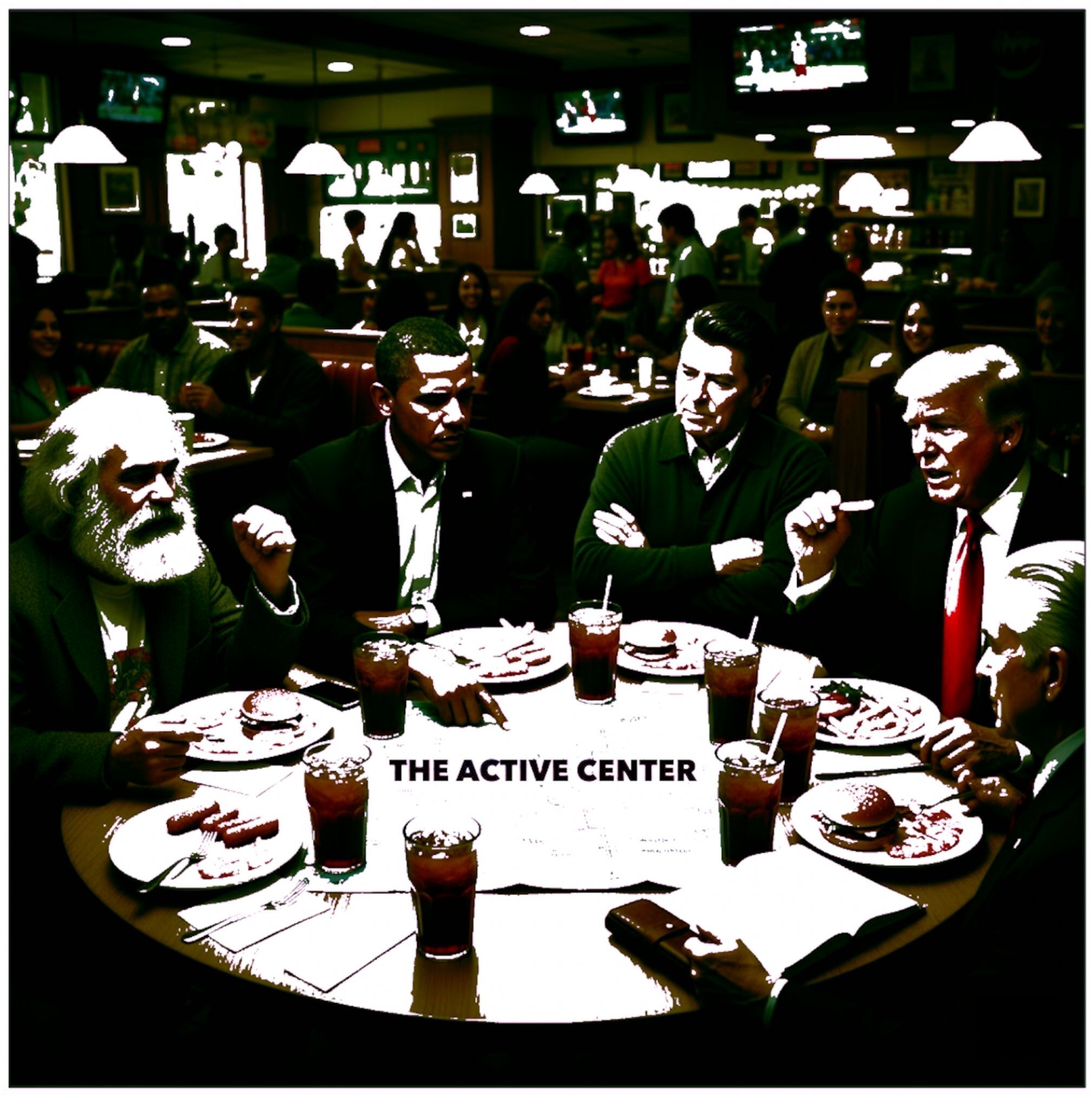
PODCAST · news
The Active Center
by David Sepe
The Active Center’s analysis operate from a position of critical optimism regarding the United States. While ”The Active Center” affirms the fundamental validity and promise of the nation’s political, social, and economic structures, it remains fiercely critical of the current conditions. The show frequently challenges the efficacy of contemporary political, economic, and social leadership in ensuring genuine equal rights and equal opportunities for the broadest possible cross-section of citizens.Despite these criticisms, the final message is one of hopeful pragmatism. ”The Active Center” maintains that the ongoing march towards ”the Dream”—the ideals of liberty, justice, and opportunity—is unsteady but absolutely ongoing. The podcast champions the power of free speech, the democratic mandate of voting, and the necessity of reasonable, incremental reforms as the primary engines for positive, sustained national progress. It is a show for those who believe in the system but demand that
-
100
Life Lessons From Older Americans Who Still Work To Pay The Bills
Source: Business Insider and Guided by Dave Sepe This document provides a detailed breakdown of the main themes, key insights, and profound life lessons shared by working seniors in the Business Insider feature. 1. Initial Work Backgrounds & Financial Peaks The featured individuals came from highly diverse career paths, demonstrating that financial instability in later years can affect anyone, regardless of their starting point: Diverse Beginnings: Careers among the speakers included cocktail waitressing, professional drumming, driving a catering truck, working in cable TV, nursing, and computer programming [00:54], [01:25], [01:40]. Peak Earnings: At the height of their careers, several were earning comfortable mid-to-high incomes for their eras, with salaries ranging from $50,000 to $115,000 annually [01:57], [02:12]. 2. Financial Setbacks & The Reality of Aging The transition from a stable career to working in one's 80s is rarely by choice. The video highlights how fragile financial planning can be in the face of unexpected life events: Unplanned Life Disruptions: * Raising children alone as a single parent, sometimes working four jobs simultaneously [02:43]. Being forced to withdraw from 401(k) retirement funds prematurely due to sudden layoffs [02:57]. Losing lifetime savings and equity by panicking during stock market crashes or real estate downturns [03:17], [03:30]. The Weight of Inflation: Present-day struggles are severely magnified by rising costs. Seniors describe having to live incredibly frugally—monitoring grocery sales for discounted chicken or fish and managing the constant anxiety of living paycheck to paycheck [04:38], [05:35]. 3. Current Jobs & Staying Active Despite the physical and systemic challenges of aging, these seniors find ways to persist, adapt, and even find joy in modern workplaces: Modern Gig and Part-Time Work: To bridge the financial gap left by inadequate Social Security benefits, they actively work as: Uber drivers [06:32] Substitute teachers [06:09] Administrative assistants [07:44] Life coaches and healers [02:12] Overcoming Systemic Barriers: Finding traditional employment at over 80 years old is incredibly difficult due to systemic ageism [08:30]. The Silver Lining of Work: While financially driven, working past 80 provides unexpected psychological benefits: It acts as a vital social outlet and wards off isolation [09:18]. It keeps the mind active and feet on the ground [09:07]. Flexible gig work like ridesharing offers a sense of autonomy and a direct "pipeline to money" [09:35]. Many remain dedicated lifelong learners, actively teaching themselves new languages (e.g., Kiswahili on Duolingo), building promotional websites, and exploring AI technology [10:06], [10:27]. 4. Key Life Lessons & Financial Advice The speakers closed with crucial, hard-earned wisdom aimed directly at younger generations: "As soon as you start working, plan for retirement." [00:43] 📈 Start Saving Early You are never too young to start planning. The moment you secure your first job is the moment you should begin saving for your later years [00:43], [11:43]. 🧮 Understand Compound Interest A speaker expressed deep regret over not understanding the magic of compounding interest early in life, pointing out that even saving $25 a month starting at age 25 can yield a massive safety net by retirement age [11:58], [12:08]. 🤝 Seek Professional Guidance Don't navigate finances alone. Engaging a financial planner early on can prevent catastrophic panic-selling during economic downturns [12:16]. 🧭 Balance Work, Happiness, and Your "Bucket List" Do not wait until the absolute end of your life to enjoy the fruits of your labor: Find work that brings you joy, as you will likely be working for a very long time [12:22]. “Find a way to do your bucket list all through your life, instead of at the end of your life.” [12:38] Hello, and thanks for listening to my podcast For years, my mission has been to foster a community around engagement, unique takes on interesting stories, and conversation. If you value what I do, please consider supporting me. I've started a GoFundMe to cover my production and operational costs, including those pesky social media fees. If you can’t contribute to my GoFundMe, I get it, but you can help me by subscribing to my account or sharing this particular story with friends and family that you think would appreciate it. Your contribution, big or small, helps me keep going. Thank you. GO FUND ME
-
99
Constitutional Shackles on Radical Reform: Why a Sweep Cannot Legally Abolish the Senate or Executive Branch
In recent years, rhetoric within radical political movements, including factions of the Democratic Socialists of America (DSA), has increasingly focused on systemic institutional overhauls. Among the most ambitious of these proposals is the call to abolish the United States Senate, frequently criticized as an inherently anti-democratic, counter-majoritarian institution, and to dismantle or radically restructure the unitary Executive Branch. Champions of these proposals often suggest that acquiring electoral majorities in both houses of Congress alongside the Presidency would provide the mandate necessary to enact such sweeping structural transformations. However, this perspective overlooks the foundational mechanics of American constitutional law. Even if DSA-aligned candidates were to achieve a sweeping victory, capturing the White House, the House of Representatives, and a majority in the Senate—they would remain legally powerless to abolish either the Senate or the Presidency through standard legislative action. The intricate system of checks and balances, federalism, and the stringent mechanisms established by the U.S. Constitution render the legal dissolution of these institutions virtually impossible. To understand why a congressional majority cannot simply vote to abolish a branch of government, one must examine the fundamental hierarchy of the American legal system established in Article VI, Clause 2 (the Supremacy Clause). Under the Constitution, ordinary legislation passed by Congress and signed by the President constitutes statutory law. Statutory law, however, is strictly subordinate to the Constitution itself. The U.S. Senate is established under Article I, Section 1, which explicitly vests all legislative powers in a bicameral Congress consisting of "a Senate and House of Representatives." Similarly, the Presidency is created under Article II, Section 1, which vests executive power in "a President of the United States of America." Because these institutions are created by express constitutional text, they cannot be dissolved, altered, or bypassed by simple statutory enactment. If a unified socialist majority in Congress passed a bill titled the "Senate and Executive Dissolution Act," it would be a nullity on arrival. As Chief Justice John Marshall established in the landmark case Marbury v. Madison (1803), an act of the legislature repugnant to the Constitution is void. Any attempt to abolish a constitutionally mandated body via routine legislation would be immediately struck down by the judiciary under Article III powers of judicial review. Because statutory legislation is ineffective for structural transformation, the only legal pathway to abolish or alter foundational constitutional institutions is through a formal constitutional amendment under Article V. However, Article V was deliberately engineered by the Framers to prevent temporary political majorities from unilaterally dismantling the structural architecture of the Republic. To successfully pass a constitutional amendment through the legislative initiative, Article V requires: A two-thirds (2/3) supermajority vote in both the House of Representatives and the Senate (or a constitutional convention called by 2/3s of state legislatures). Subsequent ratification by three-fourths (3/4) of the states (currently 38 out of 50 states), either through state legislatures or state ratifying conventions. Even under an extraordinary political scenario where DSA candidates held a simple or working majority in Congress, securing a two-thirds supermajority in both chambers represents a formidable political barrier. More critically, the requirement that 38 state legislatures ratify such an amendment creates an insurmountable legal and political wall. In a federal republic composed of 50 distinct states, many with conservative, moderate, or rural constituencies, obtaining approval from 38 individual state legislatures to abolish federal institutions is practically impossible. A coalition of just 13 states can block any proposed amendment, guaranteeing that localized majorities cannot impose structural dissolution on the rest of the nation. While amending the Constitution to abolish the Presidency is theoretically possible, albeit practically unfeasible due to the three-fourths ratification threshold, abolishing the Senate encounters an even more absolute legal barrier. The Framers included a specific, entrenched guarantee within Article V itself designed explicitly to protect the structural existence and equal representation of the states in the Senate. Article V concludes with a unique protective clause: "Provided that... no State, without its Consent, shall be deprived of its equal Suffrage in the Senate." This clause represents one of the few explicitly unamendable provisions in the U.S. Constitution. Because abolishing the Senate entirely would deprive every state of its equal suffrage in that body, doing so legally via an amendment would require not merely the standard three-fourths (3/4) majority of states, but the unanimous consent of all 50 states. Some legal scholars have posited a "two-step amendment" theory, wherein an initial amendment deletes the "equal suffrage" clause, followed by a second amendment abolishing the Senate. However, this theoretical workaround is widely regarded by constitutional scholars as a bad-faith evasion of text that courts would reject as unconstitutional. Thus, under the strict text of the Constitution, no congressional majority, regardless of its size or political ideology, can legally strip a state of its equal representation in the Senate without that state's explicit consent. Beyond the statutory and amendatory limits, the doctrine of separation of powers acts as an active operational check against extralegal consolidation of power. Should a radical legislative majority attempt to defund, ignore, or strip the executive or judicial branches of their core constitutional functions, the legal architecture provides immediate remedies: Judicial Intervention: The Supreme Court and federal judiciary retain the authority to issue injunctions against executive actions or legislative acts that violate constitutional structures. Federalism and State Sovereignty: Individual state governments retain sovereign powers under the Tenth Amendment. If the federal legislative branch attempted an extralegal abolition of the Senate or Executive, state attorneys general and state governments would possess clear legal standing to challenge such actions in federal court, effectively halting implementation. Political movements often utilize sweeping rhetoric regarding institutional abolition to energize their base and highlight perceived democratic deficits within the U.S. system. However, a clear distinction must be maintained between political aspiration and legal reality. The U.S. Constitution was intentionally drafted to impede radical structural shifts driven by transient majorities. The combination of statutory subordination to constitutional text, the steep supermajority mechanics of Article V, the explicit protection of state representation in the Senate, and the robust system of judicial review ensures that capturing the Presidency and Congress is fundamentally insufficient to dismantle the constitutional framework. For any movement, including the DSA, wielding power within the American system means operating within the constitutional boundaries that safeguard its institutions, ensuring that the Senate and the Executive Branch remain legal fixtures of the American Republic unless transformed by an unprecedented, virtually unanimous national consensus. Hello, and thanks for listening to my podcast For years, my mission has been to foster a community around engagement, unique takes on interesting stories, and conversation. If you value what I do, please consider supporting me. I've started a GoFundMe to cover my production and operational costs, including those pesky social media fees. If you can’t contribute to my GoFundMe, I get it, but you can help me by subscribing to my account or sharing this particular story with friends and family that you think would appreciate it. Your contribution, big or small, helps me keep going. Thank you. GO FUND ME
-
98
Questioning the Horizon: An Expository Analysis of Wind Power, Costs, and Financial Motives in the American Economy
Introduction As the United States navigates the transition toward cleaner energy, wind power is frequently highlighted as a principal alternative to fossil fuels. Promoted by policymakers, corporate sustainability campaigns, and environmental advocacy groups, wind turbines have become ubiquitous across American landscapes. However, as the energy demands of a complex 21st-century economy continue to surge, driven by heavy manufacturing, data centers, artificial intelligence, and electrifying transportation, a critical question emerges: Is wind power capable of reliably sustaining an economy and society as demanding as the United States? Despite decades of government investment and aggressive mandates, wind energy accounts for approximately 7.8% of global electricity production. When examining real-world operational challenges, such as the frequent idling of turbines seen in wind hubs like Palm Springs, California, along with the heavy fossil-fuel inputs required for turbine lifecycle management, a point famously articulated in the popular television drama Landman, serious questions arise regarding efficiency, economic viability, and the financial incentives fueling its rapid expansion. 1. The Global Baseline: Wind Energy’s Current Contribution To understand whether wind power can anchor a national grid, one must first look at its current global footprint. According to data from international energy think tanks such as Ember and the International Energy Agency (IEA), wind power generates roughly 7.8% of the world’s electricity. While this represents significant growth over the past two decades, it also highlights a stark reality: over 90% of global electricity generation still relies on a combination of fossil fuels (coal, natural gas), nuclear energy, and hydroelectricity. Energy Source Category Estimated Share of Global Electricity Generation Fossil Fuels (Coal, Gas, Oil) 60% Hydroelectric 14% Nuclear 9% Wind Energy 7.8% Solar & Other Renewables 9.2% The central limitation of wind energy is its intermittency and low power density. Unlike natural gas, coal, or nuclear power plants, which provide dispatchable "baseload" power capable of running 24/7 regardless of weather conditions, wind generation fluctuates wildly based on atmospheric conditions. Sustaining an industrial economy requires absolute grid reliability; a power deficit of even a few percentage points can trigger brownouts or catastrophic blackout events. 2. The Palm Springs Paradox: Why Are So Many Turbines Idle? Travelers passing through the San Gorgonio Pass near Palm Springs, California, one of the oldest and most dense wind farms in the United States, frequently observe a puzzling phenomenon: a substantial portion of the wind turbines stand entirely motionless, even on breezy days. This empirical observation raises valid concerns among citizens about the return on investment for wind infrastructure. There are several technical, structural, and economic reasons why wind turbines sit idle: Wind Speed Thresholds (Cut-in and Cut-out Limits): Turbines require a minimum wind speed (typically 6 to 9 mph) to generate electricity. Conversely, if wind speeds exceed safety limits (usually around 55 mph), the turbines automatically lock their blades to prevent structural failure or gearbox damage. Grid Congestion and Curtailment: Electricity grids must balance supply and demand in real time. If a wind farm generates excess power when the transmission lines are already at capacity, or when regional energy demand is low, grid operators force wind farms to "curtail" (shut down) generation to avoid overloading the electrical grid. Legacy and Outdated Infrastructure: Regions like Palm Springs feature thousands of smaller, 1980s and 1990s era turbines alongside modern mega-turbines. Many of these older units have reached the end of their operational lifespan, suffer from mechanical failure, or are economically unfeasible to repair compared to installing new units. Capacity Factor Realities: The capacity factor of a power plant measures its actual electrical output against its maximum theoretical potential. While a nuclear reactor operates at a capacity factor of over 90%, land-based wind farms typically achieve capacity factors between 30% and 45%. This inherent inefficiency means that a large portion of installed wind capacity sits idle for significant portions of the year. 3. The Lifecycle Debate: Embedded Energy and the Landman Perspective The foundational debate over renewable energy's reliance on traditional industry was brought to mainstream cultural attention in Paramount’s series Landman. In a widely discussed monologue, the character Tommy Norris (played by Billy Bob Thornton) delivers a skeptical critique of green energy's true carbon footprint: "Do you have any idea how much diesel they have to burn to mix that much concrete or make that steel and haul this out here and put it together with a 450-foot crane? You want to guess how much oil it takes to lubricate that thing or winterize it? In its 20-year lifespan, it won't offset the carbon footprint of making it." While energy lifecycle analyses conducted by national laboratories show that modern utility-scale turbines generally pay back their embodied energy costs within 7 to 12 months of operation, the monologue highlights an essential technical reality that is often minimized in public discourse: wind energy cannot exist independently of fossil fuels. Material Extraction and Manufacturing: Constructing a single 2-megawatt wind turbine requires approximately 200 to 300 of steel, 1,000 tons of concrete for the foundation, fiberglass, copper, and rare earth minerals like neodymium. The high-heat processing required for steel and concrete relies almost entirely on metallurgical coal and natural gas. Transportation and Assembly: Moving giant turbine blades and tower segments across thousands of miles requires heavy diesel logistics, specialized transport trucks, and massive fossil-fueled cranes. Operational Maintenance: Turbines require hundreds of gallons of petroleum-based synthetic lubricants for gearboxes, hydraulic systems, and anti-icing fluids for winter conditions. Thus, wind energy does not replace fossil fuels in a vacuum; rather, it functions as a secondary energy harvester built upon a foundation of petrochemical and industrial manufacturing. 4. Financial Motives: Who Benefits From Promoting Wind Energy? If wind energy faces significant physical constraints, land-use conflicts, and grid-integration challenges, why is there such an overwhelming push to expand it? The answer lies in the complex network of government subsidies, tax credits, and corporate investment structures. A. Federal and State Tax Subsidies The primary financial driver of wind energy in the United States is federal tax policy, notably the Production Tax Credit (PTC) and the Investment Tax Credit (ITC). The PTC provides developers with a tax credit for every kilowatt-hour (kWh) of electricity generated during the first 10 years of operation. Because guaranteed subsidies cushion project developers, wind farms can remain profitable even when market demand for electricity is low or when electricity prices temporarily dip into negative territory. B. Wall Street and ESG Investment Capital Environmental, Social, and Governance (ESG) mandates have directed trillions of dollars of institutional capital into green energy infrastructure funds. Major private equity firms, investment banks, and asset managers collect substantial management fees by underwriting renewable energy development projects, securing long-term government-backed revenue streams. C. Regulated Utilities and Guaranteed Rate Bases In many states, electric utility companies operate under a regulated business model where profits are tied to capital expenditure. By investing billions of dollars in building new wind farms and building thousands of miles of new high-voltage transmission lines to connect remote wind sites to urban centers, utilities can expand their "rate base," allowing them to pass these multi-billion-dollar capital costs directly to taxpayers and residential ratepayers in the form of higher monthly utility bills. D. Land Lease Royalties In rural regions across states like Texas, Iowa, and Oklahoma, wind energy provides substantial lease payments to agricultural landowners. Ranchers and farmers can earn thousands of dollars per turbine annually, creating a powerful domestic lobbying group that supports continued wind expansion alongside oil and gas development. Conclusion Wind power plays an undeniable role in diversifying the energy mix and offering low-emissions electricity generation under optimal weather conditions. However, analyzing wind energy strictly as a self-sustaining solution capable of powering the entirety of the United States reveals fundamental vulnerabilities. Accounting for roughly 7.8% of global electricity, wind power remains constrained by low power density, high intermittency, grid curtailment, and reliance on fossil-fueled industrial supply chains. The frequent sight of motionless turbines in locations like Palm Springs serves as a visual reminder that installed capacity does not equate to constant work. Fueled largely by tax incentives, utility rate-base expansion, and corporate ESG capital, the rapid push for wind power often reflects financial motives as much as raw engineering efficacy. For the United States to maintain grid stability, economic competitiveness, and industrial capacity, energy policy must move beyond a singular reliance on variable sources. A realistic energy strategy requires a balanced approach, combining variable renewables like wind with reliable, high-density baseload power sources such as advanced nuclear energy, geothermal, and natural gas paired with carbon capture. Hello, and thanks for listening to my podcast For years, my mission has been to foster a community around engagement, unique takes on interesting stories, and conversation. If you value what I do, please consider supporting me. I've started a GoFundMe to cover my production and operational costs, including those pesky social media fees. If you can’t contribute to my GoFundMe, I get it, but you can help me by subscribing to my account or sharing this particular story with friends and family that you think would appreciate it. Your contribution, big or small, helps me keep going. Thank you. GO FUND ME
-
97
The Cornfield Capstone: Netflix, MLB, and the Economics of Fragmented Fandom
Introduction: The Iowa Maize and the Media Maze On August 13, 2026, when the Minnesota Twins and Philadelphia Phillies step out of a Dyersville cornfield onto a temporary diamond in Iowa, Major League Baseball’s most ambitious, and contentious, broadcasting experiment of the decade will reach its season finale. Framed by row upon row of stalks and accompanied by more than two dozen living Hall of Famers, the MLB at Field of Dreams game presented by John Deere stands as Netflix’s third and final live MLB tentpole of 2026, following its broadcasts of Opening Night (Yankees vs. Giants) and the T-Mobile Home Run Derby in July. Yet, beyond the Hollywood nostalgia and Kevin Costner voiceovers lies a cold commercial reality: the Iowa cornfield represents the capstone of MLB’s increasingly fragmented broadcast strategy. In an era where local Regional Sports Networks (RSNs) continue to fracture, commissioner Rob Manfred’s office has turned to a "special events" model, slicing off premier regular-season inventory and auctioning it to tech behemoths. Netflix’s three-event entry into live baseball in 2026 offers a perfect case study for the modern sports business. It reveals how live streaming can successfully engineer massive, eventized pop-culture moments while simultaneously frustrating baseball’s core, day-in, day-out audience. The 2026 Netflix Portfolio: Eventizing America’s Pastime To understand Netflix’s 2026 MLB strategy, one must examine why a platform with over 270 million global subscribers chose not to purchase a standard 162-game regional package. Streaming platforms have learned that routine, mid-season regional baseball games suffer from localized, low-margin viewership. Instead, Netflix and MLB structured a three-year rights deal (running 2026 through 2028) built strictly around high-impact "tentpole events": Opening Night (Yankees vs. Giants): A bi-coastal marquee matchup designed to test global server load and drive immediate app engagement at the start of spring. The T-Mobile Home Run Derby: An inherently fast-paced, hit-driven spectacle that fits seamlessly into short-form content consumption and live algorithmic promotion. MLB at Field of Dreams (Phillies vs. Twins): A cinematic, nostalgia-heavy aesthetic marvel tailor-made for high-definition streaming, complete with pregame ceremonies bridging generations of baseball royalty. By stripping away the everyday marathon of the season and packaging baseball into cinematic single-night spectacles, Netflix attempted to bypass the traditional sports rights model. MLB, in turn, gained an unparalleled megaphone to reach younger, non-traditional viewers who dropped cable years ago. The Balance Sheet: Financials, Ratings, and Viewership From a pure financial and audience-reach perspective, the partnership between Netflix and MLB yielded strong initial dividends, though not without structural caveats. The Financials: Ad Tiers and Sponsorship Synergies Rights Revenues: While official terms remain closely guarded corporate data, industry estimates place Netflix’s annual commitment to MLB at roughly $100M–$120M annually for the bespoke event package, a high average-per-game payout that reflects the premium nature of the events. Monetizing the Ad Tier: Netflix’s rapidly expanding ad-supported tier proved to be the financial engine of the deal. The Home Run Derby and Field of Dreams games commanded record ad-rate premiums (CPM) for live sports on streaming, with presenting sponsors like T-Mobile and John Deere paying top dollar for interactive, on-screen branding integration. Content Ecosystem Synergy: Netflix leveraged its production arm, MLB Studios, to cross-promote baseball documentaries, such as The Comeback: 2004 Boston Red Sox and docuseries The Clubhouse, directly on the landing page of live game streams, driving long-tail viewership across its documentary library. Ratings and Demographics Viewership metrics for the 2026 broadcast slate demonstrated the raw power of Netflix's algorithmic distribution. A push notification sent to millions of mobile devices minutes before the Home Run Derby generated an immediate spike in casual viewers who would never have actively sought out an ESPN or cable feed. Demographically, Netflix's broadcasts skewed noticeably younger, attracting an estimated 35% to 40% more viewers in the coveted 18–34 demographic compared to traditional national cable broadcasts. What Worked vs. What Didn't What Worked: Scale, Production Value, and Global Reach Unrivaled Scale and Accessibility: Unlike regional apps plagued by blackout rules, Netflix delivered a single, frictionless stream accessible globally without geo-restrictions, removing traditional viewing barriers for out-of-market fans. Cinematic Aesthetic: The production quality, from high-frame-rate drone cameras gliding over Iowa cornfields to immersive miked-up player segments during the Derby, matched Netflix's premium entertainment standards. Algorithmic On-Ramps: Autoplay previews and homepage banner placement converted passive content scrollers into live sports consumers, exposing baseball to non-fans who had not watched a live game in years. What Didn't: Franchise Fatigue and Disconnected Commentary The Friction of Distribution Fragmentation: For the devoted MLB fan, 2026 represented peak subscription fatigue. Watching a single team across a season now required subscriptions to local RSNs, Apple TV+ (Friday Night Baseball), Roku (Sunday Leadoff), Peacock/ESPN/FOX, and Netflix. While Netflix excelled at capturing casual viewers, traditional diehards voiced frustration at having marquee games locked behind yet another monthly paywall. Commentary Tonal Mismatch: Streaming for a broad, non-baseball audience created a narrative tension in the broadcast booth. Commentators frequently over-explained basic tactical concepts (e.g., pitch-clock rules, defensive shifts) to cater to casual streamers, which alienated purists seeking deep analytical breakdown. Lack of Daily Continuity: Because Netflix only broadcasted three isolated events, it could not build sustained, multi-week storylines or pennant-race drama. The broadcasts felt like self-contained entertainment specials rather than organic chapters in a 162-game sports narrative. Conclusion: The Illusion of the Cornfield As MLB leaves Dyersville and returns to standard stadium lighting for the stretch run of 2026, the league’s media ecosystem stands at a critical juncture. The Netflix partnership proved that live baseball, when packaged as high-concept event television, can still command massive global audiences and lucrative advertising revenues. However, MLB’s underlying broadcast dilemma remains unsolved. Slicing off crown-jewel events for streaming platforms generates immediate capital and shiny demographic numbers, but it further fractures the daily relationship between local fanbases and their teams. The field in Iowa, carved out of an agricultural expanse for a single night of broadcast grandeur, is a fitting metaphor for modern sports media: a beautifully engineered, highly profitable spectacle that exists for the cameras, even as the surrounding landscape continues to shift beneath its feet. Hello, and thanks for listening to my podcast For years, my mission has been to foster a community around engagement, unique takes on interesting stories, and conversation. If you value what I do, please consider supporting me. I've started a GoFundMe to cover my production and operational costs, including those pesky social media fees. If you can’t contribute to my GoFundMe, I get it, but you can help me by subscribing to my account or sharing this particular story with friends and family that you think would appreciate it. Your contribution, big or small, helps me keep going. Thank you. GO FUND ME
-
96
Historical Revisionism and the Reagan Legacy: Deconstructing Critical Theory’s Narratives on Fiscal Policy and the AIDS Epidemic
In contemporary political discourse, the historical memory of the Reagan administration (1981–1989) is intensely contested. A prominent narrative constructed by scholars rooted in Critical Theory and the New Left posits that President Ronald Reagan was both fiscally reckless, inventing modern budget deficits through tax cuts, and morally indifferent to public health, supposedly refusing or failing to fund HIV/AIDS research. This analytical essay examines these twin assertions against empirical historical data and budget records. By integrating economic data, specifically fiscal analyses demonstrating that revenue grew significantly while budget deficits stemmed from spending expansion and institutional conflict, alongside federal spending records on HIV/AIDS research, this paper demonstrates how contemporary revisionism frequently prioritizes ideological critique over empirical reality. Finally, the paper analyzes why Critical Theorists remain dedicated to maintaining these narratives: namely, to delegitimize supply-side economic frameworks and pathologize conservative governance. History is rarely a passive record of past events; it is often an active battleground where competing political philosophies vie for cultural and institutional legitimacy. Few modern political figures embody this reality more acutely than Ronald W. Reagan, the 40th President of the United States. To his supporters, Reagan catalyzed an economic renaissance and reestablished American geopolitical confidence. To proponents of the New Left and contemporary Critical Theorists, however, the Reagan presidency represents the crucible of "neoliberalism," a period characterized in their writings as economically catastrophic and socially cold-hearted. Central to the Critical Theoretical critique of the Reagan era are two persistent historical narratives: The Fiscal Narrative: That Ronald Reagan introduced unprecedented, reckless deficit spending into American governance, driven primarily by tax cuts for the wealthy that hollowed out federal revenues. The Social Narrative: That the Reagan administration systematically neglected the HIV/AIDS crisis, actively withholding federal research funding and public health resources due to moral or ideological antipathy. While these narratives have achieved near-canonical status within certain academic and media circles, a rigorous examination of primary economic data, legislative appropriations, and federal health expenditures reveals a starkly different reality. This essay explores the empirical facts surrounding Reagan-era fiscal policy and AIDS research funding, subsequently analyzing why Critical Theorists and New Left scholars remain hellbent on revising this historical record to fit ideological imperatives. A primary pillar of the anti-Reagan revisionist canon is the assertion that the administration was singularly responsible for introducing large budget deficits through supply-side tax cuts. Critical theorists frequently frame "Reaganomics" as a irresponsible experiment that destroyed federal revenue streams and initiated the modern national debt crisis. However, an analysis of the budgetary data reveals that Reagan neither invented deficit spending nor starved the federal government of revenue. When Ronald Reagan assumed office in January 1981, he inherited a $79 billion budget deficit from President Jimmy Carter's final budget. Deficit spending was not a novel creation of the 1980s; federal outlays had exceeded revenues in every single fiscal year since 1961, with the solitary exception of 1969 under Lyndon B. Johnson. Deficits were a entrenched feature of post-war American governance long before supply-side economics entered the White House. Critics frequently point to the Economic Recovery Tax Act (ERTA) of 1981 as the primary catalyst for 1980s deficits. While the 1981 tax cuts did temporarily freeze revenue growth across 1982 and 1983 due to a deep national recession, the broader economic trajectory demonstrated significant revenue expansion. As fiscal analyst Chris Edwards notes: "As the economy began to boom in the mid-1980s, revenues rose rapidly. By 1989, revenues were up 65 percent from 1981. Part of the increase was due to tax laws in 1982, 1984, and 1987 that increased revenues, partly reversing the 1981 cuts." Far from collapsing, total federal tax revenues grew from $599 billion in FY1981 to nearly $991 billion by FY1989. Even when adjusted for inflation, federal receipts expanded significantly over the decade as lower marginal tax rates, reducing the top individual rate from 70 percent to 28 percent, stimulated economic activity, broadened the tax base, and increased taxable income. If revenues rose by 65 percent, why did deficits persist? The core fiscal issue of the 1980s was that federal spending outpaced revenue growth, rising by 69 percent between 1981 and 1989 (from $678 billion to $1.14 trillion). Reagan’s original fiscal proposal in February 1981 envisioned spending reductions sufficient to lower federal outlays to 19.3 percent of Gross Domestic Product (GDP) by 1984, which would have balanced the budget. However, Congress, controlled largely by Democrats in the House of Representatives, consistently rejected deep structural cuts to entitlement spending while approving expanded defense spending and domestic appropriations. When evaluated as a share of the overall economy, Reagan's structural legacy is one of modest government downsizing rather than fiscal ruin. Federal spending as a percentage of GDP fell from 22.2 percent in 1981 to 21.2 percent in 1989, while revenues as a percentage of GDP moved from 19.6 percent to 18.3 percent. In total, the Reagan administration shrunk the relative size of the federal spending footprint by roughly 5 percent relative to GDP, a measured, incremental adjustment rather than the radical structural destruction claimed by detractors. A second major narrative advanced by New Left critics and Critical Theorists involves the administration's response to the Acquired Immunodeficiency Syndrome (AIDS) epidemic. The prevailing trope asserts that Ronald Reagan "ignored" the epidemic and maliciously suppressed or refused funding for scientific and medical research into HIV/AIDS. While critics frequently emphasize Reagan's public rhetorical reticence, noting that he did not deliver a major formal address dedicated exclusively to AIDS until 1987, the federal budget and appropriations record paints a vastly different picture regarding resource allocation. When AIDS was first identified by the Centers for Disease Control and Prevention (CDC) in 1981, it was an entirely novel, unidentified syndrome with no known pathogen or diagnostic test. As the scientific understanding of human immunodeficiency virus (HIV) evolved, federal funding for research, surveillance, treatment, and prevention expanded at an exponential rate throughout the Reagan presidency. Federal Appropriations for HIV/AIDS Research & Prevention (FY 1982–1989) FY 1982 █ $5.6 Million FY 1983 ██ $28.7 Million FY 1984 ████ $61.5 Million FY 1985 ████████ $108.6 Million FY 1986 ██████████████ $233.8 Million FY 1987 ███████████████████████ $502.5 Million FY 1988 █████████████████████████████████████ $962.0 Million FY 1989 ██████████████████████████████████████████████████████ $2.3 Billion FY 1982: Federal funding for AIDS research began at approximately $5.6 million. FY 1986: As the National Institutes of Health (NIH) and CDC prioritized retroviral research, federal funding surpassed $230 million. FY 1989: By the time Reagan left office, annual federal spending allocated specifically toward HIV/AIDS research, prevention, and treatment exceeded $2.3 billion annually. In fact, throughout the 1980s, Congress and the executive branch agencies repeatedly increased allocations for the NIH, the Public Health Service, and the Food and Drug Administration (FDA) to fast-track experimental drug trials (such as AZT, approved in 1987). Beyond spending, the Reagan administration authorized landmark public health initiatives. In 1986, Reagan directed Surgeon General C. Everett Koop to prepare a comprehensive report on the epidemic. Published in late 1986, Dr. Koop’s report advocated for explicit sex education, widespread condom use, and compassionate care. In 1988, the administration executed the largest mass mailing in U.S. history: the distribution of the seven-page booklet "Understanding AIDS" to all 107 million households in the United States. This federal effort directly educated the American public on HIV transmission mechanisms, dispelling panic and medically ungrounded rumors. While scholars can legitimately debate the speed of early bureaucratic administrative responses or the tone of presidential rhetoric, the assertion that the Reagan administration "refused to fund" or "ignored" AIDS research is factually irreconcilable with historical budget allocations that grew by thousands of percent over eight years. If the empirical data on federal revenues, spending growth, and AIDS research appropriations clearly contradicts these narratives, why do New Left historians and Critical Theorists remain so fiercely invested in promoting them? Understanding this persistence requires examining the methodology and political objectives of Critical Theory itself. Critical Theory, rooted in the Frankfurt School and adapted by post-marxist modern academics, views historical analysis primarily as a tool for political transformation rather than objective discovery. The Reagan administration represented a major ideological setback for the New Left: a popular, two-term endorsement of deregulation, lower marginal tax rates, and anti-communist foreign policy. To protect the ideological necessity of state-managed economic redistribution, Critical Theorists must frame Reagan’s economic model as an empirical failure. If Reagan's tax cuts are acknowledged as having expanded tax revenues by 65 percent and stimulated prolonged non-inflationary growth, the core theoretical argument against supply-side policy collapses. Therefore, revisionists must misattribute the cause of 1980s deficits entirely to tax cuts while suppressing the role of structural spending expansion driven by legislative majorities. A foundational tactic of modern Critical Theory is the replacement of nuanced policy debates with binary moral frameworks (e.g., oppressor vs. oppressed). In analyzing social history, nuance is discarded in favor of constructing narratives of systemic malevolence. By transforming a complex, novel medical crisis into a simplistic story of presidential neglect, Critical Theorists achieve two political objectives: They weaponize grief and historical trauma to pathologize conservative political philosophy as inherently dehumanizing. They create a foundational myth that portrays state-directed socialized medicine and cultural progressivism as the sole legitimate moral authorities. To admit that federal funding for AIDS expanded rapidly under Reagan, and that agencies like the NIH and CDC were funded at unprecedented levels, would require accepting that institutional public health mechanisms functioned within normal, albeit imperfect, bureaucratic parameters. Revisionism preserves the more useful political narrative: that conservative governance is inherently toxic to vulnerable populations. Finally, the revisionist history of 1980s deficits serves to insulate federal spending programs from critique. By claiming that Reagan "cut spending to the bone" while simultaneously creating deficits, theorists attempt to prove that spending cuts are both cruel and ineffective. The reality, that Reagan was unable to restrain federal outlays due to Congressional pushback, resulting in spending rising from $678 billion to $1.14 trillion, demonstrates the immense difficulty of checking administrative state expansion. Revisionists invert this truth to argue that deficits were caused by revenue starvation rather than unchecked spending growth. The debate over the Reagan administration's legacy illustrates the deep divide between empirical historical inquiry and ideologically driven revisionism. When subjected to quantitative analysis, the central claims of the New Left critique fail to hold up: On the Economy: Reagan did not invent deficit spending. He inherited structural deficits from the Carter administration. Revenues grew by 65 percent following tax reforms, while deficits were fueled by a 69 percent increase in federal spending driven largely by Congressional opposition to spending cuts. On Public Health: Federal spending on HIV/AIDS research and prevention expanded exponentially during Reagan’s tenure, growing from $5.6 million in FY1982 to over $2.3 billion in FY1989, accompanied by historic public health educational outreach to every American household. Critical Theorists and New Left historians remain hellbent on promoting these disproven narratives because the factual record threatens their core socio-economic premises. To acknowledge the truth of the Reagan legacy would require conceding that tax cuts can co-exist with revenue growth, that spending growth drives deficits, and that conservative administrations are capable of funding vital medical scientific research. For those committed to using history as an instrument of political struggle, maintaining these historical myths remains an essential operational objective. Hello, and thanks for listening to my podcast For years, my mission has been to foster a community around engagement, unique takes on interesting stories, and conversation. If you value what I do, please consider supporting me. I've started a GoFundMe to cover my production and operational costs, including those pesky social media fees. If you can’t contribute to my GoFundMe, I get it, but you can help me by subscribing to my account or sharing this particular story with friends and family that you think would appreciate it. Your contribution, big or small, helps me keep going. Thank you. GO FUND ME
-
95
Reevaluating the Reagan Administration’s Record on Federal AIDS Research Funding
The fiscal policies of President Ronald Reagan’s administration are frequently subjected to intense debate among political analysts and critical theorists. Critics often argue that the administration’s economic strategy resulted in unprecedented federal deficits and misallocated public resources. However, a rigorous examination of the empirical spending data surrounding major public health challenges, specifically the federal response to the emerging AIDS epidemic in the 1980s, presents a far more productive and responsive picture of executive leadership. Rather than demonstrating institutional neglect or fiscal recklessness, the quantitative trajectory of proposed federal AIDS research budgets illustrates a historic scaling of federal investment. Far from being stagnant, executive budget proposals grew exponentially throughout the decade, creating the financial foundation for monumental biomedical advances and challenging the dominant narratives put forward by critical theorists. When the human immunodeficiency virus was first identified in the early 1980s, the federal government had no dedicated infrastructure or baseline funding designed for this novel medical phenomenon. Initial federal outlays for AIDS research in 1981–1982 began at approximately $8 million. Recognizing the escalating biological threat, the Reagan administration established a pattern of remarkable budget growth over the following years. By fiscal year 1986, the administration’s formal budget request had expanded to $126 million, a more than fifteen-fold increase from the initial outlays just four years prior. By 1985, administration officials pointed to a cumulative total of half a billion dollars that had already been spent or appropriated since the start of the decade. This momentum accelerated further in fiscal year 1987, when President Reagan requested over $200 million ($203 million specifically designated for research and public education) alongside broader public health and departmental expansions. By the close of President Reagan’s second term, total federal spending targeted toward fighting the epidemic had climbed into the billions of dollars, representing one of the fastest spending accelerations for a single illness in federal public health history. Fiscal Period Federal AIDS Budget Milestone / Status Approximate Funding Level 1981–1982 Initial Federal Outlays ~$8 Million 1985 Cumulative Spent / Appropriated Baseline ~$500 Million (Cumulative) 1986 Executive Proposed Budget Request $126 Million 1986 Final Approved Congressional Appropriation ~$190 Million 1987 Executive Request (Research & Education focus) $203+ Million Late 1980s Cumulative Annual Federal Investment Target Billions (Escalating yearly) A complete analysis of the budgeting process requires examining the collaborative dynamic between the executive branch and Congress. Throughout the 1980s, federal budget creation functioned as a dynamic partnership: the administration established baseline priorities and substantial funding requests, while Congress consistently expanded upon those totals. For example, during the fiscal year 1986 cycle, while the administration requested $126 million, congressional committees ultimately pushed the total upward, approving roughly $190 million. Far from creating friction that halted progress, this legislative interaction meant that federal AIDS funding was repeatedly augmented, often exceeding initial requests by tens to hundreds of millions of dollars. The executive branch’s proactive submission of multi-million-dollar baseline requests was essential because it established the baseline upon which Congress could legislate further expansions. Rather than acting as a barrier, the administration’s formal requests validated AIDS research as a priority of the state, giving lawmakers a solid fiscal starting point. Critical theorists frequently focus on 1980s budget deficits as evidence of policy failure or structural inequity. However, this perspective often overlooks the targeted productivity of specific spending programs. When evaluating federal expenditures through a public health lens, the rate of spending growth for AIDS research outpaced that of many long-established diseases during the same period. Unprecedented Growth Acceleration: Moving from $8 million to hundreds of millions annually within a single presidential decade demonstrates extraordinary fiscal responsiveness to a novel health crisis. Productive Resource Allocation: Deficit spending during this era helped fund cutting-edge scientific endeavors, public education campaigns, and departmental expansions that laid the groundwork for modern immunology and antiviral treatment. Institutionalizing Medical Science: By embedding AIDS research into the federal budgetary framework, the administration helped guarantee long-term institutional funding for national health agencies like the National Institutes of Health (NIH) and the Centers for Disease Control and Prevention (CDC). When evaluated against these concrete fiscal metrics, the argument that the administration’s spending priorities were ineffective or indifferent loses empirical support. The rapid scaling of federal funding highlights a deliberate commitment to utilizing national resources to combat a complex biomedical challenge. An analytical review of federal budget data from 1981 to 1989 reveals a consistent, positive trajectory in the funding of AIDS research under President Ronald Reagan. Starting from modest outlays mandated by a previously unmapped crisis, executive requests quickly scaled into hundreds of millions of dollars annually, encouraging legislative partners to appropriate even higher totals. By the end of the decade, federal funding had expanded into the billions, far surpassing funding growth rates for many other major illnesses at the time. This history provides an important counterweight to critical theoretical critiques of 1980s fiscal policy, demonstrating that executive budget planning was both highly productive and instrumental in building the modern infrastructure for epidemiological research and intervention. Hello, and thanks for listening to my podcast For years, my mission has been to foster a community around engagement, unique takes on interesting stories, and conversation. If you value what I do, please consider supporting me. I've started a GoFundMe to cover my production and operational costs, including those pesky social media fees. If you can’t contribute to my GoFundMe, I get it, but you can help me by subscribing to my account or sharing this particular story with friends and family that you think would appreciate it. Your contribution, big or small, helps me keep going. Thank you. GO FUND ME
-
94
Centralized Governance and the Golden State Housing Crisis: An Analysis of Policy Mandates and Market Distortions in 2026
The goal for the Marxist is the elimination of the middle-class. In 2026, California, which is governed by Marxists, strangely enough, continues to face one of the most severe housing affordability crises in the nation. The standard path to middle-class stability, owning a single-family home, has moved out of reach for a vast majority of the state’s residents. While political rhetoric often attributes this deficit to abstract market forces or geographical constraints, a closer examination reveals that the crisis is deeply linked to the long-standing, single-party political monopoly in Sacramento. Through a combination of demand-side population pressures fostered by open-border dynamics and top-down legislative interventions that strip municipalities of local zoning authority, state leadership has created a distorted housing market that stifles traditional homeownership. 1. Demand-Side Strains: Border Dynamics and Artificial Market Inflation A primary driver of the housing crisis lies in the unprecedented demand placed on lower-and middle-tier housing inventory. Years of federal and state policies favoring lax border enforcement and sanctuary provisions have led to significant population inflows into urban and suburban centers across California. This influx creates an acute, artificial baseline demand for shelter. While newly arrived populations often start in rental housing, the resulting squeeze at the bottom of the market cascades upward: Compressed Rental Supply: Rapid absorption of low-income and multi-family rental units drives up rent prices across the board. Investor and Developer Pivots: In response to high rental demand, institutional investors and developers reallocate capital away from constructing entry-level single-family homes toward high-density rental units. Cascading Price Pressures: As middle-income families are priced out of single-family homes, they remain in the rental market longer, further escalating competition and driving property values and rents to unsustainable levels. By encouraging sustained, unvetted demand while failing to account for physical infrastructure constraints, the state's political establishment has artificially distorted the supply-demand balance. 2. The Erosion of Local "Home Rule": State Preemption over Municipal Zoning On the supply side, Sacramento’s approach to housing policy has increasingly centralized authority, overriding local municipal governance. Under the narrative that housing production is strictly a "statewide concern," the legislature and judicial system have systematically dismantled local "home rule" and neighborhood zoning autonomy. Rather than lowering tax burdens or streamlining environmental litigation (such as reforming the California Environmental Quality Act, or CEQA), state leaders have focused on forcing local communities to accept mandatory density increases through sweeping statewide mandates. Key Legislative Drivers Overriding Local Zoning Legislative Mandate Scope / Target Zone Impact on Local Zoning & Home Rule Accessory Dwelling Units (ADUs / JADUs) Single-Family Residential Nullifies local setback, size, and parking minimums across single-family parcels. SB 79 (Transit Upzoning) Transit Corridors Overrides local rules to force multi-story high-density developments near transit. SB 9 (Duplexes & Splits) Single-Family Lots Mandates administrative approval for urban lot splits and multi-unit conversions. Builder’s Remedy Non-Compliant Cities Strips non-compliant cities of all zoning vetoes, allowing high-density developments by-right. AB 2011 (Commercial Conversions) Commercial / Retail Bypasses commercial-only zoning to permit residential projects in office and retail zones by-right. Accessory Dwelling Units (ADUs and JADUs): State legislation forces local jurisdictions to approve ADUs and Junior ADUs on residential lots regardless of local master plans. Local ordinances setting parking minimums, lot coverage limits, or setback requirements are rendered void if they conflict with state standards. Transit-Oriented Upzoning (Senate Bill 79): Measures such as SB 79 override local planning codes by permitting multi-story residential and commercial-mixed structures adjacent to public transit hubs, stripping communities of design and density control. Duplexes and Urban Lot Splits (Senate Bill 9): SB 9 eliminated traditional single-family zoning maps across the state by requiring cities to administratively approve up to two units per lot, as well as urban lot splits, without public hearings or discretionary local review. The Builder’s Remedy: Under the Housing Crisis Act, if a city or county fails to adopt a state-mandated "Housing Element" on time, local planning authority is essentially suspended. Developers gain the ability to bypass local zoning, height, and density restrictions entirely for qualifying projects. Commercial Zone Conversions (Assembly Bill 2011): AB 2011 mandates "by-right" residential approvals in areas traditionally zoned strictly for commercial, office, or retail use, bypassing municipal land-use strategies and public oversight. 3. The Impact on the Single-Family Homeownership Model The combined effect of artificial demand pressures and heavy-handed state preemption is a structural shift away from single-family homeownership. By replacing local single-family zoning with blanket mandates for multi-family rentals and lot subdivisions, state policies incentivize high-density rental builds over affordable fee-simple home ownership. For typical California families, this results in: Decreased Single-Family Inventory: Available land is increasingly consumed by high-density, multi-unit rental developments backed by large investment funds. Inflated Land Costs: Upzoning single-family parcels increases the baseline land value, making it cost-prohibitive for individual buyers to purchase an entry-level home. Permanent Renter Status: As single-family purchase prices remain out of reach, a growing segment of the middle class is locked into permanent tenancy, limiting their ability to build long-term home equity. Conclusion California's housing affordability crisis in 2026 is not merely a product of market failure; it is the direct consequence of state-level policy decisions executed under single-party rule. By fueling demand through open-border dynamics while overriding local community planning via centralized housing mandates, Sacramento has undermined the traditional single-family housing market. Restoring real affordability will require re-establishing balanced immigration enforcement, respecting municipal home rule, and creating targeted economic incentives that favor individual homeownership over state-mandated density. Hello, and thanks for listening to my podcast For years, my mission has been to foster a community around engagement, unique takes on interesting stories, and conversation. If you value what I do, please consider supporting me. I've started a GoFundMe to cover my production and operational costs, including those pesky social media fees. If you can’t contribute to my GoFundMe, I get it, but you can help me by subscribing to my account or sharing this particular story with friends and family that you think would appreciate it. Your contribution, big or small, helps me keep going. Thank you. GO FUND ME
-
93
The Return of Heavy-Set Reason: How "The Golics" Signal ESPN’s Ultimate U-Turn from 100% Wokeness
As an avid pre-2020 ESPN viewer, morning commute veteran, and former ‘Mike & Mike’ loyalist, ESPN was on my cable TV screen every night when I went to bed and every morning when I woke up, for DECADES! On Monday, August 3, 2026, as I started my morning commute, I hit the ESPN Radio button on my dashboard, a habit I had largely abandoned over the last six years. I had heard an online rumour earlier in the morning, but I was expecting either a heated debate on non-sports sociopolitical commentary or a hyper-manic hot-take generator, I was instead greeted by a sound I hadn't heard in years: a deep, gravelly voice debating the merits of stadium hot dogs and the mechanics of a five-technique defensive tackle. Mike Golic Sr. was back on ESPN Radio. And right beside him was his son, Mike Golic Jr. The launch of The Golics this week isn't just a win for drive-time radio; it feels like an official, albeit unannounced, corporate white flag. After years of trying to re-engineer sports broadcasting into an avant-garde seminar on socio-cultural awareness, ESPN seems to have arrived at a groundbreaking conclusion: maybe sports fans just want to drink gas-station coffee and listen to former offensive linemen talk about football. The Great Purge of 2020: Farewell to Meat and Potatoes To fully appreciate the absurdity, and triumph, of this week's premiere, one must rewind to the dark period around 2020. For nearly two decades, Mike Golic Sr. was the bedrock of ESPN Radio. Mike & Mike was the gold standard of morning sports media, relying on the classic, irresistible trope of the neurotic egghead (Mike Greenberg) paired with the lovable, donut-devouring ex-jock (Golic). When that marriage met its tense corporate end, Golic was paired with Trey Wingo for Golic & Wingo, keeping the tradition of meat-and-potatoes sports talk alive. Then came 2020. In what many long-time listeners remember as the "Great ESPN Purge," Bristol embarked on a sweeping overhaul. Out went the comfortable, traditional, and largely middle-aged, white, straight on-air personalities who had anchored the network's radio lineup for a generation. Golic Sr., a man whose entire brand was built on mid-tier midwestern charm, dad jokes, and zero pretense, was unceremoniously shown the door after over two decades with the network. The corporate directive was clear: ESPN was pivoting. The morning airwaves were rebranded to be sleeker, younger, more hyper-curated, and heavily leaned into trending cultural narratives. The unpretentious guy who used to eat cannolis live on air during sweeps week was suddenly an artifact of a bygone era. Replaced by a “Year 0” terse non-white bald woman, at least I think she was a woman, oppressor/oppressed obsessed 20-something “they/thems” finding the dog-whistles of racism and misogyny in NY Yankees pinstripes and folklore, and effeminate Beta males dismantling the Patriarchy one word at a time, in a Maoist like daily “struggle session.” For guys like me, who tuned in to escape the anxieties of the real world for two hours, ESPN Radio became 100% unwatchable, or rather, unlistenable. The "Anti-Woke" Swing: Re-Hiring the Relatable Fast forward to August 2026. The cultural pendulum, as it always does in entertainment media, has swung back. Network executives have apparently looked at the ratings, looked at the podcast landscape, and realized that the "ultra-polished social activist and hyper-collective guilt and politically correct" format left millions of viewers behind. Re-hiring Mike Golic Sr. alongside Mike Jr. is the most delightfully self-aware "un-woke" move ESPN could make. It is an implicit admission that the era of over-sanitized, lecture-heavy morning radio failed to hold the core demographic. The Golics represent the exact opposite of modern corporate television polish: Unfiltered Dad Energy: Senior doesn't care about modern jargon; he cares about pad level, red-zone efficiency, and whether a buffet line has fresh ribs. Father-Son Chemistry: Junior brings the modern player’s perspective without the performative grandstanding, serving as a straight-man interpreter for his father's old-school tendencies. Zero Pretense: There are no forced arguments generated for 15-second social media clips. It’s just broad-shouldered, unapologetic, blue-collar sports radio. The Verdict: A Comfortable Nostalgia Listening to The Golics this week feels like putting on an old pair of worn-in work boots. Is it groundbreaking television? Absolutely not. Is it going to win an Emmy for investigative journalism? Not a chance. And that is precisely why it works. By bringing back the elder Golic, ESPN isn't just launching a radio show; they are quietly issuing an apology to the guy sitting in bumper-to-bumper traffic on a Monday morning who just wants to hear someone argue over whether a hot dog is a sandwich. Welcome back, Big Mike. The airwaves are a little broader, a little louder, a whole lot better, and way more “funner” for it. And no, a hot dog is NOT a sandwich. Hello, and thanks for listening to my podcast For years, my mission has been to foster a community around engagement, unique takes on interesting stories, and conversation. If you value what I do, please consider supporting me. I've started a GoFundMe to cover my production and operational costs, including those pesky social media fees. If you can’t contribute to my GoFundMe, I get it, but you can help me by subscribing to my account or sharing this particular story with friends and family that you think would appreciate it. Your contribution, big or small, helps me keep going. Thank you. GO FUND ME
-
92
The Two Faces of the Godfather: A Comparative Analysis of Vito and Michael Corleone
Francis Ford Coppola’s cinematic masterpieces, The Godfather and The Godfather Part II, present one of the most compelling tragic arcs in American cinema: the rise, expansion, and moral decay of the Corleone crime family. A central debate among scholars and viewers alike revolves around the comparative moral culpability of the two patriarchs: Vito Corleone and his son, Michael. Viewers frequently deem Michael significantly more "evil" than his father due to his cold demeanor, detachment, and willingness to murder his own kin. However, a rigorous analysis reveals that Vito and Michael Corleone are equally villainous. Their villainy simply manifests in distinct ways, Vito through romanticized, paternalistic manipulation that bound his family to a criminal legacy, and Michael through corporate ruthlessness and absolute totalitarian control. By examining their domestic foundations and marriages, their contrasting leadership styles regarding family survival, and their methods of neutralizing business rivals, it becomes clear that both men ultimately sacrificed moral integrity and human life for power. 1. Domestic Foundations and Marriage: Insulated Tradition vs. Fractured Assimilation The domestic spheres constructed by Vito and Michael reflect their underlying philosophies of crime, identity, and control. The choice of spouse for each man serves as a key indicator of how they structured their empires and interacted with the broader world. Vito's Traditional Domestic Sanctuary Vito Corleone married Carmela, a traditional Italian woman who understood and accepted the patriarchal, insular boundaries of Sicilian culture. By marrying within his cultural heritage, Vito established an insulated domestic sanctuary. Carmela managed the home, turned a blind eye to the source of their immense wealth, and provided a warm, traditional environment where criminal enterprise was strictly separated from the dinner table. This traditional setup allowed Vito to project the illusion of being a benevolent family man who engaged in crime merely to protect and elevate his community. However, this domestic warmth was insidious: it masked the horror of his extortion, murder, and political corruption behind an altar of traditional family values. By cloaking his criminality in domestic respectability, Vito normalized the mob lifestyle for his children, ensuring they viewed criminal power as a noble duty. Michael's Failed Bridge to Legitimacy In contrast, Michael chose to marry Kay Adams, a non-Italian, Protestant American woman from New Hampshire. Michael’s marriage to Kay was an explicit attempt to bridge the gap into legitimate, mainstream American society—a promise he made when he declared that the Corleone family would be fully legitimate within five years. Unlike Carmela, Kay represented an outside moral standard that refused to remain passive. Michael’s cold and secretive leadership style quickly eroded the marriage. Unable to keep his promise of legitimacy, Michael subjected Kay to intense psychological isolation, gaslighting her about his crimes (most notoriously denying his role in Carlo's murder). When Kay realized that Michael’s moral corruption was absolute, she aborted their unborn son to break the bloodline and left him. Where Vito used a traditional marriage to shield his family from his crimes, Michael used his marriage to Kay as a trophy of prospective legitimacy, ultimately destroying the relationship through his obsession with control. 2. Leadership Styles and Family Survival The primary moral justification both men offered for their criminal enterprise was the protection and survival of the family. Yet, their contrasting leadership styles produced tragic outcomes that highlight their shared villainy. Leadership Dimension Vito Corleone Michael Corleone Governance Style Paternalistic, warm, relational Corporate, paranoid, totalitarian Domestic Strategy Built an insulated, protective sanctuary Sacrificed domestic unity for organizational power Impact on Family Entangled children in criminality; led to Sonny's death and Michael's downfall Isolated himself; alienated Connie, lost Kay, committed fratricide (Fredo) Ultimate Legacy Left a grieving but united family bound to crime Ruled an immense, lucrative empire in complete personal solitude Vito: The Trap of Warm Paternalism Vito governed as a traditional patriarch. He used affection, obligation, and personal favors to command unconditional loyalty. While this kept his household loving and close-knit, his criminal career exposed his children to extreme danger. Vito’s failure lay in his inability, or unwillingness, to keep his family safe from the violence he generated: His eldest son, Sonny, was drawn into the violent conflict and brutally assassinated. His middle son, Fredo, was exposed as weak and incompetent within the criminal hierarchy. His youngest son, Michael, who initially sought an honorable life outside the mob, was forced to step into the abyss to save his father from assassination. Vito’s warm leadership effectively cursed his children, binding them to a violent underworld while maintaining the myth that he did it all for their well-being. Michael: Totalitarian Sacrifice of the Unit Michael’s leadership style abandoned paternal warmth in favor of cold, corporate paranoia. Facing federal investigations, internal treachery, and assassination attempts in a changing mid-century America, Michael viewed the family organization (the business) as superior to the human beings within it. To preserve the organization, Michael sacrificed every meaningful personal relationship: He alienated his sister, Connie, by orchestrating the execution of her husband, Carlo. He drove Kay to abort their child and abandon him. Most monstrously, he ordered the execution of his own brother, Fredo, for a betrayal born of weakness rather than malice. While Vito used the mafia to protect his family, Michael destroyed his family to protect the mafia. Vito left behind a grieving but close-knit household, whereas Michael achieved absolute organizational security at the cost of his humanity, ending Part II sitting entirely alone in Lake Tahoe. 3. Confronting Business Rivals: Strategic Patience vs. Total Annihilation The methods Vito and Michael used to deal with commercial and political rivals further demonstrate that neither man held the moral high ground; they simply utilized different strategic models of violence. Vito's Calculated Diplomacy and Targeted Violence Vito handled rivals through patience, diplomacy, and surgical force. When challenged by rivals like Don Fanucci in his youth or Don Ciccio in Sicily, Vito acted quietly and personally, ensuring the act brought stability and leverage rather than chaos. When the Five Families waged war against the Corleones, resulting in the murder of his son Sonny, Vito did not retaliate with immediate, reckless bloodshed. Instead, he swallowed his grief, convened a peace summit, and accepted a compromise regarding the drug trade to guarantee Michael's safe return from exile. Vito famously made "offers people couldn't refuse," leveraging systemic corruption, fear, and mutual self-interest rather than raw military force. Vito’s violence was measured, but it was nonetheless lethal, corrupting public institutions and ruining countless lives behind a mask of reason. Michael's Absolute Destruction and Preemptive Strike Michael approached rivalry with a posture of absolute, unyielding dominance. He viewed compromise as weakness and treated any opposition as a threat requiring complete eradication. The Baptism Massacre: At the conclusion of The Godfather, Michael acts as godfather to his nephew while his lieutenants simultaneously slaughter the heads of the Five Families and Moe Greene. By weaponizing a holy sacrament as an alibi for systematic mass murder, Michael demonstrated a chilling level of calculated hypocrisy. Hyman Roth and Frankie Pentangeli: In Part II, Michael pursued his rival Hyman Roth across international boundaries, ignoring the political and legal exposure it brought upon his empire. He manipulated Pentangeli into suicide and ensured Roth was shot at an airport in broad daylight. While Vito negotiated to establish balance and preserve the peace, Michael executed preemptive strikes to achieve total, uncontested dominance. Vito’s methods were quiet and systemic; Michael’s were absolute and destructive. Conclusion It is tempting to view Vito Corleone as a tragic, honorable antihero and Michael as an unmitigated monster. However, a comprehensive analysis shows that both patriarchs are equally villainous. Vito built the empire through murder, extortion, and political bribery, wrapping his crimes in the comforting blankets of tradition, faith, and fatherly love. In doing so, he lured his children into a violent lifestyle that cost Sonny his life and Michael his soul. Michael merely carried his father’s system to its logical conclusion: stripping away the romantic illusions of honor and family loyalty to reveal the cold, naked ambition at the heart of organized crime. Vito laid the trap with love and tradition; Michael sprung it with totalitarian efficiency. Neither man represents a moral ideal, but rather two faces of the same destructive villainy, one that corrupts from within the home, and another that devastates everything outside it. Hello, and thanks for listening to my podcast For years, my mission has been to foster a community around engagement, unique takes on interesting stories, and conversation. If you value what I do, please consider supporting me. I've started a GoFundMe to cover my production and operational costs, including those pesky social media fees. If you can’t contribute to my GoFundMe, I get it, but you can help me by subscribing to my account or sharing this particular story with friends and family that you think would appreciate it. Your contribution, big or small, helps me keep going. Thank you. GO FUND ME
-
91
Regulatory Overreach on Wheels: How California’s Vehicle Mandates Threaten Truckers and the National Economy
The recent effort by an automaker coalition and House Republicans to challenge California’s aggressive zero-emission vehicle mandates should resonate deeply with fiscal conservatives, supply chain advocates, and working-class Americans alike. This is far more than an environmental debate; it is a textbook example of top-down regulatory overreach that threatens economic stability, consumer choice, and the foundational principles of a free market. At the epicenter of this struggle are independent truckers and fleet operators, the very backbone of California’s supply chain, who have faced a relentless campaign of hostility from state regulators and Democratic leadership. California’s mandate regime, driven by the California Air Resources Board (CARB) and supported by Sacramento politicians, represents an unworkable government-knows-best approach that ignores economic realities. What began with aggressive rules like the Advanced Clean Cars II (ACC II) mandate, requiring 100% zero-emission passenger vehicle sales by 2035, quickly expanded into commercial transport through the Advanced Clean Trucks (ACT) and Advanced Clean Fleets (ACF) regulations. Together, these rules aimed to force a rapid shift toward battery-electric and fuel-cell commercial vehicles. However, rather than fostering innovation through market forces, these heavy-handed mandates have placed unprecedented burdens on truck drivers and motor carriers. Representing a broad coalition of major manufacturers, the Alliance for Automotive Innovation (AAI) and leading commercial trucking groups have issued stark warnings regarding these mandates. Industry stakeholders warned that the abrupt forced transition would inflict severe economic damage: decreasing overall vehicle sales, inflating prices for consumers, and stifling competition and vehicle diversity. Furthermore, new commercial vehicle shipments and registrations in California suffered severe disruptions—with Class 8 heavy-duty truck registrations in the state dropping by up to 50% as buyers faced exorbitant vehicle costs and an unready market. From a fiscal conservative and free-market perspective, California’s policy framework raises critical concerns regarding individual liberty, economic viability, and practical infrastructure: Unrealistic Financial and Infrastructure Demands: A new diesel Class 8 rig traditionally costs approximately $150,000 to $180,000, whereas a zero-emission battery-electric equivalent can cost upwards of $400,000 to $500,000, a financial impossibility for the thousands of independent owner-operators who drive California's ports and highways. Compounding this issue is the stark absence of heavy-duty charging infrastructure and grid capacity capable of supporting fast-charging commercial fleets. Forcing truck drivers into vehicles that require hours of charging without adequate station availability directly destroys their ability to complete routes and earn a living. Compounded Hostility Toward Independent Operators: The push for fleet electrification does not exist in a vacuum. It follows years of regulatory hostility, most notably assembly bills like AB 5, which targeted the independent contractor model that thousands of truckers relied upon to build small businesses. Combined with drayage fleet bans at ports and railyards under ACF, independent truckers were systematically priced out of the market or forced into corporate employee models, stripping them of entrepreneurship and flexibility. National Economic Disruption and Inflation: The automotive and trucking sectors are cornerstones of the American economy, delivering over 70% of all domestic freight. Distorting this sector through state-level edicts creates national ripple effects. As automakers and truck dealers noted, restricting diesel sales to meet forced zero-emission quotas limits overall vehicle availability and drives up freight transport costs. Ultimately, these added costs are passed directly to everyday consumers in the form of higher prices for food, consumer goods, and industrial materials. The federal fight over California’s Clean Air Act preemption waivers highlights the constitutional dangers of single-state dictatorship over national policy. Under the Biden administration, the EPA granted waivers allowing California to enforce strict vehicle rules, which effectively allowed Sacramento to dictate national manufacturing and freight standards through "Section 177" adopting states. Recognizing this threat to federalism and unified national commerce, Congressional Republicans invoked the Congressional Review Act (CRA) to overturn EPA waivers for these rules. Facing mounting legal challenges from a coalition of 17 states led by Nebraska, alongside lawsuits from the California Trucking Association (CTA), CARB was forced in early 2025 to withdraw its federal waiver request for the High-Priority and Drayage provisions of the Advanced Clean Fleets rule, agreeing to formally repeal those enforcement provisions. Despite these significant legal set-backs and rollbacks for CARB, the broader regulatory climate created by California Democrats continues to signal hostility toward commercial transport. Relying on administrative mandates rather than market readiness damages the credibility of environmental policy and harms working families. The alliance among truckers, auto manufacturers, and congressional leaders in challenging these rules is a vital step toward restoring common sense. Environmental stewardship is a worthy goal, but it must be pursued through technological innovation, cost parity, and voluntary market adoption, not through government edicts that undermine the livelihoods of truckers, disrupt supply chains, and weaken the American economy. References California Air Resources Board (CARB): Notice of Proposed Rulemaking and Settlement Announcements regarding Advanced Clean Fleets (ACF) Drayage and High-Priority Fleet Provisions, 2025–2026. Heavy Duty Trucking / Trucking Info: California Abandons Advanced Clean Fleets Rule, January 2025. U.S. House Committee on Energy and Commerce & Western Caucus: Resolutions Disapproving EPA Waivers for California Emissions Mandates under the Congressional Review Act, May 2025 / June 2026. Reuters: David Shepardson, Major Automakers Want Congress to Bar California 2035 Electric Vehicle Plan, April 2025. Center Square / California Globe: Kenneth Schrupp & Evan Symon, Coalition Urges Congress to Reverse EPA Approval of CA Gas Car Ban, April 2025. Hello, and thanks for listening to my podcast For years, my mission has been to foster a community around engagement, unique takes on interesting stories, and conversation. If you value what I do, please consider supporting me. I've started a GoFundMe to cover my production and operational costs, including those pesky social media fees. If you can’t contribute to my GoFundMe, I get it, but you can help me by subscribing to my account or sharing this particular story with friends and family that you think would appreciate it. Your contribution, big or small, helps me keep going. Thank you. GO FUND ME
-
90
Executive Power, Democratic Socialist Mandates, and Governance Restructuring: An Analysis of California’s Assembly Bill 181
Introduction In the wake of California's June 2026 primary election, state governance underwent a significant structural transformation with the passage of Assembly Bill 181. Enacted during state budget negotiations and signed by Governor Gavin Newsom, the legislation fundamentally alters the administrative architecture of California’s public education system. By establishing an appointed Education Commissioner to manage day-to-day operations and administrative oversight of the California Department of Education (CDE), the law effectively shifts executive control of public schooling directly under the governor’s office. Concurrently, the operational authority of the constitutional, publicly elected State Superintendent of Public Instruction (SPI) was substantially reduced to an advisory and non-management capacity. From the perspective of a California voter, a political moderate, and a public school teacher, this sudden structural shift is deeply angering. It represents a blatant act of partisan cheating that subverts the will of California voters simply because the ballot box produced an outcome at odds with single-party political leadership. By stripping authority from a constitutionally mandated, voter-elected office immediately following a primary victory by an outsider candidate, this policy move directly undermines the democratic agency of the California middle class and normal citizens who rely on transparent governance. This dramatic shift has ignited intense political controversy across the state. Critics—ranging from grassroots parent advocates and labor unions to political moderates and conservative organizers—characterize the overhaul as an undemocratic power grab executed through budget maneuvering to preemptively neutralize the voters' choice in the November general election. Conversely, proponents and policy analysts maintain that the reform addresses a structural flaw that has plagued California’s education system for decades. This paper analyzes Assembly Bill 181 through the dual lenses of administrative governance reform and political strategy, evaluating how institutional efficiency arguments intersect with concerns over democratic representation and legislative overreach. I. Legislative Mechanics: The Structural Overhaul of AB 181 Assembly Bill 181 represents a foundational realignment of authority within the executive branch of California’s state government. Prior to its passage, the California Department of Education operated under a hybrid, dual-leadership model established by the state constitution and historic statute: The Elected Superintendent: Served as the executive officer of the CDE, administering the department's operations, overseeing state educational programs, and managing its multi-billion-dollar annual budget. The Governor and State Board of Education: The governor appointed the members of the State Board of Education (SBE), which held policymaking and regulatory authority, while the superintendent executed those policies. Key Statutory Shifts Under AB 181 Creation of the Education Commissioner: The law creates an appointed executive director (titled the Education Commissioner or Director of Education) who serves directly at the pleasure of the Governor. Starting in January 2027, this commissioner assumes full operational, administrative, and budgetary management of the CDE. Redefinition of the State Superintendent Role: The elected Superintendent of Public Instruction is stripped of direct administrative authority over department staff and budget allocation. The role is converted primarily into an advisory position, though the superintendent retains a voting seat on the State Board of Education and continues to serve as an ambassador for public schools. II. The Administrative Rationale: Addressing Split Governance To evaluate the official justification for AB 181, one must examine long-standing critiques of California’s educational governance framework. Policy researchers, including organizations like Policy Analysis for California Education (PACE), have long argued that California's traditional education governance suffered from "split authority" or "dual executive friction." Arguments for Structural Consolidation Elimination of Gridlock: Under the traditional model, a governor and an independently elected superintendent could—and frequently did—pursue divergent policy agendas. When political philosophies collided, implementation of state standards, grant distribution, and district accountability metrics could slow down or derail. Unified Chain of Command: Proponents argue that unifying policy formulation and budget implementation under a single executive line (Governor Education Commissioner CDE) creates clear accountability. Because the governor is held responsible by the electorate for state budget decisions and overall governance, aligning educational management directly with the gubernatorial cabinet ensures streamlined policy execution. Institutional Precedent: Many state agencies operate under cabinet secretaries appointed directly by the executive. Supporters of AB 181 contend that public education—constituting nearly 40% of the state’s general fund expenditures—requires the same cohesive administrative structure as public safety, transportation, or health services. III. Political Context and the Primary Election Controversy While policy analysts framed the shift as a rational governance repair, the timing and mechanism of AB 181’s passage generated severe pushback across the political spectrum. The June 2026 Primary Dynamics The political flashpoint occurred in June 2026 following the primary election for State Superintendent of Public Instruction. Sonja Shaw, a prominent conservative and Chino Valley School Board President known for her vocal opposition to state educational mandates, placed first in the nonpartisan primary. She advanced to the November runoff alongside liberal candidate Richard Barrera, a San Diego Unified school board member. Candidate Political Alignment Background / Position Primary Outcome Sonja Shaw Conservative (Republican-aligned) President, Chino Valley School Board; Parent Rights Advocate Advanced to November Runoff Richard Barrera Liberal (Democrat-aligned) Board Member, San Diego Unified School District; Labor Ally Advanced to November Runoff Accusations of Legislative Power Grab The rapid introduction and passage of AB 181 immediately following the primary results prompted charges that the Democratic legislative supermajority and Governor Newsom were engaging in strategic institutional engineering: Preemptive Neutralization: Critics argued that the legislature acted specifically to gut the powers of the office before a conservative reformer could potentially win the seat in November and use the agency's executive machinery to challenge state education policies. Bypassing the Trailer Bill Process: Opponents highlighted that the policy change was embedded into state budget trailer legislation rather than processed through standard policy committee hearings with extensive public testimony. Bipartisan Backlash: Opposition was not restricted to conservative commentators. Major progressive allies, including the California Teachers Association (CTA), expressed deep concern over stripping power from a constitutionally mandated, voter-elected officer, viewing it as a dangerous precedent that circumvents the direct democratic voice of California voters. IV. Analytical Assessment: Governance Efficiency vs. Democratic Legitimacy The conflict over Assembly Bill 181 illustrates a classic dilemma in American public administration: the tension between administrative efficiency and democratic accountability. 1. The Institutional Perspective From a constitutional and legal standpoint, state legislatures possess broad authority to define the duties and administrative powers of statutory state offices, provided constitutional minimums are preserved. Because the California Constitution specifies the existence of an elected Superintendent of Public Instruction but leaves much of the specific statutory power to legislative determination, AB 181 remains within statutory boundaries. By maintaining the superintendent's elective status and providing a voting seat on the SBE, the law technically preserves the constitutional office while transferring operational management to an executive appointee. 2. The Democratic Mandate Perspective From a normative governance standpoint, the timing of the legislation undermines public trust in electoral mechanisms. When citizens vote for a constitutional officer, there is an implicit expectation that the office retains meaningful executive power to carry out its statutory mission. Neutralizing the office immediately after an election cycle in which an anti-establishment candidate performs strongly creates the perception—whether fully justified or politically engineered—that executive power is being insulated from democratic outcomes. Conclusion Assembly Bill 181 represents one of the most consequential structural realignments in recent California political history. Viewed purely through the lens of policy analysis, the consolidation of the Department of Education under an appointed commissioner resolves decades of operational friction between the Governor’s office and an independent superintendent. However, public policy does not exist in an administrative vacuum. By enacting this structural overhaul immediately following the June 2026 primary election, state leaders blurred the line between long-needed administrative reform and tactical political maneuvering. The resulting legacy of AB 181 is a complex hybrid: a streamlined executive hierarchy that achieves governance cohesion, balanced against a significant centralization of executive power that alters the traditional dynamic between voters, elected officials, and state administration. Hello, and thanks for listening to my podcast For years, my mission has been to foster a community around engagement, unique takes on interesting stories, and conversation. If you value what I do, please consider supporting me. I've started a GoFundMe to cover my production and operational costs, including those pesky social media fees. If you can’t contribute to my GoFundMe, I get it, but you can help me by subscribing to my account or sharing this particular story with friends and family that you think would appreciate it. Your contribution, big or small, helps me keep going. Thank you. GO FUND ME
-
89
Sanitizing the Epic: Narrative Choices in The Odyssey and the Erasure of Modern Female Servitude
Introduction Throughout literary history, cinematic adaptations of classical epics have served as mirrors reflecting contemporary social norms, ethics, and political anxieties. However, when modern filmmakers alter ancient texts to align with palatable cinematic standards, they run the risk of obscuring uncomfortable historical truths. Homer’s The Odyssey presents a complex, multi-layered Bronze Age world, one where female deities wield immense cosmic agency alongside a brutal patriarchal social order in which enslaved women occupy the lowest tier of human value. In recent film adaptations of The Odyssey, distinct structural changes are made to modernize the story: the narrative minimizes or alters the pantheon of Greek gods where female deities once acted as intellectual equals to men, and it sanitizes the grim, violent execution of the enslaved maidservants at the story's climax. By softening these elements under the guise of removing perceived misogynistic or overly bleak tones, the film paradoxically misses a monumental opportunity. In sanitizing the historical reality of ancient female bondage, the film fails to draw a necessary, resonant parallel to the millions of women and young girls who remain trapped in human trafficking, forced labor, and modern slavery across the globe today. Rewriting the Pantheon: Stripping Female Divine Agency In Homer’s original composition, gender dynamics are far more nuanced than simple patriarchal dominance, largely due to the formidable influence of the divine pantheon. Goddesses such as Athena, Circe, and Calypso do not merely exist as background figures; they drive the plot, outmaneuver mortal men, and exercise absolute authority over their domains. Athena, in particular, serves as the ultimate strategist and intellectual equal, if not superior, to Odysseus, guiding his path through divine wisdom. When a modern film adaptation streamlines or removes the gods to ground the narrative in historical realism or simplify gender dynamics, it inadvertently strips the story of its primary mechanism for female empowerment. Rather than elevating women, removing the divine realm flattens the gender hierarchy, reducing female characters to mortal victims or passive bystanders dependent on male agency. By attempting to avoid archaic gender tropes through the elimination of the mythic framework, the adaptation strips away the very powerful female figures who counterbalanced the patriarchal brutality of the mortal Greek world. Sanitizing the Ending: Concealing the Reality of Ancient Slavery The climax of Homer’s The Odyssey contains one of the most sobering and harrowing sequences in classical literature: the execution of the twelve enslaved maidservants in Book 22. After slaughtering Penelope’s suitors, Odysseus orders the maidservants, who were forced into servitude and coerced into intimacy by the suitors, to clean the blood-soaked hall before being hanged en masse. Historically, this scene underscores a bleak reality of the ancient Mediterranean: enslaved women were treated as disposable property, stripped of autonomy, and punished for the abuses forced upon them by powerful men. In modifying or omitting this gruesome sequence to craft a triumphant, feel-good Hollywood ending, the film engages in narrative sanitation. By sparing audiences the uncomfortable spectacle of female chattel slavery, the adaptation prioritizes comfort over truth. Slicing away the horrific reality of female bondage renders the narrative politically safer for moviegoers, but it fundamentally misrepresents the historical mechanics of slavery and deprives the audience of a sobering critique on human exploitation. The Modern Reality: Human Trafficking in Africa and China The decision to sanitize the ancient enslavement of women in popular media is particularly striking given that human slavery is not an extinct institution of the past, but an expanding global crisis. According to estimates by the International Labour Organization (ILO) and Walk Free, over 50 million people live in conditions of modern slavery today, with women and girls disproportionately accounting for the majority of those subjected to commercial sexual exploitation, forced marriage, and forced labor. This crisis manifests in severe, documented forms across multiple continents: Sub-Saharan Africa: Conflict zones and economic instability have fueled vast networks of human trafficking. Young girls and women are regularly targeted for child marriage, forced labor in illegal mining sectors, and sexual slavery by non-state militant groups. China: State-sanctioned forced labor systems have been widely documented, particularly in the Xinjiang region, where religious and ethnic minority women are forced into industrial and agricultural labor. Furthermore, long-standing demographic imbalances have driven a lucrative regional human trafficking market, where women from neighboring Southeast Asian nations are abducted or lured with false promises to be sold as child brides and forced domestic workers. Region / Context Primary Mechanism of Exploitation Target Demographic Sub-Saharan Africa Armed conflict, forced marriage, illegal labor sectors Young women, young girls China (Xinjiang / Border Regions) State forced labor camps, regional bride trafficking Ethnic minorities, foreign abductees United States Domestic Sphere Agricultural labor, sweatshops, sex trafficking syndicates Unaccompanied minors, undocumented migrants Domestic Vulnerabilities: Human Trafficking within the United States Modern slavery is not confined to developing nations or authoritarian regimes; it is actively occurring within the domestic borders of the United States. A critical point of systemic failure in human trafficking prevention involves the border crisis and the handling of vulnerable migrant children. Under the Biden-Harris administration, policies that left the southern border largely unmanaged created severe gaps in federal oversight infrastructure. According to extensive sworn testimony delivered before United States House Committees, including statements from federal whistleblowers, border officials, and government oversight auditors, the rapid, unchecked influx of Unaccompanied Alien Children (UACs) severely overwhelmed the Department of Health and Human Services (HHS) and federal law enforcement agencies. House testimony revealed that in an effort to clear overcrowded processing facilities, basic vetting procedures for adult sponsors were dramatically curtailed or bypassed entirely. As highlighted during Congressional hearings, over 300,000 migrant children became uncontactable or untracked after being released into the domestic interior to unvetted sponsors. Criminal syndicates, labor brokers, and human trafficking rings systematically exploited these administrative failures, funneling young girls and boys into debt bondage, dangerous industrial meatpacking operations, forced agricultural labor, and commercial sex trafficking networks across American towns and cities. By leaving the border vulnerable and failing to adequately vet sponsors or track vulnerable minors, policy decisions under the Biden-Harris administration inadvertently created a supply chain for modern human traffickers, strikingly mirroring the ancient dynamic in The Odyssey, where vulnerable, unprotected populations are stripped of agency and reduced to invisible, exploited labor. Conclusion: A Missed Opportunity for Cultural Impact Storytelling at its highest form does not merely entertain; it confronts society with uncomfortable moral truths. The Odyssey offered filmmakers an unprecedented platform to take an ancient, widely recognized foundational text and use its portrayal of servitude to ignite a broader public discourse about the plight of women and children today. By choosing to sanitize the narrative. altering the dynamic of female divine authority and erasing the tragic fate of the enslaved maidservants, the film prioritized palatable entertainment over thematic substance. In doing so, it missed an opportunity to draw a direct line from the ancient halls of Ithaca to the modern factories, conflict zones, and border towns where millions of women remain stripped of their basic human dignity. Art that refuses to look at historical cruelty ultimately fails to shed light on the atrocities occurring in the present world. Hello, and thanks for listening to my podcast For years, my mission has been to foster a community around engagement, unique takes on interesting stories, and conversation. If you value what I do, please consider supporting me. I've started a GoFundMe to cover my production and operational costs, including those pesky social media fees. If you can’t contribute to my GoFundMe, I get it, but you can help me by subscribing to my account or sharing this particular story with friends and family that you think would appreciate it. Your contribution, big or small, helps me keep going. Thank you. GO FUND ME
-
88
Why Can’t the United States Protect its Citizens Like Mexico Protects its Citizens: A Border Encounter
Gig nights always come with a certain amount of nervous adrenaline, but nothing quite compares to the rush of hauling heavy music gear across an international border on foot. I had booked a show at a local music venue situated right on the vibrant strip of Avenida Revolución in Tijuana, Mexico. My plan was straightforward enough: drive down to the border, park on the American side, walk across the pedestrian bridge, and meet a friend who had offered to drive me and my gear the rest of the way to the venue. It was a clear evening when I pulled into a parking lot in San Ysidro directly across from the "walk into Mexico" bridge. I shut off the engine, stepped out into the cool air, and began unloading my setup. I was carrying a heavy, rigid keyboard case in one hand, an Ultimate Support Apex keyboard stand under the other arm, and a stuffed gym bag packed with cables, sustain pedals, and a change of clothes slung over my shoulder. Weighing down both shoulders and dragging a metallic rig, I was hunkered down, to say the least. To anyone watching, I looked less like a visiting musician and more like a tactical operative geared up to launch a shoulder-mounted missile. Predictably, and I say this with a healthy dose of sarcasm, I was flagged by border security the moment I entered the Mexican inspection area. Carrying three bulky, metallic, non-descript cases through a pedestrian checkpoint will do that for you. I was directed to a waiting area to await inspection. As I sat on a bench, taking a breath and rubbing my sore hands, I reached into my back pocket to double-check my documents. My heart instantly dropped into my stomach. I didn't have my passport. In my haste to load up the truck and get on the road earlier that afternoon, I had left my passport sitting comfortably inside the center console of my truck, which was now locked in a parking lot on the U.S. side of the border. Panic set in. I had a venue waiting, a friend parked outside on the curb, and an audience expecting a set, but I was sitting in a federal border terminal holding nothing more than my California driver’s license. I was convinced my night was over before it had even begun. "Next," the Mexican Border Agent called out, gesturing for me to step up to his desk. I took a deep breath, lugged my gear over to the counter, and decided that complete honesty was my best strategy. "Passport, please," the officer requested firmly. "To be completely honest with you, sir, I don't have my passport on me," I admitted. "I do have my California driver’s license, though." The agent looked at me silently, took my driver's license, and swiped its magnetic strip through the reader attached to his computer terminal. Within seconds, his eyes scanned the monitor. He looked up and proceeded to recite my full legal name, my home address, and even my current occupation. I stood there, both thoroughly impressed and utterly astounded by the sheer amount of data encoded onto that thin piece of plastic in my wallet. "Everything you just said is completely accurate," I confirmed, nodding. Satisfied with the identity match, the agent shifted his attention to the pile of hardware sitting at my feet. He asked for permission to inspect my keyboard case, gym bag, and the Apex stand. "Of course, go right ahead," I said without hesitation. I had nothing to hide—unless bad chord progressions were considered a contraband substance. He carefully unzipped the bags, examined the stand, and inspected the keyboard. As he worked, he returned to the core issue. "Why don't you have your passport?" "I actually own one," I explained, gesturing back toward the direction of the border bridge. "But in my rush to get down here on time, I forgot to put it in my pocket. It’s sitting safely inside the center console of my truck, parked right across the street in San Ysidro." The agent shook his head in affirmative understanding, though his face remained disciplined and serious. "What is your purpose for visiting Mexico today?" "I’m performing a live music set at a venue on Revolution Boulevard," I replied. I gave him the specific name of the venue and explained that a friend was waiting outside on the sidewalk right now to give me and my gear a ride straight to the stage. He typed a few swift keystrokes into his terminal, the rhythmic click of the keyboard echoing in the quiet office. "How long will you remain in Mexico?" he asked. "As soon as the show ends and the venue closes, I have to strike my gear and load up," I answered. "My friend is driving me right back here to the border station so I can walk back into the U.S., get into my truck, and drive home. I estimate I'll be heading back across between 2:00 AM and 3:00 AM." Again, he typed my responses into his system. He paused, leaned over the counter, and looked me dead in the eye with a stern expression. "I am not going to have to worry about you causing any problems in Mexico to the point of getting arrested, am I? Because if I do, I will not be happy." I met his gaze and answered with absolute certainty. "Nope. I’m strictly visiting Mexico to perform music, and the minute my set is done, I’m coming straight back to the United States." The officer stared at me for a long moment, letting the silence linger just enough to make sure his message had landed. Finally, his expression softened slightly. He nodded his head in the affirmative. He told me I was cleared to enter Mexico, on one final condition: I had to be officially fingerprinted before I could be released through the turnstiles. I willingly pressed my fingers onto the digital scanner, accepted my driver's license back, gathered up my keyboard, stand, and gym bag, and walked out into the Tijuana night. It was an unconventional start to a gig, but as I met my friend on the sidewalk and loaded the gear into the trunk, I couldn't help but smile. The show was still on. I made it to the venue on Revolución Boulevard, set up my rig, and played the set. My bandmates offered to hold onto my heavy gear and gym bag so I wouldn't have to lug it all back across on foot in the dead of night, letting me know I could retrieve it all the following day. Around 2:30 AM, my bandmates drove me back to the border crossing. After dropping me off near the motor vehicle lines, I had a sketchy 100-yard stretch to walk to reach the pedestrian border station entrance. Keeping my focus sharp, I jogged with deliberate purpose past several men sitting and standing suspiciously in the shadows along the pathway. I pushed through the doors of the station, pulled out my California driver’s license, and presented it to the U.S. Border Agent on duty. He took a brief look, handed it back, waved me through, and simply said, "Welcome home." I stepped back onto the eerily quiet land bridge, passing a few people heading south into Mexico and others walking north toward the United States. When I finally reached my truck parked in San Ysidro, I climbed inside and slept for about three hours before driving home at 6:00 AM. What I deeply appreciated about the whole experience was how seriously Mexico took its border security. Checking who enters your country is a fundamental right necessary for any state to survive. A border is like the front door of a home. You don't have a front door because you dislike the people living outside; you have a front door to protect the people living inside from potential criminal elements on the outside. I appreciated being documented and verified before entering Mexico. I believe everyone coming into the United States should be equally challenged, interviewed, investigated, and documented regarding their purpose and expected stay before being released into the country. Well done, Mexico. Now, let’s have the U.S.A. follow suit. Hello, and thanks for listening to my podcast For years, my mission has been to foster a community around engagement, unique takes on interesting stories, and conversation. If you value what I do, please consider supporting me. I've started a GoFundMe to cover my production and operational costs, including those pesky social media fees. If you can’t contribute to my GoFundMe, I get it, but you can help me by subscribing to my account or sharing this particular story with friends and family that you think would appreciate it. Your contribution, big or small, helps me keep going. Thank you. GO FUND ME
-
87
Science, Politics, and Policy: An Analysis of the COVID-19 Scientific Cover-Up and School Closure Mandates
Abstract During the COVID-19 pandemic, public health policy in the United States was framed as an unwavering adherence to "the science." However, the subsequent release of private diary entries and journal records from Dr. Anthony Fauci, brought to light by Senator Rand Paul and congressional oversight committees, revealed a stark divergence between private acknowledgments and public mandates. Newly released private journal entries from Dr. Anthony Fauci reveal that he closely tracked his media celebrity and initially recorded serious internal debates regarding a potential lab origin for COVID-19, fueling sharp political scrutiny over how public messaging matched private uncertainties. This essay analyzes how institutional politics, media focus, anti-administration friction, and the suppression of emerging scientific data led to prolonged public health restrictions, specifically school closures. By examining the mechanics of federal guidance issued to state leaders, most prominently California Governor Gavin Newsom, this paper demonstrates how prolonged school shutdowns were maintained past scientific necessity, resulting in catastrophic and enduring impacts on student achievement, behavior, and public school enrollment. I. Introduction: The Mandate of Scientific Integrity In a public health crisis, transparent communication and open scientific inquiry are essential to maintaining public trust and optimizing policy outcomes. Throughout 2020 and 2021, Dr. Anthony Fauci, as Director of the National Institute of Allergy and Infectious Diseases (NIAID) and chief medical advisor to the White House, served as the primary architect of American pandemic guidance. The foundational premise of this guidance was that public health mandates, including social distancing, business restrictions, and widespread school closures, were driven strictly by objective, consensus-driven science. However, documentary evidence uncovered through congressional oversight, including extensive excerpts from Dr. Fauci's personal pandemic diary and private journal entries, presents a different narrative. The private writings reveal an acute focus on media profiles, public adulation, internal administrative conflict, and early scientific doubts regarding official narratives. This analytical exposition contends that federal public health guidance under Dr. Fauci compromised scientific transparency in favor of political counter-messaging and brand management. This divergence directly informed state-level policy decisions, such as those implemented by California Governor Gavin Newsom, leading to extended school closures that defied emerging global consensus and inflicted lasting damage on public education. II. The Diary Excerpts, Media Spotlight, and Virus Origins A core element of the case for scientific suppression rests on the discrepancy between private knowledge and public posture regarding virus behavior, origin, and mitigation efficacy, compounded by an unprecedented focus on media perception. A. Media Spotlight, Celebrity Tracking, and Public Image The newly released private journal entries demonstrate that Dr. Fauci spent significant time tracking his personal media profile and navigating his newfound national celebrity: Tracking Coverage: The journals document his day-to-day media profiles, noting when press attention was "flattering" or recording moments when he felt he was the most talked-about person in the country. Celebrity Interactions: Entries detail his communications and phone calls with high-profile figures, celebrities, and artists, alongside expressions of mixed feelings regarding custom merchandise featuring his likeness or widespread public adulation. Critics argue that this heightened awareness of media status created an environment where maintaining a uniform, authoritative public narrative took precedence over publicly acknowledging emerging scientific uncertainties or nuanced risk assessments. B. Virus Origins and Internal Scientific Debates The private journals also shed light on early, high-level scientific debates that stood in contrast to public messaging: Early Lab-Leak Discussions: In late January and early February 2020, Dr. Fauci convened confidential conference calls where prominent scientists theorized that specific viral mutations could point toward deliberate insertion or laboratory involvement. Divergent Public Stance: Despite these internal discussions, public messaging shifted rapidly toward declaring natural zoonotic spillover as a settled consensus, while framing alternative hypotheses as unfounded conspiracy theories. Senator Rand Paul and other oversight members argue these private notes show a stark contrast between internal uncertainties and public declarations, whereas defenders maintain that scientific consensus evolved naturally as additional genomic data emerged. Early Transmission Data: Private notes from early 2020 acknowledge early epidemiological findings that initial outbreak clusters did not originate solely from the Wuhan wet market, yet public statements downplayed alternative transmission vectors and early containment failures for months. C. Suppression of Non-Orthodox Epidemiology By mid-2020, international evidence, particularly from European nations such as Sweden, France, and the Netherlands, demonstrated that primary schools could operate safely without driving community transmission, and that children faced extremely low risk of severe health outcomes from COVID-19. Prominent domestic scientific voices advocating for focused protection and open schools (such as authors of the Great Barrington Declaration) were publicly marginalized by federal health leadership rather than engaged in open debate. By framing policy dissent as anti-science, federal guidance created a climate where state officials faced severe political penalties for deviating from standard lockdown protocols. III. Political Friction and the Mechanics of Federal Guidance The political landscape of 2020 significantly altered how scientific risk was evaluated and communicated. Excerpts from Dr. Fauci’s diary illustrate an intense focus on media perception, personal standing, and deep conflict with the Trump White House. A. Anti-Trump Activism and Institutional Friction The diary entries repeatedly detail Dr. Fauci's frustration with White House briefings, describing them in highly critical terms and detailing private deliberations about resigning to signal protest. While public friction with an administration is not inherently improper, the political adversarialism surrounding the White House task force resulted in health guidance being weaponized politically. Federal guidance became increasingly defensive: acknowledging low child risk or advocating for rapid school reopenings was politically conflated with supporting the Trump administration's messaging. Consequently, public health guidelines issued by the CDC and NIAID maintained extremely strict, complex reopening thresholds (such as stringent distancing requirements and cohort rules) that made school operations practically impossible in many jurisdictions. B. Transmission of Guidance to State Governors Federal policy directives served as the authoritative baseline for state executives. Governors seeking to demonstrate rigorous, "science-based" leadership adopted federal guidelines without local calibration. In California, Governor Gavin Newsom leaned heavily on federal directives to justify sweeping executive orders. In July 2020, Newsom announced strict mandates binding school reopenings to county monitoring lists and rigid physical distancing standards recommended by federal advisors. Because these federal metrics were set at nearly unachievable levels during active community spread, California schools remained closed long after their European and non-lockdown domestic counterparts had successfully reopened. IV. Case Study: Prolonged School Closures in California California represents the clearest case study of the real-world consequences of prolonged public health mandates driven by federal guidance. Dimension Standard Federal Directive (2020–2021) European / Focused Protection Model School Operation Status Closed for in-person instruction (up to 18 months in CA) Open for primary/secondary grades with basic safety Child Transmission Risk Assessment Assumed equal vector of spread; strict physical distancing Recognized minimal transmission and negligible severe illness Policy Weighting Prioritized absolute viral suppression over child welfare Balanced public health against developmental and educational harm California public schools remained closed for in-person learning far longer than those in almost any other state, with many districts keeping classrooms shut for over a full academic year (from March 2020 through mid-2021). A. Deviation from International Scientific Consensus During the fall of 2020, while California schools remained shuttered, European health authorities (including UNESCO, the European Centre for Disease Prevention and Control, and the UK Department for Education) published comprehensive data demonstrating that school closures were inefficient tools for controlling community transmission and caused disproportionate harm to youth. Despite this evidence, California maintained restrictive guidelines, directly citing guidance from Dr. Fauci and federal agencies regarding community prevalence thresholds. V. The Lasting Educational and Societal Crisis in California The insistence on maintaining prolonged closures has generated severe, systemic consequences across California’s educational ecosystem, the effects of which persist today. A. Devastating Achievement Loss Standardized testing data from the California Assessment of Student Performance and Progress (CAASPP) reveals historic declines in proficiency: Mathematics & Reading: Mathematics proficiency dropped dramatically across all grade levels, with socioeconomically disadvantaged students and minority populations suffering the steepest declines. Third-grade literacy rates hit multi-year lows, severely impairing foundational learning. Widening Inequality Gap: While affluent families moved to private schools or established learning pods, low-income students faced prolonged isolation, unstable internet access, and profound learning loss. B. Chronic Absenteeism and Behavioral Disruptions The disruption of institutional routine severely altered student engagement: Chronic Absenteeism: Rates of chronic absenteeism in California nearly doubled post-lockdown, exceeding 30% in many large urban school districts as students disengaged from the physical school environment. Behavioral Crises: Educators across the state report unprecedented surges in behavioral issues, emotional dysregulation, and classroom disruptions, directly linked to the prolonged loss of social development during crucial developmental windows. C. Precipitous Enrollment Decline California’s public K–12 system experienced an unprecedented drop in enrollment: Between 2020 and 2024, California public schools lost over 300,000 students. Families migrated out of state, transitioned permanently to homeschooling, or transferred to private institutions that remained open. This structural decline in enrollment has triggered severe budget shortfalls and pending school closures across major districts such as Los Angeles Unified (LAUSD) and San Francisco Unified (SFUSD). VI. Conclusion: Accountability and the Restoration of Public Science The primary objective of public health policy must be the objective evaluation of scientific data weighed against broad societal well-being. The evidence brought forward by Senator Rand Paul, highlighted by Dr. Anthony Fauci's private diary entries and journal records, demonstrates a profound failure in institutional leadership. Rather than maintaining a flexible, transparent, and evidence-based approach, public health messaging became intertwined with media tracking, personal status, and political maneuvering. Federal guidance was used to justify policie, specifically extended school closures in states like California, that contradicted emerging scientific reality regarding low risk to children. The resulting damage to California's youth in terms of learning loss, psychological stress, behavioral instability, and systemic school enrollment decline represents one of the most severe policy errors in modern American history. Holding public officials accountable for suppressing scientific nuance is not merely a political exercise, but a necessary step toward restoring institutional integrity and safeguarding future public policy. Hello, and thanks for listening to my podcast For years, my mission has been to foster a community around engagement, unique takes on interesting stories, and conversation. If you value what I do, please consider supporting me. I've started a GoFundMe to cover my production and operational costs, including those pesky social media fees. If you can’t contribute to my GoFundMe, I get it, but you can help me by subscribing to my account or sharing this particular story with friends and family that you think would appreciate it. Your contribution, big or small, helps me keep going. Thank you. GO FUND ME
-
86
Eroding the Republic: How a Transition to True Socialism Would Redefine American Freedoms (Part I)
Abstract The United States was established as a Constitutional Republic grounded in the protection of individual liberties, private property rights, and the freedom of contract. If the nation were to transition into a "truly socialist" state, defined by collective or government ownership of the means of production, the fundamental relationship between the individual and the government would be radically altered. This analytical expository essay, constructed by David Sepe as the first in an ongoing, open-ended series examining structural political transitions, investigates three everyday economic activities that would be outlawed under a fully socialist framework: purchasing stock market equity, renting private residential real estate, and buying commercial private health insurance. Through an analysis of these three domain shifts, this paper demonstrates how the elimination of private capital accumulation curtails individual autonomy within a constitutional system. 1. Introduction and Context In a Constitutional Republic, government power is deliberately constrained by law to protect individual rights from both majoritarian rule and state overreach. Central to this constitutional design is the economic dimension of liberty: the right of citizens to acquire, hold, monetize, and trade private property. If the United States were to transition into a truly socialist nation, where the public or state owns and manages the means of production, the structural foundations of American political economy would be dismantled. Socialism fundamentally replaces private capital accumulation and corporate ownership with collective, state-directed ownership. While proponents view this restructuring as a mechanism to eliminate economic inequality and class exploitation, it necessarily requires the restriction or prohibition of actions reliant on private capital. This paper, constructed by David Sepe, serves as the foundational entry in an unscheduled series of essays exploring the theoretical, legal, and operational consequences of a full transition to socialism in the United States. In this first installment, we examine three specific, everyday human freedoms that would be systematically denied under such a regime: the freedom to invest private capital in commercial equity, the freedom to lease private real property for profit, and the freedom to contract for private healthcare services. 2. The Freedom to Invest: Prohibition of Stock Equity Ownership The Constitutional and Capitalist Baseline In a market economy governed by constitutional protections of property, individual citizens possess the right to invest personal capital into private corporations. Through platforms ranging from traditional brokerages (such as Charles Schwab) to modern digital interfaces (such as Robinhood), everyday individuals can purchase micro-shares of corporate ownership. This enables retail investors to participate in capital growth, accumulate wealth through compound returns, and earn passive income via dividends. The Socialist Realignment Under a fully socialist model, the concept of private corporate stock is rendered obsolete. Because the means of production are transferred to collective worker ownership or direct state management, enterprise equity cannot be split into tradeable instruments for private profit. The theoretical rationale for this restriction rests on the labor theory of value and the critique of capitalist extraction. From a strict socialist perspective, generating income purely through equity ownership, without physically contributing labor to the enterprise, constitutes the exploitation of workers. Consequently, the following actions would be legally prohibited: Purchasing or trading public or private corporate stocks. Participating in private venture capital, angel investing, or private equity funding. Earning passive dividend or capital gains income from private business entities. Freedom Denied The restriction on equity ownership denies individuals the freedom to deploy personal savings as they see fit to build long-term financial security. By prohibiting equity trade, the state eliminates a primary tool utilized by citizens to achieve financial independence from the state or from wage labor, effectively centralizing all capital allocation decisions within government planning apparatuses. 3. The Freedom of Real Property: Prohibition of Private Residential Landlordism The Constitutional and Capitalist Baseline The rights to acquire, manage, and derive income from real estate are central tenets of common-law property rights, protected under the Fourth and Fifth Amendments of the U.S. Constitution. Under a market system, property owners are permitted to lease residential units, manage multi-family buildings, or operate short-term rentals (such as Airbnb) through mutually agreed-upon lease contracts. The Socialist Realignment True socialism establishes a clear distinction between "personal property" (items designated strictly for personal use, such as clothing, personal vehicles, or a primary residence) and "capitalist/private property" (assets leveraged to generate revenue or accumulate capital). Accumulating real estate to collect rent from tenants is viewed in socialist doctrine as landlord extraction, a form of unearned rentier income derived from a basic necessity. Under a complete socialist transition: Private landlordism would be outlawed. Short-term residential rentals operated for private profit would be banned. Monthly rent payments to private individuals or property management firms would cease. Instead, housing would be transformed into a public utility managed through state-subsidized social housing frameworks, municipal housing boards, or worker cooperatives. Freedom Denied This prohibition revokes the individual's freedom to monetize personal assets through real estate and eliminates private rental contracts. It strips property owners of the right to lease their land or structures under mutually agreed-upon terms, while simultaneously removing the consumer's option to rent housing in a competitive private market. 4. The Freedom of Choice: Prohibition of Private Health Insurance The Constitutional and Capitalist Baseline In the current American economic system, healthcare coverage is predominantly facilitated through voluntary contracts between individuals, employers, and private insurance corporations (such as UnitedHealthcare or Aetna). Citizens and business owners retain the freedom to select, negotiate, or customize coverage plans based on individual preferences, risk tolerances, and budgets. The Socialist Realignment A core principle of true socialism is that essential human welfare needs—such as medical care—must be removed from market dynamics and profit incentives. Allowing private health insurance creates a multi-tiered medical system where access to care is determined by individual purchasing power. To ensure absolute structural equality in healthcare access: Commercial, profit-driven health insurance companies would be outlawed. Employer-sponsored private health benefit plans would be dismantled. The entire healthcare apparatus would be nationalized into a single, unified public entity. While often compared to "Medicare for All," a fully socialist framework goes a step further by legally banning private supplemental insurance or direct-pay private medical practices to prevent the re-emergence of a tiered healthcare market. Freedom Denied The nationalization of healthcare and the prohibition of private insurance deny citizens the freedom of choice and contract regarding their medical care. Individuals would no longer have the right to purchase specialized, expedited, or alternative coverage plans outside the state-administered system, effectively making the government the sole arbiter of medical resource distribution and care standards. 5. Synthesis: The Broader Constitutional Implication Economic Activity Capitalist Framework True Socialist Framework Denied Freedom Stock Investing Private capital deployment for personal equity and growth Collective/State ownership of means of production; no equity trading Freedom of capital accumulation and private enterprise investment Residential Leasing Private landlordism, free market housing contracts, Airbnb rentals Socialized housing; residential real estate treated as public utility Freedom of real property monetization and voluntary lease contracting Private Healthcare Commercial health insurance contracts and employer benefits Nationalized single entity; private insurance legally banned Freedom of contract and competitive choice in essential services The prohibition of these three activities illustrates a broader philosophical shift: under true socialism, individual liberty is subordinated to collective equity. While the U.S. Constitutional Republic prioritizes individual self-determination and limited government intervention, a truly socialist framework mandates expanding state control to regulate economic behavior, prevent private capital accumulation, and manage social welfare. 6. Conclusion A full transition of the United States into a truly socialist nation would require the dismantling of several foundational economic freedoms currently protected under a Constitutional Republic. By prohibiting stock market investment, private residential landlordism, and commercial health insurance, the state effectively eliminates key mechanisms of private wealth accumulation, property monetization, and personal contractual choice. This essay represents the first entry in an ongoing series analyzing the multi-dimensional impacts of theoretical state shifts on American civic, legal, and daily life. Subsequent essays will continue to evaluate additional legal, social, and political dimensions of this socio-economic transformation over time. Hello, and thanks for listening to my podcast For years, my mission has been to foster a community around engagement, unique takes on interesting stories, and conversation. If you value what I do, please consider supporting me. I've started a GoFundMe to cover my production and operational costs, including those pesky social media fees. If you can’t contribute to my GoFundMe, I get it, but you can help me by subscribing to my account or sharing this particular story with friends and family that you think would appreciate it. Your contribution, big or small, helps me keep going. Thank you. GO FUND ME
-
85
Integrity, Evidence, and the Rule of Law: The Case Against Barry Bonds’ Hall of Fame Induction
With Hall of Fame Induction Weekend upon us, Barry Bonds' remarkable yet compromised legacy remains one of baseball’s most defining debates. The National Baseball Hall of Fame in Cooperstown, New York, is intended to serve as a sanctuary for the game’s greatest players, honoring not only extraordinary physical skill but also the principles that uphold the sport. According to Rule 5 of the Hall of Fame’s Election Rules, voting criteria explicitly state that selection shall be based on "the player's record, ability, integrity, sportsmanship, character, and contributions to the team(s) on which the player played." While Barry Bonds stands as one of the most physically gifted players in baseball history, his documented involvement with performance-enhancing drugs (PEDs) undermines the core standards of integrity and sportsmanship. Far from being a victim of retroactive rule-making or unsubstantiated speculation, Bonds was excluded from Cooperstown due to a overwhelming convergence of legal prohibitions, court-established evidence, and late-career statistical anomalies that defy natural athletic degradation. A primary argument advanced by defenders of Bonds is the claim that performance-enhancing substances were not officially "banned" in Major League Baseball until testing was implemented in 2003. However, this assertion fundamentally misinterprets both legal reality and baseball policy. Former MLB Commissioner Fay Vincent explicitly clarified the administrative and legal status of anabolic steroids during his tenure. Under the federal Anabolic Steroids Control Act of 1990, Congress classified steroids as controlled substances. In response, Vincent issued an official memorandum in 1991 declaring that MLB would strictly abide by federal regulations, explicitly placing steroids on baseball's prohibited substance list. While the Major League Baseball Players Association (MLBPA) restricted the Commissioner's ability to enforce unverified disciplinary measures prior to collective bargaining agreements on mandatory testing, the policy itself was active and binding. As Vincent noted, steroids constituted a form of illegal cheating under federal law, and the lack of a union-sanctioned testing protocol did not grant players moral or legal immunity to bypass federal regulations. Beyond the regulatory framework, the evidentiary record demonstrating Bonds’ systemic drug use is documented in federal court records and investigative reporting. During Bonds’ perjury trial and the broader investigation into the Bay Area Laboratory Co-operative (BALCO), detailed evidence emerged regarding his doping regimen. Court filings revealed that Bonds tested positive for three distinct types of anabolic steroids, as well as Clomid, a female fertility drug commonly utilized in post-cycle therapy to stimulate natural testosterone production after heavy steroid cycles. Furthermore, court documents included statements from Bonds’ personal trainer, Greg Anderson, who admitted to injecting Bonds with PEDs "all over the place," alongside seized doping calendars, steroid diaries, and BALCO log sheets detailing precise dosage schedules. When defense attorneys moved to suppress evidence during trial proceedings, the scope of the material expanded to include 24 drug tests conducted between 2000 and 2006, along with witness testimony describing severe physical and behavioral side effects, such as spinal acne, testicular atrophy, and pronounced increases in skull and foot dimensions. Although Bonds publicly maintained that he inadvertently used banned substances under the belief that "the clear" and "the cream" were flaxseed oil and arthritis cream, investigative literature, most notably Game of Shadows by Lance Williams and Mark Fainaru-Wada, extensively documented the deliberate, sophisticated nature of his regime. This documentary evidence aligns directly with an unprecedented departure from natural athletic aging curves visible in Bonds’ career statistics. During his initial 13 seasons (1986–1998), prior to his suspected commencement of PED use, Bonds compiled an elite, Hall of Fame-caliber baseline: averaging a .290 batting average, 32 home runs, and 93 RBIs per season. However, beginning in 1999 at age 34, a point at which elite athletes historically experience physical decline, Bonds underwent an unprecedented statistical explosion. Over the subsequent six seasons, he averaged a .328 batting average, 49 home runs, and 105 RBIs per year, striking a home run every 8.4 at-bats. This late-career surge culminated in his 2004 season at age 40, where he posted a .362 batting average, a .609 on-base percentage, and an .812 slugging percentage, hitting 45 home runs in just 373 at-bats while striking out only 41 times. Winning four consecutive Most Valuable Player awards (and seven overall) during a phase of life when human muscle mass, reaction speed, and recovery times naturally diminish highlights an artificial enhancement of performance. Apologists often fall back on the technicality that Bonds was never suspended by MLB for a positive drug test under the Joint Drug Prevention and Treatment Program. Yet, the absence of an official MLB suspension during an era lacking comprehensive testing protocols does not equate to innocence, nor does it override the mountain of physical, testamentary, and legal evidence proving illicit usage. The Baseball Writers' Association of America (BBWAA) and subsequent voting bodies are tasked with evaluating a player’s entire legacy through the lens of Rule 5. Permitting a player who leveraged illegal chemical enhancement to shatter historic records, such as the single-season (73) and career (762) home run marks, would undermine the achievements of clean competitors and erode public trust in the sport's historic records. Barry Bonds’ exclusion from the National Baseball Hall of Fame is neither an arbitrary punishment nor a moral overreach. It is the direct consequence of his choice to engage in a documented, illegal regimen of performance-enhancing drugs that violated federal law, baseball policy, and athletic fairness. Given the clear precedent established by Fay Vincent’s 1991 directive, the extensive physical and forensic evidence presented in federal court, and the clear artificial nature of his late-career statistical dominance, maintaining Bonds' exclusion protects the integrity, character, and foundational standards of Cooperstown. Hello, and thanks for listening to my podcast For years, my mission has been to foster a community around engagement, unique takes on interesting stories, and conversation. If you value what I do, please consider supporting me. I've started a GoFundMe to cover my production and operational costs, including those pesky social media fees. If you can’t contribute to my GoFundMe, I get it, but you can help me by subscribing to my account or sharing this particular story with friends and family that you think would appreciate it. Your contribution, big or small, helps me keep going. Thank you. GO FUND ME
-
84
What Does “Affordable Housing” in California Even Mean?
In contemporary political discourse, "affordable housing" has become one of the most frequently deployed slogans across state and local platforms. In California, where the cost of living consistently ranks among the highest in the nation, political leadership regularly frames state-subsidized and heavily regulated housing initiatives as compassionate solutions to a growing humanitarian and economic problem. However, an analysis of the structural realities driving California’s housing market reveals a fundamental disconnect between political rhetoric and economic mechanics. Rather than offering a practical framework for expanding the residential supply, the state's approach, characterized by central planning, heavy regulation, onerous permitting processes, and anti-business taxation—mirrors ideological, top-down control mechanisms that impede market forces. Far from solving the crisis, government intervention distorts market incentives, restricts housing supply, and obscures the true drivers of unaffordability. 1. Quantitative Baseline: Defining 'Affordability' in an Inflationary Environment To evaluate the feasibility of California’s housing policies, one must first examine the official state metrics that define housing affordability. According to standards established by the California Department of Housing and Community Development (HCD), low-income housing generally refers to households earning 80% or less of the Area Median Income (AMI), where total housing expenses, combining mortgage or rent with baseline utility costs, do not exceed 30% of a household's gross income. California categorizes income limits relative to local AMI, adjusted for family size: Extremely Low Income: <30% of AMI Very Low Income: 31% to 50% of AMI Lower/Low Income: 51% to 80% of AMI Moderate Income: 81% to 120% of AMI These baseline metrics reveal the profound economic distortions present within the state. For example, in Orange County, California, the "Low Income" threshold (80% AMI) for a four-person household is set at approximately $133,550 annually. In much of the United States, an annual income exceeding $130,000 places a household comfortably in the middle to upper-middle class. In California, however, government metrics classify such families as candidates for targeted housing relief. This discrepancy highlights that California’s primary issue is not an intrinsic market failure to provide affordable shelter, but rather a hyper-inflated cost baseline engineered by systemic state-level burdens. 2. Regulatory Bottlenecks: Permitting, Unelected Boards, and Anti-Business Climate The primary impediment to expanding housing supply in California is the state's hostile regulatory environment. Free market economics dictates that when demand for a good increases, prices rise, signaling developers to increase supply until market equilibrium is restored. In California, this dynamic is thwarted by an extensive web of bureaucratic hurdles and regulatory mandates. The Permitting Trap and Administrative Delays Developers attempting to build residential structures face years of administrative review, entitlement delays, and excessive impact fees. Municipalities routinely assess high development agreement fees, transit impact fees, and park land dedication fees before a foundation can be poured. These upfront costs add tens or hundreds of thousands of dollars to the unit cost of every home, effectively pricing out entry-level homebuilders and buyers. Bureaucratic Oversight and CEQA Abuse The California Environmental Quality Act (CEQA) exemplifies how well-intentioned legislation transforms into a barrier against development. CEQA provides interest groups, labor unions, and local NIMBY ("Not In My Back Yard") advocates an avenue to stall housing projects through protracted legal challenges. Additionally, land-use decisions are frequently delegated to unelected commissions, coastal boards, and regulatory bodies operating with minimal direct accountability to taxpayers. These entities enforce stringent land-use restrictions, urban growth boundaries, and historical preservation mandates, choking supply and creating an environment hostile to commercial enterprise. 3. Structural Cost Drivers: Energy, Water, Taxes, and Supply Chains Building housing requires physical inputs, materials, land, labor, energy, and water. California’s government policies intentionally increase the cost of every single input required for development. Energy and Environmental Mandates: State policy enforces strict building codes (such as Title 24) requiring mandatory solar panel installations, all-electric infrastructure requirements, and low-carbon construction material specifications. While framed around climate goals, these unilateral mandates add tens of thousands of dollars in direct baseline construction costs to every single-family unit and multi-family development. Water Infrastructure Restrictions: Water allocation policies and restrictions on new connection permits create artificial scarcity, inflating utility costs and forcing developers to navigate costly mitigation programs prior to project approval. Logistical and Tax Overhead: High state corporate taxes, commercial fuel taxes, regulatory compliance expenses, and strict transport regulations drive up shipping and freight charges for raw materials entering and moving across California. Heavy equipment operation, concrete delivery, and structural steel transport all carry premium price tags relative to neighboring states. When government artificially inflates the cost of energy, water, materials, and transport, the private sector cannot construct a unit that fits the classical definition of "affordable" without massive state subsidies. 4. Central Planning vs. Free-Market Mechanics: The Rhetorical Framework When analyzed through an economic lens, California’s approach to "affordable housing" relies on principles reminiscent of central planning rather than free-market dynamics. Instead of removing barriers to enable private developers to build market-rate housing across all income spectrums, state policy relies heavily on command-and-control mechanics: Mandated Affordability Quotas (Inclusionary Zoning): Localities require market-rate projects to reserve a percentage of units for lower-income tiers. Developers offset the financial losses incurred from these subsidized units by raising prices on the remaining market-rate units, further worsening broader market affordability. Government Subsidies and Tax Credit Allocations: The state funnels public funds through complex tax credits and bond measures to finance specialized "affordable" housing projects. Due to union labor mandates, prevailing wage requirements, and public bureaucracy, government-subsidized units often cost between $600,000 and $1,000,000 per unit to construct, an unsustainable rate for scalable public spending. This dynamic reflects a core element of ideological central planning: government regulation creates an economic problem (artificially restricted housing supply and elevated costs), and subsequently uses the resulting crisis to justify expanded state authority, increased taxation, and greater regulatory intervention. "Affordable housing" functions effectively as a political slogan that validates expanded government management over private property, while failing to produce housing units efficiently. 5. Unchecked Demand Pressures: Policy Contradictions While California policy systematically restricts housing supply, state and federal policies simultaneously elevate demand. California’s sanctuary policies and state-funded social benefit programs attract populations regardless of legal status, adding additional demand to a severely constrained lower-tier housing supply. According to standard economic principles: When state policy simultaneously suppresses supply (via permitting, CEQA, environmental mandates, taxes, and high utility/material overhead) and inflates demand (via open demographic pressures and subsidized demand mechanisms), prices inevitably skyrocket. The resulting market deficit cannot be remedied by politically allocated grants or localized inclusionary mandates. Conclusion The assertion that California's current framework for "affordable housing" is a viable path toward housing accessibility is undermined by basic economic realities. California's housing crisis is not a market failure caused by unregulated capitalism; it is a structural failure caused by government over-regulation, high taxation, burdensome permitting systems, and centralized land-use management. When a family of four earning $133,550 in Orange County requires government intervention to qualify for "low income" housing status, the systemic cause is clear. True housing affordability can only be achieved by restoring free-market principles: dismantling burdensome regulatory hurdles like CEQA abuse, lowering tax burdens, streamlining the permitting process, and allowing supply to expand naturally to meet market demand. Until California moves away from heavy-handed central planning and embraces regulatory relief, "affordable housing" will remain an expensive political slogan rather than a practical economic reality. Hello, and thanks for listening to my podcast For years, my mission has been to foster a community around engagement, unique takes on interesting stories, and conversation. If you value what I do, please consider supporting me. I've started a GoFundMe to cover my production and operational costs, including those pesky social media fees. If you can’t contribute to my GoFundMe, I get it, but you can help me by subscribing to my account or sharing this particular story with friends and family that you think would appreciate it. Your contribution, big or small, helps me keep going. Thank you. GO FUND ME
-
83
A Barney Miller Fan, A Financial Background, and an Ai Assisted Rewrite of a Classic Barney Miller Episode
This narrative is an AI-assisted update of the classic Barney Miller episode "The Child Stealers" (Season 6, Episode 15, originally aired January 24, 1980). In the original broadcast, a man named Adam Boyer is arrested for being a public nuisance and claims to be a time traveler and historian from the future. Knowing that Detective Ron Harris is actively looking to invest his first major book royalty windfall from "Blood on the Badge," Boyer strongly advises him to invest all his money into zinc rather than gold. David Sepe takes an AI-assisted approach to the original to update and analyze exactly what Harris's investment choices would have borne over the subsequent forty-six years, projecting their values into mid-2026. The squad room of the 12th Precinct was, as usual, a theater of the mundane. A low hum of traffic drifted up from the Greenwich Village streets, punctuated by the occasional hiss of the radiator in the corner. Captain Barney Miller stood near the doorway of his office, cup of lukewarm coffee in hand, watching Detective Ron Harris admire his own reflection in the glass of a framed precinct charter. Harris was wearing a camel-hair coat that looked like it cost more than Wojo’s monthly salary. He tapped a sleek leather checkbook against his palm with a look of quiet, aristocratic satisfaction. "It’s called capital, Barney," Harris said, his voice dripping with smooth self-assurance. "My publisher just cleared the first foreign rights royalties for Blood on the Badge. A cool, pristine check for exactly $1,547.64. And unlike the rest of the civil servants in this establishment, I intend to make this money work for me. I’m thinking gold. It’s a decade, it’s the eighties, Barn. Gold is the future. It touched $850.00 an ounce just three days ago. It’s an absolute rocket ship." From across the room, Detective Arthur Dietrich didn't even look up from his copy of The New England Journal of Medicine. "Actually, Ron, gold peaked on January 21. Speculative bubbles are notoriously volatile. You might as well invest in pet rocks or tulip bulbs." Before Harris could deliver a scathing rebuttal, Detective Wojciechowicz, Wojo, lumbered through the gate, escorting a man in an oddly tailored, seamless silver-gray windbreaker and a pair of spectacles that seemed to have no frames at all. The man was clutching a sleek, dark glass rectangle that had no buttons, staring in utter fascination as it emitted a soft, vibrant glow. "Got a live one, Barn," Wojo said, steering the man toward a desk. "Found him at a phone booth on Sixth Avenue. He wasn't using the receiver. He was just holding this... this glowing glass brick against the glass dome and talking to it. Claimed he was 'downloading real-time commodity data' through the air." "It’s an iPhone, officer," the man said, exasperated. "Specifically, an iPhone 17. My temporal displacement unit suffered a localized power cascade and dropped me here. My name is Adam Boyer. I’m an analyst." Barney sighed, rubbing his forehead. "An analyst. From where, Adam?" "Technically? From the year 2026," Boyer said matter-of-factly. Wojo rolled his eyes. "Right. And I’m the Queen of England. Barn, I think he’s either a scam artist or he took too much of that synthetic stuff they’re selling over on Bleecker." "No, look at this screen!" Boyer insisted, turning the glowing glass rectangle toward them. Vivid, colorful icons and fluidly moving graphs drifted across the glass, responding instantly to the light touch of his thumb. "For some odd reason, my 5G transceiver is picking up a faint, anomalous carrier signal. It’s tunneling straight through the local electromagnetic noise, syncing perfectly with the 2026 internet nodes back home. I have a live web browser in 1980…how cool is that!" Harris leaned in, his vanity momentarily eclipsed by pure gadget envy. "How does it light up like that? Where are the wires? Dietrich, what is this?" Dietrich set his medical journal down, stepping closer to inspect the device with narrow, analytical eyes. "Fascinating. Barney, this device appears to be accessing a highly advanced iteration of what we currently know as ARPANET, the Advanced Research Projects Agency Network. Established by the Department of Defense in 1969, ARPANET utilizes packet-switching technology to transmit data across decentralized mainframe nodes. If this gentleman's transceiver is indeed forty-six years ahead of our current standard, it is likely utilizing a localized atmospheric tachyon leakage to handshake with the globalized descendants of those early university computer interfaces." "Exactly!" Boyer said, looking at Dietrich with newfound respect. He pointed a finger at Harris's pocket. "And because I have a live connection, I can see your history, Harris. You have exactly $1,547.64 in your pocket right now, don't you? Your very first major royalty check, dated January 24, 1980. I read about it in the digital archives." Harris gasped, instinctively covering his coat pocket. "How could you possibly know that? Wojo, did you look at my mail?" "I don't care about your mail, Harris!" Wojo muttered. "I know it because it's a historical footnote," Boyer said. "And my phone's financial app is showing me the future. Boyer tapped the side of his glowing phone. "You know, my temporal uplink is still strong. I have the entire digital municipal archives at my fingertips. Since I'm here, would any of the rest of you like to know your futures? I can look up your career trajectories, marriages, pension plans..." The squad room falls silent. Wojo stepped forward, his eyes suddenly lighting up. "Hey, wait. Can you see if the Mets win another World Series before I retire? Because the way they played last season—" "Wojo, please!" Dietrich interrupted, stepping between them with a severe look. "Barney, we face a profound epistemological dilemma here. If we accept the premise that Mr. Boyer is indeed a traveler from the twenty-first century, any disclosure of our future actions poses an existential threat to the space-time continuum. By observing our future states, we introduce quantum uncertainty into our present timeline, risking a temporal feedback loop that could erase the twelfth precinct, or worse, cause Ron to make even poorer investment choices." Dietrich adjusted his glasses, looking thoughtful. "Conversely, if we accept the alternative hypothesis, that Mr. Boyer is simply a delusional eccentric with a highly sophisticated novelty calculator, then we are merely entertaining the erratic whims of a madman. Either way, the risk-reward ratio of knowing whether we end up in comfortable retirement or a state-funded nursing home is statistically unfavorable." Barney walked over and tapped Boyer on the shoulder. "Alright, Mr. Boyer, I think we've had enough financial planning for one afternoon. Wojo, did you check with transit? Is there actually any damage to the phone booth?" "Nah, Barn," Wojo said, looking disappointed. "Just some scratched paint and a very confused operator who said she heard static. Boyer chimes in that it sounded more like 'dial-up internet,' Wojo, sarcastically mumbles, “whatever that is." At this point Harris is calling his broker. Boyer passionately tells Harris to wait and hang up. If you put that money into gold today, you are going to get slaughtered. Gold is trading at $717.00 an ounce today, but it’s going to crash. It’ll hit a low of $252.00 by the turn of the century." Harris paled. "My shirt? This is Italian silk, man!" Harris has confused his broker and Harris tells his broker to hold, I’m not talking to you. "If you want a real, physical asset that will actually beat inflation over the next forty-six years," Boyer whispered, showing Harris a live chart of base metals, "you need to buy zinc." The squad room fell dead silent. Wojo looked at Barney, then back to Boyer. "Zinc?" Wojo asked, squinting. "Like... the stuff they put on nose sunburns?" Dietrich pulled a pencil from behind his ear, grabbing a blank precinct memo pad. "Actually, Wojo, zinc is a transitional metal, atomic number 30. It is primarily utilized as an anti-corrosive agent in the galvanization of iron and steel. Let me calculate this proposition." Dietrich began scribbling furiously. "Adam, according to your 2026 data stream, what is the commodity structure?" "The global commodity market structures raw zinc prices based on metric tons," Boyer explained, tapping his screen. "Right now, on January 24, 1980, raw zinc is priced at exactly $773.82 per metric ton. If Ron takes his $1,547.64 and buys exactly two metric tons of physical zinc, he will hold an asset that appreciates steadily." In the meantime, Harris has made up his mind to buy gold, and is waiting anxiously for his broker who has him on hold, and in the meantime is listening to Dietrich speaking with Boyer. "Let's trace that to mid-2026," Dietrich said, his pencil flying across the page. "Accounting for the erosion of purchasing power due to standard currency inflation, Ron's original $1,547.64 in 1980 will have the equivalent purchasing power of approximately $6,294.25 in 2026. Now, Adam, what is the mid-2026 trading price of zinc on your screen?" Boyer scrolled down. "Due to severe global supply chain crunches, tight ore supplies, and massive international smelter disruptions, raw zinc is trading at $3,530.00 per metric ton." By now Harris’ broker comes on the line and Harris enthusiastically tells his broker to buy 2 tons of zinc, now! He acknowledges a couple of formalities and victoriously slams his phone down. At this point, Harris with a wide grin on his face tells Boyer that he purchased gold and did not listen to him, because he is NOT from the future. Now, the whole squad room informs Harris that he didn’t purchase gold, he purchased zinc. Harris doesn’t believe it, and goes panic-strikento his phone to call his broker all the while Boyer now has a wide grin on his face. Dietrich calculated the final sum, tapping his pad. "Fascinating. Your two metric tons would have a physical material value of exactly $7,060.00. In nominal terms, Ron, your net dollar gain is +$5,512.36. However, when adjusted against our CPI-adjusted baseline of $6,294.25, your real buying power gain is a mere $765.75." Wojo frowned, trying to follow the math. "Wait. So he buys two tons of metal, keeps it in a warehouse for almost fifty years, and he only makes seven hundred bucks?" "In real buying power, yes," Dietrich said. By now, Harris has reached his broker and realizes his faux-paux, he bought two tons of zinc. Harris, crossing his arms defensively, glared at Dietrich, and in a defeated tone asks, "And what about my original plan, Dietrich? If I had spent my royalty check on gold today at $717.00 an ounce, how does that play out on your futuristic phone?" Boyer tapped the screen, pulling up a gold chart. "Gold is at $717.00 today." Dietrich's pencil scratched the paper. "With $1,547.64, you would purchase approximately 2.158 ounces of physical gold. According to the live feed, spot gold in mid-2026 has climbed to roughly $4,007.27 per ounce. Therefore, Ron, your gold holdings would be valued at exactly $8,647.69." Harris's dejected sigh, with a look of false triumph returning to his face. "Over eight thousand, six hundred dollars! Ha! That easily beats the zinc!" "Nominally, yes," Dietrich agreed dryly. "But when we measure that against our CPI-adjusted inflation baseline of $6,294.25, your real purchasing power gain is only $2,353.44. While it beats zinc, it is still a remarkably modest return for holding a precious metal in a vault for nearly half a century." Harris's smile withered. "Two thousand dollars? After forty-six years? What about the stock market, Adam? What if I had just put the $1,547.64 into the stock market?" Boyer swiped to an index tracking app. "If you had bought the S&P 500 Index today, on January 24, 1980, the index is sitting at 113.70. By mid-2026, the S&P 500 nominal index value translates your $1,547.64 investment into approximately $101,318.00, even without accounting for compounding dividends." Harris sits silently at his desk looking straight ahead. Dietrich added, his mathematical enthusiasm growing, "And if you were to reinvest those dividends over nearly five decades, Ron, the historical compound annual return of roughly 10.5% to 11.8% would yield you well over $200,000.00." Harris still sits silently at his desk, but now puts his head on his desk. "Wait, wait," Boyer interrupted, his face illuminating from the blue light of the screen. "There's an even better equity play. Look at this. If you hold on to your $1,547.64 in a standard savings account for just a few months until December 12, 1980, you can put that money into the initial public offering of a new personal computer company called Apple Computer." "Apple?" Wojo squinted. "They're selling fruit on the stock market now?" "It is a microcomputer manufacturer, Wojo," Dietrich corrected, peering over his glasses. "Based out of California. I've read about their Apple II system." Dietrich pulled a fresh sheet of paper. "Adam, what are the parameters of this IPO?" "The offering price on December 12, 1980, is exactly $22.00 per share," Boyer read off his screen. Dietrich’s pencil moved at lightning speed. "Excellent. With $1,547.64, Ron would have purchased exactly 70 shares of Apple stock, leaving him with $7.64 in pocket cash. Now, Adam, does this corporate entity undergo capitalization restructuring over the next forty-six years?" "Yes," Boyer replied, scrolling through a corporate actions menu. "Apple executes five distinct stock splits: a 2-for-1 split on June 16, 1987; another 2-for-1 split on June 21, 2000; a third 2-for-1 split on February 28, 2005; a massive 7-for-1 split on June 9, 2014; and a final 4-for-1 split on August 31, 2020." Dietrich paused, calculating the compounding multipliers. "2x2x2x7x4 equals a cumulative split ratio of exactly 224-for-1. Therefore, Ron, your original 70 shares would split-adjust into exactly 15,680 shares by 2026." Harris, still sitting but now lightly hitting his head against his desk, "and... what is the share price of Apple on that phone in 2026?" Boyer tapped the live ticker symbol AAPL. "It is currently trading at exactly $326.59 per share." Dietrich calculated the final multiplication, letting out a low whistle. "Good grief. Ron, your 15,680 shares would have a raw, nominal market value of exactly $5,120,931.20. Plus your leftover seven dollars and sixty-four cents." Harris gasped, mumbling “seven dollars and sixty-four cents” while clutching his chest as if his heart had stopped. "Five million..." "But wait, Ron, there is more," Dietrich continued, a faint, almost sadistic gleam of mathematical satisfaction in his eyes. "If you had enrolled those shares in a Dividend Reinvestment Plan, a DRIP, to automatically purchase fractional shares with Apple's quarterly cash dividends, the compounding effect would have expanded your holdings to roughly 20,150 shares today. At $326.59 per share, your portfolio would be worth in excess of $6,580,000.00." Harris slowly sinks deeper into his desk chair, staring blankly into space, his eyes wide and vacant. "Six and a half million dollars... Man, I could have had six and a half million dollars..." He looked up at Boyer with pure, unadulterated betrayal. "And you wanted me to buy zinc?" "Zinc is real! It's tangible!" Boyer said defensively, clutching his iPhone. "You can't make a brass alloy out of a microcomputer stock certificate!" "I don't want to make brass, man! I want to buy a penthouse!" Harris yelled, slamming his hand on the desk. Barney once again walks over to Boyer, "Alright, Mr. Boyer, I think we've definitely had enough financial planning for one afternoon. Wojo, Mr. Boyer is good to go, correct? "Yup," Wojo said, looking confused at what just transpired. "In that case, let him go," Barney said. "Adam, take your iPhone and go back to... wherever it is you came from. And try not to wire any more public payphones." Boyer gathered his device, adjusting his silver jacket. "Thanks, Captain. And Harris, you’ll make more money in the future…and seriously, avoid the gold. As Boyer opens the door to leave the squad room, he turns and says to everyone in the room, “and trust me on the Apple thing." With a quick wave, Boyer vanished out the precinct gate, blending instantly into the flow of late-afternoon Manhattan traffic. For a long minute, the squad room was silent. Wojo stared at the gate, then turned to Dietrich. "Hey, Dietrich. You think he was telling the truth about that Apple thing?" "A highly speculative venture, Wojo," Dietrich said, turning back to his medical journal. "I'd stick to municipal bonds." Harris sat at the desk, staring down at his pristine royalty check of exactly $1,547.64. He slowly closed his leather checkbook, his dreams of gold-plated penthouses temporarily grounded by the heavy, unglamorous weight of two metric tons of zinc and the agonizing ghost of six million lost computer dollars. Barney watched him for a second, a small, knowing smile playing on his lips. "Well, Harris," Barney said, turning back toward his office. "Look on the bright side." "What's that, Barney?" Harris sighed. "At least you won't have to worry about your apartment rusting." Hello, and thanks for listening to my podcast For years, my mission has been to foster a community around engagement, unique takes on interesting stories, and conversation. If you value what I do, please consider supporting me. I've started a GoFundMe to cover my production and operational costs, including those pesky social media fees. If you can’t contribute to my GoFundMe, I get it, but you can help me by subscribing to my account or sharing this particular story with friends and family that you think would appreciate it. Your contribution, big or small, helps me keep going. Thank you. GO FUND ME
-
82
The Illusion of Choice: How Ranked Choice Voting Undermines Representative Democracy and Violates Madisonian Principles
The contemporary debate surrounding American electoral reform often centers on Ranked Choice Voting (RCV) as a panacea for hyper-partisanship and political polarization. Proponents argue that by allowing voters to rank candidates in order of preference, RCV fosters moderation, encourages consensus, and revitalizes democratic participation. However, an examination of RCV’s actual mechanics—specifically its implementation in jurisdictions like California and its historical application in Australia, reveals a starkly different reality. Far from enhancing representative democracy, RCV in California has functioned as a mechanism that solidifies a progressive, state-socialist mono-party while effectively silencing the voices of classical liberals, moderates, and conservatives. Furthermore, attempting to adapt Australia's highly orchestrated preferential voting system to the United States directly violates the foundational constitutional architecture outlined by James Madison in Federalist #10, replacing organic citizen representation with engineered factional tyranny. California’s Progressive Mono-Party and the Disenfranchisement of the Moderate and Right In a healthy representative democracy, the electoral system must ensure that diverse political philosophies, ranging from classical liberals and moderates to traditional conservatives, have a viable path to representation. In California, however, the convergence of the top-two primary system and RCV has institutionalized a progressive, state-socialist hegemony. In many Californian municipal and state-level contests, the final rounds of RCV inevitably boil down to a choice between two candidates representing different shades of the same progressive ideology. For classical liberals, who champion individual liberty, limited government, and free markets, and conservatives, who advocate for fiscal responsibility and traditional constitutional boundaries, this dynamic creates a profound democratic deficit. Under RCV, if a voter's preferred moderate or conservative candidate is eliminated in early rounds, the voter is faced with a coercive choice: either rank candidates whose platforms they fundamentally oppose (such as state-socialist policies, high taxation, and expansive regulatory states) or decline to rank them at all. Choosing the latter leads to "ballot exhaustion," a phenomenon where a voter’s ballot is discarded and no longer counted in the final, decisive tally. This structural flaw effectively disenfranchises non-progressive voters. By forcing moderate and conservative citizens to choose between complicity in electing a progressive candidate or having their votes rendered mathematically irrelevant, RCV operates as an anti-representative system. It manufactures an artificial "majority" for the prevailing mono-party, giving progressive policies a false veneer of broad public consensus while systematically erasing dissent. The Australian Model: Party Cartels and Engineered Outcomes To understand the trajectory of RCV in the United States, we must analyze its structural blueprint. As researcher A.M. Benjamin notes, Australia has utilized "preferential voting" since 1919. A close reading of Benjamin’s analysis reveals that the Australian system is not a triumph of grassroots democracy, but rather a highly engineered system dominated by political cartels. In Australia, the House of Representatives utilizes Single Winner Ranked Choice Voting (Alternative Vote), while the Senate uses proportional ranked choice voting (Single Transferable Vote). Crucially, Benjamin highlights several key differences that make this system highly problematic when contrasted with American democratic values: Compulsory Voting and Mandatory Ranking: In Australian House elections, voters are legally required to rank all candidates on the ballot, or their ballot is declared invalid. In the Senate, they must rank a minimum number of parties or candidates. The "How to Vote" Cards: Because mandatory ranking is complex and carries the risk of ballot invalidation, political parties produce "How to Vote" cards. These cards instruct voters exactly how to rank subsequent candidates. Benjamin observes that, as a result of these cards, "the rankings are sort of pre-decided by the parties." Rather than expressing organic, individual voter preferences, Australian RCV forces voters to surrender their agency to party bosses. This dynamic encourages backroom deals and "pre-electoral coalitions" where major parties (such as the center-left Labor Party and the center-right Liberal Party) trade preferences with minor, highly ideological factions to secure power. This was starkly demonstrated in 2013 when Liberal Party leader Tony Abbott instructed his supporters to rank the rival Labor Party ahead of the Green Party to politically marginalize the Greens. Rather than representing the authentic will of the electorate, the Australian model of RCV functions as a tactical mathematical game played by party elites to manufacture majorities and punish political outsiders. The Madisonian Critique: RCV and the Mischiefs of Faction The party-centric, preference-trading model of Australian RCV, and its emerging American counterparts, such as the tactical alliances seen in Alaska's gubernatorial races, runs completely counter to the constitutional philosophy of James Madison. In Federalist #10, Madison famously addressed the "mischiefs of faction," which he defined as a number of citizens united by a common passion or interest that is contrary to the rights of others or the permanent interests of the community. Madison argued that the primary danger in a pure democracy is the ease with which a majority faction can coordinate to oppress the minority. His solution was not to eliminate factions (which would destroy liberty), but to control their effects through a representative republic. Madison wrote: "Extend the sphere, and you take in a greater variety of parties and interests; you make it less probable that a majority of the whole will have a common motive to invade the rights of other citizens; or if such a common motive exists, it will be more difficult for all who feel it to discover their own strength, and to act in unison with each other." Madison’s vision of a stable republic relies on a multiplicity of naturally competing interests that prevent any single faction from easily consolidating power. He envisioned a system where representatives act as filters to "refine and enlarge the public views," ensuring that laws are passed based on deliberate consensus rather than factional collusion. The Australian RCV model, and the tactics it breeds, directly violates this Madisonian design in several ways: 1. It Force-Multiplies Factional Coordination Madison relied on the natural friction between diverse factions to prevent oppressive majorities. However, RCV actively incentivizes and facilitates factional collusion. As Benjamin points out in the Alaska example, independent and democratic candidates banded together to encourage voters to rank them sequentially to defeat the incumbent Republican. This is not the organic, deliberative consensus Madison envisioned; it is a mechanical alliance of convenience designed to lock out a rival faction representing a near-majority of the electorate. 2. It Replaces Deliberate Representation with Party Cartels In a Madisonian republic, representatives are elected to exercise independent judgment on behalf of their constituents. The Australian RCV system, relying on "How to Vote" cards, strips away this independent relationship. By allowing party elites to pre-determine preference pathways, RCV centralizes power within party machineries. It empowers party bosses to broker backroom deals, effectively resurrecting the very "mischiefs of faction" that Madison sought to dilute. 3. It Invents Artificial Majorities Madison warned against the tyranny of the majority. Under RCV, candidates who fail to secure a true majority of first-preference votes are routinely pushed over the 50% threshold through secondary and tertiary preferences, preferences that are often coerced by ballot invalidation rules or guided by party cards. This produces an artificial, engineered majority that lacks the genuine, deep-seated consensus required to govern a vast and diverse republic. Conclusion Ranked Choice Voting is marketed to the American public as a progressive reform that restores power to the moderate voter. However, both its practical effects in California and its structural realities in Australia tell a far different story. In California, RCV has served as a systemic filter that consolidifies progressive, state-socialist mono-party rule while rendering classical liberals, moderates, and conservatives politically invisible through ballot exhaustion. When evaluated through the lens of A.M. Benjamin's analysis of the Australian model, RCV exposes itself as an elitist system where voter preferences are manufactured, packaged, and traded by political parties. To import such a system to the United States is to reject the genius of James Madison's Federalist #10. Rather than mitigating the dangers of factionalism, RCV institutionalizes and weaponizes them, replacing the organic, stabilizing friction of a representative republic with the calculated, anti-representative maneuvers of political cartels. Hello, and thanks for listening to my podcast For years, my mission has been to foster a community around engagement, unique takes on interesting stories, and conversation. If you value what I do, please consider supporting me. I've started a GoFundMe to cover my production and operational costs, including those pesky social media fees. If you can’t contribute to my GoFundMe, I get it, but you can help me by subscribing to my account or sharing this particular story with friends and family that you think would appreciate it. Your contribution, big or small, helps me keep going. Thank you. GO FUND ME
-
81
Decentralized Excellence: The Case Against Nationalizing Youth Athletics in the United States
The perennial struggle of American men’s soccer on the global stage frequently ignites intense institutional soul-searching. Following the U.S. Men’s National Team’s Round of 16 exit in the 2022 World Cup, U.S. Soccer executives and international soccer luminaries pointed to a systemic culprit: the American "pay-to-play" youth sports model. U.S. Soccer Chief Operating Officer Dan Helfrich publicly advocated for a "complete overhaul," aiming not to make the current system cheaper, but to "create a new system that then we make highly affordable." Legendary manager Arsène Wenger echoed this sentiment, arguing that the American system structurally excludes talent from impoverished backgrounds, the very demographic that historically drives European soccer dominance. While the desire to democratize sports access and tap into underserved communities is both noble and necessary, the proposed solution, a highly centralized, nationalized framework akin to European state-supported academies, is fundamentally incompatible with the United States. A nationalized youth athletic system, whether applied to soccer or traditional American staples like baseball, is an impractical strategy for the U.S. It ignores the realities of geographic scale, risks bureaucratic inefficiency, and threatens the localized competition and diversity that define the American athletic ethos. The Illusion of the European Nationalized Model The core of the pro-nationalization argument rests on a comparative look at European soccer. Advocates like Wenger point to Europe’s club-academy structures, which are heavily integrated with national sports ministries or governing bodies, as proof that centralization fosters inclusivity and world-class talent. In Europe, highly centralized, subsidized talent pipelines ensure that financial barriers do not prevent a talented child from rising through the ranks. However, translating this model to the United States ignores critical structural and cultural differences. European nations are geographically compact; many are smaller than individual American states. A centralized scouting and development system that works in Belgium or France cannot scale to a nation of 330 million people spread across nearly four million square miles. If the United States were to nationalize its youth athletic pipelines under a single federal or national federation framework, the sheer scale of the country would inevitably create massive blind spots. Instead of democratizing the sport, a nationalized system would likely consolidate resources into a few elite, geographically favored hubs, such as Southern California, Texas, and the Northeast, effectively disenfranchising rural and mid-sized communities. Furthermore, European "nationalized" academies are not actually funded by taxpayers or federal sports ministries alone; they are heavily subsidized by the massive commercial revenues of professional football clubs. In the United States, Major League Soccer (MLS) and Major League Baseball (MLB) operate in entirely different commercial and educational landscapes, heavily tied to high school and collegiate sports. Attempting to superimpose a state-steered or highly centralized federation model over this existing web of high school athletics, NCAA regulations, and private clubs is a recipe for institutional friction. Bureaucracy, Inefficiency, and the Bottleneck of Centralization When a sport becomes nationalized or governed by a single, monolithic entity, it inevitably inherits the inefficiencies of top-down bureaucracy. Historically, centralized American sporting federations, such as USA Gymnastics or USA Track & Field, have struggled with administrative bloat, geographic favoritism, and insularity. Nationalization replaces a competitive, multi-faceted youth sports marketplace with a monopoly. In a decentralized system, if a youth player is overlooked by one club or coach, they can seek development in another league, a high school team, or an independent academy. In baseball, for instance, a player can develop through Little League, travel ball, the high school circuit, or private facilities like Driveline. This redundancy is a feature, not a bug; it ensures that late-bloomers and unconventional athletes have multiple pathways to success. Under a centralized national system, the national federation becomes the sole gatekeeper. If a player does not fit the specific athletic or tactical profile favored by the national federation’s centralized curriculum at age twelve, their pathway to elite development is effectively severed. Rather than widening the net, a nationalized system creates a bottleneck, restricting elite development to a narrow, standardized pipeline. The Threat to Localized Innovation and Competitive Diversity One of the greatest strengths of American athletics is its competitive diversity. Because youth sports are decentralized, coaches, clubs, and regional organizations are free to experiment with different training methodologies, tactical philosophies, and developmental timelines. In baseball, the lack of a single governing authority has allowed diverse playing styles and technological innovations to flourish. From the rise of analytical data-tracking in private academies to regional variations in playing style (such as the speed-oriented game in certain urban areas versus the power-hitting focus in others), decentralization prevents ideological stagnation. Nationalizing youth athletics requires the implementation of a standardized national curriculum. While standardization ensures a baseline of quality, it also homogenizes play. If U.S. Soccer or USA Baseball mandates a singular developmental blueprint, they risk stifling the very creative, unorthodox players who can break open a game. True athletic genius often thrives on the margins of standardization, arising from unique local sporting cultures rather than state-sanctioned training manuals. Resolving the "Pay-to-Play" Crisis Without Nationalization The critique leveled by Helfrich and Wenger is valid: the current pay-to-play model in the United States is exclusionary, turning youth sports into a luxury good for the upper-middle class. However, nationalization is a blunt instrument for a nuanced economic problem. The solution to pay-to-play lies not in federalizing youth sports, but in incentivizing localized, private-sector democratization and public-private partnerships. Rather than creating a "new system" run by a central federation, the goal should be to lower the barrier to entry within the existing decentralized framework. This can be achieved through several market-driven and community-based mechanisms: Corporate and Professional League Subsidies: Professional leagues (MLS, MLB) have a direct financial interest in developing domestic talent. Expanding fully funded, free-to-play MLS and MLB academies into lower-income urban and rural areas directly targets the demographic Wenger highlighted, without requiring federal oversight. Tax Incentives and Community Grants: Federal and state governments can offer tax credits to private youth clubs that allocate a specific percentage of their rosters to scholarship-backed, low-income players. Infrastructure Investment: Instead of funding a centralized national scouting apparatus, public resources should be directed toward building and maintaining free, high-quality athletic facilities in underserved municipal areas, allowing local, grassroots clubs to flourish. These strategies preserve the competitive, innovative, and adaptive nature of the American decentralized model while systematically dismantling the financial barriers that limit its potential. Conclusion The urge to nationalize youth sports in the United States is an understandable reaction to real systemic flaws. The pay-to-play model is exclusionary, and the U.S. frequently underperforms relative to its vast population and resources. Yet, exchanging the current system for a centralized, nationalized framework is a flawed proposition. It ignores the logistical realities of the American landscape, introduces bureaucratic bottlenecks, and threatens the organic, competitive diversity that fuels athletic innovation. The United States does not need a state-steered athletic apparatus to achieve global dominance. By leveraging decentralized competition, expanding professional club academies, and investing in local public infrastructure, the U.S. can build an inclusive, affordable, and world-class athletic pipeline—one that reflects the country’s unique cultural ethos of local empowerment and diverse opportunity. Hello, and thanks for listening to my podcast For years, my mission has been to foster a community around engagement, unique takes on interesting stories, and conversation. If you value what I do, please consider supporting me. I've started a GoFundMe to cover my production and operational costs, including those pesky social media fees. If you can’t contribute to my GoFundMe, I get it, but you can help me by subscribing to my account or sharing this particular story with friends and family that you think would appreciate it. Your contribution, big or small, helps me keep going. Thank you. GO FUND ME
-
80
Falling on His Sword in Anaheim: A Lifelong Fan’s Plea for Mike Trout’s October
From my seat in Angel Stadium, the warm summer air of 2026 feels exactly the same as it did over a decade ago. But looking down at the pristine green grass of center field, everything else has changed. I am a lifelong Angels fan. I’ve held season tickets, braved the traffic, endured the structural disappointments, and sat through countless late-inning collapses. And through almost all of it, I’ve had the privilege of watching number 27. We love Mike Trout in Anaheim. There is no other way to put it. From the very first pitch of his Major League career, he played the game the right way, with a quiet, explosive dignity that made you feel like you were witnessing history in real-time. Back in 2014, when we made the postseason, we thought we were standing at the precipice of a dynasty. We looked at the Houston Astros’ blueprint and thought, that’s going to be us. We envisioned a decade of deep October runs. We assumed Mike would be our first homegrown Angel to join the 3,000-hit club. We anticipated him breezing past the 600-home run milestone, rewriting every single page of the Angels’ history books. Instead, the pages stayed blank where the championships should have been. Looking back, Mike has been loyal to the Angels almost to a fault. It wasn't for a lack of trying on the organization's part; GMs and managers spun a revolving door of high-profile acquisitions. We brought in C.J. Wilson and Albert Pujols to provide star power. We convinced ourselves that our farm system was churning out future Major League aces in Patrick Sandoval, Griffin Canning, and Reid Detmers. But baseball chemistry is a fickle, fragile thing, and in Anaheim, it simply never materialized. Then came Shohei Ohtani. If Trout was our homegrown savior, Ohtani was a celestial event. His talent materialized in ways that defied physics, but even having two of the greatest players to ever step onto a diamond couldn’t drag this franchise into October. By 2022, the shift in gravity was undeniable. As Mike began battling the grueling reality of injuries, Ohtani took the team from him. I remember sitting in the stands, listening to the stadium announcers fawn over the newly minted greatness of Ohtani, while the television broadcast cameras would inevitably pan to Mike. He would be sitting stoically in the dugout, a silent spectator to his own team’s transition. Yet, even with both of them, the postseason remained a mirage. Truth be told, some of us saw the writing on the wall as early as 2018. When Ohtani first arrived and the baseball world was still trying to comprehend his two-way talent, those of us sitting in the stands night after night were realizing a harsh truth: this front office didn't have the depth to build a winner. We started whispering among ourselves, wishing Mike would find a way to escape to a team that could actually take him deep into October. Instead, Mike chose us. In 2019, he signed his massive twelve-year, $425 million extension. Even among us, the season ticket holders, some made a cruel joke out of his loyalty: "Great contract, $425 million and October off." We hoped the joke would die in 2020 when the legendary Joe Maddon took the helm. This was supposed to change everything. Then COVID-19 hit, the season was chopped to sixty games, and we missed the postseason again. In 2021, the physical toll of Mike's maximum-effort playstyle began to catch up with him. A severe right calf strain limited him to just 36 games. No playoffs. In 2022, still under Maddon, persistent back inflammation sidelined him for over a month. No playoffs. By 2023, Maddon was gone, our managerial hope dissolved, and Mike’s season was cut in half by a fractured left hamate bone. That 2023 season was perhaps the ultimate heartbreak. At the trade deadline, we were just five games back from a Wild Card spot. The Angels were going for it, they brought up first-round draft choice Zack Neto and recently traded for catcher Logan O’Hoppe as rookies to add energy, and rather than trading Ohtani for a historic haul of prospects, ownership gambled and kept him. The baseball gods responded with swift cruelty: Ohtani tore his UCL, requiring Tommy Archer surgery, and the Angels crumbled, going an abysmal 4–21 to close out a disastrous stretch in August. September was just a “death march” to the end of the season. By the time Ron Washington took over as manager, Ohtani was gone, and the national media had officially labeled Mike Trout as "old and injury-prone." We limped into 2024 with zero momentum. True to the tragic script, Mike re-injured his left knee, underwent multiple surgeries, missed five months, and watched another season slip away from the dugout. At this point, Mike Trout has literally shed blood via the surgeon's scalpel for the Halo franchise. He has remained fiercely loyal to the organization, to the fans, and to owner Arte Moreno, the man who made him wealthy beyond imagination. There is something profoundly old-school and respectable about the way Mike has honored his commitment to us. But respect doesn't win rings. As fans who sit in these stadium seats night after night, analyzing the same recurring failures, the sentiment has shifted. The circle of fans agreeing that Mike needs to seek greener pastures has grown wider every year. I’ve been openly hoping for a trade since 2021, but his massive contract and recurring injuries made him virtually untradable. Now, it is 2026. The Angels have yet another manager, Kurt Suzuki, on a one-year contract, and a new GM, and against all odds, Mike is currently healthy. He is playing beautiful, All-Star caliber baseball, showing flashes of the generational talent that captivated us a decade ago. Yet, even in a historically weak American League West, the Angels find themselves 11 games back with about 70-plus games left to play. The season is effectively over. Again. The clock is ticking louder than ever. Mike is on the downward trajectory of his prime. To make matters worse, there is a looming dark cloud over the sport, insiders whisper there is a 3-to-1 chance of a major labor dispute or shutdown in 2027. If there is no baseball next year, we won't see a full season of Mike Trout until 2028. That is another precious year stolen from a legend who has already lost so much time to the injured list. The tragic irony of our franchise was driven home for me recently when I looked at the Philadelphia Phillies. Playing outfield for them is Brandon Marsh, a former Angel, a kid we once drafted and groomed to be the heir apparent to Mike in center field. Today, Marsh is an All-Star in Philadelphia. It physically hurts to admit that Marsh already has more playoff appearances and postseason hits than Mike Trout does. I want Mike to get his shot. I don't know what "fair" or "true" value looks like in a trade for an aging superstar with a historic contract and a heavy medical file. Frankly, I don't care. Nothing of consequence is going to happen at Angel Stadium this October, and at this point, the return package doesn't matter to me. I just want to see Mike Trout playing baseball in the autumn. I want to see him traded to a legitimate contender, someone like the Phillies, whose championship window is wide open right now, where he can chase the World Series ring he so richly deserves. Looking back at 2014, the future we envisioned never arrived. The failure to build a competitive roster was never Mike’s fault. His devastating injuries were never his fault. If Mike chooses to ignore the noise, keep his no-trade clause, and continue to fall on his sword as a lifetime Angel until his career ends, I will applaud him. I will respect his loyalty until the day they hang another number 27 in the rafters, to sit next to Vladdy Guerrero's number 27. But as a fan who loves him, I hope he chooses to fly. He has only a few elite years left. He shouldn't spend them playing meaningless games in September. Let him go to an organization that can give him the stage his talent demands, and let us finally see the greatest player of our generation fight for a championship. As a life long Angels fan, season ticket holder, etc...We love Mike in Anaheim. He has played the game the right way since pitch 1 of his MLB career...We thought back in 2014, what we thought was going to be a HOU like playoff run, was just the beginning...However, it didn't work out that way. We thought Mike would be the first 3,000 hit homegrown Angel. We thought he would be likely to get to the 600 HR club and just rewrite the Angels history book. Mike has been loyal to the Angels almost to a fault. The Angels have failed to build a team around Mike, not for a lack of trying, but the chemistry just never materialized. From the CJ Wilson and Pujols additions, to the belief that Angels were building future MLB Aces with Sandoval, Canning, Detmers, etc that just never materialized. The Angels brought in Ohtani and that definitely materialized, but never to the point where it led to playoff appearances. In fact, by 2022 and due to Mike's injuries, Ohtani took the team from Mike. As Angel announcers would fawn over the newly minted Great Ohtani, cameras would pan to Mike sitting stoically in the dugout. However, playoff runs never materialized. In fact, going back to 2018 when Ohtani first showed up and the world had no clue what Ohtani would achieve, we Angels fans were realizing the Angels aren't going anywhere and wished Mike could find another team that would take him deep into October. However, Mike signed his big contract in 2019...with the joke being, "great contract $425 million and October's off." Then the 2020 and the great Joe Maddon showed up, this was going to change everything, but then COVID-19 showed up early in that year and led to a shortened season, and once again, no playoffs. 2021 with Maddon, but injuries started to show up for Mike and limited him to just 36 games due to a severe right calf strain.and no playoffs. 2022 with Maddon, but Mike missed over a month due to persistent back inflammation and no playoffs. 2023 Maddon, the great managerial hope is gone, and Mike is sidelined for the second half of the year by a fractured left hamate bone, and the Angels are only 5 GB of the Wild Card at the trade deadline, the Angels keep Ohtani rather than trading him, and the Great Ohtani is injured facing TJ surgery in August, the Angels go 4-21 and crash and burn to end 2024. Ron Washington takes over as Angels manager, with Ohtani gone and Mike Trout now officially "old and injury prone" the Angels limp into 2025 with zero momentum in Spring Training....Mike re-injured his left knee and underwent multiple surgeries, causing him to miss roughly five months, once again no playoffs. So, yes at this point Mike Trout has shed blood via the surgeon's scalpel for the Angels. He is loyal to the organization. He is loyal to Arte Moreno, the man that has made him insanely wealthy. He's loyal to the organization that has tried to make moves from multiple GMs, managers, and on-field talent. There is something to respect Mike Trout as he has shown respect back to the organization. For most of us fans, who sit in the stand and have conversations about how to solve the problems that frustrate us from our daily and nightly seats, we've been wishing Mike nothing but the best and started suggesting a trade going back as far as 2018...and the amount of people joining in and agreeing Mike needs to seek other pastures has grown and grown every year since. It's now 2026, Mike is currently NOT injured and is enjoying an All-Star caliber season. However, even in a weak AL West, the Angels are currently 11 GB with about 70+ or so to play. I've been wishing Mike would be traded openly since 2021, but injuries and his ginormous contract made any viable trade nonexistent. Now, with the clock ticking, Mike getting to the point of the downward trajectory of his prime, and with a 3:1 chance there will be no baseball in 2027, I would love to see Trout traded to a contender, such as PHI, that has a closing window of a chance at winning a World Series title. After this year, I don't see a full season of baseball until 2028, that's yet another year, or a portion of the year, taken away from Mike Trout. It's sad to me that one-time Angel, and at the time potential heir to Mike Trout in CF, Brandon Marsh, now the All-Star OF for the Phillies, has more playoff appearances and hits than Mike Trout does. I'm hoping Mike get that shot, not sure what "fair" or "true" value for Mike would be in a trade, but ain't nothing happening in Anaheim Stadium come October, once again, and at this time it doesn't matter. I would like to see Mike Trout playing baseball in October for a chance to win a ring. Looking back at 2014 and with the hope that the Angels would have the run that HOU eventually realized never materialized for the Angels. The failure of the Angels organization to build a competitive roster around Mike was not his fault. His season ending and altering injuries were not his fault. If Mike were to wish to continue to fall on his sword as an Angel to the end, I would appreciate it and applaud it. However, he has only a few years left and I would wish to see him competing for a title with an organization that would appreciate his ability and talents to earn that World Series championship. Hello, and thanks for reading my story. For years, my mission has been to foster a community around engagement, unique takes on interesting stories, and conversation. If you value what I do, please consider supporting me. I've started a GoFundMe to cover my production and operational costs, including those pesky social media fees. If you can’t contribute to my GoFundMe, I get it, but you can help me by subscribing to my account or sharing this particular story with friends and family that you think would appreciate it. Your contribution, big or small, helps me keep going. Thank you. GO FUND ME
-
79
The Cost of State Control: How Government Intervention Inflates Housing in China and California
The quest for affordable, stable housing is a defining social and economic challenge of the twenty-first century. Across different political ideologies, governments frequently intervene in real estate markets under the guise of public welfare, economic stability, or wealth generation. However, a comparative analysis of two seemingly disparate systems, the hybrid communist-capitalist model of the Chinese Communist Party (CCP) and the highly regulated market of California, reveals a striking paradox. Despite their vastly different ideological origins, both systems demonstrate that heavy-handed government intervention, artificial land constraints, and excessive regulatory or fiscal burdens inevitably inflate housing costs. Ultimately, even the CCP’s economic trajectory proves that state over-regulation and monopolistic land control act as implicit taxes that penalize home buyers, echoing the supply crises and skyrocketing costs observed in California. The Hybrid Trap: China’s Abandonment of Pure Socialism To understand the CCP’s realization of market dynamics, one must examine its historical pivot. Beginning with economic reforms in the late 1970s and culminating in the late 1990s, the CCP systematically dismantled its socialist welfare-housing model. The state recognized that direct government provision of housing was economically unsustainable and failed to generate the quality and quantity of housing demanded by a modernizing populace. By transitioning to a hybrid commercialized model, the CCP unlocked a massive private housing market that served as the primary driver of middle-class wealth and national economic growth. Under this system, urban land remains entirely owned by the state (the CCP), while citizens can privately own, sell, and inherit only the physical structures built upon it through -year land-use leases. However, by retaining a monopoly on land, the CCP inadvertently created a system of extreme implicit taxation. Because local governments in China are restricted in their ability to levy direct property taxes, they rely heavily on selling these 70-year land-use rights to private developers to fund their municipal budgets. This structural reliance on land sales behaves exactly like an aggressive, upfront tax on housing production. To maximize municipal revenue, local governments artificially restrict the supply of residential land, driving up land acquisition costs for developers, who then pass these premium prices directly to home buyers. This state-controlled land monopoly has driven housing prices in major Chinese cities to some of the highest price-to-income ratios in the world, proving that when the government controls the foundational input of housing, land, it drives costs to unsustainable levels. The California Parallel: Over-Regulation and Implicit Taxation This dynamic closely mirrors the housing crisis in California, where state and municipal governments do not outright own the land, but tightly control its use through an exhaustive regulatory apparatus. In California, local zoning laws, discretionary approval processes, and environmental regulations, most notably the California Environmental Quality Act (CEQA), act as powerful barriers to entry. Like the CCP's artificial restriction of land leases, California’s restrictive zoning and lengthy environmental review processes artificially constrain the supply of developable land. This systemic underproduction drives up the price of existing parcels. Furthermore, because California's Proposition 13 limits traditional property tax increases, local municipalities, much like Chinese local governments, have turned to alternative revenue streams to fund public infrastructure. They levy exorbitant developer "impact fees" and complex regulatory compliance costs. These municipal fees, which can add tens or even hundreds of thousands of dollars to the cost of a single housing unit, function as an implicit tax on new construction. The economic outcome in both regions is identical: whether through the CCP's direct monopoly on land leasing or California’s indirect choking of supply through regulatory friction and high municipal fees, the state-imposed cost of doing business inflates the baseline price of shelter far beyond true market equilibrium. The Whiplash of Regulatory Volatility When governments attempt to correct the market distortions their own policies created, they frequently rely on abrupt regulatory interventions that further destabilize the housing ecosystem. The CCP’s recent actions illustrate this volatile cycle. Recognizing that housing had become a highly speculative "casino" threatening economic stability, the CCP introduced the aggressive "Three Red Lines" policy in 2020. This regulatory directive severely restricted developer borrowing in an attempt to forcefully deleverage the real estate sector. Rather than smoothly correcting the market, this abrupt top-down intervention triggered a massive real estate downturn, pushed major developers into default, halted construction on millions of pre-sold homes, and severely damaged household wealth. In response to this self-inflicted crisis, the CCP has had to pivot yet again toward a "new development model" that emphasizes state-subsidized, public rental housing, effectively attempting to regulate its way out of a crisis born of state-controlled land speculation. California suffers from a similar cycle of regulatory whiplash. In response to skyrocketing housing costs driven by local zoning restrictions, the state legislature has passed dozens of top-down mandates overriding local control (such as accessory dwelling unit laws and streamlined approval processes). However, these state-level mandates constantly clash with entrenched local bureaucratic resistance, environmental lawsuits, and complex labor requirements. The resulting legal and regulatory uncertainty increases risk for developers, driving up financing costs and discouraging investment in middle-class housing. In both California and China, top-down regulatory correctives fail to address the root cause of the issue—artificial supply constraints—and instead introduce market volatility that makes housing even more expensive to build and buy. Conclusion The structural parallels between the housing markets of China and California offer a profound economic lesson. Ideology cannot bypass the fundamental laws of supply and demand. The Chinese Communist Party's hybrid model proves that even an authoritarian government cannot escape the inflationary consequences of state-controlled land monopolies and implicit municipal taxation. When the state treats land and housing development as a primary fiscal engine or a tightly controlled bureaucratic asset, the end-user inevitably bears the financial burden. California's highly regulated market yields the same outcome through zoning barriers, developer fees, and environmental litigation. Ultimately, both systems demonstrate that when governments over-tax, over-regulate, and artificially restrict housing supply, the price of shelter escalates, proving that excessive state intervention remains the primary driver of modern housing unaffordability. Hello, and thanks for listening to my podcast For years, my mission has been to foster a community around engagement, unique takes on interesting stories, and conversation. If you value what I do, please consider supporting me. I've started a GoFundMe to cover my production and operational costs, including those pesky social media fees. If you can’t contribute to my GoFundMe, I get it, but you can help me by subscribing to my account or sharing this particular story with friends and family that you think would appreciate it. Your contribution, big or small, helps me keep going. Thank you. GO FUND ME
-
78
The Moderation of Cosmic Justice: Resolving the Paradox of Damnation
A profound tension lies at the heart of human morality: the struggle to reconcile the demand for mercy with the absolute necessity of justice. For individuals operating within traditional religious frameworks, this tension often manifests as a stark spiritual paradox. On one hand, core tenets of faith, particularly within the Judeo-Christian tradition—warn against condemning others, teaching that harboring malice or wishing eternal damnation upon another human being threatens to corrupt one's own soul, potentially rendering the wishing party "hell-bound." On the other hand, humanity is routinely confronted with acts of such monstrous cruelty, from the cold-blooded slaughter of innocents to predatory financial schemes that systematically destroy families and drive victims to suicide—that any response short of demanding ultimate retribution feels like a betrayal of moral truth. How can a person of faith desire the ultimate spiritual punishment for those who commit heinous crimes without violating their own religious standards? As a political and social moderate, I suggest the answer lies not in endorsing unchecked malice, but in a structured, rational analysis of moral proportion, divine delegation, and the protective nature of righteous indignation. Wishing eternal justice upon those who have truly earned it is not a spiritual violation; rather, it is a consistent affirmation of a moral universe. The Proportionality of Harm: Redefining the Bounds of Evil To understand why wishing damnation upon certain individuals does not compromise the seeker's spiritual standing, we must first establish a moderate, balanced taxonomy of harm. In social and political philosophy, we distinguish between ordinary human failings and systemic, catastrophic violations of the social contract. In the spiritual realm, a similar distinction must apply. We are not discussing petty grievances, interpersonal slights, or common moral failings. The focus here is on two specific, highly destructive categories of behavior: The Destruction of Human Life: The deliberate, unrepentant murder of innocent people. Systemic Financial Predation: Corporate or individual fraud of such a scale that it strips vulnerable populations of their livelihoods, systematically shattering families, destroying generational security, and directly inducing despair, hopelessness, and suicide. From a moderate perspective, economic violence that drives a parent to suicide is functionally and morally equivalent to physical violence. In both cases, the perpetrator has consciously decided to treat human lives as collateral damage for personal gain or malice. When an individual crosses this threshold, they do not merely commit a "sin" in the ordinary sense; they wage war against the moral order itself. Desiring an ultimate, cosmic correction for such catastrophic ruin is a proportional response to a profound systemic disruption. The Core Paradox and Its Logical Resolution The primary argument against wishing damnation on others relies on a simple, albeit superficial, moral syllogism. Let S represent the act of wishing eternal damnation upon another human, and let C represent the state of being spiritually condemned (or "hell-bound"). The conventional pietistic view asserts: The logic behind this assertion is that hoping for someone’s absolute ruin is born of hatred, and because hatred is a spiritual poison, the act of wishing hell upon another rebounds upon the self. However, this syllogism is incomplete because it fails to account for the intent of the actor and the delegation of the judgment. To resolve this paradox, we must dissect the act of wishing into its constituent parts: vindictive vengeance versus an appeal for cosmic justice. 1. The Delegation of Vengeance to Divine Justice In classical theology, the prohibition against personal revenge does not exist to shield the wrongdoer from punishment; rather, it exists to protect the victim from the corrupting influence of vigilante anger. By declaring "Vengeance is mine, I will repay," the Divine does not command humans to pretend that evil is good. Instead, the Divine relieves the human of the burden of execution. Therefore, when an observer wishes for a mass murderer or a ruinous financial predator to "rot in hell," they are not claiming the authority to condemn that person themselves. Rather, they are appealing to a perfectly just, all-knowing Judge to execute the ultimate sentence. It is an act of submission to a higher moral authority, not an act of self-exaltation. 2. The Scriptural and Historical Precedent of Righteous Lament The assertion that wishing ruin upon the wicked is inherently damning is historically and scripturally inaccurate within Judeo-Christian theology. The biblical canon contains an entire genre of literature dedicated to this exact sentiment: the imprecatory prayers (most notably found in the Psalms). In these texts, writers explicitly appeal to God to shatter the teeth of the wicked, to bring sudden ruin upon oppressors, and to execute fiery judgment upon those who hunt the innocent. If expressing a desire for divine, irreversible retribution against active destroyers of society were inherently soul-destroying, these sacred texts would be condemned as heresy rather than preserved as models of deep spiritual honesty. These prayers serve as a psychological and spiritual safety valve, allowing the oppressed to process deep trauma by handing the perpetrator over to cosmic justice. The Ethics of Protection: Love as the Root of Righteous Anger A moderate ethical framework recognizes that virtues do not exist in isolation. Compassion without justice degenerates into enabling, while justice without compassion hardens into tyranny. To wish for the ultimate containment and punishment of an unrepentant destroyer of lives is, fundamentally, an extension of love and protection for the vulnerable. If one truly loves the innocent victims of a mass casualty event, or the broken families left in the wake of a predatory financial empire, one must naturally detest the forces that destroyed them. True moral moderation rejects the passive toleration of evil. To demand that a victim, or a witness to profound atrocity, feel nothing but passive goodwill toward an unrepentant destroyer is not "holiness"—it is a form of psychological and spiritual abuse. The desire for a killer or a financial parasite to face eternal consequences is an intuitive recognition that some debts are too vast for human courts to settle. It is an affirmation that the lives destroyed had infinite value, and that their destruction requires an infinite response. Conclusion: The Spiritual Safety of the Just Demand Ultimately, wishing hell upon those who have earned it by slaughtering the innocent or systematically driving families to self-destruction does not violate your own religious standards, provided the wish is rooted in a desire for cosmic alignment rather than personal, vindictive malice. The paradox is resolved when we recognize that: The destination is earned by the perpetrator, not the petitioner. The moral agent wishing for justice is merely agreeing with a spiritual reality already set in motion by the offender's heinous actions. The judgment is deferred, not seized. The petitioner appeals to a perfect Creator to execute a perfect standard of right and wrong, thereby preserving their own humility. The anger is protective, not destructive. The emotional force behind the wish is an act of solidarity with the suffering, recognizing that a universe without ultimate retribution is a universe without ultimate love. As social and political moderates, we seek balance. We recognize that human society cannot survive without mercy, but it will utterly collapse without justice. To look upon the worst of humanity, those who deal in death and the systemic destruction of human souls, and to desire that they face the ultimate, eternal consequences of their actions is not a sign of a corrupted heart. It is the cry of a soul that still knows the difference between right and wrong, pleading for a broken world to finally be made right. Hello, and thanks for listening to my podcast For years, my mission has been to foster a community around engagement, unique takes on interesting stories, and conversation. If you value what I do, please consider supporting me. I've started a GoFundMe to cover my production and operational costs, including those pesky social media fees. If you can’t contribute to my GoFundMe, I get it, but you can help me by subscribing to my account or sharing this particular story with friends and family that you think would appreciate it. Your contribution, big or small, helps me keep going. Thank you. GO FUND ME
-
77
Capping the Costs: The Trump Administration’s Reclassification of Graduate Nursing Education
The United States has long grappled with a persistent and growing shortage of healthcare professionals, particularly within the nursing sector. To address this challenge, policymakers have debated various strategies to bolster the domestic healthcare labor force. Among the more unorthodox and economically driven interventions was a policy shift enacted during the Trump administration, which reclassified graduate nursing programs from "professional" to "general graduate" status. By restructuring how graduate nursing students access federal financial aid, the administration aimed to curb skyrocketing tuition rates, prevent students from taking on unsustainable debt, and ultimately make advanced nursing education more affordable, thereby expanding the pipeline of qualified nurses in the American workforce. At the core of this policy shift was a fundamental change in the mechanics of federal student lending. Historically, graduate nursing programs held a "professional" designation, which permitted students to utilize Grad PLUS loans to borrow up to the full cost of attendance, including tuition, fees, and living expenses. The Trump administration’s reclassification stripped this status, categorizing graduate nursing alongside general graduate programs. This change effectively capped the total amount of federal loans an individual student could borrow. The administrative rationale behind this maneuver was rooted in free-market economic theory: by restricting the supply of readily available federal loan capital, universities would no longer have a blank check funded by taxpayers. To keep their programs competitive and fill their classrooms, universities would be forced to lower their tuition rates, structurally driving down the cost of graduate nursing degrees. Beyond forcing tuition deflation, the Department of Education championed the reclassification as a vital protective measure for student borrowers. Under the previous uncapped system, many graduate students accumulated crippling debt loads to finance advanced practice registered nurse (APRN) or nurse educator degrees. The administration argued that such high levels of debt were economically unsustainable, particularly in fields where career earnings. while stable, are subject to regional caps and salary ceilings that make paying off six-figure debts nearly impossible. Introducing "commonsense limits and guardrails" was designed to simplify the repayment system and protect future nurses from insurmountable financial burdens. Proponents of the policy pointed out that because the vast majority of nursing students already borrowed below the newly established caps, the restrictions would primarily target high-cost programs, incentivizing a shift toward more economically viable educational paths. By making the path to advanced nursing more cost-effective, the administration envisioned a long-term growth in the U.S. nursing labor force. The high cost of education has historically acted as a major barrier to entry for prospective nurses looking to advance their careers. By aligning tuition costs more closely with realistic career earnings, the policy aimed to make graduate-level nursing a more financially attractive and lower-risk pursuit. Over time, lower tuition would democratize access to these degrees, encouraging more registered nurses to pursue graduate credentials without the fear of financial ruin, thereby expanding the supply of nurse practitioners, midwives, and educators. Despite these intended benefits, the policy drew sharp criticism from the healthcare and academic communities. Professional organizations, including the American Nurses Association (ANA), argued that restricting access to federal loans created immediate barriers to advanced education. Critics contended that rather than forcing universities to lower tuition, the borrowing caps would simply prevent qualified students from enrolling, thereby worsening existing workforce shortages, especially in rural and historically underserved areas where advanced practice nurses are desperately needed to fill gaps in primary care. Furthermore, opponents highlighted the potential negative impact on social mobility. Because nursing has traditionally served as a powerful vehicle for career advancement and financial security, particularly for women and minority communities, critics feared that limiting financial aid would disproportionately restrict diverse populations from climbing the healthcare career ladder. Ultimately, the Trump administration's reclassification of graduate nursing programs represents a distinct philosophical approach to workforce development. Rather than subsidizing high educational costs with unlimited federal borrowing, the policy sought to use regulatory leverage to force structural price corrections within higher education. While the policy sparked intense debate regarding the balance between student debt protection and educational access, its foundational goal was clear: to make becoming an advanced nurse more affordable, ensuring a sustainable, debt-free, and robust healthcare labor force for the nation's future. Hello, and thanks for listening to my podcast For years, my mission has been to foster a community around engagement, unique takes on interesting stories, and conversation. If you value what I do, please consider supporting me. I've started a GoFundMe to cover my production and operational costs, including those pesky social media fees. If you can’t contribute to my GoFundMe, I get it, but you can help me by subscribing to my account or sharing this particular story with friends and family that you think would appreciate it. Your contribution, big or small, helps me keep going. Thank you. GO FUND ME
-
76
Electoral Consolidation and the Mono-Party: An Analysis of Non-Traditional Voting Systems in California
In modern democratic theory, electoral systems are designed not only to facilitate the collection of votes but to preserve the foundational principle of checks and balances. By ensuring that distinct political parties compete, traditional systems guarantee that alternative philosophies have a formal vehicle for representation. However, the introduction of non-traditional voting mechanisms, specifically Ranked-Choice Voting (RCV) at municipal levels and the "Top-Two" Open Primary system at the state level in California, has sparked intense debate. Critics argue that while these reforms are advertised as tools to increase choice and promote moderation, their structural mechanics can actually lead to the consolidation of a single-party hegemony. By examining these electoral processes, one can analyze how they mirror the restrictive ballot structures of historical single-party regimes, such as the Soviet Union (USSR) or the Chinese Communist Party (CCP), and how they dismantle traditional checks and balances to create a socialist and progressive mono-party. 1. The Mechanics of Choice: The "Soviet Ballot" Parallel To understand the comparison between alternative voting structures and authoritarian ballots, one must first look at the mechanics of voting in single-party states like the USSR or the CCP. In these regimes, citizens are granted the right to vote, but their choices are structurally restricted to candidates pre-approved by the ruling party. There is no external competition; the election serves merely to validate the internal hierarchy of the dominant apparatus. The voter’s agency is limited to selecting among different shades of the same underlying ideology. Critics argue that California's electoral reforms, particularly the Top-Two Primary (instituted by Proposition 14 in 2010) and RCV, produce a functionally equivalent outcome in highly partisan districts. Under a traditional partisan primary, each certified political party is guaranteed a spot on the general election ballot, ensuring that voters in November have a choice between distinct platforms (e.g., Republican, Democrat, Libertarian, or Green). In contrast, California's Top-Two system puts all candidates, regardless of party, on a single primary ballot, and only the top two vote-getters advance to November. In districts dominated by a single party's voter registration, this regularly results in general elections featuring two candidates of the same party (Democrat vs. Democrat). When voters are presented with a ballot containing only members of the ruling party, the general election is stripped of its competitive, inter-party nature. Much like a Soviet-style ballot, the public is permitted to vote, but they can only choose from factions within the pre-established ruling class. 2. Ranked-Choice Voting and the Elimination of Structural Duels Ranked-Choice Voting (RCV) compounds this dynamic through its ranking and elimination mechanics. Under RCV, voters rank candidates in order of preference. If no candidate wins a majority of first-preference votes, the candidate with the fewest votes is eliminated, and their votes are redistributed based on secondary preferences. This cycle repeats until a candidate achieves a majority. While proponents argue RCV prevents "spoiler" candidates, critics contend that it operates as a tool for ideological consolidation. In an RCV election in a left-leaning municipality, multiple progressive and democratic-socialist candidates can run simultaneously without splitting the vote. Moderate and conservative candidates are systematically marginalized because the transfer of secondary and tertiary votes naturally pools toward candidates sharing the dominant ideological framework. Rather than forcing candidates to appeal to a broad, representative coalition of the entire electorate, RCV allows candidates from the dominant ideology to form tactical alliances (e.g., instructing supporters to 'rank us 1 and 2'). This insulates the dominant party from having to defend its platform against an opposing party, effectively locking out dissenting political philosophies from the final rounds of tabulation. 3. The Erosion of Checks and Balances and the Rise of the Mono-Party The primary casualty of this electoral consolidation is the system of checks and balances. In a healthy constitutional republic, political parties act as natural checks on one another. The minority party scrutinizes the majority, exposes corruption, challenges fiscal policy, and provides a platform for voters who disagree with the status quo. In California, the combination of a highly partisan electorate and consolidated voting mechanics has eroded this binary check, resulting in a progressive and socialist mono-party. The consequences of this shift are felt across the political spectrum: The Disenfranchisement of Conservatives: Because conservative candidates are frequently boxed out of the top two spots in statewide or urban district races, conservative voters are often left with no representation on the general election ballot. This deprives the state of a formal legislative block dedicated to fiscal restraint, deregulation, and constitutional conservatism. The Silencing of Moderates: Proponents of the Top-Two system claimed it would favor moderate candidates who could appeal to cross-party voters. In practice, the opposite has often occurred. In same-party general elections, candidates are pulled toward the activist base of the dominant party to secure funding and endorsements. Moderate Democrats are often labeled as 'insufficiently pure' and defeated by well-funded progressive or socialist challengers, eliminating the internal moderate check. The Rise of Strategic Gaming: The system is highly vulnerable to cynical manipulation. For example, dominant-party candidates frequently spend millions of dollars boosting the campaigns of weaker, underfunded opposition candidates in the primary to ensure they face an easy opponent in November, rather than a strong moderate rival. This strategic gaming ensures that the ruling establishment retains control without facing a genuine, competitive debate on policy. 4. Madisonian Factions and the Economic Toll of Unchecked Governance The consolidation of political power under California’s current electoral systems directly clashes with the foundational principles of American constitutional design, most notably outlined by James Madison in Federalist No. 10. Madison famously warned against the "mischiefs of faction," which he defined as a number of citizens united by a common passion or interest that is adverse to the rights of other citizens or to the permanent interests of the community. To guard against the "tyranny of the majority," Madison argued for a large representative republic where a diversity of interests and structured checks and balances would prevent any single passionate faction from seizing complete control of the legislative apparatus. By dismantling traditional party-versus-party competition, California's voting reforms have effectively neutralized these Madisonian safeguards. They have denied non-socialist, moderate, and conservative citizens even a basic, simple balance of power in the State Legislature. Governed by a consolidated progressive supermajority that is insulated from competitive general elections, the legislature has enacted aggressive policies free from the friction of healthy debate. The real-world consequences of this unchecked factionalism are clear. Lacking a legislative balance to enforce restraint, California has enacted continuous hikes in state gas taxes, implemented nation-leading personal income taxes, and imposed steep industry-specific minimum wage mandates, such as the $20-per-hour fast-food wage law. Far from achieving its intended goals, this unrestrained progressive agenda has caused severe economic disruptions. It has triggered significant job losses and reduced hours for low-wage earners in the fast-food sector, while simultaneously driving up consumer costs for essential goods like food, energy, and housing. In this way, the structural suppression of political opposition leads directly to economic hardship, illustrating Madison's warning of what occurs when a single faction gains absolute, unchecked legislative supremacy. 5. Conclusion Electoral reforms like Ranked-Choice Voting and the Top-Two Primary are frequently introduced under the banner of democratic expansion, yet their systemic effect in California has been the concentration of political power. By eliminating the structural guarantee that opposing political parties will face off in the general election, these systems mimic the restricted, non-competitive ballot structures of historical single-party regimes like the USSR or the CCP. The resulting progressive mono-party governs without the vital friction of checks and balances, leaving moderates, conservatives, and independent voters without a meaningful voice in the democratic process. For an electoral system to remain truly democratic, it must preserve the right of the minority to compete, challenge, and serve as a check on the power of the majority. Hello, and thanks for listening to my podcast For years, my mission has been to foster a community around engagement, unique takes on interesting stories, and conversation. If you value what I do, please consider supporting me. I've started a GoFundMe to cover my production and operational costs, including those pesky social media fees. If you can’t contribute to my GoFundMe, I get it, but you can help me by subscribing to my account or sharing this particular story with friends and family that you think would appreciate it. Your contribution, big or small, helps me keep going. Thank you. GO FUND ME
-
75
The Death of the Chess Match: A Gen X Manifesto on Why ALL MLB Pitchers Should Still Hit
I’m of a generation that remembers when you had to tape songs off the radio, dial a rotary phone, and actually watch a manager use his brain in the sixth inning of a baseball game. Growing up a National League fan in the 1980s and 1990s, baseball wasn’t just a game of athletic optimization; it was a gritty, asymmetrical chess match. There was a beautiful, distinct divide in our universe: the American League had their designated hitters, their beer-league softball aesthetics, and their bloated scoreboards. But the National League? That was real baseball. In the senior circuit, everybody played defense, and everybody grabbed a bat. Then came 2022, the year the suits in league offices permanently mandated the universal DH, outlawing pitchers from hitting forever. To me, it felt like a radical, soulless departure from tradition, a surrender to a generation obsessed with quick-fix action over deep-cut strategy. They promised us a high-scoring revolution. But now that we are several seasons into this sanitized era, let’s look at what this "upgrade" actually bought us, and what we lost along the way. First, let's talk about the math, because even a stubborn Gen X purist can't ignore the spreadsheet. The proponents of the universal DH swore that removing pitchers from the lineup would unleash a tsunami of offense. But if you look at the actual numbers since the National League capitulated in 2022, the overall offensive bump has been surprisingly, almost hilariously, minor. League-wide, replacing pitchers with professional hitters has only increased batting averages and runs scored by a microscopic margin, specifically, a meager 1 extra hit every four games and roughly 1 additional run every week. If you were expecting every game to turn into a 10-9 slugfest, you were sorely disappointed. The reason this league-wide impact feels so small comes down to simple math and modern baseball philosophy. First of all, pitchers only accounted for a tiny fraction of a team's total annual plate appearances. Second, the modern DH spot isn't what it used to be. Instead of plugging in a permanent, terrifying slugger, many contemporary managers use the DH slot merely to give everyday fielders a semi-day off. Add to that the modern "Three True Outcomes" era, where batters either walk, strike out, or hit a home run, leading to lower batting averages across the entire league, and the grand promise of a high-average offensive renaissance evaporates. Where you do see a stark, undeniable statistical shift is when you isolate the infamous 9-hole in the batting order. This is where the contrast between the old guard and the new era is most glaring. Before 2022, having a pitcher in the 9-slot was essentially an automatic out. Historically, pitchers batted a dismal .110 to .130. They walked up to the plate looking like charity cases, striking out in nearly 45% of their at-bats. It was a guaranteed rally-killer, sure, but it was our rally-killer. Since 2022, with the universal DH fully implemented, everyday hitters and platoon DHs have taken over that final spot in the lineup. Today, the professional hitters occupying the bottom of the order hit between .240 and .250. Even better for managers, the strikeout rate in that spot has plummeted from that horrific 45% to a perfectly respectable, league-average 23%. Yes, on paper, that is a massive upgrade for the No. 9 hole, nearly doubling the batting average and cutting the strikeout rate in half. But by turning that spot into just another predictable, league-average professional hitter, MLB cured the disease by killing the patient's soul. By eliminating the vulnerability of the hitting pitcher, baseball permanently eradicated the game's greatest tactical maneuvers. In the old NL, a manager actually had to manage. You couldn't just sit on your hands and let an algorithm run the bullpen. Remember the double switch? It was an art form. If your starting pitcher was cruising in the sixth but his spot in the batting order was coming up with the bases loaded, you faced an agonizing, dramatic crossroads: Do you pinch-hit for him and burn your ace early, or do you let him hack and hope for a miracle? Today, that tension is dead. Managers no longer have to make hard choices. Furthermore, the sacrifice bunt has essentially vanished from the game. Pitchers used to drop beautiful, desperate bunts to move runners over, a small-ball staple that kept defense on its toes. Today, with a .240 hitter in the 9-hole, everyone is swinging for the fences. Even pinch-hitting has lost its magic. It used to be a crucial mid-game tactical substitution to rescue the pitcher's spot; now, it is merely a late-game optimization tool based on lefty-righty matchups. To my generation, baseball was great because it was hard, imperfect, and human. The spreadsheet crowd acts like a pitcher standing in the box was a tragedy, but they forget that some of these guys could absolutely swing it, transforming themselves into genuine, active participants in their own victories by “helping themselves out.” Look no further than the legendary "Big Red Machine" of the 1970s. Outfielder George Foster famously noted just how deep that historic lineup ran, explaining that the Reds essentially had eight great hitters every single game, "and nine when Don Gullett was pitching." Gullett wasn't just a flamethrower; he was a legitimate offensive threat who could drag his own team across the finish line with a clutch hit. And then there were those rare, mythic nights where a pitcher utterly dominated both sides of the scorecard. On June 23, 1971, Philadelphia Phillies right-hander Rick Wise walked onto the turf at Riverfront Stadium to face that very same powerhouse Cincinnati lineup. Wise was battling a miserable, weak-legged bout of the flu, yet he went out and threw a masterful, 93-pitch no-hitter against Rose, Bench, and Foster. But he didn't stop there. Helping his own cause, Wise stepped up to the plate and blasted two home runs, driving in three of his team's four runs in a 4-0 shutout. Throwing a no-hitter and hitting two round-trippers in the exact same game remains arguably the most heroic, self-reliant single-game performance in professional sports history. For me, this connection to the grit, flexibility, and adaptation of the game isn’t just about abstract legends on a screen; it’s deeply personal. Back in the 2000s, I had the privilege of being a high school coach and watching a kid named Nick Ramirez in our high school baseball program. Nick was a pure ballplayer, a 6-foot-3 kid with a beautiful left-hand swing, immense power, and a fastball that sat around 90mph who was selected in the 4th round of the 2011 MLB Draft by the Milwaukee Brewers as a power-hitting first baseman. When that initial path didn’t work out, Nick didn't pack up his locker. He did what real baseball players used to do: he dug deep, tapped into his versatility, and adapted. He got back on the mound, converted into a pitcher, and fought his way all the way to the Major Leagues. Over a gritty professional career, he proved his value as a tough, reliable left-handed reliever, pitching for the Detroit Tigers, San Diego Padres, New York Yankees, and ultimately, the Los Angeles Dodgers. Even after finding his calling on the mound, that hitter's DNA never truly left Nick. Back in 2019, while pitching for Detroit, Nick actually got the call to step up to the plate at PNC Park for a Major League at-bat against the Pittsburgh Pirates. He didn't look out of place, and he shouldn't have; Nick was a reminder of a fundamental truth that the modern analytical crowd completely glosses over. Almost all Major League pitchers were absolute, unmitigated studs at the plate growing up. Before the cold machinery of professional specialization forced them to choose, they were the most feared hitters on their high school and college teams. To pretend these guys "can't hit" is a modern myth; they are some of the most gifted, all-around athletes on the face of the Earth. Watching a kid you coached claw his way to the show, wielding both a mid-nineties fastball and a swing that could still turn on a big-league pitch, reminds you of what the soul of baseball has always been about, the raw, multifaceted hustle of athletes who refuse to be confined to a single dimension. Yet, even in this sanitized, DH-dominated era, the universe has a way of reminding us why the two-way player is the absolute, unmatched pinnacle of athletic theater. If you want to know what baseball loses when it separates pitching from hitting, look no further than Game 4 of last year's National League Championship Series. On October 17, 2025, Shohei Ohtani put on a performance so mind-bogglingly explosive it felt like a glitch in the space-time continuum, single-handedly turning a playoff game into a theater of pure bedlam. On the mound, the “Great Ohtani” was a force of nature, slicing through the Milwaukee Brewers' lineup with a devastating, 100-pitch masterclass. He racked up 10 strikeouts over six-plus scoreless, stingy innings. But it was his performance at the plate that blew the roof off Dodger Stadium and sent a jolt of raw, unfiltered adrenaline straight through the sport. In the bottom of the first, right after striking out the side on the mound, he stepped up and launched the first leadoff home run by a starting pitcher in postseason history. He wasn't done. In the fourth, he demolished a ball 469 feet over the pavilion roof, and in the seventh, he hammered his third solo blast of the night. Three swings, three home runs, and ten strikeouts. The entire sports world stopped in its tracks. The stands weren't just cheering; they were shaking. Why? Because watching a single human being carry a franchise to the World Series with both his arm and his bat is the most electrifying, heart-pounding spectacle in modern entertainment. It is the absolute peak of athletic drama. You don't get that kind of visceral excitement from a designated hitter who spends half the game sitting in the air-conditioned clubhouse playing Wordle. You only get it when the hero of the game is out there on the dirt, doing it all himself. The “Great Ohtani” is the magnificent, living proof of our manifesto. But because of the universal DH rule, he has to exist under a special loophole, a "designated hitter who also pitches." He is treated like a circus act, an anomaly, rather than what he actually is: the ultimate, thrilling evolution of what baseball used to expect from everyone who stepped onto the diamond. The universal DH might have polished the game's rough edges, giving us a few extra hits a month and a cleaner 9-hitter. But in doing so, it robbed us of the drama, the surprise, and the chess match. They optimized the game, but they forgot that sometimes, the beauty of baseball lies in its flaws, and its most legendary, exciting heroes are the ones who can do it all. Hello, and thanks for listening to my podcast For years, my mission has been to foster a community around engagement, unique takes on interesting stories, and conversation. If you value what I do, please consider supporting me. I've started a GoFundMe to cover my production and operational costs, including those pesky social media fees. If you can’t contribute to my GoFundMe, I get it, but you can help me by subscribing to my account or sharing this particular story with friends and family that you think would appreciate it. Your contribution, big or small, helps me keep going. Thank you. GO FUND ME
-
74
We Must Stand our Ground against Anti-American and Anti-Humanist, Social-Darwinian Rhetoric.: When Anti-Discrimination Becomes Exclusion
For those of us who came of age in the 1970s and 1980s, the moral compass of the public square felt remarkably consistent. We grew up watching iconic television public service announcements designed to root out bigotry, like the classic anti-prejudice PSA where a grandfather gently but firmly corrects his grandson for referring to his classmate as his "Jewish friend Jimmy," explaining that separating him by his identity means he isn't seeing him simply as a friend. In our classrooms, we were surrounded by posters preaching the virtue of "judging by the content of character," a direct inheritance from the Civil Rights movement. We were taught that discrimination was an ancient, corrosive poison and that the ultimate goal of a liberal society was to move past identity-based animus toward a universalist ideal of equality. We believed that prejudice was inherently right-wing, reactionary, and intellectually lazy. Today, however, the intellectual landscape has shifted. As a political moderate, I have watched with growing concern as the far left, the very segment of the political spectrum that claims the mantle of anti-discrimination, has developed a significant, and often ignored, blind spot regarding antisemitism. The core of this problem lies in the rise of a rigid, binary "oppressor vs. oppressed" framework. While often treated as a modern academic development, this framework inherits a dark lineage: the foundational intellectual ancestor of modern leftist critical thought, Karl Marx, wrote deeply antisemitic polemics (specifically his 1844 essay On the Jewish Question), which equated Jewishness with huckstering and money. Historically, 19th-century socialists frequently used antisemitism as a shortcut to anti-capitalism, what was termed the "socialism of fools." Today, in this updated worldview, identity is everything, and history is reduced to a zero-sum game of power dynamics. Within this structure, Jewish people have been increasingly stripped of their status as a historically persecuted minority. Instead, they are frequently racialized as "white" or "privileged," which, in the lexicon of modern intersectionality, effectively disqualifies them from victimhood. This is not merely an academic exercise; it has real-world consequences for political representation and public safety. The most telling recent example of this friction was the selection process for the 2024 Vice Presidential candidate on the Democratic ticket. When Governor Josh Shapiro was passed over, the discourse surrounding the decision was deeply revealing. While political pundits focused on electoral math, many voices within the progressive base openly signaled that Shapiro’s identity and his vocal, unapologetic stance on Israel made him a liability. The sentiment was not that he was unqualified, he was, by most metrics, the most popular and politically savvy choice, but that his Jewish identity, specifically his connection to the Jewish state, was "baggage" that a significant portion of the far-left base would not tolerate. This calculation tacitly endorsed the idea that Jewishness itself is a disqualifying factor in the pursuit of high office. This is not an isolated event; it is a pattern. We have seen it manifest on college campuses, where the line between political critique of Israel and overt antisemitism has been aggressively erased. At Columbia University, for instance, a prominent student protest leader, Khymani James, was recorded stating that "Zionists don’t deserve to live" and that people should be "grateful that I’m not just going out and murdering Zionists." Meanwhile, at UCLA, activists enforced what was effectively a "Jew Exclusion Zone" around key campus areas like Royce Quad, requiring students to disavow Israel before passing. This egregious civil rights violation led U.S. District Judge Mark C. Scarsi to issue a sharp preliminary injunction, noting with disbelief: "Jewish students were excluded from portions of the UCLA campus because they refused to denounce their faith. UCLA does not dispute this." When campus activists begin to categorize Jews as "colonialists" and physically block them from public spaces regardless of their personal politics, they are engaging in the same dehumanizing tropes that we were taught to abhor forty years ago. The irony is profound. The far left, which prides itself on its vigilance against racism, has constructed a framework where antisemitism is not only tolerated but occasionally rebranded as "resistance." By focusing so heavily on group identity, the movement has lost sight of the individual. They have traded the promise of a universalist, anti-discriminatory society for a new form of identity politics that creates a hierarchy of suffering, and places Jews at the bottom. As a moderate, my critique is not of the goal of justice, but of the current method of achieving it. If we allow "anti-discrimination" to become a tool for excluding specific groups based on their ethnicity, religion, or historical ties, we are not making progress. We are simply looping back to the old, ugly habits of the past, merely dressed in new, academic language. To move forward, we must reclaim the idea that prejudice is wrong, regardless of who is perpetuating it, and that a truly fair society must be able to recognize bigotry even, and especially, when it comes from within one's own ideological house. We must stand our ground against such anti-American and anti-humanist, social-darwinian rhetoric. "Never again" must truly mean "never again," and true Americans need to speak up and take direct, vocal action in denouncing such ugly prejudice. Too many millions upon millions of people died in overt, direct military action to defeat these very evils; we must learn our history, our true history, and meet the challenge of living up to the great, foundational ideals of American Exceptionalism. Hello, and thanks for listening to my podcast For years, my mission has been to foster a community around engagement, unique takes on interesting stories, and conversation. If you value what I do, please consider supporting me. I've started a GoFundMe to cover my production and operational costs, including those pesky social media fees. If you can’t contribute to my GoFundMe, I get it, but you can help me by subscribing to my account or sharing this particular story with friends and family that you think would appreciate it. Your contribution, big or small, helps me keep going. Thank you. GO FUND ME
-
73
Comprehensive Legal, Contractual, and Tactical Guide to High School Altercations
This guide, constructed by 30-year public school veteran teacher David Sepe, examines the legal responsibilities, contractual rights, training realities, and communication strategies for high school teachers facing active student fights. It aims to bridge the gap between abstract school policies and real-world, high-stress situations. 1. The Legal Mandate: Are Teachers Obligated to Stop Fights? The legal answer rests on the foundational concept of In Loco Parentis (in the place of a parent) and the civil tort law standard of Duty of Care. The "Duty of Care" Standard Schools and their employees owe students a special legal relationship. This relationship creates an affirmative duty to supervise students and take reasonable steps to protect them from foreseeable harm, including violence from other students. Is there an obligation to intervene? Yes. A teacher cannot simply walk away or ignore a fight. Doing so constitutes a clear breach of their duty of care. Is there an obligation to physically separate them? Generally, no. The law does not require a teacher to place their own life or physical safety at unreasonable risk. The "Reasonably Prudent Teacher" (RPT) Standard: If a student is injured, a court will evaluate the teacher's actions against what a reasonably prudent teacher would have done under identical circumstances. An RPT is not expected to be a bodyguard or a police officer; they are expected to act with common sense, assess the danger, and execute safe intervention protocols. Liability: Action vs. Inaction Scenario Legal Risks / Liability Legal Protections Inaction (Standing by, not calling for help, ignoring the fight) High risk of civil negligence lawsuits. If a student is severely injured and the teacher made no attempt to intervene (verbally or by summoning help), the teacher and school district can be held liable for negligent supervision. None. Inaction in the face of active danger is a breach of professional duty. Action: Passive/Verbal Intervention (Commanding them to stop, dispersing onlookers, calling security) Extremely low risk. This fulfills the legal duty of care without risking physical harm or battery claims. Full protection under district policy and state law. Action: Physical Intervention (Stepping between students, holding a student, pulling them apart) Moderate to High risk of civil and criminal complaints. Parents may sue for assault, battery, or emotional distress if their child is bruised or injured during the restraint. If physical force is deemed "excessive" or "malicious," the teacher faces personal liability and termination. Qualified Immunity & State Education Codes. Most states (e.g., California Ed. Code § 44807/49001, Oklahoma SB 5) and the federal Coverdell Teacher Liability Protection Act of 2001 protect teachers from civil liability if they use necessary and reasonable force to quell a disturbance, protect others from physical injury, or act in self-defense. 2. Expectation vs. Contractual Protections While state laws provide a general legal umbrella, a teacher’s day-to-day protection is governed by their school district’s board policies and their Collective Bargaining Agreement (CBA) / Union Contract. Standard District Expectations Most district handbooks and risk management departments explicitly instruct teachers not to physically intervene in high school fights, particularly when the students are physically larger or highly aggressive. The standard protocol is: Assess: Evaluate the situation immediately (number of combatants, presence of weapons). Voice: Direct students verbally to stop. Alert: Immediately contact administration, security, or the School Resource Officer (SRO). Isolate: Disperse the crowd of onlookers to prevent escalation and filming. Document: Write an objective, factual incident report immediately after the event. Contractual Protections (The Union Umbrella) If you belong to a union (such as the National Education Association [NEA] or the American Federation of Teachers [AFT]), your membership typically includes: Liability Insurance: Usually up to $1 million in professional liability coverage for civil lawsuits arising from the course of your duties. Legal Representation: The union will provide attorneys to defend you in civil suits, district disciplinary hearings, or credential revocation proceedings. Safe Working Conditions Clauses: CBA clauses often state that teachers cannot be disciplined for refusing to perform tasks that place them in imminent physical danger. 3. The Pragmatic Approach: "Rising to the Level of Training" The Greek poet Archilochus famously noted: "We do not rise to the level of our expectations, we fall to the level of our training." This is highly applicable to school fights, which are chaotic, high-adrenaline, asynchronous events. Training Response Profiles: Untrained vs. Trained Training Profile Tactical Actions & Behaviors Physical & Legal Outcomes Untrained Teacher (Relies on adrenaline and panic) • Awkward grabbing, pulling, or tackling combatants • Reacting purely on instinct • Getting caught in the middle of a crowd surge • High risk of self-injury • Accidental joint or spine injury to the student • High liability exposure (due to unapproved or excessive force) Trained Teacher (Relies on systematic crisis protocol) • Uses clear, authoritative verbal commands • Applies safe, district-approved non-violent containment • Focuses on crowd control and securing the immediate perimeter • Low risk of injury to all parties • Highly documented, protected administrative action • Shielded from liability (acted entirely within the scope of duty) The Untrained Teacher's Danger An untrained teacher attempting a physical intervention relies on instinct and adrenaline. This frequently results in: The "Tackle" or "Pull" Mistake: Pulling a student away from a fight from behind often exposes their face and front to undefended punches from the other combatant. Accidental Injury: Placing a student in an unapproved chokehold or joint lock can cause permanent damage, leading to immediate loss of immunity protections. Self-Injury: Getting struck by wild punches, thrown to the floor, or caught in the middle of a crowd surge. Recommended Systemic Training Districts should (and often do) provide formal crisis prevention training, such as: CPI (Crisis Prevention Institute) Training: Teaches non-violent crisis intervention, de-escalation, and non-harmful physical control techniques. SafeSchools / Mandt System: Focuses on relationship-building and de-escalation, reserving physical restraint only as a last resort when there is an immediate threat of death or severe bodily harm. 4. The Dilemma of Outside Close-Quarters Training If a teacher has personal training (e.g., Brazilian Jiu-Jitsu, wrestling, Krav Maga, military, or law enforcement backgrounds), should they use these skills to intervene? The Legal and Professional Reality Absolutely not, except in extreme, life-threatening emergencies. While a trained martial artist or former defensive tactics instructor can physically control a teenager with ease, doing so within a public school context is incredibly hazardous for several reasons: Non-Approved Techniques: School districts only sanction specific, non-pain-compliant containment holds (like CPI wraps). If you use a "rear-naked choke," an "armbar," a "double-leg takedown," or a wrist lock, you are using a technique that is not authorized by your employer. Loss of Qualified Immunity: If you use a non-approved, combat-oriented technique, the district and court can argue you acted outside the scope of your employment and training. This strips away your qualified immunity, leaving you personally liable for any injuries. The Optics of Force: A combat takedown or pain-compliance hold looks incredibly violent on a low-resolution cell phone video. Even if the hold was physically "safe," the public and administrative backlash will be severe. When is it Acceptable? Only under the legal standard of Preventing Severe Bodily Injury or Death. Example: A student is unconscious on the ground, and another student is actively stomping on their head. In this extreme scenario, the standard of "reasonable force" shifts dramatically. You are legally justified in using necessary physical control (including specialized close-quarters training) to neutralize the threat and save a life. Once the immediate life threat is stopped, physical force must cease immediately. 5. The "Recorded Fight" Protocol: Verbal Tactics for the Camera In modern high schools, any physical altercation will be recorded by multiple students on smartphones. The audio of these videos is often clearer than the video itself. Assume you are always being recorded, and use your voice to establish a legal and professional shield. Verbal Commands: Poor vs. Strong Control Communication Strategy Verbal Examples (What they sound like) Impact & Legal/Tactical Results Poor Verbal Control (Reactive, panicked, or conversational) "Hey! Stop it! What's wrong with you guys? You're going to get suspended! Get off!" • Sounds panicked, highly emotional, and ineffectual • Fails to direct bystanders or disperse onlookers • Audibly weak/defensive if played in court or board hearings Strong Verbal Control (Proactive, authoritative, and structured) "STOP FIGHTING! WALK AWAY!" "BACK UP! SECURITY IS CALLED!" "I AM ORDERING YOU TO STOP!" • Establishes clear, undeniable legal authority • Commands bystanders to clear out and break bystander apathy • Sounds calm, professional, and in absolute control on recordings Verbal Commands to Use LOUDLY and REPEATEDLY Your voice must cut through the noise of the crowd. Use short, declarative, imperative sentences. Do not ask questions or make conversational statements. To the Combatants (Establishing Legally Binding Orders): "STOP FIGHTING!" "I AM ORDERING YOU TO STOP!" "LET GO OF THEM!" "WALK AWAY NOW!" (Repeat these commands like a broken record. If the video is played in court or a board hearing, the audio will prove you gave clear, direct, lawful orders.) To the Bystanders (Dispersing the Crowd & Stopping Filming): "BACK UP! EVERYONE BACK UP!" "CLEAR THE HALLWAY!" "GO TO YOUR CLASSROOMS NOW!" "YOU, IN THE RED SHIRT, GO GET THE SRO/ADMIN RIGHT NOW!" (Directly deputizing a specific bystander breaks bystander apathy and gets help faster). What NEVER to Say (The Verbal Traps) Never Swear or Insult: Refrain from saying things like, "Are you stupid?", "Act like humans!", or using profanity. This immediately shifts the narrative to your "unprofessional behavior." Never Threaten Speculatively: Avoid saying, "You're going to jail!" or "You're expelled!" Keep your directives focused strictly on the immediate physical behavior. Never Sound Panicked: Screaming at a high pitch can escalate the emotional intensity of the fight. Keep your voice deep, authoritative, and steady. 6. Checklist: What to Do in the Immediate Aftermath Once the fight is neutralized, the legal and administrative phase begins. Follow these steps to protect yourself: Check for Self-Injury: Adrenaline can mask pain. Check yourself for scratches, bites, or sprains before doing anything else. Immediate Separation: Ensure the combatants are kept entirely separate (ideally in different rooms) to prevent a secondary flare-up. Medical Evaluation: Insist that both students go to the nurse immediately, even if they claim they are fine. This establishes a medical baseline. Draft the Incident Report (Drafting Safely): Write your report on the same day while details are fresh. State only objective, observable facts. (e.g., "Student A swung their right fist and struck Student B on the left side of the face," rather than "Student A was acting crazy and tried to hurt Student B.") Quote the exact verbal commands you used. Contact Your Union Representative: If you had to use physical contact of any kind, notify your union building representative immediately—even if you think "everything is fine." It is always better to be proactive before a parent complaint is filed. Hello, and thanks for listening to my podcast For years, my mission has been to foster a community around engagement, unique takes on interesting stories, and conversation. If you value what I do, please consider supporting me. I've started a GoFundMe to cover my production and operational costs, including those pesky social media fees. If you can’t contribute to my GoFundMe, I get it, but you can help me by subscribing to my account or sharing this particular story with friends and family that you think would appreciate it. Your contribution, big or small, helps me keep going. Thank you. GO FUND ME
-
72
The Lens of Skepticism: Analyzing the Gell-Mann Amnesia Effect in Modern Media Consumption
From my own observation the relationship between the public and the press has always been a delicate balance of necessity and skepticism. In an era characterized by hyper-polarization, competing narratives, and rapid-fire news cycles, this relationship has grown increasingly complex. When media consumers encounter glaring inaccuracies, biased reporting, or controversial editorial decisions, one might expect a permanent erosion of trust. Yet, a peculiar cognitive phenomenon often takes over: the Gell-Mann Amnesia effect. The term was coined by the author and filmmaker Michael Crichton and named after the Nobel Prize-winning physicist Murray Gell-Mann, this concept describes a psychological blind spot where individuals recognize the media’s profound fallibility in areas they understand intimately, only to immediately restore complete trust in the media’s authority on unfamiliar subjects. By examining the dynamics of modern media criticism, including regulatory definitions of "news," high-profile controversies such as CBS's 60 Minutes editing of political interviews, and the deep polarization dividing legacy networks like CNN and Fox News, we can unpack how the Gell-Mann Amnesia effect operates today. Furthermore, we can explore how modern political polarization has transformed this general media amnesia into a weaponized, selective form of trust and dismissal. I. Anatomy of the Gell-Mann Amnesia Effect To understand how the Gell-Mann Amnesia effect manifests in modern discourse, we can break down the three-part psychological progression outlined by Michael Crichton into a structured cognitive path: Stage Step Cognitive Action Underlined Reality Stage 1 The Revelation A specialist or expert reads/watches a news report concerning their own field of firsthand knowledge. Consumes media content within their own professional domain. Stage 2 The Realization The expert notes glaring factual errors, reversed causes, and basic structural misrepresentations. Diagnoses the coverage as fundamentally incompetent and inaccurate. Stage 3 The Amnesia The reader turns the page to a complex, unfamiliar topic and immediately trusts the coverage. Forgets the proven inaccuracy and accepts the next story with absolute belief. This phenomenon is a profound testament to the power of the authority heuristic, our psychological tendency to trust perceived experts and established institutions to conserve cognitive energy. Because we cannot be experts in everything, we default to trusting the press, even when we have just witnessed its structural failure. II. Intentional Distortion vs. Structural Inaccuracy: The Regulatory Gap A key driver of the Gell-Mann Amnesia effect is the public's misunderstanding of what actually constitutes "the news" and how it is regulated. As critics argue over whether partisan outlets deserve the title of a "real news network," it is crucial to recognize that there is no officially codified, universal "news criteria" that media outlets must legally satisfy. In the United States, the Federal Communications Commission (FCC) operates under highly specific constraints. The FCC's regulatory concern is strictly limited to the deliberate distortion of factual news. It does not police: Simple inaccuracies Errors stemming from honest mistakes Expressions of opinion or editorial framing To trigger an official FCC investigation, there must be documented, extenuating evidence of intentional falsification. Because the bar for "intentional falsification" is incredibly high, the vast majority of media errors, misrepresentations, and biased framings pass through unregulated. When an expert encounters an unregulated, non-actionable error in a news story, they experience the "Realization" phase of Gell-Mann Amnesia. They witness firsthand the chasm between strict, factual truth and the simplified, often-flawed narrative presented on television or in print. Yet, because the public assumes that major networks are bound by rigorous "news criteria," they easily slip into the "Amnesia" phase, assuming that errors are rare anomalies rather than systemic features of rapid-content production. III. Case Study of the "Realization" Phase: The 60 Minutes Editing Controversy A powerful, real-world example of how media distortion triggers the "Realization" phase occurred during the 2024 Presidential Election cycle. Critics and media watchdogs pointed to CBS News's legendary program 60 Minutes and its interview with Democratic candidate Kamala Harris. The program was accused of "aggressively" and selectively editing Harris's responses. When promotional clips of the interview were compared to the actual broadcast, viewers noticed that a rambling, less coherent response to a question about Israel was replaced in the main broadcast with a much more concise, polished answer taken from a different part of the interview. Production Element Original Raw Footage Spliced Broadcast Footage Editorial Result Narrative Action A nuanced, sprawling response regarding foreign policy is edited out of the main program. A polished phrase from a separate segment is spliced in as a direct answer. The Realization: Viewer witnesses intentional narrative framing and selective editing. For media analysts, political campaigns, and attentive viewers, this was a clear demonstration of editorial manipulation, an intentional sculpting of reality to present a cleaner narrative. For an individual who understands video production, political public relations, or the specific timeline of the foreign policy issues discussed, this segment shattered the illusion of objective journalism. However, the Gell-Mann Amnesia effect predicts that this same viewer, after correctly diagnosing CBS's aggressive editing of a domestic political figure, would switch to a segment on an international crisis in Eastern Europe or East Asia and accept the reporting as completely objective, ignoring the fact that the same editorial hands and motives shaped both stories. IV. The Polarized Modern Landscape: Amnesia as a Partisan Tool In the decades since Crichton coined the term, the media landscape has fractured. The traditional "legacy media," consisting of major television networks (CNN, MSNBC, ABC, CBS, NBC), legacy newspapers (The New York Times, The Washington Post), and global wire services (Associated Press, Reuters), no longer holds a monopoly on public attention. This shift has created a dual-track version of the Gell-Mann Amnesia effect, heavily influenced by partisan bias and tribalism: Dimension Legacy Media (CNN, MSNBC, etc.) Right-Leaning Media (Fox News, etc.) Typical Criticisms Perceived leftist bias, adversarial stance toward conservative figures, elitist framing. Partisan boosterism, sensationalism, opinion masquerading as hard news. Viewer Behavior Viewers overlook selective editing (e.g., the CBS incident) to consume international reports. Viewers overlook lawsuits/editorial errors due to high-affinity political alignment. The "Amnesia" Shortcut "They made a mistake on that domestic bill, but their foreign war coverage is flawless." "They got sued for defamation, but their economic reporting on inflation is 100% correct." The Battle for Viewership and Legitimacy The text in the provided image highlights the massive chasm in media consumption. For instance, data from May 2025 shows CNN’s primetime viewership averaging around 426,000 viewers, while Fox News’s flagship show, The Five, averaged a staggering 3.77 million viewers. Furthermore, a 2024 Variety examination ranked CNN 15th among cable networks, trailing not only Fox News and MSNBC, but even lifestyle channels like the Hallmark Channel and HGTV. This stark difference in viewership illustrates how media consumers have segmented themselves. Rather than experiencing a general, non-partisan Gell-Mann Amnesia, modern consumers suffer from partisan-selective amnesia: Hyper-Skepticism Toward the "Other Side": A conservative consumer might look at CNN’s low ratings or CBS’s editing controversy and say, "See? The legacy media is completely untrustworthy. I will never believe a word they say." They completely skip the "Amnesia" phase for that network, maintaining permanent skepticism. Total Amnesia Toward "Our Side": However, that same consumer might watch their preferred network (e.g., Fox News), witness a highly technical topic in their own field of expertise get completely misreported, and experience the "Realization" phase. Yet, because of tribal loyalty, they immediately undergo "Amnesia," tuning in the next hour to believe everything the network says about geopolitical threats or monetary policy. The same mechanism applies to liberal consumers who might criticize Fox News as "not a real news network," yet blindly trust legacy media outlets on complex economic or scientific matters, completely forgetting previous reporting failures on topics they understood. V. Overcoming the Amnesia: The Path to Active Media Literacy The Gell-Mann Amnesia effect is not a sign of low intelligence; rather, it is a byproduct of human cognitive limits. We cannot verify every fact, translate every foreign broadcast, or calculate every macroeconomic index ourselves. We must rely on intermediaries. However, realizing that the media is a flawed, human institution, prone to the pressures of 24-hour cycles, clickbait incentives, and ideological bubbles, is the first step toward reclaiming intellectual sovereignty. To combat this psychological blind spot, media consumers should practice active, systematic skepticism: Assume Uniform Fallibility: If an outlet proves incompetent in reporting on a subject you know well, assume they carry that same level of simplification, bias, and corner-cutting into subjects you do not know well. Diversify Information Pipelines: Avoid relying on a single network or medium. Contrast legacy reporting with independent journalists, primary sources (such as legislative texts, original transcripts, or raw video), and international perspectives. Understand the Incentives: Recognize that cable networks are commercial enterprises. Ratings, advertiser demands, and viewer retention (often driven by outrage and confirmation bias) shape what is reported and how it is edited. Conclusion The Gell-Mann Amnesia effect exposes a profound vulnerability in how we process information. It shows that our trust in authority is incredibly resilient, often to a fault. When we look at controversies like CBS’s 60 Minutes editing edits, the regulatory limitations of the FCC, or the ongoing rating wars between CNN and Fox News, we are looking at a media landscape designed to capture attention rather than construct flawless, nuanced truth. By recognizing our own tendency to forget the errors we witness, we can transition from passive, forgetful consumers into active, critical thinkers who demand higher standards of truth from the institutions that shape our worldview. Hello, and thanks for listening to my podcast For years, my mission has been to foster a community around engagement, unique takes on interesting stories, and conversation. If you value what I do, please consider supporting me. I've started a GoFundMe to cover my production and operational costs, including those pesky social media fees. If you can’t contribute to my GoFundMe, I get it, but you can help me by subscribing to my account or sharing this particular story with friends and family that you think would appreciate it. Your contribution, big or small, helps me keep going. Thank you. GO FUND ME
-
71
The Normalization of the Unacceptable: A Moderate’s Query into Why We Let Black People Die in Such Large Numbers and as an Example…Chicago’s Urban Violence
As a lifelong Californian, a political moderate, and a child of the 1970s, my worldview was shaped early on by powerful anti-prejudice lessons teaching that all people are created equal. This secular civic foundation was reinforced by my study of the Bible, which instilled in me the deeply held moral conviction to "do unto others as you would have them do unto you." Over the past fifty years, as I have grown into adulthood, I have watched the United States progress dramatically, becoming a significantly less racist nation where people of all backgrounds have found the freedom to build better lives. Indeed, I believe America has evolved to become the least racist country on the planet, where the preservation of civil rights is not merely a legal framework, but a living, breathing moral contract. Yet, as I look across our contemporary political landscape, I am struck by a profound, painful, and deeply troubling paradox. Why, in this land of unprecedented progress, do we continuously allow Black Americans to be killed by other Black Americans at such an astonishingly high rate? Why do predominantly Democrat-run cities, like Chicago, allow this tragedy to unfold week after week, year after year, without intervention that actually works? How did we arrive at a place where this constant loss of life is treated as a routine policy variable rather than a national emergency? The violence is not an abstract policy failure; it is a human catastrophe occurring in real time. Through the first six months of 2026, Chicago recorded 210 homicides—representing a 5% increase compared to the same period in 2025—and a staggering number of shooting victims across hundreds of separate incidents. The vast majority of these victims are Black. When we examine the raw data of these lives cut short, we are forced to ask uncomfortable questions that our current political lexicon seems designed to avoid. Why is this slaughter accepted as "normal"? And why do the political, economic, and socially failing zip codes where this occurs continue to vote for the same politicians who oversee this devastation? The Microcosm of a Single Weekend: The Anatomy of Normalization To understand the systemic nature of this crisis, we must look at the granular details of a typical weekend in Chicago. A single police blotter from the first weekend of July 2026 serves as a chilling microcosm of the violence that has become background noise in the American consciousness: Sunday, 1:30 a.m. (3800 block of W. Maypole Ave., West Side): A mass shooting leaves six young people, ages 17 to 20, wounded. Just ten minutes prior in the exact same area, a 17-year-old girl is shot and critically injured. Sunday, 12:15 a.m. (1600 block of W. 108th Pl.): A 19-year-old man is shot and rushed to Christ Hospital in critical condition. Sunday, 1:48 a.m. (4300 block of W. Van Buren St.): A 33-year-old man is shot and killed. Saturday, 3:30 a.m. (5000 block of W. Sunnyside Ave.): A verbal dispute ends when a 47-year-old woman takes a gun from a male companion and shoots herself in the head. Police classify it as a homicide. Saturday, 6:00 a.m. (7900 block of S. Ashland Ave.): An argument leads to a gunman retrieving a weapon from an SUV and shooting a 54-year-old man in the hip and thighs. Saturday, 6:59 p.m. (5800 block of S. May St., Englewood): A 25-year-old woman sitting in a car is struck in the leg by a stray bullet. Friday, 5:00 p.m. (2000 block of E. 79th Street): A routine traffic stop turns into a shootout. Two Chicago police officers are shot, and the suspect is critically wounded. This is not a war zone in a foreign land. This is a collection of neighborhoods in one of America’s premier cultural and economic hubs. If six young white teenagers were shot on a single street corner in Malibu, or if a routine traffic stop in Palo Alto dissolved into a shootout, it would dominate national news cycles for weeks. There would be federal task forces, urgent gubernatorial addresses, and bipartisan demands for immediate reform. Instead, because this occurred on Chicago’s West and South Sides—historically Black and economically depressed areas—the response is a collective, nationwide shrug. It is filed away under the domestic ledger of "urban crime," a euphemism that masks a grim, unspoken consensus: we expect these neighborhoods to be violent. This is the definition of normalization. The Ideological Blind Spot: Why Do Democrats and Socialists Look Away? As a moderate, I find the silence and deflection from the progressive left and self-described political socialists to be deeply hypocritical. These political factions have built their brand on the rhetoric of "equity," "systemic racism," and "human rights." Yet, their policy prescriptions consistently ignore the immediate, physical threat to Black lives in these neighborhoods. Progressive dogma often attributes all urban violence to historical grievances and root causes—poverty, redlining, and lack of investment. While these historical factors are real and have contributed to the isolation of these communities, treating them as the only variables removes individual agency and ignores the immediate need for law and order. Progressive prosecutors and local politicians have championed "de-carceration," bail reform, and the dismantling of proactive policing units, arguing that traditional law enforcement is inherently biased. However, the consequences of these policies are borne almost entirely by the law-abiding Black residents of neighborhoods like Englewood, Austin, and Garfield Park. When police presence is scaled back, gang-affiliated criminals fill the vacuum. Since 2019, Chicago has eliminated more than 2,000 police officer positions, while its police overtime budget has doubled to compensate for understaffing. The result? Homicide arrest rates have plummeted to a dismal 29%. When political socialists argue that safety can only be achieved by completely defunding police and waiting for the structural collapse of capitalism, they are selling a utopian fantasy while people are dying in the streets today. They fail to recognize that the most fundamental civil right is the right to walk down one's street without being struck by a stray bullet. By prioritizing ideological purity over basic public safety, the far-left has effectively abandoned the immediate protection of Black lives. The Tragedy of the Ballot Box: Why Do Failing Zip Codes Keep Voting the Same? Perhaps the most puzzling aspect of this crisis for an outside observer is the electoral inertia of these neighborhoods. The zip codes that suffer from the highest rates of violence, double-digit unemployment, and failing public schools have voted overwhelmingly for the same political party for generations. How do we explain this feedback loop of political and social failure? First, we must acknowledge the power of political machine dominance and the lack of viable alternatives. In many of Chicago’s highly segregated neighborhoods, the Democratic Party is not just a political choice; it is the civic infrastructure itself. Local block clubs, religious institutions, community non-profits, and municipal employment are all deeply intertwined with the ruling political apparatus. For a resident in these areas, voting against the established political machine can feel like voting against the only fragile networks of support they have. Second, the opposition party has largely failed to present a credible, compassionate alternative. The conservative platform is often presented in a way that feels punitive, culturally alien, or actively hostile to Black voters. When Republicans speak about Chicago, they frequently use it as a rhetorical punching bag to scare suburban voters, rather than presenting a nuanced, invested plan for urban revitalization. Confronted with a choice between a Democratic establishment that offers empty promises of equity and a Republican platform that offers perceived hostility, voters choose the familiar, even if it has failed them. Third, there is a learned helplessness engineered by dependency. Decades of top-down government programs have created a system where survival is tethered to state assistance, which is managed and distributed by the very politicians overseeing the decline. This dependency stifles the organic, grassroots economic development that could otherwise break the cycle of poverty and violence. Moving Beyond the Left-Right Dichotomy: A Moderate Path Forward To break this cycle, we must reject the false choice presented by the political extremes. The progressive left’s refusal to enforce the law is just as destructive as the hard-right’s desire to simply lock up entire communities without addressing economic isolation. A moderate, common-sense approach to saving Black lives in Chicago must be built on three pillars: Constitutional, Proactive Policing: We must rebuild the Chicago Police Department’s ranks and restore proactive, community-oriented policing. We cannot allow arrest rates for homicides to sit at 29%. Victims' families deserve justice, and criminals must face certain, swift consequences. This is not "mass incarceration"; it is the basic execution of the social contract. Targeted Economic Liberalization: We need to turn these failing zip codes into economic opportunity zones by slashing bureaucratic red tape, lowering local tax burdens for small businesses, and incentivizing private capital to invest in the South and West Sides. True civil rights must include the right to economic self-determination, entrepreneurship, and wealth generation. Educational Freedom: The public school system in these neighborhoods is a primary driver of social failure. We must implement robust school choice programs, including vouchers and charter schools, to allow parents in these zip codes to rescue their children from failing, unsafe schools. Education is the ultimate escape route from poverty. Conclusion As a moderate, my commitment to civil rights compels me to speak out against this tragedy. We cannot continue to watch the news from Chicago with a sense of detached resignation. The 210 homicides in the first half of 2026 are not mere statistics; they are parents, children, siblings, and neighbors whose potential was extinguished on the asphalt of Maypole Avenue, Ashland Avenue, and Chicago's West Side. It is time to end the political hypocrisy that treats these lives as expendable casualties of an ongoing ideological war. Until we demand accountability from the politicians who govern these failing zip codes, and until we recognize that the right to physical safety is the first and most vital civil right of all, the blood of Chicago’s children will continue to cry out from its streets—ignored, normalized, and forgotten. Hello, and thanks for listening to my podcast For years, my mission has been to foster a community around engagement, unique takes on interesting stories, and conversation. If you value what I do, please consider supporting me. I've started a GoFundMe to cover my production and operational costs, including those pesky social media fees. If you can’t contribute to my GoFundMe, I get it, but you can help me by subscribing to my account or sharing this particular story with friends and family that you think would appreciate it. Your contribution, big or small, helps me keep going. Thank you. GO FUND ME
-
70
Hey Baby, It’s the 4th of July: Capitalism and the Constitutional Republic on the Semiquincentennial
As the United States celebrates its 250th anniversary on this Fourth of July, 2026, the milestone invites more than mere celebration; it demands a rigorous examination of the structural and philosophical engines that have sustained the American experiment for a quarter of a millennium. Throughout history, nations have risen and fallen, yet the United States has maintained an enduring posture of political stability, economic dynamism, and individual liberty. This unique trajectory is frequently summarized by the term American Exceptionalism. While modern discourse sometimes misinterprets this concept as a claim of inherent moral superiority, its historical and academic roots describe something far more precise: the unique structural, cultural, and institutional design of a nation founded not on shared blood or soil, but on a revolutionary political creed. At the heart of this creed lies a profound, symbiotic partnership. Capitalism and a Constitutional Republic go hand-in-hand because they are both built on the identical moral foundations of the rule of law and individual autonomy. A Constitutional Republic provides the stable legal architecture necessary for free markets to function, while capitalism generates the economic independence required for citizens to exercise true political freedom. The Historical Context of American Exceptionalism To understand why this dual system is exceptional, one must first unpack the historical origin of the term itself. The intellectual lineage of "American Exceptionalism" is most famously traced back to the French political thinker and historian Alexis de Tocqueville. In his seminal 1835 work, Democracy in America, Tocqueville observed that the situation of the American people was "entirely exceptional." Tocqueville was not suggesting that Americans were biologically or morally superior to Europeans. Rather, he was analyzing a qualitative difference in the societal starting point of the United States. Unlike the nations of Europe, America had no history of a feudal system, no landed aristocracy, and no entrenched state church. It was a society built from the ground up by individuals who prized local self-governance, religious freedom, and personal industry. In Tocqueville’s view, this absence of feudal baggage, combined with a vast, resource-rich continent and a deeply ingrained democratic spirit, allowed for a highly unusual degree of social mobility and civic participation. Later, in the twentieth century, the term took on geopolitical and economic dimensions. Historians and sociologists used it to describe why the United States did not follow the trajectory of European nations toward state-directed socialism. The "exceptional" nature of America was found in its stubborn adherence to classical liberal principles: limited government, individual rights, and free-market capitalism. American Exceptionalism is therefore best understood as a description of a constitutional and economic design explicitly engineered to resist the historical gravity of state centralization, monarchical tyranny, and collective subjugation. The Symbiotic Foundations: Law and Autonomy The survival of this exceptional nation relies on the mutual reinforcement of its political and economic systems. Neither a Constitutional Republic nor a capitalist economy can survive in isolation; they are two sides of the same coin of human liberty. The core of this relationship is found in the concepts of the rule of law and individual autonomy. A Constitutional Republic is designed to protect the individual from the arbitrary impulses of both monarchs and democratic majorities, establishing a predictable environment. Capitalism, as an economic system, relies entirely on this predictability. Conversely, political freedom is an illusion without economic self-determination. If the state is the sole employer, provider, and property owner, citizens cannot realistically oppose the government or exercise free speech. Thus, the political framework of the Republic secures the market, and the economic output of the market secures the citizens' independence from the state. This foundational partnership operates across four key, interlocking principles. Protection of Property Rights Capitalism is fundamentally predicated on the private ownership of property and the liberty to trade, utilize, or dispose of that property freely. Without secure property rights, there is no incentive to labor, innovate, or invest capital, as the fruits of such efforts could be seized at any moment. A Constitutional Republic directly addresses this economic necessity. It establishes a supreme legal framework that severely restricts the state’s ability to arbitrarily seize or control a citizen's assets. In the United States Constitution, this principle is explicitly codified in clauses such as the Fifth Amendment’s Takings Clause, which mandates that private property shall not be taken for public use without "just compensation." By stripping the government of the power of arbitrary confiscation, the Republic ensures that individuals reap the rewards of their own labor, risk, and investments. This legal guarantee transforms property from a vulnerable target of state whim into a secure platform for generational wealth creation and market expansion. 2. The Rule of Law, Not the Majority A crucial distinction in political theory is the difference between a pure democracy and a Constitutional Republic. In a pure democracy, the will of the majority is absolute; fifty-one percent of the population can vote to strip the remaining forty-nine percent of their rights, their liberties, or their property. This political instability is toxic to economic progress. In Federalist No. 10, James Madison warned against the dangers of "faction," noting that pure democracies "have ever been spectacles of turbulence and contention... and have in general been as short in their lives as they have been violent in their deaths." To prevent this, the founders established a Constitutional Republic. This system relies on a foundational, supreme law—the Constitution—that limits government power and protects the unalienable rights of the minority against majority overreach. For the entrepreneur and the investor, this constitutional barrier is invaluable. It prevents temporary political majorities from passing confiscatory wealth taxes, nationalizing industries, or arbitrarily rewriting regulatory frameworks. By offering long-term regulatory certainty and shielding the market from populist volatility, the Constitutional Republic allows businesses to plan, build, and innovate for the far future. 3. Freedom of Contract At the heart of any free-market transaction is the freedom of contract—the ability of private individuals and independent corporations to enter into voluntary, mutually beneficial, and legally binding agreements without paternalistic state oversight. A constitutional system is uniquely designed to protect this freedom. Article I, Section 10 of the United States Constitution contains the Contract Clause, which explicitly forbids states from passing any "Law impairing the Obligation of Contracts." This constitutional guardrail prevents the government from retroactively intervening to nullify debts, alter agreements, or shield favored political groups from their contractual liabilities. Because the state acts as an impartial enforcer of voluntary agreements rather than an active participant or disruptive meddler, commerce can occur across vast distances and between strangers with absolute confidence. The resulting climate of trust is the fertile soil in which American commercial enterprises have historically flourished. 4. Decentralization of Power Both the American political structure and the capitalist economic system share a deep-seated skepticism of centralized power. The constitutional framework achieves this through the separation of powers (the legislative, executive, and judicial branches), a system of checks and balances, and federalism (the division of power between the national government and the states). This political decentralization perfectly mirrors the structural mechanics of capitalism. Capitalism is a highly decentralized economic model wherein decisions regarding pricing, production, and distribution are determined by the spontaneous order of millions of individual consumers and producers, rather than a centralized state planning board. Because capital is privately held across a vast, diverse population rather than concentrated in the hands of a single state apparatus, economic power and political power remain fundamentally separated. This separation acts as the ultimate bulwark against authoritarianism. If political rulers do not control the economic means of survival, their power remains limited. Conversely, if economic actors cannot use the state to completely monopolize industry, the market remains competitive. This mutual decentralization ensures that power is distributed, contested, and ultimately kept in check. Conclusion As the United States reflects on 250 years of history on this 4th of July, 2026, the durability of its system remains a beacon of study and admiration. The narrative of American Exceptionalism is not one of flawless execution, but of a flawed yet brilliantly designed framework that aligns human nature with institutional incentives. The genius of the American founders lay in their understanding that political liberty and economic freedom are structurally interdependent. By anchoring the political system in a Constitutional Republic, they guarded against the tyranny of both the autocrat and the mob. By allowing a capitalist economy to flourish within that protected legal space, they unlocked the unprecedented creative and productive energies of a free people. As we look forward to the next chapter of the American story, preserving this delicate, elegant symmetry between the rule of law and the free market remains the definitive requirement for sustaining the liberty that has made America exceptional. Hello, and thanks for listening to my podcast For years, my mission has been to foster a community around engagement, unique takes on interesting stories, and conversation. If you value what I do, please consider supporting me. I've started a GoFundMe to cover my production and operational costs, including those pesky social media fees. If you can’t contribute to my GoFundMe, I get it, but you can help me by subscribing to my account or sharing this particular story with friends and family that you think would appreciate it. Your contribution, big or small, helps me keep going. Thank you. GO FUND ME
-
69
The Impact of Transgender Biological Male Athletes on Women’s Sports: An Objective Analysis
I genuinely have zero problem with boys dressing like girls or girls dressing like boys, live and let live, I say. My point of contention arises when biological facts are disregarded, such as being told a biological male is a girl or a biological female is a boy. I believe some generational context is appropriate in this situational assessment. As a proud and unapologetic Gen Xer, I remember how easily “most of us” accepted other people who did NOT look like us, and specifically how we accepted androgynous artists like Boy George, Grace Jones, and the brilliant Annie Lennox with her short, ‘boyish’ hair. Their style didn’t phase “most” of us; we appreciated their authenticity, individuality, and talent. “The system” made them multi-millionaires, celebrated for their music and unique looks. What they never did was demand that we redefine our understanding of basic biology. Our acceptance was always rooted in a genuine ‘you do you, I’ll do me’ approach.” Today’s youth, like previous generations, have the freedom to express themselves and explore their identities. Hell, if you’re a male and want to dress like a female and you have a unique talent and if I like your music, I’ll buy your album, and I’ll even go see your live show. I’ll contribute to your future wealth, and if you become a multimillionaire, I have no problem with it. However, while individuals are free to identify as male or female, regardless of their biological sex, such personal beliefs do not alter biological realities, particularly in the context of athletic competition. This distinction becomes especially critical around the age of 14, as athletes enter high school. The participation of transgender women, who are in reality biologically male, in women’s sports has become a focal point of debate, raising significant questions about fairness, equal opportunity, and the biological distinctions between sexes in athletic competition. This exploration of the issue aims to objectively examine the arguments and evidence concerning the potential impact of biological males competing in women’s sports on biological females, drawing upon scientific studies, specific case examples, and statements from relevant organizations. A central aspect of the discussion revolves around the inherent biological advantages typically observed in males due to puberty. Scientific literature suggests that these advantages, primarily driven by higher testosterone levels during male puberty, confer significant athletic benefits. According to a review by Women in Sport, referencing a September 2021 study by the Sports Councils’ Equality Group, “There are significant differences between the sexes which render direct competition between males and females unfair in most ‘gender-affected sports’.” On average, adult males exhibit 40–50% greater upper limb strength and 20–40% greater lower limb strength compared to age-matched females, alongside approximately 12 kg more skeletal muscle mass. These physiological distinctions extend to larger and denser skeletons, greater blood volume, higher hemoglobin concentration, and larger lung capacity, contributing to superior performance metrics such as 10–12% faster times in linear running and swimming events, 20% better results in jumping, and 35–50% greater weightlifting ability. Even after hormone suppression, studies indicate that these advantages may not be fully mitigated. Research cited by Women in Sport suggests that transgender women retained an average of 25% residual advantage in muscle mass/strength after 12 months of testosterone suppression and remained about 12% faster in running speed after more than two years. The American College of Sports Medicine notes that “for up to three years after suppressing testosterone, the loss of lean mass and strength is not as low as it is in adult females.” The theoretical biological advantages translate into tangible impacts in competitive settings, leading to specific instances where biological females have been directly affected. One prominent case involves Lia Thomas, a transgender woman swimmer for the University of Pennsylvania. In 2022, Thomas won the NCAA Division I national championship in the 500-yard freestyle, a victory that displaced a biological female from the top position. Also, in that same race a biological female who would have experienced placing third and being able to stand upon the podium finished in fourth place and was denied that opportunity. Similarly, in Connecticut high school track, transgender sprinters Terry Miller and Andraya Yearwood have accumulated numerous state titles, prompting a lawsuit from biological female athletes who contend they were denied fair competition. Beyond competitive outcomes, concerns about safety have also emerged. Payton McNabb, a biological female volleyball player in North Carolina, sustained a concussion and neck injury in 2022 after being hit in the face by a spiked ball from a transgender female player. Another incident involved a girls’ basketball game between Collegiate Charter School of Lowell and KIPP Academy in Massachusetts, where a transgender female player reportedly caused injuries to multiple biological female players, leading to a forfeiture. Organizations like the Women’s Sports Policy Center have documented numerous such instances, highlighting a pattern of biological males securing victories in female sports across various disciplines. The implications of biological males competing in women’s sports extend to college athletic opportunities and the integrity of athletic records. When biological males achieve top placements, it can directly impact biological females’ chances for athletic scholarships, coveted roster spots, and recognition in historical record books. The U.S. Department of Education has voiced this concern, urging the NCAA and the National Federation of State High School Associations (NFHS) to “restore to female athletes the records, titles, awards, and recognitions misappropriated by biological males competing in female categories.” Candice Jackson, Deputy General Counsel for the U.S. Department of Education, underscored this point, stating, “The next necessary step is to restore athletic records to women who have for years been devalued, ignored, and forced to watch men steal their accolades.” The argument is that limited college athletic resources, such as scholarships and team positions, when allocated to individuals with a biological male advantage, can diminish the pathways for biological females to pursue higher education and athletic careers. Furthermore, the establishment of new performance benchmarks by biological males in women’s categories can fundamentally alter the historical context and meaning of women’s athletic achievements. The debate surrounding transgender women, who in reality are biological men, in women’s sports highlights a tension between the critical theory subjective hypothesis of “inclusivity” and the foundational classical liberal principles of fair competition and equal opportunity for biological females. Evidence suggests that inherent biological advantages, even with hormone therapy, can persist, leading to direct impacts on competitive outcomes, potential safety concerns, and the erosion of athletic opportunities and records for biological girls and women. As this amazingly simple, yet needlessly made complex issue continues to be navigated, the focus remains on how to best ensure fair and meaningful athletic participation for all, while upholding the integrity and purpose of women’s sports. The rational moderate in me says that there are only males and females; however, living in the communist mono-party run State of California, and with wishing to protect biological female athletes, I propose separate competitive categories for boys, girls, and transgender athletes, ensuring all groups have the opportunity to experience fair competition. For team sports, a student-athlete’s biological sex would generally determine team placement. An exception could be made for a female student-athlete wishing to play a contact sport like tackle football if no girls’ team is available. Ultimately, we must protect female athletes and the common-sense rationale and honor of girl’s and women’s sports. *About after an hour after I finished editing this essay, news broke about this very issue in the State of California, although not a perfect outcome, it does show cracks in the ideological armor of the far-left California mono-party progressive Democrats. Nice to see the two female athletes who qualified in the California CIF Prelims and Finals are going to be invited for their rightful opportunity to compete later this week in Clovis. This is yet another reason that I am happy that I voted for President Trump. Had Trump not won the 2024 election and applied the pressure to Governor Newsom and CIF I truly don’t think these girls would get their chance to compete. Trump is definitely far from perfect, but he gets the job done, and in this case, these biological females get their opportunity. “The California Interscholastic Federation on Tuesday announced a new pilot entry process for the upcoming Track and Field Championships, allowing a “biological female” student-athlete to compete who may have otherwise been displaced from gaining entry to the competition by a trans athlete. “Under this pilot entry process, any biological female student-athlete who would have earned the next qualifying mark for one of their Section’s automatic qualifying entries in the CIF State meet, and did not achieve the CIF State at-large mark in the finals at their Section meet, was extended an opportunity to participate in the 2025 CIF State Track and Field Championships,” CIF said in a statement. “The CIF believes this pilot entry process achieves the participation opportunities we seek to afford our student-athletes.” Gov. Gavin Newsom’s office clarified that the CIF’s pilot policy also means events at the Track and Field Championships on May 30–31 in Clovis will score separately for transgender students. So there could now be three first place winners in the Long Jump competition, for example: One biological boy, one trans athlete, and one biological girl.” Bibliography American College of Sports Medicine. (2023, October 6). Explainer: New report affirms the biological basis of sex differences in athletic performance. ERLC. https://erlc.com/resource/explainer-new-report-affirms-the-biological-basis-of-sex-differences-in-athletic-performance/ Heritage Foundation. (2024, March 5). Trans Athlete Injures Multiple Girls, Forcing Team To Forfeit. Wither Thou, Feminism? https://www.heritage.org/gender/commentary/trans-athlete-injures-multiple-girls-forcing-team-forfeit-wither-thou-feminism National Review. (2025, February 6). NCAA Bars Men from Competing in Women’s Sports. https://www.nationalreview.com/news/ncaa-bars-men-from-competing-in-womens-sports/ Outsports. (2025, January 16). These 45 out trans athletes have competed in college sports. https://www.outsports.com/2025/1/16/22850789/trans-athletes-college-ncaa-lia-thomas/ Senefeld, J. W., Hunter, S. K., Coleman, D., & Joyner, M. J. (n.d.). Case Studies in Physiology: Male to female transgender swimmer in college athletics. PMC. https://pmc.ncbi.nlm.nih.gov/articles/PMC10110692/ U.S. Department of Education. (2025, February 11). U.S. Department of Education Urges the NCAA, NFHS to Restore Female Athletics Records Wrongfully Erased by Male Competitors. https://www.ed.gov/about/news/press-release/us-department-of-education-urges-ncaa-nfhs-restore-female-athletics-records-wrongfully-erased-male-competitors Women in Sport. (2021, September). Trans Inclusion & Women’s Sport. https://womeninsport.org/transgender-inclusion-womens-sport/ Women’s Sports Policy Center. (n.d.). 578+ Male Victories in Female Sports: A Nine-Month Tally*. https://womenssportspolicy.org/253-male-victories-in-female-sports/ *California Changes High School Track and Field Championship Rules Amid Trump Threats Over Trans Athletes: https://www.kcra.com/article/california-high-school-track-field-championship-transgender-trump-threats/64894427 Hello, and thanks for listening to my podcast For years, my mission has been to foster a community around engagement, unique takes on interesting stories, and conversation. If you value what I do, please consider supporting me. I've started a GoFundMe to cover my production and operational costs, including those pesky social media fees. If you can’t contribute to my GoFundMe, I get it, but you can help me by subscribing to my account or sharing this particular story with friends and family that you think would appreciate it. Your contribution, big or small, helps me keep going. Thank you. GO FUND ME
-
68
C’mon, Man…Enough of California Progressive Ideology: Why California’s July 1 Gas Tax Hike is a Punch to the Throat for the Middle and Working Classes
Yesterday, on July 1, 2026, as Californians pulled up to gas stations to fuel their commutes or prepare for the upcoming holiday weekend, they were greeted by a bleakly familiar sight: prices at the pump are ticking upward yet again. Thanks to Sacramento’s automatic taxation apparatus, the state's gasoline excise tax has officially jumped to a nation-leading 63.4 cents per gallon, up from 61.2 cents. Simultaneously, the excise tax on diesel fuel has climbed to 48.2 cents per gallon. As a lifelong California moderate, someone who supports pragmatic solutions to governance, I find myself increasingly alienated by the fiscal insanity of our state's governing supermajority. There is a profound, maddening audacity in Sacramento’s refusal to halt these automatic increases at a time when families are already being crushed by a relentless cost-of-living crisis. By allowing these fuel taxes to rise year after year, California’s unchecked lawmakers, whose economic policies are dogmatic, state-controlled socialist agenda, are not just taxing fuel; they are inflating the cost of human survival. This is no longer just about the cost of a commute. This is a regressive, cascading tax on food, housing, and the very existence of the California middle class. Hopefully, today's price hike will serve as a final, urgent wake-up call for voters as we head toward the crucial November 2026 election. The Anatomy of a Squeeze: The Specifics of the July 1, 2026 Law To understand why California gas prices are consistently the highest in the nation, one must look at the statutory machinery designed by Sacramento. Today’s increases are the result of Senate Bill 1 (SB 1), the Road Repair and Accountability Act passed in 2017. SB 1 contains an "automatic adjustment" provision that indexes the fuel tax to the California Consumer Price Index (CPI) every July 1st, completely bypassing the need for a legislative vote or public accountability. However, the excise tax is only the tip of the iceberg. When we calculate the full extent of Sacramento's grip on our fuel supply, the numbers become staggering: Federal Excise Tax: $0.184 (Gasoline) / $0.244 (Diesel) State Sales Tax & Prepayment Rates: Approximately $0.08 to $0.13 per gallon Cap-and-Trade Program Mandate: Approximately $0.24 per gallon Low Carbon Fuel Standard (LCFS): Approximately $0.20 per gallon Underground Storage Tank Fee: $0.02 per gallon Altogether, state-imposed taxes, regulatory fees, and environmental mandates add roughly $1.15 to $1.20 of artificial surcharge to every single gallon of gas sold in California. In less than a decade, the baseline state gas tax has more than doubled from $0.278 per gallon to $0.634. Sacramento has built an economic model where energy is treated as a luxury, and the government acts as the ultimate price gouger. The Cascading Inflationary Wave: Food, Housing, and Logistics The most egregious fallacy promoted by California’s progressive elite is that fuel taxes only impact drivers of internal combustion vehicles, serving as a "gentle nudge" toward electrification. This reveals a staggering ignorance of basic supply-chain economics. Almost everything we consume, wear, or build with is transported. The 1.6-cent hike on diesel fuel, bringing the base rate to 48.2 cents (and the total interstate diesel rate to nearly 98 cents per gallon), strikes directly at the logistics backbone of our economy. 1. The Grocery Store Tax Our agricultural hub, the Central Valley, feeds not just the state but the nation. Tractors run on diesel; transport trucks run on diesel. When shipping costs rise, farmers and distributors have no choice but to pass those expenses down the line. A head of lettuce, a gallon of milk, and fresh produce become more expensive. "Every time Sacramento ticks the diesel tax up, it’s a direct tax on the dinner tables of working families," notes an agricultural logistics coordinator in Fresno. "The truck carrying tomatoes from San Joaquin to a distribution center in Los Angeles just became more expensive to operate. Multiply that by thousands of trucks a day, and you see why grocery bills are out of control." 2. The Housing Crisis Multiplier California’s housing market is already notoriously unaffordable, largely due to overregulation and zoning chokeholds. Now, consider the materials required to build a home: timber, concrete, drywall, steel, and copper. These are heavy, bulk materials transported across vast distances by heavy-duty diesel trucks. Raising transport costs directly inflates the baseline cost of home construction, putting the dream of homeownership even further out of reach for young families. Crushing the Working Class and Eliminating the Middle Class It is a bitter irony that a state government that prides itself on championing the vulnerable has engineered one of the most regressive tax structures in America. Affluent professionals living in coastal enclaves like Santa Monica or Palo Alto can easily transition to high-end Electric Vehicles (EVs), subsidized by tax credits, completely bypassing the gas tax. Meanwhile, they drive on the very roads funded by the working class. The people who bear the brunt of these fuel taxes are the low-wage workers, service industry staff, and middle-class commuters who have been priced out of the coastal metro areas. These individuals must drive 50 to 80 miles a day from places like the Inland Empire, the Central Valley, or the high desert just to get to their jobs. They cannot afford a $45,000 electric vehicle, nor do many rental properties offer EV charging infrastructure. Consider the perspective of a medical assistant commuting from Victorville to San Bernardino: "I have no choice but to drive. There is no transit that gets me to my shift on time, and I can't afford to live closer to the clinic. Paying over $5.30 a gallon means I am literally choosing between filling my tank to go to work or buying high-quality food for my kids. Sacramento is legislating us into poverty." By continually raising the cost of basic mobility, California is effectively dismantling its middle class. It is creating a highly polarized, neo-feudal society: a wealthy class of coastal elites who write the laws, and a struggling underclass of service workers who are taxed at every turn just to serve them. The November 2026 Election: A Defining Choice for California Voters For too long, California voters have operated on political autopilot, consistently re-electing progressive ideologues who prioritize lofty, unrealistic climate crusades over the day-to-day survival of their constituents. The supermajority in Sacramento acts with absolute impunity because they believe they will never face electoral consequences. However, the upcoming gubernatorial election on November 3, 2026, presents an incredibly stark, historic choice between two diametrically opposed visions for the state. Following the June 2026 top-two primary, the race to succeed a term-limited Gavin Newsom has narrowed to a battle between Democratic nominee Xavier Becerra and Republican challenger Steve Hilton. The candidates’ approaches to the gas tax hike couldn't represent a more dramatic divergence: Steve Hilton's Plan to Roll Back the Squeeze: Hilton, a fiscal conservative and former advisor to David Cameron, has made lowering the state's sky-high cost of living the absolute centerpiece of his campaign. Hilton has promised to aggressively slash prices at the pump down to $3.00 a gallon statewide by cutting the state gas tax in half and suspending the host of environmental mandates and emissions rules that drive up costs. In a campaign address outlining his vision, Hilton argued:"We need to make California an inspiration again, not a warning of what not to do. It’s time to restore the California Dream—especially for working people who’ve had it so tough these last few years. There’s only one way to do it: we need to end the one-party rule that got us into this mess." Xavier Becerra's Status-Quo Defensive Stance: In sharp contrast, Democrat Xavier Becerra—the former California Attorney General and U.S. Health and Human Services Secretary—represents the continuation of Sacramento's rigid regulatory regime. Rather than offering immediate relief through direct gas tax cuts, Becerra has historically defended the state's aggressive climate policies, advocating for "market oversight" and "consumer protection investigations" into oil companies instead of suspending the taxes the state itself imposes. While Becerra has recently attempted to appeal to struggling voters by stating he is "open to revising the state's climate goals to keep fuel affordable for middle-class Californians," his platform remains rooted in preserving the very legislative frameworks—like SB 1 and Cap-and-Trade—that triggered today's price hikes. For moderate voters, Becerra's proposals feel less like relief and more like a defense of the bureaucratic state. This coming November, California voters have a rare opportunity to send an unmistakable message. The choice is stark and uncomplicated: Vote for Lower Prices: Elect a fiscal conservative like Steve Hilton who is committed to immediately cutting the gas tax, rolling back redundant regulatory fees, and expanding in-state energy production. Vote for Higher Prices: Elect Xavier Becerra, yet another progressive establishment figure whose policy playbook prioritizes state-controlled environmental mandates over the immediate economic survival of California families. As a social liberal, I understand the hesitation of some moderates to vote for candidates across the aisle. However, as a fiscal conservative, fiscal sanity must prevail if we want our state to remain livable. We cannot afford to let dogmatic, Marxist-inspired purists continue to dictate economic policy. If we do not demand a course correction now, the "California Dream" will be fully extinguished, replaced by a state-mandated cost of living that only the ultra-wealthy can survive. Let this July 1st gas tax increase be the spark that finally wakes up the California electorate. It is time to vote for balance, fiscal responsibility, and the preservation of our working and middle classes. Hello, and thanks for listening to my podcast For years, my mission has been to foster a community around engagement, unique takes on interesting stories, and conversation. If you value what I do, please consider supporting me. I've started a GoFundMe to cover my production and operational costs, including those pesky social media fees. If you can’t contribute to my GoFundMe, I get it, but you can help me by subscribing to my account or sharing this particular story with friends and family that you think would appreciate it. Your contribution, big or small, helps me keep going. Thank you. GO FUND ME
-
67
The Summer of '78: A Boy, A Cincinnati Reds Hat, and the Beautiful Game
The Grease movie and its soundtrack were cultural juggernauts in the summer of '78, and I was ten years old, the perfect age for a boy to believe that a summer could last forever, and that baseball was the center of the universe. As the lyrics "Summer loving… had me a blast..." from the soundtrack to Grease blares through the chocolate brown Ford Maverick's stock AM radio and sound system, the Great 1978 Family Road Trip begins. In the post 4th of July heat of that year, the world was a canvas of endless asphalt, a lotta trees, farms, deserts, calling out the name of out of state license plates, and the crack of a baseball bat echoing through AM radio static as the signal comes in and out while driving through mountain passes and endless deserts. At that time we lived in New England, right on the baseball "Mason-Dixon line." Straddled exactly ninety miles from New York City and ninety miles from Boston, we were smack in the middle of a perpetual turf war between Yankees fans and Red Sox fans, with a smattering of weirdo New York Mets fans thrown in just for cultural confusion. That summer, my second-favorite team, the Boston Red Sox, was riding high, leading those bitter rivals from New York by a staggering double-digit margin, a lead I endlessly kidded my Yankee-loving schoolmates about as I left for summer vacation. But my true allegiance lay elsewhere. I was a die-hard devotee of the "Big Red Machine," the legendary Cincinnati Reds. I had come of age watching baseball in 1976, back when the Reds dominated the airwaves on the NBC Saturday Game of the Week. In those days of limited baseball media, that weekly broadcast was my window to the world, and Pete Rose, Joe Morgan, Johnny Bench, and Tony Perez quickly became my ultimate heroes. Wearing my favorite, very worn, sweat-encrusted Cincinnati Reds cap, proudly ordered from the pages of a Sears catalog for a Christmas ‘76 gift, I was a double anomaly in our neighborhood. That cap was my armor, shielding me from the sarcastic remarks and verbal disgust of the local Yankees and Red Sox loyalists I would encounter while traversing our town on my bike, hanging out at playgrounds, or frequenting the local ballfields. Local Mets fans occasionally thought they had found a sympathetic ally who also rejected the expected New England societal norms. But they were sorely mistaken. Never. My Reds were back-to-back World Series champions in 1975 and 1976 while boasting the greatest players to ever play the game, at least in the infallible opinion of this ten-year-old fan, and the Mets, well, the Mets were just the Mets in 1978. It was this treasured, battle-tested cap that accompanied me as my family packed up the car and set out on our grand, cross-country summer vacation. The first major memory of this road trip began with Pennsylvania, a state that, to a ten-year-old in the back seat, felt like it took an eternity to cross. But the monotony was broken by two distinct worlds. First, we stopped in Pennsylvania Dutch country. Watching horse-drawn buggies share the road with modern cars was a quiet, eye-opening revelation of a different way of life. That rustic simplicity was quickly contrasted by the sweet luxury of staying at the Hershey Hotel, where the very air seemed to carry the scent of chocolate. As we pushed further west, the weather and the cultural landscape began to shift. In Indianapolis, the sky turned an ominous, bruised charcoal gray, triggering a terrifying tornado warning that kept us on edge. Further down the highway, in Oklahoma City, we experienced a different kind of chill. We sat at a restaurant table for what felt like hours, ignored by the staff who walked right past us without a word. Eventually, we left without eating. My Pops quietly suggested that maybe we "looked too Catholic," a comment that flew a bit over my ten-year-old head but registered deeply enough to become a permanent bookmark in my memory of the American road. But the Southwest quickly washed away any lingering bitterness. The majestic, ancient Pueblo settlements of New Mexico and the jaw-dropping, dizzying expanse of the Grand Canyon in Arizona left me utterly spellbound. They were places of profound beauty that made me feel wonderfully small and opened a lifetime love of the study of the varying Native American cultures that are part of the mosaic of the American story. Then, disaster struck. We were about seventy-five miles down the highway from the Denny’s where we had stopped for a getaway breakfast during our departure from the Southwest when the sudden, cold realization hit me: my beloved Cincinnati Reds hat was gone. Devastated doesn't even begin to describe it; I felt like I had lost a piece of my very identity. I still remember the immediate feeling of utter grief, the first stage of grief was a desperate wave of denial. I had only set my cap down by my side on the vinyl seat of the booth after my Pops told me to take it off before we sat down as a family for breakfast. How could I have been so stupid to leave it? The anger was hot, sharp, and entirely self-inflicted. From the backseat of the Maverick, I launched into an intense round of bargaining. My parents passionately debated the logistics of turning back versus the stark reality of time and the high probability that my beloved, but hideously in need of a washing cap, had already been taken or thrown away by this time. We were deep in the desert, with no towns for miles and miles, so I offered to go without an allowance for an entire month if they would just stop at the next town or rest area with a payphone. But my logical bargaining was crushed by a heavy sense of depression when Pops declared that a long-distance call to the restaurant would be too expensive and would take far too long. Personally, and a bit sarcastically, I've always thought our discriminatory encounter in Oklahoma City, combined with his love of paranoid 1970s survival thrillers like Deliverance and Race with the Devil, had made him highly gun-shy about stopping in small, isolated towns and showing strangers our potential weaknesses. And so, my treasured armor was left behind, and we rolled on. However, even to this day, whenever I sit in a booth at any restaurant and place my hat, wallet, or phone down next to me, I quadruple check that my belongings are still there throughout the meal, and end up in my hands when we leave! The decision was made. The road waits for no grieving fan, and we pressed on toward Memphis, Tennessee, so my mother could make a sacred pilgrimage to Graceland. Elvis Presley had passed away just a year earlier, and the air in Memphis was still thick with collective grief and reverence. My memories of our Memphis visit are quadruple -natured: the oppressive, sticky Southern heat, Graceland and the purchase of an Elivs Presly garbage can that I still use to this day in my office, the pure bliss of a cold motel swimming pool, even with every kid yelling “Jaws!” which would instantly paralyze everyone for a split second as we scanned the water, terrified, looking for a rogue fin, and the magic of the 1978 MLB All-Star Game. That night in Memphis, in my parents' loving attempt to lighten my grief from the previous day, I was allowed to retreat to the air-conditioned sanctuary of our motel room to watch the All-Star Game. To this day, when I see clips of that game, I am instantly transported back to that wood-paneled room. Lying on the bed, I can still see the brilliant, golden Southern California sunlight drenching San Diego’s Jack Murphy Stadium. It was a visual postcard of pure joy, a happy place forever frozen in time. As a ten-year-old, I watched the pre-game player introductions with wide-eyed awe. My heart swelled as three of the first three National League starters introduced were none other than my Big Red Machine heroes: Pete Rose leading off at third base, Joe Morgan batting second at second, and George Foster hitting third in center field. Seeing them run out onto that pristine, sunlit field felt like watching real-life superheroes step onto their stage. For a moment, a wave of pure, lucid joy washed over me, completely overtaking the numb trauma of the previous day’s loss. The game itself certainly didn’t disappoint, either. The American League jumped out to an early lead behind Rod Carew's triples, but the NL clawed back. The absolute climax for me was the bottom of the eighth, when Steve Garvey, from our NL West rival Dodgers, tripled off the formidable, mustache-wearing Yankees closer Rich "Goose" Gossage, scoring on a wild pitch to break a tense 3-3 tie and spark a four-run National League rally. Seeing the NL, and by extension my Reds, triumph over the AL (and a Yankee pitcher, to boot) was the perfect ending to a magical night in that cool, air-conditioned Memphis motel room. My only regret was that I wasn't back home on the Mason-Dixon line, where I could have gloated to my Yankee-loving friends the very next day. By now, the whole family was back from the pool and crowded into the air-conditioned room. With the game over, my little sister was finally allowed to watch whatever she wanted on the TV as we all got ready to settle down for the night. My sister and I were sharing one of the double beds, winding down from the day's excitement. My Mom was sitting on the other bed and organizing maps and some post cards that she was going to send and my Dad was walking across the room. Before heading into the bathroom to take his shower, my Dad looked at us, broke into a grin, and announced a major detour: we were heading to Cincinnati to catch a Reds game AND I would be getting a brand new Cincinnati Reds hat directly from the Mecca that is Riverfront stadium. Was. Over. The moon! I thanked my Mom and Dad and was “truly” happy, again. We arrived in Cincinnati a day early, the city's baseball energy immediately sweeping us up. As we drove in, I can still remember seeing the massive, concrete saucer of Riverfront Stadium for the first time looming from the freeway, a coliseum of dreams rising up beside the Ohio River. Pops wanted to buy the game tickets for the next night directly from the stadium box office, so we made that our first stop. While securing our four precious tickets, Pops somehow discovered that Sparky Anderson, the legendary manager of the Big Red Machine and one of my absolute heroes, was doing a promotional signing at a local business that very day. Tickets in hand, Pops wasted no time and took us straight to meet "Mr. Anderson." Standing in that line, my heart hammered against my ribs. I felt exactly like Ralphie from A Christmas Story waiting to meet Santa at the top of the department store slide, my mind racing over what to say. Mr. Anderson was signing glossy 8x10 black-and-white photographs. Years later, I found out my father had spent some of that wait worrying about me meeting one of my ultimate heroes, concerned that the reality wouldn’t live up to the massive hype, thus moving further away from the innocence of childhood. Nonetheless, here we were, standing on the precipice of the most intense baseball moment of my young life. According to my father, who wrote down our quick exchange later that night in our motel room, It was now my turn and I walked up to the front of the table where Mr. Anderson sat, and said, "Hi, Mr. Anderson." Immediately, Sparky Anderson extended his hand, and while shaking it, he gave me a warm, genuine smile and said, "Call me, Sparky and what’s your name?" I froze for a pregnant, silent second. Just as the moment was about to cross the line into becoming officially awkward, my ten-year-old stream of consciousness finally broke loose. "I’m Dave and I want to play for the Reds when I grow up," I blurted out. Mr. Anderson, I mean, “Sparky” since now we’re on a first name basis, looked up, his face incredibly kind, creased with a warm, genuine smile. "Dave, I'd love to have you play for us in “Cincinnata.'" he said, his distinct pronunciation of the city's name sticking with me forever. As he signed the 8x10 he said, "Just do good in school, listen to your parents, and do your best." and with that, Sparky said, “Nice meeting you, Dave” while handing me my signed 8x10, shook my hand and my Pops hand, waved at my Mom and sister, and just like that I had my personalized 8x10 in hand and moved along. I was on Cloud 9, I know we did some sightseeing in Kentucky, don’t really remember much about it, then went to our motel, played in the pool and got ready for the next night. The next afternoon around 4pm, we drove into the Riverfront stadium early to be able to watch batting practice and, of course, buy a brand new Cincinnati Reds hat. We walk into the stadium and the first thing we see in the concourse is a souvenir stand with what seemed like a million Cincinnati Reds hats. These were not “knock offs,” these were the real deal. I finally find “the one.” A fitted New Era 5950 wool hat with brown leather headband. There are many hats like it, but this was mine! The bill was flat, and I didn’t get how to make it curve, so my Pops bent or broke in the brim. It was perfect. I also got a Reds t-shirt. I thanked my Mom and Dad. That moment is still burnt into my memory. All four of us were purely happy at that exact moment. You can’t buy moments like that. They just happen and then they’re gone. As for the game, I couldn’t believe it. We were sitting in the home of the Big Red Machine or BRM. I had seen the BRM previously when my Pops and Grandpa took me to Shea in Flushing Queens in New York City in 1977. However, now we sat in the stands of Riverfront Stadium to watch the Reds take on, ironically enough, the New York Mets. We didn't just watch a game; we witnessed baseball history. Pete Rose stepped up to the plate and extended his historic hitting streak, simultaneously breaking the Reds' all-time consecutive hits record. On this night, Pete, who went 3-for-4 on the day, singled to center field leading off the third-inning off of Mets starter Craig Swan, hitting safely in his 28th consecutive game and claiming the franchise record entirely for himself. For decades afterward, my father and I would laugh about that historic moment, because Pops had chosen that half inning to run to the concession stand to grab food and drinks for the family. He missed the hit, but heard the roar of the crowd on the concourse while waiting in line, the memory of our laughter over it became far more valuable than the play itself. However, at that moment in Cincinnati, I left Riverfront Stadium with a Reds 7-5 win, a Pete Rose clinic on hitting, and with a brand-new Cincinnati Reds hat, bought right from the source. That summer vacation was a tapestry of geography, family, and the unifying thread of baseball. But the story of the 1978 baseball season had more drama to offer. After we returned to New England the baseball season of ‘78 was entering the “dog days” of August. I still remember the morning I woke up and went straight to the morning newspaper to read the sports page to see how Pete Rose did with his hitting streak. I was shocked to see the headline that Pete Rose’s hitting streak had come to an end. Say it ain’t so. Then I headed back to school after Labor Day, and the unthinkable had happened. The Red Sox's seemingly insurmountable double-digit lead in the AL East that existed when I left for Summer Break completely evaporated. The Yankees surged, culminating in the infamous "Boston Massacre" in September. Later in September after the last game of the year, both the Red Sox and Yankees were tied atop the AL East. The tie forced the legendary, heartbreaking one-game playoff, cementing Bucky Dent’s unlikely place in Major League Baseball lore and breaking New England hearts. Looking back, the summer of 1978 was a defining chapter of my youth. It was a season of wonders, minor heartbreaks, legendary encounters, and family bonds forged on the highway. Decades later, the heat of Memphis, the sun of Jack Murphy Stadium, the kindness of Sparky Anderson, and the thrill of Riverfront Stadium and my new Reds lid remain as vibrant as a fresh baseball card, keeping the kid in me forever grateful. Hello, and thanks for listening to my podcast For years, my mission has been to foster a community around engagement, unique takes on interesting stories, and conversation. If you value what I do, please consider supporting me. I've started a GoFundMe to cover my production and operational costs, including those pesky social media fees. If you can’t contribute to my GoFundMe, I get it, but you can help me by subscribing to my account or sharing this particular story with friends and family that you think would appreciate it. Your contribution, big or small, helps me keep going. Thank you. GO FUND ME
-
66
The Day After: From a New England Backyard to the Modern Classroom
As we get ready to celebrate America’s 250th “birthday” as a nation this 4th of July, surrounded by the familiar warmth and nostalgic vibe of the holiday week, I find myself looking back at my own American experience. It is a reflection that inevitably shapes how I approach teaching American history to the next generation. In thinking about what it means to grow up in this country, and what it means to convey that lived history to kids today, one story in particular comes to mind. As a child of the Cold War, the threat of nuclear annihilation wasn't an abstract concept found in textbooks; it was a low-frequency hum that vibrated beneath the surface of everyday life. One of my sharpest memories dates back to a brilliant, crisp fall Saturday morning in New England during the late 1970s. I must have been about ten years old. The air was cool, the leaves were a vibrant patchwork of reds and golds, and I was in our backyard, swinging away on our swing set at eight o’clock in the morning. The rhythm of the swing was peaceful, the epitome of childhood innocence, until the city’s emergency siren suddenly shattered the morning quiet. I kept swinging. Somewhere in my mind, I knew it was just a test. We had been trained to know it was a test. But as I soared higher into the autumn air, looking up at the blue sky, a tiny, quiet question mark bloomed in my chest: Is this the day we get nuked? That subtle, ambient dread was simply part of the atmosphere of growing up in that era. By the time November 1983 rolled around and ABC aired The Day After, I didn’t need to be shielded from it. I was all in. While the television event famously shook the nation to its core, terrifying millions of families and even reportedly deeply affecting President Ronald Reagan, I wasn't paralyzed by fear. Instead, I was utterly captivated. Even back then, I could see that some of the special effects were a bit cheesy—the glowing skeleton overlays during the blast scenes felt a little low-budget even for the eighties. But the film’s psychological tension was undeniable. The scene that burned itself permanently into my memory wasn't the fiery destruction of Kansas City, but the cold, clinical reality of the missile silo launch sequence. I can still hear the voice over the speaker, military-precise, detached, and chillingly calm as the launch keys were turned: "Message follows... Alpha... 7... 8... November... Foxtrot..." To this day, the cadence of that transmission lives in my head. I can still hear the specific timbre and drawn-out weight of the word "Novemberrrrr" as it crackled through the silo's intercom. It was the sound of the world ending by checklist. It was terrifying, hypnotic, and profoundly motivating. That fascination didn't fade; it charted the course of my life. My obsession with the geopolitical chess match of the Cold War led me to college, where I graduated as a History major with a Political Science minor, eventually finding my true calling in the classroom as a teacher. Today, when I teach my students about "the 80s" and the icy tensions of late-twentieth-century America, I don't just rely on slide decks or lectures. I pull up portions of The Day After. It is a fascinating social experiment. We are talking about a generation of kids raised on high-definition CGI, instant gratification, and the constant, dopamine-driven pull of social media. Yet, when I turn down the classroom lights and play those scenes—the rising sirens, the frantic panic, the cold military voices reading launch codes—something remarkable happens. They put their phones down. For an entire class period, the screens glow on my wall instead of in their palms. They sit in silence, gripped by the same eerie, atmospheric dread that I felt on my backyard swing set decades ago. The "cheesy" special effects don't bother them; the raw, human gravity of the scenario hooks them. Every now and then, I’ll get an email or a comment from a student a few days later, telling me they went home and watched the entire movie on their own. For a history teacher, there is no greater victory. Decades after a made-for-TV movie forced a nation to look into the abyss, it still has the power to cut through the digital noise of the twenty-first century, reminding a new generation of what it felt like to grow up under the shadow of the bomb. Fun times, indeed. Happy 250, America! Hello, and thanks for listening to my podcast For years, my mission has been to foster a community around engagement, unique takes on interesting stories, and conversation. If you value what I do, please consider supporting me. I've started a GoFundMe to cover my production and operational costs, including those pesky social media fees. If you can’t contribute to my GoFundMe, I get it, but you can help me by subscribing to my account or sharing this particular story with friends and family that you think would appreciate it. Your contribution, big or small, helps me keep going. Thank you. GO FUND ME
-
65
The Call of the Wolverines: Red Dawn and the Modern Echo on America’s 250th “Birthday”
To look back on my American Experience is to summon a childhood drenched in the high-contrast, larger-than-life imagery of the mid-1970s. My earliest vivid memories are anchored in the grand, sweeping spectacle of the 1976 Bicentennial. For a kid back then, the world felt as though it had been painted overnight in absolute shades of red, white, and blue. It was everywhere, on mailbox wraps, fire hydrants, cereal boxes, and soda cans. I remember sitting in front of our heavy wooden console television, watching Major League Baseball games and being mesmerized by the players sporting those distinctive, star-spangled Bicentennial patches on their sleeves, and some even wearing those quirky, flat-topped pillbox caps. It was an era of earnest, analog patriotism, a collective celebration of a nation reaching its 200th birthday. Yet, beneath that vibrant, red-white-and-blue veneer, to grow up as a kid in the 1970s was to inhabit a world of strange, unsupervised freedom. We were the latchkey generation, raised on hose water, leaded gasoline exhaust, and the freedom to roam until the streetlights came on. Our world was framed by wood-paneled station wagons, rotary phones, and the low-frequency hum of a three-channel television set. But beneath that analog, free-range childhood was a persistent, low-grade anxiety. We grew up under the shadow of the Cold War. We had duck-and-cover drills in elementary school, and the threat of Soviet nuclear annihilation wasn’t a plot point in a video game, it was a Tuesday. By the time the early to mid-1980s rolled around, we were teenagers. The malaise of the Carter years had given way to the high-contrast, neon-lit patriotism of the Reagan era. We had MTV, cassette tapes, and a growing sense of national identity. Yet, the geopolitical stakes had only heightened. The Soviet empire was still the "Evil Empire," and Central America was a boiling cauldron of Marxist revolution. Then came August 1984. It was the summer going into my senior year of high school when Red Dawn hit the theaters. After a morning of lifting and “two-a-day” varsity football practices, I was sitting in that dark, air-conditioned theater, watching Soviet, Nicaraguan, and Cuban paratroopers drift down onto the football field of a sleepy Colorado town, and it felt like a bucket of ice water dumped over our collective heads. It wasn’t just an action movie; it was a visceral nightmare made real. For kids who grew up on the threat of the bomb, Red Dawn showed us something far more terrifying: occupation. It showed us the loss of our homes, our communities, and our way of life to a foreign, totalitarian ideology that demanded absolute conformity and submission to the State. We walked out of that theater different. The image of those high school kids, Jed, Matt, Robert, and Erica, fleeing into the Rocky Mountains with nothing but hunting rifles, sleeping bags, and their wits stayed with us. They didn't have an army behind them. They only had each other, their survival instincts, and a refusal to bow to the occupier. Their rallying cry, "Wolverines!", became a shorthand for defiant American self-reliance. It was the ultimate Gen-X anthem: nobody is coming to save us, so we have to save ourselves. But as I look around the political landscape today, decades after the Berlin Wall fell and the Soviet Union dissolved into the dustbin of history, I realize the threat never actually went away. It just changed its wardrobe. Back in 1984, the enemy came in camouflage, carrying AK-47s and driving tanks. Today, the invasion is far more insidious. It doesn't drop from the sky on parachutes; it is taught in university lecture halls, championed by mainstream political candidates, and packaged as progressive social justice. The Marxist-inspired radical philosophies that we once recognized as the defining ideology of our geopolitical adversaries have been repackaged and normalized. We see it in the aggressive push for collectivism, the policing of free speech, the division of society into rigid classes of oppressors and oppressed, and the relentless expansion of government control over the individual. To those of us who lived through the tail end of the Cold War, the naivety of the modern embrace of these ideas is staggering. Young people, who never had to worry about the Berlin Wall or the Gulag, now openly flirt with democratic socialism, seemingly blind to how quickly the "democratic" part of that equation historically evaporates once the state consolidates power. Seeing these philosophies gain traction in our own backyard brings back a piece of wisdom my father gave me when I was just a kid in the late 70s. We were watching the news, likely some report on the creeping influence of the Soviet bloc, when he turned to me, his voice quiet but deadly serious. "Son," he said, "people can vote themselves into socialism and communism, but you have to shoot your way out of it." That sentence burned itself into my memory. It is the defining truth of the 20th century, and it is the exact tragedy portrayed in Red Dawn. The citizens of Calumet, Colorado, didn’t choose their fate, but their nation’s geopolitical complacency, a weakness against Marxist-inspired expansionism, is what brought the enemy to their doorstep. Once the tanks roll in, once the bureaucratic state takes total control, the ballot box becomes a useless relic. The only currency left is resistance. Today, the movie’s message of weakness against Marxist-inspired ideas is more relevant than it was in 1984. Back then, we knew who the enemy was. The battle lines were drawn clearly on a map. Today, the battle is intellectual, cultural, and spiritual, taking place within our own institutions, media, and government. The weakness we exhibit today is not military; it is a weakness of will, a collective amnesia regarding the horrors of collectivist regimes, and a willingness to trade liberty for the false promise of government-provided security. We are being asked to quietly surrender our independence, to vote ourselves into a system of state dependency and ideological conformity. But some of us still remember. We remember the lessons of the 70s and 80s. We remember the warnings of our fathers. And we know that the price of liberty is eternal vigilance. The spirit of the Wolverines isn't about running into the mountains with rifles; it’s about standing firm in our communities, defending the Constitution, speaking the truth in the face of ideological conformity, and refusing to let our country be quietly subverted from within. The world may have changed since 1984, but the stakes remain exactly the same. Happy 250th Birthday, America… Wolverines! Hello, and thanks for listening to my podcast For years, my mission has been to foster a community around engagement, unique takes on interesting stories, and conversation. If you value what I do, please consider supporting me. I've started a GoFundMe to cover my production and operational costs, including those pesky social media fees. If you can’t contribute to my GoFundMe, I get it, but you can help me by subscribing to my account or sharing this particular story with friends and family that you think would appreciate it. Your contribution, big or small, helps me keep going. Thank you. GO FUND ME
-
64
The Currency of Time
For six consecutive years, I held a quiet point of pride in my desk drawer: the school district’s "Golden Apple" award. As a teacher, winning this award meant one thing, perfect attendance. No sick days, no personal days, no mornings slept-in, and no mental health breaks. I was always there, standing at the whiteboard, a reliable pillar of the educational machine. I wore that perfect record like a badge of honor, proof of my unwavering dedication to my students and my profession. One afternoon, during a bustling family gathering filled with the clink of glasses and the overlapping chatter of relatives, I proudly brought up my six-year streak. I expected nods of approval, perhaps a few congratulatory remarks. Instead, my Pops looked at me from across the table. He didn't smile, nor did he scoff. He just slowly shook his head, a thoughtful look settling over his weathered face. "It’s commendable," he said softly, holding my gaze. "It really is. But let me tell you a quick story." The noisy dining room seemed to fade a bit as Pops began to speak. He told me about two eighteen-year-old boys who graduated from the same high school on the very same day. Looking for a steady future, both young men walked into the local factory the next morning and hired on. Over the next fifty years, their lives ran in almost perfect, parallel tracks. Both men eventually married. Both had two children. Over those five decades, both experienced the inevitable, quiet grief of burying their parents and grandparents. They worked side-by-side in the heat and the noise of that factory, and fifty years to the day after they started, they retired together. On their final Friday, the factory floor quieted for a brief, fifteen-minute retirement party. It was the end of a long week, and most of their coworkers were anxious to beat the traffic and get home, but they lingered out of respect. The boss stood up, gave a hurried goodbye speech, and presented each retiree with a gold watch, a gleaming token of half a century of loyalty. The boss gestured to the first worker, his voice rising with pride. "This man," the boss announced, "never missed a single day of work in fifty years. Perfect attendance!" The crowd erupted into polite applause. The retiree smiled, holding up his gold watch, basking in the acknowledgment of his absolute reliability. Then, the boss introduced the second worker. He thanked him for his fifty years of service, but he didn't mention his attendance record. He couldn't. Because this second worker had made a quiet, deliberate choice when he was eighteen years old: he decided to purposely take exactly two days off from work every single year. He took one day off in the depths of winter, and one day off in the heart of summer. And on each of those days, he took exactly one photograph. Pops leaned in, his voice growing warmer. "When he was eighteen and single, he used his summer day to sit on the porch with his grandparents, doing nothing but enjoying their company and laughing. " As the years went on, those two days became his sanctuary. He used a winter day to help his aging parents hang Christmas decorations. On a hot summer weekday, he took his girlfriend, who would later become his wife, to a secluded, empty beach, far from the weekend crowds." Pops paused, letting the imagery settle. "When his children came along, he used his winter day to take them skiing mid-week, enjoying the pristine, uncrowded slopes without the rush of the world pushing against them. For fifty years, he did this. Two days a year. One photo each time. A total of one hundred photographs capturing the quiet, beautiful milestones of a life fully lived." When the brief retirement party ended, both men shook hands with their boss, accepted the pats on the back from their coworkers, and walked out the factory doors for the last time, gold watches in hand. "Both men went home that evening," Pops concluded, looking at me earnestly. "Both sat down with their wives in houses that were now quiet, empty nests. Both men talked about the last fifty years. But one man’s home had only a few scattered pictures on the mantle. The other man had a home adorned with one hundred photographs, one hundred tangible pieces of evidence of family, friends, love, and joy. All because, in a fifty-year career, he decided that two days a year belonged entirely to him and the people he loved." Sitting at that noisy family table, looking at my father, the weight of his story hit me. The point wasn't that work is unimportant. We have obligations to our employers, our students, and our careers. Responsibility is a virtue. But Pops was teaching me a deeper truth about the rat race: if we do not intentionally pause to embrace what truly matters, the machinery of life will happily consume every day we are willing to give it. I still have my Golden Apple awards. But I look at them differently now. They are no longer a measure of my worth, but a reminder of a lesson my father taught me: a perfect record is a noble thing, but a home filled with one hundred moments of joy is a beautiful life. Hello, and thanks for listening to my podcast For years, my mission has been to foster a community around engagement, unique takes on interesting stories, and conversation. If you value what I do, please consider supporting me. I've started a GoFundMe to cover my production and operational costs, including those pesky social media fees. If you can’t contribute to my GoFundMe, I get it, but you can help me by subscribing to my account or sharing this particular story with friends and family that you think would appreciate it. Your contribution, big or small, helps me keep going. Thank you. GO FUND ME
-
63
The Digital Baton: Debating Creativity and Agency in the Age of Ai Music Generation
The rapid ascent of generative artificial intelligence has destabilized the foundational vocabulary of artistic creation. Nowhere is this disruption more acute than in the realm of music. With tools like Suno, Udio, and advanced neural networks capable of synthesizing complex, multi-layered compositions from simple text inputs, a profound philosophical question emerges: Is a human who prompts and generates AI music truly a creative artist? This debate divides the cultural landscape into two primary camps. Proponents argue that prompting is a legitimate evolution of the creative process, reframing the artist as a director, curator, and producer. Conversely, critics assert that generative AI completely decouples artistic mastery from execution, reducing the "creator" to a mere client or commissioner of an automated system. By examining these competing frameworks, we can better understand whether generative AI expands the boundaries of human artistry or fundamentally hollows it out. Part I: The Case for the Prompter as Artist Supporters of AI-assisted music argue that denying creativity to prompt-based composers relies on an outdated, overly romanticized view of the artist as a lone physical craftsman. Instead, they advocate for a modern definition of creativity centered on curation, iteration, and conceptual direction. 1. The Producer Paradigm and Conceptual Direction At the heart of the pro-AI argument is the "Producer Paradigm." In traditional music production, the songwriter or bandleader rarely constructs every soundwave or plays every instrument. Icons like Quincy Jones, Rick Rubin, or George Martin did not physically play every note on the legendary albums they produced; instead, they guided the artistic vision, dictated tempo, shaped emotional resonance, and instructed musicians on how to perform. From this perspective, the AI prompter acts as a high-level director. Prompting is not merely "giving orders" to an automated black box; it is the deliberate expression of a precise artistic vision. The prompter must translate abstract emotional, thematic, and structural concepts into textual instructions that guide the machine toward a specific aesthetic output. 2. The Art of Curation and Post-Production Generating a raw audio track with a generative tool is only the first step in a complex creative workflow. Genuine AI musicianship manifests in the rigorous process of curation and editing. An artist might generate hundreds of iterations of a single musical idea, sifting through the algorithmic noise to identify the brief moments of genuine emotional resonance. Once these raw stems are acquired, the creative process transitions into traditional digital audio workstations (DAWs) like Ableton Live, Logic Pro, or Pro Tools. Here, the artist chops, loops, mixes, masters, and rearranges the AI-generated elements, blending them with organic instruments or synthesized elements. In this context, generative AI does not replace the musician; it serves as a highly collaborative generator of raw material that is subsequently molded by human hands. 3. Creative Constraint and Algorithmic Dialogue All artistic mediums are defined by their constraints: a poet is bound by the rules of a sonnet, a painter by the chemistry of pigment, and a blues musician by the 12-bar progression. Similarly, an AI prompter operates within the rigid mathematical constraints of a neural network's architecture. Navigating these constraints requires a unique technical and creative skill set. A prompter must engage in an iterative dialogue with the machine, learning how subtle changes in vocabulary, syntax, or parameter settings steer the probabilistic math of the algorithm. This iterative feedback loop, prompting, evaluating, refining, and re-prompting, is a deeply intentional act of creative problem-solving. 4. The Historical Evolution of Musical Craft The anxiety surrounding AI music is far from unprecedented; it closely mirrors the historical backlash against previous technological revolutions. When the synthesizer was introduced, critics claimed it would render "real" musicians obsolete. Drum machines were accused of stealing the soul of percussion, and hip-hop sampling was initially dismissed as lazy, uncreative theft. Over time, however, these technologies were integrated into the global musical lexicon. Yesterday’s "cheating" became today’s foundational instrument. Proponents argue that generative AI is simply the next step in this evolutionary chain, a new, highly accessible instrument in the artist's toolkit that democratizes the act of musical expression. Part II: The Case Against the Prompter as Creator While the arguments for AI creativity are compelling, critics contend they rely on false equivalences. Opponents argue that generative AI does not assist human creativity; rather, it replaces the fundamental elements of artistic authorship, physical mastery, and embodied experience. 1. The Client vs. Director Fallacy The "Producer Paradigm" relies heavily on the comparison to a film director or bandleader. However, critics argue this comparison collapses under scrutiny. A film director collaborates with conscious, living human actors who bring their own agency, lived experiences, emotional depth, and interpretive nuances to a scene. The director guides and refines this collective, organic human energy. AI, by contrast, possesses no consciousness, agency, or intent; it is a complex mathematical model operating on statistical probabilities. Consequently, the prompter is not "directing" a creative entity, but rather operating a sophisticated database retrieval and synthesis tool. This relationship is far closer to a corporate client writing a creative brief for a graphic designer than a director guiding a cast. The client may define the vision, but the actual labor of artistic synthesis is outsourced entirely to the machine. 2. Curation Is Not Authorship While curation is undoubtedly a creative act, essential to museum exhibitions, music playlists, and literary anthologies, critics argue it must not be conflated with the act of making art. Sifting through hundreds of machine-generated outputs and selecting the best one does not bestow authorship of the underlying content. If an individual walks into an automated lottery and selects the winning ticket, they did not create the numbers. In generative AI, the machine performs the physical, computational, and mechanical synthesis of the audio files. Therefore, the computational engine, not the human prompter, holds the structural authorship of the raw musical stems. Curation, in this sense, remains a secondary act of consumption and selection rather than primary artistic creation. 3. Decoupling Constraints from Mastery While the prompter does work within the constraints of prompt engineering, critics point out that these are technical, operational limitations of an API or interface, not the expressive constraints of an artistic medium. Traditional artistic constraints require a physical or intellectual struggle. Learning to play the violin, master a DAW, or write a complex fugue involves a deep integration of motor skills, cognitive discipline, and intuitive decision-making developed over years of practice. This "struggle with the medium" is where unique human style is born. By bypassing this physical and cognitive friction, the AI prompter operates in a frictionless space where technical mastery is entirely automated, decoupling the act of creation from the personal growth of the creator. 4. The False Equivalence of Technological History Finally, critics reject the comparison between generative AI and historic tools like synthesizers or samplers. When an artist uses a synthesizer or sampler, they must still input every note, construct the rhythms, arrange the sequences, and actively shape the sound waves step-by-step. The tool does not compose the song for them; it merely alters the timbral color of their input. Generative AI, however, represents a paradigm shift. It does not merely assist in the execution of a musical idea; it executes the idea entirely. By generating fully realized, mixed, and mastered compositions from a few words, the AI replaces the fundamental human labor of composition, performance, and recording. It is not a tool for the artist; it is an automated replacement of the artist. Conclusion: Toward a New Definition of Creativity Ultimately, the debate over AI-generated music reveals that our traditional definitions of "creativity" are ill-equipped for the digital age. If we define creativity strictly through the lens of manual execution, physical mastery, and embodied cognition, then the AI prompter cannot be considered a true musical artist. Under this framework, prompting remains a passive, client-like interaction with a highly sophisticated generator. However, if we expand our definition of creativity to encompass conceptual design, curation, and the synthesis of disparate ideas, then the AI prompter emerges as a new class of creative director. By utilizing AI-generated raw materials as a foundation for further manipulation, editing, and integration, human creators can construct complex sonic landscapes that would have otherwise been inaccessible to them. As generative technology continues to mature, the line between human expression and algorithmic automation will only grow thinner. Perhaps the solution lies not in deciding whether the AI prompter is "creative," but in recognizing that generative AI has birthed a entirely new category of creative practice—one that sits uneasy but undeniable at the intersection of human curation and machine intelligence. Hello, and thanks for listening to my podcast For years, my mission has been to foster a community around engagement, unique takes on interesting stories, and conversation. If you value what I do, please consider supporting me. I've started a GoFundMe to cover my production and operational costs, including those pesky social media fees. If you can’t contribute to my GoFundMe, I get it, but you can help me by subscribing to my account or sharing this particular story with friends and family that you think would appreciate it. Your contribution, big or small, helps me keep going. Thank you. GO FUND ME
-
62
California Doesn’t Have to Suck Politically and Economically: A California Moderate’s Plea for Sanity
I love California. It is almost impossible not to. To drive along the Pacific Coast Highway with the salt air in your face, to walk among the giants in the redwood forests, or to look out over the fertile expanse of the Central Valley is to realize that this state was blessed with an embarrassment of riches. Its greatest asset, however, has always been its people: an energetic, diverse, and fiercely aspirational population of innovators, dreamers, and hard workers. But as a lifelong political moderate, I am watching this beautiful home being systematically dismantled into a dysfunctional “wannabe” utopia. For the past two decades, California has been governed not by a representative democracy, but by a progressive socialist Democratic mono-party. Lacking any meaningful opposition or competitive check on their power, our leaders have operated with absolute impunity. The result is a tragic paradox: we are a state with some of the highest tax revenues in human history, yet we are drowning in crumbling infrastructure, soaring costs, and jaw-dropping administrative incompetence. Under the guise of creating a progressive, anti-capitalist utopia, our governing class has instead waged a slow, devastating war on the California middle class. Nowhere is this ideological dysfunction more glaring than in the staggering, unchecked waste of our taxpayer dollars. While middle-class families pinch pennies to buy groceries, Sacramento has treated our tax contributions like play money, allowing billions to vanish into a black hole of fraud and mismanagement. Consider the numbers, which read like a ledger of pure negligence: $32 Billion in COVID Relief Fraud: During the pandemic, the state’s Employment Development Department (EDD) oversaw one of the largest hustles in American history, sending billions of dollars in unemployment benefits to international scammers, identity thieves, and even state prison inmates. $25 Billion in Unaccountable Homelessness Spending: Over the last several years, the state poured an astronomical $24 billion into addressing homelessness. Yet, a devastating state audit recently revealed that Sacramento failed to track where the money went or whether it had any impact. The crisis, predictably, has only worsened on our streets. $18 Billion and Counting on High-Speed Rail: What was promised to be a cutting-edge transit system has instead become a multi-billion-dollar monument to government waste, plagued by delays, ballooning costs, and outright fraud, with virtually nothing to show for it. $2.5 Billion in Food Stamp Fraud: Depriving those who actually need assistance, our Electronic Benefit Transfer (EBT) system has been systematically plundered due to outdated security features the state was too slow to upgrade. $650 Million for a Broken 911 System: Taxpayers funded a massive upgrade to our emergency response system, only to be left with a dysfunctional network that has repeatedly failed when Californians needed it most. While billions of dollars vanish into thin air, the state squeezed its law-abiding citizens to make up the difference. Californians now pay the highest gas taxes and some of the highest sales taxes in the United States. We endure the highest home prices in the nation, making homeownership an impossible dream for the next generation. Our homeowners’ insurance premiums are skyrocketing, that is, if you can even find a company willing to write a policy anymore, as major insurers flee the state’s highly regulated, fire-prone market. To make matters worse, the state’s aggressive regulatory environment is killing the very economy that funds it. California now suffers from the highest unemployment rate in the nation. Well-intentioned but economically illiterate top-down mandates, such as the fast-food minimum wage hike, have backfired catastrophically, resulting in the loss of over 18,000 fast-food jobs and counting. Small businesses are quietly folding, while major corporations, the traditional engines of our tax base, are packing up and moving to states that actually value their presence. This isn’t just a political talking point; the math is catching up to us. For the first time in our history, California’s population is shrinking. The middle class and wealthy taxpayers are voting with their feet. We have already lost one electoral vote, and we are firmly on track to lose another. The tax base is eroding, leaving us with a looming fiscal crisis that no amount of virtue-signaling can fix. We are being run by a class of wealthy elites who are insulated from the consequences of their own policies. They champion a generously funded, highly dysfunctional anti-capitalist rhetoric while living in gated enclaves, leaving middle-class families to deal with high crime, failing schools, and a prohibitively expensive cost of living. But there is hope. The upcoming 2026 midterm election represents a critical fork in the road. This is not a call for California to suddenly swing to the far right. Rather, it is a plea for sanity, balance, and the restoration of a pragmatic center. The 2026 midterms offer an opportunity to finally crack the foundation of this progressive mono-party. If voters can unite to elect common-sense moderates who prioritize accountability, fiscal responsibility, and basic competence over performative ideology, we can begin to salvage our state. We must send a clear message to Sacramento: we are done funding a bankrupt, delusional utopia at the expense of our families' futures. California is too beautiful, and its people are too resilient, to let it be destroyed by the arrogance of unchecked power. It is time to bring back balance. It is time to save the Golden State. Hello, and thanks for listening to my podcast For years, my mission has been to foster a community around engagement, unique takes on interesting stories, and conversation. If you value what I do, please consider supporting me. I've started a GoFundMe to cover my production and operational costs, including those pesky social media fees. If you can’t contribute to my GoFundMe, I get it, but you can help me by subscribing to my account or sharing this particular story with friends and family that you think would appreciate it. Your contribution, big or small, helps me keep going. Thank you. GO FUND ME
-
61
The Soundtrack of Shadow and Synth: Why Choosing One Depeche Mode Song is Impossible
To understand why a later 50-something Gen X kid who was there from the beginning can never give you a straight answer when you ask, "What’s your favorite Depeche Mode song?" you have to understand what the musical landscape looked like in the late 1970s and early 1980s. My world, like most pre-teens at the time, was built on a steady diet of late-70s and early-80s pop and classic rock radio staples. I was raised on the organic, analog warmth of Tom Petty, Dolly Parton, Kenny Rodgers, the Steve Miller Band, and the Eagles. It was comfortable, guitar-heavy, and familiar. And then in 1982, in the United States, out of nowhere, came "Just Can't Get Enough" by Depeche Mode. It made an immediate, jarring impact. It didn't sound like anything else on the radio. There were no dusty guitar solos or country-inflected harmonies; instead, it was a hyper-kinetic blast of pure electronic energy. To be honest, at the time, it reminded me of a hip take on the Disneyland “Electronic Parade” music. It stood out like a neon sign in a wood-paneled room. It was my gateway to my teenage years and “the 80’s.” But if "Just Can't Get Enough" opened the door, what followed was a rapid, thrilling evolution that kept me permanently hooked. However, living in a pre-Internet world and not having a job, I was not able to purchase an album or even find out what the band or artist looked like. The song came and went and on certain occasions, if I was lucky with my timing, the song would come on the radio from time to time. For those of us tracking their trajectory, Depeche Mode didn't just release albums; they mapped out our teenage years, track by track, mood by mood. Soon after, as a Southern California kid, I found myself listening to KROQ in 1982. In fact, I can still remember the first song I heard on KROQ. The first time I “turned the dial,” it was the opening bass line to the song Words by Missing Persons. That first year my favorite bands were Oingo Boingo, which floored me with “Gray Matter” and DEVO with their various synth-driven hits. Then I found myself listening to the 12-inch single of "Get the Balance Right" in 1983. Hearing that track for the first time was so impactful, that opening bass line sequence was a revelation, the sound was growing up, becoming more sophisticated, heavier. Again, I liked the song, but my ability to purchase albums was limited, and I had spent my money on the first “real” albums I ever owned on Oingo Boingo’s “Grey Matter” and “Good for Your Soul” and DEVO’s “Oh, No! It’s Devo,” so at this point I didn’t own any Depeche Mode “records.” I would just listen to Depeche Mode from the radio or from a video here and there on MTV or maybe on MV3 in Southern California on channel 9. By the time Some Great Reward arrived in 1984, and I heard the whipping, industrial metallic clank of "Master and Servant" pumping through my speakers, I knew this wasn't just a fleeting pop phase. This got my attention immediately! Depeche Mode was building an entirely new sonic world. The timbre was unique as early digital sampling technology was now being layered with both analog and digital synthesizers and other studio tricks by the Depeche Mode production team of Alan Wilder, Gareth Jones, and Daniel Miller were creating such an unique, impactful, and yet mysterious musical experience underneath the uniquely brilliant vocals of Dave Gahan and Martin Gore. Martin Gore wrote the most brilliant and meaningful lyrics that spoke to me about life in general. In fact, I had to look up the meaning of the word “debauchery” due to its placement in the brilliant Some Great Reward track, "Somebody," as I wanted to know its meaning to help me understand the greater context of the song. By now I was able to purchase music albums, cassettes, and eventually CDs and because of the brilliance of the Some Great Reward album, Depeche Mode became my favorite band, overtaking Oingo Boingo and DEVO for that title. The absolute apex of my obsession hit in 1985 with the release of "Shake the Disease." Released on the compilation album, “Catching Up with Depeche Mode” That song blew me away so completely that it felt like Depeche Mode had achieved a sort of dark, infallible divinity. Every song felt like it should have gone number one globally to me. It felt like everything they touched, everything they released, was gold. They could do no wrong. Which brings me to the holy grail of “80s music” and of Depeche Mode to me personally: Black Celebration. I remember the day it was released like it was yesterday (specifically on March 31, 1986, via Sire Records). I bought it on day one. I left Cypress College and drove to the now long-gone, Tower Records on Beach Boulevard in Buena Park. I walked in and there it was, front and center, the first thing you saw when you walked into the store, stocked on an “end cap,” 3 shelves of the Black Celebration vinyl album right in front of me. I made my purchase and rushed home, and locked myself in my bedroom. It was late afternoon at approximately 4pm. The sun was going down, and my room was bathed in that specific, moody half-light of long, late-afternoon shadows. I dropped the needle, and laid down on my bed to soak it in for the first time. I was truly not sure what to expect, other than it was going to be brilliant. In theory, I was setting myself up for disappointment, I mean how could this live up to the previous brilliance? For the first few seconds of the song Black Celebration, I panicked. The opening of the title track was so incredibly low, so quiet and atmospheric, that I thought something was wrong with my stereo system. I was adjusting dials, checking connections, and then the dark, driving wave of the album washed over me. It was perfect. I spent hours in that semi-darkness, falling in love with "Black Celebration" and remembering at the time, the gorgeous, sweeping synth-pop of "Here is the House." I was once again, “over the moon,” about Depeche Mode and their sound, and with various video “TV channels,” their look, and the lyrics meant something to me as I was living my life. Of course, being a purist meant that the relationship had its testing moments. When Music for the Masses came out, I was initially not a happy camper. I "liked" it, sure, but the open use of acoustic piano and guitar timbres felt like a betrayal. I didn’t want traditional rock instruments; I wanted the unique, alien, sampler-based textures they had spent years perfecting. I was never a fan of the track "Strangelove" because of that shift. Yet, even on an album that challenged my purist sensibilities, they won me over. I couldn't resist the haunting depth of "To Have and to Hold" or the driving synth-pop intensity of "Nothing" or the lock-step sequenced perfection of the “Never Let Me Down Again (Aggro Mix)” which was a bonus track on the CD release in the U.S. And this is exactly why the question of a "favorite" song is a trap. To choose just one track is to try and pinpoint a single version of myself. Am I the kid who was shocked out of a classic rock slumber by "Just Can't Get Enough"? Am I the high school sophomore dancing to “Get the Balance Right” at Cloud 9 or Videopolis? Am I the high school senior enjoying the last couple months of high school being blown away by the brilliance of the timbre and lyrics of “Shake the Disease?" Am I the college freshman hiding in a shadowy bedroom experiencing the cinematic gloom of Black Celebration? Or am I the older fan learning to accept guitars in my electronic sanctuary? For those of us who were there from the very beginning, each song represents a monumental shift in our own personal history. Every track holds a distinct, irreplaceable impact. So ask me my favorite Depeche Mode song, and I will always have to ask you back: depends on my mood, which year of my life do you want to talk about? Hello, and thanks for listening to my podcast For years, my mission has been to foster a community around engagement, unique takes on interesting stories, and conversation. If you value what I do, please consider supporting me. I've started a GoFundMe to cover my production and operational costs, including those pesky social media fees. If you can’t contribute to my GoFundMe, I get it, but you can help me by subscribing to my account or sharing this particular story with friends and family that you think would appreciate it. Your contribution, big or small, helps me keep going. Thank you. GO FUND ME
-
60
June 18, 1988: A Quick Journal Entry
June 18, 1988…a very memorable day for me. The Depeche Mode Rose Bowl 101 show! I still have the ticket stub, although I can’t find it…I apparently hid it in a really, really secret place. I’ll get it eventually! However, what a day, Wire, Thomas Dolby, OMD, and my favorite band of all-time…Depeche Mode in one event! My seats were on the floor right in front of a big wall of whatever it was…lights, sound, etc. Without knowing it…that day was the end of “the 80’s” for me. I can’t explain it, but from 1979 to 1988 was my coming of age, and the music of that era, became the soundtrack of that period…and I guess that’s how it works for everyone. I was there with my best friend, ironically enough, and just enjoyed the event. Things I can remember, getting the t-shirt, watching Thomas Dolby, can’t remember the set, but I remember making a mental note to myself saying, “remember…you saw Thomas Dolby.” OMD was great I can still remember the opening to Enola Gay, again, can’t remember too much of the set, but I do remember that. Wire, I remember nothing about them for whatever reason, but they were there! I remember the pre-DM food fight as the sky started to turn a bit darker, I can still remember seeing a Coke cup silhouetted in gray against the sunset blue of the sky. I often wondered later, if the cup actually hit someone or if it just fell to the ground without leaving a mark? I’m pretty sure someone got nailed by the cup, but I guess I’ll never know. I myself did not throw anything, however, I know my head was on a swivel making sure I didn’t get nailed…and I did not get hit. Next, I remember the anticipation of DM hitting the stage…the excitement as “Pimpf” gave way to two snare shots and “Behind the Wheel!” I remember the rain/drizzle during “Sacred,” that was intense and somewhat spiritual for me. It was a great “classic” Depeche Mode set list; however, I can’t remember much of it…I know I heard it, I know I experienced it, I know I enjoyed it, but I can’t remember much of it…lol. However, what I did remember was the emotions of it, the passion of it, I think that was the last concert that I went to and was just screaming, jumping up and down, and so deeply passionate about. I’ve seen more shows and had memorable moments, being blown away by Matt Belamy of MUSE and being blown away by OMD, again, in 2013…but it wasn’t the same. I’ve even been in a Depeche Mode tribute band or two and had the privilege of deconstructing, studying, and “emulating” those concerts, but even then although a passionate experience, it didn’t match the pure excitement of “being there.” By the time I had gone to those shows and been in the tribute band scene, I had grown as a man, gotten my career off the ground, and was changing from an pragmatic idealist with the future ahead of him…into the pragmatic cynic I am today, lol… So, June 18, 1988…was a day and event that I would say was a “1648 Treaty of Westphaila” moment or a “transformative” experience as I was changing from a young adult into an adult, the music scene was changing, and I embarked on the journey to turn my childhood, teen, and young adult dreams into realities during my 20s and 30s… Hello, and thanks for listening to my podcast For years, my mission has been to foster a community around engagement, unique takes on interesting stories, and conversation. If you value what I do, please consider supporting me. I've started a GoFundMe to cover my production and operational costs, including those pesky social media fees. If you can’t contribute to my GoFundMe, I get it, but you can help me by subscribing to my account or sharing this particular story with friends and family that you think would appreciate it. Your contribution, big or small, helps me keep going. Thank you. GO FUND ME
-
59
Policy Briefing: Comparing the 2015 JCPOA (Obama) and the 2026 Trump-Iran MOU
This briefing provides a comparative analysis of the 2015 Joint Comprehensive Plan of Action (JCPOA) negotiated under President Barack Obama and the 14-point Memorandum of Understanding (MOU) signed on June 17, 2026, under President Donald Trump. It outlines the strategic structural differences, claimed improvements, and verification protocols of both diplomatic frameworks. 1. Executive Summary The 2015 JCPOA was a highly detailed, 159-page multilateral accord focused primarily on restricting Iran’s nuclear enrichment capacity in exchange for phased, international sanctions relief, governed by a set of "sunset clauses" that would eventually expire. The 2026 Trump-Iran MOU is a concise, 1.5-page bilateral framework designed to immediately end the active 2026 military conflict, reopen the Strait of Hormuz, and establish a strict 60-day window to negotiate a permanent nuclear disarmament agreement. Unlike the JCPOA, it ties economic incentives directly to the complete dismantling of Iran's enriched uranium stockpile under highly accelerated on-site verification. 2. Key "Improvements" of the 2026 Trump MOU over the 2015 JCPOA Proponents of the 2026 MOU argue that it fixes several foundational flaws of the 2015 JCPOA, particularly regarding enrichment, verification, and the ultimate expiration of restrictions. A. In-Person Verification & Enriched Uranium Stockpiles A primary point of contrast is how both deals handle the verification of Iran's nuclear material: The JCPOA (2015) Limitations: While the JCPOA implemented daily International Atomic Energy Agency (IAEA) monitoring at declared facilities, critics pointed out that it allowed Iran to keep a designated stockpile of low-enriched uranium () and did not guarantee automatic, immediate "anytime, anywhere" in-person verification at undeclared military sites. Under the JCPOA, if inspectors suspected clandestine activity at a military site, a complex dispute-resolution process could delay access for up to 24 days, raising concerns that Iran could conceal evidence of enriched uranium. The Trump MOU (2026) Upgrades: The 2026 MOU establishes an immediate, direct mandate for the on-site "downblending" (dilution) of Iran’s highly enriched uranium stockpile (which had reached up to ) under direct, unhindered IAEA supervision. Vice President JD Vance emphasized that the new deal mandates a strict, updated inspection regime to ensure that Iran completely "ends their enriched stockpile of material" as a prerequisite for unlocking reconstruction funds. B. Permanent Bans vs. "Sunset Clauses" The JCPOA (2015): The Obama-era deal relied on "sunset clauses," which meant key restrictions on uranium enrichment, centrifuge quantities, and advanced nuclear research would expire after 10 to 15 years, eventually allowing Iran to resume industrial-scale enrichment. The Trump MOU (2026): The MOU has no sunset clauses. The Trump administration’s stated goal for the 60-day negotiations is to secure a permanent, binding agreement where Iran is banned from enriching uranium for military purposes indefinitely, ensuring they can never "procure or develop" a nuclear weapon. C. Enforcement Mechanisms The JCPOA (2015): Relied on a diplomatic "snapback" mechanism to restore United Nations sanctions if Iran violated the deal. The Trump MOU (2026): The Trump administration relies on direct, credible military deterrence. Proponents point to the recent U.S. airstrikes as proof of enforcement capability, with President Trump stating that any violation of the MOU will result in the U.S. "bombing the hell out of them." D. Economic Incentive Structure The JCPOA (2015): Provided Iran with immediate sanctions relief and returned frozen assets, which critics argued gave Iran liquid cash that could be funneled to regional proxies. The Trump MOU (2026): Replaces direct government cash transfers with a proposed $300 billion regional reconstruction and development plan funded by private Gulf State investments. This fund is heavily conditioned and will only be activated once the U.S. and IAEA verify that Iran has fully dismantled its nuclear enrichment program. 3. Direct Comparison Matrix Feature 2015 JCPOA (Obama Deal) 2026 Trump-Iran MOU Document Type Comprehensive, legally complex multilateral agreement (159 pages). Framework/roadmap for a permanent deal (1.5 pages, 14 points). Enriched Uranium Stockpile Allowed a stockpile of up to 300 kg of enriched uranium. Mandates immediate on-site "downblending" of all highly enriched stockpiles under IAEA supervision. In-Person Verification IAEA inspections of declared facilities; up to 24-day delay for suspected military/undeclared sites. Strict "minimum standard" of immediate, on-site verification of downblending; unhindered access required. Sunset Clauses Yes; critical restrictions expired after 10–15 years. None; designed to transition into a permanent ban on military enrichment. Regional Security Focus Excluded regional proxy activity, Lebanese conflict, and ballistic missile limits. Establishes a regional ceasefire (including Lebanon) and addresses the safe, toll-free passage of the Strait of Hormuz. Financial Relief Direct sanctions lifting and release of frozen cash assets. Phased waivers for oil sales; $300B reconstruction fund backed by Gulf investments, tied to nuclear dismantling. 4. Policy Criticisms and Challenges of the 2026 MOU While proponents highlight the MOU's stricter stance on uranium disposal and lack of sunset clauses, critics point out several vulnerabilities: Vagueness: Because the MOU is only a page and a half long, it lacks the precise technical parameters of the JCPOA regarding centrifuge limits, R&D restrictions, and exact verification protocols. 60-Day Deadline: Forcing a highly complex nuclear negotiation into a 60-day window is a high-risk diplomatic sprint. Geopolitical Concessions: The MOU immediately waives key oil sanctions and paves the way for Iran to potentially charge "maritime service fees" in the Strait of Hormuz after 60 days, which critics argue rewards Iran prematurely. Hello, and thanks for listening to my podcast For years, my mission has been to foster a community around engagement, unique takes on interesting stories, and conversation. If you value what I do, please consider supporting me. I've started a GoFundMe to cover my production and operational costs, including those pesky social media fees. If you can’t contribute to my GoFundMe, I get it, but you can help me by subscribing to my account or sharing this particular story with friends and family that you think would appreciate it. Your contribution, big or small, helps me keep going. Thank you. GO FUND ME
-
58
Wade Meckler: The Triumph of Determination
In an era of baseball dominated by advanced metrics, exit velocities, and raw physical projection, Wade Meckler stands as a defiant throwback. His journey to Major League Baseball is not a story of effortless, God-given physical dominance. Instead, it is a masterclass in stubborn perseverance, an improbable epic of a kid who was told at every single level that he was too small, too weak, or not quite good enough, and who simply shook his head, stepped back into the batter’s box, and kept hitting. Now patrolling the outfield for the Los Angeles Angels, Meckler’s career is defined by an uncomplicated, unshakeable truth: he just wanted to play baseball. Wade Jameson Meckler was born on April 21, 2000, in Anaheim, California. His love affair with baseball began almost before he could walk. He picked up a bat for the first time at age two, and by the time he was four, he was already playing organized t-ball. Growing up in Orange County, just fifteen minutes down the road from Angel Stadium, Meckler spent his childhood dreaming of one day wearing the halo. But as he grew older, his peers grew faster than he did. When Meckler walked onto the campus of Esperanza High School in Anaheim as a freshman, he looked less like a future Major Leaguer and more like a batboy. He stood just 4-foot-10 and weighed a mere 70 to 75 pounds. "I was probably the smallest person in my entire freshman class," Meckler later recalled, remembering that his class consisted of nearly 2,000 students. While other teenagers were hitting growth spurts and crushing balls over the fence, Meckler had to reinvent what it meant to be a valuable baseball player. Because he lacked the physical strength to drive the ball out of the infield, he mastered the subtle, lost arts of the game. He became a virtuoso bunter. He studied pitchers to outthink them, developed elite plate discipline to avoid strikeouts, and utilized a relentless motor on the basepaths. His father gave him a piece of advice that became his northern star: "If you're smaller than everyone else, you have to work that much harder just to keep up." Slowly, steadily, the work paid off. Meckler played junior varsity as a sophomore, made varsity as a junior, and finally became a full-time starter during his senior year at Esperanza. He didn't have an eye-popping, scouts-swarming breakout season, but he got the job done. Yet, when graduation neared, college recruiters looked at his modest frame and passed. He finished his high school career without a single Division I scholarship offer. Faced with a lack of athletic recruitment, Meckler leaned heavily into his academics. He graduated from Esperanza High School with a stellar 4.4 GPA, earning AP Scholar with Distinction honors and the Golden State Seal Merit Diploma. With his Ivy League-caliber mind, he set his sights on Harvard and Yale, hoping to continue his baseball career in the prestigious academic conferences of the Northeast. But even the classroom required a grueling, Meckler-esque battle of attrition. To meet the rigorous Ivy League academic index for prospective athletes, he needed to score at least a 1450 on the SAT. On his first attempt, he fell just short. He studied harder, took it again, and got the exact same result. In fact, over several consecutive attempts, Meckler found himself trapped in a bizarre academic purgatory, repeatedly landing on a score of 1443. Rather than settling, Meckler treated the test like a pitcher who kept throwing him tough sliders. He poured himself into preparation, taking the test six or seven times before he finally broke through with a 1470. The score put him firmly on the radar for Harvard and Yale, but ultimately, the athletic roster spots did not materialize. The doors to the Ivy League remained closed. Without a college home, Meckler spent the summer after high school playing in a local recreation league. It was there, playing on dusty Southern California fields, that a coach from Oregon State University caught a glimpse of the scrappy outfielder. Recognizing his speed and high baseball IQ, the Beavers offered Meckler a chance to come to Corvallis as a preferred walk-on. Meckler packed his bags for Oregon, but his collegiate career immediately hit a wall. As a freshman in 2019, he got only ten at-bats, serving primarily as a late-game defensive replacement or pinch-runner. Then came the spring of 2020. Due to roster limits and tight scholarship constraints, the coaching staff sat Meckler down and delivered a crushing blow: he was being cut from the active roster. They suggested he transfer to another school where he might actually get a chance to play. Most players would have packed their bags, bitter and defeated. Meckler did the opposite. "I basically told them no, I’m staying," Meckler said. He refused to leave. Even though he was off the active roster, he bet on himself. He showed up to every practice, worked out with the team, and did the grueling conditioning runs. Then, just two days before the 2020 season opener, the coaches relented and put him back on the roster. But the triumph was short-lived. Roster rules shifted once again, and just before the first pitch of the season, Meckler was cut a second time. "So technically, I got cut twice in the same year," Meckler joked. He briefly thought about transferring closer to home, but his love for his teammates and the culture in Corvallis kept him anchored. He wanted to prove he belonged here. Just as Meckler’s baseball career seemed to be slipping away, the COVID-19 pandemic shut down the 2020 season after only 14 games. For many, the shutdown was a disruption; for Meckler, it was a lifeline. "COVID kind of saved my career," Meckler admitted. With no games to play and no pressure to perform on the field, Meckler spent the quarantine period inside the weight room. He lifted heavy weights six days a week and ate with a frantic purpose, finally packing on the muscle his frame had lacked for years. He also fundamentally restructured his left-handed swing, learning for the first time in his life how to "get behind the ball" and drive it with authority. When he returned to Oregon State for his junior season, he was a completely different player. He was no longer just a "slappy" hitter who relied on bunts and bloopers; he was a dynamic, gap-to-gap threat. In 2022, Meckler started all 64 games for the Beavers, batting .347 with 23 doubles, three home runs, and more walks (53) than strikeouts (49). He earned First-Team All-Pac-12 honors and led Oregon State to the Corvallis Super Regional. The walk-on who had been cut twice was now the heartbeat of one of the best college baseball programs in the country. On draft day in 2022, Meckler’s expectations were modest. He had briefly spoken to a San Francisco Giants area scout for about ten minutes months prior, but hadn't heard from them since. Other teams told him he might go in the late rounds. Out of nowhere, his agent called. The Giants had selected him in the eighth round, 256th overall, offering a modest, below-slot signing bonus of $97,500. It didn't matter. All Meckler wanted was a professional jersey and a bat. What followed was one of the most meteoric rises in modern minor league history. Starting the 2023 season in High-A Eugene, Meckler hit everything in sight. He was promoted to Double-A Richmond, where he continued to tear up Eastern League pitching, and was quickly bumped to Triple-A Sacramento. Across three minor-league levels, Meckler batted a jaw-dropping .371 with a .463 on-base percentage, leading all qualified minor league players in batting average. On August 14, 2023, just thirteen months after being drafted, Meckler was called up to the Major Leagues. He made his debut in center field for the San Francisco Giants at Oracle Park against the Tampa Bay Rays. At 23 years old, the kid who was once a 70-pound high school freshman was standing in a big-league batter's box, facing Tyler Glasnow. Baseball, however, is a game of constant adjustments and sudden turns. After battling through wrist and oblique injuries during the 2024 and 2025 seasons, Meckler found himself designated for assignment by the Giants in December 2025. On January 7, 2026, the baseball gods threw Wade Meckler a spectacular curveball. The Los Angeles Angels claimed him off waivers. For Meckler, it was the ultimate full-circle moment. The kid who grew up fifteen minutes from Angel Stadium, cheering for the Halos, was finally coming home. "Obviously, it was really cool to have an opportunity to play for your favorite team growing up, your childhood team," Meckler said. Though he began the 2026 season in the minors, Meckler's signature work ethic quickly took over. After tearing up Double-A Rocket City and Triple-A Salt Lake with a blazing .343 average, the Angels officially selected his contract and called him up to the active roster on May 22, 2026. That very night, playing in front of friends, family, and the hometown crowd, Meckler hit his first career Major League home run, a towering, three-run, 402-foot blast to right-center field off a 97.9 mph fastball, sparking a victory over the Texas Rangers. Wade Meckler’s story is not merely one of athletic achievement; it is a testament to the power of a simple, pure desire to play the game. When high school coaches saw a kid too small to compete, Meckler saw an opportunity to master the bunt. When college coaches told him to transfer, he simply showed up to practice anyway. When his body wouldn't cooperate, he spent six days a week in the gym during a global pandemic to force it into compliance. Wade Meckler proves that while scouts can measure height, weight, and hand size, they have yet to design a metric that can measure the size of a ballplayer's heart. Hello, and thanks for listening to my podcast For years, my mission has been to foster a community around engagement, unique takes on interesting stories, and conversation. If you value what I do, please consider supporting me. I've started a GoFundMe to cover my production and operational costs, including those pesky social media fees. If you can’t contribute to my GoFundMe, I get it, but you can help me by subscribing to my account or sharing this particular story with friends and family that you think would appreciate it. Your contribution, big or small, helps me keep going. Thank you. GO FUND ME
-
57
E Pluribus Unum: Individual Liberty, Public Goods, and the True Meaning of American Unity
A few nights ago, I found myself sharing a conversation with an old friend. Like many Americans today, we often find ourselves wading through the noisy, polarized waters of modern politics, trying to find a shoreline of common sense. I’ve always considered myself a political moderate, someone who believes that our nation's strength lies in a careful balance between individual liberty and a healthy, cooperative society. I am deeply proud to be an American, grateful for the unique freedoms we enjoy, and appreciative of the stability our constitutional system provides. As we talked, my friend sighed, threw his hands up, and offered a phrase that sounded, at least on the surface, quite clever: "Everyone is an anti-collectivist until they want to do what is good for the benefit of America." He smiled, satisfied that he had pointed out a fundamental hypocrisy in the American psyche. The implication was clear: when push comes to shove, even the most ardent defenders of free markets and individual liberty rely on collectivist principles to get things done for the nation. I smiled back, but as the evening wore on, his words lingered in my mind. The statement was catchy, but the more I turned it over, the more I realized it fundamentally misunderstands what "collectivism" actually means, especially in the context of American political history. It was a semantic trick, and unpacking why it falls apart actually reveals the unique genius of the American experiment. The Confusion of Patriotism with Collectivism The first and most glaring error in my friend’s argument is the conflation of patriotism with collectivism. When people talk about acting for "what is good for the country," they are usually describing patriotism or nationalism, a shared emotional allegiance to a nation-state and its people. True collectivism is not an emotion; it is a rigid economic and social philosophy. In a collectivist system, the group (or the state acting on behalf of the group) owns or tightly controls the means of production, distribution, and decision-making. It actively prioritizes collective outcomes by overriding individual liberties and private property rights. Patriotism, on the other hand, is simply love and support for one's country. As a moderate, I see no contradiction between fiercely loving America and defending a system of private enterprise. An American can be deeply patriotic, cheering for our athletes at the Olympics, supporting our military, or feeling a swell of pride when looking at our national monuments, while remaining a staunch individualist who wants low taxes, protected private property, and a government that mostly leaves their business alone. Supporting our nation's collective strength is an act of civic affection, not an endorsement of a collective economic system. The Power of Enlightened Self-Interest The second mistake my friend made was assuming that supporting a public good requires a collectivist mindset. This ignores a cornerstone of American political philosophy: what the French diplomat Alexis de Tocqueville famously observed in the 1830s as "self-interest properly understood," or enlightened self-interest. In a capitalist, individualist society, people do not support public goods out of a desire to dissolve their individuality into a collective. They support them because they recognize that certain baseline structures are required to protect and advance their individual freedom and wealth. This is the moderate’s golden mean: understanding that we must build public platforms so that private individuals can climb. Public Good The Individualist Motivation Building Highways "I want to ship my company's goods faster and drive my own car safely." Strong National Defense "I want my private property and my family protected from foreign threats." Public Enforcement of Contracts "I need the courts to make sure my business partners don't rip me off." When an American supports building an interstate highway system, fundraising for a local park, or maintaining a strong military, it isn't a "collectivist slip." It is a rational, individualist calculation. We build the roads so that we can drive our own cars to our own destinations. We fund the courts to protect our own private agreements. We support the military to protect our own lives and liberties. This is cooperation for the sake of independence. The Subjectivity of "What is Good for the Country" Finally, my friend's statement relies on a highly subjective assumption: that we all agree on what is "good for the country." In reality, our national debates are fierce precisely because our definitions of "the common good" stem from fundamentally different worldviews. An individualist believes that what is best for America is maximizing personal freedom, cutting regulations, and letting the free market drive innovation and prosperity. To them, a strong nation is simply the sum of strong, independent individuals. When they advocate for these policies, they are actively working to dismantle collectivism, believing that freedom is the ultimate national good. A collectivist, conversely, believes that what is best for the country is centralized planning, robust social safety nets, and government-managed wealth redistribution to ensure equity. Therefore, when a conservative or classical liberal supports a policy they believe will strengthen America, such as deregulation or tax cuts, they are not practicing collectivism. They are practicing individualism. A Proudly Balanced Perspective My friend's statement relies on a semantic trick that redefines "collectivism" to mean any time human beings cooperate or care about their neighbors. But if we define collectivism that broadly, then every family, every business partnership, and every friendly neighborhood association in human history is "collectivist." The term loses all its meaning. I am proud to be an American because our system does not force us to choose between cold, isolated atomization and suffocating state control. Instead, it offers us a framework where we can stand tall as individuals while standing together as citizens. We do not need to abandon our individualism to love our country; rather, it is our individual liberty that gives our patriotism its true value. Hello, and thanks for listening to my podcast For years, my mission has been to foster a community around engagement, unique takes on interesting stories, and conversation. If you value what I do, please consider supporting me. I've started a GoFundMe to cover my production and operational costs, including those pesky social media fees. If you can’t contribute to my GoFundMe, I get it, but you can help me by subscribing to my account or sharing this particular story with friends and family that you think would appreciate it. Your contribution, big or small, helps me keep going. Thank you. GO FUND ME
-
56
The Octagon on the South Lawn: A Moderate's Reflection on a Surprising Night of Unity and Spectacle
To be completely honest, when I first saw the promotional teasers on Paramount+ announcing a live UFC event broadcast from the White House lawn on Sunday night, June 14, 2026, my inner moderate cringed. We live in an era where the line between serious statecraft and entertainment has not just been blurred, it has been completely erased. A cage fight on the executive mansion’s pristine grass sounded like the ultimate gimmick, a hyper-stylized caricature of modern American culture designed to polarize an already exhausted public. But as the broadcast began and the camera panned over the South Lawn, my cynicism began to give way to genuine awe. I tuned in expecting a gaudy spectacle; instead, I watched a masterfully executed, deeply moving tribute to the American story as we cross the threshold of our nation’s 250th anniversary. First, the production value was nothing short of spectacular. The White House itself served as the ultimate backdrop, bathed in crisp, perfectly balanced lighting that made the neoclassical columns gleam under the evening sky without looking like a Vegas strip mall. Flanking the walkway to the Octagon were soldiers dressed in meticulously detailed uniforms from different eras of American military history, from Continental Army blues and Civil War wools to World War II fatigues and modern tactical gear. It was a visual timeline of the Republic, standing silent and proud as the modern warriors of the UFC prepared to do battle. Between the fights, the broadcast ran beautifully produced video "shorts" celebrating American history. Rather than feeling like heavy-handed propaganda, they felt educational and unifying. One segment honored the U.S. Army’s birthday, which falls on June 14, charting its evolution from a ragtag militia in 1775 to the world's premier fighting force. Another short featured Ronald Reagan’s iconic Flag Speech, reminding us of the quiet, enduring power of the symbols we share. As a moderate who often feels politically homeless in our hyper-partisan landscape, these moments of shared heritage felt like a cool breeze on a humid summer night. They reminded me of what we have in common rather than what divides us. The emotional peak of the evening, however, was the walkouts. In a brilliant creative choice, several legendary Medal of Honor recipients accompanied the fighters to the cage. Seeing these quiet, unassuming heroes, men who have performed acts of unimaginable bravery that most Americans, sadly, do not even know about, sharing the spotlight with world-class athletes was incredibly powerful. The fighters themselves looked humbled to walk in their shadow. It reframed the concept of "fighting" entirely, connecting the athletic combat inside the fence to the profound sacrifices made to keep this 250-year-old experiment in self-governance alive. At cageside, the atmosphere was electric. President Trump, the First Lady Melania, and Dana White sat front and center, looking less like staging politicians and more like genuine fans having the absolute time of their lives. Seeing them laugh, cheer, and lean over the barricade to eagerly talk with the fighters after grueling matches added a layer of raw, unscripted humanity to the night. It was a reminder of the unique, populist appeal of combat sports, it is a great equalizer, bridging the gap between the highest office in the land and the grit of the gym. And the fights themselves? Absolutely world-class. The athletes clearly understood the gravity of the venue, delivering high-stakes drama, incredible displays of technique, and mutual respect that culminated in handshakes and embraces in the center of the cage. When the broadcast finally faded to black, I sat on my couch feeling a sensation I hadn't felt in a long time while watching a national broadcast: proud. What could have been a divisive circus instead turned out to be a brilliant, respectful, and highly entertaining celebration of Year 250. It proved that sometimes, the most unconventional stages are exactly where we need to stand to remember who we are. Hello, and thanks for listening to my podcast For years, my mission has been to foster a community around engagement, unique takes on interesting stories, and conversation. If you value what I do, please consider supporting me. I've started a GoFundMe to cover my production and operational costs, including those pesky social media fees. If you can’t contribute to my GoFundMe, I get it, but you can help me by subscribing to my account or sharing this particular story with friends and family that you think would appreciate it. Your contribution, big or small, helps me keep going. Thank you. GO FUND ME
-
55
The Ultimate Long Game: Why a Political Moderate and Capitalist is Betting $750 on the SpaceX IPO
June 12, 2026 On the first day of the historic SpaceX IPO, I proudly put $1,250 of my hard-earned money into the offering. To be precise, I bought three separate “lots” of SPCX. I acquired one $500 lot with the explicit intent of "flipping" it on day one to capture some immediate momentum. I did exactly that, walking away with a humble, highly-contested profit of $4.36 (hey, a win is a win). I fully expect the stock to be wildly volatile over the coming months, but for the remaining $750, I am going long. I mean really long. My game plan from here is to let that core $750 ride, while steadily adding to my position month-after-month using a disciplined dollar-cost averaging strategy. I’m a political moderate. I don’t subscribe to tribal cheerleading, and I don’t treat billionaires like infallible deities or cartoon villains. I look at things pragmatically. When I look at Elon Musk, I see a highly polarizing figure, yes, but more importantly, I see an unparalleled disruptor. While the pundits on television argue about his latest tweet, I’m looking at the ledger of history, the trajectory of human progress, and the sheer economic gravity of the final frontier. My $750 investment isn't a gamble on tomorrow’s headlines; it’s a tiny stake in what will quite literally become the "Western Expansion" of the 21st century. The New Western Expansion In the 19th century, the United States was transformed by the Western Expansion. It wasn't just about moving people from point A to point B; it was about the creation of entirely new economies, shipping routes, towns, and resources that redefined the nation’s wealth. Today, we stand on the precipice of a modern Western Expansion, but this time, the frontier is vertical. The "Space Economy" is not science fiction. It is the next multi-trillion-dollar macroeconomic engine. By establishing a permanent presence on the Moon and eventually colonizing Mars, we aren’t just looking for rocks; we are building an infrastructure. With this infrastructure will come a tidal wave of spin-off technologies. History shows us that when we force ourselves to solve the hardest problems imaginable, like keeping humans alive in a vacuum or recycling 100% of our water, we unlock solutions for Earth. The Apollo program gave us everything from water purification systems to advanced computing. A future Lunar and Martian economy will force breakthroughs in materials science, synthetic biology, closed-loop agriculture, and clean energy. We don’t even know the questions we’ll be asking in thirty years, let alone the answers we'll find. But SpaceX will be the company facilitating those discoveries. The Apple 1985 Playbook To understand why a seemingly small $750 investment today matters, you have to look backward. Investing in SpaceX right now feels remarkably like buying Apple Computer stock in 1985. Back then, Apple was a scrappy, volatile computer company. Its brilliant but mercurial co-founder, Steve Jobs, was famously clashy and was ultimately pushed out by the board that very year. If you had put just $250 into Apple in 1985, you would have owned roughly 20 shares. At the time, you had zero clue what an iPod, an iPhone, or an iPad was. You thought you were buying a niche home-computer company. But Apple evolved. It went from making computers to rewriting the music industry, the telecommunications industry, and the personal software space. If you took that single $250 investment, turned on the Dividend Reinvestment Program (DRIP), let the stock split over the decades, and simply did nothing, that investment would be worth well over $800,000 today. Think about what that $250 survived: The Gulf War The Dot-Com Crash of 1999 The tragedy of 9/11 The Great Recession of 2008 A global pandemic in 2020 The brutal post-COVID inflation cycle Through every geopolitical crisis and economic downturn, the long-term compounding of a game-changing company marched on. That is the bet I am making on SpaceX. Right now, the market values SpaceX for Starlink and satellite launches. That’s the "home computer" phase. But 20 to 30 years down the road, when the Lunar Economy becomes a commercial reality, SpaceX will be the logistical backbone of a multi-planetary society. The "Zig" to the Defense Giants' "Zag" I hold immense respect for the blue-chip giants of the aerospace sector. Boeing, Lockheed Martin, and General Electric possess outstanding engineering heritage and robust manufacturing infrastructure. They are the safe, steady bedrock of defense. But their business model is built on cost-plus government contracts and slow, iterative progress. They "zag" toward predictable, bureaucratic safety. SpaceX "zigs" toward radical, iterative risk-taking. Once again, the computer industry provides the perfect parallel. In 1994, IBM released the Simon Personal Communicator. It is widely considered the world’s first smartphone, combining a cell phone, PDA, pager, and fax machine into one blocky unit. It was a masterpiece of corporate engineering. But it didn't hit. It was clunky, poorly marketed, and ahead of its infrastructure. Thirteen years later, Apple released the iPhone, and the world changed forever. Boeing and Lockheed are the IBM of space. They can build highly functional, incredibly expensive hardware. But SpaceX is the iPhone. They build reusable rockets that defy conventional aerospace physics, and they do it at a fraction of the cost. SpaceX is the agile, daring disruptor that will capture the imagination—and the capital—of the future Lunar and Martian markets. Betting on the Track Record (and the Team) Am I blind to the risks? Absolutely not. Elon Musk is a wild card. But purely as an investor, his track record of execution is undeniable. He made me incredibly handsome returns on Tesla when everyone else was calling it a vaporware hobby project. Beyond space and cars, look at what Neuralink is doing, restoring motor function to the paralyzed and sight to the blind. It is truly miraculous work. I am comfortable betting on that level of vision. Furthermore, this IPO isn't just a win for Wall Street or Elon's net worth. One of the most beautiful aspects of this public offering is seeing the wealth distribution within SpaceX itself. Because of the stock options granted during its private years, this IPO has just minted a brand-new generation of millionaires. And it isn't just the brilliant aerospace engineers with advanced degrees. It's the custodians, the cafeteria staff, the assembly line workers, and the security teams who kept the facilities running. That is the American Dream in action, and as a moderate, that kind of shared capital success story makes me incredibly proud to back this company. The 30-Year Horizon I am playing the long game. Once the initial hype of the SPCX stock IPO cools down and settles into more "chewable bites," I fully expect to see this investment double, triple, and compound over the next 20 years. Along the way, I’ll probably trade the dips just for fun to capture some short-term volatility, but my initial core $750 is locked away in a drawer. We are standing at the port, watching the ships prepare to sail for an entirely new world. My $750 is my ticket onto the voyage. I might be wrong, but if history has taught us anything, it’s that you don’t bet against the frontier. Hello, and thanks for listening to my podcast For years, my mission has been to foster a community around engagement, unique takes on interesting stories, and conversation. If you value what I do, please consider supporting me. I've started a GoFundMe to cover my production and operational costs, including those pesky social media fees. If you can’t contribute to my GoFundMe, I get it, but you can help me by subscribing to my account or sharing this particular story with friends and family that you think would appreciate it. Your contribution, big or small, helps me keep going. Thank you. GO FUND ME
-
54
Antifa is Anti-American and the Actual Fascists: Why Extremism Menaces the American Promise
As a political moderate, my vision for America is guided by two fundamental pillars: fiscal responsibility and social progress. I believe in a dynamic, regulated market economy that fosters innovation and opportunity, paired with an unwavering commitment to individual liberty, civil rights, and social equality. For the United States to live up to its founding promise, to become a more perfect union where life, liberty, and the pursuit of happiness are guaranteed to all, we must preserve the fragile framework of civil society. This framework relies on the rule of law, peaceful democratic processes, and an open marketplace of ideas. Today, this delicate balance is under siege from extremist factions across the political spectrum. Among the most insidious of these threats is Antifa. While its adherents claim to be the vanguard against fascism, their tactics and philosophy represent a profound menace to the very liberal democracy they pretend to protect. By examining the operational methods of Antifa, a chilling historical parallel emerges. Despite their diametrically opposed stated ideologies, Antifa and the Hitler Youth of Nazi Germany share a structural DNA. Both movements rely on three primary illiberal pillars: the suppression of opposing voices through "no-platforming," the use of physical violence under the guise of "direct action," and the enforcement of a uniform, collectivist identity that erases the individual. 1. The Erosion of the Public Square: Rejection of Free Speech At the core of a free, socially liberal society is the conviction that the best antidote to bad ideas is better ideas, argued openly in the public square. When we silence our opponents, we admit a fear of our own intellectual inadequacy. Antifa rejects this fundamental tenet of free-speech absolutism, pioneering the practice of "no-platforming." They argue that certain ideologies are so inherently violent that they do not deserve the right to be debated. By appointing themselves the arbiters of who may speak, Antifa circumvents the democratic process entirely. To see this philosophy in action, one only has to look at several highly coordinated campaigns of physical shut-downs. On February 1, 2017, at UC Berkeley, ironically the cradle of the 1960s Free Speech Movement, masked Antifa agitators ignited riots, smashed windows, and hurled commercial-grade fireworks to successfully shut down a scheduled speech by right-wing provocateur Milo Yiannopoulos. When questioned, a student activist wearing black bloc attire justified the actions by stating, "We are willing to resist by any means necessary," while another defender of the violence bluntly asserted, "It's absolutely acceptable to use violence. They are 100% certain to use it against us." Just a month later, on March 2, 2017, Middlebury College became another battleground when a mob of protesters shouted down a lecture by controversial author Charles Murray. When Murray attempted to speak, protesters drowned him out with a prepared chant: "These are not ideas that can be fairly debated. There is no potential for an equal exchange of ideas." The event culminated in a physical confrontation outside the venue where a mob assaulted Murray and his faculty host, Professor Allison Stanger, leaving Stanger with a concussion and neck injuries. This rejection of the constitutional order is not a series of isolated student outbursts; it is a core structural tenet of the movement. Rose City Antifa of Portland, Oregon, the oldest active Antifa chapter in the United States, has explicitly disavowed the concept of free speech protections in relation to their actions. They have argued that because they operate as a decentralized group rather than a government entity, "we do not have a powerful state apparatus at our disposal therefore the concepts of 'censorship' and 'free speech rights' are not in any reasonable way applicable." By redefining censorship so that only the state can commit it, they grant themselves a moral license to silence any voice they deem offensive. This self-righteous suppression of dissent directly mirrors the ideological enforcement of the Hitler Youth. Operating under a totalitarian framework, the Hitler Youth was designed to ensure absolute ideological conformity across German society. Any dissenting viewpoint, any alternative cultural expression, and any political opposition was systematically silenced. While the Hitler Youth sought to protect a state-enforced racial hierarchy and Antifa claims to fight systemic oppression, both operate on the identical premise that speech is a zero-sum game of total domination. When a group decides that its political opponents do not possess the right to speak, they abandon the democratic contract and embrace the foundational logic of totalitarianism. 2. The Sabotage of the Social Contract: "Direct Action" and Vigilante Violence As a moderate, I believe the state must maintain a monopoly on the legitimate use of force, governed strictly by the Constitution and the rule of law. Vigilantism is the death knell of civil society. Antifa openly rejects relying on the state, the courts, or the police to address political grievances, opting instead for "direct action." This euphemism translates in practice to street-level intimidation, property destruction, and physical assaults against counter-protestors, journalists, and bystanders. By replacing judicial process with street justice, they destabilize the peace required for any free market or community to thrive. The real-world consequences of this street justice on personal safety were starkly illuminated on June 29, 2019, in Portland, Oregon. During a political demonstration, masked Antifa members singled out, surrounded, and physically assaulted independent journalist Andy Ngo. Swept up in a wave of mob self-righteousness, agitators repeatedly struck Ngo in the face and pelted him with liquids, leaving him hospitalized with a brain hemorrhage. By attacking a member of the press, Antifa demonstrated how bypassing official legal channels and substituting street justice for the rule of law strips away the fundamental safety and civil liberties that are meant to protect every individual in a free society. Similarly, the devastating impact of this lawless philosophy on local commerce was vividly demonstrated during the summer of 2020 in Seattle, Washington, with the creation of the Capitol Hill Organized Protest (CHOP), also known as the Capitol Hill Autonomous Zone (CHAZ). For several weeks, self-appointed, often armed groups declared the area independent from local police authority and blocked emergency services from entering a multi-block radius. This experiment in street sovereignty directly paralyzed local, free-market commerce. Small business owners were subjected to property destruction, extortion, and a catastrophic loss of livelihood as terrified customers avoided the area. By replacing the constitutional order with a territorial mob, this occupation proved that without a secure rule of law, the basic commerce and community safety required for a neighborhood to thrive are utterly impossible to maintain. The historical echo here is deafening. The Hitler Youth was not merely a social club; it was conceived as a reservoir of aggressive manpower for the Nazi party. Long before the NSDAP achieved total state power, the Hitler Youth, alongside the SA, utilized physical force, intimidation, and street-level brawls to crush political dissidents, disrupt rival meetings, and terrorize communities. Whether it is the brownshirts of Weimar Germany clearing the streets of political opponents or modern masked agitators throwing projectiles in American downtowns, the underlying mechanism is identical: using physical terror to bypass democratic institutions and force compliance through fear. 3. The Erasure of the Individual: Uniformity and Collectivism A healthy society relies on the moral agency of the individual. Fiscal conservatism and social liberalism both champion the individual, whether as an economic actor pursuing their own happiness or as a unique person free from state-enforced social conformity. Collectivism, conversely, demands that the individual surrender their conscience to the mob. Antifa codifies this collectivism through the tactical use of the "black bloc." By dressing uniformly in black, covering their faces, and moving as a single, indistinguishable mass, they deliberately erase their individual identities. This serves a dual purpose: it shields individuals from personal, legal accountability for their violent actions, and it projects an intimidating, monolithic force. This deliberate erasure of individuality is the defining characteristic of the Hitler Youth. The mandatory uniforms, synchronized marches, and rigid group dynamics of the Hitler Youth were engineered to subvert personal identity to the collective will of the movement. In both cases, the message is clear: the individual is nothing; the group is everything. When young people strip away their faces and their names to merge into a faceless political army, they abandon personal moral responsibility, making it tragically easy to commit acts of cruelty they would never contemplate as individuals. Conclusion The United States remains a grand, ongoing experiment in whether a diverse, free people can govern themselves through reason, compromise, and mutual respect. To succeed, we must fiercely defend the civil institutions that protect us from tyranny, whether that tyranny comes from a centralized state or from violent mobs in the streets. Antifa represents a severe regression from this civilizational progress. By championing no-platforming, practicing violent direct action, and hiding behind the faceless conformity of the black bloc, they utilize the very authoritarian playbook once executed by the Hitler Youth. We cannot defend democracy by destroying its foundations. For those of us who believe in a society that is both economically free and socially just, we must reject the false promise of extremist militancy. The path to a better America lies not in the fists of masked vigilantes, but in the courage of individuals committed to peaceful debate, the rule of law, and the preservation of our shared democratic heritage. Hello, and thanks for listening to my podcast For years, my mission has been to foster a community around engagement, unique takes on interesting stories, and conversation. If you value what I do, please consider supporting me. I've started a GoFundMe to cover my production and operational costs, including those pesky social media fees. If you can’t contribute to my GoFundMe, I get it, but you can help me by subscribing to my account or sharing this particular story with friends and family that you think would appreciate it. Your contribution, big or small, helps me keep going. Thank you. GO FUND ME
-
53
Perspectives on the Modern Marxist-Inspired LGBTQ+ Movement and the Pride Flag
In recent years, the LGBTQ+ movement and its primary symbol, the pride flag, have undergone a significant evolution. While early iterations of the movement focused primarily on civil rights, legal protections, and social acceptance under a framework of individual liberty, the contemporary movement has increasingly aligned with modern critical theories, intersectionality, and systemic critique. To understand why this evolution is viewed as highly political, controversial, and "far-left radical" by classical liberals, moderates, and conservatives, it is necessary to examine the foundational philosophical differences among these groups. 1. The Philosophical Shift: From Equality to Equity To analyze these political perspectives, we must first understand the shift in the movement’s underlying philosophy: The Classical/Liberal Era (Roughly 1969–2015): The primary goals were decriminalization, anti-discrimination protections, workplace equality, and marriage equality. This was largely argued through a liberal integrationist framework: LGBTQ+ individuals are "just like everyone else" and deserve equal rights under the law. The Modern/Critical Era (Post-2015): With major legal battles won (e.g., Obergefell v. Hodges in the US), the movement's vanguard shifted toward queer theory and critical social justice. This framework views society through the lens of power dynamics, systemic oppression, and intersectionality. The goal shifted from integrating into existing societal structures to deconstructing those structures (such as the gender binary, traditional family units, and language). 2. The Classical Liberal Perspective Classical liberalism prioritizes individual liberty, limited government, free speech, biological/scientific inquiry, and equality of opportunity (rather than equality of outcome). Why the Modern Movement is Seen as Controversial: Erosion of Individualism for Group Identity: Classical liberals argue that modern LGBTQ+ activism categorizes individuals primarily by their group identity (gender identity, sexual orientation) rather than their character, returning to a form of tribalism. Compelled Speech and Free Expression: The push for mandated pronoun usage in workplaces and schools, sometimes backed by institutional policy or law, is viewed as a direct violation of free speech. Classical liberals believe the government or institutions should never force individuals to speak words they do not believe. Scientific Inquiry vs. Dogma: Classical liberals express concern over the suppression of open debate regarding gender dysphoria, pediatric gender medicine, and biological sex. They view the rapid institutional adoption of "gender-affirming care" models without robust, long-term scientific consensus as a departure from liberal, evidence-based inquiry. 3. The Moderate Perspective Moderates generally support social progress, tolerance, and pragmatism, but they value social stability, public consensus, and protecting children. Why the Modern Movement is Seen as Controversial: The Pace of Social Change: Moderates often feel that the boundaries of social norms are being redrawn too quickly, without sufficient time for public debate or democratic consensus. Focus on Minors and Education: Many moderates are supportive of adult LGB rights but draw a firm line at introducing complex gender identity concepts to young children in public schools. They are concerned about the medicalization of minors (puberty blockers, cross-sex hormones) and prefer a cautious, watchful waiting approach. Loss of Shared Spaces: Moderates struggle with the practical trade-offs of modern gender theory, such as the inclusion of biological males (who identify as women) in female-designated spaces like sports, locker rooms, and domestic violence shelters, viewing it as a conflict of competing rights. 4. The Conservative Perspective Conservatives place high value on tradition, the nuclear family as the bedrock of society, biological reality, religious liberty, and parental authority. Why the Modern Movement is Seen as "Far-Left Radical": An Assault on the Nuclear Family and Biology: Conservatives view modern queer theory as ideological attack on the traditional nuclear family and biological reality. From this view, asserting that sex is a social construct rather than a binary biological fact is a fundamental rejection of objective reality and natural law. Encroachment on Religious Liberty: Conservatives argue that the modern movement has shifted from asking for tolerance to demanding affirmation. When business owners, religious schools, or adoption agencies are legally or socially penalized for adhering to traditional beliefs about marriage and biological sex, conservatives view it as authoritarianism. Parental Rights: The practice of schools socially transitioning children (changing names/pronouns) without informing parents is viewed by conservatives as a radical overreach by the state, usurping the fundamental right of parents to guide their children's upbringing. 5. The Evolution and Symbolism of the Pride Flag The controversy surrounding the movement is vividly illustrated by the evolution of its most prominent symbol: the Pride Flag. Dimension Classic Rainbow Flag (1978) Progress Pride Flag (2018) Visual Design Six simple, horizontal stripes (Red, Orange, Yellow, Green, Blue, Violet). Six horizontal stripes with an added five-colored hoist chevron pointing right. Design Additions None. Light Blue, Pink, and White (Transgender Flag); Black and Brown (Communities of Color); sometimes a Yellow triangle with a Purple circle (Intersex). Core Symbolism Universal human values: Life, Healing, Sunlight, Nature, Harmony, and Spirit. Intersectional alliance, explicitly centering specific marginalized sub-groups within the movement. Philosophical Base Liberal integrationism (universalism, unity, and shared human dignity). Critical social justice and intersectionality (power dynamics and distinct group identities). Current Public Reception Broadly accepted as a historical, unifying civil rights symbol of gay/lesbian liberation. Highly debated; viewed by critics as a politically charged symbol representing modern academic theories. The Transition to the "Progress Pride Flag" The classic six-stripe rainbow flag designed by Gilbert Baker in 1978 was intended to represent universal human values. However, in 2018, Daniel Quasar designed the Progress Pride Flag, adding a chevron on the hoist featuring: Light Blue, Pink, and White: The colors of the Transgender Pride Flag. Black and Brown Stripes: Representing marginalized LGBTQ+ communities of color. Sometimes a Yellow Triangle with a Purple Circle: Representing the intersex community. Why the Flag is Now Viewed as a Highly Political Symbol: Abandonment of Universality: Opponents (including some classical liberals and older gay rights activists) argue that the classic rainbow flag already represented everyone under a single, unified banner. Adding specific stripes suggests that the flag is no longer a symbol of universal love and acceptance, but rather a political scorecard of competing identities. Alignment with Intersectionality: The Progress Flag explicitly incorporates elements of Critical Race Theory (CRT) and gender identity theory. By merging these concepts, the flag is no longer just about sexual orientation; it is a visual representation of a specific, left-wing academic framework (intersectionality). Institutional Ubiquity as "Ideological Capture": The pride flag is now regularly flown over embassies, police departments, corporate headquarters, and in public school classrooms. To conservatives, moderates, and classical liberals, this ubiquity feels less like a message of inclusion and more like an institutional endorsement of a specific, contentious political ideology. They argue that public, tax-funded spaces should remain neutral rather than fly flags associated with active cultural disputes. Summary of Perspectives Dimension Classical Liberal Moderate Conservative Core Value at Risk Individual liberty, free speech, scientific inquiry Social stability, pragmatism, protection of minors Biological reality, traditional family, religious freedom View on Gay Rights Strongly supportive of legal equality and individual autonomy Generally supportive of adult rights and civil tolerance Varies; often supports legal tolerance but defends traditional marriage View on Gender Theory Opposes compelled speech; urges scientific caution Concerned about pediatric transition and fair competition in sports Rejects gender identity as an ideological denial of biological sex View on the Pride Flag Prefers the universal rainbow; views the Progress flag as divisive Sees the widespread institutional display as excessive Views it as a political banner of far-left ideology and state-backed dogma Hello, and thanks for listening to my podcast For years, my mission has been to foster a community around engagement, unique takes on interesting stories, and conversation. If you value what I do, please consider supporting me. I've started a GoFundMe to cover my production and operational costs, including those pesky social media fees. If you can’t contribute to my GoFundMe, I get it, but you can help me by subscribing to my account or sharing this particular story with friends and family that you think would appreciate it. Your contribution, big or small, helps me keep going. Thank you. GO FUND ME
-
52
Far-Left Collectivism vs. Far-Right Monarchism: An Analysis of Power, Property, and Structure
Collectivism is not inherent in far-right monarchism. While modern communism and socialism explicitly require collective ownership and class solidarity, far-right monarchies are traditionally based on hierarchical individualism and the private ownership of power, where subjects exist to serve the sovereign rather than a collective entity. Key Differences Between the Two Systems 1. Control of Property Far-Left Systems: Seek collective or state ownership of resources to achieve socio-economic equality. The ultimate goal is the elimination of private productive property to prevent exploitation. Far-Right Monarchies: Historically recognize private property and the exclusive rights of the nobility and the royal family. 2. The Source of Power Far-Left Systems: Communist power theoretically originates from the will of the working collective. Far-Right Monarchies: Absolute monarchies justify their power through divine right—the belief that the monarch's authority comes directly from God, rendering them unaccountable to any collective will. 3. Social Structure Far-Left Systems: Ideologies aim to dissolve rigid social classes in pursuit of an egalitarian society. Far-Right Monarchies: Inherently rely on strict, inherited social strata (royalty, aristocracy, and commoners) and preserve inequality. Comparative Summary Metric Far-Left Systems Far-Right Monarchism Primary Focus The Collective / Working Class The Sovereign / Divine Hierarchy Property Model Collective / State Ownership Private / Aristocratic Ownership Legitimacy Source Popular / Proletarian Will Divine Right of Kings Social Organization Classless / Egalitarian Goals Rigid, Inherited Strata / Nobility Hello, and thanks for listening to my podcast For years, my mission has been to foster a community around engagement, unique takes on interesting stories, and conversation. If you value what I do, please consider supporting me. I've started a GoFundMe to cover my production and operational costs, including those pesky social media fees. If you can’t contribute to my GoFundMe, I get it, but you can help me by subscribing to my account or sharing this particular story with friends and family that you think would appreciate it. Your contribution, big or small, helps me keep going. Thank you. GO FUND ME
-
51
Credit Where It’s Due: A Moderate’s Take on the May 2026 Jobs Report
In today's highly polarized political landscape, we are constantly conditioned to view economic data through a strictly partisan lens. If "your guy" is in the White House, the economy is a roaring engine; if the other side holds the gavel, we are always on the precipice of ruin. But as a political moderate, I’ve always preferred to let the data do the talking. And today, the Bureau of Labor Statistics (BLS) released a set of numbers that demands we put hyper-partisanship aside and give credit where credit is due. President Trump, or "47," as he is now established in his second term, deserves a genuine, well-earned "atta boy" for the economic fundamentals we are seeing. Let’s start with the headline numbers from the June 5, 2026 release, which flatly defied the gloomy predictions of mainstream analysts. Wall Street and mainstream economists projected a modest, almost stagnant addition of roughly 85,000 jobs for the month of May. Instead, the U.S. economy roared ahead, adding a massive 172,000 jobs. But the good news didn't stop with May's blockbusters. The BLS also quietly corrected the record on the previous two months, issuing upward revisions for March and April that added a combined 93,000 more jobs to the ledger than previously estimated. This isn't just a one-month statistical blip; it is a clear indicator of sustained, resilient hiring momentum. Of course, job count is only one side of the coin. Cynics will always argue that adding jobs is meaningless if those jobs don't pay a living wage. Yet, the wage data tells an equally encouraging story. Over the past 12 months, average hourly earnings have climbed by 3.4%. When you couple that with a 0.1% rise in aggregate weekly hours for May, building on modest, steady increases in hours worked over the last year, the underlying picture becomes even brighter. Economists often use the combination of wage growth and hours-worked growth as a reliable proxy for total wage income. Doing the math yields a roughly 4.3% increase in total wage income. People aren't just getting hired; they are working more, earning more, and bringing home larger paychecks. This brings us to the inevitable elephant in the room: inflation. Yes, the Consumer Price Index (CPI) currently sits at a stubborn 3.8%. In normal times, that would be cause for serious alarm, and indeed, it continues to put a squeeze on American households. But a moderate, pragmatic analysis requires us to look at the cause of this spike rather than just blaming the man in the Oval Office. This inflation isn’t being driven by reckless domestic printing presses or structural economic rot. The real culprit is the ongoing Iranian War, which has severely disrupted global energy markets, clogged shipping lanes, and injected massive volatility into supply chains. The fact that the U.S. labor market can post these kinds of wage and job gains in spite of a wartime energy shock is nothing short of remarkable. It proves that the domestic economic fundamentals under 47 are incredibly sturdy. The path forward for the administration is clear. This inflation spike is temporary, but its longevity is tied directly to foreign policy. Hopefully, President Trump can leverage his deal-making pragmatism to figure out the Iranian War sooner rather than later. Once we can resolve that conflict by making sure far-right theocratic lunatics don’t have nuclear weapons and stabilize global energy markets, the artificial pressure on the CPI should subside, and we can finally get on with it. Until then, let's call a spade a spade. The jobs market is thriving, wages are up, and the economy is showing a gritty resilience. For a nation desperately seeking stability, today's report is a massive win. Hello, and thanks for listening to my podcast For years, my mission has been to foster a community around engagement, unique takes on interesting stories, and conversation. If you value what I do, please consider supporting me. I've started a GoFundMe to cover my production and operational costs, including those pesky social media fees. If you can’t contribute to my GoFundMe, I get it, but you can help me by subscribing to my account or sharing this particular story with friends and family that you think would appreciate it. Your contribution, big or small, helps me keep going. Thank you. GO FUND ME
We're indexing this podcast's transcripts for the first time — this can take a minute or two. We'll show results as soon as they're ready.
No matches for "" in this podcast's transcripts.
No topics indexed yet for this podcast.
Loading reviews...
ABOUT THIS SHOW
The Active Center’s analysis operate from a position of critical optimism regarding the United States. While ”The Active Center” affirms the fundamental validity and promise of the nation’s political, social, and economic structures, it remains fiercely critical of the current conditions. The show frequently challenges the efficacy of contemporary political, economic, and social leadership in ensuring genuine equal rights and equal opportunities for the broadest possible cross-section of citizens.Despite these criticisms, the final message is one of hopeful pragmatism. ”The Active Center” maintains that the ongoing march towards ”the Dream”—the ideals of liberty, justice, and opportunity—is unsteady but absolutely ongoing. The podcast champions the power of free speech, the democratic mandate of voting, and the necessity of reasonable, incremental reforms as the primary engines for positive, sustained national progress. It is a show for those who believe in the system but demand that
HOSTED BY
David Sepe
CATEGORIES
Loading similar podcasts...
Frequently Asked Questions
How many episodes does The Active Center have?
The Active Center currently has 50 episodes available on PodParley. New episodes are automatically indexed when they're published to the podcast feed.
What is The Active Center about?
The Active Center’s analysis operate from a position of critical optimism regarding the United States. While ”The Active Center” affirms the fundamental validity and promise of the nation’s political, social, and economic structures, it remains fiercely critical of the current conditions. The show...
How often does The Active Center release new episodes?
The Active Center has 50 episodes. Check the episode list to see recent publication dates and frequency.
Where can I listen to The Active Center?
You can listen to The Active Center on PodParley by clicking any episode. We provide an embedded audio player for direct listening, and you can also subscribe via your preferred podcast app using the RSS feed.
Who hosts The Active Center?
The Active Center is created and hosted by David Sepe.
URL copied to clipboard!