
PODCAST · religion
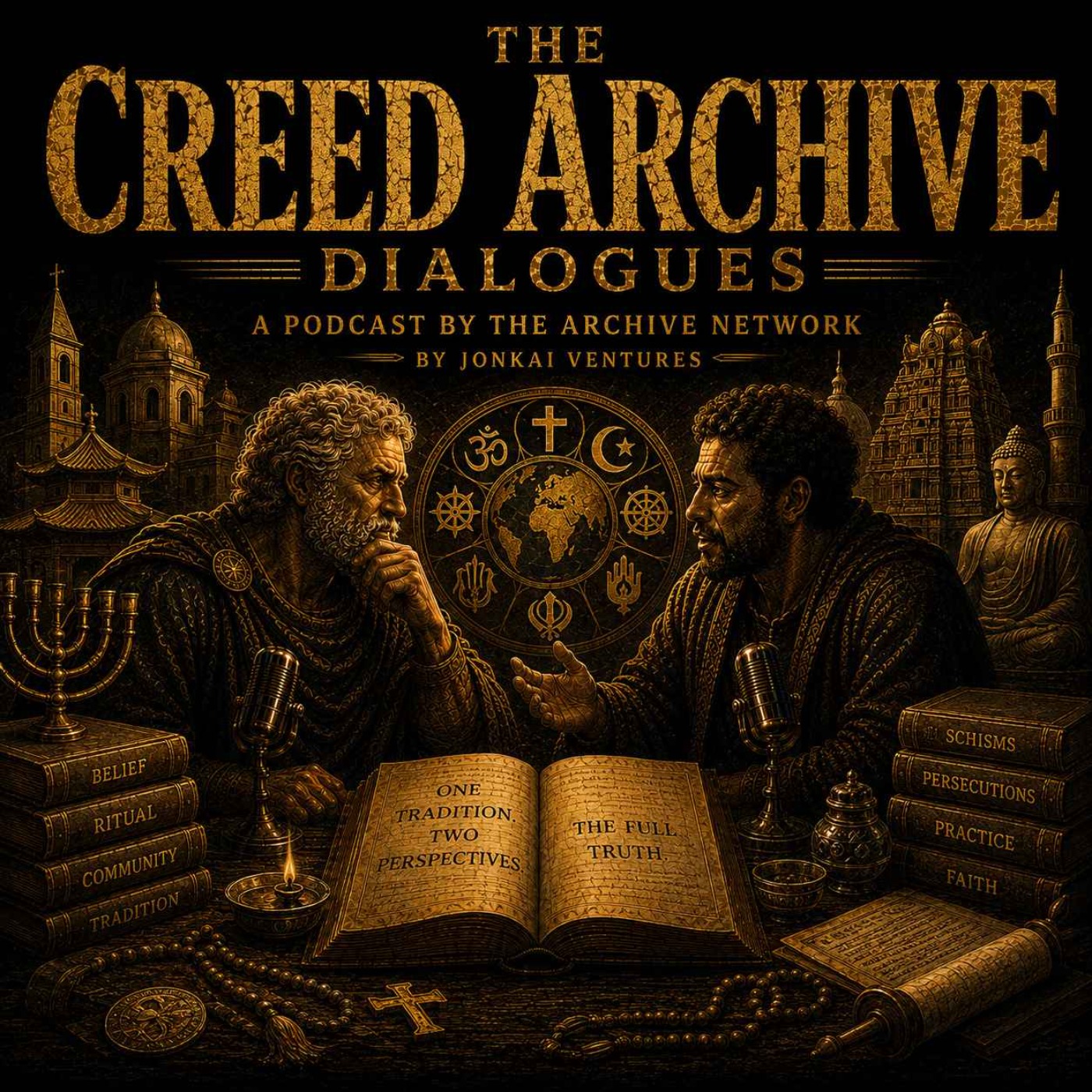
The Creed Archive Dialogues
by The Archive Network
The Creed Archive Dialogues is part of The Archive Network by Jonkai Ventures, a collection of podcasts dedicated to the stories that shaped our world.Every episode is a conversation. Aurelius and Malik, curators of The Creed Archive, take a single tradition — Ahmadiyya, Alevism, Anabaptism, Akan religion — and follow it from origin to living practice. One sets out the belief on its own terms: what it teaches, how it took shape, what holds it together. The other presses on the harder ground — the schisms, the persecutions, the distance between doctrine as written and faith as lived.These are not summaries. Each episode is one complete tradition, examined from both sides in a single sitting. Treated seriously, and on its own terms.The Archive Network is an independent, solo-run project. Every archive, podcast and documentary is free — no ads, no paywalls. If it's been worth your time, you can help keep it that way:https://thearchivenetwork.com/
-
43
Cheondoism
In the heart of nineteenth-century Korea, a new movement began to stir among villages caught between crumbling tradition and the shock of foreign powers. What began as whisper and rumor would soon erupt into revolution—and leave a mark on Korean spiritual life that endures to this day.Imagine Korea in the eighteen-fifties: a Confucian agrarian kingdom facing mounting troubles. Local corruption, rising taxes, and the approach of Western ideas all threaten the old order. In this tense climate, a man named Choe Je-u, born in eighteen twenty-four, emerges not as a court official or foreign missionary, but as a local teacher with a message that electrifies his followers. He names his vision Donghak—Eastern Learning—a call to renewal centered on Hananim, the Korean name for Heaven or God, and the dignity of every person. This is not simply a religious revival. For Choe and his first followers in Chungcheong and Jeolla, it is a way to resist both the rigid elites and new Christian missions arriving from abroad.Aurelius and Malik take on this case in full — 5 chapters, 36 minutes, one complete story.Learn more at: https://thecreedarchive.com/creed/cheondoismThe Creed Archive Dialogues is part of The Archive Network by Jonkai Ventures. In every episode, curators Aurelius and Malik take one religious tradition and follow it from origin to living practice — one setting out the belief on its own terms, the other pressing on the harder ground.The Archive Network is an independent, solo-run project. Everything is free, with no ads and no paywalls. Support doesn't unlock anything; it simply keeps the work going:https://thearchivenetwork.com/supportExplore this archive:https://thecreedarchive.comDiscover more archives and stories:https://thearchivenetwork.com Hosted on Acast. See acast.com/privacy for more information.
-
42
Caodaism
Picture a faith where Buddha, Jesus, Confucius, and even Victor Hugo share the same sanctified stage. In the Mekong Delta of the nineteen twenties, a new religion appeared that dared to bridge East and West—right under the watchful eyes of colonial authorities.Caodaism’s story begins not in mythic antiquity, but in the bustling, complicated world of colonial Vietnam. It’s a world of French administrators, Vietnamese intellectuals, and a restless search for new meaning. At the heart of this ferment, in Tay Ninh province, a handful of visionaries and mediums gathered for séances, hoping to summon wisdom that could unify a fractured society. The date is October seventh, nineteen twenty-six. Here, in a crowded hall in southern Vietnam, a declaration is read aloud. According to Caodaist tradition and official records, this marks the public founding of a new faith—Caodaism, or the Way of the High Tower.Aurelius and Malik take on this case in full — 5 chapters, 36 minutes, one complete story.Learn more at: https://thecreedarchive.com/creed/caodaismThe Creed Archive Dialogues is part of The Archive Network by Jonkai Ventures. In every episode, curators Aurelius and Malik take one religious tradition and follow it from origin to living practice — one setting out the belief on its own terms, the other pressing on the harder ground.The Archive Network is an independent, solo-run project. Everything is free, with no ads and no paywalls. Support doesn't unlock anything; it simply keeps the work going:https://thearchivenetwork.com/supportExplore this archive:https://thecreedarchive.comDiscover more archives and stories:https://thearchivenetwork.com Hosted on Acast. See acast.com/privacy for more information.
-
41
Candomblé
You might think you know the rhythms of Brazil, the thundering drums and swirling dance. But beneath the surface lies a hidden world—one shaped by survival, secrecy, and the will to remember under impossible odds. What brought the gods of Africa to the streets of Salvador?To understand the living tradition of Candomblé, we have to step back into the heat and violence of nineteenth-century Brazil—a time when the Atlantic slave trade still raged, and entire worlds were uprooted and forced to rebuild in new soil. It’s here, in the tangled alleys of Salvador and Rio de Janeiro, that enslaved and freed Africans carried their gods, songs, and rituals across the ocean. They built new communities, drawing on memories of Yoruba, Fon, and Bantu-speaking lands—regions that today stretch across Nigeria, Benin, Togo, and Central Africa. Candomblé did not emerge overnight, nor from a single hand. Instead, it grew out of the pain and creativity of people who were bound together by captivity and hope. By the late eighteen hundreds, these Afro-Brazilian communities began to create their own sacred houses—called terreiros—hidden in plain sight, adapting to the shifting legal and social landscape. Every detail mattered: which ancestor had crossed the sea, which drum pattern could call the spirits, which foods could keep the orixás close.Aurelius and Malik take on this case in full — 5 chapters, 36 minutes, one complete story.Learn more at: https://thecreedarchive.com/creed/candombleThe Creed Archive Dialogues is part of The Archive Network by Jonkai Ventures. In every episode, curators Aurelius and Malik take one religious tradition and follow it from origin to living practice — one setting out the belief on its own terms, the other pressing on the harder ground.The Archive Network is an independent, solo-run project. Everything is free, with no ads and no paywalls. Support doesn't unlock anything; it simply keeps the work going:https://thearchivenetwork.com/supportExplore this archive:https://thecreedarchive.comDiscover more archives and stories:https://thearchivenetwork.com Hosted on Acast. See acast.com/privacy for more information.
-
40
Reformed / Calvinism
A city on the edge of upheaval. A preacher’s words echo against stone walls while magistrates and ministers weigh the fate of a whole society. In the sixteenth century, a movement emerges—restless, disciplined, and destined to shape far more than a single city.The Reformed tradition, later known as Calvinism, did not begin with a single voice or a solitary act. It was born from a network of reformers, a mesh of competing ambitions, and a landscape torn apart by questions of faith and authority. As the wider Protestant Reformation sweeps across Europe, the 1530s and 1540s witness the rise of a distinct current. In places like Geneva, Zurich, and the Rhineland, a new form of church life takes shape—one that both courts danger and promises transformation. John Calvin, a French-speaking theologian, becomes the most famous face of this movement, but he is only one among many. The roots of Reformed Christianity stretch from Swiss cities to Scottish parishes, from the exiles of France to the merchants of the Low Countries. The stage is set for a tradition that will soon reimagine both theology and society.Aurelius and Malik take on this case in full — 5 chapters, 35 minutes, one complete story.Learn more at: https://thecreedarchive.com/creed/calvinismThe Creed Archive Dialogues is part of The Archive Network by Jonkai Ventures. In every episode, curators Aurelius and Malik take one religious tradition and follow it from origin to living practice — one setting out the belief on its own terms, the other pressing on the harder ground.The Archive Network is an independent, solo-run project. Everything is free, with no ads and no paywalls. Support doesn't unlock anything; it simply keeps the work going:https://thearchivenetwork.com/supportExplore this archive:https://thecreedarchive.comDiscover more archives and stories:https://thearchivenetwork.com Hosted on Acast. See acast.com/privacy for more information.
-
39
Bwiti
Night falls in Gabon’s dense forests. Drums echo under the canopy, and flames flicker in a sacred hut. Outside, the world changes—inside, ancient rituals and a mysterious root connect the living to their ancestors. Who shaped these ceremonies, and why did they survive so much upheaval?To understand the living tradition called Bwiti, we have to peel back layers of history, secrecy, and transformation. Bwiti, as it’s practiced today, did not burst forth from a single prophet or precise founding moment. Instead, it took shape in the late nineteenth and early twentieth centuries across what is now Gabon and neighboring forest regions. Colonial expansion, particularly the arrival of French administrators and missionaries from the eighteen eighties onward, forced deep changes in local life. In this pressured environment, older practices—ancestor veneration, secret rituals, and the work of ritual specialists—found new forms and new urgency.Aurelius and Malik take on this case in full — 5 chapters, 34 minutes, one complete story.Learn more at: https://thecreedarchive.com/creed/bwitiThe Creed Archive Dialogues is part of The Archive Network by Jonkai Ventures. In every episode, curators Aurelius and Malik take one religious tradition and follow it from origin to living practice — one setting out the belief on its own terms, the other pressing on the harder ground.The Archive Network is an independent, solo-run project. Everything is free, with no ads and no paywalls. Support doesn't unlock anything; it simply keeps the work going:https://thearchivenetwork.com/supportExplore this archive:https://thecreedarchive.comDiscover more archives and stories:https://thearchivenetwork.com Hosted on Acast. See acast.com/privacy for more information.
-
38
Brahmo Samaj
In the heart of nineteenth-century Calcutta, a handful of visionaries gathered in smoky salons and candle-lit drawing rooms, quietly plotting a revolution that would unsettle the foundations of tradition. Their ambition: to reimagine the sacred in an era of empire, reason, and upheaval. What began as a few voices in the crowd soon echoed across Bengal and beyond.Picture Calcutta in the year eighteen twenty-eight. The city is a crossroads: colonial officials, intellectuals, traders, and missionaries jostle amid opulent mansions and crowded streets. In this charged atmosphere, a group of Bengali elites—lawyers, merchants, scholars—form the Brahmo Sabha. The man most often linked to this turning point is Raja Ram Mohan Roy, a scholar and reformer whose critiques of sati, caste, and ritual had already ruffled feathers for decades. Roy translated Upanishadic texts into English, debated Christian missionaries, and lobbied the colonial government for social reforms. One of the earliest and most dramatic results of these reform energies was the abolition of sati in the Bengal Sati Regulation of eighteen twenty-nine, a moment that still resonates in public memory. Yet, the Brahmo Sabha was not the work of one man alone, nor did it spring from nowhere. Roy had already experimented with reform societies, including the Atmiya Sabha, and his vision was both devotional and rational—a quest for a purified, monotheistic core within an inherited tradition. The Brahmo Sabha formalized these experiments, giving them public, institutional form.Aurelius and Malik take on this case in full — 5 chapters, 35 minutes, one complete story.Learn more at: https://thecreedarchive.com/creed/brahmo-samajThe Creed Archive Dialogues is part of The Archive Network by Jonkai Ventures. In every episode, curators Aurelius and Malik take one religious tradition and follow it from origin to living practice — one setting out the belief on its own terms, the other pressing on the harder ground.The Archive Network is an independent, solo-run project. Everything is free, with no ads and no paywalls. Support doesn't unlock anything; it simply keeps the work going:https://thearchivenetwork.com/supportExplore this archive:https://thecreedarchive.comDiscover more archives and stories:https://thearchivenetwork.com Hosted on Acast. See acast.com/privacy for more information.
-
37
Bön
High in the windblown plateaus of Tibet, a tradition claims roots older than the mountains themselves. Bön is neither lost nor forgotten—it endures, whispering stories of kingdoms vanished and teachers barely touched by time. But where does myth leave off and history begin?Long before Buddhism swept across Tibet, Bön was already weaving its rituals through the valleys and peaks. It is an indigenous faith that names its birthplace in Zhang-zhung, an ancient kingdom in what is now western Tibet. According to Bön tradition, the founder Tonpa Shenrab Miwoche emerged from a mysterious land called Tagzig or Olmo Lun. His deeds and teachings, followers say, set the foundation for all of Bön—teachings carried into Tibet before any Buddhist scripture arrived. For Bönpos, as adherents are called, this story asserts a lineage beyond the reach of ordinary history. It speaks of an unbroken chain, a doctrine as old as the plateau itself.Aurelius and Malik take on this case in full — 5 chapters, 34 minutes, one complete story.Learn more at: https://thecreedarchive.com/creed/bonThe Creed Archive Dialogues is part of The Archive Network by Jonkai Ventures. In every episode, curators Aurelius and Malik take one religious tradition and follow it from origin to living practice — one setting out the belief on its own terms, the other pressing on the harder ground.The Archive Network is an independent, solo-run project. Everything is free, with no ads and no paywalls. Support doesn't unlock anything; it simply keeps the work going:https://thearchivenetwork.com/supportExplore this archive:https://thecreedarchive.comDiscover more archives and stories:https://thearchivenetwork.com Hosted on Acast. See acast.com/privacy for more information.
-
36
Baptist Tradition
Imagine a world where even the water you touch could get you arrested. In seventeenth-century England, one act—baptism by immersion—became a quiet rebellion that would echo across continents and centuries.This is the unlikely story of how a small group of dissenters sparked a global movement. In the early sixteen hundreds, England and the Low Countries simmered with religious tension. The official Church of England demanded conformity, but dissenters—called Separatists—were searching for something purer, closer to their reading of the New Testament. Out of this atmosphere, a new identity began to form, shaped by two radical ideas: baptism was for believers only, and each congregation should be free from outside control. These convictions set the stage for a movement that would challenge both religious and political authorities.Aurelius and Malik take on this case in full — 5 chapters, 34 minutes, one complete story.Learn more at: https://thecreedarchive.com/creed/baptist-christianityThe Creed Archive Dialogues is part of The Archive Network by Jonkai Ventures. In every episode, curators Aurelius and Malik take one religious tradition and follow it from origin to living practice — one setting out the belief on its own terms, the other pressing on the harder ground.The Archive Network is an independent, solo-run project. Everything is free, with no ads and no paywalls. Support doesn't unlock anything; it simply keeps the work going:https://thearchivenetwork.com/supportExplore this archive:https://thecreedarchive.comDiscover more archives and stories:https://thearchivenetwork.com Hosted on Acast. See acast.com/privacy for more information.
-
35
Bahá'í Faith
A city in turmoil. A young merchant steps forward with a declaration that will ignite both devotion and danger. In the year eighteen forty-four, in Shiraz, Persia, a movement begins—one that will ripple across continents and centuries. What compels so many to follow, and so many others to resist?Mid-nineteenth-century Persia was a place of anxiety and change. The old order was being tested by new ideas, foreign influences, and a sense that something momentous was about to unfold. Into this charged atmosphere entered Sayyid Ali Muhammad Shirazi—known as the Báb. In May of eighteen forty-four, the Báb publicly declared what his followers would soon call a new religious revelation. His writings, the Persian Bayán and the unfinished Arabic Bayán, circulated quickly among a restless population. For some, the Báb’s teachings were the answer to long-held messianic hopes within Shi'a Islam—the arrival of the expected Qá'im. For others, they were a challenge to authority and stability. Thousands responded to the Báb’s call, but so did the clerical leaders and the Qajar state, who saw danger in his claims.Aurelius and Malik take on this case in full — 5 chapters, 35 minutes, one complete story.Learn more at: https://thecreedarchive.com/creed/bahai-faithThe Creed Archive Dialogues is part of The Archive Network by Jonkai Ventures. In every episode, curators Aurelius and Malik take one religious tradition and follow it from origin to living practice — one setting out the belief on its own terms, the other pressing on the harder ground.The Archive Network is an independent, solo-run project. Everything is free, with no ads and no paywalls. Support doesn't unlock anything; it simply keeps the work going:https://thearchivenetwork.com/supportExplore this archive:https://thecreedarchive.comDiscover more archives and stories:https://thearchivenetwork.com Hosted on Acast. See acast.com/privacy for more information.
-
34
Australian Aboriginal Traditions
Fifty thousand years. Imagine a spiritual tradition that stretches back so far, its stories seem to rise from the very bones of the land itself. There is no single founder, no written charter—only the enduring presence of ancestors, law, and country, continually shaping each other.When people speak of Australian Aboriginal traditions, they are naming one of humanity’s oldest living relationships between land, story, and law. Here, origins are not confined to a distant past—they are woven through every rock, every waterhole, and every act of custodianship. The very concept of origin itself is alive, continuous.Aurelius and Malik take on this case in full — 5 chapters, 36 minutes, one complete story.Learn more at: https://thecreedarchive.com/creed/australian-aboriginal-religionThe Creed Archive Dialogues is part of The Archive Network by Jonkai Ventures. In every episode, curators Aurelius and Malik take one religious tradition and follow it from origin to living practice — one setting out the belief on its own terms, the other pressing on the harder ground.The Archive Network is an independent, solo-run project. Everything is free, with no ads and no paywalls. Support doesn't unlock anything; it simply keeps the work going:https://thearchivenetwork.com/supportExplore this archive:https://thecreedarchive.comDiscover more archives and stories:https://thearchivenetwork.com Hosted on Acast. See acast.com/privacy for more information.
-
33
Assyrian Church of the East
Imagine a Christian church that was born not in Rome or Byzantium, but in the shadow of the Persian Empire—a church whose reach would one day stretch from Mesopotamia to China.The story of the Assyrian Church of the East begins far from the centers of imperial Christianity, in a world defined by shifting borders and cultural crossroads. Its origins are not just a footnote in Christian history—they reveal how faith adapts, survives, and flourishes in the most unlikely places.Aurelius and Malik take on this case in full — 5 chapters, 35 minutes, one complete story.Learn more at: https://thecreedarchive.com/creed/assyrian-church-of-the-eastThe Creed Archive Dialogues is part of The Archive Network by Jonkai Ventures. In every episode, curators Aurelius and Malik take one religious tradition and follow it from origin to living practice — one setting out the belief on its own terms, the other pressing on the harder ground.The Archive Network is an independent, solo-run project. Everything is free, with no ads and no paywalls. Support doesn't unlock anything; it simply keeps the work going:https://thearchivenetwork.com/supportExplore this archive:https://thecreedarchive.comDiscover more archives and stories:https://thearchivenetwork.com Hosted on Acast. See acast.com/privacy for more information.
-
32
Arya Samaj
Picture a time when religious debate filled the streets of India’s cities—when the authority of ancient texts was up for grabs, and a single voice could spark a movement. It is eighteen seventy-five, and a reformer named Dayananda Saraswati has just set the stage for a new vision of Hinduism.To understand why the Arya Samaj emerged, you have to step into the world of nineteenth-century British India. This was an era of upheaval. Missionaries crisscrossed the subcontinent, colonial administrators introduced new laws, and local reformers—from the Brahmo Samaj in Bengal to Muslim dialogue circles—were locked in arguments about faith, identity, and the future. The Arya Samaj didn’t appear in isolation. It was forged in the heat of these debates, shaped by both the pressures of modernity and the allure of a return to an imagined Vedic past.Aurelius and Malik take on this case in full — 5 chapters, 36 minutes, one complete story.Learn more at: https://thecreedarchive.com/creed/arya-samajThe Creed Archive Dialogues is part of The Archive Network by Jonkai Ventures. In every episode, curators Aurelius and Malik take one religious tradition and follow it from origin to living practice — one setting out the belief on its own terms, the other pressing on the harder ground.The Archive Network is an independent, solo-run project. Everything is free, with no ads and no paywalls. Support doesn't unlock anything; it simply keeps the work going:https://thearchivenetwork.com/supportExplore this archive:https://thecreedarchive.comDiscover more archives and stories:https://thearchivenetwork.com Hosted on Acast. See acast.com/privacy for more information.
-
31
Armenian Apostolic Church
Imagine a kingdom where a single event transforms the course of an entire people. Where a king’s conversion isn’t just a personal choice, but a decision that rewrites history and reshapes national identity. This is the story of Armenia, the first state to embrace Christianity.Set on the crossroads of empires and ancient traditions, Armenia in the early fourth century was a land of princely houses, pagan temples, and shifting political allegiances. Yet, in the shadow of rival powers—Rome to the west, Persia to the east—a unique transformation unfolded. According to Armenian tradition, in the year three hundred and one, King Tiridates the Third accepted Christianity, guided by a figure whose story would become legendary: Gregory the Illuminator. For Armenians, this moment did more than change a religion. It anchored a new cultural center at Etchmiadzin, set the foundation for a church tied to royal authority, and launched a lineage of faith that would endure centuries of upheaval.Aurelius and Malik take on this case in full — 5 chapters, 36 minutes, one complete story.Learn more at: https://thecreedarchive.com/creed/armenian-apostolic-churchThe Creed Archive Dialogues is part of The Archive Network by Jonkai Ventures. In every episode, curators Aurelius and Malik take one religious tradition and follow it from origin to living practice — one setting out the belief on its own terms, the other pressing on the harder ground.The Archive Network is an independent, solo-run project. Everything is free, with no ads and no paywalls. Support doesn't unlock anything; it simply keeps the work going:https://thearchivenetwork.com/supportExplore this archive:https://thecreedarchive.comDiscover more archives and stories:https://thearchivenetwork.com Hosted on Acast. See acast.com/privacy for more information.
-
30
Anthroposophy
Picture a wooden building rising outside Basel, shaped by an architect who claimed to see hidden worlds. Now imagine that structure burning to ashes, leaving behind a movement determined not just to rebuild, but to reshape spiritual life itself.This is the origin story of Anthroposophy. At the dawn of the twentieth century, Rudolf Steiner emerges as a restless thinker in Central Europe. He is born in eighteen sixty-one in the Austro-Hungarian Empire, studies natural science, and gains early notice editing the scientific writings of Johann Wolfgang von Goethe. His book, The Philosophy of Freedom, published in eighteen ninety-four, lays out ideas about ethical individualism and cognition. Later, followers will cite this work as the foundation for Steiner’s spiritual claims, even though it came before the word Anthroposophy existed.Aurelius and Malik take on this case in full — 5 chapters, 36 minutes, one complete story.Learn more at: https://thecreedarchive.com/creed/anthroposophyThe Creed Archive Dialogues is part of The Archive Network by Jonkai Ventures. In every episode, curators Aurelius and Malik take one religious tradition and follow it from origin to living practice — one setting out the belief on its own terms, the other pressing on the harder ground.The Archive Network is an independent, solo-run project. Everything is free, with no ads and no paywalls. Support doesn't unlock anything; it simply keeps the work going:https://thearchivenetwork.com/supportExplore this archive:https://thecreedarchive.comDiscover more archives and stories:https://thearchivenetwork.com Hosted on Acast. See acast.com/privacy for more information.
-
29
Anglicanism
Under the shadow of royal ambition and religious upheaval, an unexpected act in sixteenth-century England would ignite a global tradition. Picture a king, a parliament, and a church torn between worlds—where does a faith begin when lines are drawn by law, not just by creed?In the year fifteen thirty-four, something unprecedented happened in England. The king, Henry the Eighth, was not only seeking an annulment of his marriage to Catherine of Aragon, but also challenging the spiritual authority of Rome itself. According to the Acts of Supremacy, passed by the English Parliament, the monarch was now declared the "Supreme Head" of the Church in England. This was far more than a personal or political maneuver. It was a legal and religious rupture, marking the institutional birth of what would become known as Anglicanism. But as historians and Anglicans themselves will tell you, the story is more layered than a single act or a single year.Aurelius and Malik take on this case in full — 5 chapters, 35 minutes, one complete story.Learn more at: https://thecreedarchive.com/creed/anglicanismThe Creed Archive Dialogues is part of The Archive Network by Jonkai Ventures. In every episode, curators Aurelius and Malik take one religious tradition and follow it from origin to living practice — one setting out the belief on its own terms, the other pressing on the harder ground.The Archive Network is an independent, solo-run project. Everything is free, with no ads and no paywalls. Support doesn't unlock anything; it simply keeps the work going:https://thearchivenetwork.com/supportExplore this archive:https://thecreedarchive.comDiscover more archives and stories:https://thearchivenetwork.com Hosted on Acast. See acast.com/privacy for more information.
-
28
Anabaptism
A handful of men gather in secret, risking everything for a single act. Their choice will set them against both church and state—and launch a movement that refuses to fade.The year is fifteen twenty-five. In Zurich, as in much of Europe, old certainties are breaking down. The Reformation stirs not just theological debate, but questions of power and belonging. In this charged setting, a small circle in Zurich prepares to act. They are about to reject infant baptism—a practice nearly universal in their world. Instead, they will claim baptism should be for adults who freely confess faith. This act will mark them as 'Anabaptists'—a name given by their opponents. Among themselves, they prefer to be called brethren, saints, or simply believers.Aurelius and Malik take on this case in full — 5 chapters, 37 minutes, one complete story.Learn more at: https://thecreedarchive.com/creed/anabaptismThe Creed Archive Dialogues is part of The Archive Network by Jonkai Ventures. In every episode, curators Aurelius and Malik take one religious tradition and follow it from origin to living practice — one setting out the belief on its own terms, the other pressing on the harder ground.The Archive Network is an independent, solo-run project. Everything is free, with no ads and no paywalls. Support doesn't unlock anything; it simply keeps the work going:https://thearchivenetwork.com/supportExplore this archive:https://thecreedarchive.comDiscover more archives and stories:https://thearchivenetwork.com Hosted on Acast. See acast.com/privacy for more information.
-
27
Alevism
A vast plateau. A flicker of music at dusk. In thirteenth-century Anatolia, a new spiritual current begins to flow. It is neither wholly Sunni, nor Shi'i, nor Sufi in the mainstream sense. Instead, it is something distinct—an identity forged in ambiguity, lineage, and song. If you listen closely, you might hear the first notes of Alevism, a tradition whose roots still shape millions of lives today.Imagine Anatolia in the late medieval age—crossroads of empires, home to Turkic migrants, Sufi wanderers, and local villagers. This is the uneasy world where Alevism emerges. Adherents and historians alike often point to the thirteenth century as a starting line. But the story is tangled. There is no single founder, no fixed moment. Instead, Alevism takes shape as a meeting ground—where Sufi brotherhoods, Shi'i devotion, Turkic and Anatolian folkways, and the lived memory of saints all converge. The figure of Hacı Bektaş Veli, revered by many Alevis as a spiritual archetype and conventionally dated to around twelve oh nine to twelve seventy-one, becomes central. His shrine at Hacıbektaş in central Anatolia still draws pilgrims and preserves hagiographies like the Vilâyet-nâme. Yet, historians warn: what is called Alevism today only crystallized over centuries. Its communal structures, rituals, and even its very name changed, shaped by migrations, rival empires, and the shifting sands of political power.Aurelius and Malik take on this case in full — 5 chapters, 37 minutes, one complete story.Learn more at: https://thecreedarchive.com/creed/alevismThe Creed Archive Dialogues is part of The Archive Network by Jonkai Ventures. In every episode, curators Aurelius and Malik take one religious tradition and follow it from origin to living practice — one setting out the belief on its own terms, the other pressing on the harder ground.The Archive Network is an independent, solo-run project. Everything is free, with no ads and no paywalls. Support doesn't unlock anything; it simply keeps the work going:https://thearchivenetwork.com/supportExplore this archive:https://thecreedarchive.comDiscover more archives and stories:https://thearchivenetwork.com Hosted on Acast. See acast.com/privacy for more information.
-
26
Alawism
Hidden in Syria’s rugged coastal highlands, a secretive faith quietly shaped its own world—one that outsiders could only glimpse in rumor and fragment. Who were these people whose beliefs persisted behind closed doors and mountain barriers, and what drew so much suspicion their way?In the ninth century, the eastern Mediterranean was a crossroads of religious change. Amid the swirl of Islamic sects and rival empires, a unique tradition emerged—one that would become known as Alawism. Scholars trace its earliest days to a period of intense debate among Shiʿi Muslims, after the first generations of Islamic leadership splintered and new movements vied for followers. According to community memory, a teacher named Muhammad ibn Nusayr, often called Ibn Nusayr, began to gather students around him. This circle of followers believed he possessed hidden knowledge, passed down only to the chosen few. Early sources from the ninth and tenth centuries mention the presence of these communities in Syrian towns and remote villages—places like Latakia, Jableh, and Baniyās along the coast, and the winding valleys of the Jabal al-Ansariyah mountains. By the tenth century, another figure, Abu’l-Hasan al-Khassabi in Aleppo, helped organize and spread these teachings. For historians, this was not a sudden birth but a gradual process, shaped by interactions with neighboring Shiʿi groups, local beliefs, and wider religious currents.Aurelius and Malik take on this case in full — 5 chapters, 36 minutes, one complete story.Learn more at: https://thecreedarchive.com/creed/alawismThe Creed Archive Dialogues is part of The Archive Network by Jonkai Ventures. In every episode, curators Aurelius and Malik take one religious tradition and follow it from origin to living practice — one setting out the belief on its own terms, the other pressing on the harder ground.The Archive Network is an independent, solo-run project. Everything is free, with no ads and no paywalls. Support doesn't unlock anything; it simply keeps the work going:https://thearchivenetwork.com/supportExplore this archive:https://thecreedarchive.comDiscover more archives and stories:https://thearchivenetwork.com Hosted on Acast. See acast.com/privacy for more information.
-
25
Akan Religion
Dense green forests, hidden shrines, and ancient stools: this is where the Akan religious world first took root. The echoes of priestly chants and the presence of spirits in the land still shape the lives of millions across Ghana and Côte d’Ivoire. But how did this intricate tapestry of belief and ritual begin, and who carved the first paths through the sacred groves?To explore the beginnings of Akan religion, we must travel back to the first millennium of the common era, deep into the forest and coastal regions of what is now southern Ghana and eastern Côte d'Ivoire. Here, Akan-speaking communities emerged, shaped by centuries of migration, trade, and the slow rise of powerful states. These early societies did not build temples of stone or write sacred texts. Instead, they wove their cosmology into everyday life—through rituals, oral histories, and the authority of chiefs and priests. The story of Akan religion is not the story of a single founder or a moment in time. Instead, it is a living tradition, layered and evolving, borne from local practices and the encounters of people with the land, each other, and the unseen world.Aurelius and Malik take on this case in full — 5 chapters, 36 minutes, one complete story.Learn more at: https://thecreedarchive.com/creed/akan-religionThe Creed Archive Dialogues is part of The Archive Network by Jonkai Ventures. In every episode, curators Aurelius and Malik take one religious tradition and follow it from origin to living practice — one setting out the belief on its own terms, the other pressing on the harder ground.The Archive Network is an independent, solo-run project. Everything is free, with no ads and no paywalls. Support doesn't unlock anything; it simply keeps the work going:https://thearchivenetwork.com/supportExplore this archive:https://thecreedarchive.comDiscover more archives and stories:https://thearchivenetwork.com Hosted on Acast. See acast.com/privacy for more information.
-
24
Ahmadiyya
In the late nineteenth century, as the British Empire tightened its grip over India, a quiet revolution was brewing in the towns and cities of Punjab. It was a time of fierce religious debates, missionary showdowns, and new ideas about faith and leadership. At its center stood a man from Qadian, whose claims would spark devotion, controversy, and a movement that would reach far beyond his homeland.Picture a small town called Qadian, in the Punjab of British India. Here, in eighteen thirty-five, Mirza Ghulam Ahmad was born into a landowning family. The world around him was shifting fast. Christian missionaries, Hindu reformers, colonial officials, and Muslim intellectuals were all vying for influence. By eighteen eighty-nine, this local world would give rise to a global religious community—the Ahmadiyya movement. But what made this new community different from the many others forming in the same era? To understand, we have to step back into the world that shaped it.Aurelius and Malik take on this case in full — 5 chapters, 35 minutes, one complete story.Learn more at: https://thecreedarchive.com/creed/ahmadiyyaThe Creed Archive Dialogues is part of The Archive Network by Jonkai Ventures. In every episode, curators Aurelius and Malik take one religious tradition and follow it from origin to living practice — one setting out the belief on its own terms, the other pressing on the harder ground.The Archive Network is an independent, solo-run project. Everything is free, with no ads and no paywalls. Support doesn't unlock anything; it simply keeps the work going:https://thearchivenetwork.com/supportExplore this archive:https://thecreedarchive.comDiscover more archives and stories:https://thearchivenetwork.com Hosted on Acast. See acast.com/privacy for more information.
-
23
Zen (Chan)
A master sits before a silent crowd. He lifts a single flower. No words, no explanation. One follower smiles—and in that moment, Zen’s foundational myth is born.What does it mean to inherit wisdom without a script? To trace a path from silence and gesture, rather than written law? For centuries, Zen—known as Chan in China—has told its own origin story as a living current, passed mind-to-mind from the Buddha himself. But behind the legend, the historical record reveals a tangled emergence, shaped by translation, monasteries, and the meeting of cultures in medieval China. To step into Zen’s beginnings, we enter a world of both myth and manuscript, silence and institution.Aurelius and Malik take on this case in full — 5 chapters, 35 minutes, one complete story.Learn more at: https://thecreedarchive.com/creed/zen-buddhismThe Creed Archive Dialogues is part of The Archive Network by Jonkai Ventures. In every episode, curators Aurelius and Malik take one religious tradition and follow it from origin to living practice — one setting out the belief on its own terms, the other pressing on the harder ground.The Archive Network is an independent, solo-run project. Everything is free, with no ads and no paywalls. Support doesn't unlock anything; it simply keeps the work going:https://thearchivenetwork.com/supportExplore this archive:https://thecreedarchive.comDiscover more archives and stories:https://thearchivenetwork.com Hosted on Acast. See acast.com/privacy for more information.
-
22
Sikhism
A man disappears into a river, leaving behind only rumors. When he emerges three days later, he brings a message that will reshape villages, challenge empires, and spark a new religious tradition in northern India.This is the story of Sikhism’s beginnings—a tale woven from both devotion and history. In the late fifteenth century, Punjab was a crossroads. Caravans threaded through fertile plains; Sufi mystics recited Persian poetry, and bhakti saints sang in the local tongue. Into this world, Guru Nanak was born in fourteen sixty-nine, in a village called Talwandi—now known as Nankana Sahib, in present-day Pakistan.Aurelius and Malik take on this case in full — 5 chapters, 35 minutes, one complete story.Learn more at: https://thecreedarchive.com/creed/sikhismThe Creed Archive Dialogues is part of The Archive Network by Jonkai Ventures. In every episode, curators Aurelius and Malik take one religious tradition and follow it from origin to living practice — one setting out the belief on its own terms, the other pressing on the harder ground.The Archive Network is an independent, solo-run project. Everything is free, with no ads and no paywalls. Support doesn't unlock anything; it simply keeps the work going:https://thearchivenetwork.com/supportExplore this archive:https://thecreedarchive.comDiscover more archives and stories:https://thearchivenetwork.com Hosted on Acast. See acast.com/privacy for more information.
-
21
Mahayana
Picture a network of monks, traders, and storytellers spreading through the borderlands of ancient India. Manuscripts pass from hand to hand, new ideas take shape, and soon, the Buddhist world will never be the same. This is the beginning of Mahayana—the Great Vehicle.In the first centuries of the common era, a new current emerges within Buddhism. It is not a sudden revolution, but a layered process. Scholars trace its start to northwestern India and the vital crossroads leading toward Central Asia. Here, fragments of new teachings appear—texts that later communities will call sutras. These writings, such as the Prajnaparamita, or Perfection of Wisdom literature, begin to circulate between the first century before the common era and the third century after. Archaeologists uncover Gandharan manuscript fragments—physical evidence that these new teachings were not limited to a single place or language. Meanwhile, some Mahayana communities teach that these sutras were spoken by the Buddha himself, meant for future generations. The difference between the historian’s timeline and the tradition’s self-understanding is striking, and it shapes the way Mahayana tells its own story.Aurelius and Malik take on this case in full — 5 chapters, 37 minutes, one complete story.Learn more at: https://thecreedarchive.com/creed/mahayana-buddhismThe Creed Archive Dialogues is part of The Archive Network by Jonkai Ventures. In every episode, curators Aurelius and Malik take one religious tradition and follow it from origin to living practice — one setting out the belief on its own terms, the other pressing on the harder ground.The Archive Network is an independent, solo-run project. Everything is free, with no ads and no paywalls. Support doesn't unlock anything; it simply keeps the work going:https://thearchivenetwork.com/supportExplore this archive:https://thecreedarchive.comDiscover more archives and stories:https://thearchivenetwork.com Hosted on Acast. See acast.com/privacy for more information.
-
20
Zaidi Shia
In the rugged highlands of Yemen, an idea was born—a vision of leadership that demanded action, not just inheritance. Here, a movement emerged that would challenge empires, shape villages, and transform the meaning of justice for generations to come.What drove a community to risk everything for a new kind of authority? The Zaidi movement begins with the story of Zayd ibn Ali, a name that still echoes in the mountains of northern Arabia. He was not only a descendant of the Prophet, but also a man who refused to stand by in the face of injustice. In seven forty, Zayd led a bold uprising against the Umayyad governor in Kufa. His defeat and death might have ended his story—except that, for his followers, it was only the beginning.Aurelius and Malik take on this case in full — 5 chapters, 36 minutes, one complete story.Learn more at: https://thecreedarchive.com/creed/zaidi-shia-islamThe Creed Archive Dialogues is part of The Archive Network by Jonkai Ventures. In every episode, curators Aurelius and Malik take one religious tradition and follow it from origin to living practice — one setting out the belief on its own terms, the other pressing on the harder ground.The Archive Network is an independent, solo-run project. Everything is free, with no ads and no paywalls. Support doesn't unlock anything; it simply keeps the work going:https://thearchivenetwork.com/supportExplore this archive:https://thecreedarchive.comDiscover more archives and stories:https://thearchivenetwork.com Hosted on Acast. See acast.com/privacy for more information.
-
19
Twelver Shia
In the burning sands of seventh-century Arabia, a single question split the world of early Islam: who should lead the faithful after the Prophet Muhammad’s death? Behind this question, rival claims ignited a struggle that would echo through centuries—culminating in the memory of a massacre on the plains of Karbala.What drove the forging of a tradition that would forever bind faith to lineage, loss, and the hope for a hidden guide? In the year six thirty-two, the Prophet Muhammad died, leaving behind a community united in belief, but divided by the urgent matter of succession. Twelver Shia Islam, the largest branch of Shia Islam today, traces its roots to this moment. Adherents maintain that Muhammad designated his cousin and son-in-law, Ali ibn Abi Talib, as his successor—an act they see not just as political, but divinely ordained. Historians, meanwhile, point to a more tangled story of early Islamic leadership, where competing claims unfolded across the cities of Arabia and the Fertile Crescent. Regardless of perspective, two facts remain uncontested: Ali became the fourth caliph, ruling from Kufa, and his followers there formed the nucleus of what would eventually be called Shia Islam.Aurelius and Malik take on this case in full — 5 chapters, 35 minutes, one complete story.Learn more at: https://thecreedarchive.com/creed/twelver-shia-islamThe Creed Archive Dialogues is part of The Archive Network by Jonkai Ventures. In every episode, curators Aurelius and Malik take one religious tradition and follow it from origin to living practice — one setting out the belief on its own terms, the other pressing on the harder ground.The Archive Network is an independent, solo-run project. Everything is free, with no ads and no paywalls. Support doesn't unlock anything; it simply keeps the work going:https://thearchivenetwork.com/supportExplore this archive:https://thecreedarchive.comDiscover more archives and stories:https://thearchivenetwork.com Hosted on Acast. See acast.com/privacy for more information.
-
18
Ismaili Shia
In the shadows of early Islam, a disputed inheritance ignited a revolution that would reshape the map of faith and power. The story of Ismaili Shia Islam begins not with a single act, but with a question: who truly holds the key to divine guidance?The eighth century in the Islamic world was a time of uncertainty and contest. After the death of Ja'far al-Sadiq around the year seven sixty-six, his followers faced a choice that would fracture communities and launch new destinies. Some recognized his son Isma'il ibn Ja'far as the rightful Imam, a direct link in the chain of spiritual authority. Others looked to a different line. These rival claims did not exist in a vacuum. They unfolded amid intense debates about leadership, loyalty, and the meaning of revelation. According to Ismaili tradition, this was not just a political split but a spiritual one—one that would set in motion a legacy of esoteric teaching and hereditary succession. Historians, examining texts and records from the period, mark the late eighth and ninth centuries as the time when the Ismaili movement began to crystallize. Networks of missionaries, known as da'is, fanned out across Iraq, Persia, and beyond. They spread their message quietly, building communities of secrecy and trust. The movement’s early strength came not from armies or courts, but from these invisible lines of loyalty and learning.Aurelius and Malik take on this case in full — 5 chapters, 37 minutes, one complete story.Learn more at: https://thecreedarchive.com/creed/ismaili-shia-islamThe Creed Archive Dialogues is part of The Archive Network by Jonkai Ventures. In every episode, curators Aurelius and Malik take one religious tradition and follow it from origin to living practice — one setting out the belief on its own terms, the other pressing on the harder ground.The Archive Network is an independent, solo-run project. Everything is free, with no ads and no paywalls. Support doesn't unlock anything; it simply keeps the work going:https://thearchivenetwork.com/supportExplore this archive:https://thecreedarchive.comDiscover more archives and stories:https://thearchivenetwork.com Hosted on Acast. See acast.com/privacy for more information.
-
17
Reform Judaism
Imagine stepping into a synagogue in early nineteenth-century Germany. The language is German, not Hebrew. The music is played on an organ, and the service is shorter, more familiar, more modern. In that moment, centuries of inherited ritual are quietly, but unmistakably, being transformed.This is not just a change in custom. It’s a turning point in Jewish history—a collision between ancient faith and the radical promises of the Enlightenment. The early nineteenth century was a time of upheaval for European Jewry. As the Enlightenment—the Haskalah—spread, Jewish communities across the German lands faced new legal freedoms, fresh opportunities, and the unsettling possibility of real social integration. But with possibility came tension. Could Jewish law and life adapt to modernity without losing their soul?Aurelius and Malik take on this case in full — 5 chapters, 38 minutes, one complete story.Learn more at: https://thecreedarchive.com/creed/reform-judaismThe Creed Archive Dialogues is part of The Archive Network by Jonkai Ventures. In every episode, curators Aurelius and Malik take one religious tradition and follow it from origin to living practice — one setting out the belief on its own terms, the other pressing on the harder ground.The Archive Network is an independent, solo-run project. Everything is free, with no ads and no paywalls. Support doesn't unlock anything; it simply keeps the work going:https://thearchivenetwork.com/supportExplore this archive:https://thecreedarchive.comDiscover more archives and stories:https://thearchivenetwork.com Hosted on Acast. See acast.com/privacy for more information.
-
16
Reconstructionist Judaism
In the crowded streets of early twentieth-century New York, one rabbi dared to ask: What if Judaism could be rebuilt for a modern age, not just preserved? His ideas would spark controversy— and quietly reshape Jewish life in America.It was a time when traditions were being questioned, and communities found themselves at crossroads. The old world collided with the new, and Jewish immigrants searched for ways to belong in both. Out of this tension, a bold experiment began to take form.Aurelius and Malik take on this case in full — 5 chapters, 35 minutes, one complete story.Learn more at: https://thecreedarchive.com/creed/reconstructionist-judaismThe Creed Archive Dialogues is part of The Archive Network by Jonkai Ventures. In every episode, curators Aurelius and Malik take one religious tradition and follow it from origin to living practice — one setting out the belief on its own terms, the other pressing on the harder ground.The Archive Network is an independent, solo-run project. Everything is free, with no ads and no paywalls. Support doesn't unlock anything; it simply keeps the work going:https://thearchivenetwork.com/supportExplore this archive:https://thecreedarchive.comDiscover more archives and stories:https://thearchivenetwork.com Hosted on Acast. See acast.com/privacy for more information.
-
15
Orthodox Judaism
Smoke drifts over ancient Jerusalem. The year is seventy of the common era. The Second Temple lies in ruins, and the center of Jewish life has vanished. In the ashes, a new form of leadership begins to take shape—one that will redefine what it means to live as a Jew for centuries to come.The destruction of the Second Temple was not only a historical trauma, but also a turning point for Jewish religious life. In the aftermath, the priestly rituals that once defined worship were gone. What emerged in their place was a community built around study, interpretation, and law—anchored by the authority of the rabbis. Orthodox Judaism traces its roots to this moment. From the perspective of its adherents, the Torah given at Sinai remains eternally binding, even as the world around it changes. The rabbis, inheritors of authority from the Temple priests, began to reshape Jewish life for a new age. Scholars such as Shaye J. D. Cohen point to the first through third centuries of the common era as the era when the rabbinic class and its core texts—the Mishnah and, later, the Babylonian Talmud—came into being. Two events stand out as milestones in the Orthodox memory: the destruction of the Temple in seventy, and the redaction of the Mishnah around two hundred by Judah ha-Nasi.Aurelius and Malik take on this case in full — 5 chapters, 36 minutes, one complete story.Learn more at: https://thecreedarchive.com/creed/orthodox-judaismThe Creed Archive Dialogues is part of The Archive Network by Jonkai Ventures. In every episode, curators Aurelius and Malik take one religious tradition and follow it from origin to living practice — one setting out the belief on its own terms, the other pressing on the harder ground.The Archive Network is an independent, solo-run project. Everything is free, with no ads and no paywalls. Support doesn't unlock anything; it simply keeps the work going:https://thearchivenetwork.com/supportExplore this archive:https://thecreedarchive.comDiscover more archives and stories:https://thearchivenetwork.com Hosted on Acast. See acast.com/privacy for more information.
-
14
Karaite Judaism
A centuries-old debate still echoes today: who decides what it means to follow the law? In the bustling heart of the early Abbasid empire, a new Jewish community took shape—one that dared to break away from the rabbis and look only to Scripture.This is the story of a movement that challenged authority, redefined tradition, and carved out a path all its own. In the eighth century, the Middle East was alive with religious ferment. The early Abbasid caliphate encouraged scholarship, debate, and new ways of interpreting faith. Amid this intellectual energy, a Jewish movement emerged—one that would become known as Karaite Judaism. The Karaites rejected the authority of the rabbinic Oral Torah, choosing instead to ground their beliefs and law directly in the Hebrew Bible.Aurelius and Malik take on this case in full — 5 chapters, 36 minutes, one complete story.Learn more at: https://thecreedarchive.com/creed/karaite-judaismThe Creed Archive Dialogues is part of The Archive Network by Jonkai Ventures. In every episode, curators Aurelius and Malik take one religious tradition and follow it from origin to living practice — one setting out the belief on its own terms, the other pressing on the harder ground.The Archive Network is an independent, solo-run project. Everything is free, with no ads and no paywalls. Support doesn't unlock anything; it simply keeps the work going:https://thearchivenetwork.com/supportExplore this archive:https://thecreedarchive.comDiscover more archives and stories:https://thearchivenetwork.com Hosted on Acast. See acast.com/privacy for more information.
-
13
Hasidic Judaism
A movement emerged in the shadowed woodlands and far-reaching border towns of eighteenth-century Eastern Europe—one that would change the face of Jewish spiritual life. Its founder, Israel ben Eliezer, known as the Baal Shem Tov, would become a legend, but his story begins amid hardship and uncertainty.Picture the Polish-Lithuanian Commonwealth in the seventeen-hundreds: Jewish communities scattered across the regions of Podolia, Volhynia, and what is now Ukraine and Belarus. These were decades marked by social instability, economic strain, and a yearning for religious renewal. In this environment, the seeds of Hasidic Judaism took root. The Baal Shem Tov, born around sixteen ninety-eight and living until seventeen sixty, is remembered as the movement’s originator. He lived in places like Medzhybizh, now in Ukraine, and was credited by his followers with bringing mystical devotion and joyous worship to ordinary people—not just scholars.Aurelius and Malik take on this case in full — 5 chapters, 36 minutes, one complete story.Learn more at: https://thecreedarchive.com/creed/hasidic-judaismThe Creed Archive Dialogues is part of The Archive Network by Jonkai Ventures. In every episode, curators Aurelius and Malik take one religious tradition and follow it from origin to living practice — one setting out the belief on its own terms, the other pressing on the harder ground.The Archive Network is an independent, solo-run project. Everything is free, with no ads and no paywalls. Support doesn't unlock anything; it simply keeps the work going:https://thearchivenetwork.com/supportExplore this archive:https://thecreedarchive.comDiscover more archives and stories:https://thearchivenetwork.com Hosted on Acast. See acast.com/privacy for more information.
-
12
Conservative (Masorti) Judaism
Imagine a world where tradition is a living, breathing force—and every generation must decide what to conserve and what to change. What happens when a centuries-old law encounters the urgency of the modern age?In the heart of the nineteenth century, Jewish communities across Europe found themselves standing at this very crossroads. The old ways were under pressure. Emancipation and Enlightenment demanded answers. Could Jewish law—halakhah—bend without breaking? Could the faith of ancestors survive the scrutiny of historical scholarship? What unfolded was not the vision of a single founder, but a sprawling conversation, stretching from Berlin to Budapest, from yeshiva halls to the new seminaries of America.Aurelius and Malik take on this case in full — 5 chapters, 36 minutes, one complete story.Learn more at: https://thecreedarchive.com/creed/conservative-judaismThe Creed Archive Dialogues is part of The Archive Network by Jonkai Ventures. In every episode, curators Aurelius and Malik take one religious tradition and follow it from origin to living practice — one setting out the belief on its own terms, the other pressing on the harder ground.The Archive Network is an independent, solo-run project. Everything is free, with no ads and no paywalls. Support doesn't unlock anything; it simply keeps the work going:https://thearchivenetwork.com/supportExplore this archive:https://thecreedarchive.comDiscover more archives and stories:https://thearchivenetwork.com Hosted on Acast. See acast.com/privacy for more information.
-
11
Theravada
Picture a world where a single teaching, spoken under the shade of ancient trees, would ripple out to shape entire civilizations. Imagine words and rituals passing from mouth to mouth, city to city, until they are inscribed in palm leaves and stone, enduring for millennia.How does a tradition claiming roots in the Buddha’s own time become the heartbeat of entire regions? To answer that, we have to travel back to a crossroads of history, encounter legendary kings, and step inside the story that Theravada Buddhists tell about themselves—a story that is still unfolding.Aurelius and Malik take on this case in full — 5 chapters, 35 minutes, one complete story.Learn more at: https://thecreedarchive.com/creed/theravada-buddhismThe Creed Archive Dialogues is part of The Archive Network by Jonkai Ventures. In every episode, curators Aurelius and Malik take one religious tradition and follow it from origin to living practice — one setting out the belief on its own terms, the other pressing on the harder ground.The Archive Network is an independent, solo-run project. Everything is free, with no ads and no paywalls. Support doesn't unlock anything; it simply keeps the work going:https://thearchivenetwork.com/supportExplore this archive:https://thecreedarchive.comDiscover more archives and stories:https://thearchivenetwork.com Hosted on Acast. See acast.com/privacy for more information.
-
10
Eastern Orthodoxy
A city built on two continents. A faith shaped by councils and controversy. And in the middle, a moment known as the Great Schism—a split that would echo for centuries. What really happened in Constantinople, and why does it still matter today?Step into the heart of the Byzantine world. Imagine domes rising above marble streets, incense drifting through mosaicked halls, and prayers in ancient Greek echoing from the Hagia Sophia. This is where Eastern Orthodoxy took form—not in a single moment, but in a centuries-long process. Its roots reach back to the earliest Christian communities of the eastern Roman Empire. Its identity was forged in the fires of debate, imperial ambition, and a liturgical imagination unlike any other. As we begin to explore this tradition, we’ll see how the Eastern Orthodox Church emerged as a living communion—one that would stand at the crossroads of empire, theology, and ritual, and face one of the most defining ruptures in Christian history.Aurelius and Malik take on this case in full — 5 chapters, 38 minutes, one complete story.Learn more at: https://thecreedarchive.com/creed/eastern-orthodoxyThe Creed Archive Dialogues is part of The Archive Network by Jonkai Ventures. In every episode, curators Aurelius and Malik take one religious tradition and follow it from origin to living practice — one setting out the belief on its own terms, the other pressing on the harder ground.The Archive Network is an independent, solo-run project. Everything is free, with no ads and no paywalls. Support doesn't unlock anything; it simply keeps the work going:https://thearchivenetwork.com/supportExplore this archive:https://thecreedarchive.comDiscover more archives and stories:https://thearchivenetwork.com Hosted on Acast. See acast.com/privacy for more information.
-
9
Sunni Islam
A new faith rises in the harsh heat of seventh-century Arabia. Within a single lifetime, it transforms a divided landscape into a community that will reshape world history. But the story of Sunni Islam’s origins is not only about prophecy—it is also about the struggle for unity, authority, and memory.Imagine the rocky streets of Mecca, a city where caravans bring wealth and stories from distant lands. Here, in the year six hundred ten, Muhammad receives a message that will become the Quran. His call to monotheism and social reform sparks both devotion and fierce opposition. Over two decades, Muhammad’s movement grows, first underground in Mecca, then as a new civic community in Yathrib—soon called Medina. The decisive migration, or Hijra, in six hundred twenty-two marks the beginning not just of a calendar, but of a new kind of society. According to Muslim sources, this is the founding moment of the ummah—the Muslim community.Aurelius and Malik take on this case in full — 5 chapters, 36 minutes, one complete story.Learn more at: https://thecreedarchive.com/creed/sunni-islamThe Creed Archive Dialogues is part of The Archive Network by Jonkai Ventures. In every episode, curators Aurelius and Malik take one religious tradition and follow it from origin to living practice — one setting out the belief on its own terms, the other pressing on the harder ground.The Archive Network is an independent, solo-run project. Everything is free, with no ads and no paywalls. Support doesn't unlock anything; it simply keeps the work going:https://thearchivenetwork.com/supportExplore this archive:https://thecreedarchive.comDiscover more archives and stories:https://thearchivenetwork.com Hosted on Acast. See acast.com/privacy for more information.
-
8
Roman Catholicism
A tradition that now reaches over a billion people began with a handful of followers, uncertain and underground, in the shadows of imperial Rome. How did a movement born on the fringes become a force at the very heart of Western civilization?The origins of Roman Catholicism invite us into a world where faith, power, and identity were all up for grabs. Picture the first century: Roman Palestine under imperial rule, a crossroads of languages, religions, and unrest. In this context, the life and message of Jesus of Nazareth ignited a chain reaction. His earliest followers claimed that he rose from the dead, and they began to gather, pray, and spread his teachings. For Roman Catholics, these beginnings are not just a matter of history—they are the foundation of an unbroken chain, passed down from the apostles themselves. Scholars, meanwhile, sift through letters, gospels, and archaeological fragments, seeking the traces left by those early believers. The New Testament, the Didache, and ruins in cities like Jerusalem and Rome offer glimpses of a fledgling movement navigating suspicion and hope.Aurelius and Malik take on this case in full — 5 chapters, 35 minutes, one complete story.Learn more at: https://thecreedarchive.com/creed/roman-catholicismThe Creed Archive Dialogues is part of The Archive Network by Jonkai Ventures. In every episode, curators Aurelius and Malik take one religious tradition and follow it from origin to living practice — one setting out the belief on its own terms, the other pressing on the harder ground.The Archive Network is an independent, solo-run project. Everything is free, with no ads and no paywalls. Support doesn't unlock anything; it simply keeps the work going:https://thearchivenetwork.com/supportExplore this archive:https://thecreedarchive.comDiscover more archives and stories:https://thearchivenetwork.com Hosted on Acast. See acast.com/privacy for more information.
We're indexing this podcast's transcripts for the first time — this can take a minute or two. We'll show results as soon as they're ready.
No matches for "" in this podcast's transcripts.
No topics indexed yet for this podcast.
Loading reviews...
ABOUT THIS SHOW
The Creed Archive Dialogues is part of The Archive Network by Jonkai Ventures, a collection of podcasts dedicated to the stories that shaped our world.Every episode is a conversation. Aurelius and Malik, curators of The Creed Archive, take a single tradition — Ahmadiyya, Alevism, Anabaptism, Akan religion — and follow it from origin to living practice. One sets out the belief on its own terms: what it teaches, how it took shape, what holds it together. The other presses on the harder ground — the schisms, the persecutions, the distance between doctrine as written and faith as lived.These are not summaries. Each episode is one complete tradition, examined from both sides in a single sitting. Treated seriously, and on its own terms.The Archive Network is an independent, solo-run project. Every archive, podcast and documentary is free — no ads, no paywalls. If it's been worth your time, you can help keep it that way:https://thearchivenetwork.com/
HOSTED BY
The Archive Network
CATEGORIES
Loading similar podcasts...
Frequently Asked Questions
How many episodes does The Creed Archive Dialogues have?
The Creed Archive Dialogues currently has 36 episodes available on PodParley. New episodes are automatically indexed when they're published to the podcast feed.
What is The Creed Archive Dialogues about?
The Creed Archive Dialogues is part of The Archive Network by Jonkai Ventures, a collection of podcasts dedicated to the stories that shaped our world.Every episode is a conversation. Aurelius and Malik, curators of The Creed Archive, take a single tradition — Ahmadiyya, Alevism, Anabaptism, Akan...
How often does The Creed Archive Dialogues release new episodes?
The Creed Archive Dialogues has 36 episodes. Check the episode list to see recent publication dates and frequency.
Where can I listen to The Creed Archive Dialogues?
You can listen to The Creed Archive Dialogues on PodParley by clicking any episode. We provide an embedded audio player for direct listening, and you can also subscribe via your preferred podcast app using the RSS feed.
Who hosts The Creed Archive Dialogues?
The Creed Archive Dialogues is created and hosted by The Archive Network.
URL copied to clipboard!