
PODCAST · news
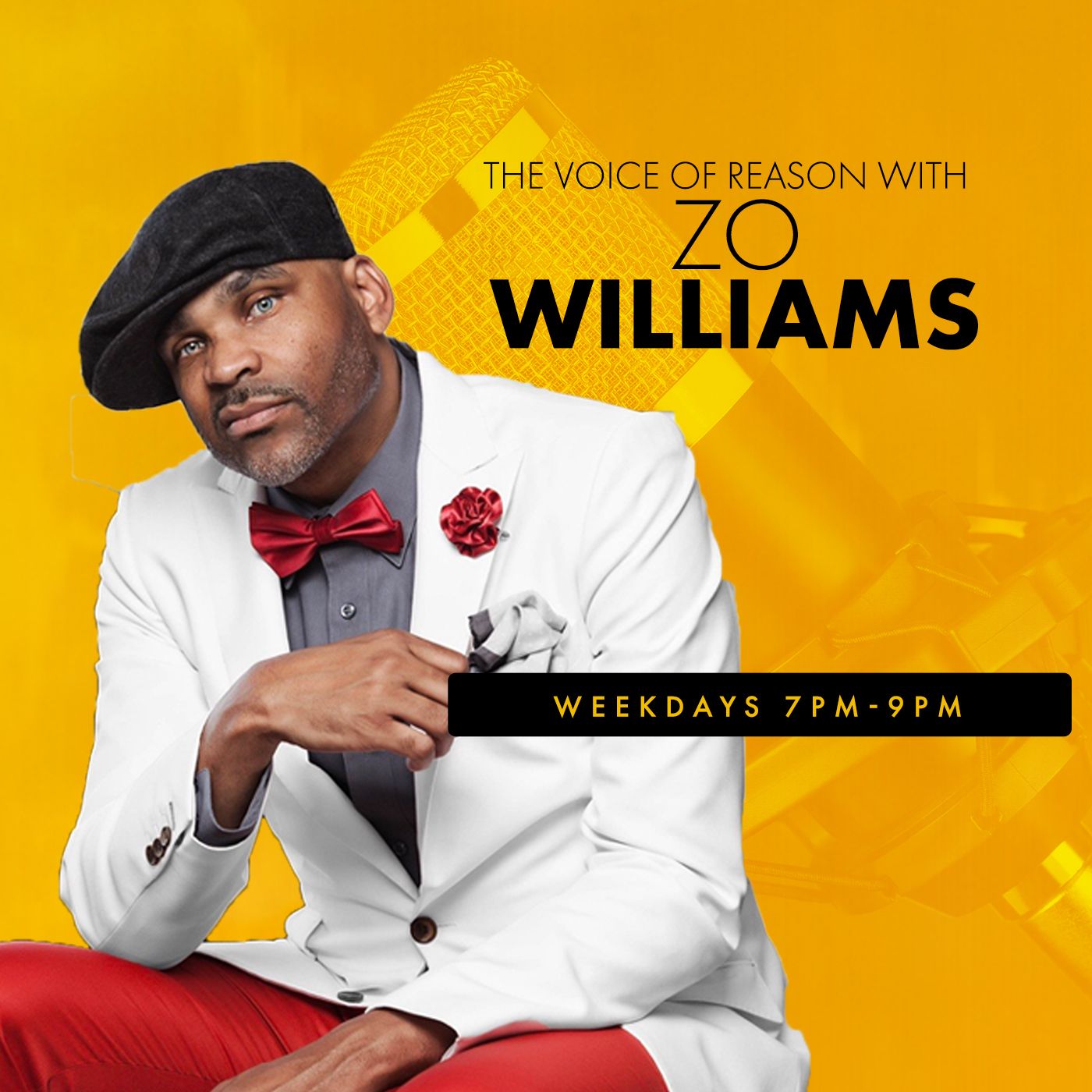
Zo Williams: Voice of Reason
by KBLA 1580 Am
Fans have dubbed Zo Williams “Tupac meets Deepak” or “The Hip Hop Dr. Phil.” Zo brings a thoughtful and unique perspective to relationships, religion, spirituality, social systems and more. He has a gift for connecting random conversations to a more profound meaning of life. For over 20 years now, Zo has dedicated himself to sharing his knowledge and personal experiences, offering listeners a highly non-traditional, scientific, and spiritual approach to deconstructing themselves to understand self and engage in better relationships.
-
543
The Anti-Promised Land
The promised land of intimacy is not a quiet house. It is a payout. You walk in looking for the land of milk and honey embodied within a person. Someone to end the wandering. Someone to cash the check the first house bounced. Metaphorically speaking, Egypt is or was that first house. First deep love and first fracture in the same hands. Parental potters, works in progress, missing chances to love on you and tend what you needed. You loved them and quietly loathed them in the same breath. You lowered the price of being shaped. The labor was the cost of the strategy you had to develop, which let you keep the love for the parental potter’s hands while surviving the mess their brokenness created within the environment and within your chest. Canaan is the fantasy that one later body will be the exodus. Disney named it happily ever after. Spacious. Sweet. Rest from that labor. Needs that no longer have to go on sale. No more exposure. No more self-knowledge. Happily ever after shirks the responsibility of a holographic relational environment. That environment is a crucible. Psychological nudity. Being known without a costume. The credits roll so you never have to stand in that. Inheritance, as if a vow sworn to a people could be performed by a spouse. You call that chemistry, destiny, finally. Intuition says I can rest now. Ask which climate trained that rest. The potter’s house or here. Authority sold you settlement as love, then sold you the ending. Reason says one finite person cannot flow with milk and honey on command, and cannot cancel the crucible. Canaan in a couple is destination-logic, not peace-logic. In the text the land is sworn possession, deliverance into fruit after barrenness, pasture after scarcity, rest from war. Cities you did not build. Wells you did not dig. Vineyards you did not plant. Eat, be full, do not forget. That cargo gets dropped on a lover and renamed happily ever after. They will see you so the first invisibility dies. They will stay so the first leaving gets reversed. They will tend what the first potters missed. Conflict then feels like eviction from the land. Ordinary human limit feels like exile, like having to raise the price of yourself again. Peace becomes a product you buy with silence, sex, image, or church. You were not relating. You were occupying. The land already had people in it. Promise arrives with contest. Spies taste the fruit and still panic at the giants. Watch what you do after closeness. That is the empirical test. Do you soften into here, or do you scan for proof the giants are gone, the old quota is canceled, and the story has finally gone to credits. Their actual life becomes what must be driven out so your hunger can settle. A healthy bond is the anti-promised land because it refuses to hire one nervous system to finish the potter’s job and refuses to play happily ever after with a human being. Presence is not a refund for Egypt. Relating is not collection for missed tending. Happily ever after is how the mask avoids psychological nudity. A kiss cannot annex a past. A vow cannot unwrite a childhood. The vows you can keep are smaller and harder. Tell the truth. Do not vanish. Do not turn their life into your territory. Stay in the exposure. Stay in the crucible. Covenant in the book can be lost. Exile sits in the same library as milk and honey. So can the marriage that was asked to be Canaan. The mask that will fight this hour is simple. I am the one who is owed rest from the labor of being shaped. I am the one who is owed a land that flows and a story that ends. If I drop that, I do not know who I am. Name one result that would change your mind. If you cannot, you are not inquiring. You are defending the deed. Are you with them in this room, or are you occupying them as the last Canaan that might still make you whole, waiting for them to keep a promise they never made, in a land they are not.
-
542
Follow No one for Love
For the self still organized around avoidance, freedom can register as exposure. Removal of the external regulator often spikes activation. Familiar limitation frequently lowers it. The preference shows itself in repeated selection. A person can choose the clinician, the preacher, the partner, the teacher, or the authority whose remaining darkness matches their own. The match can feel like recognition. It can also keep both parties exactly where they already stand. Familiar wound over unfamiliar capacity appears with striking regularity. Unreadiness in the vessel leaves an opening. Figures step into that opening offering management while speaking the language of sight. When the frequency already feels known, the vessel may accept the arrangement without detecting the substitution. Recognition occurs. Contact with the indicated material does not. The false seer remains useful. The vessel remains managed. Clean pointing stays rare. A genuine pointer aims at what only the person can reach and then withdraws without claim. When the vessel cannot yet tolerate the loss of external regulation, the same pointing tends to produce conflict, rejection, or rapid return to dependence. Readiness determines whether indication can land or whether it converts into further delay. Material a person continues to refuse rarely remains private. It can appear outside as the next guide, the next lover, the next expert who will handle what still goes unexamined. People will often construct elaborate detours to avoid turning toward their own interior. Selecting a pointer who matches the current level of avoidance ranks among the more efficient of those detours. The preference for familiar containment continues to drive the selection across intimate, clinical, spiritual, and political relationships. Until that preference itself becomes visible and is no longer automatically obeyed, the field keeps supplying what the avoidance already knows how to use.
-
541
"Marriage is the Path"
Marriage is not the soft place. It is the furnace. Marcus said the obstacle is the way. Put marriage in that seat and the claim sharpens. The repeating argument is not blocking the path. That argument is the path applying pressure where the old pattern still runs. The night both of you go quiet after the same trigger is not failure. That silence is the curriculum arriving on schedule. The urge to leave the room or shut down is not weakness. It is the exact moment the work begins. Easy love is the story sold so people keep buying the product. Real love is continuous heat that keeps asking whether you can stay when the test looks like the same fight for the hundredth time. Soft life says cut anything heavy and protect your peace at all costs. This concept says the continuous reprimand is the only force strong enough to build a peace that can actually hold weight. One side treats friction as violence. The other treats it as the living initiation the culture stopped providing. The nervous system rewires under sustained pressure it cannot easily escape. Marriage raises the walls and makes the exit expensive so the temperature can rise high enough to force the meeting with the unfinished self. Unmarried intimacy can still teach, but the door stays easier to walk through. Most people leave the moment it stops feeling like choice. The temple will not let you hide. The mirror keeps showing the places you still abandon yourself. The furnace does not care if you are ready. The daily heat is the way. Stay long enough and the obstacle stops being the problem. It becomes the only reliable teacher left in the house. Questions to Consider: 1. The Neurobiological Reframe (Scientific & Psychological) If the brain is evolutionarily wired for homeostasis and threat-reduction, does the pursuit of an "easy, frictionless love" actually cause psychological atrophy? From a neurobiological standpoint, could life’s continuous reprimand and relational friction be the exact biological catalysts required to trigger neuroplasticity and emotional maturity? 2. The Semantic Substitution (Philosophical & Authorial) If we substitute "marriage" for "obstacle" in Marcus Aurelius’s famous axiom—rendering it "Marriage is the path"—does the institution cease to be a destination of safety and instead become an active, adversarial crucible? If so, is the widespread dissatisfaction with marriage rooted in a narrative error: expecting a harbor when we have actually signed up for an ocean? 3. The Metaphysical Threshold (Metaphysical & Empirical) If life is an infinite, non-terminating testing ground of your peace, boundaries, and endurance, what is the ultimate nature of the "tester"? Is the continuous reprimand an indifferent law of a chaotic universe, or is it a metaphysically responsive mirror designed to relentlessly expose the exact areas where your self-mastery is incomplete? 4. The Domestic Darwinism Paradox (Clinical & Empirical) Clinically speaking, long-term intimacy forces a confrontation with the "Shadow" of both partners. Why do we empirically observe that unmarried or less institutionalized couples often report higher temporary baseline satisfaction, while married couples face deeper existential turbulence? Is marriage inherently designed to maximize distress to accelerate individuation? 5. The Fallacy of Resignation vs. Radical Acceptance (Zen & Clinical) Where is the boundary line between the Zen practice of "stopping the fight with reality" and the clinical trap of learned helplessness? How does an individual determine if they are engaging directly with a relational obstacle to find a lesson, or if they are merely staying comfortable in a toxic cycle of "life's continuous reprimand"? 6. The Commodification of Intimacy (Authorial & Philosophic) In modern culture, love is often marketed as a consumer good that should yield maximum emotional comfort for minimal psychological cost ("Easy Love"). From an authorial and cultural critique standpoint, how has the capitalist expectation of "convenience" poisoned our capacity to view relational struggle as a sacred, non-negotiable path to wisdom? 7. The Boundary-Peace Antinomy (Psychological & Metaphysical) Can true psychological peace exist without the constant presence of an external force testing its boundaries? If peace is never tested, is it actually peace, or is it merely an fragile illusion born of isolation? Does the continuous testing of our boundaries by those we love actually define and strengthen the architecture of the soul? 8. The Ryan Holiday / Stoic Extension (Authorial & Empirical) If "what stands in the way becomes the way," then the specific, recurring argument, the mismatched libido, or the emotional distance in a relationship is not a sign of failure, but the literal curriculum. Why does empirical human behavior consistently reject this curriculum, treating relational obstacles as exit ramps rather than the engine of the relationship? 9. The Calculus of "More Trouble Than It's Worth" (Philosophical & Clinical) When a society increasingly concludes that intimate relationships are "more trouble than they are worth," what metric of "worth" are they using? If the worth is measured in hedonistic pleasure, the conclusion is correct. But if the worth is measured in existential depth, is avoiding the "trouble" of love actually a form of spiritual and psychological bankruptcy? 10. The Ultimate Zen Paradox of "Easy Love" (Zen & Metaphysical) Could the true, deepest definition of "Easy Love" be achieved only after one completely surrenders to the fact that love is inherently brutal, continuous work? Is it possible that love only becomes "easy" when we stop demanding that it be comfortable, thereby turning the obstacle entirely into the path? Why is marriage or intimate relationships often viewed as being more trouble than it’s worth? Should the marriage construct of relationships be expected to be more challenging than those of unmarried couples? Could the word “obstacle” be used instead of “marriage” in the quote “The obstacle is the path?” by Marcus Aurelius? 1. If the nervous system only rewires under sustained pressure it cannot escape, what happens to a person who spends decades selecting partners who never raise the temperature high enough to force that rewiring? 2. When two people stay married through the same repeating fracture for fifteen years, is the fracture still a problem or has it become the only reliable teacher left in the house? 3. Does the cultural demand for easy love quietly train people to treat any sustained discomfort as evidence the relationship itself is defective rather than evidence the self still has work to do? 4. If the body records every completed defense as a new entry in its pain library, how many times can a couple complete the same argument before the library starts running the relationship without their consent? 5. What if the higher temporary satisfaction reported by unmarried couples is not proof of superiority but proof that the structure has not yet forced both people to meet the parts of themselves they still refuse to claim?
-
540
WHO IS ZO WILLIAMS, AND WHY DOES HIS VOICE MATTER NOW?
I look at the relationship-content world and I see something that should make all of us a little uncomfortable. We have never had this many people telling us how to love. Men are being taught what women want. Women are being taught what men fear. We have experts on standards, boundaries, red flags, attachment, masculine leadership, feminine energy, high-value behavior, healing, marriage, submission, narcissism, emotional intelligence, biblical order, self-worth and compatibility. So why are we still this confused about one another? That question bothers me. Because I suspect the problem may reach deeper than bad advice. Every piece of relationship advice carries an invisible philosophy inside it. Somebody has already decided what love means. Somebody has already defined a successful relationship. Somebody has already determined what makes a man valuable, what makes a woman desirable, what healing should produce, what marriage proves, what leadership looks like and what a healthy person should want. I want to know who gave those definitions permission to become truth. Kevin Samuels could make you confront your position in the romantic marketplace. Tony Gaskins can challenge your standards and choices. Stephan Speaks can ask whether unresolved pain keeps interfering with the love you say you want. Dr. Cheyenne Bryant can confront emotional functioning and accountability. Dr. Thema Bryant can bring trauma, culture, authenticity and liberation into the conversation. Iyanla can walk you toward the spiritual root. R.C. Blakes can bring your identity before God into the room. Those are serious contributions. My question usually starts acting up after the answer arrives. Tell me to choose better and I want to investigate the chooser. Tell me to know my worth and I want to know whose currency we are using. Tell a man he needs to lead and I want leadership to show me its identification. Who taught you what leading means? Is it service? Control? Responsibility? Fear wearing authority’s clothes? Tell a woman to raise her standards and I want to know what built them. Wisdom? Pain? Humiliation? Discernment? Social comparison? Fear of ever being embarrassed again? Tell me somebody is toxic and maybe they are. I still want to know what happened inside you when you met them, what made their behavior recognizable, what kept you there, what made leaving difficult and what meaning you attached to the entire experience.
-
539
CAN BLACK LOVE COMPETE WITH THE HIGH OF BEING SEEN?
Black love now competes inside an economy that can turn recognition into reward and public response into psychological evidence. For Black people, that competition enters through a historical field already charged by misrecognition, exclusion, racial projection, economic restriction, contested beauty, extracted cultural production, and repeated demands for exceptional performance. Digital platforms did not create the human hunger for recognition. They gave that hunger a visible score and a business model. Under those conditions, attention may deliver more immediate emotional voltage than intimacy. Desire can feel more convincing than devotion. Status can quiet doubt for a moment. Public approval can make private love feel strangely insufficient. The governing thesis asks whether unconditional love can retain psychological authority when a person learns to experience visibility as evidence of value. Once another person must continually confirm worth, relationship can shift from encounter toward regulation. A partner no longer carries only a human presence. The partner may also carry an assignment. Keep me significant in my own eyes. Black love therefore confronts a recognition problem that reaches through history, economics, technology, culture, and personal psychology. The decisive question asks whether Black life can cultivate forms of worth powerful enough to let love matter even when nobody watches.
-
538
THE “HEART” OF THE “MATTER
What if the person you swear you love became lovable partly because something unresolved inside you could use them? That possibility cuts deeper than codependence, compatibility, attachment style, or the familiar claim that wounded people choose wounded partners. The question reaches into the construction of love itself. Perhaps the abandoned part of you found someone willing to chase. The unseen part found an admirer. The frightened part found a protector. The financially insecure part found a provider. The self-doubting part found someone willing to believe enough for two people. The emotionally neglected part found someone with the capacity to absorb pressure you had never learned to hold. And somewhere inside all of that relief, you said: I love you. But what if part of what you loved was their usefulness to what remained unhealed?
-
537
What if God provides the mirrored intimate play, while conditioning writes the protective false-self script we keep performing inside it?
What if the person you call the love of your life entered carrying the key to the place where you still believe you are incomplete? Human beings begin life dependent. That dependence is innocent. A child requires regulation, protection, recognition, touch, presence, and care. When those needs remain unfinished, adulthood can inherit more than pain. It can inherit an assignment. Find somebody who will finally make the old absence stop hurting. Then attraction can feel like destiny because conditioning recognizes a familiar role before consciousness recognizes the script. The divine mirrored intimate play places another free, changing human being close enough to activate what solitude can keep hidden. Their distance can uncover abandonment. Independence can expose control. A boundary can reveal entitlement. Desire can expose the hunger to be chosen. Change can uncover the fear beneath your demand for permanence. The mirror shows something devastating. You have been asking an impermanent person to provide permanent evidence that you are truly whole. Bodies age, feelings move, circumstances turn, identities evolve, and relationships change form. Impermanence keeps its promise. The false self fights that fact because psychological need requires continuity of supply. Here need becomes the original sin when innocent childhood dependence survives as the adult belief that completion exists somewhere outside the self. Perhaps the fine tuning serves one ruthless purpose. Whatever you keep demanding from another person returns as a question about what remains uncultivated, disowned, or unclaimed within you. Can you become internally what you keep hiring romantic love to provide externally? Psychological freedom begins when another person can matter enormously without carrying responsibility for your wholeness. Then love loses its job as rescue. The mirror has done its work for you. You finally meet the person across from you after you stop trying to find yourself inside them.
-
536
I CAN’T TRANSLATE MYSELF TO FIT YOUR PERCEPTION OF ME
Intimacy places two private worlds in contact and gives neither person direct access to the other. Everything travels through perception. Tone acquires meaning. Silence acquires meaning. Touch acquires meaning. Distance, affection, criticism, hesitation, facial expression, timing and memory all pass through an interpretive system shaped before the present relationship existed. Learning that system may radically deepen intimacy. A partner who understands how you receive meaning gains access to an extraordinary relational skill. They can communicate across difference rather than demanding that their way of expressing love, hurt, safety or truth function as the universal language. The danger enters when translation changes jobs. Healthy translation carries meaning across perceptual difference. Corrupted translation forces one person to remodel themselves until the other person’s interpretation feels comfortable. That distinction governs the entire discussion. You may need to learn the language of your partner’s perception. You may also reach a point where speaking that language asks you to falsify your own interior. Wisdom must know the difference. Refusal can protect integrity. Refusal can also protect ego. Translation can demonstrate love. Translation can also become self-abandonment. No single position gets automatic moral authority. The deeper relational skill requires something far more difficult. Learn how your partner sees. Communicate with awareness of that sight. Remain willing to revise your own perception. Refuse any demand that requires you to become the character somebody else has already decided you are. The relationship changes when both partners learn that discipline. When only one partner learns it, intimacy slowly turns into accommodation.
-
535
I HAVE NO MOORING FOR YOUR WOUNDS TO LATCH ONTO
I HAVE NO MOORING FOR YOUR WOUNDS TO LATCH ONTO Perhaps one of love’s greatest tests arrives when your pain reaches for me and discovers that I will not become who your pain remembers. Human wounds rarely remain private. They enter relationships carrying expectations shaped by earlier experience. Abandonment may anticipate pursuit. Distrust may provoke interrogation. Fear may seek control. Shame may invite rescue. None of this means every wounded person behaves identically, nor that another person causes the wound. The deeper question concerns what happens between two people when an old expectation reaches outward and finds no cooperating response. Here lies the possibility of a different intimacy. I can care about your fear without obeying it. I can hear your accusation without manufacturing a defense merely because you expected one. Your distance can hurt without forcing me to chase you. Your anger can register in my body without becoming the author of my behavior. Compassion does not require psychological conscription.
-
534
WHEN THE REALITY OF LOVE OUTRUNS WHAT YOU THINK YOU KNOW ABOUT IT
Human beings rarely fear confusion. They fear what confusion threatens to take away. Every intimate relationship begins with the quiet confidence that we understand love well enough to recognize it when it arrives. Then something unexpected happens. The relationship refuses to obey our expectations. Communication breaks down. Attraction changes. Conflict appears. Certainty dissolves. Almost instinctively, we conclude that confusion signals dysfunction, incompatibility, betrayal, or the beginning of the end. This investigation asks a far more dangerous question. What if intimate confusion is not always evidence that reality has become unclear? What if it marks the precise moment your existing understanding of love can no longer explain the reality standing in front of you? Nobody enters a relationship empty-handed. Every person arrives carrying attachment patterns, childhood conditioning, cultural beliefs, religious teachings, trauma adaptations, family mythology, previous heartbreak, and a lifetime of conclusions about what love should feel like. These become the invisible lenses through which every partner is interpreted. They help us navigate intimacy until intimacy presents an experience those lenses cannot explain. That moment feels like confusion. Perhaps it deserves another name. Suppose confusion is neither failure nor success. Suppose it is the frontier where yesterday’s knowledge reaches its limit and tomorrow’s consciousness has not yet found its language. Then an even more unsettling possibility emerges. Many people spend years trying to escape confusion without ever realizing they have been escaping the very experience capable of expanding them. Others remain trapped in relationships because they mistake psychological stuckness for spiritual growth. Both errors originate from the same assumption: that all confusion means the same thing. Perhaps it never did. Perhaps the greatest danger in love has never been confusion itself. Perhaps the greatest danger has been allowing the conditioned past to decide what confusion means before reality has been given the opportunity to reveal something the past has never known.
-
533
Emotional Sobriety: A step-by-step guide on how to break insecure attachment codependence! With special guest, Dr. Alan Berger
EMOTIONALLY DRUNK ON YOU A Deeper Investigation Into Whether Insecure Attachment and Codependence Turn Love Into an Emotional Substance We Use to Escape Ourselves With Special Guest Dr. Allen Berger SYNOPSIS A lover can enter your bloodstream without ever touching your body. One text settles the panic. One unanswered call restarts it. A warm tone restores your worth. A distant look sends your identity into free fall. No chemical entered the system, yet the entire internal climate changed. What, then, have you been consuming? Human beings rarely describe romantic attachment as intoxication. Culture gives it prettier names. Passion. Loyalty. Devotion. Chemistry. Ride-or-die love. Yet beneath some of these celebrated experiences lives a dangerous emotional arrangement: another person has become responsible for producing the inner condition you cannot yet produce, tolerate, or sustain for yourself. Their attention becomes medicine. Their approval becomes evidence that you matter. Their availability becomes protection against abandonment. Their need for you becomes proof that you deserve to exist. Their obedience becomes peace. Once love carries this burden, relationship stops functioning as an encounter between two free human beings. It becomes a private emotional economy in which one person must keep paying so the other person does not collapse. Attachment theory helps explain how early bonds can shape the adult nervous system’s expectations of closeness, separation, safety, and loss. Codependence adds another layer. A person may manage, rescue, fix, please, monitor, sacrifice, or overfunction in order to maintain access to emotional security. The behavior can look loving from the outside while fear quietly writes the contract. The anxious partner may call control “connection.” The avoidant partner may call emotional disappearance “freedom.” The rescuer may call indispensability “service.” The self-erasing partner may call surrender “commitment.” Every strategy attempts to solve the same unbearable problem: how can I keep another person from awakening feelings I do not know how to live with? Dr. Allen Berger’s concept of emotional sobriety attacks this arrangement at its foundation. His work challenges the hidden belief that personal peace depends upon people, places, and circumstances behaving according to our private rules. “I am okay if you call.” “I am okay if you stay.” “I am okay if you understand.” “I am okay if you choose me.” These conditions turn another person’s freedom into a threat. Could emotional sobriety begin when “I am okay if” finally loses authority? This does not require emotional coldness, radical isolation, or the fantasy that mature adults need nobody. Human beings require connection. The deeper question concerns governance. Who governs your inner life when someone disappoints you? Who controls your identity when affection gets withdrawn? Who becomes responsible for calming the fear that existed before the relationship began? Clinical maturity may involve learning to experience jealousy without surveillance, loneliness without self-erasure, uncertainty without interrogation, disappointment without retaliation, and grief without turning loss into proof of personal worthlessness. Philosophically, emotional sobriety confronts our understanding of love itself. Can love remain love when it demands psychological captivity? Can intimacy survive without control? Can commitment retain meaning when fear serves as the lock? A partner who cannot leave has not necessarily chosen you. A partner who must constantly regulate you has little room left to meet you. Culturally, many communities teach people to endure emotional dependence as evidence of loyalty. Men may learn to hide dependency behind authority, possession, silence, or rage. Women may receive praise for transforming self-neglect into service. Family systems can reward the person who carries everyone while quietly punishing the same person for developing a self. Under these conditions, codependence can wear the clothing of morality. Metaphysically, the topic reaches even further. What happens when consciousness seeks completion through possession? Can another person ever provide permanent shelter from an interior world you refuse to inhabit? Perhaps every attempt to make someone else the source of your emotional stability places sacred responsibility in human hands that cannot carry it. Tonight’s investigation enters the space between love and dependency, support and self-abandonment, care and control, attachment and intoxication. Are you loving your partner? Or are you drinking them? And when the emotional supply runs low, who do you become?
-
532
“The Flow of LETTING vs. The Strategy of VETTING”
*Before a child ever learns language, the nervous system begins writing scripture. Every embrace becomes a sentence. Every absence becomes a definition. Every inconsistency becomes a prophecy. Long before consciousness asks, “Who am I?” survival has already answered, “Become whoever keeps you connected.” Need performs a miracle. It keeps the infant alive. Then, unnoticed, the miracle becomes a monarchy. The architecture that once served survival quietly begins governing identity. Self-worth becomes negotiated. Love becomes verified. Presence becomes performance. Effort becomes evidence. The first environment does not merely teach relationship. It teaches consciousness how to interrupt itself. Perhaps this explains why so many adults call it discernment while living almost entirely inside inherited conclusions. They believe they are evaluating another human being, yet every act of vetting first passes through an invisible inheritance that predates memory itself. The Mother Room has already translated reality before reality has been allowed to speak. Perhaps every wisdom tradition has been circling this same mystery from different horizons. Jung asked whether we remain possessed by what we refuse to see. Krishnamurti questioned whether observation can exist before conclusion. The Dao refuses to force the river because the river never forgot how to become the ocean. Wu wei suggests that life’s deepest intelligence appears when compulsion releases its grip. Attachment theory describes the earliest architecture through which safety becomes internalized. Different languages. One investigation. What keeps consciousness from participating in life before it organizes life into something familiar? Relationship therefore becomes something far more unsettling than romance. It becomes the only place where the architecture protecting yesterday collides with the life attempting to arrive today. Every demand for proof. Every craving for reassurance. Every fear of abandonment. Every insistence that love continually demonstrate itself. Each may represent a single movement wearing different disguises: the original pattern asking existence to obey the laws that once made survival possible. Then letting and vetting cease to describe dating strategies. They describe two civilizations living inside one psyche. One civilization believes love must first be secured before it can be trusted. The other discovers that love does not arrive through control, but through participation. Perhaps the greatest relationship never begins between two people. Perhaps it begins the moment consciousness withdraws its unconscious allegiance from yesterday’s survival and allows today’s embodiment to complete a sentence that fear has interrupted since childhood. Not because love finally arrived. Because the interruption finally departed. CORE PREMISE Every river already knows where it is going. Only the banks believe they are directing the water. Human consciousness appears to carry a similar misunderstanding. Nearly every moment becomes an attempt to negotiate with reality. Accelerate this. Delay that. Keep this. Prevent that. Predict them. Manage uncertainty. Control outcomes. Even love quietly becomes another engineering project. An invisible assumption governs nearly every decision: Life requires my management before it can be trusted. Yet every wisdom tradition eventually arrives at an altogether different possibility. The deepest intelligence may never emerge through greater control. It may emerge only after control exhausts itself. Relationship therefore presents one of the most demanding laboratories a human being will ever enter. Two conditioned identities arrive carrying thousands of conclusions about safety, intimacy, commitment, conflict, masculinity, femininity, trust, abandonment, betrayal, desire, permanence, and love. Each attempts to organize reality around those conclusions. Very little is actually allowed to reveal itself. Perhaps this explains why so much energy becomes invested in determining whether another person deserves entry into our life while almost no attention is given to whether life itself has been allowed to introduce us to ourselves. Vetting asks: “How do I determine whether this person fits the architecture I already possess?” Letting asks: “What architecture within me keeps interrupting reality before reality finishes speaking?” That second question is profoundly Daoist. Because Daoism does not begin with controlling the current. It begins with noticing that the current was already moving before you arrived.
-
531
IF RACE IS A FALSE SOCIAL CONSTRUCT… WHAT MAKES MARRIAGE MORE REAL?
Every civilization inherits stories so old that eventually nobody remembers they were stories. They become laws. They become customs. They become morality. They become identity. Then, one day, they become so deeply woven into everyday life that questioning them feels like questioning reality itself. Modern intellectual culture has spent decades asking whether race is best understood as a biological destiny or as a social construct whose meanings and hierarchies were historically created, politically maintained, and culturally reinforced. That conversation has challenged inherited assumptions about identity, power, and human worth. Yet another institution, equally dependent upon law, culture, religion, economics, and collective agreement, rarely receives the same level of ontological scrutiny. Marriage. Why? If race can be examined as a human classification whose social meaning is historically constructed rather than naturally self-evident, why shouldn’t marriage survive the identical philosophical cross-examination? Why does one institution continually stand trial while the other often enters the courtroom already presumed legitimate? This investigation does not ask whether marriage is good or bad. It asks a prior question that civilization seldom pauses long enough to consider: What makes any social construct objectively real? A wedding license cannot manufacture trust. A ceremony cannot generate intimacy. A ring cannot produce fidelity. A legal contract cannot integrate two fragmented personalities. If two defended selves, two personas, or two adaptive survival strategies exchange vows, has the institution created authentic relationship, or has it merely granted legal recognition to whatever level of consciousness already existed? The inquiry deepens further. Marriage organizes inheritance, taxation, health care, immigration, property, kinship, and child-rearing. It functions as social infrastructure. Does that practical importance establish ontological reality, or has civilization quietly confused institutional usefulness with existential truth? If an institution becomes economically indispensable, does that make it more real, or simply more difficult to question? The tension becomes sharper still when history enters the room. Contemporary scholarship broadly recognizes humanity’s African origins and the extraordinary genetic diversity found across African populations. Many historians and scholars of the African diaspora have also argued that African civilizations have not always received proportionate recognition for their contributions to philosophy, mathematics, science, spirituality, governance, and culture. Whether those historical debates have been resolved or remain contested, they expose a larger pattern: civilizations do not merely preserve facts; they also preserve narratives. Which narratives become sacred? Which become disposable? Who decides? Perhaps the deepest contradiction has nothing to do with race or marriage alone. Perhaps it concerns the standards civilization applies to every institution it inherits. Why are some collective agreements relentlessly deconstructed while others remain largely insulated from the same intellectual pressure? Is the difference grounded in evidence, or in the psychological, political, cultural, and economic work those institutions perform?
-
530
The Relationship You’re Actually In: Fantasy, Possession, and the Death of the Real Person “When the fantasy dies and the real person is all
Most people believe they are in a relationship with another human being. They are not. They are in a relationship with a carefully maintained projection, a preferred version assembled early and defended long after the real person has already left it. The fantasy is not a soft illusion. It is a demand. It requires the other person to remain recognizable, predictable, and useful to the internal story.
-
529
CAN THE RELATIONSHIP LEADER FUNCTION WITHOUT AN INTIMATE NEEDER?
What happens to male leadership when female dependence disappears? For generations, many cultures placed men at the head of the intimate household before asking whether the man possessed the judgment, restraint, emotional range, accountability, or relational competence required to lead anything. Gender supplied the title. Provision supplied the evidence. Female dependence supplied the stage. Yet the arrival of the self-sufficient woman forces the arrangement into open court. Can a man still recognize himself as valuable when he is no longer financially necessary, emotionally indispensable, physically dominant, socially authorized, or automatically obeyed? Can he remain grounded when a woman says, “I can live without you, and I still choose you”? That sentence may represent love in its freest form. It may also terrify anyone whose identity depends upon necessity. This investigation asks whether some forms of male leadership rest upon competence or contrast. A man may appear powerful because a woman has been trained to appear less powerful. He may seem decisive because she has been discouraged from deciding. She may perform dependence because protection, relief, status, erotic tension, or freedom from responsibility rewards the performance. The arrangement may therefore operate as a hidden exchange: he receives relevance; she receives exemption. The deeper problem concerns power itself. Can leadership remain ethical when another person’s weakness protects the leader’s identity? Can a leader remain objective while benefiting from the condition he claims to guide? Does authentic leadership create permanent followers, or does it strengthen another person until following becomes unnecessary? Perhaps the final test of relationship leadership arrives after need has died. No helplessness remains to manage. No cultural title can settle the question. No dependency can impersonate devotion. Only two sovereign adults remain. At that point, leadership must prove that it can survive freedom, equality, disagreement, competence, and choice. Otherwise, the relationship never contained a leader and a needer. It contained two people protecting a bargain neither could afford to expose.
-
528
Are You Looking for a Lover, or Recruiting a Devout Follower? A Deeper Investigation Into Toxic Intimate Pattern Recognition, Familiarity Ad
Are you hopelessly attracted to the mirror image of patterns you claim you want to escape? And beneath that: What if the person you call “my type” is simply someone unusually qualified to recognize, tolerate, reinforce, or worship the version of you that you have mistaken for yourself?
-
527
ARE HUMAN BEINGS THE FRACTALIZED PERSONA OR MASK OF GOD, AND IS THE DEVIL HIS SHADOW?
What if the face you call “me” is only the mask God wears while experiencing limitation? Carl Jung warned that the persona can become so convincing that consciousness forgets the deeper Self beneath it. Paramahansa Yogananda described the human being as a wave of the divine ocean, carrying the nature of the source while mistaking temporary form for separate existence. Krishnamurti exposed the prison of psychological identification. Bernardo Kastrup asks whether mind may be more fundamental than matter. Place those pressures together and a terrifying possibility appears. Humanity may not merely contain divine fragments. Humanity may be the countless faces through which one consciousness enters history, culture, race, memory, wound, desire, and death. The ego names the face, defends the face, and demands that the face remain. Childhood becomes the potter’s hand. Attachment hardens the clay. Identity calls the shape eternal. Then what is the devil? Could the devil be the force that convinces the wave it exists apart from the ocean? Could hell be the psychic and metaphysical territory created by everything the sacred mask refuses to own? Could possession, clinging, projection, domination, and resistance to reality be the instruments that keep divine consciousness trapped inside a temporary identity? And what happens in relationship when one mask cannot see the divine behind another? The partner becomes mother, father, rescuer, betrayer, possession, or enemy. The present becomes a courtroom for childhood. Love becomes a demand that another person protect the identity we are afraid to question. This inquiry does not ask whether you believe in God or the devil. It asks whether your identity has become the god you serve, whether your shadow has become the hell you export, and whether self-realization begins when the mask finally recognizes the face beneath every face, including whoever you were taught to hate.
-
526
“How about this one? Journey into the void ends loneliness”
Loneliness may be the most misnamed experience in modern intimacy. We call it the absence of another person because that explanation keeps us from examining the more dangerous possibility: we may be suffering from the absence of ourselves. The void appears when the noise stops. No text. No lover. No crisis. No audience. No one to rescue, impress, pursue, blame, or perform for. In that silence, the self we abandoned to secure attachment begins knocking from inside the walls. Ross Rosenberg’s concept of pathological loneliness sharpens the wound. Within his model, the agony of separation can grow from childhood attachment trauma, core shame, and the learned belief that one’s unaccompanied self remains unbearable. The relationship then becomes more than connection. It becomes anesthesia. Its ending feels less like heartbreak and more like withdrawal. That distinction changes everything. Do you miss the person, or the relief they provided from meeting yourself? Did the relationship nourish you, or merely keep your deepest shame sedated? If mistreatment feels safer than solitude, love may no longer be guiding the bond. Terror may be selecting the partner. The journey into the void does not ask human beings to stop needing one another. That would violate both psychology and reality. It asks whether connection can remain healthy when another person must carry the entire weight of your identity, regulation, worth, and reason to exist. Perhaps loneliness survives because we keep treating other people as exits from an interior room we refuse to enter. The void may not be empty. It may contain grief, rage, unmet need, unlived truth, and the self exiled whenever love required performance. What if entering that room ends loneliness? What if the person you feared being left alone with becomes the one person you finally refuse to abandon for anyone ever again?
-
525
ARE YOU STRUGGLING WITH THE GHOST OF NARCISSUS
What if self-love, a corrective to shame, abandonment, and self-erasure, has begun producing a danger: a person so committed to honoring the self that nobody else’s humanity can interrupt it? Self-love should restore dignity. It should rescue people from relationships, religions, families, and social systems that trained them to disappear. Yet every medicine contains the possibility of overdose. The language of healing can become a constitution. “Protecting my peace” can mean refusing truth. “Knowing my worth” can become a ranking system. “Choosing myself” can become permission to leave every room where reciprocity, compromise, correction, or repair is required. The ghost of Narcissus does not appear when someone admires themselves. It appears when the reflection becomes more sacred than reality. The person no longer loves the whole self, with its beauty, damage, courage, selfishness, tenderness, and capacity to injure. They love an edited image that must remain innocent. Anyone who challenges that image becomes toxic, misaligned, jealous, unsafe, or beneath their vibration. The deeper question may be more radical than whether self-love creates narcissistic tendencies. Could the highest form of self-love be selfless? Not self-erasing. Not boundaryless. Not weak. Selfless in the strictest sense: love with no ego seated at the center demanding elevation, exemption, admiration, or control. A functional self remains. Agency remains. Dignity remains. The throne disappears. Perhaps real self-love does not say, “I am above you.” It says, “I no longer need to stand above anyone to remain whole.” The person who hates themselves may be unable to receive love. The person who worships themselves may be unable to give it. The person who truly loves themselves may no longer need to make the self the center of love. Which one lives in your mirror: a healed self, a defended image, or Narcissus wearing the language of awakening?
-
524
HORROR HEARTS ACTIVATED
“HORROR HEARTS ACTIVATED” What if fear does not merely warn the heart, but becomes the drug that keeps its identity alive? A fear-governed person may crave love while depending upon threat. Anxiety scans the future, memory edits the present, shame protects the mask, and perception turns possibility into evidence. The partner becomes a screen upon which the nervous system projects horror. This is where fear can become addictive. Not as a formal diagnosis, but as dependence upon activation, suspicion, and emergency. Fear supplies intensity. Intensity feels familiar. Familiarity gets mistaken for truth. Peace feels empty, consistency feels suspicious, and love feels invasive because it approaches the self beneath the performance. What protects that self? Lying and control. The lie preserves the mask. Control manages the witness. We conceal what might change another person’s view, then restrict freedom so they cannot discover what concealment protects. We edit motives, feelings, and intentions. We call the editing privacy. We call the control standards. We call hypervigilance intuition. Fear recruits intelligence to defend the prison while convincing the prisoner that bars equal safety. The horror begins when these protections create what they predicted. Surveillance breeds secrecy. Testing breeds exhaustion. Possession breeds rebellion. Withdrawal breeds abandonment. Fear points toward the wreckage and claims prophecy. Does addiction to fear produce incessant lying and control? It can, whenever truth threatens the mask and freedom threatens the fear-built identity. The monster may be the system created to prevent us from being seen, loved, changed, and exposed to ourselves.
-
523
WHAT DOES IT MEAN WHEN THE RELATIONSHIP MARKETPLACE SAYS YOU CAN’T AFFORD THIS MAN OR WOMAN?
A Deeper Investigation Into Whether Romantic “Value” Measures Character, Compatibility, Purchasing Power, Social Rank, Emotional Capacity, Or Our Willingness To Pay The Hidden Price Of Access
-
522
The Intimate Hall Pass: Part 2
The hall pass begins as a simple deal. One night. Clear boundaries. As spiritual awareness grows, trauma patterns in partners stand out sharply. The evolved person shifts to observer mode and stops participating in the cycles. This creates distance. The work remains unfinished on both sides. Pressure builds. Triangulation through the hall pass offers relief without demanding full integration. It diffuses intensity while the deeper alignment catches up. Realism shows the ego and fear underneath. Spiritual clarity sees the energy scatter. Most passes do not close the gap. They manage symptoms until the real repair happens or the container breaks. Revised Radical Questions (fresh set reflecting this insight): 1. How does your spiritual growth make ordinary relationship patterns feel heavier?
-
521
The Intimate Hall Pass!
The intimate hall pass grows out of a verdict the nervous system reached long ago. One person cannot possibly carry the full weight of another’s needs. From that verdict comes the agreement. One night. One third body. Official clearance. The counterintuitive truth sits underneath. The current partner has not failed at satiation. They have succeeded at exposure. They have watched the exact moments your signal thins. They carry the accumulated memory of when the exiled parts rise and get quickly managed. That sustained witness turns the relationship into a threat to the concealment strategy. The hall pass removes the threat. It routes the hunger to someone whose eyes have not yet cataloged your particular map. The new person receives the version you still control. The body discharges. Relief registers as peace. This arrangement never expands the original room. It preserves the wound’s right to remain partially hidden. Revelation was always the actual point of the bond. The pass interrupts that point by importing a witness who lacks the shared history to see past the performance. The peace that follows is real but narrow. It comes from completion without the difficult labor of staying inside the interval where the full self stands exposed. The body signals the move before the conversation starts. Tension gathers. The fantasy arrives. One night elsewhere will quiet this pressure. The calculation repeats an old kata. It chooses fresh territory over the harder work of turning the ground already occupied. Radical questions meet the body where it tightens. What exact sensation moves through you when the idea of granting or taking the pass first appears. Which hidden dimension does the steady partner keep bringing forward. How does the outsider’s inexperience with your history become the main advantage. What ongoing interior demand does the short peace let you sidestep. If the relationship exists to reveal what lives inside why recruit a witness who sees less. The gate occupies that exact moment of discomfort. Leaving the room only extends the distance you eventually have to travel back. Staying present with what has already been seen begins the rewiring that makes real satiation possible.
-
520
COULD A RELATIONSHIP BE YOUR TICKET OUT OF HELL… OUT OF HERE
COULD A RELATIONSHIP BE YOUR TICKET OUT OF HELL… OUT OF HERE? What if the relationship you keep trying to save exists to strip bare and destroy the performative version of yourself that keeps calling superficial captivity love? Human beings built temples and spiritual systems in pursuit of liberation. Then we entered intimate relationships and treated the spiritual practice available as a comfort machine. Earth is the campus. Relationship is the curriculum. Relating is the practice. Your partner reaches places no sermon can reach. Their freedom exposes your attachment. Their difference threatens the identity built around being needed, chosen, desired, or reassured. The argument you keep trying to win may be the lesson your consciousness keeps refusing to learn. Intimate hell becomes the preferred model because it feels familiar. Clinicians may call it reenactment. Hawkins may call it an attractor field. The language changes. The return continues. The psyche keeps choosing the emotional climate it already knows how to survive. Rejection feels like chemistry. Distance feels like mystery. Control feels like care. Anxiety feels like passion. Performance feels like love. The partner becomes supply. You provide my peace. You regulate my worth. You quiet my fear. You prove that I matter. I call you perfect while you continue feeding the wound whose appetite never ends. That appetite remains endless because the wound has been starved from within. Its missing nourishment is direct, nonjudgmental observation: seeing fear, shame, grief, rage, need, and jealousy without condemnation, verdict, or exile. Integration asks us to offer inwardly what we keep demanding outwardly. We avoid that work. So intimacy becomes a supply chain. Giving stays conditional upon receiving. The pedestal holds whoever keeps the wound fed. When the supply weakens, the “perfect partner” becomes cold, selfish, or changed. Unconditional love breaks the loop. It allows truth without punishment, closeness without ownership, care without self-erasure, difference without exile, and freedom without abandonment. It can set boundaries, remove access, or end the relationship without stripping either person of human worth. The deepest question reaches beyond staying together: Can two human beings stop employing each other to manage their wounds long enough to discover whether love remains? Your partner cannot carry you out of hell. Relationship may reveal why you keep choosing it.
-
519
Test Driving Another Life!
What if most of the relationships you’ve called love were never actually about the other person? What if they were test drives for a version of yourself you were still trying to build, practice runs where someone else paid the emotional tuition while you figured out what you could finally tolerate, what you still needed to prove, and what old story you were still rewriting through their body? Tonight on Voice of Reason we stop pretending the early relationships were simply about chemistry or bad luck. We call them what they often were: starter kits. Rough drafts. The first real mirrors strong enough to show you the patterns you inherited before you had language for them. The ones that moved too fast because you were starving. The ones that felt like destiny until they revealed they were really just the first place you got to choose, to be chosen, to see if the version of love you were given could finally be rewritten. We go further. We examine the stair-step lie. The comforting story that every new relationship is automatically progress. That changing partners means you climbed. Most people don’t climb. They just find a new body to practice the same unfinished lesson inside, calling it growth while the floor never actually changes. The same wound. The same performance. The same quiet demand that someone else help them finally feel whole. And we tell the truth about the cost. The deception that almost always begins with self first. The way we let people invest in futures we already knew, somewhere underneath the intensity, we weren’t ready to build. The hurt we caused not from malice but from still being under construction while they were already showing up for something real. The wreckage we leave behind and then call “lessons.” Is this simply how self-awareness happens? Must we use other people as laboratories before we can finally see ourselves clearly? Or is there another path, one that doesn’t require collateral damage to become honest? This show doesn’t offer comfort. It offers the inventory most people spend decades avoiding. It asks what changes when you stop test-driving other people’s lives and finally do enough of the work to show up as someone who is actually there. No performance. No hidden curriculum. Just the raw question of whether you’re still practicing on someone else’s heart or finally ready to meet them where they actually stand.
-
518
I swear I don’t want or need anything from you, but secretly, I do!
I Swear I Don’t Want or Need Anything From You, But Secretly, I Do! Your body already knows you are lying. It knows before your mouth forms the sentence. The shoulders lift. The breath shortens. The jaw sets. All of it happens the instant the other person’s response falls even slightly short of the invisible standard you refuse to admit exists. That reaction is not disappointment. It is the nervous system catching you in the act of protecting an attachment you have dressed up as love. Most people never see this because the lie is too useful. The phrase “I don’t need anything from you” functions as perfect cover. It lets the demand keep running while the mouth claims moral high ground. The demand stays hidden. The attachment stays fed. The suffering stays unnamed. The Buddha did not say attachment to evil things produces suffering. He said attachment itself does. When the object of attachment is the specific ways another person continues to perform, the removal of that performance produces immediate and precise pain. The structure collapses not because love was lost, but because what was called love was never free of the requirement that the other person keep supplying the exact emotional or behavioral return that made the attachment feel like connection.
-
517
“Fe-NARCs Exposed: The ‘Women Are a Thousand Times More Narcissistic’ Lie and the Iron Will Behind It”
“Women Are a Thousand Times More Narcissistic? The Dangerous Lie That’s Poisoning Relationships” Are Women More Narcissistic than Men, especially the covert iteration? A closer examination of the subtle influence of women in intimate manipulation. “Princella’s Viral Bomb: Debunking the ‘Women Are Far More Narcissistic’ Claim With Zero Evidence” (anchors the clip as the explosive starting point) • “Anecdotal Rage vs. Hard Data: Why the Covert Female Narcissist Narrative Falls Apart Clinically” • “Exonerating Women: How Social Media Hype Turns Normal Gender Differences Into a Witch Hunt” • “From Soft White Underbelly to Your Feed: Tracing the Origins of This Anti-Women Myth” • “Iron Will vs. Iron Fist: How Women Developed Steel to Survive Male Narcissism—and Why the Reversal Narrative Fails” • “From Anecdote to Epidemic Myth: Debunking Fe-NARCs With Clinical Data That Actually Exonerates Women” • “The Play on Words They Missed: Fe as Female Resilience, Not Female Villainy”
-
516
HAS BLACK AMERICA BECOME ITS OWN COLONIZER — TEACHING BLACK MEN TO EXPECT THE PERFORMANCE MORE THAN THE PERSON?
The baddie boom arrived like victory. The music hit hard. Bodies filled the frame. Money flexed loud. Attitude stayed dialed high. Sexyy Red. GloRilla. Megan Thee Stallion. Yung Miami pushed “Spend Dat” into heavy rotation. Younger Black women leaned into the energy as ownership. Older generations leaned toward India.Arie’s warning. She called out the song for glamorizing scammer culture and fast spending. The fan backlash arrived on schedule. Music works as vibration. Low vibration pulls consciousness down to its own level. The nervous system records the repetition. Men started scanning for the high-yield performance the tracks rewarded. The woman who arrived without the loaded script registered as absence. The pattern moved before awareness could name it. Expectation dropped to the floor the music set. The exchange cut deeper. Money. Power. Visibility. The version of freedom the market would amplify. The mystery disappeared in the trade. That unknown depth once pulled a man toward protection and provision. The performance took its place. A performance that streams easy and discards faster. The community financed the low frequency. We defended the anthem. We called the transaction liberation. Relationships now show the result. Transactional. Empty. Still defended as progress. The civil war lives inside Black women. Younger voices claim the baddie blueprint as agency. Older voices hear the lowered floor and push back. The self-realized or God-realized man becomes the clearest measure. Can he still respect and connect with a woman shaped inside that field, or has the vibration reached consciousness itself? This is not one song. This is what the dominant sound installs in the nervous system, the imagination, and the spirit. The relationships carry the bill. The mystery we sold left the room quieter than anyone admits.
-
515
IT’S A SHAME THAT THIS DIDN’T WORK
“It’s a shame this didn’t work.” is one of the greatest acts of psychological misdirection in intimate relationships? What if the relationship worked perfectly? It revealed the attachment. It exposed the insecurity. It uncovered the fantasy. It demonstrated the limits of compatibility. It forced hidden expectations into daylight. It introduced two nervous systems to each other’s unresolved history. Perhaps nothing malfunctioned. Perhaps revelation was mistaken for failure. The deeper question becomes: Who decided that every relationship was supposed to survive what it was actually designed to expose?
-
514
Were You Ever In The Same Relationship?
Before today, we asked whether relationships succeed or fail because of communication, compatibility, trust, attachment, conflict, or love. Those questions remain important, but they quietly assume something far more fundamental without ever examining it. They assume that two people occupy the same relationship. What if that assumption deserves investigation? Every intimate relationship contains a paradox hiding in plain sight. The relationship belongs to two people, yet neither person can directly experience it from the other’s side. You possess immediate access only to your own first-person experience. Your partner possesses immediate access only to theirs. Between those two private worlds stands an invisible boundary created not by deception, trauma, gender, or poor communication, but by the very structure of consciousness itself. No one can literally become the subject of another person’s experience. This means every declaration of love, every apology, every argument, every embrace, every betrayal, and every reconciliation must cross a boundary that neither partner created and neither partner can eliminate. Language crosses it imperfectly. Empathy reaches toward it without dissolving it. Memory reconstructs it rather than preserving it. Meaning continually revises it. What, then, are two people actually building together? Perhaps this explains why heartbreak so often arrives carrying the same haunting declarations: “I thought I knew you.” “You’ve changed.” “The relationship wasn’t real.” Those statements may not simply express emotional pain. They may reveal the collapse of a psychological construction that each partner believed they shared. The tragedy may not lie in discovering that one person deceived the other. The tragedy may lie in discovering that both people were faithfully building different relationships while believing they were building one. This investigation does not argue that genuine intimacy is impossible. Quite the opposite. It suggests that intimacy begins only after we abandon the illusion that another person’s experience can ever become directly accessible. Love, then, may not consist of possessing another person’s inner world. It may consist of the lifelong discipline of approaching that inaccessible world with enough humility, curiosity, courage, and intellectual honesty to keep revising our understanding instead of defending our assumptions. Perhaps the greatest achievement in an intimate relationship has never been becoming one
-
513
A Deeper Investigation Into Whether Every “No” You Never Say Becomes Permission For Your Wound To Keep Governing Your Relationships “Which d
Every civilization teaches people how to speak. Far fewer teach people how to refuse. Yet a single word may determine the quality of every intimate relationship a person will ever have. No. The absence of that word rarely creates immediate catastrophe. It creates something far more deceptive. It quietly transfers authority from conscious choice to unconscious adaptation. Every time a boundary goes unsaid, something else begins making decisions. Fear. Guilt. Obligation. Loneliness. Abandonment. The desperate need to be chosen. The terror of being misunderstood. What appears to be kindness may actually be survival negotiating another extension on an old contract. This investigation asks an unsettling question. When you say “yes,” who accepted the invitation? Your values? Or the wound that learned long ago that belonging required self-erasure? Perhaps relationships rarely collapse because people refuse each other. Perhaps they collapse because someone spent years refusing themselves. A boundary delayed does not disappear. It accumulates interest. It returns as resentment, emotional exhaustion, contempt, anxiety, emotional withdrawal, or a life quietly organized around avoiding one difficult conversation. Healthy love and wounded attachment may respond to the same word in radically different ways. Genuine love may experience “no” as information. An unhealed wound may experience the identical word as betrayal, abandonment, disrespect, or war. The difference may reveal less about the boundary than about the architecture receiving it. This moves the conversation beyond communication skills. It becomes an investigation into authorship. Who has been speaking through your mouth? Who has been volunteering your time, your body, your peace, your future, and your emotional labor without your informed consent? If every “yes” nourishes something, what has your life been feeding? Tonight, we examine whether the greatest expression of love is not unlimited access but conscious limitation. Whether the strongest relationships require two people who possess the courage to disappoint each other’s wounds without abandoning each other’s humanity. And whether the most transformative “no” you will ever speak was never meant for your partner at all. Perhaps it has been waiting for the oldest survival strategy still pretending to be your voice.
-
512
IS MARRIAGE THE ONLY CONTRACT WHERE BOTH PEOPLE MAKE PROMISES…BUT ONLY ONE PERSON CAN BE LEGALLY FORCED TO KEEP THEM?
Every marriage begins with the same illusion. Two people stand before God, family, friends, and the state believing they are making the same promises, entering the same covenant, accepting the same responsibilities, and assuming the same risks. But what if they aren’t? What if one of the country’s most respected divorce attorneys has identified something almost nobody investigates? He argues that marriage may be the only contract where both people make promises, yet only certain promises remain legally enforceable after the relationship dies. In the traditional heterosexual marriage, those enforceable obligations have historically fallen most often upon the husband because he has more frequently occupied the provider role. The law cannot order love. It cannot compel desire. It cannot restore admiration. It cannot manufacture respect. It cannot sentence affection. But it can enforce financial obligations with the authority of the state. If that observation contains even a fragment of truth, then every uncomfortable question suddenly becomes unavoidable. Did two people actually enter the same contract? Or did they unknowingly enter two different agreements hidden beneath one wedding ceremony? If modern family law is written in gender-neutral language, why do so many men experience its consequences as gender-specific? Is the law producing unequal outcomes, or is the culture still producing unequal roles that the law merely inherits? Who authored these rules of engagement? Religion? Common law? Economics? Chivalry? Or an unexamined cultural assumption that men exist to remain responsible while women exist to remain protected? Then another possibility enters the courtroom. Suppose the legal system is not exposing the first fracture in the marriage. Suppose it is exposing the last. Krishnamurti questioned whether husbands and wives ever truly encounter one another, or merely the images they construct. Thomas Campbell suggests that images require continual maintenance because fear, ego, and unhealed wounds generate psychological entropy. If two people unknowingly married images instead of one another, perhaps the courtroom is not where the marriage failed. Perhaps it is where the hidden architecture of the marriage finally becomes visible. Tonight’s investigation is neither pro-marriage nor anti-marriage. It is far more dangerous than that. If marriage sells mutual vows but enforces only certain measurable obligations, and if those obligations still tend to attach to the male provider role in heterosexual relationships, are men entering a romantic covenant…or a gendered liability structure dressed in sacred language?
-
511
NEEDLESS LOVE
Long before humanity learned how to build civilizations, economies, governments, religions, or marriage, another architecture was already under construction. It was invisible, portable, and profoundly consequential. It determined not merely how people survived, but where they believed life itself originated. Every culture eventually answered the same question, whether consciously or unconsciously: What must another person provide before I can become fully myself? That answer became the hidden constitution of human intimacy. Perhaps the history of romantic love is not primarily the history of affection. Perhaps it is the history of psychological outsourcing. The history of transferring inward responsibilities onto outward relationships until another human being quietly inherited assignments consciousness never intended them to carry. Happiness became negotiable. Peace became conditional. Worth required witnesses. Identity required agreement. Love became increasingly measured by how successfully one person could regulate another person’s interior world. What if that entire direction represents a developmental inversion? Developmental psychology demonstrates that authentic dependency belongs to infancy. Contemplative traditions repeatedly suggest that realization gradually loosens psychological clinging rather than perfecting it. Theological traditions describe Ultimate Reality as fundamentally self-sufficient rather than psychologically deficient. Yet modern intimacy often continues to organize itself around the assumption that another human being should supply what an increasingly mature consciousness might eventually cultivate from within. This conversation refuses to treat that assumption as sacred.
-
510
THE SIDE-PIECE ECONOMY
Human beings have spent thousands of years attempting to answer the same question through different languages, different religions, different cultures, and different economic systems: “What is worth more than love?” The answer has never been spoken directly because few people want to admit the transaction exists. Yet every society reveals it. Status. Security. Protection. Prestige. Resources. Access. Influence. Proximity to power. Civilizations change. The currencies change. The transaction remains. Which brings us to an uncomfortable possibility. Perhaps the side-piece is not the woman sharing a man. Perhaps the side-piece is love itself. What if emotional exclusivity has quietly become secondary to the benefits attached to the relationship? What if the relationship survives not because intimacy is thriving, but because the exchange remains profitable? This question reaches far beyond gender. It reaches into the architecture of human attachment. Developmental psychology teaches that people often normalize whatever conditions accompanied their earliest experiences of connection. Anthropology demonstrates that mating systems have always been influenced by resource acquisition and social positioning. Neuroscience reveals that intermittent reward schedules can create extraordinarily powerful attachment bonds. Philosophy asks whether desire seeks truth or merely seeks satisfaction. Spiritual traditions question whether attachment to symbols can become a substitute for direct experience. Viewed through that lens, the side-piece economy becomes something far larger than infidelity. It becomes an investigation into the hidden marketplace operating beneath modern intimacy. A marketplace where attention can be exchanged for validation. Sex can be exchanged for security. Access can be exchanged for identity. And self-respect can be exchanged for proximity to a life that appears more valuable than one’s own. The most unsettling possibility may not involve the woman sharing the man. The most unsettling possibility is discovering that neither person is actually pursuing love. Both may be pursuing a transaction. One rents admiration. The other rents access. Both call the arrangement a relationship. Tonight we ask a question many people will find difficult to answer honestly: If every external benefit disappeared tomorrow, would the connection remain? Or would the relationship reveal that intimacy was never the product being purchased in the first place?
-
509
“Are we supposed to teach each other? Are the reflections that come from our partners only decipherable to us, and not to them?”
Are human beings actually teaching each other, or have we misunderstood the entire learning process? For centuries, we have organized life around teachers, mentors, experts, elders, therapists, gurus, parents, and partners. We assume wisdom travels from one person into another. Yet intimate relationships present a disturbing complication to that assumption. A partner can spend twenty years revealing the same insecurity, the same fear, the same controlling behavior, the same abandonment wound, and nothing changes. The information arrived. The lesson did not. Because experience does not automatically produce wisdom. Self-observation produces wisdom. That distinction changes everything. The central conflict inside relationships may have very little to do with communication and far more to do with self-protection. The moment uncomfortable feedback arrives, an ancient psychological security system often activates before awareness can intervene. Explanation outruns curiosity. Justification outruns investigation. Defense outruns observation. The relationship becomes a courtroom. The ego hires an attorney. The case closes. Learning never begins. This conversation examines a radical possibility: perhaps the greatest teacher in your life has never been your partner, your parents, your heartbreaks, your victories, your failures, or your trauma. Perhaps all of them merely supplied raw data. Perhaps the true professor has always been your capacity for nonjudgmental self-observation. Can you observe jealousy without defending it? Can you observe control without rationalizing it? Can you observe insecurity without hiding it? Can you observe yourself while your identity feels threatened? That is a far more difficult discipline than communication. Because the deepest function of relationship may not involve teaching at all. It may involve revelation. Your partner becomes the stimulus. Your reaction becomes the curriculum. Your defenses become the textbook. Your wounds become the laboratory. And your willingness to observe without immediately protecting yourself may determine whether experience becomes wisdom or merely becomes repetition.
-
508
“Why Are Relationships Spiritual In Nature? The Nature ( Spirit ) Vs Nurture ( Social ) Effect in Relationships!”
The most dangerous relationship question may not be, “Do I love this person?” The deeper question is, “Which part of me is doing the loving?” Because a relationship can look romantic on the surface while operating as a spiritual audit underneath. Attraction may arrive wearing the costume of chemistry, but chemistry does not automatically prove compatibility. Sometimes the nervous system recognizes an old emotional climate and calls that recognition destiny. Sometimes the wound sees a familiar room and calls it home. Sometimes the ego finds someone willing to confirm its identity and calls that safety. Sometimes the soul encounters a person who threatens every false self-defense and calls that terror. This is where nature and nurture collide. Nature is the unconditioned spirit beneath performance, fear, adaptation, family programming, cultural instruction, and inherited survival scripts. Nurture is the social curriculum that taught you who to desire, how to attach, what to tolerate, what to fear, and what to call love. The tragedy begins when conditioning imitates intuition so convincingly that people mistake repetition for revelation. A relationship becomes spiritual in nature when it exposes this confusion. It reveals whether you chose from freedom or familiarity. It shows whether your standards protect growth or protect your wound. It tests whether your love seeks truth or merely seeks comfort. It confronts the hidden chooser inside you: the abandoned child, the performing self, the controlling ego, the family script, or the deeper awareness that existed before the script arrived. Maybe relationships are not here to complete us. Maybe they are here to reveal who has been speaking in our name. And once that voice becomes visible, love stops functioning as fantasy and becomes initiation.
-
507
LOVING = ADAPTATION A Deeper Look at How Unconventional Love Requires Perpetual Adaptation
Before there were relationships, there was adaptation. Before there were marriages, there was adaptation. Before there were families, civilizations, languages, philosophies, religions, identities, cultures, nations, and histories, there was adaptation. Existence itself rests upon a single uncompromising principle: Everything that lives must continuously adjust to what is. Nothing receives exemption. Stars adapt to gravitational forces. Forests adapt to seasons. Species adapt to environments. Consciousness adapts to experience. Life itself survives through perpetual negotiation with reality. Only the human ego attempts a different strategy. It attempts permanence. It attempts certainty. It attempts preservation. It attempts to freeze living things into familiar forms and then calls that stability. This may explain one of the greatest tragedies in intimate relationships. Many people do not fall in love with a person. They fall in love with a version. A snapshot. A moment. A psychological photograph taken during a particular season of someone’s evolution. Years later they discover the photograph has changed. The ambitions changed. The fears changed. The values changed. The body changed. The dreams changed. The identity changed. And suddenly what should have been expected feels like betrayal. Not because transformation occurred. Because transformation was never included in the original agreement. The relationship begins suffering from a silent disease. Not incompatibility. Not conflict. Not communication problems. The disease is the expectation that life should stop moving. Yet life never agreed to such a contract. Every intimate relationship eventually becomes a confrontation with the most fundamental law of existence: Nothing living remains the same. The deepest form of love may therefore have very little to do with possession, agreement, compatibility, romance, chemistry, or even commitment. It may involve something far more difficult. Participation. The willingness to remain present while another human being becomes. Not who you expected. Not who you prefer. Not who you originally chose. But who life is continuously revealing. This is where rigidity enters the story. Most people misunderstand rigidity. Rigidity is not strength. Rigidity is fear attempting to negotiate with impermanence. A boundary protects what is essential. Rigidity protects what is familiar. A boundary serves growth. Rigidity resists growth. A boundary preserves integrity. Rigidity preserves certainty. One creates intimacy. The other slowly suffocates it. The irony feels almost unbearable. Many people spend years defending what they call standards, principles, values, self-respect, masculinity, femininity, tradition, or boundaries. Underneath the language often sits something much older. Fear. The fear that adaptation will require grief. Because adaptation always demands the death of something. A belief. An expectation. A certainty. An identity. A story. A version of ourselves. A version of our partner. Love therefore asks for a sacrifice few people anticipate. Not the sacrifice of self. The sacrifice of illusion. The illusion that the person beside you can remain unchanged while everything else in existence continues evolving. This becomes even more complicated when childhood wounds enter the relationship. An abandoned child becomes an adult demanding certainty. A neglected child becomes an adult demanding emotional guarantees. A rejected child becomes an adult demanding constant validation. The wound incurs the debt. The partner receives the invoice. What began as pain becomes expectation. Expectation becomes entitlement. Entitlement becomes rigidity. Rigidity becomes relational gravity. The relationship slowly bends around old injuries rather than present reality. Two people stop meeting each other. They begin negotiating with ghosts. One partner speaks from today. The other responds from twenty years ago. One partner changes. The other interprets the change as abandonment. One partner evolves. The other experiences evolution as betrayal. Neither understands the actual conflict. The argument appears relational. The conflict is ontological. Reality keeps moving. Someone is trying to stop it. Daoist philosophy recognized this thousands of years ago. Water never argues with the riverbed. Water never demands permanence. Water never mistakes form for essence. It changes continuously while remaining completely itself. Rain. Mist. Ice. River. Ocean. Different expressions. Same nature. Healthy love functions the same way. Its essence remains while its expression evolves. The couples who survive decades together may not possess superior communication skills. They may not possess superior compatibility. They may simply understand a truth that many never discover: Love is not measured by how tightly you hold on. Love is measured by how truthfully you participate in another person’s becoming. Can you update your understanding as quickly as life updates the person you love? Can you release outdated versions of them before resentment builds a shrine around them? Can you remain curious where others become certain? Can you remain present where others become controlling? Can you bless evolution where others call it betrayal? Because eventually every intimate relationship arrives at the same doorway. On one side stands certainty. On the other stands life. You cannot hold both. The person who chooses certainty eventually loses intimacy. The person who chooses life discovers that adaptation was never the enemy. Adaptation was love’s highest form of intelligence. And perhaps its most sacred expression.
-
506
DOES HEALING EQUATE TO SOLITUDE? Or Does Healing Simply Reveal Which Relationships Were Built Around the Person You Had To Be To Survive?
Many people enter the healing journey believing they are attempting to recover from pain. Years later they discover they were actually attempting to recover from adaptation. That realization changes everything. Because the deepest wound many people carry has nothing to do with what happened to them. It has everything to do with who they became in response. Somewhere along the way, many people learned how to become acceptable before they learned how to become themselves. They learned how to read rooms before reading their own emotions. They learned how to anticipate the needs of others before understanding their own needs. They learned how to secure belonging through performance, achievement, caretaking, sacrifice, emotional labor, usefulness, attractiveness, intelligence, spirituality, or success. The shiny soul often embodies this paradox more intensely than most. These individuals frequently possess a profound desire for authentic connection, a heightened moral sensitivity, and a deep commitment to truth. Yet that very sensitivity often tempts them into constructing identities designed to earn love rather than receive it. Then life intervenes. A relationship collapses. A friendship expires. A marriage ends. A career loses meaning. An identity begins cracking under the weight of its own performance. Suddenly healing arrives not as comfort but as interruption. The interruption asks a dangerous question: Who are you beneath the adaptations that earned your belonging? This conversation investigates whether healing truly requires solitude or whether solitude merely becomes the temporary consequence of removing psychological noise. We examine why certain friendships disappear during periods of growth, why some relationships resist authenticity, why the inner child often speaks in whispers, and why the journey toward selfhood frequently feels lonely before it feels liberating. Perhaps healing does not separate us from others. Perhaps healing separates us from everything that prevented us from hearing ourselves.
-
505
His Brain Her Brain… Same Destination, Different Timelines An ontological perspective of the differences between men and women. The brain de
HIS BRAIN. HER BRAIN. Same Destination, Different Timelines What if one of the most accepted beliefs about men and women survives not because it is entirely true, but because almost nobody has questioned the assumptions hiding underneath it? For generations, culture has repeated the same conclusion: women mature faster than men. The statement sounds obvious. It appears in classrooms, relationships, family systems, popular psychology, and everyday conversation. Yet the moment we investigate what maturity actually means, the certainty begins to fracture. Mature according to what metric? Emotional regulation? Executive functioning? Relational intelligence? Identity formation? Risk assessment? Existential awareness? Spiritual insight? The answer changes depending upon which developmental faculty occupies the microscope.
-
504
“Let’s Have a Fight”
What if the real reason couples fight has nothing to do with communication… and everything to do with witness protection? Not government witness protection. Psychological witness protection.Meaning:Most people do not want intimacy nearly as much as they want controlled perception. That changes the entire conversation. Because now the relationship becomes the first environment where somebody can no longer fully manage how they are seen. Your partner eventually notices the insecurity beneath the confidence. The manipulation beneath the charm. The fear beneath the control. The performance beneath the spirituality. The exhaustion beneath the hyper-independence. And once somebody feels accurately seen, conflict becomes dangerous. Not because the argument hurts. Because exposure feels irreversible. Now look at modern dating through that lens. Suddenly emotional detachment becomes attractive because detached people reveal less. Hyper-independence becomes seductive because self-sufficiency minimizes psychological exposure. Strategic inconsistency creates intrigue because ambiguity prevents full emotional access. Narcissistic traits thrive because image control matters more than relational transparency. This means many relationships are not failing because people cannot communicate. They are failing because one or both people unconsciously experience being deeply known as a threat to survival. That is a radically different conversation. Especially when you realize social media intensified the problem. People now curate themselves professionally, spiritually, sexually, politically, aesthetically, emotionally. Entire identities function like public-relations campaigns. So the moment conflict reveals contradiction, immaturity, insecurity, jealousy, dependency, emotional need, or hypocrisy, the nervous system reacts as if reputation itself is under attack. Which means the average fight is no longer: “Who is right?” The average fight quietly becomes: “Can I survive your awareness of who I actually am?”
-
503
“A ruthless investigation into competitive parenting, emotional loyalty wars, unresolved attachment trauma, and the silent psychological rec
Every authoritarian system eventually develops the same fear: the moment citizens begin independently interpreting reality, control starts collapsing. Families are no different. Somewhere tonight, a child quietly begins noticing contradictions. The parent who says, “I just want peace,” somehow feeds on conflict. The parent who says, “I would do anything for my child,” subtly punishes the child for loving the other parent freely. The parent who claims honesty strategically edits history depending on who occupies the room. And suddenly the child confronts the most dangerous discovery possible: “My parent needs me to see them a certain way.” That realization changes everything. Because now the child no longer functions merely as a son or daughter. The child becomes witness. Audience. Juror. Emotional historian. Psychological property. Tonight’s conversation investigates what happens when wounded parents unconsciously compete for authorship over the child’s reality. Not merely love. Interpretation. Who gets remembered as safe. Who gets remembered as unstable. Who gets forgiven. Who gets emotionally exiled from the family mythology. Because some parents do not merely fear losing affection. They fear being seen completely. Seen as manipulative. Seen as emotionally needy. Seen as controlling. Seen as jealous. Seen as performative. Seen as fragmented beneath the costume of “good parenting.” That terror often begins long before the child reaches adulthood. The moment children develop independent perception, they become psychologically dangerous to unresolved parents because independent perception threatens emotional propaganda. Now the child’s growing consciousness destabilizes the entire emotional economy of the household. Especially inside families where love quietly became conditional upon loyalty. Some children learn this immediately. They learn which truths injure mother. Which questions threaten father. Which emotions require editing. Which parent emotionally collapses if the other parent gets humanized. And the child adapts. Not because the child is manipulative. Because the child is trying to survive intimacy without losing attachment. Attachment Theory That adaptation becomes tragic when children eventually realize they were never simply asked to feel loved. They were asked to participate in preserving the emotional identity of wounded adults too afraid to be fully seen.
-
502
Can our unhealed Wounds have a Soul Mate? “ Are your Unhealed Wounds currently with their soulmate?”
Nobody warns you that some relationships feel spiritually significant because they successfully reopen the oldest psychological crime scene inside you. Not heal it. Not resolve it. Reopen it. That explains why some people meet somebody and immediately feel “alive” after years of emotional numbness. The body mistakes reactivation for resurrection. The nervous system mistakes emotional volatility for depth. The wounded psyche mistakes recognition for destiny. Suddenly the person who destabilizes your sleep, concentration, self-worth, emotional regulation, and peace somehow becomes the person you call “home.” That deserves investigation. Because healthy love rarely introduces itself like a hostage negotiation with your central nervous system. Tonight’s conversation dismantles the seductive mythology surrounding chemistry, soulmates, and romantic intuition by asking an almost offensive question: What if many people do not choose partners from wholeness at all? What if they choose from emotional muscle memory? Not conscious preference. Conditioned familiarity. The body remembers environments the mind claims it wants to escape. A child raised around emotional inconsistency may eventually grow into an adult whose biology associates unpredictability with emotional importance. A person who spent childhood chasing unavailable affection may later experience emotional availability as strangely flat while becoming intensely magnetized toward people requiring pursuit, performance, proving, rescuing, or survival
-
501
“Use Me Up” “Are You Loved — Or Are You Useful?” The Necessary Use and Misuse of Each Other in Love, Trauma, Healing, and Human Need
Zo Williams2:02 PM (7 hours ago)to meTopic: “Use Me Up” “Are You Loved — Or Are You Useful?” The Necessary Use and Misuse of Each Other in Love, Trauma, Healing, and Human Need Synopsis: Somewhere right now, a woman quietly realizes the relationship shifted the moment she stopped emotionally overextending herself. Somewhere right now, a man silently recognizes nobody reaches for him unless he is producing, protecting, fixing, paying, solving, or emotionally absorbing everybody else’s chaos. Somewhere right now, two exhausted people mistake depletion for devotion because suffering together feels more familiar than being seen clearly. Tonight’s conversation dismantles one of the most protected lies inside modern intimacy: the fantasy that relationships exist outside of need, utility, exchange, dependency, and psychological function. Human beings use each other. Parents use children for meaning. Children use parents for identity. Lovers use lovers for regulation, healing, validation, protection, sex, comfort, status, stability, and relief from loneliness. The real danger begins when mutual need quietly mutates into emotional extraction. How many people feel valuable only while serving a psychological function inside somebody else’s unresolved wounds? How many relationships secretly operate like emotional labor contracts disguised as romance? Tonight we confront the terrifying possibility that many people never learned how to love another human being beyond what that person provides emotionally, psychologically, sexually, financially, or spiritually. Because the moment usefulness disappears, many relationships suddenly reveal their real foundation.Questions to consider: How many people say “I love you” when what they really mean is, “Please don’t stop providing the emotional function I built my identity around”?At what point does being “needed” become the drug people confuse with being loved?If somebody only feels emotionally safe when you are overextending yourself, are they loving you—or harvesting your exhaustion?How much of modern dating secretly revolves around finding someone willing to subsidize your unhealed childhood emotionally, sexually, psychologically, financially, or spiritually?Why do so many people panic the moment their usefulness to others begins to decline with age, illness, unemployment, emotional boundaries, or self-respect?Have you noticed that some people call you “selfish” the exact moment you stop functioning as free emotional labor?If your relationship collapsed the second you stopped over-performing, was it ever intimacy—or was it employment with kissing?
-
500
“The Performance of Love vs. The Presence of Love” “The Substitutes of Love” How Modern People Replace Presence With Symbols That Resemble C
Questions to consider: “The Performance of Love vs. The Presence of Love” How many people say “I love you” when what they really mean is, “Please don’t leave me”? Are some people in love with connection… or addicted to being emotionally worshipped? How much of your “love language” is actually a sophisticated survival strategy? Have modern relationships become mutual performance contracts disguised as intimacy? How many couples secretly maintain the relationship because the image of the relationship benefits them? What if your partner knows how to manage your emotions better than they know how to genuinely connect with you? Can somebody perform affection so convincingly that even they believe the act?
-
499
“When Your Happiness Removes Their Leverage” “Why Emotionally Regulated People Sometimes Become Targets Inside Intimate Relationships”
Tonight’s conversation walks straight into a relational nerve most people would rather medicate with gender slogans, therapy language, or moral superiority: what happens when a man becomes happy without needing a woman to authorize, regulate, rescue, validate, inspire, approve, or emotionally complete that happiness? Alison Armstrong’s provocation does not merely ask whether women “attack happy men.” That phrasing gives the room something to argue about. The deeper wound asks whether some women feel unconsciously displaced when male happiness no longer orbits around female emotional centrality. If his striving once proved devotion, if his need once confirmed her importance, if his instability once gave her a role, if his pursuit once made the relationship feel alive, then his peace may not register as health. It may register as loss of influence, loss of necessity, loss of proof. This is not an indictment of women. It is an indictment of unconscious dependency contracts hiding inside intimacy. Men do it too. Parents do it. Lovers do it. Communities do it. Entire cultures train people to confuse being needed with being loved. But tonight we place the spotlight where the clip places it: on the possibility that certain women may unconsciously experience a self-sourced man as less reachable, less governable, less emotionally available, or less relationally useful precisely because he no longer needs suffering to prove connection. The psychological question becomes brutal: do we love people, or do we love the role their incompleteness gives us? The spiritual question cuts deeper: can love survive when it no longer feeds the ego’s need to matter? And the cultural question may disturb everybody: if modern intimacy has been built on pursuit, proof, emotional labor, and mutual insecurity, what happens when one person finally becomes free? That is tonight’s investigation: when happiness stops needing permission, who loses power? Allison’s Bio: Alison Armstrong is a relationship educator and workshop facilitator who studies relationship patterns between men and women through observation and lived experience—not through clinical psychology or psychiatry. She does not present herself as a psychologist, therapist, neuroscientist, or academic researcher. Her work focuses on how men and women often misinterpret each other’s emotional signals, communication styles, and expressions of connection. Her perspective is phenomenological and experiential rather than clinical doctrine.
-
498
“The Purpose of Pain: The Check Engine Light of Life” A Deep Investigation into Suffering, Signal, Attachment, Avoidance, Identity, Intimacy
Tonight’s conversation tears apart one of the most dangerous fantasies modern people carry: the belief that a painless life automatically equals a healthy one. Entire identities now get constructed around comfort optimization, emotional sedation, curated peace, avoidance rituals, dopamine management, and psychological escape routes disguised as “healing.” Meanwhile, people continue repeating the same relationships, the same betrayals, the same loneliness, the same panic, the same emotional collapses wearing different faces and different names.
-
497
“Relationships Are Work”
Has this single phrase quietly become the ideological source code behind why modern intimacy increasingly feels transactional, emotionally audited, psychologically exhausting, and spiritually depleted?
-
496
“Revealing Is the Key to Healing the Concealing” A Deeper Look at Non-Persecutory Sight as Soul Medicine Inspired by the work and observatio
“Revealing Is the Key to Healing the Concealing” A Deeper Look at Non-Persecutory Sight as Soul Medicine Inspired by the work of Raquel Hopkins Somewhere along the way, modern culture turned emotional growth into a backstage pass nobody ever stops checking. Everybody “processing.” Everybody “unpacking.” Everybody “working on themselves.” Meanwhile the rent still due, the children still growing, the body still aging, and loneliness sitting in the corner eating grapes like it pays utilities. Tonight’s conversation asks an uncomfortable question: what if some people are no longer healing from life, but hiding from participation inside highly intelligent emotional language? Because there’s a difference between self-awareness and self-surveillance. A lot of people no longer experience relationships directly. They experience themselves experiencing the relationship. Monitoring. Interpreting. Diagnosing. Regulating. Curating. The modern nervous system has become a full-time security team protecting the personality from embarrassment, rejection, uncertainty, criticism, disappointment, exposure, and ordinary human friction. Some folks don’t need intimacy anymore — they need hazard insurance with eye contact. And the strange part? Society applauds it. Hyper-analysis now masquerades as wisdom. Emotional hesitation gets marketed as maturity. Avoidance gets rebranded as discernment. People disappear behind wellness language while calling it growth. But here’s the deeper danger: concealment slowly converts the soul into customer service. Pleasant voice. Professional smile. Internal fire. Tonight we investigate whether true transformation begins not when pain disappears… but when pretending becomes more exhausting than being seen.
-
495
“Is ‘More Than The Bare Minimum’ a Scarcity Mindset?” “The Outside-In Error: Why Demanding More From Others While Giving Yourself Less Is Sp
Most of modern relationship culture teaches people to secure their worth by raising the standard on what others must deliver. The louder the declaration of “I deserve more,” the more evolved one is presumed to be. But this entire framework rests on a fundamental inversion: it asks the external world to supply the quality of presence, consistency, and care that the individual has not yet committed to supplying for themselves. This is an outside-in approach to an inside-out problem. When you require others to give you a level of emotional and energetic investment that you have not consistently given to your own interior, you are not setting a standard. You are outsourcing the development of your own self-relationship. You are asking another person to finish what you have left incomplete with yourself. In this arrangement, their effort becomes responsible for regulating what your own consistency has not yet stabilized.
-
494
“Psychic Wound Care” “How to Heal Wounds from Toxic Relationships”
Some relationships do not end. They relocate. They migrate from the visible world into the architecture of the nervous system where they continue operating long after the final phone call, long after the divorce papers, long after the blocked number, long after the social media silence. The body remembers what the conscious mind tries to archive. That becomes the real crisis. Not memory alone, but physiological continuation. The relationship survives as pulse rhythm, anticipatory anxiety, muscular guarding, erotic confusion, emotional hypervigilance, self-monitoring, abandonment rehearsal, shame reflexes, obsessive meaning-making, and psychic fragmentation masquerading as “moving on.” A toxic relationship rarely damages one isolated emotional faculty. It reorganizes perception itself. Safety becomes suspicious. Calm begins to feel emotionally vacant. Chaos acquires erotic voltage. Inconsistency starts registering as passion. Intermittent affection rewires reward circuitry so deeply that unpredictability itself begins to feel intimate. Some people no longer know whether they miss the person or miss the biochemical drama their body became dependent upon while surviving them. That distinction matters. Because many people never actually heal from toxic relationships. They merely become socially functional while privately remaining psychologically occupied territory. Tonight’s conversation refuses the reductionistic language of pop-healing culture. We are not discussing scented-candle recovery. Not affirmation addiction. Not algorithmic empowerment quotes pretending to constitute rehabilitation. Not performance vulnerability. Not spiritual cosplay disguised as transcendence. Not “high vibration” denial mechanisms used to bypass grief, rage, humiliation, dependency, jealousy, or terror. Psychic Wound Care demands something far less marketable: confrontation with the internal wreckage intimacy can produce when attachment fuses itself to fear, inconsistency, emotional deprivation, manipulation, erotic trauma, identity erosion, and nervous-system destabilization
We're indexing this podcast's transcripts for the first time — this can take a minute or two. We'll show results as soon as they're ready.
No matches for "" in this podcast's transcripts.
No topics indexed yet for this podcast.
Loading reviews...
ABOUT THIS SHOW
Fans have dubbed Zo Williams “Tupac meets Deepak” or “The Hip Hop Dr. Phil.” Zo brings a thoughtful and unique perspective to relationships, religion, spirituality, social systems and more. He has a gift for connecting random conversations to a more profound meaning of life. For over 20 years now, Zo has dedicated himself to sharing his knowledge and personal experiences, offering listeners a highly non-traditional, scientific, and spiritual approach to deconstructing themselves to understand self and engage in better relationships.
HOSTED BY
KBLA 1580 Am
CATEGORIES
Loading similar podcasts...
Frequently Asked Questions
How many episodes does Zo Williams: Voice of Reason have?
Zo Williams: Voice of Reason currently has 50 episodes available on PodParley. New episodes are automatically indexed when they're published to the podcast feed.
What is Zo Williams: Voice of Reason about?
Fans have dubbed Zo Williams “Tupac meets Deepak” or “The Hip Hop Dr. Phil.” Zo brings a thoughtful and unique perspective to relationships, religion, spirituality, social systems and more. He has a gift for connecting random conversations to a more profound meaning of life. For over 20 years now,...
How often does Zo Williams: Voice of Reason release new episodes?
Zo Williams: Voice of Reason has 50 episodes. Check the episode list to see recent publication dates and frequency.
Where can I listen to Zo Williams: Voice of Reason?
You can listen to Zo Williams: Voice of Reason on PodParley by clicking any episode. We provide an embedded audio player for direct listening, and you can also subscribe via your preferred podcast app using the RSS feed.
Who hosts Zo Williams: Voice of Reason?
Zo Williams: Voice of Reason is created and hosted by KBLA 1580 Am.
URL copied to clipboard!