
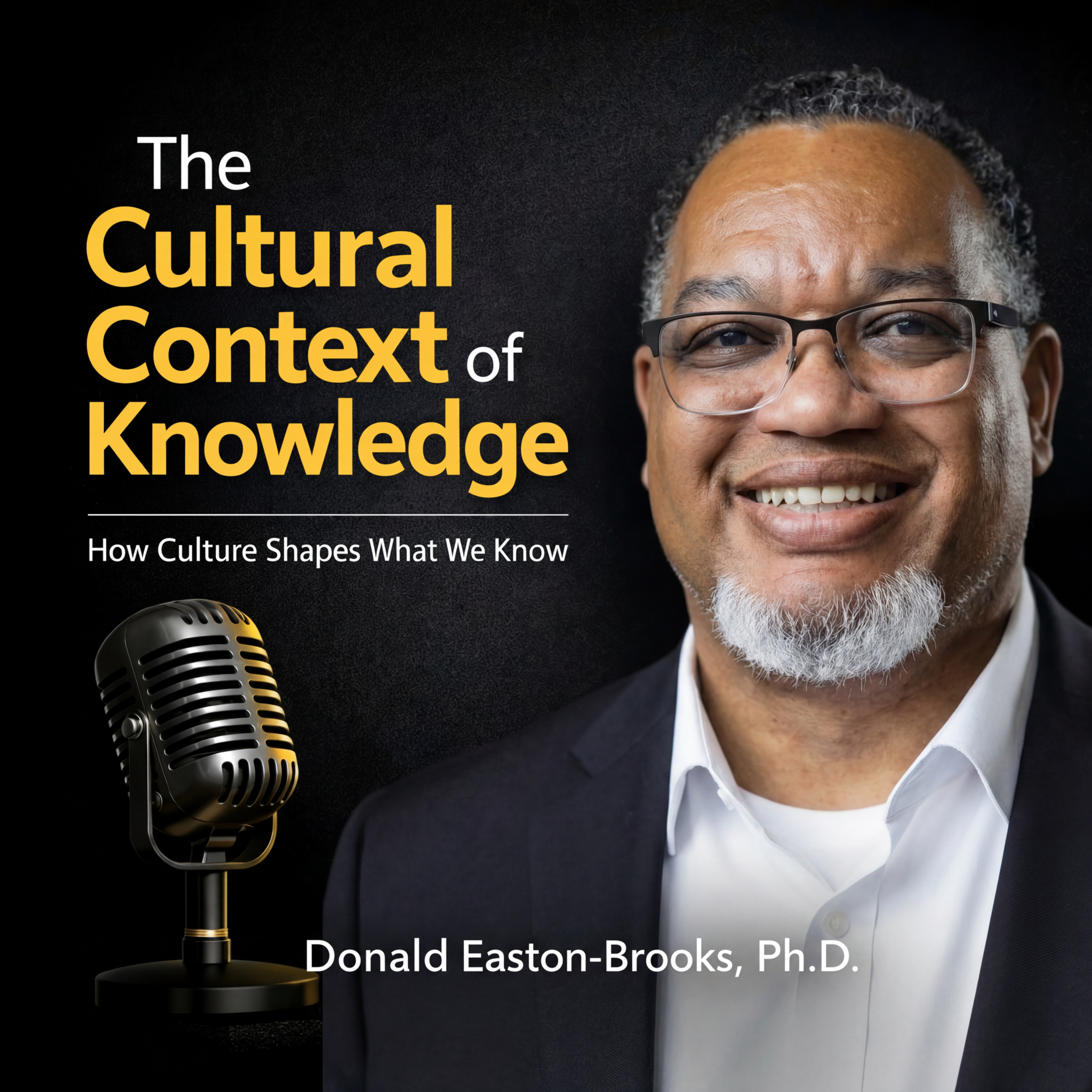
PODCAST · education
Cultural Context of Knowledge
by Donald Easton-Brooks Ph.D.
A podcast about learning and the cultural context that gives knowledge meaning. Donald Easton-Brooks, Ph.D., connects research and educator practice to explore how understanding develops through scaffolding, relationships, and history, and why learning cannot be reduced to information retrieval. Built for teachers and educational leaders seeking deeper, more durable learning.Audience: Educators, teachers, instructional coaches, and school leadersFocus: Learning, learning theory, culture, and knowledge.Host: Donald Easton-Brooks, Ph.D., is an award-winning international scholar recognized
-
22
Will Education Pivot With It?: Designing for the World That Already Exists (S2 E10)
"The pivot the season has been asking about is not waiting on a new theory. It is waiting on the workforce."We opened this season with a question. The demographic pivot has already happened. Will education pivot with it? After nine episodes describing the architecture (institutions, laws, the hidden curriculum, AI, standards-setting, assessment), the season closes by returning to the classroom we walked into in Episode 1. Same building. Same children. Same teacher. The classroom has not changed. We have.This finale synthesizes the season's argument and names the lever the next season takes up. The accountability framework is real. Culturally responsive education has been built by Gloria Ladson-Billings, Geneva Gay, and Django Paris for thirty years. Co-designed AI, community-included standards-setting, and accountable assessment are all doable. But every one of those institutional moves depends on having people in the conversation who can do the work. People who carry the cultural knowledge the institution has historically had to be specifically prompted to remember.The most concentrated, most measurable, most studied, and most under-acted-on place where that work happens is the front of the classroom. The teacher is part of the curriculum. The body of research on this is the most extensive equity finding U.S. education has produced in the last sixty years. The teaching profession is roughly 80% white; the student population is just over half non-white. The pivot is not waiting on a new theory. It is waiting on the workforce. That is what Season 3 takes up.In this episode: What we now know about the classroom we walked into in Episode 1 that we did not know nine episodes agoThe three accountability moves the season has named: AI co-design (E7), inclusive standards-setting (E8), accountable assessment (E9)The same logic underneath all three: the people who live with the decision should be the people making the decisionThe lever the season has been pointing at: the teacher at the front of the classroomWhy the workforce gap (~80% white teaching force, just over half non-white students) is the accumulated result of policy choices, not a fact of natureConcrete practices for educators, parents, community members, school leaders and policymakers, and people considering a career in teachingThe bridge into Season 3: twelve episodes on ethnic matching, teachers of color, and the body of research that has been quietly building this case for sixty yearsChapters00:00 Cold open: returning to the question01:30 Where this episode sits: the finale02:30 Returning to the classroom from Episode 104:30 What we now know about that classroom06:00 Pause and reflect: the institution operating as designed06:45 What redesign requires: the three accountability moves09:00 The same logic underneath all three10:30 The lever the season has been pointing at13:00 The workforce gap14:00 Cultural context check: the pivot is waiting on the workforce15:30 Do this this week: five audiences17:30 Landing line and bridge to Season 3Listen nextS2 E1: Knowledge, Power, and the U.S. Demographic Pivot. The classroom this finale returns to. Listening to E1 after the finale is its own listening experience. The same classroom, seen differently.About the showThe Cultural Context of Knowledge is a narrative podcast hosted by Dr. Donald Easton-Brooks, exploring how culture, history, institutions, and power shape what counts as knowledge. And what that means for learners, classrooms, and the U.S. education system.#CulturalContextOfKnowledge #EducationPodcast #SeasonFinale #KnowledgeAndPower #EducationalEquity
-
21
When Assessment Becomes Gatekeeping: An Instrument That Was Never Calibrated Against You (S2 E9)
"A number issued by an instrument that was never calibrated against you is not a verdict. It is the instrument telling on itself."Two students take the same standardized reading test. Question fourteen is about a regatta, a sailing race. The first student has been to the harbor every summer of her life. The second has never seen a regatta. They both finish the test. The test reports the first student as a stronger reader than the second.What the test measured was not reading comprehension. It was access to a particular cultural setting. But the score that gets entered into the record does not say that. The score says reading comprehension. And the score will follow the second student into every conversation about her academic potential for years to come.This episode names the standardized test as the closing instrument of the legitimacy machine. It is the place where the question of whose knowledge counts produces a measurable verdict on a specific child. The episode also names a relationship that often goes unstated: curriculum and assessment are a pair. The curriculum says what should be taught; the test says what gets rewarded; and what gets tested becomes what gets taught. Then it asks what an accountable assessment system would actually look like, drawing on Culturally Responsive Practices and on the early performance-assessment and assessment-sovereignty work that already exists. The deeper move that closes the episode: a score that systematically misreads a group of children is a defect of the instrument, not a property of the children. Accountable assessment cannot exist without accountable curriculum. The two have to be redesigned together.In this episode:What a standardized test actually is, and why "calibrated against a population" is the phrase that explains the harmCultural mismatch in test itemsWhy the standardized test is the closing instrument of the legitimacy machine. It is the place where the institution converts judgment into a number, and the number into a trajectoryCurriculum and assessment as a pair. Why what gets tested defines what gets taught, and why accountable assessment cannot exist without accountable curriculumWhat accountable assessment would actually require: co-designed instruments, multiple modes of demonstrating knowledge, honest reporting of what the test cannot measureThe deeper accountability move: treating systematic mismeasurement as a defect of the instrument, the way we already do for thermometers and blood-pressure cuffsConcrete practices for educators, parents, learners, and the people who design or commission these testsChapters00:00 Cold open: two students, the regatta02:00 The reveal: what the test actually measured03:00 Where this episode sits in Season 204:15 Curriculum and assessment, paired05:45 What standardized assessment actually does08:00 Pause and reflect: your own test scores09:00 Assessment as verdict, not measurement10:30 Cultural mismatch and stereotype threat12:00 Who pays for the mismeasurement13:30 Cultural context check: credibility as the durability problem15:00 What accountability could look like17:00 The deeper accountability move: the instrument, not the children18:00 Do this this week19:30 Landing lineListen nextS2 E8: Curriculum as Compromise. The standards-setting upstream that defines what the test is allowed to measure. This episode names the curriculum/assessment pair explicitly and argues the two have to be redesigned together.About the showThe Cultural Context of Knowledge is a narrative podcast hosted by Dr. Donald Easton-Brooks, exploring how culture, history, institutions, and power shape what counts as knowledge, and what that means for learners, classrooms, and the U.S. education system.#CulturalContextOfKnowledge #EducationPodcast #StandardizedTesting #EducationalEquity #KnowledgeAndPower
-
20
How State Standards Get Written: Curriculum as Compromise (S2 E8)
"A document written in a meeting you have never seen still walks into your child's classroom every morning."Imagine a state standards committee. About twenty people at a long table. Most are educators or administrators, some are content specialists, at least one represents a major textbook publisher. There is rarely a current classroom teacher who isn't also a department chair. There is even more rarely a learner. And the families of the children whose histories will or will not be written into the document do not enter the meeting in any direct way at all.What that meeting decides will shape what every public-school child in the state learns for the next ten years. It will shape what their textbooks contain, what their tests measure, what their teachers are trained to deliver. It will shape, in short, what counts as knowledge for a generation of children whose families were not in the meeting.This episode names the standards document as the most concentrated place in U.S. public education where decisions about other people's children get made by people who do not have to live with the consequences. Then it asks what an accountable standards process would actually look like, drawing on the culturally responsive education tradition (Ladson-Billings, Gay, Paris) and the early work on Indigenous curriculum sovereignty.In this episode:· What state standards actually are, and why they govern almost everything downstream· The frame of curriculum as compromise, and the difference between a strong, a thin, and a quietly-lost compromise· Who is at the table when standards get written, and the structural pressure of textbook publishing on what makes it in· Why the cost of a thin compromise falls on the children whose families were not in the meeting· What an accountable standards process could look like — community elders, classroom teachers, and learners as voting members of the committee· Concrete practices for educators, parents, community members, and learnersChapters00:00 Cold open: the meeting01:30 What is being decided02:30 Where this episode sits in Season 203:45 What state standards actually are06:00 Pause and reflect: did you ever hear the word "standards"06:45 Curriculum as compromise08:30 Standards revisions in plain view09:30 Who is at the table, and who is paying for who is not11:30 Cultural context check- laundered into a fact13:00 What accountability could look like15:00 Moving the cost15:30 Do this this week17:30 Landing lineListen nextS2 E7: AI as the New Gatekeeper. The episode this one inherits from, the cost-asymmetry argument applied to AI, now traced to the standards meeting upstream of the AI's training data.About the showThe Cultural Context of Knowledge is a narrative podcast hosted by Dr. Donald Easton-Brooks, exploring how culture, history, institutions, and power shape what counts as knowledge, and what that means for learners, classrooms, and the U.S. education system.#CulturalContextOfKnowledge #EducationPodcast #CurriculumMatters #EducationPolicy #KnowledgeAndPower
-
19
AI as the New Gatekeeper: Whose Knowledge the Model Was Built to See (S2 E7)
"A model that fills a silence with itself has not answered. It has spoken over you."Two high-school seniors. Same model. Same kind of paper. One asks about jazz. One asks about her grandmother's healing tradition. Both get fluent, structured, authoritative answers. Both get solid grades. But only one of them got a paper grounded in a tradition the world had recorded. The other got a paper quietly invented around a tradition the model had not been given to know.Last episode named the developmental harm of the hidden curriculum. This episode follows the same harm into the newest gatekeeper between learners and what they are trying to know, and then asks what an accountable response would look like.The mechanism is called confabulation, and it is not random. It is patterned. The model confabulates most reliably about exactly the kinds of knowledge that were already underrepresented in the written record. The episode draws on the culturally responsive teaching tradition (Ladson-Billings, Gay, Paris) and Indigenous data sovereignty (CARE Principles) to argue that accountable AI is built with the active participation of the communities whose knowledge it claims to summarize — and that real accountability means moving the cost of the model's mistakes from the powerless to the powerful.In this episode:· What confabulation actually is, and why "hallucination" is the wrong word for it· Why the model confabulates most reliably about non-dominant traditions· The asymmetric harm, who pays for the model's confidence· What culturally responsive AI accountability would actually require; drawing on Ladson-Billings, Gay, Paris, and the CARE Principles for Indigenous data governance· Why real accountability means moving the cost of being wrong from the powerless to the powerful· Concrete practices for learners, educators, and the people who build, deploy, or fund AI systemsChapters00:00 Cold open — two students, same model, two outcomes02:00 The reveal — what the model actually returned03:00 Where this episode sits — stepping into the new space04:00 The choice of a question05:30 Pause and reflect — your own deep knowledge06:15 What confabulation actually is08:30 Who pays — the asymmetric harm10:00 Cultural context check — confabulation as a power relationship11:30 What accountability could look like — culturally responsive AI13:30 Moving the cost — from the powerless to the powerful14:15 Do this this week16:00 Landing lineListen nextS2 E6 — The Hidden Curriculum: When Researchers Chose the Word Violence. The developmental-harm frame this episode inherits and applies to AI.About the showThe Cultural Context of Knowledge is a narrative podcast hosted by Dr. Donald Easton-Brooks, exploring how culture, history, institutions, and power shape what counts as knowledge — and what that means for learners, classrooms, and the U.S. education system.#CulturalContextOfKnowledge #EducationPodcast #AIInEducation #DigitalEquity #KnowledgeAndPower #AI
-
18
The Hidden Curriculum: What Schools Teach Without Teaching (S2 E6)
"The word violence demands an intervention. The word bias asks for a workshop."This season has been organized around one relationship — knowledge and power. Who decides what counts. Whose voice the institutions treat as the default. This episode names what that relationship looks like when it lands on a six-year-old.Most accounts of the hidden curriculum stop at unfairness. This one names what those accounts imply but rarely say plainly — the hidden curriculum is what knowledge and power look like when they reach a child's body. And it is not just unfair. It is documented developmental harm. Measurable. Clinical. Decades-long.The episode opens with two six-year-olds in adjacent kindergarten classrooms, both behaving like six-year-olds. One gets a redirect. One gets a referral. From there it walks the deliberate choice — made by Erhabor Ighodaro, Greg Wiggan, and Stephanie Jones — to call what schools do to many children of color by its accurate name. Violence. Once that frame is on the table, every remaining episode of Season 2 — the AI gatekeeper, the standards-writing room, the assessment instrument — inherits it.In this episode:· Why two scholars chose the word violence — and why a third built a research program around defending the choice· What the trauma research actually documents about repeated misrecognition· Adultification — the perception of Black boys (Goff) and Black girls (Epstein, Blake, González) as older, more culpable, less in need of protection· Why the misrecognition-tax frame is too gentle for what is being described· A concrete educator practice that makes the pattern visible inside one weekChapters00:00 Cold open — two six-year-olds01:30 Where this episode sits — turning the season inside02:30 The choice of a word — Ighodaro, Wiggan, Jones04:30 Pause and reflect — how the word violence sits in your body05:15 What the harm looks like — disengagement, anxiety, a flattening of curiosity07:00 Fanon, psychological homelessness, and why "tax" is too gentle09:00 Adultification — the mechanism10:30 Cultural context check — why so little has changed12:00 Do this this week13:30 Landing lineListen nextS2 E5 — The Backlash: Why Newly Legitimate Knowledge Gets Targeted. The legislative pressure that makes this episode's developmental-harm framing politically combustible.About the showThe Cultural Context of Knowledge is a narrative podcast hosted by Dr. Donald Easton-Brooks, exploring how culture, history, institutions, and power shape what counts as knowledge — and what that means for learners, classrooms, and the U.S. education system.#CulturalContextOfKnowledge #EducationPodcast #CurriculumViolence #Adultification #EducationalEquity
-
17
The Backlash: Anti-CRT Laws and Classroom Censorship (S2 E5)
"A history that cannot be told does not disappear. It waits for someone to find the words."When marginalized knowledge finally wins a place in the curriculum, something else happens at the same time. It gets targeted.This episode traces a pattern — dismissal, absorption, restriction — the predictable way dominant knowledge systems respond when histories from the margin enter the classroom. The Reconstruction-era rollback of Black education supplies the historical template. The laws passed across more than twenty U.S. states since 2020 supply the current case.What is actually being restricted? Not the mention of difficult histories — the analytical frameworks that help students connect past to present. Take the analysis out of history, and what remains is trivia.In this episode:• Why restriction arrives only after dismissal and absorption have failed• The post-Reconstruction template for narrowing what can be taught• What a chilling effect actually looks like inside a classroom• Why laws target analysis more often than they target content• A concrete practice for educators navigating restrictive policyChapters00:00 Cold open — the teacher, the classroom, the narrowing01:30 Where this episode sits in Season 202:45 The last time this happened — Reconstruction rollback04:45 The three-move response — dismissal, absorption, restriction06:50 What the research says — the chilling effect08:40 Why newly legitimate knowledge gets targeted10:30 Do this this week11:45 Landing lineListen nextS2 E4 — Who Gets to Teach It? Representation and the Long Shadow of Brown v. Board. The workforce story that sets up this one.About the showThe Cultural Context of Knowledge is a narrative podcast hosted by Dr. Donald Easton-Brooks, exploring how culture, history, institutions, and power shape what counts as knowledge — and what that means for learners, classrooms, and the U.S. education system.Hashtags#CulturalContextOfKnowledge #EducationPodcast #EducationalEquity #CurriculumMatters #HistoryMatters
-
16
Teacher Diversity and the Curriculum: Who Gets to Teach It (S2 E4)
Integration happened to the students. It did not happen to the teaching profession.This episode revisits the Brown v. Board–era displacement of Black educators rarely included in the standard story, examines what decades of research on ethnic matching reveal about student outcomes, and asks a question the season has been building toward: once institutions decide what counts as knowledge, who do they authorize to carry it?In this episode: • The Brown v. Board–era displacement of Black teachers rarely included in the story telling • The research on ethnic matching and same-race teacher effects • Why the U.S. teaching force is roughly 80% white while students are majority non-white • Representation as an equity intervention with measurable outcomesChapters: 00:00 What we remember about our best teachers 02:10 Brown v. Board: the teacher displacement rarely taught 04:00 What the research on ethnic matching says 05:50 Why the research hasn't translated to policy 07:30 Who counts as a legitimate knower 10:20 Do this this weekDraws on historical scholarship by Vanessa Siddle Walker and Michele Foster and the same-race teacher research tradition associated with Seth Gershenson and colleagues. Extends the legitimacy-and-gatekeeping frame from Season 2 Episode 2.Listen next: Season 2 Episode 2, "From Knowledge to Legitimacy." New to the show? Start with Season 2 Episode 1, "Knowledge, Power, and the U.S. Demographic Pivot."The Cultural Context of Knowledge is a narrative-podcast with Dr. Donald Easton-Brooks exploring how culture, power, and institutions shape what counts as knowledge — and what that means for learners, classrooms, and the U.S. education system.Follow the show on Spotify, Apple Podcasts, or Amazon Music. Learn more at donaldeastonbrooks.com.#EducationalEquity #TeacherDiversity #BrownVBoard #CulturallyResponsiveTeaching #CulturalContextOfKnowledge
-
15
Whose Knowledge Counts: Why Some Knowledge Is Marginalized (Ethnic Studies) (S2 E3)
"Marginalized knowledge is rarely attacked when it is ignored. It gets attacked when it starts to move."On November 6, 1968, a coalition of Black, Chicano, Asian American, and Indigenous students walked off campus at San Francisco State College and did not come back for five months ; the longest student-led strike in U.S. history. What they demanded sounded almost unthinkable: that their histories be taught.This episode traces what that demand became. The first School of Ethnic Studies in the country. A field that spent fifty years fighting for legitimacy. A wave of research in the 2010s that showed ethnic studies coursework can raise attendance, GPA, and graduation all at once, and the backlash that arrived the moment the evidence became undeniable.The signature question of the season: the demographic pivot has already happened. Will education pivot with it?In this episode:The 1968 San Francisco State strike and the first School of Ethnic StudiesWhat the research shows about ethnic studies outcomes in K–12 classroomsThe misrecognition tax : the cognitive labor marginalized students pay to translate themselves into someone else's storyChapters: 00:00 San Francisco State, November 1968 02:30 What ethnic studies actually is 04:20 The field gets in the door 06:00 The research turn and the backlash 07:00 The misrecognition tax 10:10 Do this this week 11:00 Landing lineBuilds on the grand-narrative vs. mini-narrative frame from Dr. Easton-Brooks's work, and on Season 2 Episode 2 on institutional legitimacy.Listen next: Season 2 Episode 4, "Who Gets to Teach It? Representation and the Long Shadow of Brown v. Board."#EthnicStudies #KnowledgeAndPower #EducationalEquity #CurriculumReform #CulturalContextOfKnowledge
-
14
From Knowledge to Legitimacy: How Institutions Decide What Counts (S2 E2)
How do ideas become legitimate knowledge? In this episode of The Cultural Context of Knowledge, we explore how universities, journals, and academic institutions decide what counts as credible knowledge. Drawing on the work of Foucault, Kuhn, Merton, and Bourdieu, we examine how power, institutions, and emerging technologies shape the knowledge that appears in textbooks, research, and policy.Keywords:knowledge and powersociology of knowledgehow knowledge becomes legitimateeducation systemshigher educationcultural context of knowledgeacademic knowledgepeer review processknowledge hierarchyinstitutional knowledgeAI and knowledge systemsethnic studies originseducation podcastsociology podcastknowledge systems
-
13
Knowledge, Power, and the U.S. Demographic Pivot (S2 E1)
The classroom has changed. Has education?For the first time in U.S. history, children under 18 are the majority non-white. Meanwhile, women now earn nearly 60% of all bachelor’s degrees, a complete reversal from the 1950s.So here’s the real question: Who decides what counts as knowledge?In this Season 2 premiere, we unpack how demographic shifts collide with outdated knowledge frameworks, and what happens when schools fail to evolve. This episode challenges assumptions about rigor, equity, and institutional power in the U.S. education system.The demographic pivot has already happened.Will education pivot with it?Primary KeywordsEducation podcastHigher educationK-12 educationKnowledge and powerCultural context of knowledgeEducational equityDemographic changeU.S. education systemAcademic rigorHidden curriculumSecondary / Discovery KeywordsCollege completion ratesWomen in higher educationTitle IX impactEducation reformInstitutional powerCurriculum designSociology of educationEducational leadershipEducation policy
-
12
Knowledge and Power: Season 2 Trailer
"Who decides what gets called knowledge — and what does that decision cost the people on the receiving end?"Welcome to Season 2 of The Cultural Context of Knowledge. This season is organized around one relationship: knowledge and power. The classroom in the United States has changed. The students inside it have changed. The institutions that decide what counts as knowledge have not yet changed with them. That is the gap this season takes up.What's ahead this season:· How institutions decide what counts as legitimate knowledge· The legislative wave reshaping what teachers can and cannot say· What schooling does to the children we send into it — and what the trauma research has been telling us for decades· AI as the newest gatekeeper, and what an accountable response would look like· Where state standards actually get written, and who is in the room when they are· What it would take to design education for the world that already existsIf you are an educator, a learner, a parent, or someone trying to understand a system you have spent your whole life inside of, this season is for you.Start with Episode 1 — Knowledge, Power, and the U.S. Demographic Pivot.About the showThe Cultural Context of Knowledge is a narrative podcast hosted by Dr. Donald Easton-Brooks, exploring how culture, history, institutions, and power shape what counts as knowledge — and what that means for learners, classrooms, and the U.S. education system.#CulturalContextOfKnowledge #EducationPodcast #KnowledgeAndPower #EducationalEquity
-
11
From Studying to Transfer, Confidence, and Long-Term Growth (Learner Edition, S1 E11)
This is part of the seven-part series of Learning Is a Struggle (Learner Edition). In Episode 11, Dr. Donald Easton-Brooks closes the series by showing you how to move beyond short-term studying and build learning that transfers—into new classes, new problems, and real-life decision-making. You’ll learn how to recognize whether you truly understand something (or just recognize it), how to turn knowledge into usable skill through practice and reflection, and how to protect your confidence when struggle shows up again. This episode also ties the full method together—learning as a process shaped by your lived experience, language, and cultural context—so you can keep improving without comparing your “learning room” to anyone else’s. You’ll leave with a simple long-term plan to keep learning on purpose.AudienceHigh school and college students who want learning that lasts beyond the testFirst-generation college students building long-term academic confidenceStruggling learners who want to stop the cram–forget cycleAdult learners returning to school or skill trainingStudents preparing for cumulative finals, certification exams, or next-level coursesLearners who want to connect school learning to real-life goals and identityKeywordsLearning Is a Struggle (Learner Edition)learning transferlearn on purposestudy strategiesdeep learningmetacognitionBloom’s Taxonomyactive recallretrieval practicelong-term retentionacademic confidencestruggling learnersfirst-generation studentslearning habitsstudent success
-
10
Build Your Personal Learning System: A Repeatable Method That Works (Learner Edition, S1 E10)
This is part 6 of the 7-part series of Learning Is a Struggle (Learner Edition). In Episode 10, Dr. Donald Easton-Brooks helps you turn everything from the series into one simple, repeatable learning system you can use for any subject—especially when motivation is low, and pressure is high. You’ll learn how to diagnose what you actually need (using Bloom’s), choose the right study move for the right phase, and build a short daily routine that creates progress without burnout. This episode also shows how your lived experience, language, and cultural context shape how information “fits” in your mind—so your learning system is built for you, not copied from someone else. By the end, you’ll have a practical method for studying with purpose, tracking what’s working, and building confidence through consistency.Audience:High school and college students who want a simple, repeatable way to studyFirst-generation college students building independence and confidenceStruggling learners who need structure more than motivationAdult learners returning to school or professional trainingStudents managing heavy course loads, athletics, work, or family responsibilitiesLearners preparing for finals, cumulative exams, or long-term skill buildingKeywords:Learning Is a Struggle (Learner Edition)learning systemhow to study effectivelystudy routineBloom’s Taxonomymetacognitionactive recallretrieval practicestudy planacademic confidencestruggling learnersfirst-generation studentstime management for studentsexam preparationlearning strategies
-
9
When Learning Delays Happen& How to Catch Up Without Panic (Learner Edition, S1 E9)
This is part 5 of the 7-part series of Learning Is a Struggle (Learner Edition). In Episode 5, Dr. Donald Easton-Brooks breaks down what’s really happening when you feel behind, stuck, or like nothing is clicking—especially under time pressure. You’ll learn the most common sources of learning delays (missing foundations, stress and anxiety, overloaded schedules, unclear instruction, and life responsibilities) and how to respond with a plan instead of self-blame. This episode gives you practical tools for diagnosing the type of delay you’re experiencing, choosing the right Bloom level to restart from, and building a short recovery routine you can use to catch up—without cramming, quitting, or spiraling.AudienceHigh school and college students who feel behind or overwhelmedFirst-generation college students balancing school, work, and family responsibilitiesStruggling learners who experience anxiety, shutdown, or avoidance when work piles upAdult learners returning to school while managing busy livesStudents preparing for midterms/finals or recovering from low gradesLearners who want a catch-up plan that is realistic and repeatableKeyword:Learning Is a Struggle (Learner Edition)learning delayshow to catch up in schoolstudy recovery planacademic overwhelmtest anxietyprocrastination helptime management for studentsstudy strategiesBloom’s Taxonomyactive learningstruggling learnersfirst-generation studentsacademic confidenceexam preparation
-
8
What to Do When You’re Stuck (Learner Edition, S1 E8)
This is part 4 of the 7-part series of Learning Is a Struggle (Learner Edition). In Episode 8, Dr. Donald Easton-Brooks turns Bloom’s Taxonomy into a practical toolkit you can use immediately. Instead of studying the same way for every class, you’ll learn simple strategies matched to each phase of learning. Remember, Understand, Apply, Analyze, Evaluate, and Create, so you always know what to do next when content isn’t clicking. This episode breaks down how to move from recall to real understanding, how to practice application without burnout, and how to build higher-order thinking step by step. You’ll leave with a clear, repeatable process for studying that works across subjects and helps you learn with purpose, not panic.AudienceHigh school and college students who want practical study routinesFirst-generation college students building academic confidenceStruggling learners who feel overwhelmed or “don’t know how to study”Adult learners returning to school or professional trainingStudents in STEM and reading/writing-heavy coursesLearners preparing for midterms, finals, and high-stakes examsKeywords:Bloom’s Taxonomy strategiesstudy skillshow to studyactive recallretrieval practicelearning strategiesexam preparationapplying vs memorizingcritical thinkingmetacognitionstruggling learnersfirst-generation studentsstudy routinelearning processacademic confidence
-
7
How to Diagnose What You Don’t Understand Yet (Learner Edition, S1 E7)
This is part 3 of the 7-part series of Learning Is a Struggle (Learner Edition). Most people don’t struggle because they’re “not smart”, they struggle because they study in a way that doesn’t match what the task requires. In Episode 7, Dr. Donald Easton-Brooks introduces Bloom’s Taxonomy as a practical learning map you can use to diagnose where you’re stuck: remembering, understanding, applying, analyzing, evaluating, or creating. You’ll learn how to tell the difference between “I don’t remember it” and “I don’t understand it,” why many learners get trapped in memorization, and how cultural context and lived experience shape what feels familiar—or confusing—when new information comes in. By the end, you’ll have a simple method for choosing the right study move based on the Bloom level you actually need.AudienceHigh school and college students who feel stuck despite studyingFirst-generation college students building study skillsStruggling learners who confuse memorization with understandingAdult learners returning to school or career trainingStudents in lecture-heavy courses and problem-solving coursesLearners preparing for exams, finals, or high-stakes assessmentsKeywords:Bloom’s Taxonomy, how to study smarter, learning map, study strategies, active learning, remembering vs understanding, applying knowledge, higher-order thinking, critical thinking skills, exam preparation, learning process, cultural context of learning, first-generation students, struggling learners
-
6
Memorization vs. Learning: How to Make Studying Actually Stick (Learner Edition, S1 E8)
This is part 2 of the 7-part series, Learning Is a Struggle (Learner Edition). Many learners think studying means memorizing—and then feel frustrated when the information disappears during a test or can’t be used in real problems. In Episode 6, Dr. Donald Easton-Brooks breaks down the difference between memorization and learning, why memorization can be useful (and where it fails), and how to build understanding you can apply. You’ll also learn the four common reasons memorization feels difficult: cognitive factors, environment and lifestyle, underlying conditions, and study habits, and what to do about each. By the end, you’ll have a practical, repeatable approach: memorize the basics, then turn them into learning through explanation, examples, and application.AudienceCollege and High school studentsFirst-generation college students, student-atheletes, and re-turning studentsStruggling learners who feel “behind” or doubt their abilityAdult learners returning to school or training programsLearners who rely on cramming, rereading, or last-minute studyingStudents in content-heavy courses (psychology, biology, history) and problem-solving courses (math, chemistry, statistics)Keywords: memorization vs learning, how to study effectively, Bloom’s Taxonomy, active recall, retrieval practice, deep understanding, test preparation, study habits, learning strategies, cognitive load, test anxiety, first-generation students, struggling learners, long-term retention, applying knowledge.
-
5
How Your Brain Makes Room for New Information (Learner Edition, S1 E5)
This is part 1 of the 7-part series of Learning Is a Struggle (Learner Edition). In this foundational episode, Dr. Donald Easton-Brooks explains why learning naturally feels difficult, and why that struggle is not a sign that something is wrong with you. Using a simple “mental storage room” metaphor, you’ll learn how the brain tries to fit new information into what you already know, why confusion and delay are normal, and how lived experience, language, and cultural context shape what feels familiar or unfamiliar when you’re learning. This episode sets the foundation for the series by giving you a clear way to understand the learning process and a starting set of techniques to guide your studying with purpose, not self-blame.AudienceHigh school and college students who feel overwhelmed, stuck, or “not smart enough”First-generation college students building confidence and study habitsStruggling learners who experience anxiety or shutdown when content gets hardAdult learners returning to school or career trainingStudents who want a simple explanation of how learning works (without jargon)Learners who want practical tools to study more effectivelyKeywords:Learning Is a Struggle (Learner Edition)why learning is hardhow the brain learnsstudy skillslearning strategiesacademic confidencestruggling learnersfirst-generation studentscultural context of learningmetacognitionproductive strugglelearning processstudent motivationhow to study effectivelylearner mindset
-
4
From A Cultural Context: Rethinking STEM (S1 E4)
In this episode of The Cultural Context of Knowledge, host Donald Easton Brooks challenges one of the most common assumptions in education: that STEM is neutral. If we say “math is objective” and “data speaks for itself,” what gets hidden is the cultural design of many STEM classrooms—speed, linear reasoning, abstraction-first instruction, individual performance, and language-heavy explanations. These norms are not universal; they are traditions that have been normalized as intelligence.This is not a call to lower standards or add “culture” as an extra layer. It is a redesign challenge: how do we build STEM learning where rigor is not confused with restriction, and where students don’t have to earn belonging before they can learn? You’ll leave with concrete redesign moves—starting with real-world systems before formal notation, widening how students can show reasoning, and rethinking assessments that measure familiarity and speed more than understanding.
-
3
The Foundation: Whose Knowledge Counts? Culture, Power, and Learning (S1 E3)
In this episode of The Cultural Context of Knowledge, host Donald Easton-Brooks asks a foundational question most schools rarely name: What counts as knowledge—and who gets to decide? Moving beyond the myth that curriculum and assessment are neutral, this episode examines how knowledge is shaped by history, culture, and power, and how “standard” definitions of intelligence can privilege some ways of knowing while marginalizing others.You’ll be introduced to key ideas, including epistemology, master narratives, sociocultural learning theory, and Funds of Knowledge, with clear connections to everyday classroom practice. The episode also explores Community Cultural Wealth and the consequences of misrecognition—the hidden “tax” students pay when they must constantly translate their identities and reasoning to be seen as capable. The closing challenge is practical and urgent: redesign learning so schools stop asking, “How do we fix students?” and start asking, “How do our systems fail to recognize what students already know?” This is an episode for educators, leaders, and learners committed to rigor, equity, and meaningful learning.
-
2
Learning Is A Struggle AI Must Not Skip (Non-NotebookLM Version) (S1 E2)
In this episode of Cultural Context of Knowledge, Dr. Donald Easton-Brooks compares Episode 1's use of NotebookLM with his narrated work to examine the central truth about learning: genuine learning is a productive struggle that moves us from uncertainty to understanding through a sequence of steps. Using Bloom’s Taxonomy as a frame, the episode explains why foundational concepts must be built before higher-order analysis and creation are possible, and why AI tools like ChatGPT and Gemini can become harmful when they encourage “sequence-skipping.” The conversation then extends beyond process into purpose, connecting AI-supported learning to the cultural context of knowledge: how history, lived experience, dominant narratives, and “whose knowledge counts” shape what we understand and how we interpret it. Educators and learners will leave with practical guidance for using AI as a scaffold that strengthens learning, supports inquiry, and remains culturally responsive, rather than replacing the struggle that makes understanding durable.
-
1
Learning is a Struggle AI Must Not Skip (NotebookLM Version) (S1 E8)
In this episode, Learning is a Struggle AI Must Not Skip, the AI tool NotebookLM was used to create a fully AI-narrated podcast. The episode explores Dr. Donald Easton-Brooks’ perspective that learning is a productive struggle: a process of moving from confusion toward clarity until the mind reaches a new equilibrium. Drawing on Easton-Brooks’ work on the conceptual and cultural context of knowledge and his 2025 approach to learning with AI, the episode frames learning as a sequential, scaffolded progression best understood through Bloom’s Taxonomy. It cautions that when learners use AI tools to leap directly into advanced outputs—without first building definitions, functions, and conceptual grounding—AI can become a time sink of irrelevant content, weak evaluation, and factual errors. The episode closes by highlighting a central limitation: AI has not yet mastered the cultural context of knowledge—how meaning is shaped through history, negotiated truths, and human relationships—making educator judgment essential.
-
0
Welcome to The Cultural Context of Knowledge & Season 1
Welcome to The Cultural Context of Knowledge: a narrative podcast hosted by Dr. Donald Easton-Brooks, exploring how culture, history, institutions, and power shape what counts as knowledge and what that means for learners, classrooms, and the U.S. education system.The show is organized around a single conviction. What we call knowledge is never neutral. And the way we learn , whether in a classroom, a workplace, or an everyday conversation, is shaped by the same forces that decide what gets taught and what does not, whether we name those forces or not.Season 1 takes up a single question with two halves. What does it actually mean to learn — and whose knowledge are we learning?What's in Season 1:· Episodes 1–2: An experiment comparing an AI-narrated take on learning with a human-narrated one — and what AI can and cannot do for the cognitive work of learning· Episode 3: The foundational question of the show — whose knowledge counts in a classroom, and why· Episode 4: A cultural-context rethink of STEM education· Episodes 5–11: The Learner Edition: brain, memory, diagnosis, getting unstuck, recovery, personal learning systems, and learning that lastsIf you are a learner trying to understand how you learn, an educator trying to teach better, or a parent trying to support someone in school, Season 1 is built for you.Start with Episode 1. Or jump into the Learner Edition at Episode 5 for the practical material first.#CulturalContextOfKnowledge #EducationPodcast #LearnerEdition #LearningPodcast #EducationalEquity
We're indexing this podcast's transcripts for the first time — this can take a minute or two. We'll show results as soon as they're ready.
No matches for "" in this podcast's transcripts.
No topics indexed yet for this podcast.
Loading reviews...
ABOUT THIS SHOW
A podcast about learning and the cultural context that gives knowledge meaning. Donald Easton-Brooks, Ph.D., connects research and educator practice to explore how understanding develops through scaffolding, relationships, and history, and why learning cannot be reduced to information retrieval. Built for teachers and educational leaders seeking deeper, more durable learning.Audience: Educators, teachers, instructional coaches, and school leadersFocus: Learning, learning theory, culture, and knowledge.Host: Donald Easton-Brooks, Ph.D., is an award-winning international scholar recognized
HOSTED BY
Donald Easton-Brooks Ph.D.
CATEGORIES
Loading similar podcasts...
Frequently Asked Questions
How many episodes does Cultural Context of Knowledge have?
Cultural Context of Knowledge currently has 23 episodes available on PodParley. New episodes are automatically indexed when they're published to the podcast feed.
What is Cultural Context of Knowledge about?
A podcast about learning and the cultural context that gives knowledge meaning. Donald Easton-Brooks, Ph.D., connects research and educator practice to explore how understanding develops through scaffolding, relationships, and history, and why learning cannot be reduced to information retrieval....
How often does Cultural Context of Knowledge release new episodes?
Cultural Context of Knowledge has 23 episodes. Check the episode list to see recent publication dates and frequency.
Where can I listen to Cultural Context of Knowledge?
You can listen to Cultural Context of Knowledge on PodParley by clicking any episode. We provide an embedded audio player for direct listening, and you can also subscribe via your preferred podcast app using the RSS feed.
Who hosts Cultural Context of Knowledge?
Cultural Context of Knowledge is created and hosted by Donald Easton-Brooks Ph.D..
URL copied to clipboard!