
PODCAST · religion
Never The Chameleon
by Anna Madsen
Anna Madsen is a Public Theologian, a rostered ELCA pastor, and yet serves out her call on her own platform--unaffiliated with the ELCA--of OMG: Center for Theological Conversation. She and her family live north of Duluth, Minnesota, and host The Spent Dandelion Theological Retreat Center. This podcast will tend to be audioclips of her Substack blog as well as her sermons and presentations. The title of her podcast comes from a passage of Kaj Munk, the Danish resistance preacher and martyr, killed by the Nazis for his prophetic pulpit speech. He wrote: "And remember the signs of the Christian Church have been the Lion, the Lamb, the Dove, and the Fish…but never the chameleon." revdrannam.substack.com
-
17
Dressing Your Dust
Dressing your DustEvery Ash Wednesday, I am reminded of a piece I wrote not long after the death of my husband Bill: he was killed in the same accident that gave my son his brain injury. The story concerns the moments when I stood in front of my late husband’s closet, charged by the funeral home with choosing the clothes in which he’d be cremated.Two days before, this, picking out his outfit, would have been his task.He’d picked out his own clothes since he was young.Good Lord, he was still young.Didn’t matter.Today it was my task. My absurd job. My surreal chore.Even this awful request of the funeral director led my mind down paths that should not have been mine. But there I was, standing before that closet while my mind was racing down each of them.And what difference does it make?It’s laughable, really, choosing clothes that nothing but the inside of a box will see.Anyhow, he’ll be cremated, turned back into dust.Bill won’t be in a coffin for longer than the Memorial Service.Still….naked, in a coffin?Somehow that just seems…not right. I can’t for the life of me say why, but it’s not right.And so there I stood, these thoughts in my mind, these clothes before me, and his body waiting, no choice in the matter, for my selection.So.Intake of breath.If he were here, what would he choose?Ties?Clearly out.Brand new suit?Out…though he sure looked good in it.But he was being taken under, and was not the undertaker, I thought. So no suit.He was not a suit guy. He was the anti-suit guy.That helped.Jeans, then. His favorite jeans.He was far more organized than I ever will be, so I knew right where to find them.I kept them perfectly folded as I laid them on the floor.And hiking boots, of course. Of course hiking boots, still with the dust of the Alps on them.I set them next to the jeans.I grinned when I decided on the shirt. I would surely hear it, even all the way from where-ever-he-was, if I didn’t wrap him up in an Ohio State T-Shirt.“That’s The Ohio State to you,” I could almost hear him say.Since all the OSU shirts were all his favorites, it took some time to pick the right one, the perfect one for the occasion.Silly me. Of course it had to be the one emblazoned with TBDBTL.So jeans, and a TBDBTL t-shirt, and hiking boots.Is that it? I thought. Anything more?Yep.Something was missing…what was missing….?Ah.His alb.His pastoral alb.He needs his pastoral alb.And so I reached in to the closet and I found his alb, and I took it, and I held it, and I held it close.He was so honored to wear that alb.I took it off the hanger, and I folded it neatly, and placed it on the stack of clothes, and found a bag, and placed his outfit for The Day inside of the bag, and I grabbed the handles, and I walked out the door to bring him his clothes.——————-Today is Ash Wednesday.It marks the beginning of spring. That’s what Lent means, in Latin.Spring.New beginnings.It can be a somber time, I suppose.I know of all the arguments against saying and singing Alleluia on Sundays in Lent.But as for me, give me the Alleluias.Every Sunday is an announcement of Easter, after all, of new beginnings, and I firmly believe that it is in the dark that God’s light is most clearly seen…and when we most clearly need to see it.Just as I say that Holy Saturday is the most honest day, I think Lent is the most honest season: the pivot place between death and life, despair and hope.It begins with Ash Wednesday, the day of declared dustness.We are born of dust, and we return to dust.And that’s just the way it is.We have no choice about our dustiness.But we do have choices, in-between.Like our clothes.We can choose our clothes.We can choose what to wear, what to pull on that reveals most fully who we are called to be, that makes it easier to do it and be it.We can choose the outfits we will slip on, the ones that reveal to all the world, and not just the inside of a box, what our agenda for the day will be.Sometimes, I think, we reach for something in the closet that isn’t quite right: either the outfit clashes with itself, or the outfit clashes with ourselves: the ‘self’ God loves, and wants us to love, which is the ‘self’ we are baptized and freed to be. When we pull on what’s right, we feel right. When our day is consistent with itself and with ourselves, and with God’s vision of who we are called to be, we feel more than right.We feel alive.We are living, breathing, dressed dust, clothed in our outfit, and our identity as a beloved child of God, for the day. Get full access to Anna Madsen at revdrannam.substack.com/subscribe
-
16
But Where's Home?
The trouble is, we can’t have just spent the season of Advent talking about, urging, setting up repentance as an expected and holy expression of faith, and then revile those who actually have an Epiphany and up and repent.That’s the thought banging around in my head on this day when the Church marks the beginning of the season of Epiphany, and our nation marks the January 6 insurrection, and meanwhile, everyone is marking MAGA’s cracks in its base.It’s a fair bet that lots of even lifelong Christians aren’t quite sure of what the purpose of the season of Epiphany is, but we might know that it has something to do with the Magi.And if we know that it has something to do with the Magi, we might know that it has something to do with them “going home by another way,” which might be as much thanks to balladeers like James Taylor and Bruce Cockburn as it is brother Matthew.If you remember, Matthew tells us that Herod had heard that the Magi were on the loose in his land, because they’d heard news of a new king of the Jews in his land, and they wanted to give him, this baby, their honor.Weak, petty, and greedy kings do not approve of rising counter powers, even if in swaddling clothes, so facetiously, Herod invited the Magi to return to his lair following their discovery of the young king, “so that I may also go and pay this new king homage.” Thankfully, after they honored the baby Jesus, and just in the nick of time, the Magi were warned to go home by another way: as Bruce Cockburn sings in his majestic song, “Cry of a Tiny Babe,” they’d “Come to pay their respects to the fragile little king/Get pretty close to wrecking everything/Cause the governing body of the Holy Land/Is that of Herod, a paranoid man.”Epiphany, you see, marks their epiphany, one which led them home and away from aiding and abetting a corrupt ruler.It still leads us into a season of our own epiphanies, a word which literally means, “to make manifest,” or “to be shown.”The season of Epiphany is a time to be open to new ways, new patterns, new realizations.It’s an inherently vulnerable time, then, because if something new is made manifest, it means that what you had thought to be true isn’t now, maybe never was, isn’t quite as fully understood as you’d assumed, or something simply hadn’t ever dawned on you before, so to speak.So there’s some engaged risk, then, involved both with encountering that truth, and with identifying a new way forward.It’s a period where you may need to admit that you were wrong, misguided, and need to change.Insofar as any of that is true, Epiphany is a season, then, that takes both mindfulness and courage.The part of this Jesus/Magi/Herod story, the catchy part that catches people, is this phrase, “The Magi went home by another way.”People are drawn to “by another way,” because it “makes manifest” the Magi’s clear rebellion to the authoritarian orders.These wise ones up and subverted, what was, for all intents and purposes, the law, and well done Magi, I’m here to say, and well done anyone else who does the same against cruel orders!But today, what is catching my attention, is less that notion than the word ‘home.’Funny how we breeze right by “home,” taking for granted that they must have actually had a home to which they could return.~~~~~So it appears that there are breaks, right now, growing fractures, beginning in MAGA world.The most obvious example is Marjorie Taylor Greene’s very public defection, but those Trump tariffs are doing a number on even his most conservative ag and manufacturing supporters; health insurance spikes, traceable to Trump’s bill, are kicking in and hitting at Trump voters—perhaps most of all, if you look at red states, generally lower income states, who will be terribly affected by the increases; friends and family, even citizens and non-criminals, are being plucked off the streets by nameless faceless people; and this Venezuela (and Cuba? and Greenland?) number seems definitely not America First.Oil Execs First, maybe, but not America First.And, to the point of this reflection, there one can detect, some embarrassment, some rueing, some regretting, some what-was-I-thinking of those who voted for Trump, defended Trump, or been silently complicit as Trump and his administration have codified hate, racism, bigotry, misogyny, cruelty, and autocracy.Now, some explain MAGA by saying that it has had such appeal because it’s been a community, a club, and family of sorts. It’s tapped into a tribal yearning, Us not Them, Us vs. Them, that exploits a hard-wired human tendency.It’s been, therefore, a home.But…what if it is no longer a home?What if once-MAGA adherents don’t find MAGA to be a place where they feel at home anymore?And here’s the epiphanic quandary.Those of us who have long objected to Trump’s agenda, those of us who knew of the destruction and hardship it would bring, who couldn’t believe that others couldn’t see it because it was spelled out for all to know, those of us who see now unfolding exactly what we foresaw, we are heartbroken about the fear and trauma in immigrant communities, disabilities communities, queer communities, poor communities; about the threats to education, art, history, public lands, public services, water; about our national reputation in the global sphere…I mean, where do I stop, there’s so much dismay.And anger.There’s so much anger.Many of us are ourselves victims of the MAGA agenda, and feel very little compunction to easily trust, let alone forgive, those who once supported it.Our anger is legit, let me be clear, and worthy of vent.But also true, though, is that those who would be tempted to leave MAGA are aware of the fury of that anger directed toward them.It is hot and they feel the heat.They might even know that they have earned the singe.So some parallel binds, then:Those on the left have legit disdain for Trump and MAGA, and, also desire to welcome more people to the resistance movement.Those on the right are increasingly uncomfortable with Trump’s agenda and their part in it, but do not feel any sense of welcome to the resistance movement, and so have no where to go.They’d like to go home another way, can see another way, but have no home.These people desperately need a new home.And those in the resistance need more people in our camp.It’s not only MAGA which needs to admit that they need to change.It’s time for those of us on the left to tap into mindfulness and courage to welcome them home.~~~~~In my research for my last book, Joyful Defiance: Death Does Not Have The Last Word, I noticed that across references, the theme of home kept recurring.When one felt Joy, repeatedly authors made the analogy that was that one was at home.The more that I fussed with that observation, the more it dawned on me that likewise, when someone despairs, it’s as if one is home-less. Without a home, you might feel like you have no reliable safe place.Now, if you are merely away from home, for whatever reason you just can’t get back to it as quickly as you might like, you feel unsettled, and perhaps home-sick. Nevertheless, there is some confidence that you will walk up its path again.I think those in MAGA and it’s Mar-A-Lago home are beginning to feel restless, maybe somewhere between feeling homeless—there’s no where for them to go—and homesick—they have a hunch that there is someplace which could hold them and their newfound, refound, values, and maybe even a community to boot.Many of us just were ‘home for the holidays.’We know that sometimes being home isn’t the romanticized image of holiday perfection that seasonal coffee commercials and Hallmark movies might project.But people come ‘home’ anyway, because there is something there that unites them, and makes them feel safe enough to come back anyway, bringing their quirks, idiosyncrasies, grudges, memories of infractions and hurt, regrets and their hopes right along with them.I wonder if this Epiphany season, then, marked both by the Magi who went home by another way, and the insurrectionists who stormed the People’s Home, perhaps both people in MAGA and in the Resistance Movement can have an Epiphany of their own.Perhaps followers of Donald Trump can recognize that they have been co-opted by a despot, a dictator, one who cares nothing for them or anyone unless they are a tool to his own objectives.And perhaps people in the resistance can start rolling out the carpets, brewing the coffee, and, in this season of light, flipping on the porch light, so that those who have been part of MAGA, and are beginning to have an epiphany that maybe that wasn’t the best decision ever, can, even if by a long and winding other way, pull up a chair, a protest sign, a pen during our next letter writing campaign, and come on home. Get full access to Anna Madsen at revdrannam.substack.com/subscribe
-
15
Thus Says The Lord
I preached the below yesterday on the last Sunday in the Christmas season and the morning after the Trump administration opted to illegally bomb Venezuela. First, the texts on which I depended, and then the sermon. ~~~~~First Reading: Jeremiah 31:7-14 7 Thus says the Lord: Sing aloud with gladness for Jacob, and raise shouts for the chief of the nations; proclaim, give praise, and say, “Save, O Lord, your people, the remnant of Israel.” 8 See, I am going to bring them from the land of the north, and gather them from the farthest parts of the earth, among them the blind and the lame, those with child and those in labor, together; a great company, they shall return here. 9 With weeping they shall come, and with consolations I will lead them back, I will let them walk by brooks of water, in a straight path in which they shall not stumble; for I am as a father to Israel, and Ephraim is as my firstborn. 10 Hear the word of the Lord, O nations, and declare it in the coastlands far away; say, “The one who scattered Israel will gather them, and will keep them as a shepherd a flock.” 11 For the Lord has ransomed Jacob, and has redeemed Jacob’s people from hands too strong for them. 12 They shall come and sing aloud on the height of Zion, and they shall be radiant over the goodness of the Lord, over the grain, the wine, and the oil, and over the young of the flock and the herd; their life shall become like a watered garden, and they shall never languish again. 13 Then shall the young women rejoice in the dance, and the young men and the old shall be merry. 14 I will give the priests their fill of fatness, and my people shall be satisfied with my bounty, says the Lord.The Gospel is from John 1:1-18.1 In the beginning was the Word, and the Word was with God, and the Word was God. 2 The Word was in the beginning with God. 3 All things came into being through the Word, without whom not one thing came into being. What has come into being 4 in the Word was life, and the life was the light of all people. 5 The light shines in the darkness, and the darkness did not overcome it. 6 There was a man sent from God, whose name was John. 7 He came as a witness to testify to the light, so that all might believe through him. 8 He himself was not the light, but he came to testify to the light. 9 The true light, which enlightens everyone, was coming into the world.] 10 The light was in the world, and the world came into being through him; yet the world did not know him. 11 He came to what was his own, and his own people did not accept him. 12 But to all who received him, who believed in his name, he gave power to become children of God, 13 who were born, not of blood or of the will of the flesh or of the will of a man, but of God. 14 And the Word became flesh and lived among us, and we have seen his glory, the glory as of a father’s only son, full of grace and truth. 15 (John testified to him and cried out, “This was the one of whom I said, ‘The one who comes after me ranks ahead of me because he was before me.’ ”) 16 From his fullness we have all received, grace upon grace. 17 The law indeed was given through Moses; grace and truth came through Jesus Christ. 18 No one has ever seen God. It is God the only Son, who is close to the Father’s heart, who has made God known.Grace to you and peace from our incarnate Lord and Savior, Jesus Christ.On April 25, 1981, the US Navy commissioned a lethal nuclear submarine to be named “Corpus Christi.”Actually, the word that was, and still is used wasn’t ‘commissioned,’ but rather “christened,’ as in ‘baptized.’Well, this just made the matter even worse.See, “Corpus Christi” means, in Latin, ‘The Body of Christ.’I was 12 years old at the time, but I still remember my father, his low resonant voice quivering in furious words from the pulpit at Grace Lutheran Church in Eau Claire Wisconsin, condemning Ronald Reagan’s approval of these words for this weapon.Dad knew he was adding his voice to those of the Conference of Catholic Bishops, all 270 of them expressing words of appalled objections to placing the name of the Prince of Peace onto a nuclear submarine designed solely for massive destruction of God’s creatures and creation.One Jesuit theologian, a Rev. Richard McSorley, wrote in the Catholic Standard that “we have a new type of blasphemy…We call [the sub] Corpus Christi. What does God think of that? Do we think God feels honored by the words? Are we honored?”Their collective words gained traction, and ultimately, Reagan quietly saved face, renaming the submarine “The City of Corpus Christi,” maintaining that the vessel would just be honoring the Texas town.Dad knew that his role as preacher in the pulpit in the sanctuary was to speak the Word of God, and that the Word of God said different things than the words one might hear outside of the sanctuary, but that the People of God came to hear not the same thing but rather a re-orienting thing, a reminding thing of who and whose they were.The Word of God indicts, consoles, cajoles, and emboldens those who believe in the risen Christ. It’s a hefty thing, to hear, to speak, to live it.This story about my father came to mind thanks to the Jeremiah/John combo of today, coupled with our administration’s decision yesterday to illegally bomb Venezuela and kidnap its—very much granted illegally elected—President Maduro, and his wife.God, I do believe, would like a Word.The World Council of Churches, a federation to which we the ELCA belongs, has sure offered a Word, though, Holy Smokes: “The attacks conducted by the United States of America in Venezuela and the capture and detention of President Maduro and his wife are stunningly flagrant violations of international law. These actions set a dangerous precedent and example for others who seek to shrug off all constraints against the use of armed aggression and brute force to achieve political objectives.The World Council of Churches calls urgently for the cessation of such attacks, for respect for the principles of international law and sovereignty of States, for the resolution of disputes through dialogue and diplomacy rather than by armed violence, and for the United Nations and the Organization of American States to take swift action to ensure all members respect the relevant charters and conventions.In these dangerous and uncertain times, the world needs wise and courageous leaders for peace, rather than the proliferation of conflicts and the normalization of international illegality risking a deeper descent into chaos. We pray for wisdom and peace to prevail in this context and in other parts of the world.”Their unequivocal words, words which are as loud as my father’s were 45 years ago, are thoroughly grounded in God’s Word.The question before us is whether we will listen to the Word of God rather than the words of the world.So, “Thus says the Lord,” thunders Jeremiah to his people and now to us this morning.First thing we hear from that passage: Thus says the Lord.It’s a turn of phrase in the Hebrew tradition, very much meaning that God’s Word stands behind what follows. You can trust what is being said, because these are not the speaker’s words, but the Lord’s words being spoken, and you can trust, must trust, the Lord.Thus says the Lord.Not some power-hungry despot.Nor one’s own self-deprecating inner voice. Nor some marketing, especially this time of year, that says that you are not beloved enough, beautiful enough, young enough, rich enough, or simply enough.No, the Lord speaks this Word, and with it says something new. //Now, if there were to be a word cloud made up of these passages, the biggest bubble of the word cloud would be WORD. “Word” appears a whopping 33 times total throughout our readings.So the word for ‘word’ in Greek is ‘logos.’That’s why we have bio-logists, namely people who have a word about bios, life.When Karl was so injured and tiny in Germany, we had therapists—that word means, in Greek, to heal—who were his Logo-therapeuten, his speech-healers, speech therapists.I am a theo-logian, because I have some words—some say too many, especially at sermon time—to say about Theos, namely God.So when John tells us that in the beginning there wasn’t just a logos, but rather the Logos, well, a person ought to sit up and pay attention.And you don’t need to have been an English major to catch a reference, an allusion here about this Word, immediately at the start of John’s Gospel, because of all the words John could have chosen to launch his gospel, he chose these: “In the beginning.”Not the first time we’ve heard these words launch a biblical book, followed by some speaking. “In the beginning, when God created the heavens and the earth, the earth was a formless void and darkness covered the face of the deep, while a wind from God swept over the face of the waters. And then God said.”In the beginning was the Word, says John.In the beginning, God said, says Genesis.God said, “Let there be light! Let there be seas and sky and earth, and let the earth put forth vegetation, and let there be the sun and the moon and the stars, and let there be fish and birds and animals.”And finally, God said, “Let there be humans, humans in our image, humans who have dominion over it all.”Now, I realize I’m taking a little liberty here, injecting Genesis into the mix: it’s not like there isn’t enough to preach about sans the creation story.But a friend of mine in high school still teases me about how in college, we were taught to begin the first paragraph of our papers with a broad statement and then whittle it down to our thesis statement—a bit like an upside down triangle.So I did. “Throughout the ages,” I said, and I got an A on it, for the record.John must have had the same English prof, though he took it a step further: “In the beginning of it all,” John writes, but what John is wanting to do here is root the story of Jesus not just with Mary and Joseph, all due respect to Matthew and Luke, and not just with the genealogy of Joseph, thank you for your service Matthew, but into the very essence of God and God’s delighted vision for creation and way of creating from the primordial get-go!In the beginning, he says. Right from then, there was the Word, and the Word was with God, and the Word was God, and this same Word has threaded itself through time, and then the same Word became flesh, and we are still telling the Word of God across the world even in this collective space right now.John wants to remind us that God was from the beginning, and Jesus was God, and therefore also from the Beginning, and now John very much wants us to know that God who has spoken since the beginning of time and through the prophets has now put flesh on the Word, making the intentions and essence and presence of God accessible in history, tangible, incarnate: The Word Incarnate literally means a God with flesh on! Carne, as in, well, just to make my point, carnivore, carnal, chili con carne.Flesh on the Word Bones of God means that we need not speculate about who God is, there is no room to impose our notions or expectations of God onto God, there’s little latitude now to act in God’s name when God’s name has no business being attached to our act-ions when our actions reflect not God’s agenda but ours: that is what it is to take God’s name in vain, by the way, attaching God’s name to a way of being in the world that has nothing to do with what has been revealed in God’s speech, not least of all in Jesus, which is why it is imperative that I say every pulpit opportunity I have that Christian nationalism is nothing but a heretical word mashup rising dangerously, and likewise America First, because in the beginning God created the world, God so loved the world that God sent the Word into it, which yes, of course happens to include the US, right along with Somalia, Venezuela, Iran, and all the other not-coincidentally non-white countries our present administration has attached with words like “evil,” and “garbage.” Moreover, if you look at the Story of God told with words we say we treasure in our Bible, you see and hear that God consistently aligns most of all with the people who are most suffering, and with the people who serve those who are most suffering, not with the powerful, the rich, and the proud.I am not making it up.We believe in Jesus, the Word Incarnate, the embodied Word, the one who walked among us, and who revealed God’s will and ways in tenderness, mercy, and radical love and welcome to strangers, misfits, the forlorn, the subjugated, the broken—and to the powerful, the rich, and the proud, yes, but by telling them directly, in no uncertain words, the sort that would probably get me run out of this pulpit were I to give it a whirl, to knock it off.Still not making it up.We hear that this en-fleshed God “lived among us!” I like even better the way the late theologian Eugene Peterson translated it in The Message, “God moved into the neighborhood!”God moved into the neighborhood.And listen to this dropped Word: “The light was in the world, and the world came into being through him.”The whole world is God’s neighborhood.And therefore the whole world is our neighborhood, and there is no place for bullies in the neighborhood of God.Dominate, as we hear in Genesis, does not mean what humanity has tended to want it to mean.Jesus’ entire life was one of “You have heard it said, but I say unto you a new Word.”This Incarnate Word is not about domination as the world understands it, not about power as the world understands it, not about violence, not about oppression; it’s not about isolation, fear, loneliness, enduring grief; it’s not about exploitation and mockery; it’s not about self-protection and a scarcity mindset; it’s not about despondency or apathy; it’s not about grimness or pursed lips; it’s not about division and sameness; and it’s certainly not about violently overturning another country for the exploitation of oil that benefits the gazillionaires, especially as we simultaneously tout that we are a Christian nation. Like, just this morning the Wall Street Journal reported that reps from Wall Street finance, energy, and defense firms are already on their way to Venezuela to “investigate investment prospects,” and no one not anyone needs to be sitting down to hear that.I tell you what my Dad woulda had a word here from this pulpit today. Sheesh even I quiver to think of it.See, instead of all this nonsense, we hear today “What has come into being in the Word was life.”None of that above business is life-giving: it’s life-taking, life-sapping, life-denying.This is the most bananas “You have heard it said” that Jesus offers up:You have heard it said that death has the final word.But I say unto you, death does have a word, oh yes it does, but it is not the last one.Life does, because I am the Word who promises that at the end of every day, and all our days, life awaits.We no longer need to act out of death, or in deference to death, but are instead liberated for life, to steward life, to announce life, to embody life.I know enough of you now to know of many deaths which have touched so many of you, my family and myself included. Even if I were not to know a single soul here, I’d know that in this single sanctuary there are countless deaths of loved ones, relationships, regrets, addictions, dreams, ways of life, expectations.Jeremiah would know it too: he tells us of a people who have been in exile, who have suffered deaths caused by pride, and the death of pride; the death of a nation, and the deaths endured because of warring nations.We hear plainly words of weeping and mourning, because God’s spoken promise does not deny nor erase the realities of death: I like to remind people that the risen Jesus still had the scars.But it does deny the ultimacy of the realities of death.And God’s promise denies those who claim ultimacy over the Word of God, who try to redefine the Word of God as it benefits them.And here’s where we circle back to both the beginning of this sermon, and the beginning.In the beginning was the Word, a Word which breathed life into creation, a creation which God declared to be ever so good.That Word became flesh in Jesus born of Mary, who had some words of her own to drop.John, as well as Matthew, Mark, and Luke, not to mention Paul, and all the rest of the Epistles, paid attention to Jesus because they believed that he was God incarnate, and therefore what he did is what God would have done, and, in effect, did, and the lessons that we learned from Jesus were to be understood in a “Thus says the LORD” sort of way!They wanted us to hear a word that walked in the neighborhood of the world forgiving. Offering mercy. Expressing righteous anger. Healing. Teaching. Exhorting. Feeding. Welcoming. Upending systems that center the powerful and the rich rather than the misfits, the outcast, the powerless, and the poor.THAT’s the Word Incarnate, the tangibility of God.In a few moments, we will be celebrating the tangibility of God in the Eucharist, Holy Communion, when we receive quite literally the Body of Christ.Corpus Christi.And with it, we become, guess what, the body of Christ.Corpus Christi.Rumor has it that Francis Assisi said, “Preach the Gospel at all times, and when necessary, use words.” It’s quite possible that he didn’t actually say that, but the point remains.It doesn’t need to be either/or, though, but both/and.We can preach the Gospel with words, announcing loudly that death no longer wins, that there is no need to amass, to protect, to dominate. Speak what needs to be said, write what needs to be written, redefine words which need to be re-understood.We can also incarnate the Gospel by embodying it, incarnating it, by showing up where there is death or fear, wrapping arms around those who grieve, welcoming those who are vulnerable, especially these days; sharing and celebrating the goodness of God: good food, good beverages, good music, good art, good beauty, because God declared such things good, so very good.Like, it matters, people.Words wake up every day with one goal before them: Have meaning.So if we say that we are a Christian, it means something.It means everything, actually.We too wake up every day with meaning, with a purpose, wired not to advance destruction but to advance, absorb, and announce the Word of love in a world mad with so many words of hate, even to our own selves.We actually are Christened, and we actually are the Corpus Christi.So now, refreshed in the Word, go, be, do, trust, speak the Word, for it has spoken to you from the beginning.Thus says the Lord.https://www.washingtonpost.com/archive/politics/1981/11/26/bishop-resists-naming-a-sub-corpus-christi/b8cf3981-9301-4ba7-a965-ccbe7b1246de/ Get full access to Anna Madsen at revdrannam.substack.com/subscribe
-
14
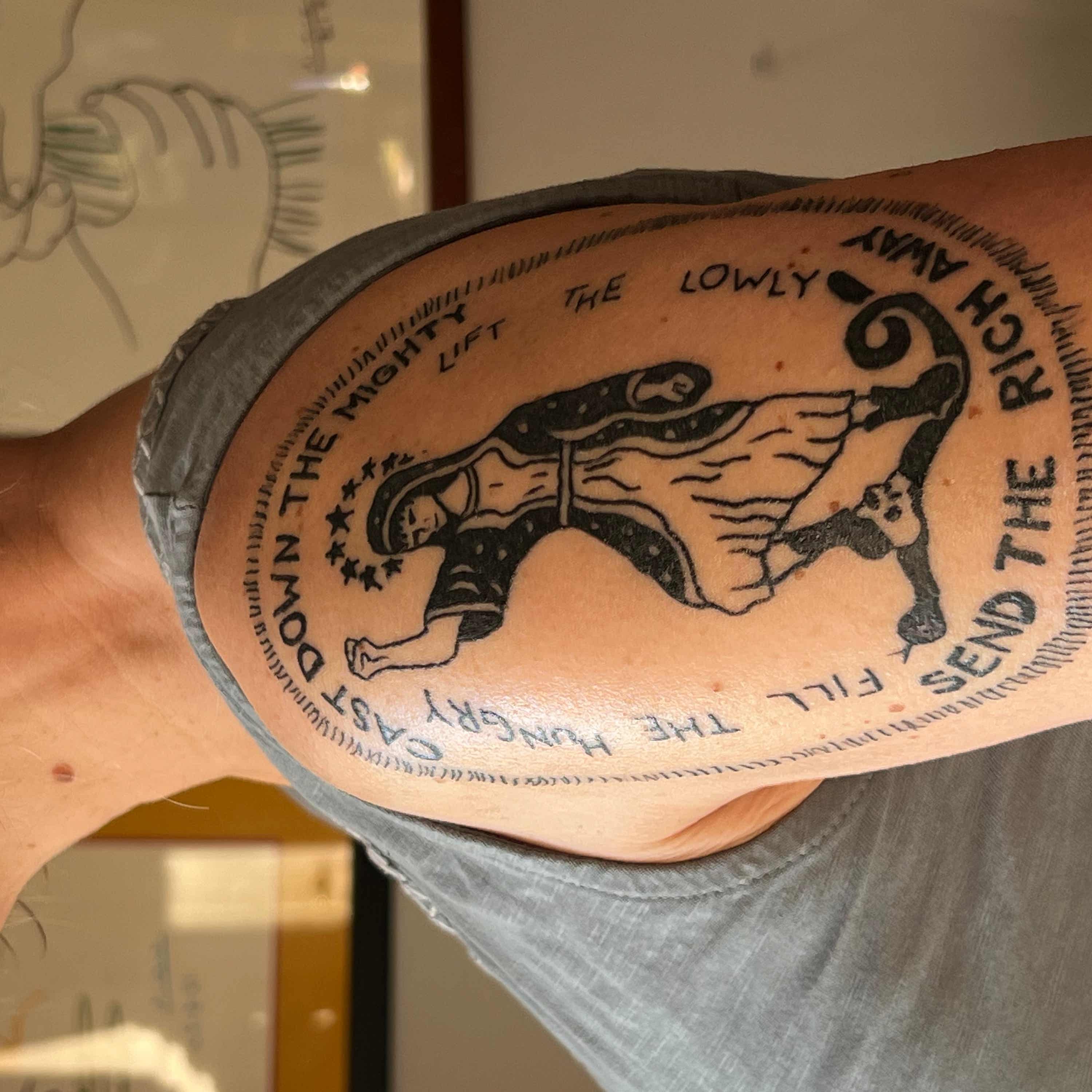
"...He has filled the hungry with good things and sent the rich away empty."
Given recent awareness of the increasing gap between the über wealthy and the rest of us, and the related power inequity too, a reflection on real-time conversations our nation is having about wealth inequity, with an assist from brother Lazarus and the nameless rich guy in Luke.This is a requested re-up of a sermon I preached last September when the passage came up in the RCL, but it references two pieces that might be timely for the third Sunday in Advent: the Magnificat, and Charles Dickens’ A Christmas Carol, so I offer it again now.~~~~~So when I was in late elementary school, my mama bought a hot air balloon. On our fridge, we have a picture of her positively giddy, sitting on the hood of our family’s squash-colored Buick Skylark, right after her first solo flight, a mix-of-blues thermos filled with what we were told was celebratory coffee but I have reason to be suspicious.My father had gifted my mother a ride in a balloon for her birthday, and as soon as that balloon started to fill up with air she was hooked. Her thrill was so obvious that just a week or two after her flight, the pilot—I still remember his name, Jeff Wingad—rang her up because a cheap one had just gone up for sale. It flew and all, he assured her, but some of the skirt was a bit singed, and one of the helmets was melted on the top: apparently the former owner had been super tall, and his head got a bit too close to the burner.Would she be interested?There was a lot behind that purchase: it didn’t cost much, but had been paid for by the inheritance she’d received from her own mother.And I wonder whether she could foresee certain Sundays when the wind was just right—sometimes my mom got a little tired of the tired expectations of pastors’ wives, and so when she couldn’t take it anymore, she was known to lick her finger early on Sunday morning, put it in the air to test the wind, and turn to my father and say, “It’s a good day for a balloon ride, George.”So I grew up with a hot air balloon in a trailer in our driveway, my mother occasionally in the air, and therefore a CB radio in the gondola and in that same squash colored Buick Skylark: it became known as the “Chase Vehicle,” because, well, balloonists need people to chase them, and sometimes you can’t be sure where they are when they go out of sight. You want a way to get them back to where they belong.Naturally, Mom had a CB handle: Balloonatic.My Dad, who was a preacher, had a handle too: Hot Air.It’s the “handle” part of the story, though, that came to mind as I was preparing the sermon for this morning.Isn’t it curious that one’s radio name is called “a handle?”Like, to reach someone, you have to have a handle, something to grab them by: that’s essentially the purpose of a name.Bellering out “Hey You!” in a crowd isn’t useful, but calling out “Hey Englebert!” narrows the options considerably.As you’re floating off into the great unknown, perhaps into some treacherous spaces, and people who love you can’t see you anymore, they need a handle to grab you back.They need to know your name.In Luke, we hear a story of a poor man who has a name: Lazarus, which, as an aside, means in Hebrew, “God helps.”Interestingly, Lazarus is the only named character in any parable told by Jesus anywhere, apart from him naming Abraham in this same parable.A name is not just a handle, of course: it’s a sign, a symbol that someone has worth, has dignity, deserves respect, exists.Wealthy people, see, we tend to know their names: Musk, Bezos, Cook, Gates, Trump—they have made a name for themselves.But in this story from Luke, it’s Lazarus, the poor guy, who gets a name in this tale.Even the rich guy knew his name: apparently Lazarus regularly sat on a bench outside the wealthy man’s home—benches like these were common beside the gates of the wealthy, who would help (and with some fanfare, so that they’d get recognition) the destitute who sat on them, but it seems that our rich guy had not gotten that memo.In fact, the wealthy dude knew his name so well that, once the both of them had died, and landed in their respective eternal spots, he even called out to Abraham—ABRAHAM! The father of Israel, as if Abraham were his servant—to have Lazarus—as if he were also his servant—to wet his lips.In the back and forth, Abraham had an opportunity to use the wealthy man’s name, but get this: he didn’t, beeeecause the rich guy never gets a name.Instead, Abraham merely called him “Child.”Oh the dripping condescension of it all: as if the rich man weren’t already sizzling in his present digs, what a sick burn.“Child,” said the father of Israel to the man accustomed to enjoying power, authority, privilege, and wielding it.“Child, remember,” said Abraham, because I sure do, “that during your lifetime you received your good things, and Lazarus in like manner evil things, but now he is comforted here, and you are in agony.”Now, see, here is where preaching this text gets tricky.It’s been kinda fun up until now.This text in any day and age is tricky, but especially these days, and especially if you’re Lutheran.We love grace, and we love talking about forgiveness, and this text does not provide much of either to the one character in the story who resembles a good lot of us, and who is of the ilk toward whom respect tends to go, our society and culture reveres, and for whom even our national policies are designed: not for the Lazarus’ of the day, but for the rich. Just look at the recent “Big Beautiful Bill” that was passed in Congress and tell me I’m wrong.See, if you aren’t feeling uncomfortable not only about this text from Luke, but from the regular cadence of disparagement about the wealthy and the hoarding of riches that thrums throughout Scripture, than either you aren’t paying attention or you yourself are poor, and are rejoicing in the word that you are promised the very balm that Lazarus himself received.The rest of texts assigned for this Sunday are no exception:Amos, not just here in Amos 6:1a, 4-7, but pretty much through his entire book declares woe to the wealthy. Like, it is not not good to be rich and within Amos’ earshot: For example, that passage in which he calls rich women who ignore the poor “cows of Bashaan?” I’m pretty sure that never shows up in a Sunday morning reading, and that is probably not by accident.And Psalm 146? Yeah, it sings of hope not to the rich, but to those oppressed by them.And 1 Timothy 6:6-19 refuses to allow wealthy and powerful people to live under any illusion that they are anything but constantly within the grasp of temptation, dancing with the evil that comes from private security, unless the wealthy are radically generous with their riches, and, in fact, are wealthy only in good works.But Luke is known for his concern for the poor…and also for his concern for the rich. New Testament scholar Dr. Mark Allan Powell has said that Luke’s main message is this: just as the poor need to be redeemed from their poverty, so too do the rich need to be redeemed from their wealth.As we are preparing to hear the words in the Magnificat for the third Sunday in Advent, recall the words that Luke places in the mouth of the very mother of Jesus, right out of the chute of his Gospel:“…indeed, his mercy is for those who fear himfrom generation to generation.He has shown strength with his arm;he has scattered the proud in the imagination of their hearts.He has brought down the powerful from their thronesand lifted up the lowly;he has filled the hungry with good thingsand sent the rich away empty.”Like there’s no equivocation here, no grey, no both sides-ing it.Instead, wallop after wallop after wallop throughout Scripture—I didn’t even get to Exodus, Deuteronomy, Jeremiah, Isaiah, Micah, and so on—it’s seriously unrelenting.Our texts from today about wealth aren’t outlier messages, no they are not.Economic injustice, the likes of which we see revealed in our passages today, are mentioned in Scripture more often and are more offensive to God than any other abomination, and you know what?I’m betting you don’t know that, because we, namely leaders in the church, have a pretty spotty record of naming that.We don’t want to handle it, in part because we don’t want to handle what will come after we do!The structure and systems of the Church that makes it all too easy to avoid naming that God is realllllllly angry at wealth inequity. Like, the word I want to use here instead of ‘angry’ shouldn’t be said from the pulpit.That we don’t have a habit of calling wealth and wealth inequity sinful reveals precisely why economic inequity is named more than any other offense to God: Wealth = power, and we trust the power of wealth and wealthy people more than we trust the power of God.Trouble is, unshared wealth, poverty, economic inequity not only displeases God, it infuriates God, and people will be in a mess of trouble with God until it’s all sorted out, and someone has to tell them that wealth ticks God off, and you will be judged for unshared wealth, and for not noticing that poverty is sin, and for not taking seriously that the poor have worth, and for willingly participating in an economic system that oppresses the poor, and for not appreciating that economic injustice harms not only the poor but also the rich.I just can’t nuance this biblical, faithful truth, though don’t think I haven’t spent significant time trying to do just that.I can’t nuance it because the Bible and pretty much Jesus reveals this to be God’s word time and again, and we are freed by the cross and the resurrection to, as Luther said, “Call A Thing What It Is.”Luther believed that once one is steeped in the theology of the cross—a belief that where there is death God brings about life, freeing us to see death so that we can be courageous enough to name death as such, and to transform it—we are thereby also freed to, as he said, “Call A Thing What It Is.”Counter-intuitive as it is, it’s ignoring or rationalizing the uncomfortable things that keep us in places of death, of places that are not of God, not the naming of them, allowing us to get a handle on them.Too late, the rich guy gets it, in that last part of the text when the rich man begs Abraham to send Lazarus to warn his five brothers about their impending fate, to name the spiritual risks of wealth, to chase them as they stray away—it’s nothing short of tragic.It can even smack as callous when Abraham says no, but he says no because, he explains, they’ve already been told, from Moses and the prophets, and they still live gluttonous and selfish lives.And then the kicker: “If they don’t listen to Moses and the prophets, neither will they be convinced even if someone rises from the dead.”Now, back when Luke’s words were beginning to be spread about, the recipients of this book, like we, they knew the end of the Jesus story.They knew that he was going to be killed and then would rise from the dead.So they could hear Abraham’s words in Jesus’ parable and say, “Yeah, so I see what you’re doing there, Jesus, I’m following the bouncing ball.”What, in other words, prod Abraham, and Jesus, and Luke, would it take for rich people to change course, to hear the Word of God and repent?Luke’s parable seems to say, “Demonstrably, not a thing, not even a resurrected Jesus,” because we love privilege too much.The story is so jarring, of course, because there is not only no happy ending for the rich man in our story, but there seems to be a suggestion that there is no happy ending for any rich people.Now, here’s where we note that some scholars believe that this story was taken from the tradition of apocryphal writings, the vivid, almost psychedelic writings the likes of which we see in the books of Daniel and Revelation.The point to texts like these isn’t a literal truth, no.The point is to serve as a warning: think, say, Charles Dickens’ A Christmas Carol. If you don’t change your ways, Scrooge, you too will end up like brother Marley.Or think of scientists who tell us about climate change, and how we can change the dire trajectory, if we listen to them.So what will it take for us to believe that of all the sins that God gets particularly hung up on, it’s unjust economic systems and rich people?Well, first, the Church must be honest and call a thing what it is.We gotta name the truth that wealth gets in the way of God. Policies which benefit the rich to the detriment of the poor really super duper torque God off. When we ignore the cries of the poor so that we can keep our privileges we harm the very children of God: the poor, and the rich who are engaging in sin and causing woe not just to the poor but to their very own souls.God’s got opinions about wealth, and they are not favorable, but you can’t be held responsible if you haven’t been told.Second, receive the word.Sit with it.Observe your reaction: your body’s posture or tightness within it, your blood pressure, constriction in your heart, even anger.Notice if you find yourself justifying your wealth, the way society is structured, the reality of the poor, or the votes you’ve made which secure privilege for a few at the expense of the poor.Consider whether you are feeling compelled to protect your status.Reflect on your feelings about the poor.Ponder what that might say about what you most value, and whether it’s possible that the God in whom you think you believe might, instead, be wealth.Take stock of how much energy you take to maintain a standard of living, to protect your belongings, and whether you have a handle on your monies or whether they have a handle on you.Third, recall that you are baptized, and you were baptized by your name, and in God’s name: in the name of the Father, and the Son, and the Holy Spirit.Remember that we know that we are baptized into the news that death does not win, even the death of our privilege or our poverty.Remember that now that we know that death doesn’t win, there’s more to do with our lives than preserve them.Texts like these, they are a chase vehicle of sorts: when we fly off too far, or into dangerous territory, not only do these hard words chase us down, but so does the gospel.Sometimes, Gospel sounds like Law, but if the word ultimately leads you back home, then Gospel it is.Beloved, you are known by name.Hear again God calling to you via 1 Timothy: “…in their eagerness to be rich some have wandered away from the faith and pierced themselves with many pains…but do not be haughty or to set hopes on the uncertainty of riches, but rather set them on God, do good, to be rich in good works, generous, and ready to share, to take hold of the life that really is life.”Amen Get full access to Anna Madsen at revdrannam.substack.com/subscribe
-
13
Mr. President, Advent Would Like a Word
Below is a fusion of some FB posts I made about Donald Trump’s obnoxious—emphasis on the ‘noxious’—words about Somali immigrants. The season of Advent would like a word. ~~~~~Trump’s vile, abhorrent comments about the Minnesota Somali community are reflective of long-standing and normed racism toward this community, and I renounce it.In fact, I’ve had to renounce it for close to 10 years.In 2016, after my two children and I arrived in Two Harbors, and after Trump’s election, I wrote a blog in which I despaired about those who’d voted for this offensive con man: in it, as a key aside, I called out the Democrats and the Church too, for both had enabled his election.Some local Republicans found the blog, took offense, and, purely out of vindictiveness, with the sole purpose to undermine my application to the Planning and Zoning Commission to create the Spent Dandelion Theological Retreat Center, spread utterly false, completely base rumors about me.Among the untethered, unhinged gossip points, ones even intentionally spread on a local Fox talk radio station for at least two days running (on one day, the announcer even named my children, then in middle school, on air), rumors were planted, including that:~really the ELCA is all about building mosques, and that was my true intent;~when I lived in Sioux Falls I had harbored a terrorist from Iran;~my OMG: Center for Theological Retreat Center was -everywhere- across the globe (they were looking at omgcenter.org, not omgcenter.com, because I wish);But the most offensive, the most troubling, the most revealing, and their main plank claim was this:I was actually intending on building not a retreat center, but rather, and I quote, a “Group Home for 30 Somalis.”I knew nothing of any of these rumors until I was ambushed with them at the local planning and zoning meeting, the publicized one at which I sought approval for my proposal for the Spent Dandelion.The place was packed, nothing but butts and elbows, because word had spread everywhere (with the solitary exception being to me), about my alleged plans.When asked if this were true, namely that I was intending on building a group home for 30 Somalis, my breath was caught.I confessed that I didn’t quite know how to answer.Most obviously, I could say that No, of course not.But then I added two things:Not only was I not intending on building a group home for 30 Somalis, I was also not intending on building a group home for 30 Norwegians either.And, I said, I was appalled at the overt racism behind the accusation.All were welcome at the Spent Dandelion, even Norwegians, but racism in any form was not.Links to the blog called “The Spent Dandelion and Truth Mattering,” with receipts—including to the on-air recordings of that Fox talk radio show—is below.We were devastated, frightened, brought up face to face with unvarnished hate, and naïve no more.~~~~~So yesterday, we have our convicted felon President saying of the Minnesota community, “They contribute nothing. I don’t want them in our country, I’ll be honest with you....They come from hell and they complain and do nothing but b***h.”He called them ‘garbage.’A president, purported Christian, and convicted felon and sexual assaulter calling an entire community of citizens ‘garbage’—while pardoning a drug dealer, bombing fishermen, having pardoned convicted violent insurrectionists, and himself having been convicted of (get this) fraud—that’s next-level mind blowing bonkers.~~~~~There is no lie, of course, that there has been a wave of fraud cases involving the Somali immigrant community, and to pretend that that isn’t the case is to intentionally ignore an uncomfortable truth.Last year, Mr. Kayseh Magan, a US citizen of Somali decent—he served as an investigator in the Medicaid Fraud Division of the MN AG office—wrote such a thoughtful, candid, informative article in the Minnesota Reformer about how it is that these fraud cases seem to center the Somali community.It’s so well-done, and highlights the complicated, nuanced, cultural, communal, and economic realities facing many within the Somali community both here and in Somalia.Many of these factors have lent themselves to the very circumstances of fraud which have wreaked havoc in and for their community.He’s written another in the last few weeks: both articles are below, and I encourage you to read them for context, insight, knowledge, and compassion.Suffice it to say, though, that the entire matter is nuanced, complicated, wrenching, and also?Most fraud cases are committed by middle-to-upper class white men.Including, by the way, crimes committed by our now-President.~~~~~Two final pieces:First, this Somali race-baiting is baked into the Minnesota GOP.I have yet to see one Minnesota Republican elected official renounce it, it has clearly been a racist trope in these parts for some time, and Minnesotans need to be calling it out.Although this is who we apparently are, it is not who we should be, or who we perceive ourselves to be.Time to be honest with ourselves.Second, addressed to those who are baptized:It is long past time to lean into the promises, and get specific about the renunciations.Advent’s themes are for you and for now: repent, prepare, and be woke.https://minnesotareformer.com/2024/07/17/a-somali-american-investigator-heres-why-youre-hearing-so-much-about-fraud-in-my-community/https://minnesotareformer.com/2025/11/25/right-wing-reporting-on-somali-money-going-to-al-shabaab-is-sloppy/https://www.startribune.com/twin-cities-ice-somali-trump/601537681?taid=692f848fb6578a00018102c1&utm_campaign=trueanthem&utm_medium=social&utm_source=twitterhttps://www.startribune.com/trump-administration-targeting-somali-immigrants/601537917?taid=6930577e75940e0001479f1f&utm_campaign=trueanthem&utm_medium=social&utm_source=twitterhttps://omgcenter.com/2016/12/21/the-spent-dandelion-theological-retreat-center-and-truth/https://www.embroker.com/blog/white-collar-crime-statistics/https://www.oklahomacitylegalgroup.com/blog/2023/03/who-commits-white-collar-crimes/https://docs.house.gov/meetings/JU/JU01/20250122/117827/HHRG-119-JU01-20250122-SD006-U6.pdfhttps://rockinst.org/gun-violence/mass-shooting-factsheet/https://www.washingtonpost.com/nation/interactive/mass-shootings/shooters/ Get full access to Anna Madsen at revdrannam.substack.com/subscribe
-
12
Second Week of Advent: Saying I'm Sorry Is The First Step
Isaiah 11:1-10; Psalm 72:1-7, 18-19; Romans 15:4-13; Matthew 3:1-12Well, not gonna lie, the first and lasting image I have of these texts—and there are many images from which to choose here for this next Sunday—is that God must have holy halitosis if, as Isaiah tells us this week, it’s strong enough to kill the wicked.Can’t decide these days if I hope that God finds a mighty toothbrush or not, to be honest…Anyway, these texts again relentlessly remind us of the identity of God, and of our own identity if we take God as God seriously.I mean, listen to this: “He shall not judge by what his eyes see or decide by what his ears hear.”Coupled in a hearty way with John the Baptist dropping some beefy insults to the religious authorities of his day, people eager to be seen Doing the All the Right and Noble Things, “You brood of vipers… do not presume to say to yourselves, ‘We have Abraham as our ancestor,’ for I tell you, God is able from these stones to raise up children to Abraham.”God can hear your words, God can see your actions, but God knows you, ‘knows’ as in the Hebrew yada, which is to say that God is intimately aware of your sincerity and integrity (or lack thereof).Point is, doesn’t matter if you look or sound like you’re a person of faith: if your actions are only performative, but your heart has other loyalties, God’s got some morning breath to blow your way.Now, these texts might get under the skin of Lutherans, because they are heavy on the works.* shrugs like a Bruno-esque Lutheran *Honestly I have never been able to understand, theologically anyway, the allergy Lutherans have to being faithful as an expression of having faith.Not only are engaging in acts of faith not inconsistent with our theology of grace, that practice, as in discipline, as in disciple, is definitely not inconsistent with Scripture.Grace is not a whatevs.Grace is a recognition that no matter what, we will never be able to extricate ourselves or anyone else from engaging in that which can cause harm.It’s a rejection of selfish and base pursuits, engaging in “good works” only to earn points, making our acts manipulative, and what we receive to be rewards.It’s an acknowledgment that we are not God, and cannot save ourselves.It’s an embrace of humility.It’s trust in God more than in ourselves.All of that said, though, grace does not mean that there are no expectations, nor any mores on which we base our lives and the way we live them out.And it also doesn’t mean that there is no judgment when we fail at righteousness.Relatedly, we hear the word ‘righteousness’ four times in our first texts…six if you count the word ‘justice,’ which, both in Hebrew and in Greek, has the same root as righteousness.God will judge with righteousness, aka justice, for the poor, we hear, and decide with equity for the oppressed, and the needy will find deliverance.The second Sunday in Advent, see, wants us to pick up what it’s laying down: when we are aligned with that agenda, we are aligned with God’s justice and we live with fidelity.These texts, along with a mess of others in this Advent season, lay out the expectations, the values, the agenda, the identity of God:Welcome, compassion, equity, justice, diversity, love.Who wouldn’t want to participate in that, I ask you?Well…turns out it can be tricky.Greed, capitalism, domination, selfishness…those are powerful drugs.Of this God and the writers of Scripture are aware.And so these texts also invite us, this Sunday, to repent.Repent is a word laden with a lot of baggage that isn’t its to bear. It’s often associated with condemnatory preachers hurling it to a congregation of wide-eyed emoji parishioners, a command not so much addressed to those who maltreat the poor, the stranger, the naked, the ostracized. Instead, it’s to the ostracized themselves, especially those who have engaged in some form of sexual or gender-specific expression that is not aligned with puritanical mores.Yeah, so this Sunday gives us a chance at a repentance reboot.My son Karl, who suffered a traumatic brain injury, is 24, but developmentally is about where he was at the time of the accident: he generally sits at the 3-7 year old zone.Relatedly, the PBS (thank you PBS, our family has got your back) show Daniel Tiger, which is a spinoff of Mr. Rogers Neighborhood (RIP) is a regular at our home.It’s a terrific show, teaching not just young people about growing up, but parents about parenting those who are growing up.The producers use short ditties as a way to help viewers remember the key messages. Karl knows all of them by heart.One of them is coming to mind this week, because it has to do with apologies.It goes like this: “Saying I’m sorry is the first step, then how can I help?”That, that right there, that is full-throated repentance.Daniel gets that repentance involves several stages:* Knowing what you should have done.This step has, surprise surprise, to do with identity. Who are we, and on what basis are we that? To whom or to what are we aligned? Or, to use First Commandment language, who or what is our God, and how is that conviction demonstrably true?* Acknowledging that you have not done whatever it is that you were called to do.This step involves incredible humility, vulnerability, and faith that God and perhaps even the person, people, or system which deserve your repentance, will actually receive your acknowledgment, and ideally with some grace.* Asking what can be done to repair the breach.Typically, we think of repentance as stopping what you are doing.But Daniel and Matthew pull us further into its meaning: it is that, but it’s doing something else in the stead of what you have been doing.That’s the ‘then how can I help?’ part from Daniel, and the ‘Bear fruit worthy of repentance’ part from Matthew.If you don’t change behavior, then you haven’t really repented.The word ‘repent’ is, in Greek, metanoia, and it literally means ‘to turn around,’ as in doing a 180º.I like that, but I’m reminded of a gorgeous interview that Krista Tippett had with Prof. Louis Newman, a Jewish philosopher and ethicist, who has written a book entitled Repentance: The Meaning and Practice of Teshuvah.Turns out that the word for ‘repentance’ in Hebrew, teshuvah, has a similar meaning—a turning away from something, but also a turning, or a re-turning, to God.And then he says this, an interesting dialogue and counter point with the Christian emphasis on a drastic and immediate shift, Dr. Newman says:“If you think about this in terms of a 360 degree circle, if you’re headed in one direction and you turn only one degree or two degrees to the right or to the left, over a long period of time — it may be a very slight turn, but over an extended period of time, if you now walk in that direction, you’ll end up in an utterly different place than if you extend that line outward infinitely. And that sense of turning even slightly…it doesn’t have to be a radical, all of a sudden transformation into a new life. It’s actually a very gradual process of recognizing, ‘you know, I need to pay attention to that particular failing a little bit more, and move in a little different direction.’”That’s quite lovely.It offers grace, patience, and compassion, without losing sight of an expectation or an act.I like it…mostly.But both in our texts and in our world, we perceive—or ought to—urgent need for repentance. Patience is not always a virtue; in fact, it can sabotage the expression of reign of God, as in “Let’s just meet them where they are.”I’m certain I’ve already griped about how Jesus met ‘them’ where they were—and, in Sunday’s text, so did John the Baptist believe you me—but then either took ‘them’ to a new place, or demanded that they move their own blame selves to anew place.Perhaps here is a classic case of both/and.Change is hard.Sometimes there might be slow changes that can be made, and can only be made slowly, like a new eating or exercise pattern, or moving through trauma or unhealthy self-dialogue, or learning to load the dishwasher correctly.Little shifts every day can make a significant difference over the long haul, and can pave the way for more little shifts, or confidence in bigger ones.But other times, when we are engaging in unrighteous, unholy, unjust behaviors and systems that hurt the people of God or the creation of God, then the time to change them is now.I did vote for Trump, and now I’m going to protests.I did not speak up, and now I’m writing letters to the editor.I did not address candidly the implications of the gospel from the pulpit, for a myriad of reasons and some of them even good and understandable, but I realize that I’ve enabled Christian Nationalism and hate for our neighbor, and have allowed the oppressors to sit tight in their oppressive ways, and in so doing stood in the way of both the poor and the rich, the oppressed and the oppressors, the meek and the mighty, hearing the law and the gospel, and reminding them that they are beholden to nothing and no one but God.And that’s key, here, namely tying it all to God.The goal of the repentance, that is, is placed firmly at the identity of God.The entire point of God’s revelations to us is to express God’s hope for love, equity, joy, diversity, and peace for God’s creatures and creation.The intention of repentance is not to create a place of rigidity and fear, what one might expect were we to leave the word ‘repent’ where it has been firmly placed in our understandings of its nature and purpose.11:6 The wolf shall live with the lamb; the leopard shall lie down with the kid; the calf and the lion will feed together, and a little child shall lead them.11:7 The cow and the bear shall graze; their young shall lie down together; and the lion shall eat straw like the ox.11:8 The nursing child shall play over the hole of the asp, and the weaned child shall put its hand on the adder’s den.https://onbeing.org/programs/louis-newman-the-refreshing-practice-of-repentance/ Get full access to Anna Madsen at revdrannam.substack.com/subscribe
-
11
An Intro to Advent 1, and the Year of Matthew
(Technically, we are still in Advent One, so I’m technically not late to posting about this week’s texts.) If you are wealthy, privileged, or an oppressor, seatbelts, everyone: the liturgical year of Matthew is gonna be a ride.Luke, the gospel writer from whom our readings up until two Sundays ago came, well he directed his words with a slant to the poor, the dispossessed, the oppressed.Matthew, though, he has some truth to drop to the top.It’s not that Luke doesn’t address the primary audience of Matthew, or that Matthew doesn’t address the primary audience of Luke, but the focus of their gospels is quite different.Our readings in Advent are nothing if not an introduction into the message of Matthew.Threading through the readings of Advent 1—Isaiah 2, Psalm 22, Romans 13, and Matthew 24—we heard core themes thrumming not just through this week, but ones which carry through the entire Advent season: Identity, Diversity, the centrality of Worship, and Preparation for the arrival of the Lord.In Isaiah, for example, we hear of the nations—not just individuals, but nations coming to gather at the mountain of the Lord.The bulk of humanity, all of the nations, come to God.In an age of America First, of the elimination of Diversity as a core value of our country, of the barring of certain peoples from certain places where the skin tones are not white, this is way way woke.Trouble is, although our present regime, one which fancies itself Christian, refuses welcome, God doesn’t.Once assembled, these many and various people of God hope that God will “teach them God’s ways, so that they may walk in God’s paths.”That’s a sit-down-and-take-it-all-in verse there, with heaps of intel about the identity of God and those who follow God.For example, it’s recognized that:~ there are ways of this God which are mightily distinct from other gods;~ to follow this God, one must know these ways;~ once one knows these ways, one must follow them;~ learning and applying what one has learned is a sign of humility and faithfulness;~ this God is a teacher, and we are called to sit at the feet of this God and hearken to what God has to say.And then we hear perhaps the most essential teaching about this God:This God is not one of violence, but one of growth—if we follow this God’s teachings, spears and swords shall be turned into plowshares and pruning hooks.Our Psalm for the day takes it a step further: peace, not violence, is the agenda of God.The word used here isn’t, actually, ‘peace,’ but in Hebrew is ‘shalom,’ which is arguably a more…robust word than ‘peace.’Peace can mean the absence of violence and expressed anger, but Shalom means the presence of justice.Peace can be passive, and arguably passive aggressive, but Shalom is the product of active wrestling.It takes work to experience Shalom.With that in mind, what a benediction is this:“May they prosper who love you.Shalom be within your walls and security within your towers.For the sake of my relatives and friends I will say, ‘Shalom be within you.’For the sake of the house of the LORD our God, I will seek your good.”It’s a bit jarring, then, after all this talk of peace and shalom to hop into our Romans text, and hear about dressing ourselves in armor, even if the armor of light!But what could that armor be?It comes right after we hear about salvation being near to us—the word ‘salvation’ rooted in the Greek word ‘soteria,’ which means ‘health, healing, and wholeness.’Paul, of course, is writing after the resurrection of Jesus, and after there is a tradition of Christian baptism.Perhaps this armor, then, is not one of war, but rather the armor of the promises of God we received in baptism.We do not need to fear, but rather can face the challenges of life aware that in the midst of it all, God is with us: or, as we are wont to say in Advent, Emmanuel.20+ years ago we lived in Southern Bavaria, a region in which both Roman Catholicism and a love of bronze work are vibrant traditions. Fusing the both of them, many homes, and ours now included, have a small small bronze basin with a baptismal symbol forged on it: people can dip their fingers in it going out of and coming in to their homes, ritualizing a reminder that they are baptized.That bit of water on their forehead is, in a real way, armor. You are baptized. God’s promises and your freedom to trust them, to identify that which is akin to God and that which is not, and to be emboldened to renounce that which is not—you’re literally dripping with hefty protection.And our last text of this week, Matthew.It’s a passage that has earned the likes of Hal Lindsey millions of dollars, this threatening and very much abused ‘left behind’ passage in which some are taken and some are not.The thing is—no, several things are—that:~some are taken and some are left, and, depending on the anecdote, it’s not at all clear whether a person wants to be taken or might rather be left behind;~ we do know that those hearing Matthew’s words were witnesses to the Roman authorities grabbing Christians, nabbing them off of the streets and out of their homes, persecuting them for their faith—not unlike ICE grabbing, nabbing, and persecuting people for the color of their skin.Fear was everywhere, legit and palpable fear.Not a far cry, to be honest, from people who need to be prepared about what to do where ICE to come knocking at their car windows, places of business, houses of worship, and homes, or merely plucking them off the street.This passage might well ask us, how would we react were we to be taken? To be left behind but see someone taken?“Be Woke,” says the text, a phrase that is loaded not just culturally, presently, but Scripturally as well.Do not sleep, do not presume that you are ready, do not rest on your assumption that saying you believe in Jesus cuts muster.Instead, actively root yourself in your faith, learn the commandments of Jesus, practice the ways of those who follow him, do not heed the counter-calls, and without shame, follow Jesus.Throughout Advent, and throughout this liturgical year, these themes aren’t precisely warm and fuzzy.Maybe that’s why we are so often tempted to skip over Advent and make our merry way to Christmas.They aren’t pleasant, but they are righteous, they are foundational, they are clarifying.Outside our Advent windows, our Advent calendars, our Advent rituals, the world is dizzying in its complexity, toxicity, and fear.But these texts remind us of several things: our identity as followers of the ways of God; of diversity as a blessed feature of God’s creation; of the centrality of gathering and recalling our baptism; of the hope for peace and delight, not just at some uncertain then, but right now; and the daily preparation to welcome this very in-breaking, to expect to encounter the Lord especially in our neighbor and the most vulnerable among us, and to say to that one, “‘Peace be within you,’ For the sake of the house of the LORD our God, I will seek your good.” Get full access to Anna Madsen at revdrannam.substack.com/subscribe
-
10
A Day in the Life of Advent
While my entire Christian faith framework begins and ends with Easter, the bones, flesh, and soul of my personality identifies with Advent.I feel Advent on the daily, even when it isn’t Advent, although the long stretches of darkness, the stars complementing it, the haunting hymns, the preparation for Christmas make me feel utterly synchronized with the season:Quiet.Waiting.Wrestling between the desire to complete all the baking and present buying and decorating, and the competing invite to savor every one of the pieces of holiday prep instead.Hygge.Worry that time is flitting by.Confidence that there is, actually, time and time to pause.Gratitude for the dark, a calibration to it in fact.A palpable tension between anxiety about reasons to repent and the reassurance in the promises to not be afraid.Swirled together like finger paints on glossy paper, Advent is roughly 30 days of urgency and waiting, anxiety and peace, vulnerability and coziness: exactly a day in the life, even when it isn’t Advent.~~~~~Recently, I’ve had a couple of occasions to actively reflect on Advent writ large, and specifically for each of the four Sunday’s texts.One event was for a church in Wisconsin, via Zoom, on Christ the King Sunday, the pivot Sunday between the last and the first days of lectionary years: this year, we are moving from Luke to Matthew.The group had asked me to reflect on the question, “What is the future of the Church?”I didn’t like the question.So I took liberty to change it. I preferred, I said to the gathered group, this question: “What is the identity of the followers of Jesus?”That prompt is far more in keeping with the season of Advent, with Matthew’s gospel’s agenda, and it’s driven less by capitalistic anxiety (I said we could imagine the first question being posed by some CEO at a huge board meeting) and more by curiosity and faithful confidence.We already know the future, because we believe that Jesus is risen: life, not death, wins.But that doesn’t mean that we skip about with baskets of flowers singing merry tunes on constant days of 72º and sunny, no: it means that we engage the moments of life, even the threatening, sorrowful, despairing, irritating ones, as people shaped by that promise.Those unwelcome moments don’t magically disappear, but they are reframed with a measure of hope and defiance.Early on in his gospel, Matthew tips his hand here, telling us that the angel of the Lord arrived to Joseph and said, “Do not be afraid.”Let’s be honest: the guy had reasons to be afraid.But as terrifying as that moment was for him, Mary pregnant and their names and lives at stake, there was greater reason to be assured: Mary would bear a son, one named Jesus, a name meaning ‘one who saves,’ who would also be called Emmanuel—God with us.Stretching from his birth to his death and resurrection, the story of Jesus envelopes both our need for saving—which means, in Greek, health, healing, and wholeness—and our freedom to act according to that very salvation, placing our faith in God rather than our faith in fear.That’s no schmarmy claim: that’s radical stuff right there is what it is: by definition, we Christians know the future and we act according to it.As to the “Church,” well, curiously, only Matthew uses that word, which in Greek is ekklesia, which literally means those called out, those set apart.It surfaces three times, namely in Matthew 16:18, when Jesus says that upon “this rock,” as in Petros, as in Peter (see what he did there?) he’d build his church, and in 18:17, when twice he uses the word to address what should happen when you have a beef with someone in the ekklesia.It’s important to recall that Matthew was rooted in the Jewish tradition, and so had held fast to the synagogue and the centrality of the teachings of the Torah.Now, though, post-destruction of the synagogue in 70 C.E., and post-resurrection, Matthew held fast to the ekklesia, a community that, even if in its nascent stages, clearly had developed enough for him to reference it and presume that others understood his reference point.The temple, he said, was “forsaken and desolate,” (23:38), but in Jesus, he said, “something greater than the temple is here” (12:6).For Matthew, that is, the commands of Jesus were central to the identity of the ekklesia: in fact, they are the parenthesis of his gospel, an embrace to all that Matthew felt compelled to convey.The first directives that we receive from Jesus are found in the Beatitudes—not to undercut John the Baptist’s calls to repent, of course, holy harangues which precede Jesus’ words—and the last are these: baptize and teach all that Jesus had commanded.In between we have perhaps the most shocking description of the commandments of Jesus when we stumble on Matthew 25, where the sheep and the goats—nations, not individuals mind you, but nations—are separated, not on the basis of whether someone has “accepted Jesus Christ as their personal Lord and Savior,” and not if they are a member of this denomination or that one, or this political party or that one, but whether they fed the hungry, gave drink to the thirsty, welcomed the stranger, clothed the naked, tended the sick and the imprisoned.You do that, and you center your identity on the commandments of Jesus, and you act as the called-out ones.If you are a member of the ekklesia, that is, you align yourself with the commandments of Jesus, and you participate in the promise and the in-breaking of the reign of God.And right here you have why, especially in Advent, and perhaps especially in Advent of Year A, I prefer transposing the question, “What is the future of the Church” to “What is the identity of a follower of Jesus?”One answer, it seems to me, is make like Advent, and not just in Advent.Stay in the Quiet.Wait.Wrestle.Find the cozy.Note the reasons to be afraid.Defy them.Repent.Be called out.Call others in.Welcome to Advent.Welcome to the way of the ekklesia. Get full access to Anna Madsen at revdrannam.substack.com/subscribe
-
9
Tis the season for repentance
Those of you who have sponsored and supported this Substack deserve a thank you, and an apology, and not just for the background sound of my snoring menagerie of three dogs and a cat by our Northern Minnesota wood stove!I am certain that I am not the only one who anticipated that resisting this Trump regime would be hard work.I had hoped it wouldn’t be all-consuming work.But it is. Right around the time I began this Substack, I became involved in creating our local branch of Indivisible: if you don’t know about this organization—movement, really—I invite you to check it out at indivisible.org, see if there’s a chapter near you, and if not, begin one yourself!In fact, I expect that I’ll have a blog up about Indivisible soon, because I find in it some parallels to the upstart expressions of Church that are garnering attention and energy.I began to pull back from that in June—we created a model much like geese flying in formation, so that leaders of the core group could fall back and others fly forward.My hope was to get back to posting here, but then life kept intervening: vocational, personal, practical responsibilities, and then, of course, all things political, which has been a daily tsunami of hard stuff demanding response, and which…sort of…got it, in various means, avenues, and outlets.Upshot: I’ve certainly been scattered in my attention and attentiveness, but frankly, I’ve never fought fascism before, and I don’t know about you, but I often feel like I’m on a balance board, using micro-muscles to try and stay upright!I’m eager to be more faithful in posting, and in fact have a backlog of posts ready to go.In the meantime, returning to that balance board notion, I’m realizing that we’re all discovering new muscles that we didn’t know we had, learning that some are weaker than others, that we might be stronger than we think, that sometimes we need a rest, and sometimes, even when it’s hard, we need to get back up and practice the hard things.Regardless, an apology for my very few postings for a too-long spell; solidarity with you in your hard work, as well as with any frustrations you might harbor toward yourselves when you can’t quite get it all done; a reminder to myself and to you that no one can get it all done, so grace, grace, grace; and gratitude to those of you who tune in. Get full access to Anna Madsen at revdrannam.substack.com/subscribe
-
8
Nursing at the Breast of Jesus
For people who think on such things, May 13th marks the day of medieval mystic Julian of Norwich.I learned about her first in my college English class.Straight away, Dame Julian pulled me in. Her quiet, sensible, compassionate, and tender writing and love of God captured me at page one of her Revelations of Divine Love.I remember breathlessly pressing my professor, “Did she really have these conversations with God? Did Jesus really come to her?”My professor smiled, shrugged, and simply left me to read the book.That I have not a whiff of the mystical about me confounds and intrigues me about her all the more. Mysticism is so out of my regular range of experience that my little spirit is stretched like taffy when I’m presented with it.So, geek that I was (*ahem* am) I wrote a paper about Julian as a way to get nearer to her, to learn what “really” happened…and probably in hopes of a shot at a mystical experience too.She lived from around 1342-1423. It’s quite possible that she knew of Margery Kempe, the other mystic I studied in tandem with Julian (though one possessing a less, um, certain refinement); there’s enough textual evidence to speculate that Margery traveled to Julian for guidance, and even that Julian honored her with comment and counsel, which for any number of reasons, not least of all Margery herself, was something. Julian may well have come from a wealthy family, as it seems clear that she was literate in English. That’s a big deal–a literate person let alone a literate woman in the 14th-15th century.So her famed mystical experience occurred after some sort of illness. She wrote about her “Showings” soon after she experienced them, and then again twenty years later. There are some alterations in the versions, but most avid readers of Julian don’t trouble themselves with these differences.Because today precedes Mother’s Day, and because Julian wrote breathtakingly eloquently about the maternal nature of God, and the sensuality of God, a podcast lingering exactly here seems like a podcast well spent.Historically, the ascetic ideal was to renounce that over which one had control.So men gave up power and wealth.Women, though, gave up their bodies, often by way of fasting. (See Rudolf Bell, Holy Anorexia, Chicago: University of Chicago Press, 1985, for a remarkable peek into the connection between women religious and eating disorders).Despite a long line of well-known female ascetics and mystics who renounced food–-even to the point of vomiting before the acceptance of Holy Communion–-Julian had no need for that. While it’s probably true that as a religious anchorite she was aware of and even lived by customary expectations of moderate eating habits, she saw our bodies as a gift from God, and believed they should be treated with respect. She even has an entry about bowel movements, because, she said, they signify God’s grace and concern:For the goodness of God is the highest prayer and it comes down to us to meet our very least need…..So it is that a man walks erect; he eats the food for his body that is then hidden away within as it were in a fine purse. And when it is the time of his necessity, the purse is opened and shut again–modestly and without show. And that all this is God’s doing is shown by his words when he tells us that he comes down to the lowest part of our need. For he never despises that which he himself has made. Neither is he reluctant to serve our simplest office that belongs to our body in kind, because he loves our soul that he made in his own likeness. (First Showing)Never thought about it like that before.Anyway.On to the mother imagery in Julian.Julian thought of Jesus as Mother. The eloquent backdrop for this notion is here:This fair word ‘mother’ is so sweet and so kind in itself that it cannot truly be said of anyone or to anyone except of him and to him who is the true Mother of life and of all things. To the property of motherhood belong nature, love, wisdom and knowledge, and this is God. (14th Reflection)See, now there’s something that we Christian feminists can embrace. This is no glorified Zeus-Omnigod, mother-lode (so to speak) of All Things Testosterone, commanding obedience rather than cultivating love. No, Julian’s God is a God of compassionate, tender creativity and wisdom.And get this: the maternal Jesus meets us tangibly in Holy Communion:The mother can give her child to suck of her milk, but our precious Mother Jesus can feed us with himself, and does, most courteously and most tenderly, with the blessed sacrament, which is the precious food of true life….That is to say [Christ says]: All the health and the life of the sacraments, all the power and the grace of my word, all the goodness which is ordained in Holy Church for you, I am he.(As a geeky cool aside, in my poking around as a medieval woman mystic fiend, I discovered this explanation of breastfeeding from a medieval physician. “The pregnant woman has a vein coming out of the liver, called the ‘quilin’. It divides into two: one branch carries the blood to the breasts, and because of its new location transforms it into milk: the other branch goes to the womb.” That understanding of blood being transformed into milk makes the whole idea of a mother nursing a child/Christ nurturing his followers with his blood awfully, well, let’s leave it at symbolic.)I have often said that the Greek word soteria is translated into English as ‘salvation,’ but the sense of it, the intended meaning of it is health, healing, and wholeness.And Julian got it. Nature, love, wisdom, knowledge, health, life, power, grace, goodness.We got ourselves some serious soteria going on here.Her most famous quote is found in the following passage, a passage that concerns the “end times,” an occasion that inspired as much fear in the hearts of some then as now.But she broaches—and perhaps even crosses into—universalism with this revelation:“It appears to me that there is a deed that the Holy Trinity shall do on the last day, and when that deed shall be done and how it shall be done is unknown to all creatures under Christ, and shall be until it has been done. — This is the great deed ordained by our Lord God from eternity, treasured up and hidden in his blessed breast, only known to himself, and by this deed he shall make all things well; for just as the Holy Trinity made all things from nothing, so the Holy Trinity shall make all well that is not well.“And I wondered greatly at this revelation, and considered our faith, wondering as follows: our faith is grounded in God’s word, and it is part of our faith that we should believe that God’s word will be kept in all things; and one point of our faith is that many shall be damned…And given all this, I thought it impossible that all manner of things should be well, as our Lord revealed at this time. And I received no other answer in showing from our Lord God but this: “What is impossible to you is not impossible to me. I shall keep my word in all things and I shall make all things well.”If “making all things well” is not what mamas do, then I’m not only not a mystic, I’m also not a mama.To be clear, you don’t need to be a mama to be compelled to make all things well. Case in point: there’s no indication that Julian was a mother.But she sure did know a mother when she saw him. Get full access to Anna Madsen at revdrannam.substack.com/subscribe
-
7
Go Do A Monica
This is the week when All Things seem to revolve around Mother’s Day, which itself is a day of raucous, rebellious history (someone needs to tell that to Hallmark), and is complicated for those who are mothers but don’t want to be, are not mothers and want to be, are children of mothers who make that challenging to be, or are children of mothers who have been but who now have died, and for those who have no opinion on the day whatsoever. As it is, I’ve got at least three different takes on Mother’s Day to offer up: below is the first, a revisited sermon on St. Monica, remembered on May 4th as the mother of St. Augustine, which is simultaneously not the whole story, and a story in and of itself.~~~~~Monica is the patron saint of girdles, tears, and wayward husbands.It’s true.Clearly, by looking at her life only briefly, we see why she is the patron saint of tears and wayward husbands, and how girdles got in there I don’t know, and don’t really care to know, although I am thankful that there is a patron saint for girdles, and that we get one-stop sainting for all three is probably a well-played thing.Now, obviously, there was more to Monica’s life than the misfortune of the aforementioned adversities in her life.In fact, she is remembered because she was the mother of St. Augustine.I have to confess: I spent some time troubled by the reason of her remembrance.I mean, if you look at other saints whom we recall, we get Philipp Melancthon, renewer of the Church; Florence Nightingale and Clara Maass, renewers of society; Kaj Munk, Danish pastor and martyr, and so forth.They are all known and remembered for what they’ve done; renewing and pastoring and martyring.Monica is recalled only because she happened to mother somebody whose name we know better than hers.My concern stems out of a feminist awareness that all too often women define ourselves and are defined by others via our relationships to others; so and so’s mother, or so and so’s spouse, for example—the latter being an instance where women often even lose their very name: think Mrs. John Doe.Now, my late mother Marge, she died in 2013. She spent much of her life being known primarily as Pastor George Madsen’s wife.That wasn’t a terrible thing, of course, but one shouldn’t stop there.Mom was educator, a flag maker, a hot air balloon flyer, a pottery-baker, a Red Cross volunteer, a caterer, and a very proud avoider of anything that smacked of obligatory pastor-wife-y roles! She would positively spin in her grave if we would one day look in our date books and find “St. Marjorie Madsen, wife of George Madsen.” She’d much prefer something more colorful like, “Marjorie Madsen, patron saint of girdles, tears, and wayward husbands.”Not that she bore any of these afflictions, mind you, but she’d figure that somebody must and she’d be happy to help as she could.So do you see my quandary?Do you see my concern about Monica’s epitaph?On May 4, 1999, I preached this piece as a sermon at Trinity Lutheran Seminary in Columbus Ohio: my late husband and I had met and earned our M.Div degrees there, and right before my late husband and I were to fly over to Germany for my doctoral studies, I was invited back to preach on St. Monica.Bill was many things, including being very intuitive, especially when it came to reading my moods. After noticing me harrumphing around the house, trying to write this very sermon, he noticed that I was not happy, and asked why. “Monica is only remembered, “ I grumbled, “because she was Augustine’s mother! It’s only because of her relationship to others that we pay her any mind at all.”And Bill said, quietly wise, “Isn’t that the point of a saint?”Isn’t it indeed. Of course it’s the point of a saint.That’s why every reading of today concerns not just the needs of one person, but people’s necessary relationship to others, be it in terms of justice and kindness, comfort and mercy, or the celebration that the body of Christ is blessed with many and varied gifts. It’s as if our texts tell us that we are positively supposed to be known by our relationship to others.Much, if not all that we know of Monica, comes from the pen of Augustine, who speaks very fondly of his mother. Her husband really was wayward—violent and disposed to “dissolute living.” Augustine testifies that she was the sole source of stability in his boyhood home. And she did shed many tears, not only about her husband, but mostly about Augustine, who tended to take after his father, particularly in terms of his fascination, and the number of sexual encounters he had, with women.Monica was quite concerned with Augustine’s propensity to enjoy the passing pleasures of life, but she was also plagued by the fact that he was not baptized, and when he became a Manichean, she fell into despair. Matters became so strained between Monica and her son that he finally moved out and into the home of his patron.In 384, Augustine left Africa, intentionally not telling his mother of his departure, and fled to Rome. But Monica followed him. When she arrived in Rome, she discovered that he had left for Milan, and so she picked up her bags and followed him again. There in Milan, they reunited, made amends (after she kicked out two lovers), and the story ends, quite happily as far as Monica was concerned, with Augustine being baptized.They left Milan together to return to Africa, and on the way home, in 387, Monica died.To our ears, we might look at this tale and think that Monica maybe had a few ‘boundary issues.” After all, when Augustine arrived in Africa he was thirty years old for goodness’ sake.Now it is a happy thing to be close to one’s mother. I was very close to mine, and I am so grateful that my daughter and I are as thick as can be.My mother knew that she was always invited to my home, and I’d hope that my daughter might invite me into hers.But the operative word, here, is ‘invite.’However.It is possible that in our stress on healthy boundaries, we might run the risk of not intervening when we ought, of giving up on our concern, of being afraid to push ourselves onto those who may have lost hope themselves but in whom we never will.See, Monica understood what we mean when we speak of the Community of the Saints. If we are into sainthood, we are by default into communion, and community.So, who needs your persistence? Who is wayward? Who needs your tears? Who’s still stuck wearing girdles? And what are you going to do about it?Not because you have to do something about it.Not because you feel guilted into doing something about it.But because on Easter Jesus freed you to do something about it. You get to do something about it. When he sprung from the grave, Jesus said, “Hey. I may be alive, but there still is waywardness in the world, not to mention tears and girdles. People still live in Good Fridays. Let this empty tomb open you to a little risk, and give you a few boundary issues. Go do a Monica,” Jesus tells us.May all your epitaphs read your name, and then mother to, or child of, or friend to, or justice-seeker for, or kindness-giver to.For thanks to Jesus, through our relationship to him we cannot help but be in relationship to others.And that indeed is good news, and a fine reason to honor a saint.Texts of the Day are Micah, 6:1-8 and 1 Corinthians 12:1-11 Get full access to Anna Madsen at revdrannam.substack.com/subscribe
-
6
There Were These Gatherings, See
Grace to you and peace from our Lord and Savior, Jesus the Christ.So in the early 2nd century, a fellow named Pliny the Younger was a Governor of Bithynia and Pontus. We don’t have much for which to thank Pliny, as you’ll hear, but he did write a now-famous and very valuable letter to the Roman Emperor Trajan—as a little sermonic card-tip here, he addressed it “Lord,” which in Latin was Domine, in Greek kurios: you might recognize kurios as the word Christians used for Jesus. ANYway, his little epistle gives us some huge clues to life as a Christian in the nascent early Church, so thank you Pliny.See, Pliny had been doing what good political lackeys do: he’d been faithfully persecuting Christians, according to Trajan’s bidding.Trouble was, once he had them, Pliny wasn’t so sure what he was supposed to do with them—clearly they posed a threat…though they were arrested with no exact named crime.The trouble with most Christians seems to be that they’d refused to offer the mandated obedience to Roman gods. They refused to pledge allegiance to the ruler, opting instead for some guy named Jesus. Obviously, that could not be tolerated, for it meant that this band of very bad people were collectively subversive, and, because they gathered, it didn’t take a rocket scientist (even though they didn’t have those back then, but work with me) to figure that they were organizing for more subversiveness.No autocrat can have that.Pliny the Younger considered himself also Pliny the Generous, noting that he gave Christians three whole opportunities to deny their faith before he killed them. “Those who denied being Christians now or in the past,” he said, “I thought necessary to release, since they invoked our gods according to the formula I gave them, and since they offered sacrifices of wine and incense before your image—which I had brought in for this purpose—along with the statues of our gods. I also had them curse Christ. It is said that real Christians cannot be forced to do any of these things.”See, just being Christian, just following the ways of Jesus, was enough for imprisonment and death, because aligning yourself with any principle or power short of the ruler was considered seditious behavior, and therefore intolerable to the Empire: any hostility to their edicts was considered hostility to the government, to the Emperor’s power, and to the supreme ruler’s intention to govern with his power unchecked.So the Christians needed to be checked.Pliny was so dedicated to rooting out these traitors that, in order to gather his indicting intel, Pliny tortured two “deaconesses,” and I’m totally going to take the quick opportunity to point out that this is a clear indication that there were women leaders in the early church. Anyway, exasperated, Pliny said he didn’t learn very much from them other than their “depraved, excessive superstition” in Jesus.What had became clear, he said, was that Christianity was spreading, both in cities and rural areas.There were these gatherings, see.At these common meetings, Pliny said, he’d learned that Christians had a custom “to gather before dawn on a fixed day and to sing a hymn to Christ as if to a god, and to bind themselves by an oath [the word here is sacramento] not for any criminal purpose, but to abstain from theft, robbery, adultery, fraud, and to repay debts. With this complete, it had been their custom to separate, and to meet again to take food—but quite ordinary, harmless food.”Pliny ruled right around the year 110.About 20 years before that, a certain John of Patmos—not to be confused with John the beloved disciple, who is not to be confused with the gospel writer John, who also was not John of Patmos—wrote seven letters, bound together.They became known as the book of Revelation—little aside pet peeve, here, it is not the book of RevelationS, just Revelation.He had time to write (though that he could write at all indicates that he was learned), because the Romans had imprisoned him on the island of Patmos for refusing to participate in their cult: it was the cult of those who followed their political leader, the Caesar, who at that time was Domitian. Domitian, yeah, he really grooved on public accolades and follower worship: remains of a temple and a huge statue, both built to glorify Domitian, have been found in Ephesus—as in Ephesians Ephesus. When I say that it was a cult, I’m not making it up, you see.No one knows exactly what John did to annoy the ruler—as an aside, in Revelation, John seems to be referencing not only Domitian, but also Nero, a corrupt, dangerous, and violent ruler: in fact, most scholars believe that the infamous number 666, so scary that some long books even skip from page 665 to 667, is simply code for Nero’s name, according to the Jewish numerology practice of gematria.To be honest, no one is even entirely sure who John himself was, but for a variety of reasons, the consensus hunch is that he was a leader, a prophet, within the young Christian community. Revelation, also known as the Apocalypse—which comes from the Greek word which means ‘revelation,’ or ‘unveiling,’ hence the name of the book—is even considered by some to be a letter of pastoral care. New Testament M. Eugene Boring believes John felt he had a “pastoral responsibility” to its recipients, people Boring says who faced the same threat—persecution, repression, and forced loyalty to the false god, namely the Roman Emperor and Empire—as he had. John wanted to acknowledge their fear and impart strength.Upshot: the entire book, that is, is a banger: an encrypted message written in Jewish metaphoric and numerological code—yes, it’s a bit psychedelic, but that’s because it dips out of the tradition of apocalyptic literature, and because John was clever: the Roman goons didn’t know Jewish imagery and numerology, but his people did. He needed them to know, but the authorities to miss the subversive word that God’s promises were true; that only God was worthy of adoration—not some paranoid and needy ruler armed with malice and hate; and that the Christian community was called to gather together regularly so that they could remain strong, buoyed, courageous, connected, and joyful, despite the threats of the beast.Lutheran theologian Rev. Dr. Barbara Rossing, whose expertise is precisely in the book of Revelation, writes that these early Christians “gathered together and worshiped God, convinced that, as Chilean scholar Pablo Richard describes early Christian ethics, 'Jesus has set up here on earth a community that is an alternative to empire.’ Early Christians ministered to the poor. They visited prisoners. They broke bread together, and they sang hymns to God and the Lamb.”This is what Christians did.Trouble was, this Way, being people of the Way really messes with the agenda of an autocrat.~~~~~An enormous part of our liturgy comes from the book of Revelation: did the passage from today sound familiar, for example?‘Liturgy’ stems from two Greek words smushed together: laos, which means people—hence, for example, ‘laity’—and ergos, namely a work, or a task, that sets out to complete a specific purpose—think ‘ergonomics’—so it literally means “work of the people.”While modern folk are most familiar with word ‘liturgy’ meaning a ritual of worship, the word originally referred to the work, namely the business, the service, and the donations that privileged people in Athens and beyond offered to and for the well-being of the people, (the laity) of the community.When absorbed into the Christian world, though, laos specifically referred to the people of God; their shared mission—to worship God, to serve only God, and to be representatives of God’s will and ways in the world—became known as the liturgy.Their entire way of life, that is, rooted in worship, especially the meal and the water and the hymns, was their living liturgy: works by the people of God for the people of God, if you will.The Romans understood worship very differently, and therefore had a very different liturgy. Again, Barbara Rossing.”Romans celebrated Victory, but more than that—they worshiped Victory...The Roman goddess of military victory was named 'Victoria' in Latin, or 'Nike' in Greek. Portrayed as a winged goddess, she is the inspiration for the wing-like symbol on running shoes today. 🤯Victory personified was emblazoned everywhere in the Roman Empire...The message was clear and strong: Rome's Victory--or Nike--in wars was what made peace and prosperity possible. No one ought to dare to oppose Rome's dominance over the world. Even a homemade graffiti inscription scrawled on a rock in rural Arabia at the end of the first century shows the widespread acceptance of this fact: 'Romans always win.’”Romans always win.Yeah, well to that threat, Christians said this: We see your Victoria and we—or rather God—raises you a Lamb.A…Lamb?Like, if you’re going to make a case that your God is more worthy than some mighty authoritarian god—with not a few victories to make the case—the Lamb is not maybe a person’s go-to.I can almost see the Metaphor Committee gathered around the table, stumped with how to counter “Victor,” and finally, one sits up and says, “Guys, guys: I’ve got it, and hear me out here: Lamb.”To make it more confounding, the word John uses isn’t even “lamb:” it’s…cuter. As Rossing says, “it’s more like ‘lambkin,’ ‘lamby,’ or, as a the late Lutheran pastor, author, and illustrator Daniel Erlander said, ‘Fluffy.’ The only other place,” she says, “that this same word is used in the New Testament is where Jesus says he is sending his disciples out into the world "as lambs among wolves" (Luke 10:3).”But here’s the kicker: John understood that the way that the Christian God becomes victorious is not by violence, not by despotic threats, not by holding power and forcing conformity to it, no: it’s by pouring himself out for the world, what is known as kenosis. As Rossing says, “Lamb theology is the whole message of Revelation."This message does not mean acquiescence, no: Rossing very much points to Biblical scholar Elizabeth Schüssler Fiorenza, who said that the hymns and liturgies in Revelation are actually "for the sake of moving the audience to political resistance . . . If the author would write today, he might say: ‘Don’t salute the flag, salute God’; or ‘Don’t pledge allegiance to the state, pledge it to God’.”If that seems bold now, imagine what it was like to receive John’s letter with your name, with Emmanuel Lutheran’s name, as its addressee.Which, to be honest, is sort of what it’s doing, insofar as John’s message was found worthy by the early church to be placed in our common texts as a reference point to a life of faith and, well, a Revelation of God.John of Patmos wrote to people who were afraid, and who had every reason to be so. They knew they had one choice: live according to the Caesar, or live according to the Christ. Be faithful to the Victor, or be faithful to the Lamb.John understood the stakes. He lived the consequences of his choice.So in his pastoral letter, John centered worship. Liturgy, he believed, provides hope, reminds people of who and whose they are, and it resists Empire.With all of this now in your minds, hear again John’s words to us, words full, of all things, of joy, and praise, and, in a word, worship:Then I looked, and I heard the voice of many angels surrounding the heavenly throne and the living creatures and the elders; they numbered myriads of myriads and thousands of thousands, singing with full voice, "Worthy is the Lamb that was slaughtered to receive power and wealth and wisdom and might and honor and glory and blessing!"Then I heard every creature in heaven and on earth and under the earth and in the sea and all that is in them, singing, "To the one seated on this throne and to the Lamb be blessing and honor and glory and might forever and ever!"And the four living creatures said, "Amen!" And the elders fell down and worshiped.They worshiped.Preparing for this sermon, for the first time I was struck by the explicit contrast that this hymn—the one we sing at every Eucharist, every time we come to the table—sings vs. what Empires want us to sing.Worthy is the LAMB John sings, and we sing. Not empire. The Lamb.It made me think of how for some time now when I pray the Lord’s prayer, I pray this way, as a reminder to myself:Our Father, who art in heaven, hallowed be thy name,thy kingdom come, thy will be done, on earth as it is in heaven.Give us this day our daily bread;and forgive us our trespasses, as we forgive those who trespass against us;and lead us not into temptation, but deliver us from evil.For thine is the kingdom, and the power, and the glory, forever and ever. Amen.Only your name, God, is to be holy, only your reign is to come, only your callings matter, and moreover, it’s not just about the heavenly then, it’s about the earthly now. We worship Jesus the Christ now, we engage in Christian liturgy now, we come to the table now, we serve Jesus now.It’s no coincidence that we are hearing this text in the Easter season.If Easter doesn’t matter, if it doesn’t fundamentally alter our understanding of God, of creation, of one another, of ourselves, and of the entire shebang’s relationship to God, well I for one would rather be outside right now rather than in this apparently pointless liturgy.But Easter is the crux (which is sort of funny, because ‘crux’ means ‘cross,’) but it’s the entire crux of our faith: Easter announces that death no longer has the last word.Death in all its forms refuses to concede that point—either that, or it does concede it, and it positively ticks death off. It rails and it fights and it clamors to maintain all the power it can, and to suppress anything and anyone with a contrary message, a subversive message, a message that devalues not just violence, bullying, threats, amassing power, material wealth, and privilege, but it devalues the empires that worship these illusory and base things.That terrifies empires, and so empires terrify us. They do.John totally gets it.The people to whom John writes totally get it.Heck: nobody gets it better than Jesus gets it.And many of us these days get it.Contrary to what you may have thought about Revelation, the book is a bastion of hope, of comfort, of courage, and of Easter promise:Weeping spends the night, but joy comes in the morning.God has turned my wailing into dancing; and has put off my sackcloth and clothed me with joy.Victory, it turns out, is not Rome’s.It’s God’s, and therefore it’s ours. Get full access to Anna Madsen at revdrannam.substack.com/subscribe
-
5
Rome Has a Word. But It Ain't The Last One
There will never be a Holy Saturday when I do not say that it’s the most honest day of the Church. The pathos, angst, and grief of Good Friday gripped those around the cross and then scattered them in fear from it.The reality of Good Friday is all-too-present now, as people are being plucked from streets, out of hospitals, and even small children from elementary schools; cuts to the arts, cuts to the care of creation, cuts to science, cuts to medical research, cuts to the most vulnerable are not raining down, they are hailing down with a ferocity that also cuts; educational institutions and media are being threatened because of exercising free speech and intellectual freedom; people’s financial security and the broader economic well-being of the country are in real question; 2SLGBTQIA siblings are living in fear simply by being who they are. Those who engage in protected and peaceful protest are having to be trained in their rights, and taught to bring goggles and milk to protect their eyes from tear gas, and to remove biometrics from their phones. Genocide in Palestine is occurring with both the past and the present administration’s blessings.It’s so so much, and all of it apparently insurmountably true.Equally true, though, is this: to plant your essence only in the joy of Easter commits you less to gladness and more to ignorance: ignorance of the reality of suffering, ignorance of the call to stand in solidarity with those who suffer, and ignorance of the holiness of lament.To brim with “Life is Good,” or “Keep on the Sunny Side,” or to loop on repeat (to self or others) that there is no need for fear, no need for lament, no need for anger, no need for doubt, no need to change our ways or perspectives and definitely no need to act because God’s got this, God’s in control is, well, to keep up that mental and spiritual charade it’s exhausting in its own right, not to mention damaging, both to those who would benefit from some assistance, and damaging also to the self.See, to live immersed, constantly cooking in the toxic stew of Good Friday is not a choice—you can’t just…opt in or out of the dire moments of our times, or of past and present trauma—but neither is it sustainable—the wear and tear of despair claims yet more life. We simply can’t cede death and hate more wins.Paradoxically, then, both Good Friday and Easter are true, but left to themselves, they are patently false. Holy Saturday, though, it straddles both, one foot in the truth of hate, hopelessness, and pain, and the other in the truth of love, trust, and life. It integrates the integers of life.Holy Saturday, then, isn’t just the most honest day in the life of the Church: it is the honesty, and the integrity, of every day in the life of a Christian. ~~~~~I imagine that after Jesus’ burial, there was silence.There often is silence after terribleness: shock, fear, unspeakable grief, they settle in, and quiet is all that comes.But silence after death does, in fact, speak, it does tell: it reveals bewilderment, abandonment, and fear.We forget, or do not know, that Jesus’ crucifixion wasn’t a religious one, it was a political one. Jesus threatened the systems by redefining the notion of king as a servant rather than a dictator; by pressing narrow borders out to and beyond the margins; by announcing to the misfits, the dismissed, and the wounded that they had worth and were cherished by God; by condemning the values of the wealthy, the powerful, the privileged, for they had reduced their worth, and that of others, to the temporal and the base; and empowering his followers—commanding them, even—to act on behalf of the meek, the lowly, the poor, and the least of these. Of course Rome killed him. They needed hope and love silenced.~~~~~This past week, I was going back and forth with another person involved in fighting against the evil of this administration.She said, “Sometimes that I think it is so hard to remember, especially right now, that there are a larger majority of people who do support marginalized communities than there are that do not. It's just that those that do not, seem to have the loudest voices.”I responded: “Yep. They do have the loudest voices...unless they don't. That the administration and those who support it are actively trying to silence ours shows that they are scared. Our code, so to speak, is love. Where you see love, where you feel love, that's how you hear those voices that the frightened ones are trying to silence.”That’s my story and I’m sticking with it. The powers that be, Rome—both past and present—in all its apparent might, might believe, and even seek to get Christians to believe, that it commands silence.Moreover, Rome, both past and present, believes that forced silence equals acquiescence. But they are wrong. Jesus was silenced, but that quiet tomb contained the beginning of a raucous word.Love, you see, love is the truth of Holy Saturday. Love is what is trespassed on that first Good Friday, and all consequent Good Fridays we experience. And love is what is brewing when it seems that anything but love holds sway. We are in a period right now where it’s all true: the brutality of the regime, and the subversive force of love.We are living in a constant Holy Saturday.And tomorrow, on Easter…well, I’ll leave you on the edge of your seat about tomorrow, but I’ll tell you this much: Rome has a word. But it ain’t the last one. Get full access to Anna Madsen at revdrannam.substack.com/subscribe
-
4
Defining The 'This': The Kenotic, Erotic, Love of Jesus, and of Christians, Poured Out In And For The World
Every time I write, Mrs. Rusch, my 8th Grade English teacher, hovers over my shoulder, scanning my work to find each and every dreaded Undefined This.Her antipathy for the Undefined This has so shaped my writing that decades later, after a couple of perfectly appropriate parental editing requests, each Undefined This in my daughter’s papers found a definition before they were handed over to me, because otherwise Else knew the report would be returned with This-es circled in scarlet red, a la Mrs. Rusch.What is an Undefined This, you ask? An Undefined This is a ‘this’ that dangles in a sentence, one that has no clarifying noun to help the reader understand the very thing the writer is referencing, and that therefore forces the reader to do the author’s work.Boy, do I wish that Luke and Paul had had Mrs. Rusch for their 8th grade English classes. In their retelling of the Last Supper, each of them have a bothersome Undefined This, one that we hear every single occasion when the Eucharist is shared: Do This. “Do this in remembrance of me,” we hear, words that hover in our ears even yet today, on the heels of Maundy Thursday, Commandment Thursday.So we lean in, totally at the ready to do…whatever it is that needs doing…and…we’re still sort of leaning in.So it could be breaking bread and drinking wine. Like, that would be the obvious thing, of course: it is the retelling of the Last Supper, after all.But as we hear from Paul, “Do this, as often as you drink it, in remembrance of me,” suggests that the “this” here is something other than drinking, something in addition to the drinking.Which would be…Well, could be giving thanks: Paul begins this passage by saying “For I received from the Lord what I also handed on to you, that the Lord Jesus on the night when he was betrayed took a loaf of bread, and when he had given thanks, he broke it and said, ‘This is my body that is for you. Do this in remembrance of me.’” Same thing happened when he took the cup: he gave thanks. I mean, the meal is called the Eucharist, after all, which literally means the Good, or the Great, Thanksgiving. Luke isn’t far off from Paul’s take here: “Then he took a loaf of bread,” Luke says, “and when Jesus had given thanks, he broke it and gave it to them,” and so on and so forth.So in each case, the “this” could be to give thanks. But it could also be that the “this” of “do this” is to give thanks, and to eat bread and drink wine. Like, Do This is Do Both of These Things.Trouble is, Paul doesn’t stop there.He goes on: “For as often as you eat this bread and drink the cup, you proclaim the Lord’s death until he comes.”So the “do this” could refer to giving thanks, and eating bread, and drinking wine, and proclaiming the Lord’s death until he comes.“What,” I can distinctly hear Mrs. Rusch say, peering over her vintage ’80’s glasses, “do you exactly mean, Luke and Paul?” These Three Days, also called the Triduum, might collectively have Paul and Luke’s back, and all our backs in these holy days in the Church, and frightening days in our nation.~~~~~Because we are in the throes of these holy three days, I’ve been thinking about the word ‘kenosis.’ It’s not one that just casually gets dropped into a conversation on the daily, so no troubles if it’s new to you. It’s a Greek word, and means ‘to pour out,’ or to ‘empty’ oneself.Typically, it was used in ancient circles when talking about a liquid, but theologians use it to talk about Jesus ‘pouring himself out’ for the world, or giving himself up for the love of the world. It’s not a huge flex for us, because of the passage in Philippians 2:6-8, in which Paul says, “Let the same mind be in you that was in Christ Jesus, who, though he was in the form of God, did not regard equality with God as something to be exploited,but emptied himself, taking the form of a slave, being born in human likeness.And being found in human form, he humbled himself and became obedient to the point of death— even death on a cross.”I am here to say that these are words that would behoove a certain President to review and reclaim, but there’s a good chance that they were left on the clippings floor before he published a Bible bearing his name, rather than the Lord’s.But here’s a thing new to me: New Testament Theologian Dr. David Fredrickson informs me that ancient peoples believed that when you fell in love, your insides, well they turned to liquid. We probably can detect traces of that sense even now, like “You make my heart melt,” say, or “I’m a puddle around you,” or “I want to dissolve in you.” But here’s the kicker: one word for love in ancient Greek is ‘eros,’ which is way more familiar to us than ‘kenosis,’ but which, I just learned, in its form ἐρᾶσαι also means to pour forth, even to vomit.Insert mind-blown emoji here, I tell you what. So yeah, we moderns, when we hear about the word ‘eros,’ we jump to eroticism, or the erotic, which is there, sure, but it’s not only about that. The late theologian Paul Tillich he was onto this truth. Now, I realize that not everyone is a fan of Tillich (I’ll never forget interviewing with Dr. Stanley Hauerwas once, at Duke, before the opportunity to earn my Ph.D. at Regensburg Germany came up; he said, “If you come here, there’s one thing you need to know: the way we say ‘Sonofabitch’ around here is to say, ‘Paul Tillich!’” Allllrighty then….)But as for me, I like Tillich, and I think Tillich has some wisdom for us in these days, including, of all things, his views about erotic love.In his book Eros Toward the World: Paul Tillich and the Theology of the Erotic, Alexander C. Irwin explains that Tillich’s understanding of erotic love has to do with an appreciation of and desire for the inherent beauty, truth, or mystery of something or someone. (ETtW 6).As far as Tillich is concerned, then, you can have an erotic feeling directed toward a whole range of possibilities, including but not limited to “other humans, to ideas, to natural objects and those fashioned by human skill, even to the divine source of all being,” (ETtW 13).In other words, erotic love pulls us into participation with that which is beautiful, in an attempt to bond with it, and to create more of it.Think, for example, of art. The creation of beautiful art, and the appreciation of it, inspires joy, contentment, and peace.Think of the delight and thrill of a microbiologist studying a cell under a microscope.Think of a scholar who has just discovered a new idea.Think of a canoer floating on the still and quiet waters, settling in to hear the birds, see the moose, catch the fish.Think of friends, reconnecting over coffee or wine.And, of course, think of shared love, expressed in either a tender touch as one passes a lover in the kitchen on the way to the fridge, or in the rousing and arousing tussle on the bed.Each of these examples has to do with an understanding of the Self, and an understanding of the Other, which leads to a mutual understanding built on respect, curiosity, and a quest for the beautiful.Here’s a great line from Irwin’s book, “Essential eros connects us to the world, rather than cutting us from it,” (52).That’s not only great; it’s timely.This administration wants to cut us off from one another, from other countries, and from the groundings of even our basic teachings of faith.The powers that be seek to cut us off even from the gift of empathy, which quite literally means to be “feeling in” something or someone.There is no ‘outpouring’ of love encouraged by this regime. There is only the damming up or drying up of it.But erotic love is built on exactly the opposite: the appreciation and dignity of relationship and the recognition of beauty in relationship.Much to the chagrin of this administration, erotic love also jars us into a recognition of that which is not beautiful, or of the absence of beauty.That is, “knowing” (itself a Hebrew word, ‘yada,’ used in Scripture for sexual intimacy, as in “Adam knew Eve,” but which also conveys a deep desire to comprehend, appreciate, embrace something or someone) knowing of the significance and sacredness of beauty in the Other, we are moved not only to notice and value beauty, but to nurture it where it is not found, or where it is endangered.In this way, erotic love poses, as Irwin says, a ‘threat’ to systems of domination, of exploitation, of injustice.And it is threatening to live with this sort of love as our mandate—Do This, whatever it means, is a commandment, apt for Maundy Thursday and the rest of the liturgical year too, but it’s a frightening one.We dare not forget that even Jesus was afraid, and he was crucified for being the very sort of threat that faithful Christian teaching and living pose to the present regime.See, it’s not acknowledged enough: it’s scary to pour ourselves out for the sake of another.It’s scary to live kenotically: to be vulnerable, and vulnerable for the sake of the vulnerable.And it’s therefore scary to be a Christian right now.Living kenotically, erotically for the world is exactly the thing that can get a person into trouble with this administration, for they are about strength and intimidation.Make no mistake: they are Rome.Following Jesus always threatens Rome.The thing of it is, it’s not only scary to be staring down Rome these days, it’s offensive as well.It offends Christians to be thrown into a life of fear and intimidation by those who want to forcibly dam up love.Christians are ticked off.I found it helpful, then, in a chapter on “The Erotic in Feminist and Womanist Theologies,”that Irwin makes reference to feminist theologians such as Sölle, Lorde, and Heyward, each of whom in their unique way connect the “work of love” with the “power of anger,” (ETtW 135).These theologians see erotic power as intrinsically subversive power, subversive to the politics and patterns that exploit, that demean, that threaten…the politics and patterns of today, that is.Here’s, then, another angle on the erotic: the more that we appreciate the beauty and the integrity of the other, the more we respect the gift of their individuality, and therefore of diversity writ large, and therefore the more that we dedicate ourselves to the protection and the fostering of it.That’s why this administration is coming down hard on the ways of love, because love reveals the ways that God’s world is not reductive, not selective, not for the privileged, not for the few, but is radically and thoroughly expansive.For God so loved the entire world that the Godself was poured out for it. Once you absorb this love and this truth, actually, you discover that by participating in erotic, kenotic love toward the world, toward nature, and toward people—all different and distinct from oneself—you can’t help but to experience tremendous joy by way of pouring out the divine love you’ve soaked up.See, in Tillich’s thought, the opposite of joy isn’t pain, but is detachment and apathy.That’s the present administration. The opposite of joy. Detachment and apathy.Erotic love, though, erotic, kenotic love is exactly not that: rather than detachment, it is attachment; rather than apathy, it is empathy; rather than cruelty, it is compassion, rather than sameness, it is vibrancy in motion.And here, you see, here is where we find the strength of these days.Here you see the contradictory beauty of a theology of the cross at hand: precisely where there is grief, there is the possibility of hope; precisely where there is abandonment, there is the possibility of connection; precisely where there is fear, there is comfort; precisely where there is ugliness, there is beauty to be rediscovered.And on this Good Friday, let us be reminded that precisely where there is death, there is resurrection promised and to be had.Erotic and kenotic love, then, is protest love, it is engaged love, it is joyful love.Resistance to Rome? Yeah, it’s scary, but it can also be beautiful, and affirm beauty.Which, believe it or not, returns us to the Undefined This of Maundy Thursday.What does the Do This mean? I’m more or less in the All-Of-The-Above camp.I think it means: Give Thanks, and then Break Bread and Drink Wine, because when you do that, you also Do This: you proclaim, and you specifically proclaim the Lord's death until he returns, and of course there's no point in proclaiming his death without proclaiming his life of love, mercy, forgiveness, healing, and welcome, which anyway you'd have to do if you are doing any of this "in remembrance" of him in the first place.“Do This” is thanksgiving, bread, wine, welcome, revelation, promise, sending, and enacting love all wrapped into one.And if you do do this—proclaim his life, and his death, and that he's coming again—then you're simultaneously proclaiming and inaugurating a new way of being that upends the old way of being.You aren’t just inaugurating, but you are incarnating kenotic, erotic, love.https://learn.elca.org/jle/the-kenosis-of-christ-in-the-politics-of-paul/https://lsj.gr/index.php?title=ἐράω&mobileaction=toggle_view_desktophttps://a.co/d/iOO31f1 Get full access to Anna Madsen at revdrannam.substack.com/subscribe
-
3
Now is the Time
Apologies for the delays in uploading more podcasts!I have two submissions ready to go, but honestly, these last two weeks have been a bit on the…full side of things, and it turns out that finitude doesn’t negotiate.However, below is an upload of a sermon I’ll offer tomorrow at a local congregation where I’m honored to be preaching and presiding while their esteemed pastor is away. I hope to upload the sermon I preached last Sunday, and reflections on Epiphany, on Monday, for they are, I believe, relevant given both MLK and Inauguration Day.With that, the sermon, more or less, tomorrow, based on John, Chapter 2, verses 1-11.Grace to you and peace from our risen Lord and Savior, Jesus Christ!Today we recall a miracle, as it’s been called, namely Jesus changing the water into wine: it’s known as Jesus’ first miracle, and it’s only retold in John.And tomorrow, we recall Martin Luther King Jr. Day. Believe it or not, there’s a line between the two, and it begins with points anchored in two teesy weensy little Greek words found in our text, nun and arti, both of which are translated into English as ‘now.’So this last October, my father George Madsen died.Dad was a biblical scholar, and happily for me today, his nerdy niche was the gospel of John.In fact he spent all four years of his dissertation on ‘nun’ and ‘arti’; not just where they were found in John, not just where they were found in the New Testament, not just where they were found in Greek translations of the Old Testament, but just…where they were found, anywhere, in ancient history. Talk about a low fun threshold.Dad lovvveeed details, so this was right up his alley.I do not love details.I’m allergic to them, in fact.So in contrast, my dissertation was on…God.Dad did ‘nun’ and ‘arti,’ and I did God. And suffering.The apple didn’t fall far from the tree, buuuut it sure did roll a bit!So Dad’s whole thing, you see, his whole dissertation, and his whole theology, was based on the very biblical notion, especially seen in John, that the in-breaking of the reign of God is happening now.We don’t have to wait for it.And in fact, if we do sit around waiting for it, not only have we missed experiencing it, but we’ve also missed participating in it, and I do believe that ticks God off.A couple of summers ago, I was invited to write on this very text for Gather Magazine, the ELCA women’s mag. I totally depended on Dad’s expertise for that piece, and earned major daughter points for not just lugging his dissertation around, but actually reading it.I learned that Dad had discovered that every single time that ‘nun’ or ‘arti’ shows up in John, Jesus is on the scene. And almost every single time that a ‘nun’ or ‘arti’ shows up, and Jesus shows up, something happens in the lives of the people around Jesus.That’s to say that the presence of a ‘now’ is a heads-up that something new is going to happen to those present, and to those to come.Dad was, and I am, of the mind that the notion of the ‘now’ is the pivot point not just of this passage, but of all of John.In fact, rather than simply a passing phrase, like “Now as I was saying,” or “Now I understand!” or “Come on now,” John tends to wield a ‘now’ with intention.How’s that?Well, Chapter 1 of John sets the stage: John the Baptist is in the house.He was sent to tell something new: “He himself was not the light,” we hear, “but he came to testify to the light” (John 1:7). John the Baptist was adamant that people understood that he was not the Messiah, but on the other hand, his cousin sure was. “Here is the Lamb of God who takes away the sin of the world!” (John 1:29, also 36).Here, in other words, is the Messiah.What the early Johannine community knew, but not all of us do, is that the word ‘Messiah’ means “the one for whom we are waiting,” or “the promised one.”The Jewish people believed—and still do!— that they have been promised that the Messiah will arrive.But John the Baptist, and John the Gospel writer, were making the case that the One for whom we have been waiting, the Messiah, is here now.So right after the story of John the Baptist’s announcements—and right before we hear about his beheading—we hear about the calling of the disciples, and then, then we get the wedding at Cana.Each word—nun and arti, that is—appears once in the Greek text of our passage today.Poor ‘nun,’ though, got missed in translation. It’s hiding there, though, right in verse 7: “Jesus said to them, “‘Fill the jars with water now. And they filled them up to the brim.”Don’t wait. Do it now. Let’s get this miracle show on the road. There is celebration still to be had!There’s an urgency to his command: we can’t wait!And Jesus was right. We can’t.It’s worth noting here that this water, it wasn’t like water that anyone can saunter up to on at, say, a hotel lobby, the kind with lemons and cucumbers floating about in it to offer calm and refreshment in a plastic cup.No, this was sacred water. Water dedicated to holy ritual.So when this guy Jesus turns holy water into holy wine, people, well, they took notice.Which is when we get our ‘arti.’The ‘arti,’ the ‘now’ in verse 10, surfaces when our groom, after tasting the water-now-wine, says to Jesus, “Everyone serves the good wine first, and then the inferior wine after the guests have become drunk. But you have kept the good wine until now.”My father said that it’s not quite clear what the tone here is, right? Like, was the guy joking with Jesus? “Everyone serves the good wine first, and then the inferior wine after the guests have become drunk. But you have kept the good wine until now…you big lug you!”Or was the groom super ticked, like ““Everyone serves the good wine first, and then the inferior wine after the guests have become drunk. But you have kept the good wine until now?????” Like,“Seriously, dude: I coulda used your help here.”However you read it, though, the ‘arti,’ the ‘now,’ set up a clear contrast to the earlier ‘then’ when the bad wine was served up.It points to a commencing not just of another hoist with better booze, the ‘now’ points instead to a revelation:That was then. This is now.The Messiah is here.~~~~~Tomorrow we remember Martin Luther King Jr.Had he been sitting on Dad’s dissertation committee, although he probably would have had a couple of decent quibbles, I’m pretty sure he would have liked what Dad did with the notion of the Now.Why?Because King knew how to wield a Now too, just like John.I want to read two excerpts from his speeches.The first is from the Freedom Rally in Cobo Hall in Detroit in 1963, just two months before the March on Washington. 125,000 people showed up, the largest rally in the Civil Rights movement up to that point. While it stood on its own—King called it “one of the most wonderful things to have happened in America”—it was also a bit of a warmup for DC, not least of all in terms of King’s speech.Here’s a small section of it:“And so we must say: Now is the time to make real the promises of democracy. Now is the time to transform this pending national elegy into a creative psalm of brotherhood. Now is the time to lift our nation, now is the time to lift our nation from the quicksands of racial injustice to the solid rock of racial justice. Now is the time to get rid of segregation and discrimination. Now is the time.”These words are set in the context of King noting how whites were saying that civil rights for blacks were moving just too fast. Wait, they said. Slow down.King? Yeah, he was of a different mind. The time for civil rights, he believed, was now.The intervening months before the March on Washington did not change his mind.Here he gave his famous I Have A Dream Speech, and he is all the more committed to the sacrality, and the urgency, of the Now.“We have also come to his hallowed spot to remind America of the fierce urgency of Now. This is not time to engage in the luxury of cooling off or to take the tranquilizing drug of gradualism.Now is the time to make real the promise of democracy.Now is the time to rise from the dark and desolate valley of segregation to the sunlit path of racial justice.Now is the time to lift our nation from the quicksand of racial injustice to the solid rock of brotherhood.Now is the time to make justice a reality to all of God’s children.”~~~~~Sisters and brothers in Christ.We Lutherans do some mighty fine work teaching the world about justification.We are justified, we preach, teach, and believe, the key message of a different Martin Luther, one who revolutionized the world in a different way 500 years ago.There is nothing, he taught, nothing that we can do to earn God’s grace, for grace is a gift.Works, we Lutherans preach, teach, and believe, are in vain, and in fact indicate vanity, because they presume that our efforts are somehow mightier, heftier, worthier than God’s abundant mercy and love.This teaching is most certainly true. Jesus is risen, after all! This is the good news: not our capacity to “be moral,” or “live right” or “do good things,” but that death no longer has the last word!But allllssssoooooo, what’s also true, alas, is that we Lutherans have therefore an unfortunate knack of dissing works, and dismissing them.Anything that smacks of works tends to at least get the theological stink eye, it might even be called heresy, because (insert stamped foot) we are saved by grace, and not by works.Which is true, yeah…but left there the focus of our belief system is only a) on us and our lives, and b) on what happens after our deaths.It’s about me, and then.Rather than we, and now.I know you’ve heard me say before, and you will hear me say again, that the Greek word which we translate as “salvation” is “soteria.” It means heath, healing, and wholeness now.It does not mean what will happen then, when we die. It means what will happen now, when we live.So sure, we aren’t saved by works.But our works can, by the grace of God, and do represent, usher in, offer up salvation, as in health, healing, and wholeness to those in need now. Second to last thing:I realize that tomorrow we are inaugurating a new president, one who will preside over a new era of US politics.But our text from John announces that now, Jesus has inaugurated the reign of God, a reign defined by justice and peace, grace and mercy, abundance and not scarcity, joy and not fear, welcome and not exclusion, and salvation: health, healing, and wholeness. As with all presidencies, our faithfulness is first, foremost, completely, and only to that inaugurated reign.A last thing, a related thing, and very much not a small thing:We dare not forget that Jesus’ mother Mary in this passage had words for the steward, and words for us.Do what he tells you. Or, to put the emPHAsis on a different syLAble,Do what he, no one else, but rather what he, Jesus, tells you. Now. Get full access to Anna Madsen at revdrannam.substack.com/subscribe
-
2
Have a Very Mary Christmas
When studying in Palestine two years ago, my daughter Else got a tattoo on her wrist.It simply says “bodacious.”Now, I understand that for those of us with a certain vintage, that word primarily brings to mind an Excellent Adventure dude. But to Else, ‘bodacious’ is the *chef’s kiss* word to describe Mary, this mother of Jesus, and as always, she is spot on.Mary is so often portrayed to be taciturn, gentle, obedient, but even at 21 Else’s over it.Instead, she knows that Mary was bold and audacious, the two words that when smushed together as German does on the regular but English not so much, create this glorious thing: ‘bodaciousness.’Mary’s song, the one that we heard just two days ago, on last Sunday, it’s revolutionary, a cascade of convictions that these days get a person labeled a radical, a socialist, a Marxist, a traitor, no patriot, and certainly a trouble maker. I mean, come on: listen to them: “My soul magnifies the Lord, and my spirit rejoices in God my Savior,for he has looked with favor on the lowliness of his servant.Surely, from now on all generations will call me blessed;for the Mighty One has done great things for me,and holy is his name.His mercy is for those who fear himfrom generation to generation.He has shown strength with his arm;he has scattered the proud in the thoughts of their hearts.He has brought down the powerful from their thrones,and lifted up the lowly;he has filled the hungry with good things,and sent the rich away empty. My daughter Else, she up and got ‘bodacious’ emblazoned on her wrist to remind her, when she’s writing, or shaking someone’s hand, or getting dressed in the morning, or any other daily garden-variety-or-bold and audacious action move to tap into her not-so-very inner Mary, and be bodacious in her engagement with the world. I love that.I love her. And I love Mary’s words—and my daughter’s bravery—so much that I also got a tattoo, the one you can see on my Substack and Facebook profile, inked on my left arm, to be raised as Mary’s is in the image from Ben Wildflower, so that I’m reminded to tap into my inner Mary when the time calls for it too.Spoiler alert: the time calls for it. It’s worth noting here that it bothers me to no end that certain Christians and Christian groups—the same ones, as an aside, which have successfully taken away a woman’s right to bodily autonomy—say that of course a woman may bear a child in her belly—Mary, bore the Word of God in hers, after all. And of course a woman may bear down and ex-press a baby from her vagina—Mary bore down and expressed the Word of God through hers. But hold up, hold up, a woman bearing the Word of God through her mouth from a pulpit, never mind that Mary bore the Word of God when she sang the Magnificat: we can not have that.Oh no.These paradoxically powerful but weak people know that a woman’s words have power, and if her capacity to speak is limited, as the Christian tradition has limited Mary’s, then they and the forces which benefit from them have a fighting chance.And I do not digress here.But here’s the thing, on this Christmas Eve Day.While it’s true that Mary is filled with righteous subversiveness in the reading we had for the last Sunday in Advent, in today’s texts, we hear different words describing her, ones more contemplative: Mary was amazed at what she heard, and she treasured and pondered what she heard and saw and experienced that holy evening.She took a moment, and she took it all in, and allowed herself to be blessed by the magic, the majesty, and the mystery of it all. You see, there is so much wonder to behold in this holy world of ours. It’s overwhelming to recognize all that is simultaneously liminal, both beyond us and yet present in our every day lives, and were we to take the time to notice, to be in awe, to stand in amazement at it all, we too would be compelled to stop everything and treasure it, ponder it, too.Mary was not either/or—we see women so often depicted as virgin or vixen; obedient or abrasive; homemaker or professional, and so on and so forth with this nonsense.But Mary was not both/and. She did root her beliefs in a deep knowledge of and conviction about God’s salvation history—often called God’s Heilsgeschichte—of course, never losing either her commitment to the God who gives and who demands preferential treatment to the poor, the marginalized, the powerless, and the forgotten; or her clear indignation at the injustice in the world, where the rich and the powerful forsake the meek and the lowly.She did refuse to be silent about her faithfulness to God and only to God, and in the whirlwind of fear and uncertainty she sang.That’s what she did: she sang a defiant tune.But Mary is not only knowledgeable, principled, and defiant. Nope. Mary also is imbued with a sense of wonder and of humility. She breathed, she paused, and she took it all in with gratitude and awe.This year, many (most?) Christians who purport to worship the very Jesus whom Mary bore most definitively did not, with their recent vote, lift up the lowly, fill the hungry, and send the rich away utterly empty. Given that, and what is to come, I am not ashamed to say that this season, I have found myself snarkily singing, “Oh come ON, all ye faithful.”I do believe that Mary in her Magnificat would approve.But I also believe that tonight, without losing the identity we share with the holy heritage about which Mary bearing Jesus sang after meeting Elizabeth bearing John, I do believe that tonight we can also cherish other elements of Mary, ones which these first two chapters of Luke reveal—one oriented more to joy, to hope, to trust, to wonder, to humility, to gratitude, to pause, and to unabashed, unfettered, unlimited love.So please do come, all ye faithful, and may you all have a very Mary Christmas. Get full access to Anna Madsen at revdrannam.substack.com/subscribe
-
1
Recall!
Twenty years ago in Germany, at the time of his brain injury, my son Karl was only on the cusp of three, but the boy could talk. Like, boy could that boy talk.Karl’s language skills in both German and English were well-beyond his few years, and I am self-aware enough to recognize that I was therefore an impossible mother to be around. For example, my son could instinctively tell whether he was speaking to a German or an English speaker, and Karl would flip that neural switch so fast that in a nanosecond his thoughts were translated into the language of the moment. I’ll never forget a play date when he and his little friend Jan were up to some sort of game, and they wanted the adults’ attention to show off their Spiel, so Karl waved excitedly to the German parents sipping Kaffee and eating Kuchen auf dem Sofa, and said, “Warte! Warte!” and then to my late husband and to me, who were entirely savoring the sweets and the scene, “Wait! Wait!”The TBI has taken many a thing, but thankfully, the accident did not steal Karl’s capacity to understand German.Now, when my son proudly if slowly teaches someone “Schmetterling,” or “Schluckauf” and, of course, our family’s motto “Doch,” his German skills create not just a defiant thrill within me (perhaps crassly almost a celebratory middle finger to all that that horrible day took).Instead, Karl’s German has been also like a precious tool salvaged after a fire: a bit scarred, but nonetheless nostalgia and function rediscovered and repurposed. His brain injury, like that of many others, means that he has fewer “neural highways” for communication to traverse. So when he and I are, say, in a public place with lots of noise, or several conversations around him are going on quickly at once, or there is commotion at home (although we’re generally quiet folk, we do have four large and effervescent dogs, and my husband and I might simply be existentially compelled to rock an occasional 70s/80s throwback jam in the kitchen), it’s easy for Karl to feel overwhelmed by the extraneous action and noise.However, I can read this son of mine, and I’m well-wired to be extra alert to his needs, so when I perceive that he’s feeling snowed by all that’s whirling around him, I’ll simply speak to Karl auf Deutsch, and the novel Sprache will cut right on through everything. Karl will immediately recall the German, recall my voice, and recall himself in the midst of it all.He’s reminded of what he knows, he feels again grounded, and all the rest is relativized by that.Advent, I’ve decided, does precisely the same thing.The abrasive texts for which this season is somewhat famous, why they cut through the cacophony of December like a hot shovel through blizzard drifts.Capitalism and culture have made this month noisy, drowning out the quieter Advent summons of waiting, wondering, and preparing.We can barely hear the tradition calling to us, “Warte! Warte! Wait. Wait.”But when one inclines an ear—perhaps rather opens one—Advent re-verberates with its own clarion to re-call us to who we are; to re-collect our otherwise distracted, disparate selves; and be re-minded of who we are and whose we are and how these truths interplay with the present moment, whatever it may be.The call of repentance especially, that unequivocal demand that threads itself through the texts of this season?Well, I do believe it serves a purpose like the German which calls Karl back to himself when there’s so much surrounding him that’s superfluous to his well-being. This year, as I’ve read and heard and pondered the assigned texts of this season, I’ve been especially struck by the harshness of John the Baptist’s words calling us to repent. John sounds not a little irritated.After this election, when so many people—people that Luke most especially seems to lift up as cherished precious ones of God—are exponentially more threatened, I’m feeling more than irritated too.In fact I’m fearful. Incredulous. Indignant. Furious.I’m so very bewildered and angry at siblings in the faith—and in the name of their faith—who voted for a candidate so brazenly antipathetic to the ways of Jesus.Just this week, in this very season when we recall that the refugee Jesus and his family had to flee to Egypt because of political persecution, we hear that our next president, this hawker of base power and policy and piety who has the audacity to even hawk his very own Bible—you’d think he’d have read it—is promising to enter churches—churches!!—and clear from these self-declared and Spirit-led sanctuaries modern-day families of Jesus. People who voted for him knew that he intended to do such a thing. They did.And while clutching their pearls and their crosses they voted for him anyway, betraying the consistent message in all of Scripture to welcome the stranger; betraying Matthew 25 where we hear Jesus say that we are called to minister to the Least of These; and therefore they are betraying Jesus himself.Repent! I want to scream with the energy of brother John. Repent, you brood of vipers!But, sigh, that rage takes so much energy, exactly the thing of which I don’t seem to have much in store. Instead I do have grief.I do have grief.In fact, two weekends ago, my family and I went to the St. Olaf Christmas Festival with my daughter, a student there.I found myself weeping through the whole show. I was a blubbering mess. My family and I were in the accessible row, the last one on the main floor, which meant that the choirs assembled directly behind us at the beginning and end of the concert. After the lights went on, and the audience stood to clap and cheer, I tried to turn around to the singers to thank them, but simply couldn’t: their Advent and Christmas tunes cut too close to the core of my heart, and were so far away from the reality of this present moment that I could hardly bear it. Clap, wipe a tear, stifle a sob, repeat: that’s all I was good for.Weeping in that darkened space, it dawned on me that I don’t have the energy this Advent to express the anger that I feel, but mourning and worry?They are totally at the ready for those who cause harm in the world, and those who suffer the harm, not only because so much pain is in play, but because the very movement that is sent to alleviate it—Christianity—is rather the very source of it.In my snarkiest of moments, when I see what is being done in the name of Jesus, I feel Holden Caulfield stirring in my soul, that glorious character in J.D. Salinger’s Catcher in the Rye (a book which MAGA of course has banned), who said while watching a nauseously gaudy Rockettes Christmas show, that “…old Jesus probably would have puked if he could see it.”But in my more generous moments, I’ve come to realize that the word I’m feeling compelled to cry out in the wilderness that is our nation these days is less “Repent!” than “Recall!”I feel compelled to beg people, especially Christians, to please, please recall who they are. “Recall,” I believe, is “Repent;” just in a different key. When we implore someone to recall themselves, we’re telling them that we know them. In fact, if we are in a position to cry out “Recall who you are!” we probably know them better than they presently do.I think that’s the urgency we hear and feel behind John the Baptist and Jesus these days: the word “Repent” and the way they each express it in the texts that tumble out from the preachers’ mouths these Advent Sundays is passionate, desperate, and angry. It’s as if they are saying, “You’ve forgotten yourself!” “You know better!” and even “You are better than this.”They are angry, but (and psychologists and linguists back me up here, because both albeit in different manners recognize the overlap between anger and grief) I believe that John and Jesus are also mourning the loss of the identity of those who once knew the Way.They are saying, “We know you better than you do. Recall who you are.”Now, who among us does not need to be invited—or cajoled—to repent, to recall. We certainly need more than a season for it, that much is true. But Advent understands the assignment. The essence of Advent is to remind us of the essence of who we are.Even if harshly, Advent jolts us into remembering that we are baptized; it reminds us that we are intended to serve the least of these and the outcasts; it reestablishes the Christian definition of power which is one of humble service rather than authoritarian might; and it restores our identity as yoked to Jesus rather than to the Herods or Caesers of our day.And we have our share, that’s for blame sure.Advent re-calls us, and helps us recall ourselves. It’s been said that in German, with its relatively harsh tones, even the words, “I love you,” make a person feel like they’re in trouble. Ich liebe dich!But they say “I love you” even so. Please, then, despite the clanging of premature Christmas and the barking of our own Herods and Caesers, please hear the Word of the Lord:“Repent!”“Recall.”And, with a tip of my hand to the season yet to come:Rejoice.This week inaugurates the Advent week of Gaudete, Joy. Exactly when we get closer to bleakness, we are summed to somehow, find joy.Words uttered in anger and dismay are nonetheless words uttered because even if we have forgotten ourselves, Jesus has not.You are baptized in my name, he says. I know you, and you once knew me. Ihr werdet geliebt.You are beloved.So yes:Warte, warte. Wait, wait. Emmanuel knows you, calls you, recalls you, and he is on his way.Rejoice. Get full access to Anna Madsen at revdrannam.substack.com/subscribe
-
0
Kaj Munk: Never the Chameleon
Below is a mashup of some musings I’ve shared in blog, book, sermon, and presentation form about the martyred Danish Lutheran playwright, poet, and preacher Kaj Munk.Needless to say, he’s a hero of mine.It’s he, as a matter of fact, who is the source of the moniker for this Substack place and podcast, “Never the Chameleon.” Given that, and that today we celebrate Christ the King, and that we are bracing for both the anniversary of Munk’s assassination and the inauguration of Trump, a man who has threatened to quash voices and even lives which object to his rhetoric and policies—exactly as did those who killed Munk—it seems like the post is apropos. Please allow me, then, to repurpose and reshare, albeit in new form, these words in honor of Kaj Munk: Minister, Martyr, and Mentor in the baptized faith.~~~~~What is, therefore, our task today? Shall I answer: “Faith, hope, and love”? That sounds beautiful. But I would say—courage. No, even that is not challenging enough to be the whole truth. Our task today is recklessness. For what we Christians lack is not psychology or literature…we lack a holy rage—the recklessness which comes from the knowledge of God and humanity. The ability to rage when justice lies prostrate on the streets, and when the lie rages across the face of the earth…a holy anger about the things that are wrong in the world. To rage against the ravaging of God’s earth, and the destruction of God’s world. To rage when little children must die of hunger, when the tables of the rich are sagging with food. To rage at the senseless killing of so many, and against the madness of militaries. To rage at the lie that calls the threat of death and the strategy of destruction peace. To rage against complacency. To restlessly seek that recklessness that will challenge and seek to change human history until it conforms to the norms of the Kingdom of God. And remember the signs of the Christian Church have been the Lion, the Lamb, the Dove, and the Fish…but never the chameleon.Call committees, when sketching out a profile for their next pastor, are awfully drawn to words like these: kind, available, comforting, pastoral, articulate, flexible, intelligent, dynamic, wise, knowledgable, organized, trust-worthy, confident.Good, solid, wholesome, reliable words.‘Reckless,’ though?Reckless never gets scratched off the brainstorm list, because it never gets on one.Ever.Nor does ‘rage-filled’ show up as coveted-pastor adjective, even with the word ‘holy’ tacked on.Ever.~~~~~~Kaj Munk, the man who wrote the words above, he was a pastor.He was a Danish pastor, and playwright, and martyr of the Danish resistance, and according to author Shane Claiborne, Munk wrote these words for a community newsletter not long before he was killed by the Gestapo on January 4, 1944.On December 5, 1943, Munk preached a sermon about the complacency of the Church.By this time, he’d stirred so many German hornets with his righteous and courageous preaching that the Nazis had declared it illegal for him to preach at all. However, with crazy and quiet risk, the pastor of the Copenhagen Cathedral permitted Munk to preach, had him sitting incognito in the congregation, ready to slip into the pulpit when the moment to preach came, and, as soon as Munk was done with his sermon, arranged to have him spirited away before the Gestapo could get him.Just three months before, Denmark’s government began resistance in earnest. On that morning, August 29, Germany had imposed martial law, confined the beloved Danish king and his family in the palace, and insisted upon the death penalty for any resister. In response, Denmark sunk its own ships rather than allow Germany to commandeer them.The entire Danish government, including the king, resigned in protest of the Nazi aggressions.Munk was exhilarated by and proud of the Danish response, and was not about to hide it under his alb. Instead, he preached regularly and openly about the threats of fascist Germany, which made him all the more a threat to the Gestapo, and therefore all the more a Gestapo target.Although Munk was admired for his integrity and for his solidarity with the threatened Jewish Danes, not all Danes, and not all Lutherans were pleased with him.Why?Because Munk did what good Lutherans do, and he up and called a thing what it is.Example? On the day that he preached, in the Copenhagen cathedral for God’s sake, he boldly and baldly said this: “Let’s keep politics out of the church, some say, we hear enough of politics on the radio, and we read about it in the newspapers. Let’s be free of that in the house of God…But perhaps we should hear about it in God’s house, but in a different way than we are used to. In God’s house we should hear about politics judged in relation to the word of God.” He went on to say that if politics began to lead people in a direction that we know is against the ways and will of God, then, Munk said, “the church is not the Church of Christ if it remains silent…God forgive us if we don’t understand that the church is exactly for this: to make, at any moment, eternity relevant.”To make eternity relevant.It’s a funny thing, that word ‘eternity.’ People talk about eternal life on the regular, but almost always tethered to what happens after we breathe our last.But if God’s time really is eternal, then it is happening right. this. very. moment.We are already experiencing eternity. We are smack dab in the midst of it. We don’t have to wait for it. We’re in it.One month after this Copenhagen cathedral sermon, on New Year’s Day, 1944, Munk stood before his tiny congregation in Jutland, along the west coast of Denmark. It turns out that my father’s uncle and Munk were dear friends: I imagine that he sat in the pews on this day.As it happened, the day coincided with the anniversary of the 20th year of Munk’s service to this parish.It was all the more noteworthy, then, that contrary to custom, on this day Munk wasn’t garbed in the typical stole and collar.Instead, he showed up in his overcoat with a scarf, wearing what anyone else on that Sunday might have worn.It seems, from the text of this homily, that he had learned that there were Nazi collaborators in his pews.This news in hand changed everything for him, and, he told his congregation, on this day, “I realized that I could not ascend to the pulpit.”Instead, he stood among his people.Straight away, in his sermon, Munk spoke out against Germany. He asserted that any Dane who helped the German cause was nothing short of a traitor to country and a traitor to God.In the pulpit he did that.Talk about calling a thing what it is.Still, he didn’t come to preach hate, Munk said, not even against Hitler. It is impossible for a Christian to hate.But he did admit he was afraid. “For months now,” Munk said, “I have not been able to sleep at night without wondering: Will they come for me tonight? That thought is not pleasant for one who loves life, and has enough to do in his calling, and loves his wife and children. And still, I cannot hate, because the Savior has taught us the prayer: Forgive them, for they know not what they do.”With all due respect to Munk, I can’t help but think that sometimes, actually, people know exactly what they do, and then they do it—like, say, a vote.To that point: despite the passage in the Lord’s Prayer where we proclaim that “thine is the kingdom and the power and the glory,” sometimes Christians do put some other ruler, some other power, some other loyalty over against their allegiance to Christ.Someone else becomes their king, someone who very, very much wants to be a king.Or a dictator. Even for a day. That truth devastated Munk, because he saw the devastation when Christians refuse to resist the kingdoms on earth in the name of the kingdom of heaven.It’s mind-boggling, really, because Christians have one job, really, and it is to resist and denounce sin, death, the devil, and all its empty promises, and instead announce life in the risen Jesus.“Today,” in the conclusion of that sermon, which would be his last, “today it is the twentieth anniversary of my first having ascended the pulpit here; and I now stand here below it…I don’t know the names of those who align with Hitler, and I don’t want to know them. I can only pray to God that these parishioners will wake up to the truth, look into their own hearts, and find their place as good Christians among us once again.”Three days later, on January 4, 1944, Munk’s fears came true. In the dark of the night he was pulled from his bed and assassinated in a ditch.~~~~~I grew up hearing about Kaj Munk.My father’s uncle Søren was a good hunting buddy of his. They, along with a mess of other men, regularly traipsed about in the land—a plantage, in Danish—of the western shores of Denmark, rifles in hand, hope in heart that each would bring home some tasty creature for their respective tables.Munk might be best known as an author of several plays, but he also served a small parish in Vedersø, until the night of January 4, 1944, when the Gestapo broke into the parsonage, dragged him away from his wife and children, shot him, then callously tossed his body in a nearby ditch.The body was found on January 5th.Resolutely defying Nazi threats, 4,000 townspeople gathered for Kaj Munk’s funeral, and De Frie Danske Newspaper dedicated page after page to Kaj Munk’s life and murder.When my father was but a schoolboy in Brookings, South Dakota, he and his parents (who had emigrated from Denmark to the US in the early 1900’s) traveled back to the homeland, back to Jutland, back to the lands near the North Sea. There they passed some time with Søren, a rugged farmer and a gentle, good-humored ox of a man, according to Dad.One day, Søren, this man with hands as big as hocks of ham, brought my father into the beloved old hunting grounds, through the woods, and to a clearing. He had something he wanted to show this young American boy.And finally, there it was, in the clearing: a stone, a Mindesten.Here stood a monument that Søren and others of Kaj Munk’s hunting clan erected exactly in the sacred space where the men passed countless moments together in glad friendship, in trust, in apparent safety.Søren, said my father (himself no small man, and his own eyes moistening just enough for this daughter to notice), Søren, this hulk of a farmer, began to sob, tears pouring onto the stone and into the ground where once walked his friend and his pastor Kaj Munk. And then they went to have lunch in the parsonage garden with Kaj Munk’s widow Lise, who told more stories to my father and his family about the courage of her late husband.~~~~~Munk believed with the conviction of his very life, a passion which threaded through all his sermons, that Jesus didn’t ascend to some otherworldly place, centered in the above and beyond as if a capricious and mostly MIA Zeus.No.The risen Jesus ascended to the future.He is not gone.Instead, the risen Jesus has injected the freedom and audacity and hope of the future into our present.We all have access to it, because we are Christ-ians, believers in the very resurrection which confirms that Jesus’ earthly, earthy ministry is God’s, namely, as the late Rev. Robert Farrar Capon says, to center the least, the last, the little, the lost, and the dead.And the resurrection also confirms the church’s calling to represent this same ministry and centering in everything that we do.My mentor, the late Rev. Dr. Walter Bouman said of the life of the church: “The Acts of the Apostles is not the story of the community after Jesus, but rather the story of the community under Jesus.”In contrast to the incoming president, Jesus, and his reign, and those who claim his name, are defined not by hubris but by humility.We know now, literally in the biblical sense, deeply and intimately, that the reign of God and our allegiance to it has to do with power, yes, but the power of life and not the power of death. It has to do with service not authoritarian might. It has to do with an allegiance to the cross and resurrection rather than an allegiance to a flag when it flies for ways that defy the generosity of God. It has to do with truth rather than lies sold as truth.It has to do with forgiveness rather than spite, mercy rather than revenge, grace rather than retribution, courage rather than fear, and love rather than hate.Hallowed be Your name, we say. Your kingdom come.Your will be done. Thine is the kingdom and the power and the glory.Proper emphasis matters, and it reminds.Likewise, in the texts for today:From Daniel 7:14: “To him was given dominion and glory and kingship, that all peoples, nations, and languages should serve him.”His dominion is an everlasting dominion that shall not pass away, and his kingship is one that shall never be destroyed.Or Psalm 93: “The Lord is king, robed in majesty and armed with strength…”Or Revelation 1: “Jesus Christ, the faithful witness, the firstborn of the dead, is the ruler of the kings of the earth.”Or John 18:37: “Everyone who belongs to the truth listens to my voice.”See we know that the risen Jesus has removed the power of death, we know therefore the future, and we know therefore that Jesus is there, holding it and sharing it with us.We know therefore not only is he the ruler of the world, he redefines what it is to rule.As followers of this Jesus, we anticipate—a word that literally means ‘to take beforehand’—we anticipate his rule by living as if the future—eternity—is already here.Pastor Munk had the audacity—a word which literally means ‘boldness,’ and in this case, a boldness which was born out of his belief in the freedom found in baptism—to write and preach against the danger, the lies, the intimidation, the cruelty, the threat of the German regime.Munk had nothing but a holy rage for the Danes and the Lutherans who were complicit or remained silent.These days, alas, Kaj Munk raises any number of questions and conversation points for us in the church, both laity and clergy, not least of all as we stand on the cusp of Donald Trump’s rule, one which he would very much like to consider his reign.Munk’s words, which I quoted above, were clearly timely then.But clearly, and discouragingly, they are still timely now.Many Danish and Lutheran people took Munk’s words to heart.For that, Munk was killed. Because words not only have power, you see, but so do the speakers and the do-ers of words.Kaj Munk was not oblivious to the threat: the Nazis were not known for equivocating on their principles or mandates.Given the clear potential cost, however, of speaking up, Munk could well be forgiven had he protected his life, his station in life, his way of life.He is remembered, of course, because he didn’t, and because he found the courage—actually, the recklessness and the holy rage of which he preached—to speak the Word of God, a Word which surely impacted his circumstance, and he hoped would impact the circumstance of his parishioners and those persecuted by the politics of the day.~~~~~Pastors today don’t tend to have Nazis eavesdropping on their sermons and pouring over their newsletters, but there are signs that Trump loyalists soon could.Even before this threat looming after Inauguration Day 2025, leaders in the Church have had understandable reasons to avoid speaking directly, to not name conflictual issues, to leave for the newspapers what could be written about in parish newsletters.Many have stayed silent.But Munk spoke, when the threats were far heftier, as they might become here.Preachers are called to serve the Gospel, namely to serve the living God who bids us to speak honestly, to resist, to act recklessly, to trust in grace, and to engage in holy recklessness and even rage where all but God is manifest.Holy recklessness refuses to be tamped down by fears, by avoidance of conflict, by ducking the facts of injustice and suffering, by questions about timing or process or appropriateness.Holy rage is a righteously indignant fury that we would feel if our own children were hungering, if our own children were floating the waters, if our own water were polluted, if our own children were shot for the color of their skin, if our own religious group were profiled, if our own parents were sleeping in boxes, if our own families were denied health insurance, if our own families were separated and deported, if our own loved ones were rejected, scorned, maligned, threatened, killed.To say nothing is to blend into the reality that should not be. To ignore, to tolerate, to excuse, to be silent, to blend in with the powers and the ways of the world is to be nothing other than a chameleon.Trouble is: whatever you can say about the followers of Jesus, we are never, ever, a chameleon. We are Christians. Get full access to Anna Madsen at revdrannam.substack.com/subscribe
-
-1
Go In Peace. Be the Body of Christ.
This was the last of three sermons I preached last summer, all offered at the same congregation while their pastor was away. The texts were based on Proper 23, Year B, and can be found here. The texts include 2 Kings 4:42-44, which tells of Elisha feeding 100 people with little food; Psalm 145:10-19, which tells of God’s constancy; Ephesians 3:14-21, which tells of the fullness of Christ’s love and abundant power; and John 6:1-21, which offers the story of Jesus walking on the water after feeding the multitudes.It contains the final summary of faith terms and claims which ground our calling and our capacity to preach and teach about justice, systemic change, and yes, even politics. Perhaps the notions in this sermon as well may be helpful to those called to preach tomorrow’s texts, considering last week’s election, tonight’s anniversary of Kristallnacht, and the theme of scarcity both in the passages slated for tomorrow, and in the fears within our country now.~~~~~Grace to you and peace from our risen Lord and Savior, Jesus Christ.Siblings in Christ, it has been such a pleasure to be here with you for lo these three weeks.I am so honored to have had the opportunity to worship with you, and to offer you the Word while your mighty and righteous Pastor has been away. Sincere thank you.Because in my vocation I am not yoked to a specific church, but rather to a specific call to serve the wider church, through fairly regular supply preaching I have the super cool chance to see little congregational quirks that I otherwise wouldn’t.So, for example, when I preach and preside at Emmanuel Lutheran in Two Harbors, they have this sweet ritual after Holy Communion—never seen it done before—in which after the Eucharist has been offered, those who served it return the elements to the table, and then they gather in a circle before the altar, and they hold hands, and they offer this gentle prayer of thanksgiving for the opportunity to have shared the bread and the wine with God’s people. It is one of the most tender sincere organic traditions I have ever beheld in a worship service.So I love this rare experience of noticing what different gatherings of God hold dear as a way to honor God and deepen their faith In their contextYou, too, have one that I caught on the very first Sunday here.Typically, at the close of a service, the pastor or assisting minister will say something like, “Go in peace, serve the Lord,” and the congregation will respond “Thanks be to God.” And it’s right and good, and reminiscent of the benediction I have sometimes seen in a sanctuary hanging over the exit door: Worship has ended. Let the service begin. Also, right and good.But here, you are accustomed to a different blessing. Here, the pastor says “Go in peace. You are the body of Christ.”You are the body of Christ.It’s so lovely.You are sent out to be Jesus.Fed with Jesus, you become Jesus to feed other people.These last two Sundays, I have given you some faith vocab I cherish: words and concepts that especially inform my theology and therefore my preaching and way of life. All of them, in one way or another, flow together to culminate in the single focus word of this Sunday. So a quick review:There are a zillion different ways to think about God and one’s Christian faith. Some, frankly, are more faithfully rooted than others, though none has it all right and you should be wary of those who say they do. Among the frameworks most consonant with orthodox Christianity, and the one with which I resonate most deeply, is the system of faith that begins its thinking about God with Easter, with the news that Jesus is risen. The Greek word that we translate as ‘gospel’ is most literally translated as ‘Good News.” News is an event, something that happens that makes a difference or has an impact on our lives. Jesus resurrection is an event which we, 2000 years later, assert still affects our lives. In contrast to bad news, it offers Good News, and at its essence it’s this: death no longer wins. Death, in any form, does not have the last word. Death manifests in, of course, the expiration of breath, but it also shows forth in our lives by way of regret, loneliness, loss, addiction, brokenness, hate, and fear, and also broader deaths that occur in our acquiescence or acceptance of unjust systems.Sometimes these forms of death do deserve a word: grief and lament and even anger can be holy, for example. Sometimes fear, for example, is legit—look at our Gospel text for this morning! Sheesh! A storm and someone who looks for all the world like an apparition over the waters in the night? But what did Jesus say? I’ll tell you what he didn’t say: “There’s nothing to be afraid of.” There are so many things in life to fear, legit things in life to fear. The gospel message isn’t that they don’t matter, or are illusions—apparitions, if you will. Instead, it’s don’t be afraid! That which is grasping you, claiming you, immobilizing you is real but it is not real-est! The thing you fear or grieve is not enduring, and is not more powerful than God’s promise of life. The resurrection reframes daily deaths, and our physical death, and allows us to live according to the promise of life rather than the threat of death.It is thanks to the resurrection that the early believers began to bestow the title of Christ to Jesus. Christ, of course, means ‘the messiah,’ as it’s a translation of the Hebrew word ‘mesach.’ Identified as the divine Christ, the life and ministry of Jesus is put into proper perspective. He was not just some good man doing good things—then, as arguably now, there are any number of miracle doers and healers. But because the early Christian community—and now we—believe that Jesus did not stay dead, we see the resurrection as confirming Jesus’ agenda as God’s agenda, Jesus’ ways as God’s ways, and insofar as we identify ourselves with Jesus by way of calling ourselves Christ-ians, they are now our ways too.His way is that of offering salvation—a word that in biblical Greek does not primarily mean that which one receives upon dying, but rather that which one receives while living! It means health, healing, and wholeness: that’s what Jesus came to offer the world: health, healing, and wholeness, and it is also what faithful Christians offer the world in his name.Woven throughout Scripture are revelations of God’s essence and God’s vision for the world, consistently identified as being in solidarity with those on the margins: the exile, the stranger, the excluded, the hurting, the poor, and the hungry. God speaks again and again to rulers and the ruled alike, insisting that the systems of order and power in the world be both just (mishpat) and righteous (tzadek), namely oriented to the principles of God’s commandments, and to God’s grace. With the crescendoed ministry of Jesus, we see what he is about, and via the resurrection we look back and, in an haha moment, we see that that’s therefore what God is about, and it clicks that that is what Christians are therefore about too.With that, we can now turn to the single word with which I leave you in today’s sermon, and the one which ties together all of these notions, and our readings for today, and this congregation’s blessing at the end of its worship: Hospitality.So it turns out that the word ‘hospitality’ and ‘host,’ and the word ‘guest,’ come from the same Indo-European root word -ghosti.How cool is that, I ask you.So when you are a host, you hospitably welcome guests and their stories, and spread the table of food, shelter, and safety. But you also become yourself a guest, sitting at the feet of your now-hosts to hear their life and story. It’s a reciprocal relationship, one of mutual vulnerability, trust, and tenderness, and right up there with economic equity is one of the key themes coursing through Scripture, baked into God’s expectation of God’s people: “Welcome the stranger,” we hear again and again, as in Hebrews “Do not neglect to show hospitality to strangers, for by doing that some have entertained angels without knowing it,” or Romans, “Rejoice in hope, be patient in suffering, persevere in prayer. contribute to the needs of the saints, extend hospitality to strangers,” or Leviticus 19:34, “You shall treat the stranger who sojourns with you as the native among you, and you shall love him as yourself, for you were strangers in the land of Egypt,” or Luke 10, “‘Teacher, what shall I do to inherit eternal life?’ He said to him, ‘What is written in the Law? How do you read it?’ And he answered, ‘You shall love the Lord your God with all your heart and all your soul and all your strength and all your mind and you shall love your neighbor as yourself.’” Like, I’m not making it up. Hospitality—going both directions, a dynamic relationship of serving and being served—is a core value of God and therefore of God’s people.Of course, we see it in action in both our text from 2 Kings and from John. In each text, you see hungry people being fed bread, and being fed abundantly, even though there were abundant hungry people hanging around. In 2 Kings, we hear “They shall eat and have some left,” and in John we hear that “Jesus took the loaves, and when he had given thanks, he distributed them to those who were seated; so also the fish, as much as they wanted.” Twelve baskets were left over. Twelve.Where there was reason to assume scarcity, instead, we have abundance, and not just for a few, but for all. Not a bad summary of the gospel’s primary take-away, and that of what the Christian life looks like in motion.Two things, then, to which I want to draw attention before this sermon and my time with you wraps up.First, notice the language John uses for this sharing of the bread. “Jesus took the loaves, and when he had given thanks, he distributed them…”Wait a minute wait just one little minute: we’ve heard those words before: oddly, perhaps, though, not in John.In John, the Last Supper—at least the words of institution—isn’t recorded—only the washing of the feet is, a supreme act of service. In a moment, we’ll get to what we do hear John say, but for now, it is enough to say this:Not only Jesus’ ministry but the entire Jewish tradition in which he is embedded is about hospitality: welcome to the hungry, to the forlorn, to the sinners, to the rejected, to the refugee, to the wayfarers, to those in need of health, healing, and wholeness.And again, if we align ourselves—remember, the word for ‘righteousness’ in Hebrew is tzadek, which also means to be properly aligned—if we align ourselves with God (think First Commandment) we are fundamentally about hospitality too.The words we hear Jesus say as he feeds the 5,000 obvious hearken to other words we’ve heard Jesus say:In the night in which he was betrayed, our Lord Jesus took bread, and gave thanks; broke it, and gave it to his disciples, saying:Take and eat; this is my body given for you. Do this in remembrance of me.Again, after supper, he took the cup, gave thanks, and gave it for all to drink, saying:This cup is the new covenant in my blood, shed for you and for all people for the forgiveness of sin. Do this in remembrance of me.It’s exactly this connection, see, that has gotten me choked up at the end of every service here.Jesus has fed us with his body by way of consecrated bread.And what then?We disperse from here, made again part of the body of Christ, to be the body of Christ in the world, feeding others as they have need of immediate salvation. We are hosts at the table spread for the world. No one is unwelcome, and all are fed.We are veritable ministers of abundance, fed by bread to feed the hungry, serving up Jesus to those who have need of the health, healing, and wholeness which he brings.We might not hear the words of institution in John, but later in John 13, we do hear this: “Whoever receives one whom I send receives me; and whoever receives me receives the one who sent me.”“Whoever receives me receives the one who sent me.”If you incline your ear, that right there is Jesus saying “I am God.” John, of course, sprinkles these hints all throughout his gospel, especially in the “I Am” sayings: I am the bread of life, I am the light of the world, I am the door, I am the good shepherd, I am the resurrection and the life, I am the way and the truth and the life, I am the true vine.That’s what’s called a Big Deal, and a heck of an allusion to boot, because in Exodus, God self-identifies to Moses as I am who I am, or I am who I will be, which sounds a bit like Popeye, but it actually comes from the Hebrew root verb “To Be,” which is, wait for it, YHWH. I am.If they tell you who they are, as the saying goes, believe them!So if we receive Jesus, we receive God, and if we receive one who acts in the name of Jesus, we therefore receive God too.When we receive communion, we receive God, and when we go out and serve others bread in any form—actual food, or housing, or welcome, or forgiveness, or our voices of comfort, encouragement, or advocacy—we serve them God.You are, to hearken to the parting words of this congregation’s worship, the body of Christ, incarnating the Good News that death does not win.Here filled with bread, we become bread.Here guests at the table, we now become hosts to the world. Get full access to Anna Madsen at revdrannam.substack.com/subscribe
-
-2
The Righteous Justice of God
This sermon, preached first on July 21, 2024, continues using these texts from Proper 11, Year B: Jeremiah 23:1-6, which offers God’s dire warning to the shepherds tasked with caring for and protecting their sheep; Psalm 23, which promises God’s steadfastness both through the threat of death and beyond it; Ephesians 2:11-22, which celebrates the unity of all humanity in God; and Mark 6:3-34, 53-56, which references Jesus’ compassion on those who were “like sheep without a shepherd.”I post it as another example of how we have resources, if not the mandate, within the faith to preach and teach biblically and politically—which, of course, is different from preaching in a partisan fashion. Perhaps the notions in this sermon may be helpful to those called to preach tomorrow’s texts, in light both of last week’s election, and tonight’s dreadful anniversary of Kristallnacht.You can find the podcast/audio version to it here: ~~~~~Grace to you and peace from our risen Lord and Savior, Jesus Christ.It is so good to be here again. Thank you.So as a refresher for those who were here last week, and as a crash course for those who weren’t, I’m going to do a quick return to the “verbal glossary” of sorts I pitched out from this pulpit last week. You’ll recall that since you didn’t know me other than a vouch from your Pastor, and since I’ll be with you all for a total of three times, I figured that it wouldn’t be a totally bad idea to introduce you to words and to concepts that I use on the regular!So last week I spoke of the Gospel as an event, namely the good news that Jesus is risen; I grounded the biblical meaning of salvation as health, healing, and wholeness now—rather than what one receives if you believe in Jesus and to be realized only after you die; Christ I yoked to its meaning as a title rather than as last name, and which means Messiah, the One of God for whom we have been waiting, and which was conferred onto Jesus only after his resurrection; and the First Commandment, which Luther defined as God being that in which or in whom you place your ultimate trust, moves us to be mindfully aware of whether the god in whom we say we believe is really the God of our baptized faith.Yeah, well you may have thought you were safe, but Round Two, words which very much tie into our texts of the day, is coming right up.First: Public Theologian. I’m an ordained pastor, but my particular role and calling in the Church is to be a public theologian. Public theology is what I do. One of the key elements of my call is to help people not only fuss with what they believe and why, but also to apply their beliefs—their theological framework, if you will—to the broader world. I worry that too often—and not least of all because the Gospel has been regularly reduced to “Your Sins Are Forgiven,” which is true, but not the whole kit and kaboodle of the Gospel—our faith is seen as an individual matter. Me and Jesus. But in the Jewish and the Christian tradition, which is rooted in the Jewish tradition, one’s faith is personal and communal. We are baptized and known by our names, but within a community that promises and renounces together as the communion of the saints.Not only that, but because we know that salvation isn’t just personal, it has to do with health, healing, and wholeness in the now; and that if we identify as followers of Jesus the Christ, we are therefore ambassadors of Jesus’ salvation—health, healing, and wholeness in the now; therefore we also are constantly alert to where there is death, the threat of death, and the need for salvation which we are baptized, fed, and sent to offer.Jesus came for me, of course, but we dare not forget that Jesus came for the whole world. So what happens in the world, whether justice is being carried out in the name of righteousness, has a lot to do with power: who is in power, who has power, and whether power is grounded in the goodness and mercy that God intends for this world.Politics: I realize that these days, this is a dicey one, but hear me out here, not least of all because politics thread throughout our texts today, especially Jeremiah’s and Mark’s, and because I am called to be a public theologian, I am keenly interested in politics.Because we Christians are baptized, fed, and sent to offer salvation to the world, it is obvious that we can’t help but to pay attention to what is going on in the world, including in the public square, which means Christians pay attention and are deeply invested in politics, because what happens in politics concerns and affects matters of the very things of which God speaks—including in our texts today—that concern access to salvation in the now.It’s unfortunately newsy that the context of a large swath of biblical texts is political, and that therefore God’s biblical word is political and bears upon the politics of the day, theirs and ours!Take Jeremiah, for example: his words from today are dour, bleak, and condemning precisely because the kings and priests and purported prophets of the day were acting not in the stead of God.The very reason we have Jeremiah’s words is because he warned that those who claimed to be faithful to God were not representing God’s will in the economies and the politics of the day, and because his words were seen as a faithful prophetic revelation from God, they were preserved in our Scriptures.As was common to do in his world, Jeremiah refers to the offending leaders as shepherds, albeit with a caveat: they were super lousy, incompetent shepherds. Not one to mince words, Jeremiah lets it be known that God is not happy not one little bit about the lack of care that these shepherds were offering their dependent sheep.When God ain’t happy, ain’t nobody happy, says Jeremiah in effect, but the reason God wasn’t happy is because nobody but the kings, priests, and prophets were happy!Why? Because to their own benefit, these purported shepherds were being unrighteous, unjust, and therefore unholy.Why? Well, the chapter immediately before our passage today reveals that these leaders were doing “wrong and violence to the alien, the orphan, and the widow, and shedding innocent blood in this place.” They weren’t giving welcome to the vulnerable or taking care of the least of these—key priorities of God—and were causing, with no remorse, violence that served their cause.Let’s bookmark Jeremiah for a moment, and spring to Mark, where we find Jesus attempting to get to the wilderness (I’m here to say that it’s no coincidence that he scurried there after last week’s Marcan text, the one in which his cousin John lost his head for speaking an inconvenient truth—a political act from both John and Herod), and yet, not only were the authorities beginning to look for him—challenges to authorities are always sought out…and dealt with—but so were the people who were needing hope. We hear that a crowd “like sheep without a shepherd” (echo-bells should be ringing) sought out Jesus, and found him, and brought their sick to him in the belief that he would offer them, well, salvation. Now.Rev. Dr. Matt Skinner, New Testament theologian at Luther, says that their need—not them, in contrast to the rhetoric we hear today about immigrants and refugees and the impoverished, but their need—was as offensive to Jesus as the people’s need in Jeremiah’s day was offensive to him. These poor hapless and hopeless people were, says Dr. Skinner, “denied well-being and justice…When Jesus heals people of their ailments, his acts are not symbolic of the salvation he provides. They are a piece of that salvation. Jesus devotes himself to ensuring human flourishing in body, mind, spirit, and community. So too should any church that conducts ministry in his name and in the power of the same Holy Spirit that indwells him……Giving support to harassed people, feeding hungry people, and healing sick people have consequences,” he goes on to say. “Those actions alter economies in households and neighborhoods. They transform relationships. They urge people to reconsider old allegiances. They give people hope.”A re-orienting of priorities based on the values of God alter economies and households and neighborhoods, they transform relationships and old allegiances.Ooof.That sounds like, to reference an Old Testament theologian named Walter Brueggemann, a subversion of the main version of the way our body politic works.Faith in action is political. It’s everywhere in Scripture, and to not lift that up as a core element of the biblical witness and in-real-time fidelity to God is to make the words of Jeremiah and the actions of Jesus into nothing more than a mere tale with no traction. In fact, a famous reformed theologian, some of you may have heard of him—Karl Barth—said that the best theologians should have a Bible in one hand and a newspaper in the other.See, if we say that the gospel is Good News, and News is something that happened and still makes a difference, then we know that we can’t ignore the prophetic takeaways from Scripture as they reverberate through the present day political turmoils. It would be supremely unfaithful to avoid preaching of the politics of those days, and not draw grounded theological—not partisan, but theological—lines to the politics of this day.And let me take a moment here to say that Christian nationalism is a Christian heresy wrapped in red, white, and blue, and with the fullness of our baptismal promises to renounce the powers of this world that rebel against God, we must reject it.A public theologian—and, to one degree or another, every pastor, including your spectacular one, is a public theologian, because they make the theology of their tradition public in their contextually-situated pulpits—wakes up every morning to figure out how to make faith relevant, even in awkward ways.I want to name a truth, here, siblings in Christ: It’s really really hard, and indeed scary, to be a preacher these days. I want to name that, because you have a banger of a preacher in your Pastor, but to be the best and most faithful preacher she can be, she needs your support, not least of all by way of your trust and your willingness to receive her words, to which she was baptized, ordained, and called to speak. She is a shepherd, with a duty to shepherd God’s sheep. The last thing you want to do is set her up to be at the receiving end of words like Jeremiah’s, or end up like John the Baptist with her vocational head on a platter because she speaks truth here!See, I have often said that a rostered leader is not called to serve a congregation. That might take a person in a pew aback, right? We say that “so-and-so is my pastor!” And you would be absolutely right.But the pastor’s primary responsibility is not to the congregation—if it were, then the relationship between congregation and pastor would be more akin to employer and employee, or customer and ware-purveyor.But that’s not how it works in the Church.The pastor’s primary responsibility is to the gospel.Rather than being called to serve a congregation, a rostered leader is called to serve the gospel in a congregation. That means that the rostered leader is constantly alert to where there is death, where there is fear, where there is grief, where there is unrighteousness, where there is injustice, and where, then, words of salvation—health, healing, and wholeness—can be preached.That is what being a good and faithful shepherd looks like on the ground. They might get bawled out by the sheep, but better that than bawled out by God!Justice and Righteousness.You hear these words laced through our First and Gospel readings today.They are often bound together, because biblically, they are entwined with one another.Justice, in Hebrew, is Mishpat. It means retribution for a wrong. It means a societally agreed to answer to an assault. It is punishment.Righteousness, in Hebrew, is Tzadek. The word can also be translated as “alignment,” as in what the late Lutheran theologian Joseph Sittler described happening when his bunged up car was brought to a Jerusalem mechanic, and when the repairs were done, the car was pronounced, “Tzadek,” as in properly aligned. To be righteous, to be tzadek, is to be properly aligned with God.When coupled with mishpat, you have not retributive justice, which is what mishpat is when left to its own devices, but you have restorative justice, which means not just the punishment of wrongs, but the righting of them.I often joke that when I’m angry about something, I write the letter when I’m indignant (that is, seeking justice), but I send them only when I’m sure I’m righteously indignant!Righteousness, you see, when coupled with Justice, creates a culture the likes of which is sung about in the song of Mary, the mother of Jesus, who spoke of the poor and meek being lifted up, and the hungry being filled, but also the wealthy and the fed being notched down to a place of equity rather than gluttony and hubris. It aspires to shared dignity, the valuation of all humanity, the restoration of well-being for the lowly and the mighty. It seeks to call out and call in. It calls a thing what it is, and then recalls the person to who they are called to be.This entanglement surfaces again and again and again in the Bible.It is the word that God speaks to God’s people, and the word that God expects God’s appointed shepherds to speak too.Years ago, and I mean years ago, as in about 15 years ago when my daughter was 3-5 years old, we were having a struggle getting to church. It was a bit of an issue, because Else, who is many forms of magnificent, and excels in ways too many to count, did…does…not like to hurry. And on this Sunday, we had to hurry.I tried everything: playful challenges, modeling, stern scolding. Finally, I knelt down to her level, and I said to her this:“Elsegirl, sweet one. We need to get in the car now to go to Church, because if we don’t, we shall be late. Once we do get to Church, my dear girl, you will hear Jesus tell you how much he loves you. And if you listen carefully, you will hear Jesus tell you something like this: ‘Elsegirl, I love you so so much. In fact, I love you so much that I gave you a mama. I gave you a mama who loves you so much too, and because I love you and your mama loves you, I want you to listen to her!”And my daughter crossed her arms, furrowed her brow, and said, “I don’t wanna hear Jesus say that.”Siblings in Christ, we come to church to hear that Jesus loves us.And he does, so very much.But sometimes he says things we don’t want to hear.And one of the ways he loves us is by telling those of us who are marginalized, hated, disparaged, and lied about, that they are, no matter what the world and the politics of the day say, worthy and treasured and sheep worth saving.But Jesus might love others of us by saying things that may challenge, anger, and offend us. Jesus is forever calling us to be more tzadek, more properly aligned with the First Commandment and the gospel and the way of the one we call Lord and Christ.And he loves us by giving us shepherds, like your pastor, who love us too, and cherish us so much that they preach God’s word faithfully, relevantly, and reverently, with justice and with righteousness, with newspaper and with Bible in hand, oriented to nothing other than God’s revelation of love, faithfulness, and concern for the salvation-in-the-now for you of course, and for the whole world. Get full access to Anna Madsen at revdrannam.substack.com/subscribe
-
-3
Sermon on Amos, on the Gospel, and on the News that All of Us May Be Prophets of God and Ambassadors of the Good News
Grace to you and peace from our risen Lord and Savior, Jesus Christ.It behooves me to begin the proclamation today by saying that Amos, and John the Baptist, and the Psalm all have words to offer us after the apparent assassination attempt on Donald Trump’s life.We may well have core disagreements with our leaders, and they may even be faithful and righteous objections.But the way to steward them is, as Amos did, by way of candid speech rather than cowardly violence.God is not a God of hate nor of viciousness, and therefore those who follow God are not either.Instead, as the Psalm for today says, we “speak peace to God’s faithful people and to those who turn their hearts to God.”May we as a nation become far more inclined to peace, may we as Christians model that peace, and may former President Trump and the others touched by yesterday’s violence and ensuing grief be restored to health in every way.With that:WHAT an honor to be here today, and, if you’ll take me back after today, for the next two Sundays to boot!We’re going to get to these texts, especially the Amos text, but before we do, it seems a good idea to introduce you a bit to how I theologically tick.I’m what’s called a systematic theologian. My passion, the thing that makes me vocationally giddy, is to help people think about what they believe, why they believe it, and what difference their beliefs make in their lives and the greater world.Often, this process isn’t about learning something new. Instead, it’s about reconsidering something you thought you knew. Faith words or concepts or traditions that are familiar might, in fact, have very different meanings for different people, and might not mean what we’ve assumed they do.It turns out that fussing with and sussing out definitions helpfully centers theological conversations and claims. As luck would have it, there are several basic terms and frameworks relevant to the texts for today to keep me happy all day long. I promise I won’t keep you here all day long.Let’s start with the two most basic ones: Gospel and salvation.The word “gospel” is the English translation of “eu-angellion,” namely good (eu) and angellion (message, or news—think ‘angel,’ for this is where we get that word.)News is something that happened, and which makes a difference in someone’s life.Today, for example, we have news in our family! It is Karl’s birthday today! [Karl suffered a traumatic brain injury at 3]. The big 2-3 for him! Happy birthday sweet man! Now, because none of you knew me when Karl was born, July 14 2001 was not a newsy day for anyone here, but it sure was for me! And yet, while only a few of you have known me, now to one degree or another you all do. Insofar as that’s true, it’s news now to you to.Of course, there are more substantive ways in which news affects us: water mains break in town, tornados rip through communities, the election or defeat of politicians, deaths of those we love.News, you see, is news only if it is an event which matters.Christians say that we have good news.Moreover, we say that the good news is the very gospel.But when I ask people what the gospel is, they will often say “Jesus loves you,” or “Your sins are forgiven,” both of which, for the record, are holy and true.Neither, though, are the gospel.They are statements rather than an event.So what’s the gospel event??The resurrection.We are Christians because we believe that Jesus is risen from the dead.That news, this crazy notion that Jesus did not stay dead, as dead people are wont to do, mattered not just “then” back in Jesus’ day, but even now!Because we believe that Jesus is risen, we believe that no death—as in no death, a la Paul: neither death nor life nor angels nor rulers nor things present nor things to come nor powers nor height nor depth nor anything else in all creation will be able to separate us from the love of God in Christ Jesus our Lord—lays claim over us.Death might like to think it still has power over us.It might be a fan of trying to make us think it does.But it does not.The gospel, then, is that Jesus is risen. Death has a word, but it is no longer the last one.So second, salvation.For a mess of reasons, not least of all because our Good News, the Gospel, has an obvious fixation about death, the word ‘salvation’ has tended to be associated with what happens after we die.But that’s not the meaning of the Greek word we translate as ‘salvation.’That word is ‘soteria.’The definition of soteria, in Greek, is not “what you get in heaven,” or, for our more conservative Christian siblings, what happens to you, as in “being saved,” after you accept Jesus into your heart.Nope.Soteria means ‘health, healing, and wholeness.’As in right now.This is why you hear Jesus say things such as “Today salvation has come to this house.He wasn’t announcing that anyone in that abode was going to tip over. He was saying that in him, one can find health, healing, and wholeness.Jesus the Christ: he’d be our third notion for this Sunday.The word ‘Christ’ is actually the Greek translation of the Hebrew word “Mesach” or “messiah.” Often, I fear and joke, people think that “Christ” is Jesus’ last name, like we had Joseph Christ, Mary Christ, and then along came little baby Jesus Christ.Instead, the word ‘Christ’ is a title, meaning the Chosen One, the One For Whom We Have Been Waiting, the Anointed One of God.It matters to notice that the New Testament reveals that that title, Christ, was given to Jesus only after his resurrection.That means that the early believers grounded Jesus as the Christ in the event of his resurrection.But that also means that for those early believers, Jesus’ resurrection confirmed not only that he was the chosen one of God, but that what he was up to when he walked this world was utterly aligned with God’s vision, God’s mission, and God’s agenda for this world.Second to last term? Christian.We call ourselves Christians. Not Jesusians.That means that we pay attention to Jesus because we believe that he is the Christ because we believe that he is risen from the dead.Christ-ians believe that Jesus was the messiah.That means that what Jesus was up to is what God is up to, and that Jesus’ agenda was God’s agenda, and so if we go to all the trouble to call ourselves Christ-ians, it is therefore what we, who publicly identify as followers of Jesus the Christ, are up to too.Last baseline concept for today: The First Commandment: I am the Lord your God. You shall have no other gods but me.Now, actually, this is more complicated than it sounds.Notice that God did not say, “There are no other gods,” but rather “You shall have no other gods before me.” God, that is, knew that there are options.This might shock us, because when we think of the word “God,” we tend to think of something or someone otherworldly, or some sort of supernatural superpower.Martin Luther would like here to enter the chat.In his definition of the First Commandment, he defines God not as something hyper pious, or overtly religious being. Instead, he said that God is that in which or in whom you put your ultimate trust.Whatever you trust most is your god. This can be a being believed to be divine, of course, like trusting Zeus or, as the Hindus believe, trusting in many and various gods.But it can also be a passing thing, like trusting in your safe position in a social group so that you say nothing when inappropriate and harmful gossip comes up; trusting in your security over your solidarity with those who could really use your voice; trusting in the values of wealth and privilege over God’s consistent and persistent concern for the least of these; trusting in your own regrettable deeds over God’s abundant grace.The First Commandment, then, summons us to reflect upon and identify who or what our real god actually is, as opposed to who or what we say or think our real god actually is.So, to review:The Gospel is that Jesus is risen, which means we no longer need to fear death of any sort.Salvation is health, healing, and wholeness now.The word “Christ” is a title rather than a name, and means the Messiah, the one chosen by God for whom the faithful await. Jesus’ resurrection confirms him both as the Christ, and confirms his ministry and his way of life as the way of God.Christian means those of us who believe that Jesus is the Christ, that his ministry and his way of life is the way of God, and that as his followers it is now our way of life too, not least of all by way of being ambassadors of the same sort of salvation—health, healing, and wholeness—that Jesus was.The First Commandment reminds us that there are options for gods, there are alternatives. The question is in what or in whom we really trust, and if we say we trust it, with all my Lutheran colors flying, what does this mean?With those notions in mind and heart, you might want me to say Amen, and I suppose I could, but we haven’t gotten to our texts of the day.With this crash theological course behind us, let’s turn quickly to the Amos text of the day..There’s this weird reference to plumb lines. Truth is, no one, not even the scholars, is exactly sure of what the heck this precisely even means.What does seem clear is that there is a a metric, a gauge, a measuring stick that God has dropped down. God’s people have fallen short.This plumb line is not the same standard to which the powers that be calibrate themselves.Amos, not known for his tact, held—as does all of Scripture, which speaks of nothing (not prayer not sexuality not worship practices no really nothing)—more central to God’s concern for God’s people than economic equity. You see Amos’ fixation on the poor in chapters 2, 5, and 8.Amos was compelled by God to speak to the wealthy and powerful, to recall them from their small-g gods, and to remind them of the identity of their capital-G God, and their yoked identity with this God.It wasn’t only his concern for the poor that moved Amos so urgently. It was rather that Amos could see that if the people did not evidence a change in heart and in allegiance, then disaster would ensue.At this point, the priest/king Amaziah called him a dastardly slur: Amos was accused of being a *gasp* prophet.Prophets are the absolute worst, of course, because a prophet, biblically understood, is not some soothsayer or a fortune teller, but rather one who, as a spokesperson of God, knows God, perceptively sees the present, and its relationship to the future, and has the courage to say what is seen.But listen to how Amos responds: “Yeah, see, I am no prophet, nor a prophet’s son; but I am a herdsman, and a dresser of sycamore trees.” This isn’t my gig, he says. I’m just an aggie, a laborer of livestock and trees.But then he says, basically, “Alllllsssso, it is the case that the LORD did take me from following the flock, and said to me, ‘Go, prophesy to my people Israel, so…yeah. I am speaking on behalf of God, which sorta makes me a prophet.”Siblings in Christ, here’s the thing.We are all called to be, and in fact are baptized to be, prophets.We believe that Jesus is the Christ because we believe that he is risen.That not just allows us but compels us to notice where death lurks and where it makes itself known, and then we become compelled to make Christ known in that place instead.We know what death is, and what life is, because we know Jesus, who, as the late Father Robert Capon said, ministered to the last, the lost, and the losers. Those on the margins were re-centered. Those who were wealthy and privileged were invited to re-center themselves. Those who were condemned are forgiven. And baptized in Christ as we are, Jesus’ ministry—which stands in the legacy of Amos’ ministry—becomes our ministry, and so prophets that we are, we do the same.Prophets are nothing but ambassadors of salvation, bearers of health, healing, and wholeness understood in the light of the gospel, the good news of an empty tomb.What, I ask you, does this world need more than that right now?What, I ask you, does this world need more than us right now?Baptized prophets, summoned and sent to spread the gospel word that Jesus is risen, that salvation can be found in word and deed by those who follow Jesus, the Christ, the son of the God who envisions health, healing, and wholeness for the whole world. Get full access to Anna Madsen at revdrannam.substack.com/subscribe
-
-4
Intro to Sermon Series: A Template for Preaching in These Troubled Times
In this somewhat ornery blog, I asserted that rostered leaders have been millstoned by systems and structures of the Church, ones which inhibit them from doing the very work they were called, by the Church no less, to do.The work in mind, here, is the center of our calling, no millstone but the cornerstone of that which leaders of the church are to be about, namely to preach and teach the Word.This Word (as we know, because we preach the Scriptures and also read them), is dangerous, unruly, subversive…and is also (to those who are open to receiving it), comforting, en-couraging, hopeful, and profoundly freeing.We were baptized into this, and for leaders in the church, we opted to officially sign up for this too, denominational system or not.Like, none of this comes as a surprise.Trouble is, those who are employed by the church encounter surprising risks: to do what we are called to do invites unpleasant conflict ranging from unhappy council meetings to finding oneself no longer able to or welcome to serve a setting.We can lose our contextual call and maybe even our livelihood.Worse, our denominational system has no protection for those who do what the very institution, let alone Scripture and the Holy Spirit, have sent us to do.With a nod to St. Jerome, let my spleen speak: this is completely messed up.We may receive affirmation, yes, but “Well done good and faithful servant” does not the house payment make.Those who are baptized and called to church leadership are also called to speak bold words rooted in the cross, and therefore also tethered to the gospel of the risen Jesus.The challenge, of course, is that regardless of one’s partisan affinities, the faithful preaching of Scripture sounds political, because Scripture is political.This truth alone makes it dicey to preach these days.But I’m of the mind that we have tools in our theological and our Lutheran toolbox that provide ways and means to preach and teach the radical, inclusive, justice-oriented, and yea even political implications of the gospel, centered not in partisan agendas, but in God’s agenda.The next three posts will be adaptations of a sermon series I offered during a stint as a supply preacher this past summer. References to the actual congregation have been smudged, because the takeway is not context-dependent, but is text-dependent.I offer them because I believe that they provide a low-hanging-fruit template for how preachers and teachers can offer not just a word, but The Word in these troubled times.All the while they remain faithful to the texts, faithful to their call, faithful to their community, and faithful to the moment in which we find ourselves, a moment begging for direction, courage, and alignment with God.Each sermon introduces and uses basic faith terms, and refreshes what was addressed in the prior sermon(s), reminding and building upon unapologetic phrases of the faith, and passages from our shared Book of Faith.The first sermon was preached directly after the first assassination attempt on Donald Trump, and so you will note my acknowledgment and my condemnation of it.With that, the next post will carry the actual sermon, based on Amos 7:7-15 (God shows Amos a plumb line, Amaziah the priest scurries to the King to tattle on Amos, claiming that he was conspiring against him by speaking truth: Amaziah banishes Amos), Psalm 85 (the psalmist promises to listen to the Lord), Ephesians 1:3-14 (the reminder that we are baptized with the Holy Spirit and are sent with the blessing of the Lord), and Mark 6:14-29 (the beheading of John the Baptist).(You can find the actual posts linked here, as they become available:) Get full access to Anna Madsen at revdrannam.substack.com/subscribe
-
-5
Of the Election, Joel, Rending Our Hearts, and the Role and Culpability of the ELCA
Get full access to Anna Madsen at revdrannam.substack.com/subscribe
-
-6
Days-After To-Dos
Get full access to Anna Madsen at revdrannam.substack.com/subscribe
-
-7
Of the Election, Joel, Rending Our Hearts, and the Role and Culpability of the ELCA
Since the election results became clear, I have not been able to get Joel 2:12-17 out of my mind.“Yet even now [Just that phrase alone, people, wells my eyes], return to me with all your heart, with fasting, with weeping, and with mourning; rend your hearts and not your clothing. Return to the Lord, your God, for he is gracious and merciful, slow to anger, and abounding in steadfast love, and relents from punishing.This Substack is reader-supported. To receive new posts and support my work, consider becoming a free or paid subscriber.Who knows whether he will not turn and relent, and leave a blessing behind him, a grain-offering and a drink-offering for the Lord, your God?Blow the trumpet in Zion; sanctify a fast; call a solemn assembly; gather the people.Sanctify the congregation; assemble the aged; gather the children, even infants at the breast.Let the bridegroom leave his room, and the bride her canopy.Between the vestibule and the altar let the priests, the ministers of the Lord, weep. Let them say, “Spare your people, O Lord, and do not make your heritage a mockery, a byword among the nations. Why should it be said among the peoples, ‘Where is their God?’”How to Handle A Locust Infestation: Fast, Weep, and Mourn…The context is this: locusts—it’s not clear whether they were actual locusts, or if the term were a derogatory, euphemistic reference to an advancing army, or both—but anyway “locusts” had swarmed Judah and annihilated the nation’s crops, and therefore everything and everyone else.This was, of course, not Israel’s first locust rodeo: they knew of the locusts which had swarmed Egypt, and they knew who sent these locusts, and they knew what had happened to Egypt in the locusts’ wake.But this time, the locusts descended upon Israel itself.This time around, God was displeased with God’s very own people.But Joel, well he showed up, and he showed up with an antidote: communal repentance.Joel announced an invitation from the Holy One: “Return to me with all your heart, with fasting, with weeping, and with mourning: rend your hearts and not your clothing.”Now, truth is, I’ve been rending most anything I can get my hands on since the election, so much so that the word, like an incessant water drip, finally moved me yesterday afternoon to rustle up this very text, and to be reminded about what it had to say to me and to this moment.In this passage, we hear that we’re to return to God, but with specific instructions to boot: we are to fast, and weep, and mourn.And after we’ve done that, we are to rend our hearts.Now I’ve never been great at fasting, but it is a standard religious ritual: fasting reminds us that we’re dependent on God, and it forces us to focus on that dependence.Fasting humbles us.Weeping comes when one cannot escape the trauma of what has or what will come to pass.It is more than a good cry: it is a wail from the soul.And when we weep before the Lord, we’ve been aptly reduced to the devastating knowledge that we’ve incurred God’s wrath, and we have earned it.And so we mourn.Mourning and weeping tend to overlap, of course, but they aren’t interchangeable.When one mourns, one grieves something that is no longer, something that’s caused irreparable separation, something that can not be reconstituted.Worse, in this case, we ourselves are the source of the devastation.It’s not like some random astronomical event obliterated our existence, or some incomprehensible fluke suddenly decimated all that we had held to be lovely and true.Nope.Joel’s community know that they destroyed something cherished and holy, and they did it all on their own.…And Then Rend…So after all that, then, after fasting and weeping and mourning, all that is left to do is to rend.It’s an odd word, ‘rend,’ one that we rarely use on the daily in our 21st Century vernacular.It’s most often used for the ripping of clothing, not to make rags, say, but to embody all-encompassing grief and regret.Rending symbolizes the destruction of something that protects us, that provides us dignity and cover.There is no hiding when we stand naked before God and everyone.No leaf can cover our shame.But, and this catches us off guard, here in Joel, God actually says, “Keep your clothes on.”I’m not interested in your bare skin, says God.I want your bared soul.Rend your hearts, says God.Rip them apart with the same ferocity you would a garment.And why?So that our hearts, the epicenter of our life, are finally open to God, the creator of all life.Deep. Exhale.…And Then Drop Everything and GatherSo at this point, there’s nothing of us left: we are hungry, we are spent, we are agonizingly aware of our guilt.And we have flayed and filleted ourselves before God, so that God’s presence can enter us again.And then, notice what occurs:God asks us to assemble.This is ‘us’ writ large: the old, the young, the children, even the infants; the bridegroom and the bride, who most certainly have other activities on their mind.Doesn’t matter.God wants us to assemble in worship, of all things.And there, collectively, we are to confess.We confess, and we remind God of who God is: a God of mercy.Precisely at the point where we have come to realize that we deserve perpetual judgment, we remind God—and we remind ourselves—that God is rather a God of mercy.It’s not, of course, that we get off scot-free.Let’s recall that at this point we are famished, exhausted, emotionally raw, and spiritually exposed.Judgement happens, as it should.But our God is a God who brings new things out of death, a God of transformation and restoration.Our God is a God who holds onto covenant promises way better than do we.So, Because of Luther, We Have to Ask, What Does this Mean?With that, a couple of post-election, Joel-inspired take-aways here.First, Love Does Not Always Win, Actually, And In Fact It Lost Spectacularly On Tuesday NightThis election was not most about how well Trump ran a campaign or how badly Harris did.This election was about the victory of raw racism, bigotry, and a permission to be crude and cruel that has saturated the ethos of our nation.It is about the basest of human instincts winning out over compassion, kindness, integrity, community, and love.It is about the preservation of the self over the well-being of all, and the reduction of ‘neighbor’ to one who looks like, eats like, lives like, believes like oneself, and particularly if white, straight, and a conservative Christian.Conversely, the people of God are to make like Micah 6:8 (“What is it that the Lord requires but to do justice, love mercy, and walk humbly with our God?”) or Matthew, in which we hear of the Least of These being served by those who fed the hungry, gave drink to the thirsty, welcomed the stranger, cared for the sick, and visited the prisoners.For starters.On Tuesday, this country voted less for Trump and more for the now-normed permission to hate, and divide, and oppress, or to feign ignorance that we cast our vote for exactly that.The majority in our nation knew who Trump is, they know what his agenda is, and they went for it.For this right here, they said, y’all just sign me and the rest of us up.Second, The Dems and the Church Swung and Wow Did We MissThis election was enabled by two things.Dems Meant (Mostly) Well, But…The first of those two was the Democrats’ collective incapacity to understand the intoxicating power of cultic behavior which draws lines and defines who is in and who is out.Dems went with logic.We went with statistics.We went with joy.But without tethering these otherwise noble approaches with a willingness to approach, appreciate, and strive to enter into Insular-and-Fear-Induced Group Think, we Dems done got Othered, and we therefore done got beat.We abhor the values of those who voted for Trump, but we were perceived as abhorring the actual Trump supporters.In this way, we were…are…no better than what we accuse MAGA of doing.So while we figured out how to talk about Trump supporters, we never really figured out how to talk to and with them.We never really sought to understand—which is different than condoning, to be clear—why they were drawn to the rhetoric of division that Trump espoused with such finesse.And with no relationship, we had no basis for change.The second matter is, in some ways, more to Joel’s point, and as a Lutheran public theologian, more to mine.The ELCA Meant (Mostly) Well, But…As I’ve been saying now for years (I’m here speaking most directly to my own people, though perhaps these words are transferable to other denominations), yesterday’s election was very much thanks to two elements of how the ELCA opts to do the Lord’s work:* The structure of the ELCA;* The well-intentioned but pastorally- and theologically-suspect culture that encourages rostered leaders to avoid calling out racism, homophobia, bigotry, and hate, all in the name of “meeting people where they are” and “being a pastor to all the people.”Turns out, though, that you can’t both-sides the God of Joel.I know, I know, I just spoke about relationship.But you can’t have a relationship with anyone without having clarity of self, and conveying that self with clarity.Anyone who has sought out a new job or a new friend or a new lover knows what I’m saying here: you can try to be who you think the other wants you to be, but then they are attracted to Not You.Such relationships either don’t last, or last at the expense of one’s own integrity.So, in terms of the pastoral relationship, avoiding proclaiming the Hard Things is not, actually, pastoral to the oppressors.Silence about their distance from the radical, merciful, but difficult ways of God leaves these privileged people both uninformed about their heresy and their blasphemy, and therefore unable to repent of it.We rob them of the Word and we rob them of restoration.And I will say the quiet part out loud here:That pastoral silence is driven not a little bit by fear of chasing those who hold MAGA principles dearer than Christian ones, and their sustaining dollars, out of the congregational pews and into someone else’s.In the name of pastoral care, the privileged become nothing but budgetary tools.For this reason, the Church needs to rend its heart rather than continue to render the wealthy into mere dollars for God rather than beloved Children of God.Moreover, the Church’s silence is not in the least pastoral to those who are oppressed.Look at Project 2025’s agenda, which will, in fact, be the Trump agenda (Matt Walsh admitted on Twitter yesterday, “Now that the election is over I think we can finally say that yeah actually Project 2025 is the agenda. Lol.”)Tell me that these following communities—immigrants threatened with deportation [plans for mass deportation are reportedly already in the works]; women threatened with reduced access to birth control, forced pregnancies, and promised digital surveillance; children threatened with a stripped education and education defined by conservative Christian values; hungry people stripped nutrition funding; low-income parents stripped of access to Head Start; ill or disabled people stripped access to health care; any number of groups dependent on Civil Rights Laws, which are now promised to be eliminated or replaced with white supremacist and hetero-centric bias; political opponents to Trump who are threatened with prosecution and even assassination; media who will be punished for publishing news or takes critical of Trump; 2SLGBTQIA+ people facing reduced rights defined by conservative Christian theologies, including a return to outlawed gay marriage and legal denial of service because of sexuality and self-defined gender; the general public who will now have reduced or eliminated vaccine mandates; the environment because of reduced protections; and those who enjoy public land, now slated to be open for fracking and drilling—tell me that they are feeling the pastoral care of clerical silence today.(Here is but one source detailing the above: do your own additional research to learn how substantiated these threats are. https://www.bigtentusa.org/project-2025-threats/)There is nothing of the above list which reflects the generous love of the God of whom Joel wrote and Jesus revealed and we leaders in the Church ostensibly, anyway, preach.Now, I get it: colleagues of mine, I understand how bound you are.I have written blogs and presented extensively about it (8 years ago I got myself in a mess of trouble by calling upon Amos: read about that here Time to Out-Amos Even Amos and here The Spent Dandelion Theological Retreat Center and Truth Mattering, and here’s another long blog about how the structure of the ELCA inhibits the leaders called to preach and teach the gospel from doing exactly that).If you need more citations you just let me know.This is a systemic problem.We are simply trapped in a denominational system which pays obeisance to capitalism, patriarchy, and white supremacy rather than to the Gospel.So to some degree, we are all the victims of a system and it is never good to blame the victim.But.But our boundedness is a systemic problem that itself is perpetuated by our silence and by our refusal to appreciate how dire and dangerous our quietude has been and now will be for the most vulnerable among us.We have had the power to change it and we have not.Now, these vulnerable people are the very people about whom God cares the very most and whom we in the name of God are most to protect, and we have abandoned them in the name of our denominational and vocational safety and in the name of pastoral care.I am not sure which is worse here.We. Are. Culpable. Directly for these election results.Look at the post-election stats if you don’t believe me.White religious people more than any other bloc voted for Trump.Again.Undefined Love Is Quite a DrugNow, I’ve noticed that there are some leaders who as of yet see no need to fast, to weep, to mourn, let alone rend anything, least of all our individual or institutional hearts.They seem to have missed this line from Joel: “Between the vestibule and the altar let the priests, the ministers of the Lord, weep.”These folks are still trying to appease the powerful in their pews, still trying to minimize the consequences and erase the divisions, still trying to offer pastoral care that avoids Calling a Thing What It Is and instead they quickly revert to an announcement of mass and bland forgiveness.If anything close to an admonition is extended, it’s to all get along, to remember that we are all loved by God, that we can still be friends even if we voted differently.In effect, these religious leaders jump to the latter part of this passage from Joel while conveniently skipping over the meat of it.(I’ve written a book, as an aside, about the toxicity—flagrantly displayed with this election—of our Lutheran fixation on justification to the expense of justice: “I Can Do No Other: The Church’s Here I Stand Moment,” Fortress Press, 2019)Yeah, so Joel would like a word, and so would God.And both would like our rent hearts instead.We’re To Have No Other God (And yes, we just opted for one of the false ones) Lest we forget, though, this passage from Joel does not end with fasting, weeping, mourning, or rending.Instead, it ends with a call to worship.Worship God, that is.With the hearts that are now open.To God.For some time, I have been of the public mind that the structure of our ELCA can’t bear the weight of our theology.Our theology is vibrant.Our structure kills it.And our structure-based silence may well contribute to the killing of others, and if you think I’m being hyperbolic than you are not paying attention to the stakes.A little apropos hidden nugget in this text:Many of us will read these words “Return to the Lord, your God, for he is gracious and merciful, slow to anger, and abounding in steadfast love,” and sing them with a familiar Lenten melody. They are so familiar to us.But what might not be known is that they first surface in Exodus 34:6, in which God gives Moses the tablets, establishing a new Covenant, and says these very words.And why is God asking for the return of the people?Because they had bowed down before a Golden Calf.And that is exactly, exactly, what our nation just did.https://www.nbcnews.com/think/opinion/golden-trump-statue-cpac-implies-he-s-king-gop-his-ncna1259362This Substack is reader-supported. To receive new posts and support my work, consider becoming a free or paid subscriber. Get full access to Anna Madsen at revdrannam.substack.com/subscribe
-
-8
Day-After To-Dos
First ThingCheck on your queer, your trans, your immigrant, your people of color, your women (especially your young women), your disabled, your young adult, and your red state family and friends, along with those who are victims of sexual assault. This Substack is reader-supported. To receive new posts and support my work, consider becoming a free or paid subscriber.They are the ones most frightened, impacted, and traumatized by last night and the next untold years. Listen to them and assure them that you stand with them, and will surround them with care and protection. No, really. This should be the primary task of today. Second ThingCreate networks of support and communication immediately. Ensure secure platforms and ways of contact, for Trump has promised retribution and violence to those who oppose and who work against him. Foster friendships and trusted relationships. We will need one another. Third ThingEstablish starting now patterns of rich and regular self care and grounding. We are looking at a long scary slog which requires internal resources that draw upon a fine balance of courage, stamina, and mindfulness. Fourth ThingAllow for grief, anger, fear, and joy. Feel guilt about none of them. Fifth ThingKnow that while you are crucial to moving forward, the movement isn’t depending on just you. Remember the geese who fly in formation, allowing for the strong ones to rest. Make like a goose. Sixth ThingHonestly review how this could have happened. What makes people vote for a racist, misogynistic, bigoted convicted sexual assaulter who demonstrably lies, threatens, calls an insurrection into being, and admires Hitler and Orban?That is not (only) a rhetorical rant, but rather a question that we should be asking ourselves deeply. Read up on and listen to those who think on these things. And ask: what was done, or not done, by people, organizations, institutions, and systems to enable this result?Reflect and call it out. Seventh ThingDo some deep dives on the Resistance Movement under Hitler, East Germany, Poland. Resistance to fascists has been done before. Learn from them. Eighth ThingLove this country, love one another. Do not say or believe that we aren’t this—clearly we are—but rather say and believe that we are -better- than this. Let love—not namby pamby or saccharine, nice love, but authentic, raw, messy, honest and risky love—animate and define us. ~~~~~There will be more to add, but these were first-pass, tormented election night thoughts which tossed and turned me last night. Now, to rustle up coffee, and to rustle up hope.This Substack is reader-supported. To receive new posts and support my work, consider becoming a free or paid subscriber. Get full access to Anna Madsen at revdrannam.substack.com/subscribe
We're indexing this podcast's transcripts for the first time — this can take a minute or two. We'll show results as soon as they're ready.
No matches for "" in this podcast's transcripts.
No topics indexed yet for this podcast.
Loading reviews...
ABOUT THIS SHOW
Anna Madsen is a Public Theologian, a rostered ELCA pastor, and yet serves out her call on her own platform--unaffiliated with the ELCA--of OMG: Center for Theological Conversation. She and her family live north of Duluth, Minnesota, and host The Spent Dandelion Theological Retreat Center. This podcast will tend to be audioclips of her Substack blog as well as her sermons and presentations. The title of her podcast comes from a passage of Kaj Munk, the Danish resistance preacher and martyr, killed by the Nazis for his prophetic pulpit speech. He wrote: "And remember the signs of the Christian Church have been the Lion, the Lamb, the Dove, and the Fish…but never the chameleon." revdrannam.substack.com
HOSTED BY
Anna Madsen
CATEGORIES
Loading similar podcasts...
Frequently Asked Questions
How many episodes does Never The Chameleon have?
Never The Chameleon currently has 26 episodes available on PodParley. New episodes are automatically indexed when they're published to the podcast feed.
What is Never The Chameleon about?
Anna Madsen is a Public Theologian, a rostered ELCA pastor, and yet serves out her call on her own platform--unaffiliated with the ELCA--of OMG: Center for Theological Conversation. She and her family live north of Duluth, Minnesota, and host The Spent Dandelion Theological Retreat Center. This...
How often does Never The Chameleon release new episodes?
Never The Chameleon has 26 episodes. Check the episode list to see recent publication dates and frequency.
Where can I listen to Never The Chameleon?
You can listen to Never The Chameleon on PodParley by clicking any episode. We provide an embedded audio player for direct listening, and you can also subscribe via your preferred podcast app using the RSS feed.
Who hosts Never The Chameleon?
Never The Chameleon is created and hosted by Anna Madsen.
URL copied to clipboard!