
PODCAST · religion
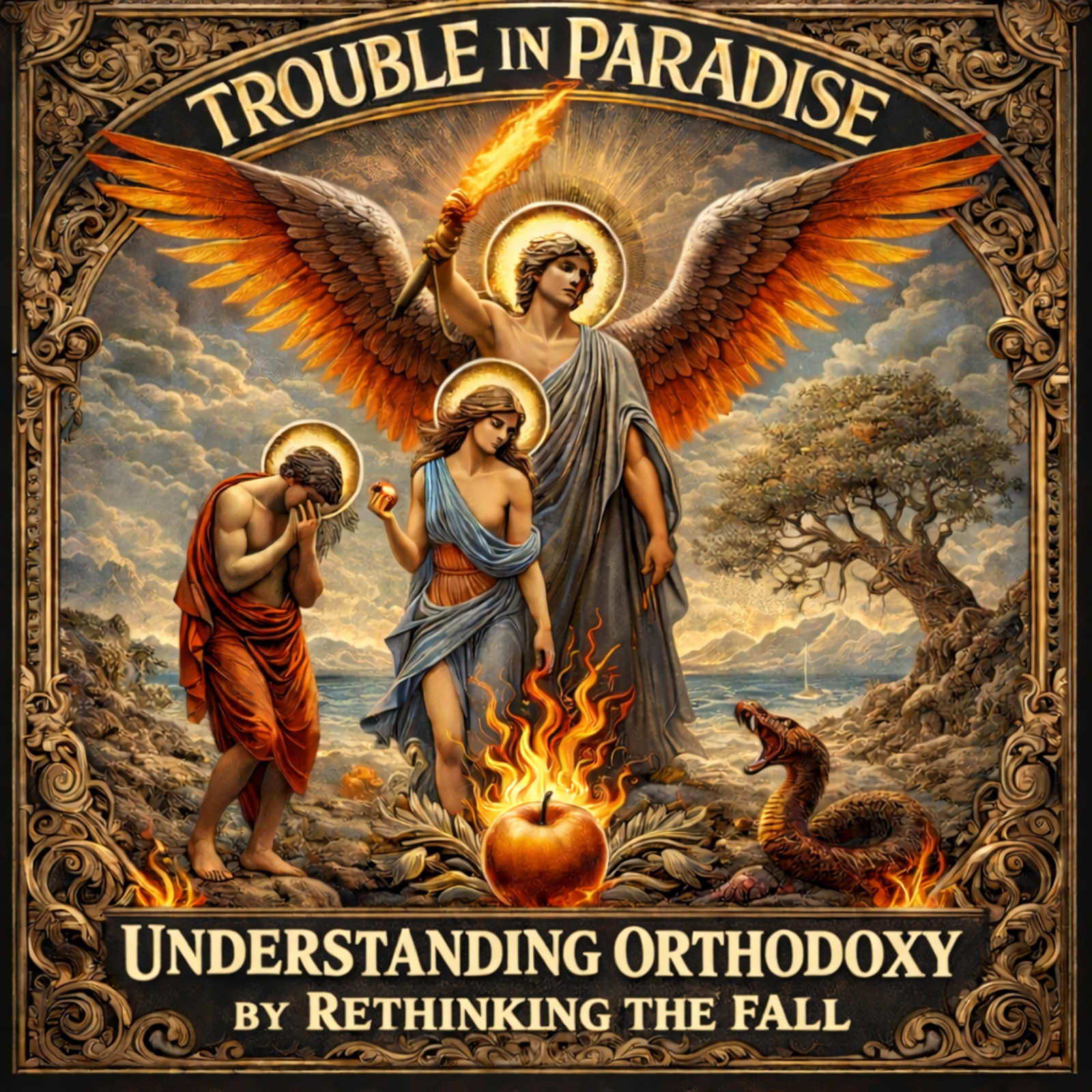
Trouble in Paradise - Understanding Orthodoxy by Rethinking the Fall
by Matthew Lyon
Trouble in Paradise explores why Eastern Orthodoxy often seems confusing to other Christians — and how rethinking Original Sin reshapes the entire Christian story.Through personal story, historical theology, and spiritual reflection, this podcast walks listeners through the crisis and discovery that can occur when those assumptions are challenged.For Protestants, Catholics, and Orthodox Christians seeking a deeper understanding of the Christian story.
-
12
Energy, Synergy, and Union: How Salvation Actually Works — Organic Pictures of Salvation — A Coherent Vision of Life in Scripture — Part 3
Organic Pictures of Salvation — A Coherent Vision of Life in ScriptureEpisode 12 — Instead of beginning with systems, we follow the pattern of Scripture itself—looking at how salvation is described through images like seed, soil, trees, and vine.Along the way, we contrast two starting points:Salvation as the removal of inherited guiltSalvation as deliverance from death and participation in lifeAnd we explore what that shift means for:the human willgrace and worksand the role of ongoing participation in the life of God🌱 Key Ideas1. The starting point shapes everything If the problem is guilt → salvation is legal If the problem is death → salvation is life2. Scripture emphasizes responsibility, not inherited guilt Passages like Book of Ezekiel 18 and Book of Deuteronomy 30 present a consistent pattern:personal responsibilityreal possibility of turninga call to choose life3. The will is not destroyed—but it is not self-sufficient The human will:cannot generate lifebut can receive or resist it4. Salvation is described as something organic Across Scripture:seed grows over timetrees require nourishmentbranches must remain connectedfruit reveals realityThese images assume:processparticipationdependence5. The Eucharist makes the pattern concrete In Gospel of John 6, Christ doesn’t just describe life—He gives it. Salvation is not something possessed independently, but something continually received.
-
11
Frankenstein, Death, and Original Sin
Episode 11 —Frankenstein, Death, and Original SinThis episode explores Frankenstein by Mary Shelley as more than a warning about science—it’s a story about death, the human will, and what happens when traditional theological frameworks collapse.🧭 Core IdeaIn earlier Christian thought—seen clearly in Paradise Lost—the pattern is:sin → deathBut in Frankenstein, that pattern is reversed:death → becomes the engine that drives human actionThe novel presents a world where death is no longer explained within a theological framework, but becomes the central problem shaping everything.⚔️ Historical and Theological BackgroundJohn Milton writes within a world shaped by:Reformation theologydivine sovereigntyhuman fallennessJohn Calvin and later thinkers emphasize:the brokenness of the human willsalvation as something givenBy Shelley’s time:these ideas are still presentbut increasingly questioned and rejectedWilliam Godwin (Shelley’s father):raised in a Calvinist environmentrejects it in favor of reason and human perfectibilityMary Wollstonecraft (her mother):rejects the idea that humans are born ruinedretains belief in moral progress💀 Death as the EngineIn Frankenstein:The death of Victor’s mother becomes the turning pointDeath is no longer a consequence—it becomes the driving forceFear of death leads to:controltechnological interventiondesecration of the human bodyThe grave becomes a resource. The body becomes material.🧠 The Will: Control vs. TrustVictor’s response to death reveals a deeper tension:The will is active, but shaped by fearFaced with death, there are two paths:Resurrection (received)death is not finalnot ours to overcomeControl (attempted)death must be defeated directlyleads to manipulation and violationVictor chooses control.🧩 The Creature and BelongingThe Creature reads Paradise Lost and asks:Am I Adam… or a fallen angel?He begins with longing and moral awarenessHe seeks relationship and acceptanceHe is consistently rejectedHis turning point comes when:he concludes he will never be receivedThis leads to:collapse of hopeemergence of rage⚡ Key QuestionThe novel leaves a central question unresolved:Are we corrupt because of how we are made… or do we become destructive because death is already at work?🔥 The HorrorThe real fear in Frankenstein is not the Creature itself—it is the recognition that his transformation makes senseUnder the same conditions:isolationrejectionfear of deathwe would become him✝️ Final ReflectionThe episode closes with a contrast:If death is ultimate → fear drives everythingIf resurrection is real → death is not the final authorityThe question is not whether we face death— but how we face it.🎯 Key TakeawayWe don’t escape becoming the Creature by overcoming death— but by trusting that death has already been overcome.
-
10
Energy, Synergy, and Union: How Salvation Actually Works — Death, Defilement, and the Restoration of Life — Part 2
Episode 10 — This episode continues the exploration of salvation as union with God, not as an abstract idea, but as real participation in divine life. Building on Part 1, we turn to Scripture—especially Leviticus and the Gospels—to examine how the Bible consistently presents the human problem as death, corruption, and separation from life.Leviticus and the Problem of DeathLeviticus is often misunderstood, but it provides a crucial foundation. Its central concern is not abstract guilt, but ritual defilement connected to death.What makes someone ritually defiled?touching a dead bodyloss of bloodbodily dischargesconditions associated with decayThese are all signs of life leaving the body.Importantly, many of these states occur without sin. This shows that ritual defilement is not primarily about wrongdoing, but about contact with mortality—a kind of participation in death.Leviticus presents a world where:death spreadscorruption spreadsdefilement spreadsThe sacrificial system restores by reorienting the person toward life. As Leviticus teaches, “the life is in the blood.”Christ and the ReversalIn the Gospels, Christ does not reject this framework—He reverses it.Under the law: contact with death → defilement spreadsIn Christ: contact with life → life spreadsExamples:A leper is touched and made cleanA woman losing blood is healedThe dead are raisedIn the case of prolonged illness, Scripture also connects suffering with spiritual bondage, as Christ speaks of those “bound” by Satan. This reinforces that corruption is not only physical, but also spiritual in nature.Christ does not become defiled. Instead, life overcomes death.Union and the Nature of SalvationThis shifts the central question:Not just, “What have you done?” But, “What are you united to?”Salvation is not merely about forgiveness—it is about being freed from death and restored to union with the life of God.Morality as Participation in LifeChristian morality flows from this reality.It is not simply a list of prohibitions. It is about aligning with life.Human beings bear the image of God, and that image is not erased. Every person is a life given by God and meant for union with Him.Love, then, is not just a feeling. It is the active support and honoring of life in another person.The Final Judgment (Matthew 25)Christ describes the final judgment in terms of love expressed through life-giving action:feeding the hungrygiving drink to the thirstywelcoming the strangercaring for the sickThe division is not framed as belief versus action, but as:love… and no loveWhere Is Merit?In this scene, there is no emphasis on earning or accumulation.The righteous are not calculating—they are surprised.They have become people who live in love, because they are participating in the life of Christ.As Christ says:“You did it to me.”Key TakeawaySalvation is union with life. Morality is living in that life. Love is the expression of that life.
-
9
The Resurrection Changes Everything—Or Nothing
Episode 9 —Why do many Christians spend months preparing for Christmas… but only hours reflecting on Easter?In this episode, we explore a quiet but significant shift in modern Christianity: the tendency to center the Cross while treating the Resurrection as secondary.Starting from a real conversation after an Easter service, this episode examines why the Passion is easier to relate to—and why the Resurrection is often reduced to little more than proof that Jesus is who He claimed to be.Drawing from the writings of Paul the Apostle, we ask what it really means to be “still in your sins,” and why forgiveness alone does not fully answer the human problem if death itself remains undefeated.We also explore how this imbalance can lead to a subtle dualism—where the soul is prioritized, the body is neglected, and salvation becomes more about escape than restoration.Finally, we contrast this with the lived rhythm of Pascha in the Orthodox Church, where the Resurrection is not just affirmed—but prepared for through Great Lent and celebrated as the central reality of the Christian life.If Christ is risen, then death is not normal—and Christianity is not just about being forgiven.It’s about being made alive.
-
8
Energy, Synergy, and Union: How Salvation Actually Works — Untangling Yourself from Death and Satan – Part 1
Episode 8 —This episode explores salvation as liberation and restored union with God, not simply forgiveness. A central question frames the discussion: What would happen if references to Satan and spiritual bondage were removed from the Bible?In the Gospels—especially Mark—a large part of Christ’s ministry involves casting out demons. This suggests the problem Christ addresses is not only human sin but also bondage to death, corruption, and spiritual powers.Humanity’s Union With DeathScripture often describes human existence in terms of union. Humanity is born into union with Adam and therefore inherits mortality and corruption. The word corruption originally referred to physical decay—rust, rot, or spoilage. Over time these terms became moral descriptions.Many words associated with moral failure began as descriptions of decay:corruptionrottenspoileddepravedThe biblical pattern often follows this progression:death → decay → fear → sinHuman beings inherit mortality, and fear of death drives self-preservation. When survival is pursued apart from trust in God, sin follows. Hebrews describes humanity as enslaved through the fear of death.Fear and TrustJesus addresses this fear in Matthew 10. He tells His disciples not to fear those who can kill the body but to fear God.Trust in God becomes the antidote to fear-driven self-preservation.Sin as Misplaced UnionSin can be understood as misdirected union.Union with God produces life and freedom. Union with destructive passions or spiritual forces produces bondage.Sin ultimately becomes self-preservation without trust. When trust weakens, union with God weakens. Repentance restores that relationship.Baptism and New UnionIn the early Church, preparation for baptism included exorcism prayers, symbolizing a break from the dominion of darkness.Baptism represents participation in Christ’s death and resurrection. Believers die with Christ and rise with Him. Through this participation a new union begins—union with Christ instead of union with the death inherited from Adam.Chrismation and the SpiritAfter baptism comes Chrismation, where the believer receives the Holy Spirit. The Spirit strengthens the human person and restores freedom of will, enabling cooperation with God’s life.Essence, Energies, and SynergyThe Fathers distinguished between God’s essence and energies. God’s essence is what God is; His energies are how He acts and gives life. Humans cannot share God’s essence but participate in His energies.Salvation therefore involves synergy—God acts first and human beings respond.The Fathers illustrated this with iron in fire. The iron remains iron but becomes radiant and filled with the fire’s energy.The Goal: TheosisAs St. Athanasius said:“God became man so that man might become god.”Not by nature, but through participation in the life of God.Next EpisodeNext time on Trouble in Paradise, we’ll explore the biblical images that describe this participatory union, including the vine and branches, living water, temple imagery, and marriage imagery.These images reveal salvation as organic participation in the life of God.
-
7
Is the Sovereign God Actually Free?
Episode 7 —Christians regularly affirm three things about God:God is sovereign. God is free. God is love.But those claims only hold their meaning if we clarify one deeper concept: necessity.When something happens necessarily, it means it could not have been otherwise. Not unlikely, not difficult, but impossible to be different. Two plus two equals four necessarily. A dropped stone falls necessarily.This episode asks a simple but far-reaching question: Is God’s willing like that?To illustrate the issue, imagine two kings.The first is King Ironlaw. Everything in his kingdom unfolds inevitably from who he is. No one forces him, and nothing compels him. But if you understood his nature perfectly, you could predict every decree forever. Nothing could have been otherwise. He is sovereign, but the future is inevitable.The second is King Artisan. He is just as powerful and wise, but when he surveys his kingdom he sees many genuine possibilities. He could build by the sea or in the mountains. None of these possibilities are inferior or forced. He chooses one simply because he wills it.Both kings are sovereign. But only one has real alternative possibility.This contrast helps frame a tension inside Western theology. Many traditions strongly emphasize that nothing happens outside God’s decree. Every salvation, every sin, every event falls within divine providence.But that raises a question: Could anything have happened differently?If the answer is no—not because God freely chose among real alternatives, but because it could never have been otherwise—then reality begins to look inevitable. God still acts from Himself, but the openness we normally associate with freedom disappears.The question becomes sharper when applied to election. Both Catholic and Reformed traditions affirm that God shows mercy to the elect while others remain outside salvation. There is a distinction between mercy and judgment.But if those outcomes were structurally necessary—if God could not have saved the reprobate or refrained from saving the elect—then what do we mean by grace or mercy?The distinction remains, but the openness seems to vanish.Interestingly, this conclusion can arise from two different directions.One path begins with metaphysics: ideas about divine simplicity and God as Pure Act, where God’s will flows necessarily from His nature.The other path begins with anthropology: the doctrine of original sin. If fallen humans cannot seek God and always act according to their nature, then freedom gets redefined as acting according to one’s desires rather than having the ability to do otherwise. Salvation must then come entirely from God’s initiative. From there, the logic of divine decree and providence expands until every event—including the Fall itself—lies within God’s will.Different starting points, but the same structural outcome: freedom defined as non-coercion, while alternative possibilities disappear.That brings us to the final question of the episode.When Christians say that God freely created, freely elected, and freely loves, what exactly does “freely” mean?If God could not have done otherwise, then divine action becomes inevitable. And inevitability is not the same thing as freedom.At the bottom of reality, does everything ultimately reduce to necessity? Or does explanation finally end with a personal act of will?The answer determines whether ultimate reality is best understood as a structure or as a sovereign mind—and that difference shapes how we understand creation, grace, and the nature of divine love.
-
6
Born Afraid: The Engine of Sin
Episode 6 —What if we’ve misdiagnosed the human problem?Many Christian traditions begin with inherited depravity — the idea that we sin because we were born corrupt at the root. But Scripture may emphasize something even more foundational: death and the fear it produces.In this episode, we explore whether mortality — not metaphysical corruption — is the deeper engine beneath human sin.Core QuestionDo we sin because we are sinners?Or are we sinners because we sin?And if we sin, is it because we were born evil — or because we were born mortal?The Biblical FrameHebrews 2:14–15Humanity is described as enslaved “through fear of death.” The bondage is existential and lifelong.Genesis 3The first recorded response after the fall is fear:“I was afraid… and I hid myself.” (Genesis 3:10)Death enters. Fear awakens. Hiding begins.Romans 5Paul emphasizes that:Sin entered the world.Death entered through sin.Death “reigned.”The focus is not only corruption — but dominion.1 Corinthians 15“The last enemy that shall be destroyed is death.” If death is the last enemy, perhaps it is also the deepest one.A Provocative ThesisWhat if sin is self-preservation without trust?What if sin is self-medicating fear?Lust quiets loneliness.Greed quiets insecurity.Control quiets vulnerability.Religious performance quiets anxiety.If death is the atmosphere of fallen humanity, fear becomes instinct — and sin becomes anesthesia.Christ’s ReversalIn Gethsemane:“My soul is exceeding sorrowful, even unto death…” (Matthew 26:38)On the cross:He refused the anesthetic (Matthew 27:34).Jesus does not numb fear. He enters death fully conscious — and breaks it from the inside.If death is the root problem, resurrection life must be the root solution.The ConclusionOur predicament does not require inherited depravity as the engine when we have already inherited death.If death reigned, then resurrection must reign stronger.If fear fueled sin, then the destruction of death removes fear’s leverage.If we share in Christ’s life, then fear no longer writes our prescriptions — and sin no longer defines our destiny.Scripture ReferencesHebrews 2:14–15Genesis 3:10, 19Romans 3:9Romans 5:12–141 Corinthians 15:22, 26, 55Matthew 26:38–39Matthew 27:34
-
5
Very Good Is a Long Way from Perfect - Part 3 - Collapse, Inability, and the Logic of the Cross
Episode 5 —In Part 3, we follow the implications of one foundational question:Did Genesis describe Adam as perfect — or as very good?We explore how imagining a perfected Adam logically leads to:Collapse/Corpse anthropologyInability to will salvific goodMonergistic graceMeticulous providenceThe “inevitability instinct”Intensified penal substitutionWe then contrast this with the Orthodox diagnosis of the Fall as mortality, corruption, and fear of death — not metaphysical annihilation of the will.It is an examination of premises.Key Biblical TextsGenesis 1:31 — “Very good” (tov me’od)Romans 8:7–13 — “Those who are in the flesh cannot please God”Hebrews 2:14–15 (KJV) — Fear of death and lifelong bondageKey Confessional Sources (Western)Thirty-Nine Articles (1563)Drafted during the English Reformation under Elizabeth I to define doctrine within the Church of England.Article IX:“Original sin… is the fault and corruption of the Nature of every man… whereby man is very far gone from original righteousness…”Westminster Confession of Faith (1646)“Man… hath wholly lost all ability of will to any spiritual good accompanying salvation.”1689 London Baptist Confession“Man… hath wholly lost all ability of will to any spiritual good accompanying salvation.”Arminian SourcesJohn Wesley“By nature every man is dead in sin… void of all power to do good… and has no free will, unless it be to do evil.”Jacobus Arminius“In his lapsed and sinful state, man is not capable… to think, to will, or to do that which is really good… unless he be regenerated and renewed by God in Christ.”Evangelical Language of InabilityEven outside confessional Calvinism, collapse anthropology persists in revival preaching:Chuck Smith“Man in his natural state is spiritually dead… incapable of coming to God apart from the work of the Holy Spirit.”The Logical Chain ExaminedPerfect Adam → Catastrophic collapse → Inability to will salvific good → Monergistic grace → Meticulous sovereignty → Inevitability instinct → Wrath-intensified penal substitutionOrthodox DiagnosisAthanasius of AlexandriaHumanity became “corruptible” and “held fast by the law of death.”Maximus the ConfessorNatural will remains.Fallen mode of willing becomes distorted.Inability is bondage under death, not ontological erasure.Analogy used in the episode:The will is like a compass near a magnet — still present, but pulled off course.Core Question RaisedDoes replacing inherited infinite guilt with mortality, corruption, Satan, and fear of death reduce the seriousness of sin?Or does it reframe it?“The question is not whether sin is serious. The question is what makes it serious — how it destroys, and why.”What This Episode Is NotNot a denial of sin.Not a denial of grace.Not a denial of substitution.Not an attack on Evangelicals or Catholics.Not a rejection of Scripture.It is an examination of anthropology.
-
4
Very Good Is a Long Way from Perfect - Part 2 - Immortal or Conditionally Immortal?
Episode 4 —If Adam was created perfect… why did he fall?And if God knew he would fall… what does that mean for evil?In Part 2 of Very Good Is Far from Perfect, we follow the logic of perfection all the way to the edge — into the question many people are afraid to ask:Does our theology accidentally make evil necessary?In this episode:Why “perfect Adam” creates pressure in theodicyA simple breakdown of free will: libertarianism, determinism, and compatibilismWhy Arminians and Calvinists may share more assumptions than they realizeWhat “God permitted the Fall” really means — and how that differs in Western and Orthodox theologyLeibniz and the “Best of All Possible Worlds”Why evil becomes instrumental in some systemsEvil as parasitic, not necessary“I am the Vine, you are the branches” — an organic vision of salvationThis episode isn’t about attacking traditions.It’s about asking whether our starting assumptions — especially the idea that Adam was created perfect — force us into theological tensions that never fully resolve.What if the problem isn’t sovereignty versus free will?What if the problem is the assumption that Adam was perfect?Very good is far from perfect.And that difference changes how we speak about God.
-
3
Very Good Is a Long Way from Perfect - Part 1 - Permitted or Ordained to Fall?
Episode 3 — What if the entire Western understanding of salvation rests on a word the Bible never uses?Genesis does not say Adam was created perfect. It says he was very good.In this episode, we explore how that distinction reshapes everything:Was Adam created finished — or with potential?If humanity was perfect, why probation?Why command Adam to subdue the earth if creation was already complete?Why is Scripture filled with imagery of ascent — Jacob’s ladder, mountains, transformation “from glory to glory”?We examine:The early Church Fathers (Irenaeus, Athanasius, Basil)Conditional immortality and participation in divine lifeAugustine’s shift toward inherited guiltHow Covenantal probation assumes growthCalvin, decree, and the pressure toward inevitabilityThe Essence–Energies distinction and divine freedomWe also ask uncomfortable questions:If you define the Gospel as “going from hell to heaven,” are you already operating inside the framework of inherited condemnation — even if you say you reject Original Sin?What does our treatment of children — communion, baptism, “age of accountability” — reveal about our anthropology?If Adam was not created perfect but called to grow into communion, then salvation is not merely legal acquittal.It is healing. Resurrection. Participation.Very good, not perfect. Communion, not probation. Freedom, not inevitability.And that difference changes everything.
-
2
What Do Christians Mean by Original Sin?
Episode 2 — The doctrine of Original Sin has shaped how Western Christianity understands salvation, grace, human nature, and the Gospel itself. But what exactly is Original Sin, and how did this doctrine develop?In this episode, we begin examining how different Christian traditions have understood humanity’s fall. We explore the historical development of Original Sin, how it became central to Western theology, and how Eastern Christianity approaches the problem of human brokenness differently.This episode lays the foundation for understanding why differences in the doctrine of the Fall lead to very different understandings of salvation.In This Episode• What the doctrine of Original Sin teaches • The historical development of Original Sin in Western Christianity • Differences between inherited guilt and ancestral corruption • How Augustine influenced Western views of sin and human nature • Why theology built on Original Sin shapes doctrines like grace, election, and atonement • How Eastern Christianity frames the human problem in terms of death, corruption, and the fear of death • Why diagnosing the human problem differently changes how salvation is understoodKey ThemesThe Diagnosis Determines the Cure How Christians understand humanity’s fall directly shapes how they understand salvation and the Gospel.Historical Development of Doctrine The doctrine of Original Sin developed over time and became foundational to Western Christian theology.Eastern vs. Western Christian Anthropology Different understandings of sin, death, and human nature lead to different theological frameworks.Why This MattersIf humanity’s primary problem is understood as inherited guilt, salvation will be understood primarily as legal forgiveness.If humanity’s primary problem is death and corruption, salvation becomes healing, restoration, and participation in divine life.Understanding this difference helps explain why Eastern Orthodoxy often approaches salvation differently than Western Christianity.Who This Episode Is For• Christians wanting to understand the doctrine of Original Sin • Listeners exploring the differences between Western and Eastern Christianity • Catechumens and theological inquirers • Anyone interested in the historical development of Christian doctrineComing NextIn the next episode, we begin exploring how early Christianity described humanity before the Fall, including the distinction between being “very good” and being fully perfected.
-
1
When the Story Became Bigger Than I Expected
Episode 1 -Most Christians are taught to start with a simple question: How am I forgiven?And while forgiveness is central to the New Testament, starting there may already assume something deeper—something we rarely stop to examine.In this episode, we step back and ask a more fundamental question: What is the gospel?In the ancient world, a “gospel” wasn’t a formula or a method. It was an announcement—news that a king had come, that a victory had been won. When the early Christians proclaimed “Jesus is Lord,” they weren’t offering a private religious belief, but making a direct challenge to a world that already had its own “gospel” and its own lord.From there, the discussion turns to a deeper issue: not just what we’ve done, but what we are.When do we become sinners? What is the condition of the human person from the beginning? And what is the will actually capable of?By looking at how different traditions approach infants, baptism, and the idea of “accountability,” we begin to see that the real divide isn’t just about forgiveness—it’s about anthropology.Is original sin primarily guilt? Or is it death, corruption, and the fear of death that gives rise to sin?And if death is the problem, then salvation is not just forgiveness—it is healing, restoration, and participation in life.
We're indexing this podcast's transcripts for the first time — this can take a minute or two. We'll show results as soon as they're ready.
No matches for "" in this podcast's transcripts.
No topics indexed yet for this podcast.
Loading reviews...
ABOUT THIS SHOW
Trouble in Paradise explores why Eastern Orthodoxy often seems confusing to other Christians — and how rethinking Original Sin reshapes the entire Christian story.Through personal story, historical theology, and spiritual reflection, this podcast walks listeners through the crisis and discovery that can occur when those assumptions are challenged.For Protestants, Catholics, and Orthodox Christians seeking a deeper understanding of the Christian story.
HOSTED BY
Matthew Lyon
CATEGORIES
Loading similar podcasts...
Frequently Asked Questions
How many episodes does Trouble in Paradise - Understanding Orthodoxy by Rethinking the Fall have?
Trouble in Paradise - Understanding Orthodoxy by Rethinking the Fall currently has 12 episodes available on PodParley. New episodes are automatically indexed when they're published to the podcast feed.
What is Trouble in Paradise - Understanding Orthodoxy by Rethinking the Fall about?
Trouble in Paradise explores why Eastern Orthodoxy often seems confusing to other Christians — and how rethinking Original Sin reshapes the entire Christian story.Through personal story, historical theology, and spiritual reflection, this podcast walks listeners through the crisis and discovery...
How often does Trouble in Paradise - Understanding Orthodoxy by Rethinking the Fall release new episodes?
Trouble in Paradise - Understanding Orthodoxy by Rethinking the Fall has 12 episodes. Check the episode list to see recent publication dates and frequency.
Where can I listen to Trouble in Paradise - Understanding Orthodoxy by Rethinking the Fall?
You can listen to Trouble in Paradise - Understanding Orthodoxy by Rethinking the Fall on PodParley by clicking any episode. We provide an embedded audio player for direct listening, and you can also subscribe via your preferred podcast app using the RSS feed.
Who hosts Trouble in Paradise - Understanding Orthodoxy by Rethinking the Fall?
Trouble in Paradise - Understanding Orthodoxy by Rethinking the Fall is created and hosted by Matthew Lyon.
URL copied to clipboard!