
PODCAST · science
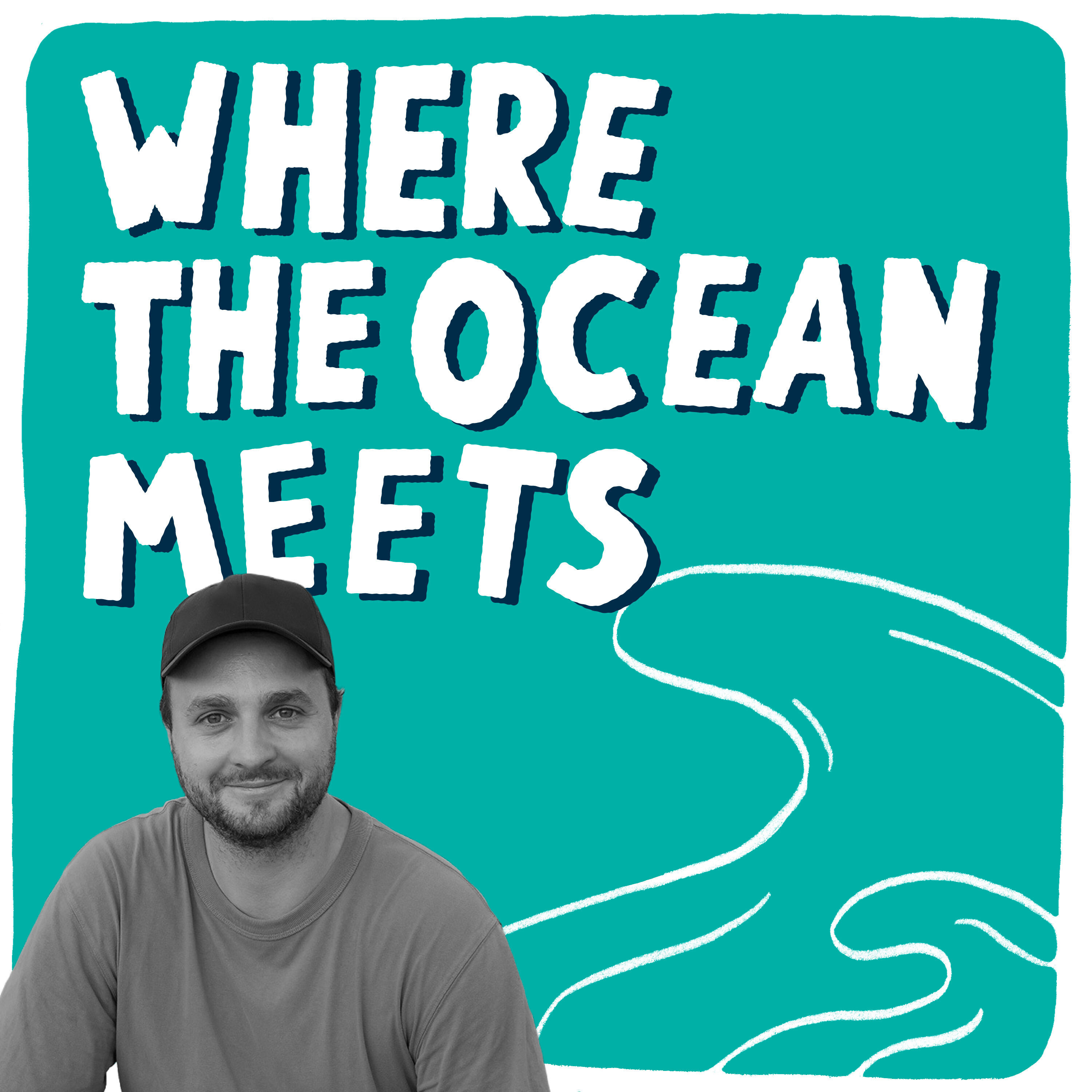
Where The Ocean Meets:
by Joel Tasche
My biggest life regret? Studying business instead of marine biology. 💔 The ocean fills me with happiness, wonder, and fascination—yet I know so little about it. By day, I fight ocean plastic pollution to make amends. By night, I create this show. ☯️This podcast is my journey, as an amateur ocean enthusiast, to explore the ocean as an ecosystem, playground, and economic powerhouse—no expertise required to dive in (though experts might enjoy hearing from their colleagues). If you're curious about the force covering 70% of our planet and sustaining life, join me—listen and follow now. 🌊
-
16
Is Microplastics Removal From Waterways Possible? | Where The Ocean Meets: Nathaniel Banks
A Princeton-educated architect walks into a water treatment plant and violently shakes microplastics into a bathtub.What sounds like a joke written by an intoxicated AI is reality for Nathaniel Banks.In this episode, we explore how thinking through problems from start to finish can help with the daunting task of solving the microplastic problem.Nathaniel is CEO & Co-Founder of PolyGone. Nature inspired their filter technology, which can remove microplastics from different kinds of waterways.We discuss how they came up with the idea, how they got it to work, and where the technology needs to go to have a significant impact.Get a glimpse into a mind that microplastics obviously haven't had any impact on yet.Key Topics:The scale and health impacts of microplastic pollutionHow aquatic plants inspired a revolutionary filtration technologyThe journey from architecture to environmental innovationReal-world deployment and results from water treatment facilitiesThe regulatory challenges and private sector opportunitiesWhat happens to collected microplastics and recycling innovations
-
15
Why scientists fail to get their stories heard - Marine Biologist turned Communicator explains
Dr. Russel Arnott manages to more than a million views on his videos. And that's not a product of guess work but by preparation. And it's not like he studied in marketing departments for ages. He is a marine biologist. But he found a way how to tell the stories better.What all that has to do with his detest of academic conferences, which frameworks he applies and how you can learn to tell better stories. He explains all of that in this episode. This is free consultation on story telling for the oceans!
-
14
Biologist explains: How corals make babies & sargassum solutions
Andrew Barrows takes us underwater in Hawai'i to learn how coral have baby. He explains there is a sense that picks it up before you can see it. And somehow coral seem to be spiritual: the species he researched only does it during a specific lunar phase. #spiritanimalIn other dirtier topics, we discuss sargassum. The stinky seagrass that is typically very important to eco-systems. But lately it's become a problem - and Andrew might have the solution to it. Listen to find out!
-
13
Why Are Companies Destroying Our Planet Allowed To Make Money? | Where The Ocean Meets: Will Pearson
Building a Positive Vision for the Future with Will PearsonEpisode SummaryWe haven't had a positive vision of the future since Star Trek in the 1960s. In this episode, I sit down with Will Pearson, co-founder of Ocean Bottle, to design a roadmap for what comes next. From reshaping capitalism to putting the ocean at the center of our economy, we explore how to build systems where businesses give more than they take and planetary healing becomes profitable.GuestWill Pearson - Co-Founder of Ocean Bottle, Forbes 30 Under 30, B-Corp advocateOcean Bottle has collected over 22 million kg of ocean-bound plastic while building an 8-figure revenue business. Will is also the founder of B+, an initiative bringing together the world's most ambitious companies on climate and nature.Key TopicsReshaping Capitalism: Start, Stop, KeepWhy businesses that heal the planet should be profitableThe B+ initiative: connecting regenerative startups with global corporationsMoving from businesses that reduce harm to businesses that create positive impactOcean-Centered FuturePutting ocean health at the center of economic planningMarine protected areas and biodiversity restorationWhy we need sharks back in the MediterraneanPlastic Economy TransformationDesign problems: 400-year materials for week-long productsBreaking plastic's dependence on oil industry byproductsBuilding collection infrastructure that provides income opportunitiesMedia and Culture ChangeWhy constructive optimism beats fear-based messagingMaking scientists and ocean researchers the new cultural heroesThe need for platforms that celebrate positive solutionsMemorable Quotes"We need to flip the question - instead of asking why environmental companies should be allowed to profit, we should ask why companies destroying the planet are allowed to make money.""Businesses need to give more than what they take. We're getting to a point where companies reduce negative externalities to zero and actually drive positive impact.""Without a doubt, if we can protect the ocean and allow it to regenerate itself, it will be our biggest ally against climate change and the biodiversity crisis."Resources MentionedB+ Initiative - Community of ambitious climate and nature companiesAtmos & Earthrise Studios - Instagram channels for sustainability stories"Ocean" by David Attenborough - Book recommendation"Blue Mind" - Book on human connection to waterCleanHub - My company partnering with Ocean Bottle on collectionConnect with WillOcean Bottle: oceanbottle.coLinkedIn: Will PearsonConnect with MeCleanHub: cleanhub.comLinkedIn: Joel TascheThis episode is part of Where The Ocean Meets, exploring the intersection of business, sustainability, and ocean conservation. Subscribe wherever you get your podcasts.
-
12
From MS Diagnosis to World Record Apnea Diver | Where The Ocean Meets: Anna Karina Schmitt
Smoking, party lifestyle, MS Diagnosis - World Record in Apnea Diving?How do all these things come together? Anna and me sit down to cover her wild ride from speed boats, to finding tranquility at 80m below sea level without oxygen. Join us in this conversation that has more highs and lows than the wild oceans. This is also your chance to acompany a world record dive without getting your feet wet.SummaryIn this conversation, Anna shares her journey as a world record apnea diver, discussing the mental and physical challenges of freediving, her early experiences with water, and how her diagnosis of multiple sclerosis led her to a healthier lifestyle.She emphasizes the importance of mental preparation, the joy of diving, and the lessons learned from both successes and failures in her sport. Anna also reflects on the deeper connections between humans and water, and how freediving has shaped her perspective on life and health.Takeaways- Anna-Karina set a world record in apnea diving under challenging conditions.- Breath-holding can be a blissful experience when the mind is free of expectations.- Early experiences with water shaped her love for diving.- Freediving provided a sense of community and belonging.- The diagnosis of multiple sclerosis prompted a lifestyle change towards health.- Mental preparation is crucial for success in freediving.- The joy of diving comes from being present in the moment.- Every dive is a learning experience, whether good or bad.- The mind plays a significant role in physical performance.- Freediving teaches resilience and the importance of self-care.
-
11
Building A Nervous System For The Ocean | Where The Ocean Meets: Sergei Nozdrenkov
If you've ever wondered how technology could actually save nature (instead of destroying it), this conversation will blow your mind.What happens when a Google X engineer who grew up driving tractors in a small village becomes obsessed with saving coral reefs?Meet Sergei Nozdrenkov, founder of Wildflow, who's building something that sounds like science fiction: a "nervous system for the planet."Sergei's journey from reading Arthur C. Clarke's 'The Deep Range' to diving in Iceland's tectonic plates to working with sharks in Mexico is wild enough.But his current mission? Creating AI that can process massive streams of ocean data—3D coral imagery, bioacoustic recordings, eDNA samples—and turn them into actionable conservation decisions in real-time.We dive deep into how nature's own algorithms could revolutionize ecosystem management, why 84% of coral restoration projects are never monitored, and Sergei's audacious vision of modeling the entire biosphere.Plus: coral that eats fish, why wolves brought rivers back to Yellowstone, and his prediction for when we'll meaningfully communicate with whales.Books Mentioned2001: A Space Odyssey by Arthur C. ClarkeThe Deep Range by Arthur C. ClarkeHow to Speak Whale by Tom Mustill
-
10
Will Marine Protected Areas Save Humanity? | Where The Ocean Meets: Dr Fabio Favoretto
At the UN Oceans Conference, I heard a bold claim from an Australian billionaire: if we turn 30% of the world's ocean into marine protected areas, we can fix the oceans.This sparked a fascinating conversation with Dr. Fabio Favoretto, an internationally renowned marine scientist who has dedicated his career to researching these protected zones.What started as an academic discussion turned into one of the most entertaining and eye-opening conversations about ocean conservation.Dr. Favoretto paints vivid pictures of healthy oceans where the sun goes dark from massive schools of tuna, and of devastated seas that have become underwater deserts. He explains what marine protected areas really are, why they're so controversial, and the surprising obstacles we face in establishing them.Most importantly, this conversation offers hope - because the science shows that when we stop interfering, nature doesn't just survive, it explodes back to life with breathtaking speed.About FabioDr. Fabio Favoretto - Marine ecologist and internationally renowned scientist specializing in marine protected areas research. With over 4,000 dives around the world, Dr. Favoretto has conducted groundbreaking research at Mexico's Revillagigedo Archipelago and works to demonstrate how ocean protection benefits both marine ecosystems and fishing communities.In this epsode you will learn about:Marine Protected Areas (MPAs): What they are and why only 3% of the ocean is truly protectedOcean Recovery: How ecosystems can bounce back in just 10 years when left aloneThe Mediterranean Crisis: How Europe's sea was transformed from a biodiverse paradise to an underwater desertIndustrial vs. Artisanal Fishing: The real culprits behind ocean depletionThe Spillover Effect: How protecting areas actually helps fishermen30 by 2030 Movement: The global push to protect 30% of oceans by 2030Hope and Solutions: Why getting out of nature's way is the key to recoveryKey Quotes"The sun darkened. Everything went and I could feel the movement of the water because thousands of tunas were like just going... you could see like, like basically Formula One cars." - Dr. Favoretto describing an encounter at Revillagigedo"That was stolen from me. I could have dove with mantas, white sharks, turtles, seals... I could have dove in the Mediterranean Sea, and I cannot anymore." - On the degradation of the Mediterranean"The ocean is not dying. The ocean will never die... We are the ones that are paying the price, but we are not realizing it.""We can do almost whatever we want with 97% of the ocean. So what are we talking about? We are really fighting about the 3%.""It's either protect or go extinct."Resources MentionedRevillagigedo Archipelago (Mexico's "Galapagos")Pristine Seas Initiative (National Geographic)Cabo Pulmo Marine Protected Area success story"The Unnatural History of the Sea" by Carl Roberts30 by 2030: ocean protection movementStay tuned for more deep dives into ocean conservation, marine science, and the people working to protect our blue planet.
-
9
Climate Change is Destroying the Great Barrier Reef | Here's Why with Dr Jodie Rummer
Witness firsthand the devastating impact of 31-degree water temperatures as Dr. Jodie Rumer describes the beginning of coral bleaching on the Great Barrier Reef.This episode dives into the physiology of the climate crisis, showcasing how marine heatwaves are affecting fragile ecosystems. Discover the critical science behind these changes and what it means for the future of ocean life.Imagine an Episode of the Huberman Lab Podcast but instead of humans, we discuss fish.Still the same keywords: VO2 Max, heart rate, oxygen levels, and how to improve performance. But this is not about self-improvement. It's about studying how fish - some of the best athletes in the world - adapt to climate change.Jodie enlightens me on how fish experience an ocean that is getting too hot. How they react, what their coping mechanisms are - and most importantly: If there is hope.About Jodie"Over her career, Dr. Rummer has researched fish buoyancy, exercise, and is a leading authority on the evolution of oxygen transport and how fish maintain performance during stress. Her team combines physiology, ecology, and evolution to address issues important to conservation, particularly focusing on the effects of climate change and other anthropogenic stressors on coral reef fishes, sharks, and rays.With over 150 peer-reviewed publications and presentations at more than 120 professional conferences worldwide, Dr. Rummer's research has made significant contributions to our understanding of marine ecosystems and climate change impacts."(From her website: https://jodierummer.com)
-
8
What It Takes To Become A Big Wave Surfer | Where The Ocean Meets: Lena Kemna
When It's Never Too Late - Lena Kemna's Journey from Student to Big Wave SurferEpisode Description"It's too late." How many times have you heard those words? Most of us accept these limits and settle into the lives we think we're supposed to have. But what happens when someone completely rewrites the rules?Meet Lena Kemna - a woman who picked up her first surfboard at 24 while deep in her studies. Just a few years later, she's paddling out at Nazaré, Portugal, facing waves that tower eight stories high. This isn't just about learning to surf late in life. It's about discovering a passion so powerful it forces you to question everything you thought you knew about yourself.In this candid conversation, Lena shares the real story behind her extraordinary journey - from that first chaotic surf lesson in Fuerteventura to competing in big wave competitions. This is a story about not listening to what common sense tells you, and proving that you can have it all if you define what your "all" is.What You'll Learn- Why starting surfing at 24 might actually be an advantage for big wave surfing- The mental approach that keeps Lena safe in 20+ foot waves- How she balances a PhD in marketing with professional big wave surfing- The reality of surf culture and localism in Portugal and Germany- Why she's "not an adrenaline junkie" despite surfing massive waves- The importance of intuition and preparation in extreme sports- How to navigate toxic environments while pursuing your passionKey Topics Discussed- That pivotal wave in Bali that changed everything- Moving to Portugal and organizing life around the ocean- The difference between paddle surfing and tow-in surfing at Nazaré- Dealing with jet ski chaos and the big wave community- Taking a break from surfing due to toxic culture- The rediscovery of love for the sport in Madeira- Balancing academic life with professional surfing- Managing finances as an extreme athlete- Her approach to sponsors and staying true to valuesAbout Lena KemnaLena Kemna is a professional big wave surfer and PhD candidate in marketing who started surfing at 24. She now surfes at among others Nazaré, Portugal, one of the world's most famous big wave spots. She's also an accomplished freediver and advocates for authentic representation in extreme sports. Based in Portugal, she's building toward creating her own big wave team.Memorable Quotes from the Episode- "I'm quite German about it" - on her all-or-nothing approach to pursuits- "It was survival... just being out there in the power of the ocean, I think that kind of hooked me"- "For me it wasn't a hard decision, it was a very clear decision that I was like, it's the only way I want my life to revolve around the ocean"- "I like to do it kind of inside of my comfort zone... I'm not a crazy adrenaline junkie"- "If you go into a meeting room with the board of directors, it's never going to be as scary as a 24-foot wave behind it"- "There is no window" - on when it's too late to pursue dreams- "If I'm not having fun, I can just go home"Resources Mentioned- Nazaré, Portugal - legendary big wave surfing spot- Ericeira, Portugal - where Lena does most of her surfing- Madeira - where she rediscovered her love for surfing- The importance of apnea training for big wave surfingConnect with [email protected]://www.lenakemna.com/---This episode challenges everything you think you know about timing, risk, and following your passion. If you enjoyed it, subscribe and leave us a review to help others discover these stories of people who refused to accept "it's too late."
-
7
Sharks: 450 Million Years Of Evolution Formed The Ultimate Predator (With A 6th Sense)
Are sharks truly the monsters Hollywood made them out to be? In this episode, host Joel Tasche sits down with Dr. Mikki McComb-Kobza, Executive Director of the Ocean First Institute and member of the Explorers Club, to dismantle decades of "bad PR" for sharks. From the surprising social lives of Hammerheads to the "sci-fi" electrical senses that allow sharks to navigate the globe, Dr. Mikki reveals why these ancient survivors are critical to our planet's health.Whether you’re a surfer, a diver, or someone who’s still a little afraid of the dark water, this conversation will replace your fear with fascination. Key Topics & Timestamps [01:21] Myth-Busting Reproduction: Do all sharks lay eggs? Discover the "Adelphophagy" (sibling-eating) survival strategy. [03:29] Ancient Survivors: Why sharks are older than trees and the rings of Saturn. [05:22] The "Punch the Nose" Rule: The science behind the shark’s snout and its electro-sensors. [06:27] The Hammerhead Enigma: Why they have that "weird" head shape and their surprising social hierarchies. [08:55] Ecosystem Engineers: Why healthy oceans are impossible without apex predators. [12:15] The Jaws Effect: How 50 years of cinema broke our connection to the water. [19:18] The Science of the "Hammer": Vision, smell, and the "metal detector" sense. [37:02] Do Sharks Smell Human Blood? The truth about the "key and lock" mechanism of shark olfaction. [45:15] Orcas vs. Great Whites: The mystery of "Port and Starboard" in South Africa. [51:15] Advice for Surfers: How to behave if you encounter a shark in the lineup. Top 5 Facts You’ll Learn They Are Not Mammals, But... Some sharks have placental-like umbilical cords and give birth to live "pups." Electro-Reception: Sharks use Ampullae of Lorenzini to detect the heartbeat of prey hidden under sand. The Human "Odor": Research shows sharks have a minimal response to human blood compared to fish blood. Navigational Geniuses: It is believed sharks use Earth’s magnetic fields as a "superhighway" to travel across oceans. Shy Giants: Hammerheads are often shy, sophisticated, and exhibit non-verbal communication. About Our Guest: Dr. Mikki McComb-Kobza is a world-renowned shark biologist and conservationist. She serves as the Executive Director of the Ocean First Institute, where she leads research on shark sensory biology and ecology. She is a member of the Explorers Club and the Women Divers Hall of Fame, dedicated to bridging the gap between scientific research and public education. Connect with Dr. Mikki & Ocean First Institute: Website: OceanFirstInstitute.org Instagram: @oceanfirstinstitute
-
6
Work in Search & Rescue: What is it like? | Where The Ocean Meets: Superintendent Tyler Brand
Storms, disaster, bravery.These are the first words that come to mind if I think about the coast guard. Especially when it comes to search and rescue.As a child, I loved to read travel reports from people sailing around the world. There was a book about the youngest person to attempt it at only age 13.At some point, a storm knocked the boat down, nothing happened, but I still feel the anxiety creeping through my body. Knowing that there are people out there, whose job begins, when others panic is fascinating to me. That's why I wanted to sit down with someone who's seen it all.That person is Tyler Brand. Superintendent at the Canadian Coast Guard. He's not guarding any coast. He's looking over British Columbia. This coast is treacherous, cold and lonely.If you have an emergency here, things can get hairy fast.Tyler talks me through some of his biggest cases, I learn that the Coast Guard is not just rescuing people, and we talk about how to prevent danger.During the conversation, Tyler shares some valuable survival lessons, if you ever get into an emergency at sea.The Canadian Coast Guard is hiring!Listen to this episode to learn what it takes to work amongst legends.
-
5
The Man Who Made Tetris Big Is Now Taking On Climate Change | Where The Ocean Meets: Henk Rogers
Henk Rogers is best known as the man who helped bring Tetris to the world, but today, he’s focused on a much bigger challenge: climate change and the global energy transition.In this powerful conversation, Henk Rogers explains why renewable energy is already cheaper, why islands may lead the world, and why determination matters more than hope.We explore how island nations are becoming real-world laboratories for renewable energy, why fossil fuels are no longer economically viable, and how one life-altering moment pushed Henk to dedicate his life to systemic change.This isn’t a conversation about doom or denial, it’s about solutions that already work, leadership, and why the fight against climate change may be closer to victory than most people realize.What You’ll Learn in This EpisodeWhy island nations are uniquely positioned to lead the renewable energy revolutionHow clean energy is already cheaper than fossil fuelsThe hidden political and economic barriers slowing climate actionWhy Henk says, “I don’t have hope — I have determination”How systems thinking (and even video games) shape real-world problem solvingWhy climate change may be humanity’s “final boss” and how we can winWhy This Conversation MattersIsland communities face the highest energy costs, the greatest climate risks, and the least margin for delay. Yet, they’re proving what’s possible for the rest of the world.If renewable energy can work for islands, it can work anywhere. About the GuestHenk Rogers is an entrepreneur, environmental advocate, and the visionary who helped popularize Tetris globally. Today, he works on accelerating renewable energy adoption, especially in island nations, through long-term infrastructure and systems-level solutions.Join the ConversationWhat stood out to you most from this conversation?Do you believe island nations could lead the global energy transition?Drop your thoughts in the comments.
-
4
A voyage to the end of the world. Polynesia on a tall ship | Where The Ocean Meets: Niccolò Banfi
As a child, I'd lose myself in Jules Verne's tales of adventure and exploration. What drew me to these stories was the thrill, the beauty of exotic places, and the spirit of discovery.I didn't know the job of the explorer still existed until a listener said: "Hey, you should speak to Niccolò Banfi."When I checked out his Instagram, I was blown away. 600,000 followers and stunning images and videos from the most remote corners of our planet.Niccolò sails the world on a tall ship—from tiny Polynesian islands inhabited by just dozens of people, to penguin colonies the size of Zurich, to the pristine silence of Antarctica. He does all this on a vessel that James Cook could have commanded.But beyond the adventure, Niccolò is documenting communities and ecosystems on the frontlines of climate change, giving voice to the most remote corners of our ocean planet.I thought it would be impossible to get this conversation, but fortunately Niccolò agreed.Today, I'm bringing you the voice behind the scenes he shares from the high seas. We speak about his adventures, the challenges facing remote island communities, and how he sees modern exploration on our beautiful home planet.
-
3
Why we need to improve ocean literacy | Where The Ocean Meets: Dr. Tom Pickerell, Global Director Oceans Program at World Resources Institute
Imagine you'd have one organ in your body that produces 50% of the air you breathe. It helps regulate your body temperature to a point that you can survive. It absorbs gases that would make living impossible for you. It delivers nutrients that keep you alive.All these things done by one single organ.How much would you want to know about that organ? How much money would you want to be spent on researching that organ? And how would you adjust your behavior to keep that organ alive?Probably you'd give it all the attention you can.Now this organ doesn't exist but the ocean basically provides these services to you every single day. It absorbs 25% of CO2, it produces 50% of oxygen, it absorbs 90% of heat. It feeds us with protein (if you eat seafood), it serves as shipping lines for the majority of the goods we consume. And yet, we don't know a whole lot about it.That's why I sat down with Dr. Tom Pickerell, a marine biologist and the Head of the Global Ocean Program at the World Resources Institute. With him I work through Ocean Literacy 101 and discuss if a sustainable blue economy is possible.👤 ABOUT TOM:Tom is a marine biologist working with the World Resources Institute's Ocean Program, supporting the High Level Panel for a Sustainable Ocean Economy—18 serving heads of state committed to protecting and sustainably managing 100% of their national waters. He's also a member of the Marine Stewardship Council's Stakeholder Advisory Committee and was inspired by Jacques Cousteau's vision of farming the ocean responsibly.💡 KEY TOPICS:Why ocean literacy is the missing piece in environmental educationThe economic case for ocean protection (and it's massive)How overfishing, pollution, and climate change interconnectWhat Marine Protected Areas actually do (and don't do)The Monterey Bay sea otter story—a perfect example of trophic cascadesWhy multilateralism for the ocean is both succeeding and failing right nowThe one type of seafood everyone can eat guilt-freeHow 18 countries representing 37.5% of national waters committed to 100% sustainable management
-
2
Are these species really extinct? | Where The Ocean Meets: Christina Biggs
Dead or alive? How this marine ecologist (re)discovers (potentially) extinct species.Episode DescriptionWe're living through the Triple Planetary Crisis: climate change, biodiversity loss, and pollution. But while climate change dominates headlines, biodiversity loss quietly accelerates—our planet experiences its 6th mass extinction event.Christina Biggs, a marine ecologist, dedicates her career to a deceptively simple question: Is this species really extinct?In this episode, Christina takes us on expeditions from the Galapagos Islands to the deep sea's mesophotic zone, where she searches for species scientists haven't documented in decades. We explore how she uses cutting-edge eDNA technology to detect life we can't see, why technical divers risk their lives at 75 meters depth, and how a coral everyone thought was extinct adapted to survive by moving deeper.But this conversation goes beyond lost species. Christina explains why a single centipede matters to the air we breathe, how aquariums serve as genetic arks for species with nowhere else to go, and why understanding ocean ecosystems—particularly the understudied deep sea—determines our own survival.This isn't a doom-and-gloom conversation. Christina shares stories of hope: sharks being rewilded in Raja Ampat, coral refuges in unexpected places, and local communities becoming the stewards of cutting-edge conservation technology.Whether you've never thought about marine ecosystems or you're already ocean-obsessed, this episode will change how you see the interconnectedness of life on Earth.Memorable Moments[08:14] What a conservation ecologist's "two separate days" look like—from spreadsheets to ship-bound expeditions[13:03] The staggering numbers: we're losing hundreds of species daily in the 6th mass extinction[18:46] How to identify which species on the "lost" list face true extinction vs. just haven't been found[30:14] The mind-bending technology of eDNA: detecting life from discarded cells in water[42:03] The chicken-and-egg problem: finding DNA from species that haven't been sequenced yet[51:24] Technical divers who spend 4-5 hours underwater with complex gas mixtures—and why they do it[54:46] The Wellington's coral rediscovery: how a "shallow water" coral survived by adapting to the deep[01:03:16] The ReShark project: a conservation success story that restores hopeGuest BioChristina Biggs is a marine conservation ecologist who ran the Lost Species Program, searching for species that haven't been documented in over 10 years. Her work spans from Madagascar to the Galapagos Islands, combining traditional fieldwork with emerging technologies like eDNA sampling. Previously, she worked at the Monterey Bay Aquarium and Research Institute. Christina specializes in making conservation science accessible and is currently developing tools that allow recreational divers to contribute to reef biodiversity data.Links & ResourcesSupport Christina's Research:Experiment.com - California Biodiversity Institute Monterey Study (crowdfunding platform for scientific research)Organizations Mentioned:IUCN (International Union for Conservation of Nature) Red ListAssociation of Zoos and Aquariums (AZA)World Association of Zoos and Aquariums (WAZA)Schmidt Ocean InstituteReShark Project (Raja Ampat & Thailand)Monterey Bay Aquarium Research InstituteSubscribe so you don't miss future episodes exploring ocean conservation, marine science, and the people working to protect our blue planet.Share this episode with someone who needs to understand why ocean health matters—even if they live nowhere near the coast.
-
1
Will this treaty solve ocean plastic? | Where The Ocean Meets: Dr. Patrick Schröder
Where The Ocean Meets: Dr. Patrick Schröder - Inside the Global Plastic Treaty NegotiationsEpisode DescriptionRight now in Geneva, 175 countries are negotiating the world's first global treaty to end plastic pollution - and it's not going smoothly. Dr. Patrick Schröder from Chatham House takes us inside the negotiation rooms where fossil fuel lobbyists outnumber entire country delegations, where a single article could make or break the entire agreement, and where the future of international cooperation hangs in the balance.From microplastics in newborn babies to real-time diplomatic drama, this episode reveals how the world actually creates treaties - and why this one matters for your health, our oceans, and generations to come.The Scale of Plastic Pollution: Why production is set to triple by 2060 and health costs hit $1.5 trillion annuallyHow Treaties Actually Work: From citizen concern to UN resolutions to diplomatic conferencesInside the Negotiation Rooms: Contact groups, bracketed text, and real-time editing on big screensThe Players: High Ambition Coalition vs Like-Minded GroupArticle 6: The make-or-break provision about limiting plastic production that has countries dividedWhat Happens Next: From national action plans to Conference of Parties meetingsNotable Quotes"We have micro and nano plastics in our bodies... in placentas and newborn babies.""Nobody wants plastic pollution. You cannot argue that it's a natural issue. It is manmade.""Some countries actually want to delay the process.""Concluding this successfully is not only about plastics, but about the ability of the international community to work together."About the Guest:Dr. Patrick Schröder is a Senior Research Fellow at Chatham House's Environment and Society Centre, specializing in the global transition to a circular economy. He serves as Coordinating Lead Author for UNEP's Global Environmental Outlook 7 and is a member of the International Science Council's expert group on plastic pollution. He's currently reporting from the INC 5.2 negotiations in Geneva.Lancet Countdown on Plastics Pollution Report (released ahead of INC 5.2)INC Plastic Pollution Negotiations WebsiteChair's Text from Busan (20 articles under negotiation)[02:02] Introduction and Chatham House Rule correction[03:29] Patrick's background in plastic pollution research[06:37] Scale of the plastic pollution problem[10:55] How international treaties actually get started[15:29] Why plastic pollution needs a global treaty[20:51] The breakthrough moment in Nairobi 2022[23:15] Inside the INC negotiation process[31:39] Why negotiations are taking longer than expected[35:22] Article 6: The production debate[39:55] What happens after a treaty is signed[47:04] What makes treaties work vs. just sound good[57:45] Global cooperation in divisive times[1:01:29] Rapid fire: Seahorses and optimismWebsite: chathamhouse.orgPatrick's Articles: Chatham House plastic treaty publicationsFollow the Negotiations: Updates from Geneva at INC 5.2If this episode helped you understand international treaties and plastic pollution, please share it with someone who cares about our oceans. Subscribe for more conversations where complex global issues meet accessible explanations.Recorded August 6, 2025, during the INC 5.2 negotiations in Geneva, Switzerland.
We're indexing this podcast's transcripts for the first time — this can take a minute or two. We'll show results as soon as they're ready.
No matches for "" in this podcast's transcripts.
No topics indexed yet for this podcast.
Loading reviews...
ABOUT THIS SHOW
My biggest life regret? Studying business instead of marine biology. 💔 The ocean fills me with happiness, wonder, and fascination—yet I know so little about it. By day, I fight ocean plastic pollution to make amends. By night, I create this show. ☯️This podcast is my journey, as an amateur ocean enthusiast, to explore the ocean as an ecosystem, playground, and economic powerhouse—no expertise required to dive in (though experts might enjoy hearing from their colleagues). If you're curious about the force covering 70% of our planet and sustaining life, join me—listen and follow now. 🌊
HOSTED BY
Joel Tasche
CATEGORIES
Loading similar podcasts...
URL copied to clipboard!