
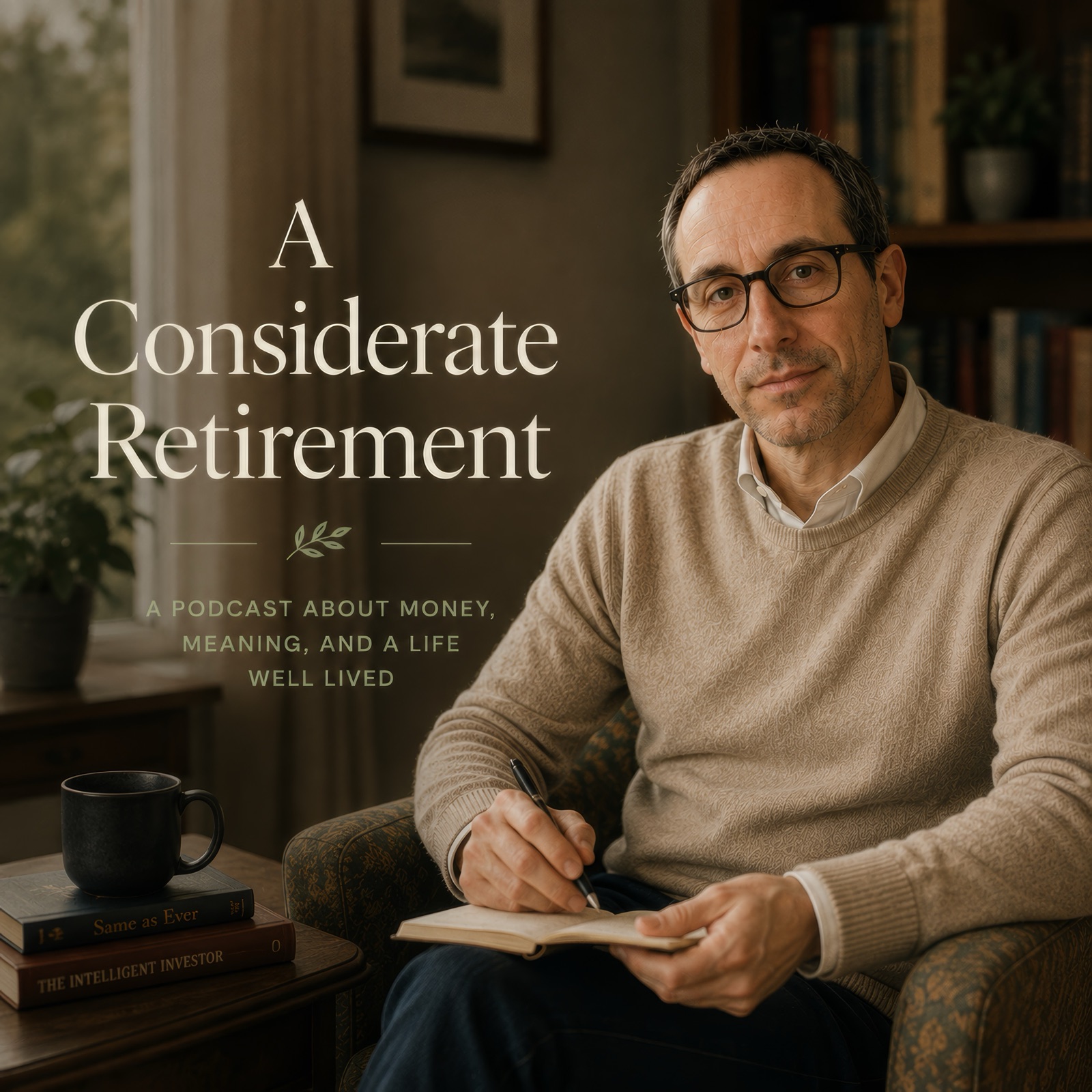
PODCAST · business
A Considerate Retirement
by Joshua Mangoubi, CFA
A Considerate Retirement is a calm, practical podcast for people approaching or in retirement — hosted by Joshua Mangoubi, CFA, founder of Considerate Capital, a fee-only fiduciary. Each episode takes one real retirement question — drawing down savings, Roth conversions and the tax window, what your bonds are actually for, the psychology of spending after a lifetime of saving — and turns it into a useful, unhurried conversation. Markets matter; behavior matters more. Full transcripts and show notes at consideratecapital.com/podcast.This content is for educational purposes only and is not investment, tax, or legal advice. Considerate Capital is a registered investment adviser in Illinois. Past performance does not guarantee future results. All strategies involve risk, including the potential loss of principal. Please consult your own tax, legal, and financial advisors regarding your specific situation.
-
26
The raise nobody applauds.
Are rising bond yields good for retirees? Long-term Treasury yields reached their highest levels in nearly twenty years this summer. Most of the coverage treats that as bad news, and for borrowers it is. For a retirement that runs on income, it is mostly a raise: every maturing bond and reinvested dollar now earns what savers spent fifteen years waiting for. This walks through what changed, what it gives a retirement plan, and the one part that already cost you. Full transcript and show notes: https://consideratecapital.com/podcast/what-rising-yields-quietly-give-you This content is for educational purposes only and is not investment, tax, or legal advice. Considerate Capital is a registered investment adviser in Illinois. Past performance does not guarantee future results. All strategies involve risk, including the potential loss of principal. Please consult your own tax, legal, and financial advisors regarding your specific situation.
-
25
The quiet first year of retirement.
What financial decisions matter in your first year of retirement? When you retire, the urge is to tell everyone. But the first year quietly decides more than the announcement does: which accounts you draw from, what you pay for health coverage before Medicare, who inherits your accounts, and how much tax your spouse would face alone one day. These choices rarely feel urgent, which is exactly why they get made by default. This is a look at the handful worth settling in the calm before the calendar fills up. Full transcript and show notes: https://consideratecapital.com/podcast/the-quiet-first-year-of-retirement This content is for educational purposes only and is not investment, tax, or legal advice. Considerate Capital is a registered investment adviser in Illinois. Past performance does not guarantee future results. All strategies involve risk, including the potential loss of principal. Please consult your own tax, legal, and financial advisors regarding your specific situation.
-
24
The reset you did not ask for.
What happens to the step-up in basis when your spouse dies? When a spouse dies, most inherited assets get a step-up in basis: their cost resets to the value on the date of death, and the tax on the gain built up over a lifetime largely disappears. In Illinois and most states, jointly held accounts reset by half, while retirement accounts do not reset at all. This walks through what resets, what does not, the one clock worth watching, and why the step-up quietly makes waiting affordable. Full transcript and show notes: https://consideratecapital.com/podcast/step-up-in-basis-when-your-spouse-dies This content is for educational purposes only and is not investment, tax, or legal advice. Considerate Capital is a registered investment adviser in Illinois. Past performance does not guarantee future results. All strategies involve risk, including the potential loss of principal. Please consult your own tax, legal, and financial advisors regarding your specific situation.
-
23
Choosing a financial advisor after you lose your spouse.
How do you choose a financial advisor after losing your spouse? When you are ready for help after losing a spouse, two questions answer most of the others: is this person a fiduciary, and how are they paid. This is how to tell a fiduciary from a salesperson, what does and does not have to be decided early, the questions worth asking, and how to check anyone's background, including ours. Full transcript and show notes: https://consideratecapital.com/podcast/choosing-a-financial-advisor-after-loss This content is for educational purposes only and is not investment, tax, or legal advice. Considerate Capital is a registered investment adviser in Illinois. Past performance does not guarantee future results. All strategies involve risk, including the potential loss of principal. Please consult your own tax, legal, and financial advisors regarding your specific situation.
-
22
What needs you, and when.
What needs to be done after a spouse dies? After a spouse dies, the question is rarely what needs doing; it is what needs doing now. This checklist sorts the first year the way life actually asks for it: keep money moving this week, make one good call to Social Security, work through the phone list this month, see the attorney this season, and let everything irreversible wait. Full transcript and show notes: https://consideratecapital.com/podcast/checklist-after-losing-a-spouse This content is for educational purposes only and is not investment, tax, or legal advice. Considerate Capital is a registered investment adviser in Illinois. Past performance does not guarantee future results. All strategies involve risk, including the potential loss of principal. Please consult your own tax, legal, and financial advisors regarding your specific situation.
-
21
The widow's penalty.
What is the widow's penalty? After one spouse dies, the survivor usually files taxes as a single person, with a standard deduction about half as large and brackets about half as wide, so a similar income is taxed more heavily. One Social Security check also stops, and Medicare can charge more. The penalty cannot be erased, but most of what softens it has to be done while both spouses are alive. Full transcript and show notes: https://consideratecapital.com/podcast/the-widows-penalty This content is for educational purposes only and is not investment, tax, or legal advice. Considerate Capital is a registered investment adviser in Illinois. Past performance does not guarantee future results. All strategies involve risk, including the potential loss of principal. Please consult your own tax, legal, and financial advisors regarding your specific situation.
-
20
When the blues does not lift.
The low that arrives in the first year or two of retirement is usually the ordinary blues, and the honest evidence is reassuring: retirement is not a reliable cause of depression, and for many people it leaves their mental health unchanged or better. But for a smaller group the low is not the blues at all, and the difference is less about how far down it goes than whether it moves at all. This is how to tell the ordinary dip from clinical depression, why depression in later life is so often missed and written off as aging, and why the safest thing to do with a low that will not lift is to stop waiting it out. Full transcript and show notes: https://consideratecapital.com/podcast/when-the-blues-does-not-lift This content is for educational purposes only and is not investment, tax, or legal advice. Considerate Capital is a registered investment adviser in Illinois. Past performance does not guarantee future results. All strategies involve risk, including the potential loss of principal. Please consult your own tax, legal, and financial advisors regarding your specific situation.
-
19
The trust that bets on your marriage.
Is a spousal lifetime access trust (SLAT) worth it? A spousal lifetime access trust lets one spouse move up to $15 million out of both estates while the other spouse can still draw on it, which keeps the household's standard of living intact. The price is paid elsewhere: the gift is irrevocable, access ends with death or divorce, heirs give up the step-up in basis, and a his-and-hers pair must survive the reciprocal trust doctrine. Weighing those honestly is the whole decision. Full transcript and show notes: https://consideratecapital.com/podcast/slat-pros-and-cons This content is for educational purposes only and is not investment, tax, or legal advice. Considerate Capital is a registered investment adviser in Illinois. Past performance does not guarantee future results. All strategies involve risk, including the potential loss of principal. Please consult your own tax, legal, and financial advisors regarding your specific situation.
-
18
The four-million-dollar line.
Can you plan around the Illinois estate tax? The federal estate tax now starts at $15 million, but Illinois draws its own line at $4 million, with no portability between spouses and a computation that taxes the whole estate once you cross it. An ordinary house, retirement accounts, and a life insurance policy clear that line more often than people expect. The softening tools are old and reliable: trusts that preserve both spouses' exclusions, lifetime gifts, insurance owned outside the estate, and honest counting before any of it. Full transcript and show notes: https://consideratecapital.com/podcast/avoiding-the-illinois-estate-tax This content is for educational purposes only and is not investment, tax, or legal advice. Considerate Capital is a registered investment adviser in Illinois. Past performance does not guarantee future results. All strategies involve risk, including the potential loss of principal. Please consult your own tax, legal, and financial advisors regarding your specific situation.
-
17
The loneliness no one plans for.
Loneliness in retirement is rarely planned for, yet it is one of the most common and least discussed parts of leaving work. The colleagues you saw every day simply stop being there, the week's human contact thins out without anyone deciding it should, and the research now treats that isolation as a genuine risk to your health rather than only your mood. This is why social connection after you retire deserves real attention, why it can creep in even inside a good marriage, and how people rebuild a life with other people in it. Full transcript and show notes: https://consideratecapital.com/podcast/the-loneliness-no-one-plans-for This content is for educational purposes only and is not investment, tax, or legal advice. Considerate Capital is a registered investment adviser in Illinois. Past performance does not guarantee future results. All strategies involve risk, including the potential loss of principal. Please consult your own tax, legal, and financial advisors regarding your specific situation.
-
16
What a CFA charterholder actually is.
What is a CFA charterholder? CFA stands for Chartered Financial Analyst, widely considered the gold standard in finance. It takes three exams over several years that fewer than half of candidates pass at each level, plus an ethics code and years of experience. This is what the charter demands, what its curriculum covers, including a private-wealth planning track, where most charterholders actually work, and the one thing the letters cannot tell you about the person in front of you. Full transcript and show notes: https://consideratecapital.com/podcast/what-is-a-cfa-charterholder This content is for educational purposes only and is not investment, tax, or legal advice. Considerate Capital is a registered investment adviser in Illinois. Past performance does not guarantee future results. All strategies involve risk, including the potential loss of principal. Please consult your own tax, legal, and financial advisors regarding your specific situation.
-
15
How to choose a financial advisor.
How do you choose a financial advisor? When you are ready for help with your money, the letters after an advisor's name are only the beginning. Two credentials carry the most weight, the CFA and the CFP, and an advisor needs only one, but neither one proves whose interest comes first. This is how to read the credentials, weigh a person's training and track record, understand how an advisor is actually paid, and vet anyone with a few plain questions before you ever sit down. Full transcript and show notes: https://consideratecapital.com/podcast/how-to-choose-a-financial-advisor This content is for educational purposes only and is not investment, tax, or legal advice. Considerate Capital is a registered investment adviser in Illinois. Past performance does not guarantee future results. All strategies involve risk, including the potential loss of principal. Please consult your own tax, legal, and financial advisors regarding your specific situation.
-
14
The dip is a stage, not a verdict.
The "emotional stages of retirement" are usually sold as a tidy staircase: honeymoon, disenchantment, reorientation, a settled new normal. The truth is more honest and more useful. Retirement does tend to move through a high and then, for many people, a low before it turns, but the research shows it is a map of the terrain and not a timetable everyone keeps. This is what the arc actually feels like, why the dip is a stage rather than a verdict, and why the giddy high and the flat low are the two worst times to make a decision you cannot take back. Full transcript and show notes: https://consideratecapital.com/podcast/the-dip-is-a-stage-not-a-verdict This content is for educational purposes only and is not investment, tax, or legal advice. Considerate Capital is a registered investment adviser in Illinois. Past performance does not guarantee future results. All strategies involve risk, including the potential loss of principal. Please consult your own tax, legal, and financial advisors regarding your specific situation.
-
13
Three million at sixty is a two-part retirement.
Can you retire at 60 with $3 million? "Is three million enough to retire at sixty?" is usually the wrong question. By sixty the money is yours to use without penalty, and for many people three million is enough. What actually decides it is how the income holds together across two phases: the years the portfolio carries alone, and the years it shares the load with Social Security. Full transcript and show notes: https://consideratecapital.com/podcast/three-million-at-sixty-two-part-retirement This content is for educational purposes only and is not investment, tax, or legal advice. Considerate Capital is a registered investment adviser in Illinois. Past performance does not guarantee future results. All strategies involve risk, including the potential loss of principal. Please consult your own tax, legal, and financial advisors regarding your specific situation.
-
12
Retiring into the same house.
Marriage after retirement is the part of the plan almost no one rehearses. When one or both partners stop working, decades of roles, space, and routines that ran on absence suddenly have to be renegotiated under one roof. This is what really happens to a relationship in retirement, why the "one spouse retires first" stretch is the hardest, what the research says about the strain and the genuine chance to rebuild, and the one part of it money can actually help with. Full transcript and show notes: https://consideratecapital.com/podcast/retiring-into-the-same-house This content is for educational purposes only and is not investment, tax, or legal advice. Considerate Capital is a registered investment adviser in Illinois. Past performance does not guarantee future results. All strategies involve risk, including the potential loss of principal. Please consult your own tax, legal, and financial advisors regarding your specific situation.
-
11
Five million is rarely the hard part. Fifty-five is.
Can you retire at 55 with $5 million? "Is five million enough to retire at fifty-five?" is usually the wrong question. The same five million can carry one couple through a forty-year retirement and leave another anxious by seventy. This walks through what actually decides it: the length of the retirement, the ten-year wait for Medicare, the money that stays locked until fifty-nine and a half, the danger of a bad first decade, and the slow work of inflation. Full transcript and show notes: https://consideratecapital.com/podcast/five-million-and-the-question-of-fifty-five This content is for educational purposes only and is not investment, tax, or legal advice. Considerate Capital is a registered investment adviser in Illinois. Past performance does not guarantee future results. All strategies involve risk, including the potential loss of principal. Please consult your own tax, legal, and financial advisors regarding your specific situation.
-
10
A retirement needs somewhere to go.
"Retire to something, not just from something" is the truest advice about retirement and the least planned for. After decades of building the money, the harder question is what the days are for once work stops supplying a reason to get up, a place to be, and people who need you. This is what the research actually shows about purpose and meaning in retirement, why a life of pure leisure tends to disappoint, and how people build a second thing worth doing, usually before they stop the first. Full transcript and show notes: https://consideratecapital.com/podcast/a-retirement-needs-somewhere-to-go This content is for educational purposes only and is not investment, tax, or legal advice. Considerate Capital is a registered investment adviser in Illinois. Past performance does not guarantee future results. All strategies involve risk, including the potential loss of principal. Please consult your own tax, legal, and financial advisors regarding your specific situation.
-
9
The order of your returns matters more than the average.
Why does the order of your returns matter more than the average? Sequence-of-returns risk is the danger that the order of your returns, not the average, decides whether your money lasts. It is strange but true: while you are saving, the order barely matters; once you retire and start withdrawing, it matters more than almost anything. This explains why the first decade of retirement is the danger zone, and what actually reduces your exposure. Full transcript and show notes: https://consideratecapital.com/podcast/order-of-returns-matters-more-than-average This content is for educational purposes only and is not investment, tax, or legal advice. Considerate Capital is a registered investment adviser in Illinois. Past performance does not guarantee future results. All strategies involve risk, including the potential loss of principal. Please consult your own tax, legal, and financial advisors regarding your specific situation.
-
8
The shape of a retired day.
Daily structure and routine in retirement is the part almost no one plans for. For decades a job supplied the schedule that organized the day whether you wanted it or not, and when that schedule stops arriving, the wide-open day can feel less like freedom than like drift. This is why the loss of structure is a real adjustment and not a soft one, what the research says about daily rhythm, sleep, and the slow slide into doing nothing, and how people build a self-chosen routine that holds them up once no boss sets it. Full transcript and show notes: https://consideratecapital.com/podcast/the-shape-of-a-retired-day This content is for educational purposes only and is not investment, tax, or legal advice. Considerate Capital is a registered investment adviser in Illinois. Past performance does not guarantee future results. All strategies involve risk, including the potential loss of principal. Please consult your own tax, legal, and financial advisors regarding your specific situation.
-
7
What your bonds are actually for.
What are bonds actually for in retirement? For most of the last decade, bonds paid so little that it was easy to forget what they are for. Then 2022 made them feel broken. This is a plain look at the job bonds actually do in retirement, why higher yields have changed the math, where to hold them for taxes, and the one risk most people misjudge. Full transcript and show notes: https://consideratecapital.com/podcast/what-your-bonds-are-actually-for This content is for educational purposes only and is not investment, tax, or legal advice. Considerate Capital is a registered investment adviser in Illinois. Past performance does not guarantee future results. All strategies involve risk, including the potential loss of principal. Please consult your own tax, legal, and financial advisors regarding your specific situation.
-
6
You were never your job title.
"Who am I without my career?" is the question almost no one plans for. For decades a job title was a complete answer to who you are, with status quietly attached, and retirement is when that answer goes blank. This is why the loss of identity after retiring is a real transition and not a soft one, what the research says about rebuilding a sense of self, and how to tell a genuine new chapter from the old title wearing a new suit. Full transcript and show notes: https://consideratecapital.com/podcast/you-were-never-your-job-title This content is for educational purposes only and is not investment, tax, or legal advice. Considerate Capital is a registered investment adviser in Illinois. Past performance does not guarantee future results. All strategies involve risk, including the potential loss of principal. Please consult your own tax, legal, and financial advisors regarding your specific situation.
-
5
The order you draw from your accounts.
What order should you withdraw from your retirement accounts? The conventional withdrawal order, spend taxable accounts first, then tax-deferred, then Roth, is a reasonable default but not a rule. Treated as a rule it can leave a large pre-tax balance to grow untouched until required distributions force it out at a higher rate. The better aim is to keep your taxable income level across the decades, using the low-bracket years between retirement and required distributions. Full transcript and show notes: https://consideratecapital.com/podcast/the-order-you-draw-from-your-accounts This content is for educational purposes only and is not investment, tax, or legal advice. Considerate Capital is a registered investment adviser in Illinois. Past performance does not guarantee future results. All strategies involve risk, including the potential loss of principal. Please consult your own tax, legal, and financial advisors regarding your specific situation.
-
4
Two million dollars is not a yes or no.
Can you retire at 60 with $2 million? "Is two million enough to retire at sixty?" is one of the most common questions we hear, and it has no answer, because it is the wrong question. The same two million can last a lifetime or run dry in a decade. This walks through the one lever that decides which, a worked example of the same couple two ways, why retiring at sixty is harder than waiting, and the risk almost no one plans for: spending too little. Full transcript and show notes: https://consideratecapital.com/podcast/two-million-is-not-a-yes-or-no This content is for educational purposes only and is not investment, tax, or legal advice. Considerate Capital is a registered investment adviser in Illinois. Past performance does not guarantee future results. All strategies involve risk, including the potential loss of principal. Please consult your own tax, legal, and financial advisors regarding your specific situation.
-
3
How I got into the room.
At twenty-three, with no professional investment experience and no connections, Joshua reached out to a new investment firm that had never posted a job, run by two of the most accomplished people in the industry, with a research packet so detailed that their first interview question was "how did you know all this?" The story of how is really a story about the most useful test there is for anyone you are deciding to trust: not what their résumé says, but whether they did the homework about you before they ever sat down. Full transcript and show notes: https://consideratecapital.com/podcast/how-i-got-into-the-room This content is for educational purposes only and is not investment, tax, or legal advice. Considerate Capital is a registered investment adviser in Illinois. Past performance does not guarantee future results. All strategies involve risk, including the potential loss of principal. Please consult your own tax, legal, and financial advisors regarding your specific situation.
-
2
The firm I would have wanted for my friend.
I never announced a wealth management firm. Considerate Capital grew, one person at a time, out of a handful of people I cared about asking for help, and out of a lesson I learned long before I had a word for it: the best businesses do not sell people what they ask for. They understand the problem the person actually has, and solve that. Full transcript and show notes: https://consideratecapital.com/podcast/why-i-started-considerate-capital This content is for educational purposes only and is not investment, tax, or legal advice. Considerate Capital is a registered investment adviser in Illinois. Past performance does not guarantee future results. All strategies involve risk, including the potential loss of principal. Please consult your own tax, legal, and financial advisors regarding your specific situation.
-
1
Why I made this show
Almost everything you hear about your money is trying to sell you a product or scare you into it. I made A Considerate Retirement to be the opposite of that noise: one honest idea at a time, explained the way I would explain it to a friend. Full transcript and show notes: https://consideratecapital.com/podcast/why-i-made-this-show This content is for educational purposes only and is not investment, tax, or legal advice. Considerate Capital is a registered investment adviser in Illinois. Past performance does not guarantee future results. All strategies involve risk, including the potential loss of principal. Please consult your own tax, legal, and financial advisors regarding your specific situation.
We're indexing this podcast's transcripts for the first time — this can take a minute or two. We'll show results as soon as they're ready.
No matches for "" in this podcast's transcripts.
No topics indexed yet for this podcast.
Loading reviews...
ABOUT THIS SHOW
A Considerate Retirement is a calm, practical podcast for people approaching or in retirement — hosted by Joshua Mangoubi, CFA, founder of Considerate Capital, a fee-only fiduciary. Each episode takes one real retirement question — drawing down savings, Roth conversions and the tax window, what your bonds are actually for, the psychology of spending after a lifetime of saving — and turns it into a useful, unhurried conversation. Markets matter; behavior matters more. Full transcripts and show notes at consideratecapital.com/podcast.This content is for educational purposes only and is not investment, tax, or legal advice. Considerate Capital is a registered investment adviser in Illinois. Past performance does not guarantee future results. All strategies involve risk, including the potential loss of principal. Please consult your own tax, legal, and financial advisors regarding your specific situation.
HOSTED BY
Joshua Mangoubi, CFA
Loading similar podcasts...
Frequently Asked Questions
How many episodes does A Considerate Retirement have?
A Considerate Retirement currently has 26 episodes available on PodParley. New episodes are automatically indexed when they're published to the podcast feed.
What is A Considerate Retirement about?
A Considerate Retirement is a calm, practical podcast for people approaching or in retirement — hosted by Joshua Mangoubi, CFA, founder of Considerate Capital, a fee-only fiduciary. Each episode takes one real retirement question — drawing down savings, Roth conversions and the tax window, what...
How often does A Considerate Retirement release new episodes?
A Considerate Retirement has 26 episodes. Check the episode list to see recent publication dates and frequency.
Where can I listen to A Considerate Retirement?
You can listen to A Considerate Retirement on PodParley by clicking any episode. We provide an embedded audio player for direct listening, and you can also subscribe via your preferred podcast app using the RSS feed.
Who hosts A Considerate Retirement?
A Considerate Retirement is created and hosted by Joshua Mangoubi, CFA.
URL copied to clipboard!