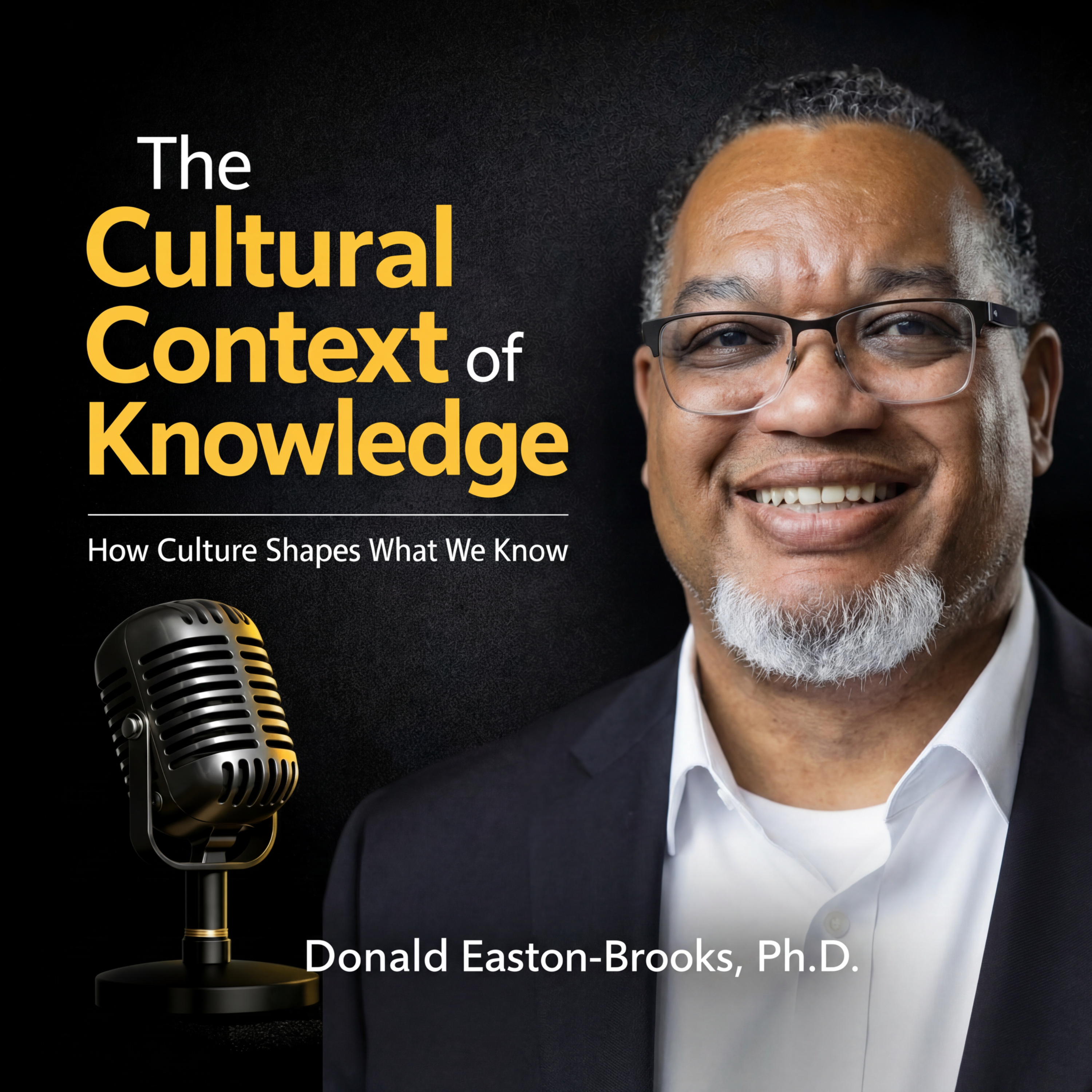
Cultural Context of Knowledge
by Donald Easton-Brooks Ph.D.
A podcast about learning and the cultural context that gives knowledge meaning. Donald Easton-Brooks, Ph.D., connects research and educator practice to explore how understanding develops through scaffolding, relationships, and history, and why learning cannot be reduced to information retrieval. Built for teachers and educational leaders seeking deeper, more durable learning.Audience: Educators, teachers, instructional coaches, and school leadersFocus: Learning, learning theory, culture, and knowledge.Host: Donald Easton-Brooks, Ph.D., is an award-winning international scholar recognized
Episodes
-
A Geo-Cultural Lens Into Technology and Education (S4 E4)
A couple of years ago Donald visited South Korea and watched four- and five-year-olds build models of an ecosystem powered by solar energy. In the spring of 2025 he visited a C-STEM teaching and experimental building inside a school in Nanjing, China, and spoke at a seminar in Shanghai with the...
-
The Culture of Mathematics: Street Vendors, Written Tests, and Who Can See What a Child Knows (S4 E3)
In Recife, Brazil, in the early 1980s, researchers posed as customers and bought coconuts, popcorn, and lemons from five children who worked the street markets. The children got 98 percent of the arithmetic right. A week later, on paper, with the same numbers, they got most of it wrong. This...
-
What Counts as a Match: Caste, Language, and the Question Underneath (S4 E2)
In a village primary school in rural India, researchers compared a child with herself: one subject taught by a teacher who shared her gender, caste, and religion, another by a teacher who did not. She scored higher in the matched subject. That is ethnic matching, measured in a country where the...
-
The Language in the Room: Who Decides What a Child Learns In (S4 E1)
In January 1970, the University of Ife in Nigeria began teaching a group of primary children in Yoruba for all six years of school, with English as a subject. In 2022, Nigeria made home-language instruction national policy for the early grades. In November 2025, the next government cancelled it…
more -
Season 4 Trailer: Whose Room Is It?
Season 4 of The Cultural Context of Knowledge follows one question around the world: who teaches whom, in whose language, and who decided. Eight episodes, with the United States in every one of them as one case among many. The trailer opens in four classrooms at eight in the morning, on the coast...
-
What the Communities Already Knew: Research, Method, and the Road Ahead (S3 E11)
The season finale looks underneath the whole argument, at the research itself. Dr. Easton-Brooks traces how the evidence for ethnic matching got built, the qualitative scholars who recorded what communities already knew and the quantitative studies that gave it scale, and shows the two did not...
-
Beyond the Schoolhouse Door: Ethnic Matching in Higher Education (S3 E10)
For nine episodes this season, ethnic matching stayed inside the PK through 12 classroom. This one steps past the schoolhouse door into higher education, where access is no longer the main barrier and the real work is belonging and cultural responsiveness. Dr. Easton-Brooks returns to the...
-
From Research to Policy: Pathways That Worked, and Why Most Didn't (S3 E9)
The case for ethnic matching was built across three decades. This episode asks the question deferred just as long: what does it actually take to turn that research into policy that lasts? Dr. Easton-Brooks walks through the workforce gap that has not closed, the three structural barriers that…
more -
Where Is the Data: The Quantitative Wave (S3 E8)
A doctoral student sits in the back of a Denver board meeting and watches the whole season come to a point in about nine seconds. Community representatives present the findings of the scholars he has spent years reading. A board member leans forward and asks, where is the data. A presenter…
more -
The Research Comes Home: The Qualitative Turn (1980 to 2000)
In 1966 the Coleman Report measured six hundred thousand children and, for all its reach, missed the ones it claimed to see. It studied children of color with instruments built by people who had never lived their lives, then wrote its findings in the language of numbers, as if numbers were…
more -
The Chair Was Full: A Lived History (1960 to 1980)
They came to measure children like me, and they could not see the one thing that was carrying us. Dr. Easton-Brooks was born in 1964 and grew up in Texas schools where nearly every teacher at the front of the classroom was Black, from his own neighborhood, and knew his family before he said a…
more -
What Winning Cost
In the spring of 1951, a sixteen-year-old named Barbara Rose Johns, tired of being taught in a tar-paper shack, led four hundred and fifty classmates onto a picket line. That walkout became one of the five cases the Supreme Court joined together as Brown v. Board of Education. A child started it....
-
The Lie in the Lesson
Somewhere around 1930, a child sat in a classroom and learned to be ashamed of her own grandmother. Between 1921 and 1940, the harm of the official school was finally named out loud, and the lesson itself had become the weapon: a history book that erased the child, a separate room that called her...
-
The Schools Built Against Them
Between 1890 and 1920, families across Black, Native, Mexican, Chinese, and Japanese communities learned the same lesson: the public school did not mean the same thing for every child. A separate school with fewer dollars and a shorter term. Removal from family, language, and ceremony. Sorting...
-
The Schools Built Against Them: What Families Knew, and What They Built (S3 E 3 Part 1 of 2)
Part 1 of 2: "The Schools Built Against Them: What Families Knew, and What They Built" They did not need a court ruling to know what the school was for. They already knew. Between 1890 and 1920, Black, Native, Mexican, Chinese, Japanese, and Korean families met a public school system that was…
more -
The Teacher They Built
Picture four teachers, in the same country, in the same years before the Civil War. They never meet. They speak four different languages. And without knowing it, each one makes the same decision. In St. Louis, a formerly enslaved Black minister teaches children in a church basement. In a…
more -
The Inheritance Tax Intro: Where Ethnic Matching Became
Season 3 opens. Dr. Donald Easton-Brooks names the season — The Inheritance Tax: Where Ethnic Matching Became — and walks listeners into the history before the history. Long before the research field had a term for it, Black, Native, Latino, and Asian communities in the U.S. were already…
more -
Season 3 Trailer: Ethnic Matching: What Forty Years of Research Already Knows
Season 3 of The Cultural Context of Knowledge takes up ethnic matching: the research that asks what happens to students, especially Black, Latino, and Indigenous students, when the teacher in front of them shares aspects of their cultural background. Twelve episodes. One through-line. Forty years...
-
Will Education Pivot With It?: Designing for the World That Already Exists
We opened this season with a question. The demographic pivot has already happened. Will education pivot with it? After nine episodes describing the architecture — institutions, laws, the hidden curriculum, AI, standards-setting, assessment — the season closes by returning to the classroom we…
more -
When Assessment Becomes Gatekeeping: An Instrument That Was Never Calibrated Against You
Two students take the same standardized reading test. Question fourteen is about a regatta, a sailing race. The first student has been to the harbor every summer of her life. The second has never seen a regatta. The test reports the first student as a stronger reader. What the test measured was…
more -
How State Standards Get Written: Curriculum as Compromise
State standards are the most concentrated place in U.S. public education where decisions about other people's children get made by people who do not have to live with the consequences. This episode names curriculum as compromise, asks who is at the table when standards get written, and sketches...
-
AI as the New Gatekeeper: Whose Knowledge the Model Was Built to See
The newest gatekeeper between learners and what they are trying to know is a model that fills silence with fluent invention. This episode names confabulation as a patterned harm — the model is most confident about exactly the knowledge traditions the written record under-represents — and asks…
more -
The Hidden Curriculum: When Researchers Chose the Word Violence
Some words are not just names — they are arguments. This episode examines how researchers came to use "violence" to describe certain institutional practices in education, and what that conceptual shift reveals about adultification, developmental harm, and the unwritten rules children of color…
more -
The Backlash: Why Newly Legitimate Knowledge Gets Targeted
Marginalized knowledge does not stay marginalized, and it does not stay curricular either. This episode names the three-move cycle — dismissal, absorption, restriction — that dominant knowledge systems run when bodies of knowledge from the margin reach the record, and traces its most recent...
-
Who Gets to Teach It? Representation and the Long Shadow of Brown v. Board
Integration happened to the students — it did not happen to the teaching profession. Revisits the Brown v. Board–era displacement of Black educators rarely included in the standard story, and examines what decades of research on ethnic matching reveal about student outcomes. Join the email list…
more -
Why Some Knowledge Is Marginalized: The Evolution of Ethnic Studies
Explores the history of ethnic studies and how student movements challenged universities to recognize marginalized histories and perspectives — and how expanding participation reshapes the boundaries of legitimate knowledge. Join the email list for the show notes, the full reference list, and the...
-
From Knowledge to Legitimacy: How Institutions Decide What Counts
How do ideas become legitimate knowledge? Drawing on Foucault, Kuhn, Merton, and Bourdieu, this episode examines how universities, journals, and academic institutions decide what counts as credible through power and gatekeeping. Join the email list for the show notes, the full reference list, and...
-
Knowledge, Power, and the U.S. Demographic Pivot
The classroom has changed — has education? For the first time in U.S. history, children under 18 are the majority non-white. Season 2 opens with the question: who decides what counts as knowledge? Join the email list for the show notes, the full reference list, and the written companion to every...
-
Knowledge and Power: Season 2 Trailer
"Who decides what gets called knowledge — and what does that decision cost the people on the receiving end?" Welcome to Season 2 of The Cultural Context of Knowledge. This season is organized around one relationship: knowledge and power. The classroom in the United States has changed. The…
more -
From Studying to Transfer, Confidence, and Long-Term Growth (Learner Edition, S1 E11)
Closing the seven-part series: how to move beyond short-term studying and build learning that transfers across new classes, new problems, and real-life decision-making. Join the email list for the show notes, the full reference list, and the written companion to every episode, plus the series...
-
Build Your Personal Learning System: A Repeatable Method That Works (Learner Edition, S1 E10)
A simple, repeatable learning system you can use for any subject — especially when motivation is low and pressure is high. Consolidates the series into one method matched to individual needs. Join the email list for the show notes, the full reference list, and the written companion to every...
-
When Learning Delays Happen, How to Catch Up Without Panic (Learner Edition, S1 E9)
What's really happening when you feel behind, stuck, or like nothing is clicking — especially under time pressure. Common sources of learning delays and recovery routines that avoid cramming or quitting. Join the email list for the show notes, the full reference list, and the written companion to...
-
What to Do When You're Stuck (Learner Edition, S1 E8)
Turns Bloom's Taxonomy into a practical toolkit. Simple strategies matched to each phase of learning — from recall through creation — so you stop studying the same way for every class. Join the email list for the show notes, the full reference list, and the written companion to every episode…
more -
How to Diagnose What You Don't Understand Yet (Learner Edition, S1 E7)
Most people don't struggle because they're 'not smart' — they struggle because they study in a way that doesn't match what the task requires. Introduces Bloom's Taxonomy as a diagnostic tool. Join the email list for the show notes, the full reference list, and the written companion to every...
-
Memorization vs. Learning: How to Make Studying Actually Stick (Learner Edition, S1 E6)
Studying as memorization leaves information that disappears on tests or can't be used in real problems. Breaks down the difference between memorizing and learning so what you study actually sticks. Join the email list for the show notes, the full reference list, and the written companion to every...
-
How Your Brain Makes Room for New Information (Learner Edition, S1 E5)
Why learning naturally feels difficult — and why that struggle is not a sign something is wrong with you. A 'mental storage room' metaphor opens the seven-part Learner Edition series. Join the email list for the show notes, the full reference list, and the written companion to every episode, plus...
-
From a Cultural Context: Rethinking STEM
Challenges the common assumption that STEM is neutral. If 'math is objective' and 'data speaks for itself,' what gets hidden is the cultural design of many STEM classrooms — speed, linearity, and whose way of knowing counts. Join the email list for the show notes, the full reference list, and the...
-
The Foundation — Whose Knowledge Counts? Culture, Power, and Learning
A foundational question most schools rarely name: what counts as knowledge, and who gets to decide? Moves beyond the myth that curriculum and assessment are neutral to examine how knowledge is shaped by culture and power. Join the email list for the show notes, the full reference list, and the...
-
Learning Is a Struggle AI Must Not Skip (Non-NotebookLM Version)
Dr. Easton-Brooks compares Episode 1's NotebookLM output with his own narration to examine a central truth: genuine learning is a productive struggle that moves us from uncertainty to understanding through a sequence of steps. Join the email list for the show notes, the full reference list, and…
more -
Learning Is a Struggle AI Must Not Skip (NotebookLM Version)
The inaugural episode, produced with NotebookLM to create a fully AI-narrated conversation exploring Dr. Easton-Brooks' view that learning is a productive struggle — a process of moving from confusion toward clarity. Join the email list for the show notes, the full reference list, and the written...
-
Welcome to The Cultural Context of Knowledge & Season 1
Welcome to The Cultural Context of Knowledge: a narrative podcast hosted by Dr. Donald Easton-Brooks, exploring how culture, history, institutions, and power shape what counts as knowledge and what that means for learners, classrooms, and the U.S. education system. The show is organized around a...
About this show
A podcast about learning and the cultural context that gives knowledge meaning. Donald Easton-Brooks, Ph.D., connects research and educator practice to explore how understanding develops through scaffolding, relationships, and history, and why learning cannot be reduced to information retrieval. Built for teachers and educational leaders seeking deeper, more durable learning.Audience: Educators, teachers, instructional coaches, and school leadersFocus: Learning, learning theory, culture, and knowledge.Host: Donald Easton-Brooks, Ph.D., is an award-winning international scholar recognized
Hosted by
Donald Easton-Brooks Ph.D.
Categories