
PODCAST · education
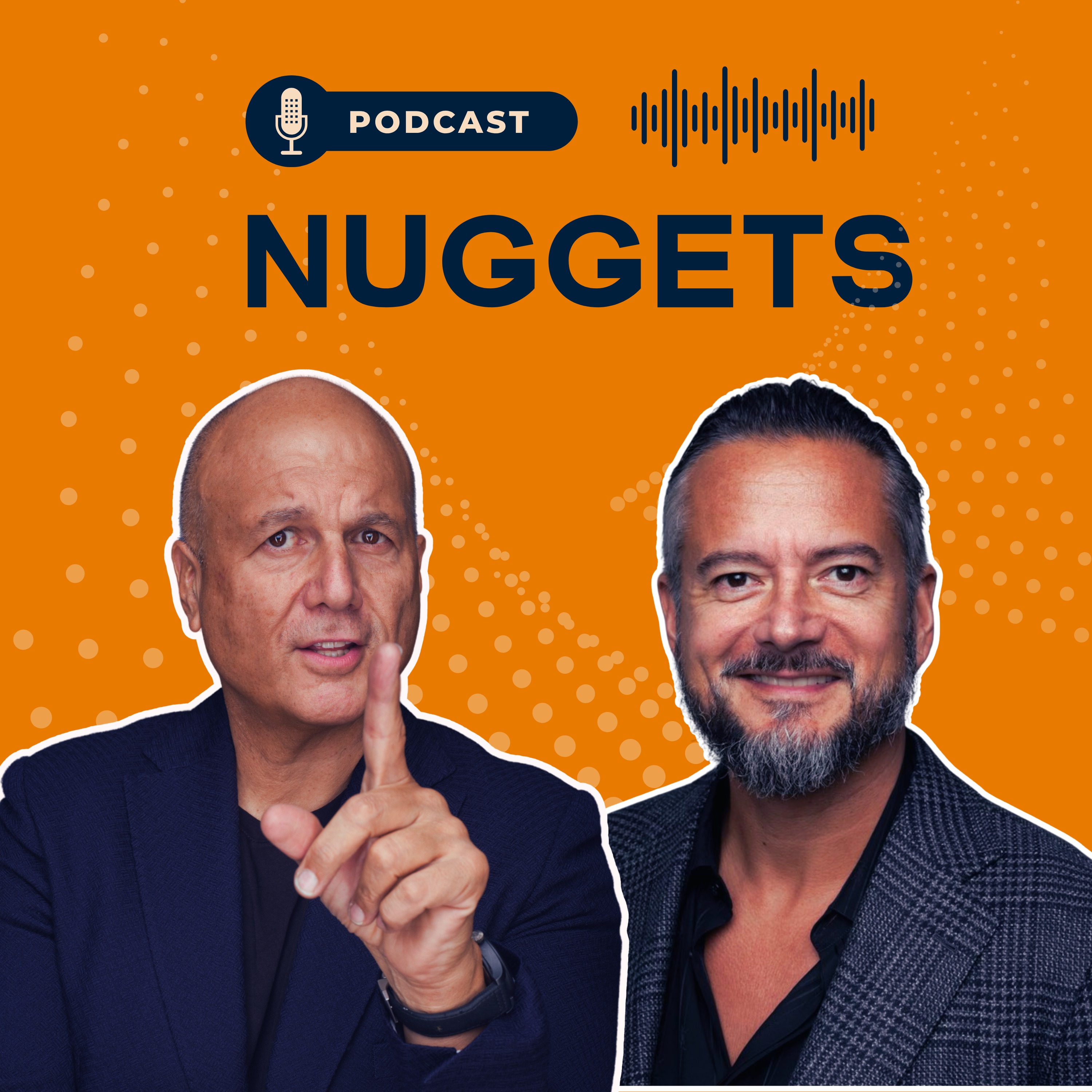
NUGGETS: Bite-Sized Lessons to Help You Live, Lead, and Think Better
by Pellegrino Riccardi & Francois Sibbald
NUGGETS is a weekly podcast about human behaviour, emotional intelligence, mindset shifts, psychology, and personal growth — designed to help you think clearer, communicate better, and lead with more confidence.In every short, practical episode, Pellegrino and Francois explore the ideas that shape how we live and work: motivation, stress, happiness, relationships, decision-making, leadership, communication, culture, and the stories we tell ourselves.We break big concepts into simple insights you can use immediately — to improve your mindset, boost emotional resilience, increase self-awareness, and show up as your best self in everyday life.If you're interested in leadership development, self-improvement, emotional intelligence training, better communication, or understanding why people behave the way they do, you're in the right place. Modern life is noisy. NUGGETS cuts through the noise — gi
-
57
She’s Terrified. She’s Doing It Anyway.
My daughter Emily is about to leave home, move to Leeds and study songwriting and artist development. She’s choosing a notoriously uncertain career in music — and, in her own words, she’s terrified.So why do it?In this episode, we talk about courage, comfort, fear and the risks we take when we decide to pursue something we genuinely care about. Emily reflects on The Voice, releasing her own music, stepping outside her comfort zone, and why she doesn’t want to reach 90 wondering: “What would have happened if it actually worked?”We also hear part of her first single, Big Talk, and explore Susan Jeffers’ idea that fear doesn’t disappear before we act — the doing comes first.A father-daughter conversation about choosing uncertainty, facing fear and having a go anyway.Also available on YouTube - search @NuggetsPod and look for the distinctive ORANGE Nuggets graphics. Hosted on Acast. See acast.com/privacy for more information.
-
56
What Parents Get Wrong on Holiday, According to a 15-Year-Old
What do teenagers really want from family holidays?In this special episode of NUGGETS, François is still on holiday, so Pellegrino is joined by a very different co-host—his 15-year-old daughter, Olivia.It begins with a simple question ... What's the biggest mistake parents make when they go on holiday with teenagers?The answers start with photos, sleeping in and wanting a little more freedom. But the conversation quickly becomes something much deeper.Olivia shares what it's really like to be a teenager today, why adults often underestimate what young people are going through, why some feelings are difficult to explain, and why sometimes the best thing parents can do is simply listen.Whether you're raising teenagers, remember what it was like to be one, or simply want to understand the next generation a little better, this honest father-and-daughter conversation offers valuable insights into communication, empathy and growing up. Hosted on Acast. See acast.com/privacy for more information.
-
55
The Hardest Part of the Camino de Santiago Isn't the Walking
Fresh from completing the 850 km Camino de Santiago across Spain, Ken Lowe joins Pellegrino for an honest conversation about what the pilgrimage really teaches you.Most people think the hardest part of the Camino is the walking. It isn't.Ken has been one of Pellegrino's closest friends for more than forty years. They studied together, cycled together and shared countless adventures before life took Ken to Australia. Passing through Oslo after completing the Camino, he stepped into the NUGGETS studio for a completely unplanned conversation.Together they explore why getting to the start line is often the biggest challenge, how saying "yes" opens unexpected doors, why discomfort can lead to growth, and how strangers can become some of life's most memorable companions.Whether you're planning to walk the Camino yourself or simply navigating a new chapter in your own life, this episode offers practical insights into commitment, connection, and what happens when you choose to take the first step.Watch on YouTube: https://youtu.be/1dDGF-TniCA?si=N_4yfCNx07EGV122Listen on Spotify: https://open.spotify.com/episode/65q6dBw5ehYYmqBxq1e6Bu?si=e5026a6fb2dd44fc Hosted on Acast. See acast.com/privacy for more information.
-
54
Why Women Find Funny Men Sexy
Most people think improvisation is something comedians, actors and jazz musicians do. We think it's one of the most valuable life skills you can develop.In this episode of NUGGETS, we explore why improvisation isn't about being reckless or making things up on the spot—it's about adapting, thinking creatively and having the confidence to deal with whatever life throws at you.Along the way, we tackle an intriguing question: Why do women often find funny men attractive? The answer has surprisingly little to do with jokes and much more to do with creativity, problem-solving and our evolutionary past.From speaking without notes and embracing mistakes to taking risks and thinking on your feet, this conversation is a reminder that life rarely follows a script—and perhaps that's exactly the point.So, if you've ever hesitated because you were afraid of getting it wrong, this episode might just persuade you to take the difficult path... and dare to improvise. Hosted on Acast. See acast.com/privacy for more information.
-
53
Why Weird People Are More Interesting
A bizarre French band sent us down an unexpected rabbit hole.Why do strange people capture our attention? Why are the most memorable comedians, musicians and creators often the ones who refuse to fit in?This episode explores why weirdness isn't something to hide—it might be your greatest advantage.Also available on YouTube - @NuggetsPod Hosted on Acast. See acast.com/privacy for more information.
-
52
When Self-Help Stops Helping
After reading hundreds of self-help books over the years, we've started asking an uncomfortable question: Can too much self-improvement actually become... repetitive?In this episode of NUGGETS, Pellegrino and Francois explore why great stories may teach us things that advice never can. They discuss the limits of self-help, the enduring power of fiction, Robin Williams' unforgettable speech from Dead Poets Society, why reading a novel engages the brain differently from scrolling a phone, and why the best book you read this summer might not be a self-help book at all.Whether you're packing for a holiday or simply looking for your next great read, this episode is an invitation to slow down, disconnect, and rediscover the power of a really good story.What you'll take away:• When self-help stops helping• Why fiction develops empathy and imagination• The hidden value of reading stories• Three simple ideas to reconnect with books this summerAlso available on YouTube: Hosted on Acast. See acast.com/privacy for more information.
-
51
Are We Turning Into Pussies?
Life has never been more comfortable.Food arrives at the door. Entertainment is instant. Difficult conversations can be avoided with a text message—or no message at all.But what if all this convenience is making us weaker?In this episode, Pellegrino and Francois explore why emotional resilience seems to be in decline and why many of us struggle more than ever with criticism, boredom, rejection and discomfort.They discuss parenting, ghosting, online trolling, personal responsibility and the surprising idea that some of life's most important lessons come from doing things we'd rather avoid.The conversation raises a provocative question: Has modern life become so comfortable that we're losing the ability to deal with discomfort?And if that's true, what should we do about it? Hosted on Acast. See acast.com/privacy for more information.
-
50
Why We Feel Guilty Doing Nothing (And Why We Need to Stop)
What happens when you stop running?In this episode of NUGGETS, Pellegrino does something unusual: he turns the spotlight on Francois. Francois arrives expecting a normal conversation. Instead, he becomes the subject of it.Together they explore a transformation Pellegrino has watched unfold over the last decade—from a life driven by performance, busyness, and constant activity to a life with more balance, reflection, and calm.The conversation covers busyness as a status symbol, the guilt many people feel when they're not being productive, the lessons of the pandemic, and why modern life makes it so difficult to switch off.This isn't really an episode about doing nothing.It's an episode about what happens when you finally stop long enough to hear yourself think. And why that might be one of the most important skills of all.Watch on YouTube: https://youtu.be/l6AK2Gv-lpA?si=rND9vuvSEGXA4aic Hosted on Acast. See acast.com/privacy for more information.
-
49
The Louder You Are, The More Fragile Your Ego
We often think ego is something negative.But without ego, would we ever take risks, pursue ambitious goals, or achieve anything meaningful?In this episode of NUGGETS, Pellegrino and Francois explore the difference between strong ego and fragile ego — and why that distinction matters in leadership, relationships, communication, social media, and everyday life.Using examples from football, business, politics and personal experience, they unpack a provocative idea:The louder you are, the more fragile your ego.Along the way, they discuss Cristiano Ronaldo, validation, defensiveness, criticism, confidence and arrogance.Most importantly, they explore a simple but powerful distinction:Strong egos contribute. Fragile egos consume.And how recognising the difference can make you a better leader, colleague, friend and partner.Three things you can do in your everyday life.WATCH ON YOUTUBE: https://youtu.be/diXlx6XckpE?si=HjdxLMdnIdJUZQ0S Hosted on Acast. See acast.com/privacy for more information.
-
48
How to Handle Anxiety (Without Trying to Eliminate It)
Anxiety isn’t caused by uncertainty. It’s caused by how we respond to it.In this episode of NUGGETS, Pellegrino and Francois explore why the brain struggles so much with the unknown — and why anxious thinking often becomes an attempt to control things we simply can’t control.From football fandom and worst-case scenarios to leadership, work stress, finances, and everyday overthinking, this conversation looks at the psychology behind anxiety in a grounded and surprisingly practical way.They explore:why the brain creates negative storiesthe role of “anxious monkeys” as an early warning systemhow uncertainty affects performance and relationshipswhy clarity and action calm people downpractical ways to stop spiralling when life feels unpredictableThe episode also includes simple tools for managing anxiety more effectively — without pretending you can remove it completely.Because anxiety may be part of life. But making it worse doesn’t have to be. Hosted on Acast. See acast.com/privacy for more information.
-
47
The Comparison Trap: The More You Compare, The Less You See Yourself
We’ve always compared ourselves to other people. That’s normal. Comparison helped humans learn, adapt, improve, and survive. But modern life has scaled comparison beyond anything we were built for.In this episode of NUGGETS, Pellegrino Riccardi and Francois Sibbald explore why comparison feels so exhausting today — from social media and status anxiety to money, relationships, parenting, self-worth, and identity.They discuss:Why humans are wired to compareDunbar’s Number and social overloadWhy social media amplifies inadequacyHealthy vs destructive comparisonWhy awareness reduces psychological pressureHow to build your own “scoreboard”“The more you use others for comparison, the less you see yourself.”20-minute episodes.3 practical takeaways.Things you can actually use in your everyday life. Hosted on Acast. See acast.com/privacy for more information.
-
46
Why We Procrastinate (It’s Not About Laziness)
Most people think procrastination is a time-management problem.It isn’t.In this episode of NUGGETS, Pellegrino and Francois unpack the real psychology behind procrastination — and why delaying things often has far more to do with emotion than laziness. From public speaking and perfectionism to relationships, health, and even an unfinished coffee table sitting in the house for nearly a year, they explore what we’re actually avoiding when we keep putting things off.The conversation moves from anxiety and self-doubt to pressure, visibility, fear of failure, and the strange comfort of postponement. Along the way, they disagree on preparation, freshness, perfectionism, and whether pressure actually helps performance.Because procrastination is rarely about the task itself.It’s about the feeling attached to the task.And now, for those of you who prefer to see the faces behind the voices, NUGGETS is also available on YouTube: https://youtu.be/CfzQNjP3oM4 Hosted on Acast. See acast.com/privacy for more information.
-
45
Why People Don’t Tell the Truth at Work (The Real Role of Fear)
Have you ever avoided telling the truth because you were afraid of the reaction? At work. At home. In a relationship. Around a parent. Around a boss. Then this episode is for you.In this week’s NUGGETS, Pellegrino and François go one level deeper into honesty — and ask a more uncomfortable question:What if people stay silent because the environment doesn’t feel safe enough for the truth?We talk about:– psychological safety– fear at work– difficult conversations– feedback culture– leadership reactions– and why people often choose silence over honestyBecause most people don’t fear the truth itself. They fear punishment. Embarrassment. Conflict. Rejection. And over time, fear settles into the culture.A sharp conversation about honesty, fear, trust, and the environments that either encourage truth — or quietly destroy it. Hosted on Acast. See acast.com/privacy for more information.
-
44
Why Leaders Avoid Difficult Conversations (The Cost of Not Telling the Truth)
The Crown Princess Mette-Marit story has put one question back on the table: Why don’t leaders—and the people we look up to—just tell the truth early?When something goes wrong, there’s a moment—right after it happens—where you decide what to say… or what to hold back.Miss that moment, and the story starts running away from you.In this episode, we look at why leaders avoid difficult conversations—and how delayed honesty quietly destroys trust. Because this isn’t just about royalty.It shows up everywhere:– leaders avoiding difficult conversations at work– companies drip-feeding bad news– people protecting themselves instead of telling it straightAnd here’s the uncomfortable part:We often judge hypocrisy more harshly than outright lies.The Nugget:Say it early.Say the hard part.Say it once.That moment right after something goes wrong? That’s where your integrity lives. Hosted on Acast. See acast.com/privacy for more information.
-
43
Why First Impressions Are Wrong (and How to Stop Judging Too Fast)
🎥 Watch this episode on YouTube: https://youtu.be/Mr_ceD3tT6MFirst impressions happen fast—and they feel accurate. But they’re often wrong.In this episode, we break down why your brain forms snap judgments within seconds, and why it then works hard to defend them—even when they’re flawed. From the Thatcher effect to the halo effect, you’ll see how easily perception can be distorted. This shows up everywhere: job interviews, leadership, meetings, dating, even walking on stage. Before a single word is spoken, people have already made up their mind.The problem isn’t that we judge. That’s human. The problem is believing we’re right.We explore how these fast judgments shape behaviour, relationships, and decisions—and what you can do to interrupt them.What you can do:• Pause your judgment and delay the story• Be intentional about the signals you send• Stay curious longer than feels natural🎥 Prefer to watch? Full episode on YouTube: https://youtu.be/Mr_ceD3tT6M Hosted on Acast. See acast.com/privacy for more information.
-
42
Why We Avoid Change (and How to Deal with the Fear of the Unknown)
Why do we avoid change — even when we know it’s the right move?Whether it’s using new tools, having difficult conversations, or stepping into something unfamiliar, most people hesitate. The fear of the unknown feels safer than the risk of change.In this episode, we break down why that happens. From the psychology of hesitation to the moment when staying the same becomes more painful than moving forward, this conversation explores the real reason people delay—and what it costs over time.You’ll hear how this shows up in everyday situations: at work, in leadership, in relationships, and in personal habits. Not as theory, but as something we all recognise. The shift is simple, but not easy: clarity doesn’t come before the jump—it comes after.If you’ve been waiting for the “right moment” to act, this episode will challenge that instinct—and give you a more useful way to move forward. Hosted on Acast. See acast.com/privacy for more information.
-
41
Toxic Ambition vs Healthy Ambition: Why Some Ambition Builds You (and Some Breaks You)
Ambition gets a bad reputation. Too much of it, and you’re seen as arrogant. Too little, and you stay stuck. So what actually separates healthy ambition from toxic ambition?In this episode, we unpack why ambition often makes people uncomfortable, how cultural norms like “don’t stand out” shape the way we express it, and why being open about your ambition can increase—not decrease—accountability.At the core of the conversation is a simple but uncomfortable question ... Are you trying to prove something… or build something?Because that distinction changes how you lead, how you perform, and how others experience you.This episode will help you reflect on your own drive—and how to use ambition in a way that builds something meaningful, rather than slowly working against you. Hosted on Acast. See acast.com/privacy for more information.
-
40
Why Uncertainty Is More Stressful Than Bad News
Most people think they’re being kind when they hold back bad news. They’re not. They’re creating stress.In this episode, we explore why uncertainty is often more stressful than the truth—and what that means for how we communicate at work, at home, and in leadership.From a neuroscience study at UCL to everyday situations like difficult conversations, unclear leadership, and “we’ll see” answers… we break down why the brain struggles most with one thing: Maybe.You’ll learn:Why uncertainty creates more stress than bad newsHow unclear communication damages trust and psychological safetyWhy people imagine worse when you say nothingAnd three simple ways to communicate with more clarityBecause this isn’t about being harsh. It’s about not leaving people in the dark.The brain can handle bad news. It struggles with maybe. Hosted on Acast. See acast.com/privacy for more information.
-
39
People Pleasing and Boundaries: Why We Say Yes When We Don’t Mean It
Why do we say yes… when we don’t mean it?In this episode, we look at people pleasing and the hidden cost of avoiding uncomfortable moments — at work, at home, and in leadership.Saying yes keeps things smooth in the short term. But over time, it creates something else: unclear boundaries, quiet resentment, and a gradual loss of respect — both from others and from yourself.We unpack why saying no can feel physically uncomfortable, and why your brain treats social tension as a real threat. More importantly, we give you a practical way to deal with it. Three simple levers — body, emotion, and thinking — to help you set boundaries clearly, without over-explaining or becoming difficult.Because leadership isn’t about being liked.It’s about being clear. Hosted on Acast. See acast.com/privacy for more information.
-
38
Norway Wins. Everyone Else Stops Caring.
Norway dominates winter sports. Medal tables. Gold counts. National celebrations.But here’s the uncomfortable question: if the same country wins everything, is it still a sport… or just national pride on repeat?In this episode of NUGGETS, Pellegrino and Francois take a slightly provocative look at national pride, nationalism, and the psychology of winning. Norway’s extraordinary success in winter sports is undeniable. For a country of five million people, the achievements are remarkable.But dominance creates a paradox.When one nation wins too often, the jeopardy disappears. The competition shrinks. And outside that nation, interest quietly fades.The conversation moves from Norwegian skiing to Dutch speed skating, football culture, and even the speaking profession—because the same principle applies everywhere.Greatness isn’t just about winning. Sometimes the real test of strength is whether you help grow the game so others can become strong too. Hosted on Acast. See acast.com/privacy for more information.
-
37
Getting Older Without Becoming Irrelevant – Part 2
In the previous episode, I recorded a spontaneous 4AM reflection about getting older and the quiet fear many people feel but rarely articulate: the fear of becoming irrelevant.This episode continues that conversation — but this time Francois is in the studio.After listening to the first episode on his way to the recording, Francois arrives with questions, challenges, and reflections of his own. What follows is a wide-ranging conversation about curiosity, relevance, experience, and the strange recalibration that happens as we move through our fifties and sixties.We explore why curiosity might be one of the most powerful antidotes to ageing — not just psychologically, but biologically. Dopamine, anticipation, and the simple human need to keep exploring the world. And we ask a deeper question ... Is growing older really the problem — or is it losing curiosity?You’ll walk away with three simple reminders:• Practice gratitude for the life you’ve lived• Share your experience with younger generations• Stay relentlessly curiousBecause ageing is inevitable.But irrelevance is optional. Hosted on Acast. See acast.com/privacy for more information.
-
36
Getting Older Without Becoming Irrelevant - Part 1
What does getting older actually do to a man?At 4AM, unable to sleep, I hit record and spoke honestly about something most men feel but rarely articulate: the quiet recalibration that happens in your fifties and sixties.Your body changes. Recovery slows. Energy becomes selective. You’re no longer the youngest in the room — sometimes you’re not even the decision-maker anymore. And somewhere underneath it all sits a harder question: Am I still relevant?In this solo episode, I separate biology from psychology. Aging is universal. Irrelevance is optional.Drawing on ideas from Phil Stutz, George Burns, Joan Rivers, Ricky Gervais, and a line from Interstellar, I explore what actually shifts — and how to respond deliberately instead of drifting.You’ll walk away with three practical recalibrations:Train your body like infrastructureUpgrade your thinkingMove from proving to contributingBecause getting older isn’t decline. But refusing to adapt is. Hosted on Acast. See acast.com/privacy for more information.
-
35
Earn It or Deserve It? East vs West on Raising Adults
In this episode of NUGGETS, we explore a fundamental cultural divide: do we raise children to express themselves first — or to earn their place first?Using the famous “wax on, wax off” scene from The Karate Kid as a starting point, we unpack the deeper tension between Western and Eastern approaches to upbringing. The West often begins with feelings, voice, and choice. Much of Asia begins with responsibility, discipline, and contribution.Neither is perfect. But when freedom comes before anchors, or discipline comes without autonomy, something gets lost.We discuss what entitlement really means, why “you are enough” can create hidden pressure, and what happens when children grow up navigating two cultural maps.And as always, we end with practical tools you can apply immediately — starting with one simple shift in the questions you ask yourself.If you care about leadership, parenting, culture, or personal growth — this one matters. Hosted on Acast. See acast.com/privacy for more information.
-
34
News, Fear and Your Nervous System
Tornadoes. War. Panic attacks. Royal power struggles. Anxiety everywhere.But the real question isn’t “What’s happening in the world?”It’s: What is constant exposure doing to your brain?In this episode of NUGGETS, we explore how modern news activates an ancient survival system that was never designed for 24/7 global crisis updates. Fear narrows thinking. Nuance disappears. Blame rises. Perspective shrinks.And it works — commercially.But it comes at a psychological cost.We break down why headlines hook you, why statistics don’t calm you, and why doomscrolling feels irresistible. Then we offer three practical resets: zoom in on what you can influence, limit exposure without denying reality, and act only where you have agency.Because caring is healthy.Living in constant threat mode is not.If you’ve ever felt overstimulated, anxious, or exhausted by the news cycle — this one’s for you. Hosted on Acast. See acast.com/privacy for more information.
-
33
Norway: The Good, the Bad, and the Ugly
Norway is often described as the best country in the world. But what happens when that belief goes unexamined?In this episode of NUGGETS, Pellegrino and Francois take an honest look at Norwegian culture through the lens of the good, the bad, and the ugly. They explore what Norway gets brilliantly right — trust, low friction, reliability — and where those same strengths quietly turn into weaknesses.From conflict avoidance and moral certainty to the subtle pressure not to stand out, this is an outsider–insider conversation shaped by decades of living and working in Norway. It’s not judgement. It’s observation.And it’s not really just about Norway.It’s about what happens in any culture, organisation, or leadership team when pride replaces curiosity — and when good intentions create blind spots.What you’ll take away: A sharper awareness of when confidence helps — and when it starts to hurt. Hosted on Acast. See acast.com/privacy for more information.
-
32
Forgiveness: The Hidden Cost of Not Letting Go
Forgiveness is often framed as something noble, generous, or morally superior. That framing doesn’t help much when you’re angry, hurt, or stuck replaying the same story in your head.In this episode of NUGGETS, we look at forgiveness from a different angle — not as approval, reconciliation, or “being the bigger person,” but as self-preservation.We unpack why forgiveness feels like losing, why anger often disguises disappointment, and how resentment quietly drains energy, focus, and peace. We also explore the difference between forgiving and reconciling — and why confusing the two keeps people stuck for years.Along the way, we talk about ego, control, being right, and the hidden cost of replaying the same grievance on loop. As always, we end with three concrete things you can actually do — no therapy language, no theory — just practical ways to stop hurting yourself.Why this matters:Because sometimes the real question isn’t “Who was right?” — it’s “What is this costing me?” Hosted on Acast. See acast.com/privacy for more information.
-
31
Optimism Isn’t Naive: The “Friendly vs Hostile Universe” Lens That Shapes Your Decisions
Is the world a friendly place—or a hostile one? That single assumption quietly runs your day: how you handle delays, conflict, uncertainty, and setbacks. In this episode of NUGGETS, Pellegrino and Francois unpack Albert Einstein’s idea that your core “lens” changes how you move through life—not by denying reality, but by choosing how you treat it.They explore why optimism often looks idiotic from the outside, yet tends to create more options, more curiosity, and faster recovery when things go wrong. Along the way: a surprisingly useful lesson from Mission Impossible, and the difference between realistic optimism and plain ignorance.You’ll leave with three simple practices: 1) Notice your default story2) Borrow the “I’ll figure it out” rule3) Reframe one situation this week so it becomes workable—not terminal. Hosted on Acast. See acast.com/privacy for more information.
-
30
Imposter Syndrome: That Voice in Your Head (And What To Do About It)
Imposter syndrome is that quiet (or sometimes loud) voice that asks: “Who do you think you are?” Even when you’re competent. Even when you’ve earned your place.In this episode of NUGGETS, Pellegrino and Francois unpack where imposter syndrome comes from, why it shows up in high performers, leaders, parents, and creatives — and why it doesn’t mean you’re weak or fraudulent. Drawing on real experiences from the stage, leadership roles, and high-pressure moments, they explore the idea that imposter syndrome isn’t the problem. Too much of it is.You’ll hear why doubt can actually function as quality control, how confidence and self-worth are not the same thing, and why evidence matters more than feelings.The episode ends with three practical tools you can use immediately:How to challenge the voice with factsHow to flip negative self-talk into realistic counter-statementsWhy action is often the fastest way to quiet doubtIf you’ve ever felt like you don’t belong — this one’s for you. Hosted on Acast. See acast.com/privacy for more information.
-
29
Future Skills 2030: The Human Skills You’ll Need to Stay Relevant (Live Episode)
This is a special live-audience episode of NUGGETS — and you can hear the room. A question keeps coming up wherever we work with organisations: What skills will matter most in the years ahead — professionally and socially?Instead of guessing, we went to the data. Using the World Economic Forum’s Future of Jobs Report 2025, we found something many people still underestimate - 7 of the top 10 future skills are human skills.Resilience. Curiosity. Self-awareness. Listening. Adaptability. Motivation.We still call them “soft skills.” But they’re anything but soft. They’re hard to do — and critical to staying relevant as technology accelerates.In this episode, recorded live, we unpack:Why a degree is now “a visa, not a passport”Why tools change faster than people — and what that means for careersHow to work with intelligent machines instead of competing with themAnd we finish with three practical takeaways you can use immediately:Stay open, curious, and brave — and learn out loudPick one human skill you usually avoid and train it deliberatelyWatch where work actually breaks — it’s rarely technicalFinal nugget: The future of work isn’t just about what you know — it’s about how you learn, adapt, and stay useful alongside intelligent machines. Hosted on Acast. See acast.com/privacy for more information.
-
28
New Year’s Resolutions Are Too Self-Focused — Try This Instead
Most New Year’s resolutions don’t fail because of weak willpower. They fail because they’re aimed at the wrong things.In this episode of NUGGETS, we flip the idea of New Year’s resolutions on its head. Instead of goals, targets, and self-optimisation, we explore what actually sticks: shared experiences, emotional moments, and memories that shape identity over time.We talk about:Why experiences last longer than things (and achievements)How memories shape who you become — personally and as a parentWhy emotional highs and lows matterThe 20-year question: will this still matter decades from now?How to plan stories, not just outcomes, for the year aheadIf you’re tired of resolutions that fade fast, this episode offers a more human, more durable way to think about the year you’re entering. Hosted on Acast. See acast.com/privacy for more information.
-
27
Christmas Isn’t Stressful — Our Expectations Are
Norwegians may be bad at small talk — but they’re exceptionally good at belonging.In this Christmas Special of NUGGETS, Pellegrino and Francois explore why Christmas works so well in Norway, and what we can all learn from it — wherever we live.They talk about:· Why rituals calm a busy, stressed world· How lowering expectations can create deeper joy· Why belonging beats perfection· The power of doing “the same procedure as last year”· And why Christmas doesn’t have to be big to be meaningfulThis episode is about togetherness over performance, depth over breadth, and presence over polish — with reflections on tradition, loss, gratitude, and reaching out to those who find Christmas hard.A calm, human conversation about what really matters at the end of the year.🎄 Merry Christmas from NUGGETS. Hosted on Acast. See acast.com/privacy for more information.
-
26
How to Build Resilience: Science-Backed Tools to Calm Your Mind and Bounce Back
When life slaps you in the face, do you bounce back – or spiral into worst-case scenarios?In this NUGGETS episode, Pellegrino and Francois dive into resilience: what it really is, why some of us catastrophise over tiny things (like an empty fridge…), and how we can train our “bounce-back ability” on purpose.Inspired by a certain blue fish who says “just keep swimming,” they explore:The difference between positivity and real resilienceWhy getting offended by everything can weaken your “resilience muscles”How tough times, shame and setbacks actually build backboneThe danger of turning every problem into an apocalyptic disaster in your headYou’ll also get three super-practical tools you can use the next time your brain goes into meltdown mode:The 90-second reset – a simple breathing trick to ride out emotional storms“Name it to tame it” – how labelling your feeling calms your nervous systemThe 3-question snapback – “What’s happening? What can I do? Will this matter in 10 days?”If you’ve ever thought, “I’m overreacting, but I can’t stop,” this nugget is for you.🎧 Hit play and start training your resilience – one small bounce-back at a time. Hosted on Acast. See acast.com/privacy for more information.
-
25
What We Can Change, What We Can’t, and Why It Matters
Francois is back – and we’re talking about something we all struggle with: CONTROL.Why do traffic jams, delayed flights, spinning beachballs on our laptops and “typing…” dots in WhatsApp stress us out so much? It’s not the event itself – it’s the powerlessness and not knowing that drives our brain crazy.In this episode of NUGGETS, Pellegrino and Francois dig into:Why the brain hates uncertainty more than painPlacebo buttons (elevator and traffic light buttons that don’t actually work) and why they still calm us downA wild “snake and rock” experiment that shows how predictability reduces stressControl freaks, parenting, and agency at work – when control helps and when it suffocatesAnd in the new segment “What Can You Do?” you’ll get 3 practical tools for everyday life:Creating your own “psychological button” to regain calmBringing clarity to vague plans and worriesThe 10-minute rule for taking back control when everything feels messyA bite-sized conversation about stress, certainty and small choices that give you your power back. Hosted on Acast. See acast.com/privacy for more information.
-
24
Acceptance Is Not Giving Up — It’s Moving Forward
Francois is out with a heroic case of man flu (he’ll survive), so today it’s just Pellegrino — alone in his man cave — reflecting on a moment that changed his entire working life.This episode is about identity, reinvention, and the psychological power of acceptance. Not the passive kind. The kind that creates clarity — and movement.Pellegrino shares how, when COVID hit and his entire calendar vanished in a week, he didn’t just lose work — he lost identity. And how a forgotten guest room in his cellar became the place where he rebuilt everything from scratch.In this episode you’ll learn:why waiting is the worst form of being stuckhow acceptance unlocks actionwhy crisis doesn’t create who you are — it reveals who you already arethe moment acceptance finally arrived (and what happened next)three practical ways to build your “acceptance muscle” this weekThis short, intimate Nugget sets up next week’s episode on Control — why humans hate powerlessness, why uncertainty triggers ancient threat systems, and how to reclaim agency in everyday life.Francois returns next week… assuming he survives the man flu. Hosted on Acast. See acast.com/privacy for more information.
-
23
Stage Fright: The Truth About Confidence on Stage
Why do some people look calm and confident on stage… while the rest of us feel like we’re being chased by a tiger?In this episode of NUGGETS, Pellegrino and Francois break down one of the biggest myths in communication:Confidence on stage isn’t something you’re born with — it’s something you build.From the amygdala’s panic signals to dopamine, mirror neurons, and the surprising relationship between ego and insecurity, we explore what’s really happening in your brain when all eyes are on you.You’ll learn:• Why nerves are normal — and how to use them• The science behind fear, presence, and emotional states• How authenticity beats perfection every time• Why stories connect and slides don’t• The tiny trick Pellegrino uses before big events• And why the best presenters aren’t performers — they’re collaboratorsWhether you pitch, teach, lead, or simply want to feel less terrified when speaking up in a room, this episode gives you practical, human tools you can use immediately.Tune in — and discover why confidence isn’t being flawless… it’s being human in public.Because a nugget a day keeps the dullness away. Hosted on Acast. See acast.com/privacy for more information.
-
22
Love: Nature’s Biggest Scam (and Why We Keep Falling for It)
Is love a miracle… or nature’s smartest con?In this episode of NUGGETS, Pellegrino and Francois dive into the messy, magical, biochemical force that hijacks our brains and convinces us to jump head-first into love.Drawing on Helen Fisher’s research, dopamine science, evolutionary psychology, Love Actually, and one unforgettable cameo from Francois’ real soulmate — Caesar the dog — they unpack:Why “falling in love” hits the same circuits as addictionWhy the magical rush fades after 2–3 yearsHow unrealistic expectations (not reality) ruin relationshipsThe truth behind the 7-year itch and Hollywood love mythsWhy long-term love becomes a choice, not a chemical reactionWhat dogs teach us about unconditional loyaltyFunny, relatable, and surprisingly emotional, this episode is for romantics, realists, dog lovers, and anyone who’s ever wondered why we love the way we do.Because the biggest scam in nature… is also the one we keep running toward.That’s today’s Nugget. See you next time. Hosted on Acast. See acast.com/privacy for more information.
-
21
Busyness: The Badge We Can’t Stop Wearing
Why do we treat “busy” like a badge of honour?In this NUGGETS episode, Pellegrino and Francois dive into one of the great modern addictions — busyness. From bees and lions to burnout and balance, they explore why constant motion makes us feel valuable, why mild stress quietly erodes creativity, and why slowing down often feels scarier than speeding up.You’ll hear:Why “busy” became a modern status symbolHow our brains confuse motion with meaningWhy constant mild stress burns focus, empathy, and perspectiveThe emotional armour underneath busyness — avoiding doubt, regret, and stillnessThe simple antidote: noticingThis is an invitation to pause, breathe, and notice what your mind does when you finally stop.Because the smartest people don’t just know how to move — they know when to stop. Hosted on Acast. See acast.com/privacy for more information.
-
20
Hello, Stranger: Why Talking to Strangers Makes Us More Human
Why do we avoid talking to strangers — and what does it cost us?In this episode of NUGGETS, Pellegrino and Francois explore the quiet power of everyday encounters: the compliment that opens a door, the one curious question that changes the mood on a bus, and even the story of an English bulldog named Caesar who turns heads (and starts conversations).From Walt Whitman — beautifully read by Sir Kenneth Branagh — to Norway’s Generation M pairing youth with elders for honest, meaningful chats, this episode digs into why small talk isn’t small at all. It’s human. It’s how we escape our echo chambers. It’s how we grow.You’ll learn:✔️ Why we look down, plug in, and pass by — and how to reverse it✔️ How a simple “entry ticket” (a compliment or a question) transforms a moment✔️ What reading the room like a great taxi driver really means✔️ Why people want your presence, not your perfection✔️ And Ram Dass’s reminder that says it all: “We’re all just walking each other home.”A gentle challenge closes the episode: notice one person today — and offer a moment of connection. Not perfect. Just human.Because connection beats perfection, every time. Hosted on Acast. See acast.com/privacy for more information.
-
19
Success – Why Comfort Kills Growth
Success feels amazing… until it starts slowing you down.In this episode of NUGGETS, Pellegrino and Francois explore the paradox of success — how comfort, routine, and “doing well” can quietly kill curiosity, creativity, and long-term growth.From Vanilla Ice to The Matrix, from business stories to brain science, they unpack why the very thing that made you successful can also hold you back.You’ll hear why the brain prefers safety over exploration, how success creates a “comfort trap,” and why curiosity — not achievement — is the real engine of momentum. The boys share personal stories, practical tools, and one powerful reminder:Success is not a finish line — it’s a temptation. Curiosity is the antidote.Tune in to learn how to stay hungry, keep taking risks, and keep the buzz alive… even when things are going great.Because growth doesn’t stop when you win — it stops when you get comfortable. Hosted on Acast. See acast.com/privacy for more information.
-
18
Stinginess: Why Tight Rules Cost More Than Generosity
What happens when loyalty meets stinginess?In this episode of NUGGETS, Pellegrino tells the unforgettable story of being charged €30 for a 3-kilo “overweight” bike bag — after 25 years of loyalty to the same airline.But this Nugget isn’t about luggage. It’s about the psychology behind stinginess, fairness, fear, and the Norwegian word RAUS — the exact opposite of stingy.Together, Pellegrino and Francois explore why stinginess hurts more than money, how rigid rules weaken trust, and why generosity boosts connection, loyalty, and even brain chemistry.From Marcus Buckingham’s experience makers to cultural insights about fairness and recognition, this is a playful but powerful dive into one of life’s most annoying traits — and what it teaches us about leadership and being human.Your Nugget: Stinginess comes from fear. Generosity comes from strength.And the real cost of stinginess isn’t €45… it’s relationships. Hosted on Acast. See acast.com/privacy for more information.
-
17
Why Compliments Feel So Awkward — And Why We Need Them
Why is it so hard to take a compliment?In this episode of NUGGETS, Pellegrino and Francois explore the strange psychology of compliments — why we squirm, why we downplay them, and why the right one can make someone’s whole day.From British awkwardness to Norwegian modesty, from As Good As It Gets to neuroscience, this conversation uncovers how compliments fuel connection, trust, and belonging.We break down:Why compliments make us uncomfortableThe cultural habits that make praise feel riskyHow the brain responds to genuine appreciationThe tiny phrases that strengthen relationships at home and at workIf you’ve ever brushed off praise with “oh, it was nothing,” this one’s for you.Because the right compliment isn’t ego… it’s connection. Hosted on Acast. See acast.com/privacy for more information.
-
16
Why Being Different Feels Risky — And Why It Might Save Your Life
Why does being different feel so dangerous — especially today?In this episode of NUGGETS, Pellegrino and Francois dig into the ancient fear of standing out, why our brains still treat “being too different” as a threat, and how social media has cranked that fear up to maximum volume.From tribal survival wiring to Steve Jobs, Prince, Bowie, and the stories we hide even from the people closest to us, this episode unpacks:Why your brain interprets difference as a riskHow social comparison magnifies the fear of standing outWhy hiding who you are costs more than being seenHow embracing your quirks, interests, and weirdness leads to the right people, the right tribe, and the right opportunitiesInspired by Pellegrino’s daughter Emily, this Nugget asks a simple but life-changing question:What’s riskier — being laughed at today, or regretting a life where you never showed who you really are?Because the courage to be different isn’t the end of fear —It’s the beginning of belonging. Hosted on Acast. See acast.com/privacy for more information.
-
15
Belonging: Why Feeling Left Out Hurts More Than You Think
Why does being left out literally hurt?In this powerful episode of NUGGETS, Pellegrino and Francois explore the deep human need for belonging — and what happens when it’s missing. Drawing on Brené Brown’s famous words, “In the absence of love and belonging, there is only suffering,” they break down the science, the psychology, and the lived experience of feeling left out, rejected, or invisible.You’ll learn why the brain processes rejection like physical pain, how small relational signals (“You matter. We share a future.”) shape trust, and why belonging at work is more than culture — it’s a performance driver. From the Cyberball experiment to the loneliness epidemic, this episode reveals why connection isn’t a luxury… it’s survival.Tune in and ask yourself:How are you creating belonging where you lead? Where you live? And who around you needs the signal: “You matter”?Because belonging isn’t soft — it’s human strength. Hosted on Acast. See acast.com/privacy for more information.
-
14
POOR: How Growing Up With Less Shapes the Rest of Your Life
What does it really mean to grow up poor? In this episode of NUGGETS, Pellegrino and Francois open up about childhoods shaped by scarcity — no holidays, no pocket money, sometimes just one chocolate bar split between five kids. From immigrant families to life in the “richest country in the world,” they explore how poverty gets into your head, and why some of those habits never fully leave.They unpack the psychology of growing up with “not enough”: how it affects stress, decision-making, ambition, guilt, and even generosity. And they explore the emotional side too — the pride, the shame, the resilience, and the strange tension that comes when you succeed, but part of you still feels like the kid counting coins at the shop counter.This isn’t just a conversation about money. It’s about identity, survival, and the invisible inheritance of scarcity.If you grew up with less — or love someone who did — this one will land deep. Hosted on Acast. See acast.com/privacy for more information.
-
13
Why Silence Feels So Hard — And Why You Need More of It
Why does silence feel so awkward? And why do so many of us avoid it? In this episode of NUGGETS, Pellegrino and Francois dive into the strange truth about modern silence — from the famous experiment where people preferred electric shocks over fifteen minutes alone with their thoughts, to why stillness used to be a natural part of daily life.Through stories, science, and plenty of laughter, they unpack what silence does to the brain:Why we’ve become allergic to quietHow boredom unlocks creativity and emotional clarityWhy stillness can feel painful — and why that’s actually a sign of growthHow seven minutes of distraction-free presence can change your relationshipsIf silence feels uncomfortable, that’s not a flaw — that’s a message. Your brain is trying to tell you something.Your Nugget: Real connection begins with presence — and presence begins with silence.Perfect for listeners curious about mindfulness, boredom, phone addiction, mental health, creativity, reflection, and emotional intelligence. Hosted on Acast. See acast.com/privacy for more information.
-
12
Bromance: Why Every Man Needs a Brother From Another Mother
Behind every emotionally healthy man, there’s usually a Francois — or a Pellegrino. A friend who sees your mess, sticks around, and laughs and cries with you anyway.In this episode of NUGGETS, we explore the secret power of male friendship — why it’s often awkward, why men struggle to say “I love you,” and how a real bromance can literally save lives.From ancient stories like Gilgamesh & Enkidu to Chandler & Joey, male friendships have always mattered… but today, they might be more important than ever.We dig into:Why male friendships reduce loneliness, depression, and stressThe brain chemistry of male bonding: oxytocin, dopamine, shared ritualsWhy men drift apart after school — and how to rebuild deeper friendshipsHow banter and teasing create safety, trust, and emotional fluencyWhy saying “I’m glad you’re in my life” is still so hard for men — and why it shouldn’t beThis one is raw, honest, awkward, funny — and surprisingly moving. If you’ve ever had (or needed) a Francois in your life, this episode is for you.Listen in — and maybe send this episode to your Francois. Hosted on Acast. See acast.com/privacy for more information.
-
11
Vulnerability: The Crack That Makes You Stronger
“There is a crack in everything — that’s how the light gets in.” Leonard Cohen wasn’t talking about pottery. He was talking about us.In this episode of NUGGETS, Pellegrino and Francois dive into the real meaning of vulnerability — why we crave it in others but fear it in ourselves. From emotional armour to awkward dinner parties to Norwegian oil-rig crews who literally became safer after vulnerability training, this conversation exposes why letting people see the cracks might be your greatest strength.We unpack:Why vulnerability = uncertainty + risk + emotional exposureHow your brain confuses emotional risk with physical dangerWhy “armour” feels safe but kills trust, connection, and creativityHow small moments of honesty create psychological safetyWhy men especially struggle with vulnerability at work and at homeThe micro-habits that make people feel safe enough to be realVulnerability isn’t oversharing.It’s appropriate openness.It’s the courage to go first — even just a little.If you’ve ever wanted deeper relationships, safer teams, or a life with less pretending, this episode is your reminder that your cracks aren’t flaws — they’re where the light gets in. Hosted on Acast. See acast.com/privacy for more information.
-
10
Why Women’s Pain Is Ignored — And Why It Matters More Than You Think
Why do women in emergency rooms wait up to 30 minutes longer than men to receive pain relief? And why are women’s symptoms still dismissed as “emotional,” “unclear,” or “overreacting”—even today?In this powerful episode of NUGGETS, Pellegrino and Francois dive into the science and story behind one of the biggest credibility gaps in modern healthcare: gender bias in pain.From ER research on 20,000+ patients to the staggering fact that most medical trials historically used only male bodies, we uncover why women’s pain is consistently downplayed — and how that delay leads to slower recovery, more complications, and more chronic pain.We explore:Why both male and female doctors prescribe less pain relief to womenHow nurses underrate women’s pain scoresWhy women’s symptoms get labelled as “atypical”The emotional load of not being believedThe biology behind self-censoring painWhat needs to change — nowThis isn’t about one doctor or one hospital. It’s systemic.And for women, “we’ll get to you when we can” has gone on long enough.Nugget of the Day:Believing women isn’t empathy — it’s evidence-based care.Listen in, and share this one. Someone needs to hear it. Hosted on Acast. See acast.com/privacy for more information.
-
9
PAIN — Why Women Wait Longer to Be Believed
Why do women wait up to 30 minutes longer than men to receive pain relief in emergency rooms? Why are female symptoms still dismissed as “unclear,” “emotional,” or “atypical”? And how did decades of medical research exclude women entirely?In this powerful episode of NUGGETS, Pellegrino and Francois dive into the uncomfortable truth about gender bias in pain, backed by real science and real stories. From ER studies of 20,000+ patients to the legacy of male-only medical trials, we explore how women’s pain has been ignored, misdiagnosed, or minimised — not because the science doesn’t exist, but because the system wasn’t designed with women in mind.You’ll learn:Why doctors are less likely to prescribe pain relief to womenHow bias turns pain into chronic conditionsWhy women’s symptoms are treated as “atypical” even when they’re normalThe emotional cost of not being believedWhy fixing this isn’t about blaming doctors — it’s about changing systemsA sharp, eye-opening, deeply important episode that reveals a truth too many women already know: pain isn’t treated equally. Hosted on Acast. See acast.com/privacy for more information.
-
8
The Attitude of Gratitude: How Small Thanks Create Big Emotional Shifts
Gratitude isn’t just a warm feeling — it’s a brain-changing habit that boosts mood, memory, connection, and emotional resilience.In this feel-good episode of NUGGETS, Pellegrino and Francois explore why gratitude works, how it rewires your chemistry, and why small moments — like two sandwiches on a park bench — can stay with you for decades.With stories, science, and a serotonin fact-check from ChatGPT, they break down:How gratitude changes your brain (hello, serotonin)Why we often forget to show appreciationWhy simple memories stick — even 40 years laterHow to train your “attitude of gratitude” like a muscleWhy gratitude is a leadership skill, not a soft emotionHow intentionally noticing small joys can shift your day, your team…and your lifeIf you’ve been moving too fast, feeling the pressure, or just need a reminder that small thanks have big impact, this episode is your reset button.Gratitude isn’t an emotion — it’s a practice. And it starts now. Hosted on Acast. See acast.com/privacy for more information.
We're indexing this podcast's transcripts for the first time — this can take a minute or two. We'll show results as soon as they're ready.
No matches for "" in this podcast's transcripts.
No topics indexed yet for this podcast.
Loading reviews...
ABOUT THIS SHOW
NUGGETS is a weekly podcast about human behaviour, emotional intelligence, mindset shifts, psychology, and personal growth — designed to help you think clearer, communicate better, and lead with more confidence.In every short, practical episode, Pellegrino and Francois explore the ideas that shape how we live and work: motivation, stress, happiness, relationships, decision-making, leadership, communication, culture, and the stories we tell ourselves.We break big concepts into simple insights you can use immediately — to improve your mindset, boost emotional resilience, increase self-awareness, and show up as your best self in everyday life.If you're interested in leadership development, self-improvement, emotional intelligence training, better communication, or understanding why people behave the way they do, you're in the right place. Modern life is noisy. NUGGETS cuts through the noise — gi
HOSTED BY
Pellegrino Riccardi & Francois Sibbald
CATEGORIES
Loading similar podcasts...
Frequently Asked Questions
How many episodes does NUGGETS: Bite-Sized Lessons to Help You Live, Lead, and Think Better have?
NUGGETS: Bite-Sized Lessons to Help You Live, Lead, and Think Better currently has 50 episodes available on PodParley. New episodes are automatically indexed when they're published to the podcast feed.
What is NUGGETS: Bite-Sized Lessons to Help You Live, Lead, and Think Better about?
NUGGETS is a weekly podcast about human behaviour, emotional intelligence, mindset shifts, psychology, and personal growth — designed to help you think clearer, communicate better, and lead with more confidence.In every short, practical episode, Pellegrino and Francois explore the ideas that shape...
How often does NUGGETS: Bite-Sized Lessons to Help You Live, Lead, and Think Better release new episodes?
NUGGETS: Bite-Sized Lessons to Help You Live, Lead, and Think Better has 50 episodes. Check the episode list to see recent publication dates and frequency.
Where can I listen to NUGGETS: Bite-Sized Lessons to Help You Live, Lead, and Think Better?
You can listen to NUGGETS: Bite-Sized Lessons to Help You Live, Lead, and Think Better on PodParley by clicking any episode. We provide an embedded audio player for direct listening, and you can also subscribe via your preferred podcast app using the RSS feed.
Who hosts NUGGETS: Bite-Sized Lessons to Help You Live, Lead, and Think Better?
NUGGETS: Bite-Sized Lessons to Help You Live, Lead, and Think Better is created and hosted by Pellegrino Riccardi & Francois Sibbald.
URL copied to clipboard!