
PODCAST · sports
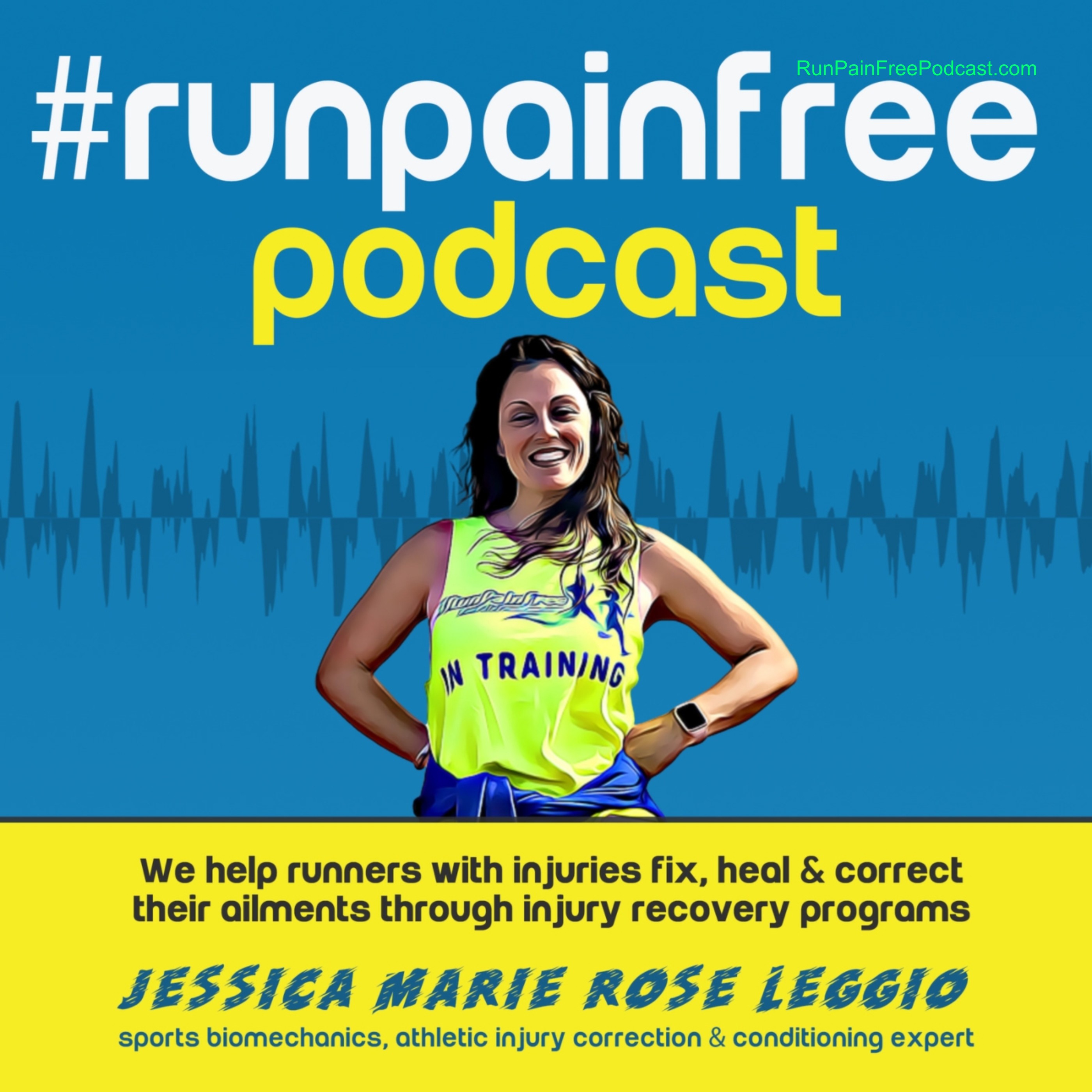
#RunPainFree Podcast
by Jessica Marie Rose Leggio
Many runners suffer from common running injuries like shin splints, runner’s knee, and more. They often search for help online, but the information they find is often conflicting and difficult to understand. It can be frustrating and overwhelming when you’re trying to get over an injury and you don’t know where to turn. The #RunPainFree Podcast has the solution- our expert advice on how to overcome running injuries! Our advice is based on 30 years of Sports Biomechanics experience helping people just like you, and it comes in an easy-to-follow format. So why not ditch the Google search and let us help you get back on your feet?
-
100
Nike Vaporfly 4, Groupthink, And The Two Kinds Of Runners
If you woke up shuffling to the coffee machine after a “great” run in your favorite carbon-plated shoes, this episode is your intervention. Coach Jessica Marie Rose Leggio laced up the Nike Vaporfly 4 so you wouldn’t have to. And what she felt wasn’t “performance.” It was a lie wrapped in tech, sold by marketing, reinforced by your run group, and echoed in your algorithm. What you’ll hear isn’t another highlight reel from a pro runner or a hype video disguised as a review. It’s a biomechanical breakdown from the injury expert who built an entire corrective system on her own broken body, then spent two decades rebuilding thousands more. Because here’s the truth no one else is saying: Your shoe isn’t just a shoe. It’s a decision. To heal or to band-aid. To feel or to numb. To learn or to follow. If you’ve ever felt pressure to wear what everyone else is wearing… If you’ve ever feared switching shoes might make things worse… If you’ve ever wondered why you’re doing “everything right” and still getting hurt… This is for you. No rankings. No fluff. No savior sneakers. Just a hard reset on your identity as a runner and the signals your body has been trying to send you every time you untie your laces. 🎧 Listen first. Then watch the latest Root Cause docuseries episode to see what words can’t capture, how Coach Jessica’s entire stride transforms between the Nike Vaporfly 4 and the Nike Free 5.0. No filters. Just biomechanics in motion. Links and resources 🎥 Watch the Root Cause docuseries The Root Cause Youtube 🧪 Test your own shoes Revisit Episode 1 of the docuseries for Jessica’s simple bend test, then check every pair in your closet as instructed in the show. 📲 Connect with Coach Jessica RunPainFreeNow.com 📝 Apply for a #RunPainFree Consultation if you want help decoding what your body is telling you
-
99
Why Your (Carbon Plated) Running Shoes Feel Great, Until You Can’t Run Anymore
You’re on here because you’re in pain. You don’t think you’re ever going to get fixed. You probably call yourself “broken” more than you realize, and you also more than likely think that’s normal. That is all hogwash. For decades, a belief system has been built that “running is a part of pain,” and it gets validated every time you wake up, put your feet on the ground, feel last night’s run, and someone tells you, “That’s just running. Get this sneaker, you won’t feel that pain.” In this episode, I start pulling that entire belief system apart. I talk to you as a Sports Biomechanics, Athletic Injury Correction and Conditioning expert, and as someone whose entire program was built on my own injured body after getting hit by a truck. My body is my science book. I’m a corrected person, which means I’m a prevented runner. My body screams the moment a sneaker forces me into dysfunction… and whether you realize it or not, yours is doing the same thing. What We Dig Into (Without Spoiling It) Why you’ve been giving your sneakers all the credit, but never any blame How innocent conversations about “what shoes to buy” quietly turn into injury-causing ideology Why simply changing into the “hot new carbon plate” and feeling less pain should actually alarm you How the running community’s “pain is part of running” culture teaches you to mask feedback instead of listen to it Why I call your sneakers your apparatus as a runner, just like a racket, a bat, or a golf club is for other sports The moment in our new docuseries where you see my body react in real time to what’s on my feet I’m not here to sugarcoat anything. I’m here so you can still run 20–30 years from now. Why You Need to Listen + Watch If you’ve: Swapped shoes and thought, “Wow, this fixed my pain” Woken up the next day with a new pain somewhere else and never connected the dots Been told by well-meaning friends, co-workers, or the internet that pain is just “part of being a runner” …then you need to hear this episode and see the visuals that go with it. I’ve taken everything you’ve been hearing on this podcast for years and expanded it into a full docuseries, where I show you, with my body, what’s really happening when a sneaker is allowed to control your movement. Links & Resources 🎬 Watch the companion docuseries episode here 🌐 Apply for a 1:1 Run Pain Free consult: RunPainFreeNow.com Watch The Root Cause Docuseries on Youtube 💬 Comment and tell us what you feel when you do the simple foot test from the episode
-
98
Debunking Runner's Knee Myths and Finding Real Solutions
Episode Summary: In this episode, Coach Jessica dives deep into the often misunderstood and misdiagnosed condition known as runner's knee. She debunks common myths, explains why knee pain is rarely about the knee itself, and shares insights on addressing the root causes of the pain. This episode is a must-listen for anyone told that knee pain is chronic and unfixable. Key Points: Introduction: Dispelling the myth that "runner's knee" is chronic and unfixable. Understanding the Pain: Why knee pain is rarely about the knee itself. Common Misconceptions: How braces, stability sneakers, and shots can make things worse. Biomechanics: The importance of understanding how your entire body moves. Personal Stories: Real-life examples of runners who overcame knee pain by addressing the root cause. Practical Advice: Steps you can take today to start addressing knee pain. Timestamps: [00:00] - Introduction and myth-busting. [03:45] - Deep dive into the causes of "runner's knee." [10:30] - The dangers of braces, stability sneakers, and shots. [17:00] - Real stories: How addressing biomechanics resolved knee pain. [23:45] - Practical advice and next steps for listeners. Resources Mentioned: RunPainFreeNow.com RunPainFreeAcademy.com RunPainFreeRabbitHole.com If you're struggling with knee pain and have tried everything without success, visit #RunPainFree, Inc., and apply for a consultation. Let's get to the root of your pain and get you back to running pain-free!
-
97
Bone Density for Runners: Herniated Disk and Backpain
Discover the truth behind building bone density and why weightlifting alone isn't the answer. Join us as we delve into functional fitness and debunk common myths on the #RunPainFree Podcast. 🔹 In This Episode: Debunking the misconception that weightlifting is the sole solution for bone density. Understanding Dana and Latricia's unique health journey and the risks they faced. The consequences of blindly following workout advice without considering individual needs. Exploring the connection between dysfunctional movement and injury. Why seeking personalized guidance is crucial for long-term health and mobility. 🔹 Why Tune In: Gain insights into the real factors influencing bone health beyond conventional wisdom. Learn how to avoid the pitfalls of generic workout advice and tailor your fitness routine to your body's needs. Discover actionable strategies to improve functional movement and protect against injury. 🔹 Connect & Discover: Join our community at https://www.RunPainFreeNow.com to access exclusive resources and personalized consultations. Take control of your fitness journey and unlock the secrets to pain-free, functional movement at https://www.RunPainFreeAcademy.com. Listen and stay tuned to https://www.RunPainFreePodcast.com for more helpful insights. Remember: Understand your body's needs and movement patterns to effectively build functional muscle and bone density. Visit https://www.RunPainFreeNow.com to uncover the truth about fitness and bone health.
-
96
Heart Health Analysis: Understanding the Heart's Role in Endurance and Injury Prevention
Welcome to #RunPainFree Podcast, where we delve into the essential aspects of injury prevention and optimal performance for runners. In this milestone 100th episode, host Jessica Marie Rose Leggio explores the critical role of heart training in ensuring longevity and enjoyment in your running journey. 🔹 In This Episode: Unveiling the importance of heart training for runners, shedding light on its often overlooked significance. Exploring real-life examples, such as Becki's journey, to understand the impact of heart health on endurance athletes. Addressing misconceptions and educating listeners on the complexities of heart health and its correlation with running performance. Discussing the dangers of pushing pace and the potential consequences of ignoring proper heart training techniques. Offering actionable insights and strategies for incorporating heart training into your running regimen for sustainable results. 🔹 Why Tune In: Gain invaluable insights into the often misunderstood realm of heart training and its profound impact on your running journey. Learn from real-life examples and expert advice to avoid common pitfalls and maximize your potential as a runner. Discover practical strategies and techniques to prioritize heart health, prevent injuries, and unlock your true running potential. 🔹 Connect & Discover: Join the community of passionate runners at RunPainFreeNow.com to access exclusive resources, expert guidance, and ongoing support for your running endeavors. Explore further insights and resources at RunPainFreeAcademy.com to elevate your understanding and performance. Remember: As you lace up for your next run, remember: pushing the pace isn't always the path to progress. Understanding your heart's capacity and respecting its limits can safeguard against long-term damage and keep you running strong for years to come. Prioritize heart health alongside your physical training regimen to unlock your true running potential while ensuring longevity in the sport you love. Keep running strong, and stay tuned for more insights and inspiration on #RunPainFree Podcast. Tune in for more episodes filled with expert advice and transformative stories!
-
95
The Miseducation of Running: Exposing Plantar Fasciitis And Other Run Misconceptions
Join Jessica Marie Rose Leggio for a riveting episode of the #RunPainFree Podcast, where we delve into the widespread misconceptions about runner injuries, focusing on the often misunderstood condition of plantar fasciitis. 🔹 In This Episode: We are unraveling the complexities of plantar fasciitis, a common ailment among runners and sedentary individuals alike. We are exploring the roots of runner injuries, debunking the myth that they are solely caused by running. Highlighting Babette's journey as a busy professional and mother as she navigates through the challenges of plantar fasciitis. Examining the detrimental impact of stability sneakers and the misleading advice surrounding them. Understanding the interconnectedness of our body, learning that foot pain like plantar fasciitis often originates from issues in the hip or spine. Recognizing the importance of proper footwear and avoiding the pitfalls of marketing tactics in the sneaker industry. 🔹 Why Tune In: Get insights from Jessica's three decades of experience treating plantar fasciitis and other runner injuries. Learn how misinformation and quick fixes can exacerbate conditions like plantar fasciitis. Discover the significance of a holistic understanding of body mechanics in treating and preventing injuries. 🔹 Connect & Discover: The #RunPainFree Podcast is not just a source of information; it's a gateway to transforming your running experience and overall health. Hosted by Jessica Marie Rose Leggio, a sports biomechanics, athletic injury correction, and conditioning expert, this podcast is where misinformation is dismantled and replaced with scientific, experience-based insights. As a listener, you're invited to join a community that goes beyond the surface-level advice commonly found online or in stores. Whether you're a seasoned runner or just starting, the insights and stories shared here are invaluable in ensuring a healthy, enjoyable running experience. Remember: RunPainFreeNow.com is your first step to a pain-free running journey, you will not only debunk common myths about running injuries but also gain a deeper understanding of your body. RunPainFreeAcademy.com offers a unique blend of professional expertise, real-life stories, and practical advice for anyone looking to improve their running experience, prevent injuries, and enhance their overall performance. Tune in for more episodes filled with expert advice and transformative stories!
-
94
Running into Trouble: Social Media’s Role in Rising Running Injuries
Join Jessica Marie Rose Leggio in this transformative episode of the #RunPainFree Podcast, where we explore the untold effects of social media on the running community and dismantle the myths surrounding shin splints. 🔹 In This Episode: We are examining the shift in fitness culture influenced by social media over the past decade. Addressing the risks associated with misinformation about running injuries and methods. Dissecting the truth behind shin splints, clarifying widespread fallacies. Understanding the integral relationship between shin issues and broader physiological concerns like hip and spine health. The influence of footwear and external suggestions on your running journey. The significance of mastering body mechanics for a safer and more effective run. 🔹 Why Tune In: Access expert viewpoints on common running injuries and their solutions. Learn how to sift through social media noise and find valuable running advice. Appreciate the need for professional expertise in sports biomechanics for injury prevention. 🔹 Connect & Discover: Calling all runners! Want to kiss those aches goodbye? Make a beeline for RunPainFreeNow.com – your first step to a pain-free running journey, tailored just for you. And here's the inside scoop: Jessica's cooking up some magic in her private training at RunPainFreeAcademy.com. You won't want to miss this! Remember: Running is more than a physical activity; it's a path to self-awareness and mastery. Embrace the authentic spirit of running with us beyond social media distractions. Keep tuning in for episodes filled with expert insights!
-
93
How Jackie Overcame Foot Pain and Learned to Love Running Again
Listen in to find out How Jackie Overcame Foot Pain and Improved her Quality of LIfe! "I was doing all the wrong things. I had the wrong shoes and was just a mess." "Having the right strength in the right areas is very important for all different kinds of sports." "The warmup is key...I couldn't imagine going out for a run now without at least foam rolling." This episode follows the story of a runner who struggled with pain and injury and how she overcame these challenges to find joy in running again. She shares her journey of learning the importance of strength training for runners, the benefits of a proper warmup, and the difference it made for her foot pain and plantar fasciitis. Top 10 Takeaways: Get stronger and prevent injuries by adopting the right strength training routine. Keep pain and injuries at bay with a proper warmup that prepares your body for running. Make your warmup more effective by adding essential releasing techniques to your routine. Say goodbye to foot pain by choosing the right pair of shoes for your feet. Don't underestimate the impact of foot pain on your daily life. Overcoming injuries is possible, and it doesn't have to be the end of your running journey. Change your habits and approach to running to improve your experience. Seek expert advice and guidance to take your running to the next level. Enjoy running without pain by adopting the right techniques and mindset. Stay consistent with your training and recovery to maintain a pain-free running routine. This episode shows that with the right tools, guidance, and mindset, it's possible to overcome pain and injury and find joy in running again. The importance of proper strength training, warmup, and shoe choice cannot be overstated, and seeking help from experts can make all the difference in achieving pain-free running. Links and Resources: Https://www.runpainfreenow.com Https://www.runpainfreeacademy.com Https://www.runpainfreenow.com/books
-
92
How To ’Run Well’ with Dr. Juliet McGrattan
There's no better expert than an expert who's had to deal with their expertise as a person. This marathon season, know how experts in #RunPainFree help you feel empowered by having a better understanding of what’s going on with your body, which can help you improve your running experience. In this episode, Dr. Juliet McGrattan shares her personal journey with running and how it led her to write her book "Run Well." She will share why she runs, how she got started, and what made her write about running. She will share her knowledge as a medical professional, explains how a runner’s body work, and how a healthy cardiovascular system benefits the body. In today’s episode, you learn… What's happening to a runner with their blood pressure when they're running and why it tanks? Why do runners pass out? How the blood pressure and the hydration is connected and how it regards one another for a runner specifically. How having a healthy cardiovascular system helps both men and women boosts sexual health and sexual function. How orgasms can be a part of a workout using the deep pelvic muscles. Links from today’s episode https://drjulietmcgrattan.com/ https://www.runpainfreenow.com
-
91
🎧 Why Your Shins Hurt After Running 🏃♀️ 🏃♂️ (And what to do about it)
See All The Visuals From Today's Episode here ==> #RunPainFree Injury Recovery Show Shin splints are common, but that doesn’t mean they’re normal! They’re actually the first warning sign of a hip problem, so don’t ignore them. Did you know that stability sneakers create shin splints? You could be a full-foot-function runner with good form, but if you’re in a stability sneaker that doesn’t allow for foot mobility, you could begin to develop hip dysfunction…feeling it in your – you guessed it -- shins. The good news is that shin splints fall into the ache/pain category, which means they can be corrected quickly. Get more technical analysis from Jessica here ==> https://www.RunPainFreeNow.Com/Apply-Now Jessica gets into the technical weeds in today’s episode, explaining exactly what shin splints are, how they develop, how the foot and hip are involved. Come geek out and learn with us. Jessica’s got supporting visuals too! Then we have a case study. You’ll love hearing Nancy’s story – about the cute barista who noticed she was losing weight and encouraged her to try running, about her weight loss journey, and about why she continues to run. When Nancy developed debilitating shin splints and struggled to find a lasting solution, she found #RPF. As is typical, Jessica kept Nancy “in sport” while she was in "correction." #RPF uses the sport as part of the correction program. Long story short – Nany recovered quickly. When she came to Jessica, she wasn’t sure she could run a marathon. She has run six-four within one year! In today’s episode, you learn… • Exactly what shin splints are and what causes them • The technical nitty-gritty behind shin splints • Jessica’s analysis of a Books stability sneaker setting up a perfect storm for shin splints • How the lower legs muscles affect the hip • Why Nike Zoom Fly sneakers, which promote toe striking, can cause shin splints • About Nancy’s running journey • Why Nancy came to #RPF and why she considers the #RPF program a bargain Links from today’s episode Get more technical analysis from Jessica here ==> https://www.RunPainFreeNow.Com/Apply-Now See The Visuals From Today's Episode here ==> #RunPainFree Injury Recovery Show
-
90
Oh My”Itis” - What Is ”Itis” ”Bursitis” Arthritis”
Welcome to the #RunPainFree podcast. Today, Coach Jessica Marie Rose Leggio gives you the answers to a common and commonly misunderstood running injury. Today, we are talking about all things' itis'. Be it your elbow or your ankle; the underlying cause is the same. Have you ever heard of this before? Well, that's why you need to listen up to this episode! If you liked this episode, you'll LOVE this free training series because if you've ever wondered "Free Training
-
89
🎧 Nerve Stimulators: The TENS Machine & Other Injury Recovery Sins
Welcome to the #RunPainFree Podcast! Today, your coach Jessica Marie Rose Leggio focuses her talk on Tens machines. Maybe you have one, perhaps you heard of them, or perhaps you want one. Whatever the case, listen up; Coach Jessica has some shocking news. One last thing, if you really want to stop nagging injuries from ruining your run journey, this program and training, #RunPainFree Injury Recovery Program, holds the secret every Injured runner needs! Check it out here: https://www.InjuryRecoveryProgram.com
-
88
🎧 Running Injuries: How To Win The Emotional Battle of Injuries
Running Injuries: How To Win The Emotional Battle of Injuries MENTIONED LINKS Resources & Programs To Run Pain Free: #RunPainFree Injury Recovery Program KEY LEARNING POINTS · There's no shame in being injured. · Not all pain is wrong, but all pain is feedback · Injuries don't have to be a downward spiral; you can learn from them and come out stronger than before. Thanks so much for tuning in this week. If you really want to #RunPainFree - without Having to hang up your run shoes and stop running altogether, possibly forever - this Free Webinar, Presented By Jessica Marie Rose Leggio, is exactly what every Injured runner is looking for! Grab it here: https://www.RunPainFreeNow.com/Free-Training
-
87
🎧 The Naked Truth About Running Form
Welcome to the #RunPainFree podcast! In today's episode, Coach Jessica Marie Rose Leggio debunks the rampant hogwash on familiar running form cues. Stay on your toes, they say, do the pose method says one camp, keep your elbows locked in says another. You've all heard it, yet you're all injured. So Coach Jessica sets the record straight before dropping the mic and walking off the podcast. Yes, this run form nonsense grinds her gears. Thinking about how you run will not improve your running form. Your body is only going to move with its ability to do so. "The minute you think with your brain, that you can actually tell your body how to move, you already have an injury." If you don't have a functional movement pattern, if you lack function somewhere and you're overcompensating somewhere else, you're going to have a problem. And your brain has nothing to say about it. TIMESTAMPS 01:00 – Distance running is a sport 03:26 – Your back story matters 06:43 – Running is a basic human movement 08:43 – Don't overthink it, just run 15-22 – Is your Run Coach specialized in long-distance running? 19:13 – The importance of entire foot function 28:59 – A note on 'over-striding.' KEY LEARNING POINTS · Your body knows how to run, so don't get your mind involved · Stability sneakers will wreck your run form by locking you up from your ankle to your hip · Run coaches that get you to do speed works and butt kicks are trained in track and field, not long-distance running. Avoid them and find an actual long-distance run coach. Also, if you want to know "How To Run Pain Free and Recover From A Run Injury Without Having To Stop Running (Even If You Have No Clue Where To Start!)" this Free Webinar, Presented By Jessica Marie Rose Leggio, makes it quick and easy! You can check it out here: https://www.RunPainFreeNow.com/Free-Training
-
86
🎧 Blame Your Pain On Your Generic Run Program: Program Design For Runners With Injuries
Welcome to the #RunPainFree podcast. Today, Coach Jessica Marie Rose is talking about all things programming. She discusses: Why tailored programs are crucial, Why catch-all programs are a recipe for disaster, The dangers of hack coaches, amongst other topics. Listen up, runners, Coach Jessica in fine form, telling it like it is. Long-distance isn't a walk in the park. Long-distance running is demanding. Are you crazy enough to question that? Yeah, you are asking it, aren't you? Ok, get off your phone and knock out a marathon for us and get on with your day. Tell us how that goes. You've got no chance in hell doing anything long distance if you haven't trained and conditioned your body for it. Oh, right. You are a born-again, born-to-run runner. Ok then. Lace up your cute little shoes, or go barefoot even. Make sure your color combination matches whatever season you are in, and you have your pre-prepared inspirational message for social media. Do you seriously think a couple of Instagram posts and Strava kudos points are going to protect you from injury? Please, just a little history lesson, the first marathon runner, that guy who ran from Marathon to Athens, Pheidippides, literally, and we mean literally, died. That's why the race ends at 26.2. Ok, you get the point on with the show. Hey, by the way, if you want to know "How To Run Pain Free and Recover From A Run Injury Without Having To Stop Running (Even If You Have No Clue Where To Start!)" this Free Webinar, Presented By Jessica Marie Rose Leggio, makes it quick and easy! You can check it out here: https://www.RunPainFreeNow.com/Free-Training
-
85
🎧 Removing 🏃♀️ Runners 🏃 Fear of CBD
Welcome to the #RunPainFree Podcast. Today, Coach Jessica Marie Rose Leggio talks with Scott Douglas, author of The Athlete's Guide to CBD. They discuss what CBD is, what it's not, what to look out for, and how it actually may benefit you as a runner. Bio: Scott Douglas is a contributing writer for Runner's World and the author/co-author of several books, including Running Is My Therapy, The Athlete's Guide to CBD, Advanced Marathoning, and the New York Times bestsellers 26 Marathons and Meb for Mortals. Difference between CBD and THC. The first point we need to address is CBD being confused with marijuana. Yes, both CBD and THC are compounds found in cannabis plants, yet they have very different effects on the human body. From a technical classification point, a cannabis plant that has less than 0.3% THC is considered hemp. Sports Biomechanics Expert publishes simple strategies to run without pain or discomfort MOST billion-dollar shoe companies don't want you to know...
-
84
🎧 The Expert Guide To Remove IT-Band Syndrome (ITBS) Once And For All!
Welcome once again to the #RunPainFree podcast. Today, Coach Jessica Marie Rose Leggio gives you the low down on your IT Band. If you thought it was just at the side of your quads and you could stretch it out, listen up, rascal – you've got a lot to learn! TIMESTAMPS 01:12 Here's where your IT Band is… 03:32 Do you even foam roll? 10:14 The Importance of runner's torque 12:41 Your IT band is crucial for your power as a runner 14:17 The connection between your IT Band and your hips 20:00 Knee pain and your IT band 24:47 Take away lesson KEY LEARNING POINTS · Your IT band's job is to protect you from moving dysfunctionally. If your IT band is jacked, you are will likely encounter many more injuries · Your IT band starts at the back of your knee and ends on the opposite shoulder; it is not just on your outer quads! · You can't stretch your IT band; you need to foam roll it! MENTIONED LINKS #RunPainFree Bootcamp: RunPainFreeNow.Com/Free-Training Keep running and keep learning!
-
83
🎧 The Science of Good Rest 😴 and Recovery (with Nick Littlehales)
Welcome to the #RunPainFree Podcast! In today's episode, Coach Jessica Marie Rose Leggio speaks with leading elite sport sleep coach Nick Littlehales. It sounds like a unique professional title, well, that's because he invented it! Nick's career spans over 20 years. He has been a true innovator in bridging the divide between sleep science and creating actionable steps that athletes can implement to improve their rest and recovery. He is also the author of the international bestselling book "Sleep: The Myth of 8 hours, the Power of Naps, and the New Plan to Recharge Your Body and Mind." In this episode, he shares his knowledge and techniques underpinning his R90 Technique to increase your rest and performance. If you have been basing your recovery on the adage of getting eight hours every night, this episode is going to give you something to sleep on. Step 1: Circadian rhythms The first thing you need to do to improve your sleep is developing your understanding of circadian rhythms. Circadian rhythms are physical, mental, and behavioral changes that follow a 24-hour cycle. Like animals and plants, we humans (yes, it turns out we are animals after all!) also respond to changes in daylight. Our melatonin increases in darkness and is suppressed in daylight, whereas serotonin rises during the daytime. Melatonin is most known for its role as a sleep hormone, and serotonin is the "feel good" hormone. So, in the world of COVID lockdowns, make sure you get outdoors every day; it will do more for you than slamming another coffee. In the evening, getting off your phone and computer and avoiding blue light will help you sleep. Take away lesson. Sleep should be considered an intrinsic part of the way you approach running. Running is intensive, and as you ramp up miles, you also need to ramp up your recovery. Performance gains won't just occur as a result of pushing harder during your training. A massive chunk of your performance relates to the way you approach to sleep and recovery. Particularly for our marathoners, if you have done a long run on the weekend, factor in having a nap afterward; you've earned it. TIMESTAMPS 00:32 – Introduction and biography 02:37 – Nick's unlikely career journey 16:09 – How Nick developed the R90 sleep technique 19:17 – Five 90 minute cycles vs. 8 hours sleep per day 22:21 – Circadian rhythms and chronotypes 25:34 – Shortcomings of sleep products KEY LEARNING POINTS Aim to achieve five 90 minute cycles a day instead of 8 hours per night Napping has a powerful effect on your recovery, memory, performance, and overall mood Develop pre and post-sleep routines Optimize your sleeping environment by eliminating bright light LINKS MENTIONED Get an Assessment With Jessica: https://www.runpainfreenow.com. Resources & Programs To Run Injury-Free: https://www.runpainfreeacademy.com #RunPainFree Bootcamp: https://www.runpainfreebootcamp.com/ Get a copy of Nick Littlehale's book, Sleep: The Myth of 8 hours the power of Naps and the New Plan to Recharge Your Body and Mind: https://www.sportsleepcoach.com/collections/sleep-by-nick-littlehales/products/sleep-by-nick-littlehales. Keep running and keep dreaming!
-
82
🎧 Ugh! Why Do I Have Knee Pain After Running 🏃 🏃♀️
Before we start the show, if you want to know "How To Run Pain Free and Recover From A Run Injury Without Having To Stop Running (Even If You Have No Clue Where To Start!)" this Free Webinar, Presented By Jessica Marie Rose Leggio, makes it quick and easy! You can check it out here: https://www.RunPainFreeNow.com/Free-Training Today, Coach Jessica Marie Rose Leggio chats with Little Billy about one of the most common problems runners face – knee pain after running. If you've just rolled in from a run, get yourself a glass of water, your foam roller, and listen up. Coach Jessica is going to tell you straight. Hey Coach, I have knee pain after running. Oh, Little Billy, so much to learn. The first thing you need to realize is that knee pain is not an injury. Your knees are fine. The pain has nothing to do with your knees. Takeaway lesson. Knee pain after running is the first red flag you'll ever get with running. Your first point of action should be to start foam rolling pre and post-run. If you're foam rolling and not feeling better afterward, contact us for an online consultation. They're complimentary. We can figure out exactly what's going on with your body, and we will teach you how to foam roll properly. If foam rolling doesn't solve your knee pain, it is a sign that you have a bigger problem at your hips. TIMESTAMPS 01:18 – Intro 02:27 – Why you should avoid knee braces 5:08 – So what's the root cause? Let me guess, my hips? 08:40 – So, Why do I only have knee pain after running? 10:50 – Am I dysfunctional? 17:41 – But all the runners I know have some pain from running? 20:15 – How do I figure out what's going on? 21:50 – Takeaway lesson KEY LEARNING POINTS – The root cause of your knee pain is hip dysfunction – Start foam rolling pre and post-run to generate blood flow – Avoid braces, bandages, and stability shoes – Start introducing conditioning exercises for your hips MENTIONED LINKS Get an Assessment With Jessica: RunPainFreeNow.Com/Free-Training
-
81
🎧 How To Overcome Your Fear of Getting Injured 🏃♀️ 🏃
Today's show is about How To Overcome Your Fear Of Getting Injured, and if you want to know more about recovering from an injury, this Free Webinar, Presented By Jessica Marie Rose Leggio, is exactly what you're looking for! You can check it out here: https://www.RunPainFreeNow.com/Free-Training In this episode, Coach Jessica Marie Rose Leggio gives you a how-to guide on trusting your body again after getting injured. She serves it up the only way she knows how, with tough love. Enjoy! Take away lesson Start shredding all those external band-aid fixes and start working on you. If you are running in fear of being injured again, then lean on the word trust. Trust your body. Don't feed it junk; feed it knowledge, and it will respond to its nourishment like a flower in full bloom. Ok, we ain't that cheesy at #RunPainFree. Also, get your butt foam rolling, get conditioning, and learn how your body works. Otherwise, you are going to be in the weeds for a while. TIMESTAMPS: 06:55 – Pain is feedback 11:30 – Losing trust in your body 16:17 – Foam roll and listen to your body 27:36 – Take away lesson KEY LEARNING POINTS Do the reading and learn what is going on with your body. Get a professional if you can't figure it out. Start adding conditioning and injury correction work into your training regime. Stop, drop and foam roll! MENTIONED LINKS Resources & Programs To Run Injury-Free: RunPainFreeNow.Com/Free-Training Keep running and keep learning!
-
80
🎧 Are You Using A Massage Gun For Running 🏃♀️ Pain Relief?
Today Coach Jessica Marie Rose Leggio aims for the rising popularity of massage therapy guns and how they may cause injuries. If you're stonewalled by the fact that more and more you're lowering your distance or the duration of your runs due to pain, then this Free Webinar, Presented By Jessica Marie Rose Leggio, is the perfect solution to your problem! Grab it here: https://www.RunPainFreeNow.com/Free-Training Jessica's counter-narrative about Theragun shoots down the marketing claims and offers up some tools and advice that will aid your recovery without the risk of injury. TIMESTAMPS 0:56 – A power tool dressed up as therapy 06:45 – Don't jump the gun; start foam rolling 14:21 – A crash course on fascia KEY LEARNING POINTS The current day massage guns result from DIY massage therapy hacks coming out of gyms, not scientific studies. The danger of massage guns is you don't feel how deep you are going, and you may bruise a muscle, which takes months to recover from. Foam roll! Foam roll! Foam roll! Foam roll your entire body while avoiding your joints. For particularly tight spots, you can add in lacrosse or golf balls. Oh, before I forget, if you're wondering "How do I get past chronic reoccurring injuries", then this Free Webinar, Presented By Jessica Marie Rose Leggio, has the solution! This presentation covers an under-the-radar perspective on what the TOP Elite runners do to avoid or rapidly fix common run injuries. Learn more here https://www.RunPainFreeNow.com/Free-Training Keep running and keep foam rolling!
-
79
🎧 Nita Sweeney: How To Overcome Depression Through Long-Distance Running 🏃♀️
The mental health benefits of running are numerous, yet talking directly about depression is often pushed to the side in running circles. Get an Assessment With Jessica: https://www.runpainfreenow.com. But that's not how #RunPainFree rolls. In today's episode, Coach Jessica Marie Rose Leggio shines a spotlight on award-winning author Nita Sweeney. She shares her intimate story on how depression affected her and how running brought her to a better place. Nita's story is harrowing, authentic, relatable, and we hope everyone out there can glean a lesson or two from Nita's words of wisdom. TIMESTAMPS: 01:00 – Intro and Lisa's biography 02:51 – Nita's running story 11:53 – Realizing it was more than negative self-talk 14:13 – Tools to discourage negative voices 17:09 – Depressed naps vs. runners' naps 22:53: Importance of having supporters KEY LEARNING POINTS Running can be transformative for your mental health Baby steps are all it takes to reap the benefits of running Social support is hugely beneficial for running and mental health Journaling positive affirmations can transform your self-talk LINKS MENTIONED Get an Assessment With Jessica: https://www.runpainfreenow.com. Get a copy of Nita Sweeney's Book, Depression Hates a Moving Target: https://nitasweeney.com/. Take care of yourself and keep running!
-
78
🎧 Simple Hacks To Love ❤️ Running 🏃♀️ (With Lisa Jhung)
In today's episode, Coach Jessica Marie Rose Leggio speaks with Lisa Jhung about Simple Hacks To Love ❤️ Running 🏃♀️ (With Lisa Jhung). Get an Assessment With Jessica: https://www.runpainfreenow.com. Lisa is a widely published writer in all corners of the running world and is the author of Running That Doesn't Suck: How to Love Running (Even If You Think You Hate It). As the title of Lisa's book suggests, she didn't always love running. She flat out hated it – to the point that she was hiding from her high-jump coach to avoid running two laps around the track during warm-up. After being forced into running to make the college volleyball team, what began as begrudging runs turned into a daily activity she positively anticipated. Lisa's offers some sage advice with a dose of dry wit that will guide new runners and advanced runners alike to find joy in the simple act of running. Focus on the journey, not the destination Ultimately, there is no one-size-fits-all. Play around with different approaches to running and find what works for you. TIMESTAMPS: 01:00 – Intro and Lisa's biography 02:02 – Lisa's running story 04:22 – Importance of identifying the reason why you run 06:22 – Advice for beginner runners 09:16 – Run where you are 13:06 – The number 1 misconception about running 16:30 – The runner's high 19:31 – The pros and cons of joining a run group 24:17 – How to get past the initial soreness as a beginner runner KEY LEARNING POINTS Be patient with your progress and run where you are on any given day Focus on the process, not the end goal Remember that the initial soreness beginner's experience dissipates over time The runner's high kicks in around the 30-minute mark of steady-state running LINKS MENTIONED Get an Assessment With Jessica: https://www.runpainfreenow.com. Read a free chapter of Lisa Jhung's book Running That Doesn't Suck, or order it from her website: http://www.lisajhung.com/books.html Keep running and keep foam rolling!
-
77
🎧 Here‘s Why Workouts 🏋️♀️ And Running 🏃♀️ Are Not The Same Things.
In today's episode, Coach Jessica Marie Rose Leggio aims at a rampant misconception in the running world. But first, if you're disappointed by the fact that pain has stopped you for months from the activities you enjoy the most, then this Free Webinar, Presented By Jessica Marie Rose Leggio, is the perfect solution to your problem! Grab it here: https://www.RunPainFreeNow.com/Free-Training Despite what you may have heard on your group run, running more miles isn't going to make you a Boston qualifier. Sorry to burst your bubble, but #RunPainFree ain't a religion; it's a science – and there is so much more to consider. I run all the time but "tank" on race day. When you're running seven days a week, you are running yourself out. If you just had an epiphany of how your injury came on straight after you did your highest mileage week – boom! There you go, there's your proof! You need to build an objective baseline and foundation before you start chasing lofting race goals. Take away lesson Simply logging miles will only get you so far before an injury flare-up. Reassess how you're working out. Are you doing functional training? Are you training for your sport? Or are you just using your sport as the workout? Hit up our back catalog of podcasts and apply the lessons on conditioning for running Ditch your stability sneakers Sign up for free for the #RunPainFree Bootcamp and learn the fundamentals of running Get bespoke guidance at the #RunPainFree Academy Bottom line: If running is what you love to do, respect the sport and start doing the conditioning workouts! TIMESTAMPS 1:35 The difference between a workout and the sport 6:16 What to look for in a qualified trainer 12:05 Why just clocking miles is the highway to injury 26:53 Why you tank on race day. 30:05 Takeaway lesson KEY LEARNING POINTS Using running as your workout increases your chance of injury as you haven't built your foundation for functional movement Start adding athletic conditioning into your training regime Introduce mobility exercises, mainly focusing on your hips if you are an office worker LINKS MENTIONED #RunPainFree Webinar Training Keep running and keep conditioning!
-
76
🎧 How To Recover From An Injury And Progress Your 🏃♀️ (At The Same Time)!
In this episode, Coach Jessica Marie Rose Leggio tells you how to recover from an injury and progress you're running simultaneously. It's something most people think isn't possible, but it is at the heart of # RunPainFree's method. Listen up and learn why progressing your running is the only way out of injury. Is the pain even an injury? Dealing with muscle pain is the last thing you should ever experience. The serious injury is in your joint. Addressing joint dysfunction is the cornerstone of runner injuries and is your path to progress. Takeaway lesson The most common running pains people experience are a symptom of a deeper-rooted injury. Consider them as a red flag for an injury elsewhere in the body. Make sure you log how you feel after each run. Each niggle, tweak, and nagging muscle is your body telling you that something is off. Your running log will be your lifeline out of injury. It helps you identify the damage and informs the conditioning work you need to progress out of harm. Identifying injuries and the corrective path forward is a complex task. If you are struggling to figure out what is going on with your body – reach out to us. That's our expertise, that's what we are here for, and that's why our clients love us. TIMESTAMPS 1:33 Is the pain even an injury? 3:46 Why you need to keep running through injury 9:38 Start foam rolling today 21:17 Why building your foundation is the path to progress KEY LEARNING POINTS If you want to run injury-free, start foam rolling now! Keep a log of how you felt after each run – this is essential for identifying the root of your injury It would be best if you kept running through injury as the run is what gives you feedback on your progress LINKS MENTIONED Get an Assessment With Jessica: https://www.runpainfreenow.com. Resources & Programs To Run Injury-Free: https://www.runpainfreeacademy.com
-
75
🎧 How To Run 🏃♀️🏃 With Strollers
In today's episode, Coach Jessica Marie Rose Leggio talks you through what you need to know so you can get out running with your kids in the stroller. Get an Assessment With Jessica: https://www.runpainfreenow.com. This topic comes from one of our team members who wanted to get Jessica's 411 on the subject. We know many mommas and poppas are finding it hard to find time currently, so this one is for you! Should I run with a stroller? As always, there are a few things you will need to consider to stay injury-free. #1 thing to look for in a jogging stroller. # RunPainFree's common sense PSA: if you are on cobblestone streets, on a jacked-up road, or going down a hill – use your gorilla grip on the stroller! Take away lesson Running with a stroller is an exceptional tool for parents. You'll find you have more opportunities in the day to run, and your kids will love it. If you've been thinking about running with a stroller, make sure you run behind it with an open gate. Keep both hands on the stroller, but play with tapping it in front of you. Other than that, get out there and enjoy running with your kids! Practical tips · Initially start slow, small, and close to home · In cool weather, pack something warm for yourself for the unplanned stops · Don't forget to pack extra food for your kids TIMESTAMPS 1:00 – Should you run with a stroller? 2:01 – What to look for in a running stroller 5:34 – Running one-handed 7:25 – Switching hands 9:29 – The role of proprioceptors 10:24 – Strength problems 16:24 – You still need to swing your arms KEY LEARNING POINTS · Make sure you can open up your stride with your stroller · Don't hold on with one hand · Try out different stroller models and find one that works for you · Plan your routes to avoid traffic and uneven pavement. Parks are ideal. LINKS MENTIONED Resources & Programs To Run Injury-Free: https://www.RunPainFreeNow.com/Free-Training Keep running and keep learning! Jessica Marie Rose Leggio
-
74
🎧 Martinus Evans: A Letter From The Back Of The Pack 🏃♀️ 🏃
In today's episode, Coach Marie Rose Leggio interviews Martinus Evans. Get an Assessment With Jessica: https://www.runpainfreenow.com. He offers up wisdom and inspiration that counters the elitist narrative. Martinus may not be breaking two hours in the marathon, but he is breaking stereotypes. That's why we got him on the show, that's why we love him, and that's why we know you will too! #RunPainFree: Is the lack of diversity in running motivation for you? Martinus Evans: I've had people call me the N-word. I've had people drive by in cars and throw things at me. I've been followed. police have even stopped me running at 5 am to wear a flashlight and carry three liters of water in my backpack. As much as it is about motivating people to run, I'm about bringing awareness to the injustice that is out there. TIMESTAMPS 2:40– Why do you run? 4:10 Buying running shoes instead of following the doctor's advice 9:22 Everyone is a runner, no matter their pace 12:56 - Choosing to win 18:25 - Starting the Slow AF community 23:22 An open letter from the back of the pack 28:52 Diversity in running KEY LEARNING POINTS · Running is for everybody. Mid-packers, shut your trap! · Starting running isn't easy, but it's the struggle that creates progress · If you are at the back of the pack, be prepared for water stations being taken away early and run with a water pack if necessary · Don't use running as a punishment for weight loss. Enjoy the benefits of being active LINKS MENTIONED Get an Assessment with Jessica: https://www.runpainfreenow.com. Connect with Martinus Evans: Blog and Podcast: 300 Pounds and Running Instagram: @300poundsandrunning
-
73
🎧 Runners 🏃 Who Make No Excuses for Life Circumstances
In today's episode, Coach Jessica Marie Rose Leggio speaks with olympian Loretta Claiborne. Get an Assessment With Jessica: https://www.runpainfreenow.com. She's a marathoner, a 4th-degree black belt in karate, and continues to compete in multi-sports at the Special Olympics. She is also a fearless advocate for women and people with disabilities. Loretta is a force to be reckoned with. This episode shows what grit and determination look like in the face of adversity! TIMESTAMPS 1:21 – Introduction and biography 3:33 – Getting into running in the 1960s 5:48 – Training for the Special Olympics 11:24 – Advice for others with physical and intellectual challenges 16:30 – Becoming an advocate for the Special Olympics 22:32 – How to be fearless during COVID KEY LEARNING POINTS · Loretta Claiborne has made changes in her school, in her community, and her life by stepping up and asking questions and pointing out injustices · Success in life is how you define it · Loretta's work with the Special Olympics has had a profound effect on female athletes' representation, not only in the US but in regions where women are significantly marginalized. LINKS MENTIONED Get an Assessment with Jessica: https://www.runpainfreenow.com Loretta Claiborne website: https://www.lorettaclaiborne.com/ Special Olympics website: https://www.specialolympics.org/about Keep running, and keep learning! Jessica Marie Rose Leggio
-
72
🎧 NYRR’s Founding President: Black American Distance Running 🏃♀️ 🏃 History
Celebrating the life and legacy of Ted Corbitt In today's episode, Coach Jessica Marie Rose speaks with running historian Gary Corbitt. Gary is the son of long-distance running legend Ted Corbitt. Gary provides a wealth of information on the impact his father's career had on the running world and physical therapy, and the civil rights movement. Ted Corbitt: Running ahead of his time For those who missed the memo and lived under a rock, Ted Corbitt is considered the father of long-distance running in The United States. Ted Corbitt held US distance records for 25 miles during his running career, the marathon, 40 miles, 50 miles, and 100 miles. Not only was he the first African American to represent the USA at the Olympics, but he also was a trailblazer in the disciple of ultra-running. Renowned for running over 200 miles a week, he ran an estimated 200,000 miles in his lifetime. Corbitt's extensive running accolades awards: https://tedcorbitt.com/ted-corbitt-record/ Influence on Running Clubs and the civil rights movement Ted Corbitt joined the New York Pioneer Club in 1947. The New York Pioneers Club, founded in 1936 in Harlem, became the first all African American club. The Pioneer Club used running to promote education, civic values, and better race relations. To this end, in 1942, the club began to welcome all races, resulting in the first large-scale integrated sports club in the US. 'He would give lectures before workouts and used athletics to build people of character. It's not just a running story; it's a civil rights story." Ted Corbitt co-founded the New York Road Runners Club in 1958 and served as the club's first president. Ted Corbitt's legacy as a founding president led the New York Road Runners to develop its inclusion agenda. An agenda that embraces and encourages all runners no matter race, speed, or creed. From its humble beginnings, the club now has a membership of over 60,000 runners and serves 695,000 runners annually. Additionally, the New York Road Runners continue to focus on empowering young people through sport and has raised over $350 million for charities since 2006. Ted Corbitt was involved in the planning of The New York City Marathon, which has become the club's flagship event and is renowned for its inclusive approach. It's safe to say, Corbitt's vision set long-distance running on a trajectory of inclusion that impacted the formation of rights-based run clubs around the country. For the history buffs: The New York Road Runners are currently celebrating Black History Month and are compiling historical resources on Ted Corbitt and other black pioneers'. For those who prefer videos, here is a New York Road Runners tribute video. Innovating physical therapy methods for long-distance runners Many runners may not be aware of the impact that Ted Corbitt had on physical therapy for long-distance running. After serving in the army in WWII, Corbitt studied physical therapy at New York University, becoming one of the first African Americans to enter the profession. Ted Corbitt traveled the world to learn from leaders in their respective disciplines to develop his holistic physical therapy approach. Consequently, he was one of the first physical therapists to study, teach and practice connected tissue massage, deep muscle therapy, Proprioceptive Neuromuscular Facilitation (PNF) progressive resistance exercises, and applied kinesiology. 'I could easily make the argument that his contributions in physical therapy far exceed his running career. He was light years ahead of the field in terms of using weight training for runners' He took a scholarly approach to physical therapy, a profession that he practiced for over 40 years. He taught and trained generations of physical therapists, which has profoundly innovated practices that continue to support runners to run injury free today. TIMESTAMPS 1:30 Gary Corbitt introduction and biography 5:31– Ted Corbitt's training and career in physical therapy 8:00 – New York Road Runners 13:33 – New York Pioneer Club 24:54 – Introducing resistance training for long-distance runners KEY LEARNING POINTS Ted Corbitt was a pioneer of long-distance running in the US, and his wake ushered in the rise in popularity of long-distance running He used his position in the New York City Road Runners Club to create an inclusive philosophy that contributed to the goals of the civil rights movement and has empowered countless young people and communities He was a master clinician, innovator, and educator in the field of physical therapy whose work continues to inform contemporary practices He was flipping badass running 200+ miles a week while also working! LINKS MENTIONED Marathon Training Summit: MarathonTrainingSummit.com Get an Assessment with Jessica: https://www.runpainfreenow.com Ted Corbitt tribute website: https://tedcorbitt.com/ New York City Road Runners: https://www.nyrr.org/ Thanks so much for being with us this week. Have some feedback you'd like to share? Please leave a note in the comments section below! If you enjoyed this episode, please share it with your friends using the social media buttons you see at the bottom of the post. Don't forget to subscribe to the show on iTunes to get automatic episode updates for our "#RunPainFree Podcast!" And, finally, please take a minute to leave us an honest review and rating on iTunes. They help us out with the show's ranking, and I make it a point to read every single one of the reviews we get. Keep running, and keep learning! Jessica Marie Rose Leggio
-
71
🎧 Are You Running With A Healthy ❤️ Heart? 🏃♀️
In today's podcast, Coach Jessica Marie Rose Leggio interviews cardiologist Dr. Rachel Bond. Get an Assessment With Jessica: https://www.runpainfreenow.com. We discuss what runners need to know should they face a heart problem when running. Dr. Bond breaks down the different types of heart problems and discusses the underlying risk factors. So pay attention, this one is a lifesaver! Heart attack The technical term for a heart attack is a myocardial infarction. It occurs where the heart has a build-up of plaque. To keep it simple, plaque is the build of cholesterol in the artery. Eventually, the plaque can become unstable and rupture. This occurrence leads to the body creating new cells that go to that area to protect that plaque. As a result, it closes off blood flow to an area of the heart. Bottom line: A heart attack is an emergency. Call 911, get to the hospital ASAP, so you are provided medical care. Cardiac arrest 80% of the time, a cardiac arrest occurs because your heart completely stops. 20% of the time, a cardiac arrest is brought on by breathing difficulties—for example, a drowning swimmer or someone who has ingested intoxicants. Bottom line: A cardiac arrest means you don't have a pulse. That's an emergency. If you notice a runner that has collapsed on the run, check their pulse immediately and call 911. If you have appropriate training, do chest compressions until the ambulance arrives. Sudden death Sudden death is a form of cardiac arrest that occurs when the person doesn't have any risk factors for underlying heart disease. Bottom line: Call 911. If trained, start CPR immediately. Find and source an automatic external defibrillator. If you have any of these symptoms, do a stress test. Stress tests are given to people when there is a suspicion that they have underlying heart disease. Symptoms of underlying conditions may include someone who experiences chest discomfort and difficulty breathing when exerting themselves. However, often medical professionals don't know women's specific heart attack symptoms. "For women a heart attack may have symptoms of fatigue, dizziness, or a racing heart." A stress test should also be performed for people with a family history of early heart disease. Heart attacks kill more women than all cancers combined. Here's what you need to know You may think breast cancer is the most significant risk for women; however, the sad news is that it is a heart attack. While cardiovascular disease doesn't have one screening tool such as the mammogram, 80% of the time, heart disease is driven by risk factors. What are the risk factors? · Elevated blood pressure · Issues with cholesterol · Excess weight and obesity · Inactivity – less than 150 minutes per week of moderate exercise · Smoking · Alcohol Women-specific risk factors Women-specific risk factors often have to do with hormonal changes that occur during pregnancy. Suppose a woman experienced a complication during pregnancy such as high blood pressure, pre-term labor (before 37 weeks), or preeclampsia. In that case, they have a higher risk for heart disease. Bottom line: If you have any of these risk factors, without question, you need to be evaluated by a doctor and possibly a cardiologist. Heart attack symptoms: the difference between men and women In most cases, women present very similar symptoms to men when experiencing a heart attack. "A heart attack feels like an elephant is sitting on your chest. This is a classic phrase we hear in the cardiology world." However, a third of women may not experience any chest pain. Instead, they may experience neck, back, or jaw pain. Additionally, women may experience dizziness episodes; they may break out in a sweat or feel nauseous. The red flag for women is fatigue. If you are doing everything right: taking your vitamins, eating healthy, sleeping well, but your body still feels tired, it could be related to heart disease. Bottom line: If you are doing everything right but feeling burnt out and lethargic, go to your doctor and get checked out. Training the heart Just like your legs, your heart is a muscle, and it needs to be trained. The longer you run, or the more significant the intensity, the harder your heart has to work. When you run, you don't just increase your heart rate but also your blood pressure. This increased blood pressure also increases the workload on your heart as it moves blood around your body. Bottom line: You need to train your heart with low aerobic activity levels over an extended period. If you don't have a solid aerobic base or 'lifetime miles,' before signing up for your first half marathon, consult your doctor. Take-home lesson: Why minorities have a higher risk of heart disease. The past 12 months has elevated the American consciousness that people of color experience systemic racism. Unfortunately, the medical field is not immune to this either. As Dr. Bond notes, African Americans coming to the hospital are less likely to get the appropriate amount of pain medication nor receive proper cardiovascular care. "Racism is a huge risk factor for cardiovascular disease. It's a public health crisis. It's something that we as a society absolutely have to work on. Racism impacts the multitude of social determinants of health. It causes inequity in health outcomes. Where you were raised, your education, your ability to access healthy supermarkets, the type of work you do all play a role in your heart's health. Bottom line: Continue to educate yourself so you can advocate for the care you need when you need it. TIMESTAMPS 1:42 – Dr. Rachel Bond introduction and biography (which is fantastic, BTW) 6:20 – Heart attack 7:12 – Cardiac arrest 8:46 – Sudden death 10:13 – Stress tests 13:13 – Heart attacks kill more women than all cancers combined 17:22 – Different heart attack symptoms between men and women 20:44 – Training the heart 22:28 – Why minorities are at a higher risk of heart attack KEY LEARNING POINTS · Your heart is a muscle, and it needs to be trained and conditioned for long-distance running · If you are new to running, get a checkup with your doctor before signing up for your first half marathon or marathon · Heart attacks kill more women than all cancers combined · If you have any heart disease risk factors, get a checkup with a doctor or cardiologist · If a runner collapses on a run, call 911. Start CPR if you are trained to do so, or find someone who is. LINKS MENTIONED Get an Assessment With Jessica: https://www.runpainfreenow.com. Learn more about Dr. Rachel Bond's work: Dr. Rachel Bond's Twitter Dr. Rachel Bond's Facebook Dr. Rachel Bond's LinkedIn Resources & Programs To Run Injury-Free: https://members.runpainfreeacademy.com Social determinants of health: https://www.who.int/gender-equity-rights/understanding/sdh-definition/en/
-
70
🎧 Stop Asking Social Media for Help 🏃 🏃♀️
In today's episode, coach Jessica Marie Rose Leggio addresses the misinformation you will run into online. If you are someone who turns to social media for help with your running injuries, listen up. This episode is for you. Why you shouldn't ask for injury advice on social media We've all seen it. A runner makes a post desperately asking for advice to treat their injury. In response, every man and his dog offers up their two cents on what a runner should take "corrective" action. We've seen everything from advising runners to stretch more, foam rolling your IT band, to getting a particular set of stability sneakers. Spoiler alert, these are all terrible ideas. "This advice is a huge contributing factor as to why 80% of runners are injured every year." The reality is you have at best a 1% chance of having a qualified person responding to your post. This statistic means, 99% of the time, you will be taking advice from someone who doesn't have a clue what they are talking about. The result is you are even more likely to exacerbate your injury or develop new ones. This reality is why posting on social media for advice on running injuries is a big no-no. Seriously, avoid all advice from runners? At #RunPainFree, we are big advocates of runners supporting fellow runners. Running is a challenging sport that requires a lot of will and determination each time you step out the door. So following runners that motivate and inspire you is excellent. Tips like local running routes, discussions on race course specifics, and sharing info on local running clubs and coaches are great ways to use social media to run. But when it comes to injuries, give any social media advice a wide berth. That's when injuries happen. No two bodies are the same, so no two training regimes or corrective work is the same. Applying whatever worked for Joe Bloggs, the marathon finisher won't guarantee injury free running for you. Direct injured runners to professionals Unfortunately, there is a tremendous amount of misinformation on long-distance running online. What makes it challenging for us at #RunPainFree to witness is that it is usually shared by fellow runners who have the best intentions in mind. "The best thing you can do is refer the question asker to a qualified professional." You wouldn't go to Facebook for advice if your spleen ruptured. So, treat your physical body the same way you would treat an organ inside yourself. Get yourself checked by a professional. Skip social media and head to runpainfreebootcamp.com In response to the mountains of spurious advice online, #RunPainFree developed the runpainfreebootcamp.com. It answers all the common questions runners have on injuries and provides you with the nuts and bolts you need to run pain-free. The Bootcamp covers what you need to know from the moment you get injured to the moment you line up for your next race. The course is delivered by our seasoned running injury and correction specialist, coach Jessica Marie Rose Leggio. We have an entire section on advice from Facebook's 'running doctors.' It includes real examples of the nonsense that gets posted online. What can we say? It's an engaging course. The more you learn, the more you laugh. Take-home lesson We want runners to run pain-free. And while we can correct those who come to us, so many runners are injured by applying misinformed advice online to their running regimes. We are on a mission to make a dent in the statistic that 80% of runners are injured each year. That's why we created our Academy. Do yourself a favor and start learning more about what will keep you injury-free. And next time you see Joe Bloggs, the marathon finisher dishing out some wacky advice online, link the person in pain to this podcast. As always, comment, share, and ask questions. We are here to help. TIMESTAMPS 1:36 – Why you shouldn't ask for injury advice on social media 4:26 – Seriously, avoid all advice from runners? 14:50 – Direct injured runners to a professional 17:23 – #RunPainFree Bootcamp 18:18 – Take home lesson KEY LEARNING POINTS Don't post online for injury advice Get a qualified professional in injury prevention, biomechanics, and sport conditioning Refer injured runners posting online to a professional Learn the fundamentals of running injury free at runpainfreebootcamp.com LINKS MENTIONED Get an Assessment With Jessica: https://www.runpainfreenow.com. Resources & Programs To Run Injury-Free: https://members.runpainfreeacademy.com #RunPainFree Bootcamp: https://www.runpainfreebootcamp.com/ Protect Yourself From The Stability Shoes Scam: https://www.runpainfreepodcast.com/blog/protect-yourself-from-the-stability-shoes-scam Planta Fasciitis Facts For Runners: https://www.runpainfreepodcast.com/blog/plantar-fasciitis-facts-for-runners
-
69
🎧 Mental Training With A Sports Psychologist 🏃 🏃♀️
In today's episode, coach Jessica Marie Rose Leggio talks with sports psychologist Dr. Jim Taylor on the importance of adding mental training into your running regime. Dr. Jim Taylor offers a wealth of knowledge on a vital overlooked side of running. Be warned; this podcast dives deep into your subconscious fears. Are you mental enough for running? All runners know that running is as much a mental sport as it is physical. Your mindset supports your motivation for the countless hours of training and translating that work on race day. Yet, despite its importance, most runners don't consider training their minds. You may be a runner that does 'mental stuff.' This realization could be visualizations or the positive affirmations that keep you going when your run. These things help motivate you to get out the door each day, stay positive, manage pain, focus, and reduce pre-competition anxiety. But there is a massive difference between doing 'mental stuff' and mental training. When to start mental training as a runner Like injured runners seeking out a physiotherapist once their bodies blow out, athletes typically seek a sports psychologist once they have a problem. However, you want to approach mental training in the same way as physical conditioning for running. Mental training should be comprehensive, structured, and consistent. That's what a running program does, and that's what your mental training should look like. Are you running from or towards something? Runners are generally running from something or running towards something. Running towards goals help people thrive and grow. Whereas running from something entails fear and doubt. Unfortunately, many runners are running from something. While it is often not discussed, an underlying reason people run in the first place is to run away from failure. Paradoxically, one way people avoid disappointment is not to have to run. "The excuse of an injury often comes from an unconscious desire to protect yourself from failure." People may use the injury to protect themselves from admitting that they may not meet their goals. While it may not be a conscious decision, this self-defeating behavior often leads runners to injury. Overtraining is often a clear sign of this fear of failure. Overtraining gives the athlete an excuse when they don't perform well, and in doing so, protects their self-esteem. Not being able to perform on race day due to an epic training regime may seem heroic. Still, it doesn't reflect a successful and fulfilled runner. Aim for prime performance, not peak performance. Peak performance is a phrase runners throw around like confetti at a wedding. You hear it in the business world, you listen to it in education, and listen to it endlessly in the running industry. Yet no one questions this term, except Dr. Jim Taylor. As he notes, peak performance is not a great way to frame your approach to running. Long-distance running requires consistency, not a tremendous one-off performance. "When you get to the peak, there is only one way to go and that's down. No one likes to have a day when the wheels fall, whether it is a training day or a race." Whereas prime performance is about performing consistently well under the most challenging conditions. What makes great runners great is not that they can occasionally perform. It's that they can always perform in challenging situations. It's easy to run well on a flat course when it's 50 degrees and sunny. Yet, how often do we race under those conditions? Rain, snow, extreme temperatures and headwinds often get in the way of these ideal race conditions. "If you perceive adverse conditions as a threat, it's not going to be a good race. But if you can go into the race and say, I trained in these conditions, I'll make some adjustments, bring it on, it becomes a very different experience." So next time you are hesitating to lace up for your run on a rainy winter's day, take it like a stoic and consider it a crucial component of your training. Each run in unfavorable conditions trains your mind for prime performance whatever the weather brings on race day. How to stay positive in the long run A runner's identity embodies more than exclusively running. It is essential to create balance in your life and have other things. "When you get out of that dark place and run towards the light it is a much more enjoyable experience that is so much more fulfilling and rewarding." There are many tactics runners can use to achieve a positive mindset. You can get into counseling and therapy, but often embracing other aspects of your life will help. Insight, self-growth, and just only letting go of the junk that we collect as we grow up is a journey we are all on. Take away lesson Runners need to re-orientate their gaze on what success looks like. Fear is in one direction, success the other. So many people use an injury to avoid failure. Instead, runners should ask themselves what success looks like. "Be realistic, we don't always achieve our goals in running. But that misses the point of running. It's the process, it's the journey. It's the joy of the experience." Every runner will experience a time when life threw a wrench into their work towards a goal or race event. Rather than lament what could have been, it would be best if you focused on working with what you've got in any given circumstance. Suppose you made it across the finish line, fantastic. If you did not finish, you listened to your body – and that's a win in the #RunPainFree book. TIMESTAMPS 5:18 – The importance of sports psychology for runners 8:38 – Are you running from something or towards something? 10:48 – Definition of Prime Performance 16:32 – How to stay positive in the long run KEY LEARNING POINTS Create a deliberate mental training practice Have multiple running goals in every race and training session Aim for prime performance, not peak performance Running is about the journey, not the finish line. LINKS MENTIONED Get a one on one Complimentary Consultation with Jessica: https://www.runpainfreenow.com Gain Access to the Marathon Training Summit Expert Interviews: https://www.marathontrainingsummit.com Visit Dr. Jim Taylor's website for books and resources: https://www.drjimtaylor.com
-
68
🎧 An Injury Prevention Checklist 🏃♀️ 🏃
In this episode, coach Jessica Marie Rose Leggio offers up a complete checklist to keep you running injury-free. So get out your pen, paper, phone, computer and take notes! Take away lesson: If you want to know more about recovering from an injury this Free Webinar, Presented By Jessica Marie Rose Leggio, is exactly what you're looking for! You can check it out here: https://www.RunPainFreeNow.com/Free-Training TIMESTAMPS: 1:30 – Never miss foam rolling and sport-specific prep work 3:20 – Only do sport-specific training 4:22 – Cross-train 9:36 – Stay in constant contact with your coach 11:32 –Get a qualified coach 13:34 – Be completely honest with your coach 18:17 – Honor any pain 19:21 – Do all of the above 23:25 – Take away lesson 25:43 – Bonus tip! KEY LEARNING POINTS · Foam rolling and conditioning work is a prerequisite before a run · Cross-train with activities that build endurance and your aerobic base · Get a qualified coach that is specialized in injury correction for runners · Listen to your body. Every ache and niggle is feedback for something to be addressed in your conditioning work LINKS MENTIONED Want more? Bottom line: if you want to discover How To Run Pain Free and Recover From A Run Injury Without Having To Stop Running (Even If You Have No Clue Where To Start!), then check this out now! https://www.RunPainFreeNow.com/Free-Training
-
67
🎧 Running Into a Sprained Ankle 🏃♀️ 🏃
In today's episode, coach Jessica Marie Rose Leggio offers up pearls of wisdom for any runner who suffers from sprained ankles. She explains why ankles roll and why looking at your feet isn't the answer. Why ankles roll Sprained ankles are a common problem for runners. Yet, most runners don't know that the underlying cause has nothing to do with your ankles. The primary reason relates to your hips. This reasoning is because your ankles and your hips are synonymous in terms of movement. If your hips are out, so too are your feet. "Pain is never where it is coming from. It is the result of dysfunction; the root cause is somewhere else. The good news is that this injury is easy to fix with the right conditioning work. However, the bad news is most runners don't do this. Instead, the most common response is to go to a running store and get fitted with a stability sneaker. Newsflash! In "stability" sneakers, your ankles are still wonky, and your hips are still unstable. In "stability" sneakers, none of the underlying causes for your wobbly ankles have been addressed. The condition a dysfunctional movement. Despite the advertising, a stability sneaker will never support you, and your ankles will never learn to stabilize themselves. The real problem is your hips. Hip dysfunction disallows ankle flexion and extension. Often runners are sold inserts to solve a pronation problem. "A stability shoe with an insert is the biggest, most expensive band-aid you are going to put on your foot. They cause injury." If you run with hip dysfunction, you will condition muscles around that dysfunction. Consequently, you will develop muscles that support the conditioning of a dysfunctional movement. To address this, you need to correct how the muscles are firing to support your hip joint. This action doesn't happen overnight, but by guiding the hip through training, you can condition a functional movement. How to stop your ankles from rolling The short answer is there is no one-size-fits-all solution. Fitness is not general; it is person-specific. However, if your ankles are rolling, it is a clear indicator your hips are in dysfunction. Still, it originates from precisely what needs to be identified by a professional to be treated. Start taking notes after each run; The good, the bad, and the ugly. When you feel a twinge, write it down. If you smashed a run and feel great, write it down. Include the specific details. Was it hilly, flat, long, or fast? These details will start to indicate what is going on with your body. #RunPainFree hot tip (yet again): Start foam rolling today. No, not your ankles, your hips! Your Running terrain and its impact on your hips. While flat terrain may be more comfortable for the heart and lungs, it is much harder on your body than hills. Your hips are cooking the entire time on a flat course because you are always in knee drive. The terrain doesn't require you to open up your stride and ignite your glutes as a hill does. It would be best if you had your glutes to fire to relax your hips. "As soon as the hip flexors engage, they release your glutes. When this natural exchange isn't happening, you tank." Conversely, hills make everything fire like a well-oiled machine. They open up your gait up and ignite your glutes. They extend your hamstrings and force you to use core torque. In essence, you move as you are naturally meant to as you run up a hill. Take-home lesson When you condition for a range of motion, you prepare to withstand a role or a sprain. That is what correction is about. It allows you to build muscle that supports a specific range of motion, so your muscles don't strain, tear or rip. This explanation is why it is common for runners to roll their ankles because no one is conditioning their ankles or hips. To be a long-distance runner, first and foremost, you need to condition for athletic endurance. If you don't have the endurance for conditioning, you don't have the endurance for long-distance running. Sorry, that that's the truth. #RunPainFree knows you can enjoy running; you can run pain-free, you can run whatever you want when you want. But the caveat is, you need to condition for it. If you want to learn more about conditioning your hips and ankles for long-distance running, head to #RunPainFreeNow for a free consultation. TIMESTAMPS 1:00 – Why ankles role 13:00 – How to stop your ankles rolling 15:29 – Running terrain and its impact on your hips 27:00 – Take home lesson KEY LEARNING POINTS · Rolling ankles are the result of a dysfunction at the hips · Stability sneakers disallow the conditioning of your ankle because it restricts your ankle's range of motion · Start conditioning your hips with mobility and stability exercises, such as bridges and donkey kicks · Alleviate the stress on your hips by running hills to activate your glutes LINKS MENTIONED Get an Assessment With Jessica: https://www.runpainfreenow.com Resources & Programs To Run Injury-Free: https://www.runpainfreeacademy.com
-
66
🎧 Cross Training No No’s 🏋️♀️
In today’s episode, coach Jessica Marie Rose Leggio discusses common cross-training mistakes made by runners. She lists her top three cross-training sports to avoid and offers advice on the type of activities that will keep you running injury-free. CrossFit CrossFit may be popular, but just because Instagram is flooded with CrossFit images doesn’t mean it’s a good cross-training option for runners. Why? Because the injury rates for CrossFit are off the chart! You already know 80% percent of non #RunPainFree runners are injured every year. Combining the two is like trying to put out a house fire with petrol! The crux of why CrossFit creates so many injuries is due to athletes having poor form. The timed nature of the workouts leads athletes to trade proper form to beat the clock. Not only does it cause injuries like torn ligaments and popped shoulders, but it can also cause internal organ damage due to the stress of the high-intensity workout. “When you are lifting weights or just your bodyweight, proper form is crucial for staying injury-free.” Injuries aside, the reason why CrossFit doesn’t help runners is it’s not sport-specific. It is High-Intensity Interval Training (HIIT), not an endurance workout. This exercise discipline means training your anaerobic system, whereas long-distance running requires you to develop your aerobic system and muscle endurance. The #RunPainFree verdict: Don’t touch CrossFit with an 8-foot pole. Alternative option: You can still take selfies and flash your abs online; trade #CrossFit for #RunPainFree instead. Yoga Don’t let the zen vibes fool you; yoga can be hazardous for runners. Runners often think they need to stretch their body as it gets banged-up and tight from pounding the pavement. But take note, the last thing you need to be doing is stretching. “The danger of yoga for runners is that it forces you to disengage muscles that actually need engagement.” The more vigorous the workout is, the more likely it will lead to injury. Bikram yoga is particularly injury-prone. The illusion of the heat makes you think you have more flexibility than you have. This concept can cause overextension and muscle strains. You may feel good during the routine because you are hot. But when you cool down, you will feel the pain strain. The #RunPainFree verdict: Leave yoga for the yogis. If you like the relaxation aspect, try meditation or turning your phone off once in a while. Alternative option: instead of yoga, runners should regularly foam roll. Pilates Pilates is the love child of CrossFit and yoga. It is a HIT workout that also involves stretching. So not only is it going to set you up for muscle strains, but it won’t condition your heart and lungs for endurance. Many of the moves in Pilates come from dancers. That is why it involves many movements that hyperextend your knees. When you hyperextend your knee, you will likely strain your hamstring. At the same time, the job of a hamstring for a runner is to stretch dynamically. Static stretches have no place in a distance runner’s training regime. The #RunPain Free verdict: Pilates can take a hike! Alternative options: Simple dynamic movements like clams and bridges are more useful for conditioning runners. For endurance, take a hike! Takeaway lesson All of these sports have high injury risks for runners. CrossFit, Yoga, and Pilates are neither functional nor sport-specific for a runner. If any workout is causing a dysfunctional movement, it will lead to injury. You need to train for your body to be functional first, then prepare for running. If you want to learn more about functional cross-training for runners, go to #RunPainFreeNow for a free consultation. TIMESTAMPS 02:10 – CrossFit 07:37 – Yoga 13:18 – Pilates 20:43 – Takeaway lesson KEY LEARNING POINTS 1. CrossFit encourages poor form and doesn’t train your aerobic system. 2. Instead of yoga, start foam rolling to get the mobility required for long-distance running. Stretching restricted muscles create strains. 3. Cross-train with workouts that build your aerobic base and develop muscle endurance. LINKS MENTIONED Get an Assessment With Jessica: https://www.runpainfreenow.com Resources & Programs To Run Injury-Free: https://www.runpainfreeacademy.com
-
65
🎧 Menopause Doesn't Have To Stop You! 🏃♀️
Intro In this episode, coach Jessica Marie Rose Leggio offers sage advice for female runners experiencing hot flashes during menopause. She provides tips to deal with it on the run and condition your body to minimize the symptoms occurring in the first place. Hot flashes are a red flag for menopause. It is usual for women going through menopause to experience hot flashes while running. However, often women don’t know that the hot flash is menopause related. Instead, you may write it off thinking you are out of shape, have low blood sugar, or it is just not your day. But, it is vitally important that you take note. If you are in the menopause age range, a hot flash is a red flag that it may be menopause related. #RunPainFree tip! Go to your doctor and get checked ASAP! Workouts reduce menopause symptoms when running. All women going through menopause will experience hot flashes and sweating. But for women who run, running may exacerbate these symptoms. The lack of muscular conditioning is often the primary reason why your body can’t handle the heat flash pressure caused during a run. In general, many runners skip strength workouts and just run – which is always a bad idea. But for women going through menopause, skipping workouts can exacerbate hot flashes. “You need to work out for your sport. The sport isn’t the workout.” There is a big misconception that if you run every day, you are working out every day. It would be best if you did sport-specific workouts to support your running regularly. And this is even more important for women during menopause. Women who work out vs. women who don’t. Women who don’t do workouts will feel the symptoms of menopause more intensely when running. If you are a woman, who has kids and doesn’t strength train, you will be on the hot flash spectrum. At the same time, women without children who work out will experience minimal hot flashes. The difference is night and day. What to do when you experience a hot flash Slow down and start walking. But don’t stop – this will shock your body. Calm your body by taking deep cooling breaths Sip water, but don’t guzzle. Consider hydrating with coconut water. It has natural electrolytes, twice the potassium of a banana, without the bloating, and natural sodium. In summer, freeze your coconut water, so it is cool on your run. Put cold packs on your wrists and behind your ear lobes. This practice will cool your core down quickly. If you don’t have ice packs with you, get to a water fountain and run your wrists underwater, and then immediately press behind your ears. Rinse and repeat. Get organized and build a system that supports you when a hot flash occurs. Get an elastic pocket belt so you can carry your ice packs and coconut water. Plan your running routes, so you are not too far from home and not too far from water. Listen to your body. Sometimes, it just isn’t your day. It is far better to give it rest rather than to push on. Running through pain when your entire body is saying stop is just asking for a bad spell that will last well beyond when your run ends. You have to learn to identify the sensation and how to calm your system down. Give your body the cushion it needs to get through that moment. Honor what your body is telling you. That hot flash is your body screaming for you to back off the pace. “You need to work with how your body is genetically driven and what you can do to condition it and work with what you’ve got.” When you condition your body, you will get to a point where hot flashes can be minimal and won’t stop you in your tracks. If you need help with specific conditioning exercises to help you keep running during menopause, head to #RunPainFree and book a free consultation. We ask many questions because we can’t fix anything unless we repair everything! TIMESTAMPS 2:05 – Women dealing with heat flashes when running 4:35 – Signs to look out for 7:58 – Women who don’t work out vs. women who do 13:15 – What to do during a run when you experience a hot flash 20:00 – What to do if you struggle after taking a breather 24:15 – Take home lesson: listen to your body KEY LEARNING POINTS 1. If you are in the menopause age range, visit your doctor and get your levels checked 2. Introduce strength and conditioning exercises into your fitness regime 3. Take cold packs and drink coconut water on the run 4. During a heat flash, stop running but continue walking 5. Cool your core quickly by placing cold packs on your wrist and behind your ears LINKS MENTIONED Get an Assessment With Jessica: https://www.runpainfreenow.com. Resources & Programs To Run Injury-Free: https://www.runpainfreeacademy.com
-
64
🎧 Question Your Run Coach If They Suggest These 3 Things.....
In today's episode of the #runpainfree podcast, coach Jessica Marie Rose Leggio takes aim at three typical running exercises. She explains why they are doing you more harm than good. Give calf raises the boot. Despite what you may have heard, adding heel raises into your training regime is counterproductive. Why? Simply put, a calf raise contracts your muscle. It's the full extension of your calf and ankle that gets you into the push-off position. "Your calf muscle will only fire when it is in full extension. If you are doing calf raises, you are pumping and contracting your muscles, not training for full extension." While heel drops provide a better range of motion, they don't mimic the action of running. The vital ingredient you are missing in this exercise is the driving power that occurs from the push-off. For long-distance runners, static calf raises train the muscle in a dysfunctional manner that won't sustain endurance. That's why so many runners break down because they train using static moves. Static calf raises hurt you because they don't mimic the biomechanics of the sport. For example, if you have trained your calf muscles doing sets of 15 reps, your muscles will fatigue because you haven't built endurance. As the muscle fails, this causes you to change your running gait. What starts as restricted motion in your calf leads to restricted movement in the hips – and that's a way more significant problem. The #RunPainFree verdict: Cut out calf raises, and save yourself hip injuries. Ain't nobody got time for that. Lateral leg swings – why are they a problem? When you watch a group of runners warming up, you'll likely see lateral leg swings. But don't be fooled; the only thing they are getting ready for is a strain. News flash: Everyone has IT band fascia that is extremely tense and restricted. When you flare your legs from right to left, you are forcing a restricted motion at the joint. This example is why lateral leg swings strain ligaments. "Maybe it's because I'm Italian, but when people do lateral leg swings,s I see ligaments as overcooked spaghetti." Hot tip! It would be best if you foamed roll before you stretch. If you can't be bothered to foam roll, don't bother stretching. You have a better chance of not injuring yourself by ignoring both. And don't be fooled by what blood flow does for your body on the run. Blood flow creates mobility and reduces pain. That's why so many runners run through injury; it feels better at the time. But when you stop, you'll know you aggravated your injury. The #RunPainFree Verdict: Lateral leg swings have got to go – they are not sport-specific. Butt kicks are for dropkicks. When does anyone on a long-distance run naturally do butt kicks? Never. That's why training butt kicks causes injuries. Butt kicks pump your hamstrings. The job of a hamstring for a long-distance runner is to assess the level of extension and to pull your leg back. When you have pumped your hamstring before you run, it can't fully extend. When you do this repetitively, your IT band says, sorry buddy; I didn't sign up for this. Consequently, your knee and hip won't fully extend. That's when you find yourself in the hurt locker. "When you are in pain on a run, it is your body saying what you trained me to do and what I am doing are two different things, so stop now." When a runner is butt-kicking, it's because they are on their toes. Have you ever seen Kipchoge on his toes? No, because butt kicks are for Usain Bolt. During Bolt's final race, he hammered his hamstring. Up until that point, he had never run a mile. But you may have guessed, he now runs miles, yet he will never again be a podium finisher for the 100 meters. "The only thing in common between running a long-distance and a short distance is the word run. You should be thinking, 'snap, I don't know what I'm doing, but I'm probably doing many things that I shouldn't be." The #RunPainFree Verdict: Butt kicks are a pain in the arse. Do walking lunges instead. KEY LEARNING POINTS: Calf raises contract your muscles, whereas you want to be training for full extension and push off. Lateral leg swings are not sport-specific and create immense tension on your hip. Butt kicks pump your hamstring, which leads to a dysfunctional running gait. Foam roll before you stretch. It breaks up the facia, which supports a better range of motion. LINKS MENTIONED: Get an Assessment With Jessica: https://www.runpainfreenow.com Resources & Programs To Run Injury-Free: https://www.runpainfreeacademy.com
-
63
🎧 How Can Runners Deal with Post-Covid Respiratory Complications 🏃♀️
In today’s episode of #RunPainFree, Coach Jessica Marie Rose Leggio discusses how Covid infection affects athletes and runners with healthy and well-developed lungs. She also shares how you can safely return to running and get back on track after dealing with respiratory complications. Running Post Covid Getting back to running after suffering from a Covid infection can be more challenging than you think. Running is an endurance sport that is demanding and requires high levels of stamina and endurance, as well as a healthy and correct rhythm between the way your heart and lungs operate. In other words, if either the heart or the lungs fall out of this well-balanced rhythm, you are going to experience many difficulties when trying to run longer distances. The disruption of this rhythm is inevitable when dealing with a Covid infection because this is a high respiratory virus that primarily attacks your lungs. Thus, even well-trained runners and professional athletes will feel extreme fatigue and exhaustion due to this virus infection. “If you’re not somebody who’s ever dealt with anything lung-wise or breathing-wise, you’re gonna be struck by the results or fallout from having this type of respiratory tax on your body.” Take Your Time The most important thing when it comes to running after Covid is to take your time. Many athletes who experience a Covid infection think that they are ready to get back on track as soon as they feel better. However, getting straight back to running is a mistake that can lead to injury, demotivation, and even more respiratory complications or relapse (which is happening to many). The reason is simple - your body won’t be ready to take up running right away. Your lungs will be so exhausted after dealing with the infection that even the simplest tasks might get you tired too soon, let alone something as demanding as running. Remember, your lungs have to work very hard to get the virus out of your system, and this battle will leave them exhausted for weeks to come. Instead of having high expectations when getting back on terrain, start by introducing light activities to retrain your lungs before running again. “You have to honor how much your body went through to fight it, and it’s not gonna be over in a week; that’s unrealistic.” Get Back on Track Thinking you’re going to get back running right after testing negative after day 10 of having it passes, is unrealistic. This respiratory virus takes a severe toll on your lungs and significantly impacts your ability to run continuously. However, this doesn’t mean you cannot get back to the level you were at or even exceed your previous skills. As long as you don’t push your body to start running right away, you will be able to gradually train your heart and lungs and build up the necessary endurance. To do so, you should begin to slow and introduce one physical activity per day. Keep track of your heart rate when resting and engaging in physical activities to ensure there are no irregularities. It might take two to three weeks of consistent light training before you can hit the road again. As long as you understand how your new set of lungs works, you will be able to build back your endurance. “This is just another way to get your body better. It’s just gonna put you on another level of understanding how your body operates, understanding what your body can and can’t do, honoring that and working with that.” Key Learning Points: Healthy athletes with well-developed lungs can suffer even graver respiratory consequences after a Covid infection. It is essential to honor the time your body needs to recover instead of pushing your limits. Make sure to start slow - practice one light activity per day before getting back to running. Links Mentioned: Get an Assessment With Jessica: https://www.runpainfreenow.com Resources & Programs To Run Injury-Free: https://www.runpainfreeacademy.com Podcast Sponsor: https://www.yourunwithit.com
-
62
🎧 Why You Should Run With Me Into 2021 (POTS) 🏃♀️
Episode: "Why You Should Run With Me Into 2021" Welcome to Episode XX of the #RunPainFree Podcast. In this episode, Jessica Marie Rose Leggio discusses Why You Should Run With Her Into 2021. So if you want to run a race, feel a sense of purpose when running, and move into the New Year to see the light at the end of the tunnel. so you can push through uncontrollable life challenges to achieve greatness, tune in now! In this episode, Jessica reveals a life-changing ailment that has sidelined her as a dancer, athlete, and distance runner. More Information Learn more about how you can improve your results by breaking through life challenges with https://race.runpainfreeacademy.com Links Mentions From This Episode: https://www.runpainfreeacademy.com Thanks for Tuning In! Thanks so much for being with us this week. Have some feedback you'd like to share? Please leave a note in the comments section below! If you enjoyed this episode on Why You Should Run With Me Into 2021, please share it with your friends by using the social media buttons you see at the bottom of the post. Don't forget to subscribe to the show on iTunes to get automatic episode updates for our "#RunPainFree Podcast!" Thanks for listening!
-
61
🎧 What To Do If Your Year Has Been Challenging 🏃
Run our 1st virtual race, “Run Into 2021” presented by the #RunPainFree Academy! This year has been something and we are all ready to get out of 2020! So, I am super excited to share this news with you today! I've been holding it back for months now and that day is finally here! Introducing our FIRST ever race, “RUN INTO 2021” Virtual race, presented by the #RunPainFree Academy! SO EXCITING!!!!!!! Here is the scoop! Because we work with all runners at all levels and all paces, we wanted the “RUN INTO 2021” to honor all runners so you can choose to run 5k, 10k. Half or Full Marathon! Registration currently open Registration closes 12/15/2020 Miles completed by 12/31/2020 Is there a medal? OF COURSE! Our custom medal is AMAZING O.M.G! You are going to love this a one of kind medal that symbolizes what running into the year 2021 actually means and looks like in this day and age! Swag bag? You got it! You can see all that on the race page here: RACE PAGE OH! And in true #RunPainFree Academy fashion, we have a BONUS challenge that can win you one-on-one with Coach Jessica (no matter where you are, we have been doing this online since 2009 ;)) Join us for our FIRST ever race, and RUN INTO 2021! Do it on your own time! Your own pace! And most importantly as we always say, RUN FOR YOURSELF… that's what we want for all our runners! BEFORE IT SELLS OUT! LET’S RUN! Join our first-ever virtual race to get out of 2020 and register for the RUN INTO 2021 race today! LET’S GO! #RunPainFree
-
60
🎧 3 Ways Runners Kill Their Run Results 🏃 Pt. 2
"3 Ways Runner skill Their Injury Recovery or Results PT. 2!" Welcome to the RunPainFree Podcast. In this episode, Jessica discusses how to avoid shiny-object syndrome, how to stop being undisciplined, and how to use customized plans instead of free generalized information so you can do what actually works to recover from injury. Tune in now! In this episode, you'll discover: Episode Title: "3 Ways Runner Kill Their Injury Recovery Or Results PT. 2!" * Too many run coaches (track and field) - * Shiny-object syndrome * The discipline and consistency it takes to get results * #RUNPAINFREE BOOTCAMP, ACADEMY, ONE ON ONE About Jessica Marie Rose Leggio Jessica is an expert in Common Run Injuries whose accomplishments include: * Sports Biomechanics, Athletic Injury Corrective and Conditioning Expert * Functional Movement Expert L2 * Running Specialist * CSCS STUDY * Fitness & Nutrition Expert * ASFA- CPT ( EFTI, AFAA, NSCF) * BeachBody Specialist/Coach * Kettlebells L2 * Pre and Post-Natal * Stretch * Dance teacher/choreographer More Information Learn more about how you can improve your results with Common Run Injuries with www.runpainfreebootcamp.com Thanks for Tuning In! Thanks so much for being with us this week. Have some feedback you'd like to share? Please leave a note in the comments section below! Don't forget to subscribe to the show to get automatic episode updates for our "RunPainFree Podcast!" Please leave a review right now if you enjoyed this episode. Thanks for listening!
-
59
🎧 3 Ways Runners Kill Their Run Results 🏃♀️ Pt. 1
"3 Ways Runner skill Their Injury Recovery or Results PT. 1!" Welcome to the RunPainFree Podcast. In this episode, Jessica discusses how to avoid shiny-object syndrome, how to stop being undisciplined, and how to use customized plans instead of free generalized information so you can do what actually works to recover from injury, tune in now! In this episode, you'll discover: Episode Title: "3 Ways Runner Kill Their Injury Recovery Or Results PT. 1!" * Too many run coaches (track and field) - * Shiny-object syndrome * The discipline and consistency it takes to get results * #RUNPAINFREE BOOTCAMP, ACADEMY, ONE ON ONE About Jessica Marie Rose Leggio Jessica is an expert in Common Run Injuries whose accomplishments include: * Sports Biomechanics, Athletic Injury Corrective and Conditioning Expert * Functional Movement Expert L2 * Running Specialist * CSCS STUDY * Fitness & Nutrition Expert * ASFA- CPT ( EFTI, AFAA, NSCF) * BeachBody Specialist/Coach * Kettlebells L2 * Pre and Post-Natal * Stretch * Dance teacher/choreographer More Information Learn more about how you can improve your results with Common Run Injuries with www.runpainfreebootcamp.com Thanks for Tuning In! Thanks so much for being with us this week. Have some feedback you'd like to share? Please leave a note in the comments section below! Don't forget to subscribe to the show to get automatic episode updates for our "RunPainFree Podcast!" Please leave a review right now if you enjoyed this episode. Thanks for listening!
-
58
🎧 Do You Make These Run Cadence Mistakes 🏃♀️
Do You Make These Run Cadence Mistakes Welcome to the RunPainFree Podcast. In this episode, Jessica discusses why training run cadence doesn't work. So if you want to learn how to run, without getting injured using run cadence, and have the proper running technique so you can #RUNPAINFREE, tune in now! In this episode, you'll discover: Episode Title: "Why Run Cadence Doesn't Work Anymore." Common run talk that is "hogwash." Learn how to run using proper technique, via functional movement patterns (how the body operates) Why cadence is a highway to injuries #RUNPAINFREE BOOTCAMP About Jessica Marie Rose Leggio, whose accomplishments include: Sports Biomechanics, Athletic Injury Corrective and Conditioning Expert Functional Movement Expert L2 Running Specialist CSCS STUDY Fitness & Nutrition Expert ASFA- CPT ( EFTI, AFAA, NSCF) BeachBody Specialist/Coach Kettlebells L2 Pre and Post-Natal Stretch Dance teacher/choreographer More Information Learn more about how you can improve your results with Run Cadence with www.runpainfreebootcamp.com. Thanks for Tuning In! Thanks so much for being with us this week. Have some feedback you'd like to share? Please leave a note in the comments section below! If you enjoyed this episode on Why training run cadence doesn't work, please share it with your friends using the social media buttons you see at the bottom of the post. Thanks for listening!
-
57
🎧 Especially For The Skeptical Runners 🏃🏃♀️
Especially For Skeptical Runners Jessica Marie Rose Leggio's guest today is a runner who shares her experience about joining #RunPainFree Academy after being skeptical about whether the program would work for her. Guess what?! It did. And it may work for you too. If you want to get to the root of a run injury, avoid race deferment, and keep running then tune in now! #RunPainFree Bootcamp #RunPainFree Academy Download this episode now to get started!
-
56
🎧 5 Rules To Run With And Live By 🏃
"5 Rules That Are Great For Beginner Runners" Welcome to the 5 Rules That Are Great For Beginner Runners. In this episode, Jessica discusses 5 Rules of Success for ANY run program. So if you want to Do the work, Show up hungry, and Not use your past or current situations so you can Be responsible for your results, tune in now! In this episode, you'll discover: "5 Rules That Are Great For Beginner Runners" Rules of the #RunPainFree Bootcamp How to Do the work How to Show up hungry Why you should Not use your past or current situations What it means to be responsible for your results Why you must be polite to your doubters Jessica Marie Rose Leggio is a Sports Biomechanics Expert for injured runners. More Information Learn more about how you can improve your results with 5 rules for growth as a runner with www.RunPainFreeBootcamp.com www.RunPainFreeAcademy.com Thanks for Tuning In! Thanks so much for being with us this week. Have some feedback you'd like to share? Please leave a note in the comments section below! If you enjoyed this episode on Rules of Success for ANY run program, please share it with your friends by using the social media buttons you see at the bottom of the post.
-
55
🎧 Advice your Favorite Run Guru 🏃 Won't Tell You!
Episode: "Advice Your Favorite Run Guru Won't Tell You" Welcome to the RunPainFree Podcast. In this episode, Jessica discusses Advice that most run gurus save for their paying clients. If you want to prevent injuries, avoid race deferment, and keep running so you can stop making common run mistakes that lead to common run injuries, tune in now! In this episode, you'll discover: Episode Title: "Advice Your Favorite Run Guru Won't Tell You" * Common run mistakes * Advice for Elite runners is not applicable for Hobby runners * Elites push through the pain and then rest, you miss work and can't make $$ * RunPainFree Bootcamp Modules. Thanks for Tuning In! Head over to www.runpainfreebootcamp.com for more. Thanks so much for being with us this week. Have some feedback you'd like to share? Please leave a note in the comments section below!
-
54
🎧 Is Your Run Buddy 🏃 🏃♀️ A Know It All 🙊?
Welcome to the #RunPainFree Podcast. In this episode, Jessica discusses the Know-it-All runners and that know nothing. 🙊 So if you want to understand the person who is always ready to debate as to if they have it all figured out, know how to not believe false presentations-gratification-feelings-emotions, and learn the "jack of all trades" who is based on visual... not years of experience so you can How to pinpoint The "know-it-all" who lacks experience, training, and education, tune in now! In this episode, you'll discover: Episode Title: "The Running "Know-It-All" * *Attention seeking social media generation * *Low Entry Online certifications (Easy to get with no vetting process) * *No prerequisites certifications (anyone can do it in 24-48 hours) * *Fake certifications (No national certifying board) * *No experience (working professional on Monday, fitness expert on Wednesday) * *NO certifications or credentials BUT a lot of followers (Sponsored as an ambassador but no functional running education). Are you following the misinformation from the "loudmouth" on social media (aka, the one with the most likes in your news feed) who is actually NOT educated, NOT experienced, NOR an expert? They are just the loudest in your news feed. And following what they say can hurt you or lead to a serious run injury. This lends to 80% of injured runners. Too many listen to peers and amateur-professionals that are not educated in injuries. It's ACTUALLY very serious and NOT everyone can do it. More Information Learn more about how you can improve your results with www.runpainfreeacademy.com Thanks for Tuning In! Thanks so much for being with us this week. Have some feedback you'd like to share? Please leave a note in the comments section below!
-
53
🎧Are You One of Those Runners Who Wastes Their Run Talent? 🏃
Welcome to the #RunPainFree Podcast. In this episode, Jessica discusses Bad habits that hold you back. So if you want to know why you're not reaching your potential, understand the downside of being educated and knowledgable with no emotional control, and why the ego prevents self-honesty in running, tune in now! In this episode, you'll discover: Episode Title: "The Running "know-it-all" " Your performance has nothing to do with anyone but your preparation. If you didn't train, condition, sleep, fuel, hydrate.. that is all cause for poor performance. NOT anything external. You. If the ego gets involved it prevents you from looking inward to be able to free yourself from that external blame, and self-improvement. So you have NOT wasted talent. Learn how to unleash your full potential as a runner: https://www.runpainfreeacademy.com
-
52
🎧 The 10 Commandments of Injury Prevention PT. 2
Welcome to #RunPainFree Podcast In this episode, Jessica discusses The 10 Commandments of Injury Prevention. So if you want to Understand how injuries happen, identify red flags of injuries, and track your body's feedback so you can learn how to prevent injuries, tune in now! In this episode, you'll discover: Episode Title: "The 10 Commandments Of Injury Prevention PT. 2" * *Travel for races * *Aches and pains * *Running in pain * *Pain feedback * *Sports Biomechanics About Jessica Marie Rose Leggio Jessica is an expert in Injury Prevention whose accomplishments include: * Lifelong athletes, study and 20+ years expertise in injuries * 80K hours and counting, in injury correction alone from olympian's to semi-pro to everyday runners * Product of our system * Been online since 2009 PRE IG (Oct. 2010), Facetime, video calls, even skype (Nov. 2015) * Just in case you are new to us, we aren't new to this More Information Learn more about how you can improve your results with Injury Prevention with www.runpainfreeacademy.com
-
51
🎧 The 10 Commandments of Injury Prevention PT. 1
In this episode, Jessica and I discuss The 10 Commandments of Injury Prevention. So if you want to understand how injuries happen, identify red flags of injuries, and track your body's feedback so you can learn how to prevent injuries, tune in now! In this episode, you'll discover: Episode Title: "The 10 Commandments Of Injury Prevention PT. 1 " * 5 of the 10 * *Foam rolling *Coach Credentials * *Stability sneakers * *Speedwork * *Online program About Jessica Marie Rose Leggio Jessica is an expert in Injury Prevention whose accomplishments include: * Lifelong athletes, study and 20+ years expertise in injuries * 80K hours and counting, in injury correction alone from olympian's to semi-pro to everyday runners * Product of our system * Been online since 2009 PRE IG (Oct. 2010), Facetime, video calls, even skype (Nov. 2015) * Just in case you are new to us, we aren't new to this More Information Learn more about how you can improve your results with Injury Prevention with www.runpainfreeacademy.com Thanks so much for being with us this week. Have some feedback you'd like to share? Please leave a note in the comments section below! Thanks for listening!
We're indexing this podcast's transcripts for the first time — this can take a minute or two. We'll show results as soon as they're ready.
No matches for "" in this podcast's transcripts.
No topics indexed yet for this podcast.
Loading reviews...
ABOUT THIS SHOW
Many runners suffer from common running injuries like shin splints, runner’s knee, and more. They often search for help online, but the information they find is often conflicting and difficult to understand. It can be frustrating and overwhelming when you’re trying to get over an injury and you don’t know where to turn. The #RunPainFree Podcast has the solution- our expert advice on how to overcome running injuries! Our advice is based on 30 years of Sports Biomechanics experience helping people just like you, and it comes in an easy-to-follow format. So why not ditch the Google search and let us help you get back on your feet?
HOSTED BY
Jessica Marie Rose Leggio
Loading similar podcasts...
Frequently Asked Questions
How many episodes does #RunPainFree Podcast have?
#RunPainFree Podcast currently has 50 episodes available on PodParley. New episodes are automatically indexed when they're published to the podcast feed.
What is #RunPainFree Podcast about?
Many runners suffer from common running injuries like shin splints, runner’s knee, and more. They often search for help online, but the information they find is often conflicting and difficult to understand. It can be frustrating and overwhelming when you’re trying to get over an injury and you...
How often does #RunPainFree Podcast release new episodes?
#RunPainFree Podcast has 50 episodes. Check the episode list to see recent publication dates and frequency.
Where can I listen to #RunPainFree Podcast?
You can listen to #RunPainFree Podcast on PodParley by clicking any episode. We provide an embedded audio player for direct listening, and you can also subscribe via your preferred podcast app using the RSS feed.
Who hosts #RunPainFree Podcast?
#RunPainFree Podcast is created and hosted by Jessica Marie Rose Leggio.
URL copied to clipboard!