
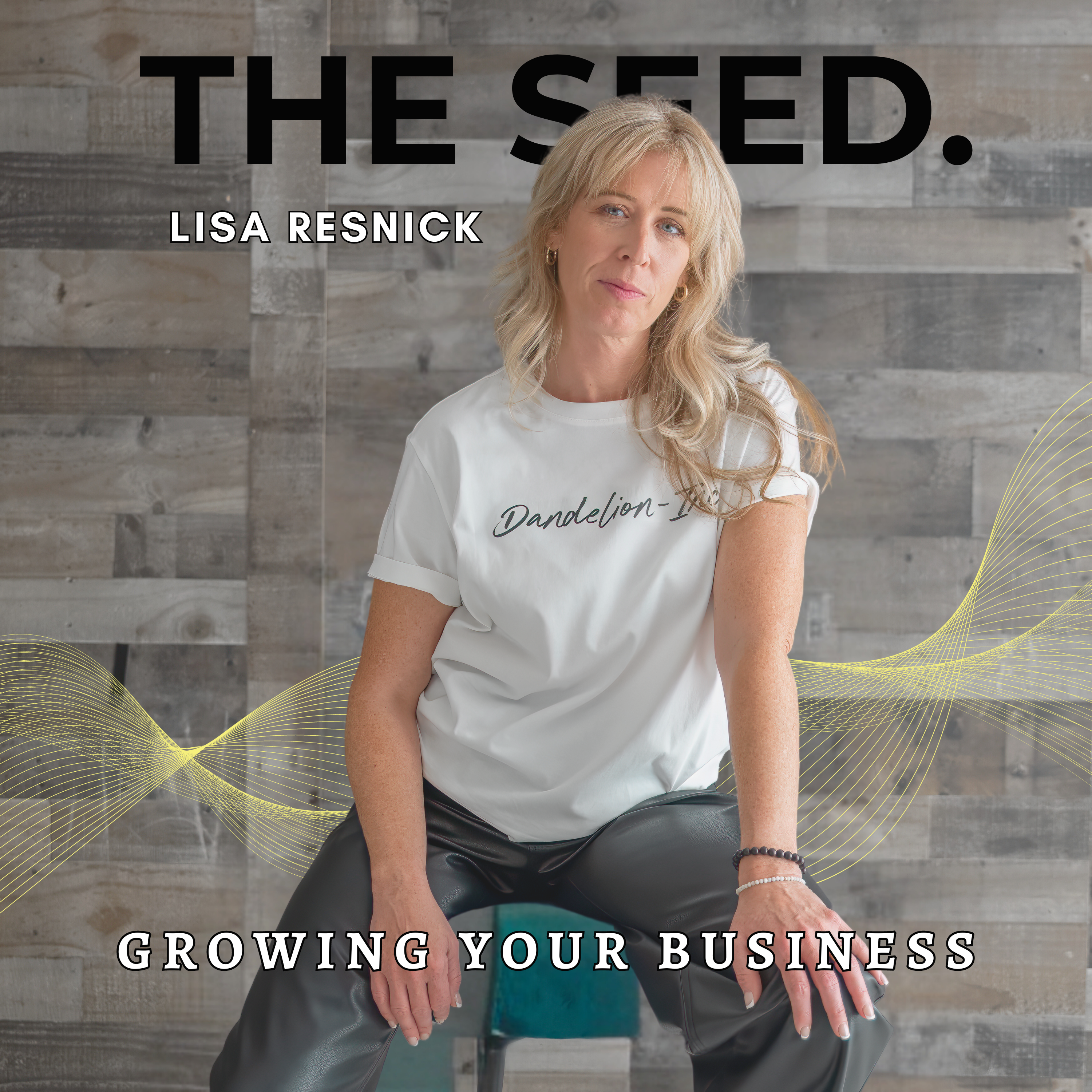
PODCAST · business
The Seed: Growing Your Business
by Lisa Resnick Founder of Dandelion-Inc
Welcome to The Seed: Growing Your Business, brought to you by Dandelion Inc. I’m your host, Lisa Resnick, and this podcast is all about connecting, developing, and supporting women in business. Join me as we explore tips and insights on leadership, business development, and social media strategies that can help you thrive. We’ll also hear from amazing guests who share their stories and experiences, offering inspiration and practical advice for your entrepreneurial journey. So, tune in, download, like, and subscribe. And remember, if you love what you hear, share the love with others. Together, let’s cultivate growth and empower women in business.
-
100
Ep 150-AI, Video Content & Standing Out Online
What actually works in marketing right now? In this fun and honest conversation, Lisa sits down with Blue Duck Agency to talk AI, video content, branding, and how to stand out in a crowded digital world.
-
99
Ep 149-Best Business Tools for Entrepreneurs
Best Business Tools for Entrepreneurs (That Actually Save Time, Money, and Stress) Let’s start with this: This is not a “use my code for 10% off” kind of post. There are no affiliate links.No hidden agenda. Just real tools that actually work. Because if you’re building a business—especially on your own—you already know: The wrong platforms don’t just cost you money. They cost you: Time Energy Momentum Sanity And most of us? We learn that the hard way. Before the Tools: The Real Lesson Before I even tell you what I use… Here’s what matters more: Do your research. Not in an overwhelming, fall-down-a-rabbit-hole kind of way. But in a: Ask better questions Don’t blindly outsource Don’t assume “this is just how it works” Because today, with AI and access to information… You can make smarter decisions faster than ever. 1. Website Hosting: Why I Switched (and What I Use Now) Let’s talk hosting. For a long time, I used an agency that told me I was getting a “group rate.” Sounds great, right? Until I realized: I could do it myself I was overpaying There was no added value When I switched? I saved money (yes—even $15/month matters in business). But more importantly… I gained real support. Not: “Here’s an article, go figure it out.” But: Actual help.Real responses.Human support that saves hours of frustration. And that changes everything. 2. Podcast Hosting: Why Support Matters More Than Features If you’ve ever dealt with: Podcast distribution WordPress issues Plugin chaos You know how fast things can get messy. What matters most isn’t just features. It’s support. Because when something breaks… You don’t want: Confusion Guessing More Googling You want someone who: Gets it Walks you through it Makes it feel manageable And honestly? That kind of support is underrated. 3. Domains & Setup: Cleaning Up the Chaos Let’s talk about the behind-the-scenes mess most people don’t show. Domains.Connections.Things linked that shouldn’t be linked. We’ve all been there. And when it gets messy? You don’t need judgment. You need someone to: Sit with you in it Help you untangle it Walk through it step-by-step Because sometimes what you actually need in business… Isn’t perfection. It’s support inside the mess. The Real MVP Isn’t a Platform Here’s the part that matters most: The most valuable “tool” in your business… Is not a tool. It’s people. Because you can have: The best platforms The best systems The best setup But if you’re: Second guessing everything Spinning your wheels Feeling like you’re doing it alone It’s going to feel harder than it needs to be. What Actually Moves Your Business Forward Not just tools. But: Conversations Support Shared experiences “Hey, I’ve been there too” That’s what builds momentum. Final Thought This episode isn’t about: “Go sign up for this.” It’s about: Asking better questions Taking control back Realizing you have options Because sometimes the smallest shift… Switching a platformSaving a little moneyGetting better support Turns into: More clarity More confidence More momentum And that’s what actually matters. Listen to the Full Episode of The Seed Podcast This is a thoughtful, grounded conversation for anyone interested in understanding themselves on a deeper level. You can also explore: Leadership insights Business growth strategies Honest conversations about entrepreneurship inside The Patch Community at Dandelion-Inc. Progress isn’t about perfection. It’s about showing up messy, brave, and real — one seed at a time. And if you’re feeling overwhelmed, behind, or like your time is constantly slipping through your fingers, it’s not because you’re doing it wrong. It’s because no one ever taught you how to manage time in a way that honors: Energy Priorities Real life That’s why I host my live-only Time & Productivity Session — focused on implementation, not theory. And if you’re craving connection, accountability, and honest conversations about building something that lasts, you’ll find that inside The Patch, the Dandelion-Inc membership. Because staying in the game?That’s the work — and it’s enough.
-
98
Ep 148-How to Enjoy Your Summer Without Losing Business Momentum
How to Enjoy Your Summer Without Losing Business Momentum Let’s talk about something most of us feel… but don’t always say out loud: How do you actually enjoy your summerwithout feeling like everything you’ve built is slipping through your fingers? Because summer pulls you in two directions. On one side: You want to slow down.Be outside.Be with your people. On the other: You’ve worked hard to build something…and you don’t want to lose momentum. So what happens? You sit somewhere in the middle. Half working.Half present.Fully frustrated. This Isn’t a Time Problem—It’s a Permission Problem Most people think they need better time management. But during summer? It’s usually not about time. It’s about permission. Permission to: Slow down Loosen your grip Not push at full speed Because if you don’t intentionally shift your pace… Your pace stays the same. And suddenly summer is over—and you were technically there… But not really in it. Start Here: Where Can You Loosen Your Grip? Not drop everything. Not walk away from your business. Just ease up. Ask yourself: Where can I loosen my grip without everything falling apart? This might look like: Posting less (but more intentionally) Saying no to misaligned events Not over-creating content Letting things be “good enough” Because most of us aren’t struggling from doing too little… We’re struggling from doing too much. Focus on What Actually Matters Here’s the question that changes everything: If I could only keep 2–3 things moving in my business this summer… what would they be? Not ten things. Not everything. Just the core. Because businesses don’t fall apart when you slow down. They fall apart when you lose focus. Your 3 Core Areas Revenue Driver – What actually brings in money Relationship Builder – What nurtures your people Visibility Anchor – What keeps you seen Everything else? Let it be flexible. Create a “Minimum Viable Week” Instead of trying to maintain your full schedule… Create a minimum. Ask: What is the least I can do to keep my business moving forward? Not scaling.Not max growth. Just steady. This could look like: 1–2 focused work blocks 1 piece of content 1 meaningful connection 1 revenue-driving action That’s it. And here’s the shift: When you define your minimum…you release yourself from the pressure of doing everything. Stop Over-Creating (This One Matters) You don’t always need more. More content.More ideas.More output. Sometimes the smarter move is: Reinforcing what you already have. Because people don’t absorb something the first time. They need repetition. Even When You Create Space… You Have to Learn How to Be In It This is the part no one talks about. You finally create space… And then: You check your phone anyway You think about what you didn’t do You mentally plan tomorrow So enjoying summer isn’t just about your schedule. It’s about presence. That might mean: Leaving your phone inside Not filling every open moment Letting things be quiet And trusting your business will still be there. Because it will. You’re Not Falling Behind Let’s be clear: You are not losing everythingbecause you slowed down. You are not falling behindbecause you simplified. You are not doing it wrongbecause you chose presence. In fact… You might be building something more sustainable. Something that actually fits your lifeinstead of something your life has to fit into. Final Thought This summer, don’t chase balance. Ask: Where can I loosen my grip? What actually matters? What is my minimum right now? Because it’s not about doing more. It’s about doing what matters… And actually being there for it. Listen to the Full Episode of The Seed Podcast This is a thoughtful, grounded conversation for anyone interested in understanding themselves on a deeper level. You can also explore: Leadership insights Business growth strategies Honest conversations about entrepreneurship inside The Patch Community at Dandelion-Inc. Progress isn’t about perfection. It’s about showing up messy, brave, and real — one seed at a time. And if you’re feeling overwhelmed, behind, or like your time is constantly slipping through your fingers, it’s not because you’re doing it wrong. It’s because no one ever taught you how to manage time in a way that honors: Energy Priorities Real life That’s why I host my live-only Time & Productivity Session — focused on implementation, not theory. And if you’re craving connection, accountability, and honest conversations about building something that lasts, you’ll find that inside The Patch, the Dandelion-Inc membership. Because staying in the game?That’s the work — and it’s enough.
-
97
Ep 147-Should You Host an Event? How to Plan Events That Actually Grow Your Business
Ep 147-Should You Host an Event? How to Plan Events That Actually Grow Your Business Let’s just get right to it: Hosting an event is not just picking a date, sending an invite, and hoping people show up. If you’ve ever hosted one—or even thought about it—you already know… It takes your time.Your energy.Your money.And honestly… your heart. And here’s the truth most people don’t talk about: Not every event that “looks successful” actually feels successful. Some fill the room and still leave you completely drained. Step One: Should You Even Host the Event? Before we get into how to host an event… We need to talk about whether you should be hosting one at all. Because events are one of the highest energy investments you can make in your business. So the real question isn’t: “Will this help my business grow?” (It probably will.) The real question is: Does this make sense for me right now? What Hosting an Event Actually Costs Let’s be honest about it: Money – venue, food, materials Time – planning, outreach, promotion Mental load – constantly thinking about it Energy – showing up, holding space, managing people Aftermath – because you don’t just walk away from an event So before you say yes, ask yourself: Do I actually have the capacity for this right now? The 5-Question Filter (Use This Before You Say Yes) 1. What is the real purpose of the event? Not just “inspiration.” Be specific: Lead generation Relationship building Revenue Visibility 2. Who is this for? Events are not for everyone. The more specific you are, the more powerful the experience becomes. 3. What does success actually look like? Not just attendance. Impact. Because a full room doesn’t mean a meaningful experience. 4. What is the real ROI? Is it: Money? Relationships? Trust? Content? Define it before you begin. 5. Does this align with my energy right now? This one matters more than people admit. Your life outside your business matters: Family Schedules Seasons of life If your energy isn’t aligned, the event will feel heavy—no matter how successful it looks. When an Event Is Actually Worth It An event makes sense when: It aligns with what you already do You’re clear on its purpose You can fully hold the space If not? You can say: No Or not right now Both are powerful decisions. Step Two: How to Host an Event That Actually Works Most people jump straight into logistics. Venue.Date.Invites. But that’s not what makes an event successful. Start With This Instead: How Do You Want People to Feel? Because people don’t remember: Your agenda Your slides Your schedule They remember: How they felt in the room. Do you want them to feel: Seen? Connected? Inspired? Comfortable? That’s your starting point. Connection Over Content (This Is Where Events Win or Lose) Most events focus on: Speakers Structure Schedules But forget: Interaction Conversation Real connection And that’s where they fall flat. Because the most valuable part of an event is often: What happens between people—not on stage. Keep It Simple (Seriously) You do not need: A huge space Over-the-top decor A packed schedule Simple works better. Because: People are more present Energy is more relaxed Connection happens naturally Overcomplication = burnout (for you and them) The Follow-Up Is Where the Real ROI Happens This is where most people drop the ball. After the event: Who are you following up with? How are you continuing the conversation? Where are you guiding people next? Ideas: Invite them into your community Send a thoughtful follow-up email Ask for feedback Have 1:1 conversations Without this? The event fades. Fast. Redefining Event Success Success is not: “How many people showed up?” It’s: Who showed up What connections were made What conversations happened What continued after Sometimes a smaller room creates a much bigger impact. Protect Your Energy (This Matters Most) You can host a “successful” event… And still feel completely depleted. So: Build space before and after Set realistic expectations Don’t overextend just to impress Because if you’re drained, the event isn’t sustainable. Final Thought If you’re thinking about hosting an event, hold both questions: Should I do this?andHow do I do this well? Because this isn’t just about events. It’s about how you choose to build, connect, and show up. Listen to the Full Episode of The Seed Podcast This is a thoughtful, grounded conversation for anyone interested in understanding themselves on a deeper level. You can also explore: Leadership insights Business growth strategies Honest conversations about entrepreneurship inside The Patch Community at Dandelion-Inc. Progress isn’t about perfection. It’s about showing up messy, brave, and real — one seed at a time. And if you’re feeling overwhelmed, behind, or like your time is constantly slipping through your fingers, it’s not because you’re doing it wrong. It’s because no one ever taught you how to manage time in a way that honors: Energy Priorities Real life That’s why I host my live-only Time & Productivity Session — focused on implementation, not theory. And if you’re craving connection, accountability, and honest conversations about building something that lasts, you’ll find that inside The Patch, the Dandelion-Inc membership. Because staying in the game?That’s the work — and it’s enough.
-
96
Ep 146-How to Create a 4-Day Work Week as a Solopreneur
How to Create a 4-Day Work Week as a Solopreneur (Without Burning Out) Let’s start with something that might make you pause: A four-day work week is not just for corporate teams.It’s not just for businesses with big staffs.And it’s not just for people who have already “made it.” It’s for you, too. And I already know what you’re thinking—because it’s the same reaction almost everyone has: “That sounds great… but there’s no way that would work for me.” Because your business depends on you.Because there’s too much to do.Because if you slow down, everything slows down. I get it. But what if the problem isn’t your workload…What if it’s how your work is structured? This episode challenges that exact idea The Biggest Misconception About a 4-Day Work Week A four-day work week is not about cramming five days of work into four. That’s not sustainable—and honestly, it misses the entire point. This isn’t about compression. It’s about: Elimination Intention Decision-making Because most entrepreneurs are not overwhelmed by essential work. They’re overwhelmed by: Unnecessary tasks Unclear priorities Saying yes to things that no longer align Constant availability The Real Shift: It’s Not Time, It’s Decisions You can work 5, 6, or 7 days a week and still feel behind. Or… You can work 4 days and feel clear, focused, and in control. The difference? Not your schedule. Your decisions. The 3 Shifts You Need to Make 1. Expectations (Yours, Not Theirs) You don’t need to lower expectations.You need to define them. This might look like: Longer response times Fewer calls Clear communication windows Most expectations aren’t fixed. You’ve just never tested changing them. 2. Boundaries (The Hardest Part) Boundaries are easy to talk about. Harder to hold. This means: Not checking email on your day off Not squeezing in “just one thing” Protecting your time even when it feels uncomfortable Because when you overextend yourself, you don’t actually show up better. You show up drained. 3. Your Offers (The Hidden Factor) Sometimes it’s not your schedule that needs to change. It’s your business model. If your business requires constant availability, a four-day work week will always feel impossible. So you need to ask: How am I delivering my services? Where can I batch, automate, or restructure? What am I saying yes to that no longer fits? What This Looks Like in Real Life For Service-Based Businesses Set specific client days Batch calls instead of spreading them out Define response timelines clearly You’re not serving less.You’re serving more intentionally. For Nonprofits Prioritize high-impact work Delegate more than feels comfortable Let go of “nice-to-have” tasks Burnout doesn’t serve your mission. For Product-Based Businesses Batch production Automate fulfillment Create structured workflows instead of constant motion Start Small (This Is Key) You don’t jump into a four-day work week overnight. You start with: One protected day One boundary One shift Then: Test → Adjust → Build This Isn’t About Doing Less It’s about doing what actually matters. It’s about building a business that supports your life—not one that consumes it. And that will look different for everyone. But the option? It’s there. Final Thought If you feel overwhelmed, behind, or like you’re constantly spinning your wheels… It’s not because you’re doing it wrong. It’s because no one taught you how to manage time in a way that actually works for real life. And that’s exactly what we’re changing. Listen to the Full Episode of The Seed Podcast This is a thoughtful, grounded conversation for anyone interested in understanding themselves on a deeper level. You can also explore: Leadership insights Business growth strategies Honest conversations about entrepreneurship inside The Patch Community at Dandelion-Inc. Progress isn’t about perfection. It’s about showing up messy, brave, and real — one seed at a time. And if you’re feeling overwhelmed, behind, or like your time is constantly slipping through your fingers, it’s not because you’re doing it wrong. It’s because no one ever taught you how to manage time in a way that honors: Energy Priorities Real life That’s why I host my live-only Time & Productivity Session — focused on implementation, not theory. And if you’re craving connection, accountability, and honest conversations about building something that lasts, you’ll find that inside The Patch, the Dandelion-Inc membership. Because staying in the game?That’s the work — and it’s enough.
-
95
Ep 145-Excuses vs Reasons: How to Move Forward Without Shame
Excuses vs Reasons: How to Move Forward Without Shame Before we start, I want to say something clearly: This is not about making you feel bad. Not about calling you out.Not about listing everything you’ve done “wrong.” It’s actually the opposite. This is about clarity.Compassion.And forward movement. Excuses vs Reasons (Let’s Define It Simply) We all use both. That’s not the issue. The difference is what happens after. What Is an Excuse? An excuse usually shows up when we’re protecting ourselves from discomfort. Not always consciously.Not maliciously. But there’s often: Avoidance Fear Ego protection Or just plain exhaustion It sounds like: “I don’t have time.” “I’ll start when things calm down.” “That’s just not how I am.” “I’ll never be as good as them anyway.” And here’s the key: Calling something an excuse is not about shame. It’s about asking: Am I protecting myself right now… or moving forward? What Is a Reason? A reason is grounded in reality. It’s honest.Specific.And includes some form of ownership. It sounds like: “I need to rest tonight, I’ll continue tomorrow.” “My priorities shifted, I need to reassess.” “I don’t have capacity today—but this still matters.” Reasons don’t shut the door. They adjust the path. Where It Gets Complicated (Because It Always Does) Sometimes: A reason becomes an excuse An excuse is actually burnout Or overwhelm… or grief… or fear That’s why compassion has to stay part of the conversation. Because growth is messy. And sometimes you’re doing your best…while knowing you can do better. That tension? That’s human. A Real-Life Example Let’s say you want to: Start a business Get back into fitness Have a difficult conversation You say: “I’m exhausted. I’ll rest tonight and do it tomorrow.” That’s a reason. But if three weeks pass… And it’s still “tomorrow”? Now we pause. Not for judgment. For awareness. The Biggest Difference: Ownership Reasons say: “This is what’s happening—and here’s how I’m adjusting.” Excuses say: “This is happening—so I can’t.” And yes—sometimes you truly can’t. Life happens. Health.Family.Stress.Finances. Those are real. But even then, the question becomes: How do I move forward within this reality? Not in spite of it. The Messy Middle (My Favorite Place) This is where real growth happens. You show up inconsistently—but you keep going You adjust after setbacks You don’t let the mess define you Excuses keep you stuck in the story. Reasons help you move through it. A Gentle Self-Check (No Judgment Allowed) Ask yourself: Am I avoiding discomfort or honoring capacity? Would I say this to someone I respect? Is this temporary—or becoming my pattern? What’s one small step forward right now? Notice: None of those ask if you’re failing. Because you’re not. The Real Question Isn’t This… It’s not: “Is this an excuse or a reason?” It’s: What am I going to do next? Because that’s where growth actually happens. Practical Shifts You Can Start Today Founder of Dandelion-Inc, a women’s networking community 1. Name it honestly Not harshly. Just clearly. 2. Adjust without drama Course correction doesn’t require criticism. 3. Keep momentum small Tiny steps beat perfection every time. 4. Stay kind to yourself You grow better from encouragement—not punishment. Final Thought You are allowed to be: A work in progress Someone figuring it out Someone who hesitates and still moves forward That’s not weakness. That’s life. Listen to the Full Episode of The Seed Podcast This is a thoughtful, grounded conversation for anyone interested in understanding themselves on a deeper level. You can also explore: Leadership insights Business growth strategies Honest conversations about entrepreneurship inside The Patch Community at Dandelion-Inc. Progress isn’t about perfection. It’s about showing up messy, brave, and real — one seed at a time. And if you’re feeling overwhelmed, behind, or like your time is constantly slipping through your fingers, it’s not because you’re doing it wrong. It’s because no one ever taught you how to manage time in a way that honors: Energy Priorities Real life That’s why I host my live-only Time & Productivity Session — focused on implementation, not theory. And if you’re craving connection, accountability, and honest conversations about building something that lasts, you’ll find that inside The Patch, the Dandelion-Inc membership. Because staying in the game?That’s the work — and it’s enough.
-
94
Ep 144-Smart Wealth Strategies for Women: What You Need to Know About Capital Gains and Financial Planning
Smart Wealth Strategies for Women: What You Need to Know About Capital Gains and Financial Planning Let’s talk about something we don’t always talk about enough: Money. Not just earning it.Not just saving it. But actually understanding it. Because at some point—whether it’s through business, career growth, or life shifts—you realize: You can’t build a life or legacy without knowing how to manage your wealth. Why This Conversation Matters (Especially for Women) In this episode of The Seed, I sat down with Hilary Hendershott—founder of Hendershott Wealth Management, TEDx speaker, and financial advisor specializing in helping women build wealth strategically. And one thing became very clear: Most of us weren’t taught how to do this. We were taught: Work hard Save a little Maybe contribute to a 401(k) But not: How to grow wealth How taxes actually impact us How to make strategic financial decisions The Reality: Your Biggest Expense Isn’t What You Think Here’s something that stops people in their tracks: Your lifetime tax bill will likely be the largest bill you ever pay. And yet… Most people don’t actively plan for it. That’s where understanding things like capital gains becomes incredibly important. What Are Capital Gains (And Why Should You Care?) Simply put: When you sell an investment and make money on it—that profit is a capital gain. And you get taxed on it. Sometimes heavily. In certain states, that combined tax rate can reach 30% or more of your gains. So the goal isn’t just to make money. It’s to keep more of it. Common “Strategies” That Aren’t Always Smart This is where the conversation got really interesting. Because there are strategies people use that sound smart… But aren’t always. 1. “Never sell” mindset Holding onto investments forever to avoid taxes. Sounds good—until: You’re overconcentrated You can’t access your money You delay actually enjoying your wealth 2. Overcomplicated tax avoidance plays Things like: Certain real estate exchanges Opportunity zone investments Highly niche tax shelters They can: Limit flexibility Reduce returns Lock you into long timelines 3. Borrowing against your assets Instead of selling, people borrow against stocks. But this can: Increase risk Add interest costs Delay the inevitable decision The Shift: Smarter, Not More Complicated What stood out most from this conversation: The goal isn’t to avoid taxes entirely. It’s to be strategic. That means focusing on: Strong long-term returns Smart tax planning Flexibility with your money Because wealth isn’t just about accumulation. It’s about usability. What Smart Financial Strategy Actually Looks Like Here are a few more grounded approaches discussed: Tax-loss harvesting Using losses to offset gains and reduce tax burden. Portfolio diversification Not putting everything into one stock, one asset, or one idea. Long-term planning with flexibility Making sure you can: Access your money Use your money Enjoy your money The Part We Don’t Talk About Enough This was one of my favorite parts of the conversation: It’s okay to want financial stability. It’s okay to: Build wealth Keep your money Charge what you’re worth And it’s okay to be intentional about it. Because for most of us? No one is coming to do it for us. Why the Right Advisor Matters Another big takeaway: Not all financial advice is created equal. You want someone who: Understands taxes (not just investments) Communicates clearly Aligns strategy with your life Helps you avoid costly mistakes Because one wrong move can cost more than years of advisory fees. Final Thought You don’t need to become a financial expert overnight. But you do need to start paying attention. Because wealth isn’t built by accident. It’s built through: Awareness Strategy Consistency And a willingness to learn what most people avoid. Listen to the Full Episode of The Seed Podcast This is a thoughtful, grounded conversation for anyone interested in understanding themselves on a deeper level. You can also explore: Leadership insights Business growth strategies Honest conversations about entrepreneurship inside The Patch Community at Dandelion-Inc. Progress isn’t about perfection. It’s about showing up messy, brave, and real — one seed at a time. And if you’re feeling overwhelmed, behind, or like your time is constantly slipping through your fingers, it’s not because you’re doing it wrong. It’s because no one ever taught you how to manage time in a way that honors: Energy Priorities Real life That’s why I host my live-only Time & Productivity Session — focused on implementation, not theory. And if you’re craving connection, accountability, and honest conversations about building something that lasts, you’ll find that inside The Patch, the Dandelion-Inc membership. Because staying in the game?That’s the work — and it’s enough.
-
93
Ep 143-How to Create Opportunities Instead of Waiting for Them
How to Create Opportunities Instead of Waiting for Them There’s something I hear all the time. “Wow… they’re so lucky.”“I wish opportunities like that came my way.” And I get it. From the outside, opportunities look like gifts—wrapped up nicely, dropped into someone’s lap. But let’s pull back the wrapping paper for a second. Because most opportunities? They’re not random. They’re built. The Difference No One Talks About There’s a big difference between: Chasing opportunitiesandCreating opportunities And if you don’t understand this difference, you’ll always feel like you’re behind. What Chasing Opportunities Looks Like Waiting to be noticed Jumping on whatever looks exciting Networking only when you need something Constantly applying, pitching, reaching It feels active. But it’s reactive. And honestly? It can feel exhausting. What Creating Opportunities Looks Like Building relationships before you need them Showing up consistently Sharing your work—even when it’s not perfect Starting conversations before there’s a transaction It’s slower. Less flashy. But so much more sustainable. Why It Looks Like “Luck” from the Outside Here’s the part people don’t see: The late nights The unpaid early work The awkward first attempts The years of relationship building The self-doubt worked through quietly They see the stage. They didn’t see the staircase. The Myth of Overnight Success You’ve seen it: Someone is suddenly everywhere. Speaking.Collaborating.Growing. And it feels like it happened overnight. But if you zoom out? There were years behind it. Years of: Showing up Learning Building Failing Trying again Consistency—not luck—created visibility. My Own Reality (Let’s Be Honest) There have absolutely been moments where people assumed opportunities I’ve had were handed to me. They weren’t. What they didn’t see: Years of community building before Dandelion-Inc Volunteer roles that expanded my network Showing up consistently—even when engagement dropped Reaching out first Starting conversations before they became collaborations Nothing magical. Just intentional. And yes—sometimes messy. The Shift: Position Yourself Instead of Waiting Creating opportunities is about positioning, not perfection. That can look like: Sharing what you’re learning in real time Offering value without immediate payoff Letting people see your process—not just your wins Staying connected even when you’re not selling Because here’s the truth: Validation follows visibility. Not the other way around. Why Chasing Feels Easier (But Isn’t) Chasing gives you a quick hit: Applying Pitching Jumping on trends It feels like you’re doing something. But without foundation? It leads to: Rejection fatigue Burnout Comparison spirals Creating, on the other hand, builds momentum. And momentum compounds. The “Sweet Treat” Illusion This is my favorite way to think about it. Opportunities look like desserts. Polished. Finished. Impressive. But what you don’t see? They were baked slowly. With ingredients like: Consistency Relationships Skill development Patience Resilience No one sees the kitchen. They just see the cake. 5 Ways to Start Creating Opportunities Let’s make this practical. 1. Build before you need Relationships, skills, credibility—start early. 2. Share your work in progress People connect with growth, not perfection. 3. Stay curious about people Opportunities come through humans—not platforms. 4. Offer value intentionally Not endlessly. Not self-sacrificing. Just thoughtfully. 5. Keep showing up (especially when it’s quiet) That’s when most people stop. Don’t. A Quick Reality Check on Comparison Next time you think: “They have so many opportunities…” Pause and ask: “What groundwork am I not seeing?” That question shifts everything. From comparison → to awareness → to action. Final Thought Opportunities are not lightning strikes. They’re gardens. And gardens grow with: Time Care Consistency Attention So if it feels like everyone else is getting ahead… You’re not behind. You’re just in the part where it’s being built. Listen to the Full Episode of The Seed Podcast This is a thoughtful, grounded conversation for anyone interested in understanding themselves on a deeper level. You can also explore: Leadership insights Business growth strategies Honest conversations about entrepreneurship inside The Patch Community at Dandelion-Inc. Progress isn’t about perfection. It’s about showing up messy, brave, and real — one seed at a time. And if you’re feeling overwhelmed, behind, or like your time is constantly slipping through your fingers, it’s not because you’re doing it wrong. It’s because no one ever taught you how to manage time in a way that honors: Energy Priorities Real life That’s why I host my live-only Time & Productivity Session — focused on implementation, not theory. And if you’re craving connection, accountability, and honest conversations about building something that lasts, you’ll find that inside The Patch, the Dandelion-Inc membership. Because staying in the game?That’s the work — and it’s enough.
-
92
Ep 142-Stop Hiding Behind Information: Why Over-Researching Is Killing Your Momentum
Stop Hiding Behind Information: Why Over-Researching Is Killing Your Momentum I’m going to say something that might surprise you—especially if you’re like me. Stop hiding behind information. And before you tighten up reading that… I’m not against learning.I’m not against curiosity.I’m not against doing your homework. I am against using information as a shield. Because there’s a difference between learning… …and avoiding. The Truth About “Productive” Procrastination If you’ve ever: Opened 12 tabs researching one idea Downloaded multiple PDFs “for later” Bought courses you haven’t finished Listened to podcasts instead of taking action You’re not lazy. You’re likely stuck in what I call “squirrel syndrome.” It looks like movement. But it’s actually motion without momentum. What Is Squirrel Syndrome? It’s when curiosity turns into avoidance. You start here: “I’m going to write a proposal.” And end up here: Watching a YouTube video Researching templates Reading about persuasion psychology An hour later? Nothing is actually done. Why We Do This (And Don’t Admit It) Let’s be honest. Most of the time, it’s not about needing more information. It’s about this: “I’m not ready to be seen yet.” “If I learn more, I won’t fail.” “If I wait, I can get it perfect.” Information feels safe. Action feels exposed. The Course Collector Trap This one hits a lot of people. You’re serious about your business, so you invest in: A marketing course A branding workshop A mindset program An SEO training Six months later? You’ve learned a lot. But implemented… very little. Because learning feels like progress. But implementation is what changes outcomes. The Perfect Plan Trap You want to launch something. So you: Research pricing Study competitors Build a full plan Refine your strategy And then… You hesitate. Because now you see everything that could go wrong. More information didn’t reduce fear. It amplified it. Here’s the Hard Truth At some point… Action is the only teacher left. You can’t research your way into confidence. You build it by doing. The 70% Rule You do not need 100% clarity to begin. If you have: 60–70% understanding… start. Adjust later. Because clarity doesn’t always come from thinking. It comes from doing. A Simple Reality Check Ask yourself this: If you stopped consuming new information for 30 days… Could you still move forward? Most people could. Because you already know enough to take the next step. You’re just avoiding the part where you’re visible. When Information Is Actually Healthy This isn’t anti-learning. It’s about intentional learning. Healthy input looks like: Learning with a specific goal Applying what you learn quickly Setting boundaries on consumption Using information to support execution Not replace it. The Shift That Changes Everything Instead of: Learn → Learn → Learn → Maybe act Shift to: Learn → Implement (immediately) Listen to a podcast → apply one idea within 24 hours Read a book → test one concept this week Take a course → change one system tomorrow That’s where momentum is built. The Real Risk (And Why We Avoid It) If you stop gathering and start acting, you risk: Being wrong Looking inexperienced Getting feedback Failing publicly And here’s the truth: That’s exactly where growth happens. Final Thought If you’re an “input person” like me… Your curiosity is a gift. Your depth is powerful. But when misused? It becomes a hiding place. You don’t need more information. You need momentum. Listen to the Full Episode of The Seed Podcast This is a thoughtful, grounded conversation for anyone interested in understanding themselves on a deeper level. You can also explore: Leadership insights Business growth strategies Honest conversations about entrepreneurship inside The Patch Community at Dandelion-Inc. Progress isn’t about perfection. It’s about showing up messy, brave, and real — one seed at a time. And if you’re feeling overwhelmed, behind, or like your time is constantly slipping through your fingers, it’s not because you’re doing it wrong. It’s because no one ever taught you how to manage time in a way that honors: Energy Priorities Real life That’s why I host my live-only Time & Productivity Session — focused on implementation, not theory. And if you’re craving connection, accountability, and honest conversations about building something that lasts, you’ll find that inside The Patch, the Dandelion-Inc membership. Because staying in the game?That’s the work — and it’s enough.
-
91
Ep 141-Mindful Living for Entrepreneurs
Mindful Living for Entrepreneurs: How Your Relationship with Food Impacts Your Success There’s a version of success we were taught to chase. The one that looks like: Running on caffeine Skipping meals Pushing through exhaustion Wearing burnout like a badge of honor And for a while… it works. Until it doesn’t. Because at some point, your body taps you on the shoulder—and if you ignore it long enough, it stops asking. The Conversation We’re Not Having Enough In this episode of The Seed, I sat down with Cassandra Bodzak—bestselling author of Mindful Table—to talk about something that impacts every entrepreneur, leader, and high-achiever: Your relationship with food, your body, and your energy. And how that relationship directly impacts your ability to show up, lead, and sustain success. Your Body Is Not Separate from Your Business This was one of the biggest takeaways from our conversation: Your body is not something you manage around your business. It’s something your business depends on. If your long-term goal is to keep showing up, growing, leading, and building… Then your body has to be part of the strategy. Not an afterthought. Why High Performers Get This Wrong If you’re anything like me (and Cassandra), you’re wired to go. You love your work.You’re ambitious.You can push through almost anything. But that’s exactly where the disconnect starts. Because being able to push doesn’t mean you should. And it definitely doesn’t mean it’s sustainable. We’ve normalized: Living on coffee and quick fixes Ignoring hunger cues Overtraining or under-fueling Disconnecting from our body entirely And calling it “discipline.” The Shift: From Control to Connection What Cassandra teaches—and what really stood out—is this: Instead of controlling your body… Start listening to it. Food isn’t just: Fuel A reward A restriction It’s a relationship. A connection to: Your energy Your emotions Your capacity When you shift from control to connection, everything changes. The “Food Detective” Approach One of the most practical tools from this conversation is becoming what Cassandra calls a “food detective.” Not restrictive.Not obsessive.Just aware. For 2 weeks, track: What you eat How you feel after Your energy levels Your focus Your sleep No judgment. Just data. Because your body is already giving you answers. You’re just not always listening. What You Might Start Noticing That “quick lunch” is tanking your afternoon focus Certain foods leave you energized vs. sluggish Sleep impacts everything (more than you think) Movement doesn’t always mean intensity—it means alignment This isn’t about perfection. It’s about awareness. The Real Strategy: Sustainability One of the most powerful reframes in this conversation: Taking care of your body is a business strategy. Not in a trendy way. In a longevity way. Because: You think clearer You make better decisions You lead with more stability You avoid burnout cycles And most importantly… You can keep going. 3 Simple Shifts to Start Today From this conversation, here’s where I’d start: 1. Look at your sleep first Not your productivity hacks. Your sleep. 2. Pay attention without judgment Become aware before you try to “fix” anything. 3. Rebuild trust with your body Start small: What feels good? What doesn’t? What do I actually need right now? Final Thought Your body is not the obstacle. It’s the partner. And the more you start listening to it… The more aligned, sustainable, and powerful your work becomes. Resources: https://divinely-design-your-life-d3df.mykajabi.com/meditation-bundle Listen to the Full Episode of The Seed Podcast This is a thoughtful, grounded conversation for anyone interested in understanding themselves on a deeper level. You can also explore: Leadership insights Business growth strategies Honest conversations about entrepreneurship inside The Patch Community at Dandelion-Inc. Progress isn’t about perfection. It’s about showing up messy, brave, and real — one seed at a time. And if you’re feeling overwhelmed, behind, or like your time is constantly slipping through your fingers, it’s not because you’re doing it wrong. It’s because no one ever taught you how to manage time in a way that honors: Energy Priorities Real life That’s why I host my live-only Time & Productivity Session — focused on implementation, not theory. And if you’re craving connection, accountability, and honest conversations about building something that lasts, you’ll find that inside The Patch, the Dandelion-Inc membership. Because staying in the game?That’s the work — and it’s enough.
-
90
Ep 140-Business Identity Evolves: Signs, Leadership Shifts & What to Do Next
When Your Business Identity Evolves: Signs, Leadership Shifts & What to Do Next There’s a conversation that doesn’t happen enough in business. Not about strategy.Not about scaling.Not about marketing. But about identity. Your business identity—and your personal identity—is allowed to evolve. Not just your logo.Not just your offers.Not just your messaging. Your voice.Your priorities.Your energy.Your leadership.Your vision. And if you’re doing meaningful work, this evolution isn’t a risk. It’s inevitable. When Something Feels “Off” in Your Business Here’s what I see all the time: You hit a point where everything technically still works. Revenue is coming in.Clients are happy.Your team is functioning. But something feels… off. That internal friction? It’s often not burnout. It’s misalignment. You’ve evolved—but your business hasn’t caught up yet. Signs Your Business Identity Is Evolving Let’s start internally—because that’s where it almost always begins. 1. You feel disconnected from work that used to excite you What once energized you now drains you. That’s not failure.That’s data. 2. Your conversations start to change You’re talking more about: Impact Sustainability Community Legacy And less about: Hustle Optics Validation That shift matters. 3. Your tolerance changes Things you once accepted now feel heavy: Chaotic workflows Poor boundaries Misaligned partnerships That’s your leadership asking for structure. 4. You want depth over volume Fewer clients.Stronger relationships.More aligned collaborations. That’s not a lack of ambition—it’s maturity. External Signs You Can’t Ignore Sometimes the outside world sees it before you fully do. Opportunities start looking different Your audience begins to shift Your team starts questioning direction You might hear things like: “This isn’t how we used to do things” “Why are we changing?” “I don’t see the vision yet” That’s not always resistance. Sometimes, it’s a request for clarity. The Hard Question: Is It Me or Is It Them? Before assuming your team “isn’t getting it,” ask yourself: Have I clearly communicated the vision—consistently? Am I modeling the evolution myself? Am I reacting emotionally or leading strategically? Because people don’t resist change. They resist confusion. But Sometimes… It Is Them And that doesn’t make anyone wrong. Some people are incredible for a season—just not every season. Pay attention to: Ongoing resistance without solutions Lack of curiosity Passive disengagement Misaligned values That’s not failure. That’s a shift in fit. How to Lead Through Business Evolution This is where leadership actually matters. 1. Over-communicate the vision Not just what’s changing—but why. And what’s staying the same. 2. Invite participation, not just compliance Ask: “What do you see for this next phase?” People support what they help build. 3. Create growth pathways Give your team: Training Ownership New responsibilities Evolution shouldn’t feel like displacement. 4. Protect psychological safety If people are afraid to mess up, innovation stops. Normalize the learning curve. 5. Set clear expectations Kind leadership is not vague leadership. Clarity reduces anxiety. The Part No One Talks About: Letting Go of Your Old Identity Sometimes the hardest part isn’t your team. It’s you. Letting go of a version of your business that: Worked Was praised Felt safe But no longer fits. Consistency builds trust. But authenticity sustains it. And when you evolve transparently? You don’t lose trust—you deepen it. Listen to the Full Episode of The Seed Podcast This is a thoughtful, grounded conversation for anyone interested in understanding themselves on a deeper level. You can also explore: Leadership insights Business growth strategies Honest conversations about entrepreneurship inside The Patch Community at Dandelion-Inc. Progress isn’t about perfection. It’s about showing up messy, brave, and real — one seed at a time. And if you’re feeling overwhelmed, behind, or like your time is constantly slipping through your fingers, it’s not because you’re doing it wrong. It’s because no one ever taught you how to manage time in a way that honors: Energy Priorities Real life That’s why I host my live-only Time & Productivity Session — focused on implementation, not theory. And if you’re craving connection, accountability, and honest conversations about building something that lasts, you’ll find that inside The Patch, the Dandelion-Inc membership. Because staying in the game?That’s the work — and it’s enough.
-
89
Ep 139-Why Work-Life Balance Is a Myth and What to Focus on Instead
Why Work-Life Balance Is a Myth and What to Focus on Instead Balance is one of those words that sounds good in theory. Work-life balance.Emotional balance.Business balance.Family balance. It paints a picture of a life that is calm, evenly portioned, and somehow friction-free. But real life does not work like that. And that is not because stability is impossible. It is not because peace is impossible. And it is not because alignment does not matter. It is because life is not static. Life moves. If you are growing, leading, parenting, healing, building, creating, managing your health, navigating relationships, or running a business, motion is constant. Which means balance, at least the way it is often marketed to us, is more myth than reality. In this episode of The Seed, I talk about why balance is oversimplified, why control often gets misunderstood, and what it actually looks like to navigate real life without constantly feeling like you are failing. The Problem With the Way Balance Is Sold to Us The modern version of “balance” often looks like a highly curated image. A woman who is: successful in business present with her family physically healthy socially connected emotionally calm financially stable somehow doing all of it beautifully at the same time That image creates pressure. It makes people think: “If I were just better at managing things, I could make my life look like that too.” But what we usually do not see are the trade-offs behind that image. We do not see: the support systems the financial realities the help behind the scenes the emotional labor the shifting priorities the exhaustion that may exist outside the frame That is why balance is often more of a highlight-reel word than a lived-experience word. Life Runs in Seasons, Not Symmetry The truth is, life tends to move in seasons. Some seasons are: career-heavy family-heavy health-focused healing-focused creative financially stressful emotionally demanding deeply transitional Some seasons are survival seasons. And those count too. That matters because survival seasons are not evidence that you are failing. They are chapters. In those seasons, balance is usually not the goal. Stability is. And sometimes, stability simply means getting through the day with enough care, clarity, and steadiness to keep going. The Difference Between Balance and Integration One of the biggest shifts in this episode is moving away from the word balance and toward the word integration. Balance suggests that every area of life should receive equal energy all the time. Integration acknowledges reality. It acknowledges that life overlaps. Work may affect family.Health may affect business.Relationships may affect energy.Leadership may affect recovery. Instead of trying to keep every category in a perfectly separate container, integration accepts that life is often a mosaic. Messy sometimes.Layered often.Still meaningful. That is a much more human standard. When Control Becomes a Coping Mechanism This episode also gets personal in the best way because it talks about control. For many people, the desire for control is not just about personality. It is about adaptation. It can come from: responsibility uncertainty earlier life experiences learning how to create safety living through unpredictability That is why control is not automatically unhealthy. In many cases, it started as a survival skill. And survival skills can absolutely become leadership strengths. But there is a difference between healthy control and fear-based control. Healthy Control vs. Fear-Based Control Healthy control looks like: planning intentionally setting boundaries creating structure preparing realistically managing time with clarity staying organized without obsession Fear-based control looks like: needing certainty before taking action resisting flexibility avoiding help feeling threatened by unpredictability equating change with danger Most people move between both of these at different times. That is part of being human. The key is recognizing when control is supporting you and when it is quietly running you. What You Can Actually Control A lot of stress comes from trying to control things that are not truly yours to control. You can control: your effort your preparation your boundaries your communication your values your consistency You cannot control: other people’s reactions the exact timing of opportunities unexpected health issues market shifts external validation life’s surprises When people blur those categories, stress multiplies. That is why one of the most useful reminders in this conversation is simple: Control what you can. Release what you can’t. Simple to say.Harder to live. But necessary. Why Perfect Balance Often Creates More Shame One of the hardest things about chasing balance is that it can make capable people feel like they are constantly failing. Not because they are doing badly. But because the standard itself is unrealistic. If the goal is to do everything equally, calmly, consistently, and beautifully at all times, then almost no one will ever feel like they are succeeding. That is why moving toward integration can reduce pressure. It helps people ask: What matters most in this season? What do I actually have capacity for right now? What trade-offs am I willing to make? What can wait without consequence? Those questions are far more useful than “How do I do all of this perfectly?” Practical Ways to Live Without Chasing Balance This episode also offers practical shifts that help people live more sustainably. 1. Define Priorities by Season Do not decide what matters forever. Decide what matters right now. Let priorities evolve with your life. 2. Accept Trade-Offs Without Shame Every yes includes a no. That is not failure. That is clarity. 3. Build in Recovery Time Rest is not a reward you earn at the end. It is maintenance. Recovery has to be part of the process. 4. Be Honest About Capacity Ambition is beautiful. Overextension is not sustainable. Knowing the difference protects your energy and your integrity. 5. Communicate Expectations Clearly With your team.With your family.With yourself. Unspoken expectations create invisible pressure. And invisible pressure adds up fast. A Better Mindset: Adaptation Instead of Failure One of the most important lines in this episode is this: You are probably not failing. You are probably adapting. That shift matters. Because adaptation is not weakness. It is evidence of resilience. And for many people, especially leaders, caregivers, and women carrying a lot of invisible labor, adaptation has become second nature. Recognizing that can be deeply relieving. It helps reframe life from: “I’m not handling this well enough.” to “I’m adjusting to what this season requires.” That is a completely different kind of self-talk. And it is much healthier. Why This Matters for Leadership If you lead a team, a family, a business, or a community, your relationship with balance affects others too. When leaders model: honest capacity boundaries adaptability recovery flexibility self-awareness they give others permission to do the same. That matters because leadership is not just about performance. It is also about creating an atmosphere where sustainable growth is possible. And sustainable growth rarely happens inside unrealistic expectations. A Simple Grounding Exercise for Overwhelm When life feels out of balance, this episode offers three questions to ask: What must happen today? What would be helpful but not essential? What can wait without consequence? Those three questions can cut through overwhelm quickly. Because they help distinguish urgency from pressure. And pressure from noise. That kind of clarity is often more useful than trying to “feel balanced.” Final Reflection Balance is not a destination. It is not a permanent state. And for many people, it is not even the right goal. A better goal is awareness. Intention. Capacity. Integration. Self-trust. Compassion. Because you do not need a perfectly balanced life to build a meaningful one. You need the ability to adapt honestly, lead wisely, and release the impossible standard that tells you you should be able to do everything all at once without friction. You are not behind. You are not broken. You are probably adjusting to a life that is moving. And that is what being human looks like. Listen to the Full Episode of The Seed Podcast This is a thoughtful, grounded conversation for anyone interested in understanding themselves on a deeper level. You can also explore: Leadership insights Business growth strategies Honest conversations about entrepreneurship inside The Patch Community at Dandelion-Inc. Progress isn’t about perfection. It’s about showing up messy, brave, and real — one seed at a time. And if you’re feeling overwhelmed, behind, or like your time is constantly slipping through your fingers, it’s not because you’re doing it wrong. It’s because no one ever taught you how to manage time in a way that honors: Energy Priorities Real life That’s why I host my live-only Time & Productivity Session — focused on implementation, not theory. And if you’re craving connection, accountability,...
-
88
Ep 138-How to Get on Podcasts and Use Guest Interviews to Grow Your Business
How to Get on Podcasts and Use Guest Interviews to Grow Your Business Podcast guesting has become one of the most effective ways for entrepreneurs, authors, and experts to grow their visibility. But getting on the right podcasts is not just about sending a generic pitch and hoping for the best. It is about relationship-building. It is about storytelling. And it is about understanding what makes someone worth listening to in the first place. In this episode of The Seed, I sat down with Michelle Glogovac, founder of The MLG Collective, author of How to Get on Podcasts, and host of a podcast network that includes My Simplified Life, Read The Damn Book, Beyond The Campaign, and BURNT. Michelle’s work centers on helping entrepreneurs, advocates, authors, nonprofits, and experts tell their stories in ways that create visibility, impact, and connection. What made this conversation especially valuable is that Michelle does not treat podcast pitching like cold publicity. She treats it like thoughtful matchmaking. And that mindset changes everything. Why Podcast Guesting Matters for Business Growth Podcast interviews offer something many other forms of visibility do not. They create intimacy. They give people the chance to hear your voice, your story, your perspective, and the way you think in real time. Michelle’s agency describes podcasting as a way to speak to your ideal audience “in an intimate way,” which is exactly why it works so well for trust-building. That matters because people do not just buy offers. They buy trust. They buy clarity. They buy resonance. And podcast interviews can create all three. For entrepreneurs, podcast guesting can support: audience growth relationship-building brand visibility authority-building book promotion client trust But only if it is done well. The Best Podcast Pitches Are Personal, Not Generic One of the strongest takeaways from this conversation was Michelle’s emphasis on personalization. She does not believe in generic copy-and-paste pitches. And honestly, neither do I. The best podcast pitches start with: actually listening to the show understanding the host referencing a relevant past episode showing why the guest fits that specific audience Michelle’s podcast pitching service is built around personalized pitch emails, branded media kits, and tailored speaking topics rather than one-size-fits-all outreach. That approach matters because hosts can tell when someone actually knows their show. And they can definitely tell when someone does not. What Podcast Hosts Really Want in a Guest A lot of people assume hosts just want credentials. A bestselling book.A big platform.An impressive title. But what many hosts really want is something else: A guest with a real story. Someone with a perspective. Someone who can hold a conversation. Someone who will bring value to the audience and not just promote themselves. Michelle’s work consistently emphasizes story and voice over empty visibility tactics. Even in her brand messaging, she frames her role as helping people “craft powerful narratives that drive visibility, impact, and connection.” That distinction is huge. Because podcast guesting is not just media. It is connection. Why Storytelling Is the Real Visibility Strategy What I loved most about this conversation is that it kept coming back to storytelling. Michelle is not simply helping people land interviews. She is helping them articulate who they are, what they know, and why their story matters. That is what makes someone memorable. Her site also reinforces this in practical ways, including resources on promoting podcast interviews and using them to extend your visibility on your own channels. She encourages guests to treat interviews as relationship-building opportunities and as content worth repurposing on social media and websites. This is why podcast guesting works so well when done intentionally. You are not only borrowing someone else’s audience. You are building your own narrative in public. How to Pitch Yourself to Podcasts More Effectively If you want a stronger podcast guesting strategy, this episode makes a few things very clear. 1. Know the Show Do not pitch a podcast you have never listened to. At minimum, understand: the host’s style the audience the themes the tone of past episodes 2. Make the Email Easy to Read Michelle’s service includes a detailed strategy outline, a branded media kit, personalized pitch emails, and linked resources that make it easier for hosts to evaluate a guest quickly. That means your pitch should not feel like work for the host. 3. Focus on the Human, Not Just the Headline A title is not enough. “Entrepreneur” is not enough. “Author” is not enough. What makes your story worth sharing? 4. Give the Host a Reason to Care Why this show?Why this audience?Why now? That is what makes a pitch land. Podcast Guesting Is Also About Timing Another important piece of the conversation was timing. People often think podcast outreach works like quick-turn media. It usually does not. Many podcast hosts record weeks or months in advance. Michelle’s own services for books, for example, recommend beginning strategy and pitching three to four months prior to launch, which is a strong reminder that podcast guesting requires lead time. That matters especially for: book launches events campaigns political cycles timely thought leadership topics If visibility matters, planning matters too. Why Podcast Guesting Builds Relationships, Not Just Reach The part of this conversation that stood out most to me is how relationship-centered Michelle’s approach is. That makes sense given her background. Before building The MLG Collective, she spent years in corporate aviation sales, where long-term relationships mattered more than tiny pricing differences. That relationship mindset now carries directly into how she approaches podcast pitching and publicity. That is a lesson more entrepreneurs need to hear. Visibility without relationship is shallow. Relationship creates longevity. And the best podcast appearances often lead to more than downloads. They can lead to: introductions collaborations future invitations referrals credibility community That is why podcast interviews are not just marketing. They are influence-building. Michelle’s business is a strong example of building a service from both lived experience and strategic depth. The MLG Collective offers podcast pitching, podcast book tours, podcast campaign tours, media kits, and strategy sessions. Michelle’s site describes her as “THE Podcast Matchmaker®,” notes that she has booked more than 1,000 interviews, and emphasizes that her team handles the details that make a guest stand out to hosts. She has also expanded into a podcast network and continues to build around visibility, books, podcasting, and bold conversations that matter. That breadth is part of what makes this episode so useful. It is not theory. It is lived expertise. Final Reflection If you have ever wondered how some people seem to show up on the right podcasts at the right time, this conversation answers a lot of that. It is not luck. It is clarity. It is strategy. It is relationship-building. And it is knowing how to tell a story that actually matters to the person on the other end. Podcast guesting is not just about being seen. It is about being heard in the right rooms. And when done well, that can absolutely move your business forward. Listen to the Full Episode of The Seed Podcast This is a thoughtful, grounded conversation for anyone interested in understanding themselves on a deeper level. You can also explore: Leadership insights Business growth strategies Honest conversations about entrepreneurship inside The Patch Community at Dandelion-Inc. Progress isn’t about perfection. It’s about showing up messy, brave, and real — one seed at a time. And if you’re feeling overwhelmed, behind, or like your time is constantly slipping through your fingers, it’s not because you’re doing it wrong. It’s because no one ever taught you how to manage time in a way that honors: Energy Priorities Real life That’s why I host my live-only Time & Productivity Session — focused on implementation, not theory. And if you’re craving connection, accountability, and honest conversations about building something that lasts, you’ll find that inside The Patch, the Dandelion-Inc membership. Because staying in the game?That’s the work — and it’s enough.
-
87
Ep 137-How to Rebuild Problem-Solving Skills in Leadership, Business, and Life
How to Rebuild Problem-Solving Skills in Leadership, Business, and Life Technology is not the villain. Let’s start there. We live in a world where information is accessible, tutorials are endless, AI can generate ideas instantly, and answers come faster than ever before. There is a lot to appreciate about that. Access to information has changed how we work, cook, learn, build, and solve problems. But there is also a tradeoff. The faster answers become, the less comfortable many people become with not knowing right away. And that matters. Because uncertainty is where real problem-solving begins. In this episode of The Seed, I wanted to talk about something I’ve been noticing in leadership, business, and even in myself at times: we are losing some of our instinct to sit with complexity long enough to understand it deeply. And that affects everything. Why Fast Answers Can Weaken Problem-Solving Skills We are surrounded by fast answers. Search engines.AI tools.How-to videos.Templates.Proven methods.Instant recommendations. These tools can be incredibly helpful. But speed has a side effect. It lowers our tolerance for uncertainty. And when we lose tolerance for uncertainty, we also lose part of our ability to problem-solve with depth. Because not every meaningful problem has one obvious answer. Some problems require: reflection experimentation patience context multiple possibilities And that kind of thinking does not happen when we rush toward the first available fix. The Trap of Looking for One Right Answer One of the biggest problem-solving mistakes people make is assuming there is one best answer. One best strategy.One best way.One proven path. But most meaningful challenges do not work that way. Real problems often have: several possible solutions trade-offs context-specific decisions imperfect but workable options That is why strong problem-solvers do not ask only, “What is the answer?” They ask, “What are the possibilities?” That shift matters. Because when you force yourself to generate multiple options, you strengthen creativity, ownership, and confidence at the same time. A Better Leadership Habit: Name Three Possible Solutions One practical habit that changes everything is this: When a problem shows up, ask: What are three possible ways we could handle this? Not one. Three. At minimum. Why three? Because once you move beyond a single default answer, your brain has to think more flexibly. You begin to activate: creative problem-solving strategic thinking perspective-taking adaptability This works in business.It works in families.It works in leadership.It works in life. There is rarely only one path forward. Why Pros and Cons Matter in Decision-Making Once you identify multiple possible solutions, the next step is to weigh the trade-offs. Every decision has pros and cons. Every path has benefits.Every path has limitations.Every path asks something of you. This is where maturity in decision-making starts to deepen. Looking honestly at trade-offs helps you avoid: all-or-nothing thinking perfectionism impulsive decisions fantasy-based expectations It helps you lead from realism instead of wishful thinking. And realism builds trust. Especially in leadership. Constructive Questioning Is a Leadership Skill Questioning often gets misunderstood. People hear questions and assume skepticism, resistance, or negativity. But constructive questioning is different. Constructive questions sound like: What might we be missing? How else could this work? What assumptions are we making? What would success look like here? What information do we already have? These questions do not shut down ideas. They expand them. That distinction matters because curiosity builds possibilities, while cynicism tends to collapse them. If you want better decisions, you need better questions. Why Leaders Should Stop Solving Every Problem This is the part many leaders need to hear most. If you lead a team, business, nonprofit, community, or family, constantly solving every problem for people may feel helpful. It may feel supportive.It may feel efficient.It may feel faster. But over time, it weakens the people around you. Why? Because when you solve every problem for others, they gain relief. But they do not gain competence. And relief is temporary. Competence compounds. This is one of the biggest differences between fixing and leading. Coaching Builds Better Teams Than Fixing Strong leaders do not always provide the answer. They provide a framework. They ask questions.They guide.They support.They help people think. Instead of saying: “Here’s what to do.” Try asking: What do you think could work? What options do you see? What feels most aligned here? What is your first instinct? What support would help you move forward? That is not abandonment. That is empowerment. And empowered people grow faster than dependent ones. What Happens When Leaders Fix Too Much When leaders step in too quickly, several things begin to happen. Teams may start to: wait for permission avoid initiative defer decisions lose confidence rely on the leader for everything Meanwhile, the leader becomes the bottleneck. And often without realizing it, over-fixing sends this message: “I don’t fully trust you.” Even if that is not the intention, it is often the impact. That is why sustainable leadership requires restraint as much as support. Why Multiple Paths Increase Confidence One reason people freeze under pressure is because they think there is only one correct answer. That creates fear. But when people can see multiple viable paths, something shifts. Confidence grows. Why? Because flexibility reduces pressure. And confidence is built through experience, not just instruction. The more people practice thinking through options and evaluating choices, the more capable they become. That is true for teams, children, clients, and leaders too. Innovation Requires Space, Not Just Speed Innovation rarely comes from immediate answers. It comes from questions like: What if? Why not? How else could this work? What haven’t we considered yet? Innovation needs space. Space to think.Space to experiment.Space to be wrong.Space to grow. Leadership is often less about controlling the answer and more about creating the conditions where better answers can emerge. That is what strong leaders do. How to Rebuild Your Own Problem-Solving Muscles If you want to strengthen your own problem-solving skills, start here: Pause Before Asking for Help Give yourself a chance to think first. Generate Multiple Options Even imperfect options count. The point is flexibility. Evaluate the Trade-Offs Every decision has costs and benefits. Reflect Afterward Ask what worked, what did not, and what you learned. Reflection turns experience into wisdom. That is how problem-solving becomes stronger over time. We Do Not Need Less Technology. We Need Stronger Thinking. This conversation is not anti-technology. Technology is useful.AI is useful.Speed is useful. But they work best when paired with stronger thinking. We do not need fewer answers. We need deeper questions. We do not need leaders who fix everything. We need leaders who help people grow. And that starts with rebuilding our own comfort with complexity, uncertainty, and thoughtful exploration. Final Reflection The next time a problem shows up, try slowing down. Look for multiple solutions.Weigh the trade-offs.Ask better questions.Resist the urge to fix everything for everyone. Because that is where confidence grows. That is where innovation starts. And that is where sustainable leadership begins. Listen to the Full Episode of The Seed Podcast This is a thoughtful, grounded conversation for anyone interested in understanding themselves on a deeper level. You can also explore: Leadership insights Business growth strategies Honest conversations about entrepreneurship inside The Patch Community at Dandelion-Inc. Progress isn’t about perfection. It’s about showing up messy, brave, and real — one seed at a time. And if you’re feeling overwhelmed, behind, or like your time is constantly slipping through your fingers, it’s not because you’re doing it wrong. It’s because no one ever taught you how to manage time in a way that honors: Energy Priorities Real life That’s why I host my live-only Time & Productivity Session — focused on implementation, not theory. And if you’re craving connection, accountability, and honest conversations about building something that lasts, you’ll find that inside The Patch, the Dandelion-Inc membership. Because staying in the game?That’s the work — and it’s enough.
-
86
Ep 136-Why Temporary Obsessions Build Skills for Business, Leadership, and Life
Why Temporary Obsessions Build Skills for Business, Leadership, and Life We tend to dismiss temporary obsessions too quickly. You get really into watercoloring for a few months.You start baking every weekend.You become fascinated by gardening, photography, kayaking, or one oddly specific topic you suddenly can’t stop reading about. And somewhere along the way, people start labeling it as random. A phase.A distraction.A side note. But what if it’s not random at all? What if those temporary obsessions are actually skill accelerators? In this episode of The Seed, I explore the idea that the hobbies, interests, and intense curiosity seasons we move through are often teaching us far more than we realize. And many of the skills they build don’t stay in the hobby lane. They transfer. To leadership.To business.To parenting.To relationships.To health.To life. Temporary Obsessions Are Not Usually Random When something grabs your attention deeply for a season, it often serves a purpose. Not always an obvious one. But a real one. That interest may be helping you develop: patience adaptability focus pattern recognition emotional regulation tolerance for imperfection creative problem solving The problem is, most people only look at the activity on the surface. They see watercoloring.You’re learning fluidity. They see baking.You’re learning sequence and recovery. They see kayaking.You’re learning to respond to changing conditions. Temporary obsessions are often less about the activity itself and more about the inner skill set it’s quietly building. What Watercolor Can Teach You About Leadership At first glance, watercolor sounds like a hobby. Relaxing.Creative.Aesthetic. But watercolor requires: patience letting go of control accepting imperfection working in layers understanding timing knowing when to stop That sounds a lot like leadership. And business. And honestly, parenting too. If you overwork watercolor, it muddies. If you rush the next layer, it bleeds. If you try to control every detail, you lose the beauty of the medium. That translates directly into life. Sometimes growth cannot be rushed.Sometimes clarity comes from restraint.Sometimes results need time to dry before you can build on them. What Baking Can Teach You About Business Baking is a great example of how structured hobbies build operational thinking. Baking requires: sequence precision timing pattern recognition troubleshooting delayed gratification It teaches you to follow a process while staying flexible enough to adjust if something goes wrong. That’s not just baking. That’s project management.That’s operations.That’s execution.That’s systems thinking. And for people who are leading businesses, building teams, or managing households, those are incredibly transferable skills. What Kayaking Can Teach You About Entrepreneurship Kayaking seems recreational. But it teaches: balance reading currents situational awareness strength through resistance momentum through movement calm under instability You don’t control the water. You respond to it. That’s entrepreneurship in a sentence. Business is rarely about total control. It’s about reading what is happening, adjusting as needed, and staying steady enough to move forward when the conditions shift. That’s a skill. And sometimes a weekend hobby is strengthening it more than a business book ever could. Hobbies Create Cognitive Cross-Training One of the hidden benefits of temporary obsessions is that they create cross-training for the brain. When you engage deeply in something unrelated to your main work, you activate different pathways. That can improve: creativity flexibility resilience problem solving confidence pattern recognition This is part of why stepping away from your main lane can actually make you stronger in it. You are not wasting time. You are broadening your thinking. And broader thinkers often adapt faster. Temporary Interests Build Identity Layers Every season of focused curiosity builds a layer of identity. You may stop doing the activity later. But you keep what it taught you. You may stop watercoloring, but keep the patience.You may bake less, but keep the discipline.You may kayak less often, but keep the adaptability. That means not every obsession has to become permanent to be meaningful. It just has to leave something useful behind. That is what makes these seasons worth respecting. Why Exploration Matters More Than We Admit There is so much pressure to “stick to one thing.” To stay focused.To pick a lane.To avoid distraction. And yes, focus matters. But exploration builds depth. Temporary obsessions are often not distractions. They are deep dives. And deep dives teach things that shallow consistency often can’t. They teach: frustration tolerance humility curiosity playfulness emotional flexibility willingness to be bad at something before becoming good That kind of learning is deeply valuable. Especially for leaders. Children Already Know How to Do This Children naturally move through temporary obsessions all the time. Dinosaurs.Drawing.Space.Sports.Music.Crafts.Bugs.Books. They dive in intensely. Then they shift. As adults, we often call that scattered. But maybe it’s actually developmental. Maybe those bursts of interest help build mastery in concentrated seasons. Maybe they are not signs of inconsistency at all. Maybe they are signs of growth. Temporary Obsessions Can Also Regulate the Nervous System Sometimes people gravitate toward focused interests because those activities feel manageable, grounding, or structured during chaotic seasons. That is not weakness. That is often nervous system regulation. Focused activity can help restore steadiness. It can create rhythm. It can give the brain and body a place to land. The key is simply making sure it supports your life rather than replacing connection or becoming an avoidance strategy. But when held well, it can be deeply stabilizing. A Powerful Question to Ask Yourself Instead of dismissing your current obsession, ask: What skills is this teaching me? For example: Gardening may be teaching patience and environmental awareness. Photography may be teaching framing and perspective. Fitness may be teaching consistency and endurance. Reading deeply may be expanding your cognitive mapping. Crafting may be teaching sequence, experimentation, or precision. This question changes everything. Because once you can name the skill, you can start applying it intentionally in other parts of your life. The Goal Is Integration, Not Endless Obsession This is not about glorifying distraction. It’s not about endlessly hopping from one thing to another without reflection. It’s about noticing what each season gives you. Then integrating it. Take the lesson.Carry the skill forward.Release the rest. That’s maturity. And that’s where temporary obsessions become part of long-term growth. Your Curiosity Is Not Random One of the biggest takeaways from this conversation is this: Your curiosity is not random. Your interests are often pointing to something. Sometimes they are building a skill you need.Sometimes they are helping regulate your system.Sometimes they are stretching your thinking.Sometimes they are preparing you for a next level you cannot fully see yet. That matters. Because not every meaningful season looks productive on paper. But it can still be deeply productive underneath. Listen to the Full Episode of The Seed Podcast This is a thoughtful, grounded conversation for anyone interested in understanding themselves on a deeper level. You can also explore: Leadership insights Business growth strategies Honest conversations about entrepreneurship inside The Patch Community at Dandelion-Inc. Progress isn’t about perfection. It’s about showing up messy, brave, and real — one seed at a time. And if you’re feeling overwhelmed, behind, or like your time is constantly slipping through your fingers, it’s not because you’re doing it wrong. It’s because no one ever taught you how to manage time in a way that honors: Energy Priorities Real life That’s why I host my live-only Time & Productivity Session — focused on implementation, not theory. And if you’re craving connection, accountability, and honest conversations about building something that lasts, you’ll find that inside The Patch, the Dandelion-Inc membership. Because staying in the game?That’s the work — and it’s enough.
-
85
Ep 135- 7 Books for Personal Growth, Leadership, and Business Success
7 Books for Personal Growth, Leadership, and Business Success Growth does not happen overnight. It rarely arrives in one dramatic breakthrough. More often, it begins quietly. A shift in thinking.A better question.A stronger habit.A new perspective.A sentence in a book that stays with you longer than expected. In this episode of The Seed, I shared seven books I believe plant meaningful seeds for growth. Some are practical. Some are psychological. Some are strategic. Some are personal. But together, they create a strong foundation for building a business, leading well, and becoming more fully yourself. If you are climbing the corporate ladder, building a company, leading a nonprofit, raising a family, or reinventing your life entirely, these are the kinds of books that can stay with you and compound over time. 1. Atomic Habits by James Clear If you want to grow, this is one of the best places to start. James Clear’s Atomic Habits focuses on the power of small repeated actions and the systems that shape behavior. Clear describes the book as a guide to changing habits and getting one percent better every day. What makes this book so valuable is that it reframes success. Not as motivation.Not as talent.Not as intensity. But as systems. This book is especially helpful for anyone who needs structure, consistency, and a more grounded way to think about progress. It reminds you that habits are not small. They are infrastructure. 2. Six Thinking Hats by Edward de Bono Edward de Bono’s Six Thinking Hats is one of the most useful books for leaders, teams, and anyone solving problems with other humans in the room. De Bono’s method is a structured process for parallel thinking that helps people be more productive, focused, and engaged. This book matters because it teaches perspective flexibility. It helps people look at a challenge through different lenses such as: logic emotion caution optimism creativity process That shift is powerful in business, leadership, and relationships. It helps reduce tunnel vision and emotional reactivity while creating better decisions. 3. Mindset: The New Psychology of Success by Carol Dweck Carol Dweck’s Mindset is foundational reading for anyone who wants to understand the difference between a fixed mindset and a growth mindset. Dweck’s work is widely known for showing how beliefs about ability and intelligence affect learning, resilience, and performance. What makes this book so important is that it changes how you interpret effort and failure. If you are building anything meaningful, you will hit resistance. You will mess up. You will have moments where growth feels slow. This book plants the seed that your ability is not static. That matters in business.It matters in leadership.And it matters in life. 4. Give and Take by Adam Grant Adam Grant’s Give and Take explores how different reciprocity styles shape success. Grant looks at givers, takers, and matchers, and makes the case that success is not only about competition, but also about contribution. This book is especially helpful because it adds nuance. It is not simply saying, “Be generous and everything will work out.” It shows that generosity without self-awareness or boundaries can become draining. But strategic generosity? That becomes a long-term advantage. For entrepreneurs, leaders, and community builders, this is a very important distinction. 5. Fool Me Once by Harlan Coben This one may surprise people because it is fiction. But fiction belongs on growth reading lists too. Harlan Coben’s Fool Me Once is a thriller centered on truth, deception, and perception. Why does it matter in a list about growth? Because fiction strengthens awareness in ways nonfiction sometimes cannot. It sharpens: emotional intelligence pattern recognition perception empathy the ability to question first impressions And that matters deeply in leadership and life. Reading people well, noticing subtext, and understanding that there is often more going on beneath the surface are all important skills. 6. The Story Engine by Kyle Gray Kyle Gray’s The Story Engine is an excellent read for entrepreneurs, founders, coaches, and anyone trying to communicate their work clearly. The book is positioned as a guide to content strategy and brand storytelling without spending all day writing. This book matters because growth today is tied to narrative. You can have a good offer, a valuable service, or a meaningful mission, but if you cannot articulate it well, you make it harder for people to understand why it matters. This book plants the seed that your story is not extra. It is leverage. 7. You’re a Mess, But So Is the Universe by Lisa Resnick Yes, this one belongs on the list too. You’re a Mess, But So Is the Universe: A Survival Guide for Beautifully Messy Souls speaks directly to the human side of growth. It centers on embracing imperfection, finding clarity, and building connections that matter. The reason this fits with the other six books is simple: You can know the strategy.You can understand the framework.You can learn the systems.And still feel like a mess sometimes. This book fills that gap. It gives people permission to grow imperfectly — not as an excuse to stay stuck, but as a reminder that messy growth is still growth. Why Books Still Matter for Growth In a world full of scrolling, summaries, short clips, and constant distraction, books ask something different of us. They ask for focus. They slow us down. They stretch our thinking. Reading full books strengthens things that growth depends on: attention vocabulary empathy strategic thinking pattern recognition That is part of why books still matter so much. They do not just give information. They build depth. A Growth Reading List That Works Together What I like about these seven books is that they work as an ecosystem. Atomic Habits gives you systems. Six Thinking Hats gives you perspective. Mindset gives you psychological flexibility. Give and Take gives you relational strategy. Fool Me Once gives you awareness. The Story Engine gives you communication leverage. You’re a Mess, But So Is the Universe gives you humanity. That is not hustle. That is not shortcut culture. That is a growth framework. Final Reflection You do not need to read all seven at once. Pick one. Start there. Let it root. Because growth is not about consuming more information for the sake of it. It is about integrating what you learn. That is where change happens. Listen to the Full Episode of The Seed Podcast This is a thoughtful, grounded conversation for anyone interested in understanding themselves on a deeper level. You can also explore: Leadership insights Business growth strategies Honest conversations about entrepreneurship inside The Patch Community at Dandelion-Inc. Progress isn’t about perfection. It’s about showing up messy, brave, and real — one seed at a time. And if you’re feeling overwhelmed, behind, or like your time is constantly slipping through your fingers, it’s not because you’re doing it wrong. It’s because no one ever taught you how to manage time in a way that honors: Energy Priorities Real life That’s why I host my live-only Time & Productivity Session — focused on implementation, not theory. And if you’re craving connection, accountability, and honest conversations about building something that lasts, you’ll find that inside The Patch, the Dandelion-Inc membership. Because staying in the game?That’s the work — and it’s enough.
-
84
Ep 134- Why Framework and Systems Thinking Matter in Business Growth
Why Framework and Systems Thinking Matter in Business Growth When most people hit a problem in business, they try to fix the visible symptom. They tweak the offer.They change the strategy.They hire faster.They push harder. But often the real issue isn’t the symptom. It’s the system underneath it. In this episode of The Seed, I sat down with Nida Leardprasopsuk, a cultural transformation expert, executive coach, and founder of her own coaching and consulting practice, to talk about what it really means to use systems thinking in business. And honestly, this conversation goes way beyond business. Because the way we lead, build teams, solve problems, and create cultures is never just about tactics. It’s about people. What Is Systems Thinking in Business? Systems thinking is the practice of looking beyond one isolated issue and instead examining how all the parts are connected. In business, that means asking questions like: What is really causing this problem? What patterns keep repeating? What beliefs, behaviors, or structures are reinforcing it? Where is there misalignment? Rather than applying surface-level fixes, systems thinking helps leaders address the root cause. That matters because most business problems are not random. They are patterns. And patterns live inside systems. Why Surface-Level Fixes Usually Fail Many companies try to solve issues by focusing only on what is easy to see. For example: low team morale poor communication lack of innovation employee turnover leadership bottlenecks But those outcomes are usually the result of deeper misalignment. A communication problem may actually be a fear-of-conflict problem. A culture problem may actually be a leadership identity problem. A growth problem may actually be an ecosystem problem. That’s why systems thinking is so powerful. It helps you stop treating symptoms and start examining structure. The Pyramid Framework for Leadership and Growth One of the most useful parts of this conversation was the framework Nida shared. She described a six-level pyramid that can be used with individuals, teams, and organizations. From top to bottom, the layers are: Vision Identity Values and Beliefs Capabilities Behavior Ecosystem This framework shows that sustainable growth doesn’t come from fixing one behavior alone. It comes from alignment across all levels. For example: If your vision is to build an innovative company, but your team is terrified of failure, then your values and beliefs are not aligned with your vision. If your business goals require high-level leadership, but your ecosystem is filled with avoidance, dysfunction, or low standards, that disconnect will eventually show up in results. Why Identity Shapes Everything One of the biggest takeaways from this episode was the role of self-identity. According to Nida, identity is often one of the most important layers in the framework because it influences everything else. How you see yourself affects: what you believe is possible what skills you’re willing to learn how you handle setbacks how you lead others what kind of culture you create If someone believes they are capable, resilient, and able to learn, they approach challenges differently. If someone’s identity is shaped by fear, conflict avoidance, or self-doubt, that will show up in leadership too. And not just in subtle ways. In ways that affect the whole business. Founders Don’t Just Build Companies. They Build Family Systems. This was one of the most powerful ideas in the conversation. Nida talked about how founders often bring their family systems into their businesses. If a leader grew up avoiding conflict, they may avoid difficult conversations at work too. If a leader overfunctions, constantly fixing everything themselves, they may unintentionally create a culture where everyone else underfunctions. That means company culture isn’t just built from values written on a wall. It’s shaped by the behaviors leaders repeat. And those behaviors often come from much deeper places than people realize. Why Conflict Avoidance Costs More Than People Think Many leaders think avoiding conflict is the easier path. They don’t address poor performance.They don’t give direct feedback.They stay quiet to keep the peace. But avoiding a hard conversation rarely saves time or energy. It usually creates: repeated mistakes lower standards team resentment leadership frustration long-term cultural dysfunction What feels like a small issue today can become an expensive pattern tomorrow. That’s why honest communication and systems awareness matter so much. The Role of Ecosystem in Growth One of the things I loved most about this framework was that the ecosystem sits at the base. Because no matter how strong your vision is, the environment around you matters. Your ecosystem includes: the people you work with the community you’re part of the standards around you the kind of conversations happening in your orbit the culture you create and tolerate We do not grow in isolation. We grow inside environments. And if your ecosystem is misaligned with your vision, growth becomes much harder. That’s true in business.And honestly, it’s true in life too. Why Organizational Change Takes Time A lot of people want quick culture fixes. But meaningful organizational change is not instant. Nida shared that shifting a company culture can take three to five years. That makes sense. If it’s hard to change one personal habit, imagine changing patterns across a team, department, or whole company. Real change requires: reinforcement repetition systems buy-in aligned leadership There is no shortcut for that. What Strong Leaders Actually Do Strong leaders do more than solve immediate problems. They: examine patterns create alignment gather feedback build honest cultures strengthen ecosystems help people grow And sometimes that means hearing hard truths. Nida spoke about using tools like 360 assessments to collect honest feedback from the people around a leader. Because growth is hard when your self-perception and others’ lived experience of you don’t match. That kind of truth can be uncomfortable. But it’s often where real transformation begins. The TEDx Connection: Ideas Worth Sharing Another fascinating part of this conversation was hearing how Nida also licensed and leads her own TEDx in Bangkok. That project is deeply aligned with the rest of her work. Because at its core, TEDx is also about systems, people, communication, and change. It’s about surfacing important ideas. Amplifying voices. Creating ripple effects. This year’s TEDx theme, Unmute the Future, centers around truth, voice, and the conversations we need to have if we want to solve larger societal problems. And that idea fits beautifully with everything else we discussed. Because change often starts with one person speaking honestly. Then another listening. Then another carrying that idea forward. Why This Episode Matters This episode is really about more than business frameworks. It’s about understanding that growth is never just tactical. It’s relational.Emotional.Structural.Behavioral.Human. If you are leading a team, building a business, managing a company culture, or even trying to become a stronger version of yourself, systems thinking matters. Because when you understand how the parts connect, you stop reacting to every isolated problem. And you start building something stronger at the root. Listen to the Full Episode of The Seed Podcast This is a thoughtful, grounded conversation for anyone interested in understanding themselves on a deeper level. You can also explore: Leadership insights Business growth strategies Honest conversations about entrepreneurship inside The Patch Community at Dandelion-Inc. Progress isn’t about perfection. It’s about showing up messy, brave, and real — one seed at a time. And if you’re feeling overwhelmed, behind, or like your time is constantly slipping through your fingers, it’s not because you’re doing it wrong. It’s because no one ever taught you how to manage time in a way that honors: Energy Priorities Real life That’s why I host my live-only Time & Productivity Session — focused on implementation, not theory. And if you’re craving connection, accountability, and honest conversations about building something that lasts, you’ll find that inside The Patch, the Dandelion-Inc membership. Because staying in the game?That’s the work — and it’s enough.
-
83
Ep 133- The Hidden Cost of Doing Everything Yourself in Business
The Hidden Cost of Doing Everything Yourself in Business Here’s a truth many entrepreneurs avoid saying out loud. If you truly believe something isn’t worth investing money in… Why are you investing your time in it? That question alone reveals one of the most common traps business owners fall into. We protect dollars more fiercely than we protect our hours. But time is the only resource in your business that you cannot replenish. You can make more money. You cannot make more time. The Time vs Money Trap in Entrepreneurship Let’s look at a simple example. You decide not to hire a social media manager because the cost feels too high. Maybe it’s $800 per month. That feels like a big investment. So instead, you handle social media yourself. You spend: 10–15 hours per week creating content editing videos writing captions posting and scheduling analyzing metrics That equals roughly 40–60 hours per month. Now assign a dollar value to your time. Even if your time is worth just $50 per hour, that’s: $2,000–$3,000 per month of your time. To avoid an $800 expense. That’s the disconnect many entrepreneurs miss. Why Entrepreneurs Get Stuck in This Loop This pattern creates a cycle that feels responsible but actually slows growth. Here’s what it often looks like: You don’t invest money because revenue isn’t consistent yet. You invest more time instead. Time goes to tasks that don’t directly produce revenue. Revenue stays flat. You feel like you still can’t invest money. And the loop continues. Most of these loops are built from good intentions. But good intentions don’t always create strategic decisions. The Real Solution: Radical Clarity Breaking the cycle starts with getting brutally clear about where your time actually belongs. 1. Identify What Drives Revenue Every business has specific activities that generate revenue. These might include: sales conversations partnerships live events referrals email marketing networking client relationships Track where your revenue actually comes from. If 70% of your clients come from referrals or direct conversations, spending hours perfecting Instagram content may not be the best investment of your time. 2. Assign a Dollar Value to Your Time Many early-stage entrepreneurs resist doing this. But it’s essential. If your goal is to earn $120,000 per year, your time is worth roughly $60 per hour. Operating with that awareness helps you make better decisions about what you should and should not be doing yourself. 3. Choose Depth Over Breadth If hiring help isn’t financially possible yet, simplify. Instead of trying to maintain visibility everywhere, choose one primary channel. Focus your energy there. Spend the rest of your time on: improving your offer strengthening relationships having revenue conversations delivering exceptional client experiences These activities compound far faster than scattered visibility. 4. Create an “Until I Can” Plan If outsourcing feels out of reach right now, create a transition plan. For example: “Until I reach consistent $4,000 months, I will: batch content once a month post twice per week repurpose everything spend no more than four hours per week on social media.” Without boundaries, social media will expand indefinitely. 5. Start Micro-Delegating Delegation doesn’t have to start with a full-time hire. Even small investments can create leverage. You might outsource: caption formatting scheduling posts video editing Pinterest pin creation graphic formatting Even partial delegation frees up valuable mental bandwidth. The Psychology Behind Overworking Sometimes entrepreneurs resist investment because of deeper fears. We fear: losing control wasting money someone not understanding our vision looking irresponsible Sometimes we even equate hustle with worthiness. But investment signals something important to the market. Seriousness. Strategic seriousness. If you don’t believe your business is worth investing in, it becomes harder for others to believe in it too. The Opportunity Cost of Doing Everything Yourself Opportunity cost is the hidden price of every decision. Consider these examples: Website Perfectionism Spending 30 hours tweaking a website design instead of having 30 hours of conversations with potential clients. Which one grows revenue faster? DIY Graphic Design Learning complex design tools instead of refining your offer or increasing your pricing. Which creates leverage? Course Overconsumption Buying a $40 course instead of hiring a $500 expert. Then spending 25 hours trying to implement it. That $40 course just cost you $1,250 worth of time. Where AI Fits Into This Conversation Artificial intelligence is becoming part of nearly every business conversation. And AI is not the villain. When used well, it can: speed up content creation help organize ideas streamline operations reduce administrative work help small businesses compete at higher levels But there is one risk. Overreliance. When AI Starts Diluting Your Brand One thing becoming increasingly noticeable across social media and websites is how similar many businesses are beginning to sound. The same phrases. The same tone. The same polished but generic messaging. When everything sounds the same, identities become diluted. And when identities become diluted, trust declines. Your voice matters. AI can draft words. But it cannot replicate: lived experience intuition humor nuance contradictions personal perspective And those are the things people actually connect with. How to Use AI the Smart Way Think of AI as an intellectual assistant, not your voice. Use it for: brainstorming rough drafts research organization But always add your own: stories perspective tone personality Because authenticity is what differentiates your brand. Volume does not equal impact. Connection creates impact. The Final Question Every Entrepreneur Should Ask If you truly believe something isn’t worth investing money in… Why are you investing hours of your time in it? That question can reveal where you’re overspending energy and underspending strategy. Building a sustainable business requires protecting your time, valuing leverage, and making strategic investments—both financially and operationally. You’re not behind. You may just need to realign how you’re investing your resources. Listen to the Full Episode of The Seed Podcast This is a thoughtful, grounded conversation for anyone interested in understanding themselves on a deeper level. You can also explore: Leadership insights Business growth strategies Honest conversations about entrepreneurship inside The Patch Community at Dandelion-Inc. Progress isn’t about perfection. It’s about showing up messy, brave, and real — one seed at a time. And if you’re feeling overwhelmed, behind, or like your time is constantly slipping through your fingers, it’s not because you’re doing it wrong. It’s because no one ever taught you how to manage time in a way that honors: Energy Priorities Real life That’s why I host my live-only Time & Productivity Session — focused on implementation, not theory. And if you’re craving connection, accountability, and honest conversations about building something that lasts, you’ll find that inside The Patch, the Dandelion-Inc membership. Because staying in the game?That’s the work — and it’s enough.
-
82
Ep 132- The Invisible Strength Women Carry: Leadership, Resilience, and the Inner World We Don’t See
The Invisible Strength Women Carry: Leadership, Resilience, and the Inner World We Don’t See Recently, I came across an image that stopped me in my tracks. It showed a woman—beautiful, poised, composed. From the outside, she looked calm and confident. But her face was blurred, and the artwork around her suggested something deeper: an inner world expanding beyond what could be contained in a single frame. The message shared alongside the image talked about what many women carry internally. Movement.Grief.Memory.Strength.Reinvention. It described the invisible world many women hold inside themselves while continuing to show up every day. And that idea stayed with me. Because whether someone has experienced widowhood, major loss, career transition, or something entirely different, almost every woman I know is carrying something unseen. Not in a dramatic way. Just in the quiet way life unfolds. The Invisible Labor Women Carry Women today are often balancing multiple roles simultaneously. We are: running businesses building careers leading teams supporting partners raising children caring for family members maintaining friendships navigating health changes managing emotional labor And much of that happens quietly. Not for applause. Not for recognition. Just because it needs to be done. Over time, many women become so skilled at carrying these responsibilities that others assume the weight must not be heavy. But skill does not mean absence of weight. It simply means adaptation. The Stories That Don’t Show Up on a Resume There are parts of life that don’t appear on LinkedIn profiles or professional bios. Things like: grief reinvention identity shifts rebuilding confidence financial pressure family complexity personal healing quiet resilience Yet women continue to show up professionally. They lead meetings.Deliver results.Collaborate with teams.Build companies. That isn’t weakness. That is resilience. Why This Matters in Business We often pretend that business and personal life are separate worlds. But they’re not. No one opens their laptop and suddenly stops being human. When we interact with colleagues, partners, clients, or even strangers, we are interacting with people who carry their own internal stories. And remembering that doesn’t make leadership soft. It makes leadership effective. Research consistently shows that emotionally intelligent leadership outperforms purely transactional leadership. Empathy improves: team performance loyalty collaboration creativity long-term results Compassion doesn’t lower standards. It raises awareness. Reinvention Is One of Women’s Greatest Strengths One of the most powerful parts of the image I saw was the idea of expansion. Women expand despite what they carry. And reinvention is often part of that expansion. Women reinvent themselves after: loss motherhood career pivots health challenges personal transformation But reinvention is rarely loud or dramatic. Often it happens quietly. It might look like: setting new boundaries redefining success prioritizing peace over hustle changing direction in business choosing alignment over external validation That kind of growth deserves recognition. Adaptability Is a Superpower Many women underestimate their ability to adapt. We often think: “This is just what I have to do.” But what feels routine to you might be someone else’s breaking point. Acknowledging your strength doesn’t mean denying the struggle. It means honoring both. Strength and challenge can exist together. How Awareness Changes Leadership When we become aware that everyone carries unseen experiences, our leadership shifts. Communication becomes more thoughtful. Collaboration becomes more respectful. Relationships become more human. Practical ways this awareness shows up include: assuming depth rather than simplicity listening fully before responding leaving space for context in conversations balancing accountability with empathy focusing on connection rather than extraction Small shifts in awareness can change entire cultures. Women Don’t Have to Hide Complexity There is a common message many women absorb early: To appear capable, we must make everything look easy. But the truth is: Professionalism and authenticity can coexist. You don’t need to: minimize what you carry hide complexity pretend things are effortless Strength and vulnerability are not opposites. They are partners. Strength Needs Softness Many women learn strength early in life. Strength is powerful. But strength alone isn’t sustainable. Softness matters too. Softness looks like: rest joy creativity reflection playfulness Strength without softness leads to burnout. Softness without strength leads to instability. But when the two are integrated, sustainability becomes possible. Why Women’s Communities Matter Women’s communities—formal or informal—serve an important purpose. They provide: shared understanding normalization of experience emotional support encouragement for growth No one is meant to carry everything alone. And when women support one another, both healing and leadership expand. The Strength You Don’t See The external version of a woman rarely tells the full story. Behind every confident woman at an event… Behind every entrepreneur posting online… Behind every leader making decisions… There is an internal world constantly evolving. Adapting. Healing. Building. Creating. Honoring that complexity—both in ourselves and in other women—changes how we lead, collaborate, and build businesses. Because the strength we don’t see is often where the real power lives. Listen to the Full Episode of The Seed Podcast This is a thoughtful, grounded conversation for anyone interested in understanding themselves on a deeper level. You can also explore: Leadership insights Business growth strategies Honest conversations about entrepreneurship inside The Patch Community at Dandelion-Inc. Progress isn’t about perfection. It’s about showing up messy, brave, and real — one seed at a time. And if you’re feeling overwhelmed, behind, or like your time is constantly slipping through your fingers, it’s not because you’re doing it wrong. It’s because no one ever taught you how to manage time in a way that honors: Energy Priorities Real life That’s why I host my live-only Time & Productivity Session — focused on implementation, not theory. And if you’re craving connection, accountability, and honest conversations about building something that lasts, you’ll find that inside The Patch, the Dandelion-Inc membership. Because staying in the game?That’s the work — and it’s enough.
-
81
Ep 131- How Astrology Can Help You Understand Yourself, Your Purpose, and Your Relationships
How Astrology Can Help You Understand Yourself, Your Purpose, and Your Relationships Astrology is often dismissed as entertainment. A quick horoscope.A zodiac meme.A passing comment about being “such a Sagittarius” or “definitely a Pisces.” But astrology, when practiced deeply, is far more layered than pop culture gives it credit for. In this episode of The Seed, I sat down with astrologer Leslie Galbraith to talk about what astrology really is, what a birth chart can reveal, and why so many people feel deeply seen when someone interprets their chart in a meaningful way. This wasn’t a conversation about newspaper horoscopes. It was a conversation about identity, self-awareness, life patterns, relationships, emotional wiring, and purpose. And honestly, it was one of the most fascinating conversations I’ve had in a while. Astrology Is More Than a Horoscope For many people, astrology begins and ends with their sun sign. You know the drill: Aries are bold Pisces are emotional Sagittarius are adventurous And while that can be fun, Leslie explained that horoscopes are only a very broad generalization. A true astrology birth chart is much more specific. Your chart is essentially a snapshot of the sky at the exact moment you were born. It takes into account: your birth date your birth time your birth location From there, astrologers look at the position of the planets, the moon, the sun, and the houses in your chart to understand how those energies may shape your personality, emotional patterns, strengths, relationships, and life direction. In other words, your chart isn’t just about your zodiac sign. It’s about your full energetic makeup. What a Birth Chart Reveals One of the most interesting parts of this conversation was hearing Leslie describe astrology as a kind of language. A language that helps explain the qualities of energy you came into this world with. According to Leslie, a birth chart can reveal: your natural gifts recurring challenges emotional tendencies communication style relationship patterns leadership strengths life cycles and seasons of growth That’s a big shift from the usual casual astrology conversation. Instead of asking, “What’s my sign?” the better question becomes: What does my full chart say about how I move through life? The Most Important Parts of a Birth Chart Leslie broke down several key chart components that shape personality the most. The Sun Your sun sign reflects identity, will, ego, and how you shine in the world. It’s often the piece people know best, but it’s only one part of the chart. The Moon Your moon sign relates to emotions, internal needs, and how you process feelings. It also moves quickly, which is why moon energy can feel especially tied to emotional atmosphere and sensitivity. The Rising Sign Your rising sign is about how you meet the world. It shapes first impressions, how others initially experience you, and the energy you naturally lead with when entering new situations. Mercury, Venus, and Mars These personal planets reveal a lot about day-to-day personality: Mercury shows communication style Venus shows how you relate, connect, and love Mars shows desire, movement, and action Together, these placements offer a much fuller view of a person than a horoscope ever could. Why Birth Charts Can Feel So Accurate One thing Leslie said that really stood out to me was how many people feel a strong sense of confirmation when they hear their chart interpreted. Not because it tells them who to become. But because it helps them better understand who they already are. That distinction matters. Astrology, at its best, isn’t about forcing a new identity onto someone. It’s about increasing self-awareness. It can help explain: why certain patterns keep showing up why some environments feel natural and others draining why some relationships flow while others feel harder why certain seasons of life feel like growth, pause, challenge, or reinvention Sometimes we intuitively know these things. But hearing them reflected back can make them click in a new way. Astrology and Purpose One of the questions I asked Leslie was how my chart might point to things like community building, leadership, and the work I naturally gravitate toward. Her explanation was such a good reminder that purpose is often visible in the places where energy flows most naturally. In astrology, the houses of the chart can reveal where your energy is concentrated. For some people, that might be relationships. For others, family. For others, career, communication, visibility, or community. That doesn’t mean one area matters more than another. It simply means that certain themes may feel especially central to your path. This is one of the reasons astrology can be such a helpful tool for people trying to understand: why they do what they do why certain work feels aligned why some roles energize them more than others Purpose isn’t always something you invent from scratch. Sometimes it’s something you recognize more clearly when you understand your wiring. The Four Elements in Astrology Leslie also explained the four elements in astrology and how they show up in a person’s chart: Fire: action, spark, movement, energy, initiation Air: thought, communication, perspective, mental processing Earth: grounding, practicality, structure, embodiment Water: emotion, intuition, empathy, creativity This part of the conversation was especially interesting because it helps explain not just personality, but how we operate. Some people naturally move fast and initiate. Some need more grounding and process. Some are highly intellectual. Some are deeply intuitive and emotionally attuned. And when you understand your dominant elements, you can often better understand your strengths, your challenges, and what helps bring you back into balance. Astrology and Relationships This is where astrology becomes especially helpful. Because relationships aren’t just about compatibility in the superficial sense. They’re about understanding different emotional and communication styles. Leslie shared how astrology can help explain why one person may process emotion through feeling, while another processes through thinking. Neither is wrong. They’re just different. That kind of awareness can be powerful in: romantic relationships friendships family dynamics business partnerships team communication Instead of personalizing every difference, astrology can offer another lens for understanding how people receive, process, and respond. And when we understand that, we communicate better. Astrology for Business and Team Dynamics One of my favorite parts of this conversation was that we didn’t limit this to personal life. We also talked about astrology in relation to business and teamwork. Because let’s be honest: relationships at work are still relationships. When people communicate differently, process differently, and react differently under stress, that affects collaboration. Astrology can help reveal: who needs time to process who moves quickly and wants immediate action who is more emotional or intuitive who is more practical or structured who communicates directly versus more reflectively No tool can solve every communication issue. But self-awareness and awareness of others can absolutely make collaboration smoother. Why This Conversation Matters What I appreciated most about this episode is that it wasn’t about handing astrology all the power. It was about using astrology as a tool. A mirror. A language. A way to better understand yourself and the people around you. That kind of understanding matters. Especially in a world where many people are moving fast, questioning what’s next, navigating transitions, or trying to make sense of their own patterns. Sometimes insight doesn’t come from pushing harder. Sometimes it comes from paying closer attention. Where to Find Leslie Galbraith If this conversation sparked your curiosity, Leslie Galbraith offers astrology readings through her website and Instagram. You can find her at: Our Cosmic DayInstagram: @ourcosmicday She also shared a helpful reminder in the episode: if you don’t know your exact birth time, you may be able to request the long-form birth certificate through your state records. That detail can make a significant difference in a full chart reading. Listen to the Full Episode of The Seed Podcast If you’ve ever been curious about astrology beyond horoscopes, this episode is a great place to start. We talk about: what a birth chart actually reveals the difference between horoscopes and real chart interpretation how astrology can support self-awareness how the elements shape personality how charts can offer insight into communication, relationships, and purpose This is a thoughtful, grounded conversation for anyone interested in understanding themselves on a deeper level. You can also explore: Leadership insights Business growth strategies Honest conversations about entrepreneurship inside The Patch Community at Dandelion-Inc. Progress isn’t about perfection. It’s about showing up messy, brave, and real — one seed at a time. And if you’re feeling overwhelmed, behind, or like your time is constantly slipping through your fingers, it’s not because you’re doing it wrong. It’s because no one ever taught you how to manage time in a way that honors: Energy Priorities Real life ...
-
80
Ep 130- Communication Overload
Communication Overload: Why Constant Notifications Are Draining Your Productivity Most people think they’re overwhelmed because they have too much work. But in many cases, the real problem isn’t workload. It’s communication overload. Between emails, text messages, Slack notifications, LinkedIn messages, Instagram DMs, school apps, project management tools, and group chats, we now manage six to ten communication channels every day. And every one of them assumes urgency. If someone sends a message, the expectation is often that you saw it.If you saw it, the expectation is that you’ll respond. This constant accessibility has created a hidden productivity problem that many leaders, entrepreneurs, and professionals are quietly struggling with. The Evolution of Communication Overload Not long ago, communication was simple. There was usually one phone in one location. If someone wanted to reach you, they called the house.If you weren’t there, they left a message. That was the entire system. Today the communication landscape looks very different. We juggle: Email Text messages Slack or Teams channels Instagram and LinkedIn DMs Facebook Messenger WhatsApp School and sports apps Project management platforms Group chats Every platform has its own notification system and its own expectations for response time. The result is constant incoming signals competing for your attention. Why Communication Overload Feels So Exhausting Communication fatigue isn’t just annoying. There’s real neuroscience behind why it drains your energy. Historically, communication happened intermittently. Your brain had time to process information, recover, and return to focus. Today your brain is constantly scanning: message previews email subject lines notification sounds tone and emotional cues in messages Even when you don’t open a message, your brain registers it. Every notification pulls attention away from what you were doing. The Task-Switching Cost One of the biggest drains on productivity is something called task switching. Every time you move between tasks—especially from deep thinking to reactive communication—your brain burns cognitive energy reorienting itself. For example: Writing → email → Slack → document → text → meeting. It feels like multitasking. But what’s actually happening is your brain repeatedly resetting. Over time, that constant switching depletes your cognitive reserves. And those reserves are exactly what you need for: strategic thinking creativity leadership clarity decision making The Dopamine Loop of Notifications Notifications also trigger a dopamine response. Not the kind associated with joy, but anticipation. Your brain hears a ping and immediately thinks: “Something important might be here.” So you check. Even if the message isn’t urgent, the cycle trains your brain to check again and again. This constant checking behavior increases distraction and stress over time. The Emotional Impact of Communication Overload Communication isn’t just informational. It’s emotional. Every message carries tone. Even a short text or subject line can trigger a reaction. Your brain quickly processes social cues like: delayed responses vague wording urgent language Over time, this constant input can increase cortisol levels, leading to: mental fatigue shorter patience reduced creativity reactive decision making If that sounds familiar, it’s not a personal failure. It’s biology. How to Reduce Communication Overload While we can’t return to a single landline, we can build systems that reduce communication chaos. 1. Audit Your Communication Channels Write down every platform you use in a typical week: email text messaging apps social media DMs project tools school or sports apps Then ask three questions: Which channels drive revenue?Which build meaningful relationships?Which create reactive noise? Ranking your channels brings clarity to what truly matters. 2. Designate Primary Communication Channels Not every channel should have equal priority. Choose: one primary professional channel one secondary internal channel For example: Email for business communication.Slack for internal teams.DMs for networking—not client management. Clear hierarchy reduces chaos. 3. Set Clear Expectations People often assume your availability unless told otherwise. You can clarify communication boundaries by: adding preferred contact methods to your website using autoresponders to explain response times pinning posts with communication guidelines Clarity reduces stress for everyone involved. 4. Batch Your Responses Responding to messages all day keeps your brain in reactive mode. Instead, create response windows. For example: morning midday late afternoon Batching communication protects your focus for deeper work. 5. Consolidate Conversations If clients contact you through text, email, and social media, conversations quickly become fragmented. Moving communication into one centralized system—such as a CRM or shared workspace—reduces cognitive overload. Leadership and Communication Culture If you lead a team, your communication habits shape workplace culture. For example: If you respond to messages at midnight, you normalize constant availability. If projects use five different communication platforms, you normalize fragmentation. Strong leaders simplify communication systems for their teams rather than increasing noise. The Personal Side of Communication Overload Communication overload isn’t limited to business. Many people also juggle: family group chats school notifications sports team apps social media messages While you can’t eliminate everything, you can reduce unnecessary input by: muting nonessential threads turning off non-urgent notifications creating phone-free time blocks Your brain needs recovery periods. That’s not a luxury. It’s maintenance. Why Structured Communication Improves Productivity When communication becomes constant, connection becomes transactional. You’re always reacting and rarely reflecting. Structured communication creates space for: deeper thinking better decision making creative problem solving meaningful connection Communication should support your work and life—not dominate them. Listen to the Full Episode of The Seed Podcast If this conversation resonates with you, this episode of The Seed podcast with Lisa Resnick dives deeper into the concept of the internal resume and how authenticity strengthens leadership, collaboration, and influence. You can also explore: Leadership insights Business growth strategies Honest conversations about entrepreneurship inside The Patch Community at Dandelion-Inc. Progress isn’t about perfection. It’s about showing up messy, brave, and real — one seed at a time. And if you’re feeling overwhelmed, behind, or like your time is constantly slipping through your fingers, it’s not because you’re doing it wrong. It’s because no one ever taught you how to manage time in a way that honors: Energy Priorities Real life That’s why I host my live-only Time & Productivity Session — focused on implementation, not theory. And if you’re craving connection, accountability, and honest conversations about building something that lasts, you’ll find that inside The Patch, the Dandelion-Inc membership. Because staying in the game?That’s the work — and it’s enough.
-
79
Ep 129- The Internal Resume
The Internal Resume: Why Authentic Leadership Beats Exaggeration in Business In business and leadership, we spend a lot of time crafting the external resume. The polished LinkedIn profile.The speaker bio.The perfectly curated “About” page. Those are important, but they’re not the most powerful resume you carry. The one that matters most is something I call your internal resume. It’s the record built from lived experience — the lessons, mistakes, reinventions, and resilience that shape how you show up in every room you walk into. This internal resume doesn’t appear on your website or in your social media bio. But it influences how you lead, collaborate, and build trust in business. And the truth is, many of us struggle with how to communicate it honestly. What Is an Internal Resume? Your internal resume is the collection of experiences that shaped who you are as a leader. It includes: Failures that taught you resilience Projects where you learned the real meaning of teamwork Moments where you had to rebuild after setbacks Lessons that changed how you make decisions Unlike a traditional resume, it’s not built around titles or credentials. It’s built around growth, reflection, and lived reality. And every entrepreneur, founder, and leader carries one. The Leadership Trap: Exaggeration vs. Minimization When people talk about their accomplishments, they often fall into one of two traps. 1. Inflating the Story Sometimes people exaggerate their experience to sound more impressive. Maybe they take credit for work done by a team.Maybe they stretch the details of a story.Maybe they position themselves as the “first,” the “only,” or the “expert.” Often, this doesn’t come from arrogance. It comes from a desire to belong, to be taken seriously, or to feel legitimate. This pressure can be especially strong for women in business, where authority sometimes feels like something that has to be fought for. But exaggeration creates a problem. It slowly erodes trust. 2. Shrinking the Story The opposite problem is just as common. Instead of exaggerating, many people minimize their accomplishments. You hear phrases like: “Oh, I was just part of the project.” “It wasn’t really me.” “It’s not that big of a deal.” This kind of self-erasure happens constantly, particularly among capable leaders. But minimizing your achievements is just another distortion of reality. Both exaggeration and minimization move you away from the truth. What Authentic Leadership Actually Looks Like The balance lies somewhere in the middle. Authentic leadership isn’t about sounding impressive. It’s about being aligned with the truth of your experience. That means embracing: Confidence without exaggeration Pride without ego Humility without self-erasure If you ran a Couch-to-5K program, celebrate it. If you started a business, own it. Those accomplishments matter. You don’t have to qualify them with disclaimers like: “But it took me longer than others.” “But it wasn’t six figures yet.” “But other people have done more.” Your lived experience carries weight. Why Authenticity Builds Authority There’s a common misconception in leadership: That authority comes from novelty. Being the first.Being the loudest.Being the most impressive. But sustainable leadership is built on something different. Integrity. Integrity is the alignment between what you say and how you actually live. When people consider hiring you, partnering with you, or collaborating with you, they are asking themselves something deeper than: “What are this person’s accomplishments?” They are asking: Does this feel grounded? Does this feel consistent? Does this feel honest? Authenticity creates trust. Trust creates collaboration. And collaboration creates long-term influence. Social Media and the Pressure to Perform The challenge today is that social media amplifies the temptation to exaggerate. Online, we see: Highly curated authority Perfect positioning Polished narratives It can feel like you need to sound bigger, faster, or more accomplished just to be noticed. But audiences are becoming more discerning. People are increasingly drawn to: honesty nuance transparency real stories Perfection is losing its power. Authenticity is gaining it. A Leadership Self-Check It’s worth asking yourself a few honest questions. Not with judgment, but with curiosity. Where might you be: Polishing a story more than necessary? Minimizing an accomplishment that deserves recognition? Shaping your narrative to fit someone else’s expectations? Self-awareness strengthens credibility. And growth requires self-honesty. You Don’t Need a Fictional Story to Lead Leadership doesn’t require you to be: the first the only the most experienced the most traveled You don’t need to have lived everywhere or done everything. You simply need to be: clear consistent reflective authentic Because influence built on fiction eventually collapses. Influence built on truth endures. Your Internal Resume Is Always Evolving Every experience you go through adds something new to the internal resume you carry. Challenges add nuance. Mistakes add wisdom. Growth adds depth. You don’t need to inflate that story. You don’t need to shrink it either. You simply need to own it honestly. Because honesty builds trust. Trust builds influence. And influence grounded in truth is what real leadership looks like. Reflect on Your Internal Resume Take a moment today and ask yourself: What’s actually on your internal resume right now? Not what sounds impressive. But what truly shaped who you are. And are you communicating that experience clearly — without exaggeration and without minimization? Because that balance is where real leadership lives. Listen to the Full Episode of The Seed Podcast If this conversation resonates with you, this episode of The Seed podcast with Lisa Resnick dives deeper into the concept of the internal resume and how authenticity strengthens leadership, collaboration, and influence. You can also explore: Leadership insights Business growth strategies Honest conversations about entrepreneurship inside The Patch Community at Dandelion-Inc. Progress isn’t about perfection. It’s about showing up messy, brave, and real — one seed at a time. And ff you’re feeling overwhelmed, behind, or like your time is constantly slipping through your fingers, it’s not because you’re doing it wrong. It’s because no one ever taught you how to manage time in a way that honors: Energy Priorities Real life That’s why I host my live-only Time & Productivity Session — focused on implementation, not theory. And if you’re craving connection, accountability, and honest conversations about building something that lasts, you’ll find that inside The Patch, the Dandelion-Inc membership. Because staying in the game?That’s the work — and it’s enough.
-
78
Ep 128- Career Pivots and Personal Branding
Nothing Is Wasted: Why Career Pivots, Personal Branding, and Entrepreneurial Growth Go Hand in Hand Recently, I had a conversation with Georgia Thomas, founder of E-Studio, whose journey from corporate law into global branding and media entrepreneurship sparked something I see again and again in the business world: the most impactful entrepreneurs rarely start exactly where they end up. Her story reinforced something I’ve learned through my own path and through working with founders, leaders, and community builders — the path rarely looks the way we thought it would. The Entrepreneur Journey: Nothing Is Wasted What fascinates me most isn’t the pivot itself — it’s what comes with it. The skills people think they’re “leaving behind” rarely disappear. They evolve into assets: Negotiation and communication skills Strategic and analytical thinking Leadership under pressure Team collaboration and adaptability Even early service jobs that taught emotional intelligence and resilience Nothing is wasted. What’s outdated isn’t our pivots — it’s the rigid rubrics that try to box us into one lane forever. In today’s entrepreneurial landscape, versatility is often more valuable than specialization alone. The most effective founders, leaders, and innovators pull from diverse experiences to shape their businesses. Entrepreneurship and Freedom: The Reality Behind the Flexibility Another truth I see repeatedly: freedom in entrepreneurship comes with responsibility. Owning a business, building a personal brand, or scaling a company rarely fits neatly into traditional working hours. The autonomy is powerful — being present for family moments, designing your own schedule, building something meaningful — but it requires intentional systems, boundaries, and sustainable leadership. For many entrepreneurs, that trade-off is worth it. Not because it’s easier, but because it’s more aligned. Personal Branding and Visibility in a Digital-First World Right now, especially, I see founders struggling with visibility and branding consistency. The online world moves fast: AI-driven content is everywhere Social media algorithms constantly shift Audiences are increasingly selective Generic messaging no longer resonates Personal branding today isn’t just logos or curated posts. It’s clarity: Who you help. What problem you solve. Why it matters. Technology can amplify your message, but it cannot replace your voice, perspective, or lived experience. That human element still builds trust — and trust still builds businesses. Business Growth Requires Clarity, Not Noise One of the biggest misconceptions in business growth is that more platforms, more content, or more visibility automatically equals success. In reality, effective brand growth often comes from: Clear audience identification Consistent messaging Strategic platform selection Authentic storytelling Sustainable marketing systems Growth is less about doing everything and more about doing the right things intentionally. If You’re Pivoting, You’re Probably Growing If you’re currently navigating a career pivot, business evolution, or personal reinvention, take heart: You’re not starting over. You’re building forward with more insight than before. And sometimes hearing how others navigated similar transitions can spark clarity or inspiration. If you’d like to hear a genuinely inspiring story about entrepreneurship, branding, and building a business with global impact, listen in to this week’s conversation featuring Georgia Thomas of E-Studio — and feel free to follow her on Instagram @withgeorgiathomas. As always, I’m cheering you on wherever you are in your business and life journey. 🎧 Listen to the full episode and let yourself revisit, revise, and re-enter in a way that actually fits your life right now. This episode is supported by Busy Bee Advisors, and this partnership feels especially aligned. Melissa and her team work with women and military families who are used to carrying a lot—showing up, doing the hard things, and often putting everyone else first. Busy Bee Advisors helps make sure businesses support real life instead of complicating it—through bookkeeping, accounting, and tax support—but also by opening doors for others. Through One Hour Bookkeeper, Melissa teaches parents how to become bookkeepers themselves so they can build flexible, meaningful careers with real balance. If managing time, finances, or capacity feels overwhelming, grab their free guide: A Busy Mom or Dad’s Guide to Achieving Work-Life Balance. Learn more: 1hourbookkeeper.com
-
77
Ep 127- Reframing Goals for Spring
You Didn’t Miss Your Chance: Why Spring Is a Better Time to Begin Again This episode of The Seed is one of those conversations I didn’t plan to record—but couldn’t ignore once it took shape in my head and heart. We’re in that in-between season. Not quite winter. Not quite spring. Quiet on the surface—but shifting underneath. And honestly, that feels exactly like where so many of us are right now. Back in January, during a Dandelion-Inc community gathering, I asked a familiar question: Does anyone have goals or resolutions for the year? One member paused—and then said something I haven’t been able to shake since. She wasn’t setting goals yet. Not because she lacked motivation. Not because she didn’t care. But because January isn’t the season for growth. Spring is. And she was waiting. That moment reframed everything for me. Because nature doesn’t rush. Seeds don’t sprout because the calendar flips. Nothing meaningful blooms on demand. Winter isn’t failure—it’s consolidation. Rest. Energy storage. And spring doesn’t apologize for arriving later. It simply responds when the conditions are right. So why do we expect ourselves to be different? In this solo episode, I talk about: Why January doesn’t get to be the only starting line How reassessment isn’t quitting—it’s wisdom Why consistency doesn’t mean rigidity What it looks like to refresh goals without shame And how to work with the season you’re actually in—not against it I also walk you through a gentle, practical reset: reflecting instead of forcing goals auditing energy instead of productivity separating intention from expectation choosing one area to refresh (not everything) replacing “all or nothing” with “now or later” This episode is a reminder that: You are not behind. You are not late. You didn’t miss your chance. Growth happens in rhythm—not resistance. 🎧 Listen to the full episode and let yourself revisit, revise, and re-enter in a way that actually fits your life right now. This episode is supported by Busy Bee Advisors, and this partnership feels especially aligned. Melissa and her team work with women and military families who are used to carrying a lot—showing up, doing the hard things, and often putting everyone else first. Busy Bee Advisors helps make sure businesses support real life instead of complicating it—through bookkeeping, accounting, and tax support—but also by opening doors for others. Through One Hour Bookkeeper, Melissa teaches parents how to become bookkeepers themselves so they can build flexible, meaningful careers with real balance. If managing time, finances, or capacity feels overwhelming, grab their free guide: A Busy Mom or Dad’s Guide to Achieving Work-Life Balance. Learn more: 1hourbookkeeper.com
-
76
Ep 126- Money Mindset Meets Strategy
Money Mindset Meets Strategy: Scarlett Stanhope of The Biz Hippie There’s a reason you can be responsible, hardworking, and even “good with money”… and still feel tense every time you open your bank account. Because money isn’t only math. It’s memory. The way we dress, the routines that make us feel safe, the choices we repeat without thinking—so much of it is shaped by experiences we’ve had and messages we’ve absorbed over time. Money works the same way. Our spending, saving, earning, and avoidance patterns often come from places far deeper than a budget. In this episode of The Seed, I’m joined by Scarlett Stanhope of The Biz Hippie, who brings a rare combination to the conversation: strong financial logic (business, accounting, finance) paired with the deeper internal work that actually changes behavior. If you’ve ever wondered why you “know what to do,” but still don’t do it consistently—or why more income doesn’t automatically create more peace—this episode will land. What you’ll hear in this conversation Scarlett shares how her path shifted from a traditional business-school trajectory into coaching—and how she eventually found her niche by realizing something important: Many people aren’t struggling because they’re bad with money. They’re struggling because their relationship with money was shaped long before they had control over it. We talk about: Why money stress can persist regardless of income How childhood and generational messages quietly influence financial decisions Why “just make more money” is rarely the full solution The difference between surface-level habits and deeper patterns How abundance becomes practical when you connect mindset and strategy ScarletT’s framework: the internal and the tangible Scarlett walks through how she helps clients combine two things that are often separated: The internal work: beliefs, scarcity patterns, self-worth, safety, identity The practical work: tracking money, building foundations, aligning spending with goals Because real change happens when you can both understand your numbers and understand yourself. Takeaway worth sitting with Before you change anything, notice what’s already true: How do you feel when you check your accounts? What do you instantly say “yes” to—or “no” to—without thinking? What does “responsible” mean in your head, and where did you learn it? That awareness is not fluff. It’s the starting point for real control and real freedom. Free resource from ScarletT Scarlett shares a free quiz so you can identify your money mindset type and start recognizing your patterns right away.(Include your link in the show notes section on your site.) Listen to the full episode If money has been feeling heavier than it should—or you’re craving a more grounded, honest relationship with it—press play on this one. Listen now and take Scarlett's Free Money Mindset Quiz. Sponsor spotlight: Busy Bee Advisors + One Hour Bookkeeper I also want to quickly spotlight a sponsor I genuinely trust: Busy Bee Advisors. If you’ve listened to the show for a while, you already know Melissa. She brings clarity, calm, and real value—especially for women and military families trying to build a business and life that actually works. Busy Bee isn’t only about bookkeeping and taxes. It’s about confidence and freedom—helping people feel steady with their finances instead of constantly stressed by them. And if you’ve ever thought about building flexible income from home, Melissa also created One Hour Bookkeeper, a program that teaches people how to launch a bookkeeping practice in a realistic, beginner-friendly way. They have also created a simple 3-step guide for free download to help you stop from feeling torn. Learn more: 1hourbookkeeper.com
-
75
Ep 125 – Work-From-Home Income Without Burnout
How to Start a Bookkeeping Business From Home (One Hour Bookkeeper with Melissa) If you’ve been craving a way to bring in income without sacrificing your family, your energy, or your sanity, you need this episode. Melissa from Busy Bee Advisors is back on The Seed, and her story is one you’ll feel in your bones—because it’s not just about bookkeeping. It’s about the moment you realize you’re allowed to build a life that fits. Melissa spent years in a demanding corporate role, barely taking time off. Then, while on a long-overdue vacation, she checked her voicemail and heard message after message of her boss screaming—blaming her for a mess she didn’t create. She made a decision right then and there: She quit. What happened after that (including a major running accident that forced her to slow down and rethink everything) led to the creation of Busy Bee Advisors, built from her dining room table with one simple goal: earn enough to contribute financially and be present for her kids. And she did. Fast. From there, Melissa built a bookkeeping business with real systems—then the pandemic made something crystal clear: The small businesses that survived were the ones that knew their numbers. That’s also when Melissa began training others, especially stay-at-home parents and military spouses, to build stable income from home. What Melissa offers now: One Hour Bookkeeper Melissa created One Hour Bookkeeper to teach beginners how to launch their own bookkeeping practices—even if they don’t consider themselves “numbers people.” Founder of the Busy Bees Advisors Her line says it best:If you can read a recipe, she can teach you bookkeeping. Inside the program, students learn: bookkeeping fundamentals (beginner-friendly) how to find clients while they’re learning support through office hours + community Melissa also created a free ebook to help people get clear on what they want—and how to build a plan to get there. Listen to the full episode This conversation is packed with the kind of real-life clarity you only get by hearing it straight from Melissa. 🎧 Listen now, then check out her program + free ebook here:1HourBookkeeper.com How to get in touch with Melissa Website: 1HourBookkeeper.comWhen you call in, you may speak with Christopher (Melissa’s son). Tell him you heard Melissa on The Seed. If you’re feeling overwhelmed, behind, or like your time is constantly slipping through your fingers, it’s not because you’re doing it wrong. It’s because no one ever taught you how to manage time in a way that honors: Energy Priorities Real life That’s why I host my live-only Time & Productivity Session — focused on implementation, not theory. And if you’re craving connection, accountability, and honest conversations about building something that lasts, you’ll find that inside The Patch, the Dandelion-Inc membership. Because staying in the game?That’s the work — and it’s enough.
-
74
Ep 124 – You Don’t Need More Time
Why You Feel Behind (Even With Support): The Cost of Unused Value Let’s start with something that might feel a little uncomfortable—but also incredibly freeing. Sometimes the answer isn’t eliminating what you have going on.Sometimes the answer is actually using what you’re already paying for. When time feels scarce, our instinct is to cut.Cancel.Pause.Simplify. And sometimes that is the right move. But other times, we remove the very things meant to support us—not because they aren’t effective, but because we’re overwhelmed. And that’s what I want to talk about today. Because time isn’t always the real issue. Unused value is. What We Do When Life Feels Full When life gets full, our nervous systems go into protection mode. We start thinking: “I don’t have time for this.” “I’ll come back to it later.” “I just need to clear the deck.” So we disengage. We cancel memberships.We stop showing up to spaces that were helping us.We avoid tools we once believed in. Not intentionally—but reflexively. And then something interesting happens. We lose: Accountability Momentum Support Perspective Eventually, we feel stuck again… and start searching for the next thing. That cycle isn’t about commitment. It’s about capacity—and not knowing how to adjust engagement without opting out entirely. Access Is Not the Same as Activation There’s a big difference between having access to something and using it intentionally. Access without activation doesn’t help you.It actually adds mental clutter. You know it’s there.You know you should use it.And that quiet pressure turns into guilt. This shows up everywhere: Courses people never open Communities people join but don’t engage in Tools people pay for but avoid because they feel behind The problem usually isn’t the resource. It’s the lack of integration. Support only works when it fits the season you’re in. You Don’t Have to Show Up to Everything for It to Be Worth It I want to say this clearly—without judgment. People often believe they need to show up to everything for support to be “worth it.” That’s not true. The value isn’t in attending every call.It’s in using what you need when you need it. Some seasons you show up for accountability.Other seasons you show up for ideas.Sometimes you just listen quietly and absorb. All of that still counts. You don’t need more time.You need permission to engage differently. When someone activates even one aspect—one conversation, one resource, one check-in—something shifts. Support becomes a multiplier, not another obligation. How to Activate What You Already Have (Practically) Let’s make this usable. Step 1: Audit (No Shame, Just Facts) Ask yourself: What am I currently paying for that’s meant to support my growth? What am I fully using? What am I ignoring? This isn’t about guilt. It’s about clarity. Step 2: Choose One Thing to Activate Not everything. Just one. One monthly call One resource One accountability check One person to connect with That’s it. Step 3: Lower the Bar for Engagement You don’t need to “catch up.”You don’t need to prove anything. Just show up as you are—where you are. Step 4: Let Support Work With Your Life If something requires more energy than you currently have, adapt how you use it. Don’t automatically eliminate it. Before you cancel.Before you start over.Before you assume you don’t have time… Ask yourself: Am I actually using what I already have? Because sometimes the support you’re looking for isn’t missing. It’s just waiting to be activated. And using what you’ve already invested in might be the most time-saving move you make. Action Steps Write this down: Everything you’re currently paying for to support your growth Circle one thing you’ll activate this week Decide how you’ll engage at your current capacity—not your ideal one This isn’t about starting from scratch. It’s about showing up as you are. And giving yourself permission to stop starting over. If you’re feeling overwhelmed, behind, or like your time is constantly slipping through your fingers, it’s not because you’re doing it wrong. It’s because no one ever taught you how to manage time in a way that honors: Energy Priorities Real life That’s why I host my live-only Time & Productivity Session — focused on implementation, not theory. And if you’re craving connection, accountability, and honest conversations about building something that lasts, you’ll find that inside The Patch, the Dandelion-Inc membership. Because staying in the game?That’s the work — and it’s enough.
-
73
Ep 123 – How to Market Test
How to Market Test a New Idea the Right Way (And Who Should Be at the Table) If you’re thinking about adding something new—a product, a service, a program, a nonprofit initiative, or even expanding what you already have—this is the pause you need before you spend money, announce anything publicly, or build yourself into a corner. Because here’s the truth most people learn the hard way: You can’t build in isolation.But you also can’t invite everyone to the table. That’s where people get tripped up. They either build alone and hope it works, or they ask everyone they know and end up overwhelmed, discouraged, and confused. Market testing done well is neither of those things. Market Testing Is About Information — Not Approval Let’s clear something up first. Market testing is not: Polling Instagram and letting strangers decide your future Asking people who’ve never bought from you what you should sell Looking for validation that your idea is “good” Market testing is: Asking whether a real problem exists Understanding if your idea solves that problem Learning how people experience, understand, and value what you’re building You’re not asking Should I do this?You’re asking If I do this, does it solve something real for someone real? That distinction matters. Because the moment you ask the wrong people the wrong questions, your confidence takes a hit—not because the idea is bad, but because the feedback is irrelevant. You Need Two Circles — And They Serve Different Purposes Most people skip this part entirely. You don’t need “everyone’s opinion.”You need two intentional circles. The Inner Circle These are the people already invested in you and your mission. They: Know your work Understand your audience Care enough to be honest Can tell you when something doesn’t fit Your inner circle helps you answer questions like: Is this aligned with what I already do? Does this make sense based on my audience? What am I not seeing? These are not hype people.They’re also not dream killers. They’re grounded truth-tellers. Examples: For nonprofits: board leadership, long-time volunteers, trusted donors, community partners For businesses/services: existing clients, members, advisors, collaborators, people who’ve already purchased from you If you skip your inner circle, you risk building something that looks good—but doesn’t actually fit. The Outer Circle Your outer circle comes later. These people represent your broader market. They’re less emotionally invested, which makes their feedback incredibly valuable at the right stage. Outer circle feedback helps answer: Would someone pay for this? Do they understand it quickly? Does it solve something urgent or meaningful? Outer circle feedback is about validation, not design. Stop Asking People — Start Assigning Hats Here’s where this gets practical. Instead of thinking in terms of people, think in terms of roles.One person can wear more than one hat—but no one should wear them all. The 5 Hats You Need at the Table 1. The Vision Hat (You)This is your mission, your why, your non-negotiables. No one else gets to decide this. 2. The Reality HatThis person asks: How will this actually work? What does this require operationally? What’s the time and energy cost? They protect you from burnout—even when it feels uncomfortable. 3. The Market HatThis person understands: Buyer behavior Attention spans Messaging clarity They help translate your idea into something the world can understand. 4. The Financial HatThis person looks at: Breakeven points Risk Sustainability This hat is especially important for nonprofits and service-based businesses. 5. The User HatThis is lived experience. Someone who would actually use what you’re creating. This is where assumptions get challenged—in the best way. The mistake?Asking one person to wear all five hats. That’s too much weight—and it skews feedback fast. What You Must Do Before You Build Anything No matter what you’re launching, do these five things first: Define the problem clearlyIf you can’t say it in one sentence, you’re not ready. Identify who it’s for — and who it’s notThis protects you from scope creep and burnout. Test with conversation, not commitmentListen for patterns, not praise. Run a low-risk pilotSmall group. Limited time. Clear boundaries. Evaluate before expandingWhat worked? What drained you? What surprised you? Market testing is about learning before scaling. Your idea doesn’t need more opinions.It needs the right people, at the right time, wearing the right hats. That’s how you protect both the work—and yourself. If you’re feeling overwhelmed, behind, or like your time is constantly slipping through your fingers, it’s not because you’re doing it wrong. It’s because no one ever taught you how to manage time in a way that honors: Energy Priorities Real life That’s why I host my live-only Time & Productivity Session — focused on implementation, not theory. And if you’re craving connection, accountability, and honest conversations about building something that lasts, you’ll find that inside The Patch, the Dandelion-Inc membership. Because staying in the game?That’s the work — and it’s enough.
-
72
Ep 122 – Quiet Seasons Still Count: Why Preparation Isn’t Procrastination
Feeling Behind? Quiet Progress Is Still Progress (And It’s Often the Real Kind) If you’re listening to this and you feel like you’re moving slower than everyone else right now, stay right here. This is for the people who are quietly working.Quietly pushing forward.Quietly holding it together while life beautifully throws a lot of crap your way. For the ones who aren’t announcing every move, every win, every pivot.The ones doing root work even when no one sees it. Let’s say this clearly before we go any further: This is not a hustle-harder season.Quiet does not mean you’re falling behind.And preparation is not procrastination. The “Catch Up” Conversation That Leaves You Feeling Less Than You know those moments when you finally catch up with someone you haven’t talked to in a while? Maybe it’s coffee.Maybe it’s a phone call.Maybe you run into each other at the grocery store. And within ten minutes you get the rundown: How busy they are.Everything they’re juggling.Launches, deadlines, chaos, exhaustion, kids, work… delivered rapid-fire. You listen. You nod. You keep up. Then it’s your turn. And all you’ve got is: “Same old, same old.” And you walk away feeling exhausted. Maybe annoyed. And if we’re being honest, maybe a little less than—like your steadiness didn’t measure up to their frenzy. If that’s you, you’re exactly who needs this message: Visibility is not the same as progress. The Cultural Lie: Loud = Progress We live in a world that rewards visible momentum. If it’s loud, it counts.If it’s public, it matters.If it’s fast, it’s impressive. We celebrate big launches and constant announcements.We glamorize “booked and busy.”We wear exhaustion like a badge of honor—especially in January, when the pressure is ruthless. But here’s what we don’t talk about enough: Loud does not mean aligned.Busy does not mean effective.Fast does not mean sustainable. Some of the most important seasons of growth are completely invisible. And from the outside, it might look like nothing is happening. But underneath? Everything is. What Quiet Work Actually Looks Like Quiet work gets misunderstood because it doesn’t screenshot well. Quiet work is not doing nothing. Quiet work looks like: Real thinking (not scrolling) Structuring ideas instead of rushing them Editing what no longer fits Saying no without needing to justify it Letting ideas mature instead of forcing them out early Quiet work can also look like: Building systems no one sees Reworking pricing to reflect your value Setting boundaries with clients or vendors Doing a calendar audit and realizing where your energy is leaking Tightening offers instead of adding new ones None of that is flashy. All of it matters. And here’s the part people forget: Quiet work is often harder than visible work. Because quiet work requires trust.It requires patience.And it requires you to resist the urge to perform productivity just to feel like you belong. If you’ve ever left a conversation feeling drained because your life doesn’t sound chaotic enough, that’s not a reflection of your ambition. That’s a reflection of a culture that confuses noise with worth. Same Old Doesn’t Mean Stagnant If your answer lately has been “same old,” hear this: Same old doesn’t mean stagnant.It often means stable.It means intentional.It means you’re not chasing chaos just to prove you’re moving. That isn’t weakness. That’s wisdom. And you should be proud of yourself. Growth Doesn’t Need Noise Let’s reframe this in a way your nervous system can actually believe: Consistency beats urgency every single time. Ask yourself: What looks small right now but will matter long-term? Where am I rushing just to feel productive—not because it’s necessary? What am I quietly strengthening that doesn’t need an audience yet? Not everything needs to be shared in real time. Not every season needs commentary.Not every win needs validation. Some seasons are meant to be lived and not narrated. Nothing Planted in Winter Is Wasted Just because it’s quiet doesn’t mean it’s empty. Just because others are loud doesn’t mean they’re ahead. Just because you are preparing doesn’t mean you are procrastinating. If you’re in a season of reflection, restructuring, or rebuilding—honor it. Reflect. Don’t react.Trust the work you’re doing, even when it doesn’t make for a good social media update. Action Steps for Quiet Progress Write down: One thing you’re quietly working on that doesn’t need an audience yet. One place where you’re rushing just to feel busy. One boundary or system you will strengthen this week. Quiet seasons still count. If you’re feeling overwhelmed, behind, or like your time is constantly slipping through your fingers, it’s not because you’re doing it wrong. It’s because no one ever taught you how to manage time in a way that honors: Energy Priorities Real life That’s why I host my live-only Time & Productivity Session — focused on implementation, not theory. And if you’re craving connection, accountability, and honest conversations about building something that lasts, you’ll find that inside The Patch, the Dandelion-Inc membership. Because staying in the game?That’s the work — and it’s enough.
-
71
Ep 121 – Building a Business That Doesn’t Resent You
Building a Business That Doesn’t Resent You: How to Prevent Burnout Without Burning It All Down There’s a version of success that looks perfect on paper. Revenue is coming in.Clients are happy.People compliment your work.You’ve built something real. And yet… it feels heavy in your body. If you’re here right now—successful, capable, “doing it well”—but privately irritated, drained, or stuck in a low-grade state of dread, I want you to stay right here. Because businesses don’t usually burn us out overnight.They do it slowly—through a thousand small compromises we keep calling “just this season.” Somewhere along the way, the thing you created for freedom can start to feel like a cage. This post is about how to build a business that doesn’t resent you—and just as importantly, how to build one that the people working with you don’t end up resenting either. Because success that costs your nervous system, relationships, and sense of self isn’t sustainable—and it’s not the point. Resentment Doesn’t Scream. It Whispers. Resentment rarely shows up with fireworks. It leaks. It disguises itself as: “I’m just tired.” “It’s been a rough week.” “This is what growth feels like.” “Other people would love to be where I am.” But underneath that… something feels off. Here are the most common signs resentment is already present. 1) You dread clients you used to love Their name pops up and your shoulders tense. You delay replying—not because you’re busy, but because you don’t want to engage. That dread often isn’t because they’re “bad clients.” It’s because you’re carrying misaligned expectations too long. 2) You’re overgiving and under-recovering You keep saying yes.You keep adding value.You keep throwing in “just one more thing.” And then you quietly feel bitter that no one notices how much you’re giving. Resentment thrives where generosity isn’t reciprocated or respected—and that’s just human nature. You’re not “bad” for feeling it. You’re human. 3) You avoid your own business You procrastinate on work that normally excites you. You stay busy with side projects. Your house has never been cleaner. You reorganize everything. You scroll. Avoidance isn’t laziness—it’s often self-protection. 4) You feel trapped in what you created “I can’t raise my prices now.”“I can’t change this.”“People depend on me.”“I can’t slow down—everything would fall apart.” That’s not leadership. That’s fear dressed up as responsibility. Most Resentment Isn’t Caused by Failure—It’s Caused by Unexamined Success This is where I plant my flag: Many people don’t resent their business because they’re failing.They resent it because they grew—and never updated the structure. Here are the biggest culprits. Culprit #1: Boundaries that evolved… but you didn’t update them What worked early on doesn’t work as you scale. Access that once felt generous becomes draining.Availability that once felt flexible becomes expected. Boundaries aren’t walls. They’re instructions. And instructions can be updated. Culprit #2: Pricing fear Underpricing doesn’t just hurt revenue. It erodes respect. When you’re not paid fairly, you subconsciously expect gratitude to fill the gap—and it never does. Pricing is tricky, especially in service businesses where “value” feels subjective. But here’s what I know: Survival pricing might get you started. It can’t sustain you. Culprit #3: Over-identifying with your work When your business becomes your identity: Critique feels personal Setbacks feel like verdicts on your worth You stop knowing where you end and the business begins That’s a fast track to burnout. You need an identity outside of what you produce—even if you love what you do. Culprit #4: Saying yes early on… and never revisiting it Early-stage yeses are often survival-driven. But survival strategies don’t always belong in growth seasons. What once kept you afloat may now be the very thing pulling you under. The Real Fix: Renegotiate the Relationship (Don’t Burn It Down) Needing to repair your relationship with your business doesn’t mean you need to set it on fire. It means you need to renegotiate. 1) Rewrite expectations (yours and everyone else’s) Ask yourself: What am I expecting of myself that I never agreed to? What am I allowing others to expect of me by default? Clarity stops resentment. 2) Adjust access Not everyone needs immediate access to you. Not everything needs a same-day response. This one was a learning curve for me. I used to be an immediate responder—because I was trying to be reliable and helpful. But it created a pattern where I was constantly reacting, constantly “on,” and I could feel the slow drain. Access is not entitlement. 3) Design work around energy (not just time) Time management without energy awareness is useless. Notice: When are you most clear? When do you need recovery? What drains you faster than it should? Your body matters. Build like it does. 4) Let seasons change Some seasons are expansion.Some are maintenance.Some are rest and repair. Shifting gears isn’t failure. It’s maturity. Your business should evolve as you do. "Your Business Should Support Your Life—Not Replace It" If your business feels heavy right now, it doesn’t mean you did it wrong. It means you grew—and the structure hasn’t caught up yet. That’s fixable. That’s allowed. And it will keep happening in new ways as you rise. Action Steps: Two Small Shifts This Week Audit your resentment.Where do you feel irritated, exhausted, or trapped? That’s information—not failure. Choose one boundary to reset.A response time. A price. A delivery expectation. A meeting you no longer need.Small shifts restore trust between you and your business. You are not meant to resent what you created. And neither are the people working with you. If you’re feeling overwhelmed, behind, or like your time is constantly slipping through your fingers, it’s not because you’re doing it wrong. It’s because no one ever taught you how to manage time in a way that honors: Energy Priorities Real life That’s why I host my live-only Time & Productivity Session — focused on implementation, not theory. And if you’re craving connection, accountability, and honest conversations about building something that lasts, you’ll find that inside The Patch, the Dandelion-Inc membership. Because staying in the game?That’s the work — and it’s enough.
-
70
Ep 120 – Real Estate Investing for Beginners: How to Build Wealth with Rental Properties (Even Out of State)
Real Estate Investing for Beginners: How to Build Wealth with Rental Properties (Even Out of State) Real estate has a way of sitting in the back of your mind. You hear someone mention a “rich grandma” who owned rentals.You meet people who seem to have “extra money” and they casually say, “We have a couple properties.”Or you hit a point in your career where you realize: I don’t want to leave what I love… I just want another way to grow wealth. That’s why this episode of The Seed felt personal for me. I lived in the real estate world for years. I’ve seen the best parts of it — and the parts that can chew you up if you’re not clear on what you’re actually building. And in this conversation with Melissa Nash, we get into the real side of real estate investing: the long game, the systems, the risks, the mistakes people make, and why owning even one property can change your financial future. This isn’t a “get rich quick” episode.It’s a “build long-term wealth with intention” one. Real Estate Is Still One of the Most Powerful Wealth Tools Melissa’s story starts the way a lot of real estate stories do — with observation. Her husband’s grandmother owned single family homes in Los Angeles decades ago, bought them with a disciplined approach (including that classic 20% down mindset), held them, and built a retirement from them. Then something happened that’s far more common than people realize: when she passed, the family sold everything. The generational wealth ended — not because it wasn’t valuable, but because no one understood how to manage it. And that right there is the lesson: Real estate isn’t just about buying property. It’s about learning how to hold it. Entrepreneurship, Recession Lessons, and the “Now What?” Moment Melissa is an entrepreneur at heart. She built a children’s clothing company that took off — until 2008/2009 changed everything. Stores closed. The market shifted. The business wasn’t recession proof. And instead of walking away from what she built, she sold it — even if it wasn’t a massive payday — because value is value. Trademarks, inventory, brand equity… that matters. Then came the question most business owners hit at least once: What’s next — and how do I build something that lasts? That’s when real estate came back into the picture. Why Being a Real Estate Agent Isn’t the Same as Being an Investor Melissa got her real estate license in California thinking it would be the best way to learn investing. And then she realized something that many agents quietly feel: Real estate can steal your time if you’re not careful. Open houses, weekends, evenings, constant availability… it’s not “freedom” by default. And for her, the lifestyle mismatch made one thing clear: If she wanted to stay in real estate long-term, she needed a model that protected her time — and that’s where investor-focused real estate came in. Out-of-State Real Estate Investing: Why It Works Here’s what Melissa said that I want you to sit with: The math doesn’t math in California the way it can in the Midwest or South. Many investors start in high-cost markets and hit a wall. Out-of-state investing opens options because you can often buy in affordable markets where the rent-to-price ratio supports real cash flow. She bought her first rental in Birmingham, Alabama — and she did it without trying to play agent in a state where she didn’t know the laws, contracts, or norms. That matters. Because investing out-of-state isn’t about ego. It’s about systems. What “Turnkey” Real Estate Investing Actually Means Turnkey can mean a lot of things, but in the way Melissa describes it, the goal is simple: A property renovated for investor ownership A tenant-ready setup A vetted property management system Numbers that work from month one (or at least cover the property sustainably) The point isn’t “easy.” The point is structured. And she emphasized the part people skip: You’re not just buying a property.You’re buying a team. The Two Things That Separate Smart Investors From Stressed Investors If you take nothing else from this conversation, take these: 1) Reserves are non-negotiable Vacancy is not an “if.” It’s a “when.”Maintenance is not an “if.” It’s a “when.” So if someone says, “I have $40,000 to invest,” the real question is: Does that include reserve money set aside? Because buying a property without reserves isn’t investing — it’s gambling. 2) Property management can make or break you Melissa was blunt (and she’s right): asking only about the management fee is missing the point. Most charge roughly the same range. The real question is: What do they actually do — and how do they protect you? One example she shared that I love: home warranties. You can buy one after purchase, add coverage like sewer line protection, and a good property manager will actually coordinate warranty calls for you — meaning you stay hands-off while your systems handle the headache. That’s the game. The Power of One Property Melissa said it best: Your tenant is essentially buying you a house over time. When you zoom out, you’re getting: Cash flow (even modest) Appreciation Mortgage paydown (someone else paying your principal) Inflation hedge (locked-in loan with tomorrow’s dollars) Tax benefits (often substantial when structured correctly) This isn’t Lamborghini overnight. This is long-term wealth with intention. Women and Real Estate Wealth We also touched on something that deserves more space: Women need to play a bigger role in real estate investing. Not as a “trend.” Not as a hustle. But as a legitimate wealth-building strategy — especially for women who want a diversified financial life that doesn’t rely on a single salary stream. The goal isn’t to become a finance robot.The goal is protection, options, and freedom. Listen to the Episode If you’ve ever said: “I want another income stream, but I don’t want to blow up my life.” “I’m curious about rentals but I don’t know where to start.” “I want long-term wealth — not constant grinding.” This conversation will meet you where you are. Listen to the full episode of The Seed with Melissa Nash and start building your knowledge one smart step at a time. If you’re feeling overwhelmed, behind, or like your time is constantly slipping through your fingers, it’s not because you’re doing it wrong. It’s because no one ever taught you how to manage time in a way that honors: Energy Priorities Real life That’s why I host my live-only Time & Productivity Session — focused on implementation, not theory. And if you’re craving connection, accountability, and honest conversations about building something that lasts, you’ll find that inside The Patch, the Dandelion-Inc membership. Because staying in the game?That’s the work — and it’s enough.
-
69
Ep 119 – Staying in the Game
Staying in the Game: Why Long-Term Business Is Built on Endurance (Not Hype) Staying Isn’t Sexy — But It’s Everything We love to romanticize growth. Big launches.Fast scaling.Viral moments.Explosive revenue months. But here’s the truth most people don’t talk about: Long-term business is a lot quieter than that. It looks like: Plateaus that last longer than you expected Revenue that stabilizes instead of skyrockets Work that feels repetitive, even boring, some days And boredom doesn’t mean broken.It means you’re building something real. Whether you’re a service provider, product-based business, nonprofit leader, solopreneur, founder, or executive director — the businesses that last aren’t built on hype. They’re built on endurance. Most Businesses Don’t Fail — People Quit This is uncomfortable, but it matters. I’ve watched respected brands shut down: Email lists that once fueled growth Courses that used to sell out Communities that once thrived Not because they failed — but because the market shifted. What worked five years ago doesn’t always work now.Sometimes what worked last year is already being phased out. And instead of adapting, many people: Get discouraged Take change personally instead of strategically Decide the rules change too much Burn out and walk away Staying in the game requires paying attention — not panicking. Staying in Your Lane Doesn’t Mean Ignoring Traffic I’m a “head down, do the work” kind of person. But staying in your lane does not mean ignoring what’s happening around you. AI has changed the landscape.The internet democratized education.Technology has removed humans from parts of the process — and pretending that hasn’t happened isn’t noble. It’s dangerous. You don’t have to adopt every trend.You don’t have to chase every shiny object. But if there isn’t a mirror available, you add one. Long-term builders look honestly at: What’s shifting What’s becoming obsolete What’s being asked for — adjacent, not opposite That’s not selling out.That’s staying relevant. Reinvention Without Identity Whiplash Long-term business does require reinvention — but not constant pivots that leave you unrecognizable. The real questions are: Is this still serving my people? Is this aligned with how I want to work? Is the market asking for something adjacent, not opposite? Reinvention should feel like refinement — not a personality crisis. You Are Not Your Worst Month This is where most people get tripped up. They attach their identity to: Revenue Engagement numbers Enrollment totals Applause And when those numbers dip, their sense of self goes with it. But your business is shaping you just as much as you are shaping it. Who you become by staying matters more than any single result. Long-term builders learn how to: Separate self-worth from sales Detach meaning from metrics Stay curious instead of defensive If your business only works when everything is going well, it’s not resilient — and resilience is what keeps you in the game. You are not: Your quietest launch Your worst month Your engagement dip You are the person who shows up anyway. That’s endurance. You Cannot Do This Alone (Not Long-Term) Solo grind is romanticized — but it’s not sustainable. Community doesn’t mean noise.It doesn’t mean comparison.It doesn’t mean constant promotion. It means perspective. People who can say: “I’m seeing this too.” “You’re not crazy.” “Here’s what I’m noticing — let’s talk it through.” When markets shift, isolation is what makes people quit.Community is what normalizes change instead of turning it into fear. And no — community is not just a place to promote.It’s a place to stay human while building something meaningful. Staying in the game doesn’t mean staying rigid.It means staying connected. The Real Win Is Staying If you’re tired but not done — this is for you.If you’ve questioned whether it’s worth it — this is for you.If you’ve noticed the shifts and wondered if you’re behind — you’re not. You’re paying attention. And that’s how people stay. The real win isn’t: Being everywhere Being first Dominating the market The real win is staying long enough to: Adapt Mature Build something that actually lasts Progress isn’t about perfection.It’s about showing up — messy and brave — one seed at a time. If you’re feeling overwhelmed, behind, or like your time is constantly slipping through your fingers, it’s not because you’re doing it wrong. It’s because no one ever taught you how to manage time in a way that honors: Energy Priorities Real life That’s why I host my live-only Time & Productivity Session — focused on implementation, not theory. And if you’re craving connection, accountability, and honest conversations about building something that lasts, you’ll find that inside The Patch, the Dandelion-Inc membership. Because staying in the game?That’s the work — and it’s enough.
-
68
Ep.118- Build 2026 with Intention
Build 2026 with Intention: Momentum, Alignment & What Matters Most We are officially done with the idea that every new year has to look like the ones before it. No more resolutions that disappear by week two.No more “new year, new me” pressure.No more chasing what looks good online instead of what actually feels good to wake up to. Founder and CEO of Dandelion-Inc 2026 isn’t about reinventing yourself — it’s about aligning with yourself. Because intention builds momentum.Intention builds alignment.And intention builds a business and a life that actually fits the human inside of it. This is the year we stop running in circles and start walking — steadily, confidently — in the right direction. Why Speed Means Nothing Without Direction There’s a lot of noise out there telling us to hustle harder: ➡️ Sell more➡️ Post more➡️ Scale faster But here’s the truth most people avoid: Speed means nothing if you’re running in the wrong direction. Success that demands burnout isn’t success — it’s survival. You deserve more than surviving your own dreams. Let Your Business Evolve With You We don’t talk enough about this — your business should grow with you… or it starts to feel like a cage. Maybe you’ve outgrown old offers.Maybe you’re ready to go deeper, not wider.Maybe your purpose has shifted — and it’s time your work reflects it. 2026 is not the year to shrink yourself to fit outdated goals.It’s the year you rise into what’s next. Momentum Comes From Intention, Not Activity Busy is not the same as building. And if everything is a priority… nothing is. So here are three grounding questions to build your 2026 with clarity and confidence: 1️⃣ What do I want to be known for this year?2️⃣ What am I building that lasts beyond this year?3️⃣ What am I committed to showing up for every single week? Weekly consistency builds momentum.Momentum builds confidence.Confidence fuels growth that lasts. Build What Supports Your Life — Not Consumes It Intentional growth includes: ✅ Systems that save your sanity✅ Offers that create revenue and impact✅ Processes that give you breathing room✅ Visibility that builds connection, not noise If 2025 was the year of figuring it out…2026 is the year of building it out. Not perfectly.Not constantly.Not alone. You Don’t Have to Build Alone Real talk?Women entrepreneurs have been building in isolation for far too long. When we build inside community, things shift: ✨ Clarity becomes natural✨ Support becomes consistent✨ Confidence becomes lived — not performed✨ Growth feels aligned instead of forced That’s why I created The Patch, our global membership for women building bold things with purpose and community beside them. If you’re ready for alignment, momentum, and meaningful expansion in 2026 — this is where it happens. 👉 Join us at: dandelioninc.com/patch Your Year of Intention Starts Now Let this be the year you: 🔹 Move with intention🔹 Build what matters🔹 Stop waiting for permission🔹 Step into the work you’re meant to do next You don’t need hype.You don’t need to change who you are.You just need clarity — and support. Because progress isn’t about perfection.It’s about showing up — messy and brave — one seed at a time. Here’s to the year we build intentionally… together. 🌱 Keep Going—with Support If this resonated, join me inside The Patch—the Dandelion-Inc membership where community, accountability, and honest momentum meet. Explore what’s inside: dandelion-inc.com Sponsored by Inperium — a unified network helping nonprofit and human service organizations reduce costs, increase efficiency, and scale impact while staying true to their mission. Learn more at inperium.org
-
67
Ep.117- From Burnout to Better
From the Courtroom to Clarity: Wendy Meadows on Choosing Mediation, Going Solo, and Beating Burnout Some people believe hardship should be the rite of passage. “I suffered, so you should too.” Today’s guest, Wendy Meadows, chose the opposite: learn, evolve, and then make the path easier for the next woman. Wendy spent years as a family law litigator before realizing the role no longer aligned with who she is. She turned off the litigation spigot, built a solo practice, and shifted to family law mediation—where curiosity, calm leadership, and practical systems do what conflict rarely can: create durable solutions. Why “I Suffered, So You Should Too” Is a Broken Model Pain doesn’t have to be a template. Real leadership looks like shortening the learning curve for others. Wendy’s lens: use your story to open doors, not gatekeep them. The Pivot: From Litigation to Family Law Mediation Mediation lets families design outcomes privately and humanely. It fits Wendy’s strengths: listening, clarity, and future-focused agreements. Key shift: from “win/lose” to interest-based problem solving. Building a Solo Practice Without Burning Out Reputation and relationships beat aggressive advertising. “Top of mind” marketing: consistent presence on LinkedIn and Facebook, clear messaging about mediation services. Make the ask: tell colleagues you now mediate; referrals follow clarity. Coaching Lawyer Moms: Structure, Sanity, and Sustainable Growth Wendy now coaches burned-out lawyer moms and attorneys who want to go solo. Her coaching centers on: Defining the work you actually want to do Simplifying operations (intake, billing, client experience) Saying no to misaligned matters and yes to sustainable revenue SEO cues: burnout for lawyers, coaching for attorneys, leave big law, attorney work–life balance The Pause Time Playbook: Journaling That Changes Your Day Wendy’s Pause Time Playbook is a simple daily practice: Set your compass each morning (who you’ll be, what matters). Rehearse high-stakes moments before they happen. Reflect at day’s end to lock in learning and confidence. Pen-to-paper intention turns reaction into leadership. Practical Takeaways You Can Use This Week Get honest about alignment. If the role no longer fits, explore alternatives like mediation or a limited-scope practice. Tell people what you do now. Clear, repeated messaging builds referral paths. Systemize once, benefit daily. Intake, payment, templates, and checklists save hours. Journal with purpose. Decide who you’ll be before the hard moment arrives. Listen to the Episode Hear the full conversation with Wendy Meadows on The Seed to learn how she left litigation, built a values-aligned practice, and helps other attorneys do the same. Keep Going—with Support If this resonated, join me inside The Patch—the Dandelion-Inc membership where community, accountability, and honest momentum meet. Explore what’s inside: dandelion-inc.com Sponsored by Inperium — a unified network helping nonprofit and human service organizations reduce costs, increase efficiency, and scale impact while staying true to their mission. Learn more at inperium.org
-
66
Ep.116- Push Built the Foundation. Focus Builds the Future
Push Built the Foundation. Focus Builds the Future. Every December, we choose a word for the year ahead. A word that feels hopeful. Inspired. Safe. This year, I chose a word I wasn’t ready for: Push. with Lisa Resnick I thought pushing meant doing more.Instead, it meant becoming more. Push asked me to stretch emotionally, mentally, spiritually, and professionally in ways I could not have planned for. It forced me to step into rooms that made me question if I belonged there. It demanded courage I wasn’t sure I had. And it changed me. Push Meant Doing It Scared I said yes to public speaking when every cell in my body wanted to run. I stood on a stage at the university I graduated from — a full-circle moment of stepping back into a place that shaped me, now as a woman rewriting her story in real time. I flew to Poland alone to teach leadership and civic engagement. Airports, foreign languages, navigating unfamiliar places. Old me would have declined. This year, I went anyway. And I returned with proof that I can do hard things — because I just did. Push Built What I Said I Wanted I always dreamed of creating space for women that was deeper than networking — a space where collaboration, connection, and genuine support scale lives and businesses. That is what The Patch became. A movement. A place where women rise together. And I wrote the book I’ve talked about writing for years. Not in theory. Not with pretty Instagram quotes. I wrote it. For real. Push knocked down the doors I needed to walk through. Now — the Word Changes 2026 isn’t my year to hustle harder. It’s my year to focus. Focus means: • No more scattering my energy• No more saying yes to everything• No more urgency driving decisions• No more sprinting without direction Focus means: • Clarity• Precision• Depth• Sustainable growth Push built the foundation.Focus builds the future. Focus Is a Movement The Patch Community is where focused women build.Where accountability becomes standard.Where collaboration accelerates growth.Where momentum doesn’t stall halfway through the year. And in 2026, we gather again: The Women Rising Summit — September 25, 2026This isn’t an event to attend.It’s an experience to feel.A catalyst. A shift. A spark. Get in the room with us. Listen to the full episode here: [Insert link]Join The Patch: dandelion-inc.com/patch Choose Your Word. Choose Your Year. If something is stirring in you while reading this — pay attention.You didn’t build everything you’ve built to stay small. Let’s grow with focus, depth, and intention. Together. Keep Going—with Support If this resonated, join me inside The Patch—the Dandelion-Inc membership where community, accountability, and honest momentum meet. Explore what’s inside: dandelion-inc.com Sponsored by Inperium — a unified network helping nonprofit and human service organizations reduce costs, increase efficiency, and scale impact while staying true to their mission. Learn more at inperium.org
-
65
Ep.115- Failure Isn’t Fatal, It’s Data
Failure Isn’t Fatal, It’s Data: 5 Business Lessons I’m Taking from 2025 Some lessons you learn from books. Others you learn sitting in front of your laptop after a launch belly-flops, wondering what just happened. This year handed me a handful of those lessons—the kind that sting first and serve later. Here are the five shifts that changed everything for me in 2025. Use what serves you. Leave what doesn’t. But whatever you do, don’t quit. Treat it as data. 1) Clarity Is Leadership (Not a Task You Outsource) It’s tempting to think a coach, designer, VA, or tool can fix fuzzy strategy. They can help—but they can’t own your vision. If you can’t explain your offer in one sentence and why it matters in one breath, go back to the drawing board and get closer to your customer. Have real conversations. Validate needs. Then build. Quick prompt: Who do I serve, what outcome do I create, and why does it matter now 2) Consistency Compounds (Even When It’s Quiet) I ran a 60-day daily content challenge. It didn’t go viral. But my messaging sharpened, recall increased, and more people said, “I see you everywhere.” Consistency isn’t flashy; it’s trust over time. Try this: Pick one channel and one format. Ship three times a week for eight weeks. Measure clarity and conversion, not likes. 3) Community Is a Strategy, Not a Side Effect Business doesn’t grow in isolation. When I built The Patch, everything improved—retention, results, and the energy to keep going. We learn from experts, yes, but we also learn from each other. Design it in: Create recurring touchpoints (office hours, hot seats, co-working) so connection is part of your model, not a bonus. 4) Systems Save Your Sanity (And Your Schedule) We systemized launches, content, onboarding, client ops, and podcast production. Every hour invested in a workflow returned ten. Freedom isn’t just time—it’s repeatability. Start small: Document one repeat task this week: steps, owner, assets, timeline. Run it twice. Improve it. Name it. 5) Rest Is Strategy Exhaustion is not a badge of honor. My best ideas rarely arrive on Zoom; they show up on runs, in the kitchen, or when I finally stop. Rest restores judgment, creativity, and staying power. Protect it: Block recovery time on your calendar like a client meeting. Honor it. Your future self will thank you. A Simple Reflection to Close the Year Reverse-engineer your biggest 2025 lesson: What was your hardest moment this year What did it force you to confront What lesson will you carry into 2026 so you don’t repeat it Turn failure into data. Turn data into wisdom. Keep Going—with Support If this resonated, join me inside The Patch—the Dandelion-Inc membership where community, accountability, and honest momentum meet. Explore what’s inside: dandelion-inc.com Sponsored by Inperium — a unified network helping nonprofit and human service organizations reduce costs, increase efficiency, and scale impact while staying true to their mission. Learn more at inperium.org
-
64
Ep.114- Surprising Secret to List Building
The Surprising Secret to List Building: Connection Over Transaction with Jennie Wright There’s a moment many entrepreneurs don’t talk about. The moment when you put a lead magnet into the world — a beautiful guide, checklist, quiz, or webinar — and it feels like no one is there to receive it. You’re working hard behind the scenes, hoping your offer will make a difference, but the response feels quiet. Too quiet. On this week’s episode of The Seed, list-building expert Jennie Wright is here to transform the way we think about growing an audience. Because list building isn’t about numbers. It’s about people. Why Traditional List Building Feels So Lonely Many entrepreneurs sit behind the safety of step-by-step guides and long-form nurturing funnels — and wonder why connection is missing. Jenny explains it clearly: We’ve turned list building into a transaction instead of a relationship. When the process shifts from: “How do I get more emails?” to “How do I help someone feel seen?” your list doesn’t just grow — it thrives. Connection Is the New Strategy Jenny has helped hundreds of business owners rapidly expand their reach using: • Virtual summits that multiply visibility through collaboration • Community-driven engagement that builds trust • Micro-audiences who convert better than massive ones • A non-transactional approach that feels good for everyone involved Here’s the truth: People take action when they feel like you care about them first. The Power of Collaboration One speaker. One email. One share. Suddenly your message reaches thousands instead of dozens. Jenny reminds us that major momentum doesn’t come from going viral — it comes from going together. That’s how list building becomes: • Faster • More aligned • More sustainable Your Community Is Waiting The scariest part of growing a list isn’t the technology or the content. It’s the vulnerability of showing up. You don’t have to do it alone. Listen to the full conversation with Jenny Wright here. Ready to grow WITH support? Join us inside The Patch — the membership that combines community, accountability, and meaningful growth. Explore everything we offer: www.dandelion-inc.com Sponsored by Inperium — a unified network helping nonprofit and human service organizations reduce costs, increase efficiency, and scale impact while staying true to their mission. Learn more at inperium.org
-
63
Ep.113- The Story You’re Telling Yourself Matters
Why Your Story Matters More Than You Think: Lessons from Patty Aubrey of Chicken Soup for the Soul Your Story Has Power Long Before It Feels Polished There’s a moment in every entrepreneur’s journey when doubt becomes louder than the dream. Maybe progress slows, or the outside validation doesn’t come as quickly as you hoped. Suddenly, you start telling yourself you aren’t ready. That you need more expertise, more experience, more confidence before you can lead. Patty Aubrey knows that internal dialogue well. Before she helped transform Chicken Soup for the Soul into a global powerhouse, she was the woman behind the scenes—managing the moving parts, building the structure, and keeping everything running. She wasn’t introduced as the face of the brand. She wasn’t handed a seat at the leadership table. She earned it. Her message is simple and needed: Stop shrinking. Step up. You’re already qualified to lead. Who Is Patty Aubrey? Patty has been at the forefront of one of the most recognizable publishing brands in the world. Her leadership helped scale Chicken Soup for the Soul into a billion-dollar enterprise with books, media, products, and a global audience. But her rise wasn’t linear. It wasn’t glamorous. And it certainly wasn’t perfect. Which is exactly why she’s so relatable—and so powerful. The Power of Owning Your Voice In our conversation on The Seed, Patty pulls back the curtain on: What keeps women from stepping fully into leadership: Waiting to feel more ready or more legitimate Downplaying success to maintain likability Allowing others to take the credit Believing someone else knows better What accelerates confidence and visibility: Sharing the unpolished parts of your story Speaking up even when your voice shakes Taking credit for the work you actually do Understanding the value you already bring Patty’s leadership didn’t change when she stepped forward.What changed was who finally saw it. The Cost of Silence When women hold back: Innovation slows Teams lose direction Impact stays small The wrong voices lead the room Your silence has a cost.Your voice has a purpose. And as Patty reminds us:Belief is not optional if you want big things to happen. One Question to Ask Yourself Today What is a story you’ve been telling yourself that keeps you small? Now rewrite it. The world doesn’t need a polished version of you.It needs the real one—the one who is still figuring it out and moving anyway. Listen to the Full Episode Hear Patty’s full story and leadership strategies here:https://podcasts.apple.com/us/podcast/the-seed-growing-your-business/id1500087271 This conversation is a must-listen if you’re building something meaningful and you want to lead with both humility and undeniable authority. Let’s Grow Together If this resonated with you, join us inside The Patch. We are building businesses and legacies together—one honest step at a time. Sponsored by Inperium — where strong leaders and strong communities grow together. Learn more at inperium.org
-
62
Ep.112- How Visibility Unlocks Growth
The Visibility Strategy Most Entrepreneurs Ignore (And Why It Still Works) If you’ve ever launched something with total excitement… only to hear crickets… you are so not alone. Every entrepreneur, creator, and business owner has been in that moment: Was it the message? The timing? The ever-changing, always-confusing algorithm? Here’s the thing: Your message deserves to be heard — and not just by the people already in your bubble. That’s why this week on The Seed, I sat down with Christina Lenkowski, known as The Podcast Pitch Pro. Christina has helped her clients land more than 1,000 podcast guest appearances — all without paid ads or exhausting content creation. We talked about why visibility can’t be optional anymore — and why podcast guesting might be the smartest, simplest growth strategy for your brand. 🌱 The Three Pillars of Visibility Marketing Christina breaks marketing into three sections every business needs: 1️⃣ Owned Media Your platforms: website, podcast, newsletter, social media 2️⃣ Paid Media Ads, sponsorships, boosted posts 3️⃣ Earned Media (The Magic One) Guest interviews, media features, speaking opportunities → Where trust is built and new audiences discover you So many entrepreneurs focus only on the first two — and then wonder why growth feels slow. 🎙️ Why Podcast Guesting Works When you show up on a podcast: ✔ You gain credibility by being featured ✔ You build trust through long-form conversation ✔ You reach brand-new audiences waiting for your expertise ✔ You reduce burnout from constant posting And if you’re introverted? Christina insists that podcasts are your stage — intimate, thoughtful, powerful. ✨ The Lighthouse Mindset We also dove into how visibility supports confidence. Everytime you show up, you shine a light. Everytime you share your story, you make it easier for the right people to find you. You become the lighthouse — steady, strong, unmissable. Take the First Step Ready to grow your visibility (and your confidence)? Start with Christina’s quiz to discover your publicity path: ➡️ podcastpublicityquiz.com Connect with Christina on Instagram: ➡️ @publicityxchristina And if you loved this episode, make sure you subscribe, share it with a friend, and join us inside The Patch — where business growth is never a solo sport. Sponsored by Imperium — empowering nonprofits and health & human service organizations with the operational support they need to stay mission-focused. Learn more at imperium.org Listen to the Full Episode 🎙️ I share the whole behind-the-scenes story on this week’s episode of The Seed. No filters. No hiding. Just truth. If this planted something in you, come deeper. Join me inside The Patch—a community for builders, believers, and brave women growing in real time. Progress isn’t about perfection. It’s about showing up—messy and brave—one seed at a time. Sponsored by Imperium — empowering nonprofits and health & human service organizations with the operational support they need to stay mission-focused. Learn more at inperium.org
-
61
Ep.111-Why I Finally Wrote You Are A Mess, But So Is The Universe
What if the messiest parts of your life were never meant to break you—only to shape you? You’re a Mess, But So Is the Universe is a true, vulnerable, and empowering look into what it really takes to build a life, a business, and a self you’re proud of… while everything around you feels anything but polished. Written for ambitious, overwhelmed, heart-driven women and entrepreneurs, this book shares the honest behind-the-scenes of becoming—navigating self-doubt, perfectionism, starting over, mom life, burnout, friendships, identity shifts, and discovering your voice again. Lisa Resnick wrote this book as a promise to herself and in honor of the woman who always believed in her—a reminder that dreams don’t have expiration dates, and storytelling is power. Whether you’re growing a business, rebuilding after a setback, or just trying to hold it all together, these pages will help you feel seen, supported, and far less alone. ✨ For the woman who has big goals and an even bigger heart. ✨ For the woman who wants to stop hiding and start becoming. ✨ For the woman who’s ready to rewrite the story. If you’re craving real—not curated—and encouragement with depth, humor, and heart… this is your sign. Buy the Kindle edition now or preorder the paperback. Read. Review. Share with someone who needs it. Your becoming starts here. Join The Patch (Dandelion-Inc Membership): dandelion-inc.com Sponsor: imperium.org
-
60
Ep.110-Joy is Your Job, Leadership is a Verb, and the Ripple Effect
In this episode of The Seed, I sit down with leadership coach, keynote speaker, and author Lisa Even — a woman who radiates energy, purpose, and pure heart. Lisa believes joy is a job, not something we wait around for, and she’s on a mission to help leaders create massive ripple effects in their work, homes, and communities. We dig into: Lisa’s refreshingly simple process for writing her first book Joy Is My Job Why joy fuels success (and how to bring it back into your life now—not “someday”) Leadership as a verb, not a title Her powerful PB&J 1:1 framework that transforms team culture How tiny interactions create lasting ripple effects The biggest leadership mistakes—and how to fix them A preview of her upcoming book The Ripple Effect coming soon Real stories, real tools, and real talk about leading with heart This conversation is full of practical wisdom and soul-level truth. If you’re a leader, a builder, a dreamer—or just someone trying to make a difference—this episode is for you. 🎧 Listen now—and then come join us inside The Patch, where leaders grow together. Connect with Lisa Even: Website: lisaeven.com Book: Joy Is My Job (Amazon) Follow: @lisaeven on social media Join The Patch (Dandelion-Inc Membership): dandelion-inc.com Sponsor: imperium.org
-
59
Ep.109-From Resilience to Real Impact
Resilience, transformation, persistence. In this episode of The Seed, host Lisa Resnick talks with Cher, CEO of Trinity Youth Services (CA), which provides foster care, adoption, residential treatment, and support for unaccompanied minors—serving ~400 youth daily with ~500 staff. Cher shares how one caring adult changed her life, how she rose from marketing to the C-suite through continuous learning, and how she led through the pandemic with transparency and courage. We dig into trauma-informed leadership, mission-first operations, and practical ways to support kids and families now. Want to connect? Schedule a free 30 min discussion: https://calendly.com/dandelion/letsmeet Visit dandelion-inc.com to subscribe to our weekly newsletter and get more inspiring stories from badass women around us.
-
58
Ep.108-Trillionaire Energy: Relauch Your Business (and Life)
Bring the energy, get the results. In this episode of The Seed, host Lisa Resnick sits down with Hillary De Caesar of Relaunch to unpack her high-velocity approach to growth—mindset reframes, energy-on-demand practices, and practical habits that make success sustainable. They riff on Human Design & Enneagram, simplifying supplements and skincare, and Hillary’s new project interviewing iconic impact millionaires. You’ll learn how to reframe setbacks (buried vs. planted), create momentum fast, and protect the asset—you—so your business (and life) actually feels good to scale. Want to connect? Schedule a free 30 min discussion: https://calendly.com/dandelion/letsmeet Visit dandelion-inc.com to subscribe to our weekly newsletter and get more inspiring stories from badass women around us.
-
57
Ep.107-Know Your Numbers or Bust
Know your numbers—or your business pays the price. In this episode of The Seed, host Lisa Resnick talks with Melissa Brockton, founder of Busy Bee Advisors, about the real reason businesses fail (it’s not marketing), the essential bookkeeping rhythms every owner needs, and simple reports (like P&L by Month) that reveal trends, leaks, and opportunities. You’ll learn how to set up clean books, avoid fraud and redundancy, decide when to outsource, and create a sustainable owner-finance rhythm—so your marketing growth actually sticks. Want to connect? Schedule a free 30 min discussion: https://calendly.com/dandelion/letsmeet Visit dandelion-inc.com to subscribe to our weekly newsletter and get more inspiring stories from badass women around us.
-
56
Ep.106-Thinking About Hosting Your Own Event?
The Women Rising Summit is in the books—wow, what an experience! In this episode of The Seed, I’m sharing how to host events that align with your purpose and fuel your business. From micro coffee chats to summits with hundreds, I’ll walk you through the why, the what, and the how—plus simple logistics that keep you from burning out. Tune in for real stories, strategies, and inspiration. Want to connect? Schedule a free 30 min discussion: https://calendly.com/dandelion/letsmeet Visit dandelion-inc.com to subscribe to our weekly newsletter and get more inspiring stories from badass women around us.
-
55
Ep.105-How Rhea Lana Built an Empire
From living room pop-up to 120 locations across 26 states. In this episode of The Seed, host Lisa Resnick talks with Rhea Lana Riner, founder of Rhea Lana’s—a boutique-style, pop-up kids’ consignment franchise built on community, organization, and heart. Rhea Lana shares how she bootstrapped her first sale, scaled through franchising, and created a premium secondhand shopping experience families love. You’ll learn: how to launch with low risk, why systems matter more than hype, what it really takes to franchise, and how to lead through challenges (including a federal legal battle) and come out stronger. Perfect for women entrepreneurs, resale lovers, and anyone curious about sustainable fashion and community-driven business. Want to connect? Schedule a free 30 min discussion: https://calendly.com/dandelion/letsmeet Visit dandelion-inc.com to subscribe to our weekly newsletter and get more inspiring stories from badass women around us.
-
54
Ep.104- Break Free from Money Fears
Money can feel intimidating, but you don’t have to face it alone. In this episode of The Seed: Cultivating Growth & Empowering Women in Business, host Lisa Resnick sits down with financial advisor and bestselling author Leisa Peterson (The Mindful Millionaire, The Money Catalyst). Together they dive into the emotional side of money, why so many women struggle with financial confidence, and practical ways to build wealth without fear. You’ll learn how to shift your money mindset, start investing with confidence, and understand the role of risk in financial growth. Whether you’re a business owner, entrepreneur, or simply ready to feel empowered in your financial decisions, this conversation will give you tools, insights, and encouragement to take the next step. Want to connect? Schedule a free 30 min discussion: https://calendly.com/dandelion/letsmeet Visit dandelion-inc.com to subscribe to our weekly newsletter and get more inspiring stories from badass women around us.
-
53
Ep.103-Facing Fear and Rising Together
Lisa Resnick pulls back the curtain on the Women Rising Summit—sharing nerves, excitement, and her 7-step checklist for deciding when to push through fear or pause. Plus, a sneak peek at her upcoming book. Tune in to The Seed for inspiration and strategies to rise in business and life. Want to connect? Schedule a free 30 min discussion: https://calendly.com/dandelion/letsmeet Visit dandelion-inc.com to subscribe to our weekly newsletter and get more inspiring stories from badass women around us.
-
52
Ep.102- The Power of Repitition
Welcome to The Seed, where we cultivate growth and empower women in business—one real conversation at a time. I’m your host, Lisa Resnick, founder of Dandelion-Inc, and here we talk about the messy, honest, and inspiring moments behind building a business and a life that feels aligned. Each episode offers insights on leadership, mindset, entrepreneurship, social media, and sustainable business growth—with stories from women who are doing the work and showing up as their whole selves. You’ll hear solo episodes, interviews, and practical tips to help you take action, stay grounded, and grow with intention—not pressure. If you're craving connection, community, and reminders of what you already carry within you, this is your space. Subscribe, listen in, and share the episodes that speak to your soul. Let’s rise together. Want to connect? Schedule a free 30 min discussion: https://calendly.com/dandelion/letsmeet Visit dandelion-inc.com to subscribe to our weekly newsletter and get more inspiring stories from badass women around us.
-
51
Ep.101- Simple Framework for Strategic Q4 Planning
In this episode of The Seed, host Lisa Resnick chats with the magnetic Mel McSherry about how understanding your Human Design can radically shift the way you approach business, energy, and life. Mel shares how she went from burnout and disconnection to building an aligned, successful business by learning how she’s uniquely wired. 💻 Learn more about Mel and book a reading: https://www.melmcsherry.com ☕ Book a virtual coffee chat with Mel: https://www.virtualcoffeewithmel.com 📲 Connect with Mel on Instagram: https://www.instagram.com/melmcsherry 🎙️ Want more episodes like this? Subscribe to The Seed and visit https://www.dandelion-inc.com to join our community of women growing businesses with heart and intention. Want to connect? Schedule a free 30 min discussion: https://calendly.com/dandelion/letsmeet Visit dandelion-inc.com to subscribe to our weekly newsletter and get more inspiring stories from badass women around us.
We're indexing this podcast's transcripts for the first time — this can take a minute or two. We'll show results as soon as they're ready.
No matches for "" in this podcast's transcripts.
TOPICS IN THIS SHOW
Loading reviews...
ABOUT THIS SHOW
Welcome to The Seed: Growing Your Business, brought to you by Dandelion Inc. I’m your host, Lisa Resnick, and this podcast is all about connecting, developing, and supporting women in business. Join me as we explore tips and insights on leadership, business development, and social media strategies that can help you thrive. We’ll also hear from amazing guests who share their stories and experiences, offering inspiration and practical advice for your entrepreneurial journey. So, tune in, download, like, and subscribe. And remember, if you love what you hear, share the love with others. Together, let’s cultivate growth and empower women in business.
HOSTED BY
Lisa Resnick Founder of Dandelion-Inc
CATEGORIES
Loading similar podcasts...
Frequently Asked Questions
How many episodes does The Seed: Growing Your Business have?
The Seed: Growing Your Business currently has 50 episodes available on PodParley. New episodes are automatically indexed when they're published to the podcast feed.
What is The Seed: Growing Your Business about?
Welcome to The Seed: Growing Your Business, brought to you by Dandelion Inc. I’m your host, Lisa Resnick, and this podcast is all about connecting, developing, and supporting women in business. Join me as we explore tips and insights on leadership, business development, and social media strategies...
How often does The Seed: Growing Your Business release new episodes?
The Seed: Growing Your Business has 50 episodes. Check the episode list to see recent publication dates and frequency.
Where can I listen to The Seed: Growing Your Business?
You can listen to The Seed: Growing Your Business on PodParley by clicking any episode. We provide an embedded audio player for direct listening, and you can also subscribe via your preferred podcast app using the RSS feed.
Who hosts The Seed: Growing Your Business?
The Seed: Growing Your Business is created and hosted by Lisa Resnick Founder of Dandelion-Inc.
URL copied to clipboard!