
PODCAST · science
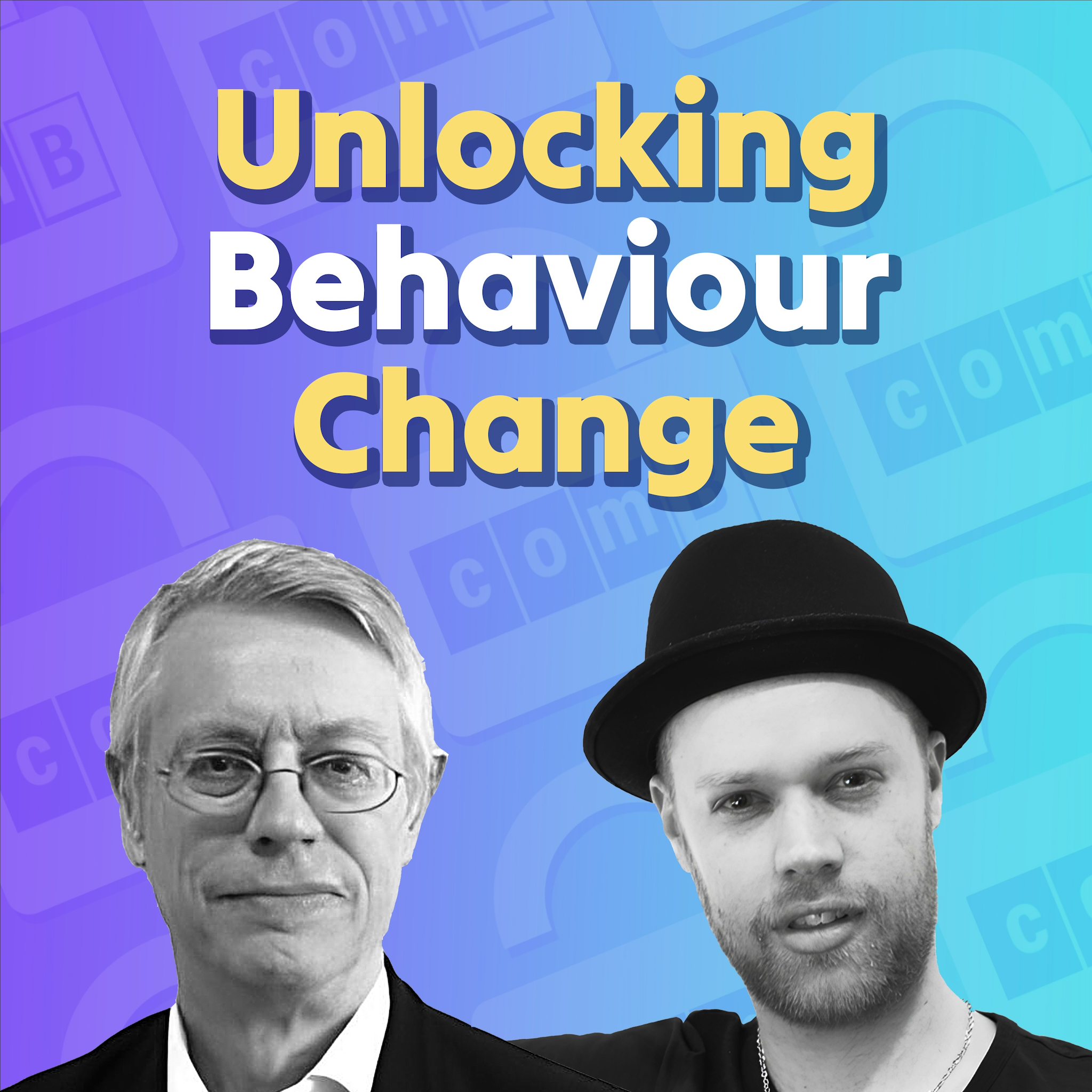
Unlocking Behaviour Change
by Robert West
Welcome to the Unlocking Behaviour Change (UBC) podcast – a show all about psychology and changing behaviour. Meet your hosts: Professor Robert West and Jamie West OBE (not really, but he wanted a title). In this opening episode Robert and Jamie introduce the topic of the first season: decision-making. They tease a brand new framework to help make sense of it all and dive into the concept of cognitive dissonance. Want more? Check out our latest books: Energise: The Secrets Of Motivation: https://shorturl.at/bbA7y React: Harness Your Animal Brain: https://shorturl.at/yiFQ9 Sign up to Robert’s Substack: https://robertwest100.substack.com/ Subscribe to the UBC YouTube channel: / @unlockingbehaviourchange
Episodes
-
Communication for behaviour change
Robert has been to China with Susan (Michie) to launch the Chinese translation of the Behaviour Change Wheel book. Robert waxes lyrical about what a wonderful time he had and how smart, fun, and kind his hosts were, and how modern, clean, and efficient everything was ... Meanwhile, in what's left...
-
Can we make economic theory more accurate if we base it on behavioural science?
In the previous episode, Robert castigated economics and economists' concept of 'utility' as fundamentally flawed, leading to models whose predictions keep being wrong. This week, Robert sketches out a way of thinking about utility that could improve economic modelling, yield more accurate...
-
Economists have it all wrong: How we should be looking at 'utility'
Robert has a bone to pick with economic theory . . . In fact, he wants to pick its bones clean and start over with a much better theory for everyone! Join the duo as they discuss what economic theory gets wrong and how it might be put right . . . Want more? Check out our latest books: Energise…
more -
The good and the bad consequences of classifying things differently!
Derisory amounts of money paid for a piece of work called an 'honorarium' seem ok when if they were a 'fee', it would be insulting! Robert and Jamie discuss how we react differently to the same things when they are classified and labelled differently. This includes clinical diagnoses, where...
-
Classifying the world - how we do it and what are the consequences?
Robert and Jamie discuss the crucial question of how we classify and label things: one of the most basic things that we do in our mental and social world. But in an infinitely complex universe, putting things into boxes is fraught with difficulties, and classifications lie at the heart of…
more -
'Stats beat experience every time (almost)'
Robert and Jamie pay tribute to Dolly Parton - and Jamie plugs his video on her which can be found here - and then discuss how our intuitions about probability can be seriously misleading - leading to disastrous decisions. Robert explains why decision-makers must understand numerical probability....
-
How do we understand and use probability in decision-making?
Robert and Jamie discuss various ways in which we understand probability, including a tendency to 'overchunk' probabilities ('possible', 'likely'), and how these can lead to disastrous decisions. Want more? Check out our latest books: Energise: The Secrets Of Motivation: https://shorturl.at/bbA7y...
-
Why every behavioural scientist should understand 'Bayesian' probability
Robert makes the bold claim that 'probability' underlies all knowledge and that behavioural scientist should always be thinking about knowledge and claims we make in terms of 'priors' (their judgement of the likelihood that something is true before gathering some evidence) and their 'posterior...
-
The Odyssey, AI and the human condition
Robert and Jamie discuss the ubiquitous phenomenon, illustrated by one of the episodes in The Odyssey, that the first priority of our motivational system is not necessarily our best interests, or even what we most enjoy - it's something else. Because humans kind of know this, we are sometimes...
-
How does COM-B compare to the Theory of Planned Behaviour? Part 2 - What COM-B adds
In the second half of a two-parter, Robert explains the limitations of the Theory of Planned Behaviour and how the COM-B model addresses these. The Theory of Planned Behaviour is EXTREMELY widely used and increasingly so despite its age. Among the limitations of the TPB that COM-B addresses are…
more -
How does COM-B compare to the Theory of Planned Behaviour? Part 1 - Understanding the TPB
The COM-B model of behaviour was put forward in 2011 as a comprehensive model of behaviour, capturing influences that lay within individuals (capability and motivation) as well as the outside world (opportunity). It has become popular, with some 17,000 citations to the original paper, but nothing...
-
Decision fail number 5 of 5: 'I didn't ask'
Last but not least in our miniseries on decision fails we have 'I didn't ask'. Even when we think we know it all, we should often ask for another opinion or perspective. And we should always reflect on our own limitations and be willing to consult experts for important decisions that require...
-
Decision fail number 4 of 5: 'I didn't imagine'
In the mini-series on decision fails - common things that we fail to do that result in mistakes when making decisions - this episode covers our failures of imagination. Robert thinks this plays a large part in the well-known phenomenon of 'temporal discounting' - failing adequately to concern...
-
Decision fail number 3 of 5: 'I didn't think'
Continuing on the ‘Top 5 Decision Fails’, Robert and Jamie discuss: ‘I didn’t think’. Why don’t leaders appear to think through the consequences of starting wars? When will the AI bubble burst? Thinking things through comes in three main flavours: depth of analysis, breadth of analysis, and…
more -
Decision fail number 2 of 5: 'I didn't check'
In this mini-series on the top five decision fails, Robert and Jamie discuss five important things we fail to do, or do properly, that lead to mistakes in decision-making. We don't claim that this is the be-all and end-all, but we put them forward as ones that are probably really worth paying...
-
Decisions fails number 1 of 5: 'I didn't look'
In this new mini-series, Robert and Jamie go through candidates for the five biggest decision-making mistakes and how to avoid them - maybe. The first one is ‘I didn’t look’ . . . Sounds obvious - but there are important nuances. Robert and Jamie also discuss psychologists trying to make people...
-
Changing the behaviour of family and friends
The Behaviour Change Wheel is geared towards behaviour change interventions that might be delivered by governments, comms agencies, service providers, companies or teams whose role is to influence the behaviour of whole populations, subpopulations, groups or individuals. But what about the…
more -
Some slightly weird behaviour change techniques, and how to get the most out of practice
Robert and Jamie delve into a class of Behaviour Change Techniques called 'Advise specific behaviour BCTs' in the BCT Ontology. Some are a bit weird, but among them is advising on practice. They discuss what’s the best way to practice a new skill, like a musical instrument. Should you have a beer...
-
A deeper dive into behaviour change techniques and the 'Behaviour Change Technique Ontology'
What if you had a list of everything you could possibly do to change behaviour? Well, today Robert talks about such a list: The Behaviour Change Technique Ontology and also how you can see it and use it yourself! Robert and Jamie then take a deeper dive into one of the categories of behaviour...
-
What are Behaviour Change Techniques?
What is a ‘behaviour change technique’ (BCT)? How does the way you deliver a technique affect the outcome? What is the difference between a thought and a behaviour? Join Robert and Jamie as they introduce this highly useful and widely applicable concept. Robert makes reference to the Behaviour...
-
We have to talk about AI
AI - curse or cure, or both or neither? Most behavioural researchers are using AI in some aspects of their work. But are the benefits outweighing the costs? How can we do it most productively, and what are the pitfalls to look out for? Robert uses it a lot but also recognises the limitations and...
-
Where do values come from and where do they go?
Robert and Jamie ask the deepest questions imaginable . . . At least according to AI chatbots. Where do our values and moral intuitions come from and what do we do with them? Why are ideas that seem ‘obvious’ to us not universally accepted? Are today’s morals better than those of the past? Want...
-
What role do values play in our behaviour?
Is stealing always bad? Are we all hypocrites? What do we do when our morals conflict with our own self-interest? Join Robert and Jamie as they discuss values, ethics and judgements, exploring ideas from a Substack article Robert has written drawing together key writings of psychologists and…
more -
Justice is in the eye of the beholder
Our sense of justice plays a huge role in our moral judgements and our behaviour. But there are many different versions of justice - what is justice for one person is gross unfairness for another. In their journey through things we like and dislike, Robert and Jamie delve into this thorny topic…
more -
Power struggles and group identity
Robert and Jamie continue to explore sources of likes and dislikes (in the broadest sense) and in this episode move on to 'power' and how that relates to leadership. Robert reflects on the idea that often people don;t just want power for themselves, but for groups with whom they identify - and…
more -
The extraordinary motivating force of 'purpose' and 'transcendence'
Humans appear to need some kind of purpose to our existence. It might be directed at spiritual enlightenment, furthering the well-being of the species, personal growth, getting good at something, or even just collecting stamps. Robert and Jamie discuss this as part of their examination of things...
-
The mysterious power of 'craving' and its role in addiction
What are cravings and what causes them? Craving is weird. You'd think that the more we enjoy something the more we would crave it. Not so. We crave things we don’t even like! As part of the series on what people do and do not like, Robert is on to one of his favourite topics. Here is a link to…
more -
Never underestimate the importance of being 'amused' as a motivational force
What would life be like without entertainment? Is beauty integral to a good life? Is all art subjective? As part of their wide-ranging look at what people do and do not like, Robert and Jamie explore the world of aesthetic pleasure and displeasure . . . Here is a link to the Substack article that...
-
Matters of life and death
Staying alive is terribly important to us . . . under certain circumstances. Why do we behave in ways that actually damage our bodies and shorten our lifespan? Robert and Jamie discuss what is going on and how life and death fit in with and compete with other motives. Here is a link to the…
more -
How important are 'agency' and 'understanding' as drivers of our behaviour?
Robert continues to explore the different factors that act as sources of liking and disliking and has asked his AI friend Claude to review his list and suggest how these could be usefully grouped. One crucial grouping concerns being in control of ourselves, other people and events, and...
-
Lots of things motivate our behaviour: Robert has been making a list ...
Robert has been busy making a list of things we like and things we dislike... Or do we? One person’s meat is another person’s poison. The duo also discuss drinking culture, life and death, and wanting to feel less bored... and make a passing reference to the wonderful Hitchhiker's Guide to the...
-
How pleasure and comfort versus pain and discomfort drive our behaviour
So much of what we do stems from anticipated comfort, pleasure or satisfaction, or relief from pain or discomfort. So a really important target when trying to change behaviour is creating these anticipated feelings. We do this in lots of different ways, from rewarding and punishing behaviours,...
-
What makes us accept that changing our behaviour is a good idea?
As part of their exploration into the updated COM-B and the CACTIS tool, Robert and Jamie discuss one of the big reasons for changing behaviour: because people think it's a good idea! But there is so much to unpack here when it comes to how we can provoke behaviour change. Do we improve their...
-
CACTIS: A tools for developing behaviour change interventions using the COM-B model
How can we make practical use of the COM-B (Capability, Opportunity, Motivation - Behaviour) Model when developing behaviour change interventions? The answer is the CACTIS (COM-B Assessment To Intervention Strategy) tool! It was CACTISS with 'Spreadsheet' at the end, but since the podcast, a...
-
How the COM-B model helps us understand the intervention-action gap
Robert has been wondering whether the updated COM-B is enough of an advance to merit the label COM-B 2.0! But more importantly, Robert and Jamie drill down on the concept of 'intention' and explore the intention-action gap. This leads to evidence-based tips for increasing the chances that we will...
-
How identity and imagination can turn 'should' into 'want'.
This week Jamie has been playing Animal Crossing and Robert has been trying not to eat chocolate biscuits. Also, Robert offers tips on making marginal but meaningful changes to behaviour as the duo delves deeper into COM-B. Robert talks about how identity and imagination are important in turning...
-
The COM-B model in detail
Why does Robert keep hitting tennis drop shots into the net? How does ‘Atomic/Individual COM-B’ relate to ‘Aggregate/Population COM-B’? Robert continues his preview of COM-B 2.0 while Jamie wonders if England’s cricketers will ever learn how to make the right decisions ‘in the moment’ . . . Oh…
more -
Updating the COM-B model in the light of experience
An updated version of the COM-B model is nearly ready to roll. It clarifies some things and expands others. It is 'backwardly compatible' with 'classic COM-B'. This episode is the first of several discussing what's new in COM-B 2.0 covering: 1) distinguishing 'individual' and 'population' level...
-
How capability, opportunity and motivation interact to influence behaviour
You can do it! Or . . . can you? When does believing in your own abilities help you achieve your goals? In this episode, Robert and Jamie explore how the different elements of the COM-B model interact. They clear up a bit of confusion about whether self-efficacy sits better with capability or...
-
Introducing the COM-B model of behaviour
Having finished their series on decision-making, Robert and Jamie start a new series that delves into a widely used model of human behaviour, designed to guide interventions that influence behaviour. Many podcast listeners will be very familiar with this model, and many won't. Either way, Robert...
-
Recap on the FACET framework for understanding real-world decision-making
It’s the last episode of the season! Robert and Jamie go on a whistle-stop tour through the FACET framework for understanding real-world decision-making: (Framing, Assessing, Comparing, Enacting and Time). They offer some of their favourite decision-making tips from the last season. These…
more -
How do we decide whom to trust when making decisions?
How do you spot a ‘dubious’ expert? What signs should you look out for? What counts as reliable evidence? And ultimately . . . who can you trust? Robert and Jamie offer tips and advice on navigating the information that bombards us every day. Want more? Check out our latest books: Energise: The...
-
Unlocking Behaviour Change Podcast Episode 32: Embrace 'the power to disbelieve'
This is the first of a two-part episode on how best to use advice and information from so-called 'experts'. When and how much should we trust them? What does healthy scepticism look like? Robert reflects on his time in SPI-B advising the UK government and discusses the importance of behavioural...
-
Unlocking Behaviour Change Podcast Episode 31: The benefits and pitfalls of democratic decision-making
How do democracies work? Can there ever be a perfect voting system? What is the difference between desire and willingness? Deep dive with Robert and Jamie into the often murky and fraught world of democratic decision-making. Want more? Check out our latest books: Energise: The Secrets Of...
-
Unlocking Behaviour Change Podcast Episode 30: Groupthink, risky shift and nuclear war!
In this episode Robert gets it the wrong way round, citing the Cuban Missile Crisis as an example of how groupthink brought the West to the brink of nuclear war when in fact it was previous decisions such as authorising the failed invasion of Cuba that had exhibited groupthink and President…
more -
Unlocking Behaviour Change Podcast Episode 29: The ebb and flow of group decision making
Crucial decisions that affect our lives are made in 'groups', which technically can range from two or more people, as in the flight crew of a commercial jet, to the voting population of a country. This episode begins to examine how group decisions are made. Robert and Jamie analyse the ebb and…
more -
Unlocking Behaviour Change Podcast Episode 28: What are 'ontologies' and why they will be at the heart of behavioural science?
Robert was fed up with asking for a flat white and getting heaven knows what, so with the help of his AI friend, Claude, he created an 'ontology' of milk-containing coffee drinks! Claude and Robert got carried away and ended up writing a Substack article about the power of ontologies as a way of...
-
Unlocking Behaviour Change Podcast Episode 27: The desire to believe ...
Robert argues that we should assume people pretty much always believe things because we want or need to believe them. Some of us value evidence and truth and so want to believe things based on evidence, but clearly that is only one source of desire. So when we hear someone espousing a belief, it…
more -
Unlocking Behaviour Change Podcast Episode 26: Explaining decisions, 'optics' and the 'lose-change/win-stay' heuristic
Jamie has been watching Celebrity Traitors while Robert has been learning about Cicero. In this episode, the duo talk about why it can be stressful to explain your decisions to others, the pros and cons of focusing on ‘optics’, and how the simple 'lose-change/win-stay' heuristic can lead to bad...
-
Unlocking Behaviour Change Podcast Episode 25: Hot decisions
Decisions can be stressful – sometimes so stressful that we procrastinate or even avoid making them at all. In this episode, Robert and Jamie explore how to use our emotions to clarify rather than cloud our judgements. They also reveal the honest truth about how they feel receiving feedback . . ....
We're indexing this podcast's transcripts for the first time — this can take a minute or two. We'll show results as soon as they're ready.
No matches for "" in this podcast's transcripts.
No topics indexed yet for this podcast.
Loading reviews...
ABOUT THIS SHOW
Welcome to the Unlocking Behaviour Change (UBC) podcast – a show all about psychology and changing behaviour. Meet your hosts: Professor Robert West and Jamie West OBE (not really, but he wanted a title). In this opening episode Robert and Jamie introduce the topic of the first season: decision-making. They tease a brand new framework to help make sense of it all and dive into the concept of cognitive dissonance. Want more? Check out our latest books: Energise: The Secrets Of Motivation: https://shorturl.at/bbA7y React: Harness Your Animal Brain: https://shorturl.at/yiFQ9 Sign up to Robert’s Substack: https://robertwest100.substack.com/ Subscribe to the UBC YouTube channel: / @unlockingbehaviourchange
HOSTED BY
Robert West
Loading similar podcasts...
Frequently Asked Questions
How many episodes does Unlocking Behaviour Change have?
Unlocking Behaviour Change currently has 73 episodes available on PodParley. New episodes are automatically indexed when they're published to the podcast feed.
What is Unlocking Behaviour Change about?
Welcome to the Unlocking Behaviour Change (UBC) podcast – a show all about psychology and changing behaviour. Meet your hosts: Professor Robert West and Jamie West OBE (not really, but he wanted a title). In this opening episode Robert and Jamie introduce the topic of the first season:...
How often does Unlocking Behaviour Change release new episodes?
Unlocking Behaviour Change has 73 episodes. Check the episode list to see recent publication dates and frequency.
Where can I listen to Unlocking Behaviour Change?
You can listen to Unlocking Behaviour Change on PodParley by clicking any episode. We provide an embedded audio player for direct listening, and you can also subscribe via your preferred podcast app using the RSS feed.
Who hosts Unlocking Behaviour Change?
Unlocking Behaviour Change is created and hosted by Robert West.
URL copied to clipboard!