
All Episodes
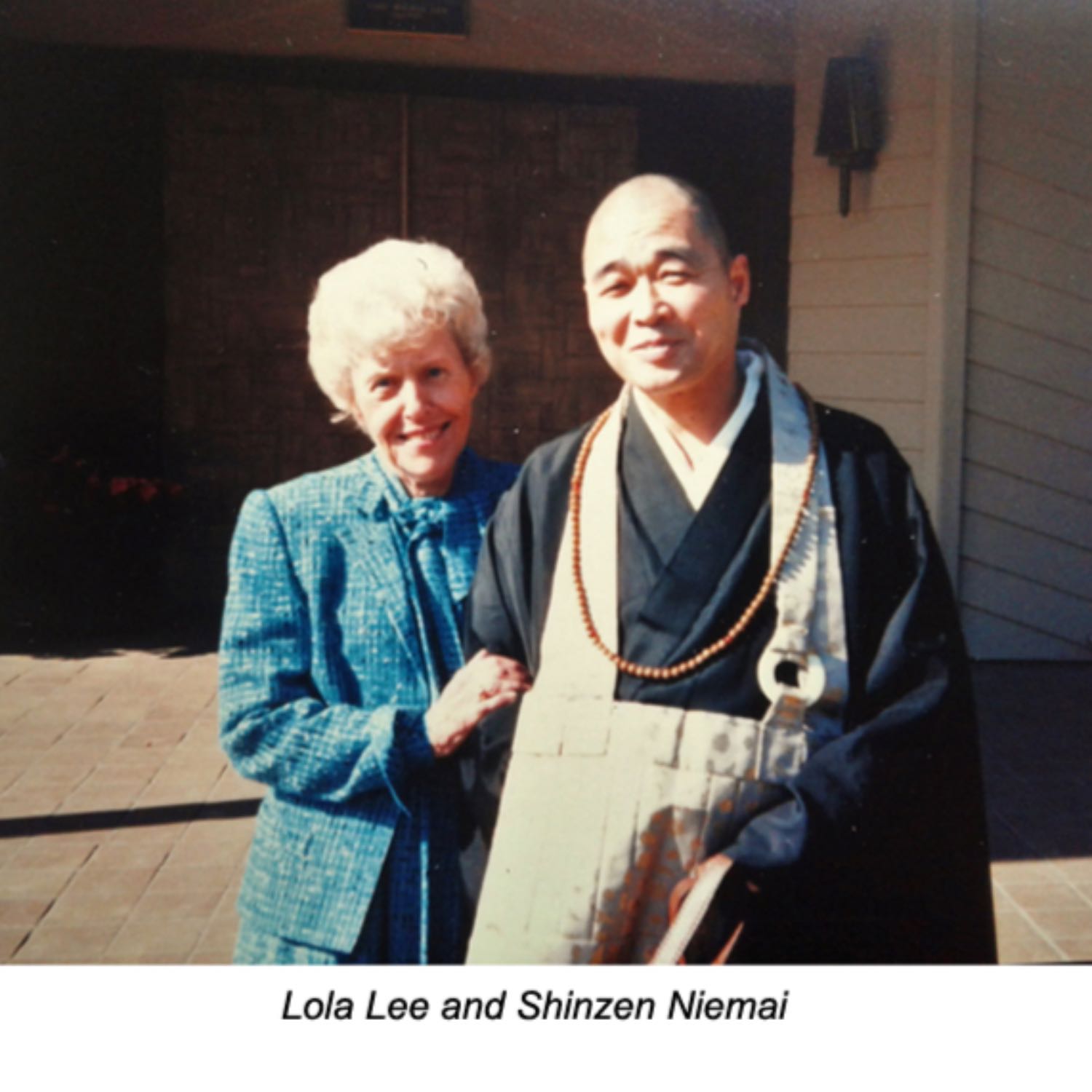
Talks by Zen Roshi, Lola McDowell Lee — 141 episodes
Freedom from preferences. Delivered Aug 31, 1986
Where Taoism, Christianity and Zen meet. Delivered August 17, 1986
Unlearning and existential trust. Delivered Aug 10, 1986
The Trap of Words - Delivered August 3, 1986
Zen is not an intellectual exercise. Delivered Jun 20, 1986
Emptiness is not nothingness. Jul 14, 1986
How to enter a gateless gate. Delivered July 6, 1986
The Basic Teachings of Zen Meditation. Presented on June 29, 1986
Accumulating knowledge versus attaining true wisdom. June 22, 1986
The Lesson of True Listening. June 15, 1986
An exploration of the subject of death. Delivered Jun 8, 1986
Does an enlightened Zen master live a saintly, extraordinary life? Delivered Jun 1, 1986
Give gifts with no notion of reward or praise. Like moving something from one hand to the other. Mar 9, 1986
Learning to live less from the mind and more from the hara. Oct 14, 1981
Allowing Purusha to extricate itself from the mindless play of Prakrit. Sept 27, 1987
Plato, art and spiritual growth. Sep 5, 1987
The Middle Way—between the world of appearance and the inner world of consciousness. Aug 29, 1987
How do you go in? Simply stop going out. Aug 2, 1987
The meanings of various Buddhist terms, practices & traditions. July 26, 1987
Dogen: “Not knowing is most intimate.” July 5, 1987
How you form your ego—and can ultimately overcome it. Jun 28, 1987
Zen and Socrates. Jun 21, 1987
Instructions for Koan study. And true understanding & non-discrimination. May 31, 1987
The limitations of human knowledge. May 17, 1987
In the struggle between opposites is the Truth. Mar 6, 1987
Where is God? Feb 28, 1987
Mystica Theologica, the Sutras of Patanjali and the Book of Genesis. Jan 31, 1987
How do you answer: “Does God exist?” Sep 20, 1987
A detailed introductory talk about the Bauls — a religious sect of India—and the mystery of consciousness. Sep 13, 1987
The Bauls religious sect of India. And Prakrit and Parusha. Oct 18, 1987
Zen and the meaning of Easter. Apr 19, 1987
Guilt and rejection of life does not make you more enlightened. Lola May , 1987
What we can learn from Indian religious traditions. May 10, 1987
How to meditate. And why. Nov 29, 1987
The unconscious is the gateway to reality. July 18, 1981
Why “What is the purpose of life?” is the wrong question. June 28, 1981
The role of patience in Zen practice. July 5, 1981
Further exploration of the Mystica Theoligica. Dec 11, 1988
The meaning of the the Mystica Theoligica. Dec 4, 1988
Watch how you make your choices. Otherwise, how can you ever change? Nov 6, 1988
How often do we think that we—as individuals—are going to be enlightened? Oct 30, 1988
Meditate for one hour daily, and truly concentrate, and you can merge with the Ku. July 31, 1988
The One-finger Zen of 9th Century Chinese Master Gutei. Jul 10, 1988
To meditate no action is required—simply a shift in consciousness. Exploring the Tao Te Ching, Chapter 16. Jul 3, 1988
How do we cross an icy stream? Exploring the Tao Te Ching, Chapter 15. May 28, 1988
A detailed exploration of Chapter 14 of Lao Tzu’s Tao Te Ching, “Praising The Mysterious.” May 8, 1988
Lao Tzu on two fundamental types of meditation. May 1, 1988
More Bible parables that can help you practice Zen. Dec 12, 1984
Bible parables that can help you practice Zen. Dec 9, 1984
Zen is not a belief system. Zen disturbs the dreaming mind. Nov 12, 1984
When you learn to accept that you are alone, truly alone, it builds a great strength. Nov 5 1984
Who are you really? Your name is not you. Your photo is not you. Who are you? Oct 28, 1984
We are looking for nothing. Which doesn’t give you much to look for, does it? Oct 21, 1984
Lao Tzu: Existence renders actual. Non-existence renders useful. Oct 7, 1984
How can Truth be expressed without speaking—and without being silent? Sep 30, 1984
Is Zen difficult? Also, an in-depth examination of the Mu koan. Sep 23, 1984
The story of the centipede, convinced by a fox to start thinking. Sep 16, 1984
Don’t run to—and don’t run away. Aug 7, 1988
“In what state of mind should I seek Truth?” Doko asks. Sep 9, 1984
Without a word, without a thought, who are you? Aug 19, 1984
Words can’t teach how to practice. Like swimming, we must do it. Jul 22, 1984
Lola recounts the surprising tale of the Sufi mystic who is captured and taken to the slave market by his captors. July 15, 1984
The Paramitas - 1. Giving 2. Observing precepts 3. Patience 4. Diligence 5. Meditation. 6. Wisdom. July 8, 1984
Pranyaparamita, or “the perfection of transcendental wisdom.” July 1, 1984
The similarities between Hassidic Judaism and Buddhism. May 19, 1985
Make the smallest distinction and heaven and earth are set infinitely apart. May 12, 1985
A monk asked his teacher, "I am pecking from inside the shell. I beg you, Master, please peck from outside." May 5, 1985
First is learning, called hearing. Then approaching. Then transcending. Lola Apr 14, 1985
As illusions drop, as attitudes drop, how relaxing it is to be at ease with yourself. Mar 31, 1985
The depth in saying “I don’t know.” Mystica Theologica. Lola Jul 22, 1985
Zen masters never tell the truth. July 15, 1985
"The mind dwells in the cave of the heart. He who conquers it frees himself from slavery." May 26, 1985
The mightiest fighting rooster does not crow about his might. Jun 24, 1984
When you’re silent, there is one mind. When you’re thinking, you are many. Jun 10, 1984
Examine your past so it doesn’t govern you. The past is dead. Stop living it. Oct 30, 1983
What must wake up in you for you to be awake? Oct 29, 1989
Once we understand we are not the masters of our thoughts—but victims—we can stop cooperating. Lola Mar 17, 1985
The tale of the visitor who asked Zen master Bankei what miracles he could perform. Aug 6, 1989
Easter of 1985 - What Zen practitioners can learn from the story of Christ's Resurrection. Apr 7, 1985
Second in a series about using Transactional Analysis in Zen - the Child, Parent, Adult. Lola Oct 13, 1983
Learning to work with three elements of our identity: the parent, the child and the adult. Oct 6, 1983
Most of us are after power. Control in our situation. A wiseman seeks not. Instead, he cooperates. Nov 27, 1923
Life. Death. And Love. The most important thing for you is your life. Do you ever thoroughly investigate it? Nov 20, 1983
We can repeat the most profound teachings and remain stupid. What in us is orginal? May 1, 1983
Get beyond the effort of meditation and find real meditation. Jul 3, 1983
What is the greatest miracle in the world? Oct 30, 1983
The Taoist sage, Lieh Tzu, was once asked: Why do you value emptiness? Jun 12, 1983
By the merit of a single sitting, they destroy innumerable sins. (Hakuin) Jun 5, 1983
There are plenty of Buddha statues sitting still. But have you ever seen a Zen master sitting still? Mind vs action. May 29, 1983
The tale of the thief who robs Shichiri Kojun who was busy reciting sutras. Don’t fight the darkness—light a candle. May 22, 1983
Human beings are stuck in an in-between state—not unconscious and we’re not completely conscious. May 15, 1983
When we meditate and watch our breath, we are playing an iron flute with no holes. Apr 24, 1983
Without speaking and without silence, how can you express the Truth? Apr 10, 1983
Being truly alive should be an adventure into the unknown. Apr 3, 1983
We identify with everything but ourselves. Possessions, emotions, thoughts. But not our true selves. What is true silence? Mar 12, 1983
Chuang Tzu and appreciating the useless in the world. Mar 6, 1983
The intellect cannot penetrate consciousness. When you drop thoughts, consciousness is present. When you drop the pseudo self, the True Self is present. July 12, 1981
What is the meaning of movement and rest, in Zen and Christian practice? Dec 13, 1981
As you breathe into the tanden (Hara), your focus deepens and mysteries will reveal themselves. You don’t have to solve them—they reveal themselves to you. Apr 14, 1981
Are you free or is your conditioning controlling you? Dig into yourself and ask “Who am I?” Jun 21, 1981
We are divided between our senses and our thinking, our body and soul, matter and consciousness. Jun 14, 1981
Zen practice is not an intellectual endeavor. The tale of the blind man and the lantern. Feb 17, 1985
When you look in the mirror, do you see you? When you are silent, it speaks. Your absence is its presence. Feb 10, 1985
Understanding Lao Tsu’s Tao Te Ching and the Middle Way. Non-action, yet nothing remains undone. Sep 22, 1985
Do not sit in meditation waiting for enlightenment. Direct your attention to the mind. And, what is faith? Mar 2, 1986
Exploring the meaning of the Dhammapada. Listening to teachings as if you are an empty tape recorder. Sep 4, 1983
What is this life living you? It’s the same as that which sings in the birds. Jan 8, 1984
A Christmas message for Zen practitioners about the birth of the light within. Dec 20, 1986
To witness the apparent in the real and the real in the apparent. One mind sees both worlds. Jan 26, 1986
We try to both change and remain the same—the hook that many are on. Jun 7, 1981
Meditation is about life and death. Nirvana is not. The thundering silence. 1990 Sesshin Friday
Learning to differentiate what you see, what you think and what you feel. Aug 16, 1981
Your ego has no power to do anything. It’s impotent. Dec 6, 1981
Misfortune and our identity. And the tale of the farmer who asks God to let him choose the weather. Dec 03, 1981
Lao Tzu uses the metaphor of a vessel to show that while existence renders it (and us) actual, it is the vessel's non-existence (or emptiness) that renders it useful. Aug 23, 1981
What is consciousness? Does a rock have consciousness? Who are we? Summer 1990 Wed Night Sesshin
The mind-body relationship. And breathing from the Hara. Apr 14, 1981
Lola shares the tale of the monk and the bottomless pitcher. And how to focus with a no-thinking mind. 1990 Summer Sesshin Monday
When you're fast asleep and hear a noise you wake up. What wakes up? What was awake to hear the noise? Jan 27, 1985.
First one finds quiet, explains Lola. Then one goes further and finds silence, or Shunyata. Mar 28, 1982.
An early talk by Lola where she explains the metaphor of a boat crossing a river to reach the other side. Apr 20, 1975.
We can live in the valley—but be the peak. Lola explains how to live an awakened life. Apr 4, 1982
What is the power with which you look at yourself? Lola explores the meaning of religion and non-discrimination. Feb 2, 1985
Lola asks: What gives the eye its sight, the ear its hearing? Mar 22, 1987
Lola explains how the process of becoming awakened depends on two factors—the information you feed your mind—and your meditation. Sep 24, 1989
Lola suggests we ask ourselves Agathon’s question: What in your life is the greatest good? She also explains that truth is not an idea but an encounter, an adventure. Mind is just a record of what has happened. Sep 10, 1989.
Lola mentions an early experience of awakening. And shares the tale of the Duke and the wheelwright. Feb 15, 1987
Lola explores the nature of consciousness and the relationship in our world of subject and object. Apr 26, 1987
Lola shares the story of the old man, the young man, and the donkey. Habits and non-attachment. Nov 30, 1986
Lola explores how we create many identities during our lives, all the time ignoring our true selves. Mar 29, 1987.
Lola asks "What is consciousness?" And continues exploring the meaning of the Hindu Isha Upanishad. Mar 15, 1987
Lola explores the relationship of subject and object using sacred Hindu texts. Mar 08, 1987
Lola discusses the Great Doubt, or dark night of the soul, which sometimes precedes Satori. May 17, 1989
Lola tells the story of the frog in the well. And answers the question: Is Zen meditation active or passive? Aug 27, 1989
Lola tells of the three men who ask Buddha if there is a God? June 3, 1984
On Easter, Lola explores the meaning of the Resurrection. Apr 22, 1984
Lola Explores the Meaning of the Eightfold Path - Apr 15, 1984
Lola shares the story of the traveler and the one-eyed monk. Oct 20, 1985
Lola explains how sometimes that which you value most in your life can become your greatest burden. Jan 24, 1988.
Lola McDowell Lee, a Zen Roshi, explores what it means to plan for the future while we also are told to live in the present. February 7, 1988.
Zen Roshi Lola McDowell Lee talks about the breath, and how we may have distanced our instinctual being from our rational mind. Jan 31, 1988