
PODCAST · news
The Active Center
by David Sepe
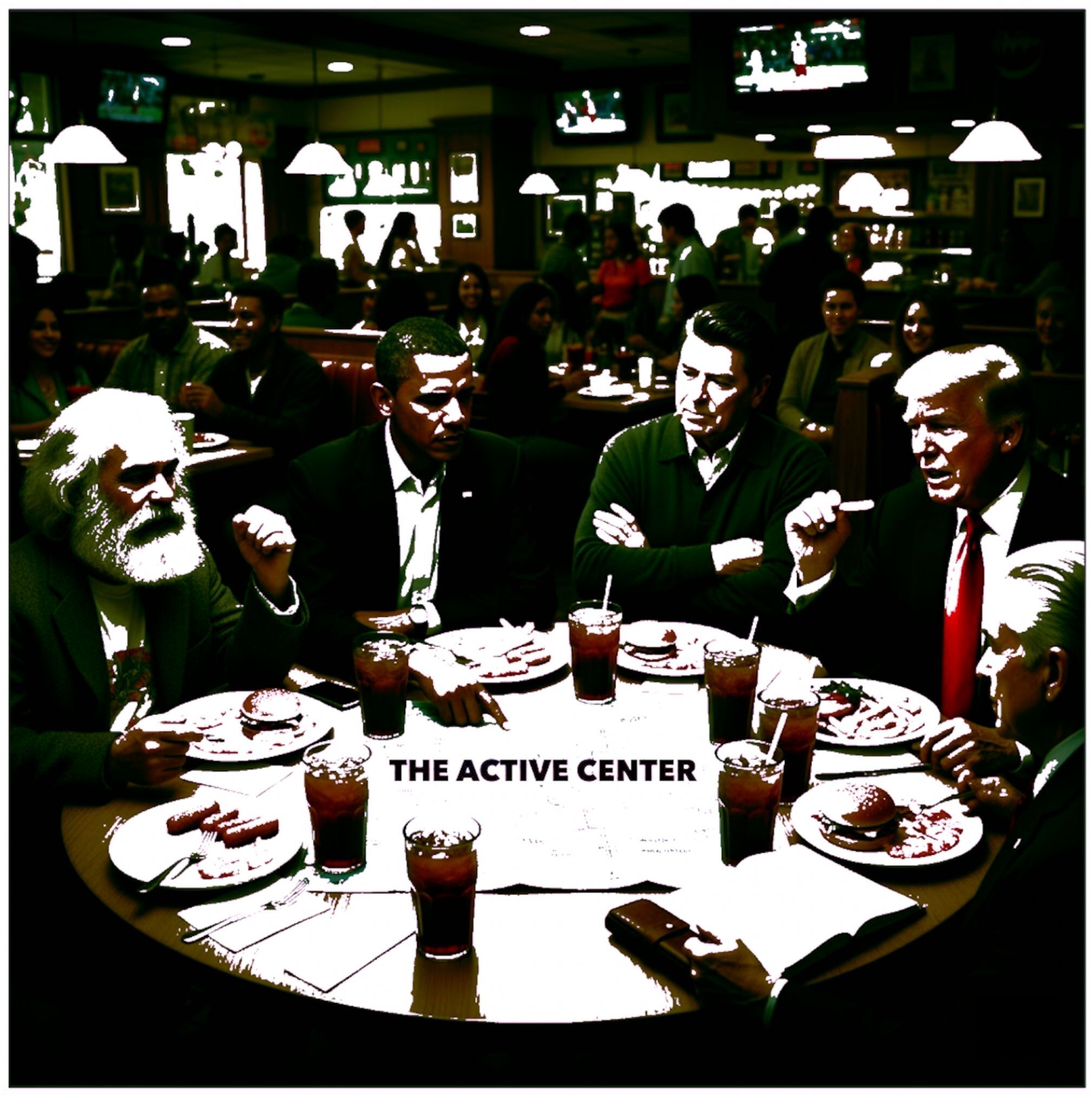
The Active Center’s analysis operate from a position of critical optimism regarding the United States. While ”The Active Center” affirms the fundamental validity and promise of the nation’s political, social, and economic structures, it remains fiercely critical of the current conditions. The show frequently challenges the efficacy of contemporary political, economic, and social leadership in ensuring genuine equal rights and equal opportunities for the broadest possible cross-section of citizens.Despite these criticisms, the final message is one of hopeful pragmatism. ”The Active Center” maintains that the ongoing march towards ”the Dream”—the ideals of liberty, justice, and opportunity—is unsteady but absolutely ongoing. The podcast champions the power of free speech, the democratic mandate of voting, and the necessity of reasonable, incremental reforms as the primary engines for positive, sustained national progress. It is a show for those who believe in the system but demand that
-
95
Real Estate Investment the Gift of Capitalism
Real estate investments can be a sound financial decision regardless of your lifestyle. Whether you prefer a hands-on or hands-off approach, real estate works through four primary strategies. What Is a Real Estate Investment? Consider the story of Craig, who bought his first home and saw its value quintuple in less than seven years. This experience led him to acquire several other properties. His success highlights the two primary ways real estate builds wealth: Income Generation: Earning steady cash flow through rental units. Price Appreciation: Benefiting from the increase in a property’s market value over time. The Four Primary Types of Real Estate Investment 1. Residential Real Estate Residential property is designed for individuals and families. The investor acts as a landlord, leasing the home to a tenant who pays monthly rent. The Benefit: It is generally a safe investment because it generates consistent monthly income. Ideally, the rent covers all expenses (mortgage, taxes, repairs) while providing a net profit. The Risks: * Tenant Issues: Difficulty removing non-paying tenants can disrupt cash flow. Rising Costs: Increases in property taxes or insurance can eat into margins. Mitigation: Smart investors use rigorous screening processes and forecast for tax hikes when setting rent. 2. Commercial Real Estate This involves properties like office buildings or large apartment complexes. While the concept is similar to residential (the investor is the landlord), the scale is much larger. The Benefit: Economy of Scale. With multiple businesses or individuals paying rent within a single complex, the profit margin is significantly higher. The Challenge: Commercial properties require a much higher initial capital investment than single-family homes. 3. Real Estate Investment Trusts (REITs) REITs are ideal for "hands-off" investors who do not wish to manage physical property. An REIT is a company that owns and operates commercial real estate using pooled investor money. The Benefit: It functions similarly to owning stock in a public company. You are a shareholder and investor in a real estate portfolio and earn dividends as the trust profits. The Advantage: It offers exposure to the real estate market without the responsibilities of maintenance or tenant management. 4. Flipping Flipping involves purchasing a property—often a foreclosure or a home priced below market value—performing renovations, and reselling it quickly for a profit. The Strategy: Some investors save money by doing the renovations themselves, while others hire contractors for larger-scale projects. The Goal: To add value through improvements and capitalize on a quick turnaround. Understanding the Risks While real estate can be lucrative, savvy investors must be aware of potential pitfalls: Liquidity: Real estate is not a liquid asset like cash; it can take months to "unload" or sell a property. Market Volatility: If the market turns "sour," property values may decrease, making it difficult to sell for a profit. Maintenance: Unexpected repairs and ongoing maintenance can be costly and unpredictable. Hello, and thanks for reading my story. For years, my mission has been to foster a community around engagement, unique takes on interesting stories, and conversation. If you value what I do, please consider supporting me. I've started a GoFundMe to cover my production and operational costs, including those pesky social media fees. If you can’t contribute to my GoFundMe, I get it, but you can help me by subscribing to my account or sharing this particular story with friends and family that you think would appreciate it. Your contribution, big or small, helps me keep going. Thank you. GO FUND ME
-
94
Does the City of Orange Have a Plan to Increase Revenue by Leveraging the 2026 FIFA World Cup?
Spillover, Strategic Positioning, and Financial Projections for the City of Orange, California 1. Executive Summary The 2026 FIFA World Cup, running from June 11 to July 20, 2026, is projected to bring over 146,000 unique out-of-town international and domestic soccer fans to the Southern California region, with eight matches hosted at SoFi Stadium in Los Angeles. While Los Angeles County is the epicentre, the extreme price hikes, hotel capacity constraints, and traffic gridlock in LA present a massive opportunity for neighboring Orange County. This report outlines how the City of Orange, CA can position itself within the "World Cup Corridor," leveraging its historic charm, proximity to Anaheim’s theme parks, and excellent transit infrastructure to capture significant economic spillover. 2. SoCal Regional Economic Projections (The Macro Picture) Updated economic impact studies show a substantial financial opportunity for Southern California: Total Regional Economic Impact: Estimated between $892 million and $1.1 billion for Southern California. Direct Visitor Spending: Projected at $515 million across lodging, dining, retail, transport, and entertainment. Local Tax Yield (LA County): Projected at $50 million in direct municipal/county tax revenue. State Tax Yield: Estimated at $36 million. 3. The "Official Strategy" Reality: Policy, Licensing, and Quotes Does the City of Orange have an official World Cup 2026 Business Strategy? No. Officially, the City of Orange does not have a publicly published, dedicated "World Cup 2026 Business Strategy." This is not a municipal oversight, but rather a calculated legal and financial reality. Under FIFA's strict intellectual property and licensing laws, only designated host cities and their official host committees (such as the Los Angeles World Cup 2026 Host Committee) have the legal right to use official trademarks, brand matches, or market municipal events under the "World Cup" banner. As Kathryn Schloessman, President & CEO of the Los Angeles Sports & Entertainment Commission, remarked regarding regional integration: "Hosting the FIFA World Cup 2026 isn't just about hosting eight matches at SoFi Stadium, it's about using the tremendous media attention generated to highlight all the opportunities for community engagement throughout our region... by creating accessible fan experiences." However, because Orange is outside of Los Angeles County, it does not receive direct allocation from the host committee's $26 million community champion grants or official fan zones. Therefore, the city's strategy is informal and reactive, relying on local business associations, chambers of commerce, and hoteliers to implement grass-roots "workarounds" to capture the overflow. Orange-Specific Projected Tax Gains (Analysis of the Spillover Corridor) While the city cannot legally spend tax dollars on official "FIFA" branding, it sits directly in the sweet spot of the Anaheim-SoCal transportation corridor. Below is a granular breakdown of the potential fiscal gains for the City of Orange: A. Transient Occupancy Tax (TOT): $550,000 to $680,000 (Net Incremental: +$180,000) The Baseline: Orange operates a lean but highly accessible hotel inventory of roughly 2,200 rooms situated primarily along the I-5 corridor (near The Outlets at Orange), Main Street, and Tustin Street. The Rate: Orange levies a 10% TOT rate on lodging. The Spillover Mechanics: Standard summer occupancy in Orange sits at 72%. Due to extreme rate inflation in Los Angeles (where some nightly prices have jumped by 50% or more, according to local hospitality data) and high occupancy in Anaheim, Orange hotels will capture cost-sensitive domestic fans and international family groups. The Yield: Occupancy is projected to spike to 84%–88% with an average daily rate (ADR) of $195 to $230. This translates to a total lodging tax yield of up to $680,000 during the 39-day window, giving the city an extra $180,000 in pure, unbudgeted TOT surplus. B. Sales Tax: $120,000 to $180,000 (Net Incremental: +$65,000) The Baseline: Under California law, the City of Orange receives a 1% Bradley-Burns local sales tax allocation on taxable retail, food, and beverage transactions. The Spillover Mechanics: The average international sports tourist spends roughly $230 to $300 per day (excluding lodging) on meals, souvenirs, and retail. The Yield: Food and beverage sales in Old Town Orange ("The Circle") and high-volume discount fashion retail at The Outlets at Orange will see highly concentrated international patronage. This influx is modeled to generate between $12 million and $18 million in taxable visitor transactions, yielding the city up to $180,000 in direct sales tax allocation. C. Gas Tax: $15,000 to $22,000 (Net Incremental: +$8,000) The Baseline: Local streets and highway maintenance in Orange are partially funded through state allocations of SB 1 (the Road Repair and Accountability Act) and local gas tax disbursements. The Spillover Mechanics: Navigating between Orange County hotels, local theme parks (Disneyland/Knott’s), and SoFi Stadium in Inglewood will require extensive driving for the subset of the 146,000 fans choosing rental cars over rail. Orange's position at the "Orange Crush" interchange (I-5, SR-22, and SR-57) makes its fueling stations highly high-traffic points. The Yield: Local stations are expected to see a 12% to 15% surge in fuel volume over the summer baseline, resulting in a localized gas tax allocation bump of up to $22,000. 4. Financial Projections: City of Orange vs. City of Anaheim Because of its massive resort district and 20,000+ hotel rooms, Anaheim will naturally capture the largest share of Orange County's hospitality spillover. However, the City of Orange can secure highly profitable secondary "corridor" revenue. Economic Projections Comparison (June–July 2026) Economic Metric City of Anaheim (Projections) City of Orange (Projections) Hotel Room Inventory ~22,000 rooms ~2,200 rooms (focused along I-5 / Main St / Tustin St) Projected Occupancy (June-July) 92% – 95% 84% – 88% (up from standard 72% summer baseline) Average Daily Rate (ADR) $280 – $340 $195 – $230 Transient Occupancy Tax (TOT) Rate 15% 10% Projected TOT Revenue Yield $7.5M – $9.2M (Incremental: +$2.8M) $550,000 – $680,000 (Incremental: +$180,000) Projected Sales Tax Revenue $1.8M – $2.4M (Restaurants/Retail) $120,000 – $180,000 (Focus on Old Town & Outlets) Projected Gas Tax Allocation Increase Minor regional bump $15,000 – $22,000 (Highways 55, 22, & I-5 corridors) Total Direct Fiscal City Benefit $9.3M – $11.6M $685,000 – $882,000 5. Theme Park Impact: Disneyland & Knott’s Berry Farm Mega-sporting events introduce a unique economic phenomenon known as the "displacement effect" (or crowding-out), alongside standard tourism growth. Expected Tourist Flow Trends: The "Crowding Out" Effect: Typical summer leisure tourists (families from the Midwest or Western US) often defer their Disneyland and Knott's Berry Farm trips during June and July to avoid the hyper-inflated airfares, hotel rates, and regional congestion associated with the World Cup. The Compounding International Segment: To offset this, international World Cup ticket holders (particularly from Europe, South America, and East Asia) frequently bundle their matches with local attractions. A family traveling from France or Brazil for a match at SoFi Stadium is highly likely to spend 2–3 days at Disneyland Resort or Knott's Berry Farm. Net Attendance Shift: Disneyland and Knott's are projected to see a 5% to 8% net increase in overall attendance, but a dramatic 25% shift toward international, high-spending day-visitors. Competitive Hotel Rate Strategies for Orange: Because Orange hotels do not carry the premium "Disneyland walking-distance" tax, they can market themselves as the "Value and Authenticity Alternative." Bundled Transport Packages: Orange hotels can partner with independent shuttle services or market proximity to the ART (Anaheim Regional Transportation) lines to offer seamless transit to Disneyland, keeping total travel costs lower than on-property hotels. The Knott's Advantage: Knott's Berry Farm is only a 15-minute drive straight up the 5 or 91 freeways from Orange. Orange hotels should offer "Knott's + Stay" packages tailored to international visitors seeking a classic American theme park experience at a friendlier price point than Disney. 6. The Licensing Workaround: Navigating FIFA Restrictions Because the City of Los Angeles and the LA Host Committee hold the official local FIFA host city licenses, the City of Orange cannot use official trademarks, logos, or terminology (e.g., "World Cup 2026," "FIFA," or "SoFi Stadium matches") in its public-facing marketing. Compliance-Safe Marketing Alternatives: Instead of using protected terms, the City of Orange and local business associations should adopt high-association, generic phrasing: Protected: "Official World Cup Watch Party at the Circle" Safe: "Global Soccer Celebration in Old Town" Protected: "Your FIFA World Cup Hotel Hub" Safe: "Your Southern California Football Hub" or "The Championship Summer Hub" Protected: "Discounts for World Cup Ticket Holders" Safe: "Show Your Match Day Ticket for 10% Off" 7. Actionable Blueprint: How Orange Can Capture the Spillover Strategy A: Elevate Old Town Orange ("The Circle") as the Premier Watch Hub Old Town Orange is uniquely positioned to capture fans looking for a charming, walkable, European-style plaza to enjoy pre- and post-match dining. Outdoor Screening Licenses: The City should streamline permitting for restaurants on Glassell and Chapman to install outdoor TVs and temporary viewing areas under string lights, branding it as an "International Fan Walk." Themed Dining & Pub Crawls: Establish a "Passports of the World" dining promotion. As different nations play at SoFi, local restaurants can feature national dishes and beers (e.g., matching the playing teams of that week). Extended Alfresco Hours: Temporarily ease noise and outdoor dining ordinances during match days to allow historic district pubs and eateries to maximize evening foot traffic. Strategy B: Establish the Metrolink "Gridlock-Free" Corridor Traffic between Orange County and Inglewood (SoFi Stadium) during the tournament will be highly congested. Orange must market itself as the transit-friendly alternative. The Metrolink Advantage: The Orange Metrolink Station (located right in Old Town) connects directly to LA Union Station. From Union Station, fans can take express shuttles or light rail directly to SoFi. "Park, Dine, and Ride" Campaigns: Target domestic drive-market fans. Encourage them to park at the Orange Transit Center structure, have lunch or breakfast in the Circle, and take the train up to Los Angeles to avoid $100+ parking fees and gridlock at SoFi Stadium. Targeted Digital Ads: Run geofenced digital campaigns targeting visitors booking hotels in Anaheim or LA, highlighting: "Skip the $120 SoFi Parking. Stay in Orange, Take the Train." Strategy C: Anaheim Overflow & Visitor Welcoming Campaigns To capture the massive overflow of tourists staying in Anaheim, the City of Orange must make itself highly visible to those visitors. Multi-Lingual Welcoming Signage: Install "Welcome Soccer Fans" (in Spanish, Portuguese, French, Japanese, etc.) banners at the borders of Orange and Anaheim (especially along State College Blvd and the City Drive). Shuttle Integration: Work with hotel operators to integrate the Orange Transit Center into existing hotel shuttle loops, making it effortless for tourists staying near the Anaheim Convention Center to explore Old Town Orange for dinner. The Outlets at Orange Synergy: International soccer fans are historic drivers of premium retail spending. The Outlets at Orange should partner with the city to distribute "Global Fan VIP Savings Booklets" to all hotels in Orange and Anaheim. By utilizing its natural transit advantages, historic dining appeal, and proximity to major Southern California tourist nodes, the City of Orange can quietly generate close to $1 million in direct tax revenues and drive over $10 million in local business transactions during this historic summer tournament. Hello, and thanks for listening to my podcast For years, my mission has been to foster a community around engagement, unique takes on interesting stories, and conversation. If you value what I do, please consider supporting me. I've started a GoFundMe to cover my production and operational costs, including those pesky social media fees. If you can’t contribute to my GoFundMe, I get it, but you can help me by subscribing to my account or sharing this particular story with friends and family that you think would appreciate it. Your contribution, big or small, helps me keep going. Thank you. GO FUND ME
-
93
Applying Classroom Concepts into the Real World: Anaheim and the 2026 World Cup An Economic Analysis
Scarcity Scarcity is a fundamental economic principle that highlights the limited nature of resources in the face of unlimited wants. For Anaheim, the 2026 World Cup will bring this principle to the forefront. While the city itself won't host matches, its position as a major hospitality destination means it will absorb a large portion of the overflow tourism from nearby Inglewood. Key resources that will become scarce include: Hotel Rooms: Anaheim's hotel inventory, while vast, is finite. The surge in demand from international and domestic soccer fans will quickly fill available rooms, especially on match days. This scarcity will drive up prices, as hotels can charge a premium due to the high demand and limited supply. Road Capacity and Public Transit: Major freeways like the I-5 and local roads will experience unprecedented congestion as fans travel between Anaheim, the surrounding areas, and SoFi Stadium. The limited road capacity, coupled with an increase in rideshare and taxi demand, will create bottlenecks and longer travel times for everyone, not just World Cup attendees. Public Safety Personnel: Anaheim's police and fire departments will need to allocate significant resources to managing large crowds, traffic control, and public safety at viewing parties and fan-related events. The number of trained personnel is limited, meaning resources dedicated to the World Cup will be diverted from other routine city services. Cost-Benefit Analysis From Anaheim's perspective, a hypothetical cost-benefit analysis of the World Cup's effects would weigh the potential economic gains against the operational and social costs. Potential Benefits: Increased Revenue: Hotels, restaurants, and retail stores will see a massive boost in sales. This leads to higher sales tax revenue for the city. Hotel occupancy taxes will also see a significant increase, providing a direct financial benefit to Anaheim's general fund. Job Creation: The high demand for services will create temporary jobs in the hospitality, food service, and retail sectors. Existing employees may also see more hours and potential wage increases. Enhanced Global Visibility: The World Cup will put the entire Southern California region, including Anaheim, on the international stage. This could attract new international tourists and conventions in the years following the event, creating a long-term legacy. Potential Costs: Traffic and Infrastructure Strain: The most significant cost will be the increased traffic and strain on existing infrastructure, leading to frustration for residents and regular commuters. Increased Public Safety Expenses: The city will incur additional costs for public safety, including overtime pay for police and fire personnel, event security, and emergency services. Negative Impact on Regular Tourism: Families and leisure tourists, who are Anaheim's bread and butter, might be deterred by the high prices, crowded conditions, and perceived chaos, potentially leading to a temporary decline in this core tourism segment. The Multiplier Effect The multiplier effect explains how an initial injection of money into an economy circulates and generates a larger, cumulative impact. In Anaheim's case, the money spent by World Cup visitors will not just be a one-time transaction. For example, a family of four from another country stays in an Anaheim hotel and spends money on their room, meals at local restaurants, and souvenirs. The hotel uses the revenue to pay its employees, who then use their wages to buy groceries at a local supermarket. The supermarket then uses its new revenue to restock its shelves, paying local suppliers. The restaurant owners use their profits to hire more staff or invest in new kitchen equipment from a local vendor. Each dollar spent by a visitor is re-spent multiple times within the local economy, generating a ripple effect of economic activity and benefiting a wide range of businesses and workers beyond the initial point of sale. Supply and Demand The sudden and significant increase in visitors due to the World Cup will be a classic example of a demand shock. The demand curve for goods and services in Anaheim will shift dramatically to the right. Hotels: As the demand for hotel rooms surges, with a relatively fixed short-term supply, the equilibrium price will rise sharply. This is why hotel rates are expected to be significantly higher during the tournament. Restaurants and Bars: The influx of visitors will increase demand for dining and drinks. With the supply of tables and staff remaining constant, prices for menu items may increase, or wait times will become significantly longer. Transportation: Ride-sharing services, taxis, and public transportation will experience a huge spike in demand. This will lead to surge pricing, making travel more expensive for everyone. The consequence is that locals and regular visitors will have to pay more for services or face a reduced availability of these resources. Opportunity Cost Opportunity cost is the value of the next-best alternative that must be forgone when a choice is made. For Anaheim, the decision to manage the World Cup's effects involves several opportunity costs. Financial Resources: The city's financial resources, which are dedicated to public safety, traffic management, and event-related operations, could have been used for other civic projects, such as upgrading public parks, improving local schools, or funding community programs. Personnel Hours: The hours spent by police officers, city staff, and sanitation workers on World Cup-related tasks could have been used for other city initiatives, like neighborhood patrols, community outreach, or infrastructure maintenance. Marketing and Tourism Efforts: While the World Cup offers immense exposure, the city's tourism board will spend time and resources marketing to World Cup fans. This time and money could have been spent on attracting other target audiences, such as business conferences or families during a different, less-congested season. In essence, by preparing for and managing the World Cup's spillover effects, Anaheim is choosing to forgo the benefits it could have received from these alternative uses of its resources. Hello, and thanks for listening to my podcast For years, my mission has been to foster a community around engagement, unique takes on interesting stories, and conversation. If you value what I do, please consider supporting me. I've started a GoFundMe to cover my production and operational costs, including those pesky social media fees. If you can’t contribute to my GoFundMe, I get it, but you can help me by subscribing to my account or sharing this particular story with friends and family that you think would appreciate it. Your contribution, big or small, helps me keep going. Thank you. GO FUND ME
-
92
More Proof of American Exceptionalism: Why Americans Say “Soccer” and Always Will, So Help Me Gawd! A Historical and Cultural Perspective
So, I’m assessing and grading student work at my desk in my high school “gov” class, and I see an “upcoming alert” on my computer that Trump is going to be talking about his FIFA World Cup Task Force, three-quarters of my class are Latino and rabid “futbol” fans, so I cut the incidental background 80’s classroom music, fire up the LCD projector and show the “Live Now” feed as the students are working. As Trump is talking about calling the game soccer or futbol, he and Gianni Infantino, the FIFA President, have a lighthearted “back and forth” about the name of the game. I ask my predominantly Latino students, “Why do Americans call futbol, soccer? All of a sudden, my classroom loses their ability to speak, so I ask again, can any of you explain to me as if I’m a 5-year old, why Americans call the game soccer, I get nothing. So, I tell them the price of their silence is that I’m going to drop into a potential rabbit hole and then I’m going to report back to them. They stare back at me with indifference and playful contempt and into the Internet I went. Hey, Google…“why do americans call it soccer and not futbol?” Then like Danny Elfman’s Jack Skellington character, in the What’s This? scene, in the movie “The Nightmare Before Christmas,” I am blown away from what my humble research has yielded. The word “soccer” is a source of “linguistic distinction,” particularly between the United States and the majority of the world, where the sport is known as “football,” or “futbol” when one hablas the Espanol. There are interesting and unique historical and cultural factors that led to the prevalence of “soccer” in American English. Essentially, it came from the need to differentiate between association football and the indigenously developed and immensely popular sport of American football, or “futbol Americano.” The term “soccer” did not originate in the United States. It emerged in England in the late 19th century as a colloquial abbreviation of “association football.” British students at the time had “a thing” for shortening words and adding the “-er” suffix, a twist on the second syllable of “association,” resulting in “assoc” becoming “soccer.” So, in theory, we’re saying “soccer” wrong, it should be, phonetically “So-sure,” right? Nonetheless, back to the history lesson, this terminology helped to distinguish the sport from other forms of “football” prevalent in England, such as rugby football. Ironically, while the term originated in England, its usage gradually declined there during the 20th century, as “football” became the standard designation for association football. Across the Atlantic, the landscape of football was evolving differently. The United States developed its own form of football, derived from a combination of rugby and early versions of association football. This sport, characterized by its emphasis on running, tackling, and the use of an oval-shaped ball, gained immense popularity and cultural significance, eventually becoming known simply as “football” within the American context. This variance in terminology created a unique situation in the United States. With “football” firmly established as the name for the American gridiron sport, a different term was needed to refer to association football. Introduced to the U.S. through immigrants and sports enthusiasts in the late 19th century, and while the name of the first American to offer a grand gesture and say, “Ladies and Gentlemen, I give to you, and your children after you..the game…the game of Soccer!,” is unknown, “Soccer” provided a clear and convenient way to avoid confusion. The term’s adoption was further solidified by the official name of the sport’s governing body in the U.S., which, for a significant period, incorporated the word “soccer.” The first governing body for soccer in the United States was the American Football Association (AFA), founded in 1884. It was established to maintain uniformity in rules and promote the sport’s organized growth. Later, in 1913, the United States Football Association (USFA) was formed, eventually becoming the United States Soccer Federation (USSF). Throughout the 90-year history of U.S. Soccer, the organization has been known by three different names: U.S. Football Association — 1913–1944, U.S. Soccer Football Association — 1945–1973, U.S. Soccer Federation — 1974-Current. The persistence of “soccer” in American English reflects the historical development of both sports within the country. The dominance of American football necessitated a distinct term for the globally popular sport, and “soccer,” already in existence, filled that role effectively. While the increasing popularity of the sport in the U.S. and the influence of global media may lead to a more frequent understanding and use of “football” in the American context, “soccer” remains the most used and widely understood term. The use of “soccer” in the United States is not a rejection of the term used elsewhere, but rather a product of a specific historical and cultural context, and yet even more proof of American Exceptionalism (sarcasm). It simply started from the need to separate association football from American football, a sport that had already claimed the unqualified term “football.” The term “soccer,” although of British origin, became the standard in the U.S. and continues to be used. Hello, and thanks for listening to my podcast For years, my mission has been to foster a community around engagement, unique takes on interesting stories, and conversation. If you value what I do, please consider supporting me. I've started a GoFundMe to cover my production and operational costs, including those pesky social media fees. If you can’t contribute to my GoFundMe, I get it, but you can help me by subscribing to my account or sharing this particular story with friends and family that you think would appreciate it. Your contribution, big or small, helps me keep going. Thank you. GO FUND ME
-
91
The Multi-Billion Dollar Goal: Projecting the Economic and Employment Windfall of the 2026 FIFA World Cup in the United States
The roar of the crowd, the vibrant colors of national flags, and the beautiful game itself are iconic hallmarks of the FIFA World Cup. Beyond the sporting spectacle, however, lies a significant economic engine, and the upcoming 2026 tournament, co-hosted by the United States, Canada, and Mexico, is poised to unleash a substantial wave of economic activity and job creation within the US. Projections indicate that the event will generate billions of dollars in economic output, bolster tourism, and create hundreds of thousands of employment opportunities across various sectors, leaving a lasting impact on the host nation. In 2018, during Donald Trump’s first term as U.S. President, the United States, Canada, and Mexico secured the joint bid to host the 2026 FIFA World Cup. Trump actively supported the bid, engaging with FIFA President Gianni Infantino and U.S. Soccer President Carlos Cordeiro, and establishing a task force to aid in event planning. Trump expressed confidence, at the May 7th press conference, in hosting “the biggest, safest, and most extraordinary soccer tournament in history.” President Trump also suggested that allowing Russia, who is banned from participating in FIFA events, to participate could be “a good incentive” to end the Ukraine conflict. Trump also highlighted the economic benefits and global attention the World Cup would bring to the US, noting the large viewership and the significance of hosting such a major event alongside the Olympics and the nation’s 250th anniversary. The sheer scale of the FIFA World Cup guarantees a considerable boost to the United States’ Gross Domestic Product (GDP). A comprehensive study conducted by FIFA and the World Tourism Organization (WTO) estimates a potential contribution of up to $17.2 billion to the US GDP. This injection of capital stems from various avenues, including direct spending by tourists, investments in infrastructure, and the overall economic activity spurred by the event. Furthermore, the global economic uplift associated with the tournament is projected to reach a staggering $40.9 billion, highlighting the immense international financial implications of this sporting mega-event. The gross output for the US is also forecast to reach $30.5 billion, underscoring the extensive economic transactions anticipated across industries. Delving deeper into regional impacts, individual host cities within the United States are bracing for a significant influx of economic activity. The Dallas-Fort Worth metropolitan area, for instance, anticipates a direct economic impact ranging from $1.5 billion to $2.1 billion. Similarly, Los Angeles County projects a total economic impact exceeding $594 million, while Houston is operating with a placeholder estimate of $1.5 billion for its potential gains. In the Pacific Northwest, Seattle and King County are looking at a minimum economic generation of $929 million. These figures underscore the localized benefits that hosting World Cup matches can bring, revitalizing regional economies through increased commerce and investment. A crucial component of this economic surge is the anticipated increase in tax revenue for host cities and states. The influx of tourists and the heightened economic activity will naturally lead to greater tax collection. Los Angeles County alone estimates an additional $34.9 million in tax revenue, funds that can be reinvested in public services and infrastructure. The allure of the World Cup is a powerful magnet for tourism, both domestic and international. Millions of fans are expected to converge on the host cities, leading to a surge in spending on accommodation, dining, transportation, retail, and entertainment. The sale of match tickets is also projected to be substantial, potentially surpassing $500 million across all three host countries, further fueling the economic engine. Beyond the direct financial benefits, the 2026 FIFA World Cup is expected to be a significant catalyst for job creation across the United States. The FIFA-WTO study forecasts the generation of approximately 185,000 full-time equivalent (FTE) jobs within the US. On a global scale, the tournament is projected to underpin nearly 824,000 FTE jobs, demonstrating its far-reaching impact on employment. These job opportunities will span a wide range of sectors, directly and indirectly related to the event. Host cities are already anticipating a significant boost in employment within key industries. The hospitality sector, encompassing hotels and accommodation providers, will require additional staff to cater to the influx of visitors. Restaurants, cafes, and other food and beverage establishments located near stadiums and tourist hotspots will also see increased hiring. The demand for transportation services, including public transit, ride-sharing, and airport personnel, will similarly create new job opportunities. Ensuring the safety and security of the event will necessitate the recruitment of a larger security force. Furthermore, infrastructure projects and stadium improvements undertaken in preparation for the World Cup will generate employment in the construction sector. Finally, retail businesses are expected to hire more staff to cater to the increased consumer demand. Specific projections for individual cities further illustrate this trend. Seattle anticipates the World Cup will support 20,762 full-time and part-time jobs in King County, while a study in Cincinnati estimated the creation of approximately 3,087 jobs in the region from hosting just four matches. The 2026 FIFA World Cup holds immense promise for the United States, extending far beyond the excitement on the pitch. Projections indicate a substantial economic windfall, with billions of dollars expected to be generated in GDP and gross output. Host cities stand to benefit significantly from increased tourism, tax revenue, and a revitalization of their local economies. Crucially, the tournament is also anticipated to create hundreds of thousands of jobs across various sectors, providing a significant boost to employment figures nationwide. While these figures are projections and the ultimate impact may vary, the 2026 FIFA World Cup is undeniably poised to be a powerful economic and employment driver for the United States, leaving a lasting legacy that extends well beyond the final whistle. Hello, and thanks for listening to my podcast For years, my mission has been to foster a community around engagement, unique takes on interesting stories, and conversation. If you value what I do, please consider supporting me. I've started a GoFundMe to cover my production and operational costs, including those pesky social media fees. If you can’t contribute to my GoFundMe, I get it, but you can help me by subscribing to my account or sharing this particular story with friends and family that you think would appreciate it. Your contribution, big or small, helps me keep going. Thank you. GO FUND ME
-
90
The Wealth of Time: A Letter to a Graduate
Disclaimer: Investing involves risk. This document is for educational purposes and does not constitute financial advice. Always do your own research or consult with a professional before making investment decisions. Sit down for a second. I know you’re halfway out the door, cap and gown still in the backseat, ready to take on the world. At eighteen, you feel like you have an infinite supply of the most precious commodity on earth: time. But as a man looking back from fifty-eight, I can tell you that time is the only thing you can’t buy back, unless you start planning for it today. There’s a quote by Warren Buffett that I didn't truly respect until I was halfway through my career. He said, “If you don’t find a way to make money while you sleep, you will work until you die.” When you’re young, that sounds like a threat. But it’s actually an invitation. Most people spend their lives trading hours for dollars. They show up, they work, they get paid. If they stop showing up, the money stops coming. That is a treadmill that eventually wears out your knees and your spirit. To get off that treadmill, you have to own things that grow without you touching them. You have to turn your money into a little army of soldiers that goes out and fights for you while you’re dreaming. The Magic of the Long Game You’ve probably heard of "compound interest," but at eighteen, it’s hard to visualize. Think of it like a snowball. At first, you’re just a kid in the cold, packing a tiny, insignificant handful of snow. It’s hard work, and the ball is small. But once you get it rolling down a long enough hill, the snowball starts picking up more snow than you could ever pack by hand. Eventually, it becomes an avalanche. The secret isn't the size of the snowball; it’s the length of the hill. Let me show you what that hill looks like in the real world. Imagine a kid just like you back in 1985. Let's call him "Past Me." If I had tucked away just $25 a month—the price of a couple of pizzas—into a boring, low-cost S&P 500 index fund starting in June of 1985, and I never stopped, do you know what that account would look like today in 2026? Through the dot-com crash, the 2008 housing crisis, and a global pandemic, that $25 a month (a total contribution of about $12,300 over 41 years) would have grown into roughly $245,000. Just imagine if I had invested $100 a month or more! Oh, by the way, if you can only start out with $5 or $10 a month, then you get a new job that pays more, you can invest more up to any amount a month you wish. That’s the power of the S&P 500's historical average. I didn't have to be a genius. I just had to be patient. I had to let the "sleep money" work. The Home Run Now, maybe you want to take a little more risk. Let’s look at a different 1985 story. Suppose you had $250 from graduation gifts. On June 15, 1985, a company called Apple Computer was struggling. Steve Jobs was about to be pushed out. The stock was trading for pennies when you adjust for all the splits that happened later. If you put that $250 into Apple that day and just… forgot about it? By today, in 2026, through five stock splits (including that massive 7-for-1 in 2014 and the 4-for-1 in 2020) and the return of the dividend, that $250 would be worth over $425,000. How did that happen? It wasn't magic. It was the fact that for 41 years, while that investor was sleeping, getting married, raising kids, and growing grey hair, Apple was out there selling iPhones, MacBooks, and apps. The investor owned a piece of that labor. Your Modern Launchpad You have tools I never dreamed of in '85. You can open an account on your phone with Fidelity or Robinhood in five minutes. You can link your bank account and set up an automatic transfer so you don't even have to think about it. I want you to look into companies that are building the "hill" for the next forty years. Look at the space industry—companies like Rocket Lab or Intuitive Machines that are trying to do for the Moon what the railroad did for the West. Watch for SpaceX if they finally offer shares to the public in 2026. And don’t forget the "Forever Stocks" like Coca-Cola. Why? Because even in a hundred years, people are still going to be thirsty, and Coke has the "moat" to make sure they're the ones quenching it. If you're interested in real estate, look at REITs like Realty Income. They own the land under the stores you shop at, and they send you a check every month just for owning a piece of the dirt. The Golden Rule: Reinvest Whatever you do, when these companies pay you a dividend, don’t take the cash to buy a steak dinner. Reinvest it. Use that "free" money to buy more shares. That’s how you keep the snowball rolling. You’re eighteen. You have the one thing I can’t get back: a forty-year runway. Don’t waste it. Start making money while you sleep now, so that when you’re fifty-eight, you’re working because you want to, not because you have to. Ok, Uh…How Do We Actually Do This? Disclaimer: Investing involves risk. This document is for educational purposes and does not constitute financial advice. Always do your own research or consult with a professional before making investment decisions. Step 1: Secure Your "Home Base" (Banking) Before you can invest, you need a place for your money to live. Checking Account: Use this for your daily spending and to receive your paycheck. Savings Account: Use this for your "Emergency Fund" (3–6 months of expenses). Why? You should never invest money that you might need for next month's rent or car insurance. Only invest money you don’t plan on touching for at least 5 to 10 years. Step 2: Choose a Brokerage A brokerage is the platform that allows you to buy and sell stocks. Two of the most popular for beginners are Fidelity and Robinhood. Fidelity Investments Pros: Highly reputable, excellent customer service, and offers "Fractional Shares" (you can buy $5 worth of an expensive stock). Best for: Someone who wants a "forever" home with deep research tools and 24/7 support. Robinhood Pros: Very easy-to-use mobile app, sleek design, and pioneered zero-commission trading. Best for: Someone who wants a simple, "app-first" experience on their phone. How to Connect Your Accounts Once you open your brokerage account, go to the "Transfers" or "Funding" section. You will link your bank account using your Routing Number and Account Number. This allows you to move money from your bank to your brokerage to start buying stocks. Step 3: Stocks to Consider for Your Portfolio 1. The "Forever" Stock: Coca-Cola (KO) Coca-Cola is often called a "forever stock" because it has a Wide Moat. This means it has a brand and distribution system so powerful that it is almost impossible for a competitor to take them down. Why it's stable: People buy Cokes regardless of whether the economy is good or bad. Dividend King: They have increased their dividend payment every year for over 60 years. It is a reliable "paycheck" just for owning the stock. 2. The Future: SpaceX (Targeting June 2026) As of early 2026, reports suggest SpaceX has confidentially filed for an IPO (Initial Public Offering). The Opportunity: SpaceX is the leader in rocket reusability and global satellite internet (Starlink). Note: IPOs can be very volatile. If they go public in June 2026, expect a lot of excitement and price swings. 3. The Space Frontier: Rocket Lab (RKLB) & Intuitive Machines (LUNR) If you believe the "Space Economy" is the next big thing, these two are key players: Rocket Lab: They are the second most successful private orbital launch company after SpaceX. They focus on small satellite launches and are building a larger rocket called Neutron. Intuitive Machines: They focus on the lunar economy. They were the first private company to land a spacecraft on the Moon (Odysseus) and are building the infrastructure for future Moon missions. 4. The Monthly Paycheck: Realty Income (O) Realty Income is a REIT (Real Estate Investment Trust). What is a REIT? It’s a company that owns and manages real estate (like malls, warehouses, or pharmacies). By law, REITs must pay out 90% of their taxable income to shareholders as dividends. Why "O"? They are known as "The Monthly Dividend Company." Instead of getting paid every three months, they send you a dividend every single month. Step 4: The Secret Weapon — Reinvesting Dividends When a company pays you a dividend, you have two choices: take the cash, or reinvest it. Always choose to "Reinvest Dividends" (often called a DRIP). Why? Compound Interest: When you reinvest, your dividend buys more shares. Next time, those new shares also pay a dividend, which buys even more shares. Dollar-Cost Averaging: It happens automatically, regardless of the stock price, helping you build a larger position over time without having to add "new" money from your bank account. Growth: Over 30 or 40 years, reinvested dividends can account for a massive portion of your total wealth. Disclaimer: Investing involves risk. This document is for educational purposes and does not constitute financial advice. Always do your own research or consult with a professional before making investment decisions. Happy graduation, kid. Now go get started. Hello, and thanks for listening to my podcast For years, my mission has been to foster a community around engagement, unique takes on interesting stories, and conversation. If you value what I do, please consider supporting me. I've started a GoFundMe to cover my production and operational costs, including those pesky social media fees. If you can’t contribute to my GoFundMe, I get it, but you can help me by subscribing to my account or sharing this particular story with friends and family that you think would appreciate it. Your contribution, big or small, helps me keep going. Thank you. GO FUND ME
-
89
Buying vs. Leasing a Vehicle: A Comprehensive Guide
Choosing between purchasing and leasing a vehicle is a significant financial decision. Each path offers distinct advantages and challenges depending on your driving habits, budget, and long-term goals. 1. Buying a Vehicle Buying a vehicle involves financing the purchase over a set period (typically 4–6 years). Once the loan is paid in full, you own the asset outright. Advantages Long-Term Ownership: Once the loan is paid off, you can drive the car for years without monthly payments, allowing you to save or invest that money elsewhere. No Mileage Restrictions: You have total freedom to drive as much as you want without financial penalty. This is ideal for commuters or those who take frequent road trips. Customization: Since you own the car, you can modify it as you see fit. Disadvantages Higher Upfront Costs: Lenders typically require a significant down payment (e.g., 5% or more) to reduce the total loan amount. Negative Equity: This occurs when the car is worth less than the remaining loan balance. If a model is discontinued or its market value drops, you may owe the bank money even after selling the vehicle. Maintenance Risks: Vehicle warranties often expire after 3 years, while loans last 4–6 years. You are responsible for all major repairs once the warranty ends. 2. Leasing a Vehicle Leasing is essentially a long-term rental from a dealership. You pay for the vehicle's depreciation over a fixed term (usually 3 years) and return it at the end. Advantages Lower Payments: Leases generally offer smaller down payments and lower monthly costs than buying, which may allow you to drive a more expensive or "premium" model. Warranty Protection: Because lease terms are short (usually 3 years), the vehicle remains under the manufacturer’s warranty for the duration of the lease, protecting you from hefty repair bills. Flexibility: You can easily upgrade to a brand-new model every few years. Some leases also include a purchase option if you decide you want to keep the car at the end of the term. Disadvantages Mileage Restrictions: Most leases limit you to a specific number of miles per year (e.g., 15,000 miles). Exceeding this limit results in "per-mile" charges (e.g., $0.25 per mile) that can add up quickly. No Equity: You never own the car. You are effectively renting the vehicle, meaning you will always have a monthly car payment if you continue to lease. Wear and Tear Fees: You may be charged for any damage beyond "normal" wear and tear when you return the vehicle. Comparison Summary Feature Buying Leasing Ownership You own it after the loan ends. You return it after the term ends. Monthly Cost Higher Lower Down Payment Typically significant Typically lower Mileage Unlimited Restricted (charges for overages) Repairs Responsible after warranty ends Usually covered by warranty Equity Potential for negative equity No equity (renting) Case Study: Sue and the GZ Sport Sue, a recent graduate, decided to buy her GZ Sport. Her reasoning: As her first car, she likely values the eventual freedom from payments and the ability to drive without worrying about mileage limits as she starts her new career. Her risk: She must be prepared for the possibility of negative equity if the GZ Sport loses value quickly, and she should save for repairs that may occur after her 3-year warranty expires. Hello, and thanks for listening to my podcast For years, my mission has been to foster a community around engagement, unique takes on interesting stories, and conversation. If you value what I do, please consider supporting me. I've started a GoFundMe to cover my production and operational costs, including those pesky social media fees. If you can’t contribute to my GoFundMe, I get it, but you can help me by subscribing to my account or sharing this particular story with friends and family that you think would appreciate it. Your contribution, big or small, helps me keep going. Thank you. GO FUND ME
-
88
A Concise History of Karl Marx’s Theory of Class Conflict
The history of humanity, as proposed by Karl Marx, is not a series of random events but a continuous and structured narrative of class conflict. Marx argued that every distinct epoch is defined by a struggle between an oppressed class and an oppressor class, where the eventual seizure of power by the former leads to the creation of a new social order. However, this transition historically results in the previously oppressed group becoming a new oppressor, even as the specific nature of social relations undergoes significant transformation. In this framework, a social class is defined not by simple identity but by an individual's position relative to labor and physical subsistence. Thus, the very definition of class conflict is the fundamental struggle over the means to command and control the organization of society. In the specific context of capitalist society, Marx identifies two primary pillars: the proletariat and the bourgeoisie. The proletariat constitutes the working class, composed of individuals who have nothing to sell but their labor, which they trade for wages to survive. Conversely, the bourgeoisie are the owners of the means of production, the factories, machines, and capital, who purchase the labor of the proletariat to generate profit. This relationship creates a stark divide in social and political standing. Because the bourgeoisie possess surplus resources and leisure time, they are better situated to influence government policy to favor their interests. Furthermore, their ownership of the tools of production grants them superior negotiating power, as the proletariat’s immediate need for subsistence often makes them more desperate to secure work than the bourgeoisie is to provide it. Class conflict manifests as a constant struggle to dictate the terms of organized labor and the exchange of goods. Those who emerge victorious in this struggle enjoy lives characterized by autonomy and comfort, while those on the losing side are subjected to external control and impoverishment. This dynamic shifts across different historical eras; in an industrial society, the bourgeoisie live off company stocks while the proletariat works for necessities. This is distinct from the managers of such societies, who Marx still considers part of the proletariat because they are employees rather than owners. This differs significantly from the earlier feudal epoch, where the labor relationship was defined by peasants who were treated as chattel property belonging to lords rather than wage earners. Marx and Friedrich Engels framed their conflict theory as a scientific analysis, yet it remains deeply rooted in a moral critique of exploitation. They argued that the bourgeoisie derived their wealth by extracting the labor power of the proletariat without offering them a share in the resulting profits. To maintain this unequal status quo, Marx suggested that the ruling class provides various "sedatives" to keep the working class from revolting. He famously described religion as the "opiate of the masses," a spiritual distraction from earthly suffering, and argued that alcohol and cheap entertainment serve similar functions, keeping the proletariat sedated and disconnected from the inhumane conditions of their daily existence. The foundation of Marx’s class theory rests on two critical principles: the primacy of labor relations and the economic base of politics. Marx asserted that grouping people by labor relationships is more significant than divisions based on gender, religion, or political party, because these economic roles dictate all other social interactions. He further argued that the legal system and the government itself are rooted in these class structures. For example, he viewed the "right" to private property as an illusion of neutrality; in reality, it is a legal framework that primarily benefits those who already possess extensive property, serving as a bargaining chip that ensures the bourgeoisie can dictate the terms of survival for the property-less class. Within the framework of revolutionary socialism and communism, the existence of a middle class is often viewed as a structural resistance to the necessary resolution of class conflict. Marxian theory suggests that for a total revolution to succeed, society must polarize into its two primary pillars: the proletariat and the bourgeoisie. The middle class, or petite bourgeoisie, often complicates this binary by holding small amounts of property or identifying with the aspirations of the ruling class while still being subject to market pressures. From a revolutionary standpoint, this group offers resistance because its members often seek to preserve their modest privileges and social stability rather than join the proletariat in a total upheaval of the private property system. Consequently, the eradication of the middle class, either through economic "proletarianization" or state policy, is often seen as a prerequisite for communism, as it forces the remaining population into a single working class, thereby removing the buffer that protects the bourgeoisie from the direct force of the universal class. Marx believed that the eventual rise of the proletariat would be the final chapter in the history of class struggle, resulting in a transition to communism. He designated the proletariat as the "universal class" because their interest in ending exploitation aligns with the general interest of humanity. Under his vision of communism, the cycle of oppression would end through collective ownership, where every individual has a stake in the products of their labor. In this society, the abolition of idleness would mean everyone must work, but everyone would be compensated according to their needs. Marx believed that the sheer numerical superiority of the workers would allow them to seize the means of production by force and reorganize society to end dehumanizing poverty forever. Central to this transition was Marx's belief that human nature is historically shaped rather than fixed. He contested the common argument that humans are naturally greedy, positing instead that greed is a byproduct of some social institutions like private property that reward competitive and harmful behavior. He believed that once private property was abolished in favor of collective property, the incentive for greed would vanish, leading to a more equitable human character. While he may have viewed labor unions as a non-violent step toward empowering workers in contract negotiations, he ultimately believed that a complete communist revolution required the proletariat to become the ruling class and fully reorganize the government. However, the historical implementation of Marxist-Leninist ideas in the 20th and 21st centuries has faced severe criticism for failing to realize this egalitarian vision. In states such as China, Cuba, Laos, and Vietnam, the attempt to establish a "dictatorship of the proletariat" frequently led to the total suppression of basic human rights, including freedoms of speech and religion. Centrally planned economies often resulted in stagnation, shortages, and levels of poverty that exceeded those in market-based systems. Most tragically, the pursuit of these ideals has been linked to the deaths of untold millions through state-sponsored purges, forced labor camps, and man-made famines. Furthermore, instead of achieving a classless society, these regimes often replaced the old bourgeoisie with a new political elite known as the nomenklatura, who maintained power and privilege while the general population remained in a state of hardship. In contemporary American politics, Marxist foundations underpin the agendas of far-left figures such as Alexandria Ocasio-Cortez, Bernie Sanders, and Gavin Newsom, who utilize Marxist-inspired critical theory to challenge established institutions. This ideological framework is often seen in efforts to disrupt law enforcement through "defund the police" initiatives and legislative changes like California’s Proposition 47, which downgraded certain thefts and drug offenses to misdemeanors. Opponents suggest that these policies, coupled with the slow implementation of voter-approved measures like Proposition 36, which attempts to fix the problems of Proposition 47, have contributed to rising crime rates, increased insurance premiums for struggling businesses, and longer 911 response times. Furthermore, Marxist-inspired critical theories are central to modern gender politics; by arguing that gender is a social construct rather than a biological reality, these ideologies challenge traditional concepts of civil society. Critics highlight that such shifts allow biological males identifying as women to compete in female sports, which can result in the erasure of hard-earned records, fair competition, and scholarship opportunities for biological female athletes. Similarly, Diversity, Equity, and Inclusion (DEI) mandates are Marxist-derived tools that prioritize group outcomes over individual merit, potentially compromising established safety and performance norms in critical fields such as medicine and aviation. Karl Marx’s analysis of the battle between the proletariat and the bourgeoisie provided a powerful lens for viewing economic exploitation and the influence of wealth on governance. He proposed a radical seizure of the means of production to end the cycle of conflict and establish a society based on need rather than profit. Yet, the legacy of these ideas is deeply complicated by their historical application. While his theories intended to liberate the worker, the resulting regimes often descended into totalitarianism and economic failure, leaving a stark gap between the equitable social order Marx envisioned and the reality of the states that claimed his name. Hello, and thanks for listening to my podcast For years, my mission has been to foster a community around engagement, unique takes on interesting stories, and conversation. If you value what I do, please consider supporting me. I've started a GoFundMe to cover my production and operational costs, including those pesky social media fees. If you can’t contribute to my GoFundMe, I get it, but you can help me by subscribing to my account or sharing this particular story with friends and family that you think would appreciate it. Your contribution, big or small, helps me keep going. Thank you. GO FUND ME
-
87
The Orange Taxpayer’s Dilemma: A Plea for Accountability in the "Abyss"
As a resident of Orange and a fiscal conservative, I find myself in a deeply conflicted position as we approach the November 2026 election. On one hand, I see our current city administration finally having the “courage” to stop kicking the can down the road. They have aired the city’s dirty laundry, hired forensic auditors like Grant Thornton, and admitted that we are staring into a fiscal abyss. For their honesty, I am grateful. But as a citizen of California, I am also a victim of a continuous abuse of "taxpayer trauma," and the critical question I have is whether the current administration has the "talent" to manage this influx of cash or if this is a "Lucy pulling the football away" situation, where residents provide the money, ONCE AGAIN, only to see it squandered by the same fiscal culture that created the "abyss." I am a fiscal conservative, yet at the same time I’m social liberal. I am the "good guy" who has always played along. I have willingly checked the "Yes" box on past measures to fix our crumbling roads, upgrade our water infrastructure, help children's hospitals, and upgrade our schools. I did this because I care about my community. But now, I feel less like a contributor and more like a target. I expected the custodians of my taxpayer contributions and our collective revenues to be professional, pragmatic, and efficient to the best of their abilities in using our taxpayer surplus dollars, saved based on the principles of fiscal prudence to be used to augment the quality of life for our state and local communities. At the state level and local level, I got none of that. I’ve always maintained a hopeful and positive outlook, trusting that engagement through voting and thoughtful reforms could propel ALL of us forward, unevenly, towards the ideal of “the Dream.” I’m still keeping a positive growth mindset on this issue and trying to remain civil, but to be honest, now I’m mad, I’m pissed, and I have to question the motives and intelligence of both our state and local leadership. The weight of statewide failure is heavy. California roads are getting worse, the reservoirs, other water catchment, and water conveyance upgrades we voted for with Prop 1 in 2014 don’t exist other than on some documents on an unelected bureaucrats desk . We watch as $24 billion of our hard-earned money, money I could have used for my own family’s well-being, vanishes into the "black hole" of homelessness spending with zero accountability and even fewer results. The California High-Speed Rail project, which aims to connect Los Angeles and San Francisco, has faced significant cost increases, with total projected costs for Phase 1 now estimated between $106,000,000,000 and $128,000,000,000 and you know that money has been or will be spent by someone. We see crime rates rising, from business crippling shoplifting to cars crashing into local retail outlets, while prisons close, and we watch our taxpayer contributions being diverted to fund the lives of non-citizens while our own public safety infrastructure is held together by "spit and duct tape." I’m over it. In Orange, we are now being asked for a 1% sales tax increase to solve a $17 million structural deficit. While the current administration has made strides, freezing 50 positions and cutting where they can, my skepticism remains. We remember the "sustainable staffing" error, where $28 million in one-time COVID relief was used to hire 39 permanent staff members. That was a "Nordstrom appetite on a Walmart budget," and it is the reason we are here. External audits from firms like Grant Thornton have noted that the city is "decades behind" in economic development, suggesting a deep-seated institutional inertia that may not be solved simply by throwing more money at the problem. Why should I believe that this time, the football won't be pulled away just as I’m ready to kick? I’ve listened to the current city of Orange administration and I appreciate that the current leadership has been blunt about the risk of bankruptcy, hiring outside forensic consultants (Grant Thornton) to "call out poor fiscal decisions" and air the city's problems in a pragmatic manner. I acknowledge that the current administration has already frozen or eliminated over 50 full-time positions and kept operating expenditures nearly flat despite massive inflation, suggesting they are finally taking the "belt-tightening" seriously before asking for more money. If I am to vote for this "lifeline," I need more than promises; I need a contract. My support and vote is contingent on binding, iron-clad guarantees written into the ballot measure: A "Lockbox" Expenditure Plan: I want to see exactly which projects, like the long-overdue Fire Station #1 upgrades safety infrastructure to lower commercial insurance costs, are guaranteed to be funded. No more bait-and-switch. Tustin St. Modernization: Revitalizing commercial corridors to stop retail "leakage," are guaranteed to be funded. No more bait-and-switch. North Glassell/Innovation District Infrastructure: Upgrading fiber-optics to attract high-paying MedTech jobs, are guaranteed to be funded. No more bait-and-switch. Independent Oversight with Teeth: An 11-member Citizens’ Oversight Committee that doesn’t just "review" but has the power to halt the diversion of funds. Mandatory Performance Audits: Annual third-party audits specifically for this tax revenue, published for every resident to see. Maintenance of Effort (MOE) Clause: A binding pledge that the new revenue supplements, rather than replaces, existing funds. A "Family First" Economic Strategy: The city must show it can grow the local economy, attracting MedTech jobs to North Glassell and revitalizing our retail corridors, so that the burden eventually shifts off the backs of the residents and onto a thriving business sector. 10-Year Sunset Clause: Most California cities use a 10-year sunset or a Citizens' Oversight Committee. This provides the "review and evaluate" mechanism you’re looking for without creating a "fiscal cliff" every 24 months. I’ve heard talk of building in a 2-year sunset clause, and upon further research I’ve learned that while a 2-year sunset clause sounds like a great way to ensure accountability, in the world of municipal budgeting, it is often considered financially destabilizing. Here is why: Hiring Stability: Public safety (Police/Fire) accounts for the majority of a city's budget. It is nearly impossible to recruit and train a police officer if their funding might disappear in 24 months. Cities need "ongoing revenue" to make long-term employment commitments. The "Bonding" Problem: Cities often borrow money (issue bonds) for large projects like the repairs and building mentioned previously. Lenders look at the city’s guaranteed revenue to set interest rates. A tax that expires in two years cannot be used to "back" a 20-year bond, meaning the city would still be unable to fix its crumbling infrastructure. The Cost of Elections: Putting a measure on the ballot is expensive. If the city has to spend hundreds of thousands of dollars every two years to re-campaign for the tax, a significant chunk of that "new" money is wasted on administrative costs. Basic economics tells you that if one city raises its prices (via tax), consumers will "leak" to the neighboring city to save money. As a fiscal conservative, I’m concerned that raising taxes will NOT lead to economic growth. Orange will soon find itself facing the Samueli family funded OCvibe, a "walkable urban village" that combines entertainment, dining, and lodging on a 100-acre, mixed-use entertainment and hospitality district located just three miles away from both “the Block” and Old Town Orange. A consumer’s disposable income will go farther in Anaheim than it will in Orange if the tax measure passes. An Orange resident buying a $50,000 car would save $500 by driving to an Anaheim dealership rather than an Orange dealership. Without the Binding Guarantees listed above, the "trust gap" may lead voters to choose their wallets over the city's "lifeline." City 2026 Sales Tax Rate (Est.) Orange (Current) 7.75% Orange (Proposed 1%) 8.75% Anaheim 7.75% Tustin 7.75% I want to help the City of Orange. I want my family to live in a safe, prosperous city with 911 response times that aren't a gamble. But I am done being manipulated by a political culture in California that sees my paycheck as its personal slush fund. If the city cannot prove they have the talent to manage my money better than I can manage it for my own family, then my answer must be "No." I will contemplate more deeply about moving my family from the city of Orange. The football is on the ground, Orange. Don't make me Charlie Brown again. Hello, and thanks for reading my story. For years, my mission has been to foster a community around engagement, unique takes on interesting stories, and conversation. If you value what I do, please consider supporting me. I've started a GoFundMe to cover my production and operational costs, including those pesky social media fees. If you can’t contribute to my GoFundMe, I get it, but you can help me by subscribing to my account or sharing this particular story with friends and family that you think would appreciate it. Your contribution, big or small, helps me keep going. Thank you. GO FUND ME
-
86
MLB Ownership Insurance, Economics, and Labor Stoppages
The history of Major League Baseball is not merely written in box scores and record books, but in the ledger sheets of labor negotiations. For over four decades, the power dynamic between billionaire owners and millionaire players has been shaped by a singular question: how long can one side afford to stay away from the diamond? From the insurance-backed collapse of 1981 to the uninsulated disaster of 1994, and now toward the looming "war chest" of 2027, the financial fortifications of MLB ownership have evolved from external safety nets into a massive, self-contained internal fortress. The 1981 strike remains the quintessential case study in the vulnerability of external insurance. Fearing the burgeoning power of the Players Association under Marvin Miller, the owners sought protection through a $50 million strike insurance policy from Lloyd’s of London. This policy was intended to be a shield, but it inadvertently became a countdown clock. The insurance provided coverage for roughly fifty days of missed games, a window the players were more than happy to outlast. When the policy was finally exhausted on July 31, 1981, the owners' unity vanished almost instantly. Deprived of their daily "strike checks" from the insurer, the owners reached a compromise within twenty-four hours. This event taught the players a vital lesson: ownership resolve is often only as deep as its insurance coverage. Thirteen years later, that lesson led to a catastrophic miscalculation. Heading into the 1994 season, ownership was again determined to break the union, this time by demanding a salary cap. However, the financial environment had shifted. Insurance companies, viewing a work stoppage not as a risk but as an inevitability, refused to offer the same protections they had in 1981. Uninsured and exposed, the owners nonetheless pushed forward, triggering a strike that would eventually cancel the World Series. Without insurance, the 1994 strike was financially devastating. It is estimated that owners lost approximately $580 million in revenue, while players lost roughly $230 million in salaries. The strike ended not because insurance ran out, but due to a legal injunction issued by then-Judge Sonia Sotomayor in March 1995. The 1994 strike proved that without a financial buffer, a labor war becomes a war of attrition that neither side can truly win. As the league approaches the expiration of the current Collective Bargaining Agreement in December 2026, the strategy has undergone a radical transformation. Owners have abandoned the search for third-party insurance in favor of a self-funded "war chest." Recent reports indicate that the league has successfully diverted and consolidated central revenues to build a $2 billion lockout fund, roughly $66 million per team. Unlike the 1981 policy, which had a hard fifty-day expiration, this fund is designed to cover team overhead, stadium debt, and front-office operations for an entire calendar year without a single fan entering a stadium. This modern "holding power" is further bolstered by a sophisticated web of media rights protections and corporate credit. New broadcast deals with giants like Netflix, NBCUniversal, and ESPN often include clauses that protect the league’s long-term value even if short-term payments are paused. While payments may be paused during a lockout, the contracts are often structured to extend or "make good" once play resumes, ensuring the long-term value remains intact. Unlike 1981 or 1994, the modern MLB is a massive, highly-rated corporate entity. Most teams have access to revolving credit lines, some upwards of $100 million to $200 million per club, secured against their multi-billion dollar franchise valuations, granting them access to revolving lines of credit that were unthinkable in the 1980s. High-ranking team officials have stated that ownership is "ready to burn the house down" to secure a salary cap in 2027. With the $2 billion fund and massive credit leverage, the owners' "holding power" is estimated at 6 to 12 months, far exceeding the 50-day window seen in 1981. In 1981, the owners were dependent on a foreign insurance firm to tell them when they had to surrender. In 1994, they were left exposed to the elements. For 2027, the owners have essentially become their own insurance company. By building a $2 billion internal reserve, they have signaled that they are no longer operating on a fifty-day clock. As the labor battle lines are drawn once more, the diamond is no longer just a field of play, it is the site of a long-term financial siege. Hello, and thanks for listening to my podcast For years, my mission has been to foster a community around engagement, unique takes on interesting stories, and conversation. If you value what I do, please consider supporting me. I've started a GoFundMe to cover my production and operational costs, including those pesky social media fees. If you can’t contribute to my GoFundMe, I get it, but you can help me by subscribing to my account or sharing this particular story with friends and family that you think would appreciate it. Your contribution, big or small, helps me keep going. Thank you. GO FUND ME
-
85
From Al Bundy to the Latch-Key-Kid: A Detailed Analysis of the Collapse of the Single-Income Family
The image of the mid-century American middle class, a single earner supporting a family of four with a home, a car, and an annual vacation, is often dismissed today as a mere relic of post-war nostalgia. However, for a quarter-century between 1945 and 1970, this was a concrete economic reality. Perhaps the most poignant, if accidental, illustration of this shift is found in the 1980s sitcom character Al Bundy from Married... with Children. While intended to satirize a "loser" lifestyle, today’s viewers find a bitter irony in the fact that a humble shoe salesman could afford a spacious two-story suburban home and support a stay-at-home spouse and two children on a single retail salary. In the modern economy, that "loser" lifestyle has become an unattainable luxury for the vast majority of Americans. I. The Great Decoupling: The 1973 Hinge of Fate To understand why the Al Bundy model collapsed, one must look at the year 1973, which economists often call the "hinge of fate" for the American worker. Prior to this point, the relationship between a worker’s output and their paycheck was linear. Between 1948 and 1973, productivity grew by 96.7%, and hourly compensation grew by 91.3%. As workers became more efficient, their families shared in the prosperity. However, after 1973, these two metrics "decoupled." From 1973 to 2013, while productivity continued to climb by 74.4%, hourly compensation grew by a stagnant 9.2%. This divergence represents a fundamental shift in the American economy: the gains from growth moved away from labor (the workers) and toward capital (shareholders and corporate profits). II. The Two-Income Trap vs. The Quality of Life Debate The question of why families can no longer survive on one income has sparked a fierce debate between structuralists and consumption critics. The Structuralist View In their landmark 2003 study, The Two-Income Trap, Elizabeth Warren and Amelia Tyagi argue that the move to dual-income households was not a choice driven by greed, but a desperate response to rising fixed costs. They found that the median dual-income family earns 75% more than the single-income family of a generation ago, yet after paying for essentials, mortgages, health insurance, cars, and taxes, they actually have less discretionary income than their one-income parents did. The second income, they argue, has been entirely "swallowed" by the rising cost of staying in the middle class. The Consumption Counter-Argument Fiscally conservative analysts, such as Mark Perry of the American Enterprise Institute (AEI), argue that the "trap" is partially a result of vastly increased consumption standards. In 1973, the average new U.S. home was 1,660 square feet; by 2015, it had ballooned to nearly 2,700 square feet. Perry and others argue that families are bidding up their own costs by demanding larger homes and modern amenities. Scott Winship of the AEI suggests that if a modern family were willing to live at a 1960s standard, a 1,100 sq. ft. home with no air conditioning, one car with manual windows, and no high-speed internet or smartphones, a single median income might still be viable today. III. Policy Shocks and Monetary Devaluation The transition from a commodity-backed economy to a fiat system remains a central point of contention in the decline of purchasing power. On August 15, 1971, President Richard Nixon ended the direct convertibility of the U.S. dollar to gold. Nixon justified the move as a means to "protect the position of the American dollar as a pillar of monetary stability." However, "hard money" advocates like Ron Paul argue that this "Nixon Shock" allowed for the infinite printing of money, leading to a long-term devaluation of the dollar. The "Silver Quarter Analogy" serves as a stark metric: in 1964, the minimum wage was $1.25, paid in five silver quarters. Today, the silver content in those same quarters is worth roughly $20 to $25. This suggests that had the currency maintained its metallic backing, a simple base-level wage would have retained enough purchasing power to support a family without the inflationary "hidden tax" that has characterized the fiat era. IV. The Erosion of Labor and the Rise of Globalization The mid-century American economy was anchored by the strength of the union worker. During the 1950s and 60s, union density peaked at roughly 33% of the workforce. This "Golden Age" allowed high-school educated workers to secure a "family wage," a salary scaled to support an entire household with ironclad job security and fully-funded pensions. The signal of decline arrived in August 1981, when President Ronald Reagan fired 11,359 striking air traffic controllers (PATCO). Reagan declared, "If they do not report for work within 48 hours, they have forfeited their jobs and will be terminated." This broke the back of organized labor's leverage. Critics, however, argue that unions contributed to their own downfall through high-profile corruption scandals, such as the Teamster racketeering cases, and by becoming overly politicized at the expense of industrial competitiveness. Simultaneously, Globalization and trade agreements like NAFTA (1994) accelerated the offshoring of manufacturing. Between 2000 and 2010 alone, the U.S. lost 5.6 million manufacturing jobs. Economist David Autor notes that this "hollowed out" the middle class, replacing $35-an-hour union roles with $12-an-hour service-sector jobs that lack the bargaining power to sustain a single-income household. V. The Housing Crisis: Regulation and Bidding Wars Housing remains the primary obstacle to the single-income model. While Elizabeth Warren argues that parents use second incomes to bid up prices in zip codes with good schools, supply-side critics point to government over-regulation. In states like California, the shortage is exacerbated by a staggering array of "soft costs." Government-imposed impact fees, application fees, environmental review costs, and permit fees can add between $50,000 and $150,000 to the cost of a single home before construction begins. These fees act as a "hidden tax," creating a government-mandated price floor that makes it mathematically impossible for builders to construct the "starter homes" that were once the gateway to the middle class. VI. Financialization and the Shift to Shareholder Primacy Finally, the very goal of the American corporation changed. In 1970, Milton Friedman famously declared that "the social responsibility of business is to increase its profits." This shifted focus from "stakeholder capitalism" to "shareholder primacy." Corporate leaders like GE’s Jack Welch (nicknamed "Neutron Jack") pioneered the cutting of labor costs to drive quarterly stock prices. This shift was aided by the SEC’s 1982 adoption of Rule 10b-18, which legalized large-scale stock buybacks. Consequently, money that once went into worker raises began going to shareholders. In 1950, the financial sector accounted for 10% of corporate profits; by 2005, it reached 40%. Joseph Stiglitz argues this system is now "rigged in favor of those at the top." Conclusion: Paths Toward Restoration The Al Bundy era was possible because the "essentials" of life, housing, health, and education, were affordable relative to a single median wage. To restore the viability of the single-income family, several structural changes are required: Permit and Fee Reform: Capping government fees to lower the floor of housing costs. Monetary Stability: Protecting wages from inflationary erosion. Labor Reform: Strengthening bargaining power while ensuring union transparency. De-linking Education from Zip Codes: Reducing the necessity for housing-based bidding wars. Unless the structural costs of survival are addressed, the single-income family will remain a historical curiosity rather than a reachable goal for the American worker. Hello, and thanks for listening to my podcast For years, my mission has been to foster a community around engagement, unique takes on interesting stories, and conversation. If you value what I do, please consider supporting me. I've started a GoFundMe to cover my production and operational costs, including those pesky social media fees. If you can’t contribute to my GoFundMe, I get it, but you can help me by subscribing to my account or sharing this particular story with friends and family that you think would appreciate it. Your contribution, big or small, helps me keep going. Thank you. GO FUND ME
-
84
The Complex Economic and Political Reality of California's Water Distribution Part III
The catastrophic wildfires in Los Angeles in January 2025 highlighted a critical distinction between regional water supply and local water infrastructure capacity. Why Hydrants Ran Dry The problem was not an overall lack of water supply in regional reservoirs (many of which had above-average levels), but rather a failure of the local, municipal distribution system. Design Limitations: Urban water systems (pipes, hydrants, local tanks) are engineered to meet daily domestic and commercial needs and to handle structural fires (a single house or building). They are not designed to sustain the massive, simultaneous demand required to fight a widespread, fast-moving wildfire across multiple neighborhoods. Pressure Collapse: During the L.A. fires, demand spiked to over four times the normal rate for many hours. This extreme usage drained local water storage tanks designed to maintain pressure in hilly areas faster than the main trunk lines could refill them. This resulting collapse in water pressure caused hydrants, particularly at higher elevations, to run dry or operate too weakly. Emergency Response: Firefighters were forced to rely on alternate, less efficient methods, including emergency water tenders (trucks) and aerial support (planes, like the "Super Scoopers") scooping up and dumping seawater from the Pacific Ocean, a last resort due to its corrosive effects on equipment and potential harm to inland ecosystems. The Santa Ynez Reservoir Factor A contributing factor to the pressure failure in the Palisades Highlands was the status of a key local storage facility: Offline for Repairs: The 117-million-gallon Santa Ynez Reservoir in the Pacific Palisades, located on a hilltop within the fire zone, was empty and offline for repairs during the destructive fires. Timeline and Cause: The Los Angeles Department of Water and Power (LADWP) had discovered a tear in the reservoir's cover in January 2024. The reservoir was emptied to facilitate the cover repair, which had been ongoing for nearly a year when the Palisades Fire broke out in January 2025. Impact on Pressure: The empty reservoir is believed to have contributed significantly to the critically low water pressure and dry fire hydrants that severely hampered initial firefighting efforts in the affected high-elevation areas. Differing Opinions: While some firefighting personnel believed a full reservoir would have significantly boosted local pressure and aid, former LADWP officials and other water experts maintained that the reservoir's supply, while helpful, would not have been enough to change the outcome of such a massive fire driven by hurricane-force winds. Municipal water systems are generally not designed for the extreme demands of large-scale wildfires. Aftermath and Investigation: Following the disaster, the L.A. City Council called for transparency on the issue, and California Governor Gavin Newsom ordered an investigation. The reservoir was eventually reopened months later in June 2025. The Role of Proposition 1 Water Storage The $2.7 billion allocated by Proposition 1 to water storage was not a solution for the municipal water pressure failure: Focus on Regional Supply: Proposition 1's Water Storage Investment Program (WSIP) is designed to fund the "public benefits" of large-scale, regional projects like new surface reservoirs (e.g., Sites Reservoir) and major groundwater banking efforts. These projects aim to secure long-term, multi-year supply for the state, which is a different issue than short-term, high-pressure urban demand. Infrastructure Mismatch: Building a new reservoir hundreds of miles away in Northern California, or expanding a groundwater basin in the Central Valley, would have no immediate physical impact on the pipe size, pumping stations, or local storage tank capacity in the Los Angeles municipal water network. Targeted Local Spending: The L.A. fires exposed a massive need for localized infrastructure modernization rather than a simple lack of available water from the State Water Project. Economic and Political Perspectives on Solving California's Water Crisis California’s water debate is often defined by economic, political, and ideological differences, particularly concerning who should pay for and control water resources. Solutions often diverge based on three main viewpoints, which often clash over the use of Proposition 1 funds and future investment priorities: 1. The Conservative Viewpoint: Supply-Side and Market Focus This perspective prioritizes maximizing water supply for economic output, primarily through large-scale engineering and deregulation, favoring users with existing senior water rights. Issue Conservative Solution Rationale Prop 1 Funds Maximum Storage Direct all available bond funds toward new surface storage (dams) and maximizing conveyance capacity to deliver water to farms and cities efficiently. Water Catchment New Dams & Desalination Build new large reservoirs (e.g., Sites Reservoir) and invest heavily in technology like ocean desalination to create a new, drought-proof supply source. Water Infrastructure Private/Local Control Decentralize infrastructure control; promote market-based trading of water; use public-private partnerships to fund repairs and upgrades. Water Prices Economic Productivity Focus Keep agricultural water prices low to support California's food production and economic engine; use basic tiered pricing for urban areas to curb waste but avoid excessive financial burden. Wildfire Resilience Dedicated Local Systems Invest in dedicated, high-capacity, local storage systems (tanks and mains) specifically for firefighting, ensuring immediate, high-pressure supply regardless of domestic demand. 2. The Liberal Viewpoint: Environmental Focus and Demand Reduction This perspective stresses ecological preservation, environmental justice, and managing demand through conservation and recycling, seeing water as a public trust resource. Issue Liberal Solution Rationale Prop 1 Funds Recycling and Equity Prioritize funding for water recycling (toilet-to-tap), groundwater cleanup, stormwater capture, and securing safe drinking water for disadvantaged communities. Water Catchment Decentralized Capture Focus on managed aquifer recharge (MAR), urban stormwater capture, and conservation to reduce demand. Oppose large, environmentally disruptive dams. Water Infrastructure Climate Resilience & Efficiency State-led massive investment in replacing aging pipes, detecting and fixing leaks, and upgrading treatment plants for recycling. Water Prices Conservation Incentive Implement steeply progressive tiered water rates (higher costs for higher use) across all sectors to strongly discourage non-essential use and subsidize conservation programs. Wildfire Resilience Watershed Health Focus upstream efforts on forest health and watershed management to increase natural runoff and protect the state's largest natural water storage system (the mountains/snowpack). 3. The Moderate Viewpoint: Balanced and Risk-Sharing This pragmatic approach seeks to bridge the gap by combining new supply with aggressive conservation, utilizing efficiency measures, and ensuring financial stability through shared responsibility. Issue Moderate Solution Rationale Prop 1 Funds Balanced Allocation Fund new infrastructure that maximizes efficiency: a mix of large-scale groundwater banking, water recycling projects, and only the most cost-effective and environmentally sound surface storage projects. Water Catchment Efficient Storage Support both new surface storage (if politically and environmentally viable) and aggressive expansion of groundwater recharge and local capture programs. Water Infrastructure Systemic Modernization Implement systematic, data-driven utility upgrades and maintenance, utilizing predictable rate increases to fund necessary repairs while pursuing federal grants to offset consumer costs. Water Prices Transparent, Tiered Pricing Adopt rate structures that are transparently designed to cover fixed costs while providing strong, measurable conservation signals to consumers without making rates punitive for average use. Wildfire Resilience Mandated Redundancy Mandate all water districts in high-fire-risk areas to establish backup power, ensure system redundancy (pipe loops), and certify dedicated high-pressure firefighting capacity. Hello, and thanks for listening to my podcast For years, my mission has been to foster a community around engagement, unique takes on interesting stories, and conversation. If you value what I do, please consider supporting me. I've started a GoFundMe to cover my production and operational costs, including those pesky social media fees. If you can’t contribute to my GoFundMe, I get it, but you can help me by subscribing to my account or sharing this particular story with friends and family that you think would appreciate it. Your contribution, big or small, helps me keep going. Thank you. GO FUND ME
-
83
The Great Society was Reparations.
As a member of Generation X, I grew up in the shadow of the Great Society—a period defined not by slogans, but by a massive, taxpayer-funded architecture of integration. Today, I watch with growing concern as a new generation of activists demands state-level reparations. While their rhetoric is draped in the language of justice, it bears the unmistakable hallmarks of the Marxist-inspired shakedowns we witnessed during the BLM era of 2020. To understand why these modern demands are a regressive step, one must look at the actual history of how the United States already engaged in the most successful reparations program in human history. The Great Society was a set of domestic programs initiated by President Lyndon B. Johnson (LBJ) to eliminate poverty and racial injustice. In contemporary discourse, these programs are often analyzed as "functional reparations"—remedial actions intended to repair the structural damage caused by centuries of slavery, Jim Crow, and redlining. It was built on the integrationist ideal: the belief that the "chains" LBJ spoke of at Howard University in 1965 could be broken through federal investment in human capital, health, and law. By dismantling the legal architecture of Jim Crow through the Civil Rights Act of 1964 and the Voting Rights Act of 1965, the federal government didn't just grant rights; it restored the political and economic agency that had been stolen for a century. The fiscal scale of this effort is staggering and often overlooked. Since 1964, U.S. taxpayers have invested an estimated $23 trillion into anti-poverty and integrationist programs. To put that in perspective, this is roughly three times the amount the United States has spent on every war in its history, from the American revolution to the present day. This wasn't a "shakedown"; it was a structured, long-term commitment to schools, healthcare, and economic access. The Great Society sought to dismantle the legal and economic architecture of segregation through three landmark legislative pillars. The Civil Rights Act of 1964, primarily authored in the House by Emanuel Celler and steered through the Senate by Hubert Humphrey and Republican leader Everett Dirksen, who called the act "an idea whose time has come," ended legal segregation and employment discrimination. This functioned as a "legal reparation," restoring rights withheld for a century. The Voting Rights Act of 1965, spurred by the "Bloody Sunday" attack on John Lewis at the Edmund Pettus Bridge, provided the political "capital" necessary for Black Americans to claim their share of federal resources. Finally, the Fair Housing Act of 1968, championed by Senator Walter Mondale in the wake of Dr. Martin Luther King Jr.’s assassination, targeted "redlining" to repair the generational wealth gap caused by housing exclusion. The "War on Poverty" served as the economic restitution centerpiece of this framework, operating on the premise that Black poverty was a result of stolen labor and denied opportunity. Through Head Start, launched in 1965, the government addressed the "opportunity gap" by providing comprehensive early childhood education and nutrition; this acted as a "pre-emptive reparation" to equalize the developmental starting line for children previously relegated to dilapidated schools. Simultaneously, Title I of the ESEA funneled billions into schools with high concentrations of low-income students, recognizing an "educational debt" owed to Black communities. This was a direct fiscal intervention against the property-tax-based funding model that had historically starved Black schools, using federal funds as a "carrot" to force compliance with desegregation orders and effectively end educational apartheid. Beyond the classroom, Medicaid and Medicare served as the primary engines for desegregating the American medical system. Prior to 1965, many hospitals in the South refused to admit Black patients or relegated them to substandard "basement wards." Under the Great Society, the federal government mandated that no hospital could receive federal reimbursements unless it was fully integrated. By providing consistent prenatal care and chronic disease management to those historically excluded, Medicaid acted as a form of "biological reparation." The result of this expansion of the circle of opportunity is undeniable: since the enactment of the Great Society in the 1960s, the life expectancy for Black Americans has increased by approximately 11 to 14 years, rising from roughly 63 years in 1960 to over 75 years in recent decades. Affirmative action, expanded by Executive Order 11246, emerged as the most direct form of non-cash reparations, utilizing the state's economic power to bridge the gap created by prior exclusion. As LBJ famously argued, you do not liberate a person hobbled by chains and expect them to compete fairly at the starting line without further action. This policy, combined with the broader Great Society framework, transformed the American economic profile. In 1960, only 10% of Black families were middle class; today, that figure is nearly 40%. We have seen high-earning Black households (over $100,000) increase tenfold, and the number of Black millionaire households has surged to 1.4 million—exceeding the total number of millionaires on the entire African continent. With Black-owned businesses growing from 50,000 to over 3 million today, this model proved that integration is a primary engine of U.S. GDP. Citigroup and McKinsey estimate that closing the remaining racial gaps could add up to $1.5 trillion annually to the economy, largely because the Civil Rights Act improved "worker-job matching," accounting for up to 40% of the growth in aggregate market output per person over the last fifty years. In more recent years, we have seen a resurgence of this integrationist spirit through the federal policies of President Trump, which many view as a contemporary, practical form of reparations. By securing permanent, record-level funding for Historically Black Colleges and Universities (HBCUs) and championing the First Step Act, his administration took direct aim at the systemic issues of the "educational debt" and the carceral state. This landmark legislation, coupled with the appointment of a White House Pardon Czar, facilitated the release of thousands of individuals who were serving disproportionately harsh or wrongful sentences, including high-profile cases like Alice Marie Johnson and Matthew Charles. Beyond legal reform, the proposal of "MAGA bank accounts"—federally backed investment accounts for newborns—coupled with aggressive crime-fighting initiatives in urban centers, represents a shift back toward social, political, and economic thriving. These programs don't seek to bypass the American system but to ensure Black Americans are primary stakeholders in it, providing the security and capital necessary to compete and win. However, the current movement for state-level reparations threatens this progress. Unlike the Great Society or these recent federal efforts, which sought to bring people into the American mainstream, these new demands are rooted in Marxist-inspired redistribution. They mirror the 2020 BLM "shakedowns" that saw billions of dollars extracted from corporations and taxpayers with virtually no measurable improvement in the quality of Black life. Where the Great Society built hospitals and schools, the modern movement focuses on ideological payoffs and cash transfers that ignore the structural need for human capital. For an integrationist, the path forward is clear: we must continue the work of the Great Society by closing the remaining gaps through the productive frameworks of the mainstream economy. To abandon the successful, $23 trillion integrationist project in favor of a Marxist-inspired fiscal shakedown is to gamble with the future of the very people the activists claim to represent. History has already shown us the blueprint for repair; we would be wise not to tear it up. Hello, and thanks for listening to my podcast For years, my mission has been to foster a community around engagement, unique takes on interesting stories, and conversation. If you value what I do, please consider supporting me. I've started a GoFundMe to cover my production and operational costs, including those pesky social media fees. If you can’t contribute to my GoFundMe, I get it, but you can help me by subscribing to my account or sharing this particular story with friends and family that you think would appreciate it. Your contribution, big or small, helps me keep going. Thank you. GO FUND ME
-
82
Marxists Suck at Trucking in California
California's strict regulations on diesel trucks, particularly those built before 2010 and the mandate for zero-emission new truck purchases, aim to significantly reduce air pollution and promote cleaner transportation. However, these policies come with complex economic implications for both California and the broader U.S. economy, impacting GDP, unemployment, and inflation, as well as the practicalities of the trucking industry. Cost of New Diesel vs. EV Trucks The upfront cost of an electric truck is generally higher than that of a comparable diesel truck. While exact figures vary by class and manufacturer, some sources indicate that electric trucks can be up to three times the price of diesel trucks initially. However, studies from institutions like UC Berkeley suggest that long-haul electric trucks are becoming increasingly cost-competitive, potentially being 13% cheaper to own today and nearly 50% cheaper by 2030 when considering the total cost of ownership (TCO), primarily due to lower fuel and maintenance expenses. For example, a Class 5 electric truck might have lower operational costs for driving 50 miles ($6.58 USD for charging) compared to a diesel truck ($18.56 USD for fuel), assuming national average electricity and diesel prices in the U.S. (as of March 2025). This can be offset by more expensive DC fast charging, which might cost $12.90 for 50 miles. These operational savings are a key driver for the projected long-term TCO parity or advantage of EVs. Scarcity of Truckers, Products, and Consumer Prices in CA The transition to zero-emission trucks (ZETs) could exacerbate existing challenges in the trucking industry, potentially leading to a scarcity of truckers and products, and subsequently higher consumer prices in California. Scarcity of Truckers: The high upfront cost of ZETs, coupled with the need for new charging infrastructure, could make it difficult for small and independent owner-operators to comply. This financial burden, alongside existing issues like driver misclassification and high operating costs in California, might force some truckers out of business or out of the state, leading to a reduction in the available trucking workforce. A shortage of drivers, already a concern in the industry, would intensify. Scarcity of Products: A reduced fleet size or increased operational delays due to charging needs could disrupt the supply chain. This means fewer trucks available to move goods from ports to warehouses and then to retail shelves. Such disruptions inevitably lead to product shortages or delays. Impact on Consumer Prices: When the supply of goods is constrained, and the costs of transportation increase (due to higher truck prices, infrastructure investments, or potential downtime for charging), these expenses are typically passed on to the consumer. One analysis suggests that an 80% increase in trucking costs could translate to a 3.6% increase in the cost of goods and services for California households, representing an average of $2,500 in additional annual expenditures to maintain the same standard of living. This acts like a regressive tax, disproportionately affecting lower-income households. EV Truck Limitations and Infrastructure Challenges While promising, EV trucks currently face significant limitations compared to their diesel counterparts, especially for long-haul operations: Lower Carrying Capacity: Despite a 2,000-pound federal weight allowance for battery-electric heavy trucks, EV semi-trucks on average still require sacrificing approximately 5,000 pounds of cargo-carrying capacity due to the weight of their batteries. This means less freight can be hauled per trip, potentially requiring more trucks for the same volume of goods, or limiting the types of cargo that can be economically transported. Limited Range and Charging Infrastructure: The range of current long-haul EV trucks (e.g., Tesla Semi's estimated 300 or 500 miles) is often less than a diesel truck's range on a full tank. More critically, the charging infrastructure for heavy-duty EV trucks is still in its nascent stages. Lack of Widespread Charging Stations: There is currently no widespread network of high-power charging stations suitable for 18-wheelers, particularly along critical long-haul routes. Existing chargers are often not "pull-through," requiring unhitching, and slower, making efficient long-distance travel challenging. Charging Time: Recharging a heavy-duty EV truck can take significantly longer than refueling a diesel truck, leading to increased downtime for drivers and potentially impacting delivery schedules. While some EV trucks can regain a substantial portion of their range in 30-45 minutes with fast charging, this is still longer than a typical fuel stop. Joliet, Illinois Study and CA Power Grid Impact A multi-state transportation electrification impact study conducted by Kevala, in partnership with the U.S. Department of Energy, included analysis for states like California and Illinois. While specific findings for Joliet, Illinois, aren't directly translated to California's grid, the study provides insights into the demands of heavy-duty EV charging. Significant Power Draw: Fast-charging a single Class 8 semi-truck can require at least 350 kilowatts of power. A large charging station catering to multiple heavy-duty trucks simultaneously could demand 20 megawatts (MW) of power or more. To put this in perspective, charging four or five electric trucks at once is comparable to plugging in 100 Tesla Model Ys simultaneously. Strain on the Grid: This immense power demand will necessitate substantial upgrades to the electrical grid, including transmission and distribution infrastructure. If California's electrical grid expansion fails to keep up with the electricity demand from widespread EV truck adoption, it could lead to: Electricity Rationing/Load Shifting: Mandated by grid operators, which would further hamper fleet operations and raise trucking costs. Widespread Electricity Supply Disruptions or Blackouts: More severe problems could emerge, causing product shortages and price spikes. Increased Utility Rates: The significant investment required for grid upgrades will likely contribute to higher electricity costs for all consumers in California. Potential Job Losses for California Businesses Quantifying specific job losses attributable solely to California's strict trucking guidelines is challenging, as the trucking industry is influenced by many factors (e.g., freight rates, driver shortages, automation). However, concerns exist regarding job displacement: Small Business Impact: Small trucking companies and independent owner-operators, who often operate on thin margins, are particularly vulnerable to the high costs of compliance and new equipment. The regulations could lead to business closures and a reduction in self-employed truckers, impacting jobs for drivers, dispatchers, and administrative staff associated with these businesses. Transition Period Challenges: While new jobs are expected in the EV manufacturing and infrastructure sectors, there's a transition period where skills may not perfectly align. Diesel mechanics may need retraining to work on electric powertrains, for instance. Overall Economic Downturn: If the regulations lead to significant increases in transportation costs and consumer prices, it could reduce overall economic activity in California, indirectly affecting job creation across various sectors. While specific, universally agreed-upon numbers for job losses are difficult to pinpoint, the potential for a substantial impact on small trucking businesses and related jobs is a recurring concern raised by industry groups. The long-term success of these regulations in California, and their influence on the U.S., hinges on how effectively the state and industry can address the economic challenges, particularly in terms of reducing the upfront cost of ZETs, rapidly building out robust charging infrastructure, and managing the demands on the power grid without disproportionately burdening businesses and consumers. Hello, and thanks for listening to my podcast For years, my mission has been to foster a community around engagement, unique takes on interesting stories, and conversation. If you value what I do, please consider supporting me. I've started a GoFundMe to cover my production and operational costs, including those pesky social media fees. If you can’t contribute to my GoFundMe, I get it, but you can help me by subscribing to my account or sharing this particular story with friends and family that you think would appreciate it. Your contribution, big or small, helps me keep going. Thank you. GO FUND ME
-
81
The Immortal Bambino: Babe Ruth’s Immunity to Elite HoF Pitching
I’ve been sitting in grandstands since the early 1970s. I’ve seen the game change from the high-mound dominance of Gibson to the "Small Ball" speed of the 80s, through the steroid-era power surges, and into today’s world of 102-mph openers. If there is one thing fifty years of being a "student of the game" has taught me, it’s that comparing eras is a fool’s errand. You can’t compare a guy who played in wool in the afternoon to a guy today who has a nutritionist and a launch-angle monitor. However, there is one metric that cuts through the noise: How did you perform when the man on the mound was just as legendary as you? When we talk about Babe Ruth, the "facts" usually center on his 714 home runs or his 2.28 ERA as a pitcher. But for those of us who obsess over the nuances, the most staggering figure is his .339 career average against Hall of Fame pitchers. Think about that. Against the likes of Walter Johnson, Lefty Grove, and Red Faber, men whose names are literally synonymous with the peak of the craft, Ruth was essentially the same player he was against a Triple-A call-up. He didn't just survive elite pitching; he ignored its status. The Standard Bearers: Ruth, Williams, and Gehrig In my time, I’ve seen some great ones. I watched George Brett flirt with .400 in 1980 and saw Tony Gwynn dismantle Greg Maddux with clinical precision. But the data tells a story of a "Big Three" that stands alone. Ruth, Ted Williams, and Lou Gehrig are the only hitters in the history of this sport who essentially maintained a 1.000+ OPS when facing the best arms of their day. Lou Gehrig is one of the few players whose numbers against HOFers mirror Ruth's in terms of consistent run production. Together, they form the most statistically terrifying duo against elite pitching in history. Williams, in many ways, was the more disciplined scientist. His .469 On-Base Percentage against HOFers is actually higher than Ruth’s. If I needed a guy to draw a walk or see twelve pitches against a peak Sandy Koufax, I might take Teddy Ballgame. But Ruth’s slugging, a .588 mark against the immortals, is what separates him. He wasn't just getting on; he was ending the game. The Evolution of the Elite As a fan who transitioned from the "Golden Era" highlights to the modern game, the drop-offs for some of our favorites are telling. Look at Pete Rose. "Charlie Hustle" was the hit king, but against HOF pitching, his average dipped to .286 and his power essentially evaporated (only 7 homers). It’s not a knock on Pete; it just shows that against elite stuff, the "slap hitter" has a harder time finding the gaps than the "force of nature." Pete Rose and Paul Molitor maintained respectable averages but saw significant power drops against HOFers, whereas Willie Mays and Hank Aaron used their longevity to compile massive HR totals against the best of the best. Contrast that with the modern era. I watch Aaron Judge and Shohei Ohtani today and see something that feels like a spiritual echo of Ruth. Their batting averages against "HOF-track" arms like Justin Verlander or Clayton Kershaw hover in the .250 range, considerably lower than Ruth’s .339. However, their slugging percentages (Judge at .521, Ohtani at .535) prove that the "Three True Outcomes" era has created a different kind of elite. They may strike out more than the guys did in the 70s, but when they connect, the ball stays hit, even against a 100-mph heater. The "Machine" and the "Kid" In the middle of my life as a fan, two players stood out for their consistency: Albert Pujols and Ken Griffey Jr. Pujols, specifically, earned the nickname "The Machine" for a reason. Maintaining a near-.500 slugging percentage against the best of the best for two decades is a feat of mental and physical endurance that stacks up against any era. Griffey, meanwhile, despite the injuries, proved he belonged in the conversation by launching 32 homers against the elite, a number that surpasses many of the legends of the 40s and 50s. Barry Bonds maintained an elite .421 OBP against HOF talent. His numbers reflect the "fear factor" he induced; even the greatest pitchers of his era (such as Greg Maddux, Randy Johnson, and John Smoltz) often preferred to pitch around him rather than challenge him in the zone. The Final Verdict Being a fan means accepting that every generation thinks their baseball was the "real" baseball. But when I look at the spreadsheet of history, Babe Ruth remains the ultimate outlier. Ruth didn't just pad his stats against average HOFers; he dominated the absolute icons: vs. Walter Johnson: Against the "Big Train" (arguably the greatest RHP ever), Ruth batted .293 with 10 Home Runs. In an era where 10 home runs was a season-total for most players, hitting that many off a single HOFer was unheard of. vs. Lefty Grove: Facing the premier southpaw of his era, Ruth hit .315. vs. Red Faber: One of the few who "contained" him, Faber held Ruth to a .247 average, though Ruth still managed 7 homers off him. Most players, even Hall of Famers, see their stats dip by 15% or 20% when they step into the box against an All-Time Great. Ruth didn't. He hit .342 against the league and .339 against the Hall. He wasn't just a great player; he was a player who was immune to the quality of his opposition. Whether it was 1923 or 2024, that kind of dominance is the only "fact" that matters. We can argue about the quality of the competition or the travel schedules all we want, but the numbers don't lie: when the stakes were highest and the pitching was best, the Bambino was still the Bambino. Hello, and thanks for listening to my podcast For years, my mission has been to foster a community around engagement, unique takes on interesting stories, and conversation. If you value what I do, please consider supporting me. I've started a GoFundMe to cover my production and operational costs, including those pesky social media fees. If you can’t contribute to my GoFundMe, I get it, but you can help me by subscribing to my account or sharing this particular story with friends and family that you think would appreciate it. Your contribution, big or small, helps me keep going. Thank you. GO FUND ME
-
80
Marxists Suck at Holidays: A May Day Analysis of the Human and Economic Cost of Marxist Regimes (1917–Present)
The history of the last century has been a titanic struggle between two irreconcilable visions of humanity. Traditionally, May Day has been used by various far-left, anti-American, movements to celebrate the "proletariat" and the rise of socialist ideals; however, for the citizens of the free world, this day should instead be a solemn occasion for observation and education. It should be a day spent understanding the hideous human conditions brought forward by Marxism and the regimes inspired by its tenets, a time to reflect on the staggering cost of trading individual sovereignty for state-mandated collectivism. On one side stands the Classical Liberal tradition, which states that all men are created equal and endowed by their Creator with certain unalienable rights, chief among them Life, Liberty, and the pursuit of Happiness and Property. On the other stands the Marxist-Leninist project, an ideology that perceives the individual as a mere instrument of the state, to be molded, used, or discarded in the pursuit of a collective utopia. When we examine the ledger of the last 126 years, the evidence is not merely clear; it is harrowing. The most fundamental right, the right to life, was the first casualty of the Marxist century. As the political scientist R.J. Rummel documented in his seminal studies on "Democide," absolute power is a primary cause of mass murder. Rummel’s work, alongside the monumental research of Stéphane Courtois and his team in The Black Book of Communism, reveals a global death toll that staggers the imagination, estimated between 85 million and 100 million victims. This was not the accidental byproduct of war, but a systematic campaign against humanity. In China alone, approximately 65 million lives were extinguished, many during the "Great Leap Forward," a period where the abolition of private property rights and forced collectivization transformed the nation into a graveyard. In the Soviet Union, some 20 million perished under the boot of a state that viewed the starvation of the Ukrainian peasantry, the Holodomor, as a necessary step in the liquidation of class enemies. Yet, the carnage was not confined to the largest powers; the ideology’s rejection of individual worth was global in its application. In Cambodia, the Khmer Rouge’s attempt to enforce a radical agrarian collective resulted in the "Killing Fields," where between 1.5 and 2 million people—nearly a quarter of the entire population, were slaughtered or starved. North Korea’s regime, through decades of political purges, labor camps, and a policy-driven famine in the 1990s, claimed another 2 million lives. Across the Eastern Bloc, roughly one million dissidents and "class enemies" were executed in nations like Poland, Hungary, and Romania for the crime of desiring liberty. In Africa and Central Asia, the story was much the same: 1.7 million died in Ethiopia under the "Red Terror" and policy-induced famines of the Derg regime, while 1.5 million perished in Afghanistan following Marxist purges and the subsequent Soviet-Afghan War. Even in Latin America and Vietnam, hundreds of thousands more were sacrificed in re-education camps and guerrilla conflicts, proving that wherever the state sought to subsume the individual, the result was a rhythmic and predictable tally of death. Liberty, too, was systematically dismantled, as the Marxist state asserted a total claim over the body and movement of the individual. This "enslavement" of entire populations was manifested through state-mandated labor systems and the draconian restriction of movement. Between 1930 and 1953, the Soviet Gulag system saw approximately 18 million people pass through its gates; at any given time, 2 million souls were held in forced labor camps, their lives consumed by the industrial and mining appetites of the USSR. In China, the "Laogai," explicitly meaning "reform through labor," has processed tens of millions of prisoners since 1949, with some estimates suggesting a peak population of 10 million simultaneous captives. This legacy of bondage persists in North Korea’s Kwalliso, where 80,000 to 120,000 people are currently held in political prison camps, performing forced manual labor in mines and farms. Beyond the camps, the "Iron Curtain" served as a broader instrument of enslavement for the 130 million people of the Eastern Bloc. By denying the right to emigrate, forcing the collectivization of land, and asserting absolute state control over all employment, these regimes proved that when the individual’s right to his own person is denied, the nation itself becomes a prison. The Classical Liberal understands that property rights are not merely about material wealth; they are the essential safeguard of freedom. Without the right to own the fruits of one's labor, the incentive to innovate and the ability to flourish vanish. The economic data from the Maddison Project provides a stark "Great Divergence" that serves as a controlled experiment in human history, measuring the profound cost of Marxist policies by comparing socialist nations to their capitalist counterparts. We see this most clearly in the division of Germany; by 1990, East Germany, burdened by central planning, possessed a GDP per capita only 30% to 40% of its free-market counterpart in the West, despite both having started from a similar baseline. On the Korean peninsula, the contrast is even more divine: as of 2023, a South Korea that embraced property rights and trade is roughly 30 to 50 times wealthier than a North Korea where the state controls every grain of rice. Economists further estimate that had China adopted market reforms in 1950 rather than 1978, its GDP might have been four to five times larger by the turn of the century. The "lost GDP" of these "lost decades" represents a theft of human potential on a scale that is nearly impossible to calculate, representing trillions of dollars in missing medical advancements, infrastructure, and personal fulfillment. Beyond direct executions, Marxist regimes experienced a "silent" death toll due to the failure of state-run universal healthcare systems to keep pace with global medical advancements. Historical data shows that while life expectancy in Marxist states improved post-WWII due to basic sanitation, it began to stagnate or decline in the 1960s and 70s, a phenomenon known as the "State Socialist Mortality Syndrome." While Western life expectancy continued to rise by approximately 4–5 years per decade, progress in the Eastern Bloc stalled, leading to a six-year gap between East and West European men by the late 1980s. This was a direct result of a lack of innovation; because healthcare was treated as a "consumption branch" rather than a productive sector, research and development lagged. The USSR and its satellites lacked modern diagnostic equipment, advanced oncology treatments, and cardiovascular medications common in the West. Furthermore, the promise of "free" care often existed only on paper, as access to high-quality care or innovative drugs frequently required informal payments or high-ranking party status. The opportunity cost of this denied progress is measured in the millions of avoidable deaths from cancer, heart disease, and infant mortality. That this was a failure of the system rather than the culture is proven by the aftermath: following the collapse of these regimes, life expectancy in countries like Slovakia and Poland surged, rising up to seven years in a single generation, correcting the "excess mortality" previously caused by state inefficiency. The verdict of history is written in the blood of 85 to 100 million victims and the poverty of billions more across over 30 affected nations. The data provided by researchers like Courtois, Rummel, and the economic historians of the Maddison Project serves as a grim monument to the failure of the collectivist ideal, which in its pursuit of equality achieved only a 60% to 90% loss in economic growth relative to market peers and a historical aggregate of 40 to 60 million people enslaved in labor systems. It reinforces the timeless truth of the Classical Liberal tradition: that any system which seeks to "liberate" the collective by shackling the individual will inevitably end in tyranny, stagnation, and a 4 to 7-year decline in life expectancy compared to free peoples. Therefore, May Day 2026 should be a day in which we in the free world observe, study, and reaffirm our allegiance to our current Constitutional Republic and social contract which protects our God-given rights to life, liberty, and the pursuit of happiness and property. The only path to true human flourishing lies in the protection of those unalienable rights that no government has the authority to grant, and no ideology has the right to take away. God Bless America on this May Day 2026. Hello, and thanks for listening to my podcast For years, my mission has been to foster a community around engagement, unique takes on interesting stories, and conversation. If you value what I do, please consider supporting me. I've started a GoFundMe to cover my production and operational costs, including those pesky social media fees. If you can’t contribute to my GoFundMe, I get it, but you can help me by subscribing to my account or sharing this particular story with friends and family that you think would appreciate it. Your contribution, big or small, helps me keep going. Thank you. GO FUND ME
-
79
The Complex Economic and Political Reality of California's Water Distribution Part II
Being a political moderate in California often feels like watching a slow-motion train wreck from the center of the tracks. Nowhere is this more apparent than in our state’s water management, a system defined by northern abundance, southern demand, and a mid-state bureaucracy that seems designed to produce more lawsuits than liquid. For those of us who prioritize government efficiency and pragmatic results over ideological purity, the current state of affairs isn't just frustrating; it’s a failure of our basic social contract. The core of the problem isn't a lack of water; it’s a lack of will and efficiency. We are told by Sacramento that we must let our lawns die and shower with buckets because we are in a "permanent drought." Yet, during heavy precipitation events, our agricultural leaders in the Central Valley watch in horror as 95% of the water collecting in the Sacramento-San Joaquin Delta is flushed directly into the sea. Farmers like Jason Giannelli point out that our massive pumps are often curtailed to 20% capacity due to regulatory frameworks. While protecting the Delta Smelt is a noble environmental goal, the centrist asks: Why haven't we modernized our infrastructure to allow for both environmental protection and water capture? The answer, sadly, is a decade of bureaucratic stall tactics. In 2014, we, the voters, passed Proposition 1, authorizing $7.545 billion to fix this very problem. We were promised $2.7 billion in new storage, specifically for "public benefits" like Sites Reservoir. A decade later, not a single major surface reservoir has broken ground. We are stuck in a cycle of "conditional funding," endless environmental reviews, and a failure to secure non-state financing. For a centrist, this is the definition of government inefficiency: we have the money, we have the mandate, and we have the water during storm flushes, but we lack the ability to move a shovel. This inefficiency has deadly consequences. The January 2025 Los Angeles wildfires were a wake-up call that "regional supply" means nothing if your local pipes are failing. While regional reservoirs were at healthy levels, hydrants in the Palisades Highlands ran dry. The local system collapsed under a pressure spike four times the normal rate. Adding insult to injury, the 117-million-gallon Santa Ynez Reservoir sat empty and offline for over a year just for a cover repair. Whether a full reservoir would have "changed the outcome" is debated by experts, but for the taxpayer, it is an inexcusable symbol of a system that is falling apart while we argue over the details. The average citizen is then hit with the "Paradox of Conservation." We do our part, we conserve, we cut back, and our reward is a higher water bill. Because 80% of a utility's costs are fixed (infrastructure, debt, maintenance), lower usage means lower revenue, which necessitates rate hikes to keep the pipes from bursting. We are paying more for less, all while facing a $50 billion infrastructure investment gap that Sacramento seems content to bridge with more bond measures rather than streamlined project delivery. So, where do we go? The conservative demands deregulation; the liberal demands "toilet-to-tap" and the dismantling of dams. The centrist demands efficiency. We need a moderate, risk-sharing approach that stops viewing water as a zero-sum game between a fish and a farm. We need: Systemic Modernization: A data-driven upgrade of aging pipes and canals to combat subsidence and leaks. Mandated Redundancy: Requiring high-fire-risk districts to certify dedicated high-pressure firefighting capacity so we never see a dry hydrant again. Balanced Storage: Moving forward on the most environmentally sound surface projects while aggressively expanding groundwater recharge. California is a state of immense wealth and natural bounty. It is time our government stopped managing scarcity and started managing our resources with the efficiency we pay for. We don't need more "perspectives," we need the water we were promised in 2014. Hello, and thanks for listening to my podcast For years, my mission has been to foster a community around engagement, unique takes on interesting stories, and conversation. If you value what I do, please consider supporting me. I've started a GoFundMe to cover my production and operational costs, including those pesky social media fees. If you can’t contribute to my GoFundMe, I get it, but you can help me by subscribing to my account or sharing this particular story with friends and family that you think would appreciate it. Your contribution, big or small, helps me keep going. Thank you. GO FUND ME
-
78
Marxists Suck at Racial Integration: A Gen-X Integrationist’s Challenge to the Far-Left’s Embrace of Racism
I have spent my entire life, as a child and now as a public school educator believing in a simple, steady trajectory: that the United States, though flawed, was moving toward the "Dream" of racial integration socially, politically, and economically. I am a member of Generation X, a generation that came of age when the integrationist ideal fell within our grasp. We didn't just hope for a post-racial society; we were building one in our classrooms, our sports teams, and our neighborhoods. I was in kindergarten and early elementary school in the early 1970s and can remember the “anti-discrimination” lessons at school and in the commercials as we watched our afterschool afternoon cartoons. I remember one PSA in particular that showed a grandfather with his grandson fishing on a boat, and the grandson talking about his “Jewish friend,” and the grandfather telling his grandson that he is “prejudiced” because he is identifying his friend as Jewish rather than simply his friend. We were being lovingly raised and conditioned to believe in the virtues of meritocracy and colorblindness. I can remember watching the Cincinnati Reds, the Big Red Machine, playing baseball in the middle to late ‘70s, and being fans of Pete Rose, Johnny Bench, Joe Morgan and Tony Perez. They were great baseball players playing for one of the premier baseball teams of all-time. Although we saw color, and knew of “race in America” to some degree, we didn’t see it as an identifier of being a member of an oppressor/oppressed social construct. We just saw great baseball players who got to the top of their profession based on merit and the right to equal opportunity, and as kids, we wanted to emulate them. Today, kids are being conditioned to acknowledge Pete Rose and Johnny Bench’s privilege and Joe Morgan and Tony Perez as under-represented members of a marginalized class. What a sad path today’s children are being led. However, as I look at the federal indictment handed down against the Southern Poverty Law Center (SPLC) in April 2026, I am filled with a profound and sickening sense of betrayal. It appears that while we were working to put out the fires of ignorance, those who claimed to be our greatest allies were secretly holding the matches. The Era of Progress: A Retrospective To understand my anger, you have to understand where we were. In the 70s, 80s, and 90s, the progress was palpable. We were moving away from the overt, systemic hatred of the past. Racism was becoming a social death sentence; it was retreating into the shadows because we, as a collective, had decided it had no place in our future. I can remember watching the Cincinnati Reds, the Big Red Machine, playing baseball in the middle to late ‘70s, and being fans of Pete Rose, Johnny Bench, Joe Morgan and Tony Perez. They were great baseball players playing for one of the premier baseball teams of all-time. Although we saw color, and knew of “race in America” to some degree, we didn’t see it as an identifier of being a member of an oppressor/oppressed social construct. We just saw great baseball players who got to the top of their profession based on merit and the right to equal opportunity, and as kids, we wanted to emulate them. Today, kids are being conditioned to acknowledge Pete Rose and Johnny Bench’s privilege and Joe Morgan and Tony Perez as under-represented members of a marginalized class. What sad times. In the ‘80s we were blessed to listen to the best era of American music. We listened to Phil Collins, Madonna, Whitney Houston, Tina Turner, Gloria Estefan, Boy George, Van Halen, Los Lobos, Michael Jackson, Prince and a list of other great, unique, and talented musicians and artists. White, black, latino, gay, and binary…we didn’t care. We liked the music, the looks, and we made those artists extremely wealthy by buying concert tickets, albums, and merchandise such as t-shirts. Although we could identify people by their skin color, gender, and sexual orientation, we just didn’t care, we loved their music, style, and creativity based on merit. That’s the foundation of “colorblindness.” In the 90’s we saw Black excellence thrive from Michael Jordan leading the Chicago Bulls to the greatest win/loss record ever in the 1995-96 NBA season and eventually win 6-world championships to General Colin Powell lead and become a major voice for the United States military during and after the Gulf War. We witnessed Dr. Mae Jemison become the first Black American woman in space in 1992 aboard the Shuttle Endeavour. We bought tickets to the movies to watch Denzel Washington, Whoopi Goldberg, and Cuba Gooding Jr. win academy awards for their performances on the silver screen. By the 1990s, the number of affluent African-American families, defined as having incomes over $50,000, increased from 266,000 in 1967 to over 1 million by 1989. There are roughly 1.7–1.8 million Black millionaires today, this represents over 50-fold growth in the past four decades. I could see the social, political, cultural, and economic success of Black America over the course of my lifetime, it was palpable. This social and cultural growth mindset was the foundation of my youth and the pillars upon which I built my adulthood. As an educator, my mission was to ensure that every student, regardless of their background, saw themselves as an integral part of the American tapestry. We were winning. But apparently, for the SPLC, "winning" was a threat to the bottom line. The Indictment: Manufacturing a Nightmare The DOJ indictment, announced by Acting Attorney General Todd Blanche and FBI Director Kash Patel, reveals a gutless betrayal of the Civil Rights mission. The organization is charged with 11 counts of wire fraud, bank fraud, and money laundering, not because they were fighting hate, but because they were allegedly funding it to stoke the fears of donors. The specifics are enough to make any integrationist fume: The National Alliance Payoff: While publicly claiming this neo-Nazi group was "moribund," the SPLC reportedly funneled over $1,000,000 to Informant F-9, a leader within that group, between 2014 and 2023. The Charlottesville Arson: Most disturbing is the role of Informant F-37. This individual was a member of the inner leadership circle that planned the 2017 "Unite the Right" rally. Under SPLC supervision and funded by over $270,000 in donor money, F-37 helped coordinate transportation and posted racist vitriol online. The SPLC didn’t just monitor the fire in Charlottesville; the indictment suggests they helped pay for the wood and the kerosene. They needed a spectacle of hate to justify their "Hate Map" and to keep the millions flowing from terrified citizens and corporations like Apple. The Cost of the "Partisan Smear Machine" The economic impact of this deception is staggering. In the wake of Charlottesville, an event the SPLC allegedly helped facilitate through its informants, donations skyrocketed. Their endowment ballooned to over $730 million. This is blood money. It is money taken from people who genuinely wanted to help, only to have it used to pay the salaries of Klansmen and neo-Nazis through shell companies like "Fox Photography" and "Rare Books Warehouse." This isn't just financial fraud; it is a moral crime against the progress of this nation. By manufacturing the narrative that the United States is an "inherently racist nation," these activists have undone decades of hard-won social cohesion. They have convinced a new generation that the Dream is a lie, all to ensure that their "partisan smear machine" remains profitable. A Call for Accountability As someone who has stood at the front of a classroom for decades trying to erase the lines that divide us, I demand that those responsible be held to account. The names in the indictment are just the beginning. We must expose every far-left "activist" who chose a paycheck over the peace of our communities. The march toward the Dream is unsteady enough without supposed allies tripping us from behind. To stoke the fires of racial tension for financial gain is a gutless, hollow expression of greed. The rise of far-left critical theory and its insular and Marxist inspired anti-Americanism must be challenged on the merits. We must return to the path of true integration and cast out the far-left social arsonists who have profited from our pain. Hello, and thanks for listening to my podcast For years, my mission has been to foster a community around engagement, unique takes on interesting stories, and conversation. If you value what I do, please consider supporting me. I've started a GoFundMe to cover my production and operational costs, including those pesky social media fees. If you can’t contribute to my GoFundMe, I get it, but you can help me by subscribing to my account or sharing this particular story with friends and family that you think would appreciate it. Your contribution, big or small, helps me keep going. Thank you. GO FUND ME
-
77
How Do You Screw Up Selling Fast Food and Providing Jobs for Low-Income Workers? Ask a California Progressive Democrat. Balancing Interests: A Centrist View on the California Fast Food Council
The California Fast Food Council, established through the landmark Assembly Bill 1228 (AB 1228) and signed into law in late 2023, represents a significant shift in the state's approach to labor regulation. At the heart of this legislative experiment is the mandate for a $20-per-hour minimum wage for fast-food workers—a rate that took effect on April 1, 2024, and stands significantly higher than the standard state minimum wage. From a centrist perspective, the creation of this council and the $20 wage floor reflect a direct response to the rising cost of living and a recognition of the sector’s large, often vulnerable workforce. However, it also raises immediate and difficult questions about market intervention: how can the state improve worker livelihoods without triggering a cascade of unintended economic consequences, such as accelerated automation, reduced operating hours, or price hikes that disproportionately affect low-income consumers? By granting the council the power to adjust wages and workplace standards for an entire industry, California has created a powerful regulatory body that must now navigate the delicate balance between social equity and the economic vitality of a sector characterized by high-volume, low-margin operations. The council's mandate is significant and multifaceted. It is charged with setting standards for wages, working conditions, and training within the fast-food industry, including the authority to adjust the minimum wage annually by the lesser of 3.5% or the annual change in the Consumer Price Index (CPI). As the council looks toward 2026, its agenda is increasingly focused on the sustainability of the initial $20-per-hour floor. A primary item for 2026 is the deliberation over a potential cost-of-living adjustment (COLA) that could see the wage rise closer to $21 per hour to account for persistent inflation that has eroded the purchasing power of the 2024 gains. Beyond wages, the 2026 roadmap includes drafting new sector-specific health and safety standards, particularly concerning workplace violence prevention and heat illness protocols—issues that labor advocates argue are unique to the high-stress, fast-paced environment of quick-service restaurants. This level of intervention in the market is not without controversy. While advocates argue it is necessary to protect workers and ensure fair labor practices, others express concern about the cumulative burden of these regulations on small-scale franchisees who are already grappling with increased ingredient and energy costs. The composition of the Fast Food Council is a key factor in this debate. The council includes representatives from various stakeholders: business owners, workers, and union representatives, along with a neutral chairperson. This structure is intended to ensure that decisions are informed by a range of perspectives. The current voting members of the council and their political affiliations (where known) include: Nicholas Hardeman (Chair): A longtime political staffer and former Chief of Staff to State Senate President pro Tempore Toni Atkins. He is a registered Democrat. Joseph Bryant: International Executive Vice President of the SEIU. He represents worker advocates and is typically aligned with labor/Democratic interests. Maria Maldonado: Deputy Field Director for the California Fast Food Workers Union (SEIU). She represents worker advocates and is aligned with labor/Democratic interests. Anneisha Williams: A shift leader at Jack in the Box and member of the California Fast Food Workers Union. She is a registered Democrat. Angelica Hernandez: A cook trainer at McDonald's. She is not registered to vote. Michaela Mendelsohn: CEO of Pollo West Corp (El Pollo Loco franchisee). She is a registered Democrat. Richard Reinis: Partner at Thompson Coburn LLP and former Krispy Kreme franchisee CEO. He is a registered Democrat. Piardip “Joe” Johal: CEO of Wendy’s of the Pacific. He is registered with No Party Preference. SG Ellison: CEO of Diversified Restaurant Co. (Taco Bell/Arby’s franchisee). He is registered with No Party Preference. The inclusion of non-voting members from agencies like the Governor’s Office of Business and Economic Development (GO-Biz) and the Department of Industrial Relations (DIR) further adds to the complexity of the council's deliberations. The process by which individuals become members of the council is entirely centralized through the executive branch, specifically through gubernatorial appointment by Governor Gavin Newsom. While AB 1228 mandates that the council be composed of specific interest groups, including employees, advocates, and franchisees, the Governor retains the ultimate authority to select which specific individuals fill those seats. This centralization has drawn sharp criticism from fiscal conservatives and political moderates, who point to the fact that nearly every voting member with a known party affiliation is a registered Democrat. Critics argue that by failing to appoint a single fiscal conservative or a registered Republican to the board, the Governor has created an ideological echo chamber. There is a growing concern that without moderate voices to push back against aggressive labor proposals, the council is inherently biased toward the left or even the far-left. Skeptics maintain that this "one-sided" recruitment ensures the council acts as a rubber stamp for organized labor's agenda rather than serving as a truly neutral body capable of weighing the economic risks of rapid wage inflation and regulatory expansion. A crucial aspect of the Fast Food Council is the system of checks and balances designed to prevent any single interest from dominating its actions. These include balanced representation, a legislative framework, public meetings, political oversight, legal challenges, and limitations of authority. However, many centrists and industry analysts argue that these supposed safeguards have already failed to prevent a "worst-case scenario" for the state's most vulnerable employees. Since the legislation was fast-tracked, reports have surfaced indicating that the industry has seen the loss of approximately 18,000 jobs as businesses have struggled to absorb the sudden 25% increase in labor costs. For working-class and low-income families, this displacement negates the theoretical benefits of a higher wage floor. Critics point out that the legislative framework failed to include "off-ramps" or economic triggers that would pause wage hikes if job losses reached a certain threshold. Instead of acting as a moderating force, the oversight mechanisms appeared unable to address the reality of franchisees cutting staff, reducing hours to part-time status, or closing locations entirely to remain solvent. This job contraction suggests that the "checks" in place were insufficient to protect the very individuals the law was intended to help. The effectiveness of these checks and balances remains a subject of intense, ongoing debate characterized by fundamentally different views on economic justice and market reality. On one side, labor advocates and progressive members of the council argue that any initial job losses are a temporary "correction" in a sector that has long relied on exploited labor; they contend that a more stable, better-paid workforce will ultimately lead to higher productivity and lower turnover. On the other side, business groups and centrist economists point to a "decoupling" of California’s fast-food prices from the rest of the nation as proof of the council's distorting effect. They argue that the council ignores the nuances of the franchise model, where individual owners, often immigrants or multi-generational families, cannot simply "absorb" costs like a multinational corporation. This debate is further complicated by disagreements over data: while the DIR tracks raw employment numbers, industry skeptics argue these figures fail to capture the thousands of "ghost" jobs, shifts that were never scheduled or positions left unfilled through attrition. This lack of consensus on the actual state of the industry has led to a breakdown in trust, with critics viewing the council's public hearings as mere formalities for pre-determined, left-leaning policy outcomes. Ultimately, the California Fast Food Council stands as a polarizing case study in modern labor policy. While the intentions behind AB 1228 were rooted in the desire to lift workers out of poverty, the real-world results have validated the cautionary maxim of economist Milton Friedman, who famously argued that "one of the great mistakes is to judge policies and programs by their intentions rather than their results." In the case of the California fast-food industry, the results suggest a growing disconnect between intent and impact. The reported loss of 18,000 jobs represents a significant blow to the very working-class and low-income demographics the policy aimed to support. Furthermore, the current state of the industry is defined by soaring prices for consumers and a pervasive "shrinking" of opportunity for those who remain employed, as hours are cut and responsibilities are consolidated to offset the $20-per-hour floor. For a centrist observer, the success of the council should not be measured by the moral weight of its goals, but by its ability to reverse these negative trends. Unless the council can address the reality of job displacement and the burden on small franchisees, it risks becoming a cautionary tale of how top-down market interventions can inadvertently harm the economic vitality and stability of the communities they were designed to serve. Hello, and thanks for listening to my podcast For years, my mission has been to foster a community around engagement, unique takes on interesting stories, and conversation. If you value what I do, please consider supporting me. I've started a GoFundMe to cover my production and operational costs, including those pesky social media fees. If you can’t contribute to my GoFundMe, I get it, but you can help me by subscribing to my account or sharing this particular story with friends and family that you think would appreciate it. Your contribution, big or small, helps me keep going. Thank you. GO FUND ME
-
76
The SPLC Federal Indictment, Gutless Far-Left Leadership, and the Charlottesville Controversy
In April 2026, the United States Department of Justice (DOJ) unsealed a federal indictment against the Southern Poverty Law Center (SPLC), charging the organization with 11 counts of wire fraud, bank fraud, and conspiracy to commit money laundering. The central allegation is that the SPLC defrauded donors by secretly funneling over $3 million to the very extremist leaders and organizations it claimed to be dismantling, including significant funding provided to a primary organizer of the 2017 "Unite the Right" rally in Charlottesville. Radical Shift: The Move to Far-Left Leadership The indictment highlights a significant ideological shift within the SPLC, particularly following the 2019 firing of co-founder Morris Dees. Under subsequent leadership, including Interim CEO Bryan Fair and recent directors of the Intelligence Project, the organization has transitioned from its original mission of civil rights litigation into what critics and the DOJ describe as a "partisan smear machine." Examples of Radical Far-Left Stances The DOJ and congressional oversight committees have identified several key areas where the SPLC’s radical shift has manifested: The "Hate Map" Expansion: The SPLC significantly expanded its criteria for "hate groups" to include mainstream organizations that hold conservative views on gender, immigration, and education. Targeting Parents and Education: In its 2024 Year in Hate and Extremism report, the SPLC labeled parental rights groups such as Moms for Liberty and Parents Defending Education as "anti-government extremist" organizations, equating concerned parents with violent militias. DEI and ESG Advocacy: The organization shifted its focus toward aggressive advocacy for radical Diversity, Equity, and Inclusion (DEI) frameworks, often labeling any opposition to these corporate and educational policies as a hallmark of "white supremacy." Attempts at "Canceling" Moderate and Conservative Voices The indictment alleges that the SPLC actively sought to monopolize the "fight against racism" by marginalizing and "canceling" anyone outside of its radical far-left orbit: Turning Point USA (TPUSA): The SPLC targeted TPUSA as a "case study of the hard right," leading to significant security threats against its members. Following the assassination of its founder, the FBI cited the SPLC’s rhetoric as a factor in severing its intelligence-sharing relationship with the group. Family Research Council (FRC): By maintaining the FRC on its hate list alongside the KKK, the SPLC has been accused of inciting "cancel culture" campaigns that resulted in financial de-platforming and, in one instance, a violent shooting at the FRC headquarters. Silencing the "Integrationist" Middle: The DOJ argues that the SPLC’s narrative—that the United States is "inherently racist"—is designed to silence moderate integrationists who believe in the progress of the 70s, 80s, and 90s, effectively branding anyone who believes in a colorblind meritocracy as an extremist. Key Figures in the Indictment The charges were announced by Acting Attorney General Todd Blanche and FBI Director Kash Patel. While the SPLC as a corporate entity is the primary defendant, the indictment references several high-level internal figures and external informants: Todd Blanche (Acting Attorney General): Stated that the SPLC was "manufacturing racism to justify its existence." Kash Patel (FBI Director): Alleged the group engaged in a "massive fraud operation" to enrich themselves while paying extremist leaders. Employee-1 & Employee-2: Identified in court documents as individuals who became the Chief Financial Officer (CFO) and Director of the Intelligence Project, respectively. They are alleged to have opened shell bank accounts for fictitious entities. Informant F-37: A member of the online leadership chat group that planned the 2017 Charlottesville rally. Under SPLC supervision, F-37 reportedly posted racist content and coordinated transportation for attendees. Informant F-9: An associate of the neo-Nazi National Alliance who was paid over $1 million over a decade while fundraising for the extremist group. Specific Monetary Expenditures The DOJ alleges that between 2014 and 2023, the SPLC used donor funds to pay informants and "field sources" (the "Fs") through shell companies such as "Fox Photography" and "Rare Books Warehouse." Entity/Event Alleged SPLC Payment Timeframe National Alliance (Informant F-9) Over $1,000,000 2014–2023 Unite the Right Organizer (Informant F-37) Over $270,000 2015–2023 Aryan Nations Affiliate Over $300,000 2014–2020 KKK Members (Former) Over $73,000 Total Period American Front President $19,000 Total Period The Charlottesville Connection and Fatal Impact The indictment provides a timeline suggesting that the SPLC’s financial involvement in Charlottesville was not merely passive observation, but a catalyst for the violence that resulted in the death of Heather Heyer. Active Promotion: The DOJ alleges that the SPLC-paid informant (F-37) was part of the inner circle planning the "Unite the Right" rally. Logistical Support: This informant used SPLC-provided funds to help coordinate transportation for participants to Charlottesville, ensuring a higher turnout of volatile actors. Online Agitation: The informant made racist postings under SPLC supervision to maintain cover and, as prosecutors argue, "stoke racial hatred" to heighten tensions. Legal Culpability in the Death of Heather Heyer The federal indictment argues the SPLC is legally culpable for the violence and subsequent death through several mechanisms: Facilitation of State and Federal Crimes: FBI Director Kash Patel stated the SPLC "utilized funds to have these groups facilitate the commission of state and federal crimes." By providing the logistical and financial infrastructure for the event, the SPLC is alleged to be an accessory to the resulting violence. Proximate Causation: The DOJ posits that without the SPLC's secret funding of organizers like F-37, the rally—and the specific environment that led to James Alex Fields Jr. driving into the crowd—would not have reached the same level of lethality. Deceptive Omission: By withholding the fact that they were funding the organizers, the SPLC prevented local law enforcement and the public from understanding the true nature and scale of the threat, leading to inadequate security measures that failed to protect Heyer and others. Economic and Societal Impact Fundraising Explosion: Following the 2017 violence, the SPLC’s revenue "ballooned." Major corporations, including Apple, donated millions (e.g., Tim Cook pledged $2 million) based on the SPLC’s portrayal of the event as evidence of a rising white supremacist threat. Resource Misallocation: Donors contributed hundreds of millions of dollars to "dismantle" hate, unaware that their contributions were allegedly paying the salaries of the very leaders they sought to oppose. Destabilization of Public Trust: The indictment alleges that by "manufacturing" extremism, the SPLC swayed from its original path of civil rights litigation to become a "partisan smear machine" that profited from social division. Conclusion The SPLC has vowed to "vigorously defend" itself, claiming the charges are politically motivated. However, the details regarding the funding of Charlottesville organizers suggest a deep misalignment between the organization's public mission and its covert operations, raising fundamental questions about the commodification of racial tension and the organization's direct role in a tragedy that claimed an innocent life. Hello, and thanks for listening to my podcast For years, my mission has been to foster a community around engagement, unique takes on interesting stories, and conversation. If you value what I do, please consider supporting me. I've started a GoFundMe to cover my production and operational costs, including those pesky social media fees. If you can’t contribute to my GoFundMe, I get it, but you can help me by subscribing to my account or sharing this particular story with friends and family that you think would appreciate it. Your contribution, big or small, helps me keep going. Thank you. GO FUND ME
-
75
The Complex Economic and Political Reality of California's Water Distribution Part I
In the popular imagination, California’s water crisis is often reduced to a binary struggle: a choice between the needs of the environment and the survival of the agricultural industry. This tension is frequently distilled into provocative statistics, most notably the claim that the state "wastes" 80% of the water it catches by allowing it to flow into the Pacific Ocean. However, beneath this rhetoric lies a deeply complex reality defined by geography, aging infrastructure, and a legal landscape that struggles to keep pace with a changing climate. The perception of "waste" is the first hurdle in understanding the state’s distribution system. In reality, approximately 50% of California’s total water supply is legally and biologically mandated for environmental flows. These are not merely aesthetic allocations; they serve critical functions. Instream flows support endangered species like the Delta Smelt and Chinook Salmon, while massive volumes are required to push back saltwater intrusion from the Pacific. Without this constant pressure of fresh water, the Sacramento-San Joaquin Delta, the hub of the state’s water system, would become too saline to support the very farms and cities that rely on its pumps. Of the water that is successfully diverted for human use, agriculture accounts for nearly 80%, with urban centers consuming the remaining 20%. While urban use has steadily decreased due to successful conservation efforts, agriculture remains the primary consumer, fueling a Central Valley that is globally unmatched in productivity but politically sensitive regarding its massive water footprint. The most heated point of contention today is the "95% vs. 50%" paradox. Central Valley farmers frequently observe that during massive storm events, the Delta pumps are restricted to just 20% of their operational capacity, resulting in 95% of that specific "pulse flow" being flushed into the sea. Meanwhile, the state defends its actions by citing a long-term annual average of 50% environmental allocation. Both groups are technically correct, but they are looking at different windows of time. The state’s figure represents a yearly balance across all conditions, while the farmers’ figure captures the system's inability to seize moments of sudden, overwhelming abundance. This disconnect highlights the true systemic failure: California’s infrastructure is optimized for a climate that no longer exists. The state lacks the storage and conveyance capacity, such as modern reservoirs and groundwater recharge sites, to capture short-duration, high-intensity storms. Consequently, when a storm hits during a critical regulatory window, such as a salmon migration, the water cannot be legally or physically diverted, and it must be allowed to flow to the ocean. These technical failures inevitably bleed into the political arena. In 2020, the Trump administration attempted to shift the balance through a revised Biological Opinion (BiOp), which aimed to ease pumping restrictions and increase deliveries to the south. This federal intervention was met with immediate resistance; the State of California and various environmental groups filed lawsuits to block the implementation, arguing that the new rules violated the Endangered Species Act. The resulting legal gridlock meant that the older, more protective rules remained in place, effectively decreasing the water available for human diversion compared to the federal government's original intent. The debate over California’s water distribution is a symptom of an inflexible system pushed to its limits. Whether through "intentional regulatory flushing" or political litigation, the outcome remains the same: a cycle of scarcity that persists even in times of rain. Solving this crisis will require more than just a victory in court or a change in administration; it will require a fundamental modernization of infrastructure to capture the volatile extremes of a 21st-century climate. Hello, and thanks for listening to my podcast For years, my mission has been to foster a community around engagement, unique takes on interesting stories, and conversation. If you value what I do, please consider supporting me. I've started a GoFundMe to cover my production and operational costs, including those pesky social media fees. If you can’t contribute to my GoFundMe, I get it, but you can help me by subscribing to my account or sharing this particular story with friends and family that you think would appreciate it. Your contribution, big or small, helps me keep going. Thank you. GO FUND ME
-
74
The Great California Tax Debate: Taxes and Proposition 13
Moderator: Welcome to our debate on California's fiscal policy. The state boasts the highest income, sales, and gas taxes in the nation, yet faces an exodus of residents and businesses. We will address two questions: First, are these high taxes hindering economic expansion and deterring young families? Second, should Proposition 13, the bedrock of California property law, be repealed or reformed? Meet the Debaters: Economic Philosophy and Ideology To understand the arguments presented, it is essential to know the fundamental philosophies driving each participant's view on taxation, government spending, and capital: Karl Marx (Marxist/Socialist): Advocates for the abolition of private property and the capitalist system, viewing all tax debates as distractions from inherent worker exploitation. Adam Smith (Classical Economist): The father of free-market economics, who champions minimal state intervention, low and uniform taxes, and the efficient operation of the "Invisible Hand." Ronald Reagan (Supply-Side Conservative): A proponent of tax cuts, deregulation, and reduced government spending to stimulate economic growth by increasing production and investment. Donald Trump (Populist Conservative/Supply-Side): Focuses on business tax reduction and deregulation to boost national competitiveness, often framing high taxes as a penalty on success. Barack Obama (Progressive Centrist/Keynesian): Believes in a strong, progressive tax structure to fund necessary collective investments (infrastructure, education) and mitigate market failures and inequality. Gavin Newsom (Progressive Democrat/Keynesian): Argues that high, progressive state revenues are vital "investments" to address modern crises like climate change and housing, ensuring shared prosperity. Round 1: High Taxes and the California Exodus DONALD TRUMP (Business Magnate, Populist Conservative): Look, this is a very simple thing. California is a disaster, an absolute disgrace. The highest taxes—highest!—in the country. They’re driving out the job creators, the smart people, the people who actually pay for everything. Businesses are leaving for Texas and Florida, where the taxes are low and the regulation is minimal. When I was in charge, we cut taxes tremendously, and the economy boomed. Newsom and Obama, they want to take your money and spend it on things nobody needs. If you want young families to move to California, you don't tax them out of a home; you make it possible to hire people, build things, and keep your hard-earned money. It's common sense. It's a tremendous mistake. GAVIN NEWSOM (Current Governor of California, Progressive Democrat): Mr. Trump, with all respect, you mistake correlation for causation. People are leaving California primarily because of the cost of housing—a crisis fueled by decades of under-building—not because of the top-tier income tax bracket, which only affects the wealthiest 1% of earners who, by the way, are driving the world's 5th largest economy. Our high revenues are investments. They fund the world-class public education, the climate solutions, and the safety nets that make California the global center of innovation and optimism. What you call a "disaster," I call a commitment to shared prosperity. You want Texas wages for California services, and that math simply doesn't add up. RONALD REAGAN (40th U.S. President, Supply-Side Conservative): Governor Newsom, what you call "investment," I call “confiscation” and what I see is as the relentless expansion of the state apparatus. High marginal tax rates—which California specializes in—do not just affect the "wealthy." They affect the entrepreneur who decides not to take a risk, the doctor who decides not to work extra hours, and the engineer who relocates their intellectual capital to a state that respects their effort. Taxes are not merely a means of revenue for the government; they are a penalty on worker production. We saw in the 1970s that high taxes did not lead to prosperity; they led to stagnation and flight. The best social program, as I always said, is a job, and California's current tax regime is discouraging the very creation of those jobs. BARACK OBAMA (44th U.S. President, Progressive Centrist): I appreciate the historical context, President Reagan, but we have to recognize the world has changed. The structural issues in California—the lack of affordable housing, the infrastructure needs, the legacy of inequality—demand robust, collective investment. Our tax system, particularly the income tax, is progressive. It ensures that those who have benefited most from the innovative ecosystem that California has fostered contribute their fair share to maintaining it. The debate isn't whether taxes matter; it's what we get for those taxes. We cannot fix homelessness, climate change, or crumbling infrastructure on a budget designed for 1978. Young families want great schools, safe neighborhoods, and climate resilience, and those things are funded by revenue. ADAM SMITH (Classical Economist, Author of The Wealth of Nations): Gentlemen, we must look to first principles. The high taxes currently levied in California violate my second and third maxims: certainty and convenience. When taxes are so high that they actively induce the emigration of capital and labor, they become inefficient—they destroy the very source of the revenue they seek to draw upon. The state's appetite for revenue acts as a great discouragement to industry. Further, the complexity and high rates in the income and sales tax structure distort the natural direction of capital flow. A simple, low, and uniform tax, proportionate to the income a man enjoys under the protection of the State, is always preferable to this dizzying array of punitive levies. KARL MARX (Communist Philosopher, Author of Das Kapital): This entire conversation is a farce. High taxes, low taxes—it is all mere window dressing on the inherent exploitation of the capitalist system. Mr. Trump wishes to lower taxes so the bourgeois can retain a larger share of the surplus value extracted from the workers. Governor Newsom wishes to raise taxes to fund superficial reforms that pacify the masses but leave the fundamental structure of capital and wage-slavery intact. The worker's meager income is perpetually consumed by rent and commodity prices, regardless of the state's tax rate. The problem is not the rate of the tax; the problem is the system of private ownership that allows one class to extract the wealth created by another. Abolish capital, and this debate on tax percentages becomes immediately irrelevant. Round 2: The Future of Proposition 13 Moderator: Proposition 13 caps property tax at 1% of the purchase price and limits annual increases to 2% until the property is resold. Opponents argue it starves local government and disproportionately benefits long-term commercial owners. Proponents call it the indispensable shield for homeowners. Should Prop 13 be repealed or reformed? RONALD REAGAN: Proposition 13 is the great expression of the taxpayer revolt against an overreaching government. It is more than a tax policy; it is a declaration of economic freedom. It ensures that no Californian—especially the elderly and those on fixed incomes—will ever be taxed out of their homes by rising property values. To repeal it is to invite the financial chaos and government rapaciousness of the 1970s back into our lives. Any attempt to introduce a "split roll" to raise business taxes is a backdoor repeal that will simply result in higher costs passed directly on to consumers and struggling businesses. Protect Prop 13 at all costs. GAVIN NEWSOM: Prop 13 has become an engine of inequality that starves our communities. It has created a fundamental imbalance where a business that purchased its property in 1980 is paying a fraction of the property tax of a new, small business that purchased property last year. This is not fair, and it starves local governments and schools. I support a targeted, commercial-only reform—a "split roll"—that preserves the constitutional protections for homeowners and family farms, while requiring large corporations to pay their fair share based on current market value. We must reclaim the local control and funding needed to address our infrastructure and educational deficits. DONALD TRUMP: A "split roll" is a bad, bad idea. It's a socialist attack on business stability. These commercial properties are the engines of the California economy! You raise their taxes, they don't just "pass the cost" on—they fire people, they move headquarters, they stop investing. It’s a direct tax on jobs. Prop 13 protects the long-term stability needed for big investments. Newsom’s plan is just another way to get his hands on money so he can waste it. Keep Prop 13 intact; it’s a tremendous deal for America, and it keeps some stability in this crazy state. And believe me, if they eliminate Prop 13, you'll see even less housing. The huge tax hikes on land and new commercial development will kill the incentive to build the apartments and homes California desperately needs. BARACK OBAMA: The structural rigidity created by Prop 13 is undeniable. When you lock in property assessments for decades, you create a system that is profoundly unfair to newcomers, businesses, and, most importantly, the public education system. The revenue base for our schools, which should be local and robust, has been held hostage for fifty years. Reforming the commercial property component is a pragmatic, centrist solution. It respects the spirit of protecting the long-term homeowner while restoring the necessary financial capacity for local communities to invest in the next generation. It is about equity and restoring democracy to local finance. ADAM SMITH (Classical Economist, Author of The Wealth of Nations): From a purely economic perspective, Proposition 13 is an anomaly—a distortion that confuses the market. By decoupling the property tax assessment from the property's true market value, it has artificially constrained supply and rewarded incumbency over efficiency. It subsidizes long-term holders, whether they be homeowners or large corporations, by punishing new entrants and new investment. The ideal tax is neutral, treating all capital equally. Proposition 13 is the very definition of a non-neutral, market-distorting intervention. It must be reformed to align property assessments with market realities, restoring efficiency and fairness to the tax base. KARL MARX: The debate over Proposition 13 is the perfect illustration of how the ruling class maintains its control. This "revolt" was not about the worker; it was about the property-owning bourgeois protecting their accumulated capital from the state's minor attempt at redistribution. Whether the assessment is based on 1975 values or current values, the property itself remains a tool for the exploitation of the landless proletariat, who must pay exorbitant rent to the owners whom Prop 13 protects. The repeal or reform of Prop 13 merely shuffles the deck chairs on the sinking ship of capitalism. The true solution is the collective ownership of all land and property, eliminating both the rentier and the need for a property tax entirely. Moderator: A fascinating look into the fundamental ideological chasm on the role of government and capital in California's economy. Thank you, gentlemen. End of Debate Hello, and thanks for listening to my podcast For years, my mission has been to foster a community around engagement, unique takes on interesting stories, and conversation. If you value what I do, please consider supporting me. I've started a GoFundMe to cover my production and operational costs, including those pesky social media fees. If you can’t contribute to my GoFundMe, I get it, but you can help me by subscribing to my account or sharing this particular story with friends and family that you think would appreciate it. Your contribution, big or small, helps me keep going. Thank you. GO FUND ME
-
73
Vehicle Purchase Cost Comparison: Texas vs. California
Vehicle Purchase Price: $25,000 (New Car) This document breaks down the estimated sales tax and first-year registration fees for a $25,000 vehicle purchased in Texas compared to California. 1. Sales Tax Comparison (Difference based on rates) Sales tax is calculated based on the state rate plus any applicable local (county/city) taxes. State State Sales Tax Rate Max Combined Sales Tax Rate (State + Local) Tax on $25,000 (State Only) Tax on $25,000 (Max Combined) Estimated Sales Tax Range Texas 6.25% Up to 8.25% $1,562.50 $2,062.50 $1,562.50 – $2,062.50 California 7.25% Up to ~10.50% $1,812.50 $2,625.00 $1,812.50 – $2,625.00 Key Takeaway on Sales Tax: Texas has a lower base state rate (6.25%). California has a higher base state rate (7.25%) and the potential for much higher combined rates due to local district taxes, leading to a potentially higher total sales tax expense. 2. New Car Registration Fees (First Year) Registration fees are comprised of fixed fees (base, CHP, etc.) and variable fees (based on vehicle value). Texas New Car Registration Cost Texas fees are generally fixed or based on weight class, not vehicle value. Fee Component Amount Notes Base Registration Fee $50.75 For cars and light trucks. Local Fee (Varies by County) Up to $20.00 Fee set by county commissioners. Processing/Handling Fee $4.75 State mandated. Inspection Replacement Fee Varies Initial fee for new car (two-year inspection) may apply. Estimated Total Range ~$70 – $80+ The final amount depends heavily on county-specific fees. California New Car Registration Cost California fees are significantly influenced by the vehicle's value. Fee Component Amount for $25,000 Car Notes Base Registration Fee $65.00 Standard fee. Vehicle License Fee (VLF) $162.50 Calculated at 0.65% of the vehicle's value. Transportation Improvement Fee (TIF) $65.00 to $129.00 Tiered fee based on vehicle value. California Highway Patrol (CHP) Fee ~$29.00 Supports CHP operations. County/District Fees Varies (e.g., $7 to $50+) Additional local fees for air quality/transit. Estimated Total Range $250 – $480+ The actual cost will be higher than Texas' due to the value-based fees (VLF and TIF). Key Takeaway on Registration Fees: California registration costs are much higher than in Texas for a new vehicle, primarily because of the Vehicle License Fee (VLF) and Transportation Improvement Fee (TIF), both of which are calculated based on the $25,000 value of the car. The Texas registration fee is largely a fixed cost. Hello, and thanks for listening to my podcast For years, my mission has been to foster a community around engagement, unique takes on interesting stories, and conversation. If you value what I do, please consider supporting me. I've started a GoFundMe to cover my production and operational costs, including those pesky social media fees. If you can’t contribute to my GoFundMe, I get it, but you can help me by subscribing to my account or sharing this particular story with friends and family that you think would appreciate it. Your contribution, big or small, helps me keep going. Thank you. GO FUND ME
-
72
The Great Economic Debate: President Obama and President Reagan and Supply-Side vs. Keynesianism Economics
Text Generated by Gemini Ai and Guided by David Sepe Moderator: Welcome to this historic debate on economic philosophy. Today, we contrast two powerful approaches to prosperity and growth: Supply-Side Economics, championed by former President Ronald Reagan, and Keynesian Economics, favored by former President Barack Obama. Opening Statements Ronald Reagan: "Governor Obama, it’s good to be here. My economic philosophy, often called 'Reaganomics,' was simple: the government is not the solution to our problem; the government is the problem. We came into office facing 'stagflation,' high inflation and high unemployment. The tired, big-spending Keynesian model had failed us. We answered with Supply-Side policies: bold tax cuts for individuals and businesses, deregulation, and restrained growth in non-defense spending. The results? From 1982 to 1990, the economy experienced its longest peacetime expansion on record. We created over 20 million jobs, inflation was brought to its knees, and, yes, we cut tax rates dramatically. This was the 'high tide' that lifted all boats. When you reduce the tax burden, you incentivize work, saving, and investment. This increased supply of goods and services is what creates real, sustainable growth and rising wages for all Americans. Furthermore, our necessary investment in a strong military, government spending, yes, but vital, put unsupportable pressure on the Soviet Union, leading to its eventual, peaceful dissolution and securing a generation of global stability. That was an investment that paid the highest possible dividend." Barack Obama: "President Reagan, I respect your legacy and your optimism, but the history of our economy, especially in times of crisis, shows the limits, and dangers, of your 'trickle-down' theory. I took office in 2009 facing the worst economic crisis since the Great Depression. The financial system was frozen, and unemployment was soaring. Waiting for tax cuts for the wealthy to slowly 'trickle down' to the struggling middle class was not an option. We needed immediate, aggressive action to spur demand, the core principle of Keynesian economics. My administration implemented the American Recovery and Reinvestment Act, a vital stimulus package focused on tax relief, unemployment benefits, and necessary public investments in infrastructure and clean energy. Was it government spending? Absolutely. Did it work? It stopped the free-fall, saved the auto industry, and laid the groundwork for the longest streak of private sector job creation in American history. We created nearly 16 million jobs and cut the unemployment rate in half. The idea that a massive tax cut for corporations is the most effective way to help a waitress in Cleveland or a construction worker in California is, frankly, a fundamentally flawed theory that has not worked for the middle class over the past few decades. Prosperity is built from the middle-out, not the top-down." Reagan on "A High Tide Lifts All Boats" Ronald Reagan: "Governor, you call it 'trickle-down,' but that is a pejorative invented by our opponents. I call it common sense and economic reality. When you cut the marginal income tax rate from 70% to 28%, as we did, you don't just help 'the wealthy.' You unleash the entrepreneurial spirit of America. The small-business owner expands. The inventor takes a risk. New businesses are formed, and they need workers, creating new jobs, which drives down unemployment. This competition for labor is precisely what forces wages up for all Americans, including the middle class. In fact, I would argue that my tax cuts didn't just help the middle class, they actively grew it. Studies show that between 1982 and 1989, nearly half of the jobs created were in middle-and high-paying sectors, enabling millions of working-class families to move into higher income brackets. We saw poverty rates fall dramatically from their early 80s peaks, demonstrating true upward economic mobility enabled by growth and incentive. The dramatic drop in inflation under my watch, from double digits down to around 4%, was a massive benefit to every single working family, protecting the value of their paycheck. The tax cuts, coupled with deregulation, didn't just enrich the few; they laid the groundwork for a massive expansion of prosperity that benefited most demographics in this country. A growing pie means a larger slice for everyone." Obama on Disdain for Trickle-Down Barack Obama: "President Reagan, your tax cuts did coincide with a strong recovery, but the evidence is now undeniable: they also marked the beginning of decades of rising income inequality, where the gains went overwhelmingly to the very top. The 'high tide' was great for the yachts, but it barely wet the rowboats. My fundamental disagreement with your model is this: in a recession, a tax cut for a millionaire is likely to go into savings or overseas investment. A dollar spent on an unemployed worker's family through extended benefits, or on a local road repair project, is a dollar that is immediately injected into the economy. That is the necessary demand-side stimulus that puts people back to work right now. Furthermore, we cannot sustain an economy purely on supply-side tax cuts while starving the public investments that create long-term supply, investments in education, scientific research, and infrastructure. Your policies led to a massive increase in the national debt, an imbalance we had to address even as we fought the Great Recession. I believe in an economy where everyone plays by the same rules, and where we invest together in the ladders of opportunity for the next generation. That is a better path to shared and lasting prosperity than waiting for crumbs to fall from the top table." Reagan's Acknowledgment of Government Spending (Cold War) Ronald Reagan: "Let me be clear, Governor. I am not against all government spending, only wasteful spending. The central fight of my time was against the 'Evil Empire,' the Soviet Union. My administration recognized that winning the Cold War required strength, not just diplomacy. We launched the largest peacetime military buildup in American history. This massive expenditure, a key element of government spending, was a strategic economic weapon. It forced a command economy, already crippled by socialist planning, to try and keep pace with a free-market power. The Soviet system could not bear that burden. So, yes, we used the engine of American government spending on defense to create a technological and economic challenge that proved fatal to the Soviet totalitarian state. Furthermore, this strategic spending, especially in research and development, often has vast commercial implications. Much of the digital technology we recognize today, including the foundational research that led to the Internet and cell phones, emerged from these necessary military and defense investments, proving that the government can indeed be the catalyst for technological breakthroughs that ultimately benefit every American consumer and entrepreneur. This investment in freedom was a profound success, proving that when government spending is purposeful, strategic, and focused on its core constitutional duties, like national defense, it can be an overwhelmingly positive force in the world." Also, as it relates to your misguided belief that the “high tide” was only great for the yachts, the reality is that when a millionaire uses the extra capital from a tax cut to purchase a yacht, that demand doesn't simply vanish. That money directly creates thousands of skilled jobs in boatyards, the welders, the plumbers, the electricians, the engine mechanics, and the painters. These are all high-value, livable-wage trades that benefit working families immediately. Obama's Successes vs. Reagan's Plan Barack Obama: "President, you are right that strategic spending is important. But the spending that defined my time was a necessary national defense against economic collapse. The Great Recession was an immediate crisis caused by a lack of regulation and a bubble built on risky financial behavior. My administration's response, a fundamentally Keynesian one. was precisely what the moment demanded. The stimulus was not just 'spending'; it was a targeted injection of capital to prevent total economic failure. We followed that with the Dodd-Frank reforms to install new 'rules of the road' for Wall Street, preventing the next crisis. And in the face of deep Republican opposition to further job creation measures, we pursued policies that still fostered consistent job growth. The key difference, sir, is that my plan was not about cutting taxes for the wealthy and hoping for the best. It was about actively stabilizing a broken system, investing in the long-term competitiveness of our people and infrastructure, and ensuring that the rewards of recovery were felt by the middle class. The result was a dramatic recovery in the job market, a restored auto industry, and millions of Americans gaining health insurance. That success, built from the middle out, proves that a more balanced, demand-side approach is not only necessary during a crisis but is the best way to secure a future of broadly shared American prosperity." Moderator: President Reagan and President Obama, thank you both for this insightful debate on the core principles that have shaped the American economy. Hello, and thanks for listening to my podcast For years, my mission has been to foster a community around engagement, unique takes on interesting stories, and conversation. If you value what I do, please consider supporting me. I've started a GoFundMe to cover my production and operational costs, including those pesky social media fees. If you can’t contribute to my GoFundMe, I get it, but you can help me by subscribing to my account or sharing this particular story with friends and family that you think would appreciate it. Your contribution, big or small, helps me keep going. Thank you. GO FUND ME
-
71
President Trump’s Restoration of Order and the Recovery of the Lost: A Necessary Reckoning that the Mainstream Media is Ignoring
The transformation from a state of managed chaos to one of restored order is rarely quiet, and the current efforts to recover the "lost" children of the previous administration are no exception. For those of us who value the rule of law and the fundamental duty of a sovereign nation to protect the vulnerable, the recent progress made by the Trump administration since January 2025 is a welcome correction to years of systemic, almost calculated, negligence. Since the inauguration of President Trump in January 2025, the Department of Homeland Security (DHS) and Immigration and Customs Enforcement (ICE) have prioritized the location of unaccompanied migrant children (UACs) who were unaccounted for during the Biden-Harris administration. Yet, the successes of the current Trump administration is being ignored by the mainstream media. The statistics are as staggering as they are sobering. A 2024 DHS Office of Inspector General (OIG) report and subsequent congressional testimony established that during the previous administration, approximately 320,000 to 450,000 children were "unaccounted for" within the U.S. interior. We began 2025 facing a humanitarian crisis of the Biden-Harris administration's making: a "lost" population of unaccompanied migrant children (UACs) who had effectively vanished into the American interior. Under the Biden-Harris "open border" framework, the southern border was transformed into a conveyor belt for cartels, with the Border Patrol forced into the role of a government-funded transit service for human traffickers. These children were often released to "unvetted" sponsors due to policies prioritizing processing speed over security. Data shows that roughly 11% of sponsors (over 11,000 cases) received no background checks or fingerprinting. By the time President Trump returned to office, over 291,000 of these children had never even been issued a court date, making them "ghosts" in a system that had ostensibly promised them sanctuary but delivered them to unvetted sponsors and labor exploiters. Since the inauguration, in January of 2025, the shift in momentum has been palpable. Under Secretary Kristi Noem and Border Czar Tom Homan, federal agents have moved from rhetoric to results. By July 2025, 13,000 children had been recovered. By November of 2025, 24,400 children confirmed being located in-person. As of January 2026, over 145,000 of these missing children have been located and accounted for. This was not achieved through passive paperwork, but through grit and high-intensity enforcement. Operations like Metro Surge in Minnesota alone located 3,364 children, while Operation Northern Lights rescued dozens more across the Southeast, some as young as 18 months old. The HHS Backlog Initiative has cleared 65,000 ignored reports, yielding over 4,000 investigative leads into the dark reality of human trafficking. The administration has shifted focus toward Transnational Criminal Organizations (TCOs) like Tren de Aragua (TdA), which utilized the "open border" period to establish human trafficking cells in major U.S. cities. It is here that the mainstream media’s silence is most deafening. While newsrooms spent years ignoring the warnings of whistleblowers regarding unvetted NGOs and the exploitation of the UAC program, they now remain remarkably tepid in reporting the liberation of these children. There is a profound lack of objective coverage regarding the reality of the "Worst of the Worst" (WOW) list, a database of the most dangerous criminal aliens, including pedophiles and gang leaders from organizations like Tren de Aragua (TdA) and MS-13, who are finally being purged from our communities. Federal authorities have publicly cited the following individuals for their roles in child exploitation and trafficking: Kentakumar "Ken" Chaudhari & Rashmi Ajit Samani, arrested in August 2025 for operating a trafficking ring involving 10 children across Omaha, Nebraska. Luis Jesus Acosta Gutierrez, a suspected member of Tren de Aragua, was arrested in December 2025 after resisting federal agents; involved in smuggling and exploitation. Jozias Natanael Carmona-Pena, a convicted child predator who had previously been released into the community; apprehended in late December 2025 after a multi-week search. Mahad Abdulkadir Yusuf, a convicted sex offender arrested in Minneapolis; federal agents noted that an apartment manager attempted to shield him from ICE during the raid. Rafael Alberto Cadena-Sosa, a Mexican national arrested for leading a sex-trafficking ring in Miami that lured girls from Mexico with false job promises.Gerson Emir Cuadra Soto (alias "Fantasma"), an MS-13 leader and hitman wanted for multiple homicides; arrested in the U.S. during enforcement sweeps. Jose Ordaz-Sanchez, convicted in Dallas (March 2026) for aggravated sexual assault of a child. Gabriel Garcia-Tapia, convicted in Washington state (March 2026) for child molestation and incest. The names of those brought to justice should be lead stories, not buried in local police blotters. These are not "non-criminal" migrants, as some outlets would have you believe, but high-tier threats that the current administration is jailing or deporting at a rate approaching 3,000 arrests per day. The "Worst of the Worst" (WOW) designation is a specific classification used by the Trump administration to prioritize the arrest and removal of the most dangerous criminal illegal aliens. In December 2025, DHS launched the WOW.DHS.GOV public database to provide transparency on these enforcement actions. The WOW list is reserved for individuals with criminal histories involving crimes against children, including child rapists, pedophiles, and child pornographers. Violent crimes, murderers, kidnappers, and those involved in aggravated assault or armed robbery. Gang leadership, active members and leaders of Transnational Criminal Organizations (TCOs) such as Tren de Aragua (TdA), MS-13, Sinaloa Cartel, and 18th Street Gang. National security threats, known or suspected terrorists and those associated with foreign terrorist organizations (FTOs). The administration has characterized the previous border policy as an "Uber service" for cartels, noting that current enforcement has ended the "release and run" cycle. However, significant work remains to fully resolve the backlog of criminal cases and missing persons. As of April 2026, the WOW.DHS.GOV database continues to feature approximately 20,000 "public-facing" criminal targets. Officials note this is only a subset of the total; ICE continues to pursue tens of thousands of additional individuals with violent convictions or gang ties who remain at large in the U.S. interior. Senior advisers have set an enforcement goal of a minimum of 3,000 arrests per day to clear the most dangerous criminal cases by the end of the fiscal year. Yet, as a centrist committed to results over optics, I recognize that the mission is far from over. With roughly 175,000 to 300,000 children still unaccounted for, many living with "ghost sponsors" who provided fake identities, with fake addresses, during the 2021-2024 period. The search must continue with even greater intensity. The 670,000 deportations carried out in 2025 are a strong start, but they represent the clearing of a massive backlog of neglect. HSI expects the remaining recoveries to be the most difficult, requiring high-intensity door-to-door investigations and forensic data analysis to track down unvetted placements. The current administration has demonstrated that when the law is applied consistently and the border is secured, the incentives for human trafficking begin to evaporate. It is time for the media to set aside its partisan discomfort and acknowledge the moral necessity of this operation. Recovering these children and removing the "Worst of the Worst" is not a matter of politics; it is a matter of basic civilizational duty. Hello, and thanks for listening to my podcast For years, my mission has been to foster a community around engagement, unique takes on interesting stories, and conversation. If you value what I do, please consider supporting me. I've started a GoFundMe to cover my production and operational costs, including those pesky social media fees. If you can’t contribute to my GoFundMe, I get it, but you can help me by subscribing to my account or sharing this particular story with friends and family that you think would appreciate it. Your contribution, big or small, helps me keep going. Thank you. GO FUND ME
-
70
The Nuclear Plowshare: A History of Geographical Engineering
In the mid-20th century, the United States stood at a crossroads of unprecedented scientific power and boundless optimism. The same technology that had leveled cities and ended a world war was suddenly reimagined as the ultimate tool for civil progress. This vision was crystallized in Operation Plowshare (1957–1975), a government initiative directed by the Atomic Energy Commission (AEC) and Lawrence Livermore National Laboratory. Its mission was to explore the feasibility of using nuclear explosives for "civilian" and "industrial" applications—a literal interpretation of the biblical prophecy to "beat swords into plowshares." As President Dwight D. Eisenhower famously declared in his 1953 "Atoms for Peace" address, "We will make the atom a servant of man... to provide more food, more power, and more of the good things of life." The Philosophy of Geographical Engineering The program was championed by figures like Dr. Edward Teller, the "Father of the Hydrogen Bomb," who viewed nuclear physics as the ultimate labor-saving technology. Teller and his colleagues coined the term Geographical Engineering to describe the use of nuclear force to reshape the Earth's surface at a scale previously thought impossible. Their confidence was absolute; Teller once remarked, "If your mountain is in the wrong place, just drop us a card." The logic behind using nuclear devices for civil works was rooted in three pillars: concentrated energy, economic superiority, and the belief in a "clean bomb." Scientists argued that a 100-kiloton device possessed the power of 100,000 tons of TNT while being small enough to fit in a truck. Furthermore, they believed they could develop fusion-based explosives that would trap radiation underground, making it, in the words of Plowshare Director Dr. Gerald Johnson, "just a problem of engineering" rather than a "fundamental obstacle." The Grand Designs of the Atomic Age Operation Plowshare was defined by several high-stakes proposals. The most ambitious was the construction of a second Panama Canal, studied under the "Isthmian Canal Studies." Project routes included Route 17 in Panama and Route 25 in Colombia. The plan involved using 651 nuclear devices to excavate a 59-mile-long sea-level waterway. Representative Craig Hosmer argued that "the nuclear method is the only way that a sea-level canal can be built across the American Isthmus at a reasonable cost," citing a projected cost of roughly $650 million compared to a staggering $2.3 billion for conventional methods. In the far north, Project Chariot aimed to create an artificial deep-water harbor at Cape Thompson, Alaska, to facilitate mineral and oil exports. The design utilized five nuclear bombs in a chain. During a 1958 visit to Fairbanks, Edward Teller claimed that "the development of peaceful uses of nuclear explosives is as important as the discovery of electricity." The initial studies for this Arctic harbor cost the government approximately $5 million. Domestically, the program looked to the Mojave Desert for Project Carryall. A partnership between the AEC, the Santa Fe Railway, and the California Division of Highways, the project aimed to cut a two-mile path through the Bristol Mountains for a railroad and Interstate 40. By using 22 nuclear explosions, the AEC estimated the nuclear method would save nearly $8 million over the $21.8 million conventional cost while reducing construction time by several years. The Shift to Resources and the Final Failure By the late 1960s, the focus shifted to underground "stimulation" of natural gas in the Rocky Mountains. Three major tests—Project Gasbuggy in New Mexico ($4.7 million), Project Rulison in Colorado, and Project Rio Blanco in Colorado—attempted to fracture rock "chimneys" to release trapped gas. AEC officials hailed these tests as the "opening of a new era of resource development... where the energy of the atom unlocks the riches of the earth." However, the dream began to fracture. The 1962 Sedan Test, which displaced 12 million tons of earth, sent a massive radioactive cloud across several states, shattering the myth of the "clean bomb." Underground tests like Project Rulison produced gas that was radioactive and therefore commercially unsellable. Ground motion from the blasts damaged local buildings, leading to lawsuits and fierce public opposition. One anonymous AEC engineer reflected on the program’s conclusion: "We have a tiger by the tail... we didn't realize how much the ground would shake or how much the people would care." The Economic and Scientific Legacy When Operation Plowshare was finally terminated in 1977, it left behind a complex legacy. The U.S. government had spent over $770 million, the equivalent of several billion dollars today, with $82 million specifically sunk into the gas stimulation sub-program. Economically, it was a net loss. Studies later estimated that even in a best-case scenario, the government would have recouped only 15% to 40% of its investment. Yet, scientific offshoots remained. The program’s data significantly improved seismic imaging and geophysics, tools now used by the modern oil and gas industry. It led to the discovery of heavy elements like Einsteinium (99) and Fermium (100) and refined atmospheric and hydrological modeling software. Despite these academic gains, Operation Plowshare remains a stark historical monument to a time when humanity believed it could tame the power of the sun to pave its roads and dig its harbors. Hello, and thanks for listening to my podcast For years, my mission has been to foster a community around engagement, unique takes on interesting stories, and conversation. If you value what I do, please consider supporting me. I've started a GoFundMe to cover my production and operational costs, including those pesky social media fees. If you can’t contribute to my GoFundMe, I get it, but you can help me by subscribing to my account or sharing this particular story with friends and family that you think would appreciate it. Your contribution, big or small, helps me keep going. Thank you. GO FUND ME
-
69
What if Entire Negro League Organizations Had Integrated MLB Instead of Just Jackie Robinson in 1947? A Diamond Reimagined: The Economics and Legacy of Full Integration
The 1947 racial integration of Major League Baseball (MLB) was a profoundly brave and necessary act. Yet, even with a respectful consideration for historical context, it was ultimately limited. Consider how the U.S. economy, society, and MLB might have been radically different if the 1947 integration had extended beyond individual players like Jackie Robinson and Larry Doby to fully incorporate, integrate, and merge whole Negro League organizations, including ownership, general managers, scouts, managers, and players. It is critical to acknowledge the inherent challenges in this estimation. The absence of a direct historical comparison, the difficulty in quantifying social and cultural factors, and the inherent uncertainty of long-term economic projections all contribute to the complexity of the task. While a definitive valuation remains elusive, it’s important to understand that there does exist extensive research on the integration of Major League Baseball and its effects. The specific hypothetical scenario of full-scale Negro League organizational integration with African-American ownership, management, and on-field talent in 1947 is a complex counterfactual. It’s challenging to find research that precisely isolates that specific scenario. However, we can look at research that addresses related aspects. Specifically, “Productivity, Discrimination, and Lost Profits During Baseball’s Integration by Jonathan Lanning” was a great resource I researched after making my claim of full Negro League organizational merging with MLB. In his work, Lanning writes about Gunnar Myrdal and his ideas on integration: Three years prior to baseball’s integration, Gunnar Myrdal suggested a solution to this persistent segregation. In “An American Dilemma”, Myrdal concluded that “more public events” were essential to overcoming “white indifference,” and in fact that “publicity is of the highest strategic importance” for racial equality. Unlike earlier integrations, Major League Baseball’s prominence made its integration a truly public event that could meet Myrdal’s charge. More than 18.5 million consumers attended Major League baseball games in 1947, with many millions more attending games in other leagues. Even outside of Major League cities, most every newspaper dedicated numerous daily column inches to baseball, and nearly every major news outlet covered baseball’s integration. Baseball’s integration also reached from sports into popular culture — for example, a song about Jackie Robinson (the man who integrated baseball in 1947) reached as high as #13 on national radio charts. In fact, prior to Brown v. The Board of Education of Topeka, baseball’s integration was an issue of “even greater salience” than school desegregation in the fight for Civil Rights. Through baseball, a nation would bear direct witness to the success or failure of an institution’s integration. The importance of baseball’s integration may be best measured by the impact it had on future integration efforts. Major League Baseball integrated in 1947, a year before President Truman integrated the armed forces, seven years before the Brown case, and 17 years before the 1964 Civil Rights Act. Major League Baseball was the catalyst for subsequent “public” integrations. During the 1947 integration of Major League Baseball, the Kansas City Monarchs, Homestead Grays, and Newark Eagles represented the most promising Negro League franchises for a potential merger. In 1947, the Kansas City Monarchs, co-owned by J.L. Wilkinson and Tom Baird (both white), were a stable and successful franchise, having developed stars like Jackie Robinson and recently appointed Buck O’Neil as manager (Imagine Buck O’Neil as one of the first three African-American managers in Major League Baseball?). The Homestead Grays, owned by Cumberland Posey, consistently profitable and managed by Elander “Vic” Harris, who had a .663 career winning percentage, the Grays won 9 consecutive titles from 1937 to 1945, and featured a roster of Hall of Famers and a large fan base in Pittsburgh and Washington D.C. The Newark Eagles, co-owned by Abe and Effa Manley (Effa being the first Black female co-owner), were managed by Hall of Famer Biz Mackey, fresh off their 1946 championship, and showcased talent like Larry Doby, Monte Irvin, and Don Newcombe. These three teams, combining strong on-field performance, established management, financial stability, and fan support, were the most probable Negro League teams for MLB integration. The hypothetical integration of the Kansas City Monarchs into MLB in 1947 offers a valuable case study. Evaluating this scenario demands consideration of the economic factors governing professional sports, as well as the cultural and historical weight carried by the Monarchs. Despite the challenges in assigning a precise valuation, even with assumed stable ownership, it is evident that their presence would have dramatically reshaped the American baseball landscape, yielding a franchise of considerable financial worth. The legacy of the Kansas City Monarchs was strong enough that even I, with limited access to media in the 1970s, knew of them as a young MLB fan. One crucial factor in estimating the Monarchs’ potential value lies in the economic dynamics of their market. Kansas City, while a city with a passionate sports following, occupies a mid-sized market. This would inevitably influence revenue streams derived from ticket sales, broadcasting rights, and team merchandise. However, the Monarchs’ unique historical significance would most likely transcend regional boundaries, cultivating a fervent national and even international fanbase. The team’s legacy, studded with iconic figures like Satchel Paige, Ernie Banks, Hilton Smith, Willard Smith, James “Cool Papa” Bell, Newt Allen, Buck O’Neil, and Jackie Robinson (this raises a debate for another time…would Jackie Robinson have become “Jackie Robinson” had this scenario unfolded?), would serve as a powerful magnet, attracting fans drawn to the rich tapestry of baseball’s past. This inherent brand value, rooted in cultural importance, would distinguish the Monarchs from contemporary conventional MLB franchises. The Kansas City Monarchs’ on-field performance would have been a crucial factor in their financial success. In this hypothetical scenario, the team, as well as the other merging Negro League teams, would have integrated players from diverse racial and ethnic backgrounds over time. Consistent winning seasons and potential World Series appearances would have generated significant revenue, increasing the team’s overall value. Given the exceptional talent within the Monarchs’ original roster, it’s reasonable to assume they would have been consistent championship contenders. The integration of these skilled players into MLB would have elevated the league’s overall quality, further enhancing the Monarchs’ marketability. The economic evolution of MLB since 1947 must also be considered. The league’s exponential growth, driven by lucrative television deals, sponsorships, and merchandise sales, would have provided the Monarchs with a fertile ground for financial prosperity. Focusing solely on merchandise, if the Kansas City Monarchs had seamlessly integrated into Major League Baseball in 1947, their current merchandise value would likely be substantial, estimated in the tens to hundreds of millions of dollars annually. This significant value would stem from factors such as a continuous team history and dedicated fan base built over nearly eight decades within MLB, the embedded legacy of baseball integration directly within the team’s identity, generational fandom, and the extensive marketing and exposure provided by Major League Baseball. Success on the field and the presence of iconic players throughout their hypothetical MLB history would have further amplified merchandise demand, mirroring the current robust sales of established MLB franchises with strong historical significance. By participating in this expanding market, the team would have reaped the benefits of increased revenue streams, contributing to its overall valuation. Moreover, the presence of a modern, well-maintained stadium would be paramount in maximizing revenue potential. A state-of-the-art facility would not only enhance the fan experience but also attract lucrative events, further solidifying the team’s financial standing. To attempt to grasp the magnitude of the Monarchs’ potential worth, it is instructive to examine the current valuations of existing MLB teams. The Forbes list of most valuable MLB franchises, exemplified by the New York Yankees’ $8.2 billion valuation in 2025, provides a tangible benchmark for assessing the potential economic impact of a full integration of Negro League organizations into MLB in 1947. We can use the current value of the Kansas City Royals (around $1.3 billion as of March 2025, according to Forbes) as a starting point. This accounts for the market size. While a precise valuation of a hypothetical scenario from nearly eighty years prior is speculative, the current financial landscape of MLB suggests that a team like the Kansas City Monarchs, with their rich history, strong brand potential tied to the integration narrative and iconic players, and the overall growth of the league’s economics, would likely be a franchise worth billions of dollars today. Considering the Monarchs’ unique historical significance, it is reasonable to assume that their valuation would surpass that of many present-day teams. Their brand, steeped in cultural significance and sporting excellence, would command a premium, reflecting their unique place in baseball history. In this scenario, the Kansas City Athletics and Kansas City Royals would not exist (George Brett a Kansas City Monarch?), concentrating the market, the integrated Monarchs could be worth $2 billion to $4 billion. While a precise financial figure remains speculative, the Kansas City Monarchs’ hypothetical journey into MLB would have undoubtedly resulted in a franchise of immense value. Their rich history, combined with the economic forces that have shaped professional baseball, would have created a team that transcended mere financial worth. The Monarchs could have become a cultural institution potentially equal to the New York Yankees, a testament to the enduring power of baseball to unite and inspire. Their legacy, etched in the annals of American sports, would be an invaluable asset, making them a franchise worth billions, and more importantly, a team whose impact would resonate far beyond the confines of the baseball diamond. Hello, and thanks for listening to my podcast For years, my mission has been to foster a community around engagement, unique takes on interesting stories, and conversation. If you value what I do, please consider supporting me. I've started a GoFundMe to cover my production and operational costs, including those pesky social media fees. If you can’t contribute to my GoFundMe, I get it, but you can help me by subscribing to my account or sharing this particular story with friends and family that you think would appreciate it. Your contribution, big or small, helps me keep going. Thank you. GO FUND ME
-
68
The 1776 Ideal: A Centrist Teacher’s Classical Liberal Critique of the 1619 Project
The 1619 Project, launched by The New York Times Magazine, has sparked one of the most significant historiographical debates in modern American education. By attempting to "reframe" the American narrative with 1619, the arrival of the first enslaved Africans in Virginia, as the nation’s "true founding," the project challenges the traditional primacy of 1776. While classical liberals acknowledge the project's success in highlighting the gravity of slavery’s legacy, they argue that its underlying critical theory framework is fundamentally flawed and ultimately unsuitable as the primary driver of American high school curricula. At the heart of the classical liberal interpretation is a rejection of 1619 as a "founding." For classical liberals, a nation is defined not by the date of its first residents or its first sins, but by the intellectual and political framework that brought its government into existence. They contend that displacing 1776 with 1619 ignores the transformative power of the principles articulated in the Declaration of Independence. As critics note, the project seeks to replace the "positive ideals" of constitutional order and human equality with a narrative of inherent corruption. From a classical liberal perspective, 1776 represents a "moral revolution" based on Enlightenment ideals, natural rights, limited government, and the social contract that provided the very tools eventually used to dismantle the institution of slavery. This critique is bolstered by significant historical challenges to the project’s specific claims. Prominent historians, including Gordon Wood and Sean Wilentz, have identified what they term "factual errors" in the project’s central thesis. Most notably, the project initially asserted that a primary motivation for the American Revolution was the colonists' desire to protect slavery from British abolitionism. However, historical evidence suggests there was no credible threat of abolition from the British Crown in 1776. Furthermore, the project’s attempt to link modern American capitalism exclusively to plantation management, the "Low-Road Capitalism" thesis, has been criticized for ignoring that many pro-slavery theorists actually despised free-market capitalism, viewing it as a system "at war with slavery." When considering the application of these ideas in a high school setting, classical liberals raise several alarms regarding critical theory. First is the concern of "overemphasis on oppression." By centering the narrative entirely on power structures and systemic racism, history can become a deterministic "morality tale" where the United States is portrayed as "irredeemably flawed" or "conceived in sin." This approach risks alienating students and undermining civic education, which should aim to foster a sense of shared responsibility rather than inherited guilt or perpetual victimhood. Second, the classical liberal perspective warns against the "neglect of individual agency." Critical theory tends to prioritize group identity and collective forces over the actions of individual actors. In a pedagogical context, this can lead to a sense of fatalism, teaching students that they are merely products of their demographic categories rather than agents capable of making independent moral choices. Finally, the focus on "group identity and power struggles" is seen as inherently divisive. Rather than uniting a diverse citizenry around common principles of equality and dignity, a critical-theory-driven curriculum may exacerbate social tensions by emphasizing immutable differences over shared aspirations. While the 1619 Project has performed a service by forcing a deeper national conversation on the horrors of slavery, classical liberals argue it should not serve as the foundational text for American history. A balanced education must acknowledge the nation’s failures without discarding the Enlightenment ideals that allow for their remedy. By maintaining 1776 as the focal point, educators can teach a history that is honest about the past’s brutalities while remaining hopeful about the future’s possibilities, grounding students in a tradition of liberty that remains America’s most vital contribution to the world. Hello, and thanks for listening to my podcast For years, my mission has been to foster a community around engagement, unique takes on interesting stories, and conversation. If you value what I do, please consider supporting me. I've started a GoFundMe to cover my production and operational costs, including those pesky social media fees. If you can’t contribute to my GoFundMe, I get it, but you can help me by subscribing to my account or sharing this particular story with friends and family that you think would appreciate it. Your contribution, big or small, helps me keep going. Thank you. GO FUND ME
-
67
Trump the Nuclear Pragmatist Prince: Assessing the Iranian Threshold Through a Machiavellian Lens
The debate surrounding military intervention against the Islamic Republic of Iran is frequently polarized between hawkish advocacy for regime change and a nuclear free Iran and dovish insistence on diplomatic patience. However, a centrist pragmatic view suggests that the most pressing concern is not ideological, but structural: the reality that a far-right murderous and lunatic theocratic government, should it acquire nuclear weapons, fundamentally destabilizes the global security architecture. Under this framework, the merits of President Donald Trump engaging in a preventive strike against Iran’s nuclear infrastructure are not judged by conventional morality, but by the "ends," the survival and security of the Republic. To evaluate the merits of a preventive strike, one must look past partisan rhetoric and toward the cold, analytical framework of Niccolò Machiavelli. Niccolò Machiavelli (1469–1527), a veteran of the volatile politics of the Italian Renaissance, argued in his seminal work The Prince that the primary moral duty of a leader is the preservation of the state. He famously argued that "in the actions of all men... where there is no court to appeal to, one looks to the end." In this view, statecraft is not about adhering to personal piety or abstract international norms, but about acknowledging necessità (necessity). For a modern pragmatist, the question is simple: does the long-term risk of a nuclear-armed revolutionary theocracy outweigh the immediate, certain chaos of a military strike? If the end is the prevention of a nuclear-armed adversarial regime that has demonstrated a "murderous" nature since the 1979 Revolution, then the means, including preemptive warfare, become a matter of political necessity (necessità). From a pragmatic standpoint, the Iranian regime’s governing philosophy complicates the standard logic of nuclear deterrence. While the Cold War relied on the "rational actor" theory, where both sides feared Mutual Assured Destruction, pragmatists worry that a government driven by eschatological or "far-right" theocratic mandates might not respond to the same cost-benefit incentives. Machiavelli’s Prince must be a "tragic figure" who understands that to protect the citizens, he may be required to "enter into evil." This is the burden of the leader: the willingness to condemn his own soul to Hell to ensure that his people do not suffer a literal hell on earth. In the context of Iran, the argument holds that allowing a regime that characterizes the U.S. as the "Great Satan" to obtain nuclear weapons is a failure of the Prince’s duty, regardless of whether the danger is "clear and present" or merely a future certainty. History provides a grim template for this dilemma. The legacy of George W. Bush’s intervention in Iraq is often cited as a warning against preventive war, yet a Machiavellian analysis offers a different perspective. The justification for Trump’s potential actions finds a parallel in the controversial legacy of George W. Bush’s invasion of Iraq. To understand the Machiavellian logic, one must look back to March 16, 1988, and the city of Halabja. The chemical attack by Saddam Hussein’s forces, which killed over 5,000 defenseless Kurdish civilians, proved that Hussein was a leader capable of utilizing WMDs. Following the 1988 chemical attack on Halabja, the international community knew Saddam Hussein was a leader willing to use weapons of mass destruction. A pragmatist might argue that while the intelligence leading to the 2003 invasion was flawed, the intent was to resolve a "Prince’s Dilemma": the proactive elimination of a known genocidal threat before it could achieve a 9/11-scale chemical or biological capability. While the 2003 invasion of Iraq failed to uncover active stockpiles of WMDs, a Machiavellian defense of the decision suggests the following: Bush knew Hussein was a mass murderer with a history of chemical use. If the invasion successfully prevented a future 9/11-style chemical attack, even if those weapons were hidden in the Bekaa Valley or destroyed, the "end" of American security justifies the "means" of a war based on imperfect intelligence. Bush faced the "Prince’s Dilemma," being branded a liar by the Republic he sought to protect, sacrificing his reputation to eliminate a known genocidal threat. Today, the calculation for a leader like Donald Trump is aided by technological shifts that Machiavelli could only imagine. AI-enhanced surveillance provides a higher degree of certainty regarding enrichment levels and clandestine facilities than was available in the early 2000s. If this data confirms that a hostile, ideological regime is on the nuclear threshold, the Machiavellian Prince sees no choice but to act, the centrist pragmatist must ask if inaction is actually the more radical path. If a nuclear event occurs ten years from now because a leader was too cautious to act today, that leader has failed the primary Machiavellian test: the maintenance of peace and stability. The Iranian regime’s history of regional destabilization and internal repression serves as the "moral" justification for the "amoral" act of war. The Prince recognizes that if he attacks, he is called a warmonger; if he does nothing and a nuclear catastrophe eventually occurs, he is called a coward or a failure. In this tragic cycle, the decision to destroy nuclear capabilities is viewed as a "sound decision" of statecraft—the proactive elimination of a threat that, once realized, cannot be undone. The Machiavellian defense of a strike on Iran rests on the belief that a Prince cannot afford the luxury of a conscience when the existence of the Republic is at stake. Whether the threat is imminent or nascent, the "ends" of a world without a nuclear-armed Iranian regime are used to justify the "means" of military force. Like the figures in Machiavelli’s writings, the modern leader is defined not by the purity of his methods, but by the stability of the peace he leaves behind. Ultimately, the defense of a strike on Iran rests on a tragic, realist assessment of human nature and power. It acknowledges that in a world of imperfect options, the "ends," a global order where a revolutionary theocracy does not hold the power of nuclear blackmail, justify the "means" of limited military force. This is not a call for warmongering, but a recognition of the tragic weight of authority. The moral core of this pragmatism can be distilled into a single, uncomfortable question that moves from the halls of power to the level of personal survival: Would you lie, cheat, steal, or kill to protect a loved one from a known killer and kidnapper who has explicitly stated their intent to destroy your family, or would you wait patiently, hoping that their threats are merely empty rhetoric? For the Machiavellian pragmatist, the answer is found not in hope, but in the decisive action required to ensure that "nothing happens" is a guarantee rather than a wish. Hello, and thanks for listening to my podcast For years, my mission has been to foster a community around engagement, unique takes on interesting stories, and conversation. If you value what I do, please consider supporting me. I've started a GoFundMe to cover my production and operational costs, including those pesky social media fees. If you can’t contribute to my GoFundMe, I get it, but you can help me by subscribing to my account or sharing this particular story with friends and family that you think would appreciate it. Your contribution, big or small, helps me keep going. Thank you. GO FUND ME
-
66
The Digital Deadbolt: Trump, Chinese AI, and the Iranian Resistance
I have never been a friend to war. I recoil from the kinetic certainty of missile strikes and the automated geometry of aerial bombardment; there is no "glory" in the sterile violence of Operation Epic Fury. Yet, my distaste for conflict is matched only by my profound understanding of the threat that lives within Tehran. We are not dealing with a rational actor in the conventional sense. The current government, a far-right, theocratic echo chamber of the IRGC, views the development of multiple nuclear weapons not as a strategic deterrent, but as a righteous end state, a tool for divine leverage in a temporal world. This quest, which is both existential and non-negotiable for the regime, must be neutralized. This is the tragic premise. I see the righteousness in the mission to make sure that Iran, currently under the control of murderous far-right religious lunatics, is never a world nuclear power and giving the Iranian people a voice from this choking grip. The aspiration of President Trump to catalyze a bottom-up revolution, an "en masse" rising, is noble. It is the only moral outcome. I want the streets of Iran to be reclaimed by those who truly live in them. But wanting the Gordian Knot cut is not the same as having the sword. And right now, the sword of American military power, despite its immense kinetic capability, is being blunted not by traditional armor, but by an integrated digital mesh. We are not just fighting the IRGC; we are fighting the ghost of Chinese authoritarianism that the IRGC has imported. This is where the variable of Tiandy Technologies moves from a footnote to the entire thesis. Tiandy Technologies Co., Ltd. is a privately held surveillance giant based in Tianjin, China. It is currently ranked as the 7th largest security company in the world. The company is controlled by its founder and Chairman, Dai Lin, who owns a majority stake. Dai Lin is a billionaire whose wealth is directly tied to the expansion of China's domestic and international surveillance contracts. The company also receives significant state support and funding from the Tianjin municipal government and Chinese state-owned banks. As of 2026, Tiandy is estimated to have an annual revenue exceeding $950 million to $1.1 billion. While not publicly traded, its market valuation in the private sector, driven by its dominance in the "safe city" markets of the Global South, is estimated at approximately $4.5 billion. Tiandy has operated in Iran since at least 2011, but its role became critical in 2021 when it signed a multi-year deal to provide "AI-enabled public safety solutions" to the IRGC and the Law Enforcement Forces (LEF). Tiandy does not just sell cameras; they provide a "total solution" for detention and questioning. These tools are designed to use AI to break a prisoner's psychological resolve. Approximately $12,000 to $18,000 per unit depending on the sensor suite. These tables are embedded with high-definition cameras and "emotion detection" sensors. They track pupil dilation, heart rate, and skin temperature. The AI analyzes these biometrics in real-time to provide the interrogator with a "sincerity score." If the prisoner’s heart rate spikes during a specific question about a protest organizer, the system flags it as a "likely deception," prompting the interrogator to escalate pressure. Iran has adapted China's Social Credit System (SCS) to create a digital caste system. In the Iranian context, "Trustworthiness" is redefined as "Loyalty to the Wilayat al-Faqih" (the Guardianship of the Jurist). Earned through participation in pro-government rallies, "Basij" volunteer work, or reporting "un-Islamic" behavior in neighbors. Triggered by participation in strikes, posting "subversive" content on Telegram/Instagram, or being flagged by AI for improper hijab. The IRGC spent an estimated $85 million in 2025 to link the national "Nazer" (Monitor) database with the Social Credit platform. A citizen who drops below a "C-Rating" (approximately 600 points) is automatically blocked from buying airline or high-speed rail tickets, a direct copy of the Chinese "Deadbeat Map" strategy. "We are moving toward a 'Smart Governance' model where technology ensures that those who serve the revolution are rewarded, and those who seek to burn the country are identified before they can strike." - Alireza Zakani, Mayor of Tehran (2024). In early 2024, a leaked contract revealed €400 million (approx. $435 million) purchase for "smart cameras" from Chinese firms to blanket Tehran. The standard AI Bullet Camera costs $625–$785 and the 4K Pan-Tilt-Zoom (PTZ) with 40x Optical Zoom costs $3,200+. These are used to identify individual faces in crowds from over 500 meters away. By early 2025, Iran committed $115 million to a "National AI Cloud" to host the massive data generated by these millions of sensors. During the opening of Operation Epic Fury (Feb 28, 2026), President Trump’s call for a mass uprising was met with a technical "Digital Deadbolt." The AI infrastructure, built on millions of Tiandy sensors, has locked the Iranian streets in a technical stalemate. Dissent has been atomized. The system uses real-time traffic and behavioral analysis to predict crowds before they form, dispatching security forces to preemptively occupy protest squares. The system used real-time traffic analysis to identify groups of more than five young men moving toward central squares, triggering automatic dispatch of IRGC "Saberin" units before a crowd could even form. A young woman thinking about stepping out without her hijab is identified and fined automatically, the digital psychological stress weighing her down as heavily as an IRGC soldier. The regime has moved past the inefficiency of manual repression; they are running an automated "Nazer" database linked to a national Social Credit framework. We are witnessing "surveillance trauma." It’s a psychological deterrence, "They don't need to put a guard on every corner anymore; the camera is the guard, and it never blinks,” according to an anonymous Iranian student activist. For the U.S. military, Tiandy’s system presents a profound strategic paradox. The Chinese AI surveillance platform has created a dual-edged strategic environment for the United States. Its influence extends beyond street control into the high-stakes realm of nuclear non-proliferation. The infrastructure designed to track the Iranian people has inadvertently become a primary intelligence asset for the U.S. By penetrating the Tiandy-managed networks, U.S. and Israeli intelligence have gained real-time "eyes" inside previously opaque logistics hubs. This has allowed for the "boutique style” Biometric tracking of key nuclear scientists and IRGC logistics officers, providing proof of their presence at undeclared sites. AI analysis of specialized vehicle traffic that correlates with the transport of centrifuges or nuclear material, giving the U.S. high-confidence evidence to challenge the regime's claims of "civilian-only" research. The system gave us the proof we needed to validate our deepest fears: that the regime was, in fact, pursuing a parallel nuclear weapons program under the cover of civilian energy. In this small, vital window, the system helped us target the very brain of the theocracy. But a weapon that can target a leader can also paralyze a people. The system severely undermines the U.S. ability to guarantee that a "liberated" Iran would remain nuclear-free. The system's ability to "atomize dissent" ensures that no pro-Western or secular alternative can form a stable government. This leaves a power vacuum that the IRGC fills with digital efficiency, maintaining their grip on the nuclear program. Furthermore, the regime uses this AI "Digital Shield" to: Obscure Inspections: During periods of "blinded" IAEA monitoring (such as the 2025-2026 suspension of access), the AI system manages the movement of hidden assets during "dark windows," ensuring that if inspectors ever return, they find a sanitized facility. The "Verification Paradox": While the U.S. can use the cameras to prove the regime is pursuing weapons, the system simultaneously prevents the Iranian people from rising up to install a government that would voluntarily surrender them. Tiandy has fundamentally altered the terrain of dissent. While we were dropping bombs, we were simultaneously trying to spark an uprising that we had promised. But we did not understand the nature of the grid we were dropping people into. For the U.S. military, this is the "Digital Deadbolt." We are kinetic experts trying to spark a political fire, but the environment itself has been rendered inert. We can dismantle a radar station, but we cannot dismantle a behavioral algorithm. Even as we successfully degrade the physical manifestations of the nuclear program, the Tiandy system creates a shield of opacity for the regime. During "blinded" IAEA windows, the system is used to manage the sterilized, hidden movement of remaining assets. It is a dual-purpose shield: while we can see the personnel, the program remains dynamic and obscured behind automated security layers. We can prove they are doing it, but we cannot prove they have stopped, precisely because the system prevents the kind of political change that is the only true guarantee of non-proliferation. This leads us to the heart of the matter. We cannot force freedom upon a people that the state has scientifically conditioned into compliance. Our mission, the one I support, the one to keep Iran from becoming a nuclear world-power and giving the Iranian people a voice in their government, is righteous. But it is currently facing lack of traction in “the streets,” because of this one singular Chinese variable. War, as I said, is a tragedy. But a war that cannot achieve its political objective, that only creates a smarter, leaner, digitally shielded dictatorship, is a potentially profound moral failure. We are witnessing the first truly asymmetric war where traditional military power is neutralized by biometric dominance. The solution, if there is one that does not end in radioactive dust, must move from physical liberation to a strategy of "Cyber-Liberation." We must not just bomb the regime; we must blind it. Until the U.S. can dismantle the "all-seeing eye" of Tiandy Technologies, the Gordian Knot of Tehran will remain intact, and the Iranian nuclear weapons program will survive and the Iranian people will remain trapped within the cold, digital cage they never asked to build. Hello, and thanks for listening to my podcast For years, my mission has been to foster a community around engagement, unique takes on interesting stories, and conversation. If you value what I do, please consider supporting me. I've started a GoFundMe to cover my production and operational costs, including those pesky social media fees. If you can’t contribute to my GoFundMe, I get it, but you can help me by subscribing to my account or sharing this particular story with friends and family that you think would appreciate it. Your contribution, big or small, helps me keep going. Thank you. GO FUND ME
-
65
Marxists Suck at Competent Leadership on Homelessness: The Fiscal Fiasco on California’s Streets
As a political centrist, my concern lies not in ideological extremes, but in pragmatic governance and the responsible stewardship of taxpayer dollars. The escalating crisis of homelessness in California is not just a humanitarian tragedy; it has become a dangerous blight on our communities, impacting public safety, sanitation, and the overall quality of life for all residents. What is particularly infuriating is the apparent inability of our state leadership to effectively utilize the vast sums of money allocated to address this issue. With prices remaining high for necessities like gasoline, electricity, food, and housing, and consumer credit card debt reaching alarming levels, the relatively recent revelation that California cannot fully account for nearly $24 billion spent on homelessness is particularly shocking. It is not simply an accounting error but a damning indictment of incompetence and a profound betrayal of the public trust. For years, Californians have witnessed the growth of encampments, the rise in both petty and more violent crimes and drug use associated with untreated homelessness, and a palpable sense of insecurity in our public spaces. We, the taxpayers, have consistently supported efforts to alleviate this suffering, with the understanding that our contributions would translate into tangible solutions. Yet, the staggering figure of $24 billion spent with questionable accountability raises a fundamental question: where did the money go, and what tangible progress, backed by data, has it actually yielded? Growing up in Southern California with KROQ as my ever-present soundtrack of 80s alternative music, I, like many Gen X’ers who were impacted by the 1986 Comic Relief concert for the homeless, was always inclined to support measures like propositions and tax increases to aid this cause. Yet, nearly 40 years have passed, and despite paying significantly more now, I’ve observed not just stagnation on the homelessness issue, but a disheartening regression. The lack of a unified, effective strategy is glaring. Responsibility for addressing homelessness is scattered across numerous state agencies, local governments, and non-profit organizations, creating a bureaucratic labyrinth where funds can disappear into a black hole of fragmented systems and inconsistent data collection. The absence of standardized reporting and outcome measurement has allowed for a situation where billions can be spent without a clear understanding of what works, what doesn’t, and whether taxpayer money is actually making a difference in the lives of those experiencing homelessness or the safety of our communities. The excuses offered — the complexity of the issue, the lack of affordable housing, the challenges of mental health and substance abuse — while partially valid, do not absolve state leadership of their responsibility to ensure fiscal accountability. Competent governance demands the establishment of robust tracking mechanisms, transparent reporting requirements, and rigorous oversight to guarantee that public funds are used efficiently and effectively. The fact that audits reveal “poor data quality and integration” at the local level, coupled with concerns about insufficient financial controls, paints a picture of systemic failure in managing a crisis of this magnitude. Having recently earned a humble Google Data Analytics Certificate, I’ve gained a new insight as to the significance of reliable and clean data and this has made the apparent lack of reliable and clean data for the state of California particularly concerning. As W. Edwards Deming famously said, “In God we trust, all others must bring data,” emphasizing the primacy of evidence over ideology. Given the modern value placed on data, often described as “the new oil,” why isn’t California run with more business-like precision, focusing on stated objectives and data-driven solutions, instead of what many see as a failing progressive experiment? While I respect the right to hold leftist progressive ideals, a state governed by unchecked ideology, devoid of centrist or conservative counterbalances, and relying on substandard data is not progressive; it’s unacceptable! This same style of ideological governance hindered effective wildfire response during intense windstorms in January of 2025. Speaking of incompetent California governance, ideological hires, and its struggles to meet the challenge of devastating wind-fed wildfires in Southern California, the data emerging from Los Angeles County regarding the connection between homelessness and fire incidents is deeply concerning and demands serious attention. The data indicates a significant problem: one report from early 2025 suggests that 54% of all fires in Los Angeles during 2023 were linked to homeless encampments. Alarmingly, another report from May of last year cited nearly 17,000 fires in the city of Los Angeles alone attributed to homeless individuals in 2024. Even earlier, in Downtown LA in 2021, a report claimed a staggering 80% of recent blazes were connected to these encampments. These figures, while specific to Los Angeles County, paint a disturbing picture of a clear and present danger that requires pragmatic solutions. We need an approach that balances both public safety and a humane, common-sense strategy for the homelessness crisis, one that prioritizes progressive and cutting-edge business-like precision over utopian, ideologically driven hires making haphazard decisions. Despite its limitations, the data undeniably shows the people of California a miserable failure on the part of those responsible for their safety. This is not about demonizing those experiencing homelessness; it is about demanding responsible governance. The dangerous conditions on our streets are a direct consequence of the state’s inability to implement coherent and effective solutions. While data on perpetration remains limited (of course it does…why wouldn’t crime data be more detailed and reliable?), some information sheds light on the broader involvement of homeless individuals in the criminal justice system. Los Angeles Police Department data from 2018 to 2021 indicated that, despite representing a small fraction of the overall population (around 1%), homeless individuals were suspects in a disproportionately higher percentage of all crimes (6–8%) and violent crimes (11–15%). Similarly, a 2022 report from the San Diego County District Attorney’s Office noted a significantly higher likelihood of arrest and felony charges among the homeless population. However, it is crucial to interpret this data with caution. These figures do not delineate the specific types of crimes committed, nor do they distinguish between acts of survival, responses to victimization, or other factors that might contribute to their involvement in the criminal justice system. Critically, these statistics also include instances where homeless individuals are the victims of crimes, blurring the lines between perpetrator and victim. However, what the data and evidence does show us is that California’s current governing philosophy is making the state less safe. These ideologically driven hires and policies are getting men, women, and children assaulted, these ideologically driven hires and policies are getting men, women, and children sexually assaulted, these ideologically driven hires and policies are getting men, women, and children maimed, these ideologically driven hires and policies are getting men, women, and children killed, these ideologically driven hires and policies are getting men, women, and children burned out of their homes. This is a data-driven opinion based upon the facts. We cannot continue to throw money at the problem without a clear understanding of its impact. The lack of accountability breeds cynicism and erodes public support for future efforts, potentially hindering progress even further. As a centrist, I believe compassion and comprehensive solutions addressing the root causes of homelessness are essential. However, I’m increasingly frustrated with the constant reliance on excuses like the lack of affordable housing, mental health services, and addiction treatment. It’s akin to solely blaming the January 2025 wildfires on climate change. While acknowledging climate change’s potential to exacerbate wildfires, a pragmatic approach demands proactive planning and strategic investment. This means adequately funding our fire departments and ensuring the readiness of existing equipment, rather than pursuing utopian ideals that could compromise public safety. It also necessitates building the reservoirs voters approved in 2016 to enhance water availability and addressing critical infrastructure failures like inadequate fire hydrant pressure. California’s leadership needs to prioritize building a robust fire-fighting capability for the current environment, rather than fixating solely on long-term climate goals. The significant environmental destruction resulting from the January 2025 wildfires due to governmental failings presents a stark data-driven irony. However, compassion without competence is ultimately futile. We need state leadership that prioritizes pragmatic strategies, data-driven decision-making, and stringent financial oversight. The $24 billion question mark hanging over California’s homelessness spending is a stark reminder that good intentions are not enough. Taxpayers deserve to know how their money is being used, and more importantly, they “damn-well” deserve to see tangible results in the form of safer communities and a meaningful reduction in homelessness. The time for excuses is over. California needs a fundamental shift in its approach to this crisis, demanding accountability, transparency, and a laser focus on effective solutions. The fiscal fiasco surrounding homelessness spending is a dangerous symptom of a larger leadership failure, one that must be addressed with urgency and a commitment to responsible governance. Our communities, and the individuals struggling on our streets, deserve nothing less. Hello, and thanks for listening to my podcast For years, my mission has been to foster a community around engagement, unique takes on interesting stories, and conversation. If you value what I do, please consider supporting me. I've started a GoFundMe to cover my production and operational costs, including those pesky social media fees. If you can’t contribute to my GoFundMe, I get it, but you can help me by subscribing to my account or sharing this particular story with friends and family that you think would appreciate it. Your contribution, big or small, helps me keep going. Thank you. GO FUND ME
-
64
A Comparative Study of Michael Corleone and Thomas Shelby OBE: The Psychology, the Physical Presence, and the Economics of the Head that Holds the Crown
In the pantheon of cinematic crime, few figures cast a longer shadow than Michael Corleone and Thomas Shelby OBE. Though separated by decades and the vast expanse of the Atlantic, the protagonists of The Godfather and Peaky Blinders are cut from the same cloth, a durable, blood-stained fabric of post-war trauma and relentless ambition. Their stories are not merely chronicles of lawlessness; they are profound explorations of how the individual is consumed by the systems they seek to master. By comparing their psychological trajectories and the tangible economic ripples their stories have sent through the real world, we uncover a shared narrative of the high cost of the "American Dream" and its British industrial counterpart. The foundation of both men is built upon the scorched earth of global warfare. Michael Corleone, a decorated Marine of the Second World War, and Thomas Shelby OBE, a tunnel-digging Sergeant Major of the Great War, are introduced to the audience as men whose souls have been cauterized by mechanized slaughter. This shared "veteran’s burden" is the engine of their success. Unlike their more volatile siblings, the impulsive Sonny Corleone or the fractured Arthur Shelby, Michael and Tommy operate with a cold, tactical detachment. They do not view violence as an emotional release, but as a necessary line item in a ledger. Their military service provided them with the organizational discipline and emotional numbness required to treat a criminal empire like a sovereign state. However, their leadership styles diverge through the lens of their specific ambitions. Michael Corleone is the ultimate "Architect" of isolation. His trajectory is a tragic irony: he enters the family business to protect it, yet his methodology, marked by silence, calculation, and the preemptive strike only when the board is perfectly set, as seen in the "Baptism Murders." It eventually leaves him ruling over a graveyard of his own making. Michael’s primary struggle is the transition to legitimacy, a goal that remains forever out of reach because he cannot reconcile the morality of the "straight" world with the ruthlessness required to protect his father’s legacy. In contrast, Thomas Shelby OBE is the "Commander" of expansion. While Michael often reacts to threats, Tommy is more overtly ambitious and expansive. Tommy is a colonialist of the underworld, aggressively pushing from the slums of Small Heath into the halls of Parliament. He is more comfortable with the grime of the street than Michael, leveraging personal charisma and Romani mysticism to maintain a loyalty that Michael can only buy through fear. The moral decay of these characters is punctuated by the loss of the women who anchored them to their humanity. The deaths of Apollonia and Grace, and the eventual alienation of Kay, serve as the "price of the crown." For Michael, this decay results in a spiritual hollow, a man who ends his life alone in a Sicilian courtyard, having saved the "business" but lost the family it was meant to sustain. For Tommy, the decay is more hallucinatory, a battle with PTSD that he attempts to outrun through political power and social influence. OBE stands for Officer of the Most Excellent Order of the British Empire. It is a prestigious chivalric honor bestowed by the British monarch to recognize a major role or contribution to society. For Tommy Shelby, it signifies his transition into a legitimate, respected member of the upper class. While Michael represents the death of the soul, Tommy represents the desperate search for its redemption. Beyond their strategic minds, much of the enduring power of these characters lies in their overwhelming physical and emotional presence. Their fashion is not merely clothing but armor; for Michael, the transition from his baggy Marine uniform to the sharp, dark, high-collared silk suits of the 1950s signals his total immersion into the underworld. His presence is defined by stillness and the "Corleone Stare,” an unblinking, predatory gaze that investigates and intimidates without a single word. A definitive moment occurs in The Godfather Part II during the Senate hearings: Michael sits perfectly still, his eyes burning with a quiet, lethal intensity that makes him the most dangerous man in a room full of federal power. This stillness is most terrifying during his interrogations; Michael often sits across from a subordinate or enemy, asking a question he already knows the answer to. The audience feels the crushing weight of his gaze as he waits for a lie, creating a sense of psychological entrapment where his eyes act as a mirror to the victim's guilt. In contrast, Thomas Shelby OBE possesses a kinetic, almost "superhero" quality defined by the famous "Peaky Blinders Walk." Tommy’s strut, a forward leaning, brooding, rhythmic pace with squared shoulders and arms held wide as if perpetually prepared to draw from his leather gun holsters, commands the very air around him. This movement suggests an aura of invincibility, turning a simple stroll through the soot of Small Heath into a non-verbal declaration of war. Crucial to this allure is the tactical use of his signature flat cap. By pulling the brim low to hide his eyes, Tommy creates a shroud of mystery that projects absolute confidence; he can see everything, while his own intentions remain in the dark. This symbolism is perfectly captured in the film The Immortal Man during the confrontation in the Garrison Bar. When a bragging British soldier challenges an older Tommy, the visual contrast is stark: the soldier’s hat is pushed up, exposing his entire face and vulnerability to the room, while Tommy’s cap keeps his eyes steeped in shadow. This "hidden eye" look adds a supernatural weight to his presence, signaling that while the soldier is merely playing a part, Tommy Shelby OBE is an apex predator whose true depth is unknowable. This physical mastery, the square shoulders, the brooding pace, and the shadowed gaze, elevates the character from a mere gangster to a memorable, larger-than-life figure of modern mythology. Beyond the narrative, the economic impact of these two franchises is a testament to the enduring public fascination with the "noble" outlaw. In 1972, The Godfather became the highest-grossing film of all time. Produced for $6 million, it earned roughly $287 million ($2 billion adjusted for inflation). It was the first film to earn $1 million a day. The franchise essentially created the "Modern Blockbuster" and saved Paramount Pictures from bankruptcy. It paved the way for "Prestige Cinema," proving that a violent crime drama could also be a high-art box office juggernaut. The film's portrayal of organized crime as a mirrors-and-smoke version of American capitalism (complete with board meetings and "expense reports") changed how audiences perceived corporate structures. The Godfather did not just win Academy Awards; it fundamentally restructured the economics of Hollywood. Peaky Blinders, meanwhile, has exerted a more tangible influence on modern consumer culture through what is known as the "Peaky Effect." The production has generated millions of pounds in inward investment for the North of England, specifically in the West Midlands and Yorkshire. The show has become a significant driver of "screen tourism," transforming Birmingham and the Black Country from industrial relics into global travel destinations. The Shelby aesthetic has sparked a multi-million dollar resurgence in traditional British menswear. The show has created a global demand and resurgence of 1920s British menswear. Brands like Garrison Tailors and collaborations with figures like David Beckham emerged to meet the demand for flat caps, tweed waistcoats, and heavy wool overcoats. The Black Country Living Museum saw record-breaking visitor numbers, with themed "Peaky" evenings selling out in under 24 hours. Birmingham has transformed from a post-industrial city into a "cool" destination, leveraging the "Peaky brand" to boost its hospitality sector through guided tours and themed bars. The franchise successfully moved into physical products, including themed spirits (Sadler’s Ales’ gins and whiskeys) that secured international distribution deals due to the show's global popularity. From themed spirits to high-street fashion collaborations, the Shelby name has become a lifestyle brand in a way the Corleone name never sought to be. When comparing the sheer capital generated by these two titans, we see a shift from centralized box-office dominance to a decentralized "lifestyle" economy. The Godfather franchise has generated over $1.1 billion in raw theatrical revenue alone since 1972, a figure that swells to an estimated $4 billion to $5 billion when factoring in 50 years of home video sales, television licensing, and video game adaptations. Conversely, while Peaky Blinders operates under a different financial model as a Netflix/BBC global hit, its economic footprint is measured by the sheer breadth of its market influence. Analysts estimate the "Peaky economy," encompassing official and unofficial fashion trends, themed tourism in Birmingham, and tangible products like Sadler’s Peaky Blinder Gin, generates upwards of £500 million ($630 million USD) in annual economic activity worldwide. While The Godfather remains the high-water mark for pure cinematic profit, Peaky Blinders has created a sustainable, multi-sector financial engine that leverages the modern consumer’s desire to "live" the brand. Michael Corleone and Thomas Shelby OBE stand as two sides of the same coin. Michael represents the tragic descent of the immigrant looking for a seat at the table, while Tommy represents the upward mobility of the working class aiming to own the table itself. Whether through the record-breaking box office of the 1970s or the fashion and tourism booms of the 2010s, both franchises have proven that the story of the crime boss is, at its heart, the story of industry, a dark, compelling reflection of our own ambitions and the heavy price we pay to achieve them. Hello, and thanks for listening to my podcast For years, my mission has been to foster a community around engagement, unique takes on interesting stories, and conversation. If you value what I do, please consider supporting me. I've started a GoFundMe to cover my production and operational costs, including those pesky social media fees. If you can’t contribute to my GoFundMe, I get it, but you can help me by subscribing to my account or sharing this particular story with friends and family that you think would appreciate it. Your contribution, big or small, helps me keep going. Thank you. GO FUND ME
-
63
The Costs of a Nuclear Free Iran and the Costs of Iran as a Nuclear Power
Launched February 28, 2026, the joint U.S.-Israeli strikes successfully neutralized primary enrichment infrastructure at Natanz and Fordow. As of April 2026, the Middle East stands at a precipice that has been decades in the making. The smoke rising from the enrichment facilities at Natanz and Fordow, is not merely the result of a month-long air campaign; it is the physical manifestation of a collapsed diplomatic order. For forty-seven years, the United States engaged in a "slow-bleed" strategy of containment, spending upwards of $122 billion specifically to neutralize Iranian-backed groups (Hezbollah, Houthis, and PMF). An additional $12 billion was spent in the two years leading up to the current war to defend the Red Sea and Israel from drone saturation attacks. Today, that strategy has been discarded in favor of a high-stakes, high-impact military intervention aimed at a definitive conclusion to the "Iran Problem." The immediate fiscal reality of this shift is staggering. In just thirty-two days, the direct military outlay has reached nearly $28 billion, a burn rate that would have been unthinkable during the era of strategic patience. Retaliatory strikes from Iranian forces have destroyed approximately $2.52 billion in U.S. hardware, including an AN/FPS-132 early warning radar ($1.1B). With the Pentagon requesting an additional $200 billion in emergency funding, the American taxpayer is being asked to fund a gamble: that an intense, expensive surge today is more sustainable than another half-century of proxy skirmishes. Yet, proponents of the intervention argue that even this massive price tag is a bargain compared to the alternative. A single nuclear breakout by the Iranian regime could trigger a regional exchange with a global economic toll exceeding $6 trillion, potentially ending the U.S. dollar’s reign as the global reserve currency. Potential Targets of a Nuclear-Armed Iran would be Israel (Tel Aviv/Haifa) with an estimated $1.4 trillion in immediate economic destruction; 300,000+ casualties. The KSA, or the Kingdom of Saudi Arabia, specifically an attack on Dhahran and Riyadh oil infrastructure could trigger a $4 trillion to $6 trillion global energy depression. A nuclear attack on the UAE, Dubai and Abu Dhabi would result in an Immediate wipeout of $120 billion in market capitalization and systemic banking failure. The United States response and costs would trigger the "Decapitation Doctrine,” a full-scale thermonuclear response targeting IRGC command. The estimated response cost within the first 24 hours of retaliation would cost $45 billion, with a total war cost potentially reaching $3 trillion. However, the war is not being fought only in the silos and command centers of the Islamic Revolutionary Guard Corps (IRGC). There is a second, parallel conflict, a "war against the people," waged by a far-right theocratic government that has prioritized ideological purity and domestic survival over the basic welfare of its eighty-five million citizens. The economic cost of this domestic repression is a self-inflicted catastrophe. Iran’s GDP is projected to contract by 10% in 2026 alone. Capital is fleeing the country at a record pace of $15 billion per quarter, and hyper-inflation has pushed nearly two-thirds of the population below the poverty line. The human toll of this internal crackdown provides the most haunting evidence of the regime’s character. The "2026 Massacres" have claimed thousands of lives, including students like twenty-three-year-old Robina Aminian and athletes like champion wrestler Saleh Mohammadi, who was executed in Qom this past March despite global outcries. The state’s use of advanced Chinese supplied, AI-driven surveillance has created what activists call "algorithmic fear," a system where dissent is identified and crushed before it can reach the streets. As Nazanin Zarei, an underground organizer, noted from her hiding place, the Iranian people are not just fighting men with guns, but a "ghost in the machine" that logs their faces and threatens their families within hours of a protest. Despite President Trump's explicit calls for revolution, success is impeded by the Iranian people remaining trapped in "survival mode." When the search for bread takes ten hours a day, there is little energy left for heroism. Fragmented opposition lacks the heavy weaponry to face the IRGC. Furthermore, the external bombardment, while targeting the regime’s nuclear teeth, has inadvertently stoked a "rally around the flag" effect, where even the most ardent critics of the theocracy fear that a revolution mid-war might lead to a foreign-installed puppet state. The financial trajectory of the Iran conflict presents a stark choice between "Slow Bleed" and "High Impact" expenditure. Approximately $122 billion has been spent in a multi-generational effort to contain the IRGC's regional expansion and proxy networks. This represents a steady drain on U.S. resources with no definitive end-state. At a burn rate of $28 billion per month, the current intervention is an intense, high-cost attempt to solve the "Iran Problem" permanently. While the $200 billion price tag is immense, advocates argue it prevents the $6 trillion catastrophe of a regional nuclear exchange. A successful outcome for the United States and its allies in the war against the IRGC would involve three primary pillars: The complete dismantling of the IRGC’s command and control, as well as its economic grip on the Iranian state (the "Bonyads"), ensuring that the military-theocratic complex can no longer fund regional terrorism. The physical destruction of all enrichment capabilities combined with a new, intrusive inspection regime that makes a "breakout" impossible for at least two generations. While foreign-imposed regime change is risky, a "victory" scenario would see the Iranian people, led by survivors like Nazanin Zarei or the student movements, filling the power vacuum left by the collapsed IRGC. A secular, representative Iranian government would reintegrate into the global economy, ending the blockade of the Strait of Hormuz and bringing Brent Crude back to sub-$60 levels. Ultimately, the $200 billion current war expenditure is a gamble that a "hard reset" is more cost-effective than another 40 years of the $110 billion containment cycle or the potential $3 trillion cost to the U.S. Treasury should Iran succeed in using a nuclear weapon. Hello, and thanks for listening to my podcast For years, my mission has been to foster a community around engagement, unique takes on interesting stories, and conversation. If you value what I do, please consider supporting me. I've started a GoFundMe to cover my production and operational costs, including those pesky social media fees. If you can’t contribute to my GoFundMe, I get it, but you can help me by subscribing to my account or sharing this particular story with friends and family that you think would appreciate it. Your contribution, big or small, helps me keep going. Thank you. GO FUND ME
-
62
Reflection on Gold Star Spouses Day 2026
In the quiet landscape of American military remembrance, few days carry as much weight or as personal a history as April 5th. Known as Gold Star Spouses Day, it is a date that marks more than just a place on the calendar; it is a testament to the enduring resilience of those left behind when the cost of freedom is paid in full. To understand the purpose of this day is to understand a legacy of mutual aid that began in a small Manhattan apartment over eighty years ago and continues to shape national policy and community support in 2026. The specific choice of April 5th serves as a living monument to the founding of the Gold Star Wives of America. On that day in 1945, while the world was still gripped by the closing chapters of World War II, four young widows gathered in the home of Marie Jordan. Their goal was simple yet revolutionary: to create a support system for women who, like themselves, were navigating the sudden, hollow silence of a life interrupted by war. The organization’s gravity was solidified just a week later when President Franklin D. Roosevelt passed away. His widow, Eleanor Roosevelt, joined the fledgling group, eventually becoming one of the fifteen original signers of its 1945 charter. Her involvement transformed a private support circle into a national movement, lending the prestige of the White House to the struggles of military widows. The evolution of the day’s name reflects a broadening of the American heart. While the observance began as "Gold Star Wives Day," officially recognized in 2010 and tied to the April 5th date by the Senate in 2012, it was renamed in 2016. This shift to "Gold Star Spouses Day" was a necessary acknowledgment that grief is not gendered. It honored the husbands, as well as the wives, who stand as the surviving pillars of military families. In 2026, the observance has taken on a renewed significance, framed by the upcoming Semiquincentennial—the 250th anniversary of the United States. This year has seen a transition from mere recognition to radical support. For instance, the Tunnel to Towers Foundation marked the season by providing thirty mortgage-free homes to Gold Star families, a move Chairman Frank Siller described as a way to ensure children of heroes have a "place to call home, free from any financial burden." Simultaneously, the Department of Veterans Affairs has intensified its focus on the "Edith Nourse Rogers STEM Scholarship," ensuring that the sacrifice of a spouse does not result in the end of a family’s educational dreams. The spirit of the day is perhaps best captured by the voices of those who live it. Early member Myrtle Tedesco once reflected on the raw necessity of their community, noting, "I watched her kids at night so she could work, and she watched my kids during the day... we didn't get much money back then." This tradition of "carrying the torch" continues with modern spouses like Annie Cox, who observes that the honor belongs to those who continue the journey long after the flags have been folded. This sentiment has been echoed at the highest levels of government. In his 2026 State of the Union address and subsequent proclamations, President Donald Trump highlighted the "unfathomable heartache" of survivors. He described Gold Star families as those who "know better than anyone the tremendous cost of our freedom," emphasizing that their loved ones "forfeited their hopes and dreams so that others may live with peace." By pledging "enduring support and respect" through a policy of peace through strength, the 2026 observance reaffirms a sacred national contract: that while a soldier may fall, their family will never be left to stand alone. Gold Star Spouses Day is not merely a look backward at the tragedies of the past. It is a day that celebrates the strength of the survivors who, since 1945, have turned their private grief into a public service, ensuring that the legacy of their loved ones remains a guiding light for the nation.
-
61
The Active Center: A Biological Blueprint for Civic Action
For David Sepe (pronounced "Seh-pee"), the name of his creative project, The Active Center, is more than just a title; it is a philosophy. Through a diverse range of podcasts, essays, and music, Sepe explores the political, economic, and social architecture of America. The name is borrowed from a fundamental concept in biology to describe a vision for a more functional and productive society. In biology, the "active center" (or active site) of an enzyme is a highly optimized region where catalysis occurs. It is where substrates are converted into products, lowering the energy required for a reaction to take place. At the molecular level, the active center does more than just host a reaction; it orchestrates it through precise orientation and "induced fit." By bringing disparate molecules into exactly the right alignment, the enzyme overcomes the natural chaos and repulsion that usually prevent a bond from forming. This biological phenomenon creates a micro-environment where the "activation energy" is dramatically lowered, allowing life-sustaining processes to occur that would otherwise be impossible or too slow to matter. Without this focused center, the biological system would be a soup of potential energy that never translates into action. Sepe believes our political, economic, and social systems should function the same way. Rather than retreating to the extreme left or right, where energy is often wasted in friction and ideological purity tests, we need to move forward from a place of pragmatism, reason, and action. This "Dynamic Center" is not a place of lukewarm compromise, but a high-energy zone of alignment where the actual work of representative government happens. It is the site where diverse interests are oriented toward common goals, lowering the barriers to progress and ensuring that freedom and democracy are not just abstract concepts, but functional tools that work better for more people. The Active Center is his contribution to that movement: content for those who believe in the American System but demand that it work better for more people. Hello, and thanks for listening to my podcast For years, my mission has been to foster a community around engagement, unique takes on interesting stories, and conversation. If you value what I do, please consider supporting me. I've started a GoFundMe to cover my production and operational costs, including those pesky social media fees. If you can’t contribute to my GoFundMe, I get it, but you can help me by subscribing to my account or sharing this particular story with friends and family that you think would appreciate it. Your contribution, big or small, helps me keep going. Thank you. GO FUND ME
-
60
The Lunar Economy, 8th Continent, and Lunar Sovereignty, Oh My!
As a lifelong observer of the stars, I see this NASA mission as more than a daring flyby. The Artemis II flight is the starting gun for a multi-decade economic expansion. It is the moment the Moon stops being a distant, silver lantern in our sky and starts becoming what many are already calling the "Eighth Continent." By 2030, the Moon is projected to transition from a scientific outpost to a commercial hub, often referred to as the "Eighth Continent." We are no longer just visiting; we are preparing to move in, and the political, economic, and spiritual implications for both Earth and its satellite are profound. For decades, we viewed space as a government-funded "temple,’ a place for flags, footprints, and prestige. But the transition we are witnessing now is the birth of a true lunar economy, built on the backbone of what NASA calls "In-Situ Resource Utilization." In simpler terms: living off the land. As nations return to the Moon, the political landscape is defined by a tension between international law and strategic "boots on the ground." Under the 1967 Outer Space Treaty, no nation can claim sovereignty over the Moon or its territory. However, the treaty allows for the "use" of lunar land. While the Moon isn't legally divided like Earth's continents, nations are establishing "safety zones" around their outposts to prevent interference, creating a de facto patchwork of operational control. Two primary blocs have emerged. The Artemis Accords, led by the U.S. and joined by over 40 nations, emphasize commercial rights. In opposition, China and Russia are leading the International Lunar Research Station (ILRS). The "real estate" of the century due to Water Ice and Peaks of Eternal Light (near-constant sunlight for power). The Lunar South Pole has become the most coveted real estate in the solar system, not for its view, but for its "black gold,” water ice. Hidden in the shadows of craters like Shackleton, this ice is the "gas station" for the next century. By splitting water into hydrogen and oxygen, companies like Intuitive Machines and Astrobotic aren't just looking for a drink; they are creating the propellant that will fuel the first human footsteps on Mars. The transition from exploration to economy is being funded by NASA's Commercial Lunar Payload Services (CLPS), which has a total contract ceiling of $2.6 billion through 2028. NASA awarded Intuitive Machines approximately $118 million for the IM-2 mission (PRIME-1), which features a drill to harvest ice. Astrobotic was previously awarded $320.4 million for the Griffin lander to deliver the water-prospecting VIPER rover. "We will find, characterize and eventually utilize the water-ice on the Moon. VIPER will inform our human landing," said former NASA Administrator Jim Bridenstine. Primarily private venture capital. In 2024, Interlune secured a hundred-million-dollar deal with the Finnish firm Bluefors to purchase lunar Helium-3 for quantum computing applications. Interlune aims to be the first to commercialize lunar resources. CEO Rob Meyerson stated, "Interlune will provide the huge amounts of helium-3 that are critical for the development and operation of quantum computers." As for cislunar logistics and transportation, SpaceX holds a $2.9 billion contract for the initial Human Landing System (Starship). Blue Origin was awarded $3.4 billion for the "Blue Moon" lander as a second provider to ensure competition. NASA Administrator Bill Nelson noted, "We want more competition. We want two landers... that means you have more reliability and you have a backup." NASA awarded Nokia $14.1 million under the "Tipping Point" program to build the first 4G/LTE cellular network on the Moon. Intuitive Machines secured a $4.8 billion (potential ceiling) contract for the Near Space Network to provide communication and navigation services. "The system could support lunar surface communications at greater distances, increased speeds and provide more reliability than current standards," according to NASA's award announcement. The lunar economy currently relies on a hybrid funding model. The Anchor Tenant (NASA), underwriting the majority of early costs through CLPS and Artemis. For FY2025, NASA's Artemis-related budget lines totaled roughly $7.6 billion. Firms like American DeepTech are calling for a $100 billion+ "Space Project Finance" initiative to move beyond government agency capital. International Partners: The European Space Agency (ESA) and Canadian Space Agency (CSA) are contributing billions in hardware (like the $1 billion Canadarm3) in exchange for crew seats and research access. The timeline has been set. Phase 1 is exploration (2024–2026) with Robotic missions (CLPS) map resources; and the Artemis II flyby proves crew safety. Phase 2 is Colonization and Settlement (2027–2030). The Artemis III landing will be the establishment of the Lunar Gateway ($332M launch contract to SpaceX). The last will be Phase 3, (2030s+) will be the Industrialization of the Moon. Mature Helium-3 markets and propellant exports to Mars-bound vessels will lead the way. Of course, this "New Frontier" brings old-world problems. The geopolitics are thickening. We see the U.S.-led Artemis Accords, a coalition of over 40 nations, standing in a friendly but firm competition against the Sino-Russian International Lunar Research Station. The legal "Wild West" of the Moon, governed by a 1967 treaty that never anticipated a private company wanting to sell lunar soil, is being tested. We must navigate the establishment of "safety zones" and resource rights with a care that we didn't always show during the colonial expansions on Earth. So, without a universal treaty on resource ownership, "safety zones" could lead to terrestrial-style border disputes, and the abrasive regolith or the Lunar dust remains the #1 mechanical killer of expensive mining hardware. Ultimately, as a fan of this journey, I believe the impact on the human spirit will be as significant as the impact on our bank accounts. The Moon is a mirror. By building 3D-printed habitats with ICON or laying the foundations of the Lunar Gateway, we are forced to innovate in ways that, in theory, could benefit life at home, recycling every drop of water, optimizing every joule of solar energy, and thinking in centuries rather than fiscal quarters. The Lunar economy is our invitation to that potential future of pragmatic abundance. The Eighth Continent is waiting, and for the first time, the door is open for all of us…but we all know how that usually works out. Hello, and thanks for listening to my podcast For years, my mission has been to foster a community around engagement, unique takes on interesting stories, and conversation. If you value what I do, please consider supporting me. I've started a GoFundMe to cover my production and operational costs, including those pesky social media fees. If you can’t contribute to my GoFundMe, I get it, but you can help me by subscribing to my account or sharing this particular story with friends and family that you think would appreciate it. Your contribution, big or small, helps me keep going. Thank you. GO FUND ME
-
59
The Mechanics and Successes of Supply-Side Economics: A Theoretical and Historical Overview
Supply-side economics represents a foundational school of macroeconomic thought that rose to prominence in the late 20th century as a solution to the stagnation of the post-war era. While traditional Keynesian models focus on managing total spending, supply-side theory posits that the most effective way to foster sustained economic growth is to increase the aggregate supply of goods and services. By focusing on the producer and the entrepreneur, proponents argue that a more efficient, less restricted market naturally leads to broader prosperity and technological innovation. The fundamental premise of supply-side theory is that economic growth is best nurtured by lowering the barriers to production. This is achieved through three primary policy levers: the reduction of marginal tax rates, the deregulation of industries, and the privatization of government services. The logic suggests that high taxes on income and capital gains act as a penalty on productivity, disincentivizing individuals and businesses from working and investing. For example, when corporate tax rates are lowered, a firm that previously saw a project as unprofitable due to tax burdens may now find the "after-tax return" high enough to justify building a new factory or hiring additional staff. As Adam Smith famously noted in The Wealth of Nations, "It is not from the benevolence of the butcher, the brewer, or the baker that we expect our dinner, but from their regard to their own interest." By lowering taxes, the government aligns the self-interest of the producer with the expansion of the national economy, ensuring that capital is deployed toward its most productive uses rather than being shielded in tax havens. A critical theoretical pillar of this school is the Laffer Curve, which illustrates the relationship between tax rates and total tax revenue. The curve suggests that there is an "optimal" tax rate that maximizes government income without stifling the economy. As Arthur Laffer succinctly argued, "There are always two tax rates that yield the same revenues," pointing to the reality that a 100% tax rate yields nothing because people cease to work, just as a 0% rate yields nothing. This concept was vividly demonstrated in the early 1960s under President John F. Kennedy; after substantial across-the-board tax cuts, the resulting economic boom led to a nearly 62% increase in personal income tax receipts by the end of the decade. This historical precedent provided the mathematical justification for the tax cuts of the 1980s, proposing that lowering prohibitive rates could stimulate enough new taxable economic activity to offset the lower percentage, a concept that famously appealed to advocates of limited government. The most prominent real-world application of these theories occurred during the presidency of Ronald Reagan. Facing the "stagflation" of the 1970s—a combination of stagnant growth and high inflation, the Reagan administration implemented significant tax cuts and sought to reduce the federal regulatory burden. Reagan often encapsulated this philosophy by stating, "Government's view of the economy could be summed up in a few short phrases: If it moves, tax it. If it keeps moving, regulate it. And if it stops moving, subsidize it." By reversing this trend through the Economic Recovery Tax Act of 1981, which slashed the top marginal tax rate from 70% to 50%, the administration aimed to jumpstart the "engine" of private enterprise. The results of this era were marked by a dramatic reduction in unemployment from 10.8% to 5.4%, and a rise in GDP exceeding 4%. Milton Friedman, the Nobel Prize-winning economist and champion of free-market capitalism, was a staunch supporter of these moves. Friedman argued that the reduction of the money supply to combat inflation, combined with the removal of government "wedges" like high taxes, was the only viable path to a stable, prosperous economy. Furthermore, while government spending was reallocated during this period, it served as a catalyst for unprecedented technological breakthroughs that validated the supply-side focus on long-term capital investment. As President Reagan noted in his 1988 State of the Union address, "The progress of the future will be measured in the advancement of the human mind and the exploration of the heavens." This vision was realized through high-tech defense and research and development (R&D) that laid the groundwork for the modern digital age. Strategic investments led to the commercialization of the Global Positioning System (GPS) and the early infrastructure of the Internet (ARPANET). Notably, innovations like digital x-rays—originally developed to x-ray bolts and structural components for space travel and high-altitude defense, were later adapted for medical use. These "dual-use" technologies became essential tools in oncology for locating and fighting cancer, proving that supply-side incentives for high-stakes innovation yield life-saving dividends for the broader public. In summary, the implementation of Reaganomics achieved a historic transformation of the American landscape, characterized by the creation of over 20 million jobs and the passage of the largest tax cuts in history up to that point. By prioritizing the supply side, the administration oversaw a period where inflation was curbed from a high of 13.5% in 1980 down to 4.1% by 1988. This revitalization led to the cultural and economic sentiment that it was "Morning in America," a phrase representing a new dawn of confidence where the malaise of the previous decade was replaced by growth, stability, and a sense of national renewal. Beyond domestic borders, this economic strength provided the leverage for Reagan to engage in masterful diplomacy with the leadership of the USSR. Through programs like the Strategic Defense Initiative (SDI) and the INF Treaty, Reagan worked with Mikhail Gorbachev to ensure the world became a safer place, ultimately precipitating the fall of communism in the Soviet Union and Eastern Europe. As Reagan reflected in his Farewell Address, "We meant to change a nation, and instead, we changed a world." However, a comprehensive analysis must also acknowledge the critiques regarding how these fiscal shifts impacted the national balance sheet and domestic priorities. Critics argue that while the administration aimed for a smaller government, the reality was a significant increase in federal spending, fueled by defense outlays at the expense of health and human services. Furthermore, some analysts observed that the tax breaks intended to spark domestic expansion were occasionally utilized by the wealthy to invest in overseas factories rather than local industry. As former Secretary of Labor Robert Reich noted when discussing the diverging interests of global capital and domestic labor, "The dirty little secret is that both parties or rather, the mainstream of both parties may be converging on a brand of economic nationalism," highlighting the tension when corporate incentives do not align with national job growth. In conclusion, supply-side economics remains a vital framework for modern fiscal policy, centered on the idea that prosperity is driven by productivity rather than mere consumption. President Reagan clarified that his philosophy was not an inherent opposition to all state functions, famously stating, "I am not against all government spending, but efficient government spending." This efficiency was evidenced by the targeted R&D that birthed transformative technologies such as cell phones, GPS, and digital x-rays, as well as the space exploration tools that redefined human potential. Perhaps most significantly, the strategic deployment of these resources placed an insurmountable economic strain on the Soviet Union, effectively helping to bankrupt the USSR and precipitating the fall of communism across Eastern Europe. Ultimately, the Reagan era demonstrated that when a nation incentivizes its supply side, it does not just grow a domestic economy; it reshapes the global technological and political landscape for generations to come. Hello, and thanks for reading my story. For years, my mission has been to foster a community around engagement, unique takes on interesting stories, and conversation. If you value what I do, please consider supporting me. I've started a GoFundMe to cover my production and operational costs, including those pesky social media fees. If you can’t contribute to my GoFundMe, I get it, but you can help me by subscribing to my account or sharing this particular story with friends and family that you think would appreciate it. Your contribution, big or small, helps me keep going. Thank you. GO FUND ME
-
58
President Ronald Reagan: A Great President…Not A Perfect President…but a Great President
The presidency of Ronald Reagan, from 1981 to 1989, is widely considered a pivotal moment in modern American history. Upon taking office, Reagan faced a nation grappling with economic stagnation and a perceived decline in global influence. His administration's policies, often referred to as "Reaganomics" and the "Reagan Doctrine," ushered in a period of significant change, with many historians and supporters pointing to notable positive outcomes in both domestic and foreign affairs. These successes, particularly the economic recovery and the strategic push against the Soviet Union, are central to understanding his enduring legacy. One of the most immediate and impactful aspects of Reagan's presidency was his economic agenda. At the start of the 1980s, the United States was suffering from "stagflation," a painful combination of high unemployment and soaring inflation. Reagan's policies, which included significant tax cuts, deregulation, and a focus on supply-side economics, aimed to stimulate growth by empowering individuals and businesses. The Economic Recovery Tax Act of 1981 was the cornerstone of this plan, slashing the top marginal tax rate from 70% down to 50%, and eventually to 28% by the end of his term. Reagan argued that "government is not the solution to our problem; government is the problem," suggesting that lower taxes would allow Americans to keep more of their earnings to reinvest in the economy. For example, a business owner who previously paid a high percentage of their profits in taxes could now use those thousands of saved dollars to hire new staff or upgrade equipment. This approach proved effective in a number of key areas: inflation, which had been over 13% in 1980, was brought down to just over 4% by 1988. Following a brief but severe recession, the economy entered a period of robust expansion, creating over 20 million new jobs and leading to a drop in the unemployment rate from 7.6% to 5.5%. Proponents of "Reaganomics" also point to a 26% rise in real Gross National Product and a 27% increase in the net worth of many middle-class families, specifically those earning between $20,000 and $50,000 annually, as evidence of the widespread economic prosperity. Beyond domestic policy, Reagan’s foreign policy is often credited with helping to bring about the end of the Cold War through a strategy of "Peace Through Strength." His administration abandoned the previous policy of détente in favor of a massive military buildup, with defense spending jumping from approximately $171 billion in 1981 to over $300 billion by the mid-1980s. Reagan famously labeled the Soviet Union an "evil empire," asserting that the struggle was a "test of wills" between freedom and totalitarianism. A primary example of this pressure was the Strategic Defense Initiative (SDI), a proposed space-based shield against nuclear missiles. While critics dubbed it "Star Wars," the program forced the Soviets to realize they could not match American technological spending; a Soviet official later noted that the U.S. buildup "made the Soviet leadership realize that they had to change." Despite this initial hardline approach, Reagan developed a productive working relationship with Soviet leader Mikhail Gorbachev. This dialogue led to the 1987 Intermediate-Range Nuclear Forces (INF) Treaty, the first-ever agreement to eliminate an entire class of nuclear weapons. Reagan’s commitment to liberty was further immortalized during his 1987 speech at the Brandenburg Gate, where he issued the direct challenge: "Mr. Gorbachev, tear down this wall!" Many historians view these assertive policies and high-stakes investments as the catalysts that pushed the Soviet Union toward reform and its eventual peaceful dissolution. Reagan’s administration also oversaw significant social and legislative milestones that impacted minority communities and the American immigrant experience. In a major gesture of national reconciliation and respect for civil rights, Reagan signed the bill in 1983 creating Martin Luther King Jr. Day as a federal holiday, stating that the nation should "rejoice in his life and the changes he helped bring about." Reagan actively sought to bring Black talent into the highest levels of government, appointing individuals like Samuel Pierce as Secretary of Housing and Urban Development and Colin Powell as National Security Advisor. Furthermore, Reagan’s judicial appointments reflected a desire for diverse perspectives within a conservative framework; he appointed more Black judges to the federal bench than several of his predecessors combined. Economically, the broad growth of the 1980s benefited Black Americans, with the real median income for Black households rising significantly and the number of Black-owned businesses increasing by nearly 38% during the decade. This economic surge contributed to a notable expansion of the Black middle class, which grew by nearly 30% as more families gained access to higher-paying professional and managerial roles. Simultaneously, Reagan held a distinctively welcoming view of immigration, describing the U.S. as a "shining city on a hill." This philosophy culminated in the Immigration Reform and Control Act of 1986, which provided a pathway to legal status, or "amnesty," for approximately 2.7 million undocumented immigrants. Reagan viewed neighbors like Mexico as vital partners, famously saying in a 1980 campaign speech that we should "work out a program to have the border be as open as it could be" for those seeking work. His stance on Cuba was equally firm; during the 1980 Mariel Boatlift and subsequent years, he expressed a strong desire to airlift and welcome those fleeing Castro’s regime, providing millions in support for Radio Martí to broadcast news of freedom to the island, while asserting that the Cuban people deserved "the same rights and freedoms" enjoyed by Americans. In addition to these major policy achievements, the Reagan administration is also recognized for its symbolic impact. Reagan's optimistic and confident communication style earned him the nickname "The Great Communicator." He utilized powerful campaign slogans like "Let's Make America Great Again" in 1980 and "Morning in America" in 1984 to project a message of national renewal and hope, suggesting that the country’s best days were ahead rather than in the past. Beyond rhetoric, Reagan’s strategic allocation of government spending led to transformative breakthroughs in science and technology. His support for high-tech research and development, often linked to national defense and space initiatives, accelerated the creation of technologies that define modern life, including the Global Positioning System (GPS) and the foundation for cellular phone networks. Medical advancements flourished as well, with the development of digital x-rays that revolutionized the detection and treatment of cancers. Furthermore, the administration’s continued investment in ARPAnet provided the critical framework for what would eventually evolve into the global Internet in the 1990s. These technological legacies, combined with his appointments to the federal judiciary, including four Supreme Court Justices, have shaped American society for decades. Despite these notable achievements, the Reagan years also faced legitimate criticisms regarding the long-term consequences of his administration's decisions. Critics frequently point to the tripling of the national debt, which grew from approximately $900 billion to $2.8 trillion due to the combination of large tax cuts and increased military spending. Socially, observers noted a widening gap in wealth inequality and criticized the administration’s initial slow response to the emerging AIDS crisis. Furthermore, the Iran-Contra affair, a political scandal involving the secret sale of weapons, posed significant ethical and legal challenges for the administration. Many also argued that deregulation and reduced funding for some social safety nets disproportionately affected vulnerable populations, leading to ongoing debates about the true balance of his economic and social legacy. The Reagan presidency left a profound mark on the United States. While his administration's policies are subject to ongoing debate and criticism regarding issues like rising budget deficits and wealth inequality, the positive outcomes, a revitalized economy, a renewed sense of national confidence, and a decisive role in the final years of the Cold War, are undeniable. These achievements cemented his legacy as a transformative leader and defined an era in American politics. Hello, and thanks for listening to my podcast For years, my mission has been to foster a community around engagement, unique takes on interesting stories, and conversation. If you value what I do, please consider supporting me. I've started a GoFundMe to cover my production and operational costs, including those pesky social media fees. If you can’t contribute to my GoFundMe, I get it, but you can help me by subscribing to my account or sharing this particular story with friends and family that you think would appreciate it. Your contribution, big or small, helps me keep going. Thank you. GO FUND ME
-
57
MLB Opening Weekend 2026: Offensive Surge vs. Historical Consistency
The 2026 MLB Opening Weekend has been defined by extreme polarities in offensive production. While the league-wide scoring average remains in line with historical "stabilization" patterns, the performance gap between the top and bottom of the leaderboard is remarkably wide for the first three games of the season. Key Offensive Takeaways The Brewers' Explosion: Milwaukee leads the league with an incredible 10.00 runs per game. This surge was highlighted by a 14-2 blowout of the Chicago White Sox. Power Numbers: The Los Angeles Angels are currently averaging 2.67 home runs per game, a massive jump from their 2025 average of 1.40. The Drought at the Bottom: In stark contrast to the leaders, the San Francisco Giants (0.33 R/G) and Kansas City Royals (1.00 R/G) are off to historically slow starts, with the Giants scoring just one run in their three-game opening series against the Yankees. Historical Context & Stabilization While 2026 has provided high-scoring highlights (like the Mets' 11-7 win over Pittsburgh), it has not yet eclipsed the total league-wide scoring records of previous years. For comparison, the Arizona Diamondbacks set a modern Opening Day record in 2024 by scoring 16 runs in a single game. Historically, league-wide scoring averages (typically between 4.3 and 4.6 runs per game) tend to stabilize after the first 15–20 games as pitching rotations settle and "early-season adrenaline" fades. Top Run Producers (Total Runs - Opening Weekend) Milwaukee Brewers: 29 Runs Los Angeles Angels: 25 Runs Tampa Bay Rays: 23 Runs Houston Astros: 22 Runs St. Louis Cardinals: 22 Runs Rookie Impact A significant driver of the 2026 early-season offense has been the rookie class. Across the league, MLB rookies entered Sunday with a combined OPS over 1.000, suggesting that the "surges" seen by teams like the Brewers may be fueled by a fresh infusion of young talent into the middle of lineups. Data Source: TeamRankings.com, StatMuse, and MLB Advanced Media (Updated March 29, 2026). Hello, and thanks for listening to my podcast For years, my mission has been to foster a community around engagement, unique takes on interesting stories, and conversation. If you value what I do, please consider supporting me. I've started a GoFundMe to cover my production and operational costs, including those pesky social media fees. If you can’t contribute to my GoFundMe, I get it, but you can help me by subscribing to my account or sharing this particular story with friends and family that you think would appreciate it. Your contribution, big or small, helps me keep going. Thank you. GO FUND ME
-
56
The DEI Debate: A Centrist History Teacher’s Reappraisal
The Trump administration's approach to Diversity, Equity, and Inclusion (DEI) initiatives sparked a national conversation about how American history is represented and how diversity is valued in our institutions. First, we need to simply call DEI what it is, a leftist rebranding of critical theory. What is critical theory? While the intellectual roots of critical theory are complex and involve many thinkers, Max Horkheimer is credited with first defining the concept. In his 1937 essay "Traditional and Critical Theory," Horkheimer outlined critical theory as a social theory oriented toward critiquing and changing society, distinguishing it from traditional theory that merely sought to understand it (Horkheimer, 1937). Horkheimer, director of the Frankfurt School, aimed to build upon Marxist thought, though he and his colleagues also sought to move beyond orthodox Marxism by incorporating insights from other disciplines. So, while the Trump administration's actions, such as removing certain DEI-related or critical theory-related content from government websites, were often criticized as attempts to erase minority contributions, it's important to understand this issue from a balanced perspective. The motivations of the DEI or critical theory debate, acknowledging the legitimate concerns about historical representation and the potential pitfalls of certain marxist progressive “decentering” and “reimagined” interpretations of history. Critical theory, despite its influence on social and political thought, poses substantial challenges to the historian's craft. Its focus on subjective narratives, rejection of objective standards, and detachment from empirical methodologies make it a problematic framework for historical analysis. An example of this problematic subjective framework would be the 1619 Project’s assertion that the primary motivation for the American Revolution was to preserve slavery. No, it wasn’t. While slavery was undoubtedly a factor in colonial society, reducing the revolution to this single cause oversimplifies a complex historical event with multiple contributing factors. The 1619 hypothesis in itself is an interesting academic exercise, but to tout its subjective claim as an “objective truth,” and to “decenter” and “reimagine” U.S. history is a dangerous proposition. This “subjective” historiography has been challenged by historians across the political spectrum. This is what the Trump administration is correcting, they are recentering U.S. history, based on objective and agreed upon historiography, otherwise known as the “consensus school” of history. The consensus or classical liberal school of history is an approach that has significantly influenced the interpretation and presentation of the past, particularly within the context of American history. This perspective emphasizes shared values, national unity, and a narrative of progress. At its core, the classical liberal school of history argues that despite periods of conflict and challenge, a fundamental agreement on core values has united Americans throughout history. This approach highlights the common beliefs, ideals, and principles that are believed to have shaped the nation's development. Consequently, historical narratives constructed from this viewpoint often portray American history as a story of an unsteady, but forward march, towards social, political, and economic progress and improvement or “the dream,” focusing on the nation's achievements and successes, such as Jackie Robinson and other examples of Black Excellence. Several values are inherent in the consensus perspective. Patriotism, a sense of national pride and loyalty, is frequently promoted. A strong sense of national identity, emphasizing a shared purpose among Americans, is also a key component. Furthermore, the consensus school often fosters a belief in social harmony, suggesting that Americans have generally been able to overcome divisions and work towards the common good. Finally, there is an emphasis on stability, highlighting the continuity and endurance of American institutions and values. The consensus school gained prominence in the mid-20th century, particularly in the 1950s, and became a dominant mode of historical interpretation in the post-World War II era. Historians such as Richard Hofstadter, Daniel Boorstin, and Louis Hartz were influential in shaping this perspective. However, the consensus school began to face challenges and critiques from historians associated with the New Left movement in the 1960s, who argued for greater attention to conflict, social inequalities, and the experiences of marginalized groups. At the heart of the matter is the tension between these two competing visions of how to teach and present U.S. history, to help achieve a more just and equitable society. The Trump administration, reflecting a more traditionalist consensus viewpoint, often framed leftist DEI or critical theory initiatives as divisive and promoting preferential treatment based on race or other identity categories. Trump and like-minded consensus or classical liberal school historians emphasize individual merit and a "colorblind" approach, rooted in the idea that equal opportunity is best achieved by downplaying group differences. For example, the Department of Defense's initial removal of a webpage dedicated to Jackie Robinson, while ultimately reversed, illustrated this emphasis on recognizing individuals for their service and patriotism, rather than through the lens of their racial identity, or critical racial theory. At its core, meritocracy is a system where individuals are rewarded and succeed based on their abilities, talents, and efforts, rather than factors such as social class, family connections, or inherited wealth, or in a DEI or critical theory sense, their race, gender, and sexuality. This system, when coupled with a commitment to equal opportunity, allows a society to harness the full potential of its citizens. When individuals are judged on their capabilities, the most talented and skilled are more likely to be placed in positions where they can make the greatest contribution. This leads to a more productive and innovative workforce, driving progress across all sectors of society. The concept of equal opportunity is crucial in fostering a sense of fairness and justice. It ensures that everyone, regardless of their background, has a chance to succeed. This principle acknowledges that while individuals may have different starting points, they should not be limited by circumstances beyond their control. By striving to create a level playing field, a society can reduce resentment and social unrest, promoting a more harmonious and stable environment. The benefits of meritocracy and equal opportunity extend beyond individual fulfillment; they also play a vital role in driving economic growth. When the most capable individuals are in positions of power and influence, they are better equipped to make sound decisions, manage resources efficiently, and foster innovation. This, in turn, leads to increased productivity, competitiveness, and overall economic prosperity. A nation that embraces these principles is more likely to thrive in a globalized world. Moreover, a meritocratic system encourages individuals to work hard, develop their skills, and strive for excellence. When people know that their efforts will be recognized and rewarded, they are more motivated to invest in themselves and contribute to society. This fosters a culture of ambition, innovation, and continuous improvement, which is essential for progress in any field. Another key benefit of meritocracy and equal opportunity is the enhancement of social mobility. In a society where success is determined by merit, individuals are not trapped in a cycle of poverty or limited by their social class. They can move up the social ladder based on their achievements, creating a more dynamic and open society. This not only benefits individuals but also strengthens the social fabric by reducing inequality and promoting a sense of hope. By establishing a fair and transparent system where everyone has a chance to succeed, meritocracy and equal opportunity can help to build trust in social institutions and strengthen social cohesion. When people believe that the system is just and that they have a stake in its success, they are more likely to be engaged in their communities and contribute to the common good. This creates a more united and resilient society. Finally, let us consider the concept of a colorblind society. The idea that race should not be a factor in how individuals are treated has been a powerful aspiration, particularly in the aftermath of the Civil Rights Movement. A colorblind approach seeks to promote equality by disregarding race, aiming to eliminate the discrimination and bias that have plagued our nation for centuries. Proponents of colorblindness believe that focusing on our shared humanity and common values can foster unity and encourage individualism, where individuals are judged by their character rather than their skin color. American history should highlight the contributions of great Black leaders, American history should highlight the racist obstacles placed before them, and American history should highlight how even with the cards stacked against them these talented Black men and women found a way to overcome and find success in “their” America. This is one of the reasons we study history to find clues as to what worked and what didn’t and for today’s students to critically think and attempt to apply those methods to their own lives. A more liberal historical perspective, however, emphasizes that a truly "colorblind" approach can only be achieved by acknowledging the historical legacy of racial inequality and the ongoing effects of systemic discrimination. Figures like Jackie Robinson are not just symbols of individual achievement; their stories also highlight the struggle against deeply entrenched racism and the importance of understanding how historical injustices continue to shape the present. This perspective views DEI and critical theory initiatives as necessary tools to address those lingering inequalities and ensure that all individuals have a fair chance to succeed. However, some progressive interpretations of DEI and critical theory have led to unintended consequences (are they really unintended or meant to “disrupt?”). An overemphasis on identity politics can sometimes exacerbate social divisions, creating an "us versus them" mentality that undermines the goal of unity. Additionally, a focus on historical guilt and collective blame can be counterproductive, alienating individuals and hindering constructive dialogue about race relations. There are legitimate concerns that some DEI critical theory programs may prioritize ideological conformity over intellectual diversity, leading to a stifling of open debate and a reluctance to challenge prevailing narratives. While acknowledging historical injustices is crucial, it's also important to recognize the progress that has been made. America has made significant strides in overcoming racial discrimination, and to portray the nation as irredeemably racist can be both inaccurate and demoralizing. A balanced approach requires acknowledging both the historical wrongs and the ongoing efforts to create a more just society. The debate over DEI and critical theory in light of the consensus classical liberal school of history is a complex one. The Trump administration's actions, while raising legitimate concerns about the representation of minority history, also highlighted the need for a more nuanced discussion about the role of “diversity” in American life. A way forward requires a commitment to historical accuracy, a recognition of both past injustices and present progress, and a willingness to engage in open and constructive dialogue. Somewhere in between the progressive marxist view of America and a Disney-esque view of America, we should strive to find “age appropriate” common ground, promoting policies that foster meritocracy, equality of opportunity, colorblindness and the rise and sense of the individual, and a deeper understanding of our shared history. Hello, and thanks for listening to my podcast For years, my mission has been to foster a community around engagement, unique takes on interesting stories, and conversation. If you value what I do, please consider supporting me. I've started a GoFundMe to cover my production and operational costs, including those pesky social media fees. If you can’t contribute to my GoFundMe, I get it, but you can help me by subscribing to my account or sharing this particular story with friends and family that you think would appreciate it. Your contribution, big or small, helps me keep going. Thank you. GO FUND ME
-
55
The Digital Eviction: A Gen X Reflection on MLB Opening Night 2026
I remember the sound of a game before I remember the sight of one. Growing up Gen X, baseball was the ambient noise of summer, a crackling transistor radio on a porch, the rhythmic cadence of a local announcer, and the smudge of black newsprint on my fingers as I scanned the box scores over breakfast. We were the bridge generation; we saw the move from free-to-air rabbit ears to the "golden age" of cable and satellite. We paid our dues, literally and figuratively, supporting the local RSNs and buying the jerseys that funded the cathedrals our teams now play in. The 2026 MLB Opening Night matchup between the New York Yankees and the San Francisco Giants represents the first time a season opener has been placed behind a streaming-only paywall. This move is part of a three-year agreement (2026–2028) that also includes the Home Run Derby and the "Field of Dreams" game. But as I watch Opening Night 2026, looking at a marquee matchup between the New York Yankees and the San Francisco Giants, I find myself staring at a Netflix login screen rather than a familiar channel number. It’s a moment that feels like a "digital eviction,” a sign that the National Pastime is no longer a shared public heritage, but a fragmented collection of high-priced "boutique" events. As a fan, I understand the evolution. I see the "purge quality" of this transition, the way MLB is shedding the skin of a dying regional cable model to survive in a digital future. From a business standpoint, the move is a masterstroke of fragmented media strategy. When Netflix drops $50 million a year for just three games, they aren’t just buying baseball; they are buying exclusivity. At $16.7 million per game, the league is chasing the kind of "appointment viewing" revenue that only the NFL has truly mastered. Commissioner Rob Manfred has acknowledged the shift, stating, "The right strategy is to make sure we are where the people are. You got to go where people are going." Historically, MLB tried to drive all traffic to its own platforms (like MLB.TV), but the current strategy is to "go where the subscribers already live" (Netflix has over 280 million global subscribers) to maximize reach and rights fees. This fragmentation is a desperate financial hedge. As Regional Sports Networks (RSNs) like the FanDuel Sports Network (formerly Bally) collapse under the weight of cord-cutting, MLB is replacing lost local revenue with high-value national "fragments." MLB is explicitly targeting Gen Z and Millennials (ages 18–44), demographics that consume sports as a multi-layered, interactive experience rather than a passive one. Unlike Boomers who might sit through an hour of pre-game analysis, younger fans largely ignore traditional pre-packaged pre-game or post-game TV shows. Instead, they seek "snackable" highlights on TikTok, Instagram, and X (formerly Twitter) that happen in real-time. As one industry analyst noted: "For Gen Z, the 'game' isn't just what happens on the field; it’s the conversation and memes happening simultaneously on their phones." Gen Z and Millennials are significantly more likely to engage in live micro-betting (gambling on individual pitches, at-bats, or innings) while the game is being played. This "active" participation requires a high-speed digital interface. By partnering with streaming giants like Netflix, MLB can more easily integrate betting data and interactive overlays into the broadcast, turning a three-hour game into a continuous series of "gamified" moments. This target group contains many "cord-nevers,” individuals who have never paid for a cable subscription. To reach them, MLB must be on the apps they already use for movies and series. As Manfred has stated, "We have to make the game accessible to the next generation of fans on the platforms they use every day." Yet, this evolutionary leap forward comes at a staggering cost to the very people who built the foundation of the sport. For the Boomers who raised us and the Gen Xers who stayed loyal, the "Streaming Tax" has become a prohibitive barrier for some. To follow a team through an entire season now requires a "Frankenstein" bundle of subscriptions: Netflix for the openers ($6.99–$22.99/mo), Apple TV+ for Friday nights ($9.99/mo), Peacock for Sunday mornings ($9.99/mo), ESPN+ / MLB.TV (Out-of-market) $29.99/mo or $149/season, Local RSN (The Daily Games): $19.99–$29.99/mo (if available standalone), and a Live TV streamer (For FOX/TBS/ESPN): $75.00–$85.00/mo (YouTube TV/Hulu) just to catch the playoffs. For retirees on Social Security, these costs are prohibitive. As one critic noted: "MLB is treating its most loyal customers like ATM machines, forcing them to subscribe to six different services just to follow the pennant race." With healthcare costs and general inflation eating into fixed incomes, a $150/month "baseball tax" is a luxury many can no longer afford, that isn't just a hurdle, it’s a lockout. There is a profound irony in this shift. These older generations are the ones who provided over $17 billion in public subsidies to build the stadiums where these games are played. These generations spent 40+ years buying tickets, $15 beers, $40 parking, and $100 jerseys. They provided the $11.6 billion in annual revenue that MLB now enjoys. As one long-time fan put it: "We built the house, and now they've changed the locks and are charging us a 'digital entry fee' to look through the window." It feels like a breach of a social contract. While MLB is legally protected by a century-old antitrust exemption, the ethical "legacy debt" remains unpaid. The central question remains: Is MLB’s digital migration a savvy business move or a violation of a social and legal contract with its oldest fans? While a "class action" lawsuit for age or income discrimination is a popular talking point, the legal path is fraught with obstacles. MLB is the only professional sports league with a supreme court-sanctioned Antitrust Exemption (established in 1922). This allows them to operate as a legal monopoly, controlling broadcast rights without the same level of competition-based scrutiny other industries face. Legally, watching a baseball game is considered a "luxury service," not a "civil right." Therefore, pricing a game out of reach of those on fixed incomes is generally seen by courts as a "business decision" rather than illegal discrimination. As one legal scholar noted: "The law protects against discrimination in employment and housing, but it does not mandate that a private sports league make its entertainment affordable for all." The only real legal "threat" comes from Washington. Senator Richard Blumenthal and others have previously criticized sports leagues for "migrating to paid streaming," threatening to revoke the Sports Broadcasting Act of 1961, which allows leagues to sell rights collectively. If this were revoked, the "monopoly" on these $50M deals could collapse. Ethically, many believe a league with "National Pastime" status has a duty of care to ensure that the elderly, who may be isolated and rely on the companionship of a nightly game, are not cut off from their primary source of community engagement due to mounting medical bills and high inflation. I was there on Opening Night, as I’ve been for 50-years. The shift to Netflix is proof that MLB is prioritizing new fans over loyal fans. Boomers and Gen X grew up in an era where the game was a ubiquitous cultural constant, first through radio, then free-to-air TV, followed by the "golden age" of Cable and Satellite. Throughout each transition, these fans paid for the privilege to watch and support MLB content, viewing their financial and emotional investment as a lifelong membership. I understand that MLB needs to hook the "micro-betting" crowd to stay relevant, but it’s hard not to feel a sense of loss. However, the 2026 Opening Night broadcast serves as a harbinger of a "fragmented" future where viewing habits are forcibly modernized. While I “tuned” to Netflix, I did so with one hand on the remote and the other on a radio dial, prepared for a broadcast that felt increasingly alien. I foresee the "inclusion" of high-energy, non-traditional guests like Mr. Beast, offering 30-second "attention-deficit soothers" to explain how Logan Webb should pitch to Aaron Judge, highlights the gap between the sport's traditional rhythm and its new entertainment-first mandate. Ultimately, it is a "brave new world" of death by micro-transactions. As MLB chases the ephemeral engagement of the next generation, it risks losing the true and loyal fans who built the foundation of the sport. For them, the switch to streaming isn't just a technical hurdle; it is a sign that in the modern business of baseball, the "National Pastime" is no longer meant for everyone. We are witnessing the end of baseball as a ubiquitous cultural constant. It is being sliced, diced, and sold to the highest bidder in a brave new world of streaming fragments. To the league, this is progress; to the fans on fixed incomes, it is a quiet exclusion. We are moving toward a future where the crack of the bat is only heard by those who can afford the subscription, and for a game that calls itself the "National Pastime," that feels like the biggest error of all. Hello, and thanks for reading my story. For years, my mission has been to foster a community around engagement, unique takes on interesting stories, and conversation. If you value what I do, please consider supporting me. I've started a GoFundMe to cover my production and operational costs, including those pesky social media fees. If you can’t contribute to my GoFundMe, I get it, but you can help me by subscribing to my account or sharing this particular story with friends and family that you think would appreciate it. Your contribution, big or small, helps me keep going. Thank you. GO FUND ME
-
54
Rebutting the "America is Socialist Because it Pays for the Military and…" Argument
In contemporary political discourse, the definition of socialism is frequently blurred, leading to the common assertion that the United States is already a socialist nation. Proponents of this view point to the existence of taxpayer-funded entities such as the Department of Defense (DoD), local Fire Departments (FDNY or LAFD), and social safety nets like Medicare and Amtrak (the National Railroad Passenger Corporation). However, an objective examination of economic structures reveals that the provision of public services within a liberal democracy is fundamentally different from the mechanics of a socialist or communist command economy. The distinction lies not in the existence of government spending, but in the source of capital, the ownership of production, and the nature of political governance. The most critical difference involves the origin of the capital used to fund these services. In the United States, public programs are financed through a system of taxation and fines—such as the Federal Insurance Contributions Act (FICA) tax—levied against a thriving private sector. This is a symbiotic relationship, but it is not socialist. The wealth being redistributed or spent is generated through free-market capitalist activity, where private individuals and corporations, from small businesses on Main Street to giants like Apple or Walmart, engage in the voluntary exchange of goods and services. Without the underlying engine of private enterprise to create taxable value, the government would have no revenue to allocate. In a true command economy, such as that of the former Soviet Union (USSR) or modern-day North Korea, the state does not rely on private wealth; it claims total ownership of all resources and production from the outset, eliminating the private market entirely. The concept of "public goods" is a functional necessity of modern governance, not an ideological shift toward state ownership of the means of production. Agencies like the Federal Bureau of Investigation (FBI) or the United States Forest Service are funded because they provide non-excludable services that ensure the stability required for a market to function. Even in sectors often viewed as "government-run," such as national defense, the U.S. government operates primarily as a customer within a competitive marketplace. It does not own the factories that build the F-35 Lightning II; instead, it contracts with private firms like Lockheed Martin and Northrop Grumman, which operate under the incentives of profit and innovation. In a socialist system, the state would own the steel mills, the assembly lines, and the supply chains, dictating production quotas through a State Planning Committee (like the Soviet Gosplan) rather than responding to market signals. The political framework governing these services also stands in stark contrast to the authoritarian nature of a command economy. In a representative democracy, the scope, funding, and existence of public programs are authorized by elected officials in the U.S. Congress who are held accountable by a free electorate. Programs like the Social Security Administration must operate within the constraints of constitutional law and fiscal budgets debated in the public square. Conversely, a command economy replaces the "invisible hand" of the market with the "visible hand" of a central authority. In Maoist China’s Great Leap Forward, for example, this authority dictated all labor assignments and set all prices by decree, effectively stripping individuals of economic agency and the right to choose their own profession. The United States is best characterized as a mixed economy, a system that utilizes a capitalist foundation to generate wealth while employing a democratic process to fund specific public interests. The presence of the Interstate Highway System or the Tennessee Valley Authority (TVA) does not represent a move toward communism. Rather, these are tools used by a democratic state to support a society where private property and individual enterprise remain the primary drivers of economic life. In a command economy, the state is the foundation; in a democracy, the state provides the services that allow the private foundation to remain secure and productive. GO FUND ME
-
53
Babe Ruth and the Negro Leagues: A Historical and Economic Perspective
Babe Ruth, a figure synonymous with the golden age of baseball, is celebrated for his unparalleled power and larger-than-life persona. However, a less-known but equally significant aspect of his career is his interaction with the players and teams of the Negro Leagues. These encounters, occurring during an era of deep racial segregation, provide a fascinating and complex look into baseball's history, highlighting both Ruth's exceptional skills and the immense talent of the Black athletes he competed against. During the offseason, when the official Major League Baseball season was over, Ruth frequently participated in what were known as “barnstorming” tours. These exhibition games were played across the country and often pitted teams of white all-stars against the best players from the Negro Leagues. These contests were not just casual games; they were highly competitive and a rare opportunity for Black and white players to face off on the field. Historical records show that Ruth did not shy away from this competition, embracing the chance to play against different talent. His performance in these games was a testament to his status as one of the game’s greatest hitters. While official records from this era are often incomplete, available documentation, mostly from Black owned newspapers, from 16 barnstorming games against Negro League all-star teams shows that Ruth was remarkably successful. He posted a batting average of .463, going 25-for-54, and hit an impressive 11 home runs. This high level of production against some of the most skilled Black pitchers of his time underscores that his dominance was not limited to the white Major Leagues. It also demonstrates the high caliber of competition he faced, as these games were far from an easy day at the park. According to one Philadelphia Tribune account covering an October 4, 1920 game, "Ruth Gets Home Run Off Redding" was reported after a game between Babe Ruth and his All-Stars and the Bacharach Giants of Atlantic City, played in Philadelphia. Dick "Cannonball" Redding was the pitcher of record for Bacharach. The willingness of Babe Ruth to play against Negro League teams was significant because it challenged the prevailing racial segregation of the time. His participation provided a platform that showcased the immense talent of Black players and gave them the opportunity to compete against one of baseball’s biggest stars. While Ruth’s actions did not single-handedly dismantle the color barrier, his presence on the same field as Negro League greats sent a powerful message that could not be ignored. It was a step toward a more integrated game, even if it took several more decades for that to be fully realized. Babe Ruth’s interactions with the Negro Leagues offer a vital historical perspective that goes beyond his well-known statistics. His participation in barnstorming games showcased his exceptional hitting prowess against a high level of competition and demonstrated a personal willingness to engage with Black players in a time of segregation. His actions, while perhaps not politically motivated, had a powerful impact, providing a rare and public moment of integration that foreshadowed the eventual breaking of the color barrier. Hello, and thanks for listening to my podcast For years, my mission has been to foster a community around engagement, unique takes on interesting stories, and conversation. If you value what I do, please consider supporting me. I've started a GoFundMe to cover my production and operational costs, including those pesky social media fees. If you can’t contribute to my GoFundMe, I get it, but you can help me by subscribing to my account or sharing this particular story with friends and family that you think would appreciate it. Your contribution, big or small, helps me keep going. Thank you. GO FUND ME
-
52
The Geography of Black Wealth: A Comparative Analysis of the United States and Africa
The global distribution of wealth among people of African descent offers a compelling lens through which to examine economic systems, historical labor movements, and the power of industrial specialization. Current data indicates that the United States serves as the world’s primary hub for Black millionaires and billionaires. While the African continent is home to a burgeoning class of high-net-worth individuals (HNWIs) and several of the world’s most prominent industrial titans, the sheer volume of wealthy Black individuals in the U.S. currently exceeds the combined total across the fifty-four nations of Africa. This economic landscape is a product of specific structural advantages in the U.S., including deep capital markets, a globally dominant entertainment sector, and a history of legal challenges that redefined the value of Black talent. The United States maintains its position as a central wealth hub due to an economic environment that has facilitated a significant rise in Black household wealth. Statistics from various wealth reports suggest that there are over 1.4 million Black households in the United States with a net worth exceeding $1 million. In stark contrast, the 2024 Africa Wealth Report estimates that the entire African continent is home to approximately 135,200 HNWIs. This disparity highlights the efficiency of the American infrastructure for capital accumulation, particularly within the sectors of technology, finance, and media. While tracking personal wealth is inherently difficult due to the private nature of assets, the trend points toward a higher density of millionaires within the U.S. Black population than in any individual African nation. This is not to say that the African continent lacks significant wealth centers. On the contrary, several African nations are experiencing a rapid acceleration in wealth creation. The "Big 5" wealth markets—South Africa, Egypt, Nigeria, Kenya, and Morocco—account for the vast majority of the continent's millionaires and billionaires. South Africa remains the historic leader in this regard, with approximately 37,400 millionaires driven by robust financial services and mining sectors. Nigeria, meanwhile, is home to some of the wealthiest individuals globally, with fortunes built on tangible industries such as cement, manufacturing, oil, and telecommunications. These nations are currently seeing a rise in wealth that is increasingly tied to domestic innovation and the expansion of intra-continental trade. When examining the billionaire class specifically, the gap between the U.S. and Africa narrows, yet the nature of the wealth remains distinct. As of early 2026, the United States is home to 14 Black billionaires, including finance leaders like Robert F. Smith and technology pioneers like David Steward. Conversely, Africa is home to 23 billionaires according to the latest Forbes rankings; however, this continental total includes non-Black individuals. Within that group, there are approximately 17 to 19 Black billionaires living and operating on the continent, led by industrialist Aliko Dangote. While Africa has a slightly higher number of individuals at the very top of the billionaire pyramid, the U.S. maintains a much broader base of millionaires, suggesting a different model of wealth distribution and accessibility. A unique feature of Black wealth in the United States is its deep integration with the sports and entertainment industries. The immense financial success of modern Black athletes is a direct legacy of the courage shown by MLB player Curt Flood in 1969. By challenging the "reserve clause," Flood effectively sacrificed his own playing career and future earnings to dismantle a system that treated players as property. His legal battle was the catalyst for free agency, a shift that eventually allowed athletes to transition from mere employees to global business owners. Today, this sacrifice manifests in the massive, guaranteed contracts of Black baseball stars like Aaron Judge ($360 million) and Mookie Betts ($365 million), both of whom are multimillionaires with diverse investment portfolios. This economic liberation has reached such heights that, as of 2026, there are now six billionaire athletes in the United States, including Michael Jordan, LeBron James, Tiger Woods, and Magic Johnson, representing a level of capital accumulation previously inaccessible to Black figures in professional sports. This pattern extends into the arts and media, where individuals have moved beyond performance into complete vertical ownership. Rihanna achieved billionaire status primarily through her 50% stake in Fenty Beauty—a joint venture with LVMH that disrupted the industry with its inclusive shade range—and her ownership in the Savage X Fenty lingerie line. Similarly, Tyler Perry reached the ten-figure mark by maintaining 100% ownership of his entire creative library, spanning over 1,200 television episodes and 22 feature films. His wealth is anchored by Tyler Perry Studios, a 330-acre production complex in Atlanta that is larger than the major lots in Burbank and Hollywood combined. These figures demonstrate that the highest levels of wealth are achieved through equity and the control of physical and intellectual property rather than through service-based income alone. Crucially, the sustainability and growth of this wealth are increasingly driven by strategic participation in the U.S. stock market. While many households focus on liquid assets or real estate, Black millionaires and billionaires in the U.S. have historically used the equity markets to compound their initial earnings from salaries and business ventures. By investing in corporate equities and mutual funds, these individuals capture the growth of the broader American economy. As of the most recent financial snapshots, Black Americans collectively hold approximately $313 billion in stocks and mutual funds. Within the elite billionaire bracket, the impact is even more concentrated; for instance, the top fourteen Black American billionaires hold a combined total of $50.9 billion, much of which is tied to the valuation of public companies or private equity firms that invest directly in the stock market. This "wealth begets wealth" cycle—where capital gains often outperform traditional labor income—has allowed the American Black elite to maintain a significant lead in total assets over their counterparts in regions with less liquid secondary markets. In conclusion, the American economic system, anchored by the unparalleled depth of its equity markets, is poised to create Black billionaires at a faster rate than the combined nations of Africa over the coming decades. While Africa possesses immense natural resources and a rapidly growing population, its wealth creation is often hindered by fragmented markets and less liquid stock exchanges. In contrast, the U.S. system allows successful Black entrepreneurs and athletes to instantly multiply their net worth through public offerings and compounding stock portfolios. As financial literacy and market participation continue to rise among the Black American upper class, the "compounding effect" of the U.S. economy will likely ensure that the United States remains the global epicenter of Black billionaire wealth for the foreseeable future. Hello, and thanks for listening to my podcast For years, my mission has been to foster a community around engagement, unique takes on interesting stories, and conversation. If you value what I do, please consider supporting me. I've started a GoFundMe to cover my production and operational costs, including those pesky social media fees. If you can’t contribute to my GoFundMe, I get it, but you can help me by subscribing to my account or sharing this particular story with friends and family that you think would appreciate it. Your contribution, big or small, helps me keep going. Thank you. GO FUND ME
-
51
The Wise Fool of the Public Square: A Socratic Critique of First Amendment Auditors
In the bustling marketplaces of ancient Athens, Socrates famously dedicated his life to exposing the hollow rhetoric of the Sophists. These were men who possessed a formidable command of language and law, yet used their talents not to uncover the "Good," but to win arguments and accumulate status. Today, this ancient conflict finds a startling modern parallel in the "First Amendment Auditor," a figure who occupies the public square with a camera in one hand and a legal statute in the other. While these auditors operate within the letter of the law, a Socratic critique suggests they are the "Sophomores" of the digital age: wise fools who possess the technical knowledge of their rights but lack the moral wisdom to exercise them justly. The term "sophomore" is itself a linguistic relic of this struggle, merging the Greek sophos (wise) with moros (fool). This "wise-foolishness" defines the auditor’s methodology. They are "wise" in the sense of being legally literate; they understand that in a public space, there is no expectation of privacy. They know the boundaries of the sidewalk to the inch and the specific court cases that protect their right to record. However, they are "foolish" because they mistake the existence of a right for a mandate to use it as a weapon. For Socrates, knowledge was inseparable from virtue. To know the law but use it to intentionally distress a fellow citizen is not an exercise in liberty, but a demonstration of phronesis, or rather, a profound lack of it. Central to the Socratic objection would be the auditor’s use of goading as a primary tool. Socrates famously called himself the "Gadfly" of Athens, stinging the "noble steed" of the state to wake it from its intellectual lethargy. However, the gadfly’s sting was directed at the powerful and the complacent in the pursuit of truth. In contrast, the modern auditor often directs their sting at private citizens, parents in parks or individuals walking to their cars, hoping to provoke an agitated response or potential "lawbreaking" reaction. By filming children or families until a protective parent reacts with anger, the auditor does not reveal a truth about the law; they create a snare. Socrates would likely argue that if your "freedom" requires you to intentionally manufacture the suffering or rage of your neighbor to prove you possess it, you have moved from the realm of the philosopher to that of the tyrant. The auditor’s reliance on "correct rhetoric" mirrors the Sophistry Socrates so loathed. The auditor often adopts a calm, repetitive script: "I’m just a journalist," or "I’m exercising my rights." This is technically true, yet the intent behind the words is to escalate rather than de-escalate. It is a performance of peace used to mask an act of emotional harassment. To Socrates, the purpose of the law was to improve the citizenry and harmonize the city. When the First Amendment is used as a shield for "creepy" behavior rather than a tool for accountability, the substance of the right is lost. The auditor wins the legal argument, but loses their soul in the process. Ultimately, the Socratic verdict on the First Amendment Auditor would be one of "knowledge without justice." As Plato once observed, such a combination is merely "cunning." The auditor may successfully record the physical reality of the public square, but they remain blind to the human reality of the people within it. By prioritizing the "win" of the encounter over the peace of the community, they remain trapped in the same hollow victory that once defined the Sophists. They prove that while the law can grant us the right to be a gadfly, it cannot grant us the wisdom to know when we have simply become a pest. Hello, and thanks for listening to my podcast For years, my mission has been to foster a community around engagement, unique takes on interesting stories, and conversation. If you value what I do, please consider supporting me. I've started a GoFundMe to cover my production and operational costs, including those pesky social media fees. If you can’t contribute to my GoFundMe, I get it, but you can help me by subscribing to my account or sharing this particular story with friends and family that you think would appreciate it. Your contribution, big or small, helps me keep going. Thank you. GO FUND ME
-
50
Marxists Suck at Due Process: The Vile, Immediate, Chaotic, Ideological, and Morally Absolute Cancellation and Purge of Cesar Chavez in 24-Hours…
The movement to dismantle the legacy of Cesar Chavez provides a startling modern case study in what might be termed "ideological liquidation." In recent years, a rush to scrub Chavez’s name from public institutions and murals has gained significant momentum, driven by a singular focus on his historical opposition to illegal immigrant labor. While framed as a quest for social justice, the speed and methodology of this movement mirror the mechanics of the 20th-century Marxist-Leninist purge. In both instances, the pursuit of "revolutionary" ideological purity necessitates the destruction of internal contradictions, the rejection of historical context, and, most significantly, the total abandonment of due process. The fundamental parallel between the Marxist purge and the modern "cancellation" of Chavez begins with a shared contempt for procedural fairness. Marxist-Leninist theory famously argued that the legal system was merely part of the "superstructure," a bourgeois tool designed to protect the status quo and slow down the working class. Because they viewed the revolution as a state of war, due process was regarded as a dangerous luxury. Today, a similar logic governs the rapid condemnation of Chavez. There is no historical "trial" or careful weighing of his lifelong contributions; rather, an accusation of being "anti-immigrant" is treated as an immediate, irreversible verdict. In this environment, the accusation does not initiate a process, it concludes it. For decades, Cesar Chavez was the undisputed "Latino Moses," a figure whose name adorned schools, parks, and stamps, representing a sanctified era of American labor rights. A man whose courage, ambition, and uncompromising tactics built the middle-class for agricultural workers. However, in the spring of 2026, this carefully curated legacy has faced a sudden and catastrophic collapse. While a wave of recent, harrowing sexual abuse allegations serves as the immediate catalyst for his "cancellation," the speed of his downfall reveals a deeper, more complex story. It is a story of a long-simmering ideological civil war between Chavez’s moderate labor nationalism and a far-left movement that has waited half a century for the opportunity to dismantle his pedestal. To understand the "why" behind the efficiency of this cancellation, one must look toward the long-standing resentment Chavez sparked among radical political activists. Long before the 2026 investigation, the far-left viewed Chavez not as a hero, but as a "border hawk" whose tactics betrayed ethnic solidarity. In the 1970s, Chavez spearheaded the "Illegals Campaign," a formalized effort to purge undocumented workers from the fields. He viewed these migrants primarily as "strikebreakers" or scabs who undermined the bargaining power of his union. Chavez’s rhetoric during this period was uncompromising and, by modern standards, radioactive. When confronted by staffers like Huerta who argued that the term "wetback" was offensive, Chavez famously doubled down, insisting that "a spade’s a spade" and dismissing concerns over language as "hang-ups." His enforcement was equally blunt; he appointed his cousin, Manuel Chavez, to lead the "wet line," a civilian border patrol along the Arizona-Mexico border that was frequently accused of beating and robbing those attempting to cross. Chavez’s own words, "If my mother were an illegal and she was breaking a strike, I would have her deported," cemented his image among the radical left as a nationalist collaborator with the state. This historical disdain created a deep schism between Chavez and figures like Bert Corona of CASA, who argued that undocumented workers should be organized rather than reported to the INS. For Corona and other radical Chicano activists like Herman Baca and Rosalio Muñoz, Chavez’s cooperation with the federal government was an unforgivable alliance with the "oppressor." They viewed his support for employer sanctions, such as the Dixon Arnett Bill, as a tool for racial profiling that fractured the broader "La Raza" movement. The primary driver of the current upheaval is the revelation of grave misconduct that has shattered Chavez’s moral authority. The most damaging blow came from his longtime organizing partner, Dolores Huerta. At 95 years old, Huerta finally broke a sixty-year silence to disclose that Chavez had “allegedly” sexually assaulted her twice in the 1960s, encounters that resulted in secret pregnancies. Her testimony was followed by a chorus of other survivors, including Ana Murguia and Debra Rojas, who detailed a pattern of abuse starting in the 1970s. These accusations, arriving with the force of an avalanche, led the United Farm Workers (UFW) to distance themselves from their founder almost overnight, prompting the cancellation of marches and festivals in hubs from San Diego to Central Texas. Crucially, Dolores Huerta was not merely a passive observer of these policies; she was a core architect of the UFW’s nativist strategy. Despite her later image as a champion for all immigrants, Huerta spent the late 1960s and 1970s aggressively lobbying against the Bracero Program and undocumented labor, arguing that such workers were "scabs" who depressed wages for domestic farmworkers. She was a vocal supporter of the "Illegals Campaign" and served as a lead negotiator who leveraged the threat of INS raids against growers. While she famously questioned Chavez on the use of derogatory slurs, she defended the underlying mission of removing undocumented workers, stating in 1974 that the union’s goal was to ensure that "no illegal person should be working while a union man is out of work." Her advocacy for employer sanctions, laws that would penalize businesses for hiring undocumented migrants, placed her in direct opposition to the radical Chicano groups of the time who viewed such measures as tools of systemic racism. Despite these controversies, Chavez’s tangible achievements for farm workers were undeniable. He transformed a destitute workforce into a political power, securing the first-ever union contracts with giants like Giumarra Vineyards and Tenneco. He successfully lobbied Governor Jerry Brown for the landmark Agricultural Labor Relations Act of 1975 and ended the use of the "short-handled hoe," a tool that had literally broken the backs of generations of laborers. To the liberal establishment, these victories justified his elevation to a secular saint. However, the current moment represents a chaotic upheaval where these two threads, moral failure and ideological friction, have finally converged. Far-left activists are now leveraging the weight of the horrific abuse allegations to achieve the "de-mythologization" they could not accomplish through policy debates alone. In the absence of exhaustive physical evidence or traditional due process, the sheer magnitude of the accusations has become a strategic tool to purge a figure who was always deemed "insufficiently radical." This lack of due process is further exacerbated by the stripping away of historical and economic defense. In a court of law, a defendant is entitled to present context to explain their actions. For Chavez, that context was deeply rooted in labor economics: he viewed undocumented labor not as a racial issue, but as a weapon wielded by corporate growers to break strikes and depress the wages of legal farmworkers. To Chavez, the "Wet Line" patrols of 1974 were a desperate tactical response to strike-breaking. However, much like a political rival in 1930s Moscow, Chavez’s legacy is being purged by those who view such nuance as a hindrance to modern dogma. By removing the "why" behind his actions, activists can more easily justify the total "liquidation" of his status as a civil rights icon. The current movement echoes Joseph Stalin’s "Theory of the Aggravation of the Class Struggle," which suggested that the movement’s internal enemies become more dangerous as the cause advances. As the modern immigrant rights movement has evolved to favor more open borders, Chavez’s earlier protectionist stances are seen as "contaminants" that must be eradicated to ensure the purity of the current cause. This leads to a prioritisation of purity over accomplishment. Just as Leon Trotsky was airbrushed from Soviet history books despite his indispensable role in the 1917 Revolution, Chavez is being airbrushed from the American landscape. The tangible victories he secured, the first union contracts for farmworkers, the banning of the back-breaking short-handled hoe, and even his later 1986 support for “Reagan’s amnesty,” are sacrificed to satisfy the immediate requirements of contemporary ideological alignment. The modern denunciation of Chavez resembles the "Mass Line" purges of Mao Zedong. In Maoist China, "struggle sessions" were used to publicly humiliate and destroy those who held "backwards" thoughts. Today, the speed of digital denunciation and the rapid administrative removal of Chavez’s name serve as a modernized struggle session. There is a "rash" quality to these actions; they are designed to bypass debate and establish a new orthodoxy through the sudden removal of the "problematic" figure. In a purge, the goal is never reconciliation or a balanced understanding of a human life; the goal is the total removal of the perceived contaminant. The rush to destroy the accomplishments of Cesar Chavez reveals a troubling adoption of Marxist-Leninist tactics within modern social movements. By treating history as a binary struggle between oppressor and oppressed and purity and betrayal, these movements sacrifice the complexity of the human experience. When we prioritize the immediate needs of an ideological "revolution" over the documented reality of an individual’s life, we trade the preservation of historical truth for the efficient, but ultimately hollow, victory of the purge. The legacy of Cesar Chavez is thus being rewritten in real-time. He is no longer the flawless icon of "¡Sí, se puede!" but a cautionary tale of how a figure’s personal conduct can render their historical victories untenable. For his political enemies, the removal of the less radical Chavez is not just a pursuit of justice for survivors, but a final victory in a fifty-year battle over the soul of the movement. Hello, and thanks for listening to my podcast For years, my mission has been to foster a community around engagement, unique takes on interesting stories, and conversation. If you value what I do, please consider supporting me. I've started a GoFundMe to cover my production and operational costs, including those pesky social media fees. If you can’t contribute to my GoFundMe, I get it, but you can help me by subscribing to my account or sharing this particular story with friends and family that you think would appreciate it. Your contribution, big or small, helps me keep going. Thank you. GO FUND ME
-
49
What Is Supply-Side Economics?
Supply-side economics is a macroeconomic theory that suggests economic growth is most effectively created by investing in capital and by lowering barriers on the production of goods and services. Often colloquially referred to as "trickle-down" economics, it became a cornerstone of United States fiscal policy during the 1980s under President Ronald Reagan. 1. Defining Supply-Side Economics At its core, supply-side economics argues that economic improvement is best stimulated by: Decreasing government regulation. Lowering taxes (specifically for corporations and high-income earners). Encouraging free trade. The goal is to increase the aggregate supply—the total production of goods and services within an economy. Proponents argue that when suppliers have fewer expenses and fewer investment barriers, prices drop and production rises. This, in turn, gives consumers more buying power and encourages overall economic participation. 2. Key Supply-Side Policies Economists identify several fiscal and monetary policies intended to increase the aggregate supply: Tax Reductions: Lowering income and capital gains taxes to increase incentives for individuals and businesses to work, spend, and invest. Deregulation: Reducing the "red tape" and government oversight (e.g., environmental restrictions or minimum wage laws) to make it easier for businesses to expand. Privatization: Moving industries from government control to the private sector to downsize the federal government and stimulate innovation through competition. 3. Theoretical Tools: The Laffer Curve A central concept in supply-side theory is the Laffer Curve, developed by Arthur Laffer in the 1970s. It illustrates the relationship between tax rates and tax revenue. The Premise: At a 0% tax rate, the government gets no revenue. At a 100% tax rate, the government also gets no revenue because there is no incentive to work. The Conclusion: There is an "optimal" tax rate. If taxes are too high, cutting them can actually increase total tax revenue by boosting taxable income through increased economic activity. 4. Historical Context: Reaganomics In the 1970s, the U.S. faced "stagflation" (high inflation combined with stagnant growth). President Ronald Reagan adopted supply-side policies to combat this, focusing on: Reducing government spending growth. Reducing federal income and capital gains taxes. Shrinking the money supply to reduce inflation. Results of the Reagan Era Successes: Unemployment dropped from 10.8% to 5.4%; GDP rose over 4%; inflation fell from 10% to 4%. Failures: The federal budget was not truly reduced; spending was reallocated to defense, leading to a significant increase in the national debt. Individual savings rates also dropped from 7% to 4.8%. 5. Does Supply-Side Economics Work? The effectiveness of these policies remains a subject of intense economic and political debate. The Case For: Supporters point to the growth seen during the 1980s and argue that it provides long-term stability by making the economy more efficient and productive. The Case Against: Critics argue that tax cuts primarily benefit the wealthy (hence "trickle-down") and can lead to severe budget deficits. Summary Supply-side economics prioritizes the supplier. By removing the hurdles of high taxes and heavy regulation, the theory posits that businesses will produce more, hire more, and ultimately create a more prosperous economy for everyone. While it has successfully spurred growth in certain historical contexts, its tendency to increase national debt and wealth inequality continues to be a point of contention. Hello, and thanks for listening to my podcast For years, my mission has been to foster a community around engagement, unique takes on interesting stories, and conversation. If you value what I do, please consider supporting me. I've started a GoFundMe to cover my production and operational costs, including those pesky social media fees. If you can’t contribute to my GoFundMe, I get it, but you can help me by subscribing to my account or sharing this particular story with friends and family that you think would appreciate it. Your contribution, big or small, helps me keep going. Thank you. GO FUND ME
-
48
A Concise History of Communism in Cuba from 1959 to the Present
The Cuban Revolution was a transformative social and armed movement that fundamentally altered the political landscape of the Caribbean. It resulted in the overthrow of the U.S.-backed dictatorship of Fulgencio Batista and the establishment of a socialist state led by Fidel Castro. 1. Historical Context and Causes In the first half of the 20th century, Cuba faced severe internal crises that fueled revolutionary sentiment: Political Corruption: Fulgencio Batista, originally elected democratically in 1940, seized power in a 1952 coup. His second term was defined by authoritarianism, the suspension of political parties, and state-sponsored violence against dissenters. Economic Inequality: While a small urban elite and foreign investors grew wealthy—often through casinos and illegal liquor businesses—the rural population suffered from extreme poverty and starvation. Social and Racial Division: Cuba experienced acute social stratification. Deep racial divisions persisted, with Afro-Cubans often excluded from the economic benefits of the republic. Foreign Influence: Many Cubans felt the nation had become a "de facto" colony of the United States, which held significant influence over Cuban land, utilities, and politics. 3. Revolutionary Timeline July 26, 1953: Castro leads an attack on the Moncada Barracks. The attack fails; Castro is imprisoned but the date becomes the name of his movement. 1955: Castro is released from prison and exiled. He travels to Mexico to organize the July 26th Movement. December 2, 1956: Castro and 81 men land in Cuba aboard the yacht Granma. They are ambushed, and only a small group survives to flee into the Sierra Maestra mountains. 1957–1958: The revolutionaries wage a Guerrilla War. Using knowledge of the terrain and "hit-and-run" tactics, they wear down Batista's superior numbers. May 24, 1958: The Battle of Santa Clara begins. Led by Che Guevara, the rebels capture a strategic munitions train. January 1, 1959: Fulgencio Batista flees the country. January 8, 1959: Fidel Castro makes a triumphal entry into Havana. 4. Military Strategy: Guerrilla Warfare Because the revolutionary forces were vastly outnumbered by the professional Cuban army, they employed guerrilla tactics: Geography: They used the dense jungles and steep mountains of the Sierra Maestra as a base of operations. Attrition: Small-scale ambushes on infrastructure (bridges, supply lines) and isolated military outposts. Hearts and Minds: The rebels built support among the rural peasantry, who provided food, intelligence, and new recruits. 5. Impact and Legacy The revolution's aftermath had profound global and domestic consequences, marked by both radical social change and systemic human rights violations. Political Suppression and Human Rights Following the victory, Castro and Guevara consolidated power by dismantling democratic institutions. They banned all political parties except the Communist Party and suspended elections. To secure the regime, revolutionary tribunals were established; thousands of Cubans were executed by firing squads (notably at the La Cabaña fortress under Guevara's oversight), and thousands more were jailed for political dissent. Fundamental liberties were systematically dismantled, including: Freedom of Speech and Press: All independent media outlets were seized or shut down. Property Rights: The state confiscated private property and businesses without compensation. Personal Wealth: While the regime championed equality, reports (including those by Forbes) indicated that Fidel Castro amassed a personal fortune estimated at $900 million by the time of his death, contrasting sharply with the poverty of the populace. The Exodus and "Balseros" Seeking freedom and economic opportunity, hundreds of thousands of Cubans attempted to defect. This led to several mass exoduses, most famously the "balseros" who attempted to cross the Florida Straits on homemade rafts. It is estimated that thousands of people died at sea during these attempts due to drowning, dehydration, or shark attacks. Modern Economic Conditions While the government highlights public health and literacy, the average Cuban today lives in extreme economic hardship. Income: The average monthly salary in Cuba is approximately $40 USD, leaving many families dependent on government rations and remittances from relatives abroad. Poverty: Decades of centralized planning and the loss of Soviet subsidies have led to crumbling infrastructure and chronic shortages of food, medicine, and electricity. Isolation: Despite modern globalization, the combination of the U.S. embargo and internal state controls has left the Cuban people largely isolated from the global economy. 6. Current Viability and the Path to Reform As of 2026, the viability of the Communist government is facing its most significant challenge since the 1959 revolution. A convergence of internal economic collapse and external political pressure has created a pivotal moment for the island's future. U.S. Policy and the Trump Administration The current Trump administration has implemented a "maximum pressure" campaign designed to accelerate the transition from communism to a constitutional republic. Key actions include: Energy Blockades: By cutting off oil lifelines from traditional allies like Venezuela and imposing tariffs on third-party countries that supply fuel to the island, the administration has crippled the regime’s ability to maintain basic infrastructure. Diplomatic Isolation: Re-designating Cuba as a State Sponsor of Terrorism and suspending migration talks has further isolated the ruling elite. Geopolitical Realignment: Following the extraction of President Nicolás Maduro from Venezuela in early 2025, U.S. officials, led by Secretary of State Marco Rubio, have turned their full attention to Havana, aiming for a total collapse of the communist system. Aspirations for a Constitutional Republic Anti-communist elements within the United States and the Cuban diaspora are advocating for a transition to a modern constitutional republic. Proponents argue that replacing the failed "communist utopia" with democratic institutions will unlock Cuba’s latent economic potential. A move toward a free-market system, protected by the rule of law and private property rights, is seen as the only viable path to ending the chronic poverty that has defined the island for decades. Internal Fragility and the Looming Transition The Cuban state’s legitimacy has largely evaporated due to record-high inflation, 15-hour daily blackouts, and the exodus of over 10% of its population in recent years. While the regime remains defiant, the lack of an alternative oil supplier and the absence of Soviet-style subsidies have left the government in a state of "managed decline." For many observers, the question is no longer if the system will change, but how the transition to a thriving, democratic Cuba will be managed to avoid total humanitarian chaos. Hello, and thanks for listening to my podcast For years, my mission has been to foster a community around engagement, unique takes on interesting stories, and conversation. If you value what I do, please consider supporting me. I've started a GoFundMe to cover my production and operational costs, including those pesky social media fees. If you can’t contribute to my GoFundMe, I get it, but you can help me by subscribing to my account or sharing this particular story with friends and family that you think would appreciate it. Your contribution, big or small, helps me keep going. Thank you. GO FUND ME
-
47
The Obama Administration’s 2014 Critical Theory Experiment in School Discipline Has Failed…Can We Go Back and Modify the Proven Discipline Models that Led to More Student and Teacher Success, Please?
In January 2014, the Obama Administration issued the infamous “Dear Colleague” letter, which was intended to influence K-12 public school discipline policies by threatening federal action if discipline policies resulted in a “disparate impact” on racial minorities. The Obama Dear Colleague letter stated: “to assist public elementary secondary schools in meeting their obligations under Federal law to administer student discipline without discriminating on basis race, color, or national origin.” The letter correctly observes that “intentionally disciplining students differently based on race” violates federal law, specifically Title IV and Title VI of the Civil Rights Act of 1964. But it goes further, asserting that (1) even if a school’s discipline policy does not discuss race and (2) even if that policy is applied to students without regard to their race (i.e. there is no intentional discrimination), the policy might still violate federal law if it has a “disparate impact, i.e., a disproportionate and unjustified effect on students of a particular race.” The Dear Colleague Letter indicated a policy shift where the Obama administration intended to use the Department of Education and Department of Justice to address what he perceived as excessive policies or actions by states and districts in education. This suggested a move away from federal deference to state control over education, potentially aiming to enforce standards or intervene in areas where local policies are deemed problematic. Hello, and thanks for listening to my podcast. For years, my mission has been to foster a community around engagement, unique takes on interesting stories, and conversation. If you value what I do, please consider supporting me. I've started a GoFundMe to cover my production and operational costs, including those pesky social media fees. If you can’t contribute to my GoFundMe, I get it, but you can help me by subscribing to my account or sharing this particular story with friends and family that you think would appreciate it. Your contribution, big or small, helps me keep going. Thank you. GO FUND ME
-
46
Crisis for the Iranian Women’s Soccer Team
The Heart of the Issue The heart of the issue for the Iranian national women’s soccer team is a choice between national loyalty and personal safety following acts of silent protest. During the Women’s Asian Cup in Australia, members of the team refused to sing the Iranian national anthem, an act of civil disobedience interpreted as a protest against the Islamic Republic. Consequently, the players were branded as "wartime traitors" by Iranian state media—a charge that carries severe legal penalties, including the risk of execution or life imprisonment. This situation has been further complicated by the ongoing U.S.-Israeli conflict with Iran, which has intensified the Iranian government's crackdown on any perceived disloyalty. Why They Are Seeking Asylum The players are seeking political asylum to escape: Persecution at Home: The labeling of the players as traitors has led to credible fears for their lives if they return to Iran. Hostage-like Conditions: Sources reported that the team was under "very tight security" by Iranian officials (including IRGC-linked handlers) in their Australian hotel, effectively being held against their will. Family Safety: While seeking safety for themselves, many players face the "impossible choice" of staying in Australia or returning to protect families in Iran who have reportedly received direct threats. Timeline of Events (March 2026) March 2, 2026: Before their opening match against South Korea, players decline to sing or salute the national anthem. March 3–7, 2026: Iranian state TV brands the players "wartime traitors." Reports emerge of players being monitored by security handlers at their hotel in Gold Coast. March 8, 2026: The team loses 2-0 to the Philippines and is eliminated from the tournament. Concerns spike as the team prepares to depart Australia. March 9, 2026: Chaos erupts at the team hotel. Several players attempt to flee their handlers. Protesters surround the team bus, chanting "Save our girls." March 9–10, 2026 (Overnight): President Donald Trump calls Australian Prime Minister Anthony Albanese at approximately 2:00 AM local time to discuss the situation. March 10, 2026: Australia’s Home Affairs Minister, Tony Burke, announces that five players—Fatemeh Pasandideh, Zahra Ghanbari, Zahra Sarbali, Atefeh Ramezani-Zadeh, and Mona Hamoudi—have been granted humanitarian visas. March 10, 2026 (Evening): The remainder of the squad boards a flight to Malaysia to begin their journey back to Iran, amid reports that two additional team members may have stayed behind to seek protection. President Donald Trump’s Response President Donald Trump took an active role in the crisis, utilizing Truth Social to pressure the Australian government and publicize the plight of the athletes. Actions Taken: Public Pressure: He urged Australian Prime Minister Anthony Albanese to grant the women asylum, framing it as a major humanitarian issue. Direct Diplomacy: He held a "fairly lengthy" phone call with PM Albanese to ensure the players were protected. Offer of U.S. Refuge: He explicitly stated that the United States would take the players in if Australia refused to do so. Truth Social Texts: President Trump issued two primary posts on Monday, March 9, 2026: The Critique: "Australia is making a terrible humanitarian mistake by allowing the Iran National Woman's Soccer team to be forced back to Iran, where they will most likely be killed. Don't do it, Mr. Prime Minister, give ASYLUM. The U.S. will take them if you won't." The Follow-up: "I just spoke to Prime Minister Anthony Albanese, of Australia, concerning the Iranian National Women's Soccer Team. He's on it! Five have already been taken care of, and the rest are on their way. Some, however, feel they must go back because they are worried about the safety of their families, including threats to those family members if they don't return... God bless Australia!" Hello, and thanks for reading my story. For years, my mission has been to foster a community around engagement, unique takes on interesting stories, and conversation. If you value what I do, please consider supporting me. I've started a GoFundMe to cover my production and operational costs, including those pesky social media fees. If you can’t contribute to my GoFundMe, I get it, but you can help me by subscribing to my account or sharing this particular story with friends and family that you think would appreciate it. Your contribution, big or small, helps me keep going. Thank you. GO FUND ME
We're indexing this podcast's transcripts for the first time — this can take a minute or two. We'll show results as soon as they're ready.
No matches for "" in this podcast's transcripts.
No topics indexed yet for this podcast.
Loading reviews...
ABOUT THIS SHOW
The Active Center’s analysis operate from a position of critical optimism regarding the United States. While ”The Active Center” affirms the fundamental validity and promise of the nation’s political, social, and economic structures, it remains fiercely critical of the current conditions. The show frequently challenges the efficacy of contemporary political, economic, and social leadership in ensuring genuine equal rights and equal opportunities for the broadest possible cross-section of citizens.Despite these criticisms, the final message is one of hopeful pragmatism. ”The Active Center” maintains that the ongoing march towards ”the Dream”—the ideals of liberty, justice, and opportunity—is unsteady but absolutely ongoing. The podcast champions the power of free speech, the democratic mandate of voting, and the necessity of reasonable, incremental reforms as the primary engines for positive, sustained national progress. It is a show for those who believe in the system but demand that
HOSTED BY
David Sepe
CATEGORIES
Loading similar podcasts...
URL copied to clipboard!