
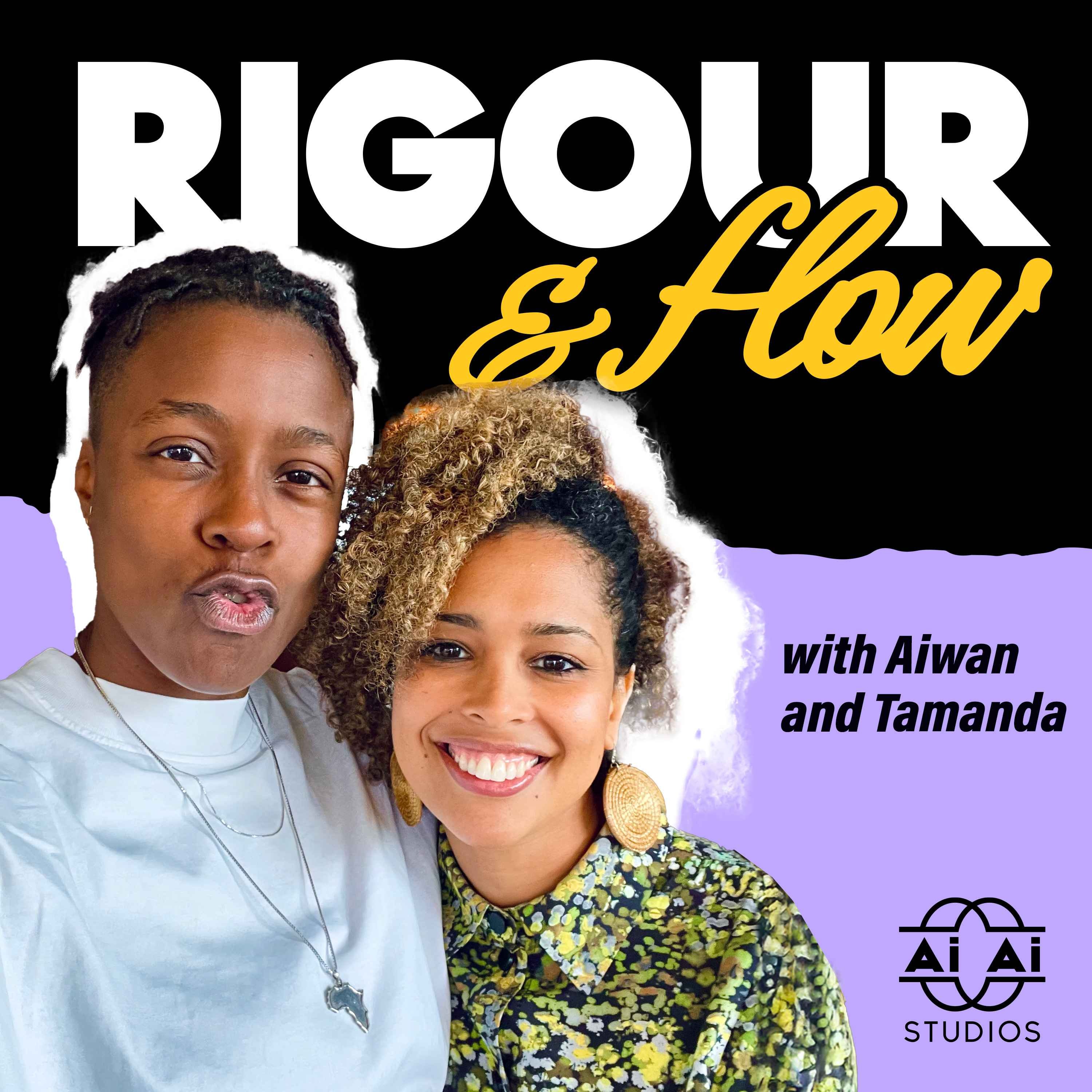
PODCAST · society
Rigour & Flow with Aiwan and Tamanda
by Rigour & Flow with Aiwan and Tamanda
The show where business meets love, and culture meets critique. We’re Aiwan and Tamanda, two Black women with 20 years each in entertainment, research, and social justice. We’re also a married couple figuring out what it means to build a life and two businesses together.We'll talk about the realities of running a business, making creative work that matters, and navigating research with integrity.What You’ll Find:Honest conversations on entrepreneurship, research, and creativity.Unpacking the intersections of business, leadership, relationships, and identity.Hot takes on media, culture, and social change.Guest insights from entrepreneurs, researchers, and artists.If you’re navigating business, love, and the messiness of life while trying to do meaningful work, you’re in the right place.Episodes drop every Tuesday! Hosted on Acast. See <a s
-
64
"I Was a Walking Illegal Human" | Growing Up Between Botswana & South Africa
"Who gets to decide who you are? And why do systems still shape who you are in the present?"In the first episode of our new Living the Archive series, we are revisiting one of the most significant and debated conversations from Rigour & Flow’s first year: "Are Mixed Race People Properly Black?"A year ago, this topic sparked a viral "storm." Our trailer reached hundreds of thousands, generating intense debate across social media and prompting hundreds of messages from listeners sharing their own experiences of identity, belonging and race across our social channels.But archives shouldn’t gather dust. As we enter Year 2, we are looking back to ask: What has changed, and what do these discussions mean now?Ahead of Nelson Mandela Day, Tamanda reflects on a recent return to South Africa for her postdoctoral research. An unexpected encounter with apartheid-era racial categories on university diversity monitoring forms reopened questions that have followed her since childhood.🎙️In this episode:The Living Archive: Why we’re revisiting our most controversial conversationsCrossing Borders: Growing up mixed race between Botswana, apartheid South Africa, and the UKApartheid’s Legacy: Why institutional systems still use apartheid era categories and racial scripts in 2026The Politics of Belonging: Deconstructing colourism, the "best of both worlds" myth, and competing ideas of Black identityThe Intimacy of Violence: The hidden impact of racism within families and intimate relationshipsWhether you're discovering this conversation for the first time or returning to it with us, this episode is an invitation to think differently about race; not as a fixed category but as an evolving story.🎧 Listen wherever you get your podcasts🎥 Watch the full episode on YouTube: https://youtu.be/wMHY_t9Z8e0🔁 Share with someone thinking about systems, power and change ☕ Want to support the show? Buy us a coffee: https://buymeacoffee.com/rigourandflow 👓 Subscribe for more critical deep-dives into history, storytelling and public scholarshipPlease rate, review and subscribe for weekly episodes.Connect with us on:TikTokInstagramLinkedInAiAi StudiosRoots & RigourThis is an AiAi Studios Production©AiAi Studios 2025 Hosted on Acast. See acast.com/privacy for more information.
-
63
They Didn’t Just Escape. They Planned It. | The Underground Railroad & Black Resistance
How do we move beyond stories of victimhood to stories of Black ingenuity and resistance?In this special summer Feedwarmer, Aiwan and Tamanda explore the power of audio storytelling to reshape how we understand Black history and agency.Aiwan pulls back the curtain on her experience producing "Escape the Underground Railroad" - the official companion podcast to Barry Jenkins’ acclaimed Amazon Prime series. And dives deep into another experience of producing the Small Axe companion podcast, to reflect on what happens when podcasting, film and historical research come together to centre Black agency rather than passive victimhood.From a surreal first meeting with Sir Steve McQueen to being "whipped into shape" by legendary executive producer Isis Thompson, Aiwan shares the steep learning curve of bringing cinematic sound design to the podcasting world.This is a conversation about who gets to write the story, the "silly games" systems play, the responsibility of telling history well, and why we must give people their flowers while they can still smell them.🎙️In this episode:The Cincinnati 28: How a group of enslaved people used the ultimate "hidden in plain sight" tactic to secure their freedom.The Power of Companion Podcasts: Why audio allows for a "deeper dive" into history than film or TV can often provide.Working with Luminaries: Insights from collaborating with Barry Jenkins and Steve McQueen.The "Rigour" of Academics: The challenge (and joy) of translating dense historical research into captivating, human-centric stories.Sonic World-Building: How artists like Lex Amor are redefining the "cinematic" sound of modern podcasting.Subscribe to our YouTube channel for more critical deep-dives into history, storytelling and public scholarship.☕ Want to support the show? Buy us a coffee: https://buymeacoffee.com/rigourandflow 🎧 Listen wherever you get your podcasts 🎥 Watch the full episode on YouTube: https://youtu.be/mFX1ccU9ErA 🔁 Share with someone thinking about systems, power and change Please rate, review and subscribe for weekly episodes.Connect with us on:TikTokInstagramLinkedInAiAi StudiosRoots & RigourThis is an AiAi Studios Production©AiAi Studios 2025 Hosted on Acast. See acast.com/privacy for more information.
-
62
Why Do We Protect Powerful Men? | Academia, Algorithms & Sexual Violence
It happened to us right here at Rigour & Flow. One of the stories we needed to tell turned out to be the one the digital world was least willing to amplify.In this Unfinished Business episode, Aiwan and Tamanda revisit some of the most powerful conversations from our Women's History Month series and ask:What happens when the systems designed to protect people end up protecting power instead?Across marriage, the law, academia and technology, this episode explores the uncomfortable reality that the systems built to protect people can sometimes end up protecting power instead. From debates around sex work and marital rape to the courage of survivors like Gisèle Pelicot and the disturbing rise of online "rape academies", we explore the cultures of silence that continue to shape how violence against women is understood, discussed and challenged. We also reflect on a fascinating conversation with Washington-based researcher Olga Naidenko about academic authority, survivor knowledge and the ethics of citation. Should influential thinkers still be treated as intellectual authorities when serious allegations of harm surround them? And who gets to decide whose voices deserve to be amplified? Along the way, we unpack the unexpected suppression of our own content by social media algorithms and what that reveals about technology, safety and the unintended consequences of platform moderation.🎙️ In this episode: The Algorithm of Silence. How social media platforms unexpectedly suppressed some of our most important conversations on violence against women - and what that reveals about digital gatekeeping.When Safety Becomes Transactional. Revisiting debates around marriage, sex work, capitalism and the blurred lines between intimacy, protection and obligation.Gisèle Pelicot and the Switching of Shame. What happens when a survivor refuses silence, chooses public accountability, and forces society to confront its own complicity.The "Do Not Cite" List. The ethical minefield of academia, intellectual authority and whether influential thinkers should remain untouchable when allegations of harm emerge.The Ethics of Looking Away. Exploring the tension between protecting a cause and confronting the harm that can exist within it.Why Do We Protect Powerful Men? Across marriage, the law, academia and technology, asking why institutions so often shield the powerful while failing the people they were designed to protect.🎧 Listen wherever you get your podcasts🎥 Watch the full episode on YouTube: https://youtu.be/CbNxG3UeFx8 🔁 Share this with someone who is tired of being dictated to by the algorithm and is ready for rigorous conversations. ☕ Support the show: https://buymeacoffee.com/rigourandflow Please rate, review and subscribe for weekly episodes.Connect with us on:TikTokInstagramLinkedInAiAi StudiosRoots & RigourThis is an AiAi Studios Production©AiAi Studios 2025 Hosted on Acast. See acast.com/privacy for more information.
-
61
Daddy's Girl, Different Worlds | A Mixed-Race Daughter's Story (Tamanda's Story)
What happens when your white father, who’s your ultimate hero, has not lived your Black reality? In part two of our fatherhood series, Tamanda shares the intensely personal story of her father. For years, he was the "encyclopaedic hero" of a "Disney-esque" childhood on a school campus in Botswana. But as the Tamanda of 11 years in age moved to the North of Ireland, the "invisible privilege" of good fatherhood met a complicated reality: a white father who, despite his love and intellectual depth, had not lived the realities of racism his Black-mixed daughter was now navigating. In this episode, we explore the "secondary wounding" that occurs when the person who represents safety is experientially removed from the systemic oppression you face - simply on account of race or ethnicity. We discuss the decades-long journey of taking a parent off their pedestal to meet the man beneath the hero you held so high in your heart and mind. And the humbling "once a man, twice a child" transition that emerges, when carer roles are eventually reversed, and your parent enters their twilight years. With our lens fixed on mixed race family dynamics, we ask: Can we keep loving someone deeply while acknowledging the ways they were unequipped to see us? How do we find our own validation when it isn’t just naturally mirrored back? 🎙️ In this episode:The Hero and The Vortex: Tamanda reflects on being the quintessential "daddy’s girl", where her every curiosity was nurtured by her father’s gentle, intellectual power.The Gap in Lived Experience: Grasping the moment a Black-mixed child realises their white parent cannot be their compass or protector for a world they have never had to navigate.The Pedestal vs. The Man: The "different kind of hard" that comes with processing grief for a living parent while moving from idealisation to a level of understanding and on to acceptance.A "Soft Place to Land": How Tamanda’s stable upbringing provided a "nervous system peace" that now anchors her and Aiwan’s marriage.Once a Man, Twice a Child: A raw look at the "privilege of giving back" through caregiving and the power of a final, imperfect validation in the twilight years.🎧 Listen wherever you get your podcasts🎥 Watch the full episode on YouTube: https://youtu.be/NJ1NRqh1CXA🔁 Share this with someone who is navigating the "different kind of hard" that comes with taking a parent off their pedestal and learning to love the human beneath.☕ Support the show: https://buymeacoffee.com/rigourandflowPlease rate, review and subscribe for weekly episodes.Connect with us on:TikTokInstagramLinkedInAiAi StudiosRoots & RigourThis is an AiAi Studios Production©AiAi Studios 2025 Hosted on Acast. See acast.com/privacy for more information.
-
60
“When I Called, They Never Answered” | Fathers, Faith & Disappointment
In this deeply personal episode, Aiwan shares the "three goes" she had at fatherhood and why all of them failed her. From a biological father known only through fragments, to a step-parenting experience defined by high control religion and mushrooms growing out of tower-block walls, Aiwan and Tamanda peel back the layers of what happens when the "protector" figure is absent, abusive or conditional. Together we dive into the complex world of Nigerian Pentecostal "Spiritual Fathers" and the moment a violent sermon in 2014 forced Aiwan to choose between her faith and her humanity. As she left home and chose homelessness to keep her self-worth intact. But this isn't just a story of absence. It’s a conversation about reclaiming the "missing story" and redefining what it means to be meaningfully present as a parent. Aiwan describes the father she never had, the caregiver dads she imagines for the next generation, and how her own experiences shape her own thinking about raising a child herself one day. 🎙️ In this episode:Status and Absent Fathers: How growing up fatherless on a council estate impacts a child’s sense of protectionThe Myth of the Presence: Why having multiple "father figures" can sometimes feel lonelier than having none at allThe Spiritual "Daddy": The power dynamics of the Nigerian Pentecostal church and the moment Aiwan left it all behindBreaking the Cycle: The intellectual and emotional work of building a parenting blueprint from scratchSaluting Dope Black Dads: A celebration of the Black fathers counteracting stereotypes with "soft discipline" and intentional love 🎥 Watch the full episode on YouTube: https://youtu.be/6dRWI1PWnBc🎧 Listen wherever you get your podcasts🔁 Share this episode with someone healing their inner child or a father figure who understands that presence is the greatest gift of all.☕ Support the show: https://buymeacoffee.com/rigourandflowPlease rate, review and subscribe for weekly episodes.Connect with us on:TikTokInstagramLinkedInAiAi StudiosRoots & RigourThis is an AiAi Studios Production©AiAi Studios 2025 Hosted on Acast. See acast.com/privacy for more information.
-
59
Whose Equality? | Reform, DEI and the Post-BLM Backlash
DEI is under attack. But what exactly is being defended? We take on the three letters that have become everything from a flagellant workplace promise, to an impotent political punchline. We get into Reform UK’s proposal to scrap the Equality Act, the backlash against diversity, equity and inclusion, and the class conversation that keeps being used as a wedge instead of a route to solidarity. Tamanda explains what the Equality Act and Public Sector Equality Duty actually do, why the Bank of England internship controversy became such a political flashpoint, and why class and socioeconomic status need to be part of any serious conversation about equality. Aiwan reflects on the creative industries after BLM, the realities of being treated like a quota, and why marginalised creatives do not need endless “emerging talent” schemes as much as they need infrastructure, commissioning, fair pay and real backing. Together, we ask: What happened to DEI? How did radical struggles for justice become corporate diversity awards, PR statements, bureaucratic documents and business-case language? And can DEI ever be reclaimed if it cannot talk honestly about race, class and power? 🎙️ In this episode:Reform and the Equality Act: What the proposal to scrap the Act reveals about race, class and political dog whistlesTokenisation vs. Transformation: Aiwan shares her personal experiences of being "box-ticked" by white-led companies during the BLM era and the "disheartening dehumanisation" of being instrumentalised for PRThe Missing Class Link: Why the exclusion of socioeconomic status from the Equality Act allows elites to use "divide and conquer" tactics to keep marginalised groups at oddsThe Language of Distraction: A look at the ever-shifting terminology, from "BAME" to "Global Majority" and whether this towering "Babel" of acronyms prevents us from facing systemic racism head-onRadical Histories & What DEI Should Become: Remembering the legacy of warriors like Doreen Lawrence and the McPherson report, and why we must restore DEI as a moral and ethical imperative 🎧 Listen wherever you get your podcasts🎥 Watch the full episode on YouTube: https://youtu.be/Y2-pmW9WwV0 ☕ Support the show: https://buymeacoffee.com/rigourandflow🔁 Share this episode with someone ready to move beyond the "business case" and toward actual justicePlease rate, review and subscribe for weekly episodes.Connect with us on:TikTokInstagramLinkedInAiAi StudiosRoots & RigourThis is an AiAi Studios Production©AiAi Studios 2025 Hosted on Acast. See acast.com/privacy for more information.
-
58
Hard to Reach or Easy to Ignore? | The Truth About Community Research, Anger & Power
Why do we let 'experts' from outside our communities decide what we need? Today, we’re talking about the politics of help, the myth of the 'hard to reach' and why genuinely community-led research has the potential to solve global crises like suicide and inequality. From Black maternal health to Black men’s mental health, in this episode Aiwan and Tamanda explore what could happen when money, power and agency move directly into the hands of communities. When communities set the agenda, choose the questions, shape the process and decide what counts as change. Aiwan reflects on entering Tamanda’s research world, being baffled by its language and slowly realising that terms like “participatory action research”, “community engagement” and “co-production” point to a pivotal question: who gets to decide what matters and what change is needed? From there, the episode moves into the anger that surfaces when communities recognise how often they have been studied, used, consulted, underpaid and discarded. Aiwan speaks honestly about the fury of realising how often “help” is designed without the people it is meant to serve. Tamanda unpacks why this anger is not a distraction from the research, but part of the process of knowledge production. Together, they explore the difference between research that extracts and research that heals. 🎙️ In this episode:Beyond the Buzzwords: Stripping away research jargon to understand the truthsThe Extraction Economy: How communities have been "used and discarded" by traditional research institutionsResearch and Community Agency: What happens when we stop being the "subject" and start being the "architect"Setting the Agenda: Why the "most important problem" shouldn't be decided upstream by strangersRelational Research: Why connection is the only real antidote to a disconnected worldFrom Local to Global: How community-led insights can fix our hyper-connected but deeply fractured and unequal world 🎧 Listen wherever you get your podcasts🎥 Watch the full episode on YouTube: https://youtu.be/7f5vKA-hYNQ🔁 Share with someone who believes communities should lead the change that affects them☕ Support the show: https://buymeacoffee.com/rigourandflowPlease rate, review and subscribe for weekly episodes.Connect with us on:TikTokInstagramLinkedInAiAi StudiosRoots & RigourThis is an AiAi Studios Production©AiAi Studios 2025 Hosted on Acast. See acast.com/privacy for more information.
-
57
The Dark Side of Activism: Why Our Safe Spaces Turn Toxic
What happens when the oppressed become the oppressor? In this episode, taking inspiration from an article by Dr Yvon Guest, Aiwan and Tamanda pull back the curtain on the concept of the "wounded activist”, a phenomenon where unresolved trauma drives social movements, often leading to the very oppression, hierarchy and exclusion we claim to fight. From the "untouchable founder" to "brand activism", we reflect on justice spaces we’ve been in that felt like fundamentalist religions and explore how to understand and break the cycles of trauma-driven bad behaviour. Aiwan shares about entering Black queer activist spaces with hope, only to find new rules, "pronoun politics" and exclusion. From vegan safe spaces to the murky line of “no hierarchy”, she traces the ways community can quickly turn into conformity. Tamanda brings the conversation inward, questioning her own journey in antiracism and Diversity, Equity and Inclusion (DEI) work. She takes a vulnerable look at her historical need for recognition from white institutions and the identity collapse that happened when she realised no movement could heal her wounds. That she had to do that work herself. 🎙️ In this episode:The Wounded Activist: How trauma can become both fuel and fracture in justice workThe Oppressed as Oppressor: How marginalised spaces can recreate the hierarchies they hateActivist Archetypes: Identifying the “Spiritualisers”, “Perpetual Martyrs” and “Untouchable Founders”Class Silence in Black Queer Spaces: What gets hidden when everyone performs samenessBurnout and Identity Crisis: Who are you when activism is no longer your whole self?Healing the Core Wound: How come activists die young and how to break the destructive cycle Note: This is not an anti-activism episode. It is a conversation about what happens when people carry their wounds into spaces that promise belonging, then reproduce the same control, hierarchy and judgement we were all trying to escape. 🎧 Listen wherever you get your podcasts🎥 Watch the full episode on YouTube: https://youtu.be/tmYBzXCMWYo🔁 Share with someone who has ever loved a movement, left a movement or been hurt by one☕ Support the show: https://buymeacoffee.com/rigourandflow#RigourAndFlow #WoundedActivist #PsychologyOfActivism #ActivistBurnout #SocialJusticeAnalysis #DEICritique #BlackQueerThought #CriticalThinking #TraumaInCommunity #SocialMovementsPlease rate, review and subscribe for weekly episodes.Connect with us on:TikTokInstagramLinkedInAiAi StudiosRoots & RigourThis is an AiAi Studios Production©AiAi Studios 2025 Hosted on Acast. See acast.com/privacy for more information.
-
56
Policed by Design: Why Your Neighbourhood Feels Like a Prison
Have you ever looked at your own neighbourhood and felt like you weren’t actually meant to be there? In this episode, Aiwan and Tamanda reveal that it’s not in your head. It’s in the blueprints. We dive into the sobering reality that communities are increasingly under surveillance, including how the Metropolitan Police are far more directly involved in the architecture of homes, schools and playgrounds than we might ever imagine. With memories of the Meridian Estate and the "prison-like" Ferrier Estate, Aiwan explains how our built environment is designed to infantilise us, and why the antidote is teaching the "structure of local politics" from a young age. We explore the possibility of training the next generation of architects directly from the community, so the people designing estates are the same people who call them home. The same people who live, breathe and feel their realities. Finally, we move beyond the critique of hostile architecture to ask how we take our power back from these structures of control. Tamanda brings in Amahra Spence’s work on "architectures of abolition" - plus learnings from some recent work with The Ubele Initiative - which remind us that safety isn't simply the absence and prevention of crime, but the presence of care, dignity and collective agency. From Northumberland Park and the shadows of Tottenham Hotspur Stadium to the sterile playgrounds of modern social housing, this is a conversation about race, class and the radical act of reclaiming our agency through architecture that reflects that its communities have been heard.🎙️ In this episode:The Met as Architect: How police influence the design of our "securitised" streetsThe Southwark Pergola: A case study in how "security" logic destroys community’s sense of safetyThe Technology of Power: Why buildings, barriers and shutters are never neutralArchitecture from the Ground Up: Why the kids on the estate should be the ones designing its futureAgency as a Basic Right: Why every living thing needs control over its environmentThe Power of the Mass: Why collective agency is the only way to "reclaim and rebuild the block" 🎧 Listen wherever you get your podcasts🎥 Watch the full episode on YouTube: https://youtu.be/rsv0XzIrFp0🔁 Share with someone thinking about housing, class or the places that shaped them☕ Support the show: https://buymeacoffee.com/rigourandflow#RigourAndFlow #SpatialJustice #UrbanDesign #PoliceByDesign #LondonHousing #SocialHousing #Architecture #AmahraSpencePlease rate, review and subscribe for weekly episodes.Connect with us on:TikTokInstagramLinkedInAiAi StudiosRoots & RigourThis is an AiAi Studios Production©AiAi Studios 2025 Hosted on Acast. See acast.com/privacy for more information.
-
55
WTF Happened to Body Positivity? | The Rise of the Ozempic Aesthetic
Is body positivity dead in the wake of Ozempic? We're exploring how weight loss culture and the 'heroin chic' aesthetic are making a high-speed comeback under the guise of medical wellness. ☕ Support the show: www.buymeacoffee.com/rigourandflow With this being Mental Health Awareness week, we couldn’t think of a better time to put the spotlight on one of the most overlooked mental health conditions in the Black community. As just six months ago, body positivity felt like a permanent cultural shift and today, the landscape has changed. People are "shrinking" overnight. In response, Aiwan and Tamanda interrogate the radical shift in weight loss culture in 2026. From the medicalisation of weight loss using a “miracle” drug to the normalisation of "shrinking," we unpack how quickly the conversation has shifted back toward unhealthy control. We deep dive into how so called “wellness” language - and even medical terminology - is being used to mask aesthetic pressure and the impact of diet culture on Black body image. Drawing on her personal experience with eating disorders and recovery, Tamanda reflects on the unsettling "seduction" of these new drugs, and what this shift means for a generation of teenagers watching people dwindle in real-time. 🎙️ In this episode:The Rise and Retreat: How body positivity moved from a cultural force to a quiet disappearanceThe Ozempic Effect: The medicalisation of weight loss and the normalisation of "shrinking"Wellness or Control?: Decoding how "health" language is being used to mask aesthetic pressureRace and Body Politics: How Black bodies sit differently inside cycles of visibility, pressure, and desirabilityChasing Capitalism: Why the system needs our bodies to remain "projects" that need fixingWatching in Real Time: What this shift means for teenagers growing up inside itSubscribe for more critical deep-dives into power, class and the Black experience. 🎧 Listen wherever you get your podcasts 🎥 Watch the full episode on YouTube: https://youtu.be/g-yUKuuTSCU 🔁 Share with someone thinking about what “health” and “beauty” mean today.Please rate, review and subscribe for weekly episodes.Connect with us on:TikTokInstagramLinkedInAiAi StudiosRoots & RigourThis is an AiAi Studios Production©AiAi Studios 2025 Hosted on Acast. See acast.com/privacy for more information.
-
54
92% of England’s Land is Inaccessible | Are You As Free As You Think?
92% of England is off-limits to the public. And 50% of the land is owned by 1% of the population. Most people in Britain believe they are free. But are we really? Episode description and notes: In this episode of Rigour & Flow, we move between the personal and the structural to interrogate land ownership in Britain today. We start with the film 'Our Land' and its exploration of the politics of walking, before widening the lens to connect British land estates to global colonial histories. Touching on the Right to Roam movement and contrasting rights of passage in Scotland vs. England, we ask: what does it mean to live in a country where you are legally a trespasser on most of the land? This conversation is not just about countryside access or a "nice walk". It is about who is allowed to belong, how colonial logic reorganised itself into modern property law, and how community wealth building is being systematically stalled. 🎙️ In this episode: Landing British Realism: The myth of freedom in a country where 92% of land is inaccessible.The Right to Roam: The radical differences between Scotland and England and what they reveal about power.Colonialism at Home: How 1% owning 50% determines class, control and belonging in the British countryside.Indigeneity and Erasure: Why Western societies do not see themselves as indigenous and the discursive moves that separate us.Community Wealth Building: Why land ownership is the centre of long-term Black community security and survival. Subscribe for more critical deep-dives into power, class and the Black experience.🎧 Listen wherever you get your podcasts 🎥 Watch the full episode on YouTube: https://youtu.be/SQUH9YPO6Lo🔁 Share with someone thinking about land, freedom or belonging☕ Support the show: https://buymeacoffee.com/rigourandflow Please rate, review and subscribe for weekly episodes.Connect with us on:TikTokInstagramLinkedInAiAi StudiosRoots & RigourThis is an AiAi Studios Production©AiAi Studios 2025 Hosted on Acast. See acast.com/privacy for more information.
-
53
95% of Doctors Who Died Were Black | Why Was This Not a National Scandal?
95% of doctors who died during COVID-19 were Black and racially minoritised. And at the height of the pandemic, while making up only 14% of the population, Black and minoritised communities accounted for 63% of all healthcare worker deaths. Why was the risk so unevenly distributed? It’s time to stop sitting with the numbers and shift the stakes. In this Feedwarmer edition, Tamanda and Aiwan revisit a 2021 conversation to dismantle the deep-seated racial disparities in UK healthcare. Featuring Rianna Raymond-Williams (Ree Speaks) and Michael Hamilton (The Ubele Initiative), we explore how youth-led organising like the "We Need Answers" campaign forced accountability onto the national agenda. From public health activism to the deeper architecture of systems change, we ask: Who is protected? Who is exposed? And what must happen now? 🎙️ In this episode:The 95% Reality: What COVID-19 revealed about racial inequality in the UKThe Frontline Cover Up: Why black and racially minorised doctors were sent to the frontline over their white colleagues and what this reveals about a lack of institutional safetyWe Need Answers: The power of youth-led organising and how it put accountability onto the agendaUnhealthy Structural Racism: What could happen when data confirms what communities already know?Moving up the “Funding Food Chain”: Why black organisations must shift from "firefighting" on small, unpredictable grants to controlling large-scale institutional capital 🎧 Listen wherever you get your podcasts 🎥 Watch the full episode on YouTube: https://youtu.be/L5WdH5NZiIA🔁 Share with someone thinking about systems, power and change ☕ Want to support the show? Buy us a coffee: https://buymeacoffee.com/rigourandflow Subscribe for more critical deep-dives into power, class and the Black experience. And be ready for the launch of Season 5 next week! Please rate, review and subscribe for weekly episodes.Connect with us on:TikTokInstagramLinkedInAiAi StudiosRoots & RigourThis is an AiAi Studios Production©AiAi Studios 2025 Hosted on Acast. See acast.com/privacy for more information.
-
52
The Future of Rigour & Flow: Seasonal Shifts and Personal Reflections
Rigour & Flow is evolving. After a full year of weekly episodes, we are moving to a Seasonal rhythm starting with Season 5 this May.In this intimate update, we reflect on our first year through the lens of Chimamanda Ngozi Adichie’s Dream Count and our own personal Easter Monday reflections. We’re sharing the "why" behind our move to seasons, what the data from Year 1 told us, and a preview of the incredible conversations we’ve already recorded for the new season. Stay tuned for a feedwarmer coming soon!🎧 Listen wherever you get your podcasts🎥 Watch the full episode on YouTube: https://youtu.be/KCuL_ALYTsA 🔁 Share with someone trying to build something that lasts ☕ Want to support the show? Buy us a coffee: https://buymeacoffee.com/rigourandflow Please rate, review and subscribe for weekly episodes.Connect with us on:TikTokInstagramLinkedInAiAi StudiosRoots & RigourThis is an AiAi Studios Production©AiAi Studios 2025 Hosted on Acast. See acast.com/privacy for more information.
-
51
Podcasting Is Easy… Until You Try It | Learnings From One Year of Rigour & Flow
Everyone has a podcast. But very few people sustain one.In this final episode of Season 4, we mark one year of Rigour & Flow - a milestone that feels both significant and, at times, improbable. Because behind the weekly releases, the conversations and the growth, there have also been moments of doubt, exhaustion, and the very real question of whether we could keep going.We reflect on what it actually takes to build and sustain an independent podcast. Not just creatively, but emotionally, relationally and practically. This takes us back to the beginning: the original names we nearly chose, the friend who thankfully stopped us being ‘Ditsy Wise’, the poll that pointed us one way, the reality check that forced us another, and the emergence of ‘Rigour & Flow’ as the title that could hold the tension between depth and levity, critique and ease, research and culture. We talk about how the show has changed us. Aiwan speaks about getting to understand, from the inside, what clients go through when they try to make podcasting sustainable. Tamanda reflects on how hosting has expanded her sense of identity, raising new questions about research, knowledge, public thought, and the blurred line between scholar and public intellectual. Finally, we look back at the first year of the show itself: 52 episodes, platform features, awards, global listeners, growing audience connection, the first signs of monetisation, and the reality that sustainability has to become the next serious conversation if the show is to keep evolving. 🎙️ In this episode:One year is no small thing: Why sustaining a weekly podcast matters more than simply launching oneThe podcasting apocalypse horsewomen: Burnout, time and despair as real threats to creative consistencyThe names before the name: From Ditsy Wise to In Tandem to Rigour & FlowFrom producer to podcaster: What Aiwan learned by living what clients faceResearch in real time: Tamanda on audience, interpretation and the question of public intellectual workThe archive before the show: How relationship video diaries became the seedbed of the podcastWhat the show has changed in us: Podcasting, identity and becoming ourselves in publicMarking the journey: Apple features, awards, global listeners and building from zeroSustainability and the future: What has to change if independent podcasting is going to endure 🎧 Listen wherever you get your podcasts 🎥 Watch the full episode on YouTube: https://youtu.be/7kq4dvcwNMw🔁 Share with someone trying to build something that lasts ☕ Want to support the show? Buy us a coffee: https://buymeacoffee.com/rigourandflow Please rate, review and subscribe for weekly episodes.Connect with us on:TikTokInstagramLinkedInAiAi StudiosRoots & RigourThis is an AiAi Studios Production©AiAi Studios 2025 Hosted on Acast. See acast.com/privacy for more information.
-
50
Can You Trust Podcasts? | Power, Women & the Manosphere
Podcasting is shaping politics. But who controls the mic and who gets left out? In this episode, we turn the mic on the podcasting industry itself. We start with Aiwan’s journey into podcasting, from the early iTunes and RSS era to producing shows professionally and use that to ask what makes podcasting so different from film, television and music. What emerges is a picture of a medium that still feels young, unstable and oddly opaque: open source, easy to access, but thin on shared standards, reliable metrics and real accountability. From there, we get into the politics of measurement, or the lack of it. We unpack the confusion around downloads, plays, streams and influence, and why podcasting can still feel full of smoke, mirrors and unverifiable claims. We also look at Spotify’s move to make play counts visible and what that revealed about hype, visibility and the pressures facing indie creators. We then move to one of the episode’s sharpest concerns: podcasting as a site of power. From the Steven Bartlett health misinformation controversy to the underrepresentation of women - and especially Black women - across major podcast ecosystems, we ask: who gets to dominate the mic, whose voices get amplified, and who still gets left out? Finally, we turn more directly to big ‘P’ of politics. We reflect on the so-called “podcast election”, the rise of right-leaning media ecosystems, and the way entertainment formats now carry ideology far beyond formal news spaces. Beneath all of this sits the major challenge: if podcasting is helping shape the future, who is building that future through sound, story and representation? And what responsibility comes with having listeners, however many they may be? 🎙️ In this episode:Origin stories and RSS feeds: How podcasting began, and how Aiwan found her way into the mediumThe Wild West problem: Why podcasting still feels under-regulated, opaque and structurally immatureMetrics or mythological claims?: Downloads, plays, streams and the absence of shared industry standardsSmoke and mirrors: Why podcasting can be easy to hype and hard to verifyMisinformation on mic: What the Steven Bartlett controversy reveals about health claims, platform power and mis and disinformationWho dominates the mic?: Gender, race, class and the myth of podcasting as a democratised mediumThe podcast election: How entertainment formats increasingly shape political discourseRight-wing media ecosystems: Why the best-funded voices often dominate culture through repetition and reachResponsibility and risk: What Rigour and Flow means when you are speaking into public life in real-time 🎧 Listen wherever you get your podcasts 🎥 Watch the full episode on YouTube: https://youtu.be/f3owORRx3BY🔁 Share with someone thinking about media, politics and who gets to shape public conversation ☕ Want to support the show? Buy us a coffee: https://buymeacoffee.com/rigourandflow Please rate, review and subscribe for weekly episodes.Connect with us on:TikTokInstagramLinkedInAiAi StudiosRoots & RigourThis is an AiAi Studios Production©AiAi Studios 2025 Hosted on Acast. See acast.com/privacy for more information.
-
49
Is Marriage Sex Work? | Power, Morality & the Myth of Respectability
From sex work in Georgian England to modern debates on marriage, consent and criminalisation, this episode of Rigour & Flow focuses on women’s perspectives on power, survival and who gets to define respectability. We start by discussing the historical drama Harlots, a series set in 18th-century London that centres the lives of women working in the sex trade. Written by women, the show offers a refreshing lens on the world’s “oldest profession.” Instead of caricatures or moral judgement, we see the economic realities, survival strategies and brutal power dynamics shaping women’s lives. Our behind-the-scenes conversation evolves to consider what happens when women control the narrative. When the story is told from a woman’s experience, the hypocrisy of power becomes harder to ignore. In this case, the series depicts men not as romantic heroes but as unrefined figures of entitlement and violence. From there, we move beyond the show. Exploring the politics of sex work today, the consequences of criminalising sex work, and some unconsidered parallels between sex work and marriage as historical economic transactions. religion, law and survival as we draw attention to the structures and hierarchies societies build around sex and sex work. Finally, the episode then turns personal. As Aiwan and Tamanda reflect on their own perspectives on sex work, the sociology behind it and why an 18th-century dominatrix in Harlots - who flips the power dynamic entirely - represents a radically different form of agency for women. Underneath the humour and cultural critique runs the question: What exactly is sex work and what does it tell us about women’s lives today? 🎙️ In this episode:Women holding the pen: Why Harlots tells a truer story of women’s livesNo heroes here: What women-centred storytelling exposes about male power and hypocrisySurvival for sale: Sex work, status and the brutal economics of being a woman in Georgian EnglandWhen payment becomes permission: Consent, coercion and the fiction of contractual sexHoly performance: Religion, shame and Florence’s use of faith as shield and strategyMarriage as transaction: Why the line between wifehood and sex work is not as neat as we pretendMurky power: Secrets, brothels and the influence women hold inside patriarchal systemsWhips, wit and reversal: Nancy Birch and the seductive idea of women turning power back on men 🎧 Listen wherever you get your podcasts 🎥 Watch the full episode on YouTube: https://youtu.be/ivPBaWFO4sE🔁 Share with someone interested in culture, feminism and social powerPlease rate, review and subscribe for weekly episodes.Connect with us on:TikTokInstagramLinkedInAiAi StudiosRoots & RigourThis is an AiAi Studios Production©AiAi Studios 2025 Hosted on Acast. See acast.com/privacy for more information.
-
48
Would You Want to Live in a Matriarchy? | Power, Authority & The Crisis of Imagination
It’s International Women’s Month. So what better time to ask: what would society look like if women were truly prioritised? In this week’s episode of Rigour & Flow, we explore the idea of matriarchy - not as a fantasy of female domination, but as a thought experiment about power, care and social priorities. We begin with the plot of a recent series we watched: ‘The Power’. Teenage girls develop the ability to emit electric shocks. “Everything is getting zapped.” Overnight, hierarchies destabilise. Power shifts. Fear shifts. But is that a matriarchy? Or simply patriarchy reversed? Very quickly, we realise the term itself needs unpacking. Matriarchal. Matrilineal. Matrifocal. Gynarchy. Some anthropologists argue that matriarchies have never existed in any strict sense. While others point to examples across the globe. The conversation moves between theory and lived experience. Women-only spaces. Academic retreats. AiAi Studios as a women-led business. We ask what might change if women were truly prioritised. If sanitary care were not taxed. If maternal mortality were treated as urgent. If research into fibroids and endometriosis were as widely understood as space exploration. At one point, we name it exactly as we see it: we have been bamboozled by patriarchy. If power has always looked like domination, can we even imagine a world organised differently? In response, we examine communities often labelled matriarchal, such as the Umoja village in Kenya. We then consider female politicians in the UK, and ask whether representation alone transforms structures. Underneath the debate lurks a blunt question. Is the fear of matriarchy really fear of women ruling, or fear of men no longer being centred? This episode interrogates how power is defined, who is prioritised, and whether we are capable of imagining structural change without defaulting to ineffective reversal. 🎙️ In this episode:Patriarchy flipped or structural shift: Why female domination is not the same as systemic transformationMatriarchy, matrilineal, matrifocal: Untangling definitions often collapsed into one wordCentred vs accommodated: What changes when women are prioritised rather than simply includedThe knowledge gap exposed: Fibroids and maternal mortality versus the Hubble telescope and dark matterWomen-only spaces under the microscope: Church fellowships, academic retreats and the experience of being centredRepresentation without restructuring: Why female Prime Ministers do not automatically dismantle patriarchyUmoja and other women-led communities: Survival, refuge and the limits of the “matriarchy” labelThe imagination gap: Whether discomfort with matriarchy is really discomfort with decentring men 🎧 Listen wherever you get your podcasts 🎥 Watch the full episode on YouTube: https://youtu.be/yi1qn3gBJQI🔁 Share with someone thinking about power, gender and the systems we live inside ☕ Want to support the show? Buy us a coffee: https://buymeacoffee.com/rigourandflow Please rate, review and subscribe for weekly episodes.Connect with us on:TikTokInstagramLinkedInAiAi StudiosRoots & RigourThis is an AiAi Studios Production©AiAi Studios 2025 Hosted on Acast. See acast.com/privacy for more information.
-
47
Was I the Toxic Friend? | Adult Friendship & Accountability
Last week, we told the story of friendship rupture. But what happens when the mirror turns around?In Part 2 of our adult friendship series, we step into uncomfortable territory: the moments where we may have been the difficult one. The one who ghosted. The one who didn’t communicate. The one who hurt someone we loved. This episode moves beyond betrayal and jealousy to something quieter and harder - accountability.We begin with conditioning. Aiwan reflects on growing up in a high-control Pentecostal Nigerian church community, where friendship came with warnings: Do not be unequally yoked. Friends were for saving. Held lightly. Guarded. No birthday parties. No Christmas gifts. No sleepovers.We get into the charged territory of ghosting. Referencing therapist Nedra Glover Tawwab, we ask: Are people allowed to leave relationships without explanation? Is ghosting immaturity or sometimes necessary discernment? Tamanda confesses her core toxic trait: “When I’m done, I’m done.”We then revisit the “broken bone” analogy from last week’s episode. Once trust fractures, even if repaired, will it ever land the same way again? Finally, we answer the question many of us avoid: Was I the problem? As we know now, adult friendships are not low stakes. They are spaces of learning, ego confrontation, grief and growth. And we acknowledge that the deepest maturity is not just knowing when to leave but knowing when to look at yourself. 🎙️ In this episode:Inherited friendship scripts: How religious control, family trauma and “unequally yoked” theology shape adult relationshipsAdolescent betrayal under the lens: When low self-esteem, displacement and the hunger for validation override loyaltyToxic or traumatised: Distinguishing character flaw from unprocessed survival strategyGrace in the aftermath: The gift of friends who allow you to grow beyond your worst momentBoundaries or avoidance: When “I’m done” is clarity and when it is emotional evasionThe slow friendship fade: Ghosting, disengagement and the message of silenceFracture and load-bearing trust: Why repaired relationships rarely carry weight the same way againNarrative humility: Asking how the friend you lost would tell the story of youIntentionality as practice: Wanting to be a better friend in a life already stretched thin 🎧 Listen wherever you get your podcasts🎥 Watch the full episode on YouTube: https://youtu.be/Oi2ID23STvg 🔁 Share with someone navigating friendship tension, repair or release.☕ Want to support the show? Buy us a coffee: https://buymeacoffee.com/rigourandflow Please rate, review and subscribe for weekly episodes.Connect with us on:TikTokInstagramLinkedInAiAi StudiosRoots & RigourThis is an AiAi Studios Production©AiAi Studios 2025 Hosted on Acast. See acast.com/privacy for more information.
-
46
When Your Best Friend Resents You | Adult Friendship & Jealousy
Where do you stand on choosing to fix a failing friendship, or deciding to let it go? Adult friendships are supposed to be the easy relationships. No shared mortgage. No in-laws. No vows. Why then can they break you in ways that feel like such a fundamental failure? In this episode of Rigour & Flow, we open a conversation that surprised us both. Using a provocation from Lovette Jallow on friendship breakups and “outgrowing” people, we ask whether growth always calls for departure, or whether sometimes we lack the skills to repair what ruptured. We start with joy. Childhood friendships. Estate windows facing each other. Writing and recording songs onto cassette decks. The best friends who became family when there was no family. The friend groups that shaped us. The boarding school betrayals that undid us. The adult friendships that finally felt chosen, reciprocal and real. Then we recount the ruptures. What happens when envy enters a friendship? When a friend falls in love with you? When your growth feels like their loss? Aiwan shares about the devastating breakdown of a 20-year friendship. She takes us through the triggers that tore it apart: Jealousy. Resentment. One-sided romantic feelings, disclosed despite an existing relationship. Attempts at repair. Boundaries set. And then the slow and painful realisation that some friendships could not hold the fullness of who she was becoming on her journey. What do you do with such difficult dynamics? We examine how fixing a friendship in this bind may be attempted, but sometimes trust no longer feels intact. And we get deep into the discussion of the trickiest dilemmas: Can you have friendships when someone feels romantic attraction? And is “outgrowing” someone simply growth, or merely avoidance in disguise? 🎙️ In this episode:Chosen “family” & early belonging: Estate windows, cassette tapes, and the friendships that felt like home when home was unstableFriendship as “low stakes” myth: Why we treat romance and family as therapy-worthy, but sideline friendship rupturesMoments of envy: What happens when someone cannot celebrate your wins and finally says, “I was jealous of you.”When attraction destabilises friendship: Queerness, blurred lines and the shock of a foundation shiftingGrowth vs abandonment: Realising that your becoming feels like their lossSetting boundaries in conversation: Accountability, difficult questions and the refusal to stay in ambiguityBoundaries as safety: Aiwan’s “broken bone theory” and the (im)possibility of repair after rupture Outgrowing or avoiding?: Exploring the difference between emotional maturity and ego protection This is Part 1 of our exploration into adult friendships and friend breakups. In Part 2, we will be doing more self-introspection and asking if or when we’ve ever been the toxic friend! 👀 Stay tuned. 🎧 Listen wherever you get your podcasts🎥 Watch the full episode on YouTube: https://youtu.be/ceGb5I53gZk 🔁 Share with someone who has ever felt the grief of losing a friend ☕ Want to support the show? Buy us a coffee: https://buymeacoffee.com/rigourandflow Please rate, review and subscribe for weekly episodes.Connect with us on:TikTokInstagramLinkedInAiAi StudiosRoots & RigourThis is an AiAi Studios Production©AiAi Studios 2025 Hosted on Acast. See acast.com/privacy for more information.
-
45
Silence and Shame: Sexual Violence and the Institutions that Protect It
Many of us learned very young that sexual violence is “unsayable”. That naming it has consequences. In turn, sexual violence remains endemic, sustained by the silent treatment it is given, and by a society that tolerates such an insatiable appetite for violence without accountability. In this episode, we step into terrains of this damaging silence and ask who it protects, who it punishes, and what it costs to speak out. We begin with memory. Tamanda reflects on the moment she first encountered the word “rape” as a child, and the shock of being told never to say the word again. We trace how “unsayability” becomes culture - how silence is taught, reinforced and often rewarded by wider society. We examine the instinctive disbelief that greets disclosures of abuse, and the psychological defences that surface when believing someone would require us to confront our own histories. Then we take the fight for justice to institutions. Universities. Creative industries. And justice systems. We explore what happens when belief demands action, and action threatens power. Why do institutions so often choose disbelief? Why does position protect perpetrators? How do cultures of silence become entrenched through complicity? Tamanda reflects on navigating sexual misconduct within academic spaces, including the bind of having to cite known perpetrators to move through the system’s assessment hoops. Aiwan examines how the entertainment industry reproduces similar dynamics through scarcity, blurred boundaries and informal power - creating what she calls a “Bermuda triangle” of silence. We move on to whisper networks. The informal, often women-led circuits of protection that emerge when formal systems repeatedly fail. Discussing their necessity, their limits, and what they reveal about institutional trust. Throughout, we hold to one principle: safety before testimony. Even in cases where justice is achieved, the process itself can be devastating. With that in mind, we ask: What do survivors truly owe the world? And do unsafe systems deserve our disclosure at all? In closing, we return to the personal and the practical. To therapy. To allies. To gauging risk. To the hope that even making sense of one’s own experience is a step toward protection. This is not an episode about individual villains or public scandal. It is about structures. Rather than offering prescriptions or calls to disclosure, we sit with a more difficult truth: that silence is sometimes imposed, sometimes chosen, and sometimes the only viable survival strategy available. ⚠️ Content note: This episode contains discussion of sexual violence, abuse of power and institutional harm. Please take care while listening. 🎙️ In this episode:Unsayable from the start: How childhood silence around sexual violence shapes adult speech and shameDisbelief as defence: Why the first response to disclosure is often “But do you believe her?”Silence by design: How institutions teach, reinforce and reward quiet complicityBelief and consequence: Why institutions choose disbelief when belief would demand actionThe Bermuda Triangle of survival: Small industries, reputational risks and the cost of speaking upWhisper networks explained: How informal systems of warning emerge when formal systems failAcademic entanglement: Citing scholars accused of harm and the structural bind of professional survivalMen and masculinity: Why patriarchy makes male disclosure uniquely difficultSafety before testimony: Why getting to safe matters more than satisfying institutional narrativesFinding allies and resources: From therapy to the 1752 Group and survivor-led protection networks🎧 Listen wherever you get your podcasts🎥 Watch the full episode on YouTube: https://youtu.be/D3cqvxgI0-o🔁 Share with someone navigating institutional silencing and safety ☕ Want to support the show? Buy us a coffee: https://buymeacoffee.com/rigourandflow Please rate, review and subscribe for weekly episodes.Connect with us on:TikTokInstagramLinkedInAiAi StudiosRoots & RigourThis is an AiAi Studios Production©AiAi Studios 2025 Hosted on Acast. See acast.com/privacy for more information.
-
44
Why Do Institutions Protect Perpetrators Over Survivors? | Whistleblowing & Power
Whistleblowing is often framed as an act of courage. But in practice, it is more often met with punishment, isolation and quiet retaliation.In this episode of Rigour & Flow, we examine what actually happens when people tell the truth inside institutions that claim to value transparency, ethics and accountability.Drawing on lived experience, research and patterns across multiple sectors - including academia, media, charities and the creative industries - we explore why whistleblowers so often become the problem, while harm is minimised, managed or protected.We explore the gap between official reporting processes and informal power: how complaints are received, reframed, delayed or quietly buried; why “doing the right thing” frequently backfires and how institutions close ranks when truth threatens reputation, funding or authority.Similarly, we explore what happens when allegations of wrongdoing enter the public sphere, how reactions play out on social media, and what we’ve encountered ourselves since launching the show.This is a discussion about retaliation that doesn’t always look dramatic, but is deeply effective. It’s about progressive spaces that punish, often reproducing the same silencing they claim to oppose. And it’s about the emotional, professional and psychological costs of refusing to stay quiet.Rather than offering a simple morality tale, we sit with the uncomfortable reality: that silence is often rewarded, truth is seen as a liability, and whistleblowers are rarely protected in the ways policy suggests.This episode is for anyone who has ever been told to report concerns and then learned directly the cost of doing so. 🎙️ In this episode:The system punishes courage: why speaking up often triggers retaliation rather than protectionThe whistleblowing myth: how “doing the right thing” is celebrated rhetorically but punished in practiceThe whistleblowing paradox: why institutions tell you to report harm, until you actually doWhy systems close ranks: reputation management, risk containment and the quiet defence of powerProgressive spaces aren’t exempt: how charities, media, academia and creative industries reproduce the same silencing dynamicsRetaliation without spectacle: exclusion, stalled careers, informal blacklisting and being reframed as “difficult”Silence as currency: how compliance, restraint and loyalty are rewarded over truthWhat accountability would actually require and why institutions resist it🎧 Listen wherever you get your podcasts🎥 Watch the full episode on YouTube: https://youtu.be/FWzSfpNpimI🔁 Share with someone thinking about power and accountability☕ Want to support the show? Buy us a coffee: https://buymeacoffee.com/rigourandflow Please rate, review and subscribe for weekly episodes.Connect with us on:TikTokInstagramLinkedInAiAi StudiosRoots & RigourThis is an AiAi Studios Production©AiAi Studios 2025 Hosted on Acast. See acast.com/privacy for more information.
-
43
Whitewashed Lecture Halls | African Knowledges and the Limits of the Western Higher Education
African knowledges have always been everywhere, in language, land, healing and survival. Yet most of us passed through the highest levels of education without ever encountering them. In this episode, we step into the lecture halls of “higher” education and ask what it means to be trained to forget, and who that forgetting ultimately serves. We begin inside higher education itself. Tamanda reflects on achieving the highest formal qualification possible, a PhD, while being taught almost nothing about Black people, African histories or global majority cultures within the core curriculum. She speaks about navigating universities that were not built for us, encountering racism and silencing, being mocked for studying race, and carrying the emotional weight of ancestral absence inside institutions that claim neutrality. From Britain and Northern Ireland to Southern Africa, we trace how entire peoples, geographies and ways of knowing have been written out of what counts as knowledge. Not by accident, but by design. From there, we go deeper. Together, we unpack how higher education operates through state-sanctioned curricula where silence is framed as objectivity and colonial histories are avoided rather than confronted. We explore how African spiritual, ecological and communal ways of knowing were dismissed as backward or dangerous, even as their insights were extracted, repackaged and profited from elsewhere. We confront epistemicide in practice. Dismissal, extraction, pathologisation and profit. We ask what this has cost a world now facing ecological collapse, mental health crises, and deep social fragmentation. This is not only a loss borne by Africans and Caribbeans, but a collective impoverishment of how humanity understands care, land, community and survival. In closing, we return to vital African knowledges themselves. Knowledge rooted in connection, collective life, healing, land and embodiment. Tamanda reflects on what she reclaimed during her PhD, her commitment to documenting the knowledge of her ancestors, and why putting our stories on record matters in systems where what is written is what is recognised. This is a conversation about remembering. About power. And about why African knowledges are not supplementary or symbolic, but essential to making sense of the world we are living in now. 🎙️ In this episode:Colonial higher education exposed: What higher education reveals about Black history erasure in universities State-sanctioned silence: How colonial curricula erase entire peoples, geographies and colonial historiesErasure by design: Why African knowledges were dismissed, pathologised and written out of what counts as knowledgeWho gets to be a knower: Power, legitimacy and the marginalisation of Black academics in white institutionsEpistemicide in practice: The global consequences of destroying indigenous ways of knowing and insightWhat modernity forgot: How the strength of collective life, connection and ritual were lost in the pursuit of profit and progressReclaiming the archive: On ‘writing what I like’ and why putting ancestral knowledge on record matters deeplyKnowledge for everyone: Why African knowledges are not niche or symbolic, and what it costs us to keep pretending they are 🎧 Listen wherever you get your podcasts 🎥 Watch the full episode on YouTube: https://youtu.be/x5RYSYRRs5Y🔁 Share with someone thinking about knowledge, power and belonging📬 Reflections or stories to share? [email protected]☕ Want to support the show? Buy us a coffee: https://buymeacoffee.com/rigourandflowPlease rate, review and subscribe for weekly episodes.Connect with us on:TikTokInstagramLinkedInAiAi StudiosRoots & RigourThis is an AiAi Studios Production©AiAi Studios 2025 Hosted on Acast. See acast.com/privacy for more information.
-
42
Black Kids, White Classrooms: Black History Erasure, Colonial Control & Britain’s Education System
Education is not neutral. And for Black children, it is rarely complete. School is often the first place where erasure is formalised, belonging becomes conditional, and history is taught as if our people were a footnote rather than the foundation.In this episode, we turn our attention to education - not as a neutral site of learning, but as a powerful system of selection, silence, and control. Drawing on our own schooling across Botswana, Northern Ireland, London, Leeds, and the Midlands, we reflect on what we were taught, what we internalised, and what we later had to unlearn. Aiwan reflects on moving from a Black-majority school in South-East London to predominantly white classrooms in Leeds, navigating the silence around race while carrying the weight of being “the only one.” She speaks about the hidden curriculum - how schools quietly teach you who is centred, who is valued, and who is merely tolerated - and why supplementing formal education at home became essential to developing a fuller sense of self. Tamanda draws on her education in Botswana, Northern Ireland, and England, as well as her later academic experience, to examine how education systems claim neutrality while carefully avoiding power. She reflects on moments where critical thinking was praised in theory, yet penalised in practice - revealing the tight boundaries around what could be questioned, named, or challenged. Together, we explore how Black history is routinely framed as optional or supplementary in UK schooling, rather than foundational to understanding Britain itself. We examine the expectation that Black families must fill the gaps - through Saturday schools, community learning, books, travel, and cultural memory - simply to counter what is missing, sanitised, or distorted in statutory education. We then consider what Aiwan learned over ten years educating young minds as a teacher herself. This is a conversation about power, not pedagogy alone. About what knowledge is protected, what knowledge is deferred, and why calls for “balance” or “neutrality” so often function to preserve the status quo. And about the long-term emotional and intellectual cost of learning in systems that demand assimilation while withholding recognition. 🎙️ In this episode:Encounters with erasure: Growing up Black in White education systems, beginning with the deafening silence around Black historyThe curated curriculum: How schooling disciplines curiosity, avoids power, and prioritises order over understandingSupplementing the system: Learning Black history beyond the classroom through Saturday schools, newspapers and self-directed studyWhen curiosity is punished: A defining moment where questioning the curriculum was met with anger, revealing what was “off limits”Entering teacher training: Confronting Eurocentric ideas of intelligence, culture and legitimacy as a Black womanTeaching from lived culture: What happened when music education met connective language, rhythm and real-world experienceBeyond Black History Month: Tokenism, cherry-picked heroes and how Black history must be continuous and connected to the nowChanging the status quo: What it means to teach with care, responsibility and cultural fluency for the next generation 🎧 Listen wherever you get your podcasts🎥 Watch the full episode on YouTube: https://youtu.be/qQ6-XNwHaeY🔁 Share with someone thinking about education, history, or curriculum reform☕ Want to support the show? Buy us a coffee: https://buymeacoffee.com/rigourandflowPlease rate, review and subscribe for weekly episodes.Connect with us on:TikTokInstagramLinkedInAiAi StudiosRoots & RigourThis is an AiAi Studios Production©AiAi Studios 2025 Hosted on Acast. See acast.com/privacy for more information.
-
41
“I’m Done Performing Productivity!” | Burnout, Worth & Walking Away
New year energy is usually about what we are chasing next. In this episode of Rigour & Flow, we slow that impulse down and start 2026 by asking, “What are we leaving behind in 2025?” After an intense year of work, production, learning curves and hard lessons, we wanted something lighter for this conversation. The result is a mix of reflection and a lot of laughter, alongside some seriously important focus points as we step into the year ahead for Rigour & Flow, AiAi Studios, as well as Roots & Rigour. We launched into our on-mic reflections without comparing notes at all for this one - each of us sharing five things we are consciously putting down as we enter into a year we both want to feel totally different from that last! Aiwan reflects on leaving behind the misused word “talent” in the creative industries, exploring how it enables poor behaviour, while erasing the intense work of entire teams. She speaks about productivity systems that promised balance, but only delivered pressure, pain and anxiety. And finally, the cost of allowing other people’s visions to dominate her time, energy and creative life. Tamanda reflects on entering public-facing work after years in academia and the shock of navigating online hostility and automated culture war commentary. She talks about funding applications, funding rejections, the need to centre realism, and the difference between backing yourself and building expectations on timelines you do not control. Together, we unpack over-functioning, the consequences of straying out of our lanes, underestimating the labour behind the scenes in creative work, and the subtle ways self-abandonment often masquerades as dedication. We close with reflections on choosing to trust our experience and instinct more this year, planning for guilt-free rest, living truthfully and outline some simple decisions we have made to build a work and life balance that can be sustained. 🎧 In this episode:The misuse of “talent”: How creative industries blur the lines of contributions, empower poor behaviour, and overlook collective effortProductivity promises and personal cost: Systems that claimed balance but delivered anxiety, rigidity and rebellionWasted social media arguments: Navigating public commentary spaces, automated hostility, and why not every comment deserves a responseOptimism and timelines: Funding hopes, rejection, and learning the difference between backing yourself and just getting your hopes up too earlyOver-functioning and reciprocity: The hidden costs of filling the gaps others leave behind because you are a high performerStaying in your lane: Underestimating creative processes, straying into everything, and learning to respect and trust others’ expertiseSelf-care as infrastructure: The importance of planning rest, nourishment and recovery before crisis hits 🎥 Watch the full episode on YouTube: https://youtu.be/xuvHT96FGeY🔁 Share with someone choosing differently this year☕ Want to support the show? Buy us a coffee: https://buymeacoffee.com/rigourandflow Please rate, review and subscribe for weekly episodes.Connect with us on:TikTokInstagramLinkedInAiAi StudiosRoots & RigourThis is an AiAi Studios Production©AiAi Studios 2025 Hosted on Acast. See acast.com/privacy for more information.
-
40
Snatched! | Behind the Scenes on RuPaul’s Drag Race Companion Podcast
In this Feedwarmer episode of Rigour & Flow, we spotlight a project from Aiwan’s back catalogue that brought her an enormous amount of joy to produce: Snatched! - the companion podcast celebrating all things RuPaul’s Drag Race.We open with a short preamble reflecting on why Snatched! mattered to AiAi Studios as a creative project - not just because of the joy and chaos of Drag Race, but as producers who care deeply about sound, pacing, playfulness, and permission to lean fully into camp, queer chaos. From there, we introduce Snatched! and share clips and reflections on how the show came together, why it worked, and what made it such a pleasure to produce.Hosted by Sam Damshenas and Umar Sarwar, Snatched! is smart, funny, irreverent, and unapologetically joyful - a podcast that treats fan culture as something thoughtful, creative, and worth taking seriously. We sit with the craft behind that joy: the sound design choices, the creative freedom, and the rare delight of making something that doesn’t need to justify itself beyond being fun.We talk about why Drag Race lends itself so well to podcasting, what it means to make a companion show that serves both superfans and casual listeners, and why projects like this remind us that pleasure, camp, and creativity are not distractions from “serious” work -they are part of it.🎧 In this episode:Reflections on joy, camp-queer chaos, and creative freedomSpotlighting Snatched! as a Drag Race companion podcastWhy RuPaul’s Drag Race makes perfec the opportunity to build new sonic landscapesFan culture as thoughtful, playful, and meaningfulWhy making something fun can still be rigorous and technical work🎧 Listen wherever you get your podcasts 🎥 Watch the full episode on YouTube 🔁 Share with someone who loves Drag Race, podcast craft, or joyful sound design☕ Want to support Rigour & Flow? Buy us a coffee: https://buymeacoffee.com/rigourandflowPlease rate, review and subscribe for weekly episodes.Connect with us on:TikTokInstagramLinkedInAiAi StudiosRoots & RigourThis is an AiAi Studios Production©AiAi Studios 2025 Hosted on Acast. See acast.com/privacy for more information.
-
39
She Love Bombed the F*ck Out of Me: The Unapologetically Black Podcast on Friendship
In this Feedwarmer episode of Rigour & Flow, we spotlight a podcast that had us nodding, wincing, laughing, and quietly re-evaluating our own friendships.We open with a short preamble and reflections on adult friendship; the stories we tell ourselves about loyalty, closeness, and safety, and the moments when something starts to feel off but we can’t quite name why. From there, we introduce an episode of the Unapologetically Black Podcast that literally woke Tamanda up in the dead of night.Hosted by Dr Leanne Levers and Roshan Roberts, the episode centres on friendship red flags- from love bombing and emotional over-investment, to negativity, judgement, and relationships that drain more than they give. What unfolds is an honest, funny, and sometimes uncomfortable conversation about how friendship can mirror romantic dynamics, and why so many of us end up lowering our standards when it comes to the people we call friends.We reflect on why this episode resonated so deeply: the language it gives to experiences many people struggle to articulate, the permission it offers to reassess “ride or die” narratives, and the importance of boundaries in friendships.This Feedwarmer is all about giving ourselves permission to name the patterns and emotional labour that seem to go unquestioned, and asking what healthier, more reciprocal friendships look like. You can see it as a taster of what’s to come in a deeper dive on friendship we’ll be dropping in 2026.🎧 In this episode:Reflecting on adult friendship: unspoken discomfort and toxic patternsSpotlighting the Unapologetically Black Podcast and their episode on friendshipLove bombing in friendships, and why it’s not just a dating phenomenonRed flags, emotional drain, and the myth of unconditional loyaltyRethinking friendship standards, boundaries, and reciprocity🎧 Listen wherever you get your podcasts 🎥 Watch the full episode on YouTube 🔁 Share with someone rethinking friendships, boundaries, or emotional labour☕ Want to support Rigour & Flow? Buy us a coffee: https://buymeacoffee.com/rigourandflowPlease rate, review and subscribe for weekly episodes.Connect with us on:TikTokInstagramLinkedInAiAi StudiosRoots & RigourThis is an AiAi Studios Production©AiAi Studios 2025 Hosted on Acast. See acast.com/privacy for more information.
-
38
What a Gold Medal Meant for Black Britain: Tessa Sanderson’s Legacy
In this Feedwarmer episode of Rigour & Flow, we share a moment of encounter: meeting sporting history in the flesh.The episode opens with us setting the scene at CLIMB 2025, where Aiwan attended a talk by Olympic gold medallist Tessa Sanderson and knew immediately she had to hear more. After that brief introduction, we move into a live conversation between Aiwan and Tessa, recorded at the AiAi Studios stand during the festival.Tessa Sanderson is the first Black British woman to win an Olympic gold medal. In this conversation, she reflects on her journey to the 1984 Olympics, the mindset required to win, and the reality of carrying history on her shoulders. She reflects on racism in British sport, the pressures faced by Black women athletes, and the mental discipline required to sustain excellence over time.The conversation also moves beyond the track. Tessa shares how she has translated elite sport into business, leadership, and advocacy - from boardrooms to grassroots work - including her longer term vision to set up a Museum of Diversity and her commitment to creating pathways for young people, especially Black girls, in sport.This is a warm, generous, and energising conversation about excellence, confidence, legacy, and what it means to meet someone whose achievements shaped generations.🎧 In this episode: • Tessa’s journey to Olympic gold in 1984 and the mindset behind it • What that medal meant for Black Britain and Black women in sport • Mental strength, self-belief, and sustaining confidence over time • Sport as business: sponsorship, leadership, and treating yourself as an enterprise • The Museum of Diversity and educating future generations • Encouragement for Black women and girls to take up space and keep going🎧 Listen wherever you get your podcasts🎥 Watch the full episode on YouTube🔁 Share with someone who loves sport, legacy, and Black British history☕ Want to support Rigour & Flow? Buy us a coffee: https://buymeacoffee.com/rigourandflowPlease rate, review and subscribe for weekly episodes.Connect with us on:TikTokInstagramLinkedInAiAi StudiosRoots & RigourThis is an AiAi Studios Production©AiAi Studios 2025 Hosted on Acast. See acast.com/privacy for more information.
-
37
Why We Love Reality TV: Unguilty Pleasures with Liv Little & Scarlett Curtis
In this Feedwarmer episode, we spotlight one of our absolute favourite projects of 2025: Unguilty Pleasures - the Real Housewives–inspired podcast we launched this year as a collaboration between AiAi Studios and Daylight Productions.Hosted by Liv Little and Scarlett Curtis, Unguilty Pleasures is a joyful, self-aware ode to reality TV, escapism and the softer corners of culture we don’t always give ourselves permission to enjoy. From the chaotic brilliance of The Real Housewives to the emotional intelligence hidden inside so-called “trash TV,” Liv and Scarlett dive into the shows that hold us, distract us, heal us or simply make us laugh.In this episode, we revisit their conversation with Elizabeth Day - a warm, funny, chaotic delight that celebrates pleasure without guilt, the art of switching off, and the beauty of finding meaning in the unserious. We reflect on why these worlds grip us, what they reveal about class, gender and longing, and why escape isn’t something to apologise for.If you need a smile, a breather or a reminder that joy counts as culture, this Feedwarmer is for you.To close the year, we also share how much fun it has been to help bring this show into the world - with Aiwan Obinyan serving as Executive Producer and Senior Producer, Elizabeth Day as Executive Producer, and Tamanda Walker leading on data and insights for the series. One of the brightest collaborations of our 2025. 🎧 Listen wherever you get your podcasts 🎥 Watch the full episode on YouTube 🔁 Share with someone who loves Housewives, pop culture or escapist joy ☕ Want to support Rigour & Flow? Buy us a coffee: https://buymeacoffee.com/rigourandflowPlease rate, review and subscribe for weekly episodes.Connect with us on:TikTokInstagramLinkedInAiAi StudiosRoots & RigourThis is an AiAi Studios Production©AiAi Studios 2025 Hosted on Acast. See acast.com/privacy for more information.
-
36
Why Are Mixed Race People Always Asked to Pick a Side?
We return to a conversation that never really settled.After the unexpected response to Season 2’s “Episode 19: Are Mixed Race People ‘Properly Black’?”, we sit with what lingered; the comments, the discomfort, the language policing, and the familiar demand that mixed race people either ‘pick a side’ or ‘play the bridge’.This isn’t a debate about identity labels. It’s a reflection on what mixedness is asked to do in a world structured by racial hierarchy.We begin with language: the push to abandon the word “race,” the claim that naming it only entrenches division, and the exhaustion - especially among Black and mixed communities - of being told that silence equals progress. We ask what gets lost when language is policed, and why refusing to name race never seems to dismantle racism.From there, we move into the deeper fault lines. The recurring pressure to “pick a side.” The temptation to claim a separate category. And the seductive pressure and idea that mixed race people are uniquely positioned to mediate, reconcile, or soften conflict - to ‘be the bridge’ in a divided world.Drawing on personal experience, online responses, and psychological frameworks, we unpack the emotional labour hidden inside that phrase. The shapeshifting. The code-switching. The quiet expectation to absorb tension so others don’t have to sit with it themselves, and the discomfort of racial anxiety.Along the way, we name a distinction that matters: being asked to pick a side is not the same as being asked to pick a politics. Identity does not determine values - but values do determine what we refuse to excuse, paper over, or explain away.This episode is about exhaustion, refusal, and integrity. About belonging everywhere - and what it costs. And about the possibility that wholeness does not require neutrality, mediation, or silence.In this episode:Language policing and why refusing the word “race” doesn’t end racismThe pressure on mixed race people to “pick a side”, and why that framing sometimes failsIdentity vs politics: why values matter more to Tamanda than categoriesThe burden of being the bridge: emotional labour, mediation, and being “walked over”Shapeshifting, code-switching, and the hidden cost of adaptability as told by Jamilla AnderssonWhy mixedness is often welcomed only when it is quiet and non-disruptiveRefusing the bridge as an act of integrity: when standing for something leaves you feeling most wholeWhat staying whole looks like in a world that keeps asking you to split🎧 Listen wherever you get your podcasts 🎥 Watch the full episode on YouTube 🔁 Share with someone navigating mixedness, mediation, or the cost of belonging ☕ Want to support the show? Buy us a coffee: https://buymeacoffee.com/rigourandflowPlease rate, review and subscribe for weekly episodes.Connect with us on:TikTokInstagramLinkedInAiAi StudiosRoots & RigourThis is an AiAi Studios Production©AiAi Studios 2025 Hosted on Acast. See acast.com/privacy for more information.
-
35
Healing, boundaries and borders: Mental health, money lending and Black queer travel stories
In this Notes from the Margins edition of Rigour & Flow, we follow three journeys that sit at the heart of Black life: how we heal, how we give, and how we move through a world that does not always want us in it. Tamanda opens with a little-known and astonishing history of mental health care in Nigeria. Long before global psychiatry learned to speak about community, Dr Thomas Adeoye Lambo pioneered a model that placed patients with local families, blended medical care with traditional healing, and produced recovery outcomes that surpassed Western institutions. We trace how cultural belief, ancestral knowledge and community networks transformed treatment, and why colonisation buried so many of these practices from view. From there, Aiwan takes us into the psychology of lending money. Growing up in a home where generosity came before the electricity meter, she unpacks the emotional inheritance behind giving, the different meanings of “broke”, and the personal boundary she had to learn the hard way: ‘Do not lend what you cannot afford to lose!’. We explore how culture, responsibility and survival shape our money instincts, and why boundaries are a form of self-care. We close with a listener request that goes straight to the marrow of identity: travelling while Black and queer. From the relief of landing in majority Black countries, to “walking the gauntlet” in Lanzarote, we speak honestly about safety, the violence of the white gaze, and the fragile peace that holiday planning requires when your body is othered before you even reach passport control. We also speak to the joy of finding Black owned and queer run travel spaces that see us, hold us and shelter us. 🎧 In this episode:Community as clinic: The Aro Village System and the ancestral healing that Western psychiatry could not recogniseCulture and healthcare: Why traditional healers shaped better outcomes and how colonial healthcare erased that knowledgeInherited generosity: Growing up in homes where giving was the norm, and how this shapes adult money habitsUnquestioned belonging: Landing in majority Black countries and feeling the burden of Blackness liftThe colonial gaze abroad: Othering in Asia, Europe’s white gaze, and finding the familiar in Africa Travel as calculation: Scanning for safety as Black queer travellers, and the pain of choosing destinations on a heavy criteria of safety Queer routes and refuge: Finding unexpected joy in Black owned and queer run travel communities, and recognising the places that hold us 🎧 Listen wherever you get your podcasts🎥 Watch the full episode on YouTube: https://youtu.be/1TTKqQl9k_o🔁 Share with someone navigating their own journey📬 Reflections or stories to share? [email protected] rate, review and subscribe for weekly episodes.Connect with us on:TikTokInstagramLinkedInAiAi StudiosRoots & RigourThis is an AiAi Studios Production©AiAi Studios 2025 Hosted on Acast. See acast.com/privacy for more information.
-
34
Pentecostalism & Zionism: Faith, Conditioning & the Politics of Palestine
We step into the charged, intimate territory of religion, politics and the stories we were raised to believe, and ask how aspects of Pentecostal conditioning continue to shape how many of us understand Israel, Palestine, and the Middle East today.We begin with the lessons we absorbed long before we had language for them: Zion as a sacred homeland, Jews as “God’s chosen people,” Muslims as enemies in spiritual warfare, and Israel as a nation that could never be questioned without risking blasphemy. We trace how church services, sermons, youth camps and worship songs shaped a political worldview long before we voted, read widely, or understood the stakes.From there, we widen the lens. Aiwan recalls her childhood Pentecostal formation: the unquestioned reverence for Israel, and the anti-Muslim narratives woven into some spiritual teachings. She then reflects on her pilgrimage to the Holy Lands - from being baptised in the River Jordan, to standing on the shore of the Sea of Galilee - and how the holiness of those spaces blurred the violence and dispossession occurring in the present day. Together, we ask what it means to inherit a theology that centres on people’s chosenness at the expense of others’ humanity.Along the way, we confront the fear many Christians carry: the fear of questioning Israel; the fear of “dishonouring God”; the fear of being seen as anti-Semitic simply for naming state violence. We explore how Christian Zionism blurs spiritual devotion with geopolitical allegiance, and what it looks like to unlearn those scripts with clarity, compassion and courage. This is not a geopolitical debate.Recorded on 19 August 2025, it is a discussion about how faith shapes our inner world, how conditioning influences what we think is right or wrong, and what it means to find honesty at a holy crossroad. It is about learning our minds, unlearning what no longer fits, and staying open to the full story of building faith in humanity.🎧 In this episode:Pentecostal conditioning: the scriptures, sermons and spiritual warfare narratives that shaped our worldviews‘God’s chosen people’ alongside anti-Semitic teaching: how reverence, hostility and identity became entangled.Christian Zionism 101: what Pentecostals believe about Israel and the why behind these beliefsPilgrimage stories: baptisms, holy sites and how sacred awe masked political realityThe fear of blasphemy: why questioning Israel felt spiritually dangerousPalestine in the present: state violence, dispossession and the inherited blind spots many of us were raised withWhy religion is never “just religion”: faith as a political education and as banal cultural backdropUnlearning with compassion: how to dismantle harmful scripts without dishonouring personal history🎧 Listen wherever you get your podcasts 🎥 Watch the full episode on YouTube: https://youtu.be/vf84RUtOtgc 🔁 Share with someone exploring faith, politics or deconstruction📬 Reflections or stories to share? [email protected]⚠️ Content note: discussion includes anti-Semitism, anti-Muslim narratives, state violence, and theological indoctrination.Please rate, review and subscribe for weekly episodes.Connect with us on:TikTokInstagramLinkedInAiAi StudiosRoots & RigourThis is an AiAi Studios Production©AiAi Studios 2025 Hosted on Acast. See acast.com/privacy for more information.
-
33
‘Divorce is like death’: Leaving, grieving and finding yourself
Divorce is sheer grief. It pulls apart your routines, your identity and the story you believed you were living. In this episode of Rigour and Flow, we open up with one of our most private conversations. Tamanda shares the long road from confusion to clarity in her first marriage. She reflects on growing up with parents who modelled peace but not conflict, and how that silence left her without the tools to navigate a hint of difficulty in her own relationship. She talks about sexless partnership, emotional distance, shrinking herself, and the quiet moment she realised she could not live another decade in a marriage that looked calm but felt empty. She shares about rings coming off, crying in public, the support of older women and the slow, steady work of starting again. We also walk through the identity collapse that follows and the loneliness of losing not only your spouse but the entire community that forms around a marriage. We then explore dating after divorce, stepping back into a world that feels unfamiliar and the gradual rebuilding of confidence, boundaries and desire. Ultimately, we wrap up reflecting as a couple on how Tamanda found the courage to marry again. Then we get to how Aiwan’s certainty in proposing grounded Tamanda… and how conflict resolution, honesty and growth have reshaped the meaning of love the second time around. 🎧 In this episode: Marriage, fantasy and fallout: What no one tells us about divorceLeaving as liberation vs. staying as survival: Why the hardest choice can be the right one#CouplesGoals: Myths, fantasy and the reality of what we should be striving for, and what’s best left to DisneyUnspoken silence and emotional distance: Why conflict skills matter more than compatibility in marriageDivorce and identity collapse: Sexless marriages, emotional avoidance and the cost of shrinking the selfLiving through D-days: Grieving someone who is still alive and why so many people stay too longDating after divorce: Finding yourself again and choosing marriage again with clarity and courage🎥 Watch the full episode on YouTube🔁 Share with someone navigating heartbreak, healing or hard decisions #RigourAndFlow #Divorce #Relationships #LoveAndLoss #IdentityRebuild #GriefWork #DiasporaDialogues #AiAiStudiosPlease rate, review and subscribe for weekly episodes.Connect with us on:TikTokInstagramLinkedInAiAi StudiosRoots & RigourThis is an AiAi Studios Production©AiAi Studios 2025 Hosted on Acast. See acast.com/privacy for more information.
-
32
Lost Black Boys: Education, The Red Pill & Incel Culture
We take education to task. Asking who it serves, what it leaves out and what it means for boys growing up in an age of algorithms and Andrew Tate. Aiwan opens with a question many 18-year-olds are asking today: "Is university still worth it?" She shares what she gained from structured learning in music technology and what 20 years in a creative industry taught her that a degree never could. We talk debt, discipline and the difference between education and enlightenment. And, dare we say, even wisdom. Then Tamanda brings to the surface a story that’s hard to ignore: the rise of the Black Red Pill bros. She introduces Kelvin Frimpong, a Ghanaian-born ex-Red Piller, whose viral TikTok lays bare how young men can be groomed through isolation, resentment and the promise of belonging. We hear his cut-through voicenotes on education as prevention, and the role that adults can and must play in creating spaces where boys can question safely without being shamed. Finally, we hear from our dear friend, Dr Alex Blower, whose academic work explores the most critical and urgent of questions: “What can we do about the issue of boys, men and toxic masculinity?” Alex adds a dose of compassion that’s informed by his work on boys, schooling and masculinity. And he offers a roadmap for teachers, parents and communities to become “trusted adults”, i.e. mentors who can protect and honour the emotional lives of boys in a world that too often forgets them. 🎧 In this episode:Learning vs. livestreams: What university teaches that Youtube can’t and why structured learning still matters in a digital world.£27K degrees and AI degrees: The rising cost of Higher Education, creative industry realities and whether AI is helping or hollowing out learning.The Black red pill: Isolation, grooming and the pipeline from resentment to radicalisation.Hearing from Kelvin Frimpong: A first-hand account of alienation, belonging and how art and feminist literature rebuilt identity.Culture and conservatism: How African social values, religion and prosperity gospel ideals can make red pill ideas harder to spot.Saving our sons: Dr Alex Blower on schools, masculinity and community; from the “lost boys task force” to the call for trusted adults.Education as prevention: Why communication, critical thinking and conversation matter more than condemnation.Teaching and the teachers: Why constraints on educators limit care and how every adult can help raise emotionally whole boys.Can Black feminism save Black boys?: Education, Black red pill bros and Incel culture.🎙️ Listen wherever you get your podcasts🎥 Watch the full episode on YouTube🔁 Share with a parent, teacher or friend raising a boy in 2025📬 Reflections or stories to share? [email protected] rate, review and subscribe for weekly episodes.Connect with us on:TikTokInstagramLinkedInAiAi StudiosRoots & RigourThis is an AiAi Studios Production©AiAi Studios 2025 Hosted on Acast. See acast.com/privacy for more information.
-
31
Could You Work With Your Partner? | Love, Labour & The Business of Us
In this episode of Rigour & Flow, we step into the tender terrain of family business: where bedrooms and boardrooms can potentially become interleading doors. From millennia-old trading families to today’s co-founder couples, we ask what it takes to build something together without breaking each other. Our conversation starts with a question we hear often: “How do you run a business with your spouse?” To get to the heart of it, we trace our journey of running two entities side by side: AiAi Studios and Roots & Rigour. Plus building out this podcast from scratch! Aiwan reflects on her childhood fascination with families running their corner-shops and the powerful influence of prosperity preachers - like TD Jakes - passing on their mega-gospel empires to their kids so that wealth and work were kept in the family. Tamanda offers a counter-portrait of her parents’ co-op working farm in Botswana, a familial partnership built on hard work and a whole lot of unforgettable produce. After covering this ground, we walk through another door and consider why our modern workplaces have become so loveless. Why are they places where we “leave ourselves at the door”, and how has capitalism cut emotion out of work relations? Then we turn the key and confront the paradox of partnership: that business can strengthen love, or test it to breaking point. From succession plans to Succession-style dramas, from grant-making films to hard working farms, there’s no holding back in getting to the realities of what it means to turn shared purpose into shared prosperity within a single family unit. 🎧 In this episode:Family business as humanity’s oldest business model: Corner-shop entrepreneurs & gospel-gold empiresGenerational wealth & inheritance: The right to ease & the will to pass something on to our kids and kinWork as a love language: Finding balance when your partner is your co-founderThe “Loveless Workplace”: Periods, cycle syncing & the need to replace capitalism with careWhat makes family business work well?: Communication for breakthroughs and repair; radical candour for breakdowns 🎧 Listen wherever you get your podcasts🎥 Watch the full episode on YouTube🔁 Share with someone thinking about love, work and legacy📬 Reflections or stories to share? [email protected] ⚠️ Content note: discussion includes references to domestic violence and workplace inequality. #RigourAndFlow #FamilyBusiness #FamilyLegacy #BusinessPartners #BlackBusinessGrowth #WorkMarriage #WorkAndLove #Entrepreneurship #WorkCulture #RelationshipGoals #AiAiStudios #BlackPodcast #DiasporaDialogues #BlackWomenPodcasters #RootsAndRigourPlease rate, review and subscribe for weekly episodes.Connect with us on:TikTokInstagramLinkedInAiAi StudiosRoots & RigourThis is an AiAi Studios Production©AiAi Studios 2025 Hosted on Acast. See acast.com/privacy for more information.
-
30
Super Rich Africans | The Soft Life & Hard Truths of Class
We turn our gaze to the glittering world of Africa’s super rich - and ask what wealth really means in a world built on inequality.Beginning with the BBC documentary From Lagos to London: The Rise of Nigeria’s Super Rich, we unpack the rise of “soft-life” culture, the myth of meritocracy, and the emotional price of Black excellence. From oil money and old elites to Instagram entrepreneurs and Dubai Bling escapism, we explore how class divides shape not only who gets to live well - but whose stories get told as success.From there, we widen the lens. Tamanda reflects on growing up between Botswana, South Africa, and Britain - seeing wealth, domestic work, and dignity collide inside her own family history. Aiwan recalls her first reaction to the From Lagos to London BBC documentary in 2016 - the thrill of representation, the absurdity of diamond-encrusted phones, and the unease of celebrating excess while living through austerity. Together, we map the fault-lines between aspiration and accountability, asking how we can enjoy the good life without reproducing the hierarchies we claim to resist.Along the way, we confront the paradox of privilege: the soft-life that depends on someone else’s hard one; the excellence that excludes; the success that can’t always look itself in the mirror. 🎧 In this episode:From Lagos to London: BBC’s portrait of Nigeria’s new elite and what it revealed about class pride and cultural cringeSoft-life vs. survival: how social media turned aspiration into performanceOil, old money & influence: why most wealth isn’t as self-made as it looksPrivate schools, “area boys” and the classed accents of belongingDubai Bling & Young, Famous & African: when representation becomes replicationCuppy, Amosu & the entrepreneur myth: grit, guilt and gold-threaded suitsRespectability politics in Black spaces: how class mimics colonial etiquetteWhat does accountability look like when we’ve “made it”?🎧 Listen wherever you get your podcasts🎥 Watch the full episode on YouTube🔁 Share with someone thinking about wealth, class or “soft-life” culture📬 Reflections or stories to share? [email protected]⚠️ Content note: discussion includes class inequality, elitism, and structural violence.Please rate, review and subscribe for weekly episodes.Connect with us on:TikTokInstagramLinkedInAiAi StudiosRoots & RigourThis is an AiAi Studios Production©AiAi Studios 2025 Hosted on Acast. See acast.com/privacy for more information.
-
29
Bad Gals Get The Corner Office | Millie Odhiambo, Black Wildlife Filmmaking & Class Difference
The original African Bad Gal gets us going, Kenyan MP and activist Millie Odhiambo Mabona, whose fearless voice and legendary one-liners have cut through flaccid politics with candour. From calling out men on the parliamentary floor on decisions, periods (!), to publishing her book Rig or Be Rigged, Millie embodies the unapologetic role needed for women to step into power. From there, we pivot to the plains, asking why the wildlife stories of Africa are still told through a White lens. Where are the Black filmmakers in natural history and conservation media? From Botswana’s Tourism Board to BBC studios, we trace the complex landscape of access, ancestral knowledge and representation in this important space.Finally, we turn the lens inward for a segment that’s equal parts rigour and self-reflection: After an anonymous comment called out a previous episode on Black Britishness, Tamanda and Aiwan unpack what happens when class and accountability collide in our own communities - and why words absolutely DO matter in a world that too easily wants to delete them (after rightfully expressing them).🎧 In this episode:Unfiltered & Ignited | Mille and the Importance of the Women Who Refuse to ShrinkAccess, Ancestry & Archaic Colonial Doccies | Where Are the Black African Wildlife Filmmakers? On the Record | Class Difference, Dead Naming and the Disrespect in Respectability Politics🎧 Listen wherever you get your podcasts🎥 Watch the full episode on YouTube🔁 Share with a Bad Gal who speaks the truth and rewrites respectability rules📬 Reflections or stories to share? Email us: [email protected] rate, review and subscribe for weekly episodes.Connect with us on:TikTokInstagramLinkedInAiAi StudiosRoots & RigourThis is an AiAi Studios Production©AiAi Studios 2025 Hosted on Acast. See acast.com/privacy for more information.
-
28
How a Fake African Agony Aunt Shaped a Generation: The Men Behind “Dear Dolly”
We travel back to the glossy pages that raised us - the agony-aunt columns, gossip spreads, and advice pages that shaped girlhood across Africa and beyond.At the centre of the story is Dear Dolly - an advice column that captured the hearts of readers across the continent of Africa, answering questions about love, shame, and desire. What few people knew was that, in the early days at least, “Dolly” wasn’t a woman at all, but a group of men writing under her name. Reading directly from the Drum magazine archives, we dive into real letters from the 1960s and 70s - from women asking about cheating husbands and body image, to queer readers cautiously revealing their desires in a deeply heteronormative world. We sit with the tenderness, the absurdity, and the harm in those pages: the empathy that sometimes peeked through, and the patriarchy printed between the lines.Together we ask what these columns reveal about love, morality, and modernity in post-colonial Africa - and how their logics still echo today, from tabloid talk shows to TikTok advice culture.🎧 In this episode:The secret life of Dear Dolly - how men became agony aunts,and moral arbiters of women’s livesDear Dolly advice columns - live and direct from the archivesMarriage, fatphobia, and the policing of women’s bodiesPatriarchy in print: how advice columns shaped women’s moralityQueer love, shame, and silence in 1960s advice columns“Good girl” scripts, body image, and the policing of women’s behaviourFrom Drum to gal-dem: the rise of Black women’s magazinesThe evolution from agony aunt to algorithm - how advice culture never really died🎧 Listen wherever you get your podcasts🎥 Watch the full episode on YouTube🔁 Share with someone raised on the magazines that taught us who to be📬 Reflections or stories to share? Email us: [email protected]⚠️ Content note: discussion includes gendered violence, body shaming, and references to mental health.Please rate, review and subscribe for weekly episodes.Connect with us on:TikTokInstagramLinkedInAiAi StudiosRoots & RigourThis is an AiAi Studios Production©AiAi Studios 2025 Hosted on Acast. See acast.com/privacy for more information.
-
27
The Land Is Still Not Ours | Colonial Legacies, Reparations & Climate Crisis
We step into the charged terrain of land, power, and belonging - and ask who really gets to claim ownership of land in Africa. Beginning with a screening of The Battle for Laikipia at Hyde Park Picture House, we trace the tensions between Indigenous Samburu pastoralists and fourth-generation white settlers in Kenya - and unravel how the logic of private property, colonial inheritance, and climate crisis continue to shape who eats, who survives, and who gets fenced out.From there, we widen the lens. Tamanda connects the film’s themes to her own family history across Botswana, South Africa, and Britain - from childhood memories of “the boy” on white relatives’ farms to a recent, real-life story of stolen oranges and guinea fowl that became a parable of modern policing versus ancestral justice. Aiwan brings a filmmaker’s eye to the ethics of empathy and the politics of whose pain is centred, then flips the frame to Yellowstone and the global story of land as commodity - whether in Montana, Laikipia, or the post-colonial south.Along the way, we confront the colonial hangover that refuses to die: white settlers who never left, governments that compensate the oppressor before the oppressed, and a climate emergency exposing the same old inequalities in new forms.In this episode:The Battle for Laikipia: fences, drought, and two irreconcilable logics of land“You’re an immigrant, mate”: whiteness, belonging, and the myth of post-colonial AfricaCrimes of Survival: how climate crisis exposes colonial scarsReparations begin with the soil: who gets to own Africa, and who never didFrom Samburu to suburbia: how colonial land logic still shapes our livesBotswana storytime: stolen oranges, copper theft, and crimes of survivalPolice reports vs. the healer’s ritual: colonial law and Indigenous accountabilityOwning the unownable: property rights vs ancestral rights in the Global SouthEconomic vs political power: when independence doesn’t mean ownership, and why land still concentrates wealth after independenceClimate crisis as accelerant: scarcity, violence, and who gets to surviveWhat would reparations rooted in soil (not slogans) actually look like?🎧 Listen wherever you get your podcasts 🎥 Watch the full episode on YouTube 🔁 Share with someone thinking about land, identity, or climate justice 📬 Reflections or stories to share? Email us: [email protected]⚠️ Content note: discussion includes colonial violence, racist language, and murder/death.Please rate, review and subscribe for weekly episodes.Connect with us on:TikTokInstagramLinkedInAiAi StudiosRoots & RigourThis is an AiAi Studios Production©AiAi Studios 2025 Hosted on Acast. See acast.com/privacy for more information.
-
26
Confronting FGM in Britain: “A Lifetime Sentence” | Feedwarmer 4
FGM, cultural silence, and women’s rights in Britain today.In this feedwarmer - and our very first Rigour & Flow On The Go - we take our podcast out of the studio and into community spaces. Live from Climb25 in Leeds, Aiwan reflects on the intimacy of podcasting, how deep conversations can cut through even in a noisy public space, and the art of capturing sound in the moment. From the clang of a circus game in the background to the warmth of our signature African textile on the table, this is Rigour & Flow out in the real world.At the centre of this episode is Dorcas, founder of Peacemaker International and Women in Safe Hands. Dorcas shares her experience as a survivor of female genital mutilation (FGM), the cultural superstitions that sustain the practice - including the belief that a newborn could be harmed by touching a woman’s clitoris - and her fight to protect other women and girls. She speaks about underfunding, being surveilled in the building her organisation carries out its work, and the “quiet sacrifices” she has made to keep her work going, from personally funding Christmas gifts for families to running culturally-sensitive food banks stocked with African produce.We close with reflections on what Dorcas’ story reveals about women’s rights, cultural taboos, and the resilience of grassroots activists working against the odds.In this episode:FGM in the UK: why it persists, and the silence surrounding it.“A lifetime sentence”: the long-term impact of female circumcision.Superstition and taboo: harmful beliefs that put women at risk.Survivor to campaigner: Dorcas’ journey and the founding of Peacemaker International.Quiet sacrifices: personally funding food banks and Christmas presents for struggling families.Grassroots struggle: underfunding, systemic racism, and the cost of advocacy.Sound & intimacy: podcasting in noisy public spaces and the art of listening deeply.🎧 Listen wherever you get your podcasts🎥 Watch the full episode on YouTube: https://youtu.be/mWTOfcjwnvs 🔁 Share with someone who needs to be in this conversation📬 Leave us a voicenote for Season 3: https://telbee.io/channel/_lea4tltbwrlyfaymnucla/⚠️ Content note: This episode contains discussion of female genital mutilation (FGM) and violence against women and girls (VAWG). Please rate, review and subscribe for weekly episodes.Connect with us on:TikTokInstagramLinkedInAiAi StudiosRoots & RigourThis is an AiAi Studios Production©AiAi Studios 2025 Hosted on Acast. See acast.com/privacy for more information.
-
25
Undocumented & Working in London: A Hidden Struggle | Feedwarmer 3
Trans rights, migrant labour, and the hidden lives of domestic workers in Britain.In this feedwarmer, we shine a light on Our Place Is Here - a powerful three-part podcast series created in partnership with the Our Place Is Here campaign produced by Aiwan and AiAi Studios in collaboration with gal-dem. The Filipino Domestic Workers Association, and campaign partners fighting for migrant workers’ rights including Kanlungan Filipino Consortium, The Voice of Domestic Workers, Kalayaan, and Purpose. Visit gal-dem.com to read the essays in both English and Tagalog, and find out what you can do to support the campaign. At the centre of our conversation is Nina’s story: a trans woman navigating life as an undocumented domestic worker in the UK. Her essay, read in both English and Tagalog, unpacks the intersection of gender, migration status, and labour - revealing what it means to survive, resist, and find dignity while working behind closed doors.We reflect on the broader campaign, the dual-language production process, and what this project teaches us about trauma-informed storytelling, the politics of translation, and the role of podcasting as a tool for research and systems change.In this episode:Living in fear of sirens: the everyday hypervigilance of undocumented migrant lives.The home as a site of vulnerability & resistance in domestic work.Finding agency through storytelling; how Filipino domestic workers claim their voices.What academia can learn from Our Place Is Here about language, knowledge, and accessibility.The politics of translation: why some words defy Tagalog equivalents - intersectional feminism, classism, racism, for example.Trauma-informed storytelling and how to avoid extractive narratives.Our Place Is Here was created with and for the community it represents - centring the voices of domestic workers themselves, in their own words.Listen, reflect, and ask yourself: who gets to be seen, and whose labour remains invisible?Our Place Is Here was produced by Aiwan Obinyan with production and sound design by AiAi Studios. The Executive Producers for gal-dem were Suyin Haynes, Cici Peng and Katie Goh.The Executive Producer for the Our Place Is Here campaign was Francesca Humi, supported by the Filipino Domestic Workers Association, Kanlungan and The Voice of Domestic Workers.With graphics produced by Karis Pierre and artwork produced by Khadija Said.Please rate, review and subscribe for weekly episodes.Connect with us on:TikTokInstagramLinkedInAiAi StudiosRoots & RigourThis is an AiAi Studios Production©AiAi Studios 2025 Hosted on Acast. See acast.com/privacy for more information.
-
24
What Links Queer DV, Raising Boys & Anti-Immigrant Anger?
In this final episode of Season 2, we return to our signature Unfinished Business format, bringing together the conversations that refused to be neatly stitched up.We open with reflections on the mixed reactions to our episode on mixed race identity, which sparked far more commentary than we anticipated on social media - including a sharp intervention from the brilliant BBC 1Xtra presenter and commentator Richie Brave, who stepped in with timely analysis just as things were getting hot in the kitchen.From there, we weave together three of the season’s most urgent themes to ask: What links queer domestic violence, the raising of boys, and the anger directed at migrants and asylum seekers?Aiwan reflects on the silence around queer relationships in DV spaces - why they’re rarely addressed in mainstream narratives - and the frustration of being asked to speak on the issue in professional spaces when her expertise lies elsewhere. Tamanda builds on this by connecting anti-immigrant rhetoric to violence against women and girls, drawing on the recent statement by 100 women’s rights groups that challenges far-right attempts to scapegoat migrants and asylum seekers.Along the way, we share stories from ourselves and our listeners: being caught in Millwall football crowds on matchday, facing down misogyny from schoolboys, and healing from trauma as a teacher. The through-line is patriarchy and masculinity - how harm is taught, inherited, and weaponised from the playground to the political stage.As Season 2 closes, we carry forward the reflections of two teachers who sent us a powerful voicenote exchange: Who teaches men to harm, where are we right now, and what would it take to break the cycle?In this episode:Mixed reactions to our episode on mixed race identityWhy queer DV remains invisible in mainstream narrativesThe exhaustion of lived experience testimony, and why healing is not the same as harmPatriarchy, masculinity and power, from the playground to the political sphereSister Space, Southall Black Sisters & the 100 women’s rights groups statement against far-right rhetoricStories from ourselves and our listeners: Millwall football crowds, classroom misogyny, and teacher traumaHow much are we really rewriting gender scripts in schools today?Reflections on Season 2 - what we’ve learned, and what we’re carrying into the futurePlease rate, review and subscribe for weekly episodes.Connect with us on:TikTokInstagramLinkedInAiAi StudiosRoots & RigourThis is an AiAi Studios Production©AiAi Studios 2025 Hosted on Acast. See acast.com/privacy for more information.
-
23
Sickle Cell, Queer Faith & Black Britishness - Through Your Voices
We hand the mic to you. For our first-ever community voicenote episode, we asked you, our listeners, to share what’s stayed with you so far. What you’ve disagreed with. And what you want us to explore more deeply. The result is this moving, funny, and thoughtful collection of reflections that remind us why we make this show in the first place.From lived experiences of sickle cell and navigating Black British and other migrant identities, to the intersections of queerness and faith, your voices bring new dimensions and fresh truths to the conversation.We are so grateful to everyone who sent in a voicenote. We received a lot more than we expected and could only feature a small selection here, but we’ll be returning to others across the season as they connect with future themes. Also, since we loved hearing from you directly: we’ve decided to keep our voicenote channel open all season long, so please keep sending your reflections, provocations, and questions as you listen.Please rate, review and subscribe for weekly episodes.Connect with us on:TikTokInstagramLinkedInAiAi StudiosRoots & RigourThis is an AiAi Studios Production©AiAi Studios 2025 Hosted on Acast. See acast.com/privacy for more information.
-
22
From Tyler Henry to Satanic Panic: Guilty Pleasures in the Afterlife & Beyond
We abandon the serious stuff and dive straight into our love of all things woo-woo: near-death experiences, dodgy mediums, growing up under Satanic Panic, and the paranormal guilty pleasures that make us cry with laughter.Tamanda sets the scene early: this is not a serious death and grief episode. Instead, it’s a confessional of the strange, terrifying, and sometimes hilarious ways we first encountered the afterlife - from her family cat “Pussy Rosa”, to the endless references to reincarnation and sangomas in her mother’s magazines.Aiwan recalls growing up under the shadow of debunked Christian writers like Rebecca Brown and Mary K. Baxter, whose lurid books about demons terrified her as a child… and still rack up glowing Amazon reviews. Meanwhile, Tamanda confesses her loyalty to Tyler Henry, the sweating, scribbling “white boy band” medium who claims to chat with the dead.Between the crying-laughing fits, we ask ALLLLLL the serious-unserious questions: are near-death experiences brain glitches, or proof of the great beyond? Are mediums for real, or do they just make really great TV? And is it better to chase the afterlife — or focus on the here and now?In this episode:Netflix guilty pleasures, Tyler Henry, and the medium who sweats his way to the other sidePussy Rosa the cat, Nollywood demons, and the strange ways we first met deathRebecca Brown, Mary K. Baxter, and the Christian books that terrified a generation (and still sell like hotcakes)Why we can’t stop watching dodgy paranormal shows even when we don’t believe a word of themNDEs: glitch in the brain, window to the beyond, or just our favourite binge-worthy trope?Laughing our way through the fears that used to keep us up at night🎧 Listen wherever you get your podcasts 🎥 Watch the full episode on YouTube📲 Follow us on TikTok 🔁 Share with someone who secretly loves bad paranormal TVPlease rate, review and subscribe for weekly episodes.Connect with us on:TikTokInstagramLinkedInAiAi StudiosRoots & RigourThis is an AiAi Studios Production©AiAi Studios 2025 Hosted on Acast. See acast.com/privacy for more information.
-
21
Too Fat for Europe, Too Skinny for Africa? The Beauty Standards That Trap Us
We step into the tangled, deeply personal politics of body image - and the fat and skinny shaming scripts that shape how we see ourselves, each other, and the people we love.We open with a conversation about what it means to be two women in a relationship with entirely different body types; each of us shaped by radically different cultural beauty standards in our own homes. From Lagos to London, Malawi to the Midlands, we unpack how the same body can be celebrated in one place and critiqued in another - and sometimes by the very same people!Tamanda shares her lifelong entanglement with weight, the childhood humiliations that stuck, and how growing up in southern Africa taught her that a bigger body could be a symbol of health, wealth, and desirability. Meanwhile, Aiwan reflects on the flip side: the invisibility and dismissal that can come with being naturally slim, the “chicken bone legs” taunts of school, and why she’s had to defend the legitimacy of skinny shaming as real harm.Along the way, we trace the food rules and body scripts we inherited: from family kitchens lined with SlimFast boxes, to the public weigh-ins of Weight Watchers, to today’s Ozempic era. We unpack how those scripts collide in our relationship, how they shape intimacy, and what it takes to stop policing each other’s bodies when the culture won’t.In this episode:Loving each other while living in very different bodies and body rulesWhy fat and skinny shaming are two sides of the same policing coinThe cultural flip: how African and European standards can praise or condemn the same bodyFamily food rules and public humiliation, from SlimFast to “30 lemons a day”Weight Watchers, Ozempic, and the shifting landscape of current-day diet cultureWhat it means to write new body scripts in love and in lifePlease rate, review and subscribe for weekly episodes.Connect with us on:TikTokInstagramLinkedInAiAi StudiosRoots & RigourThis is an AiAi Studios Production©AiAi Studios 2025 Hosted on Acast. See acast.com/privacy for more information.
-
20
Are We Ever Really Grown? Generations, Adulthood & the Lie of Turning 40
We step into the messy truth about adulthood, rites of passage, and why so many of us hit 40 feeling… not quite grown.Aiwan opens with Kendra Lindsay’s viral post - a rallying call to join the “Council of Elders” instead of clinging to youth - which ultimately ruffled the feathers of a legion of women in their 40s. From there, we dive into the uncomfortable question: Where did we get the idea that 40 isn’t old? And who exactly benefits from allowing us to believe that, at 40, we are still really youthful?The conversation spirals into Blindboy’s take on the infantilisation of millennials - from the deregulation of children’s advertising in the 1980s, to the way nostalgia and “adult baby” culture can soothe us… while distracting us from demanding what we deserve.Tamanda shares her own feelings about approaching a milestone age: how she carries all the responsibilities of an adult, but none of the financial security promised to us if we worked hard and played by the rules. Aiwan reflects on getting past the big 40, growing up outside of commercial youth culture, the rites of passage she did experience, and why she believes adulthood is something we should step into rather than avoid.Together, we ask what happens when capitalism needs to keep us “forever young”, just so it can hold on to its happy and willing consumers - and what it takes to claim your place as a fully-fledged adult in a system that keeps moving the goalposts.In this episode:Are We Ever Really Grown? The truth about turning 40, rites of passage, and the “Council of Elders”Blindboy on millennials, nostalgia, and how childhood marketing still shapes our adulthoodTamanda on reaching 40 with responsibilities, but without the markers of security her parents’ generation hadAiwan on growing up outside the commercial toy culture, and how the protectionist values of the Church set her up for stepping into adulthoodHow selling to us has become a way of silencing our demandsThe case for reclaiming intergenerational community and collective adulthoodPlease rate, review and subscribe for weekly episodes.Connect with us on:TikTokInstagramLinkedInAiAi StudiosRoots & RigourThis is an AiAi Studios Production©AiAi Studios 2025 Hosted on Acast. See acast.com/privacy for more information.
-
19
Are Mixed Race People “Properly Black”?
One of the most emotionally charged and quietly policed questions in the politics of race - a question so fraught, it’s almost unsayable: Are mixed race people “properly Black”?This time, the question’s unquestionably personal…!This isn’t just a discussion between two Black women. It’s a conversation between two queer women in love - building a life, a business, and a podcast together - while navigating complex and sometimes uncomfortable truths about race, desire, identity, and proximity.Tamanda shares what it meant to grow up mixed race in Botswana with a Black mother and a white British father - and the deep shame and silences that often surrounded her identity. From being told she wasn’t “properly Black” to the experience of not speaking the language of her homeland, she traces the painful dissonance between cultural belonging and bloodlines. Aiwan speaks with her usual candour about never imagining she’d be in a relationship with a mixed-race person. She reflects on the distrust and resentment she once held towards mixed-race people, shaped by the realities of colourism, social hierarchy, and the unspoken rules of blackness in the UK. Together, we explore how narratives of race shift across borders and generations, how identity is shaped by more than just skin tone, and why mixed identity is neither a bridge nor a middle ground - but its own terrain, shaped by history, pride, shame, and longing.In this episode:“You’re not properly Black”, and other wounding words that linger, even in Black-majority spacesGrowing up mixed in Botswana, and the loneliness of not speaking the languageThe violence of white family members and the refusal to reckon with itHow the politics of proximity, the violence of colourism and the deep distrust of whiteness meant Aiwan never anticipated falling for a mixed-race womanMixed identity across borders: Botswana, South Africa, Northern Ireland, EnglandThe diversity of mixed race identities and the impossibilities of pigeon-holing and fitting people into neat boxesThe “best of both worlds” narrative, and the violence and erasures it containsWhy mixed race isn’t a middle ground, and what we gain when we stop pretending it isPlease rate, review and subscribe for weekly episodes.Connect with us on:TikTokInstagramLinkedInAiAi StudiosRoots & RigourThis is an AiAi Studios Production©AiAi Studios 2025 Hosted on Acast. See acast.com/privacy for more information.
-
18
Who does the algorithm think you are?
We’re unpacking what our algorithms say about us, whether business can cure poverty across the continent of Africa, and why women are so obsessed with true crime as a genre.Tamanda opens with a late-night spiral about the politics of platform recommendations: what do your YouTube and Instagram feeds reveal about your identity? And are you really who you think you are? Or does the algorithm tell a different story?Aiiwan follows with a deep dive into African economic development, reflecting on the new Dangote oil refinery in Nigeria and why some argue that business - and not Western aid - is the real key to the continent’s future.Finally, in our segment, we wrestle with a question sparked through a recent meeting with @Duncan Barber at Audible: What explains the huge gender skew in true crime fandom, and is it possible that watching violent stories helps survivors feel safe?This episode moves through algorithm data, development, and the darkest corners of the entertainment industry - with rambling side steps into South London in the '80s, postcolonial theory, YouTube survivalists and off-grid dwellers, and Netflix serial killers. It's warm, strange, expansive and surprising… just how we like it!In this episode:What our Instagram and YouTube algorithms say about race, gender, queerness… and, well, all of us…!Why YouTube thinks Aiwan is a right-wing white man and Tamanda is a Jamaican Muslim Black womanist weight-watcher!The story behind Nigeria’s first oil refinery, and what it could mean for African economic independence and sovereignty.Can business cure poverty? Is trade inherently capitalist? And what does feminist economics say in response?The gender politics of true crime obsession, and why trauma survivors might feel “seen” by serial killer stories.Shoutouts to Magatte Wade, Ha-Joon Chang, Walter Rodney, Duncan Hamilton at Audible, Michael Berhane at POCIT and…. the Betrayal podcast. (…Yup! We really put them all in the same bullet point! And the same episode!)Please rate, review and subscribe for weekly episodes.Connect with us on:TikTokInstagramLinkedInAiAi StudiosRoots & RigourThis is an AiAi Studios Production©AiAi Studios 2025 Hosted on Acast. See acast.com/privacy for more information.
-
17
Black, Queer, Free: What UK Black Pride Gave Us!
We take you inside one of the most joyful, radical, and hard-won celebrations of Black queer life: UK Black Pride. As the movement gets ready to mark another year, we reflect on Aiwan’s work on the UK Black Pride Time Capsule Podcast, what it really means to come into yourself, and the very real challenges of building sustainable spaces that can hold us through every stage of becoming.Aiwan reflects on her first encounter with UK Black Pride back in 2015, the American YouTubers who shaped her sense of queer embodiment, and how discovering Black queer community changed her life after leaving the Church. Tamanda shares her own rather intellectual coming of age, her pathway into queerness in her mid-thirties, and what it means to find belonging without ever having attended UKBP.Together, we explore what it takes to build a Black queer movement that lasts, the unexpected role of YouTube in our sexual and emotional education, and what it means to go through a second adolecense - sex education and all - as a full blow adult! In this episode:UK Black Pride’s twenty-year legacy, and why its existence is no small featComing into queerness later in life, and why a “second adolescence” can be just as disorienting as the firstWhat it meant to find King Kellz, Amber’s Closet, and other queer YouTubers in Aiwan’s second coming of ageLeaving the Church and finding the internet, a gateway to queer joy, sex, and survivalTamanda on longing, embodiment, and finding sex ed through Beck Thom’s Quintimacy and Lama Rod Owens’ teachingsThe challenges of branding, sponsorship, and resourcing UK Black Pride and the challenge of longevityWhat would it take to properly fund a Black queer movement for the long haul?Please rate, review and subscribe for weekly episodes.Connect with us on:TikTokInstagramLinkedInAiAi StudiosRoots & RigourThis is an AiAi Studios Production©AiAi Studios 2025 Hosted on Acast. See acast.com/privacy for more information.
-
16
How Do You Raise a Boy When You Don’t Trust Men?
We dive headfirst into the contradictions and complexities of what it means to raise boys as a lesbian couple… especially when men have caused us so much harm?Aiwan opens with a striking reflection on The Tin Men, a social media account that toes the line between thoughtful masculinity and, at times, men’s rights rhetoric. From there, she shares more about her own desire for a son, the question of if and how our son would need male role models in their life, and the impacts of growing up in a single parent home without a father figure. Tamanda builds on this by exploring her own ambivalence about having a son… Admittedly one rooted in a deep mistrust of men, trauma, and jokes that land a little too close to home: “Despite having the most amazing father… I’m basically a misandrist!”Together, we unpack what happens when women and queer people are expected to raise emotionally literate boys in a system that still rewards domination, silence, and shame. From incel culture and men’s rights memes, to educational programmes for girls and boys in school and Roxy Longworth’s Behind Our Screens campaign, we ask: what are we passing on - and what’s the cost?In this episode:What if you’re too angry at men to raise a boy with love? …Tamanda on imagining life with a son, and why it fills her with dreadAiwan on The Tin Men, absent fathers, and whether our boychild would really need male role modelsWhat makes incel culture so seductive for some young boysFeminist parenting: idealistic dream, impossible task, or both?What Tamanda learned from Plan International, The Great Initiative and Fearless Futures' school-based attempts to change the narrativeDeep insights from the powerful youth-led Behind Our Screens campaign, including the role of online harm in shaping boys’ values and girls’ experiencesReflections on a conversation with Dr Jenessa Williams who’s done powerful work to understand the attitudes of boys at the intersection of music and metoo Why healing our own father wounds and trauma from gender based violence might be part of the work.Please rate, review and subscribe for weekly episodes.Connect with us on:TikTokInstagramLinkedInAiAi StudiosRoots & RigourThis is an AiAi Studios Production©AiAi Studios 2025 Hosted on Acast. See acast.com/privacy for more information.
-
15
Notes From the Margins: From Sickle Cell to Save the Children to the Word ‘Queer
In this three-part episode of Rigour & Flow, we explore how race, gender, and language shape our lives, and how health inequities, queer histories, and identity politics often get erased.Aiwan opens with a deep dive into sickle cell and other racialised health disparities, reflecting on her own sickle cell trait diagnosis as a child and how the UK’s most common genetic condition continues to be under-researched and underfunded. Tamanda traces the forgotten queer history of Save the Children’s radical founder, Eglantyne Jebb. Plus the hidden twenty-year love affair that formed the backdrop to the charity’s early vision.And together, we grapple with a question sparked by Tamanda’s mum, and our wonderful business partner, Travis Baxter: What does the word “queer” really mean, and who gets to claim it?This episode weaves together personal story, public health, queer history, and language politics - from ringworm and fibroids to possibilities of Save the Children’s “lavender marriage”. It's a curious, surprising, and emotionally rich ride through the margins of health, history, and identity.In this episode:Why sickle cell is still so underfundedm, and what that reveals about racial bias in healthcare. (Shout out NHS Race & Health Observatory and Sickle Cell Foundation, who released their own cogent analysis and report into this issue just weeks after we recorded the episode!)From fibroids to ringworm: the difference Black representation makes in diagnosis and care.Meet Eglantyne Jebb, radical founder of Save the Children, queer humanitarian, and badass rule-breaker.The surprising lesbian history behind the Declaration of the Rights of the Child.What “queer” means across generations, and what it means to claim or reject the word whatever your age or background.On misnaming, identity policing, and why language still carries weight in Black and queer communities.Please rate, review and subscribe for weekly episodes.Connect with us on:TikTokInstagramLinkedInAiAi StudiosRoots & RigourThis is an AiAi Studios Production©AiAi Studios 2025 Hosted on Acast. See acast.com/privacy for more information.
We're indexing this podcast's transcripts for the first time — this can take a minute or two. We'll show results as soon as they're ready.
No matches for "" in this podcast's transcripts.
No topics indexed yet for this podcast.
Loading reviews...
ABOUT THIS SHOW
The show where business meets love, and culture meets critique. We’re Aiwan and Tamanda, two Black women with 20 years each in entertainment, research, and social justice. We’re also a married couple figuring out what it means to build a life and two businesses together.We'll talk about the realities of running a business, making creative work that matters, and navigating research with integrity.What You’ll Find:Honest conversations on entrepreneurship, research, and creativity.Unpacking the intersections of business, leadership, relationships, and identity.Hot takes on media, culture, and social change.Guest insights from entrepreneurs, researchers, and artists.If you’re navigating business, love, and the messiness of life while trying to do meaningful work, you’re in the right place.Episodes drop every Tuesday! Hosted on Acast. See <a s
HOSTED BY
Rigour & Flow with Aiwan and Tamanda
CATEGORIES
Loading similar podcasts...
Frequently Asked Questions
How many episodes does Rigour & Flow with Aiwan and Tamanda have?
Rigour & Flow with Aiwan and Tamanda currently has 50 episodes available on PodParley. New episodes are automatically indexed when they're published to the podcast feed.
What is Rigour & Flow with Aiwan and Tamanda about?
The show where business meets love, and culture meets critique. We’re Aiwan and Tamanda, two Black women with 20 years each in entertainment, research, and social justice. We’re also a married couple figuring out what it means to build a life and two businesses together.We'll talk about the...
How often does Rigour & Flow with Aiwan and Tamanda release new episodes?
Rigour & Flow with Aiwan and Tamanda has 50 episodes. Check the episode list to see recent publication dates and frequency.
Where can I listen to Rigour & Flow with Aiwan and Tamanda?
You can listen to Rigour & Flow with Aiwan and Tamanda on PodParley by clicking any episode. We provide an embedded audio player for direct listening, and you can also subscribe via your preferred podcast app using the RSS feed.
Who hosts Rigour & Flow with Aiwan and Tamanda?
Rigour & Flow with Aiwan and Tamanda is created and hosted by Rigour & Flow with Aiwan and Tamanda.
URL copied to clipboard!