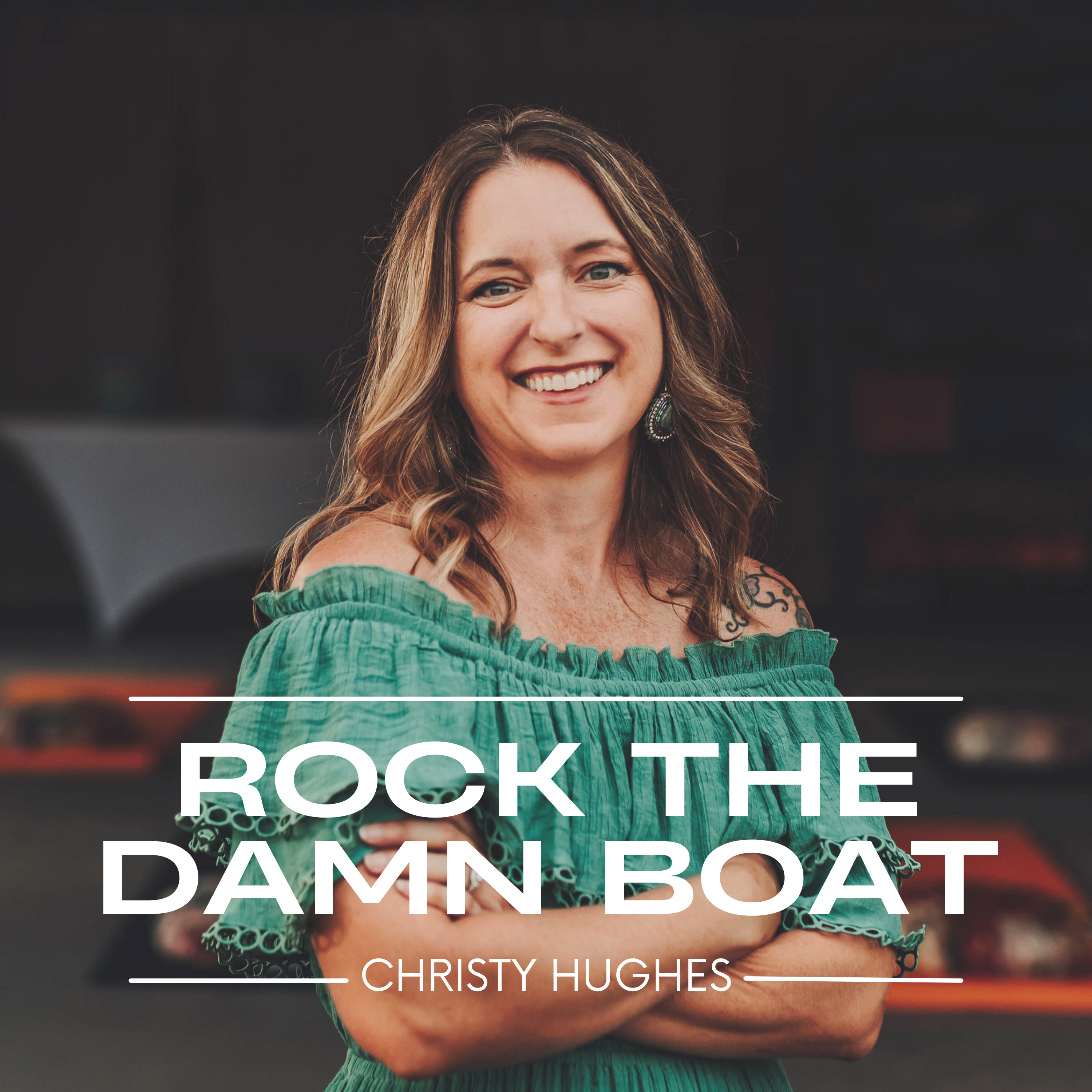
Rock the Damn Boat podcast artwork

PODCAST · education

Rock the Damn Boat

Rock the Damn Boat is a podcast for women who were raised to be good, grateful, and quiet—and are ready to unlearn all three.Host Christy Hughes grew up in the Bible Belt, where the “right” path meant being practical, pleasing others, and not rocking the boat. As an empath and lifelong people-pleaser, she learned early how to read the room, put everyone else’s needs first, and silence her own instincts in the name of peace. But eventually, that way of living came at a cost. Nearly a decade sober from alcohol, her former coping mechanism, Christy blends personal storytelling with honest conversations about boundaries, burnout, sobriety, identity shifts, and redefining success—especially for women leaving corporate life, navigating midlife transitions, or stepping into leadership without losing themselves. You’ll hear from female founders, former high achievers, quiet leaders, and recovering people-pleasers who chose courage over

  1. 71

    When Your Nervous System Is Maxed Out: Menopause, Creativity & Letting Others Be Happy

    Some weeks the nervous system runs hot. In this Sunday Shortie of RTDB, I'm talking about windows of tolerance — the space where you can actually feel and function before you tip into overwhelm or shutdown — and what it looks like when menopause keeps shrinking that window without warning.I also get honest about something quieter: the pull to dim someone else's joy when you're depleted. Not out of meanness — out of exhaustion. And what it takes to let other people be happy without making it mean something about you.Then there's Yesteryear. I always thought I was writing the character's postpartum depression. Turns out the page was holding a mirror up to my own state of mind in menopause. The writing knew before I did.In this episode of RTDB:What a "window of tolerance" is, in plain languageWhy menopause narrows that window — and how to notice the edges soonerThe difference between protecting your peace and stealing someone else'sHow my own writing surfaced what I wasn't saying out loudA gentler way to move through a depleted weekKey takeaways:Your window of tolerance isn't fixed — hormones, sleep, and stress move the wallsFeeling depleted doesn't make you a bad person; it makes you humanSomeone else's joy is not a withdrawal from your accountThe creative work you make often reflects you before you're ready to lookYou don't have to fix the whole feeling — you can just name where you areWhat is a window of tolerance? The range where your nervous system can handle stress and emotion without tipping into overwhelm (hyperarousal) or shutdown (hypoarousal).How does menopause affect emotional regulation? Hormonal shifts can narrow that window, making it easier to feel flooded or flat with less provocation than before.What does "stealing someone's joy" mean? Diminishing another person's happiness — often unconsciously, when you're depleted — instead of letting their good moment exist on its own.Learn more about The Thrive Collective at thrivewithchristy.com

  2. 70

    Removing the Subconscious Beliefs That Prevent Growth: Nicole Beaudin, pt. 2

    The second half of Christy's conversation with Nicole Beaudin picks up right where things get real — shadow work. If Part 1 was about recognizing you want something different, Part 2 is about doing the deeper work to actually get there.Nicole walks through the coaching method she uses to help high performers uncover the subconscious beliefs quietly running the show — the ones formed at age seven that are still blocking you at forty. From denied personas to underlying commitments, this conversation gets specific about what the inner work actually looks like in practice.In this episode of RTDB, you'll hear:What shadow work is and why the person who triggers you most is a mirror worth looking intoHow subconscious beliefs form in childhood and show up as self-sabotage in adulthoodNicole's concept of a "spiritual board of directors" — and why she recently fired hers and started overWhat to do when your tools stop working (and how to build a regulation toolkit that evolves with you)Why the aftermath of a big life change can feel harder than the change itself — and what that means for your nervous systemLearn more and work with Nicole at nicolebeaudin.comFollow her Substack: https://substack.com/@nicolebeaudinLearn more about The Thrive Collective and work with christy at thrivewithchristy.com

  3. 69

    Who Will You Inspire? Celebrating the Wins That Make Waves, Even if it's a Tiny Ripple Effect

    In this Sunday Shortie episode of Rock the Damn Boat (RTDB), Christy slows down. Before she heads back to corporate life and a lot more screen time, she's spending the week outside — trading notifications for fresh air and reconnecting with nature.Benefits of nature include: • Pattern Recognition and Nervous System: Pattern recognition can create nervous system regulation. • Bird Song and Safety: Bird song can create a sense of safety. • Trees and Calming Effect: Trees releasing phytocides can have a calming effect.This one's a gentle nudge to celebrate your milestones, even when it feels like bragging. If you were taught to shrink as a kid, or you've spent years as a people-pleaser, owning your wins can feel uncomfortable. But Christy makes the case that celebrating your achievements isn't ego — it's a ripple effect. When you honor how far you've come, you give someone else permission to chase their own passions too.Tune in for a grounded reminder to rest, unplug, and take real pride in what you've built.

  4. 68

    I Don't Want That Life: Moving from Corporate Retail to Spiritual Coaching with Nicole Beaudin, pt 1

    What happens when you're succeeding on paper but falling apart on the inside? In Part 1 of this RTDB conversation, Christy sits down with Nicole Beaudin — alignment leadership coach, Reiki-trained facilitator, and author of the This Way to Lightness Substack — to talk about the corporate career that looked impressive from the outside and felt hollow from within.Nicole shares her path from Williams-Sonoma and West Elm to Tory Burch, and the moment a psychic in Wisconsin handed her a piece of black tourmaline and changed everything. She opens up about discovering she's an empath, learning Reiki as an act of self-preservation, and what it felt like to look up at the women ahead of her in corporate and think: I don't want that life.In this episode of RTDB, you'll hear:How Nicole's reference to an archaelogical dig reminded Christy of a transformative bookWhy high-achieving people pleasers are often the most disconnected from their own needsWhat empaths are (and the neuroscience behind why they experience the world differently)How Reiki became Nicole's entry point into intuitive healingThe moment Nicole knew corporate retail wasn't her final chapter — and how she leaned into spiritual practice instead of pushing throughLearn more and work with Nicole at nicolebeaudin.comFollow her Substack here: https://substack.com/@nicolebeaudinOrder your copy of Something More by Sarah Ban Breathnach from Thrift Books

  5. 67

    When Manifesting Isn't Enough: Why I'm Going Back to Corporate After 7 Months

    Seven months into building a business from scratch, Christy Hughes gets honest about what entrepreneurship in this economy actually looks like — and why the disappointment so many women feel isn't a sign they didn't believe hard enough. In this Sunday Shortie, she shares how a new corporate opportunity found her when she stopped forcing it, what it sounds like when intuition speaks up, and why The THRIVE Collective isn't going anywhere. If you're building something while wondering if you're doing it wrong, this one's for you.What You'll Hear:Why business disappointment in this economy is normal — not a personal failingThe manifesting myth: why you didn't think your way into struggleHow Christy's new role landed when she listened to her gut instead of pushing harderWhat intuition actually sounds like in a job searchWhy The THRIVE Collective continues — and why going back to corporate makes it strongerThe case for a life that holds both professional success and personal wholenessEnjoyed this episode? Share it with a woman who's building something and wondering if she's failing.Learn more about The Thrive Collective at thrivewithchristy.com

  6. 66

    When Pets Come First: Lori Wahl on Reinvention, Animal Advocacy, and Pursuing Nonprofit Passions

    In this episode of RTDB, Christy sits down with Lori Wahl — a pet industry veteran with 15+ years in rescue and pet sales — to talk about the unexpected ways those two worlds overlap. Lori went from the corporate pet industry to serving as Development Director for Heidi's Village in Phoenix, one of the most meaningful pivots she's made. Now, after relocating to Charlotte for her husband's career, Lori is navigating yet another reinvention — and she's honest about how hard it is to leave something you love. This one is for anyone who's ever had to close a chapter they weren't ready to close.What You'll Hear:How Lori and Christy connected through the pet industry (shoutout to the Pet Firm in Phoenix)The surprising synergies between corporate pet work and animal rescueWhat led Lori to leave corporate for nonprofit — and what that transition actually looked likeHer role as Development Director at Heidi's Village and what that work meant to herRelocating to Charlotte and stepping away from nonprofit lifeWhy it's okay to change your mind — and how to stop apologizing for itStarting a new chapter even when the previous one wasn't "finished"How to find and get involved with your own local rescue — and why it matters more than you thinkResources/Links:Heidi's Village: heidisvillage.orgNational Rescue: aspca.org or bestfriends.org Connect with Lori: https://www.linkedin.com/in/lori-wahl/Feeling inspired? Find your local rescue and show up — even in a small way. It adds up.

  7. 65

    Avoiding Conflict at All Costs: Why Enneagram 9 Needs to Learn to Rock the Damn Boat

    In this Sunday Shortie episode of RTDB, Christy explores Enneagram Type 9 — The Peacemaker — and what it really means to keep the peace at your own expense. After testing equal parts Type 2 and Type 9, Christy digs into the 9's core patterns: avoiding conflict, numbing out, and the slow fade of self. She connects the 9's spiritual potential to the eight limbs of yoga as a grounding framework for growth — and gets honest about how the unhealthy 9's pull toward addiction showed up in her own life. Development tips sourced from the Enneagram Institute round out this bite-sized but powerful episode.What You'll Hear in This Episode:Why Christy tested as both a Type 2 and Type 9 — and what the overlap revealsCore Type 9 traits: the peacemaker, the conflict-avoider, the one who disappears into the backgroundWhat "not rocking the boat" actually costs youThe healthy 9: becoming a spiritual seeker, grounded in contentmentHow the eight limbs of yoga support a 9's growth pathThe shadow side: how the 9's numbing tendency can fuel addiction (and Christy's personal connection to this)Growth tips for Type 9s from the Enneagram InstituteResources Mentioned:Enneagram Institute — Type 9The Eight Limbs of Yoga

  8. 64

    Burnout Recovery, Nonprofit Leadership & Finding Joy Again with Beckie Irvin

    In this episode of RTDB, I sit down with Beckie Irvin to talk about the hidden cost of mission-driven work and why so many nonprofit leaders quietly struggle with burnout.Beckie shares her personal experience navigating exhaustion, overwhelm, and the emotional weight that can come from constantly serving others without the systems and support needed to sustain the work. We discuss how nonprofits often rely on passionate people operating in survival mode — and why proper infrastructure, boundaries, leadership support, and sustainable operations matter just as much as the mission itself.We also explore the healing side of burnout recovery: the small practices that helped Beckie reconnect with herself, the role creativity and photography played in restoring joy, and how building tiny, manageable habits can help people slowly find their footing again after a difficult season.This conversation is a reminder that recovery doesn’t usually happen through dramatic overnight transformation. More often, it begins with small decisions, gentle routines, and giving yourself permission to rebuild one step at a time.If you’re a nonprofit leader, entrepreneur, caregiver, helper, or high achiever who feels emotionally exhausted, this episode offers an honest look at burnout, healing, nervous system recovery, and the importance of creating a life that includes joy alongside responsibility.In This Episode of RTDB, We Discuss:Burnout in nonprofit leadership and mission-driven careersWhy passion alone cannot sustain unhealthy systemsThe importance of infrastructure and operational supportCompassion fatigue and emotional exhaustionRecovering from burnout without shamePhotography, creativity, and hobbies as healing toolsSmall daily habits that support mental wellnessLessons inspired by Atomic Habits by James ClearHow to slowly rebuild motivation, energy, and hopeAbout Beckie IrvinBeckie Irvin is passionate about helping organizations and individuals create more sustainable, healthy ways of working and living. Through her consulting work and creative pursuits, she advocates for balance, intentionality, and finding joy again after burnout.Learn more at beckieirvin.comFor more about Christy's work or to apply to be on the show, visit thrivewithchristy.com

  9. 63

    Enneagram Two: The Helper - Are You Helping Others Because You Need to Feel Loved?

    In this episode of RTDB, Christy dives into Enneagram Type 2 — The Helper. If you're a Two (or love one), this episode is your permission slip to stop giving from an empty cup.What You'll Learn in This EpisodeWhy Type 2s are the ultimate people pleasers — and what's really driving itThe genuine strengths that make Twos magnetic, generous leadersThe unhealthy patterns that can leave Twos burned out, resentful, and invisible to themselves5 practical development tips for Type 2s ready to break the people-pleasing cycleStrengths of the Enneagram Type 2Deeply empathetic and emotionally intuitiveNatural connectors who make people feel seen and valuedGenerous, warm, and fiercely loyalMotivated by genuine love and care for othersUnhealthy Patterns to WatchChronic self-sacrifice that leads to burnoutDifficulty saying no — or even knowing what they wantSeeking approval and validation through givingResentment when help isn't reciprocated or recognizedSuppressing their own needs to feel worthy of love5 Personal Development Tips for Type 2s (as shared by the Enneagram Institute)Notice the martyr pattern — Ask yourself if you're giving freely or keeping score unconsciously.Practice receiving — Allow others to help you without deflecting or minimizing.Name your own needs — Daily check-ins: What do I actually need right now?Set boundaries without guilt — A "no" to others is often a "yes" to yourself.Separate worth from helpfulness — You are enough without doing a single thing for anyone today.👉 Learn more about the Enneagram Type 2 at The Enneagram InstituteConnect with ChristyJoin The THRIVE Collective: thrivewithchristy.comFollow on Instagram: @rockthedamnboatSubscribe & leave a review — it helps more women find the boat 🚤

  10. 62

    This is 50: Reflections on a Roller Coaster Year of Sobriety, Menopause and ADHD

    If you'd like to be part of a community that supports this season of life, visit thrivewithchristy.comIn this episode of RTDB, Christy shares the unfiltered reality of 50 becoming one of the hardest — and most transformative — years of her life. What began as a season of exhaustion, brain fog, emotional overwhelm, and feeling like she was “falling behind” eventually led to deeper answers: menopause, hormonal shifts, an ADHD diagnosis, and a complete reevaluation of work, identity, and success.Christy reflects on how her 8th year of sobriety felt like year one because of the chaos of perimenopause and post-menopausal changes that affected her focus, emotional regulation, confidence, and ability to perform in high-pressure corporate environments the way she always had before.This episode is an honest conversation about what happens when high-achieving women suddenly realize they can no longer “push through” symptoms that are biological, neurological, and deeply intertwined. Christy discusses the grief of leaving a career she worked hard to build, the fear and shame that can come with executive dysfunction and burnout, and why so many women are misdiagnosed, dismissed, or silently struggling during midlife transitions.She also shares why seeking support matters — from hormone replacement therapy (HRT) conversations to finding qualified mental health and psychiatric care that understands the intersection of hormones, ADHD, anxiety, burnout, and women’s health.If you’ve ever felt like you suddenly stopped recognizing yourself, this episode is a reminder that you are not lazy, broken, weak, or failing. Sometimes your brain, body, and nervous system are asking for support — not more pressure.In This Episode of RTDB:What 8 years of sobriety has taught Christy about resilience and self-awarenessThe unexpected ways menopause impacted focus, mood, motivation, and emotional regulationHow ADHD symptoms became impossible to ignore during hormonal changesThe reality of struggling professionally after years of high performanceWhy leaving a corporate role can feel both devastating and freeingThe connection between hormones, executive function, anxiety, and burnoutWhy women deserve informed conversations about HRT and psychiatric supportHow midlife can become a starting line instead of an endingListen If You’ve Ever:Felt like your brain changed overnightWondered if menopause was affecting your mental healthStruggled to keep up at work despite trying harderBeen diagnosed with ADHD later in lifeFelt ashamed of burnout or emotional overwhelmQuestioned your identity after leaving a careerNeeded permission to ask for helpBecause sometimes “This is 50” isn’t about slowing down — it’s about finally understanding yourself clearly for the first time.Resources:Dr. Mary Claire Haver, thepauselife.comAshleigh Auth (FL only), Pausitive Women's CareHormones by Design (TX only), https://hormonesbydesign.com/She Recovers, https://sherecovers.org/

  11. 61

    Choose Empowering Language Over Apologies: What Meeting Jess Ekstrom Taught Me About Taking Up Space

    I drove to San Antonio for the NAWBO conference specifically to hear Jess Ekstrom speak.As someone navigating entrepreneurship, visibility, podcasting, and leadership after corporate life, I deeply wanted to learn from women who are already standing confidently in rooms I’m still growing into.But despite intentionally putting myself in that room, despite years of leadership experience, I still caught myself saying something so many women say automatically when I asked for a photo:“Can I bug you…”The moment itself was harmless. But the language behind it revealed something bigger.Why do so many women instinctively apologize before taking up space? Why do we minimize ourselves before making even the smallest request? Why do capable, accomplished women still feel like they’re inconveniencing people simply by existing in the conversation?In this episode of RTDB, we unpack the subtle language patterns that expose deeper conditioning around people-pleasing, self-worth, visibility, and confidence.We talk about:How phrases like “sorry to bother you” quietly diminish our presenceThe hidden ways people-pleasing shows up in professional settingsWhy women often place others on pedestals instead of seeing themselves as equalsThe connection between language, nervous system safety, and confidenceHow to replace minimizing language with grounded, empowering communicationWhy visibility starts long before the stage, microphone, or business launchRemembering that every successful person is still just another human beingThis conversation is about more than wording. It’s about identity. Confidence isn’t always built through giant leaps.Sometimes it’s built by simply removing unnecessary apologies from our everyday language.If you’ve ever overexplained yourself, softened your needs, apologized for asking questions, or felt intimidated in rooms you worked hard to enter — this episode will resonate deeply.Follow Jess at jessekstrom.comJoin The THRIVE Collective at thrivewithchristy.com

  12. 60

    Sobriety, Compassion, and the Courage to Pivot — A Conversation with Danni Carr

    In this episode of RTDB, Christy sits down with Danni Carr of iquitalcohol.com.au — and this one starts with a full-circle moment: back in 2022, Danni had Christy on her podcast when Christy first published her sobriety memoir. Now the tables have turned, and the conversation is just as good the second time around.Danni shares her own sobriety journey — one she walked alongside her husband, musician Ash Grunwald — and the book they wrote together about it. She opens up about a year spent studying Compassionate Inquiry under the legendary Gabor Maté, and how that training reshaped everything she thought she knew about healing.Now she's layering mindfulness and retreats onto her sobriety coaching, and this conversation is a masterclass in what it looks like to do the inner work and build something meaningful from it.What you'll hear in this episode:The full-circle moment — Danni hosted Christy in 2022 when her sobriety memoir first publishedDanni and Ash Grunwald's sobriety journey and the book they wrote togetherWhat a year studying Compassionate Inquiry under Gabor Maté actually looks like — and how it changed herHow manifestation guided hers and Ash's sobriety journeyWhat sobriety, self-compassion, and safe spaces have in commonConnect with Danni:iquitalcohol.com.auInstagram: https://www.instagram.com/howiquitalcohol/Learn more about Christy's retreats and community at: thrivewithchristy.comShare this episode with someone quietly reconsidering their relationship with alcoholPlease follow, subscribe and leave a review if you are loving this podcast

  13. 59

    Stop Performing: The Enneagram, Nervous System, and the Cost of Being Someone You're Not

    What if the anxiety, exhaustion, or low-grade frustration you've been feeling isn't a discipline problem — it's an alignment problem?In this Monday Mini, Christy breaks down all nine Enneagram types and what they can teach us about why we're wired the way we are. More importantly, she explores what happens in our bodies and nervous systems when we spend too much time performing a version of ourselves that doesn't fit — and how coming back to your actual type can be one of the most grounding, regulating things you do.Whether you're a Type 2 who's burned out from giving or a Type 8 who's been told to soften, this episode is permission to stop working against yourself.In this episode of RTDB:A quick breakdown of all 9 Enneagram typesHow your type connects to nervous system regulationThe real cost of "type masking" — and how to come home to yourselfPerfect for: women in transition, overthinkers, anyone who's ever been told they're "too much" or "not enough"Learn more at theenneagraminstitute.comJoin The THRIVE Collective at thrivewithchristy.com

  14. 58

    Grit, Grief and Spirit-Led Service: JeanAnn Saint Grace of Shop Talk Her Way

    What does it take to build a service-first auto shop — and rebuild yourself after losing it all?In this episode of RTDB, Christy sits down with JeanAnn Saint Grace, host of Shop Talk Her Way, to talk about grit, grief, and what it really means to lead with service.JeanAnn spent more than a decade running a successful automotive service shop alongside her husband — until cancer took him. Now she coaches shop owners, carrying forward the philosophy that drove their business: service isn't a strategy, it's a standard.In this conversation, we cover:How JeanAnn found her footing in a male-dominated industry — and why that's starting to shift (yes, even at the top of NAPA)The energy transfer between shop owners and customers, and why it matters more than your marketingHow JeanAnn's spiritual practices carried her through grief — and how she quietly brings them into her coaching workWhat running a shop for 15+ years teaches you that no business course ever willWhether you're in automotive, entrepreneurship, or just navigating what comes after the hardest chapter of your life — this one is for you.Learn more about JeanAnn at jeanannsaintgrace.netListen to Shop Talk Her Way wherever you get your podcast content!Coach with Christy: thrivewithchristy.com

  15. 57

    From Garden to Growth: When the Conditions Are Finally Right Outdoors and in Life

    What does gardening have to do with launching a business? Everything. In this bite-sized episode of RTDB, Christy Hughes breaks down how revamping her garden revealed the truth about growth: conditions matter more than effort. She'll walk you through how that realization led her to stop circling Thrive Collective and finally launch — and what it means for you to stop waiting and start planting.The THRIVE Collective is a membership for women needing to plant their own seeds and create the right environment: support, mindfulness practices, and practical coaching.Learn more at thrivewithchristy.com

  16. 56

    Chance Encounters and Kickoff to Podcast Series: Courtney Koenig, Host of ROI of Peace

    In this episode of RTDB, Christy sits down with Courtney Koenig, host of the ROI of Peace podcast — a connection that sparked when Christy spotted Courtney's LinkedIn post about attending Create & Cultivate in Austin and realized they'd both been there. What started as an online comment turned into a conversation neither of them planned but both of them needed.What you'll hear in this episode:How a LinkedIn post led to a meaningful online connection between two women who were in the same room without knowing itHow Human Design shifted the entire trajectory of Courtney's businessCourtney's honest reflection on asking for help and support at the event while navigating life with MS — and why that vulnerability opened doorsThe shared truth about how hard it is to ask for help (and why we resist it)Courtney's podcasting journey and what keeps her coming back — the pure joy of connecting womenConnect with Courtney:ROI of Peace Podcast: roiofpeace.comInstagram: https://www.instagram.com/courtney.koenig/Links + Resources:The THRIVE Collective is launching: www.thrivewithchristy.comLearn more about Human Design hereTag a woman you connected with online that turned into something realLeave a review if RTDB is your people

  17. 55

    Monday Mini: Retreat Recap and a Big Secret Revealed - How I Applied THRIVE to My Own Decision

    In this Monday Mini of RTDB, Christy pulls back the curtain on the Rise + Thrive Retreat — what happened, what was created, and the unexpected personal decision that came out of it.What you'll hear in this episode:What the Rise + Thrive Retreat actually looked like — and why the safe space it created mattered so muchThe corporate role Christy was interviewing for (and why she was a perfect fit on paper)How she used the THRIVE model to work through her own big decision — not just teach itWhy she chose building safe spaces for women over a return to corporateA sneak peek at what's coming: a new community that brings together the RTDB and The Rooted Soul worldsKey takeaway for me? The framework works — even when the decision is yours and the stakes are personal.Links + Resources:Join the email list at thrivewithchristy.comFollow Christy on Instagram: @thrivechristyhughesIf this episode resonated, share it with a woman standing at a crossroadsStay tuned — the community is coming and you can get a founding rate now

  18. 54

    When Grief Goes to Work: Workplace Wellness with Brie Kluytenaar of Practicing Wellness

    Some of life's hardest moments don't wait for a convenient time. They show up on a Tuesday — and then so does your 9am meeting.In this episode of RTDB, Christy sits down with Brie Kluytenaar, founder of Practicing Wellness, for an honest, human conversation about what it looks like to carry grief into the workplace and white-knuckle your way through the day alone.Brie opens up about her own experience with pregnancy loss and how pushing through without support planted the seed for her company's mission. Christy adds her personal experience with menopause and feeling like a failure at work because of scrutiny rather than support.Brie knows firsthand: when people feel held at work, they show up differently — for their colleagues, their clients, and themselves. Practicing Wellness can hellp provide this in a well-rounded way.Key Takeaways:Brie's pregnancy loss experience became the foundation of Practicing Wellness — pain with purposeCompartmentalizing at work has a real cost — to performance, connection, and wellbeingWellness isn't a perk — it's what makes people better employees and better humansCompanies that support the whole person see it reflected in client service and team cultureWorkplace wellness belongs alongside work — not saved for after hours or HR emergenciesLearn more about Practicing Wellness:www.practicing-wellness.comFollow on Instagram: https://www.instagram.com/practicing__wellness/Subscribe on Substack:https://practicingwellness.substack.com/Brie's Boat-Rocking Role Model: https://www.okeeffemuseum.org/Christy has a 6-week THRIVE cohort launching soon!Learn more at www.thrivewithchristy.com/coachingRock the Damn Boat in Tahoe, June 14-18www.thrivewithchristy.com/tahoeretreatFollow RTDB on Substack:www.rockthedamnboat.com

  19. 53

    Your Gut Knows: Trusting Intuition Over the Internet's Quick Fixes

    Ever feel pulled toward every $7 course and "quick path to success" that floods your feed? Same. In this Sunday Shortie, Christy gets real about the noise — and why your intuition is still your best compass.In this episode:What intuition actually is (hint: it starts in your gut, not your brain)The mind-heart-gut connection and the science behind itWhy somatic awareness helps you know what's truly right for youThe modern-day snake oil problem — and how to spot itHow to tell the difference between a "should" and a genuine inner callingWhether you're chasing someone else's blueprint or second-guessing your own path, this episode is your reminder to get quiet, tune in, and trust what your body already knows.And if you need some help launching what that inner wisdom is telling you, Christy has several ways to work together:Thrive Cohort — 3-week and 6-week options starting in MayTexas retreat (April) + Tahoe retreat (June)🔗 thrivewithchristy.com

  20. 52

    The Alchemy of Motherhood: Casey Keen on Postpartum Advocacy and Creating a Village

    In this episode of Rock the Damn Boat (RTDB), I sit down with Casey Keen—founder of Alchemy of Motherhood and author of the upcoming book The Alchemy of Motherhood (releasing May 2026)—to talk about the parts of motherhood we don’t talk about enough.After experiencing birth trauma followed by postpartum depression (PPD) and postpartum anxiety (PPA), Casey found herself navigating a system that offers mothers a single six-week checkup—and very little support beyond that. Her journey led her to therapy, deep healing, and ultimately to building a platform that advocates for more honest, ongoing care in motherhood.We dive into:The emotional impact of birth trauma and how it can shape postpartum recoveryHow PPD and PPA can show up (even when everything “looks fine”)Why the standard six-week postpartum checkup falls shortThe role of therapy in healing and reclaiming your voiceThe mission behind The Alchemy of Motherhood and Casey’s growing communityCreating spaces where mothers feel seen, supported, and not aloneCasey also shares how she’s building connection through her online platform and Discord group—because motherhood was never meant to be navigated in isolation.If you’ve ever felt overwhelmed, dismissed, or like you should be handling motherhood “better,” this conversation will remind you that your experience is valid—and that support should extend far beyond six weeks.Who this episode is for:New and expecting mothers, women navigating postpartum recovery, those healing from birth trauma, and anyone passionate about improving maternal mental health care.Connect with Casey:Visit alchemyofmotherhood.com to learn more, join her community on Discord or Substack. Stay updated on her upcoming book release at casey-keen.com or preorder now on Amazon. Learn more about Christy's work or apply to be a guest on the show at thrivewithchristy.com

  21. 51

    The Surprise Mindset Shift I Didn't See Coming - and the AI Game Changer That Got Me There

    This week's Sunday Shortie is a personal one. After chatting with Naoma of We Know Marketing, We Promise, and having a deep conversation with my friend Beckie about how to "sell" with heart, I had a huge mindset shift from the unlikeliest of places: Claude. What I discovered changed the way I think about showing up for potential retreat guests without losing the warmth and authenticity that makes people say yes to a retreat space.I also get reflective and share three retreat experiences that have genuinely shaped my perspective: two transformative weekends with my own yoga teacher and one soul-expanding journey to Bali. Because the best way to encourage someone to say yes is with truly remembering what it feels like to be held in one.If you're a retreat host, wellness entrepreneur, or curious about using AI in a way that still feels deeply human, this one's for you.Key Takeaways:Two podcasts worth adding to your list right now if you're a wellness entrepreneur or content creatorA real mindset shift around using Claude AI to write retreat sales emails — and why it doesn't have to feel robotic or inauthenticHow retreat experiences create an unmatched level of growth, celebration and friendshipsReflections from three retreat experiences — two with my yoga teacher and one transformative trip to BaliHow raising our hand may never feel easy, but it's worth it for the growth opportunity🌿 Curious about retreats? Explore available spaces at thrivewithchristy.com/retreatsShows to Follow:🎙️ Real Time Creator with Alison Kinsey — https://podcasts.apple.com/ca/podcast/real-time-creator-a-career-break-diary/id1866730211 🎙️ We Know Marketing, We Promise — https://podcasts.apple.com/us/podcast/we-know-marketing-we-promise/id1801092716

  22. 50

    Midlife Hormones, HRT & Finally Feeling Heard with Ashleigh Auth, PA-C, of Pausitive Women's Care

    In this episode of RTDB, I sit down with Ashleigh Auth, founder of Pausitive Women’s Care, for a real, refreshing conversation about women’s health in midlife—and why so many of us feel dismissed, confused, or stuck when it comes to our bodies.Ashleigh is a women’s health provider specializing in perimenopause, menopause, and hormone optimization, with a deeply personalized and holistic approach to care. She’s on a mission to help women feel heard, validated, and empowered in their health decisions—especially during a season that’s often misunderstood or minimized.We talk about what’s actually happening in your body during midlife, how hormone replacement therapy (HRT) fits into the conversation, and why individualized care—not cookie-cutter solutions—matters more than ever.This conversation is for the woman who knows something feels off… but hasn’t been given real answers.In this episode, we cover:What’s really happening during perimenopause and menopauseCommon hormone symptoms that get overlooked or dismissedThe truth about HRT and who it may be right forWhy traditional healthcare often falls short for midlife womenThe power of feeling heard, educated, and supported in your careHow to advocate for yourself and find the right providerIf you’ve ever been told “your labs are normal” but you don’t feel normal—this episode will feel like a deep exhale.If you are in Florida and fortunate enough to work with Ashleigh, you can book her services at:https://www.pausitivewomenscare.com/Follow Pausitive Women's Care on Facebook or Instagram for amazing tips on hormone health!Learn more and work with Christy at thrivewithchristy.comInterested in being a guest? Email [email protected] symptoms, menopause support, hormone replacement therapy, HRT for women, midlife health, women’s hormones, holistic gynecology, hormone imbalance, menopause podcast, women’s wellness

  23. 49

    Pruning What Isn't Working: Conversations on Clarity and Necessary Endings

    In this episode of RTDB, I’m sharing three things that have been on my mind this week—each one rooted in connection, clarity, and the courage to let go.From virtual coffee chats and online networking to in-person moments at book club and mahjong, I’ve been reminded how powerful the right conversations can be. Not every connection will click—and that’s okay. The goal isn’t to force it, it’s to find your people.A conversation with my soul sister Kelsey brought something into sharp focus: I’ve been spinning too many plates. And not all of them are meant to keep spinning.That clarity led me back to Necessary Endings by Henry Cloud—a book that hits especially hard if you’re questioning what’s next in your career or considering a corporate exit. Sometimes growth isn’t about doing more—it’s about cutting what’s no longer working.This episode is your reminder that clarity doesn’t come from overthinking—it comes from the right conversations and the willingness to release what’s weighing you down.Key TakeawaysThe right conversations can accelerate clarity—keep seeking them outIf a group, coach, or connection doesn’t click, keep lookingSpinning too many plates isn’t a badge of honor—it’s a signalGrowth requires pruning: not everything is meant to come with youIf you’re contemplating a corporate exit, Necessary Endings is a must-readIf you haven't watched it, check out this conversation with Kelsey: https://podcasts.apple.com/us/podcast/its-okay-to-change-your-mind-a-powerful/id1844202665?i=1000739550347Buy the book: Necessary Endings by Dr. Henry Cloud

  24. 48

    Wired, Tired, and Wondering Why? Midlife Stress, Hormones, and What Nutrition Your Body Needs Now

    In this episode of RTDB, we’re diving into midlife nutrition through a lens that doesn’t get talked about enough: stress, hormones, and how your body is actually responding behind the scenes.I’m joined by Erika Hewlett of Compassion Wellness Nutrition to unpack what’s really happening during midlife—especially when it comes to adrenal function, declining estrogen levels, and the ripple effect they have on your energy, metabolism, mood, and overall health.If you’ve been feeling more fatigued, wired-but-tired, or like your body just isn’t responding the way it used to, this conversation will help you understand why.We talk about:How chronic stress impacts adrenal gland function and energy levelsWhat drops in estrogen actually do to your body in midlifeWhy protein becomes even more essential for muscle, metabolism, and stabilityWhat HTMA (Hair Tissue Mineral Analysis) testing can reveal about your bodyWhy mindfulness isn’t optional—it’s a critical tool for managing stress and supporting hormone healthThis episode is about moving out of confusion and into clarity—so you can stop guessing and start supporting your body in a way that actually works for this season of life.If you’re a thoughtful woman navigating midlife changes and looking for grounded, practical guidance, this conversation will give you a new perspective—and a way forward.Work with Erika at compassionwellnessnutrition.comHer favorite midlife experts:Dr. Mindy Pelz https://www.drmindypelz.com/Dr. Lisa Mosconi https://www.lisamosconi.com/Dr. Sara Gottfried https://www.saragottfriedmd.com/Alisa Vitti floliving.comMaisie Hill https://maisiehill.com/Regena Thomashauer https://mamagenas.com/Learn more about working with Christy atthrivewithchristy.com

  25. 47

    Feel Like a Fraud? Here’s How You Start to THRIVE Anyway

    In this episode of RTDB, we’re unpacking impostor syndrome—the quiet, persistent voice that makes capable women question whether they really belong. The truth? You’re not alone. Research suggests up to 70% of people experience these thoughts at some point, often despite clear evidence of their competence.Drawing from insights in TIME, we break down the five common ways impostor syndrome shows up—and why it has less to do with your ability and more to do with how you interpret challenges.You’ll hear how impostor syndrome can look like:Perfectionism – believing anything less than flawless means failureOverworking – trying to “earn” your place through exhaustionSelf-doubt loops – questioning your competence even after successAvoiding help – fearing that asking exposes you as a fraudDownplaying wins – crediting luck instead of your abilityWe’ll also reframe what’s really happening: impostor syndrome isn’t proof you’re unqualified—it’s a pattern of thinking. And the difference between those who feel like impostors and those who don’t often comes down to how they respond to challenges, not their actual capability.If you’ve ever thought, “Who am I to do this?”—this episode will help you recognize the pattern, challenge it, and take your next step with steadier confidence.TIME Article: https://time.com/5312483/how-to-deal-with-impostor-syndrome/Visit thrivewithchristy.com to learn more about ways to implement the THRIVE framework to overcome impostor syndrome and pursue your dream!

  26. 46

    The Right to Feel Safe: Speaking Up About Domestic Violence with Dr. Kathryn Jacob of The Archway

    In this episode of RTDB, Christy Hughes sits down with Dr. Kathryn Jacob of The Archway to discuss the realities of domestic violence, systemic abuse, and victim advocacy within the criminal justice system.I offer a trigger warning for anyone who is sensitive to this topic. This conversation is deeply personal for Christy. During college, she experienced abuse in a violent relationship—an experience that shaped her understanding of how complicated, isolating, and confusing abusive dynamics can be. That history is part of why raising awareness about domestic violence prevention and survivor support is so important to her today.Dr. Jacob explains how organizations like The Archway support survivors in ways that go far beyond providing emergency shelter. From legal advocacy and safety planning to counseling and community partnerships, their work helps victims navigate the legal system, find safety, and begin rebuilding their lives.We also talk about the warning signs of abusive relationships, why leaving can be so difficult, and the importance of accessible resources like the National Domestic Violence Hotline, which offers confidential support for anyone who believes they—or someone they care about—may be experiencing abuse.This episode is an honest and compassionate conversation about domestic violence awareness, survivor advocacy, and the systems working to protect victims.Key Topics in This EpisodeChristy’s personal experience with an abusive college relationshipUnderstanding systemic abuse and why it’s often misunderstoodHow domestic violence organizations work with victims and the justice systemServices available beyond emergency shelterWarning signs of abusive relationshipsHow the National Domestic Violence Hotline can help victims and loved onesIf you or someone you know may be experiencing domestic violence, confidential support is available through the National Domestic Violence Hotline at 1-800-799-SAFE (7233) or thehotline.org.Learn more about The Archway at https://www.thearchwaytx.org/ and reach their hotline in Tarrant County by calling 24/7 Crisis Hotline: 1-877-701-7233During March Women's History Month, donate $25 to get a "Don't Mess with Texas Women" sticker, and check the website for ways to volunteer.

  27. 45

    Bonus Episode: Create & Cultivate Future Summit Takeaways

    In this bonus episode of Rock the Damn Boat (RTDB), Christy shares a behind-the-scenes reflection on her spontaneous decision to attend the Create & Cultivate conference in Austin, Texas—alone. What started as a last-minute leap turned into a powerful reminder that growth often begins with simply showing up.Surrounded by ambitious founders, creatives, and entrepreneurs, Christy listened to inspiring speakers including Jonathan Van Ness and Emily McDonald, founder of Mindcraft, and walked away with a renewed belief in her ability to step into rooms that once felt intimidating.This episode explores what it means to take brave steps—even as an introvert or self-described “quiet woman”—and why courage doesn’t always look loud or confident. Sometimes it just looks like booking the ticket, walking through the door, and trusting that you belong there.Christy also reflects on how experiences like this shape her mission to help other thoughtful, capable women find their voice through the Rock the Damn Boat podcast and her upcoming women’s retreats.If you’ve ever wondered whether you’re ready to take a leap, attend an event alone, or step into a new community, this conversation is for you.Discussion Highlights:Why Christy made a spontaneous decision to attend Create & Cultivate AustinWhat it felt like to walk into a networking event aloneInsights from speakers including Jonathan Van Ness and Emily McDonald of MindcraftThe quiet courage it takes to show up in unfamiliar spacesHow stepping outside your comfort zone builds confidence over timeWhy Christy believes more introverted and thoughtful women deserve spaces to grow their voiceHow retreats, storytelling, and community can empower women to take brave steps forwardCreate & Cultivate Austin, women’s networking events, Jonathan Van Ness speaking event, Emily McDonald Mindcraft, women entrepreneurs conference, overcoming introversion in networking, confidence building for women, solo travel for conferences, women empowering women, Rock the Damn Boat podcastIf this episode resonates with you, share it with a friend who’s ready to take a brave step of her own. And don’t forget to follow Rock the Damn Boat on Apple Podcasts, Spotify, or YouTube for more conversations that inspire people-pleasers and quiet leaders to use their voice—even when it makes waves.

  28. 44

    Ready to Tell Your Story? My Personal Writing Journey and How I Can Help You Get Started

    In this Sunday Shortie episode of RTDB (Rock the Damn Boat), Christy shares her excitement about attending the Women in Publishing Summit and reflects on the personal journey that led her deeper into writing. What began as a potential biography after the death of her grandmother Polly eventually transformed into something entirely different, a deeply personal memoir about Christy's sobriety journey and the influence of her beloved grandmother.Christy also reflects on how learning more about her grandmother Gladys’ experience working in a WWII shipyard during the Rosie the Riveter era inspired an entirely new creative project five years later. It is a broader narrative about the women who stepped into unconventional roles during the war—echoing the spirit behind this month’s Women’s History Month conversations on RTDB.If you’ve ever thought about writing your own story, Christy shares an encouraging reminder: writing isn’t reserved for a select few. Anyone can learn the craft if they’re willing to study the process, stay curious, and keep showing up to the page.Key moments in this episode:Christy’s excitement about attending the Women in Publishing SummitHow the loss of her grandmother Polly sparked the idea for her original memoirThe surprising transformation of that book into a completely new creative projectHow learning more about her grandmother Gladys’ WWII shipyard work inspired a new project and new genre: historical fictionHow these stories connect to RTDB’s Women’s History Month series celebrating women who rocked the boat in unconventional careersWhy writing is a skill anyone can learn with patience and practiceHow the THRIVE framework can help you move from idea to action and start writing your own storyWhether you’re an aspiring author, a family historian, or someone feeling the quiet nudge to finally put your story on paper, this episode will encourage you to step up to the starting line and begin.

  29. 43

    Unconventional Roles and Small Town Texas Life: A Conversation with Cindy Sims

    In this episode of RTDB, we celebrate Women’s History Month with a conversation that proves you don’t have to be famous to make history—you just have to be willing to rock the boat.Our guest, Cindy Sims, was nominated by her daughter Courtney and selected as our Women’s History Month honoree for her remarkable life in unconventional roles. From running a small-town newspaper to working as a welder in a traditionally male trade, Cindy has spent decades quietly challenging expectations and showing what women are capable of.With humor, heart, and plenty of stories, Cindy shares what it was like growing up in a small Texas town, stepping into jobs few women held at the time, and building a life fueled by curiosity and determination. Her energy and quick wit make this one of the most entertaining conversations we’ve had on the show.We also talk about the women who inspired her—including Ruth Bader Ginsburg, Cindy’s ultimate boat-rocking role model.If you love stories about women breaking barriers, small-town resilience, and the courage to try something unexpected, this episode will leave you smiling.In this episode of RTDB, we discuss:What it was like being a woman working as a welderHow she came to own a small-town newspaperGrowing up in rural Texas and the power of communityHer unconventional career paths and what she learned as an American Sign Language interpreterCindy’s Women’s History Month inspiration: Ruth Bader GinsburgSometimes the most powerful boat-rockers are the ones who never set out to be famous—just brave enough to follow their own path.

  30. 42

    Three Things Keeping Me Going in My Solopreneur Journey

    In this Sunday Shortie, Christy shares a raw and honest reflection on what keeps her moving forward in the uncertain world of solopreneurship. Building something of your own can feel lonely, especially when the income isn’t predictable and the people around you don’t always understand the vision.In this episode of RTDB, Christy talks about three simple but powerful mindsets helping her stay grounded during the messy middle of entrepreneurship: learning to live frugally and separate wants from true needs, taking the journey one step at a time—much like the “one day at a time” philosophy in sobriety—and choosing to believe in herself even when external validation is nowhere to be found.If you’re navigating a career pivot, building a business from scratch, or standing at the starting line of something uncertain, this conversation is a reminder that progress often looks like quiet persistence.In this episode:Why redefining wants vs. needs can reduce financial pressure while building a businessHow the “one day at a time” mindset helps solopreneurs keep moving forwardThe courage it takes to believe in yourself when others doubt your pathWhy persistence—not perfection—is what gets you to the next chapterA short, honest pep talk for anyone walking the long road of entrepreneurship.Listen on Apple Podcasts, Spotify, or YouTube.

  31. 41

    Women in Film & TV: The Milestones, The Mavericks and the Work Still Ahead

    In this episode of RTDB, I’m joined by my former college roommate and co-host of The Screening Lounge, also Christy, for a lively and layered conversation about women in film and television — the trailblazers who rocked the boat, the milestones that changed Hollywood, and the representation gaps we’re still working to close.We talk about historic Oscar milestones, unforgettable movie scenes that shaped cultural conversations, and the actresses who have built long, enduring careers in an industry that hasn’t always made that easy for women. From the early pioneers to modern powerhouses, we explore how storytelling both reflects and reshapes what women believe is possible.This episode is equal parts celebration and reality check.Yes, women have broken barriers in directing, screenwriting, producing, and acting. But equal representation, diverse voices, pay equity, and decision-making power remain ongoing conversations.If you care about women’s leadership, media representation, Hollywood history, and the cultural power of storytelling, this conversation will remind you why it matters who gets to tell the story.Discussion Highlights:Historic Oscar award milestones for women directors and actressesThe firsts that paved the way — and the barriers that lingerMemorable movie scenes that redefined female agency on screenActresses who have built decades-long careers in HollywoodHow representation in film and TV shapes identity, ambition, and voiceWhere the industry still has significant strides to makeListen to Christy's show, The Screening Lounge, for weekly recommendations of binge-worthy TV shows and new films.Some of the movies and filmmakers we discuss:The Hurt Locker - Kathryn BigelowNomadland - Chloe ZhaoHamnet - Chloe ZhaoNorma Rae - Sally FieldsWhen Harry Met Sally - Meg RyanBarbie - Greta GerwigBlack Panther - Rachel Morrison

  32. 40

    Assertive is not a Dirty Word: How to Transform from Doormat to Direct

    In this episode of RTDB, we’re reclaiming a word that many women were taught to fear: assertive.If you’ve ever confused assertiveness with being rude, selfish, or unkind, this conversation will shift that belief. For people-pleasers, Enneagram 2's, and high-capacity women, staying quiet, over-explaining, or softening every request can feel safer. But over time, that pattern leads to burnout, resentment, and feeling invisible.In this Sunday Shortie, I break down how to move from passive to direct — without becoming harsh — and share five practical ways to build assertive communication skills:• Use “I” statements and direct language. Clearly state your needs with ownership: “I feel…” “I need…” Be honest and concise instead of meandering or over-explaining.• Learn to say no. Healthy boundaries don’t require long justifications. “No” is a complete sentence when it protects your time and energy.• Adopt confident body language. Stand tall, maintain eye contact, keep your posture open, and let your nonverbal cues match your message.• Start with low-stakes practice. Build confidence in small moments — ask for a different table at a restaurant or clarify a scheduling mix-up — before tackling bigger conflicts.• Manage emotions and stay calm. Pause, breathe, and regulate. Assertiveness is grounded clarity — not frustration spilling over into aggression.Assertiveness isn’t about dominating a room. It’s about respecting yourself enough to be clear. And clarity, as we know, is kind.If you’re ready to stop being the doormat and start communicating with calm, steady confidence, this episode will give you the mindset and language to begin.SEO Keywords: assertive communication skills, how to be more assertive, people-pleasing recovery, setting healthy boundaries, how to say no without guilt, confident body language, overcoming fear of conflict, women and leadership communication, burnout prevention.

  33. 39

    Navigating Sober Resources: Marin Nelson, CEO of Sobrynth, on Shifting Workplace Culture

    In this episode of RTDB, Christy sits down with Marin Nelson, founder of Sobrynth.com, for a powerful conversation about creating recovery-friendly workplaces and challenging the unspoken role alcohol plays in professional culture. Approaching eight years of sobriety from alcohol herself, Christy shares incredibly vulnerable stories about her own sober-curious days and how she ultimately got and stayed sober. It is why she believes so passionately in Marin's mission.After more than 15 years in enterprise tech and navigating her own sober journey, Marin founded Sobrynth to help organizations and professionals rethink how alcohol shows up at work — from networking events to leadership norms. Her mission is clear: build workplace cultures where recovery, sober curiosity, and alcohol-free living are respected, normalized, and supported.Together, Christy and Marin explore:What it actually means to create a recovery-friendly workplaceThe impact of workplace drinking culture on women’s leadership and advancementHow high-performing professionals quietly question their relationship with alcoholThe difference between sobriety, sober curiosity, and mindful drinkingHow leaders can build inclusive environments without relying on alcohol-centered connectionIf you’re a leader, HR professional, entrepreneur, or ambitious woman navigating corporate culture, this episode will expand your thinking about inclusion, performance, and authenticity.Learn more about Sobrynth at www.sobrynth.com or on LinkedIn at https://www.linkedin.com/company/sobrynth/Keywords: recovery-friendly workplace, sober curious, alcohol-free lifestyle, workplace drinking culture, women in leadership, corporate inclusion, sobriety journey, HR leadership, workplace wellness.

  34. 38

    The Two R’s: Rehearsing and Ruminating (And How to Break the Loop)

    In this Sunday Shortie episode of RTDB, we’re unpacking two classic people-pleasing behaviors that keep us stuck in anxiety cycles: rehearsing conversations before they happen and ruminating long after they’re over.If you’ve ever:Practiced what you were going to say 47 different waysPlayed out worst-case scenarios in your headReplayed a conversation for hours (or days) afterwardWondered if you were “too much,” “too blunt,” or “not enough”This episode is for you.Why People Pleasers Rehearse ConversationsRehearsing isn’t about preparation — it’s about protection.When you grow up managing other people’s emotions, your brain learns that safety equals predictability. So before hard conversations, your nervous system tries to:Predict every possible reactionScript the perfect responseAvoid conflict at all costsControl the outcomeThe problem? You can’t control the outcome. And trying to creates anxiety, not clarity.We’ll talk about the neuroscience behind rehearsing — how your brain’s threat system (hello, amygdala) activates when connection feels at risk — and why your body treats social tension like physical danger.

  35. 37

    Staying Brave in Your Pursuit of Joy: Alicia "ACE" Easter on Creative Entrepreneurship

    In this episode of Rock the Damn Boat, I sit down with Alicia "ACE" Easter, founder of Ace Yoga LA, for an honest conversation about leaving corporate life, navigating burnout, and building a career rooted in alignment rather than approval.ACE shares her journey from the corporate world into full-time yoga teaching in Los Angeles—and the emotional, financial, and identity shifts that come with making a major career pivot. We talk candidly about entrepreneurial alignment, trusting intuition after years of external expectations, and how yoga becomes a grounding practice during seasons of uncertainty.This episode is for women craving something more—those questioning the “safe path,” navigating a career transition, or craving more meaning in their work and lives. It’s a grounded, real-world look at what happens after you leap, and how to build something sustainable without losing yourself in the process.In this episode, we explore:Leaving corporate life without a perfect planNewfound freedom and nervous system regulationThe realities of entrepreneurship for womenYoga as a tool for clarity, resilience, and self-trustRedefining success beyond productivity and incomeWhether you’re a yoga teacher, creative, founder, or woman navigating a career change, this conversation offers reassurance, perspective, and permission to listen to what your body and intuition already know.Follow ACE and support her work at aceyogala.comSubscribe to her Substack The Life of a RamCheck out three of her boat-rocking role models:Rae Okino: https://www.raeokino.com/Maryam Hasnaa: https://www.maryamhasnaa.com/Imani Cohen: https://thehoodhealer.com/Learn more about Christy's work at thrivewithchristy.comincluding her upcoming Texas and Tahoe retreats

  36. 36

    Sunday Shortie: Menopause, Medication, and a Shocking Global Statistic

    In this episode of RTDB (Rock the Damn Boat), I’m talking about something that doesn’t get nearly enough daylight: the increased risk of suicide during menopause — and what can happen when hormone or medication changes impact your mental health.This Sunday Shortie is personal.I’m sharing my own experience with medication adjustments that unexpectedly triggered intrusive and suicidal thoughts — not because I wanted to die, but because my brain chemistry shifted. If you’ve ever felt blindsided by anxiety, depression, or dark thoughts during perimenopause or postmenopause, you are not broken — and you are not alone.We’ll talk about:The link between menopause, hormone shifts, and mental healthWhy medication changes (including HRT or antidepressants) can temporarily intensify symptomsWhy to discuss this with your doctor, even if they are dismissiveThe importance of monitoring mood during hormonal r medication transitionsMenopause mental health is still wildly under-discussed — especially in high-functioning women who “look fine” on the outside.If you’re navigating perimenopause, postmenopause, hormone therapy, antidepressants, ADHD, or mood instability in midlife, this episode is a reminder: your brain deserves support just as much as your body.If this conversation resonates, please share it with a woman who might need to hear it.And if you’re struggling right now, reach out for professional help immediately. You are not meant to carry this alone.9-8-8 is the national suicide hotline in the United States.You can reach me at [email protected] for more resources on substance abuse. Learn about my upcoming retreats or work with me by visiting thrivewithchristy.com

  37. 35

    Full Circle: Bundle x Joy Founder Jessica Berger on Tenacity, Timing, and Betting on Yourself

    In this episode of Rock the Damn Boat, Christy sits down with Jessica Berger, founder of Bundle x Joy and a former PetSmart colleague who left corporate seven years ago to build a purpose-driven pet food brand from the ground up.With more than a decade in the pet industry, Jessica shares what it took to stay the course long before the wins were visible — including the moment her brand finally lit up a Times Square billboard.As a first-generation Latina founder, Jessica reflects on how her heritage, values, and commitment to community shape her leadership and business decisions. This conversation is a real-world example of the kind of steady persistence Christy coaches on — the quiet, resilient tenacity that compounds over time.In this episode, we discover:Tenacity isn’t loud — it’s the daily choice to keep going when progress feels slow or invisibleLeaving corporate doesn’t mean instant freedom; it means learning to trust your timing and instinctsRepresentation matters — building a brand can also be about creating space for othersBig moments (like Times Square billboards) are usually the result of years of unseen effortIf you’re in the messy middle, questioning your timeline, or wondering whether your determination is enough, this episode is your reminder to keep going.Check out the full product line at https://bundlexjoy.com/Follow Jessica Berger on LinkedIn or Instagram.Learn how to work with Christy at thrivewithchristy.com

  38. 34

    Reaching Out vs. Withdrawing: Friendship, Shame, and Theory of Mind

    What happens when time passes between texts, calls, or visits—and shame fills in the gaps?In this episode, I explore theory of mind and how our ability (and tendency) to assume what others are thinking can quietly sabotage friendships. When we haven’t heard from someone in a while, our brains often jump to self-blaming stories: I did something wrong. They’re upset. They don’t care anymore.But what if none of that is true?I share how shame convinces us to stay silent and how we can move forward with courage: by reaching out without over-explaining, releasing relationships that have naturally run their course, and making peace with the fact that not every friendship is meant to last forever.This episode is for anyone who’s ever stared at their phone, wanting to reconnect—but letting shame stop them.In this episode:What theory of mind is—and how it works against us in adult friendshipsWhy silence often has nothing to do with rejectionHow shame convinces us to assume the worst about ourselvesThe difference between grief and shame when friendships changeWhen reaching out is brave—and when letting go is healthyHow to stop making neutral situations mean something about your worthSometimes the bravest thing we can do isn’t protecting ourselves from rejection—it’s refusing to let shame write a story that was never true in the first place.

  39. 33

    When The Practice is The Pause: Allie Van Fossen on Her Sabbatical

    In this honest and grounding conversation, I sit down with Allie Van Fossen, founder of The Body Mind Soul Studio, former travel blogger, and creator of the Yoga with Allie Van Fossen YouTube channel, to explore what happens when passion alone is no longer enough.After years of building a thriving yoga business and online community, Allie reached a quiet but undeniable truth: she no longer felt like she was giving her work her all. Rather than pushing harder or forcing herself to keep going, she chose a braver path—taking a year-long sabbatical from her studio and embracing what author and entrepreneur Neha Ruch calls The Power Pause.Inspired by Neha Ruch’s book, The Power Pause, Allie shares what it looks like to step back without guilt, redefine success beyond productivity, and trust that rest can be an intentional, strategic choice—not a failure.In this episode, we explore:Why pausing can be a powerful leadership move for founders and creativesThe identity shift that comes with stepping away from a business you’ve builtHow burnout often whispers before it screamsWhat clarity, creativity, and alignment can emerge when you stop forcing momentumAllie continues to support her community through accessible online yoga practices on her YouTube channel, Yoga with Allie Van Fossen (https://www.youtube.com/c/YogawithAllieVanFossen), even as she honors this season of rest and recalibration.

  40. 32

    Sunday Shortie: Now What? Finding Joy without Hustle Post-Corporate

    In this Sunday Shortie, Christy reflects on being ten weeks post-corporate—fully in motion, yet quietly questioning what success is supposed to feel like after leaving a decades-long career.This episode explores the tension many women face after a big transition: staying productive without turning life into a constant cycle of self-promotion, metrics, and visibility. Christy shares why she’s choosing to prioritize joy, meaning, and alignment over relentless output—and what it looks like to trust yourself when the old structures are gone.If you’ve left a corporate role, started a business, or are navigating an identity shift where busyness doesn’t equal fulfillment, this honest reflection will resonate.In this episode:Life after corporate identity and why “busy” can still feel disorientingThe pressure to self-promote—and why it can quietly drain joyRedefining success beyond productivity and external validationChoosing joy as a strategy, not a rewardPerfect for women in transition, former people-pleasers, and anyone learning how to build a life that feels good—not just looks good.To learn more about what I'm up to now, check out thrivewithchristy.com

  41. 31

    ADHD And Rebellious Wellbeing: Amy Green

    In this episode, I’m joined by Amy Green, founder of NeuroMagic Club, for an honest, validating conversation that connects a lot of dots many women are struggling to name.We talk openly about my own ADHD diagnosis later in life — and how so many symptoms didn’t fully make sense until hormones entered the picture. From perimenopause to chronic stress, we explore how fluctuating estrogen, cortisol, and nervous system overload can amplify ADHD traits like overwhelm, emotional reactivity, brain fog, and exhaustion.Amy shares why so many traditional ADHD strategies fall flat for women, especially in midlife, and why nervous-system regulation is often the missing piece. We dig into what regulation actually looks like (beyond bubble baths and breathing apps), how safety and capacity come before productivity, and how women can begin working with their brains instead of constantly fighting them.We also talk about how women can work with Amy through NeuroMagic Club — from personalized ADHD coaching to therapeutic approaches designed for neurodivergent nervous systems — and why community and compassion are just as important as tools.If you’ve ever wondered:“Is this ADHD… or hormones… or both?”Why your old coping strategies stopped workingOr how to calm your nervous system without shaming yourself into burnoutThis conversation will make you feel seen — and give you a clearer path forward.Learn more about Amy’s work at neuromagicclub.com.Follow Amy on Instagram at https://www.instagram.com/neuromagic.amy/

  42. 30

    Sunday Shortie: You Can't Please Everyone

    In this Sunday Shortie of Rock the Damn Boat, I’m sharing a candid reflection on resilience in real time—after the disappointment of postponing a women’s retreat I deeply believed in.When one person’s frustration shows up loudly, it can trigger the “1 in 100” negativity bias: our brains fixate on the single negative response instead of the many quiet affirmations. I unpack how this bias shows up in leadership, people-pleasing, and decision-making—and how to interrupt it with perspective and self-trust.I also zoom out to acknowledge a deeper truth: the world is hurting right now. Global events, collective grief, and uncertainty are weighing heavily on so many of us. And yet, that reality has only strengthened my commitment to helping women use their voices with clarity and courage.This episode is for anyone navigating disappointment, self-doubt, or emotional whiplash while still feeling called to lead, create, and make waves.In this episode, we explore:Why negativity bias hits people-pleasers and leaders especially hardHow global pain can sharpen—not silence—our sense of purposeWhy helping women amplify their voices matters now more than everIf you’re learning how to stay steady, speak up, and keep going—even when it would be easier to shrink—this one’s for you.

  43. 29

    The End of Sugarcoating: Midlife Clarity with Ellen Scherr

    In this episode of Rock the Damn Boat, I’m joined by Ellen Scherr—licensed therapist, midlife coach, and Substack writer whose work on midlife and people-pleasing has resonated with women around the world.Ellen shares her midlife pivot from a successful career in sales to becoming a therapist, and how that transition reflects the deeper shifts many women experience in midlife. We explore how changes in neurochemistry and hormones affect emotional regulation, tolerance, and boundaries—and why people-pleasing often becomes unsustainable during this stage of life.We also break down Ellen’s viral Substack article, which offers direct, practical guidance for anyone ready to stop over-explaining, over-giving, and prioritizing everyone else’s comfort over their own.Ellen also previews her upcoming Midlife Clarity Assessment, designed to help women better understand where they are in midlife, what’s changing internally, and how to move forward with confidence and clarity.✨ In this episode, we discuss:How midlife neurochemical changes impact boundaries and emotional toleranceWhy people-pleasing is replaced by raw truth in midlifeCareer pivots, identity shifts, and redefining success in the second half of lifeSteps women can take at any age for more direct communicationLearn more about Ellen and her work at https://lifebranches.com, and watch for the launch of her Midlife Clarity Assessment.Read the article that launched a movement here!

  44. 28

    Sunday Shortie: The Results are in

    Drum Roll, Please...In this Sunday Shortie, I’m sharing the results of my recent psychological assessment—and what the testing process revealed during midlife, when symptoms are often harder to untangle.I talk candidly about the complexity of ADHD assessments, how long and mentally demanding the tests were, and how my mind wandered throughout the process—a detail that turned out to be important data, not a failure.My official diagnoses: ADHD, predominantly inattentive type, and Generalized Anxiety Disorder (GAD).This episode explores how midlife and menopause can blur the lines between anxiety, hormonal changes, burnout, and ADHD—especially for women who’ve spent decades coping, masking, and pushing through.In this episode, we cover:What a comprehensive ADHD and anxiety assessment actually looks likeWhy distraction, fatigue, and wandering focus during testing matterHow midlife and menopause can amplify cognitive and emotional symptomsWhy many women receive an ADHD diagnosis later in lifeHow receiving clarity can feel grounding—not definingIf you’re navigating perimenopause or menopause and questioning what’s “hormonal” versus something deeper, this conversation offers perspective, validation, and steadiness.Keywords / SEO tags:adult ADHD diagnosis, inattentive ADHD, ADHD and menopause, perimenopause and ADHD, midlife mental health, women with ADHD, ADHD assessment, generalized anxiety disorder, GAD, late ADHD diagnosis

  45. 27

    Role Reversal: Breast Cancer and the Radical Act of Receiving Help

    In this deeply moving episode, I’m joined by Dawn Frechette, who received a breast cancer diagnosis right before her 25th wedding anniversary cruise.We talk candidly about how she prepared, but still didn't expect, this diagnosis, and how it shifted her life overnight . Her diagnosis forced her to release lifelong people-pleasing patterns and find the courage to ask for and receive help in multiple areas of her life. Dawn shares what it looked like to stop carrying everything alone, allow others to support her, and engage in honest—sometimes uncomfortable—conversations that ultimately transformed her family’s communication.This conversation explores the emotional impact of cancer and how facing uncertainty can lead to deeper relationships and healthier boundaries. Dawn’s story is a powerful reminder that vulnerability isn’t weakness—it’s often the doorway to real connection and healing.If you’re navigating a breast cancer journey, supporting someone with cancer, or learning how to ask for help after years of putting everyone else first, this episode offers honesty, hope, and perspective you won’t forget.In this episode, we explore:Why annual cancer screenings and early detection matter more than we often realizeWhat it takes to shift from always giving care to learning how to receive itHow releasing people-pleasing can create space for real supportThe role of hard, honest conversations in times of crisisHow tragedy can unexpectedly bring families closer and deepen communicationKeywords: breast cancer journey, breast cancer screening, cancer diagnosis, people-pleasing, asking for help, receiving care, family communication, emotional healing, women’s health, midlife health, boundaries, support during cancer

  46. 26

    Sunday Shortie: Where is My Mind? Menopause vs Mental Health

    In today’s episode, I’m sharing a vulnerable moment in my mental health journey: I have a four-hour psychological assessment scheduled tomorrow, and instead of fear, I’m feeling clarity and curiosity.I reflect on what led me here—early ADHD patterns I can now recognize in hindsight, including Rejection Sensitive Dysphoria (RSD)—and why seeking answers later in life feels grounding, not overwhelming.This episode is less about labels and more about understanding how the brain works, especially when it comes to people-pleasing, emotional sensitivity, and chronic over-functioning.How people-pleasing is reinforced through dopamine and the amygdalaWhy the nervous system learns safety through approval and performanceHow insight and assessment can support healthier choices moving forwardWhen we understand the neurobiology behind our patterns, shame loses its grip. People-pleasing isn’t a personality flaw—it’s often a learned survival response shaped by the brain’s reward and threat systems.For me, pursuing assessment now isn’t about rewriting the past. It’s about gaining clarity, self-compassion, and better tools for the decades ahead—so I can work with my brain instead of constantly pushing against it.If you’ve ever wondered why you’re so sensitive to feedback, driven by approval, or exhausted by always holding it together, this episode offers context—and relief.🎧 Listen now for a grounded, honest conversation about mental health, ADHD awareness, and understanding your nervous system with more kindness.Interested in the Rise + Thrive retreat? Visit:www.thrivewithchristy.com

  47. 25

    Afraid of AI? Let Sabrina Valdez Be Your Fearless Guide To Efficiency

    In this episode, I’m joined by Sabrina Valdez, AI strategist and mindset coach, for a conversation that completely shifted how I think about using tools like ChatGPT.Sabrina shares how she built her consulting business at the intersection of strategy, mindset, and artificial intelligence—and why AI doesn’t have to feel overwhelming, impersonal, or “out of alignment.” In fact, she’s the reason I finally became a ChatGPT convert.We talk about:How Sabrina uses AI to support (not replace) human creativityPractical ways ChatGPT can save time and mental energyUsing AI to create more personal freedom, clarity, and spaciousness in your workWhy mindset still matters—especially when working with powerful toolsWhether you’re AI-curious, quietly skeptical, or looking for smarter ways to work without burning out, this conversation will help you see what’s possible when technology is used intentionally.Learn more about Sabrina's work at thenextmoveconsulting.com and follow her on LinkedIn for more AI education.✨ Less grind. More agency. Smarter support.

  48. 24

    Sunday Shortie: Healthy Anger vs Dangerous Resentment

    What’s the difference between healthy anger and the kind of resentment that quietly drains your energy?In today’s Sunday Shortie, I unpack two very real moments from my week: my anger when my landlord refused to negotiate rent, and the spiral that followed after I ruminated on a gossip-filled social media post. One situation was strictly business — the other felt deeply personal… until I realized it actually wasn’t.Drawing on my past 4th Step work in AA, I walk through how resentment forms, why it lingers, and how taking an honest look at my part helped me release what was never mine to carry in the first place.This episode is for anyone who:Struggles to tell the difference between justified anger and self-sabotaging resentmentFinds themselves replaying conversations, posts, or perceived slightsWants to process emotions without spiritual bypassing or self-blameIs learning how to let go — even when the feelings feel validHealthy anger can be clarifying. Resentment, left unchecked, can become a prison. This short reflection is an invitation to feel what’s real, take responsibility where it’s yours, and release the rest.🎧 Tune in for a gentle but honest reminder: not everything is about you — and that realization can be incredibly freeing.

  49. 23

    2025 Year in Review: My Quarterly Report on Lessons, Leaps & Letting Go

    In this reflective year-end episode, I’m sharing my 2025 year in review, breaking the year down quarter by quarter to explore the personal growth, mindset shifts, boundaries, and life lessons that shaped me.From navigating burnout and people-pleasing to making hard decisions, redefining success, and choosing alignment over approval, this episode offers an honest look at what growth really looks like behind the scenes.Inside this episode:Quarter 1: Intentions, expectations, and eternal optimism for the yearQuarter 2: Burnout, boundaries, and falling out of love with retail professionally and personallyQuarter 3: Letting go, uncomfortable clarity, and identity shiftsQuarter 4: Rebuilding trust with myself and stepping into alignment, even with unsure footingThis episode is for anyone reflecting on their own year, questioning what’s next, or craving permission to evolve — personally, professionally, or creatively.If you’re searching for inspiration, clarity, or a grounded way to move into the new year, this 2025 personal growth podcast episode will help you reflect, reset, and move forward with confidence.✨ Perfect for year-end reflection✨ Ideal for journaling and goal setting✨ A reminder that growth doesn’t have to be perfect to be powerful

  50. 22

    Sunday Shortie: Holiday Boundaries

    Sunday Shortie: How Did Your Boundaries Hold Up This Holiday?The holidays have a way of testing even our strongest boundaries.Maybe you spoke up, said no, and protected your energy.Or maybe you found yourself overgiving, overexplaining, and ending the season feeling depleted.In this Sunday Shortie, I’m inviting you to reflect — not judge — how your boundaries actually played out over the holidays. We’ll explore what worked, what didn’t, and what your exhaustion (or peace) might be trying to tell you as we move into a new season.Because boundaries aren’t about getting it perfect — they’re about learning, adjusting, and choosing yourself again and again.✨ A gentle check-in for anyone who loves deeply… and is learning not to disappear in the process.Don't forget to check out thrivewithchristy.com for coaching programs that help build confidence, especially when it comes to setting boundaries. Cohorts kick off in January.

Type above to search every episode's transcript for a word or phrase. Matches are scoped to this podcast.

Searching…

We're indexing this podcast's transcripts for the first time — this can take a minute or two. We'll show results as soon as they're ready.

No matches for "" in this podcast's transcripts.

Showing of matches

No topics indexed yet for this podcast.

Loading reviews...

ABOUT THIS SHOW

Rock the Damn Boat is a podcast for women who were raised to be good, grateful, and quiet—and are ready to unlearn all three.Host Christy Hughes grew up in the Bible Belt, where the “right” path meant being practical, pleasing others, and not rocking the boat. As an empath and lifelong people-pleaser, she learned early how to read the room, put everyone else’s needs first, and silence her own instincts in the name of peace. But eventually, that way of living came at a cost. Nearly a decade sober from alcohol, her former coping mechanism, Christy blends personal storytelling with honest conversations about boundaries, burnout, sobriety, identity shifts, and redefining success—especially for women leaving corporate life, navigating midlife transitions, or stepping into leadership without losing themselves. You’ll hear from female founders, former high achievers, quiet leaders, and recovering people-pleasers who chose courage over

HOSTED BY

Christy Hughes

Frequently Asked Questions

How many episodes does Rock the Damn Boat have?

Rock the Damn Boat currently has 50 episodes available on PodParley. New episodes are automatically indexed when they're published to the podcast feed.

What is Rock the Damn Boat about?

Rock the Damn Boat is a podcast for women who were raised to be good, grateful, and quiet—and are ready to unlearn all three.Host Christy Hughes grew up in the Bible Belt, where the “right” path meant being practical, pleasing others, and not rocking the boat. As an empath and lifelong...

How often does Rock the Damn Boat release new episodes?

Rock the Damn Boat has 50 episodes. Check the episode list to see recent publication dates and frequency.

Where can I listen to Rock the Damn Boat?

You can listen to Rock the Damn Boat on PodParley by clicking any episode. We provide an embedded audio player for direct listening, and you can also subscribe via your preferred podcast app using the RSS feed.

Who hosts Rock the Damn Boat?

Rock the Damn Boat is created and hosted by Christy Hughes.
URL copied to clipboard!