
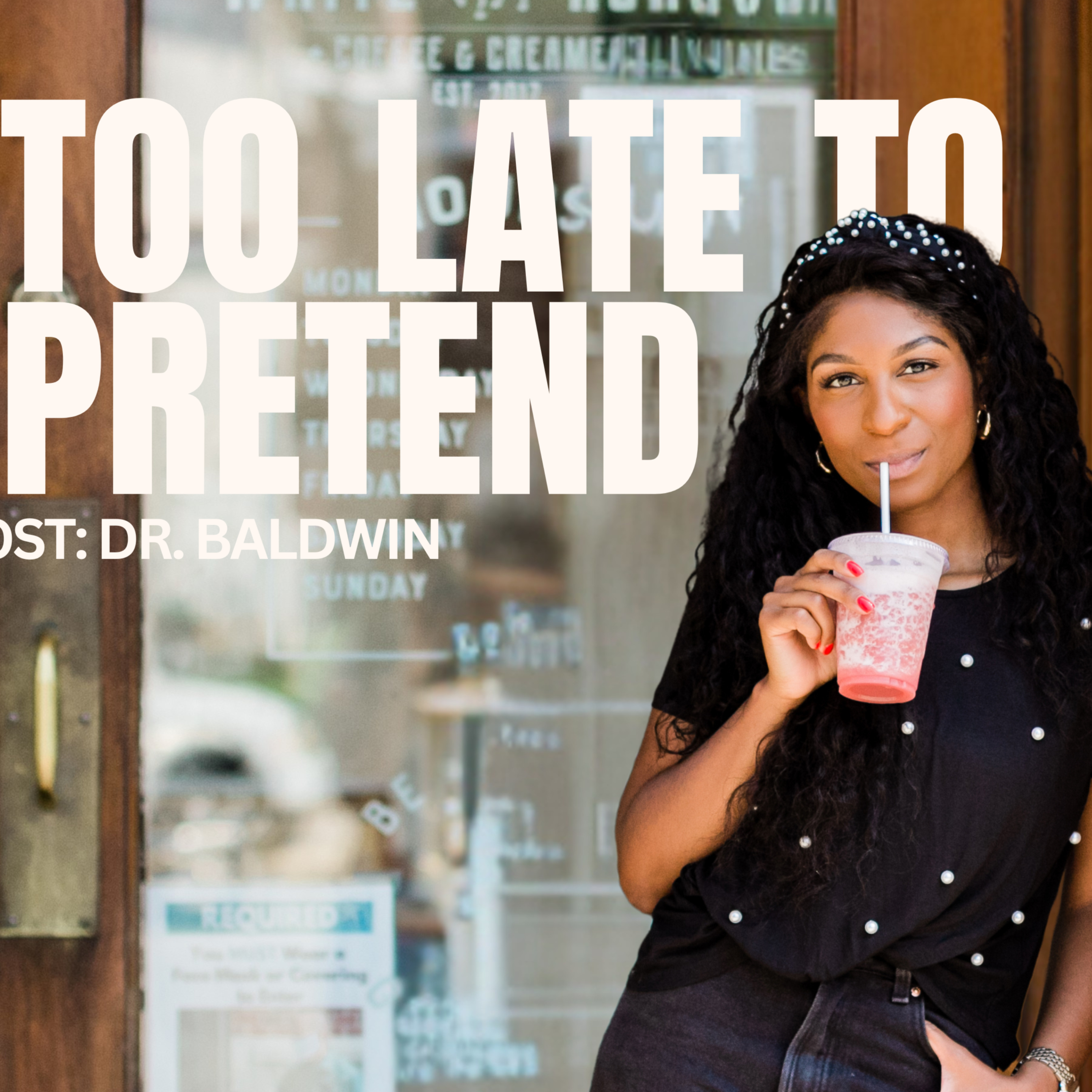
PODCAST · health
Too Late To Pretend
by Dr. Cecelia Baldwin
Welcome to Too Late to Pretend.If you’re here, I’m going to assume something:A part of you is tired. Not tired like “I need a nap.”Tired like… I’m tired of holding it together.Tired of performing.Tired of pretending you’re fine when your body is screaming, and your mind is doing backflips just to get through the day.So let me start by saying this:You’re in the right place.My name is Dr. Baldwin, Licensed Therapist and this is a podcast about mental health, nervous system regulation, relationships, healing, grief, boundaries, and the real work of becoming your most honest self.
-
18
Why the Same Patterns Keep Repeating In Your Life
You're still running an old program.Dr. Cecelia Baldwin breaks down how childhood experiences, even ones from a genuinely loving, "good" home, quietly shape the decisions, relationship patterns, and emotional habits you're living out as an adult. She explains why your brain doesn't automatically update just because you got older, and walks through five concrete, practical steps for identifying and changing the patterns that no longer serve you.You'll learn: → Why your childhood doesn't have to have been traumatic to still be impacting you→ How your brain learned what love, safety, and conflict "should" look like→ Why a good childhood and an impactful one aren't opposites→ The real reason you keep repeating the same relationship and conflict patterns→ 5 practical steps to actually change the pattern — starting with noticing itThis is for you if:— You keep ending up in the same kind of relationship with a different person— You shut down in conflict or say yes when you mean no— You've thought "I had a great childhood, so why am I struggling like this?"— You're ready to understand your patterns instead of just judging yourself for themDisclaimer: The content shared on this page is for informational and educational purposes only and does not constitute psychotherapy, counseling, or any form of professional mental health treatment. Viewing, commenting on, or engaging with this content does not establish a therapist-client relationship. The information provided is general in nature and may not apply to your individual circumstances. Please consult a licensed mental health professional for personalized advice and support.Please note that I am unable to respond to direct messages or comments regarding clinical concerns, personal mental health questions, or requests for therapeutic advice. Social media is not a secure or appropriate platform for clinical communication, and any such messages received will not be answered.If you are experiencing a mental health emergency or crisis, please call or text 988 (Suicide & Crisis Lifeline), call 911, or go to your nearest emergency room.
-
17
How Disrespect Shows Up In Friendships
Some of the people you call friends may not actually be treating you like one. Dr. Baldwin, a licensed therapist, breaks down how disrespect hides inside friendships — disguised as jokes, "honesty," or teasing — and why the moment you push back, the conversation shifts from what they did to what's wrong with you.This episode covers:- Why "I was only joking" is often a deflection, not an explanation- How subtle disrespect (dismissiveness, sarcasm, constant commentary) becomes normalized over time- Where this pattern of disrespect started - The nervous system science behind why criticism and unpredictability activate a real stress response in your body- How to tell the difference between overreacting and correctly identifying disrespect- A simple exercise to track the pattern instead of questioning yourself every timeYou deserve friendships built on respect, not ones you have to brace yourself for.Disclaimer: The content shared on this page is for informational and educational purposes only and does not constitute psychotherapy, counseling, or any form of professional mental health treatment. Viewing, commenting on, or engaging with this content does not establish a therapist-client relationship. The information provided is general in nature and may not apply to your individual circumstances. Please consult a licensed mental health professional for personalized advice and support.Please note that I am unable to respond to direct messages or comments regarding clinical concerns, personal mental health questions, or requests for therapeutic advice. Social media is not a secure or appropriate platform for clinical communication, and any such messages received will not be answered.If you are experiencing a mental health emergency or crisis, please call or text 988 (Suicide & Crisis Lifeline), call 911, or go to your nearest emergency room.
-
16
You Can Love Someone and Still Choose To Leave
Dr. Baldwin unpacks one of the hardest emotional skills there is: duality — the ability to hold two seemingly opposite feelings at the same time without letting one cancel out the other. In this episode, she breaks down why you can love someone deeply and still recognize the relationship isn't safe, why leaving isn't the opposite of loving someone, and how to start trusting your feelings again when your brain has been talking you out of them.What you'll learn in this episode:- Why "love means staying" isn't always true and when it isn't- How to tell the difference between guilt and love when they feel identical- Why red flags are a signal to stop, not a signal to push through- Practical ways to reconnect with your feelings as reliable information (not just noise)- How choosing yourself is not the same as abandoning someone elseIf you've ever felt stuck between loving someone and knowing the relationship is hurting you, this one's for you.Disclaimer: The content shared on this page is for informational and educational purposes only and does not constitute psychotherapy, counseling, or any form of professional mental health treatment. Viewing, commenting on, or engaging with this content does not establish a therapist-client relationship. The information provided is general in nature and may not apply to your individual circumstances. Please consult a licensed mental health professional for personalized advice and support.Please note that I am unable to respond to direct messages or comments regarding clinical concerns, personal mental health questions, or requests for therapeutic advice. Social media is not a secure or appropriate platform for clinical communication, and any such messages received will not be answered.If you are experiencing a mental health emergency or crisis, please call or text 988 (Suicide & Crisis Lifeline), call 911, or go to your nearest emergency room.
-
15
7 Steps to Fix a Relationship (Most People Get This Wrong)
Some relationships are worth fixing — but only if you know how to actually repair them. In this episode of Too Late to Pretend, Dr. Cecelia Baldwin, a licensed therapist, breaks down what real repair looks like after a relationship has been damaged, and why most apologies fail before they even start.She walks through a 7-step framework for repairing a relationship the right way:- Why "I'm sorry things went bad" is avoidance, not acknowledgment- How adding "but" to an apology cancels it out- Why listening to understand (not to defend yourself) rebuilds trust faster than words- The one question most people skip: asking what the other person actually needs- Why apologizing without changed behavior is a form of manipulation- Why you don't get to set the timeline for someone else's healing- Why you need to repair yourself, too — not just the relationshipNot every relationship can or should be repaired. But for the ones worth fighting for, this episode gives you the real steps forward. Disclaimer: The content shared on this page is for informational and educational purposes only and does not constitute psychotherapy, counseling, or any form of professional mental health treatment. Viewing, commenting on, or engaging with this content does not establish a therapist-client relationship. The information provided is general in nature and may not apply to your individual circumstances. Please consult a licensed mental health professional for personalized advice and support.Please note that I am unable to respond to direct messages or comments regarding clinical concerns, personal mental health questions, or requests for therapeutic advice. Social media is not a secure or appropriate platform for clinical communication, and any such messages received will not be answered.If you are experiencing a mental health emergency or crisis, please call or text 988 (Suicide & Crisis Lifeline), call 911, or go to your nearest emergency room.
-
14
If You Weren't Allowed to Say No as a Kid, You'll Struggle With THIS as an Adult
Your boundaries aren't a preference, they're the structure that holds your entire life together. And if no one respected your "no" when you were a kid, chances are you're still struggling to hold that structure up as an adult.In this episode, Dr. Cecelia Baldwin breaks down why boundaries function like the walls of a building: not built to keep people out, but to keep you standing. Most of us were never taught what healthy boundaries even look like. Instead, we were raised in homes, schools, and communities that rewarded selflessness and punished self-protection. When a child's "no" gets overridden again and again, that child grows into an adult who feels guilty, or selfish just trying to set one.This episode covers:- Why boundaries are a developmental process that starts in childhood- How "compliance" and "respect" get confused when kids aren't allowed to say no- Why the guilt you feel setting boundaries comes from old messages, not present reality- A simple starting practice: saying "no, thank you" to something small this weekIf this episode resonated with you, comment below what you thought. Disclaimer: The content shared on this page is for informational and educational purposes only and does not constitute psychotherapy, counseling, or any form of professional mental health treatment. Viewing, commenting on, or engaging with this content does not establish a therapist-client relationship. The information provided is general in nature and may not apply to your individual circumstances. Please consult a licensed mental health professional for personalized advice and support.Please note that I am unable to respond to direct messages or comments regarding clinical concerns, personal mental health questions, or requests for therapeutic advice. Social media is not a secure or appropriate platform for clinical communication, and any such messages received will not be answered.If you are experiencing a mental health emergency or crisis, please call or text 988 (Suicide & Crisis Lifeline), call 911, or go to your nearest emergency room.
-
13
The People You Spend Time With Are Not Neutral
The people around you are either building you up or quietly costing you something, there's no in-between.Dr. Cecelia Baldwin, a licensed therapist, breaks down why your next six months will look exactly like your last six unless two things change: who you're spending your free time with, and what you're spending it doing. She walks through why comfort isn't the same as growth, why familiar relationships can feel safe while still keeping you stuck, and why your nervous system responds to your environment, not your goals.→ Why your environment shapes your thinking more than your willpower does→ The "seed and concrete" metaphor for growth that never happens→ Why familiar (even draining) relationships can feel comfortable→ Two practical exercises to take inventory of your relationships and time→ How to tell if you're growing — or just going in circlesThis one is for you if:→ You feel stuck despite having real goals and real motivation→ You suspect certain relationships are keeping you anchored to an old version of yourself→ You're ready to take an honest inventory of your time and your people, not just your habitsDisclaimer: The content shared on this page is for informational and educational purposes only and does not constitute psychotherapy, counseling, or any form of professional mental health treatment. Viewing, commenting on, or engaging with this content does not establish a therapist-client relationship. The information provided is general in nature and may not apply to your individual circumstances. Please consult a licensed mental health professional for personalized advice and support.Please note that I am unable to respond to direct messages or comments regarding clinical concerns, personal mental health questions, or requests for therapeutic advice. Social media is not a secure or appropriate platform for clinical communication, and any such messages received will not be answered.If you are experiencing a mental health emergency or crisis, please call or text 988 (Suicide & Crisis Lifeline), call 911, or go to your nearest emergency room.
-
12
Are You Staying in This Relationship Too Long? (A Therapist's Perspective)
Are you staying in this relationship too long? Is it time to reevaluate this friendship? Can it be repaired? In this episode, Dr. Cecelia Baldwin, a licensed therapist, walks through her perspective on why so many of us stay in relationships — romantic, friendship, and professional — long after they stop serving us, and how to honestly evaluate the ones you're in right now.→ Why comfort, history, and fear of uncertainty keep people stuck in painful dynamics→ The physical signals your body gives you before your mind catches up→ How chronic relational stress shows up as real, measurable health decline→ Why most people can't name what they actually need from a relationship→ A step-by-step action plan for evaluating who belongs in your next chapterThis is for you if:✔ You've felt a weight in your chest before a phone call or conversation✔ You're more yourself away from someone than you are with them✔ You've been avoiding a conversation you know you need to have✔ You're trying to figure out which relationships deserve your energy going forwardDisclaimer: The content shared on this page is for informational and educational purposes only and does not constitute psychotherapy, counseling, or any form of professional mental health treatment. Viewing, commenting on, or engaging with this content does not establish a therapist-client relationship. The information provided is general in nature and may not apply to your individual circumstances. Please consult a licensed mental health professional for personalized advice and support.Please note that I am unable to respond to direct messages or comments regarding clinical concerns, personal mental health questions, or requests for therapeutic advice. Social media is not a secure or appropriate platform for clinical communication, and any such messages received will not be answered.If you are experiencing a mental health emergency or crisis, please call or text 988 (Suicide & Crisis Lifeline), call 911, or go to your nearest emergency room.
-
11
How to Start Expressing Your Feelings (Even If It Terrifies You)
If you don't practice expressing your feelings, you might watch your soulmate marry someone else.Dr. Cecelia Baldwin, a licensed therapist, breaks down why so many people shut down instead of speaking up, and what that silence is actually costing them. Your feelings are not the problem, you were never taught that it was safe to have them.You'll learn:→ Why anger is often a sign every other emotion has been suppressed→ Why holding it in doesn't protect you, it isolates you→ The 3-step framework to start building emotional expression: name it privately, say it safe, expand slowly→ Why vulnerability isn't for everyone, but it is for the people who've earned your trustThis is for you if you've ever stayed quiet when you should have said what you really felt, or you've been told you need to "work on your anger" when really, anger is the only feeling you've ever been allowed to show.Leave a comment. Send this to a friend who needs it.Disclaimer: The content shared on this page is for informational and educational purposes only and does not constitute psychotherapy, counseling, or any form of professional mental health treatment. Viewing, commenting on, or engaging with this content does not establish a therapist-client relationship. The information provided is general in nature and may not apply to your individual circumstances. Please consult a licensed mental health professional for personalized advice and support.Please note that I am unable to respond to direct messages or comments regarding clinical concerns, personal mental health questions, or requests for therapeutic advice. Social media is not a secure or appropriate platform for clinical communication, and any such messages received will not be answered.If you are experiencing a mental health emergency or crisis, please call or text 988 (Suicide & Crisis Lifeline), call 911, or go to your nearest emergency room.
-
10
Visualization Is The Key To Change
Change doesn't happen just because you think about it. Change happens when you can actually picture it.In this episode, Dr. Cecelia Baldwin breaks down the role imagination plays in whether people heal, grow, or stay stuck and why so many people never even realize their imagination is the missing piece. She explains how trauma and chronic stress disrupt the brain's ability to picture anything different, why the brain doesn't fully separate what's imagined from what's real, and how visualization can become a rehearsal for the life someone actually wants to live.→ Why talking about change isn't enough to create it→ How imagination works as a cognitive function, not just creativity→ Why trauma collapses the ability to picture a different future→ How visualization activates the same neural pathways as real action→ A simple two-minute practice to start rebuilding that capacityIf you want to start changing your life for the better, this episode is for you. Disclaimer: The content shared on this page is for informational and educational purposes only and does not constitute psychotherapy, counseling, or any form of professional mental health treatment. Viewing, commenting on, or engaging with this content does not establish a therapist-client relationship. The information provided is general in nature and may not apply to your individual circumstances. Please consult a licensed mental health professional for personalized advice and support.Please note that I am unable to respond to direct messages or comments regarding clinical concerns, personal mental health questions, or requests for therapeutic advice. Social media is not a secure or appropriate platform for clinical communication, and any such messages received will not be answered.If you are experiencing a mental health emergency or crisis, please call or text 988 (Suicide & Crisis Lifeline), call 911, or go to your nearest emergency room.
-
9
Are You Jealous Of Your Friend? (Most People Won't Admit This)
Nobody wants to admit they're the jealous friend. But if so many people are experiencing jealousy from others — somebody has to be on the other side of that equation.In this episode, Dr. Cecelia Baldwin, licensed therapist, tackles the part of friendship jealousy that almost no one is willing to examine: the jealousy we carry ourselves. → Why jealousy is information, not a character flaw — and what it's actually pointing to→ The difference between jealousy and grief, and why so much of what we feel is really the latter→ How unmanaged jealousy silently changes your behavior and damages friendships over time→ The self-reflection exercise that traces a feeling all the way back to its real source→ What emotional maturity actually looks like when jealousy shows up in a friendship→ Why the healthiest people aren't the ones who never feel jealous — they're the ones who know what to do when they doThis episode is not here to make you feel bad, instead it's a mirror so you can heal and show up as a better friend by telling the whole truth. Disclaimer: The content shared on this page is for informational and educational purposes only and does not constitute psychotherapy, counseling, or any form of professional mental health treatment. Viewing, commenting on, or engaging with this content does not establish a therapist-client relationship. The information provided is general in nature and may not apply to your individual circumstances. Please consult a licensed mental health professional for personalized advice and support.Please note that I am unable to respond to direct messages or comments regarding clinical concerns, personal mental health questions, or requests for therapeutic advice. Social media is not a secure or appropriate platform for clinical communication, and any such messages received will not be answered.If you are experiencing a mental health emergency or crisis, please call or text 988 (Suicide & Crisis Lifeline), call 911, or go to your nearest emergency room.
-
8
People Pleasing Is Destroying Your Mental Health
People pleasing is one of the most destructive relational patterns Dr. Baldwin sees in therapy. Most people have no idea it started in childhood, as a survival strategy, long before they could understand what was happening. In this episode, she breaks down where this pattern actually comes from, why it mimics anxiety and depression, and why it doesn't even guarantee the connection you're working so hard to protect.→ How people pleasing develops in childhood, before you have the words for it→ Why it's less about kindness and more about control through approval→ The anxiety overlap: overthinking, second-guessing, social hypervigilance→ Why people pleasing can eventually start to look like depression→ A real first step: noticing the gap between what's being asked and what you feel→ How to start small, with the people who already feel safeThis is for you if you've ever agreed to something and immediately regretted it, if you're exhausted from managing everyone else's reactions, or if you've started to lose track of what you even want anymore.Disclaimer: The content shared on this page is for informational and educational purposes only and does not constitute psychotherapy, counseling, or any form of professional mental health treatment. Viewing, commenting on, or engaging with this content does not establish a therapist-client relationship. The information provided is general in nature and may not apply to your individual circumstances. Please consult a licensed mental health professional for personalized advice and support.Please note that I am unable to respond to direct messages or comments regarding clinical concerns, personal mental health questions, or requests for therapeutic advice. Social media is not a secure or appropriate platform for clinical communication, and any such messages received will not be answered.If you are experiencing a mental health emergency or crisis, please call or text 988 (Suicide & Crisis Lifeline), call 911, or go to your nearest emergency room.
-
7
Self-Awareness Is the Foundation of Every Healthy Relationship
If you've ever felt like you're carrying the weight of a relationship alone, over-explaining, over-apologizing, constantly questioning yourself, this episode is about the reason why that keeps happening.Dr. Baldwin breaks down the one skill that changes everything in your relationships: self-awareness. Not self-knowledge. Not knowing your history or your diagnosis or your attachment style. Real-time, honest, in-the-moment awareness of yourself: what you're feeling, what you're repeating, and what role you're actually playing in your own experience.You'll learn: → Why knowing your story isn't the same as being self-aware→ What it looks like to be in a relationship with someone who lacks self-awareness — and what it costs you→ Why "better communication" is not the answer to a self-awareness problem→ How self-awareness is multidimensional — it doesn't just change how you see yourself, it changes who you choose→ The 3 practical tools to start building it: the daily honesty check, pattern noticing, and the relationship audit→ The two questions you need to answer honestly before you go any furtherIt starts with you and that's where the real power is.This episode is for you if you keep ending up in the same dynamics, feel unseen in your relationships, or know something needs to change but can't quite name what it is.Disclaimer: The content shared on this page is for informational and educational purposes only and does not constitute psychotherapy, counseling, or any form of professional mental health treatment. Viewing, commenting on, or engaging with this content does not establish a therapist-client relationship. The information provided is general in nature and may not apply to your individual circumstances. Please consult a licensed mental health professional for personalized advice and support.Please note that I am unable to respond to direct messages or comments regarding clinical concerns, personal mental health questions, or requests for therapeutic advice. Social media is not a secure or appropriate platform for clinical communication, and any such messages received will not be answered.If you are experiencing a mental health emergency or crisis, please call or text 988 (Suicide & Crisis Lifeline), call 911, or go to your nearest emergency room.
-
6
Depression Is the #1 Cause of Disability Worldwide And Most People Don't Know Why
Depression is the leading cause of disability worldwide. Not because people aren't trying hard enough but because most of us have been handed the wrong tools.Dr. Cecelia Baldwin breaks it down differently. Dr. Cecelia Baldwin is a licensed therapist with nearly two decades of clinical experience in anxiety, trauma, and relational patterns. In this episode, she unpacks what depression actually is at the nervous system level, why "talking about it" can sometimes make things worse, and what the research actually says breaks the depressive cycle.→ Why depression is a nervous system state, not just a thinking problem→ What "depression" literally means — and why the word itself tells you what's happening in your body→ The hormones depression disrupts (and what that explains about your symptoms)→ The depressive cycle: what keeps people stuck and why it's so predictable→ Why mood follows behavior — not the other way around→ The difference between processing and rumination (and why it matters)→ What "widening the lens" looks like when depression narrows your reality→ Three things to do if you're in a depressive cycle right nowThis is for you if you're exhausted from analyzing why you feel the way you feel and you're ready for something that actually moves you forward.Disclaimer: The content shared on this page is for informational and educational purposes only and does not constitute psychotherapy, counseling, or any form of professional mental health treatment. Viewing, commenting on, or engaging with this content does not establish a therapist-client relationship. The information provided is general in nature and may not apply to your individual circumstances. Please consult a licensed mental health professional for personalized advice and support.Please note that I am unable to respond to direct messages or comments regarding clinical concerns, personal mental health questions, or requests for therapeutic advice. Social media is not a secure or appropriate platform for clinical communication, and any such messages received will not be answered.If you are experiencing a mental health emergency or crisis, please call or text 988 (Suicide & Crisis Lifeline), call 911, or go to your nearest emergency room.
-
5
Stop Handing Unstable People the Keys to Your Nervous System
You've done the work. You've read the books, gone to therapy, tried to stay positive and yet somehow, you keep ending up right back where you started. Exhausted and dysregulated. Wondering what you're missing.This is for the people who are fighting hard to heal but keep getting pulled back into survival mode by the unstable, emotionally reckless people around them.In this episode, Dr. Cecelia Baldwin breaks down why mental health is not just about mindset — it's about protection. And she gives you seven concrete things to start doing differently right now.→ Why your body already knows what your mind hasn't admitted yet→ The difference between compassion and access — and why confusing them is costing you→ Why you need to protect your routines like your mental health depends on it (because it does)→ How growing up in chaos can make peace feel boring, suspicious, or just wrong→ Why your identity needs to be bigger than your pain→ The hard truth about people who don't have the capacity to love you safely→ Why your healing cannot depend on someone else finally becoming who they promisedThis episode is for you if you're doing everything right and still feel exhausted, you keep ending up in the same cycles with the same people, or you've started to wonder if maybe the problem isn't just your thinking.Disclaimer: The content shared on this page is for informational and educational purposes only and does not constitute psychotherapy, counseling, or any form of professional mental health treatment. Viewing, commenting on, or engaging with this content does not establish a therapist-client relationship. The information provided is general in nature and may not apply to your individual circumstances. Please consult a licensed mental health professional for personalized advice and support.Please note that I am unable to respond to direct messages or comments regarding clinical concerns, personal mental health questions, or requests for therapeutic advice. Social media is not a secure or appropriate platform for clinical communication, and any such messages received will not be answered.If you are experiencing a mental health emergency or crisis, please call or text 988 (Suicide & Crisis Lifeline), call 911, or go to your nearest emergency room.
-
4
What If Mother's Day and Father's Day Don't Feel Like Celebrations?
Some days are supposed to feel celebratory. And for a lot of people, they just don't.Mother's Day and Father's Day are everywhere — cards, posts, brunch reservations, the word "happy" built right into the name. But for many people, these holidays don't bring gratitude or warmth. They bring grief, complicated memories, and a weight that's hard to explain to people who've never felt it.In this episode, Dr. Cecelia Baldwin breaks down what's really happening when Mother's Day and Father's Day hurt:→ The difference between grief from death and grief from estrangement — and why they move through the mind and body so differently→ What "ambiguous loss" actually means, and why it keeps the nervous system stuck in loops of hope, disappointment, and self-doubt→ Why some people spend years trying to fix a relationship from their side — overextending, explaining, adjusting, forgiving — and why effort alone can't create capacity in someone else→ The invisible pressure to perform gratitude publicly when the holiday doesn't match your reality→ Seven practical coping strategies from a family systems lens — including how to stop arguing with reality, how to grieve the unmet need directly, and what "closure" actually looks like when it's not coming from the other person→ Why healing from estrangement isn't about reconciliation — it's about returning to yourselfIf these holidays feel heavy, if you've spent years trying to earn a relationship that never felt safe, or if you're carrying grief for a parent who is still alive — this one's for you.Disclaimer: The content shared on this page is for informational and educational purposes only and does not constitute psychotherapy, counseling, or any form of professional mental health treatment. Viewing, commenting on, or engaging with this content does not establish a therapist-client relationship. The information provided is general in nature and may not apply to your individual circumstances. Please consult a licensed mental health professional for personalized advice and support.Please note that I am unable to respond to direct messages or comments regarding clinical concerns, personal mental health questions, or requests for therapeutic advice. Social media is not a secure or appropriate platform for clinical communication, and any such messages received will not be answered.If you are experiencing a mental health emergency or crisis, please call or text 988 (Suicide & Crisis Lifeline), call 911, or go to your nearest emergency room.
-
3
Nobody Talks About What It's Like to Grow Up With a Parent Who Has a Mental Illness
Nobody talks enough about what it's like to grow up in a home where mental illness is present and that silence has a cost. Most conversations about mental health center the person experiencing the illness. But what about the children who were right there, developing alongside it? What about the nervous systems being built inside that emotional climate, without the language or capacity to understand what they were living with?In this episode, Dr. Cecelia Baldwin breaks down what actually happens to the brain and nervous system of a child growing up in a home with parental mental illness and what that means for the adults those children become. This is not blaming the parents or the people struggling, instead this video is meant to raise awareness for how these family systems repeat and continue. → Why children in these homes become hypervigilant, people-pleasing, and hyper-attuned to other people's moods→ The role reversal that happens when kids become emotional caretakers for their parents→ How survival adaptations from childhood follow us into adult relationships, parenting, and the workplace→ Why you might have a high tolerance for chaos — and what that's actually about→ The difference between impact and intention (and why both can be true at the same time)→ What self-care actually means when you grew up under chronic emotional stress→ How to begin separating who you are from what you had to adapt toDisclaimer: The content shared on this page is for informational and educational purposes only and does not constitute psychotherapy, counseling, or any form of professional mental health treatment. Viewing, commenting on, or engaging with this content does not establish a therapist-client relationship. The information provided is general in nature and may not apply to your individual circumstances. Please consult a licensed mental health professional for personalized advice and support.Please note that I am unable to respond to direct messages or comments regarding clinical concerns, personal mental health questions, or requests for therapeutic advice. Social media is not a secure or appropriate platform for clinical communication, and any such messages received will not be answered.If you are experiencing a mental health emergency or crisis, please call or text 988 (Suicide & Crisis Lifeline), call 911, or go to your nearest emergency room.
-
2
Stop Giving Second Chances to People Who Haven't Changed
Nobody wants to hear this, but it needs to be said. Not everyone deserves a second chance. And giving one doesn't make you more evolved, more enlightened, or more emotionally mature. It just means you made a decision. The question is whether that decision is an informed one.In this episode, Dr. Cecelia Baldwin gets into the one thing that actually earns a second chance. It's not an apology, it's not time, and it's not them saying they've changed. It's a full perspective shift. The kind you can feel in the room before they even open their mouth.You'll hear: → What separates a real second chance from giving someone permission to hurt you again→ Why contempt is the quiet relationship killer → What it actually looks like to forgive someone fully vs. letting them back in while keeping them on trial→ A real example of a second chance done right and what happens when the pattern repeatsIf you've been wrestling with whether to let someone back in, or you already did and something still feels off, this one's for you.Disclaimer: The content shared on this page is for informational and educational purposes only and does not constitute psychotherapy, counseling, or any form of professional mental health treatment. Viewing, commenting on, or engaging with this content does not establish a therapist-client relationship. The information provided is general in nature and may not apply to your individual circumstances. Please consult a licensed mental health professional for personalized advice and support.Please note that I am unable to respond to direct messages or comments regarding clinical concerns, personal mental health questions, or requests for therapeutic advice. Social media is not a secure or appropriate platform for clinical communication, and any such messages received will not be answered.If you are experiencing a mental health emergency or crisis, please call or text 988 (Suicide & Crisis Lifeline), call 911, or go to your nearest emergency room.
-
1
You Were Never Taught How to Recognize Negative Patterns (A Therapist Shows You How)
Nobody ever taught you how to spot a negative pattern while you're inside one. So you keep ending up in the same conversation, the same tension, the same outcome — and wondering why nothing changes.In this episode, Dr. Baldwin breaks down what negative interactional patterns actually are and why so many people spend years experiencing them without ever having the language to name them. Once you can name it, something shifts.→ What a negative interactional pattern actually is (and why you're part of it)→ Why your brain defaults to familiar pain over unfamiliar safety→ The 3-step framework therapists use: See it. Understand it. Respond to it.→ What "building capacity" really means — and why it's the actual goal of healing→ How holding a boundary can literally break the cycleThis one is short and practical. If you have something to write with, grab it.Disclaimer: The content shared on this page is for informational and educational purposes only and does not constitute psychotherapy, counseling, or any form of professional mental health treatment. Viewing, commenting on, or engaging with this content does not establish a therapist-client relationship. The information provided is general in nature and may not apply to your individual circumstances. Please consult a licensed mental health professional for personalized advice and support.Please note that I am unable to respond to direct messages or comments regarding clinical concerns, personal mental health questions, or requests for therapeutic advice. Social media is not a secure or appropriate platform for clinical communication, and any such messages received will not be answered.If you are experiencing a mental health emergency or crisis, please call or text 988 (Suicide & Crisis Lifeline), call 911, or go to your nearest emergency room.
-
0
Your Family Doesn't Celebrate You (A Therapist Explains Why)
Your family loves you. And somehow, every time you share good news, you feel worse after than you did before.That's not a coincidence and it's not your imagination.After Dr. Baldwin's episode on comparative friendships blew up her comment section, the messages that kept pouring in weren't just about friends. They were about mothers. Fathers. Sisters. Brothers. So she recorded this.In this episode, Dr. Baldwin, a formally trained marriage and family therapist who spent the first eight years of her career working with high-conflict families, breaks down what's actually happening when envy lives inside a family system, and why it almost never announces itself honestly.What we get into:→ The difference between jealousy and envy, and why it matters in family dynamics→ Why family envy is almost always rooted in a wound that existed before you did→ How siblings can grow up in the same house and have completely different experiences — and what that does→ Why a parent's unhealed pain can make your success feel like a verdict to them→ What it actually looks like to protect your inner world inside a family that expected full access→ The five concrete things Dr. Baldwin tells her clients to do when they're navigating thisDisclaimer: The content shared on this page is for informational and educational purposes only and does not constitute psychotherapy, counseling, or any form of professional mental health treatment. Viewing, commenting on, or engaging with this content does not establish a therapist-client relationship. The information provided is general in nature and may not apply to your individual circumstances. Please consult a licensed mental health professional for personalized advice and support.Please note that I am unable to respond to direct messages or comments regarding clinical concerns, personal mental health questions, or requests for therapeutic advice. Social media is not a secure or appropriate platform for clinical communication, and any such messages received will not be answered.If you are experiencing a mental health emergency or crisis, please call or text 988 (Suicide & Crisis Lifeline), call 911, or go to your nearest emergency room.
-
-1
You Don't Have to Do Life Alone | How To Build A Support System
You're carrying too much alone.Dr. Cecelia Baldwin has spent nearly 20 years as a licensed therapist, and she keeps seeing the same pattern: brilliant, capable, motivated people completely exhausted because they don't have a real support system around them.In this episode, Dr. Baldwin breaks down exactly what a support system is (hint: it's not just having people around you), why your nervous system literally depends on connection to function, and how to start building one, even if your family never gave you that foundation.This is the third pillar in Dr. Baldwin's framework for making life more manageable. If you missed the episodes on self-care and boundaries, check those out too — they all work together.This is for you if you've been feeling overwhelmed, isolated, or like you have to handle everything yourself — and you're ready to stop.Disclaimer: The content shared on this page is for informational and educational purposes only and does not constitute psychotherapy, counseling, or any form of professional mental health treatment. Viewing, commenting on, or engaging with this content does not establish a therapist-client relationship. The information provided is general in nature and may not apply to your individual circumstances. Please consult a licensed mental health professional for personalized advice and support.Please note that I am unable to respond to direct messages or comments regarding clinical concerns, personal mental health questions, or requests for therapeutic advice. Social media is not a secure or appropriate platform for clinical communication, and any such messages received will not be answered.If you are experiencing a mental health emergency or crisis, please call or text 988 (Suicide & Crisis Lifeline), call 911, or go to your nearest emergency room.
-
-2
This is what boundaries are really about (and what not having them costs you)
You've heard you need boundaries. But nobody told you what they're actually for — or what it's quietly costing you not to have them.In this episode, Dr. Cecelia breaks down what boundaries really are — and it's not what most people think.→ Why boundaries are protective infrastructure, not just a way to shut people out→ How your nervous system responds when you have no boundaries (hint: constant alert)→ The energy system your body runs on — and how boundaries literally keep it full→ Real examples: your sleep, your lunch, your mental space, your late-night texts→ Why saying "I can't do that" without explaining is one of the hardest practices you'll ever do→ Small, daily boundary actions that actually change your lifeEvery time you say yes when you mean no, you lose a little piece of yourself. This episode is the reminder you needed.Disclaimer: The content shared on this page is for informational and educational purposes only and does not constitute psychotherapy, counseling, or any form of professional mental health treatment. Viewing, commenting on, or engaging with this content does not establish a therapist-client relationship. The information provided is general in nature and may not apply to your individual circumstances. Please consult a licensed mental health professional for personalized advice and support.Please note that I am unable to respond to direct messages or comments regarding clinical concerns, personal mental health questions, or requests for therapeutic advice. Social media is not a secure or appropriate platform for clinical communication, and any such messages received will not be answered.If you are experiencing a mental health emergency or crisis, please call or text 988 (Suicide & Crisis Lifeline), call 911, or go to your nearest emergency room.
-
-3
The Self-Care Industry Lied to You (Here's What It Actually Is)
You've been told self-care is a spa day, a candle, a green juice, or a shopping spree. After nearly 20 years as a licensed therapist, Dr. Baldwin is here to tell you: that's not self-care — that's marketing.Self-care is the foundation of your entire life. Your health, your relationships, your ability to show up for the people you love — all of it flows from how well you care for yourself. And the billion-dollar wellness industry depends on you never learning that.In this episode, Dr. Baldwin breaks it all the way down: what "self" actually means (your brain, body, nervous system, and patterns — all working as a system), why real self-care is behavioral and not aesthetic, what your body actually needs to function, and how to start building habits that will transform your life — no supplements required.Disclaimer: The content shared on this page is for informational and educational purposes only and does not constitute psychotherapy, counseling, or any form of professional mental health treatment. Viewing, commenting on, or engaging with this content does not establish a therapist-client relationship. The information provided is general in nature and may not apply to your individual circumstances. Please consult a licensed mental health professional for personalized advice and support.Please note that I am unable to respond to direct messages or comments regarding clinical concerns, personal mental health questions, or requests for therapeutic advice. Social media is not a secure or appropriate platform for clinical communication, and any such messages received will not be answered.If you are experiencing a mental health emergency or crisis, please call or text 988 (Suicide & Crisis Lifeline), call 911, or go to your nearest emergency room.
-
-4
Why Does This "Friend" Make You Feel Weird? | How Envy Shows Up in Friendship
You know this person. They're there when things go wrong. They're there when things go right. But being around them always leaves you feeling a little smaller.In this episode, Dr. Baldwin breaks down the psychology of the "frenemy" — what's actually happening beneath the surface of these confusing friendships, why envy looks so different from jealousy, and how to stop managing someone else's unresolved wounds at the cost of your own joy.In this episode:- The difference between jealousy and envy (and why it matters)- What a "comparative relationship" really is — and how to spot one- Why some people are drawn to your energy but quietly resent you for having it- How proximity-based friendships can outlast their expiration date- How to build adult friendships grounded in values, not just vibes- Practical steps: listening to your nervous system, letting people show you who they are, and graceful exitsIf you've ever felt like you had to soften your good news around a certain person, this episode is for you.Disclaimer: The content shared on this page is for informational and educational purposes only and does not constitute psychotherapy, counseling, or any form of professional mental health treatment. Viewing, commenting on, or engaging with this content does not establish a therapist-client relationship. The information provided is general in nature and may not apply to your individual circumstances. Please consult a licensed mental health professional for personalized advice and support.Please note that I am unable to respond to direct messages or comments regarding clinical concerns, personal mental health questions, or requests for therapeutic advice. Social media is not a secure or appropriate platform for clinical communication, and any such messages received will not be answered.If you are experiencing a mental health emergency or crisis, please call or text 988 (Suicide & Crisis Lifeline), call 911, or go to your nearest emergency room.
-
-5
Building Capacity: The Part of Anxiety Recovery Nobody Talks About
This is the episode about what happens after you've gotten out of the anxiety spiral when you've done the breathing, you've done the regulation, and you still keep ending up back at square one after a hard week.In this episode, Dr. Cecelia Baldwin introduces the concept of capacity: what it actually means to lower your nervous system's baseline so anxiety has less ground to work with in the first place. This is the foundation underneath all of them.In this episode:→ Why managing anxiety and building resilience are not the same thing — and why you need both→ What your nervous system's "baseline" actually is, and what happens when it's chronically elevated→ The 4 areas that shift your baseline over time: sleep, avoidance, connection, and meaning→ Why avoidance feels like relief but quietly makes anxiety louder — and what to do instead→ What the research shows happens in your brain after even one night of poor sleep→ The one root cause of anxiety that no amount of coping will fixThis is Part 3 of a 3-part series on anxiety. Episode 1 covers what anxiety actually is. Episode 2 covers in-the-moment regulation tools. This episode is the longer game.This episode is for you if you've been doing the work — and you're ready to go deeper.Disclaimer: The content shared on this page is for informational and educational purposes only and does not constitute psychotherapy, counseling, or any form of professional mental health treatment. Viewing, commenting on, or engaging with this content does not establish a therapist-client relationship. The information provided is general in nature and may not apply to your individual circumstances. Please consult a licensed mental health professional for personalized advice and support.Please note that I am unable to respond to direct messages or comments regarding clinical concerns, personal mental health questions, or requests for therapeutic advice. Social media is not a secure or appropriate platform for clinical communication, and any such messages received will not be answered.If you are experiencing a mental health emergency or crisis, please call or text 988 (Suicide & Crisis Lifeline), call 911, or go to your nearest emergency room.
-
-6
5 ways to actually calm your nervous system when you're anxious (not just your thoughts)
If you've ever tried to talk yourself down from anxiety and it just… didn't work — this episode explains why, and what to actually do instead.This is episode two of a three-part series on anxiety with Dr. Cecelia Baldwin, licensed therapist. In episode one, we reframed what anxiety actually is: not a personality flaw or a sign something's broken in you, but a physiological stress response. This episode builds on that foundation and moves into something practical — what regulation actually means, and five research-backed strategies that work at the level of the body, not just the mind.Here's the core idea: anxiety is not just a thought problem. When your nervous system is activated, your heart rate is up, your muscles are tight, your breathing is short, and your brain's threat-detection system is running the show. You cannot think your way out of that physical state. What you can do is give your body what it needs to come back down.Disclaimer: The content shared on this page is for informational and educational purposes only and does not constitute psychotherapy, counseling, or any form of professional mental health treatment. Viewing, commenting on, or engaging with this content does not establish a therapist-client relationship. The information provided is general in nature and may not apply to your individual circumstances. Please consult a licensed mental health professional for personalized advice and support.Please note that I am unable to respond to direct messages or comments regarding clinical concerns, personal mental health questions, or requests for therapeutic advice. Social media is not a secure or appropriate platform for clinical communication, and any such messages received will not be answered.If you are experiencing a mental health emergency or crisis, please call or text 988 (Suicide & Crisis Lifeline), call 911, or go to your nearest emergency room.
-
-7
Anxiety is a Response, Not Your Personality | Part 1 of 3
If you've ever said "I'm just an anxious person" — this episode is for you.Anxiety is one of the most common reasons people seek therapy. But most of us have been thinking about it wrong. We've turned a nervous system response into a personality trait — and that shift in language determines everything: what we avoid, what we attempt, and how much space anxiety gets to take.In this episode, Dr. Cecelia Baldwin breaks down what anxiety actually is — not as a diagnosis or a character flaw, but as a built-in survival mechanism that your body has been using since before you were born. Once you understand what's really happening, you can start working with it instead of being controlled by it.In this episode:→ Why anxiety shows up even when nothing is "wrong"→ The nervous system science behind racing thoughts and physical tension→ Why your body can't tell the difference between a real threat and a worried thought→ The story layer that makes anxiety worse than the original trigger→ 4 practical shifts you can try this weekThis is Part 1 of a 3-part series on anxiety. Episode 2 covers in-the-moment regulation. Episode 3 covers how to build long-term capacity so anxiety stops running the show.This episode is for you if you're just starting to explore why you feel the way you feel — and you're ready to understand, not just cope.Disclaimer: The content shared on this page is for informational and educational purposes only and does not constitute psychotherapy, counseling, or any form of professional mental health treatment. Viewing, commenting on, or engaging with this content does not establish a therapist-client relationship. The information provided is general in nature and may not apply to your individual circumstances. Please consult a licensed mental health professional for personalized advice and support.Please note that I am unable to respond to direct messages or comments regarding clinical concerns, personal mental health questions, or requests for therapeutic advice. Social media is not a secure or appropriate platform for clinical communication, and any such messages received will not be answered.If you are experiencing a mental health emergency or crisis, please call or text 988 (Suicide & Crisis Lifeline), call 911, or go to your nearest emergency room.
-
-8
Your Body Remembers What Your Mind Forgot | Trauma & the Nervous System Explained
You've wondered why you shut down. Why you overreact to things that shouldn't bother you. Why you feel anxious even when nothing is "logically" wrong.In this episode of Too Late to Pretend, Dr. Cecelia Baldwin — a certified trauma professional with advanced clinical training — breaks down one of the most misunderstood truths about trauma: it's not about the story. It's about the imprint.Most people believe that if they can't remember something, it didn't affect them. But your nervous system doesn't work that way. Your body records experiences in ways that don't always turn into words — and that stored charge can shape how you feel, react, and relate to people for years without you even knowing why.Disclaimer: The content shared on this page is for informational and educational purposes only and does not constitute psychotherapy, counseling, or any form of professional mental health treatment. Viewing, commenting on, or engaging with this content does not establish a therapist-client relationship. The information provided is general in nature and may not apply to your individual circumstances. Please consult a licensed mental health professional for personalized advice and support.Please note that I am unable to respond to direct messages or comments regarding clinical concerns, personal mental health questions, or requests for therapeutic advice. Social media is not a secure or appropriate platform for clinical communication, and any such messages received will not be answered.If you are experiencing a mental health emergency or crisis, please call or text 988 (Suicide & Crisis Lifeline), call 911, or go to your nearest emergency room.
-
-9
If you’re here, you know insight alone doesn't heal you
You're not broken. You're bracing.In Episode 2 of Too Late to Pretend, Dr. Baldwin breaks down one of the most misunderstood truths about trauma. It is not a memory you can just think through. It lives in your body.If you have ever felt like you understand your past but still can't stop reacting to it, this episode explains exactly why.Connect with Dr. Baldwin on Instagram https://www.instagram.com/dr.celia/?hl=enDisclaimer: The content shared on this page is for informational and educational purposes only and does not constitute psychotherapy, counseling, or any form of professional mental health treatment. Viewing, commenting on, or engaging with this content does not establish a therapist-client relationship. The information provided is general in nature and may not apply to your individual circumstances. Please consult a licensed mental health professional for personalized advice and support.Please note that I am unable to respond to direct messages or comments regarding clinical concerns, personal mental health questions, or requests for therapeutic advice. Social media is not a secure or appropriate platform for clinical communication, and any such messages received will not be answered.If you are experiencing a mental health emergency or crisis, please call or text 988 (Suicide & Crisis Lifeline), call 911, or go to your nearest emergency room.
-
-10
If you're here, it's because you're tired of pretending | Too Late To Pretend Episode 1
Welcome to Too Late to Pretend.If you’re here, I’m going to assume something:A part of you is tired. Not tired like “I need a nap.”Tired like… I’m tired of holding it together.Tired of performing.Tired of pretending you’re fine when your body is screaming, and your mind is doing backflips just to get through the day.So let me start by saying this:You’re in the right place.My name is Dr. Baldwin, Licensed Therapist and this is a podcast about mental health, nervous system regulation, relationships, healing, grief, boundaries, and the real work of becoming your most honest self.Connect with me on Instagram: https://www.instagram.com/dr.celia/
-
-11
Welcome To Too Late To Pretend
This is Too Late To Pretend with Dr.Cecelia Baldwin
We're indexing this podcast's transcripts for the first time — this can take a minute or two. We'll show results as soon as they're ready.
No matches for "" in this podcast's transcripts.
No topics indexed yet for this podcast.
Loading reviews...
ABOUT THIS SHOW
Welcome to Too Late to Pretend.If you’re here, I’m going to assume something:A part of you is tired. Not tired like “I need a nap.”Tired like… I’m tired of holding it together.Tired of performing.Tired of pretending you’re fine when your body is screaming, and your mind is doing backflips just to get through the day.So let me start by saying this:You’re in the right place.My name is Dr. Baldwin, Licensed Therapist and this is a podcast about mental health, nervous system regulation, relationships, healing, grief, boundaries, and the real work of becoming your most honest self.
HOSTED BY
Dr. Cecelia Baldwin
Loading similar podcasts...
Frequently Asked Questions
How many episodes does Too Late To Pretend have?
Too Late To Pretend currently has 30 episodes available on PodParley. New episodes are automatically indexed when they're published to the podcast feed.
What is Too Late To Pretend about?
Welcome to Too Late to Pretend.If you’re here, I’m going to assume something:A part of you is tired. Not tired like “I need a nap.”Tired like… I’m tired of holding it together.Tired of performing.Tired of pretending you’re fine when your body is screaming, and your mind is doing backflips just to...
How often does Too Late To Pretend release new episodes?
Too Late To Pretend has 30 episodes. Check the episode list to see recent publication dates and frequency.
Where can I listen to Too Late To Pretend?
You can listen to Too Late To Pretend on PodParley by clicking any episode. We provide an embedded audio player for direct listening, and you can also subscribe via your preferred podcast app using the RSS feed.
Who hosts Too Late To Pretend?
Too Late To Pretend is created and hosted by Dr. Cecelia Baldwin.
URL copied to clipboard!