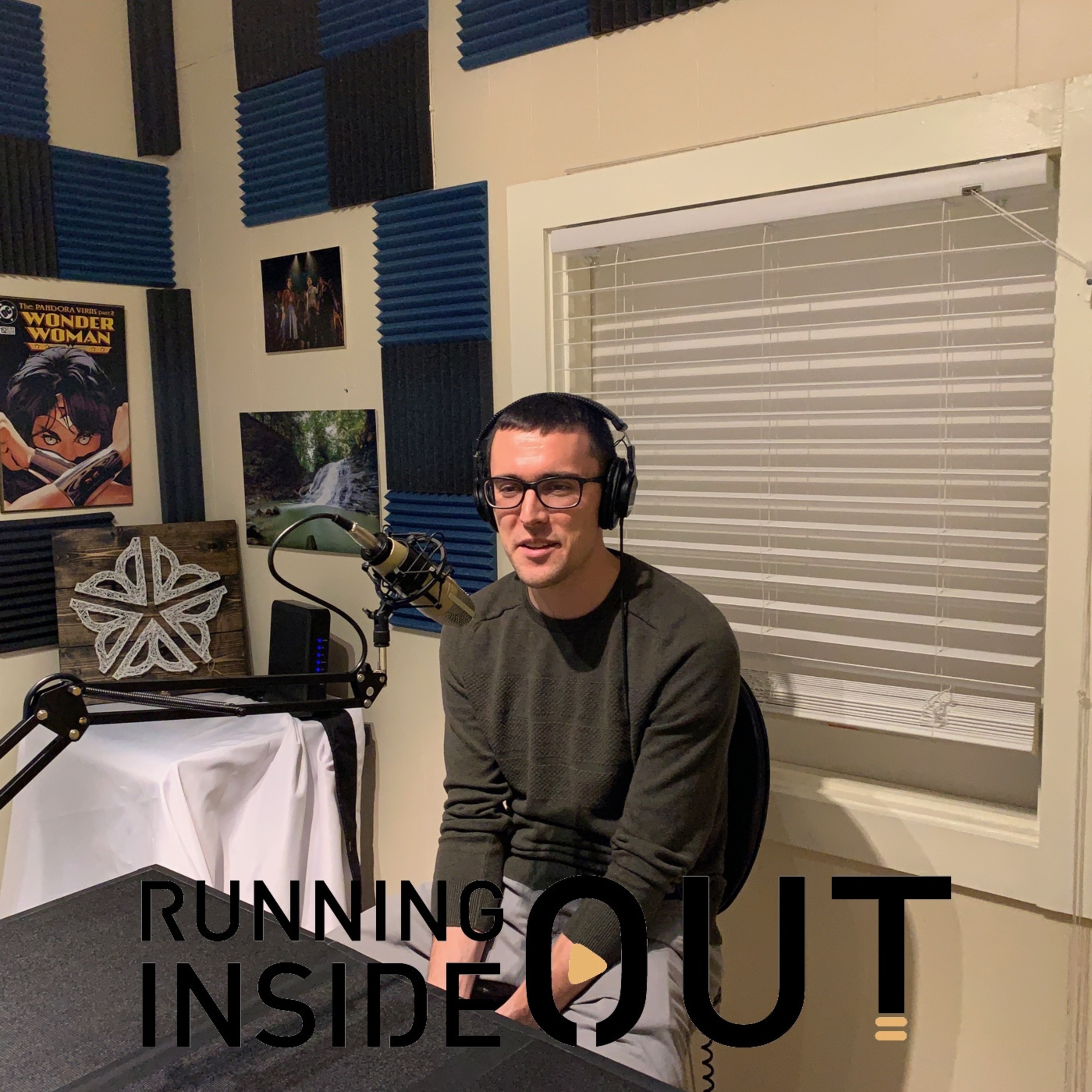
Hello and welcome to Running Inside Out Podcast, where we talk about the races we ran in, the races we're not in, and getting outside to see what's going on inside the Rochester running scene. In this episode... Mark Streb sprints into the studio to quickly tell us some of his favorite running stories. One that I'm particularly interested in hearing again is his run at the 2018 Chase Corporate Challenge. Maybe he'll want to recount that for us. I'm not sure. That's because it was actually the first time that I actually met and talked with Mark about running. Also, it's a pretty exciting tale. For me, it is, at least, as somebody hearing it. But hopefully, we'll get into some other stuff, like what got Mark moving so fast, where he's from, where he's going, and some things he does in my less...
frequent traveled areas of the Rochester running community. So with that, let's get into the trails, training, food, friends, and yes, even feelings of runners just like you. So, hey, I like that. It's professional. I do like that. Professional grade. So, yeah, sir, this will be interesting because we have chatted a few times about running, and just before we even started recording, I learned a whole bunch. So it'll be pretty exciting for me to learn about, like I said, some of those parts of the running community that I've heard about and I've seen but not really been fully in.
So, yeah, why don't we, it's a brief intro of yourself, and then we're going to talk about that corporate challenge because I'm going to get it out of you. Sure, sure. Well, I'm born and raised in the Rochester area, never really left. I grew up in Brockport. Okay, Westside. Westside, yes. And, you know, I went to Brockport High School and went to Geneseo for college after that. And I started working at the University of Rochester after college and, you know, kept sticking around and still haven't left to this day.
now work at Rochester Regional, where I eventually met you. So yeah, I love Rochester, love the place, love the community, love the running community here, know a lot of people, and started running at a very young age. I was 12. 12. You know the day, right? 12. Awesome. Yep. Is there a specific trigger to the day that you ran? Do you know it? Yeah. I was a lazy kid prior to 12. Okay. You had 11 and a half years of being lazy. And so my parents got to the point where they said, we don't care what you do from the hours of 3 to 6 p.m. Just do something. All right. And so my older brother was on the track team.
And at the time, he was actually, he just started running. He was a shot putter who then became a runner. That's a transition. It was. He actually became a runner because he actually backtalked the distance running coach. He made this claim that distance runners were weak. And she said, if you think that way, the next meet, we're going to have you run the two mile. And so that's what he ended up doing. And he did horribly.
Horribly. Carrying that giant shot around. It's hard to run with that thing. But she told him he did well. Okay. And he really believed it. So he started doing more and more distance events at meets. And he would go up to the official at a track meet and say, I've got to go over to the two-mile. I'll do my last throw later, which is an official. It's a real head turner. You don't see too many shot putters say, hey, I've got to go over to the two-mile. Give me a minute. Give me about 15 minutes. I'll be right back. Yeah.
And so he started running and actually he took off with it. He dropped throwing all together and became a runner. And around that time was when my parents kind of gave me that ultimatum. And so I said, well, what does my older brother do? And I was like, I'll give it a shot. I never really had any hand-eye coordination, so I pretty much ruled out anything else. Or baseball or basketball. I was not going to make any of those teams, at least what I thought at the time. So I gave it a shot. And I actually did start running at 12, and this was before I could even get on a team. And I just started running a few days a week.
on my own. Uh, and you know, it started out a mile or two. I didn't really know what I was doing. Uh, and you know, my brother gave me a little bit of guidance, but he had just started as well. Yeah. So that, so that's it. So you, you were like, Oh, can I run with you? Is that what you asked him? Yeah. And he was like, sure. Little brother. Yeah. I don't know any big brothers that often do that. Sure. Little brother, come tag along with me. He's five years older than me. And he, I tagged along to pretty much everything, uh, with him. So that was one of the things that he, uh, he was actually welcoming of that. Uh, and, and, you know, it was excited that I was into it. Um,
So the next year came, and I went out for the cross-country team, and I was on modified. And I did okay there. I was getting my bearings. I still was not sure about it. And then at that age, they didn't have a modified track team. So an indoor track, I actually tried out for the JV team. They had me pass these physical tests as a middle schooler to move up to... Checking your vitamin D levels and stuff? Yeah. Well, they had these weird metrics, too. You'd have to...
one of the things was you had to do a standing broad jump at like seven feet. Oh yeah. Yeah. You know, and that was like, they said, okay, if you're 12 and you can do that, we'll allow you to, they have these other requirements for pull-ups and all these things. I could run pretty well. So the, the person, you know, you know, administering the test at the time, I think let a few things slide. It's pretty interesting that you have such, you have such like, you went, you know, not like, oh, we used to run around the neighborhood chasing each other, playing tag. You went right to like, I want to be a member of a team. I'm going through these requirements. I'm, you know, signing forms, you know, you went right to like formal racing.
I went from lazy couch potato kid to formal racing in a very short period of time. And it was all pretty much on an ultimatum that my parents gave me. Well, you don't know any of the Nintendo cheat codes from the 90s anymore. In fact, I was just talking about this the other day. I used to love video games at that age. And then I think at a certain point, I hit like 12, 13, I just said, eh.
And I just haven't picked up a video game since. Pretty much. I mean, I occasionally would. Socially, if someone else is playing, I'll hop in. But I don't even know today's video game systems. I'm way behind on all of that. I think the last system I really played was Nintendo 64. Yeah. Okay. A little golden eye. Maybe a little golden eye. All right. I get it. So yeah, you went right from that to racing. And so where I wanted to start was, let's talk about a race. And then we'll bounce around in a little bit. But I first noticed, I was sitting at work and the corporate challenge happened. And I was looking through the results. And I saw Mark Streb.
Huh. I know that name. That's that guy right down the hall. So started a few weeks before that. Yeah. Well, and I hadn't started much before that even. So what was it was like, oh, wait, yeah, this is a huge company. Lots of people are going to be running here. And the corporate challenge team. I know at URMC there was one and I wasn't really plugged into it. And I was kind of like, wow, you know, there's there's this huge company, you know, and and I.
I see that they had posted sometimes, but I didn't even know that they had a team. Like when I worked at Thompson Reuters, I ran the corporate challenge every year. But I just something, you know, maybe because I was new or changing or something. So it just kind of breezed right by me. But you got plugged in right away. And I think that's, again, part of your I want to race thing, right? Yeah. Yeah. Yeah. And actually, when I was at the university, I ran the corporate challenge pretty much every year. Two of the years I actually went to the world championships for it.
Yeah. When you told me that, it kind of like, it kind of, I don't know. There's that phrase blew my mind, but I was like, wait a minute. That's right. Because if you get five really fast people, you can win. It's four. It's four. Yeah. So, all right. So let's talk about this. Well, yeah. Let's talk about those URMC races. So you said that you had gone to Berlin for one, right? It was Frankfurt. Frankfurt for one. And then San Francisco. Right. So how does that happen? How do you get...
five, four really fast people, because there's the co-ed and then there's the male and then the female, right? And you can have three different teams and you got to put all the scoring in after the fact and there's all the strategy and stuff. But do you set out and say, look, we're four really fast people. We're going to go win this thing. Or do you, I mean, do you train together? How did it work for you at URMC? Well, the funny thing is the first year just kind of, it just kind of happened. There's four people that just ended up showing up. Like you said, there's so many employees.
At the time, I didn't really fully understand the team scoring. I just ran the race. Run as fast as you can. Yeah. And then afterwards, they kind of let me know, oh, hey, we're submitting this team. And the team captain for the university looked at the results and said, here's what I think is the best. And it was a co-ed team. And she put that forth. And I kind of didn't fully understand what was going on. And then I had a co-worker who was on that team with me who I knew who explained everything he had been before to previous championships. And I said, wow, we actually that year, that first year, our team.
It was a co-ed team that we put forth. But of all teams, men, women, co-ed, we were second overall when you even smush them all together. Wow. And we weren't too far out of beating the first all-men's team. So we had a really good powerhouse of a team that year. And so I thought it was just awesome. And they don't actually announce.
where you're going for the championship until we ran the race in June. So you didn't know until January is when you found out. Oh, because the whole series has to finish, right? The whole series has got to go. And then they announce where the next year's championship will be. And the previous year's series is what qualifies you for the next year's championship race. And I said San Francisco. I'd never been. And so I was excited about that. Chase pays for the whole thing. You know, you fly out. They fly out. They wine and dine you. It's a blast.
And the race is the coolest thing. Super fast, huh? Yeah. It started and finished right at the San Francisco Giants Stadium. which was wild. Yeah. I mean, you can accommodate the parking lot and all the people and everything, right? Yeah. But that had to be pretty cool. I mean, I run the Medved Father's Day ALS 5K here, and it's cool to be at Red Wing Stadium, you know? So yeah, being at Giant Stadium is pretty crazy. And even before the race, actually, where you got ready before the race, they took you up to this kind of lounge that was for owners and coaches and players. And it was this big, fancy thing. I would never be able to step foot in something like that ever again. Yeah, considering you don't have any hand-eye coordination.
And it was like, it was really cool. So the actual players, like this is where they like hung out, I think like after games or whatever. Neat. Yeah. Wow. And so that was, that was your first year going to San Francisco. Yeah. All right. So you got warmed up before you went over to Europe. Yeah. Yeah. So now, okay. So you do that. How, how did you do in that race? Was it like, was it, um, big race, you know, kind of fever and you ran your fastest and the team was geared up or was it like celebration alley? It was, it was more celebration. I think once we got there.
Part of us were like, all right, so there's teams from all over the world. Some of them are exceptionally good. Some of the cities don't put as much emphasis on it. We were somewhere in the middle. So we kind of took the approach of like this is a vacation. We earned it. So we were partying the night before. Yeah, that seems fine. And you're just running three and a half miles, right? Yeah, yeah. So that's easy. And then so you do it again next year. You get everybody together. You get the band back together. Was it a similar team that went? Well, actually, we had a gap year because the way they work it the next year, you're actually not.
eligible to, you take those people who were in that year's like that ran the championship that year and whatever the local race is where those people can run it, but they're ineligible for team scoring. You have a gap year. You can't, you can't have ringers. Yeah. Yeah. Cause they don't want to like have a, I guess a monopoly over. Oh wow. Okay. I want to give other, I think organizations a chance. Cause there's certain ones. That makes sense. Yeah. And that makes absolute sense, I guess. But if you got a, if you got two healthcare organizations and people are changing jobs, you might get another chance. That's right. Okay. So we had a gap year and then we had another, the next year I was eligible again to. Okay. To win. Yeah. All right.
And so that year, same thing, co-ed team again, it ended up being. And I ran a little slower that year. I was working on my master's degree. That year I was running a little bit less. But we still qualified. So it was a little bit different of a group of people. The other guy was a younger guy that just started working there. Whereas the year before, it was actually a guy at the time who was 58, 59. So he was an older runner, still incredibly fast. Local guy, Charlie Andrews. Okay.
He was actually – he finished just behind the younger guy that qualified for the year we went to Frankfurt. And he was offering bribes out to us for whoever is going to give up our seat. Absolutely. Absolutely. Especially because that young kid probably just elbowed him in the chute and got in front of him. Yeah. All right. So now it's Frankfurt. That's a big deal. Yeah. Oh, wow. Frankfurt was wild. Isn't – I remember.
One of the years I ran it, wasn't it true that Rochester was the city of one of the championships when Greta Weitz was here, right? That's correct. That's correct. Yeah. I mean, I love our city, and I can imagine people from all over the world coming here, but imagine being the Rochester team. Like, you got this conflict, right? You win a trip to the championships to Rochester. The guy who I was talking about before, Charlie, he actually, the year, U of R had a team that won and was actually in the Rochester World Championships that year, and he described being so let down when they announced it was Rochester.
Well, you've got to be conflicted. I mean, you're the host city. That's got to be some pride. And it was the RIT course. But yeah, you're not going on that all expenses paid trip or anything like that. Entertainingly enough, actually, he still made them pay for a hotel room for me. He's like, I don't want to clean my house for a week. I'll stay here. Yeah, I don't want to go shopping. You've earned it. So Frankfurt, how was that? I mean, that's a big deal. Did you bring people on the trip with you? Was it like, hey, I'm getting an all expense paid trip. You can stay in a hotel room with me. How does that all work?
It was awesome. We had a blast, actually. And that year, we did convince work to give us a little bit of extra funds to hang out for a little while longer. You're representing the university in Germany. Yeah, it was awesome. San Francisco, I'd never actually been out of the continental United States besides Canada, and I don't really view that as counting. So when I went to Frankfurt, it was like culture shock for me. It was just so cool and so different. And trying to find your way was a little bit more challenging when you got there because you got to the airport and you just...
You're there, and you've got to figure your way to your hotel. I've never actually done something like that in another country. Yeah, and how do you keep up your running and then plan for a trip and get in the headspace of, I'm running an international race? Yeah, it was a 12-hour flight, too, so there was that to deal with, kind of the jet lag. We got in at like...
10 a.m. their time, and I went right to sleep, which was weird. I didn't sleep at all in the flight. Yeah. And so to put a little context around this, these times that you're running in the corporate challenge, you're running sub-20 minutes for most of these, right, for 3.5 miles. You're running 19, somewhere around there? Yeah. Yeah. So I think...
my best corporate challenge time is maybe 24. So I don't get any trips to Frankfurt or San Francisco, but I do get, I do, I do get an all expenses paid trip to RIT, you know, there you go. There you go. Got free parking, stuff like that. So, all right. So let's talk about 2018 then. Cause now this is your first race at your new company. And, and I said, Hey, I saw your name in fifth place. And I was like, that's pretty good. And that's when you're like, well, you know, there's these, these other times when I went and did all this, but fifth place was just like, to me,
Seeing 520 a mile and fifth place, I was like, wow, that's pretty fast. And then I said, but wait a minute, fourth place, right? So you are 1890 or 1840. Fourth place is 1839. I'm sort of going right to the end of the story here, but there's a reason. Third place is 1837. Second place is 1836. You're four seconds out of second place. And then Matt Wilber blew everybody out of the water by 15 seconds. Yeah, just way ahead, way ahead. But you're four seconds. And then fifth place behind you was 1844. So from 1836 to 1840, there's four of you. What the heck? It was crazy. This year I ran the race. I knew...
Rochester Regional wasn't going to be eligible to win a team category because I just looked at, I was the people who I knew that worked there that were fast and their different statuses because this is the gap year I was talking about. One of the guys that finished right behind me, Brett Smith, who I know very well, Rochester Regional employee. works over at unity um he wasn't eligible because he ran actually the world championships this calendar year so um you know and there's a couple other people that i knew weren't running that year so i said well what i'm going to do is i'm going to run the race because it was a new course this year i don't know if you knew they moved it yeah so i'm gonna run the race so i can get a feel for the course so that for next year we can really go after it you know and try the team team thing again uh so the course starts out like you know right next to frontier field and uh I made the mistake of this one thing I learned for next year. I went into Frontier Field before the race. And so they said, all right, we can go to the starting line now. And they funneled people out in this little narrow, fenced-off passageway. And thousands of people behind were the front of the race. They wouldn't let me up. Don't you get the colored bib, but nobody would let you through? I asked all these people, and they said, no, you can't.
cheat that i'm like but i'm like i need to be you know yeah you get the bib that says you start up in this corral that's on purpose yeah that's not cheating so i had to like fight my way through people pretty much i had to really just you know kind of shove my way up there i felt bad about it but i was like i need to get you know so i started like waiting for all these people and i got up there like just in time uh before i think like as they were you know uh probably 30 45 seconds from starting you know okay so time time to like calm yourself back down now yeah yeah because because you're you want to be at the white line not at the other white line right in the back. And the thing I found out that other people did that were up front that I should have done was they didn't go into a frontier field at all before the race. They just, you know, parked somewhere and then approached the race from the front, which is what I should have done. Yeah. And so, you know, race starts and that race is one where especially you get a lot of people who are newer, don't run a lot. And it's just kind of chaos at the start that there's these random people that just run really fast.
Yeah, yeah. But you're running a 520. You're running really fast. And there's people for that first like 800 meters who have no business running that fast. We'll try and run faster than that. Well, you want to lead the race for a little while. Yeah, get in the DNC and get in the photo. Yeah. And so, you know, you got to kind of let those people go. And so even after those people kind of subsided, the pace was still really pretty hot up front. You know, there's a group of probably about 10 to 15 people who I still just was let go. You know, I just said I'm going to, I wear, some people it's kind of a.
People have varying opinions on it. I like to wear a GPS watch when I race, and a lot of the purists are people that don't wear a watch. Run by feel. Run by feel. I like the data. I'm a nerd. So I could see in real time what pace I was going, and I backed off because I knew where I was at and where my fitness was. So I hung right around that 15 to 520 area and kind of let those people go. And you go out under the inner loop, which how often do you get to run in the inner loop? Never. Right outside of here.
And it kind of is like a gradual uphill on the way out. And then, you know, it's basically an out and back is basically what the course was. And so I gradually start bringing a couple of those people back from up front. And they start to start to gradually fade back. And at the point, we're about ready to turn around, which is we got up to you go off the ramp at East Main and then you make a left and you go back on and go the other direction on the interloop.
and uh at about that point i started picking off more people and i think probably after we went on the exit ramp and like things started going back downhill which i'm taller i'm a taller runner i tend to do well on the downhills i really lean into them and i have a big stride i tend to like downhills um i started eating up ground on some people and i think at about the two mile mark maybe i was in ninth or so ninth or tenth so you let a lot of people go out faster than you yeah i still had a good chunk of people and uh so so you know at this point i'm thinking i gotta i gotta time a move i'm feeling pretty well at this point i'm not i'm not feeling tapped out or gassed at this point i'm feeling like pretty good but i said i gotta time a move because some of these people are gonna start to come back um but if i if i try to catch them too soon i could i could put myself into the well and i could i could start to fade um if i go too late you know then i might not catch the people i'm looking to catch um and that matt will he was way up there but i was looking at The rest of them, there's just a cluster of people. And I'm like, I think I could kind of get that group. Yeah, as long as you catch the back of them, then you can start running with them, right? Yeah, yeah. And I've always been, I've kind of transitioned into being into longer distances. But my roots and my bread and my butter was always the 800 in the mile. So I was really banking on having some muscle memory. So I said, I'm going to wait until, it's three and a half miles away. So I'm going to wait until three. That's what I'm going to wait. And at three, that group was a little bit closer. But then I just turned it on. I went for a run. I think it was like a five.
I think it was like 5.20, 5.18, somewhere around there were the first two splits. The third mile was a little faster, like 5.15 or so. And then that last half mile, I really turned it on. And the whole goal was to try and catch anybody that I could at that point. And they had just a little bit more than I thought. I maybe should have started moving. And I had a little bit too much left at the end. I should have started moving maybe a quarter mile sooner. But right down that stretch, going to front of your field and back to the finish, I was very close, just as you pointed out. Four seconds.
between four the top the top five people you know and and what if the course was say a hundred yards longer i think i could have got second if it was yeah yeah i think so i you know as i was running that last half mile before 52 pace and picking up so i was you know i still like at the end of the race i felt like i had something left you know just ran out of room instead of ran out of gas yeah yeah I don't even know. Like, that experience is very foreign to me. So when I heard it, I was like, I just, you know, I was like, other people need to hear that too. Do you feel good about that? Do you feel good about that fifth place? Yeah, I felt good about it. I obviously would have liked to finish a little higher, but I was happy I learned a lot this year, you know, so that for next year, I'll be able to use some of the little lessons I learned about the course, about some of the logistics and about timing things. So hopefully we can, I would like to win as an organization. That would be awesome.
When your other races, when you did, when the teams did win, is this your highest individual placing fifth place or have you placed higher? This is actually my highest individual placing. Yeah. So that's, that's pretty good. Yeah. You know, fifth place in a slow year. Wow. That's good. Yeah. So this racing thing, we said it, it kind of came natural to you. And one of the things you mentioned to me earlier was roadkill racing. Yeah. Right. So that's like cross country. That's like grass, right? We do cross country. We do road races. We do it all.
Yeah, we do everything. So I know a little bit about that, but why don't you give me the Fs and Bs of Roadkill? Yeah, so a few years out of college, I was running with the Genesee Valley Harriers for a little bit on and off, and that was good, but it wasn't quite the right fit for me. I was looking for something a little bit different, and I think at that point, I was looking as well for not just a group for running, but I think more of a social group as well, too. So around that time, it was...
I had a friend, Dave Rappelier, who was running for them, another local runner. And he suggested, hey, why don't you come out and check this out? And so I went to a couple of team events and stuff like that. And pretty much the whole model of Roadkill is we're a group that we do get together and run. We do get together and train. It's not hyper-organized. We kind of designed it around people who are working professionals that have families, that have all these things going on. So it's not meant to be hyper-intense, but it's kind of a network of people that, you know.
If you're part of roadkill, here's X number of people that you can reach out to if you want somebody to run with on a given day. But roadkill is relatively fast, too. I mean, there's some fasties in there. Maybe fast old dads, but there's still some fast people. Yeah, and you get a range. You get people that are on the front end, you get people in the middle, and you get people all the way in the back, too. We have just this wide spectrum. We always like to say we literally will take anybody who's interested. I get that it's more of a suburban group than a city-based group. Yeah, yeah. It's west side, right? It's virgin. Spread out. We got people, too, further south.
Yeah, it's a hodgepodge of people. It's really random. And it's beer and glory, right? That's the deal? Yeah. After most races, you'll find us with some Genesee beer after most races. Keep it local. Yep. And I was saying, I noticed that you had run a bunch of the Peak Lavin races. That's kind of like roadkill. Those are roadkill gathering events, right? Yeah, we put a big emphasis on that. We really encourage people to run that whole series. It's a fun series.
There are, you know, obviously some team scoring aspects to it that are good, too, and chances to win a little bit of prize money, which helps the club. But mostly they're just a blast. I mean, it's a great series. They kind of do a little, like, you know, Buffalo, Rochester, Syracuse roadshow, you know, or even they've gone down to Watkins Glen, so even further down, you know, in the Finger Lakes, too. So it's really pretty cool. The courses are all different. Some of them are flatter, easier, less technical, and suitable to certain types of runners, and then some of them are hyper-technical, hilly.
complicated, difficult courses. What would be one of those? The one in Watkins Glen is very challenging. It's just a lot of uphill, a lot of turns, a lot of trails. And trails that aren't very well-groomed. But then in contrast, we've raced at Genesee Valley Park, which is gentle rolling hills, but pretty well-groomed. A little river walk. Nothing crazy. So there's a little bit of both.
And I guess when I think of it, when I think of the Pete Glavin thing, I really do think of that as racing. And there's teams, there's all the different teams, and there's the traditional cross country. It's like high school cross country, but for old people, right? I mean, that's what I'm thinking of it as. If the young kids show up, I feel like you need to have some injuries and some family obligations and bills to pay, and then you can run Pete Glavin. Yeah, that's pretty much what it is. You rarely see anybody under the age of...
I'd say 25 is a cutoff. You don't see anybody too much younger than that. It's not a literal cutoff. Yeah, a general cutoff. Yeah, and the under 25 people, we do need more of those in the trail running world, but that's, I guess, what I think of it as, and I haven't seen much of it, but that's my initial impressions of it. Yeah. So roadkill, has that been a big thing for you since you've transitioned into your professional life? Yeah, absolutely. It's been one of those clubs that has been a good way to balance running and life and everything else that I've got going on and work.
and gone back and got another degree. Another degree? So that makes three? Two, so the bachelor's and the master's. And I was part of the club while I was getting my master's degree and only had time to run three miles a day as I was working full-time. So I went through a period where that was pretty much all I could do. But the club doesn't really care. We don't have certain standards on you need to be running this fast or this much. If you want to do it and you like running and you want to be a part of it, you're welcome to join.
We typically like people who have something interesting to say or come with an interesting background because it generally makes you more fun to either run or to drink beer with afterwards. Characters welcome, huh? Yeah. So while we're talking about things in common, I think there are a few people that we do know in common. I will call out our friend Sarah, our mutual friend Sarah. We know her. She happens to run with the Borough Runners, so that's her beer-drinking running group. So we got that. But then you know Chris Patterson as well, right? Yeah. You run with Chris here and there? Yep. There's a group of roadkill people that get together every Wednesday, usually at about 5.45 in the morning.
Chris is not a roadkill member, but, you know, he likes to tag along, and he lives in the area. So, yep, I do run with Chris a decent amount. Yeah, and when you said you transition into longer distances and, like, racing is natural for you, that's sort of what I think of is Chris is that kind of person, right? He went from, like, instantly I don't run to I race, you know? So, you know, it's like, oh, yeah, the fast racers normally find each other, whether it's because you're at the front at the beginning or you're at the front at the end. Yeah.
But now he's turned into the human metronome, you know, and put his marathon racing days maybe on hold a little bit with that work-life balance. It seems like he's pacing a marathon, though, every weekend. That's how he gets his training miles in, you know. But, yeah, I think, you know, it'll be fun to talk with Sarah on the podcast someday soon. Once she hears this, she'll realize that she needs to talk about her group. Yeah, she absolutely does. Yeah. So, all right. You talked about that work-life balance thing. Yeah. But you're still running really fast, right? Yeah. And what would you say, like, you say you're getting, like, maybe...
30, 40, 80 miles a week? What are you running per week these days? These days I average anywhere from 30 to 50. It really depends. I was actually just looking at this today because you can go on, you've got a Garmin, you can go on and kind of do some reports. Yeah, you're in the podcast Strava group. You're usually right in the middle of the group.
with your mileage most of the time. It changes by time of year. This time of year is when I start to run a little bit more. It's like from December on into June when it starts to get really hot. When it gets hot, I'm still running consistently, but the mileage drops a little bit for some reason. Then it starts to pick up again a little bit in the fall. There's a July, August, September.
I don't like being hot. And so you do run outside throughout the winter as well, right? Yeah. So do you do roads in the winter? Generally roads, but I also snowshoe. Okay. So I started doing that in college. I knew a couple people who did it. And I bought a pair of running snowshoes and decided, you know, I got my coach in college to actually buy into it. I remember the year that I did it, it snowed all winter. And I was on those things like three days a week.
Nice. And I actually improved that season. Yeah, snowshoeing is some serious cardio. It is, it is. Have you ever run any of the goose snowshoe races? I've actually never done a snowshoe race. Never? I've only trained them. You want some real live redline? That's real live redline races. Yeah, you should. And there's one that comes out to the west side. They got Cast a Shadow out there in February. The one down at Harriet Hollister Park, usually right after New Year's, is a very good one too. Frozen Assets. Yeah. So, yeah, I mean.
Snowshoe racing might be the new thing for you. It could be, and it's less impact. I mean, you get a little more cushion with the snow. It's not as unforgiving as asphalt. Yeah, well, I had one race at Frozen Assets where, I mean, I went out running and just could not, I just full-on redlined like a mile and a half into the race. But then you're walking, and you're walking in snow, in snowshoes. So you're not really reducing your output so much. So I was like, well, this is the same effort as running. It really is. Might as well keep going, you know. So, yeah, snowshoe racing is crazy.
Going to have to try some more of that this year. Yeah, yeah. So you run around in the city in the winter, and I guess you're one of those winter training brings spring PRs type of folks. Yeah, yeah. And I pretty much do whatever you have to do to make it more palatable, I guess. And it does help that I work at a place now that has a fitness center. I can go down there and change and go run outside in the middle of the day. Within the lunch hour, I can fit in like six miles.
if I change fast enough and shower fast enough. Yeah, and you had mentioned that you also, I saw you one day unlocking your bike, so you ride your bike to work. Yeah, yeah. So you ride your bike to work, you go for the run during lunch, and then you ride your bike home. Yeah, yeah. And are you riding your bike in the winter? Less so in the winter. I do like to bike. I do really like it, but as soon as it hits like, you know, like 40, 45, I'm like, 40, 45 on a bike is like, it's like running in negative 10 degrees. You know, it's a whole different, and you need a whole, it gets more complicated because you need a whole other set of gear that I just don't feel like lugging around and finding, you know, so it gets more complicated.
Yeah, the biking to work thing since I started working here at Rochester Regional, it's only three and a half miles from my house. So it's literally like a pretty leisurely warm-up, easy bike. Yeah, I got about 13 miles. So I was like, I can run a marathon a day to and from work. That's a heck of a run commute. But it seems like that's one of the ways that you're balancing things is now riding to work and getting your miles in at lunch. And then after work, you have life that you can go to. Yeah, I come home and I'm done. And I can focus my time on being home and I'm married. So I can focus on my marriage and my wife.
No kids yet, but we do have three pets that occupy a little time. I guess that's kind of like a tenth of the way to having a kid, but they share some responsibilities, I guess. Yeah, I'm glad you keep it realistic. It's a tenth of the way. Yeah, a tenth of the way. At least you've got to be home consistently and feed a living being. I would say, though, my dog stays in the crate when I'm not at home because I can't trust her, but obviously you can't put a kid in the crate. There's rules. Yeah, there's plenty of rules. There are rules on that kind of stuff.
So, all right. So where, where from here? Obviously you got the, the 2019 corporate challenge on your mind, but do you run other, do you run other stuff? Are you, are you like 10 K guy? Are you half marathon kind of guy? I've been, I've been really getting into the half marathons. Um, and, uh, I've done, I've done a bunch, uh, since, since kind of college in the last, you know, eight or nine years. And, um, you know, so I, I feel like I have some untapped potential in there. And when I look at kind of my lifetime, best times, I'm approaching 30. So at the age where maybe.
I'm going to start tapering off soon and getting a little slower. Who knows? Maybe. Maybe. But, you know, I'm looking at my lifetime PRs and I kind of, I look at everything from like 5K down and I'm like, nope, not going to happen. And then from there, I'm like, wow, I could still get, I have some chances of some, you know, bettering some lifetime times above that. And the half marathon is one where I've been like trying to consistently get that lower and faster because I feel like I still can.
Yeah, that's why I run ultras now because I'm 40. The distance just goes up, right? Yeah. So what's your half PR then? Hour 16. Okay, so hour 16. And do you have a goal for it at this point or do you think an hour 15? Yeah, any lower than that I'd be happy with. And I actually have been running year after year. I don't think I've missed many years of it, but I've been doing the Flower City half marathon. And my mindset is if I keep doing the same ones, I'll get better at running those particular courses. And it's not necessarily the fastest or the slowest course.
Um, and I could go to ones that are faster, but it's like different time of year, different situation. I have some other variables that I have to adapt to. Yeah. So I'm like, you know what? Maybe I'll just, I'll be better off. I just keep running the same race and I know it like the back of my hand. There's some hills. I mean, flower city is pretty, it's a great race, but there's some climbs in that, in that race. There are, there are, there's, there's one going up.
You go up Goodman leading up to Highland Park that you make up to right into Highland Park. And that one, that mile, I always know is going to be slow. So it's like, you know, now that I've done this race for so many consecutive years, I'm like, well, this one's a write-off. You know, I already expected this mile is going to be slow. I don't have to worry. So when was the last time you got close to that PR? The last time I actually hit it and got my PR was this past spring. Okay. So I ran 1.16.15. All right.
So, and that race was, I think I placed fifth. I think I was fifth in the race overall. So there's good competition there. There's people to run with, even though it gets spread out at a point. But, you know, I couldn't have run that race probably better, I don't think. You know, it was like the only way I could run it better if I was a little more fit. You know, that'd be the only way. I think technically I ran it. The way you wanted to. Yeah. I didn't have anything left at the end. You know, I pushed it at the right spots and then, you know, took certain hills with a grain of salt and realized that, you know, those are going to be slower, you know. What about something like Johnny's? Johnny's is a nice, predictable.
race right you're going straight out and back you know there's one you're going over the ford street bridge once coming back that's what you got yeah yeah i love like a drag strip yeah have you done it i've done it yeah yeah i broke 40 minutes so that's my that's my thing i love that race and it's like the it's the first race of like the of the season and there's the winter races but people view it as the first race you know and uh i do always love like the environment surrounding that and people get so excited for it um there's so many people that do come to it um and uh Although, I don't know, are we calling it Johnny's now? Because Johnny's closed. I think Rochester Running Company will probably still call it Johnny's. Yeah, still call it Johnny's. I think so. They took it over. Yeah, and they want to keep it alive. I don't know what to long-term, but I think they're going to. Yeah, yeah. I think they should retain the name. That would be cool. Maybe if Johnny will let him. Who knows? I don't know how that all works out. Well, John's name is John, so maybe he'll just take the H out of it, and it'll be a J-O-N. It'll be Jonathan's five-miler. Yeah, he could. He could. Why not? Johnny's J-O-N-Y-S.
Do you know him well? Yeah, yeah. He's a pretty good guy. It's funny because he talks about the same thing you did where he grew up in Rochester. He's never left, never wanted to leave. This is where he runs. And they got that whole thing going now this winter. Run every street in the city. And they're collecting everybody's maps and they're doing the whole thing. Yeah. So, I mean, he's definitely vested in the city. And I think...
that was a big deal for him to make sure that Johnny's kept going. Yeah. Yeah. After the bar closed. Yeah. Well, and then they didn't want to do the race either. So, you know, at least the race gets to keep going. And he took over the run like hell too. That was the other, that's in my neighborhood actually. Oh yeah. Cool. It goes right through my neighborhood. I've done that a couple of years. Yeah. So, you know, there's, there's a lot of these little small road races that just kind of are, are mainstays of the city, you know? Yeah. Yeah. You want to have them keep around, you know, and they're still, they're the simple road races that, that I think are starting to dwindle.
like or hate it, there's kind of this added complication now to races. I think to get people to do it, you have to add all these bells and whistles. I think the days of like, hey, we're just going to show up. We don't need a shirt. We don't need paint or bubbles or whatever they throw into them. Or zombies. We're just going to show up. We're going to run. Five bucks. There's not a lot of those left now. I think it's good and bad. I think it's getting more people active and more people kind of into it. But it also, I think...
I don't know. Maybe it's a get-off-my-lawn type of thing, but I kind of like the old school. We're going to keep this simple. We're going to run, and we're going to run as hard as we can. Yeah, and it's about the running, right? Yeah, and it's all about the running. But if the net result is we get more people into it, I think that's cool. Yeah, I think that's fine. As long as you don't have to wade through them to get to the front of the race, right? That's right. That's right. So that's cool. Do you have a favorite out of all these races we're talking about? I mean, it's hard. It's like children. That is really hard.
I would say favorite half marathon is Flower City. I'm going to break it down by distance. Oh, all right. Favorite 10K is a lilac 10K. There's not as many 10Ks. It's really hard to find a 10K, right? Yeah. There's very few. I don't know why. There's a 10K snowshoe race now. I don't want to talk out of turn here real quick because I believe going on the internet to do some research and make sure I get my stuff right.
Yeah, Nordic Fest, 10K. I knew it was a 10K. Where's that? It's down at the Cumming Nature Center. Okay. So Snowshoe 10K. I might have to look into that. Let's see, favorite 5K. There's so many. This one gets harder. And I think this race is probably, I don't think it's carrying on anymore. I think this year is the last year for it. But the Virgin 5K, I did that a ton. That was probably the most competitive. And that's not going to be around anymore? No, Eric Boyce is the director of it. He's living further away. He's further down.
south into dansville area and and uh i think it got to be too much to organize a race and being further away and i think he was trying to find someone else to take it over but it was indeterminate last i knew yeah that and that was uh that was a memorial race right that's that jenny jenny kuzma yep yep no that'd be a bummer it would be it would be that was it was weird that was one of the races there you didn't have a huge number of people there it was like 300 but but if you added the average if you did the average time of those 300 people it was definitely the most competitive if you compare the average you know uh so it was it was one of those races he kept it pretty simple you know so that was definitely up there. And then I would say alongside of that, maybe even ahead of it, it would be the Medved 5K ALS race. My aunt passed away from ALS, so that one definitely holds a special place in my heart. So I like to run that one a lot. Yeah, I like that race as well. We got a lot of good stuff floating around the city, don't we? We do. It's pretty cool. So what's your big plan for the summer? If you were to name a goal?
For the summer, is it? Let's get into the Corporate Challenge Championships? Yeah, that to me is like the ultimate goal. And then I want to better my half marathon time at Flower City. Okay. And from there, in the summer, I don't race a ton. Okay. There's less races available. I don't like being hot. There's less races available. So I typically, July and August, don't race a lot. And then kick back up again in cross country. I love cross country, so the whole Glavin series I'll do again and try and better myself at. So that's pretty much my...
roadmap for the year you know all right yeah and i so um this year is uh actually the 20th annual um medvet als run so yeah that's uh i didn't realize it's 20 years old either but there you go crazy yeah um so uh i i have to ask uh trail races what's the deal yeah you know i've never to be honest i'm i guess i'm kind of ignorant to them because i don't know i don't know a whole lot about them that's you're saying i just spent an hour talking about road races yeah it's it's a whole whole nother world to me whole foreign world to me yeah um cross country is getting there it's getting there yeah it's getting there um but not quite there you know there's a whole and the distances vary so much ish you run on ish in the trail world yeah five ish don't complain if you get more i've got a friend of mine one of my really good friends uh we grew up together and stuff like that and he got into running and he's he got into marathons and i've been kind of giving him advice and stuff like that as he went and then uh just recently he was he's like i'm getting kind of bored with running on the road so he goes i think i'm gonna sign up for a trail race and he goes what do you know about it
I don't know. I can't help you. Tell him you can listen to a little podcast. Yeah. I was like, I don't know what to do for you. He can get about 106 hours of free advice. Yeah. He's going to need it because I'm like, I don't know how to help you. You know, he signed up. The name of the race escapes me, but it's a 20 mile trail race. He really went. 20 miler. Yeah. It's an odd distance. And he went, he never does anything, you know, halfway. Is that around here in Rochester? Syracuse area. Okay. I got, I got it. It's like Green Lakes. I'm blanking on the name of it. All right. Well, you know.
Maybe he can report back. Yeah. I'm going to be really interested to see how it goes. He was another one who actually, he was a shot putter in college. He's actually a SUNYAC champion in the shot put. And then after college, he became a physical therapist. And he's like, you know, I don't want to lift weights and be huge anymore. And I just kind of want to be generally in shape. So he's like, I guess I'll try this. Yeah. All right. Cool. Okay. Well, I don't know. I think we covered a pretty good spectrum of stuff here. Did we miss anything?
I don't think so. Unless you wanted to talk about my glory days. I thought we did. You want a free trip to Frankfurt in San Francisco? I guess we skipped over high school, huh? College, yeah. Man, sorry. Yeah, but that's okay. I just breezed over. Cut to present day, you know? Yeah, yeah. Well, it's interesting.
What we can do is we can just leave people wanting more. And then when you go to the championships and when I tag along as the fourth person on the team, then we can come back and tell everybody about this. My high school cross country, I was always sixth. I was always the sixth fan. I was the sixth runner. I just couldn't do it. We had some really fast people. We had a guy who went to Marquette on a full scholarship and a guy that went to Union. And I wasn't really, I don't know, fast.
But you're fast in a different regard, though, on the trails. It's a whole other. Yeah, I guess it is. But, I mean, it's really, you know, I think, as we always say, everybody gets out of running what they want. And I like to think that some days I'm ready to run fast and other days I'm just running, you know. Yeah, I totally identify with that. Yeah, so someday you'll slum and do some eights with me. Yeah. You know, for me, it ebbs and flows. Some days I'm like that. You know, other days I want to go out and hammer. You know, it just depends. You know, there are days where I go out and run 830 pace, you know. Yeah, sure. That's tough.
All right, man. Well, thanks a lot. Yeah, absolutely. Thanks for having me. See you. Well, there you have it, folks. If you want a compendium of races to run in Rochester, you're going to get them off the show notes of this one because that's all we talked about is all the really fast, cool road races in Rochester. So be sure to check out the episode show notes for all those things. You can see some of Mark's times. You can see his Strava profile. You can find Roadkill. You can go see any number of the races we discussed. They'll all be out there.
That's at runninginsideoutpodcast.com slash 073. You can also find links to the Strava Run Group and the Patreon page. Thank you to all this month's Patreon supporters. There are certainly lots of worthwhile endeavors and places to put your hard-earned dollars, especially this time of year. And I just want you to know that the...
Continued support. I truly appreciate it. And it does keep the lights on here at Rio headquarters. So thank you. If you look forward to this podcast each week and it inspires, educates, or at least entertains you regularly, consider becoming a supporter. You can find that at the bottom of the show notes as well. If you want to chat about this episode with other listeners or simply share your stories, consider the Running Inside Out Slack where we talk about all manner of things. It's basically your basic old school chat room. It's like social media before we had the media part of it. So it's much better that way. If that sounds like your kind of place, email me at chris at runninginsideoutpodcast.com with the subject Slack.
But keep in mind, the number one way you can always support the show is to tell a friend. Tell Mark's friends. Tell Mark's trail running friend about it. He needs to help, apparently. Mark's not doing it.
And help them subscribe. You'd be surprised how many people don't know how to subscribe to a podcast. Take their phone, physically subscribe them, push the buttons, and let them walk away with a brand new podcast to listen to. One last thing, I'm always interested in your comments and feedback, so please drop me a line at the aforementioned chris at runninginsideoutpodcast.com and let me know your thoughts. Thank you all for listening, subscribing, telling your friends. Thanks for sharing your stories and getting out there to create more stories. Until next episode, be thankful for what you've been given, be proud of what you've achieved, and let go of what you've lost. See you out there.
You really need to make sure your balance is good. You know, you need really good balance. And he's a physical therapist. So he knows more about how to improve his balance than I would ever know. I'm like, and you know that. So just do what you would do. You know, I'm like, I could help you with like, you know, progression and mileage and stuff and maybe some workouts. But, you know, I still, it's a 20 mile trail race is different than what my.
You can just help them by taking them out on the trails. That's the way I do it. I can't teach people race strategy, but I can say these are some really cool trails to go run.