
PODCAST · religion
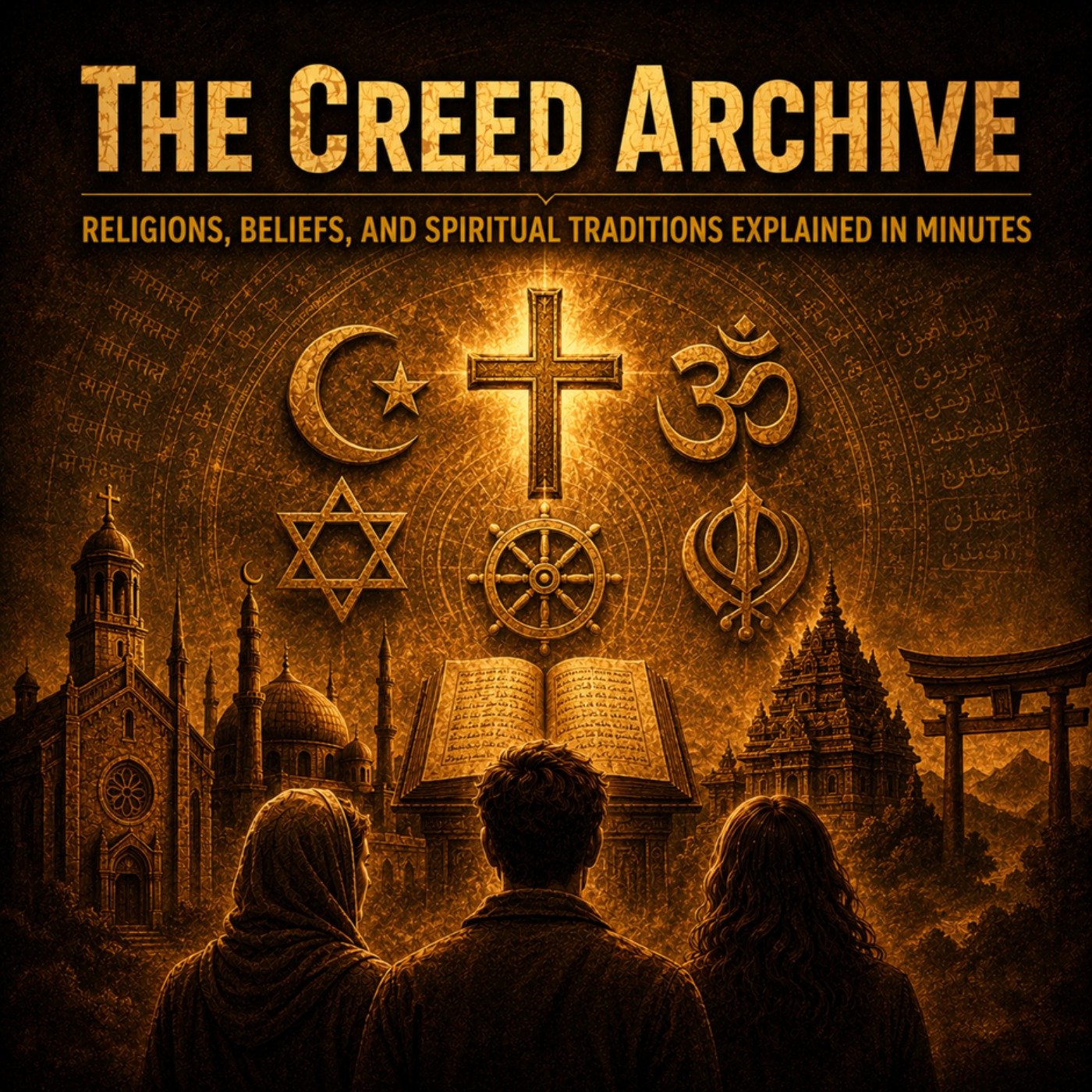
The Creed Archive – The World's Living Faiths and Religions explained in minutes
by The Archive Network
The Creed Archive is part of The Archive Network by Jonkai Ventures, a collection of podcasts dedicated to the stories that shaped our world. This series explores the world's living religious traditions: their origins, beliefs, practices, and the millions who follow them today, told with neutrality and respect, never preaching, ranking, or judging.From Christianity, Islam, and Buddhism to Hinduism, Judaism, Sikhism, and lesser-known living movements, each series tells one tradition's story across five episodes as a documentary-style narrative: how it began, what its followers believe, how it is lived, how it is passed down, and where it stands today.Support the podcast and access exclusive content on Patreon:https://thearchivenetwork.com/supportDiscover more at:https://thecreedarchive.comhttps://thearchivenetwork.com Hosted on Acast. See <a style='color:grey;' target='_blank' rel='noopener nor
-
60
Zaidi Shia - Part 3: The Rhythm of the Highlands
In the shadow of Yemen’s mountains, the call to prayer echoes through ancient stone villages. Here, Zaidi Islam is not just believed—it is lived, woven into the daily and seasonal rhythm of highland life.What does faith look like when it shapes every moment, from the mosque to the market and from the home to the field? In Zaidi communities, the core practices of Islam—daily prayer, fasting during Ramadan, zakat charity, and pilgrimage—form the backbone of religious life. In the towns of Sa’dah, Amran, and the old city of Sanaa, the call to prayer signals more than ritual; it marks the pulse of the community. Communal Qur’an recitation and mosque-based teaching bind neighbors together.Learn more at: https://thecreedarchive.com/creed/zaidi-shia-islamThe Creed Archive is part of The Archive Network by Jonkai Ventures, a collection of podcasts dedicated to exploring the world's living faiths and religious traditions.Support the podcast and access exclusive content on Patreon:https://thearchivenetwork.com/supportDiscover more archives and stories:https://thearchivenetwork.comExplore this archive:https://thecreedarchive.com Hosted on Acast. See acast.com/privacy for more information.
-
59
Zaidi Shia - Part 2: The Shape of Justice
What does it mean to lead with justice—and who decides what justice demands? The Zaidi tradition, forged in revolt and refined in debate, offers a striking answer: leadership is not inherited by right alone, but earned by ethical courage, learning, and action.In a world of competing claims, how does one community define the true path? At the heart of Zaidi Shiism lies a distinctive theory of leadership. Adherents hold that a rightful imam must be a male descendant of Hasan or Husayn, grandsons of the Prophet. But descent is not enough. The imam must also possess knowledge and moral integrity. Most crucially, he must step forward—publicly claiming authority and, if necessary, confronting injustice.Learn more at: https://thecreedarchive.com/creed/zaidi-shia-islamThe Creed Archive is part of The Archive Network by Jonkai Ventures, a collection of podcasts dedicated to exploring the world's living faiths and religious traditions.Support the podcast and access exclusive content on Patreon:https://thearchivenetwork.com/supportDiscover more archives and stories:https://thearchivenetwork.comExplore this archive:https://thecreedarchive.com Hosted on Acast. See acast.com/privacy for more information.
-
58
Zaidi Shia - Part 1: A Banner Raised in the Highlands
In the rugged highlands of Yemen, an idea was born—a vision of leadership that demanded action, not just inheritance. Here, a movement emerged that would challenge empires, shape villages, and transform the meaning of justice for generations to come.What drove a community to risk everything for a new kind of authority? The Zaidi movement begins with the story of Zayd ibn Ali, a name that still echoes in the mountains of northern Arabia. He was not only a descendant of the Prophet, but also a man who refused to stand by in the face of injustice. In seven forty, Zayd led a bold uprising against the Umayyad governor in Kufa. His defeat and death might have ended his story—except that, for his followers, it was only the beginning.Learn more at: https://thecreedarchive.com/creed/zaidi-shia-islamThe Creed Archive is part of The Archive Network by Jonkai Ventures, a collection of podcasts dedicated to exploring the world's living faiths and religious traditions.Support the podcast and access exclusive content on Patreon:https://thearchivenetwork.com/supportDiscover more archives and stories:https://thearchivenetwork.comExplore this archive:https://thecreedarchive.com Hosted on Acast. See acast.com/privacy for more information.
-
57
Twelver Shia - Part 5: A Living Tradition in a Changing World
In a world of shifting borders and new technologies, how does an ancient tradition remain alive? For Twelver Shia Muslims, the story is one of resilience, adaptation, and ongoing debate—a living faith that stretches from the shrine cities of Iran and Iraq to the suburbs of London and Toronto.Today, Twelver Shia Islam is a global tradition with national centers and diasporic communities. By the early two thousands and twenties, the largest populations lived in Iran and Iraq, where cities like Qom, Najaf, and Karbala function as spiritual and institutional hubs. But vibrant communities also exist in Bahrain, Azerbaijan, Lebanon, southern Pakistan, India, and throughout Europe and North America. Scholars estimate that Shia Muslims make up about ten to fifteen percent of the global Muslim population, with Twelvers as the largest group.Learn more at: https://thecreedarchive.com/creed/twelver-shia-islamThe Creed Archive is part of The Archive Network by Jonkai Ventures, a collection of podcasts dedicated to exploring the world's living faiths and religious traditions.Support the podcast and access exclusive content on Patreon:https://thearchivenetwork.com/supportDiscover more archives and stories:https://thearchivenetwork.comExplore this archive:https://thecreedarchive.com Hosted on Acast. See acast.com/privacy for more information.
-
56
Twelver Shia - Part 4: Authority, Scholarship, and the Inheritance of Faith
When the last divinely appointed Imam vanishes from view, who speaks for the community? In Twelver Shia Islam, the answer is a tapestry of texts, scholars, institutions, and rituals—each woven to sustain the tradition through centuries of change.At the heart of Twelver Shia authority lies the Qur’an, revered as scripture by all Muslims. But the tradition’s unique texture comes from a vast body of hadith—reports attributed not only to the Prophet Muhammad but also to the twelve Imams. Canonical collections such as al-Kafi by al-Kulayni, Man la yahduruhu al-Faqih by al-Saduq, and works by al-Tusi became essential references. Unlike their Sunni counterparts, Twelver scholars give special priority to traditions transmitted through the Imams. Over time, disciplines like isnad criticism and biographical evaluation of narrators—known as ilm al-rijal—helped distinguish reliable reports from weaker ones. In seminaries, students learn to sift through chains of transmission and assess the content of each report. This critical engagement with sources remains central to the training of Twelver scholars, and the process is ongoing.Learn more at: https://thecreedarchive.com/creed/twelver-shia-islamThe Creed Archive is part of The Archive Network by Jonkai Ventures, a collection of podcasts dedicated to exploring the world's living faiths and religious traditions.Support the podcast and access exclusive content on Patreon:https://thearchivenetwork.com/supportDiscover more archives and stories:https://thearchivenetwork.comExplore this archive:https://thecreedarchive.com Hosted on Acast. See acast.com/privacy for more information.
-
55
Twelver Shia - Part 3: Ritual, Pilgrimage, and the Living Memory of Karbala
What does it feel like to step into a city where millions gather to mourn the same event, reciting ancient poetry and walking for days to reach a shrine? For Twelver Shia Muslims, religious life is not just a matter of belief—it is lived, sung, cried, and experienced in a cycle of rituals that tie individuals to history, community, and the sacred.Daily prayer, or salah, forms the backbone of religious practice. In most ways, Twelver Shia Muslims observe the five daily prayers familiar across the Islamic world. Yet, there are distinctive features: many followers of the Jaʿfari school combine the five prayers into three periods, grouping midday and afternoon, and evening and night prayers. Prostration is often performed on a small clay tablet, the turbah, usually made from the soil of Karbala or Najaf. For adherents, the turbah is a sign of the sanctity of earth and the Imams’ connection to the land. Prayer books and manuals from seminaries in Najaf and Qom describe the use of the turbah, which can be found in homes and mosques around the world.Learn more at: https://thecreedarchive.com/creed/twelver-shia-islamThe Creed Archive is part of The Archive Network by Jonkai Ventures, a collection of podcasts dedicated to exploring the world's living faiths and religious traditions.Support the podcast and access exclusive content on Patreon:https://thearchivenetwork.com/supportDiscover more archives and stories:https://thearchivenetwork.comExplore this archive:https://thecreedarchive.com Hosted on Acast. See acast.com/privacy for more information.
-
54
Twelver Shia - Part 2: Divine Leadership and the Hidden Imam
What if the world still waits for its true leader? In Twelver Shia thought, leadership is not just a matter of politics—it is a bridge between the divine and the human, stretching from the bloodlines of early Islam to the present day.The doctrine of the Imamate stands at the very center of Twelver Shia belief. For adherents, God has chosen twelve Imams, beginning with Ali ibn Abi Talib and ending with Muhammad al-Mahdi. Each Imam is believed to have been designated by God—a process called nass—and endowed with a unique ability to interpret scripture and guide the community. This claim to divinely conferred authority is a defining difference from Sunni Islam, where leadership is seen as a matter of consultation and community consensus.Learn more at: https://thecreedarchive.com/creed/twelver-shia-islamThe Creed Archive is part of The Archive Network by Jonkai Ventures, a collection of podcasts dedicated to exploring the world's living faiths and religious traditions.Support the podcast and access exclusive content on Patreon:https://thearchivenetwork.com/supportDiscover more archives and stories:https://thearchivenetwork.comExplore this archive:https://thecreedarchive.com Hosted on Acast. See acast.com/privacy for more information.
-
53
Twelver Shia - Part 1: Blood and Succession in Early Islam
In the burning sands of seventh-century Arabia, a single question split the world of early Islam: who should lead the faithful after the Prophet Muhammad’s death? Behind this question, rival claims ignited a struggle that would echo through centuries—culminating in the memory of a massacre on the plains of Karbala.What drove the forging of a tradition that would forever bind faith to lineage, loss, and the hope for a hidden guide? In the year six thirty-two, the Prophet Muhammad died, leaving behind a community united in belief, but divided by the urgent matter of succession. Twelver Shia Islam, the largest branch of Shia Islam today, traces its roots to this moment. Adherents maintain that Muhammad designated his cousin and son-in-law, Ali ibn Abi Talib, as his successor—an act they see not just as political, but divinely ordained. Historians, meanwhile, point to a more tangled story of early Islamic leadership, where competing claims unfolded across the cities of Arabia and the Fertile Crescent. Regardless of perspective, two facts remain uncontested: Ali became the fourth caliph, ruling from Kufa, and his followers there formed the nucleus of what would eventually be called Shia Islam.Learn more at: https://thecreedarchive.com/creed/twelver-shia-islamThe Creed Archive is part of The Archive Network by Jonkai Ventures, a collection of podcasts dedicated to exploring the world's living faiths and religious traditions.Support the podcast and access exclusive content on Patreon:https://thearchivenetwork.com/supportDiscover more archives and stories:https://thearchivenetwork.comExplore this archive:https://thecreedarchive.com Hosted on Acast. See acast.com/privacy for more information.
-
52
Ismaili Shia - Part 5: Global communities, present debates, and the future of faith
Imagine standing at the crossroads of tradition and modernity, where ancient rituals meet global migration and contemporary debate. Ismaili Shia Islam today is not a relic of the past—it is alive, diverse, and deeply engaged with the world.How does a community sustain its identity when its members are scattered across continents and confronted by change at every turn? Today, Ismaili communities can be found from the crowded streets of Karachi and Mumbai to the city centers of London, Toronto, and Nairobi. Their presence is marked by jamatkhanas, schools, and social welfare agencies. In South Asia and East Africa, Ismailis have long histories, shaped by migration and adaptation. The twentieth and twenty-first centuries have seen the rise of diasporic communities in North America, Europe, and Central Asia, where new challenges and opportunities shape communal life.Learn more at: https://thecreedarchive.com/creed/ismaili-shia-islamThe Creed Archive is part of The Archive Network by Jonkai Ventures, a collection of podcasts dedicated to exploring the world's living faiths and religious traditions.Support the podcast and access exclusive content on Patreon:https://thearchivenetwork.com/supportDiscover more archives and stories:https://thearchivenetwork.comExplore this archive:https://thecreedarchive.com Hosted on Acast. See acast.com/privacy for more information.
-
51
Ismaili Shia - Part 4: Hereditary Imamate, da'wa, and the transmission of authority
Who holds the right to guide, to teach, to interpret the mysteries of faith? In Ismaili Shia Islam, authority is neither static nor simple. It is a living thread—woven through families, shaped by institutions, and guarded by both secrecy and learning.How does a tradition decide who speaks for God? The answer lies in a unique system of transmission, where hereditary Imams, missionary networks, and educational initiatives all play decisive roles. The Fatimid caliphate, rising in the tenth century, offers the first well-documented example of centralized Ismaili authority. The Fatimid state was not just a political project; it was a spiritual one. Da'wa networks, staffed by trained missionaries and scholars, spread doctrine and organized communities across the Islamic world. Surviving certificates, letters, and theological treatises from this era reveal a system where authority flowed from the Imam through learned hierarchies to local believers. Thinkers like Hamid al-Din al-Kirmani and Abu Yaqub al-Sijistani, writing in the late tenth and early eleventh centuries, clarified both doctrine and the functions of the clerical class.Learn more at: https://thecreedarchive.com/creed/ismaili-shia-islamThe Creed Archive is part of The Archive Network by Jonkai Ventures, a collection of podcasts dedicated to exploring the world's living faiths and religious traditions.Support the podcast and access exclusive content on Patreon:https://thearchivenetwork.com/supportDiscover more archives and stories:https://thearchivenetwork.comExplore this archive:https://thecreedarchive.com Hosted on Acast. See acast.com/privacy for more information.
-
50
Ismaili Shia - Part 3: Jamatkhanas, ginans, and the lived tapestry of faith
Step into a room where voices blend in devotion, where prayers echo in many languages, and where an ancient rhythm connects communities from South Asia to East Africa to the heart of North America. In Ismaili Shia Islam, ritual is not just a set of obligations—it is a living fabric, woven from local customs, communal gatherings, and the enduring guidance of the Imam.How does a tradition balance secrecy and visibility, the old and the new, in daily life? The practice of Ismaili Shia Islam unfolds across continents and centuries. At its heart is the jamatkhana—a space for prayer, education, and community. Jamatkhanas can be humble rooms in rural Gujarat or grand centers in cities like London and Toronto. Some, like the Ismaili Centre in Dubai or Lisbon, are architectural landmarks, combining assembly halls, libraries, and classrooms. But whether modest or magnificent, each jamatkhana serves as a hub for communal du'a, for collective remembrance, and for the transmission of tradition. In South Asia, the jamatkhana is also home to the performance of ginans—devotional hymns composed in Gujarati, Sindhi, and other regional languages. Figures like Pir Sadardin and Pir Shams, celebrated in community memory, crafted these hymns to teach, inspire, and unite. Ginans are sung at gatherings, weddings, and commemorative events. In East African congregations, Swahili and Gujarati intermingle in song. In Persianate communities, mystical poetry shapes devotion. The result is a tapestry where faith is always both inherited and adapted.Learn more at: https://thecreedarchive.com/creed/ismaili-shia-islamThe Creed Archive is part of The Archive Network by Jonkai Ventures, a collection of podcasts dedicated to exploring the world's living faiths and religious traditions.Support the podcast and access exclusive content on Patreon:https://thearchivenetwork.com/supportDiscover more archives and stories:https://thearchivenetwork.comExplore this archive:https://thecreedarchive.com Hosted on Acast. See acast.com/privacy for more information.
-
49
Ismaili Shia - Part 2: Imamate, esoteric exegesis, and the journey inward
Imagine a faith where the outward and the inward are always in dialogue—where every ritual gesture, every verse, carries a meaning both seen and unseen. In Ismaili Shia Islam, the search for inner truth is not a private journey, but a path guided by the living presence of an Imam.What does it mean to follow a tradition where revelation, law, and mysticism converge? For Ismaili adherents, belief is not only about external practice or historical memory. It is about a set of foundational ideas that shape how the universe is understood and how life should be lived. At the center of this worldview stands the Imam—a descendant of Ali and Fatima, a figure who, according to Ismaili doctrine, serves as both spiritual guide and interpreter of the divine message. The Imam’s authority is not abstract. In Ismaili understanding, each Imam possesses the unique capacity to reveal the inner meaning—what is called ta'wil—of scripture and practice. This sets Ismailis apart from other Shia groups. Where Twelver Shia look to a hidden Imam and await his return, Ismailis affirm a continuous line of living, hereditary Imams. This difference is not just a matter of lineage. It shapes the very way revelation is experienced and interpreted.Learn more at: https://thecreedarchive.com/creed/ismaili-shia-islamThe Creed Archive is part of The Archive Network by Jonkai Ventures, a collection of podcasts dedicated to exploring the world's living faiths and religious traditions.Support the podcast and access exclusive content on Patreon:https://thearchivenetwork.com/supportDiscover more archives and stories:https://thearchivenetwork.comExplore this archive:https://thecreedarchive.com Hosted on Acast. See acast.com/privacy for more information.
-
48
Ismaili Shia - Part 1: Rival claims and the birth of an esoteric movement
In the shadows of early Islam, a disputed inheritance ignited a revolution that would reshape the map of faith and power. The story of Ismaili Shia Islam begins not with a single act, but with a question: who truly holds the key to divine guidance?The eighth century in the Islamic world was a time of uncertainty and contest. After the death of Ja'far al-Sadiq around the year seven sixty-six, his followers faced a choice that would fracture communities and launch new destinies. Some recognized his son Isma'il ibn Ja'far as the rightful Imam, a direct link in the chain of spiritual authority. Others looked to a different line. These rival claims did not exist in a vacuum. They unfolded amid intense debates about leadership, loyalty, and the meaning of revelation. According to Ismaili tradition, this was not just a political split but a spiritual one—one that would set in motion a legacy of esoteric teaching and hereditary succession. Historians, examining texts and records from the period, mark the late eighth and ninth centuries as the time when the Ismaili movement began to crystallize. Networks of missionaries, known as da'is, fanned out across Iraq, Persia, and beyond. They spread their message quietly, building communities of secrecy and trust. The movement’s early strength came not from armies or courts, but from these invisible lines of loyalty and learning.Learn more at: https://thecreedarchive.com/creed/ismaili-shia-islamThe Creed Archive is part of The Archive Network by Jonkai Ventures, a collection of podcasts dedicated to exploring the world's living faiths and religious traditions.Support the podcast and access exclusive content on Patreon:https://thearchivenetwork.com/supportDiscover more archives and stories:https://thearchivenetwork.comExplore this archive:https://thecreedarchive.com Hosted on Acast. See acast.com/privacy for more information.
-
47
Reform Judaism - Part 5: Living tradition in a changing world
What does Reform Judaism look like today, as it moves through the twenty-first century? The answer—like the movement itself—is plural, adaptive, and deeply engaged with the challenges of our moment.In North America, Reform Judaism stands as the largest Jewish denominational identity. By the early two thousands, surveys showed that about a third of American Jews identified with Reform or progressive Jewish streams. Institutions like Hebrew Union College–Jewish Institute of Religion, the Union for Reform Judaism, and the Central Conference of American Rabbis continue to shape clergy training, liturgy, and policy, though local congregations maintain wide autonomy.Learn more at: https://thecreedarchive.com/creed/reform-judaismThe Creed Archive is part of The Archive Network by Jonkai Ventures, a collection of podcasts dedicated to exploring the world's living faiths and religious traditions.Support the podcast and access exclusive content on Patreon:https://thearchivenetwork.com/supportDiscover more archives and stories:https://thearchivenetwork.comExplore this archive:https://thecreedarchive.com Hosted on Acast. See acast.com/privacy for more information.
-
46
Reform Judaism - Part 4: Who decides? Authority and the flow of tradition
Who has the right to say what Judaism means, and how does a tradition adapt when no single voice is in charge? In Reform Judaism, authority flows through a web of seminaries, congregational boards, scholarly debate, and grassroots leadership.This decentralized approach has shaped how Reform Judaism survives, adapts, and transmits its teachings across generations. At the heart of Reform authority is institutional education. Hebrew Union College–Jewish Institute of Religion, founded in eighteen seventy-five by Isaac Mayer Wise, became the principal seminary for North American Reform rabbis. Other centers, like Leo Baeck College in London, and a network of regional programs, train clergy and produce curricula that blend classical texts with modern academic methods. These seminaries have educated thousands of rabbis and cantors, generating new liturgical texts and interpretive traditions.Learn more at: https://thecreedarchive.com/creed/reform-judaismThe Creed Archive is part of The Archive Network by Jonkai Ventures, a collection of podcasts dedicated to exploring the world's living faiths and religious traditions.Support the podcast and access exclusive content on Patreon:https://thearchivenetwork.com/supportDiscover more archives and stories:https://thearchivenetwork.comExplore this archive:https://thecreedarchive.com Hosted on Acast. See acast.com/privacy for more information.
-
45
Reform Judaism - Part 3: Rituals reimagined
Picture a synagogue service where the prayers are in the language of the people, the melodies echo with organ and choir, and men and women sit together as equals. For many, these sights and sounds are the hallmarks of Reform Judaism—a tradition that has continually asked: How should ritual serve the needs of a changing world?At the heart of Reform practice is a willingness to adapt. The Hamburg Temple of eighteen eighteen set the tone by introducing German-language prayers, music, and shortened liturgies. These innovations—controversial in their day—laid the groundwork for practices that would spread across Europe and North America. Early Reform thinkers like Abraham Geiger and Samuel Holdheim argued that ritual is not fixed but should evolve in response to the times.Learn more at: https://thecreedarchive.com/creed/reform-judaismThe Creed Archive is part of The Archive Network by Jonkai Ventures, a collection of podcasts dedicated to exploring the world's living faiths and religious traditions.Support the podcast and access exclusive content on Patreon:https://thearchivenetwork.com/supportDiscover more archives and stories:https://thearchivenetwork.comExplore this archive:https://thecreedarchive.com Hosted on Acast. See acast.com/privacy for more information.
-
44
Reform Judaism - Part 2: Rethinking faith and law
What happens when a tradition dares to look at its own sacred texts and say—these words, these laws, they change with time? For Reform Judaism, this question isn’t theoretical. It’s the heart of its worldview.The movement’s beliefs revolve around history, ethics, and the ever-living challenge of adapting ancient law to modern life. In Reform Judaism, the center of gravity shifts away from ritual obligation and toward ethical monotheism. The movement’s early leaders asked: What does Judaism mean in a world shaped by science, democracy, and rational thought? The answer, for many, was to emphasize justice, mercy, and social responsibility—the prophetic ethics found in the Hebrew Bible.Learn more at: https://thecreedarchive.com/creed/reform-judaismThe Creed Archive is part of The Archive Network by Jonkai Ventures, a collection of podcasts dedicated to exploring the world's living faiths and religious traditions.Support the podcast and access exclusive content on Patreon:https://thearchivenetwork.com/supportDiscover more archives and stories:https://thearchivenetwork.comExplore this archive:https://thecreedarchive.com Hosted on Acast. See acast.com/privacy for more information.
-
43
Reform Judaism - Part 1: When tradition met the Enlightenment
Imagine stepping into a synagogue in early nineteenth-century Germany. The language is German, not Hebrew. The music is played on an organ, and the service is shorter, more familiar, more modern. In that moment, centuries of inherited ritual are quietly, but unmistakably, being transformed.This is not just a change in custom. It’s a turning point in Jewish history—a collision between ancient faith and the radical promises of the Enlightenment. The early nineteenth century was a time of upheaval for European Jewry. As the Enlightenment—the Haskalah—spread, Jewish communities across the German lands faced new legal freedoms, fresh opportunities, and the unsettling possibility of real social integration. But with possibility came tension. Could Jewish law and life adapt to modernity without losing their soul?Learn more at: https://thecreedarchive.com/creed/reform-judaismThe Creed Archive is part of The Archive Network by Jonkai Ventures, a collection of podcasts dedicated to exploring the world's living faiths and religious traditions.Support the podcast and access exclusive content on Patreon:https://thearchivenetwork.com/supportDiscover more archives and stories:https://thearchivenetwork.comExplore this archive:https://thecreedarchive.com Hosted on Acast. See acast.com/privacy for more information.
-
42
Reconstructionist Judaism - Part 5: The Living Mosaic
In the twenty-first century, what does it mean for a tradition to call itself 'under construction'? Reconstructionist Judaism, though small in scale, remains a living force—reshaping itself to meet the needs of a changing world.Its story is not just about survival. It is about influence, diversity, and the ongoing work of making meaning. Today, Reconstructionist Judaism is centered in the United States and Canada. Its main institutions include local congregations, the Reconstructionist Rabbinical College near Philadelphia, and the organizational body known as Reconstructing Judaism, formed in twenty twelve from a merger of movement institutions. These institutions provide rabbinic training, coordinate congregational services, publish liturgy, and support youth and adult education programs.Learn more at: https://thecreedarchive.com/creed/reconstructionist-judaismThe Creed Archive is part of The Archive Network by Jonkai Ventures, a collection of podcasts dedicated to exploring the world's living faiths and religious traditions.Support the podcast and access exclusive content on Patreon:https://thearchivenetwork.com/supportDiscover more archives and stories:https://thearchivenetwork.comExplore this archive:https://thecreedarchive.com Hosted on Acast. See acast.com/privacy for more information.
-
41
Reconstructionist Judaism - Part 4: Who Decides? Authority and the Living Tradition
Who holds the keys to a changing tradition? In Reconstructionist Judaism, authority is never just handed down. It is shaped, negotiated, and sometimes contested.In a movement built on democratic ideals, how is the past transmitted—and who gets to lead? Authority in Reconstructionist Judaism is distributed across seminaries, congregations, educational programs, and published texts.Learn more at: https://thecreedarchive.com/creed/reconstructionist-judaismThe Creed Archive is part of The Archive Network by Jonkai Ventures, a collection of podcasts dedicated to exploring the world's living faiths and religious traditions.Support the podcast and access exclusive content on Patreon:https://thearchivenetwork.com/supportDiscover more archives and stories:https://thearchivenetwork.comExplore this archive:https://thecreedarchive.com Hosted on Acast. See acast.com/privacy for more information.
-
40
Reconstructionist Judaism - Part 3: Tradition Remade
What does it feel like to walk into a Reconstructionist synagogue? The familiar sounds of Hebrew prayers mingle with new melodies. Rituals echo centuries past—yet something has shifted. Here, tradition is a point of departure, not a cage.At the heart of Reconstructionist Judaism’s ritual life are two guiding principles: honoring the cultural forms of Judaism, and allowing communities to renew practice democratically. This balance shapes how congregations worship, celebrate, and mourn.Learn more at: https://thecreedarchive.com/creed/reconstructionist-judaismThe Creed Archive is part of The Archive Network by Jonkai Ventures, a collection of podcasts dedicated to exploring the world's living faiths and religious traditions.Support the podcast and access exclusive content on Patreon:https://thearchivenetwork.com/supportDiscover more archives and stories:https://thearchivenetwork.comExplore this archive:https://thecreedarchive.com Hosted on Acast. See acast.com/privacy for more information.
-
39
Reconstructionist Judaism - Part 2: Civilizations in Motion
Imagine a tradition that sees itself not as a fixed set of rules, but as a living civilization—always changing, always up for debate. What happens when belief itself becomes something to be reconstructed?Reconstructionist Judaism begins with a striking premise: Judaism is an evolving religious civilization. This idea, first articulated by Mordecai Kaplan, is both a description and a call to action. It says that what counts as Jewish—rituals, law, theology, language, even social customs—has always changed. And it insists that today’s Jews have the right and the responsibility to reshape Jewish life so that it remains meaningful. This is not just a theory. It’s a worldview that affects everything from ideas about God to the way law is understood.Learn more at: https://thecreedarchive.com/creed/reconstructionist-judaismThe Creed Archive is part of The Archive Network by Jonkai Ventures, a collection of podcasts dedicated to exploring the world's living faiths and religious traditions.Support the podcast and access exclusive content on Patreon:https://thearchivenetwork.com/supportDiscover more archives and stories:https://thearchivenetwork.comExplore this archive:https://thecreedarchive.com Hosted on Acast. See acast.com/privacy for more information.
-
38
Reconstructionist Judaism - Part 1: A New Vision in Modern Jewish Life
In the crowded streets of early twentieth-century New York, one rabbi dared to ask: What if Judaism could be rebuilt for a modern age, not just preserved? His ideas would spark controversy— and quietly reshape Jewish life in America.It was a time when traditions were being questioned, and communities found themselves at crossroads. The old world collided with the new, and Jewish immigrants searched for ways to belong in both. Out of this tension, a bold experiment began to take form.Learn more at: https://thecreedarchive.com/creed/reconstructionist-judaismThe Creed Archive is part of The Archive Network by Jonkai Ventures, a collection of podcasts dedicated to exploring the world's living faiths and religious traditions.Support the podcast and access exclusive content on Patreon:https://thearchivenetwork.com/supportDiscover more archives and stories:https://thearchivenetwork.comExplore this archive:https://thecreedarchive.com Hosted on Acast. See acast.com/privacy for more information.
-
37
Orthodox Judaism - Part 5: Continuity and Change in a Global Era
Across Israel, North America, Europe, and beyond, Orthodox Jewish life pulses with new energy. In Jerusalem’s Meah She’arim, in Brooklyn’s Borough Park, and in communities from Melbourne to Johannesburg, ancient rhythms continue—and new challenges emerge.What does Orthodox Judaism look like in the twenty-first century? And where might it go next? Today, Orthodox Judaism is a global tradition, marked by institutional growth, demographic change, and lively internal debate. The numbers tell part of the story. According to the Pew Research Center in two thousand thirteen, about ten percent of American Jews identified as Orthodox. In Israel, the Central Bureau of Statistics records a growing Haredi population each year. These figures shift, but they show Orthodox communities as publicly visible, expanding, and diverse. Israel is a central hub. Jerusalem is home to major yeshivot, rabbinic courts, and Hasidic dynasties. Neighborhoods such as Meah She’arim and Geula are known for their dense Orthodox life. In the United States, Brooklyn—especially Borough Park and Williamsburg—along with Lakewood, New Jersey, and Los Angeles, are major centers. Each community supports its own network of schools, kosher shops, and organizations, making halakhic life possible for thousands.Learn more at: https://thecreedarchive.com/creed/orthodox-judaismThe Creed Archive is part of The Archive Network by Jonkai Ventures, a collection of podcasts dedicated to exploring the world's living faiths and religious traditions.Support the podcast and access exclusive content on Patreon:https://thearchivenetwork.com/supportDiscover more archives and stories:https://thearchivenetwork.comExplore this archive:https://thecreedarchive.com Hosted on Acast. See acast.com/privacy for more information.
-
36
Orthodox Judaism - Part 4: The Chains of Transmission
Consider a room filled with the quiet hum of study—pairs of students poring over pages, voices blending in debate. Authority in Orthodox Judaism is not just inherited; it is built, argued, and transmitted from teacher to student, from one generation to the next.What keeps this tradition alive is more than text alone—it is a living chain, linking past and present. The backbone of Orthodox authority is textual. It begins with the Torah, moves through the Mishnah, redacted around two hundred of the common era, and the Babylonian Talmud, completed by the fifth century. These foundational works are joined by legal codes, most notably the Shulchan Aruch, published in fifteen sixty-three, and Moses Isserles’ glosses for Ashkenazi practice. But merely reading these texts is not enough. They are studied with a particular method: commentators, legal responsa, and generations of decisors—called poskim—form a continuous conversation. This layered literature is not only a historical record but the living arena in which halakhic questions are answered today.Learn more at: https://thecreedarchive.com/creed/orthodox-judaismThe Creed Archive is part of The Archive Network by Jonkai Ventures, a collection of podcasts dedicated to exploring the world's living faiths and religious traditions.Support the podcast and access exclusive content on Patreon:https://thearchivenetwork.com/supportDiscover more archives and stories:https://thearchivenetwork.comExplore this archive:https://thecreedarchive.com Hosted on Acast. See acast.com/privacy for more information.
-
35
Orthodox Judaism - Part 3: Ritual Rhythms and the Texture of Daily Life
Picture a kitchen in Brooklyn on a Friday afternoon—pots bubbling, candles ready to be lit, and the quiet anticipation of Sabbath in the air. Or imagine a study hall in Jerusalem, voices rising and falling over ancient texts late into the night. For Orthodox Jews, daily life is shaped by rituals and laws that transform the ordinary into the holy.Orthodox Jewish practice is built on a legal calendar, ritual cycles, and community life organized around study, worship, and family. The day begins with Shacharit, the morning prayer, followed by Mincha in the afternoon and Ma’ariv after nightfall. Each prayer has its own liturgy, melodies, and customs, sometimes differing between Ashkenazi, Sephardi, and Hasidic communities. Prayer is not simply recitation; it is an embodied act, often involving the donning of tefillin for weekday mornings, and careful attention to liturgical detail.Learn more at: https://thecreedarchive.com/creed/orthodox-judaismThe Creed Archive is part of The Archive Network by Jonkai Ventures, a collection of podcasts dedicated to exploring the world's living faiths and religious traditions.Support the podcast and access exclusive content on Patreon:https://thearchivenetwork.com/supportDiscover more archives and stories:https://thearchivenetwork.comExplore this archive:https://thecreedarchive.com Hosted on Acast. See acast.com/privacy for more information.
-
34
Orthodox Judaism - Part 2: Law, Commandment, and the Shape of Belief
Imagine a tradition where the daily and the divine are inseparable, where law and life intermingle in every action, and where the act of asking what is permitted becomes a spiritual pursuit. This is the landscape of Orthodox Jewish belief—a world where revelation, law, and community are woven into one fabric.At the heart of Orthodox Judaism, as described by its practitioners, is the conviction that the Torah—both the Written Torah, the Pentateuch, and the Oral Torah, the traditions codified in the Mishnah and Talmud—is not just a historical document but a living, binding authority. The Orthodox worldview asserts that the Torah was given at Sinai and has been faithfully transmitted through generations of scholars and communities. Historical-critical scholars may frame these texts as the product of centuries of editing, but for Orthodox communities, the chain of transmission is a core theological claim that defines their starting point.Learn more at: https://thecreedarchive.com/creed/orthodox-judaismThe Creed Archive is part of The Archive Network by Jonkai Ventures, a collection of podcasts dedicated to exploring the world's living faiths and religious traditions.Support the podcast and access exclusive content on Patreon:https://thearchivenetwork.com/supportDiscover more archives and stories:https://thearchivenetwork.comExplore this archive:https://thecreedarchive.com Hosted on Acast. See acast.com/privacy for more information.
-
33
Orthodox Judaism - Part 1: From Temple Ruin to Rabbinic Resilience
Smoke drifts over ancient Jerusalem. The year is seventy of the common era. The Second Temple lies in ruins, and the center of Jewish life has vanished. In the ashes, a new form of leadership begins to take shape—one that will redefine what it means to live as a Jew for centuries to come.The destruction of the Second Temple was not only a historical trauma, but also a turning point for Jewish religious life. In the aftermath, the priestly rituals that once defined worship were gone. What emerged in their place was a community built around study, interpretation, and law—anchored by the authority of the rabbis. Orthodox Judaism traces its roots to this moment. From the perspective of its adherents, the Torah given at Sinai remains eternally binding, even as the world around it changes. The rabbis, inheritors of authority from the Temple priests, began to reshape Jewish life for a new age. Scholars such as Shaye J. D. Cohen point to the first through third centuries of the common era as the era when the rabbinic class and its core texts—the Mishnah and, later, the Babylonian Talmud—came into being. Two events stand out as milestones in the Orthodox memory: the destruction of the Temple in seventy, and the redaction of the Mishnah around two hundred by Judah ha-Nasi.Learn more at: https://thecreedarchive.com/creed/orthodox-judaismThe Creed Archive is part of The Archive Network by Jonkai Ventures, a collection of podcasts dedicated to exploring the world's living faiths and religious traditions.Support the podcast and access exclusive content on Patreon:https://thearchivenetwork.com/supportDiscover more archives and stories:https://thearchivenetwork.comExplore this archive:https://thecreedarchive.com Hosted on Acast. See acast.com/privacy for more information.
-
32
Karaite Judaism - Part 5: A Living Minority
In the twenty-first century, Karaite Judaism is still here—small, resilient, and unmistakably alive. From Israel to the Crimea, Turkey to the United States, Karaite communities continue to read Scripture, debate the law, and negotiate their place in a changing world.The story is not just one of survival, but of adaptation, revival, and ongoing debate. Estimates of Karaite numbers in recent decades range from the lower tens of thousands to higher figures, depending on who is counting and how. Israel is now the heart of Karaite life, with communities navigating the complexities of legal status, marriage, national service, and burial—issues that demand both religious and civic negotiation. These practical matters show how minority traditions must adapt to modern states, balancing continuity with change.Learn more at: https://thecreedarchive.com/creed/karaite-judaismThe Creed Archive is part of The Archive Network by Jonkai Ventures, a collection of podcasts dedicated to exploring the world's living faiths and religious traditions.Support the podcast and access exclusive content on Patreon:https://thearchivenetwork.com/supportDiscover more archives and stories:https://thearchivenetwork.comExplore this archive:https://thecreedarchive.com Hosted on Acast. See acast.com/privacy for more information.
-
31
Karaite Judaism - Part 4: The Power to Interpret
If Scripture alone is the law, who gets to decide what it means? For Karaites, authority is both simple and complex—rooted in the Hebrew Bible, but always negotiated by learned interpreters and communal councils.The written word stands at the center, but the question of who interprets it has shaped Karaite life for centuries. The core sacred text for all Karaites is the Hebrew Bible, known as the Tanakh. They do not accept the Mishnah, the Talmud, or rabbinic codes as binding law. Instead, Karaites create their own secondary literature: legal treatises, commentaries, and even polemics. Two of the most influential works are Aaron ben Elijah’s Etz Hayyim, written in the fourteenth century, and Elijah Bashyazi’s Aderet Eliyahu from the fifteenth century. These texts gather rulings and principles, always grounding their arguments in direct biblical exegesis.Learn more at: https://thecreedarchive.com/creed/karaite-judaismThe Creed Archive is part of The Archive Network by Jonkai Ventures, a collection of podcasts dedicated to exploring the world's living faiths and religious traditions.Support the podcast and access exclusive content on Patreon:https://thearchivenetwork.com/supportDiscover more archives and stories:https://thearchivenetwork.comExplore this archive:https://thecreedarchive.com Hosted on Acast. See acast.com/privacy for more information.
-
30
Karaite Judaism - Part 3: Life by the Letter
Step inside a Karaite synagogue, and you might notice something different. The prayers echo straight from the Hebrew Bible. The Torah scroll takes center stage. The rhythm of life, from Sabbath to festival, from kitchen to cemetery, is measured not by rabbinic decree but by the written word.This is faith shaped by Scripture alone. Ritual and daily practice for Karaites revolve around the text—sometimes in ways that look familiar, sometimes strikingly distinct from rabbinic Judaism. Public worship centers on the Torah scroll, often called a SeFER Torah, and readings come directly from the Hebrew Bible. Karaite synagogues, or kenesas as they’re known in Crimean and Turkic communities, have their own layout and customs.Learn more at: https://thecreedarchive.com/creed/karaite-judaismThe Creed Archive is part of The Archive Network by Jonkai Ventures, a collection of podcasts dedicated to exploring the world's living faiths and religious traditions.Support the podcast and access exclusive content on Patreon:https://thearchivenetwork.com/supportDiscover more archives and stories:https://thearchivenetwork.comExplore this archive:https://thecreedarchive.com Hosted on Acast. See acast.com/privacy for more information.
-
29
Karaite Judaism - Part 2: Scripture Alone
What if the only guide to life’s deepest questions was a single book—read, debated, and endlessly interpreted? For the Karaites, the answer was clear: the Hebrew Bible stands alone.No Talmud. No oral law. Just written Scripture, and the responsibility to reason for yourself. This principle—scripture alone—sits at the heart of Karaite identity. Karaites describe themselves as 'scripturalists,' Jewish communities who take the Hebrew Bible as their only authority in matters of law and belief. It is a defining stance, one that sets them apart from the much larger rabbinic tradition.Learn more at: https://thecreedarchive.com/creed/karaite-judaismThe Creed Archive is part of The Archive Network by Jonkai Ventures, a collection of podcasts dedicated to exploring the world's living faiths and religious traditions.Support the podcast and access exclusive content on Patreon:https://thearchivenetwork.com/supportDiscover more archives and stories:https://thearchivenetwork.comExplore this archive:https://thecreedarchive.com Hosted on Acast. See acast.com/privacy for more information.
-
28
Karaite Judaism - Part 1: The Scripturalist Revolt
A centuries-old debate still echoes today: who decides what it means to follow the law? In the bustling heart of the early Abbasid empire, a new Jewish community took shape—one that dared to break away from the rabbis and look only to Scripture.This is the story of a movement that challenged authority, redefined tradition, and carved out a path all its own. In the eighth century, the Middle East was alive with religious ferment. The early Abbasid caliphate encouraged scholarship, debate, and new ways of interpreting faith. Amid this intellectual energy, a Jewish movement emerged—one that would become known as Karaite Judaism. The Karaites rejected the authority of the rabbinic Oral Torah, choosing instead to ground their beliefs and law directly in the Hebrew Bible.Learn more at: https://thecreedarchive.com/creed/karaite-judaismThe Creed Archive is part of The Archive Network by Jonkai Ventures, a collection of podcasts dedicated to exploring the world's living faiths and religious traditions.Support the podcast and access exclusive content on Patreon:https://thearchivenetwork.com/supportDiscover more archives and stories:https://thearchivenetwork.comExplore this archive:https://thecreedarchive.com Hosted on Acast. See acast.com/privacy for more information.
-
27
Hasidic Judaism - Part 5: Continuity and Change
Step onto the crowded streets of Borough Park, Jerusalem’s Mea Shearim, or London’s Stamford Hill and you see it: Hasidic Judaism is not a relic, but a living, growing tradition. It is a world of bustling families, vibrant synagogues, and dynastic courts that connect the past to the present.In the early twenty-first century, Hasidic communities number in the hundreds of thousands—perhaps even more than a million worldwide, depending on how you count. They cluster in neighborhoods like Borough Park, Williamsburg, Crown Heights, Monsey, Kiryas Joel, Mea Shearim, Geula, Bnei Brak, and Stamford Hill. There are also communities in Antwerp, Buenos Aires, and São Paulo. These concentrations reflect waves of migration, the trauma of the Holocaust, and the postwar rebuilding of Hasidic life. After the destruction of European Jewry, survivors reestablished courts and yeshivot in North America, Israel, and beyond, holding fast to liturgies, customs, and annual commemorations.Learn more at: https://thecreedarchive.com/creed/hasidic-judaismThe Creed Archive is part of The Archive Network by Jonkai Ventures, a collection of podcasts dedicated to exploring the world's living faiths and religious traditions.Support the podcast and access exclusive content on Patreon:https://thearchivenetwork.com/supportDiscover more archives and stories:https://thearchivenetwork.comExplore this archive:https://thecreedarchive.com Hosted on Acast. See acast.com/privacy for more information.
-
26
Hasidic Judaism - Part 4: The Chain of Authority
Who decides what is sacred, and who speaks for the community? In Hasidic Judaism, authority is not only a matter of law—it is built on charisma, family, and the living presence of a rebbe.The story of Hasidic leadership is a story of courts, dynasties, and the ongoing transmission of tradition. The rebbe, or tzaddik, is the axis of Hasidic communal life. From the earliest days, this figure has served as teacher, interpreter, guide, and head of the court. Adherents see the rebbe as the source of spiritual vitality, able to mediate blessing, resolve disputes, and shape the norms of the group. Sociologists call this charismatic authority, and historians trace its roots to the Baal Shem Tov, the Maggid of Mezeritch, and their disciples in eighteenth-century Poland and Ukraine.Learn more at: https://thecreedarchive.com/creed/hasidic-judaismThe Creed Archive is part of The Archive Network by Jonkai Ventures, a collection of podcasts dedicated to exploring the world's living faiths and religious traditions.Support the podcast and access exclusive content on Patreon:https://thearchivenetwork.com/supportDiscover more archives and stories:https://thearchivenetwork.comExplore this archive:https://thecreedarchive.com Hosted on Acast. See acast.com/privacy for more information.
-
25
Hasidic Judaism - Part 3: Rituals of a Living Community
Dawn breaks in a Hasidic neighborhood. The day will unfold not just through routine, but through a choreography of prayer, song, and shared meals. Here, ritual shapes not only the sacred, but the everyday.So, what does it mean to live as a Hasidic Jew in the twenty-first century? The roots of Hasidic ritual life stretch back to the movement’s founders, figures like the Baal Shem Tov and his disciple the Maggid of Mezeritch. Their teachings, later developed by generations of leaders, created a ritual culture that is at once deeply traditional and vividly distinctive. In Hasidic communities today—whether in Eastern Europe, Israel, or North America—daily life revolves around prayer, study, family observance, and communal gatherings.Learn more at: https://thecreedarchive.com/creed/hasidic-judaismThe Creed Archive is part of The Archive Network by Jonkai Ventures, a collection of podcasts dedicated to exploring the world's living faiths and religious traditions.Support the podcast and access exclusive content on Patreon:https://thearchivenetwork.com/supportDiscover more archives and stories:https://thearchivenetwork.comExplore this archive:https://thecreedarchive.com Hosted on Acast. See acast.com/privacy for more information.
-
24
Hasidic Judaism - Part 2: The World as Divine Encounter
What if the ordinary world around you was suffused with divine presence, hidden in every act and every moment? Hasidic Judaism teaches that God is not distant, but immanent—encountered in daily life, in song, and even in struggle.In this episode, we step inside the worldview that defines Hasidic faith. Hasidic Judaism builds on classical Jewish ideas, but it does so through the vibrant lens of Kabbalah—Jewish mysticism—and the lived experiences of close-knit communities. Adherents hold that God, often called Ein Sof in mystical texts, is both beyond comprehension and immediately present. The world, they say, is charged with sparks of holiness waiting to be uplifted. That process happens not just through rituals, but through intention—what Hasidim call kavanah. Every prayer, every kindness, and even every honest day's work becomes a way to encounter the divine.Learn more at: https://thecreedarchive.com/creed/hasidic-judaismThe Creed Archive is part of The Archive Network by Jonkai Ventures, a collection of podcasts dedicated to exploring the world's living faiths and religious traditions.Support the podcast and access exclusive content on Patreon:https://thearchivenetwork.com/supportDiscover more archives and stories:https://thearchivenetwork.comExplore this archive:https://thecreedarchive.com Hosted on Acast. See acast.com/privacy for more information.
-
23
Hasidic Judaism - Part 1: Mystics on the Borderlands
A movement emerged in the shadowed woodlands and far-reaching border towns of eighteenth-century Eastern Europe—one that would change the face of Jewish spiritual life. Its founder, Israel ben Eliezer, known as the Baal Shem Tov, would become a legend, but his story begins amid hardship and uncertainty.Picture the Polish-Lithuanian Commonwealth in the seventeen-hundreds: Jewish communities scattered across the regions of Podolia, Volhynia, and what is now Ukraine and Belarus. These were decades marked by social instability, economic strain, and a yearning for religious renewal. In this environment, the seeds of Hasidic Judaism took root. The Baal Shem Tov, born around sixteen ninety-eight and living until seventeen sixty, is remembered as the movement’s originator. He lived in places like Medzhybizh, now in Ukraine, and was credited by his followers with bringing mystical devotion and joyous worship to ordinary people—not just scholars.Learn more at: https://thecreedarchive.com/creed/hasidic-judaismThe Creed Archive is part of The Archive Network by Jonkai Ventures, a collection of podcasts dedicated to exploring the world's living faiths and religious traditions.Support the podcast and access exclusive content on Patreon:https://thearchivenetwork.com/supportDiscover more archives and stories:https://thearchivenetwork.comExplore this archive:https://thecreedarchive.com Hosted on Acast. See acast.com/privacy for more information.
-
22
Conservative (Masorti) Judaism - Part 5: A living tradition negotiating global challenges and new horizons
What does it mean to carry a tradition into the twenty-first century, when every old certainty seems up for debate? For Conservative, or Masorti, Judaism, the present is a story of pluralism, adaptation, and resilience.The movement’s institutional centers remain influential: in the United States, the Jewish Theological Seminary continues as a major intellectual hub, while the Rabbinical Assembly and the United Synagogue of Conservative Judaism coordinate congregational life, education, and outreach. The Masorti name, meanwhile, connects communities across Israel, the United Kingdom, Argentina, and beyond. Each region shapes the movement’s identity in its own way. Numbers tell part of the story. In the United States, the Pew Research Center reported in twenty thirteen that about eighteen percent of Jews identify as Conservative. Globally, the label means different things in different places, and many Jews connect culturally rather than through formal membership. Institutions often emphasize depth—regular participation, learning, and commitment—over mere numbers.Learn more at: https://thecreedarchive.com/creed/conservative-judaismThe Creed Archive is part of The Archive Network by Jonkai Ventures, a collection of podcasts dedicated to exploring the world's living faiths and religious traditions.Support the podcast and access exclusive content on Patreon:https://thearchivenetwork.com/supportDiscover more archives and stories:https://thearchivenetwork.comExplore this archive:https://thecreedarchive.com Hosted on Acast. See acast.com/privacy for more information.
-
21
Conservative (Masorti) Judaism - Part 4: Text, process, and the ongoing negotiation of leadership
Who gets to decide what counts as tradition? In Conservative Judaism, authority is never just handed down from on high. It’s debated, argued, and built through process—text, institution, and community all playing a part.The story of authority and transmission in Conservative, or Masorti, Judaism is less about a single voice, and more about a living network. Textual authority is the foundation. Adherents look to the Hebrew Bible, Mishnah, Talmud, and a vast library of commentaries and codes—from Maimonides to Joseph Karo. But there’s a twist: Conservative scholars use modern tools—languages, history, philology—alongside classic methods. This “positive-historical” approach, linked to Zacharias Frankel, is not just about preserving texts, but understanding how they’ve changed and how they continue to guide.Learn more at: https://thecreedarchive.com/creed/conservative-judaismThe Creed Archive is part of The Archive Network by Jonkai Ventures, a collection of podcasts dedicated to exploring the world's living faiths and religious traditions.Support the podcast and access exclusive content on Patreon:https://thearchivenetwork.com/supportDiscover more archives and stories:https://thearchivenetwork.comExplore this archive:https://thecreedarchive.com Hosted on Acast. See acast.com/privacy for more information.
-
20
Conservative (Masorti) Judaism - Part 3: Inside the lived realities and evolving rituals of a plural tradition
Walk into a Conservative synagogue on a Saturday morning, and you might hear the ancient melodies of Torah chanting—only to notice a woman called up for an aliyah, or the soft hum of English prayer woven into the Hebrew. What does it mean to live tradition when tradition itself is always in motion?Conservative Judaism’s practice reveals its tightrope walk between continuity and adaptation. Ritual life in Conservative and Masorti synagogues preserves many classical forms—Hebrew prayer, the full cycle of Torah readings, the structure of Jewish festivals, and the rules of dietary law. Yet local differences abound. In one community, a choir might lift up the Friday night service with music and instruments. In another, the melodies come from centuries-old Eastern European traditions. Prayerbooks—like Siddur Sim Shalom—bring together Hebrew, English, and commentary, reflecting both tradition and innovation. The choice of prayerbook signals something important: how a congregation views its relationship to history, language, and change.Learn more at: https://thecreedarchive.com/creed/conservative-judaismThe Creed Archive is part of The Archive Network by Jonkai Ventures, a collection of podcasts dedicated to exploring the world's living faiths and religious traditions.Support the podcast and access exclusive content on Patreon:https://thearchivenetwork.com/supportDiscover more archives and stories:https://thearchivenetwork.comExplore this archive:https://thecreedarchive.com Hosted on Acast. See acast.com/privacy for more information.
-
19
Conservative (Masorti) Judaism - Part 2: Inside the beliefs and worldview that anchor a moving center
What does it mean to keep faith with a tradition while letting history reshape its meaning? Can a law be both ancient and alive—binding yet open to reinterpretation?For Conservative, or Masorti, Judaism, these are not just academic questions. They’re the pulse of a living movement. The beliefs and worldview of Conservative Judaism reveal a bold experiment: holding fast to the authority of Jewish law while allowing history itself to become a tool for understanding and, at times, for change.Learn more at: https://thecreedarchive.com/creed/conservative-judaismThe Creed Archive is part of The Archive Network by Jonkai Ventures, a collection of podcasts dedicated to exploring the world's living faiths and religious traditions.Support the podcast and access exclusive content on Patreon:https://thearchivenetwork.com/supportDiscover more archives and stories:https://thearchivenetwork.comExplore this archive:https://thecreedarchive.com Hosted on Acast. See acast.com/privacy for more information.
-
18
Conservative (Masorti) Judaism - Part 1: When modernity challenged ancient faith, a new Jewish path emerged
Imagine a world where tradition is a living, breathing force—and every generation must decide what to conserve and what to change. What happens when a centuries-old law encounters the urgency of the modern age?In the heart of the nineteenth century, Jewish communities across Europe found themselves standing at this very crossroads. The old ways were under pressure. Emancipation and Enlightenment demanded answers. Could Jewish law—halakhah—bend without breaking? Could the faith of ancestors survive the scrutiny of historical scholarship? What unfolded was not the vision of a single founder, but a sprawling conversation, stretching from Berlin to Budapest, from yeshiva halls to the new seminaries of America.Learn more at: https://thecreedarchive.com/creed/conservative-judaismThe Creed Archive is part of The Archive Network by Jonkai Ventures, a collection of podcasts dedicated to exploring the world's living faiths and religious traditions.Support the podcast and access exclusive content on Patreon:https://thearchivenetwork.com/supportDiscover more archives and stories:https://thearchivenetwork.comExplore this archive:https://thecreedarchive.com Hosted on Acast. See acast.com/privacy for more information.
-
17
Theravada - Part 5: Theravada in the twenty-first century—plurality, reform, and global presence
Step into a street in modern Bangkok, Colombo, or Yangon. You might see a digital billboard streaming a dhamma talk, a monk with a smartphone, or a festival merging ancient chants with modern sound systems.Theravada today is anything but static. It is a living tradition, shaped by global movements, national identities, and the everyday choices of millions of people. In countries like Sri Lanka, Myanmar, Thailand, Laos, and Cambodia, Theravada forms the religious majority. According to census data from the early twenty-twenties, over ninety percent of Thais, eighty to ninety percent of Burmese and Cambodians, and about two-thirds of Sri Lankans identify as Buddhist, mostly in the Theravada tradition. Monasteries anchor village and urban life, organizing rites of passage, festivals like Vesak, and the rhythms of daily devotion. But these institutions don’t exist in isolation.Learn more at: https://thecreedarchive.com/creed/theravada-buddhismThe Creed Archive is part of The Archive Network by Jonkai Ventures, a collection of podcasts dedicated to exploring the world's living faiths and religious traditions.Support the podcast and access exclusive content on Patreon:https://thearchivenetwork.com/supportDiscover more archives and stories:https://thearchivenetwork.comExplore this archive:https://thecreedarchive.com Hosted on Acast. See acast.com/privacy for more information.
-
16
Theravada - Part 4: Who decides what counts as Theravada, and how is it passed on?
Who decides what it means to be a Theravada Buddhist? Is it the words written in ancient palm-leaf manuscripts, the discipline of the monastic community, or the authority of living teachers?In Theravada, authority is a layered and sometimes contested tapestry, woven from texts, rituals, and generations of transmission. The Pali Canon—Tipitaka—sits at the center. Divided into three baskets, it contains the Vinaya Pitaka with rules for monastics, the Sutta Pitaka with discourses, and the Abhidhamma Pitaka with systematic analysis. These texts are the reference point for doctrine, practice, and organization across Theravada communities.Learn more at: https://thecreedarchive.com/creed/theravada-buddhismThe Creed Archive is part of The Archive Network by Jonkai Ventures, a collection of podcasts dedicated to exploring the world's living faiths and religious traditions.Support the podcast and access exclusive content on Patreon:https://thearchivenetwork.com/supportDiscover more archives and stories:https://thearchivenetwork.comExplore this archive:https://thecreedarchive.com Hosted on Acast. See acast.com/privacy for more information.
-
15
Theravada - Part 3: How Theravada is lived—ritual, monastic discipline, and daily practice
Before dawn breaks in a village in Thailand or Myanmar, a procession of saffron-robed monks steps quietly down the lane. Bowls in hand, they receive offerings from families—rice, fruit, a whispered blessing.These scenes unfold not just in textbooks, but in real streets and homes across Southeast Asia. What does daily life look like in Theravada communities? The answer is woven from ritual, discipline, and the deep ties between monastic and lay worlds.Learn more at: https://thecreedarchive.com/creed/theravada-buddhismThe Creed Archive is part of The Archive Network by Jonkai Ventures, a collection of podcasts dedicated to exploring the world's living faiths and religious traditions.Support the podcast and access exclusive content on Patreon:https://thearchivenetwork.com/supportDiscover more archives and stories:https://thearchivenetwork.comExplore this archive:https://thecreedarchive.com Hosted on Acast. See acast.com/privacy for more information.
-
14
Theravada - Part 2: The beliefs, cosmology, and ethical vision of Theravada
Imagine standing before a wall of ancient texts, each line promising a way out of suffering. What if the answer to life’s deepest questions—why pain exists, what happens after death, how to live—was hidden in a set of teachings passed down for two thousand years?For millions across Southeast Asia and beyond, these are not just abstract puzzles. They’re the living questions at the heart of Theravada Buddhism. In this episode, we step inside a worldview shaped by the Four Noble Truths, the doctrine of non-self, and a cosmology that stretches from heavenly realms to the present moment.Learn more at: https://thecreedarchive.com/creed/theravada-buddhismThe Creed Archive is part of The Archive Network by Jonkai Ventures, a collection of podcasts dedicated to exploring the world's living faiths and religious traditions.Support the podcast and access exclusive content on Patreon:https://thearchivenetwork.com/supportDiscover more archives and stories:https://thearchivenetwork.comExplore this archive:https://thecreedarchive.com Hosted on Acast. See acast.com/privacy for more information.
-
13
Theravada - Part 1: How a teaching crossed empires and oceans to take root
Picture a world where a single teaching, spoken under the shade of ancient trees, would ripple out to shape entire civilizations. Imagine words and rituals passing from mouth to mouth, city to city, until they are inscribed in palm leaves and stone, enduring for millennia.How does a tradition claiming roots in the Buddha’s own time become the heartbeat of entire regions? To answer that, we have to travel back to a crossroads of history, encounter legendary kings, and step inside the story that Theravada Buddhists tell about themselves—a story that is still unfolding.Learn more at: https://thecreedarchive.com/creed/theravada-buddhismThe Creed Archive is part of The Archive Network by Jonkai Ventures, a collection of podcasts dedicated to exploring the world's living faiths and religious traditions.Support the podcast and access exclusive content on Patreon:https://thearchivenetwork.com/supportDiscover more archives and stories:https://thearchivenetwork.comExplore this archive:https://thecreedarchive.com Hosted on Acast. See acast.com/privacy for more information.
-
12
Eastern Orthodoxy - Part 5: A Living Tradition in a Changing World
By the light of a candle in Moscow. In the echoing hymns of Thessaloniki. In a Toronto parish where Greek and English prayers mingle. Today, Eastern Orthodoxy is both ancient and new—a living tradition facing the challenges of a rapidly changing world. How does this centuries-old faith continue to shape lives across continents?Eastern Orthodoxy now spans the globe. Estimates in the early twenty-first century put the number of adherents between two hundred and two hundred sixty million. The largest communities are found in Russia, Greece, Romania, Serbia, Bulgaria, Georgia, Ukraine, and across Eastern Europe and the Mediterranean. Diaspora communities flourish in North America, Western Europe, Australia, and Latin America, creating parishes that blend languages and customs.Learn more at: https://thecreedarchive.com/creed/eastern-orthodoxyThe Creed Archive is part of The Archive Network by Jonkai Ventures, a collection of podcasts dedicated to exploring the world's living faiths and religious traditions.Support the podcast and access exclusive content on Patreon:https://thearchivenetwork.com/supportDiscover more archives and stories:https://thearchivenetwork.comExplore this archive:https://thecreedarchive.com Hosted on Acast. See acast.com/privacy for more information.
-
11
Eastern Orthodoxy - Part 4: Councils, Canons, and Voices of Authority
Who holds the keys to tradition? In Eastern Orthodoxy, authority is not a single voice, but a choir—a network of councils, bishops, monasteries, and living memory. How does a tradition this ancient keep its teachings alive, and who gets to decide what is true?In the Orthodox Church, authority is woven through many channels. The foundation is conciliarity—bishops meeting in council to discern doctrine. The first seven ecumenical councils, from Nicaea in three twenty-five to Nicaea Two in seven eighty-seven, are still cited as the ultimate benchmarks. The creeds and canons produced by these councils mark where the boundaries of faith are drawn. Historians point out that the authority of these councils was not automatic; it was hammered out as rules and ideas spread across the empire, and their influence grew over centuries.Learn more at: https://thecreedarchive.com/creed/eastern-orthodoxyThe Creed Archive is part of The Archive Network by Jonkai Ventures, a collection of podcasts dedicated to exploring the world's living faiths and religious traditions.Support the podcast and access exclusive content on Patreon:https://thearchivenetwork.com/supportDiscover more archives and stories:https://thearchivenetwork.comExplore this archive:https://thecreedarchive.com Hosted on Acast. See acast.com/privacy for more information.
We're indexing this podcast's transcripts for the first time — this can take a minute or two. We'll show results as soon as they're ready.
No matches for "" in this podcast's transcripts.
No topics indexed yet for this podcast.
Loading reviews...
ABOUT THIS SHOW
The Creed Archive is part of The Archive Network by Jonkai Ventures, a collection of podcasts dedicated to the stories that shaped our world. This series explores the world's living religious traditions: their origins, beliefs, practices, and the millions who follow them today, told with neutrality and respect, never preaching, ranking, or judging.From Christianity, Islam, and Buddhism to Hinduism, Judaism, Sikhism, and lesser-known living movements, each series tells one tradition's story across five episodes as a documentary-style narrative: how it began, what its followers believe, how it is lived, how it is passed down, and where it stands today.Support the podcast and access exclusive content on Patreon:https://thearchivenetwork.com/supportDiscover more at:https://thecreedarchive.comhttps://thearchivenetwork.com Hosted on Acast. See <a style='color:grey;' target='_blank' rel='noopener nor
HOSTED BY
The Archive Network
CATEGORIES
Loading similar podcasts...
Frequently Asked Questions
How many episodes does The Creed Archive – The World's Living Faiths and Religions explained in minutes have?
The Creed Archive – The World's Living Faiths and Religions explained in minutes currently has 50 episodes available on PodParley. New episodes are automatically indexed when they're published to the podcast feed.
What is The Creed Archive – The World's Living Faiths and Religions explained in minutes about?
The Creed Archive is part of The Archive Network by Jonkai Ventures, a collection of podcasts dedicated to the stories that shaped our world. This series explores the world's living religious traditions: their origins, beliefs, practices, and the millions who follow them today, told with neutrality...
How often does The Creed Archive – The World's Living Faiths and Religions explained in minutes release new episodes?
The Creed Archive – The World's Living Faiths and Religions explained in minutes has 50 episodes. Check the episode list to see recent publication dates and frequency.
Where can I listen to The Creed Archive – The World's Living Faiths and Religions explained in minutes?
You can listen to The Creed Archive – The World's Living Faiths and Religions explained in minutes on PodParley by clicking any episode. We provide an embedded audio player for direct listening, and you can also subscribe via your preferred podcast app using the RSS feed.
Who hosts The Creed Archive – The World's Living Faiths and Religions explained in minutes?
The Creed Archive – The World's Living Faiths and Religions explained in minutes is created and hosted by The Archive Network.
URL copied to clipboard!