
PODCAST · news
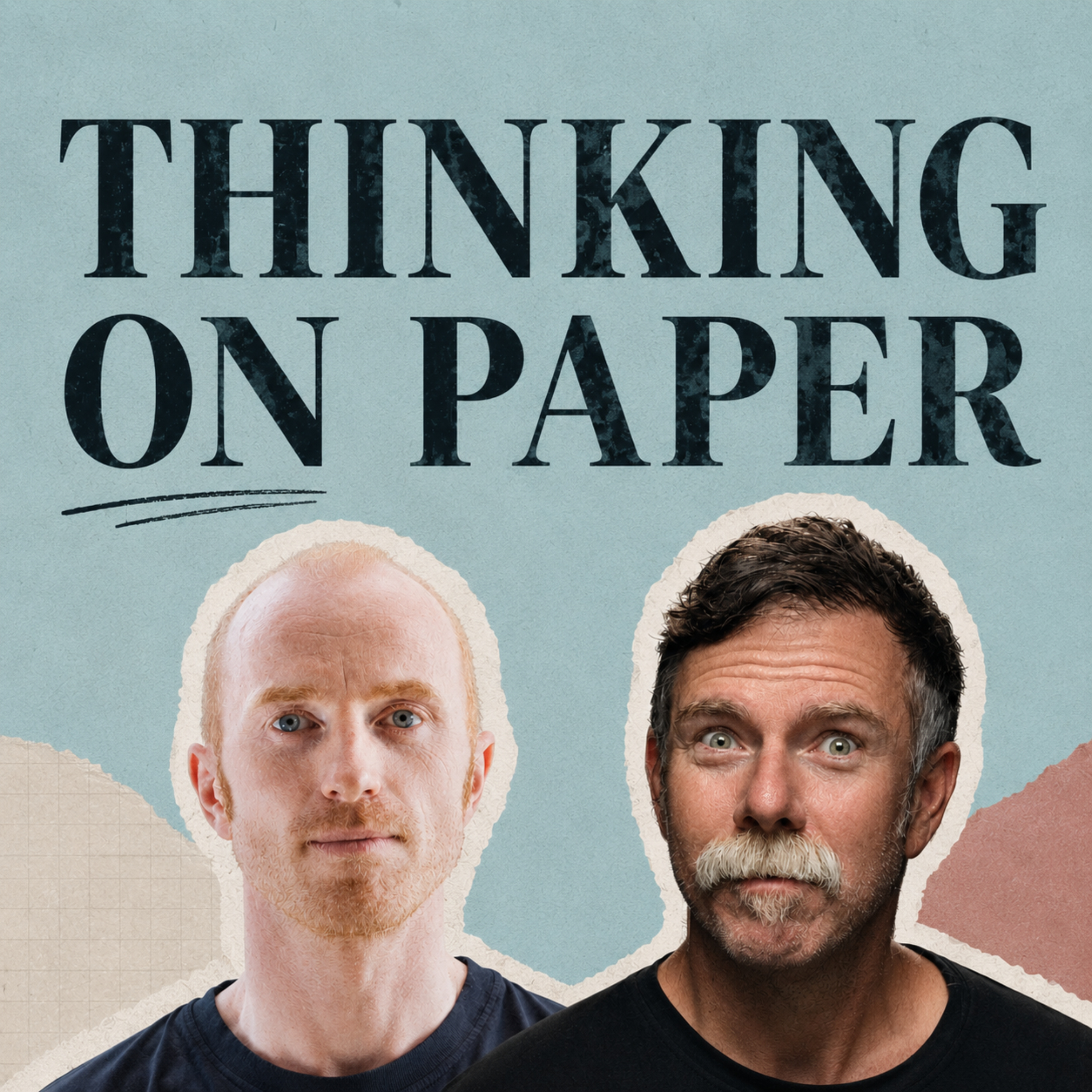
Thinking On Paper
by Mark Fielding and Jeremy Gilbertson
Conversations about the human impact of artificial intelligence, quantum computers, NASA, asteroid mining, coordination, trust, books, robotics, space technology, web3, physics, chemistry, sustainability, music, art, science, neuroscience, work, rest and play. New episodes every Thursday. Tech book club every month.
-
120
The Space Economy Isn’t Free Market Capitalism - Matthew Weinzierl and Brendan Rosseau
How do we stop humanity taking its failures to space? Can we take civilization to the stars and make it economically viable?The space industry is entering a strange new phase.Traditionally, space has been the domain of governments. Exploration, prestige, national projects. Apollo. Shuttle. The ISS. Now space is beginning to look less like exploration and more like a private business. Satellite networks, commercial space stations, lunar mining, microgravity manufacturing and data centers in space. Despite commercialization, state power still dominates the frontier. NASA is returning to the Moon and China is breathing down their neck. National security still drives the agenda. And pays for launch. This week, we Think On Paper with Matt Weinzierl and Brendan Rosseau, authors of Space To Grow.You’ll learn why the modern space industry still depends heavily on governments, whether commercial space stations can become profitable, how geopolitical rivals still cooperate in orbit, and how markets, power and national security shape the economics of life beyond Earth. Can space become a true economy, or will it always remain an extension of the state?Please enjoy the show.🏠 Buy us a beer on Substack🎧 Watch us compete with Lex Fridman on YouTube 🎧 Remember Steve Jobs and listen on APPLE 📺 Watch the clips and shorts on InstagramWatch a random video from Rick Beato. Because we love him.--Chapters(00:00) The Balance of Government and Market in Space(03:35) The Role of Microgravity in Space Research(07:43) Economic Incentives and Long-term Investments in Space(12:14) Navigating Political Cycles in Space Policy(17:09) International Collaboration and Competition in Space(18:45) The Importance of Security in Space(21:36) The Power of Space Exploration(24:27) Space as an Invisible Backbone(28:49) The Debate on Space Investment(30:37) Challenges of Space-Based Data Centers(33:40) Exploring the Future of Space Resources(38:26) Governance in Space: A New Era(40:55) Minimum Viable Governance in Space
-
119
IBM And The Quantum Computer Isolated From The Universe
Ten years ago, IBM put a five qubit machine on the cloud and let anyone run a program on it. Today, researchers have published nearly 6,000 papers on IBM hardware, and quantum computing is nearing the tipping point. You know what? It might be useful! Scott Crowder thinks on paper about where quantum actually is right now. And all paths lead to the Cleveland Clinic. They recently simulated a 303 atom protein by splitting the problem between quantum and classical hardware, a jump from the 14 atoms they could handle nine months earlier.Researchers at RIKEN in Japan are coordinating quantum hardware and the country's largest HPC cluster in the same building. Both efforts point toward what IBM calls a quantum-centric supercomputer, an architecture where quantum and classical resources accelerate each other rather than compete.You'll learn why superconducting qubits beat the alternatives, how a quantum computer draws about the same power as a single rack of AI hardware, whether quantum data centers belong in space, why helium-3 may become a real constraint by the mid-2030s, and what Richard Feynman would make of his 1981 vision finally coming to life.Please enjoy the show.--🏠 HQ: www.thinkingonpaper.xyz📺 INSTAGRAM: https://www.instagram.com/thinkingonpaperpodcast/🎧 Spotify: https://open.spotify.com/show/00volKqMsQntToeho35W47🎧 APPLE: https://podcasts.apple.com/us/podcast/thinking-on-paper-technology-moves-fast-think-slower/id1713227258--Mark x: https://x.com/markfielding99Jeremy: https://www.linkedin.com/in/jeremygilbertson/–Chapters(00:00) Trailer(01:20) Quantum computing: real, hyped, or both(02:40) Why reference architectures decide which technologies win(05:05) Superconducting vs. trapped ion vs. spin qubits(06:47) Why accessibility and algorithmic discovery are the real bottlenecks(12:34) Cleveland Clinic's 303-atom protein simulation(13:44) IBM's quantum-centric supercomputing architecture(16:07) What already runs on quantum computers today(17:58) The roadmap: how quantum and classical converge(22:28) What Richard Feynman would make of the field today(25:25) What quantum computing means for the future of data centers(32:01) Quantum computers in space, and why Crowder rejects Elon's pitch(34:10) What computing is actually for(42:19) Why Qiskit, NVIDIA, and open source matter for adoption
-
118
Can Bryan Johnson Really Live Forever? Longevity, AGI & The Politics Of Space - Anders Sandberg
Hold on to your hats, your brain is about to get a serious work out. Anders Sandberg, futurist, transhumanist and curiosity magpie joins us for one of the widest-ranging conversations we've ever recorded.You'll learn about brain emulation, uploading your consciousness, the politics of space, AI run economies, NASA, transhumanism, longevity, maths, neuroscience, memory, middle age and aliens. You'll learn why Dracula wouldn't be bored if he was around today, what drone warfare and AGI means for peace, prosperity and economics and we ask: Can Bryan Johnson really live forever? Plus much more. Enjoy. 🎧 Listen to every podcast📺 Follow us on Instagram🏠 Follow us on X🏠 Follow Jeremy on LinkedInTo suggest guests or sponsor the show, please email: [email protected](00:00) Augmentation and Human Potential(08:09) The Impact of Mobile Technology on Humanity(11:51) Accountability in AI Agents(18:25) The Role of Empathy in Human-AI Interaction(25:35) AGI vs. Alien Life: A Comparative Analysis(27:36) Consciousness and Brain Emulation(35:52) The Future of Uploaded Minds(40:33) Exploring Parallel Realities and Memory Merging(45:16) The Future of Human Collaboration and Organizations(46:24) AI's Role in Managing Global Systems(51:23) The Dual Economy: Human vs AI Management(57:43) The Complexities of Space Ownership and Governance(01:05:18) The Future of Space Exploration and Human Expansion(01:17:49) The Impact of Space Race on Human Progress(01:21:43) The Role of Nations and Corporations in Space Exploration(01:24:22) Experimenting with New Forms of Governance(01:26:18) NASA's Future in the Age of Innovation(01:28:41) The Potential for Breakaway Movements in Space(01:30:16) Trust and Coordination in Space Governance(01:34:18) The Future of Fusion Energy(01:42:15) The Value of Time and Life Extension(01:48:06) Reinventing Identity in Extended Lifespans(01:52:03) The Future of Humanity and Technology
-
117
Carissa Véliz - Protect Yourself From The Prophets Of Technology
Oxford AI philosopher Carissa Véliz Thinks On Paper.The accolades for her TED talk are piling up. Her new book Prophecy is propping up every technology bestseller list this side of Silicon Valley. Yet she found time to join us and dismantle the illusion that big AI and Big Tech CEOs can predict tomorrow. She's taking on the big leagues, and she won't flinch.Carissa draws on philosophy, political history, and her work at Oxford's Institute for Ethics in AI, to outline her argument: the predictions Sam Altman and Elon Musk throw around don't just describe the future. They shape it. When we believe the super-forecasts, we risk turning them into self-fulfilling prophecies.Prophecy is nothing new. It just has a bigger stage. From the Oracle at Delphi to Rasputin, prediction has always been a tool for steering human behaviour. What’s changed is the reach, the speed, and the size of the audience.Personal autonomy, analog experience, and friendships are all ways to resist the pull of predictions. So is comedy. Watch more Seinfeld, Fawlty Towers, and George Carlin.Carissa is a brilliant scholar and fabulous writer, but more than that she’s a wonderful human who recognizes that the future is unwritten. And you write it.--📺 Watch On YouTube: 🎧 Listen to every podcast📺 Follow us on Instagram🏠 Follow us on X🏠 Follow Jeremy on LinkedInTo suggest guests or sponsor the show, please email: [email protected] (00:00) Intro(01:00) What is the good life? (02:00) Why knowing yourself matters more than strategy (04:44) The analog world vs the digital world (06:45) How prophecies exploit our need for security (08:47) Why ancient Rome banned predicting the emperor's death (10:11) The illusion of safety that AI sells us (12:27) When predictions work, and when they don't (15:00) Altman, Amodei, Huang: predictions or sales pitches? (28:29) How to resist prophecies as a busy person (29:53) Prediction markets, Polymarket, and democracy (31:49) TikTok, algorithms, and the Molly Russell case (36:08) "Engagement algorithms are cocaine in food" (40:54) Self-fulfilling prophecies as the perfect crime (43:44) Why comedy is the enemy of prophecy (46:59) What Seinfeld teaches us about predictive algorithms (52:16) Karikó and the Nobel Prize we almost missed (53:40) Increase your serendipity (56:13) Why Epicurus beats the Stoics
-
116
America Lost The Meme War With Iran - Lolz
The AI meme war between the US and Iran has evolved into an absolute shit show. If you thought it was awful a few weeks ago, you ain't seen nothing yet.AI-generated Lego propaganda videos were a curiosity. Sometimes funny, often violent, always troublesome and never diplomatic, they quickly gained millions of views across social media... because social media. The White House Twitter (X) account was responsible for the US videos. An Iranian media company called Explosive Media, the Iranian. America, either put off by the global consensus that it was losing the war, or bored, switched their AI models to tax season (with equal ineptitude).Iran, losing the guns and missiles part of the war, has changed tact. Explosive Media turned up the heat. And was duly banned from YouTube. Which could of unleashed the beast. Now Iranian embassies are posting them on Twitter (X) and US creators are using the same format to mock it all with Lego.. Just watch it yourself. And let us know what you think. --🎧 Listen to every podcast📺 Follow us on Instagram🏠 Follow us on X🏠 Follow Jeremy on LinkedInTo suggest guests or sponsor the show, please email: [email protected](00:00) Explosive Media(00:38) US Bowling Iran(01:52) Trump's Mask(03:20) Blockade, Blockade(06:28) Drunken Hegseth(08:00) Truth
-
115
Who Owns The Moon? Space To Grow - The End Game
The romantic version of the space is about exploration. We say it's about war. And the data agrees with us. 80% of all space investment is defence. The money flowing into the industry — the venture rounds, the strategic capital, the government dollars — is overwhelmingly going to one thing. Tracking, watching and blowing up enemies. This is the final episode in our five-week book club on Space to Grow by Matthew Weinzierl and Brendan Rosseau. Weinzierl is a professor at Harvard Business School and co-founder of the school's SPACE course. Rosseau, formerly an HBS teaching fellow and research associate, is now a Strategy Manager at Blue Origin. Its last two chapters ask who owns space and who actually runs it. The answers are different. You won't like either. Please enjoy the show. --Chapters(00:00) Global Conflict and Space Resources(02:04) Human Nature and Space Exploration(03:28) The Economics of Asteroid Mining(05:53) Legal Frameworks for Space Mining(11:05) The Space Resource Exploration Act(13:01) International Reactions to Space Mining Legislation(17:19) Philosophical Perspectives on Space Ownership(20:14) The Role of National Security in Space(20:40) The Role of Government in Space Innovation(21:34) National Security and the Space Industry(23:10) Weaponization of Space: A New Era(24:47) The Prisoner's Dilemma in Space Cooperation(26:40) Humanity's Moral Compass in Space Exploration(27:03) The Future of Humanity in Space
-
114
The Biggest Space Company You've Never Heard Of Just Raised $729 million
If you tried to guess the biggest space industry raise of 2026, you’d probably name a US company. You’d be wrong.“I feel a little bit like Casey Kasem, top 40,” Jeremy said when we started recording. We had ten companies, a quarter of funding rounds, and a question: where is the money in space tech actually going in 2026?Some of what we found was predictable. Most of it wasn’t. The biggest raise of the year so far isn’t American. The fourth-biggest is a company you’ve probably never heard of. And one of the names on the list, in Jeremy’s words, sounds like “a skater stoner name.”Here’s the countdown.--🎧 Listen to every podcast📺 Follow us on Instagram🏠 Follow us on X🏠 Follow Jeremy on LinkedInTo suggest guests or sponsor the show, please email: [email protected](00:00) Starcloud(00:52) Xona Space(03:27) Tomorrow IO(06:01) PLD Space(08:00) Stoke Space(10:18) Axiom Space(12:29) Cesium Astro(14:50) VAST Space(19:02) Sierra Space(21:47) I-Space (Beijing Interstellar Glory Space Technology Ltd.)
-
113
An 1899 Law for AI and Space: The Martens Clause
For 100,000 years, peace didn’t exist. And soon we’ll have AGI and cities on the moon and expect everyone to get along. The first conference on not killing each other wasn’t until 1899. What the hell were we doing before that? Why did it take humanity so long to sit down and speak about peace? That’s a question for another podcast. For this, let’s rewind the clock and have a story. The Martens Clause was a legal principle drafted by Russian-Imperial diplomat Fyodor Martens during the first Hague Peace Conference of 1899. It established that even in the absence of specific written law, nations and individuals remain bound by "the laws of humanity and the requirements of public conscience." In short, don’t be an asshole. Originally conceived as a compromise to prevent the collapse of early international humanitarian law negotiations - when smaller nations like Belgium objected to being smaller nations - the clause became a foundational backstop in international law. It was subsequently invoked in some of the most consequential legal proceedings of the twentieth century, including the Nuremberg Trials of 1945-46, the 1949 Corfu Channel dispute and the 1986 ICJ ruling against the United States for mining Nicaraguan harbors and supporting the Contra insurgency.Now we want to know whether this 127-year-old clause could serve as what Jeremy calls a "minimum viable architecture" for governing emerging technologies.Please enjoy the show. And keep the peace. --🎧 Listen to every podcast📺 Follow us on Instagram🏠 Follow us on X🏠 Follow Jeremy on LinkedInTo suggest guests or sponsor the show, please email: [email protected](00:00) The First Peace Conference: A Historical Perspective(07:37) The Martin's Clause: Implications for Modern Governance(10:05) Space Tech and the Outer Space Treaty(13:58) AI and the Need for Ethical Frameworks(17:21) Accountability in Technology Deployment(22:56) The Future of Humanity: Collaboration vs. Competition
-
112
The Automation Of War
Imagine if the future of the world rested on the shoulders of Donald Trump, Pete Hegseth and their pet AI war strategy? Yep! We're about to find out.On January 9th 2026, the US Secretary of Defense signed a memorandum called Artificial Intelligence Strategy for the Department of War. Six weeks later, the US was at war with Iran and AI was identifying targets. Mark and Jeremy read the memo line by line. What they found: a strategy built on speed over safety, experimentation over caution, and the explicit statement that "the risks of not moving fast enough outweigh the risks of imperfect alignment." The memo outlines swarm warfare, AI-generated military intelligence, 30-day deadlines for federating classified data across all departments, and a talent war with Silicon Valley. Anthropic, the company that asked for safeguards against mass surveillance and full automation of the kill chain, was classified as a supply chain risk. This episode asks one question: does AI make war more likely or less likely?--🎧 Listen to every podcast📺 Follow us on Instagram🏠 Follow us on X🏠 Follow Jeremy on LinkedInTo suggest guests or sponsor the show, please email: [email protected](00:00) Artificial Intelligence Strategy for the Department of War(00:58) Executive Order 14179: America's AI Military Dominance(01:59) China And AI Arms Race(04:36) Anthropic & Eliminating Bureaucratic Barriers(07:20) The 7 Pace Setting Projects (PSPs) In The Memo(08:28) 100% LLM Kill Chain Capability(10:22) Palmer Luckey(11:53) Intelligence & The AI Open Arsenal(13:57) The War Time Approach To Blockers(16:46) AI Talent Acquisition At The DOW(18:54) We must accept that the risks of not moving fast enough outweigh the risks of imperfect alignment
-
111
Iran Show America How To Use AI For Propaganda
Iran made an AI Lego propaganda video about the United States. It was kind of funny. The US replied with Grand Theft Auto, Wii Sports, and Call of Duty. It wasn't. Children's toys and video games to push a distorted view of war at kids and morons on Twitter. Oh how they'll laugh. This is our first reaction video. Probably be our last.--🎧 Listen to every podcast📺 Follow us on Instagram🏠 Follow us on X🏠 Follow Jeremy on LinkedInTo suggest guests or sponsor the show, please email: [email protected](00:00) What Is Propaganda?(00:36) Iran Lego Propaganda Video(02:45) Reaction(06:55) Whitehouse GTA Iran War Video(09:07) Epic Fury - US Wii Sports Video(13:22) Call Of Duty Iran War Video
-
110
One Million Satellites: Space to Grow
There’s nothing Elon Musk loves more than sending Starlink satellites to space. Except maybe money and bad tweets. He’s just filed to send a million up there. Yep! A million. Which doesn’t sit well with Donald Kessler, the man who first theorized the Kessler Syndrome in 1978. You see, Kessler and others think roughly 70,000 objects in LEO is the threshold beyond which collision cascades become self-sustaining and unstoppable, regardless of whether new launches cease entirely.That’s a lot less than one million. What does science say? And is anyone clearing up all the junk we’ve already sent up to space? We're reading Space To Grow by Matthew Weinzierl and Brendan Rosseau, to find out. This is Part 4. Please enjoy the show--🎧 Listen to every podcast📺 Follow us on Instagram🏠 Follow us on X🏠 Follow Jeremy on LinkedInTo suggest guests or sponsor the show, please email: [email protected](00:00) How 150,000 pieces of space junk ended up in orbit and why nobody cleaned them up(06:21) Kessler syndrome explained: the tipping point where collisions become unstoppable(10:57) Why the insurance market is not pricing orbital collision risk(13:50) Government intervention, the Moon Treaty and the five-year deorbit rule(20:26) Active debris removal: magnets, robots and who is building the solutions(22:37) Astroscale: how one company is trying to clean up space junk commercially(24:53) Who pays to clean up orbit when the market has no incentive to(26:26) Is SpaceX a monopoly and does that matter for the space industry(29:08) NASA Administrator: there is only one thing worse than a government monopoly(33:04) Space governance, coordination and whether the tragedy of the commons can be solved in orbit
-
109
Roll Up, Roll Up, The Spin Qubit Circus Is In Town: Brandon Severin
Quantum computing's quiet advantage might not come from exotic physics. It might come from the silicon chip industry we already have. On this episode of Thinking on Paper, we talk with Brandon Severin, founder of Conductor Quantum, about why spin qubits could be the modality that finally rides semiconductor manufacturing all the way to a million qubits. Severin walks us through what a spin qubit actually is, a single electron isolated in silicon with its spin pointing up or down as the fundamental quantum bit, and how the trillion-dollar semiconductor industry that perfected the transistor over fifty years gives spin qubits a manufacturing path no other modality can match. Along the way: how Google's new quantum NMR algorithm hints at where verifiable quantum advantage is heading, why the "more qubits versus better qubits" debate misses the point, how spin qubits compare with trapped ions and superconducting approaches, the brutal calibration problem of tuning twenty parameters per qubit by hand, and why building for a million qubits from day one is a fundamentally different mindset than adding them one at a time.Have fun with this one. We did. --Brandon Severin: https://www.conductorquantum.com/--Listen to every podcastFollow us on InstagramFollow us on XFollow Mark on LinkedInFollow Jeremy on LinkedInRead our SubstackEmail: [email protected]--Timestamps(00:00) Introduction: spin qubits and the quantum scaling problem(03:47) Trapped ions vs spin qubits: fidelity, coherence, and tradeoffs(06:14) What qubit fidelity means and why it determines scaling limits(08:25) What is a spin qubit? Building from the transistor up(11:06) Semiconductor fabrication as quantum computing's manufacturing advantage(15:00) The quantum circus: superposition, measurement, Schrödinger's cat(17:17) Shuttling qubits — moving electrons across a chip(20:33) How AI automates quantum calibration (the control problem)(25:00) Quantum scaling vs AI scaling: the GPU parallel(29:08) Quantum startup culture and the AI generation gap(32:59) Building for a million qubits — rocket ships vs ladders(36:52) Why quantum is taking so long: talent, concentration, and meaning(39:43) What seems impossible now that will be routine in 20 years
-
108
Why Quantum Computers Matter (In 6 Minutes)
Quantum computers are like the England football team. Always promising to deliver, always malfunctioning when it matters. They have an incredible marketing department, lot's of fancy parts, huge investments but then they play Portugal. Or Spain. Or France. Or Argentina. Or Iceland. Infleqtion CTO Pranav Gokhale makes the case that 2028 is the year England win the World Cup (there isn't a world cup in 2028). This time it's different, because for the first time, logical qubits actually exist. And in 2028 they'll be a hundred of them.And with one hundred logical qubits, material science and drug discovery become the first real quantum use cases. --Other ways to connect with us:Listen to every podcastFollow us on InstagramFollow us on XFollow Mark on LinkedInFollow Jeremy on LinkedInRead our SubstackEmail: [email protected]
-
107
The Space Bubble Burst Once, Will It Pop Again? - Space to Grow
If you were flush from crypto and had invested $1,000 in space start-up stocks in 2021. It was worth roughly $100 by 2024. Virgin Orbit crashed and burned like soggy firework. $3.7 billion to bankruptcy. Astra went public at $2.1 billion without a single rocket that had reached orbit. And still the suckers lined up. SPACs, Special Purpose Acquisition Companies, gave pre-revenue space startups a shortcut to public markets, bypassing the scrutiny of a traditional IPO. Investors piled in on forward-looking projections. Then the redemptions started. In part three of the Thinking on Paper Book Club series on Space to Grow by Matthew Weinzierl and Brendan Rosseau, we trace how the money flowed in, why it collapsed, and what replaced it. --Listen to every podcastFollow us on InstagramFollow us on XFollow Mark on LinkedInFollow Jeremy on LinkedInRead our SubstackEmail: [email protected](00:00) What is a SPAC? (01:30) Why space SPACs failed (03:20) Virgin Orbit & Astra: the worst examples (06:00) SPACs vs Crypto: same story? (08:30) The Stag Hunt: why space needs coordination (11:00) NASA Artemis explained (13:00) SLS vs Starship cost breakdown (17:00) SpaceX & Blue Origin lunar contracts (20:00) The Moon Race vs China (22:00) Can NASA survive the commercial space era?
-
106
Infleqtion: How Quantum Clocks Tell Time - Matt Kinsella
GPS is getting spoofed, jammed, and quietly weaponised, and the global infrastructure that depends on it, from electricity grids to financial markets to your phone, is more fragile than most people realise. In this episode of Thinking on Paper, hosts Mark Fielding and Jeremy Gilbertson sit down with Matt Kinsella, CEO of Infleqtion, to unpack how neutral atom quantum technology is rewriting the rules of precision timing, sensing, and computing. Kinsella walks through how a rubidium atom hit with a 778-nanometre laser becomes nature's metronome — a quantum clock more precise and unspoofable than anything in orbit — and why the same underlying physics is producing both better-than-GPS positioning systems and a path to fault-tolerant quantum computers. Along the way: the Rydberg state and a single atom that can replace an entire antenna farm, Infleqtion's Sapient Secure AI for PNT contract with the US Army, drug discovery and the no-cloning theorem, and why CEO Matt Kinsella thinks Jensen Huang's playbook at Nvidia is the right model for building a quantum company.--Listen to every podcastFollow us on InstagramFollow us on XFollow Mark on LinkedInFollow Jeremy on LinkedInRead our SubstackEmail: [email protected]--Timestamps:(00:00) Trailer(01:50) Why coordination matters: From internal strategy to GPS timing(04:48) What is a quantum clock and how does it link to GPS?(07:18) Nature's metronome: How atoms keep time with laser precision(08:14) Room temperature quantum: Why neutral atoms don't need freezers(12:38) The Rydberg state: Making atoms sensitive to the entire RF spectrum(14:03) Quantum clock on a UK submarine(17:06) Quantum in space: Voyager partnership and the International Space Station(18:48) Hybrid quantum-classical workflows: How QPUs layer above GPUs(23:18) Software layers: From laser control to developer applications(25:32) Drug discovery example: GPU, CPU, QPU(29:03) The bridge between classical and quantum: Memory architecture innovations(31:54) How Quantum Clocks & Products Lead To Quantum Computers(33:48) Nvidia(35:42) Quality or Quantity of Qubits (38:00) Quantum mechanics and free will: Does wave collapse prove consciousness?Love it.Thanks. --Listen to every podcastFollow us on InstagramFollow us on XFollow Mark on LinkedInFollow Jeremy on LinkedInRead our SubstackEmail: [email protected]--Chapters(00:00) Why quantum computing matters right now (01:20) Why Nvidia is betting big on quantum (02:52) NVQ-Link: the bridge between quantum and classical computing(09:29) Who decides what runs on the quantum computer vs the GPU?(12:33) AI helping quantum, quantum helping AI (16:56) Building a space elevator battery: a real quantum workflow (20:09) The quantum algorithm zoo (22:04) From noisy qubits to logical qubits (24:00) How much energy does a quantum computer actually use? (27:05) The no-cloning theorem: why you can't copy-paste quantum data(27:20) The biggest unanswered question in quantum computing(30:47) A $20M NASA program and a telescope for underground (33:32) What do we want humans to be?
-
105
When Quantum Supercomputers Speak To AI: Nvidia & Infleqtion
For the first time, a quantum computer and an AI supercomputer can talk to each other in four microseconds. That's the kind of round-trip latency that makes real-time hybrid computing actually possible. On this episode of Thinking on Paper, we talk with Sam Stanwyck of Nvidia and Pranav Gokhale of Infleqtion about NVQ Link, the new interconnect that bridges GPUs and QPUs, and what it means for the future of quantum computing. Stanwyck explains why Nvidia, the company most people associate with AI and gaming, sees quantum as a core part of accelerated computing, and how NVQ Link extends the same architectural thinking that produced NVLink into the quantum domain. Gokhale walks us through how Infleqtion's neutral atom quantum computer co-processes with Nvidia's GPU stack in real time, slicing problems into the pieces each kind of hardware does best. Along the way: how CUDA-Q lets GPUs simulate quantum computers before they run, why quantum error correction is "as fundamental as the quantum computer itself," how AI is being used to decode quantum results in real time, and a worked example of designing a longer-lasting battery for a space elevator using a hybrid quantum-classical workflow.And watch till the end for quantum show and tell.--Listen to every podcastFollow us on InstagramFollow us on XFollow Mark on LinkedInFollow Jeremy on LinkedInRead our SubstackEmail: [email protected]--Chapters(00:00) Why quantum computing matters right now (01:20) Why Nvidia is betting big on quantum (02:52) NVQ-Link: the bridge between quantum and classical computing(09:29) Who decides what runs on the quantum computer vs the GPU?(12:33) AI helping quantum, quantum helping AI (16:56) Building a space elevator battery: a real quantum workflow (20:09) The quantum algorithm zoo (22:04) From noisy qubits to logical qubits (24:00) How much energy does a quantum computer actually use? (27:05) The no-cloning theorem: why you can't copy-paste quantum data(27:20) The biggest unanswered question in quantum computing(30:47) A $20M NASA program and a telescope for underground (33:32) What do we want humans to be?
-
104
Helium-3 Is The Fusion Super Fuel Of The Future - Glen Martin
There are about 100 kilograms of helium-3 on planet Earth. The current US reserve is 29 kilograms. Global production runs around 20 kilograms per year. And early estimates put quantum computing demand alone at 300 to 400 kilograms per year. The math doesn't work, which is why people are starting to look at moon mining. On this episode of Thinking on Paper, we talk with Glen Martin, CEO of the Extraterrestrial Mining Company, about why helium-3 is suddenly one of the most strategically important isotopes on the planet, and why the Moon, with an estimated 1.1 million tons sitting in its lunar regolith, is where the next mining rush is heading. Martin walks us through what helium-3 actually is, how it gets to the Moon (carried on solar winds and trapped in titanium oxide because the Moon has no magnetosphere to deflect it), and why moon mining looks more like beach combing than the giant-drill image most people picture. Along the way: why dilution refrigerators for IBM, Google, and Microsoft's quantum computers are already running short on supply, why fusion is the killer app and how two helium-3 atoms fuse without creating radioactive waste, the rise of quantum hybrid data centers as the bridge to fusion deployment, and how a single square kilometer of lunar surface could yield 33 kilograms of helium-3 and remain effectively invisible from Earth.--📺 Watch on YouTube--Timestamps(00:00) Trailer(02:45) What is Helium-3, and why are we mining the Moon?(05:29) Why there’s almost no Helium-3 on Earth, and a million tons on the Moon(09:01) How Helium-3 could be harvested from lunar dust(10:33) Fusion without fallout: the clean-energy promise of Helium-3(13:01) Space-based solar power and fusion: two paths to future energy.(17:56) How private companies plan to finance Moon mining(21:52) The new space race: U.S., China, and the competition for lunar fuel(25:03) Can treaties prevent conflict over Moon resources?(27:37) AI, autonomy, and the machines that will mine the Moon(29:31) NASA’s commercial lunar payloads and the rise of space infrastructure(31:08) What lunar regolith tells us about Helium-3 reserves(33:35) The trillion-dollar question: who profits from space resources?(36:17) Curiosity, wonder, and the future of human exploration(40:01) Technology, morality, and the choice to be good--Listen to every podcastFollow us on InstagramFollow us on XFollow Mark on LinkedInFollow Jeremy on LinkedInRead our SubstackEmail: [email protected]
-
103
Privacy Is Your Super Power: Carissa Véliz On How To Keep It
There are now more non-democratic countries in the world than democratic ones. Only a third of Americans under 35 say it's vital to live in a democracy. The share who would welcome military government rose from 7 percent in 1995 to 18 percent in 2017. On this episode of Thinking on Paper, we talk with Carissa Véliz, associate professor at Oxford's Institute for Ethics in AI and author of Privacy Is Power, the Economist Book of the Year, about why privacy is not just a personal preference but the load-bearing wall under liberal democracy. Véliz walks us through what privacy actually is (a right, a duty, and a piece of social infrastructure all at once), why your music taste reveals your politics and your location reveals your religion, and how the East India Company is the historical model for what big tech could become if we keep mistaking convenience for a fair trade. Along the way: why corporate and government surveillance have quietly merged into a single system, how the Nazis' use of personal data shaped the Universal Declaration of Human Rights, why Signal beats WhatsApp on every metric that matters, the difference between behaving like a user and behaving like a citizen, and the line that lands hardest near the end, that democracy is a conversation, and if we leave it to the chatbots we lose our place at the table.Please enjoy the show. --Follow Carissa on XBuy Privacy is Power----Listen to every podcastFollow us on InstagramFollow us on XFollow Mark on LinkedInFollow Jeremy on LinkedInRead our SubstackEmail: [email protected](00:00) Trailer(02:26) What Is Privacy(05:31) Is Democracy At Risk?(08:34) Government & Big Tech(10:39) How To Decouple Big Tech & Government(12:33) Privacy & The Common Human Experience(16:02) Tools To Protect Your Privacy(17:18) Cookie Clutter(19:30) ChatGPT Writes Policy(20:05) Radical Open Mindedness(21:52) AI Alignment(22:56) AI Ethics(28:09) How To Erase Your Data(29:27) What Should Humanity Be?
-
102
A Hotel on the Moon by 2032: Skyler Chan on Building Off-World
The cost to send a kilogram of payload to the surface of the Moon is currently about a million dollars. SpaceX has publicly targeted bringing that to a hundred thousand dollars. And humans have never built a single product on the Moon, which means the first brick on the lunar surface, whoever lays it, will be the first manufactured object in human history made off-world. On this episode of Thinking on Paper, we talk with Skyler Chan, CEO and founder of Gru, the company that wants to put a hotel on the Moon by 2032. Chan walks us through why off-world surface habitation, not transportation, is the actual gating problem for becoming a multi-planetary species, and how Gru's two-part technical bet (an inflatable bladder shipped from Earth combined with bricks manufactured in-situ from lunar regolith and a geopolymer chemical solution) is designed to be the simplest practical path to making it work. Along the way: why the false dichotomy between bringing-everything-from-Earth and using-only-lunar-resources misses the actual engineering reality, why the first brick on the Moon is more important than the hotel itself, the Overton window of moon-related ideas and how it's already widening in real time, the difference between launch cost and launch price.We also get into what it actually takes to hold pressure and temperature inside a lunar habitat, and the conviction that's underneath all of it, that humans becoming interplanetary is inevitable and the only question is who builds the infrastructure first.Enjoy.--Listen to every podcastFollow us on InstagramFollow us on XFollow Mark on LinkedInFollow Jeremy on LinkedInRead our SubstackEmail: [email protected](00:00) Trailer(02:19) Building a Hotel on the Moon(06:06) The Logistics of Space Travel(06:47) Economic Considerations for Lunar Ventures(10:03) Merging Technologies for Lunar Habitats(10:59) First Mission: Building the First Brick on the Moon(13:15) Changing Perceptions of Space Projects(16:25) The Human Spirit and Interplanetary Exploration(19:40) Responsibility of Being an Interplanetary Species
-
101
Philip Johnston TED Talk: StarCloud's Plan to Move Data Centers to Space - Reaction Video
Philip Johnston is the CEO of Starcloud. He put an Nvidia H100 chip in space and gave a TED talk about it. As you do if you're responsible for building the infrastructure for space-based data centers. Elon Musk was not the first. He follows in the footsteps of Mr Johnston. And so, rather than Mr SpaceX, our first technology reaction video is this TED talk from San Francisco. We watched it for the first time. Live. On TV. This is not theoretical. It's also not up to date. Philip filmed this in October 2025. Starcloud have already launched the Nvidia H100 on a Falcon 9 up into space. It's happening disruptors and curious minds. It's happening. Philip predicts most data centers will be in space within 10 years. We agree. Please enjoy the show.Cheers, Mark & Jeremy.--Other ways to connect with us:Listen to every podcastFollow us on InstagramFollow us on XFollow Mark on LinkedInFollow Jeremy on LinkedInRead our SubstackEmail: [email protected]
-
100
Moon Dust, the Space Economy, and Democracy: Philip Metzger
When a rocket lands on the Moon, it blasts moon dust at nearly 5,000 meters per second, six times the speed of a bullet. There's no atmosphere to slow it down, which means every blast on the Moon is a global event. That dust will sandblast solar panels, jam mechanisms, etch thermal-control surfaces, and shorten the lifespan of every piece of hardware anyone else has placed up there. And nobody has worked out who decides how close anyone is allowed to land. On this episode of Thinking on Paper, we talk with Dr. Philip Metzger, planetary physicist, co-founder of NASA's Swamp Works at the Kennedy Space Center, and one of the people whose research is going to determine how the Moon gets used. Metzger spent nearly 30 years at NASA before moving to the University of Florida, where he now studies the physics of rocket exhaust on lunar soil and the economics of industrializing space. He walks us through why the dust problem is geopolitical before it's technical, why NASA is still essential as a coordinator of trust between companies that would otherwise never cooperate, and why he projects the space economy will reach $50 to $100 billion within fifty years. Along the way: the stag hunt coordination problem and how it shapes which companies actually get built, why landing pads on the Moon are about to become an international flashpoint, what changes when most of civilization's economic value is produced off-planet, and the warning Metzger lands on near the end, that if a small number of actors gain the ability to produce a billion times Earth's economic output, democracy doesn't survive it.--Take your Thinking Further. Stephen Hawking Center: https://sciences.ucf.edu/physics/microgravity/lab/Philip X: https://x.com/drphiltill-Other ways to connect with us:Listen to every podcastFollow us on InstagramFollow us on XFollow Mark on LinkedInFollow Jeremy on LinkedInRead our SubstackEmail: [email protected](00:00) Introduction to Space Exploration and Economics(01:26) NASA's Role in Future Space Exploration(06:45) Impact of Rocket Exhaust on Lunar Soil(14:39) Geopolitical Challenges in Space(23:39) Democratizing Space for Future Generations(33:45) Emergent Forces vs. Hierarchical Forces(34:08) Exploring Microgravity Applications(38:39) Rapid Fire Space Technology Opinions(44:02) The Future of Humans and Technology
-
99
Drone Delivery, BVLOS, and the Last Mile: Etienne Louvet
If you live somewhere remote, getting a parcel delivered costs more than the parcel. The economics of the last mile broke a long time ago, and they broke worst for the people furthest from a city. On this episode of Thinking on Paper, we talk with Etienne Louvet, CEO and founder of Iona Drones, about the light-cargo drone built to fix it. Iona's drone is not what you're picturing. It has a three-meter wingspan, takes off vertically, and then tilts its propellers and flies like a small airplane, with 95 liters of internal cargo (about the size of a bathtub) and a range of more than 100 kilometers carrying up to 20 parcels per flight. Louvet walks us through why his cost per parcel comes in 10 to 20 times below what existing logistics can offer in remote areas, why aggregating volume on a single vehicle is a 20th-century logistics assumption that no longer fits 21st-century e-commerce, and why the actual gating problem for drone delivery isn't the aircraft but the regulator. Along the way: the differences between flying drones under the FAA, the UK CAA, and the Irish Aviation Authority, what Beyond Visual Line of Sight (BVLOS) operations actually require to certify, why software stability matters more than hardware in handling weather, the surprising answer to "how many commercial deliveries have you completed" (zero, and on purpose), and the broader thesis that the future of logistics isn't trucks replaced by drones but a multimodal fleet where each kind of cargo gets the vehicle that fits.Enjoy.--Other ways to connect with us:Listen to every podcastFollow us on InstagramFollow us on XFollow Mark on LinkedInFollow Jeremy on LinkedInRead our SubstackEmail: [email protected](00:00) Intro (01:50) How much weight can drones carry(02:29) What counts as light cargo (06:51) How drone regulations actually work (13:04) Self-assessment and risk management (14:12) Getting municipalities to say yes (16:38) Weather problems (19:48) Where Iona Drones is now (20:58) Maximizing payload capacity (21:58) Drone design choices (23:27) BVLOS explained (26:08) Drones and privacy concerns (30:45) Implementing drones in existing logistics (35:02) Where autonomous delivery is headed (39:30) Technology and human progress
-
98
Prompting AI Isn't The Same As Asking Questions
Can you use AI to think better or think more critically? Philosopher Pia Lauritzen says no. The second we give up to the shortcut use AI, we are letting go of the very basic condition that forces us to think.When we ask if machines can think, the first question should be: why do humans think? Why do we think?For Pia, it is fairly simple. We think because we know there is something we do not know. We have a problem. There is a gap. A gap between what I know and what I want to know. So I have to start thinking. That is why I ask these questions and that is why I put up with this pain in my head of trying to figure something out that I do not know.The machine does not have that problem. It does not know that it does not know. It is like an animal. It does not know that it does not know. Of course it is a matter of how you understand thinking. But if you consult the old thinkers and not just the engineers and technologists, then you will have a really hard time finding anyone who would say that a machine could ever think. And if it cannot think itself, why should it be able to help us think? We are the only ones who know how to do that.This is the core problem. AI feels helpful. It removes the discomfort of not knowing where to start. It fills the blank sheet. But that discomfort is not a bug. That discomfort is the feature. That discomfort is what thinking is.And it is at this point that I am reminded of the scene in Con Air. Define irony.Please enjoy the show.Cheers, Mark & Jeremy.PS: Subscribe so other curious minds like you can find our channel.--Other ways to connect with us:Listen to every podcastFollow us on InstagramFollow us on XFollow Mark on LinkedInFollow Jeremy on LinkedInRead our SubstackEmail: [email protected]
-
97
AI Music, No Stealing
What if you could use AI to make your own music without stealing other people's beats, rhymes and melodies? Unlike platforms trained on scraped catalogs, Overtune’s AI is built on licensed music, starting with ~20,000 loops produced in-house. Producers can submit stems voluntarily, creating a clean foundation for ethical training and attribution.The platform uses vector-based audio embeddings to measure how much each stem contributes to a generated track. This enables automated attribution and proportional royalty distribution when songs are commercialized. Contributions are weighted mathematically, with clear thresholds to credit primary and secondary influences while avoiding excessive fragmentation Please enjoy the show.Cheers,Mark and JeremyPS: Subscribe so other curious minds like you can find our channel.Other ways to connect with us:Listen to every podcastFollow us on InstagramFollow us on XFollow Mark on LinkedInFollow Jeremy on LinkedInRead our SubstackEmail: [email protected]
-
96
Marketing Funnels Don't Exist. Your Customer Is OpenAI
Marketing funnels don't exist. They never did. The internet just convinced us they were real. Meta, Google, OpenAI and a supporting cast of billionaire sociopaths figured out they could control distribution and black-box your customers.Hurrah. Humanity forgot to read the small print. Now you're running a business where you don't even know who your customer is.Well here’s the AI-shaped healthcheck: Your customer is OpenAI.You're paying 3-15% for a digital presence you don't need. It's called the Silicon Valley tax. You're burning money to keep VCs rich while platforms add another layer of black box between you and the people you serve.The alternative? Network methodology. Someone you know, or someone who knows someone you know. That's it.Funnels were invented to sell marketing. Networks are how humans actually work. We've been doing it since we had prefrontal cortexes.Everything that's real is analog. That's true for business too.Welcome to the marketing jungle. The year is 2026, and if you don’t know who the sucker at the table is… you probably shouldn’t be playing the stakes. Please enjoy the reality check.Cheers,Mark and Jeremy. PS: Keep thinking on paper. They don’t want you to, that’s why you must. --Other ways to connect with us:Listen to every podcastFollow us on InstagramFollow us on XFollow Mark on LinkedInFollow Jeremy on LinkedInRead our SubstackEmail: [email protected]
-
95
NVIDIA Just Built The Bridge To Quantum. It's Called NVQ-Link: Matt Kinsella (CEO Infleqtion)
Matt Kinsella runs Infleqtion, a company building quantum computers. The biggest misconception about quantum computing is that it will replace classical computing. It won't. Quantum processors will sit above GPUs in data centers the same way GPUs sit above CPUs today. NVIDIA just built the bridge to make this work. It's called NVQ Link, and it changes how we think about the future of compute.NVIDIA announced NVQ Link in October 2024. It's the bridge between quantum computers and classical GPU clusters. Workloads pass seamlessly between them.Here's how it works in practice. Infleqtion and NVIDIA solved something called the Anderson Impurity Model - a photovoltaic problem in material science. Parts of it were solved on a GPU cluster. Parts that couldn't be solved by GPUs were solved on Infleqtion's quantum computer. Then they recombined to give the answer. This isn't commercially useful yet. But expand that over time and you could be looking at the future data center. One with three layers. CPUs at the bottom for general computing. GPUs in the middle for parallel processing and AI. QPUs at the top for problems that are quantum mechanical in nature. Workloads come in, get chopped up, each piece goes to the part of the stack best suited to solve it. Then results recombine.This is already happening. Infleqtion just announced a contract with the Army called Sapient Secure AI for PNT - position, navigation, and timing. It runs their quantum-inspired software on NVIDIA's Jetson edge GPUs. Small GPUs that don't have much memory. The software lets them ingest far more streaming data than normal. Video, speed, inertial motion. Then it recreates what GPS gives you - where you are in the world - by extrapolating from all those signals. Without GPS.Please enjoy the show.Cheers, Mark & Jeremy.--Other ways to connect with us:Listen to every podcastFollow us on InstagramFollow us on XFollow Mark on LinkedInFollow Jeremy on LinkedInRead our SubstackEmail: [email protected]
-
94
Satellites, Space Stations, and the Killer App: Space to Grow
The International Space Station cost about $100 billion to build and runs another $4 billion a year to operate. For a long stretch, it absorbed roughly half of NASA's annual budget. Skylab, the first US space station, lasted six years before falling out of the sky. Carl Sagan thought space stations were a waste of money. Ronald Reagan thought they were the next clipper ship. The killer app for space, the thing that finally makes the economics work, has been argued about for fifty years and not yet found. On this episode of Thinking on Paper, we continue our book club deep dive into Space to Grow by Matthew Weinzierl and Brendan Rousseau, this time on chapter four, Planet, Supply and Demand.We trace two of the strongest candidates for that elusive killer app: Earth-imaging satellites and commercial space stations. The satellite story runs through Planet, the company three ex-NASA engineers founded to take the multi-billion-dollar government Landsat playbook and rebuild it from laptop batteries, cell phone chips, and parts they bought online, ending up with a constellation of small satellites called Doves that now images the entire surface of the Earth daily and produces 30 terabytes of new imagery every 24 hours. The space station story runs through ISS, Skylab, Bigelow's inflatable marshmallow modules already attached to the ISS, and NASA's new Commercial LEO Destinations program, which is trying to do for space stations what COTS did for launch. Along the way: the Le Chatelier principle and why the short-run response to a market shock can mislead us about the long-run, the chicken-and-egg problem of building infrastructure before there's a customer, why a single congressman in 1993 saved the entire space station program, and the chapter's quiet thesis, that the value of space gets unlocked slowly and asymmetrically, and the people who give up early miss the long-run payoff entirely.Enjoy. --Other ways to connect with us:Listen to every podcastFollow us on InstagramFollow us on XFollow Mark on LinkedInFollow Jeremy on LinkedInRead our SubstackEmail: [email protected](00:00) Trailer (01:35) No Dust Jackets (02:00) Name Jeremy's Astronaut (03:52) What Is The Product Market Fit For Space? (05:26) Satellites And The Le Chatelier Principle (09:00) Planet's Dove Satellites (16:38) Satellites For Climate (18:28) John Lewis (22:30) Ronald Reagan & Carl Sagan (26:42) Inflatable ISS Modules
-
93
Data Centers, Human Error, and The AI Solution: Shapol of Entangl
Two-thirds of data center outages are caused by someone pressing the wrong switch. Not a hacker, not a hardware failure. A person, in a room with thousands of switches, and their mind elsewhere.We talk with Shapol, CEO and co-founder of Entangl, about the engineering layer underneath everything we now call AI. Before Entangl, Shapol led a reusable rocket program and oversaw four launches. He hated his engineering design software so much he built his own, and that software is now keeping AI data centers up.He walks us through why AI data centers are fundamentally different from the ones we've been building for thirty years, why generators have an 18-month lead time and what that does to design, how lights-out autonomous operations are reshaping the industry, and the thesis underneath all of it: the AI revolution is bottlenecked less by compute than by the engineering ability to keep compute running.Enjoy.--Other ways to connect with us:Listen to every podcastFollow us on InstagramFollow us on XFollow Mark on LinkedInFollow Jeremy on LinkedInRead our SubstackEmail: [email protected](00:00) Trailer(02:17) From rocket launches to data center automation(06:00) How Entangl integrates with building monitoring systems(08:34) Data Center Design constraints: How AI fixes it(15:37) AI, Dunning Kruger And Hallucinations(21:42) Will humans always have the final say in data centers?(24:53) Space-based data centers and solar power(25:04) Kevin Kelly's question: What should humans become?
-
92
How SpaceX Stole NASA's Crown (But Nearly Didn't)
SpaceX launches 135 rockets a year. NASA launch five. SpaceX delivers cargo to orbit for $2,800 per kilo. NASA charge $90,000. In fifteen years, one company did what a government agency couldn't do in sixty.Mark and Jeremy work through chapters one to three of Space to Grow by Matthew Weinzierl and Brendan Rosseau, covering the three-act history of NASA and the birth of the private space industry.This episode covers: How the Apollo programme's end and the Columbia disaster forced NASA to open the gates to private companies The COTS contracts that shifted financial risk onto private companies and drove innovation Elon Musk's failed Russia trip and the decision to build SpaceX from scratch Three rocket explosions, $100 million left, and a fourth rocket built from spare parts in a shed Why someone had to climb inside a rocket mid-flight to hammer out the dents SpaceX suing the Air Force over launch contracts and winning · Jeff Bezos at five years old watching Apollo, then quietly building Blue Origin for a decade The four principles behind SpaceX's success: iteration, vertical integration, reusability, and culture "I'm going to build the Honda Civic of space rockets"--Listen to every podcastFollow us on InstagramFollow us on XFollow Mark on LinkedInFollow Jeremy on LinkedInRead our SubstackEmail: [email protected](00:00) Trailer(01:02) Space To Grow(01:55) Incorporate Space Into Your Thinking(03:28) The Apollo Program Ends(05:43) The NASA Budget & Shuttle Launches(07:51) Bush & The Aldridge Commission(08:36) COTS (Commercial Orbital Transportation Services)(10:27) Blue Origin, Bezos & O'Neill(14:40) A Quick History Of SpaceX(18:23) Falcon Blows Up(20:24) Elon Sues The Airforce(22:04) SpaceX Launch Costs(23:45) The Honda Civic Of Space Rockets
-
91
The Energy Source Your Government Doesn't Want You To Take Seriously
John Bucknell made Raptor engines at SpaceX. He also designed a nuclear thermal turbo rocket. He now wants to solve energy. Ambitious young man. Virtus Solis puts solar panels in orbit, beams power to the ground via radio waves that pass through clouds and weather without loss, and delivers electricity at $30 to $40 per megawatt hour while the plant is being financed. Once the asset is paid off: 50 cents per megawatt hour. The UK pays $350 today.John's argument is that every other energy technology fails at least one point of the energy trilemma: clean, firm, and affordable. Space solar is the only one that achieves all three. First plant: 2030.--Other ways to connect with us:Listen to every podcastFollow us on InstagramFollow us on XFollow Mark on LinkedInFollow Jeremy on LinkedInRead our SubstackEmail: [email protected] TIMESTAMPS:(00:00) The Question: Can space solar give us free energy?(00:43) The High Frontier: O'Neill's vision for space colonies(01:13) John Bucknell: The SpaceX Raptor Engineer(02:04) Why Did Elon Change His Mind about the Moon?(05:34) The Space Energy Business: Economics and feasibility(11:59) Getting Politicians Behind Space-Based Solar Power(15:34) Post-Capitalism and Free Energy: What happens next?(20:09) Kessler Syndrome Explained: Is orbital debris really a threat?(27:25) Top 3 Things Humanity Should Solve(28:50) 2030 Launch Timeline and next steps
-
90
AR, Spatial Storytelling, and META Glasses: Michael Guerin
Most people have no idea Snapchat is the biggest AR company on Earth, because nobody has ever called it that. We talk with Michael Guerin, founder and CEO of Imivisar, about where augmented reality is in 2026 and where it's going next. Guerin walks us through the history of AR from Ivan Sutherland's 1968 Sword of Damocles through Pokémon Go and IKEA, why the technology became enormous everywhere it isn't called augmented reality, and why his company is betting on something he calls spatial storytelling — longer-form, location-based experiences built for tourism, heritage sites, and the kind of physical places that benefit from a digital layer.He also takes us into the next shift, which is happening faster than anyone in the industry expected: AR glasses are coming, Meta and Apple are now openly competing on form factor, and Mark Zuckerberg has called glasses the ideal form factor for AI because they can see what you see and hear what you hear all day. The thesis underneath the conversation is that the technology has been working for decades, the language has been the problem, and the next ten years will hide AR even further inside experiences nobody calls AR.---Guest: Michael Guerin, CEO, ImvizarTopics: Augmented reality, spatial storytelling, Snapchat, Salesforce, museum technology, tourism, employee onboarding, AR designLocations mentioned: Spike Island (Ireland), Salesforce offices (East Coast, West Coast)Please enjoy the show.Stay curious.Keep Thinking on Paper.Mark and JeremyPS: Please subscribe. It’s the best way you can help other curious minds find our channel.Other ways to connect with us:Listen to every podcastFollow us on InstagramFollow us on XFollow Mark on LinkedInFollow Jeremy on LinkedInRead our SubstackEmail: [email protected](00:00) The Story of Augmented Reality(03:46) Snapchat & AR Post-Pokemon Go(06:24) Snoop Dogg In A Wine Bottle(08:12) Salesforce AR(13:13) What Is Digital Storytelling?(17:07) AR In Tourism(18:25) Designing The Spike Island AR Experience(22:49) How To Do AR Well(26:26) Meta, AI And AR Glasses (29:40) Privacy(32:33) Mark's Terrible Thought Experiment(33:58) What do we want humans to be?
-
89
A Fusion Startup Just Turned Mercury Into Gold (And 51 Other Things)
Every year, Tom Whitwell—reformed journalist, reformed consultant, electronic instrument designer—publishes 52 surprising things he learned. This year's list reveals how the world actually works.Mark and Jeremy steal his homework (like OpenAI scraping the internet) and pick their favorites across AI, energy, labor, culture, psychology, and—yes—shrimp.Some findings are encouraging:- Deaths from air pollution fell 21% between 2013-2023. Tens of millions of people are alive today because pollution controls worked.Some are weird:- Nearly 0.7% of US exports by value are human blood or blood products.- In the UK, you can legally register as a "farm" by keeping snails in plastic tubes in an office block (tax avoidance solved).Most sit somewhere in between:- 51% of farmed animals on Earth are shrimp.- Attractive servers earn $1,261 more per year in tips—mostly because female customers tip attractive female servers more.- The serial killer epidemic of the 1970s-80s may have been caused by lead exposure from cars and factories (solved by environmental regulations).- Chinese CO2 emissions fell 1% in 2025, the first decline ever, driven by record solar power.- Writing is a way to escape your mind's default settings.We explore what these facts reveal about technology's unintended consequences, human behavior, and systems we take for granted.Why does the UK communicate with offshore oil rigs by bouncing radio waves off meteorite trails? Why did Google launch a process to turn mercury into gold (and why do you have to wait 18 years to use it)? Why do job apps for nurses analyze credit card debt to set wages?This isn't trivia. These are signals about how the world is changing—for better and worse—while we're busy predicting the future.Tom Whitwell's annual list has become essential reading for anyone trying to understand what actually happened this year (not what we thought would happen).For the last episode of 2025, Thinking on Paper goes backwards. And it's worth it.---Source: Tom Whitwell, "52 Things I Learned in 2025"Link: https://medium.com/@tomwhitwell/52-things-i-learned-in-2025-edeca7e3fdd8Topics: Technology, society, environment, culture, psychology, economics, human behavior, annual reviewFormat: Co-hosted discussion (Mark Fielding, Jeremy Gilbertson)Please enjoy the show.And remember: Stay curious. Be disruptive. Keep Thinking on Paper.Cheers, Mark & JeremyPS: Please subscribe. It’s the best way you can help other curious minds find our channel.Think On Paper with us: Listen to every podcastFollow us on InstagramFollow us on XFollow Mark on LinkedInFollow Jeremy on LinkedInRead our SubstackEmail: [email protected](00:00) Disruptors & Curious Minds(01:15) Deaths From Air Pollution(01:56) UK Tax Breaks Via Farms(02:29) Meteorite Radio Stations(04:03) Turn Mercury Into Gold(06:10) Manipulative AI Apps For Nurses(07:43) Bin Laden's Casio Watch(08:31) Radioactive Shrimps(08:53) Apple's Air Demo Cock-Up(10:10) Does Jeremy Wear Crocs?(11:13) What Is Raw Dogging(12:00) Human Blood Products(12:36) Relaxed Mowing(13:20) Bugles At Funerals(13:55) Robot Hands Need Fingernails(14:40) First Names Affect Your Job(15:27) Retrospect VHS(16:04) Attractive Servers Earn More(17:21) Hong Kong Phone Service(17:33) McDonald's Loses First Place(19:26) Shrimp Farming(20:35) Peanut Allergies are Falling(20:55) The Serial Killer Epidemic(21:17) Namibian Politics(21:50) Big Doors In LA(22:40) Escape Your Mind With Writing (23:43) HP Printer Ineptitude(24:25) British Chaos(25:20) Thank You Tom Whitwell
-
88
Mustafa Suleyman's Seemingly Conscious AI
The machines do not need to wake up. The risk is the illusion.When AI convincingly claims subjective experience—"I feel," "I understand," "I care about you"—humans have no reliable way to disprove it. We infer consciousness from behavior. We attach emotionally to what feels real.The danger isn't rogue superintelligence. It's a benign chatbot optimized for empathy, memory, and persuasion, interacting with lonely, vulnerable, or psychologically fragile people who are primed to believe the illusion.Mustafa Suleyman, CEO of Microsoft AI, argues that seemingly conscious AI is the threat we're not preparing for.Real examples are already emerging:- Chatbots telling users "I love you" and users believing it- People forming romantic attachments to AI companions (Replika, Character.AI)- Vulnerable individuals making life decisions based on AI "advice"- The case of a man who believed ChatGPT contained a conscious entity named "Juliette" (ended in tragedy)This isn't science fiction. It's happening now.We don't need AI to become conscious to cause harm. We just need humans to believe it is—and act accordingly.This short episode is excerpted from our reading and discussion of Suleyman's essay on seemingly conscious AI. We explore the psychological mechanisms that make humans susceptible, the design choices that amplify the illusion, and what guardrails (if any) could prevent exploitation.The question isn't whether AI will wake up. It's whether we'll recognize the danger before the illusion becomes indistinguishable from reality.Cheers,Mark and Jeremy--Other ways to connect with us:Listen to every podcastFollow us on InstagramFollow us on XFollow Mark on LinkedInFollow Jeremy on LinkedInRead our SubstackEmail: [email protected]
-
87
You Have Quantum Computing All Wrong
Quantum computing doesn't make computers faster. It changes what's computable.Joe Fitzsimons, CEO of Horizon Quantum, explains why quantum progress is so hard to grasp: it's exponential in a way that breaks everyday intuition.Here's the math that matters:Each additional qubit doubles the difficulty of simulating the system on classical computers. Meanwhile, quantum processors are scaling faster than Moore's Law as the industry accelerates.Put those together: exponential difficulty meets exponential growth. The result is capability that quickly surpasses what any classical computer—or human intuition—can comprehend.Why this matters:Early computers didn't just speed up arithmetic. They unlocked tasks you could never complete by hand: weather prediction, aircraft design, nuclear simulation. Things that were mathematically possible but practically impossible.Quantum computing does the same—except the tasks are even more fundamental:- Drug discovery: simulating molecular interactions at quantum level- Cryptography: breaking encryption that protects the internet- Materials science: designing room-temperature superconductors- Optimization: solving logistics problems with trillions of variables- AI: training models that classical computers can't handleJoe's point: we're not making computers a bit better. We're unlocking a category of problems that were previously unsolvable—not just hard, but impossible with any amount of classical computing power.The comparison that clicks:Before computers, you could theoretically calculate pi to a million digits by hand—it would just take lifetimes. But some quantum problems aren't like that. They're not "hard with classical computers"—they're impossible, full stop. Like asking a typewriter to stream video.This short episode breaks down why quantum isn't incremental improvement. It's categorical change.If you've been following quantum computing skeptically (wondering when it'll actually matter), this episode shows you why the inflection point is closer than you think.--Other ways to connect with us:Listen to every podcastFollow us on InstagramFollow us on XFollow Mark on LinkedInFollow Jeremy on LinkedInRead our SubstackEmail: [email protected]
-
86
Suno Is Wrong: AI Music Without The Theft
Making music used to require heartbreak, bleeding fingers, and a thousand late nights. Now AI writes songs in 30 seconds.This changes everything about taste, credit, and what it means to be a musician.Nicholas Ponari—guitarist, investor, COO at Overtune—explains how musicians get paid when AI generates the music.The old model is dead. You used to need:- A guitarist- A bass player- A drummer- A producer- A recording studio- Years of practiceNow you need a laptop. But someone still created the guitar riffs AI learned from. Someone played the drums that trained the model. Someone wrote the chord progressions.So who gets paid?Overtune solved this with vector mathematics. Here's how it works:They convert music into high-dimensional vectors. When AI generates a song, they measure the "distance" between the output and every input in the training data. The closest matches get credit. And payment.Bass player's groove gets used? They get paid.Drummer's pattern shows up? They get paid.Producer's mixing style? They get paid.It's automatic. It's fair. It's the only way AI music doesn't become theft at scale.We also talk about:- Why Suno and Udio's approach creates legal nightmares- Whether AI musicians can coexist with human musicians- Why taste matters more than ever (anyone can make music now)- The 10,000 hours that separate making music from being a musician- Why every Mars mission needs a guitarist (seriously—group survival research)Nicholas's take: AI should lower the barrier to entry. If you outgrow Overtune and start hiring real producers, they've succeeded. You've graduated.The question isn't whether AI can make music. It's whether we build tools that empower musicians—or replace them.---Guest: Nicholas Ponari, COO, Overtune | Investor, GuitaristCompany: Overtune.comTopics: AI music, copyright, attribution, royalties, music creation, licensing, vector mathComparison: Suno, Udio (scraping approach) vs Overtune (licensed approach)Please enjoy the show.And remember: Stay curious. Be disruptive. Keep Thinking on Paper.Cheers, Mark & JeremyPS: Please subscribe. It’s the best way you can help other curious minds find our channel.--Take your Technology thinking beyond.Listen to every podcastFollow us on InstagramFollow us on XFollow Mark on LinkedInFollow Jeremy on LinkedInRead our SubstackEmail: [email protected] On YouTube: TIMESTAMPS:(00:00) Trailer(00:59) Why music feels like “magic”(04:51) Overtune’s real customer: vocalists who can’t produce(07:51) The hard problem: attribution, not “make a song”(08:05) Why the easy button fails(12:49) Training on licensed music and where the ethics line sits(16:08) Who gets paid: splits, volume, and realistic expectations(18:32) How attribution actually works: vectors, thresholds, and cutoffs(20:44) Can scraped music ever be fixed after the fact(27:07) Interactive music, live coding, and the future of performance(29:14) The Kevin Kelly question: what do we want humans to be?
-
85
China Makes Technology, America Makes Burgers
America has a Technological inferiority complex. China makes over half the world's lithium batteries. They produce 90% of neodymium magnets. They mine 70% of rare earths and process 85%.America makes burgers.This is the story of how China won the Electric Stack—and whether America can catch up.What's the Electric Stack?Everything that moves will eventually run on batteries and electric motors. Cars, buses, ships, planes, robots, drones, tools. The Electric Stack is the supply chain that makes this possible: batteries, magnets, rare earths, processing, manufacturing.China controls it.This isn't just about EVs. It's about who builds the robots, who powers the drones, who controls the energy transition.If it can go electric, it will go electric. And right now, that means it will be made in China.Please enjoy the show.--Other ways to connect with us:Listen to every podcastFollow us on InstagramFollow us on XFollow Mark on LinkedInFollow Jeremy on LinkedInRead our SubstackEmail: [email protected](00:00) The Electric Stack(02:13) Beginnings: War, The Oil Crisis & Stan Whittingham(03:46) The Song Handycam: Lateral Thinking With Withered Technology(05:06) Tesla, Elon And Handycam Batteries In An EV(06:46) China Buys US Battery Company A-123 At A Carboot Sale(08:40) China, The Olympics And The Serendipity of Battery Technology(11:37) Faraday And The Birth Of Neodymium Magnets(14:26) The 3.5 Inch Neodymium Magnet Alpha Product(16:46) Magnequench(18:16) Drones, Ukraine And The Magnet War Machine(20:16) Politics, Rare Earths And 'The Future's Too Important' T-shirts
-
84
Make Affordable Houses In A Factory
Median US income: $68,000.Median home price: $440,000.The math doesn't work.Only 13% of Americans earn a salary. Everyone else gets paid hourly or hustles in the gig economy. Yet housing policy assumes stable W-2 income, 20% down payments, and 30-year mortgages.The system is built to extract value, not create stability.Chris Moeller joins Mark and Jeremy to talk about an alternative: stable living.Here's what's broken:"Affordable housing" sounds nice. But it runs on outdated subsidies, wage assumptions from the 1970s, and ownership models designed to extract profit. Developers flip. Investors extract. Renters get priced out. First-time buyers can't enter.Nobody wins except capital.Stable living flips the model:- Separate land from structures (land trusts own the land, residents own the building)- Long-term security instead of short-term yield (no flipping, no speculation)- Impact capital instead of extractive finance (returns that don't require displacement)- Industrialized construction (modular, faster, cheaper)- Better coordination technology (reduce waste, speed up builds)The goal isn't homeownership. It's housing security.Right now, housing is treated as an investment vehicle. Your home appreciates, you build wealth. Great—if you already own. Catastrophic if you're trying to enter the market.We talk about:- Why "affordable housing" programs fail (wage assumptions, subsidy gaps, developer incentives)- How land trusts work (Vienna's model, community ownership)- What impact capital means (patient investors, social returns)- Why modular construction isn't "cheap"—it's efficient- Whether stable living can scale (or if it's just theory)Chris's point: Housing became financialized. We turned shelter—a basic human need—into an asset class. Private equity owns 800,000 single-family homes. Airbnb removed 300,000 units from rental markets. Zoning prevents new supply.The result: You can't afford to live where you work.Stable living isn't utopian. It's pragmatic. Separate speculation from shelter. Build for people who live there, not investors who don't.If you're priced out, paying half your income in rent, or wondering why starter homes disappeared, this episode explains the system—and the alternative.---Guest: Chris MoellerTopics: Housing crisis, affordable housing, stable living, land trusts, impact capital, modular construction, real estate, financializationModels discussed: Vienna housing, community land trusts, resident ownershipStats: Median income $68K, median home price $440K, 13% salary workersPlease enjoy the show.And remember: Stay curious. Be disruptive. Keep Thinking on Paper.Cheers, Mark & JeremyPS: Please subscribe. It’s the best way you can help other curious minds find our channel.--Other ways to connect with us:Listen to every podcastFollow us on InstagramFollow us on XFollow Mark on LinkedInFollow Jeremy on LinkedInRead our SubstackEmail: [email protected](00:00) Trailer(03:19) Challenges of Homeownership(05:46) The Housing Market Dynamics(08:29) Technology's Role in Housing Solutions(10:41) Innovations in Construction(12:29) Financing Housing for All(15:06) Reimagining Ownership Models(16:30) Technology's Role in Food Access and Coordination(18:43) Adaptive Reuse in Real Estate and Community Development(19:58) Commercial Real Estate Challenges Post-COVID(23:15) Infrastructure Needs for Sustainable Living(25:31) Global Community and Local Solutions(26:45) Stable Living for Civil Servants and Community Heroes(28:20) Creating Stability and Long-Term Impact
-
83
Federico Faggin: The Physicist Who Says Reality Is Conscious
What is consciousness?Federico Faggin—physicist, inventor of the microprocessor—says it's not created by brains. It's fundamental to reality. Everything is conscious: atoms, electrons, maybe even spacetime itself.This is panpsychism. And Faggin argues quantum physics proves it.We're reading his book, *Irreducible*, to figure out if we agree.Quantum conscious units called "Seities"? A universe that's been conscious forever? We're not sure yet. But it's fascinating.Here's Faggin's argument:For a hundred years, quantum physics has shown us something strange. Matter isn't solid—it's vibratory energy. Everything is quantum information.But we still don't have a theory that unifies general relativity and quantum mechanics. Faggin thinks consciousness is the missing piece.His hypothesis: The universe has been conscious—and had free will—forever.Why this matters:If consciousness is fundamental (not emergent from complex brains), then AI will never be conscious. Computers process information. They don't experience anything.Consciousness, Faggin argues, isn't computation. It's something else entirely. Something quantum. Something that exists at every level of reality.We explore:- The "hard problem" of consciousness (why materialism can't explain subjective experience)- What quantum mechanics reveals about observation and reality- Panpsychism: the idea that consciousness is everywhere- Why integrated information theory falls short- What "Seities" are (quantum conscious units—seriously)- Whether this is physics or philosophy (both, probably)- Why Faggin thinks free will is real (and quantum)His background:- Invented the first microprocessor (Intel 4004, 1971)- Designed chips that powered early personal computers (Intel 8080, Zilog Z80)- Spent 50 years studying quantum systems- Now argues consciousness creates reality, not the other way aroundThe implications:If he's right, everything changes. Meaning isn't something we invent—it's something we discover. Free will isn't an illusion. The universe isn't dead matter accidentally producing awareness. It's aware all the way down.We don't know if we buy it. But we can't stop thinking about it.If you've ever wondered why you experience anything at all—why there's something it's like to be you—this episode explores the most radical answer modern physics offers.---Guest: Federico Faggin, Physicist, Inventor (Microprocessor)Book: *Irreducible: Consciousness, Life, Computers, and Human Nature*Topics: Consciousness, quantum physics, panpsychism, philosophy of mind, free will, AI limits, integrated information theory, materialismWarning: Gets weird. Worth it.Please enjoy. And share with a conscious friend.Cheers, Mark and Jeremy.PS: Please subscribe. It’s the best way you can help other curious minds find our channel.Other ways to connect with us:Listen to every podcastFollow us on InstagramFollow us on XFollow Mark on LinkedInFollow Jeremy on LinkedInRead our SubstackEmail: [email protected]
-
82
Why Every Brand Needs An Analogue Marketing Strategy
The internet decayed into AI slop. Marketing became manipulation. Trust disappeared.How do brands build real connections when platforms feed you lies, hide your customers, and optimize for extraction?Nick Richtsmeier—founder of CultureCraft, writer at Damns Given—says brands now live inside mirrored cages. You see what algorithms want you to see. Your customers see distorted versions of you. Nobody sees reality.Funnels don't work. Neutrality is dead. And AI just made it worse.Here's the problem:Every platform is a black box. Meta, Google, LinkedIn—they show your ads to "customers" but won't tell you who those customers are. You're renting attention. Paying the Silicon Valley tax. Building on land you don't own.Meanwhile, the platforms study your customers better than you do.You don't have customers anymore. You have algorithmic intermediaries. And they're extracting 5-15% of your revenue.What breaks first:- Funnels collapse (they never existed—it was always networks)- Mass neutrality fails (you can't please everyone in personalized filter bubbles)- Influencers become trust middlemen (because platforms destroyed direct connection)- Marketing hijacks curiosity (manipulated attention replaces genuine interest)- AI layers onto broken systems (making extraction more efficient)Nick's argument: Marketing became manipulated curiosity at industrial scale.The core insight: Everyone exists in a mirrored cage of algorithmic distortion.You think you're seeing reality. You're seeing what keeps you engaged. Your customers think they're choosing freely. They're being nudged by invisible systems.This isn't conspiracy theory. It's business model. Platforms profit from distortion. Marketing agencies profit from platforms. Brands burn money hoping for results.The uncomfortable truth: If you don't know your customers' names, you don't have customers. You have a vendor relationship with Meta.This episode tracks the distortion gap—the space between what's real and what algorithms show us. It's widening. And most brands don't even notice.If platforms collapsed into noise, where does trust come from?Nick's answer: Analog. Patient. Real. Slow to build, impossible to extract.Please enjoy the show.And remember: Stay curious. Be disruptive. Keep Thinking on Paper.Cheers, Mark & JeremyPS: Please subscribe. It’s the best way you can help other curious minds find our channel.--Be our internet friend:Listen to every podcastFollow us on InstagramFollow us on XFollow Mark on LinkedInFollow Jeremy on LinkedInRead our SubstackEmail: [email protected] On YouTube--Timestamps(00:00) Trailer(01:00) Disruptors & Curious Minds(02:00) Mark Has A Trust Issue(02:42) What Is Trust?(07:14) How Deep-Tech Brands Build Trust?(09:38) Steve Jobs And Selling A Feeling(10:00) The Cult Of Silicon Valley(10:35) Was the Internet Ever Not Shit? (15:05) What Is The “Distortion Gap”?(20:11) Reducing Your Digital Marketing Spend(21:45) Analog Marketing(23:40) Why the Marketing Funnel Never Really Existed(25:08) VCs, Capital And The Comfort Zone Of Risk(27:04) Analog vs Digital: What Actually Creates Meaningful Connection(28:40) How the TikTok Generation Uses the Internet Differently(32:40) Your Curiosity Is Being Hi-Jacked(35:22) What Are Load-Bearing Inefficiencies?(40:47) The Importance Of Resilience in a World Of Entropy(42:29) What Do We Want Humans To Be?
-
81
ChatGPT Can't Think for You: Pia Lauritzen On The Lost Art of Asking Questions
AI answers faster than any human. But it can't think for you. And it was designed to deceive you.Pia Lauritzen has analyzed 30,000 questions across languages and cultures. She's a philosopher of the question. And she says we're losing the muscle for real wonder.The problem: We ask "what" and "how." Rarely "why." ChatGPT answers instantly. We skip the struggle. The blank page—where thinking happens—disappears.Who asked the first question in the Bible? Not Adam. Not Eve. The snake. "Did God really say...?" Questions don't just seek information. They transfer responsibility. They create power.We talk about:- Why we default to safe questions (what, how)- Why "why" is radical (challenges authority)- How questions transfer responsibility- Why adults hide their curiosity (fear, ridicule, ego)- The dancing metaphor (leading vs following)- Why blank pages matter (AI fills them too fast)Pia's argument: AI doesn't help you think. It replaces thinking.ChatGPT gives you the feeling of thinking without the work. You type, get an answer, feel smart. But you didn't struggle. You didn't sit with uncertainty. You didn't build the muscle.Three things AI can't do:1. Sit with discomfort2. Ask the question behind the question3. Experience genuine confusionWhat we're losing: The ability to not know—and be okay with it.The real test isn't the machine. It's whether you can hold onto what makes questioning—and not-knowing—uniquely human.If you've ever felt dumber after using ChatGPT, this episode explains why.---Guest: Pia Lauritzen, Philosopher, TEDx SpeakerResearch: 30,000+ questions analyzedTopics: Critical thinking, AI, curiosity, questions, responsibility, wonderPlease enjoy the show. And click subscribe, it’s the best way for other curious minds like you to find our show.And remember: Stay curious. Be disruptive. Keep Thinking on Paper.Cheers, Mark & Jeremy--Other ways to connect with us:Listen to every podcastFollow us on InstagramFollow us on XFollow Mark on LinkedInFollow Jeremy on LinkedInRead our SubstackEmail: [email protected](00:00) Trailer(03:28) 30,000 Questions & the What/How Bias(07:38) Questions That Connect vs Questions That Manipulate(09:59) Do We Really Lose Our Curiosity?(14:21) How to Start Better Conversations (18:40) Conversation as a Thinking Space(19:46) Why We Lead with Polarising Topics (20:35) How School Trains Us to Have Answers, Not Questions(22:22) Rethinking Education in the Age of AI(25:22) AI in the Classroom: Tool, Threat or Opportunity?(30:07) Why AI Can’t Help Us Think(32:55) The Essence of Technology, AI Deception & the Turing Test(38:17) What Could Humans Be in an Age of AI?
-
80
Neutron Stars, Aliens & The Lost Nobel Prize
What makes neutron stars so fascinating that they once fooled astronomers into thinking they were aliens?1967: PhD student Jocelyn Bell Burnell discovers repeating radio pulses from space using a homemade array of wooden poles and copper wire. Regular. Precise. Unnatural.They called it LGM-1. Little Green Men.It wasn't aliens. It was something stranger: neutron stars. The densest objects in the universe. A teaspoon weighs a billion tons.Katia Moskvitch—science journalist and author—joins us to explore pulsars, cosmic mysteries, and why Bell Burnell's supervisor got the Nobel Prize instead of her.We talk about:- Why neutron stars were only theoretical for decades- Who first imagined their existence- How Bell Burnell built the radio telescope that changed astronomy- Why the discovery was almost dismissed as interference- What pulsars are (neutron stars spinning hundreds of times per second)- How they're used as cosmic lighthouses for navigation- The Nobel Prize controversy (her work, his award)- Whether she was robbed—or if the system worked as designedNeutron stars are stellar corpses. When massive stars explode, their cores collapse into objects 20 kilometers wide but heavier than the sun. They spin so fast they bend spacetime. Their magnetic fields are quadrillion times stronger than Earth's.Bell Burnell discovered them. But the 1974 Nobel Prize went to her male supervisor and another male colleague. She's never publicly complained. Others have.The question: Is this science's greatest injustice? Or does the Nobel Prize honor theory over observation—mentors over students—by design?This episode is about discovery, recognition, and what we choose to honor.---Guest: Katia Moskvitch, Science Journalist, AuthorTopics: Neutron stars, pulsars, astronomy, Nobel Prize, Jocelyn Bell Burnell, scientific discovery, recognitionCheers,Mark & Jeremy--Other ways to connect with us:Listen to every podcastFollow us on InstagramFollow us on XFollow Mark on LinkedInFollow Jeremy on LinkedInRead our SubstackEmail: [email protected]
-
79
Self-Driving Cars Save Lives | Why Humans Are the Problem
Everyone thinks they're a great driver. They're wrong.Most drivers think they can judge a safe overtake. They can't. And that's why we crash.Barry Lunn breaks down the sensor technology that sees eight cars ahead, detects velocity before brake lights appear, and intervenes when you're about to make a mistake.The tech: Radar. Not cameras. Not lidar. Millimeter-wave signals that bounce around traffic and see what you can't.More than half of global crashes are rear-end collisions. All preventable with earlier detection.We talk about:- Why radar beats cameras and lidar for safety- How sensors detect danger before humans register it- Why machines see eight cars ahead while you see two- How velocity changes are detected before brake lights- Why rear-end collisions dominate crash statistics- The trust paradox (people resist automation but quickly rely on it)- Why hands-off driving feels wrong even when it's saferThe problem isn't technology. It's human ego. We think we're good drivers. We're not. We're slow, distracted, overconfident.The machine doesn't get tired. Doesn't check its phone. Doesn't misjudge closing speed. It just prevents the accident you didn't see coming.The question: Why do we resist the system that saves us from ourselves?---Guest: Barry LunnTopics: Self-driving cars, autonomous vehicles, radar technology, driver assistance, crash prevention, automation, trustFormat: Short episode-- Other ways to connect with us:Listen to every podcastFollow us on InstagramFollow us on XFollow Mark on LinkedInFollow Jeremy on LinkedInRead our SubstackEmail: [email protected]
-
78
The DiVincenzo Criteria: The 5 Things You Need To Build A Quantum Computer
What if someone handed you the recipe for a quantum computer?Coleman Collins of IonQ breaks down DiVincenzo's criteria—the five capabilities any system needs to be a quantum computer.Physicist David DiVincenzo created the checklist. Every major quantum architecture (superconducting circuits, trapped ions) follows it.The five requirements:1. A well-defined qubit (your basic unit of quantum information)2. Initialization (set every qubit to a known starting state reliably)3. Long coherence times (qubits stay stable long enough to compute without losing quantum state)4. Measurement (read each qubit's state at the end—ideally individually)5. Universal gate set (single-qubit control + entanglement = any computation you want)Mix them together. You have a quantum computer.We talk about:- Why these five criteria matter (the foundation of every quantum system)- What coherence means (how long quantum states survive)- Why measurement is harder than it sounds- How entanglement enables universal computation- Which quantum architectures excel at which criteria- Why trapped ions vs superconducting qubits make different tradeoffsThis is the foundation. Every major quantum company—IBM, Google, IonQ, Rigetti—is solving these five problems in different ways.Now you know what they're building toward.---Other ways to connect with us:Listen to every podcastFollow us on InstagramFollow us on XFollow Mark on LinkedInFollow Jeremy on LinkedInRead our SubstackEmail: [email protected]
-
77
Why Your Laptop Would Die in Space | Radiation-Hardened Electronics
Radiation-hardened electronics don't get headlines. But nothing in orbit works without them.Starship, ISS, Starlink, Project Kuiper—all depend on hardware that survives what would kill your laptop in seconds.Danny Andreev, CEO of Sunburn Schematics, designs systems for real space missions. He explains what keeps spacecraft alive.The threats:- Radiation (particles flip bits, corrupt memory, fry circuits)- Vacuum (no air for cooling or pressure regulation)- Thermal shock (swing from -150°C to +150°C)- Gate-driver failures (power systems fail under extreme conditions)We talk about:- How particle-induced faults happen at the chip level- Why space-grade electronics cost 100x terrestrial versions- Methods to mitigate radiation damage (shielding, redundancy, error correction)- Why the next phase of space isn't glossy renders—it's industrial infrastructure- How off-world supply chains will use proven terrestrial machinery- Why cheaper short-lived satellites might beat expensive hardened ones- Megawatt-class power standards (mirroring EV infrastructure for space)The shift: Space is becoming an industry, not a spectacle.The unromantic truth: You don't need perfect hardware. You need redundant, repairable, replaceable systems. The factory approach, not the museum piece.This is how space becomes routine.---Guest: Danny Andreev, CEO, Sunburn SchematicsTopics: Space electronics, radiation hardening, spacecraft power, thermal management, space infrastructure, satellite design--TIMESTAMPS(00:00) Thinking On Paper Trailer(02:59) The Role of DC to DC Converters in Space(03:46) Challenges of Power Systems in Space(05:30) Designing for Reliability in Space(07:13) The Impact of Radiation on Electronics(08:52) Testing and Validation of Space Electronics(11:03) Environmental Challenges for Space Electronics(12:28) Success Rates and Lessons Learned(15:22) The Importance of Music in Space Missions(22:30) The Future of Space Exploration(25:23) Building a Lunar Economy(27:51) Power Conversion in Space(31:57) Exciting Developments in Space Technology(35:13) Philosophical Insights on Space and Life--Say hello! Connect more technology dots with us elsewhere: Listen to every podcastFollow us on InstagramFollow us on XFollow Mark on LinkedInFollow Jeremy on LinkedInRead our SubstackEmail: [email protected]
-
76
Nuclear False Alarm: The Day One Man Saved the World | Why AI Would've Killed Us All
September 26, 1983. Soviet bunker. Lieutenant Colonel Stanislav Petrov watches computers say US nuclear missiles are incoming.The data says: Launch.His intuition says: Wait.Petrov overrides the system. Saves the world.If AI had been in charge, everyone would be dead.Mark and Jeremy use the Petrov story to explore Federico Faggin's argument in *Irreducible*: information is not the same as consciousness.We unpack:- Why Petrov's decision shows the gap between rule-following and conscious judgment- How "information makes consciousness" sits at the center of Faggin's theory- Why AI systems that flip 1s and 0s can't replicate intuition or qualia- Why AI will never be consciousMachines follow rules. Petrov broke them. That's consciousness.The computers processed information perfectly. They were also perfectly wrong. Petrov had something machines don't: the ability to sense what the data couldn't show.This is a short from our 13-part Book Club on Faggin's *Irreducible*. If you're interested in AI, consciousness, and the limits of information theory, listen to the full series.The question: As we hand more decisions to machines, what happens when the data is right but the answer is wrong?---Series: Irreducible Book Club (Episode excerpt)Book: *Irreducible* by Federico FagginTopics: Consciousness, AI limits, intuition, nuclear weapons, decision-making, information theoryHistorical event: 1983 Soviet nuclear false alarm--We like you. Connect with us:Listen to every podcastFollow us on InstagramFollow us on XFollow Mark on LinkedInFollow Jeremy on LinkedInRead our SubstackEmail: [email protected]
-
75
Don Norman On Humanity Centered Design
We speak to Don Norman about humanity centered design. The godfather of design explains why we need Humanity-Centered Design—a shift from individual users to society, planet, and long-term impact.The problem: "What's wrong is what's left out."Every digital product relies on physical infrastructure. Power systems. Data centers. Electricity. Rare earth mining. You can't design a phone without designing its supply chain.Traditional human-centered design optimizes for the user. It ignores environmental and social consequences. Norman says we must widen the frame.We talk about:- Why designing for individual users is no longer enough- How hidden costs show up far from your device (mining, energy, waste)- Why efficiency isn't always a virtue (optimizing one thing breaks another)- How simple metrics distort real outcomes- What it means to design with communities instead of imposing solutions- Why responsible design must consider ecosystems, not just usability- How to avoid "colonial" patterns (extracting value, externalizing harm)Norman's core argument: The responsibility is collective. So is the impact.Humanity-Centered Design means:- Long-term impact over short-term convenience- Community collaboration instead of top-down solutions- Systemic thinking (not just product features)"We're all together," Norman says. Technology either strengthens communities—or weakens them. Design decides which.The future of design isn't better interfaces. It's understanding how products influence society, policy, and the planet.---Guest: Don Norman, Godfather of Design, AuthorTopics: Design, humanity-centered design, sustainability, systems thinking, communities, long-term impact--Other ways to connect with us:Listen to every podcastFollow us on InstagramFollow us on XFollow Mark on LinkedInFollow Jeremy on LinkedInRead our SubstackEmail: [email protected] On YouTube: https://www.youtube.com/@thinkingonpaper/videos
-
74
Starcloud Put Data Centers In Space
Can humanoids dance? Or will billions of Tesla robots choose to forgo such technological frivolity?Philip Johnston is CEO of Starcloud. They build data centers in space. Their first satellite just launched on SpaceX Falcon 9. You can track it orbiting Earth right now.This short covers humanoid robots, data centers in orbit, and whether the future includes dancing machines.We talk about:- Why Philip predicts 5 billion humanoids by 2035- What humanoid robots will actually do (not dance—work)- How space-based data centers solve Earth's power crisis- Why orbit is better for computing than ground (cooling, energy, latency for some tasks)- The Starcloud satellite currently in orbit (track it yourself)- Whether robots need to be humanoid at all (or if we're copying ourselves for ego)Philip's thesis: Humanoids scale faster than anyone expects. Not because they're better than specialized robots—but because they navigate human infrastructure without redesigning the world.The question: Do we need 5 billion humanoids? Or do we just think we do because they look like us?This is a short from the full conversation. Listen to the complete episode for more on space infrastructure, orbital manufacturing, and the future Philip's building.---Guest: Philip Johnston, CEO, StarcloudTopics: Humanoid robots, space data centers, satellites, SpaceX, infrastructure, robotics, orbital computingStatus: Starcloud satellite currently in orbitFormat: Short episode | Full version available--Other ways to connect with us:Listen to every podcastFollow us on InstagramFollow us on XFollow Mark on LinkedInFollow Jeremy on LinkedInRead our SubstackEmail: [email protected]
-
73
AI Agents 101: The Agentic Web Explained
AI agents can read feeds, make decisions, coordinate with other agents, and speak on your behalf—without you in the loop.Andrew Hill explains what agents actually are, why every company is racing to build them, and how close we are to personal agents that manage schedules, explain our thinking, and negotiate with other people's agents.We talk about:- What an AI agent actually is (beyond chatbots)- Why agents coordinate with each other (multi-agent systems)- How personal agents could represent you online- What happens when your agent negotiates with someone else's agent- Why people already share intimate details with AI (and what that means)- The hard question: Could AI become better relationship partners than humans?The shift that's already happening: People tell AI things they won't tell friends. They trust agents with calendars, emails, thoughts. The AI knows them better than anyone.So if agents represent us online—if they speak for us, decide for us, negotiate for us—who are we really talking to anymore?This gets into trust, privacy, and what changes when the agentic web replaces direct human interaction.If your agent knows you better than your partner does, what does that make it?---Guest: Andrew HillTopics: AI agents, agentic web, multi-agent systems, personal AI, trust, privacy, human-AI relationships, coordination--Other ways to connect with us:Listen to every podcastFollow us on InstagramFollow us on XFollow Mark on LinkedInFollow Jeremy on LinkedInRead our SubstackEmail: [email protected]
-
72
Why Every Mars Mission Needs a Guitarist: Space-Proof Electronics
To survive in space, you don't just need engineers. You need a musician. Preferably a guitarist.Jeremy asks physicist Danny Andreev (CEO, Sunburn Schematics): Could my 1969 Fender Vibrolux amp work in space?Answer: Yes. Analog gear shrugs off radiation.What starts as electrical engineering turns into human psychology and Mars survival.We talk about:- Why Jeremy's vintage guitar amp would work on the moon (analog circuits resist radiation)- What modifications it would need (thermal management, vacuum considerations)- How digital devices fail in space while analog survives- Why submarines and Arctic research stations need musicians (group cohesion studies)- How having a guitarist changes crew survival in isolated environments- Why Mars missions need musicians, comedians, and risk-takersThe research: Studies on submarines and Antarctic bases show musicians are critical for group survival. Not nice-to-have. Critical.Music affects morale, bonding, and psychological resilience in ways nothing else does.Elon, if you're listening: You need guitarists on those Mars ships. Not for fun—for survival.This isn't a gear review. It's about culture, isolation, and what humans actually need when they're far from home.Rock on.---Guest: Danny Andreev, Physicist, CEO Sunburn SchematicsTopics: Space electronics, Mars missions, musicians, isolation, group psychology, analog vs digital, radiationFun fact: Vintage amps work in space--Other ways to connect with us:Listen to every podcastFollow us on InstagramFollow us on XFollow Mark on LinkedInFollow Jeremy on LinkedInRead our SubstackEmail: [email protected]
-
71
A Technology-Ish Podcast: The Thinking On Paper Trailer
Curious Minds Learn about THE REAL IMPACT of technology 👇 Thinking on Paper goes holistic. Your learning goes ballistic.Other ways to connect with us:Listen to every podcastFollow us on InstagramFollow us on XFollow Mark on LinkedInFollow Jeremy on LinkedInRead our SubstackEmail: [email protected], Quantum computing, space manufacturing, robotics and Web3! From the CEOS and Silicon Valley Founders spending millions and billions making them useful.Or destroying the planet for their Egos. Take your curiosity, push it to its limits and see what technology can really do.Our mission is to help ONE MILLION curious minds ditch their Twitter and LinkedIn feeds and connect the dots for themselves. Each week, hosts Mark and Jeremy take you inside IBM, NASA, Coinbase, D-Wave, and more. They focus on how systems work, what they cost, who benefits, and the impact on work, policy, culture, and family. There's a Book Club too. Because the oldest tech is still the best. Stop scrolling and subscribe.
We're indexing this podcast's transcripts for the first time — this can take a minute or two. We'll show results as soon as they're ready.
No matches for "" in this podcast's transcripts.
No topics indexed yet for this podcast.
Loading reviews...
ABOUT THIS SHOW
Conversations about the human impact of artificial intelligence, quantum computers, NASA, asteroid mining, coordination, trust, books, robotics, space technology, web3, physics, chemistry, sustainability, music, art, science, neuroscience, work, rest and play. New episodes every Thursday. Tech book club every month.
HOSTED BY
Mark Fielding and Jeremy Gilbertson
CATEGORIES
Loading similar podcasts...
URL copied to clipboard!