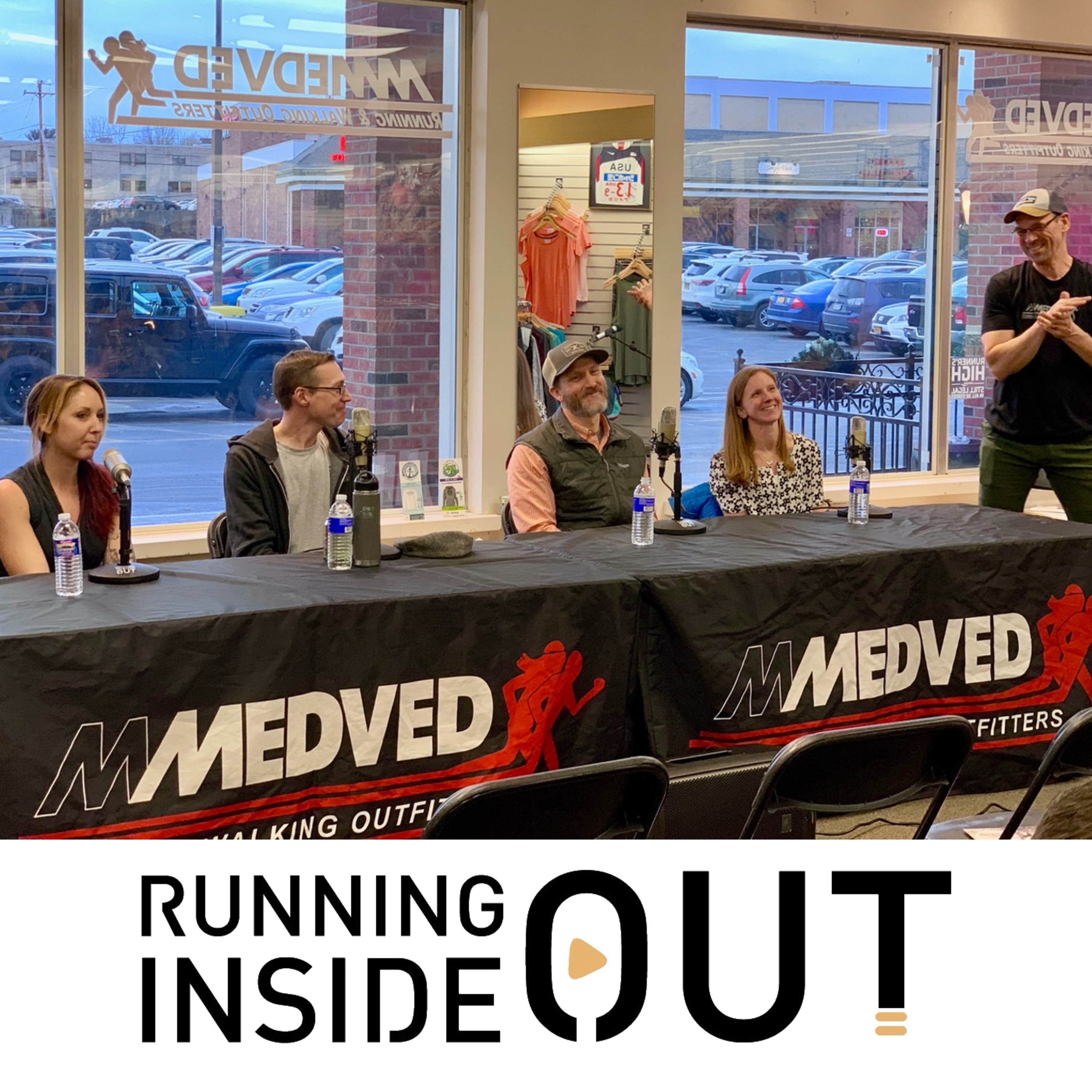
Hello, and welcome to a special episode of Running Inside Out podcast. This is the 2019 edition of Voices from the Trail, recorded at Medved Running and Walking on Monroe Avenue in Pittsburgh, New York. Another spring is upon us, and that means it was time for Mort Nace to assemble a panel of trail running outdoor enthusiasts and call us all into the shop for a night of talking trails. Laura Reckerth, Davin Oskvig, Tim Kent, and Laura Weber all joined. So Laura Reckerth made her way up 74 peaks last year. Davin Oskvig has run more than 70 ultras, finishing many on the podium. Tim Kent is a purposeful training machine set on setting an example for the next generation. Laura Weber is a family-oriented adventure racer who actually did a 24-hour mountain bike relay race with her husband, Ian, while their one- and three-year-old served as crew.
They each were kind enough to share their experiences and motivation running and getting outside, as well as humoring me during some of my more interesting lines of questioning. So one other thing. Now, I was never good enough to get into the AV club in high school, and I can barely put batteries in my headlamp before a race. So many of you longtime listeners know that mobile recording can sometimes be a challenge for me. So that means that I screwed up a little bit of this recording. It makes it authentic. Luckily, it was my track that got messed up. So you can still hear the important people fairly well. All the panelists come through crisp and clear.
It's really the bleed through the microphones that saved my track. It's oddly enough, the same week, two of my favorite podcasts, both hosts, completely unrelated, different episodes, different shows, both hosts did the same thing, screwed up their end of the recording. And they're professionals. So I feel like, you know, I'm in good company there. So sorry for all you audiophiles.
Uh, you probably won't be able to make it through this, but maybe you will, because, um, if you do stick around and all you regular folks, when you stick it out, there's some, uh, pretty good stuff in here, including like, just what's, what's it all about trails and running and outdoors and, uh, the real, why, what gets people going and also, you know, learning which kitchen appliance our panelists are most closely aligning themselves with these days. So give it a listen. And with that, let's get into the trails, training, food, friends, and yes, even feelings of runners. Just. like you. Hi guys, welcome. Thank you for coming. I really appreciate this. This is always a fun night for us as the trail racing season is upon us, we think. Bring friends together and have some guests who, some friends who will just lead a conversation. We invite you to participate. Hopefully you fill in some questions for these guys. And many, many thanks to Chris O'Brien for leading this conversation. But we always look forward to it. And again, thanks for coming out. I'll do some quick intros of these guys before Chris takes it away. To my immediate right, Laura Weber, part of our Goose Adventure Racing family, teammate of mine, multi-sport athletes, as well as she's won the last two money sneakers.
She's attempted to skip this year's Muddy Sneaker by Running Boston, but despite her objections, she's registered to defend her title. We'll see, we'll see. Tim Kent, a training partner of mine, we often work out together. I'm grateful he's willing to share his story. Tim brings an outdoor element, frequently training for hunting expeditions out west, as well as many of the trail races he does locally, as well as while he's out west as well. He's got recent stories of racing in Grand Mason, Colorado, a place that I'd love to have visited. I'm looking forward to hearing more of what he has to say, including putting dinner on the table.
Davin, talented runner from, very frequently is on the podium, with over 70 ultras to name. He's recently also dabbled in multi-sport doing a half Ironman, is that correct? Yeah. Trying some water sports as well, but pretty well-rounded athlete. And Laura Recker, through many mountain stories that tell, not only racing, but climbing. She's, I frequently hear stories of the Adirondack trips, but recently the White Mountains. And it has a...
A very recent story to tell, I hope, about the Grand Canyon and running rim to rim to rim. But thank you guys for all sharing your time. And welcome to the shop. And with that, I invite Chris O'Brien. Hi, everybody. So we've all met now. We're all friends here. So this is a safe space. We can share. There's no judgments. So as we start, we always like to get a little bit of background, a little bit of motivation. What gets you up and out? So some days it's the beautiful bird sunshine. Other times it's the training plan.
Sometimes it's promise or escape. Tim's like, escape. Let's start with you then, Tim. If you think about what gets you really going, what does it come down to for you? For all of us, I think there's times when we're challenged. Not just by what the individual workout is, but just staying motivated. For me,
it's just kind of trying to take those moments and make them as few as possible. So if I kind of get some momentum going, then I'm able to keep that momentum. But I mean, ultimately, to be totally honest, what keeps me going in a bigger way is my dad had a quadruple bypass when he was 48 years old. And so, you know, he didn't live like a great lifestyle. He was a smoker, wasn't super active, desk job, a lot of that stuff. But I have a desk job, you know, and have not made always the best decisions in my life.
I kind of always look at that situation, and that's a lot of what motivates me to get up and get moving and try and buck that potential trend and some of those genetic traits. And then, you know, that easily dovetails with, I just love being outside. And I talk with people all the time, like, oh, hey, what do you like most about trail running? And for me, it's just covering ground. I just, I love covering ground. I love seeing things. I love catching the sunrise or the sunset or just the things that.
you definitely wouldn't experience if you weren't to get up and get out that day. And so, and you never know what each day is going to bring. And there's days where it sucks, you know, and it hurts and it's not fun and you don't want to be there. But once you passed it, it's over, you move on and then you have the next one and you go from there. So that's my thing. Well, currently I've spent five years qualifying for the lottery of Western States and five years I've been denied entry. So they haven't pulled my name.
And if it wasn't for the fact that I had five years already in, I would probably look at other horizons. But I'm kind of stuck now in the sense that I've been doing this for long enough that I have to run another qualifier and I have to put my name in again just to finally get there. So a big part of the motivation right now is to go ahead and get that lottery entry and for the sixth year, put my name in for that race. So there is that drive of the schedule itself and the qualifying race. That being said, the recent past is more...
Trying to combat the winter, I just decided to start streaking it in a Matt Bertrand style. So I made a point to go out every day since January 2nd. Only two runs, I think, have been inside. And I hate the treadmill. Two miles on the treadmill feels like an eternity. So I managed to do all of those miles, save for two runs, outside, no matter what the conditions are, blizzard, wind, whatever. And the hardest step you take is to step out the door. And once you're out the door, it kind of all disappears in whatever you face. And I love to see those drivers who look at you like you're crazy because you're out there in the blizzard, in the wind, and your eyebrows turn bright white, and you have snot sickles, and they think you're crazy. And they're right.
they're missing out on something that you get to experience. There's a quietness to winter. Now that we've entered spring, there's this rebirth of sound all around us, and so many people are missing out on that experience because they're not taking that first step just to go outside. So the streak, in some way, has been the motivation just to take the step outside, to get outside. Yeah, we're going to come back to Stats of the Slayer. It's going to be a poignant moment of the evening. I can't wait. So, Rekker, what about you? You've got a crazy work schedule. You're on a different clock than most of us here. What gets you going?
Mostly just doing things that you never thought you would do or maybe, like, you didn't know your body could do. Like, my very first ultra, it was just a 12-hour race, and I had no idea it was going to be an ultra. I was just like, I'm going to run for 12 hours, and I don't know, I'll probably go. It ended up being 55 miles. And then, like, now it's strat. Like, whenever we go to the mountains, it's like, we're going to do this hike, and I don't know how long it's going to take. I don't know. It might be 20 miles. It might be 30.
you know we probably won't finish but then like you get to a point where you can't turn around and you just have to finish and maybe you're hiking all night and that's kind of like the best part is you just end up being on your feet longer than you planned and you're out there and you're just completely drenched in your own sweat and i think that's one of my favorite feelings is just like being totally exhausted maybe like hitting bottom and like coming back and yeah yeah we'll talk about that night Yeah. Her and Stratton went out to the presidential traverse. They got there late and just decided instead of going to sleep and starting in the morning to just start that. So they started the presidential traverse and all the night. Well, that'll be fun. We'll have Laura go to that. On to our other Laura. So we talk primarily of runners, but Laura's an adventurer, so Laura may decide that it's a good idea to go skiing.
Yeah, so, well, lately it's been more running, and I can definitely relate to the cold mornings this winter. I've been trying to get out. I also hate the treadmill. And there's been some skiing, too, and I need to get more on the bike this spring. So juggling what I'm going to do when is partly by feel. I mean, what I feel like doing that day, and it's nice to have those choices of, you know, I don't think I have a run in me today, or I'd rather go out on the bike.
ride the canal with my kids on the bike and trail them behind or, you know, do kind of just getting out there, I think is the most important thing. And I agree with, you know, just getting out the door is probably the hardest part. And once you kind of carve out the time for that and get out there, I'm always glad I did. I can't recall going out for a run and going, wow, I really wish I hadn't done that. So even though when I'm heading out the door, I don't know if I feel like going there. Once you get out and going, I definitely, and I running and just getting out there for me is also my time to think, my peace and quiet, my stress relief. So those are all motivating factors for me too. Because if I don't for several days, it would work.
family and obligations get in the way, I get more cranky. So it's definitely good for me to get out. Yeah, the crankiness factor is the first thing my wife will say. Did you run yesterday? And they're like, no, I didn't run yesterday. She's like, you should run today. Yeah, it just gets like a little pent up. Now, we were talking earlier, and you had mentioned young kids. And your husband, Ian, is also an adventure racer, right? Yep.
What's that like? Are you dragging the kids out to run? No. Just the other day, one of my sons, I had gone for a run, and he asked to go with me. So we went on our own run just through the neighborhood. And, you know, whatever he wants to do, he kept wanting to go further. And I keep after reminding him, we do have to go back. So we live up a hill. But, no, they like to get out there. It is a challenge. They're little. They can't stay on their own. So we're always going after the elusive perfect schedule and trying to fit in everything we want to do. There isn't one. But we...
We do a mix of different things going on on our own, trying to take them with us. We have the trailer and the bike trailer and the jogging stroller and all that stuff. They won't stay in that much, though they really want to be doing it on their own. So we have the tag along so they can ride on their own. And, yeah, it's always changing.
Always, always. Tim, you had mentioned the idea of not following in those genetic footsteps. Is it also kind of like making new genetic footsteps, sort of showing that example and leading and sort of building? Yeah, very much so. I mean, I try and do that with all aspects of my life. And so it's particularly important for me with my kids. I want them to have uptake of a healthy lifestyle, whether they choose to run. But more importantly, I just want them to be active. You know, I don't care if they're...
cross-country skiing or playing basketball or snowboarding or whatever just doing stuff sure i mean i don't have boys so there's no speedo involved or any of that stuff it's just you know it's fine yeah yeah whatever you know so it's an olympic sport yeah i don't even understand how water polos how can you tread water with somebody jumping on your head i think that's how it became an olympic sport So, Michelle Fantin and Tim run together a lot. I hadn't met Tim, and she said, well, a lot of people haven't met Tim. And so I was kind of minding her for information. And one of the things she told me was, if Tim tells you you're going out for a 15-mile run, you're going out for a 15-mile run. Regardless of the conditions, regardless of how long it takes, you're doing 15 miles. Maybe more, but you're not doing 14.9. What's that about it?
Uh, well, I, I train with, with Dan Ostrander a lot too. Um, I train with Dan every Tuesday and I usually train with Michelle either every Friday or Saturday at this point. And, um, Dan and I were talking about this on Tuesday morning and, you know, I'm a, I'm a pretty firm believer in like deliberate practice. So when, when I go out and I'm training, obviously generally I'm training for something. Sometimes I'm training more intently for something, you know, I might have a race or I might have an event that I'm working up to, or, you know, I don't, who knows, you know, just, we're always training for something, even if it's just life. But, um, so.
with that deliberate practice you know i'm working on mechanics certain days or you know there's certain sections of trail that are like my nemesis by my house and i'm always trying to find a more efficient way to run it or i want to run a hill faster or whatever but i feel like if i'm accountable to that to myself like i have to stick to it right and so I'm not like a really good training plan guy. Like last year was the first year I ever laid out a training plan, like a spreadsheet. It looked really cool and whatever else. And then I thought I did really good. And then I went back and looked at it. I was like, man, there's a lot of weeks where I ran zero miles, you know, or like I ran 10, you know, and then there'd be a week where I ran 60, you know, or 40 or whatever. But, um, but the thing is, it's like, if, if you're not, if you're not going out and you're deliberately trying to achieve what you set out to do, then I feel like you're, you're not preparing yourself mentally for, you know, whatever the next challenge is. I mean, you know, you guys understand if you're, if you're going out and you're going to run an ultra, like let's say it's a 50 K and it's 31 miles.
it doesn't all of a sudden become 27 because it starts to suck so like you know so it's like oh oh i'm cramping up this race just got shorter like there's no there's no option there it's binary it's like oh i can dnf which is fine if that's what you choose to do or i keep going no matter what the conditions are oh it started raining oh you know whatever and so um It's just like if you can kind of harness that, for me personally, if I can harness that and be accountable to it and whatever, then I'm going to constantly achieve that. And then the other thing, and I think Mort can attest to this, if I can train with somebody and I can help them too, that gives me such an enormous amount of gratification. If I can help them be better. So it's like there are days where I can tell Michelle does not want to keep going.
I mean, we just did a 20-miler two weekends ago, and at mile 17, I could just tell. She was like, done. I didn't want to keep going either, but you have to. And so that's kind of my thing with that. I can't help but seeing Davin's head doing this the whole time you were talking. The idea of being very deliberate and being very intentional. If I've learned anything from Davin, that's a big piece of your training as well in your mindset, right? It's part of if there's any equation to success, it's that. You cannot get to the finish line without putting in the miles.
And I've come to abide by a rule of a training plan that is at least 10% in excess at the distance you're racing, which means if I'm racing 100 miles, I'm maxing out at at least 110 in a given week because you're going to have to cover that in a day. So if it's 100K, then you need about 70 miles in the week. Now, I know that my body can handle that and others can't, so it's also somewhat realistic for what you can handle. And for people that I coach or manage, I always look at a three-hour threshold. Being on your feet and running consistently for three hours, you're going to maximize your endurance capacity. And with everything over three hours, you're only increasing the chance of injury. But I can go a lot further in three hours than most people. And it's not arrogance. It's just how it is. So my weekly totals with just one three-hour run end up very high by virtue of it. But, yeah, I'm very wedded to the schedule in the sense that you've got to put in the work if you want the result. You cannot go get the result without the work. And I think we've all had experiences where we know we haven't put in the work.
Even if the result is okay or by other standards would be pretty good, we know based on how we feel that the work wasn't there. And we also know those races where we've come away and we've had a great experience because the work was there beforehand. And so, yeah, it hurt. It was a race. It was long. But at the same time, that hurt was mitigated by the work that was done beforehand. Yeah. Again, very detailed, very man-oriented. Here's the numbers. Here's the percentages. And you've coached Laura. I have. You've coached Laura through 100-Milers. I did.
But Laura's training and Laura's experiences are very organic. I want to go out and have an adventure. So how do you balance that, Laura, with a coach that you like, but with, I want to start a hike at 1 a.m., and we'll see where we go. Well, I mean, those hikes did happen after we were done with the 100. So, yeah. He coached me through the 100, and then Manny and the Jenny, and then kind of after that, I was like, there's nothing really left, or nothing until this year. So, kind of like...
She got what she wanted out of me and she was like, see ya. But you do rock climbing and things like slacklining and you go to Rossi as well. And so you have this more well-rounded kind of thing. So are the woods and the trails training for you or are they something else? I think, I mean, in the summer, yes, definitely. Because I just like being outside and I like the heat. And I like taking three or four hours to just run through the woods.
But in the winter, I didn't really have much motivation to get out. I was like, I don't want to be cold. And I wasn't training for 100. Last winter, I was outside every run for three or four hours. Back-to-back. And the most miles I ran ever because of diving. Yeah, most people are aiming for 1,000 miles in here. Laura got that in a winter. Yeah. When we did the podcast, she just said, I'm not used to a tube in front of my monthly mileage. No, she was doing well over 200 miles a month training for 100 miles.
So, Laura, when was the last time that you had a real, solid, full, tick-the-boxes training plan? Me? I have a training plan now. I'm doing the Boston Marathon in a couple weeks, so I'm on tapering now, so I'm super excited. So I did follow one for that.
But that's probably about it. I ask that because it's this idea of, like, we go out for adventures. We go out there to fill our spirit and to, you know, take in the trees and to have the earth beneath our feet and all that. But Tim said I train with Dan Osterner. I train with Michelle, right? He runs with Dan Osterner. You know, but I train. And there's something, there's this balance between, like, I train, but I'm also experiencing and I'm having fun.
I know I'm enriching myself in that weird sort of balance. So that's why I asked that, because it is hectic getting out with the kids. It is dragging up, you know, like you said, my toe behind on the bike ride. The kid wants to stop for ice cream, and you're like, I've got to get these bottles in, right? So how do you and Ian sort of fill your cup with adventure, and yet you qualify and train for Boston? Well, the training plan I have has lots of scribbles and arrows, and I move this over here, and so even that doesn't go always to plan. But like I said, we're always trying to figure out the best way to...
to balance all that, and I was just talking, you know, I'm still figuring out what races and adventure races we want to do coming up this summer. I want to do a couple of adventure races and planning which ones, but I'm also very conscious of not signing up for every race that sounds awesome because we want to have those weekends and that time at home to go do adventures and camp with the kids and do adventures with them. And they, by the way, are convinced that they are doing an adventure race this summer, so I'm going to have to figure out how to make that happen. But, yeah, so they, I mean, it's that balance, and it's always a fine line trying to figure out what it is. There was one year.
Maybe a few years ago. It was mostly local races, but I signed up for a ton of races and just decided that was too many. So trying to keep it to the right number. I don't know what that is, but do that balance. And sometimes we bring them with. I've met your kids more than I do, because Ian's always got them out on the course taking pictures and stuff. I've seen that quite a bit. They did Hardcore 24 with us a couple years. So we were a two-person team, Ian and I.
We're on the team, and they were our support crew. We supported them, so we made an extra challenge. So we did 24-hour racing. We just would tag off whoever was riding, was riding the course. The other person was, you know, fixing peanut butter and jelly sandwiches, or mostly on the playground. Spent a lot of hours on the playground. So for the people that don't know on 424, this is a 24-hour bike race. It starts at Ontario County Park and rides down the same thing that we run down and goes around the park and then goes back up to the top of the park. And you do that for 24 hours. Yeah, it's like about a 7-mile loop in OCP.
People think that's fun. It was. It was. What you're saying is you did that as a family. Yeah. Yeah. They had their bikes. Yeah. Yeah. They were riding around the campground and yeah, it was, it was fun. It added an extra challenge, but I'm glad we did it that way. It was, it was a lot of fun. Do they, do they think it was a lot of fun? Yeah. They keep asking if we're going to go to that race that we camped at again. Maybe we'll see. How old are they? Uh, they're right now three and five. They were, when we did it the first time, one in three. One, you can do it.
Tim, Mort mentioned that a lot of your training is for deep woods hiking or excursions out. You're carrying a lot of gear doing that kind of stuff, right? So that's why you're doing the Rossi kettlebell thing. What's that like for you to plan and go on? I'm guessing you do the game and stuff like that. Yeah, Colorado, Wyoming, this year Idaho. So that's sort of how trail running came to pass. I ran in high school, kind of got burned out on it. Early college stopped and came back to it.
later just as a part of training to go out west and um just you know i live right laura and i live around the corner from each other uh it's like us and then the matthews are like right between us but uh so you all race down the road no we never see each other that's the funny thing like i'll chase her down the road sometimes and never catch her and then wait i didn't know during the summer like brian yeah brian will like uh yeah yeah but she must we must run the same loop or something because every once in a while i'll see her like up in front of me yeah so uh But we live right by the Crescent. So it's cool because we have access to, I think, one of the best trail systems outside of Menden and OCP in the area, especially if you want to climb. So where was I going with this? Oh, so preparation for that. So that's kind of how that all started was I was just trying to get in better shape to go out west and living right by the Crescent. I just started going in there and it was hiking and then turned into a little bit of running and be like winded after a quarter mile. I'm like, I don't know what the hell's wrong with me. I used to be able to do this for tons of time when I was younger. That whole, you know, I could throw the football over the mountains over there, Uncle Rico thing.
you know so over the years it's just kind of evolved and come back to deliberate practice just mix that with strength training and cycling and you know and everything else and it's just uh just becomes a plan it's kind of to answer your question like everything else just becomes a plan and you know you're going to go at this point have this event at this point and you start planning here and just go through with it so when you get out there is it is it now your mind is off and you're in big sky country and you're just looking at the clouds thinking how wonderful this is and you've earned it no I wish I could say my mind is off. That's like my biggest struggle because I'm self-employed. So the first usually three to four days when I'm out there, I'm a disaster. Like mentally, I'm just trying to process it all between.
knowing that I'm away from my family, usually for an extended period of time, and then knowing that I'm away from my business for an extended period of time, I really struggle for the first few days. And then after that, I can tend to focus. And the same holds true. Like last year when I went out and did the Grand Mesa with my friend, the first like three days I was there, I was not focused on the race at all. And I started to get worried because I was pacing him for the last 37 miles. And I was like, that's all I kept thinking was, I hope I don't fail this guy. Well, meanwhile, I've been working since January to physically be ready, but I still didn't feel like I was mentally ready. And then it's just like, you have that moment where the switch flips.
And then it's, then I'm good. You know, there's other people that get out there and they're, they're on. I'm not that guy. I'm, I'm more of a crock pot than a microwave, I guess. So, so like, you know, it's like, you know, once I, once I get there, I'm ready, I'm hot and let's go. But, um, it takes me, it takes me a bit. So. What I'm saying is you're, you're still one to the touch. Yeah, yeah, yeah, yeah, yeah. That's in the show notes right there. How, how, how does one get to be a microwave? Because my, my understanding is, is.
you don't sign up for a race or an adventure unless you know you're absolutely ready for it. And obviously with caveats, right? But you're not going to go there unless you feel like you can do a thing. And you've often told me, like, I just, I turn it off and I just don't think about it and I just do the things. Yeah, once I'm there, it is a matter of kind of shutting out everything else and just being immersed in the experience itself. I don't know if that's necessarily the microwave, maybe more Instapot. This is just getting fun now. There's an element to the style in which I've...
become accustomed to race i don't know if it's always the logical or right approach but it has worked out well for me and it has tended to be very aggressive from from the goal and some of that is it's much easier for me to be immersed in the setting if i don't have to stare at somebody's feet and so i choose to go out fast and in front so i can simply be there and it has worked out for the most part for me. But yeah, I guess that might be microwave reality. But you've seen me before races. I mean, I try really hard to shut everything out to a degree in which you can often find me in a corner by myself trying to sort of hide from everything before they say go. And as soon as they say go, it's an entirely different... You're not checking out the calves of the competition.
No, I don't hang out at the pre-race stuff. That's all nervous energy. And for some people, they draw their energy off of that. For me, it's counter. It just takes energy away from me. So when I do packet pickup, particularly for a long race, I get in and get out as quick as I can because I think mentally you get in that space and everybody looks fit. I mean, I can look around this room and go, man, there's some fit people here. And that can get in your head in the sense of how things might shake out.
come race day, particularly if you're trying to be competitive. If you're out there simply to finish, which is a good goal to have, then it's probably not as heavy of a thing to have to manage. Do you ever have a run where you're not, there are no metrics, where you're just out running? Do you seek that type of run? Or is there always a measurement or a success criteria to your runs? So I never look at my watch. So while you think I'm driven by the metrics... I don't think you are. I just ask the questions. I never look at my watch in the course of a race or in the course of a training run. Ever.
So everything I do is by feel. Now, once I'm home and the watch dumps all its data, I'll sit there and look at all of the numbers and crunch it down. But in the run itself, I never, God bless you, look at the watch. So I kind of say that's every experience for me. As I go out the door, even if it's a speed work run or something intense, I don't look at the watch. It's always on vibrate. It never makes a noise because I don't want it to make noise at me. But yeah, I never look at it. But you just checked yours. I thought it was more.
I think we can all do that in the sense of, particularly as parents, when we have a set amount of time, we can look at that time and go, how do I maximize the amount of time that I have? And when you know yourself and your capabilities well enough, when you know the bus is going to stop at the house at such and such a time, it suddenly becomes speed work out of necessity. And you just know how to drop it down and get to where you need to get to. And sometimes I've gone up and down my block, waiting for the bus to come, trying to get in the miles. Because that's life, and that's where you're at. But if I have an hour, I can pretty much almost pinpoint the exact number of miles that I can cover in that hour. And I don't have to look at the watch to know if I'm going to be late or not.
So Laura, what kitchen appliance might you be? I feel like it's a vitamin. It's a theme. I don't know. So how do you balance your enjoyment versus your training? Do you try to say training is enjoyment or do you go out in the woods for fun? What's the balance for you? I'd say it's...
It's mostly fun unless I'm trying to squeeze it in before work or during work. It's kind of something I have to make time for rather than it being just part of my day. On the weekend, you can just be like, I'm going to do this this weekend, and this weekend's just going to be a run, or this weekend's just going to be a race, or it's going to be a trip. It's always a trip. It's always an adventure, isn't it? Yeah. So for people that don't know, Laura did 74 peaks last year.
I don't know if you know how many weekends are in a year. It's not 74. So what was that about 74 peaks? Was that a goal? Was it 17 mountains every month? How did you decide that you wanted to do it? How did that happen? I didn't know it happened until I was like, I wonder how many peaks we did this year. And I started adding them up, and I'm like, okay. Because one weekend was presidential, and the next one was Pemi Loop. And then there was a week in the Adirondacks. It was like each one of these hikes was like eight peaks.
And then I did, like, Catsdale Marathon, and that was, like, another six. That's one race, just it's a marathon that's got six peaks in it. No big deal, right? Yeah, just you do these hikes, and they just end up being more than one peak. And then maybe you do, like, multiple days of multiple peaks, and it just happens. The other thing that I think maybe a lot of people don't...
is Laura does graphic design, makes really nice things, including the podcast logo. But she also made a little book called Diner Quest. And in this book is, you open up page one, and it says, what's the name of the diner? Where was it? What day did you go? And then it has star ratings, where coffee, pancakes, eggs, toast, and you just fill out your stars for, you know. And she gave me one of these, and I'm like, you have to have gone to a lot of diners to decide that you want a Diner Quest book.
So are all those people associated with diners? No, just our goal is usually to finish in time to go to the diner. So that's why you start at midnight, right? Yeah, exactly. We're like, if we start tomorrow morning, we won't make it to the diner. So I think I know the answer, but what's your go-to at a brand new diner? I mean, it's usually, I mean, it depends on the pancake, if they have like chocolate chip and peanut butter, and then strawberry jam, and eggs.
I think we've talked about this. I used to judge diners based on toast, and it got to be there just wasn't a lot of good toast at diners. And Laura helped me with those metrics. She's like, no, the first place you go is a pancake. Always try to do it. And I learned a lot. What about you, Laura? Are you a diner fan? Yeah. I don't think I am the connoisseur.
Apparently, I have work to do to check out more, I think. You're no person that can help you. Well, I guess what I would say is that's sort of the reward after the big hike. So you did Hardcore 24. You do these giant adventure races. What are you looking forward to at the end? It varies, but I will tell you during the race, there's always conversations with your teammates, and this is what I'm going to have when I'm done. It might be a burger or a beer. Fun fact, though, during the race, you can put into your gear bin, if you're coming to a gear bin,
McDonald's or Burger King cheeseburger. You know, there's plenty of preservatives in there. I'm sure it's fine. So having one of those mid-race at, like, 2 in the morning or whatever it is is wonderful. They taste delicious. We heard a story of a certain host in the adventure race. Everybody stopped, all of Goose, stopped at a McDonald's, bought a whole bunch of burgers. And Feisner made sure he stacked up on burgers. Timmy had his burgers. Or just bought a couple burgers. Shut up.
More of us light on cheeseburgers. Everybody else is riding, pulling out of the bag. It's amazing how quick they go down when you're really hungry. You're like, I'll have another. And they can handle a lot of abuse, right? Yeah, yeah. I haven't gone that long. So Tim, the woods, the backwoods, way out. You're hiking three, four days in. No, not usually that far.
you know, we'll go in for maybe up to three overnights, but we usually go in, you know, however many miles and then stop instead of like a spike camp or something like that. And then, and then go out from there on, on day stuff, maybe, maybe move from there. I mean, it all depends upon where we are and what access is like each year. So, so you're going to Idaho this year? Yep. Idaho. Man.
That's a tricky... Yeah, I'm eating my hunting partner. I don't know. I just recently had to make some pretty significant dietary changes. So I'm sort of in the process of trying to figure that out. The good news is I can still have bacon. So that'll be on the menu. But yeah, a lot of... No pancakes. No, no pancakes unless they're gluten-free. Oh, we could have like the... We do those birch benders. They're made with like almond flour and stuff. Sounds great. They're actually pretty good. My kids will even eat them. So they went gluten-free. They don't even know. It's a good trick.
tricked my wife into it that's how we got married too yeah yeah tricked her into it yeah yeah so no but it's uh i mean for like day-to-day energy like you know the honey singer waffles have been a pretty big staple over the years yeah yeah yeah yeah um like pro bars and that type of thing i mean you know still like those i can still take in a lot of the honey stinger stuff so you know it's really similar nutritionally like the same stuff that i pack for an ultra is the same stuff i'll use in the backcountry except for you know if we're gonna if we're gonna be in the backcountry end up using like a freeze-dried type meal or something like that just just add water heat it up so you know what about what about what do you like at the end 18 hour 18 that's a longer one how many of you are hungry when you finish these things i'm not always hungry but now i'll dream about food but then come the end I won't find myself in a place to actually want it. Sometimes it'll take a couple of hours before my body is really ready for it. And it tastes vary. It's never one particular thing. You know, a burger and a milkshake often sounds great, but at the end of a race, I've had them put in front of me and struggled with them. So sometimes a bowl of cereal, just like it's easy to eat, and you can get it down, and got a lot of sugar to it. Captain Crunch? Fruit Loops?
More like a Golden Grahams. Which, I don't really eat sweetened cereal, so talk about a special treat. It's like, oh, yeah. You got that emotion. I know, I know. So, obviously, I've taken us down a dark tunnel. So, I'm going to look here. And maybe with these, we can look at them in terms of some of the adventures. As Mark mentioned, Laura did Rim to Rim to Rim with Princess The Running Company last month, this month, some month ago? This month. Yeah, so there was a group of, how many of you, 14? No, three.
How many was there? Twelve? Eleven? Laura, didn't you help lead this trip? One, two, three. Ten. Yeah. So, all right. So, Laura did Rim to Rim to Rim. And this question is, we can keep it in this sort of this idea. What was the darkest hour of that Rim to Rim to Rim trip? Surprisingly, we had a really good group. I don't think anyone had any real low points other than me.
I'm asking you the question. I know. But I was more worried about the group, so I definitely hit a wall because you don't really take care of yourself when you're trying to think about everyone else. True. So there was a point when I was starving, but we were all running, so you couldn't really eat or drink because the stuff's in your bag and your pockets are all empty. So, yeah, we got to one of the water stops.
I was like, I ate an apple, and it was not enough. And then we just kept going, and it was just a group of girls, me and four others, three others. And they were just super strong, and I was supposed to be the leader, and I was just falling back, and I'm like, oh my god, I have the car keys. So I'm like, I've got to make sure I stay with them, because I don't want them to freeze if they finish before me. So it took a little while. I've never done that.
So, but this was a 40, this was 40, how many hours was it? It took us 20. 20, yeah, but from, so you started. Started at 4 a.m., finished, like, right at midnight. And we had two groups, so second group finished, like, right behind us, like, 12.30. So 20 hours. And this was springtime, and the trails were perfect, and it was wonderful. Well, I mean, you start, and it's icy going down, and it lasts for, like, a mile and a half. And then you have spikes, and you have the traction, and you're fine. But it was definitely a slow start. Like, it took, you know, maybe a few hours to get down.
I don't know, three miles? It was not a fast start. But after that, it was pretty much a nice trail run. The trails are smooth, they're awesome. You see the sunrise from the Grand Canyon, and how often do you get to do that? And then you get to the other side, where it's still a good trail run. But then you go through the Sapia Tunnel, and you start seeing snow again.
And you're like, oh, this is where, you know, we heard there might be a lot of snow. And it was getting kind of late. It was, like, going to be 1130 noon. And we were thinking we would turn around at 1 o'clock to, like, you know, try and finish today. But we were getting, you know, closer to the north rim. And it was getting closer to 1. And we just, you know, we weren't there yet. And we just find ourselves breaking trail. And then all of a sudden I'm, like, up to my hip in snow. And then, yeah. Oh, yeah. You know, we were in shorts and a tank top.
But it's the Grand Canyon, right? So, I mean, so there's a lot of people here that have done Grand Canyon or been near the Grand Canyon and just walk right past it right now. Just walk right past the Grand Canyon. But Jason Pintmar did the Grand Canyon differently, 95 degrees. But that idea of you're out all day and you're in a different terrain. You're the leader. Oh, Greg's the leader. And so that feeling of, like, I'm going to let folks down. But you came through, right?
Well, I'm going into it. We said, you know, there's a good, good chance. Well, we won't make it to the North Rim because we don't know how much snow is up there. So in our heads, we're like, it's okay. We don't get there. And, you know, maybe we will, but I will have, we'll turn around at one, no matter where we are. But then it was one 30 and we were still going up the North Rim. And so at the point when I was like swimming in snow, we were like, you know, we're going to turn around. We didn't, we didn't reach the sign, but we were at the North Rim almost. So. But you weren't, you weren't there. Yeah. I mean, I was, yeah, I was, no one was sad. We turned around like our feet were cold. They were frozen. Our hands are cold.
Our legs are numb, so. Yeah, shorts. Yeah. So, however, these adventure races are deep, dark affairs. Is there a moment that when I ask you that question, I'm like, pop right in your head, and you're like, I know what I'm going to say.
No. But, yeah, I mean, you're talking 12, 24 hours. Sometimes you don't know where you're going to be going or even what mode of transportation you're going to be using at any given time. So you might find yourself on the bike at 2 a.m. And I remember doing the USARA Nationals several years ago. It was actually in New York State, so it wasn't very far of a drive down towards the gunks. And it was a low of 29 that night in September, I think, or October. And we were really excited being a team from Western New York.
We've got this. We know cold temperatures. We talked to a team from Florida at dinner the night before, so we thought we're good. It's still cold. No matter where you're from, it's still cold. So we stopped at a gas station. We're putting plastic bags in our bike shoes. And then as soon as I changed into my one pair of dry socks, like in a puddle, you know, 10 minutes later. So, yeah, you don't. The interesting thing with that is being a team sport.
you hope, then everyone's not hitting the low point at the same time. And so that's where you can kind of draw energy from the people you're with. I know we've done races where kind of every person had a point where they, you know, weren't feeling the best or didn't want to go on, but just fortunately it doesn't happen at the same time. So, you know, that's where you can kind of trade off and take someone's gear or just try to encourage them to keep going or distract them with talking about something else. I've tried all the tactics. So, yeah. Tim, you had mentioned bringing people up and when they're hitting one of their low points, she was just mentioning a team sport idea.
Have you had to been pulled out of the low point as you would push somebody or they pushed you into your other spots? Yeah, definitely. I mean, kind of back to what I was saying earlier, sometimes when I'm doing these trips out west, because I'm a little slower to disconnect from the other half of my life, if you will, I definitely need somebody to kind of keep me going in the beginning. And then it's just like anything else. If things aren't going my way, I definitely need some encouragement. That's probably my biggest.
obstacle when you know physically i'm always i mean you know again like i said like i'm not i'm never paired with somebody that is equal you know physically i'm always ahead of them it's just the mental side it's just if things you know again aren't aren't going the way that you want or the weather gets uh unfavorable you know or yeah in the case of the hunt like if the animals aren't cooperating or whatever or yeah and yeah right in a race like you know on the mesa we were that was when the big fire was happening last year so we're breathing in smoke-filled air and like sort of back to the snotsicles but they're not freezing like i just I didn't know my body had that much liquid in it that was snot. It started to bother me after a while. My face was chafing because I'm wiping my nose all the time. Here I am supporting another guy. We'd get into the aid station and my buddy's mother-in-law would be like, are you okay? I'm like, yeah, I'm fine, except for I just want to cut my face off. Can we just remove my head? My nose is running so badly. It's just all that particulate in the air. His mother-in-law and father-in-law were kind of our crew. They were just so good about picking you up when you get there. Plus, when you get to sit down and chill out for a little bit, it's the best thing ever.
It's awesome to have people that you can rely on. I think that's the most important part of any of this. It's just having a good support, a great support system. So he's doing this for me now. I know. So he did remind me of Snotsicles, which is important. But he talked about the support group. I alluded to earlier, you were willing to turn it off and not think. And that's a large part of your racing event with your parents being your support group.
Do they also do the attaboy and the courage and pull you out of the dark spots? No, they lie. Which I usually only find out about afterwards, sometimes months or years later, where in the middle of a race I'll say, I'm post, talk to the race director, find out if I can drop to the 50-mile distance, if it's that kind of race that's got multiple distances going on at the same time. And I've been lied to. Nope, the distance you're signed up for is a distance you have to run.
And it ends up that's not true. But some of that is the way that others see you and know the disappointment that you're going to have if you do drop down overrides where you're at in the moment. And so there is an element where, you know, there is the taking care of a person as part of the crew aspect, giving them a chance to sit down, take in some nutrition and hydration. And then there's the point where you pull the chair away and walk away and they go, oh, crap, I guess I have to go on. because you're not left with an option. And I think that's part of the challenge for people that are crew is to understand that you have to be kind of cruel at a certain point because your objective is to get the runner to the finish. And sometimes that means taking the chair away, even though all they want to do is stay. What I've seen, Cayuga comes to mind, you're running fast, you're running hard. You come into Buttermilk Falls, you got boogers all over your face. They're just pouring out. You don't take the time to wipe the boogers.
They're just going to come back. So he comes rolling into the state station, his parents roll up, and he's like, and his dad's like, eat these salt potatoes. And he doesn't ask, he doesn't do anything. They go in. His mom comes over, snot goes, boogers, and then he leaves. And that's what I was alluding to. You turn your mind off, you do the thing, and then you run. I don't know that I've ever heard him say, you're doing great. No. Well, there's also a degree to which we've become symbiotic over time in the sense of, I don't necessarily want to hear that. I don't want to hear my position relative to other people.
I just don't. If I happen to be leading the race and somebody is coming up quickly, I don't want to know. Because that gets in my head and takes me away from the experience of just running. I sign up for these races so I can go run on the trails. That's really why I do it. And I have a finite amount of time. I think that's probably why you do adventure races. We have a finite amount of time to exercise our joy. And so for me it's, okay, I've got a day to run 100 miles, now I've got to be home to work. It's so glamorous when you put it there.
So it's capitalizing on being really present. So the difference between us is I've got that finite amount of time, so I turn the mind right into it because that's all I've got. I don't have more time than I can lend to it. So we talked about dark moments are the darkest time. The idea of what are you chasing? What is the bright moment that you could sort of, what was the time that you want to relend? Do you have a bright experience in the past? If I could just get back to that.
I think any of us that have experienced a sunrise in the midst of any outing will say that there is something truly redemptive and resurrecting about sunrise. That even if you've been out for a day or two days or three days, when the sun comes up, it does make you feel better. And there is this appreciation that washes over you for a new day and what lies before you. So, you know, if there's a light you're chasing, I don't know, maybe we're all just chasing the sun. What about you around here? What's one of the bright moments that you want to do? What are you chasing after? I think the bright moments just happen.
Like, during the hikes, the family loop hike, it just happened to be the night of the Palisades Meteor Tower, and we were hiking all night. So it ended up being perfect. And we got to watch Shooting Stars all night and hike this, like, awesome range. We had no idea. It was just something that kind of happened. We were just out there. Yeah. And then the Prezi Traverse, like, that was also... We just didn't want to wake up super early, so we just started hiking. And it ended up being, like, you saw a sunrise over Mount Madison, and there's only, like, 60 clear days of the year on Mount Washington, and we had one of them. So, yeah, it just happened.
Yeah, things just happen if you put yourself out there. If you do 74 peaks, one of them is not to be clear, right? What about you? Do you have one of those moments? I don't know if I can point to one specific one. I do agree with the sunrise. There's something, especially if you're in a situation where you haven't slept, right? And there's something about it starting a new day, even though you haven't slept, you feel like you're just getting up and it kind of gives you this burst of energy for some time anyway. And so anytime you get to experience that, I think I also like getting new experiences and trying new things. And so maybe I don't know what it is yet, but, you know, just seeing what else is out there and trying to come up with new challenges for myself, I think is also something I like to try to figure out.
Yeah, the idea of new is something I think where in our area, you know, we say, oh, we got the best trails and we got the most amazing network of systems and greatest races. But then you see people, they're going out to Grand Canyon or they're going out to Moab or to Utah or, you know, Portland because they're going to look for something new. But then they always kind of come back here for the most part. Some people might stay, but they end up coming back here in Rochester. Yeah, I mean, I think there's a lot to offer here. And I think Laura had said earlier, too, of doing something that you maybe didn't think you could do or didn't know your body could do. And then that feeling afterwards of, wow, I just did that really hard thing I didn't think I'd be able to do. And then it kind of gives you energy for the next thing. Well, what's the next thing going to be? Tim, do you have one of those great moments that you're chasing after? I honestly can't single one out. I just feel like it's constantly a chase. I don't want to say the next thing, but I feel like I'm always chasing those moments. And that's part of the fun, whether it's the sunrise.
see that almost every day, but they're always different. I don't know. I can't think of just one. Like I said, that's part of the fun. I think that's why I do all of it. I think of Rochester. I got in this point where I was like, where do I want to run today? I can run at this cool place. I can run at that cool place. I can run at this one. I can run at that one. I'm just going to go out the door and just run. I don't need to pick the most perfect spot. It's 47 degrees and it rained yesterday, so which trail is going to be awful? It's like just go and figure out what you're going to find. So with that, I guess I would ask, do you have a favorite place in Rochester that's your sort of go-to?
that we can all follow you, too, and try to catch you. Well, just from proximity, the Crescent Trail's literally on my back door, so most recently... That's not my favorite. But going back to having the finite amount of time, I can spend 15 or 20 minutes driving somewhere, or I can have more time on the trail if I just go out my door. So, I mean, that's the kind of thing you have to weigh sometimes. But I do enjoy going down to the Finger Lakes area, too, when we have more time, OCP, and parts of the Finger Lakes Trail, too, for sure.
It's the Crescent Trail. It really is. The Crescent or the Seneca. I mean, I just... If I do that one more than anything. Yeah, I just... It's not only the fact that I'm used to it, but it's challenging. It's great scenery. And, you know, there's certain times a day you can run certain sections. And it's just awesome. To have it, like, literally a stone's throw from our houses is... It's like a gift. So have you raced zero SPF or would you like to not take that trail?
I'm trying to think. I don't think I've raced it. That race always falls on my daughter's birthday weekend. So it's not in my best personal interest to do it right now. Well put. Yeah. So you weren't here. You do the Buffalo thing. I graduated high school in Rochester and live in Buffalo now. You all don't know how good you have it. Maybe you do. But, you know, I've got to drive 45 minutes to get even a remotely decent trail.
Within an hour, I can be in Rochester, and so sometimes rather than going south from Buffalo, I just come east to Rochester because I know all the trails around here. And a lot of times that just lands me at Menden Ponds because it's convenient to Interstate 90. And I know every trail in that part. And I managed to string it together in a way where you can do a full marathon without repeating a trail. So it's how to play games in your head with how can I do this in a way to be creative with what I have in the time that's here. My parents live about a half a mile away from an entry point in a powder mill. So the convenience of when I happen to be at my parents' house or I'm overnighting there is I'll run that half a mile.
up the road and jump on the trail in powder mill and you can string together a pretty good run in powder mill if you get creative as well so there's there's just so much that's good around here and i think that often when you're immersed in your setting you don't realize how good you have it until you're somewhere else like buffalo and you go man there is nothing around here we're on the waterfront again i grew up i did the opposite i grew up buffalo king here So, Laura, do you have a favorite trail or place in Rochester to get out? I love Dryer Park. It's a lot of fun to run in. You can't run that far. Or you just got to repeat everything. Dryer Park. Yeah, Dryer Park. But if I want to do a longer run, I do like linking the Crescent Trail with the Auburn Trail and you can go through Powder Mill, too.
So maybe we'll wrap up with some philosophical thoughts. So maybe you can use your word voice for this one. If you're going to try to tell somebody, somebody's going to be like, I don't understand. Why do you do this? Why? What's why? Tell me why you do this. I don't care. What would you say? I do this because...
You get to know yourself and you hit so many points, whether it's a race or it's an adventure. Maybe you hit a low point and then maybe you eat something or drink something and then you feel totally different. And maybe you think you can't run any farther and then an hour later you're running again. Just hitting those low points and coming back and feeling like you're so sore when you're done and wake up the next morning and you're like, I don't know when I'll be able to run again. And then the next day you're like, oh, I feel like I can run. It's just amazing to see what your body can do. And you get to see a lot of stuff during it.
See the sights. Get Dom's. Try again. What about you, Dom? Why? I don't get it. Why not? Well, because you can take up something like water polo instead. You know, that might be somebody's thing. For me, what it has become is it has restored my hope in humanity. And that may be overreaching, but there's a lot when we read the headlines and generally walk through life that can leave us rather despondent and hopeless. And the trail community is the counter to that. So every time that I really don't have...
a sense that the future is going to be okay. And I've got a kid, you know, and so I need that reassurance that the future is going to be okay. Participating in a trail race is the most egalitarian, selfless. It's the one place where somehow the divisions and the political alignments and everything else just seems to disappear as everybody says, hey, good job. And if you stumble over and fall on your face, everybody stops. Even people in the front of the race and says, are you okay? Can I help you out? And I don't think there's anywhere else in life that I've experienced that. So for me...
It's become spiritual in the sense that it's become my faith community. It's become the place that has restored my hope for the future. So why? Because I need hope. I can't one-up that at all. I won't even try. No, no. It's just so simple. It's just people, places, and things. And I think that you have exposure in a positive way to all of those through this activity and through this community. And that's what I love about it.
Every day is new and different. And again, even when there's challenges, it's still the best. It's the best. I agree with the other comments. It's really a chance to get out. Like I said, it's a time to be by myself and stress relief and think. Sometimes I spend time just going and not thinking, but other times I'm thinking about other things in my day. It's almost meditative, I think, in some ways, when I'm out there by myself. I agree with the community aspect of it, too. I've met some really great people.
I do think there's a really great community here in the area. Well, thank you all. Thanks for answering my questions, and thanks for aligning yourself with various kitchen appliances. It's going to be really necessary, come the apocalypse, to know who's the crowd and who's the microwave. It's going to be helpful. And again, thanks, Mark, for letting me do this part. Thank you all for coming. It's yours again, Mark. I'd love to just echo what you have to say, Chris. Thank you guys for sharing your time, your stories.
We're going to stick around for a little bit and talk more with these guys. Yeah, we're going to kick around and free-form beverages on mark. Thanks, guys. And look forward to having a trail running season ahead of us. Thank you so much.