
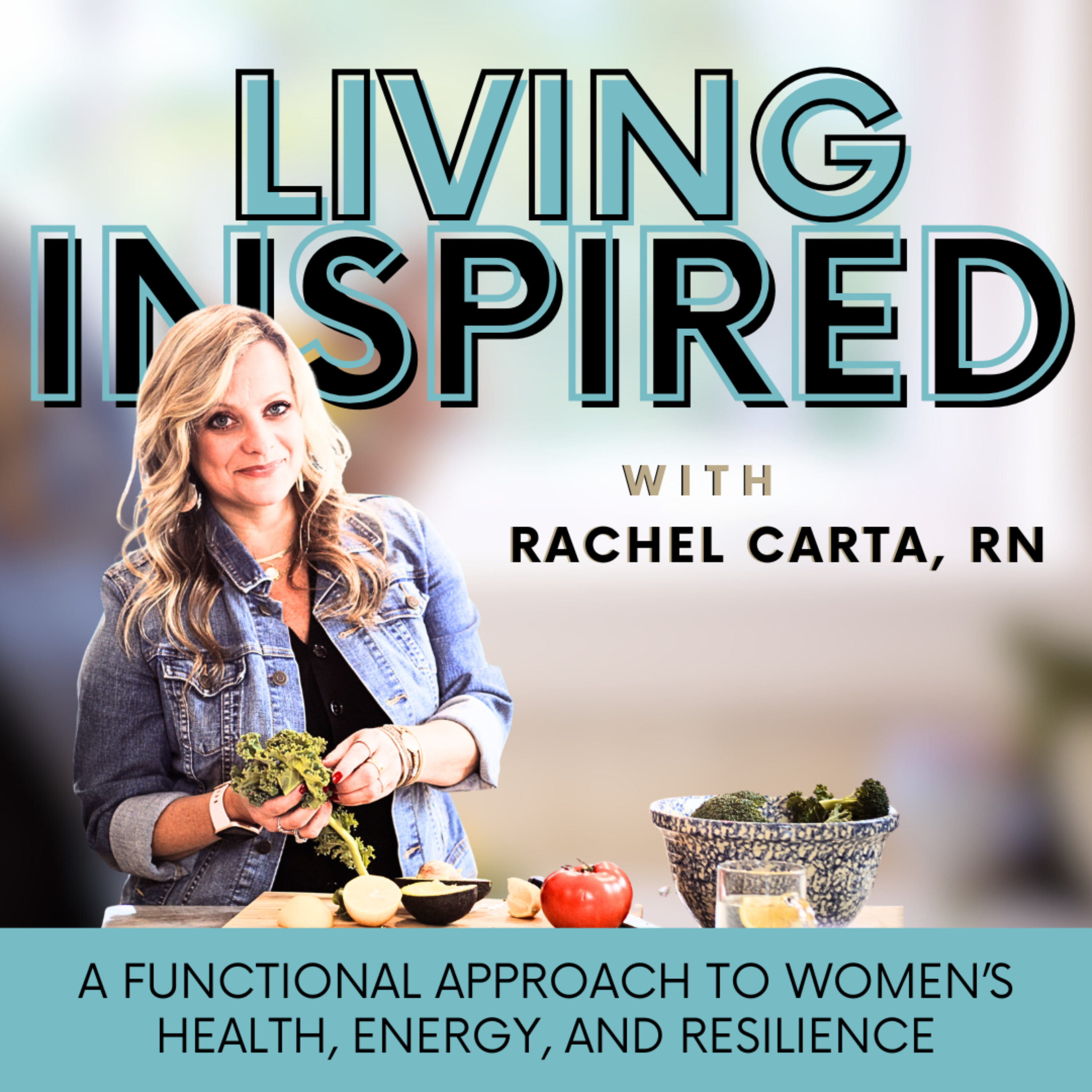
PODCAST · education
Living Inspired - A Functional Approach to Women’s Health, Energy, and Resilience
by Rachel Carta, RN
Living Inspired is a podcast for women who feel overwhelmed by their health, frustrated by normal lab results, and are looking for a calmer, more grounded way to feel better. Hosted by Rachel Carta, RN, Functional Nutrition Counselor, and Life Coach, this podcast explores women’s health through a functional, root-cause approach. We talk about fatigue, stress, hormonal changes, sleep issues, metabolism, and chronic symptoms, and how small, sustainable changes can restore energy and build resilience—without quick fixes or rigid protocols.Learn More: RachelCartaRN.comIG: @peaceinperimenopause
-
102
110. Is Nervous System Regulation Enough? A Conversation with Psychotherapist Kim Saunders
Nervous system regulation can help you feel calmer, but is calm the same thing as healed?In this episode, I’m joined by psychotherapist and yoga educator Kim Saunders to talk about the difference between regulating the nervous system and processing what may be underneath the reaction. We discuss somatic work, EMDR, Internal Family Systems, old belief patterns, and why the same reactions can keep showing up even when you’re doing all the “right” things.If you’ve been working on your nervous system but still feel stuck in familiar patterns, this episode will help you understand why.Connect with Kim:TheLiftYouNeed.comInstagram: https://www.instagram.com/kimuplift/Connect with Rachel:Instagram: https://www.instagram.com/peaceinperimenopause/Rachel's Free Resources:Mood Swings? Get the 5 minute audio to calm them now. https://rachelcartarn.com/sosDo you want to understand more of what's changing in your body in midlife and get a few simple tools to feel better now? Get the free guide: The Real Reason You Still Feel Off.Ready to Talk: Book a Clarity & Relief Session here.Eat Well Made Easy CourseThis episode is brought to you by the Living Inspired Life Lab, my group coaching program for women who want to feel better, understand what’s driving their symptoms, and make sustainable changes in stress, sleep, nutrition, movement, relationships, and more. Doors are opening soon.
-
101
109. The Brain You’re Building in Midlife
Brain health is not only something to think about later in life. What we do in midlife may influence the brain we have in our seventies and eighties, and many of the same habits that support long-term brain health can also help us feel better now.In this episode, I’m breaking down what women in perimenopause need to know about blood sugar, ultra-processed food, movement, strength training, sleep, relationships, mental health, and the modifiable factors connected with dementia risk.This conversation is personal for me because my dad developed dementia, and watching how much it changed him made brain health something I care deeply about.Most importantly, this is not about fear or trying to fix everything at once. It is about understanding where you have influence and choosing one small place to begin.In this episode:Why brain health matters in midlifeHow blood sugar and metabolic health connect to brain healthWhy movement, strength, sleep, and relationships matterWhat ultra-processed food actually meansHow to focus on one realistic change instead of doing everything at onceFind Rachel on Instagram: @peaceinperimenopauseDr. Mark Hyman's episode that was referenced in today's podcast: https://podcasts.apple.com/us/podcast/the-dr-hyman-show/id1382804627?i=1000784321249Mood Swings? Get the 5 minute audio to calm them now. https://rachelcartarn.com/sosDo you want to understand more of what's changing in your body in midlife and get a few simple tools to feel better now? Get the free guide: The Real Reason You Still Feel Off.Ready to Talk: Book a Clarity & Relief Session here.Eat Well Made Easy Course
-
100
108. What a 93-Year-Old Taught Me About Aging Well
If you have caught yourself holding onto a version of you that no longer fits, this conversation is for you. Barb Wojahn, who is 93 years old, has volunteered as a bird bander for 52 years, held leadership roles in her church for decades, and is only now handing off a seniors program she has run for almost 30 years. This is not a conversation about how to live to 93. It is a conversation about how to keep asking who you want to be, no matter what stage of life you are in.In This EpisodeThe interest inventory that told Barb she was suited to be a housewife, and what it took to build a life beyond thatLetting go of activities and identities that no longer fit, and why that is harder than it soundsLearning to say no at 93, and what her husband used to tell her about being in two places at onceThe advice Barb's mother gave her about friendship that shaped her entire lifeWhy connection is one of the six vital inputs your nervous system reads every dayFind Rachel on Instagram: @peaceinperimenopauseRachel's Free Resources:Mood Swings? Get the 5 minute audio to calm them now. https://rachelcartarn.com/sosDo you want to understand more of what's changing in your body in midlife and get a few simple tools to feel better now? Get the free guide: The Real Reason You Still Feel Off.Ready to Talk: Book a Clarity & Relief Session here.Get the Eat Well Made Easy Course, on sale now
-
99
107. How to Stay Calm Under Pressure: Lessons From a Pilot
You already know the feeling. The plan falls apart, the day turns sideways, and you are left standing in the wreckage of your own expectations, wondering why you could not just stay calm this time. In this episode, I sit down with a woman who spent decades in the cockpit of major airliners, flying everything from a small four passenger plane to a 787 across oceans, and who is now retired and figuring out what comes next. This conversation is not just about flying. It is about what happens in your body before the crisis ever shows up, and whether you have trained for it.In This EpisodeAn unconventional path into a forty-six-year flying career, and the one conversation that started it.What it took to build a career in a field where only a small percentage of pilots were women.The exact moment an engine failed midair, and why the response was calm instead of panic.Simulators, checklists, and the real difference between talent and training.Calculated risk versus recklessness, and how to tell which one you are actually taking.The fine line between fear and excitement, and how to use it to make better decisions.What retirement actually looks like eighteen months in, and who would not let the dream sit unfinished.Why a hobby that hits more than one of your values will carry you further than one that only hits one.Rachel's Resources:- Mood Swings? Get the 5 minute audio to calm them now. https://rachelcartarn.com/sos- Do you want to understand more of what's changing in your body in midlife and get a few simple tools to feel better now? Get the free guide: The Real Reason You Still Feel Off.- Ready to Talk: Book a Clarity & Relief Session here.- Eat Well Made Easy Course
-
98
106. Root Cause Nutrition for Women: Reading the Signals
You already know the feeling. It's the moment your calendar says you should be able to keep going, but your body has quietly decided otherwise: the fog rolling in mid-afternoon, the irritability you can't explain, the sense that you used to handle more than this without falling apart. In this episode, I'm sharing a conversation I had as a guest on Tracy Hoth's podcast, The Organized Coach, where we got into why so many high-achieving women blame their mindset or their discipline for something that is actually coming straight from the body. In This EpisodeRoot causes: the three places nearly every chronic symptom actually traces back toGenes and epigenetics: why family history is not the same thing as fateThe soil and the roots: a garden metaphor for how autoimmune conditions really developFight or flight and your to-do list: why your nervous system can't tell a real threat from a busy dayBlood sugar and business: the physical reason behind midday irritability and brain fogThe three-minute nervous system reset that changes how the rest of your day goesFat, fiber, and protein: the simplest way to stabilize blood sugar without tracking anythingSleep as the first domino: why it matters more than any other single habitPattern awareness: the practice that comes before any protocolResourcesTracy's podcast, The Organized CoachFree Guide: The Real You Still Feel Off: What Your Symptoms Are Telling YouWebsite: rachelcartarn.comIG: @peaceinperimenopause
-
97
105. The Magic Meal Formula: Fewer Cravings, More Energy, No More Diets
If you've spent another Sunday night staring at a grocery list wondering whether you should be low carb, cutting dairy, fasting, or counting macros, this one is for you. In this episode, Rachel steps away from all the noise and hands you the one place she starts with almost every client, no matter what brought her through the door. This isn't another diet. It's a simple formula you can carry into any kitchen, for the rest of your life.In This EpisodeThe Magic Meal Formula and why it starts with three simple pieces, not another diet.Blood sugar spikes and crashes, and what's actually behind your cravings.Healthy fat sources and what they're doing for your hormones, your brain, and your energy.Fiber, the piece almost every woman is under-eating, and how much you actually need.Protein's role in steady mood, muscle, and blood sugar, and how to tell if you're getting enough.Real client patterns, mood swings and hot flashes that shifted once meals were rebuilt around this formula.Simple examples for smoothies, salads, and eggs so you can build a plate without overthinking it.Eat Well Made Easy, the mini course this teaching is pulled from.ResourcesEat Well Made EasyRachelCartaRN.comFind Rachel on IG: https://www.instagram.com/peaceinperimenopause/Rachel's Free Resources:Mood Swings? Get the 5 minute audio to calm them now. https://rachelcartarn.com/sosDo you want to understand more of what's changing in your body in midlife and get a few simple tools to feel better now? Get the free guide: The Real Reason You Still Feel Off.Ready to Talk: Book a Clarity & Relief Session here.
-
96
104. What Nobody Explained to You About Perimenopause and Hormones
You wake up in a body that doesn't quite feel like yours. Sleep is worse, moods are sharper, weight settles somewhere it never used to, and when you finally ask your doctor, you’re told your labs are normal. In this episode, I'm opening the doors to something I teach inside the Living Inspired Life Lab. This is the hormone conversation I have with nearly every woman who finds her way to me. It's not the version you've seen online where estrogen is the enemy and the right supplement fixes everything. It's the real one, where your hormones are one part of a much bigger story your body is telling you, and if you're in your late 30s, 40s, or beyond and you've started to feel like a stranger to yourself, this one is for you.In This EpisodeThe hormone hierarchy, and why your sex hormones sit at the very top of the pyramidBlood sugar as the foundation everything else is built onThe monthly cycle, and the difference between feeling unstable and being cyclicalPerimenopause, menopause, and post-menopause, and why menopause is only one single dayThe estrogen roller coaster, and why this stretch is often harder than menopause itselfProgesterone, ovulation, and the reason your sleep changedFSH, lab tests, and why a normal result doesn't mean nothing is happeningHormone therapy as a start-at-the-base conversation, not a first moveResources MentionedFind Rachel on Instagram: @peaceinperimenopausePodcast episode with a hormone nurse practitioner, Dana Culp, on the hormone therapy process.Podcast episode with Jane Butler on the mindset of the menopause journey.
-
95
103. The Pelvic Health Conversation No One Ever Had With You
You laugh, you sneeze, you pick up the laundry basket, and there it is again, that little leak you've quietly learned to work around. Or intimacy has started to hurt, and the only advice you've ever gotten was to have a glass of wine and relax. Maybe days pass without a real bathroom trip and you've decided that's just how your body is now. I sat down again with Dr. Judy Rossi, a pelvic floor therapist with a doctorate in physical therapy and advanced training in pelvic health and orthopedics, for the honest conversation most of us were never offered about what these symptoms are actually trying to tell us. If you've been handed the word "normal" every time you've worked up the courage to ask, this episode is for you.In This EpisodeThe pelvic floor as twenty-five percent of your core, and why the six-pack you were taught to chase isn't even part of itStress incontinence versus urge incontinence, and why the leaking you brushed off gets treated two completely different waysPainful intimacy, medical gaslighting, and the "just relax" advice that sends women home without help when ninety percent of the time it's fixableChronic constipation and dyssynergic defecation, the pattern where your pelvic floor clenches at the exact moment it's supposed to let goThe two-way highway between your brain and your pelvic floor, and what stays stuck when you're living in fight or flightWhy you can't out-supplement, out-exercise, or out-biohack a dysregulated nervous system, and where the work actually has to beginJudy's own decade with IBS and interstitial cystitis, and the tight, angry muscles that turned out to be the real driverThe places the body stores stress, from the jaw to the neck to the pelvic floor, and one patient story you won't forgetPerimenopause, thinning tissue, and the topical estrogen conversation worth having with your providerSimple vagus nerve practices like gargling, humming, and cold water that you can start at the bathroom sink todayResourcesDr. Judy Rossi, Woodstock Pelvic HealthJudy on Instagram @woodstockpelvichealthLiving Inspired Podcast, Episode 54 (pelvic health basics and myths with Dr. Judy Rossi)Learn More About RachelRachel on Instagram @peaceinperimenopauseGet the Free Guide The Real Reason You Still Feel Off in Perimenopause
-
94
102. What a Gas Line Trench Taught Me About Gratitude and the Nervous System
This is one of those solo episodes where I interrupt the regular schedule because an ordinary moment had something to say. If you've been moving so fast that you're missing your own life, and carrying a stress load you've never actually named, this one is for you.In This EpisodeA hole in the road, a hard hat, and the morning that changed how I see comfortPhysical stress versus emotional stress, and why your body counts bothThe hidden labor behind the heat, the roads, the gas lines, and the clean sidewalks most of us never seeWhy a nervous system living at its limit can't heal, no matter how hard you pushThe irritation of construction delays, and the one question that calms your body in the momentComfort as the baseline, and what it costs us to treat every interruption as a problemA missions trip at fifteen, trash trenches, and what infrastructure really isReading the name tag: a ten-second practice for actually seeing the people around youRachel's Free Resources:Mood Swings? Get the 5 minute audio to calm them now. https://rachelcartarn.com/sosDo you want to understand more of what's changing in your body in midlife and get a few simple tools to feel better now? Get the free guide: The Real Reason You Still Feel Off.Ready to Talk: Book a Clarity & Relief Session here.
-
93
101. A New Way to Understand Your Body in Midlife with Andrea Nakayama
If your health feels like a list of problems you're supposed to fix on your own, and the internet keeps adding one more thing you "have to" do to feel okay in midlife, this conversation is the exhale you've been needing. My guest is Andrea Nakayama, a pioneer in functional nutrition, the founder of the Functional Nutrition Alliance, and the educator who trained me to think the way I think. She has taught thousands of practitioners to see the person instead of the diagnosis, and that one shift changes everything about how you understand your own body. If you're a high-achieving woman who is tired of chasing symptoms and quietly wondering why you couldn't just figure this out yourself, this one is for you.In This EpisodeThe note-card model of medicine most of us were handed, and why symptom plus disease plus drug was never the whole story.The matrix Andrea teaches, made of story, soup, and skill, and the layer almost everyone skips.The tree, its roots, and the soil, and why you don't heal by cutting off the branches.The pause, and the one person who actually profits from it.Blood sugar at the base of the hormone hierarchy, and the morning habit that quietly sets your whole day off.Hormone therapy in midlife, and why it helps some women and isn't the fix it's being sold as for everyone.The nervous system stuck in fight or flight, and what your body cannot do until it feels safe.One client, fifteen supplements, and the two-minute practice that finally moved the needle on her IBS.Building your own ecosystem of support instead of asking one doctor to be everything.Resources:Find Andrea here: https://www.andreanakayama.com/Andrea on IGRachel's Resources:Website: RachelCartaRN.comMood Swings? Get the 5 minute audio to calm them now. https://rachelcartarn.com/sosDo you want to understand more of what's changing in your body in midlife and get a few simple tools to feel better now? Get the free guide: The Real Reason You Still Feel Off.Ready to Talk: Book a Clarity & Relief Session here.
-
92
100. Surviving Your Life, or Living It
You're doing all the things you've always done, and somehow your body is pushing back anyway. You're tired in a way sleep doesn't touch, reactive over things that never used to rattle you, moving so fast that whole days disappear before you've actually been inside any of them. You keep telling yourself you'll slow down once everything calms down and everyone else is taken care of. This is episode 100 of the Living Inspired Podcast, and instead of a guest, Rachel sits down to reflect on what 100 episodes, two decades with women, and the last three nights of her father's life have taught her about the difference between surviving your life and actually living it. If you've forgotten what it feels like to be fully present in your own days, this one was made for you.Key TakeawaysYour symptoms are rarely the problem. They are your body's response to a load that's been building for years, and that means they can be read and answered rather than only silenced.Your body was always paying the price. Midlife is simply the season it stops letting you defer the bill, which is information, not a verdict.Living inspired means living at a pace your body and soul can actually sustain, and slowing down enough to notice you are alive now, not eventually.Rachel's Free Resources:Mood Swings? Get the 5 minute audio to calm them now. https://rachelcartarn.com/sosDo you want to understand more of what's changing in your body in midlife and get a few simple tools to feel better now? Get the free guide: The Real Reason You Still Feel Off.Ready to Talk: Book a Clarity & Relief Session here.
-
91
99. Why Your Cravings Aren't a Willpower Problem
You've made it through the day. You ate well, you stayed focused, you held it together. And then the evening comes and something shifts. Suddenly you're standing in your kitchen reaching for bread, or something sweet, or anything that will quiet the noise. You tell yourself you'll do better tomorrow. But tomorrow looks exactly the same. If this is your life right now, this episode is going to explain something nobody has taken the time to tell you: your cravings have a physiological root cause, and willpower was never the solution.In This EpisodeBlood sugar mechanics and why refined carbohydrates trigger a craving cycle that feels nearly impossible to breakCortisol, sleep deprivation, and the direct connection between a hard night and a carb-heavy next dayInsulin resistance, what it actually means, and why it makes cravings more intense even when you're eating enoughThe brain chemistry behind why sugar temporarily calms a stressed nervous system, and what that means for women who think they're "just emotional eaters"The gut microbiome's role in what you reach for and why certain imbalances can make sugar cravings feel relentlessThe fat, fiber, protein principle Rachel teaches every client and why it's the most consistent shift she sees make a real differenceWhy restrictive dieting keeps failing and what your body is actually asking for insteadResourcesWebsite: RachelCartaRN.com Instagram: @peaceinperimenopauseRachel's Free Resources:1. Mood Swings? Get the 5 minute audio to calm them now. https://rachelcartarn.com/sos2. Do you want to understand more of what's changing in your body in midlife and get a few simple tools to feel better now? Get the free guide: The Real Reason You Still Feel Off.3. Ready to Talk: Book a Clarity & Relief Session here.
-
90
98. Mud Before Wings: What Nobody Told You About the Woman You're Becoming
You've done the labs. Everything looks normal. But you still don't feel like yourself and nobody has been able to tell you why. In this episode, Rachel sits down with Dr. Ellen Albertson, psychologist, self-compassion researcher, and the Midlife Whisperer, to talk about what is actually happening in your body and mind during perimenopause and why feeling lost in this season doesn't mean something is wrong. It means you're becoming.Dr. Ellen introduces the dragonfly as a metaphor for midlife — the nymph stage, the murky water, the slow and often uncomfortable process of transforming into something with 360-degree vision and the freedom to fly. This conversation is for any woman who has felt dismissed, confused, or quietly exhausted by a season of life nobody prepared her for.In this episode:Why your operating system is updating and what that actually means in your brain and bodyThe estrogen veil: what happens when it lifts and why so many women finally say "enough"Why we cannot put everything in the perimenopause bucket and what else to look atThe three elements of self-compassion and why the research says it changes your health, not just your mindsetDestination vibration: how to access the felt sense of feeling well even when you're not there yetWhy self-care is not a spa day and what it actually looks like when your nervous system needs supportHuman design, the dragonfly framework, and understanding your unique wiring in midlifeKey Takeaways:Your symptoms are not a malfunction. They are a recalibration.Self-compassion is a muscle. The more you practice treating yourself like a good friend, the more your relationship with yourself changes.Small hinges swing big doors. You don't need an overhaul. You need to find the one or two things creating the most drag and start there.Resources:Dr. Ellen Albertson: themidlifewhisper.comInstagram: @the_midlife_whisperRachel Carta: RachelCartaRN.comInstagram: @peaceandperimenopauseRachel's Free Resources:Mood Swings? Get the 5 minute audio to calm them now. https://rachelcartarn.com/sosDo you want to understand more of what's changing in your body in midlife and get a few simple tools to feel better now? Get the free guide: The Real Reason You Still Feel Off.
-
89
97. The Hidden Cost of Urgency in Midlife
If you’ve been feeling more overwhelmed, emotionally reactive, mentally exhausted, or disconnected from yourself lately, this episode is for you.And no, I don’t think it’s “just hormones.”In this conversation, I’m talking about something I see constantly with women in midlife: the hidden cost of living in a constant state of internal urgency.Everything feels important.Everything feels immediate.Everyone needs something.Over time, the nervous system starts treating life like one ongoing emergency, and eventually that pressure impacts far more than stress levels. It affects sleep, digestion, hormones, focus, emotional regulation, energy, and your ability to actually feel present in your own life.Inside this episode, I share a powerful framework from one of my Root & Rise coaching calls that helps explain why so many women feel emotionally overloaded all the time, even when they’re “doing all the right things.”We talk about:Why many women are not just tired, but stuck in chronic reaction modeThe connection between nervous system overload and midlife symptomsHow urgency quietly steals peace, fulfillment, and emotional capacityThe difference between what feels urgent and what actually moves your life forwardWhy many healing practices get abandoned first when life gets busyThe four zones that shape how you feel every daySimple ways to reduce mental overload and create more nervous system safetyThis episode is not about becoming less responsible or getting everything perfectly balanced. It’s about recognizing that many women have spent years operating from pressure and reaction, and that healing often begins by slowing down enough to become more intentional again.Because peace does not come from getting everything done.Peace comes from learning what really matters.If this episode resonated with you, send it to a woman who feels like she’s carrying the weight of everything right now.And if you enjoyed this conversation, I’d love for you to leave a review or share the episode on Instagram and tag me at @peaceinperimenopause.Learn more about working with me: RachelCartaRN.com
-
88
96. Burnout In Midlife: Why Your Body Is Pushing Back
If you’ve been feeling exhausted, overwhelmed, emotionally reactive, wired but tired, or like your body suddenly isn’t responding the way it used to, this episode is for you.In this powerful conversation, I sit down with functional diagnostic nutrition practitioner and HTMA expert Dori Martin to talk about what burnout really is, why so many women in midlife feel stuck in survival mode, and how chronic stress impacts everything from hormones and sleep to energy, mood, and healing capacity.We talk about the hidden emotional and physiological load many women are carrying, especially in midlife, and why symptoms are often connected instead of random.This episode is not about doing more. It’s about understanding what your body has been trying to tell you.Inside this conversation, we discuss:why midlife often feels like “everything stopped working”the connection between burnout, nervous system stress, and hormone symptomshow your body prioritizes survival over repairwhy so many women feel exhausted even when they’re trying everythingthe role of mitochondria and energy productionwhy women in midlife often feel stuck in fight or flightthe emotional load of caregiving, perfectionism, and over-functioningsimple shifts that can help your body feel safer and more supportedwhy sunlight, hydration, breathing, and slowing down matter more than people realizeDori also shares her personal story of caregiving, chronic stress, and burnout, and we talk honestly about the shame many women feel when their bodies can no longer keep up with the pace they’ve been forcing themselves to maintain.Resources:Learn more about Dori Martin: https://dorimartin.comFollow Rachel on Instagram: https://instagram.com/peaceinperimenopauseLearn more about working with Rachel: https://RachelCartaRN.comLiving Inspired Podcast Episode 7: Meditation for Stress ReliefLiving Inspired Podcast Episode 12: Medication to Just BeLiving Inspired Podcast Episode 37: Feel Stress Release NowIf this episode resonated with you, please share it with someone who needs this conversation right now, and if you haven’t yet, I’d be so grateful if you left a review for the podcast.
-
87
95. You’re Not Crazy. Your Body Is Trying to Tell You Something
If you’ve been feeling more anxious, more reactive, or just not like yourself lately… this episode is for you.You’re trying to do the right things. You’re taking care of yourself, paying attention to your health, maybe even running labs… and still, something feels off.In this episode, Rachel sits down with a client, Amanda, who shares what it felt like to be in that exact place. After having her baby, Amanda experienced anxiety, exhaustion, mood swings, and a sense that she had lost herself. Even though she knew something wasn’t right, she wasn’t getting the answers she needed.What you’ll hear in this conversation is what changed when she stopped trying to fix the symptoms and started addressing what was actually driving them.Rachel breaks down:why mood swings, anxiety, and irritability are signals, not personality changeswhy hormones are part of the story, but not the whole storyhow stress, blood sugar, inflammation, and the nervous system all play a rolewhat it actually looks like to make small shifts that create meaningful changeAmanda shares how, within a matter of weeks, she went from feeling like a shell of herself to feeling safe in her body again and genuinely happy, without overhauling her life.If you’ve been feeling off and can’t quite explain why, this episode will help you start to see what your body might be trying to tell you.If you’re ready to go deeper, here are a few ways to get support:Book a call with Rachel: https://rachelcarterrn.com/schedule A simple conversation to talk through what’s going on and what your next step could look like.Mood Swings SOS (free 5-minute reset): https://rachelcarterrn.com/SOS A quick, practical tool to help you calm your system in the moment when everything feels heightened.Free Guide: The Real Reason You Still Feel Off https://rachelcarterrn.com/LastingHealth A deeper look at what’s actually driving your symptoms and how to start addressing them at the root.Partner Communication Guide https://rachelcarterrn.com/communication Because this season of life affects your relationships too. This will help you communicate what’s going on in a way that brings more understanding and support.
-
86
94. Lifestyle Medicine: How Daily Habits Shape Your Health and Long-Term Disease Risk
In this conversation with Dr. Ann Hester, we talk about what’s missing in traditional healthcare, and why lifestyle is not just a side note, but a major driver of how you feel day to day. This isn’t about doing everything perfectly or overhauling your life overnight. It’s about understanding how your daily habits are shaping your energy, your hormones, your inflammation, and your long-term health in ways most people have never been taught to look at.We also talk about why change feels hard, even when you know what to do, and how small, consistent shifts can create meaningful results without overwhelm.What We CoverThe gap in medical training around nutrition and lifestyleHow daily habits impact hormones, energy, and inflammationThe role of lifestyle medicine in long-term healthWhy change feels hard (and what actually works instead)How to start making small, sustainable shiftsYour body is responding to what you do every single day. When you understand that, you stop chasing fixes and start seeing patterns.Resources MentionedDr. Ann Hester’s website: https://ptrreset.comTake the Survey: Click Here. If this episode resonated with you, I’d love to hear what stood out.You can send me a message on Instagram:👉 https://instagram.com/peaceinperimenopauseOr explore more resources here:👉 https://rachelcartaRN.com
-
85
93. Don’t Wait Until It’s Too Late to Live Your Life
This is not our usual conversation. We’re not talking about hormones, gut health, or trying to figure out what’s causing your symptoms.This is a pause.A moment to step out of the constant doing… and come back to what it actually means to be living.In this episode, I sit down with Billy Duke, a 55-year-old living with ALS, a progressive neurological disease that slowly takes away the body’s ability to move, while the mind remains fully aware.What he shares is simple, but powerful. A reminder that most of us are moving through life too quickly… waiting for the right time… putting things off… assuming we have more time than we do.This conversation isn’t about fear. It’s about clarity. About what actually matters when everything else is stripped away.As you listen, notice what comes up for you.What have you been putting off?Where have you been moving too fast?What matters most right now?This episode is an invitation to slow down, look up, and come back to your life.What we talk about:What ALS is and how it impacts the body over timeWhy we spend so much of our lives working and rushingThe quiet regrets that come from waiting too longThe importance of people, connection, and shared timeHow to slow down and actually experience your lifeSimple reminders to stop, notice, and be present🎧 Listen to more episodes like this: 100 Years of Wisdom🤍 Connect with me on Instagram@peaceinperimenopauseI’d love to hear from you.What stood out to you the most? What are you changing in your life? Email: [email protected] me a message and share this episode with someone you love. These are the conversations that stay with us… and sometimes, they’re the ones that gently change how we live.
-
84
92. GLP-1 Weight Loss: Risks, Muscle Loss, and What Matters
GLP-1 medications like Ozempic and Wegovy are everywhere right now, but most people aren’t being told what actually matters if they choose to take them.In this episode, I sit down with pharmacist and health coach Mike Thomas to break down how GLP-1s really work, why they’re so effective for weight loss, and the part that often gets missed. We talk about muscle loss, metabolism, food noise, and what can happen when the medication is stopped.If you’ve been considering a GLP-1, are currently taking one, or just want to understand your options, this conversation will help you make a more informed decision about your health.We also talk about how to support your body alongside these medications so you’re not just losing weight, but actually building long-term health.What we cover in this episode:What GLP-1 medications are and how they work in the bodyWhy “food noise” decreases and what that actually meansThe biggest mistake people make when taking GLP-1sMuscle loss during weight loss and why it matters for metabolismWhat happens when you stop the medicationWhy strength training and protein are essentialThe emotional side of weight loss that no one talks aboutHow to support your body whether you take a GLP-1 or notConnect with Mike Thomas:https://glp1coachmike.comFollow Rachel:Instagram: https://www.instagram.com/peaceinperimenopauseFree resource:The Real Reason You Still Feel Offhttps://rachelcarterrn.com/lastinghealthNeed a mood swings rescue: https://rachelcartarn.com/sos
-
83
91. Stop Ending Your Day Feeling Behind
If you’ve ever gotten to the end of the day and thought… I did so much, so why does it feel like nothing actually moved forward? this episode is for you.In this conversation, we’re unpacking why you can feel busy all day and still feel behind. Not because you’re doing something wrong, but because the way you’ve been taught to work doesn’t always support how your brain and energy actually function, especially in this season of life.I’m joined by Steven Puri, founder of The Sukha Company and studio executive at 20th Century Fox and DreamWorks Pictures. After years working in high-performance environments, he now teaches how to access deeper focus, reduce distraction, and create meaningful progress without constantly pushing harder.We talk about what’s really keeping you stuck in that cycle of doing more but feeling behind, how distractions are draining your energy, and the one simple shift that can change how your entire day feels.This is not about doing more. It’s about doing what actually matters.Why you can feel busy all day but still feel behindWhat’s actually happening when your focus feels scatteredHow constant interruptions impact your energy and progressWhat “flow state” really means (in a practical, real-life way)The simple shift that helps you move your day forwardHow to start working with your energy instead of against itLearn more about Steven and his work: https://www.thesukha.co/Rachel's Free Resources:Mood Swings? Get the 5 minute audio to calm them now. https://rachelcartarn.com/sosDo you want to understand more of what's changing in your body in midlife and get a few simple tools to feel better now? Get the free guide: The Real Reason You Still Feel Off.
-
82
90. Why You Feel Stuck Even When You're Trying
Why You Feel Stuck (Even When You’re Doing Everything Right)If you’ve been wondering why you feel stuck even when you’re doing everything right, this episode will help you see things differently.In this short, personal episode, I walk you through a simple but powerful shift that can change how you experience your health, your emotions, and your life. Because often, it’s not just what’s happening that keeps us stuck. It’s what we’re thinking about what’s happening.We talk about how your thoughts shape your feelings, your actions, and ultimately your results, and how small shifts in awareness can open the door to real change.This is not about forcing positivity or pretending everything is fine. It’s about creating space so you can move forward in a way that feels calm, grounded, and sustainable.In this episode, we cover:Why you feel stuck even when you’re trying and doing everything “right”How your thoughts influence your health, mood, and daily actionsThe common thought patterns that keep you in the same placeA simple way to shift your thinking without forcing itWhy noticing small wins can change your nervous system and momentumIf you’ve been feeling frustrated, overwhelmed, or like nothing is really working, this episode will meet you right where you are.Free Resources to Support YouIf you’re ready to go deeper, here are a few simple starting points:The Real Reason You Still Feel OffIf your labs say you’re fine but you don’t feel fine, this will help you start connecting the dots.👉 https://rachelcarterrn.com/lastinghealthMood Swings SOS (5-minute audio)A quick, grounding reset to help shift your mood in the moment.👉 https://rachelcarterrn.com/sosPartner Communication GuideLearn how to talk about what you’re experiencing in a way that builds understanding and support.👉 https://rachelcarterrn.com/communication
-
81
89. Why So Many Relationships Struggle in Midlife (And What To Do About It)
If your relationship has been feeling harder lately… this episode is for you. There are real changes happening in your body, your stress levels, your capacity… and most people have never been taught how much this can affect connection, communication, and intimacy.In this conversation, I’m joined by Jesse Robertson, the voice behind Husbands4Menopause, who is helping men better understand what women are going through in this season.We talk about:• Why relationships can start to feel tense, distant, or disconnected• What’s actually happening underneath mood swings, overwhelm, and irritability• Why intimacy often changes (and what most couples misunderstand about it)• How men can better support their partners without feeling confused or shut out• Simple shifts that can completely change the tone of your relationshipThis isn’t about blame. It’s about understanding what’s really going on… so you can feel more connected, supported, and on the same team again.If you’ve been thinking, “Why does everything feel harder right now?” — you’re not alone. And there’s a reason for it.🎧 Share this episode with your partner or listen together. It can open up a completely different kind of conversation.Find Jesse on all your social media platforms: @husbands4menopause📄 Download my Partner Communication Guide: rachelcartarn.com/communication
-
80
88. When Midlife Symptoms Get Dismissed: What Women Need to Know About Hormones, Perimenopause, and Finding Real Help
Many women enter their 40s and 50s feeling like something in their body has shifted. Mood swings, anxiety, sleep changes, and low energy start showing up, yet many are told their labs are normal or that this is simply part of aging.In this episode, I sit down with Dana Culp, a nurse practitioner and menopause expert who has spent more than 25 years working with women in midlife. Dana also shares her own experience navigating perimenopause and the challenges she faced getting the support she needed.In this episode we discuss:• Why so many women struggle to get help during perimenopause• What hormone therapy actually is (and what it isn’t)• The difference between bioidentical and synthetic hormones• Why menopause education is still lacking in medicine• How to advocate for yourself in doctor’s appointmentsIf you’ve been trying to understand what’s happening in your body lately, this conversation will help bring clarity.Links & ResourcesMood Shift Method Live WorkshopConnect with Rachel: Website: RachelCartaRN.comInstagram: https://www.instagram.com/peaceinperimenopause/Website: https://www.thrivemidlifemed.com/Instagram: https://www.instagram.com/thrivemidlifemed/Facebook: https://www.facebook.com/thrivemidlifemedLinkedIn: https://www.linkedin.com/company/thrive-midlife-medicine/Free consultation and free class: https://thrivemidlifemedicine.cal.com/thrivemidlifemedicinehttps://www.thrivemidlifemed.com/event
-
79
87. Your Labs Are “Normal” So Why Do You Still Feel So Off?
Have you ever been told your labs are “normal,” but you still feel exhausted, foggy, bloated, anxious, or just not like yourself?In this episode, Rachel explains why normal lab work does not always mean your body is functioning optimally and why labs should never be interpreted without the full story of your health.Through a functional nutrition lens, labs are not the final answer. They are clues. Rachel shares how she looks at patterns, symptoms, lifestyle, digestion, stress, and health history alongside lab work to better understand what may be contributing to fatigue, mood changes, and other chronic symptoms.If you’ve ever felt confused by lab results that say everything is fine while your body tells you otherwise, this conversation will bring clarity.Why “normal” lab results do not always mean optimal healthThe difference between functional and pathological lab rangesWhy labs are a snapshot in time, not the full storyThe problem with a lab-first, supplement-first approachThe three principles Rachel uses when looking at labsCommon patterns Rachel sees in women’s lab workWhy thyroid testing often needs a broader lens than TSH aloneHow improving the body’s “terrain” can help symptoms begin to shiftMood Shift Method LiveA live workshop where Rachel walks you through the deeper root causes behind mood swings, anxiety, fatigue, and feeling unlike yourself in midlife.Learn more and register here:https://rachelcartarn.com/moodshiftWebsite:https://rachelcartarn.com
-
78
86. The Real Reason You’re More Irritable Lately
Have you ever reacted to something and thought, Where did that come from?If you’ve been feeling more irritable, more anxious, more overwhelmed, or just not quite like yourself lately, this episode is for you.In this conversation, I’m walking you through something I see in so many women navigating midlife: emotional shifts that feel confusing, intense, and sometimes even alarming.Midlife is not just a hormonal transition. It’s also a nervous system shift, a metabolic shift, and a resilience shift. When estrogen and progesterone begin fluctuating, your internal buffering system changes. The same life you were managing before can suddenly feel like too much.In this episode, I talk about:Why your “window of tolerance” may feel smaller than it used toThe stress bucket analogy and why everything feels heavierHow blood sugar instability impacts irritability and anxietyWhy nervous system load matters more than you thinkThe overlooked role of margin and space in emotional regulationHow to begin seeing mood swings as information, not failureIf you’ve ever wondered why small things feel bigger lately…If you’ve questioned whether you’re “losing it”…If you’ve felt dismissed or confused about what’s happening in your body…This episode will help you connect the dots in a way that feels grounding instead of overwhelming.Ready to Go Deeper?If this resonated with you, I’d love to invite you to my Mood Shift Method Live Workshop.This is where we take everything we discussed and apply it directly to your own patterns, rhythms, and stress load so you can understand what your body has actually been trying to say.You can learn more and reserve your spot here:rachelcartarn.com/moodshiftYou deserve to feel calm, confident, and like yourself again. And it starts with understanding.If this episode helped you, share it with someone who needs to hear it. And as always, thank you for being here.
-
77
85. Why Your Body Won’t Relax And What It Means
Have you ever tried to relax, only to notice your mind speeding up or your body staying tense? In this episode, Rachel shares what these experiences may actually mean and why they often point to your nervous system rather than a personal shortcoming.Through a powerful client story and practical insights, she explains how mood, digestion, energy, and stress responses are deeply connected, and why real healing often begins with helping your body feel safe instead of pushing harder or adding more protocols. You’ll also learn gentle signs your system may be stuck in survival mode and one simple practice you can use to begin shifting toward calm.In This Episode:why your body may feel restless even when life looks calmhow nervous system state affects mood, digestion, and energysigns your system may still be in stress modewhy foundations matter more than quick fixesa simple way to signal safety to your bodyIf this episode speaks to you and you want deeper support, Rachel’s live Mood Shift Method workshop will walk you through how to understand your body and create lasting change. Join here: RachelCartaRN.com/moodshift
-
76
84. Why Your Patterns Keep Repeating And What Your Subconscious Is Trying To Protect
In this episode, I’m joined by Sheila Wenger, founder of Shift Hypnosis and certified hypnotherapist, for a powerful conversation about subconscious patterns, emotional healing, and why change can feel hard even when you truly want it.We talk about how the subconscious mind works, why certain fears and reactions stay with us for years, and how many of the patterns women struggle with are actually protective responses that once served a purpose. Sheila explains how root beliefs form, how they influence behavior and relationships, and why real healing often begins when truth is acknowledged.If you’ve ever wondered why you keep repeating certain cycles, feel stuck despite doing all the “right” things, or want to better understand your emotional patterns, this conversation will give you a new lens to look through.Connect With SheilaWebsite: https://www.shifthypnosis.orgPodcast: Shift Is HappeningEmail: [email protected] With RachelWebsite + resources: https://www.rachelcartarn.comFree Guide - The Real Reason You Still Feel Off: https://rachelcartarn.com/lastinghealthInstagram: https://www.instagram.com/peaceinperimenopause
-
75
83. Grief, Self-Compassion, and the Nervous System: What Healing Really Requires
What if healing isn’t about fixing what feels wrong, but learning how to feel what’s been held for too long?In this episode of Living Inspired, I’m joined by somatic and transformational coach Soulla Demetriou for a grounded conversation about grief, self-compassion, and the nervous system, and why these are often the missing pieces in healing.We explore how grief shows up not only after loss, but in quieter, less visible ways when life doesn’t unfold as we hoped. We talk about how avoiding grief can keep the nervous system stuck in survival mode, and how this can ripple into fatigue, digestive issues, sleep struggles, and emotional overwhelm.This episode is especially for women who feel unsettled in their bodies despite “doing all the right things.” We discuss how self-compassion creates safety in the nervous system, and how healing often happens in small, steady moments rather than big overhauls.Why grief is not something to fix, but something to allowHow unprocessed grief can show up as physical and emotional symptomsThe role of nervous system safety in healingWhy self-compassion is foundational, not optionalSimple ways to help the body exhale and softenFind Rachel here: RachelCartaRN.comFree Guide: The Reason You Still Feel OffFree Mood Swings AudioInstagram: https://www.instagram.com/peaceinperimenopauseFind Soulla Here: Website: https://www.withsoulla.comBook: https://www.withsoulla.com/always-enoughInstagram: https://www.instagram.com/withsoullaFree Self-Compassion Course: https://www.withsoulla.com/courses/7-steps-course-sign-up
-
74
82. The Real Reason Everything Feels Like Too Much in Midlife
In this episode, I’m sharing a live talk I gave for the Brigham Education Institute, part of Brigham and Women’s Hospital. It’s the fourth time I’ve been invited to speak for their program, and this conversation felt too important not to share more widely.So many women reach midlife and feel blindsided by what’s happening in their bodies. Sounds feel louder. Emotions feel closer to the surface. Digestion changes. Sleep becomes elusive. And often, everything looks “normal” on paper, even though you know something feels off.In this episode, we take a step back and look at symptoms differently. Not as random or inevitable, but as meaningful signals from the body.You’ll hear about:Why midlife can suddenly feel harder, even if nothing dramatic has changedA simple bucket analogy that explains capacity, stress, and symptom spilloverThe four core systems that often drive mood changes, digestive issues, and overwhelm in midlifeHow hormonal shifts impact the nervous system, blood sugar, digestion, and recoveryWhy moving from fixing to listening creates real and lasting changeThis is not about another protocol or checklist. It’s about understanding what your body has been responding to, and how small, steady shifts can help you feel calmer, more confident, and more at home in yourself again.If you’ve been feeling off, overwhelmed, or confused by your symptoms, this episode is for you.Free Guide: The Real Reason You Still Feel OffAnd if you’d like deeper, personalized support, you can book a Clarity and Relief Session.
-
73
81. Why Strength Training Matters More in Midlife Than Ever (According to Decades of Research)
Strength training is often framed around appearance or fitness goals. But its real impact goes far deeper than that.In this episode, I sit down with Dr. Wayne Westcott, a leading researcher in strength training and exercise science, to talk about why building and maintaining muscle matters so much in midlife and beyond. Wayne has spent decades studying how resistance training affects the body across the lifespan, including adults in their 90s, and his research offers a hopeful, practical perspective on aging.We talk about how muscle loss affects metabolism, bone density, mood, and independence, what strength training actually looks like in real life, and how little time it can take to see meaningful benefits. Wayne also shares powerful insights from nursing home studies that challenge the idea that it’s ever too late to get stronger.This is a grounded, encouraging conversation for anyone who feels overwhelmed by fitness advice, unsure where to begin, or curious about how to support their body in a way that feels realistic and sustainable.Why muscle matters for healthy aging and daily functionHow strength training supports metabolism, bones, and moodWhat research shows about building strength later in lifeWhat strength training really means (and what it doesn’t)How to get results without spending hours in the gymDr. Wayne Westcott is a retired professor of exercise science and one of the most respected researchers in strength training. He has authored over 100 peer-reviewed studies, written 30 books, and taught at institutions including Harvard and Yale.Get: Strength Training Past 50Contact Rachel: [email protected] Free eBook: The Real Reason You Still Feel Off
-
72
80. Change Your Perspective, Change Your Life
In this episode, I share a powerful shift in perspective that changed how I move through life, especially during hard seasons.Through stories from my time as a nurse and hospice nurse, I talk about what happens when we stop waiting for life to get easier and instead build ourselves strong enough to meet it.We explore the idea:What if your life is happening for you, not to you?Not as a positivity slogan, but as a way to relate to challenges without staying stuck in them.In this episode, you’ll hear:A moment from nursing school that forever changed how I view hardshipWhy hard and beautiful things often exist at the same timeA sacred hospice experience that reshaped my understanding of presence and meaningWhat courage really looks like when life feels overwhelmingA simple journaling invitation to reflect on your own challenges with honesty and compassionThis episode is for anyone who feels like they’ve been waiting for life to get easier, or who knows there must be another way to move forward, even when things feel heavy.There's a meditation to practice at the 11 minute mark. You are here for a reason. And you are more capable than you realize.Connect with Rachel: [email protected] the Mood Swings SOS (when your mood feels overwhelming). Learn More: RachelCartaRN.com
-
71
79. What I’m Really Focusing On In Midlife (Instead Of Chasing Every Biohack)
You are not imagining it. Midlife health has turned into one long to-do list.From supplements and biohacks to hormone protocols and trackers, it can feel like everyone has an opinion about what you “should” be doing to feel better. If you are in perimenopause or navigating chronic symptoms, that constant noise can be exhausting.In this episode, I am sharing what I am actually focusing on this year as a midlife woman with a full plate, and just as importantly, what I am intentionally letting go of.We talk about how to shift from chasing every new thing to being “boringly consistent” with the habits that truly move the needle for your energy, mood, and peace.You will hear:Why the endless list of midlife “must dos” feels so overwhelmingHow my chronic migraines and a moment with my son became a turning pointWhat I am focusing on in 2026How to rethink your resilience in midlife and honor your real capacityThe power of seeing your symptoms as signals instead of enemiesA beautiful client story about moving from hopeless and burned out to hopeful and resourcedWhat I am releasing this year, including productivity as proof of worthThis episode is an invitation to step away from the pressure, listen to your body, and choose a simpler, more peaceful way forward in midlife.How to connect with Rachel + Free Resources:Book a Clarity and Relief Session and learn more about working together: RachelCartaRN.comFollow me on Instagram: @peaceinperimenopauseFree resources to help you feel more clear and calm in your body:Mood Swings SOSThe Real Reason You Still Feel OffPartner Communication Guide for Perimenopause
-
70
78. How to Bend Time and Feel Less Overwhelmed
What if time isn’t actually the problem?In this episode of Living Inspired, Rachel sits down with Michelle Niemeyer, a former attorney turned coach, to explore a powerful reframe she calls time bending. Instead of managing time more efficiently or cramming more into already-full days, this conversation looks at how our relationship with time changes when we reconnect with what energizes us.Michelle shares how chronic stress and burnout quietly shrink our world, draining joy, creativity, and focus, and how her own autoimmune diagnosis became a turning point that forced her to slow down and listen. From there, she explains how rediscovering what truly lights us up can expand our capacity, improve focus, and help us get more done without pushing harder.This episode is especially meaningful for women navigating midlife, chronic stress, or ongoing symptoms, where the nervous system has been “on” for far too long. Rachel and Michelle explore how joy, creativity, movement, and alignment are not luxuries, but essential ingredients for healing, clarity, and sustainable energy.Rather than offering another productivity system, this conversation invites you to pause, reflect, and take back agency over how you spend your time, energy, and attention.Why burnout isn’t just about working too much, but losing pieces of yourselfHow doing what energizes you can actually expand your experience of timeThe connection between nervous system regulation, joy, and productivityWhy energy, not hours, is the real currencySimple ways to regain clarity without quitting your job or overhauling your lifeHow small shifts in awareness can create big changes in how life feelsMichelle also shares a free resource for listeners, including a guided meditation and journaling prompts to help you identify what truly lights you up, along with a goal-setting framework designed to support intentional living.
-
69
77. What If 2026 Was One Giant Tiny Experiment?
As we stand on the edge of a new year, it’s easy to feel the pressure to set big goals, fix what feels broken, or reinvent ourselves entirely.In this episode of Living Inspired, Rachel invites you into a very different way of approaching 2026. One that is gentler, more sustainable, and deeply rooted in who you are already becoming.Instead of resolutions, we explore the idea of tiny experiments. Small, low-pressure shifts that help you listen to your body, rebuild trust with yourself, and create real change without burning out your nervous system.This episode is especially for you if:You feel tired of starting over every JanuaryYou’ve tried diets, supplements, or protocols that didn’t stickYou’re navigating midlife changes, chronic symptoms, or emotional overwhelmYou want to feel calm, confident, and more like yourself againInside the episode, we talk about:Why resolutions often fail and what works betterHow identity, not willpower, drives lasting changeWhat “tiny experiments” are and why they’re so powerfulReflecting on who you became in 2025 (not just what you did)How curiosity can replace pressure and self-criticismWhy symptoms are signals, not failuresHow this approach supports healing, especially in midlifeRachel also shares how this framework has shaped her own life and work, and why rebuilding trust with your body is at the heart of true healing.Resources mentioned in the episode: Free Consultation: Find Clarity and Relief with Rachel. Mood Swings SOS (Free Audio Resource):A calming nervous system reset you can use in the momentInstagram: Follow Rachel at @PeaceInPerimenopause
-
68
76. Should I Be Shrinking Too? GLP-1s, Food Noise, and Making Peace with Your Body
I’m joined by Nina Manolson, a body peace coach and therapist with over 30 years of experience helping women end the war with food and their bodies.Together, we explore the growing cultural pressure to shrink, especially in the era of GLP-1 medications, and the quieter question so many women are asking themselves: Should I be shrinking too?This episode is not about judging GLP-1s or telling anyone what they should or shouldn’t do. Instead, it’s about understanding the emotional and relational impact of living in constant body comparison and management. Nina introduces the idea of body autonomy, reminding us that while every woman gets to choose what she does with her body, we also deserve a compassionate, connected relationship with it.We talk about food noise and why simply shutting it off may mean losing important body communication. Nina reframes cravings and hunger as messages rather than problems, and shares what it actually looks like to build a respectful, sustainable relationship with food and body, especially if you were never taught how.One of the most powerful moments of the episode is when Nina reads her poem, I Don’t Want to Die Hating My Body, a moving reminder of what’s at stake when we spend our lives at war with ourselves.If you’ve ever felt pressure to shrink, struggled with food noise, or wondered if there’s a calmer, kinder way to live in your body, this conversation will meet you right where you are.You can learn more about Nina and access her free journals, masterclasses, and Body Peace Deck at ninamanelson.com or bodypeacewithnina.com.Contact Rachel: [email protected] more about her work: RachelCartaRN.comFind relief from Mood Swings ASAP here: rachelcartarn.com/sos
-
67
Bonus Episode: Navigating Grief in the Holidays
In this bonus episode, we take a gentle pause from regular programming to honor something many people carry this time of year: grief. Whether your loss is recent or years in the past, the holidays often bring memories and emotions to the surface.Rachel opens the episode by sharing her own experience of losing her dad and a simple analogy that reframes how grief lives within us over time. She offers compassion, permission, and understanding for anyone moving through a tender season.This episode includes a special conversation from Rachel’s other podcast, Hospice Redefined, featuring three hospice professionals who have also experienced significant personal loss. Their stories offer comfort, validation, and practical tools for navigating the holidays with more ease.Why grief often intensifies during the holidaysA simple way to understand how grief changes over timeHow honoring a loved one can create connection and reliefReal stories of adapting traditions and creating new onesPractical strategies for lowering expectations and protecting your emotional energyGentle reminders that you don’t have to navigate this season aloneThis episode is for anyone grieving a loved one, anyone supporting someone in grief, and anyone who feels heaviness or emotional overwhelm during the holiday season.May this episode bring comfort, connection, and a little more breath to your season.Reach out to Rachel: [email protected] out more about her work: RachelCartaRN.comLearn more about her passion project: HospiceRedefined.com
-
66
75. How to Create Space When Your Nervous System Feels Overloaded (Especially During the Holidays)
If you have been feeling irritable, overstimulated, or like your nervous system is stuck on high this holiday season, this episode is for you.In this coaching call I am sharing with you, we talk about what actually makes this time of year feel so intense and how to gently bring your system back down without clearing your schedule or disappearing for a week. You will learn simple, realistic ways to create tiny pockets of space that calm your body, soften your mind, and help you feel more like yourself again.These strategies work during the holidays and in any busy or transitional season of life.Why the holidays and other busy seasons hit your nervous system harder in midlifeHow sensory overload, hormones, blood sugar, grief, and expectations all play a roleWhat “dysregulated” really looks like in everyday lifeSimple ways to create space without canceling everything on your calendar“Space snacks” you can use anywhere: mini regulation tools in between tasks or conversationsHow to use breath, silence, and small pauses as powerful nervous system medicineGentle questions to help you prioritize what actually matters and let go of what drains youPermission to choose presence over perfection and cut out things that steal your peaceMentioned in this episode:Free 5-minute Mood Swings SOS audioA short guided reset you can use when irritability, rage, or emotional overload hit.Connect on Instagram: @peaceinperimenopause
-
65
74. You’re Allowed to Feel What You Feel: The Surprising Key to Getting Unstuck
In this episode, I am inviting you into something that feels very close to my heart.On Black Friday morning, instead of running a sale, I felt led to simply open my Zoom room for 30 minutes and offer a live breath and meditation practice. No slides. No pitch. Just community, connection, and a space to allow whatever was present.If you are in midlife, or in any season where your hormones, emotions, and energy feel like they are all over the place, you might recognize yourself in this conversation. Mood swings, irritability, oversensitivity, grief, and feeling “not like yourself” can bring so much shame. In this episode I walk you through a gentle body scan, a simple journaling practice, and a way of relating to your inner world that is rooted in curiosity instead of judgment.Allowing what you feel is not weakness. It is one of the most powerful ways to get unstuck.In this episode you’ll hear about:Why allowing your feelings can open the door to healingHow trauma and “shoulds” can create patterns that leave you feeling stuckWhat it looks like to create space in your day for your nervous system to softenA guided body scan you can do lying down, sitting, walking, or even driving (eyes open)Simple journaling prompts to help you hear from your inner wisdomWhy practices like this are no longer “nice to do,” but essential when you are in a season of fluxMentioned in this episode:The Mood Shift Method (one of my core frameworks for stabilizing mood swings)Mood Swings SOS free audio (short audio you can use in the moment when your mood spikes)Blog + podcast archive: rachelcartaRN.com (click “Blog / Podcast” in the menu)If this episode supports you, it would mean so much if you shared it with a friend or left a review. It helps these conversations reach more women who need to know they are not alone.Find and follow Rachel on instagram: @peaceinperimenopause
-
64
73. How One Daily Practice Can Rewire Your Brain Towards Calm
I’m sharing Chapter 3 of my book, Secrets to Authentic Happiness, as today’s episode. This chapter is all about the power of gratitude, how it rewires your brain through neuroplasticity, and why a simple five-minute daily practice can begin to shift your entire inner world.You’ll hear stories from my clients, the science behind gratitude, and a guided invitation into a 90-day practice I call Living in Extreme Gratitude—a gentle, doable way to retrain your brain to look for small moments of joy, even on the hardest days.If you’ve ever rolled your eyes at “just be grateful” advice or felt like gratitude practices were too fluffy or forced, this chapter is for you.And if you love what you hear, you can grab the full audiobook here:👉 SecretsToAuthenticHappiness.com/audiobookShare your gratitude journey with me:Email: [email protected]: @peaceinperimenopause
-
63
72. Marriage in Perimenopause: Why Everything Feels Different And How To Find Your Way Back To Each Other
What happens to marriage when hormones shift?For many women, midlife brings not only physical changes — but emotional distance, shorter tempers, and a quiet wondering: What happened to us?In this deeply personal episode, I sit down with Brooke Davis, creator of Marriage in Perimenopause, to talk honestly about what’s really happening inside relationships during this season of life — and how to find your way back to connection, compassion, and understanding.This conversation came straight from my own experience.When my perimenopause symptoms began, after working in a high-stress hospital environment, I didn’t recognize myself anymore. I felt irritable, foggy, exhausted, and disconnected. My husband once said, “I just wish you were like you used to be,” and it broke me. Because I wanted that too.Learning how much my hormones and nervous system were affecting my mood, my energy, and my relationships changed everything. And Brooke helped me see that clearly.Together, we talk about:✨ Why midlife can make relationships feel strained — and what biology has to do with it✨ The “Estrogen Veil” and why little things suddenly feel so big✨ How to communicate with your partner when brain fog and irritability take over✨ The real reason libido changes — and how to rebuild intimacy naturally✨ The emotional and practical tools that help couples reconnect✨ Why this season can actually become a turning point toward deeper love and understandingBrooke’s perspective combines relationship wisdom and hormone science in a way that brings instant relief — and hope. Whether you’re married, dating, or simply trying to understand yourself better, this episode will help you see that you’re not broken. You’re just changing. And there’s a way through.Connect with Brooke:Instagram: @marriageinperimenopauseCheck out her course The Hormone-Informed Midlife Marriage — a powerful resource for couples navigating this season together.Connect with Rachel: Website: RachelCartaRN.comInstagram: @peaceinperimenopauseGrab the Partner Communication Guide mentioned in this episode — it’s a free resource to help you start these conversations with more clarity and compassion.Get The Mood Shift Method to finally know what to do to navigate mood swings during perimenopause. More articles to check out regarding relationships and lower perimenopause symptoms: ➡️ Cacioppo & Cacioppo, Psychoneuroendocrinology, 2014➡️ Idiana HI et al., Menopause Research Journal, 2022;➡️ Tadayon et al., Journal of Midwifery & Reproductive Health, 2024
-
62
71. When One Small Thing Feels Like Too Much: Rebuilding Resilience in Perimenopause
Does it ever feel like the smallest thing can send your whole day spiraling?You spill the coffee, your kid melts down, a meeting runs late—and suddenly, your emotional stability feels like it’s gone.In this week’s episode, Rachel opens up about what real resilience looks like in perimenopause—and why it’s not about pushing harder or doing more. Through her personal story of burnout as a nurse during the COVID pandemic, she shares how resilience isn’t a mindset—it’s a physiological state.You’ll learn:Why resilience feels so out of reach in midlife (and why that’s not your fault)What “allostatic load” means and how it explains your symptomsThe 3 foundations for rebuilding resilience: rest, mindset, and nervous system regulationSimple daily practices to help you feel calm, grounded, and steady againIf you’ve been feeling like one small thing could send you over the edge, this episode will remind you that you’re not broken—you’re just overloaded. And there’s a way back to calm and strength.👉 Grab Rachel’s free guide to uncover the root causes of your symptoms and start your path to relief: rachelcartaRN.com/lastinghealth👉 Need a Mood Swing SOS? Grab one for free here: rachelcartarn.com/sos
-
61
70. The Sacredness of Life and the Lessons of Loss
This week’s episode is a little different. Rather than talking about hormones or health habits, I’m sharing something deeply personal, something that reminds us of the sacredness of life and how grief can be one of our greatest teachers.Six years ago, I lost one of my dearest friends, Maria. Her life, and her passing, changed me forever. In this episode, I reflect on what she taught me about living with purpose, love, and courage.Whether you’ve lost someone close or simply need a reminder to slow down and be present, this conversation will invite you to pause, breathe, and reconnect with what truly matters.Because living inspired isn’t about perfection; it’s about presence. It’s about honoring the gift of being alive.Why grief can be one of life’s most powerful teachersHow loss can inspire you to live more fullyThe connection between life, death, and healingHow serving in hospice care reminds me of what truly mattersA reflection on finding stillness in the busyness of lifeTake a moment to honor someone who has shaped your life. Light a candle, take a walk, or simply say their name out loud.Share this episode with a friend who might need comfort or encouragement today.Please leave a review. It helps more women discover Living Inspired.🌿 Instagram: @peaceinperimenopause💻 Website: RachelCartaRN.com🎧 Listen to more episodes: Living Inspired Podcast
-
60
69. Why You Can’t Do It All in Perimenopause and What to Do Instead
You’re the one everyone depends on; the woman who holds it all together.But inside, you’re tired, emotional, and wondering how much longer you can keep this up.It’s not that you’re failing.It’s that perimenopause makes doing it all impossible and pushing harder only fuels the chaos happening inside your body.In today’s episode, Rachel Carta, RN, Functional Nutrition Counselor, and Life Coach, breaks down:✨ Why “doing it all” no longer works in midlife✨ What’s really happening in your body during perimenopause✨ How emotional ups and downs are actually signals from your body✨ Three simple shifts, Simplify, Stabilize, and Support, that help you feel steady again✨ How to start listening to your body instead of pushing throughRachel shares her own story of hitting the wall (and the moment her son said, “Mom, I know you’re not fine”) and how that realization became a turning point toward healing, calm, and clarity.You’ll walk away knowing that you’re simply being invited to care for yourself differently.Free Guide: Why You Still Feel Off—What Your Symptoms Are Really Telling You (and How to Start Feeling Like You Again)→ Get a 5-minute checklist and three gentle shifts to start feeling better today.Learn More: rachelcartarn.comConnect on Instagram or FB: @rachelcartarn
-
59
68. What Conventional Medicine Is Missing About Midlife Health
Have you ever walked out of the doctor’s office feeling dismissed? Maybe your labs came back “normal,” yet you’re still exhausted, moody, bloated, or foggy and the only advice you got was “eat less, move more” or “here’s a prescription.”If that sounds familiar, this episode is for you.Conventional medicine is lifesaving in emergencies, but when it comes to chronic symptoms and midlife changes, it often misses the bigger picture. That’s why so many women feel unheard and stuck, because the system wasn’t designed for prevention, or for the complex hormonal and metabolic shifts that happen in midlife.In this episode, I share:The frustrating advice most midlife women hear (and why it falls short)The truth about “normal” labs and what you actually need to ask forWhy symptoms like fatigue, brain fog, mood swings, and bloating are signals, not failuresSimple strategies to start supporting your body right now without strict protocols or chasing dietsYou’ll walk away empowered to ask better questions, understand what your body is trying to tell you, and take practical steps that support long-term vitality.Because “normal” doesn’t mean fine and you deserve more than crisis care.👉 Get the free resource mentioned in this episode: rachelcartaRN.com/lastinghealthIf this episode spoke to you, please follow the show, leave a review, and share it with a friend. That’s how we spread this message to more women who need hope and clarity in their health journey.
-
58
67. Feeling On Edge? Try These 3 Gentle Shifts for Calm This Week
Life in perimenopause, midlife, or even just womanhood can feel too full, too heavy, and too overwhelming. The last thing you need is another complicated plan.In this episode of Living Inspired, I’m sharing three gentle, simple practices you can lean on this week to bring calm to your body and mind—without adding hours of work to your day. These are practices I use personally and with my clients to shift out of fight-or-flight and back into balance.If you’ve been feeling anxious, exhausted, or on edge—you’re not broken. Your body is sending signals that it needs support. These practices will help you listen, reset, and find more resilience in the middle of life’s demands.Why symptoms in perimenopause are signals—not failuresHow a simple breathing reset can calm your nervous system in minutesThe power of stepping outside for natural light and gentle movement to reset your mood and sleepA quick evening body scan ritual to quiet your mind and prepare for restorative restWhy calm doesn’t come from doing more—it comes from listening to your bodyThese are tiny, gentle shifts—but they’re powerful anchors, especially in a season of life where your body can feel unpredictable.Grab my free guide: The Real Reason You Still Feel OffListen to Episode 55Follow me on Instagram: @rachelcartarnIf this episode resonated with you, please share it with a friend who needs a reminder that calm is possible—even in perimenopause. And if you love the show, leaving a review helps more women find the support they need.
-
57
66. 3 Tiny Shifts That Can Transform Your Healing (Even If You’re Exhausted and Overwhelmed)
Do you ever feel like your life is so full that the idea of “fixing your health” feels impossible?If you’ve been running on empty—juggling work, family, errands, and the never-ending to-do list—it’s easy to believe you need a massive overhaul to start feeling better. But here’s the truth: healing doesn’t begin with doing more. It begins with the right small shifts, repeated consistently.In this episode, I’m sharing:The myth that’s keeping so many women stuck in exhaustion and frustrationWhy quick fixes and information overload can make healing harder, not easierA client story that shows how one intentional shift can change everything3 powerful actions you can try in under 15 minutes to support your nervous system, reclaim your energy, and create momentum in your healing journeyYou don’t need a perfect season of life or a brand-new plan to start feeling like yourself again. You just need to begin with one small step.✨ Free Resource: Exhausted and Bloated? This Might Be WhyGrab your copy at RachelCartaRN.com/lastinghealth
-
56
65. Symptoms Are Signals: My Journey from Breakdown to Breakthrough
Have you ever felt like your body is betraying you? Maybe it’s migraines, fatigue, anxiety, mood swings, or digestive issues that just won’t go away—no matter what diet, supplement, or protocol you try.I know that feeling all too well. In 2020, as a brand-new nurse on a high-acuity COVID floor, my body completely broke down. I was unraveling under the stress, getting up to 25 migraines a month, barely sleeping, and starting to believe I had ruined my life by becoming a nurse.But that rock-bottom moment led me to a truth that changed everything: your symptoms are not failures—they’re signals.In this episode, I share my personal story of collapse, discovery, and healing. You’ll learn:Why symptoms like migraines, fatigue, and anxiety aren’t random—they’re messages from your body.The missing piece in our conventional medical model when it comes to chronic conditions.How functional nutrition helped me get to the root causes instead of masking symptoms.Why healing isn’t about quick fixes or “trying harder,” but about tuning in to your body’s wisdom.If you’ve been feeling exhausted, bloated, on edge, or just not like yourself lately—this episode is for you.✨ Resources mentioned in this episode:Grab my free guide: Exhausted, Bloated, On Edge? This Might Be WhyBook a free Clarity and Relief Session: rachelcartarn.com/scheduleConnect with me:Website: rachelcartarn.comInstagram: @rachelcartarnIf this episode resonates with you, share it with a friend who needs to hear that they are not broken.
-
55
64. The Real Reason You Keep Falling Off Track with Your Health Routines with Mandy Harvey – Part 2
Welcome back to Part 2 of this incredibly moving and insightful conversation with trauma healing guide Mandy Harvey.If you’ve ever wondered why you “self-sabotage,” why motivation isn’t enough, or why change feels so hard to sustain—this episode is going to offer so much clarity, compassion, and hope.In Part 2, we dive deeper into the emotional patterns that keep us stuck and how to begin healing them from the inside out. Mandy shares a beautiful somatic practice called “Body Talk” and explains how to listen to your body in a way that helps you finally move forward—without burnout or pressure.This is for anyone who's tired of fighting their body and ready to build a gentler, more sustainable path to healing.✨ In this episode:What self-sabotage really is (and what it’s not)Why beliefs like “I’m not enough” live in the bodyHow to pause and create space between your reaction and your next stepThe Body Talk practice: how to listen to stored emotions without fearA breathwork practice to help rewire limiting beliefsWhy your body is already wise, resilient, and built for healingMentioned in this episode:Free gift: StopYourBrainBully.comMandy Harvey’s website: www.mandylharvey.comConnect with Mandy on Instagram: @mandylharveyConnect with Rachel: @rachelcartarn
-
54
63. Why You’re Not Broken: How Trauma Shapes Health Habits (with Mandy Harvey) - Part 1
Have you ever felt stuck in a cycle of starting and stopping—no matter how much you want to feel better?In this powerful two-part conversation, I’m joined by trauma healing guide Mandy Harvey to explore what’s really happening beneath the surface when we can’t seem to stay consistent with our health habits. In Part 1, Mandy shares her courageous personal story and helps us begin to understand the deep connection between trauma, resistance, and our nervous system.Whether you've been hard on yourself for not having enough motivation or you’ve been wondering why change is so hard to sustain—this conversation will help you see things through a new, more compassionate lens.You are not broken. Your body is responding exactly the way it was wired to survive. And healing is possible.In this episode:Mandy’s story of trauma, survival, and healingThe hidden cost of perfectionism and emotional stressWhy we keep falling back into old patterns (even when we feel better)How trauma is stored in the bodyA beginner-friendly explanation of the nervous system and stress responseA simple digestion tip that can help reduce bloating and improve energyMandy Harvey’s website: www.mandylharvey.comFree gift: StopYourBrainBully.comConnect with Mandy on Instagram: @mandylharveyConnect with Rachel on Instagram: @rachelcartarnRachelCartaRN.com
-
53
62. 100 Years of Wisdom: Timeless Lessons for Living with Purpose and Peace
In today’s episode of the Living Inspired Podcast, I’m sharing a truly special conversation with a remarkable woman who has lived through a century of experiences. Fern, who at 100 years old, shares timeless lessons on living a life filled with faith, positivity, resilience, and purpose.In this episode, you’ll hear:Fern’s secrets to living a long, healthy life, including her powerful approach to staying positive and listening to your body.The importance of faith and how it has guided her through the darkest times of history.How focusing on helping others and maintaining a positive mindset can transform your life.Simple yet profound advice on taking care of yourself, your loved ones, and the things that matter most.Fern’s reflection on the world’s changes and how we can stay grounded amidst turmoil.Fern’s story isn’t just about longevity—it’s about living a meaningful life, grounded in love, faith, and intentional choices. Her wisdom and perspective are sure to inspire you to live with more peace, purpose, and gratitude.Join us in this heartwarming conversation and let these lessons from a centenarian guide your journey.Please subscribe to the show and share the episodes with those you love.
We're indexing this podcast's transcripts for the first time — this can take a minute or two. We'll show results as soon as they're ready.
No matches for "" in this podcast's transcripts.
No topics indexed yet for this podcast.
Loading reviews...
ABOUT THIS SHOW
Living Inspired is a podcast for women who feel overwhelmed by their health, frustrated by normal lab results, and are looking for a calmer, more grounded way to feel better. Hosted by Rachel Carta, RN, Functional Nutrition Counselor, and Life Coach, this podcast explores women’s health through a functional, root-cause approach. We talk about fatigue, stress, hormonal changes, sleep issues, metabolism, and chronic symptoms, and how small, sustainable changes can restore energy and build resilience—without quick fixes or rigid protocols.Learn More: RachelCartaRN.comIG: @peaceinperimenopause
HOSTED BY
Rachel Carta, RN
CATEGORIES
Loading similar podcasts...
Frequently Asked Questions
How many episodes does Living Inspired - A Functional Approach to Women’s Health, Energy, and Resilience have?
Living Inspired - A Functional Approach to Women’s Health, Energy, and Resilience currently has 50 episodes available on PodParley. New episodes are automatically indexed when they're published to the podcast feed.
What is Living Inspired - A Functional Approach to Women’s Health, Energy, and Resilience about?
Living Inspired is a podcast for women who feel overwhelmed by their health, frustrated by normal lab results, and are looking for a calmer, more grounded way to feel better. Hosted by Rachel Carta, RN, Functional Nutrition Counselor, and Life Coach, this podcast explores women’s health through a...
How often does Living Inspired - A Functional Approach to Women’s Health, Energy, and Resilience release new episodes?
Living Inspired - A Functional Approach to Women’s Health, Energy, and Resilience has 50 episodes. Check the episode list to see recent publication dates and frequency.
Where can I listen to Living Inspired - A Functional Approach to Women’s Health, Energy, and Resilience?
You can listen to Living Inspired - A Functional Approach to Women’s Health, Energy, and Resilience on PodParley by clicking any episode. We provide an embedded audio player for direct listening, and you can also subscribe via your preferred podcast app using the RSS feed.
Who hosts Living Inspired - A Functional Approach to Women’s Health, Energy, and Resilience?
Living Inspired - A Functional Approach to Women’s Health, Energy, and Resilience is created and hosted by Rachel Carta, RN.
URL copied to clipboard!