
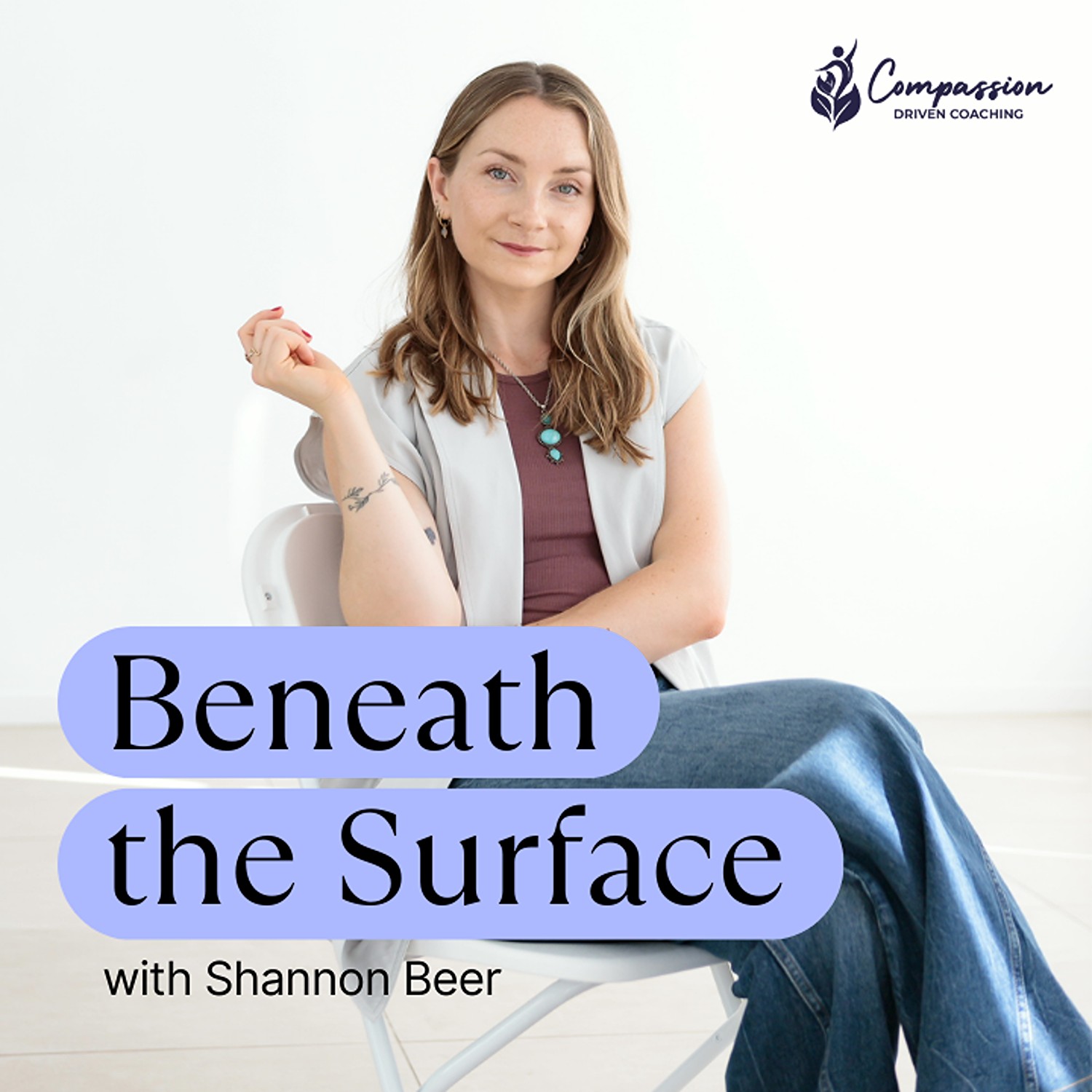
PODCAST · education
Beneath the Surface
by Shannon Beer
What if the pressure to 'be better' is the very thing holding you back? On Beneath the Surface, we challenge the myth that self-compassion means lowering the bar — and show you how caring more, not less, is the secret to becoming the person you want to be.Hosted by Shannon, registered nutritionist studying a diploma in Compassion Focused Therapy, this podcast is your space for honest conversations about self-worth, emotional eating, body image, and doing meaningful work without burning out. Whether you’re a coach, creative, or self-critical high-achiever, you’ll learn how to quiet your inner critic, commit with care, and finally feel like you're living a life that reflects your real values — not your fears.Because the highest standard isn’t perfection. It’s treating yourself like someone who matters.New episodes every week.
-
41
Intellectualising instead of feeling
If you're someone who loves to understand the why behind everything — the science, the patterns, the theory — this episode is for you. Intellectualizing can be a genuine strength, but it can also become the very thing that keeps you stuck. I'm unpacking how to spot when you're explaining instead of feeling, and what to do about it. Key takeaway: Understanding is the beginning of the process, not the destination. At some point, the work stops being about learning more and starts being about being willing to feel more. If you've learned a lot and still feel stuck, you're not doing it wrong, you're simply ready for the next level. 💬 If you're ready to start integrating what you know and building up those lagging emotional muscle groups, I'd love to support you. Submit a coaching inquiry via this link 🔗 Coaching --- Timestamps:00:00 - What is intellectualisation?02:20 - Why intellectualising develops in the first place03:15 - The crucial difference between understanding something and actually doing something04:00 - Where in your life are you explaining instead of feeling?05:00 - The social dimension: why our culture prizes intellect over emotion05:50 - What it actually looks like to interrupt the pattern06:30 - Three questions to catch intellectualizing in the moment07:30 - A practical body-based practice: describing sensations instead of explaining feelings08:30 - Compassionate colour and other tools for sitting with discomfort rather than thinking your way out of it10:40 - Putting these techniques into practice11:15 - The shift from knowing more to being willing to feel more ---Enjoying Beneath the Surface? Leave a review and share it with someone who needs to hear this.More Resources:Grab the free mini-course: Emotion Systems Audit – Download hereConnect with Shannon on Instagram: @coachshannonbeerLearn more about compassion coaching: get the details here
-
40
Emotional reasoning in business
When your coaching business isn't where you want it to be, it's tempting to overhaul your website, revisit your ideal client, or build out new resources. But what if those urges are being driven by emotion rather than evidence? In this episode, I'm breaking down emotional reasoning in business — what it is, how to spot it, and how to make clearer, steadier decisions that actually move things forward. Key takeaway: When business feels stuck, the instinct is to fix something visible. But often what needs addressing first is what's happening underneath. Data gives you an objective reference point; emotional awareness stops you wasting time solving the wrong problem. 💬 Want support working through the emotions that are getting in the way of running your business with clarity? Submit a coaching inquiry via this link 🔗 Coaching --- Timestamps:00:00 – Why emotional reasoning is one of the biggest things holding coaches back01:10 – What emotional reasoning is, and how it shows up in business02:50 – The confidence myth in coaching — why doubt is normal, and what to address instead03:00 – Helpful vs. fear-driven motives04:00 – Trigger #1: Comparison05:10 – Trigger #2: Making decisions from a place of uncertainty07:20 – Trigger #3: Endlessly refining08:15 – How to use data as an objective anchor when emotions are driving your decisions09:20 – The one question to ask first when your coaching isn't selling10:00 – Separating the emotional work from the practical next steps --- Enjoying Beneath the Surface? Leave a review and share the episode with a fellow coach who needs to hear this.More Resources:Grab the free mini-course: Emotion Systems Audit – Download hereConnect with Shannon on Instagram: @coachshannonbeerLearn more about compassion coaching: get the details here
-
39
Emotional regulation vs integration
If you've tried breathing techniques, journaling, or urge surfing and the emotions just keep coming back — this episode is for you. I'm breaking down the difference between managing emotions in the moment and actually changing how you feel long-term, and why that distinction could be the missing piece in your progress.Key takeaway: Emotion regulation helps you cope in the moment. Emotion integration is what actually changes your emotional landscape over time, and it works by finding and building tolerance for the emotion you've been avoiding, not the one that's loudest.💬 Ready to go beyond the in-the-moment tools and work on the deeper patterns? Submit a coaching inquiry through the link below, I'd love to support you through this process.🔗 Coaching---Timestamps:00:00 – Why your go-to coping tools might only be scratching the surface00:55 – How I define emotion regulation02:00 – When emotion regulation *is* useful02:50 – What emotion integration actually means03:45 – A deep dive example: social anxiety, and the hidden emotion that's actually driving it05:20 – Why blocked anger can show up as anxiety — and what healthy anger is really there to do06:30 – What this looks like in practice07:45 – My personal experience getting in touch with my own anger, and why it changed everything08:40 – The Steady Mind: why we build this first before turning towards difficult emotions09:20 – Two questions to get you started on your own emotion integration journey---Found this helpful? Share it with someone who might need to hear it, and leave a review to help more people find the show.More Resources:Grab the free mini-course: Emotion Systems Audit – Download hereConnect with Shannon on Instagram: @coachshannonbeerLearn more about compassion coaching: get the details here
-
38
Why do I always blame myself? Unpacking self blame
Have you ever caught yourself thinking "I should be able to do this, why can't I just get it together?" In this episode, I'm unpacking self-blame: where it comes from, why we developed it, and how to take responsibility for our lives without turning on ourselves. 💬 If you'd like deeper, more long-term support working through these patterns I'd love to hear from you. Submit a coaching inquiry via the link below.🔗 Coaching --- Timestamps:00:00 – The inner critic's greatest hits — and why they're keeping you stuck01:15 – What self-blame actually is, and when it can be constructive vs. destructive02:30 – Why self-blame developed as a learned safety strategy04:20 – How blaming yourself protects you from anger, sadness, and feelings of helplessness06:00 – My real-life illustration of self-blame vs. responsibility in action08:45 – The crucial difference between fault and responsibility — and why it changes everything09:50 – Practical steps to begin noticing your self-blame patterns10:40 – The fear beneath the pattern and why that's where your compassion needs to go --- Enjoyed this episode? Leave a review and share it with someone who needs to hear it.More Resources:Grab the free mini-course: Emotion Systems Audit – Download hereConnect with Shannon on Instagram: @coachshannonbeerLearn more about compassion coaching: get the details here
-
37
It's not resistance, it's fear
In this episode of Beneath the Surface I challenge the common coaching assumption that struggling to follow through automatically means “resistance” and I introduce a clearer framework of blocks, resistance, and fears. With rest (or lack of it) as an example, I unpack how understanding the root cause of our limitations can help us to shift our mentality and be more compassionate towards ourselves.Timestamps: 00:25 – Why “resistance” is oversimplified01:30 – Blocks: external limits on rest03:20 - Resistance: not seeing the benefit of rest04:55 - Fears: knowing it helps but still can’t rest07:55 - Compassion, courage, and origins of overworking/rest guiltMore Resources:Grab the free mini-course: Emotion Systems Audit – Download hereConnect with Shannon on Instagram: @coachshannonbeerLearn more about compassion coaching: get the details here
-
36
Working through performance anxiety
I’m kicking off the self-sabotage series of Beneath the Surface with a real-time example of how I worked through performance anxiety before running my first ever half marathon.In this episode, I walk through the exact tools I used, including an approach from Rational Emotive Behaviour Therapy (REBT), reframing perfectionist thinking, and the self-talk that helped me stay focused during the race.If you’ve ever felt pressure around a goal you really care about, this episode will help you hold high standards without letting anxiety sabotage you.Timestamps:00:00 – Performance anxiety before my first half marathon02:30 – The hidden belief driving the pressure04:15 – Reframing goals: preference vs demand06:00 – Perfectionism, social pressure, and self-compassion08:30 – Returning to the why10:00 – Self-talk and mindset during the race12:15 – A question to reflect on for your own goalsMore Resources:Grab the free mini-course: Emotion Systems Audit – Download hereConnect with Shannon on Instagram: @coachshannonbeerLearn more about compassion coaching: get the details here
-
35
Reframing self sabotage
Welcome to season 3 of my newly renamed podcast Beneath the Surface.In this episode I explore safety strategies — the hidden drivers behind behaviours like emotional eating, procrastination, overworking, doom scrolling, and people-pleasing. I explain the science behind these behaviours, and why, when our threat system is activated it is harder to access logical thinking and choose differently.I also introduce the soothe system and the idea of developing a “steady self” — an observing part of the mind that helps you respond to these patterns with awareness rather than being driven by them.Timestamps:00:00 – Season 3 introduction00:38 – What safety strategies are01:45 – Why all behaviors serve a function02:35 – The brain’s threat system03:45 – Amygdala, stress hormones & reactivity05:20 – Why change feels hard in the moment06:10 – The soothe system07:10 – Why soothing can feel difficult08:00 – Developing the “steady self”09:00 – Understanding emotional parts09:40 – Reflecting on your safety patterns10:27 – Wrap upMore Resources:Grab the free mini-course: Emotion Systems Audit – Download hereConnect with Shannon on Instagram: @coachshannonbeerLearn more about compassion coaching: get the details here
-
34
Changes are coming
More Resources:Grab the free mini-course: Emotion Systems Audit – Download hereConnect with Shannon on Instagram: @coachshannonbeerLearn more about compassion coaching: get the details here
-
33
How coaching works
In this episode of Stronger Standards, I break down how coaching actually works. I share how my work has evolved from nutrition and body image into Compassion Focused approaches, and why self-compassion alone isn’t enough. I explore why receiving support can feel harder than giving it — and why that flow of compassion is often the missing piece. I explain: Why insight doesn’t automatically create emotional changeThe difference between rigid, tick-box coaching and skill-based transformationHow we build what I call a “steady self” (your inner secure base)Why pacing matters (you don’t have to feel everything all at once)How Compassionate Mind Training strengthens your soothing systemHow to sign up for coaching with me and my team If you’re smart, self-aware, and know exactly what to do… but still find yourself stuck when it comes to real, lasting change, then coaching could definitely be for you. If you have any questions or thoughts I would love to hear from you. 🔗 Links mentioned:– Coaching waitlist --- Timestamps:00:00 – Why change feels confusing (even when you “know better”)02:15 – My evolution into compassion-focused coaching04:30 – Why self-compassion isn’t the whole picture06:10 – Insight vs. emotional change: the real block08:05 – Therapy vs. rigid coaching: what’s missing09:40 – Building your “steady self” and secure inner base12:00 – The core psychological skills we train14:15 – Pacing emotional work (like progressive overload)16:00 – How Compassionate Mind Training regulates emotion17:45 – What working together actually looks like19:00 – What changes when you cultivate strong (not harsh) standardsMore Resources:Grab the free mini-course: Emotion Systems Audit – Download hereConnect with Shannon on Instagram: @coachshannonbeerLearn more about compassion coaching: get the details here
-
32
Take more risks
This episode drops on my birthday 🎂 and as I step into a new decade, I’m reflecting on the risks that shaped my life, and why playing it safe might actually be the biggest risk of all. In this episode, I share: How taking risks built my resilienceWhy your brain defaults to safetyHow to stop letting fear make your decisionsThe role of social support in building courage 🔗 Links mentioned:– Coaching waitlist Timestamps:00:00 – Why risk matters02:00 – The one-way flight that changed my life06:00 – Why fear keeps us stuck08:00 – The “fear tax” & the real cost of comfort09:30 – The question: *If I wasn’t afraid, what would I do?*11:00 – Compassion, courage & the science of support12:30 – Coaching & next stepsMore Resources:Grab the free mini-course: Emotion Systems Audit – Download hereConnect with Shannon on Instagram: @coachshannonbeerLearn more about compassion coaching: get the details here
-
31
The three Cs of change
In this episode of Stronger Standards I talk about the simple framework I come back to whenever I feel stuck: The 3 Cs of Change.If you’re feeling stuck in your growth, whether it’s with food, your body, your business, or your confidence, this episode is for you. I cover: What the 3 Cs of change areHow missing one or more of the Cs can impact your lifeHow to use this framework to focus your energy where you need it most 🔗 Links mentioned:– Coaching waitlist Timestamps:00:00 - Why feeling stuck doesn’t mean change isn’t possible02:10 - Why “clarity” isn’t actually what you need (and how action creates clarity)04:00 - C #1 - Curiosity06:30 - How understanding your patterns builds self-compassion08:00 - C #2 - Courage09:30 - Building your internal secure base + safe haven10:45 - C #3 - Commitment12:00 - The question to ask when you feel stuck12:30 - Coaching waitlist + how to support yourself if you’re doing this aloneMore Resources:Grab the free mini-course: Emotion Systems Audit – Download hereConnect with Shannon on Instagram: @coachshannonbeerLearn more about compassion coaching: get the details here
-
30
Rethinking Distress Tolerance
In this episode of Stronger Standards I unpack what distress tolerance actually means, and why pushing through isn’t always beneficial.I explain:The impact of learned association on emotionsWhy slowing down can feel threatening for high achieversHow to cultivate a compassionate brain state so you can regulate instead of react🔗 Links mentioned:– Coaching waitlist Timestamps: 00:00 – The myth of pushing through 02:30 – High functioning vs. thriving 05:00 – Emotional differentiation explained 08:00 – Why slowing down feels hard 11:00 – Compassion as real resilienceMore Resources:Grab the free mini-course: Emotion Systems Audit – Download hereConnect with Shannon on Instagram: @coachshannonbeerLearn more about compassion coaching: get the details here
-
29
Building self trust after setbacks
You’re intelligent, capable, and deeply self-aware — so why do you keep starting things and not finishing them? In this episode, I’m breaking down self-efficacy, your confidence in your ability to follow through, and why it quietly erodes when you keep letting yourself down.Rather than repeating the same surface-level advice, we look at what actually gets in the way — including self-criticism, unrealistic standards, and emotional barriers that sabotage consistency.In this episode, I cover:What self-efficacy really is — and how low self-efficacy keeps you stuck in stop–start cyclesWhy setting goals for your “ideal self” backfires (and how to meet yourself where you are)How small, realistic wins build confidence more effectively than big plansThe four key facilitators of self-efficacyWhy mindset alone isn’t enough — and the emotional skills required to stay consistentHow coaching helps you unlearn self-defeating patterns and build real trust in yourself🔗 Links mentioned:– Motivated Masterclass– Coaching waitlist (NOW OPEN!)I’ll see you in the next episode.Timestamps:00:00 - Why you start strong but don’t follow through02:00 - What self-efficacy actually is04:00 - How low self-efficacy keeps you stuck06:00 - The mistake of setting goals for your ideal self08:30 - Building confidence with small, realistic wins11:00 - What actually facilitates self-efficacy13:30 - Why reflecting on success matters15:30 - How self-criticism and comparison undermine progress17:30 - The emotional skills needed to stay consistent19:00 - How coaching helps you break self-defeating cyclesMore Resources:Grab the free mini-course: Emotion Systems Audit – Download hereConnect with Shannon on Instagram: @coachshannonbeerLearn more about compassion coaching: get the details here
-
28
Embodying your steady self
We all have patterns that once kept us safe but now keep us stuck. In this episode of Stronger Standards, I explore how compassion isn’t about being “soft,” but about building the inner strength and steadiness needed to work with those patterns—without being driven by them. I talk about:Why old safety strategies keep us stuckCompassion as a trainable brain stateReflection vs. rumination (and venting)Why self-compassion creates stronger boundariesKey compassionate qualities: wisdom, strength, commitmentThe role of play, posture, and embodimentUsing the body to support mindset changeChoosing small, daily actions that create lasting change This episode is about becoming the version of yourself who can meet challenges with steadiness, intention, and aliveness—one small, embodied choice at a time. Timestamps:00:00 - Introduction: Understanding Patterns and Compassion00:42 - The Role of Compassion in Change01:30 - Journaling and Self-Reflection02:30 - Misconceptions About Compassion03:05 - Qualities of Compassionate Minds06:00 - Embodying Compassionate Qualities10:30 - Using Body Posture to Support the Mind13:51 - Starting the Day with Compassion15:31 - Practical Actions to Embody Qualities20:16 - Conclusion: Building Capacity to Show Up DifferentlyMore Resources:Grab the free mini-course: Emotion Systems Audit – Download hereConnect with Shannon on Instagram: @coachshannonbeerLearn more about compassion coaching: get the details here
-
27
Question your values
What if the values you’re most proud of are also the ones keeping you stuck? In this episode of Stronger Standards, I explore how “good” standards like reliability, resilience, discipline, and independence can quietly become fear-based safety strategies. I talk about:When “good” values quietly keep you stuckThe 'Cage of Unquestioned Standards'Values shaped by safety, not authenticitySame actions, different motives: toward vs. awayWhat your values are costing youRecalibrating values with compassion, not fear This episode invites you to notice how you relate to your values and whether they’re serving you, or keeping you stuck — and how to recalibrate your values with compassion. Timestamps:00:00 - Introduction: The cage of unquestioned standards01:00 - Safety strategies and identity formation02:25 - Examples of limiting standards04:06 - Intellectualization as a safety strategy04:44 - Resilience and overcoming tolerance05:57 - The impact of discipline on body image06:43 - Reevaluating your relationship with values10:18 - Practical steps to recalibrate your values12:25 - Conclusion: building a better relationship with valuesMore Resources:Grab the free mini-course: Emotion Systems Audit – Download hereConnect with Shannon on Instagram: @coachshannonbeerLearn more about compassion coaching: get the details here
-
26
Recalibration over reinvention
In this episode of Stronger Standards, I talk about why the pressure to reinvent yourself at the start of a new year can actually keep you stuck — especially if you struggle with all-or-nothing patterns. Instead, I share why recalibration is a more compassionate, sustainable way to create real change by working with your mind and body, not against them. I cover:Why New Year reinvention often keeps us stuckRecalibration vs. starting overThe 'Fresh Start Effect' and self-pressureWhere safety behaviors (perfectionism, overworking, people-pleasing) come fromWhy “just stop” goals don’t workUsing awareness instead of force to create changeNoticing thoughts, feelings, and body cues in real timeCompassion as the foundation for sustainable growth If you’re tired of starting over every January, this episode is your invitation to slow down, get curious, and build change that actually sticks. Timestamps:00:00 - New year, new you?01:00 - The fresh start effect01:47 - The problem with wiping the slate clean03:47 - Recalibration over reinvention04:33 - Practical steps for recalibration06:20 - Understanding safety behaviors08:15 - Building awareness and compassion11:48 - Final thoughts and next stepsMore Resources:Grab the free mini-course: Emotion Systems Audit – Download hereConnect with Shannon on Instagram: @coachshannonbeerLearn more about compassion coaching: get the details here
-
25
Courage to try again
In this episode of Stronger Standards, I break down why change feels so hard—especially when part of you wants to grow and another part is scared to try again. I explain how our brains and nervous systems are wired for safety, how old coping strategies can keep us stuck, and what actually helps change become sustainable. I also share personal reflections, practical exercises, and an invitation to think differently about the year ahead. I cover:Why change feels scary even when you want itHow the brain’s need for safety keeps us stuckThe role of people-pleasing, perfectionism, and overthinkingWhy forcing change doesn’t lastHow sustainable change comes from safety, not pressureA reflection on how you want to feel in one yearPracticing new beliefs with compassion, not force Keep an eye out for more Stronger Standards episodes, focused on small, meaningful changes that support a more fulfilling life. Timestamps:00:00 - Introduction: overcoming the fear of change01:24 - Understanding the brain's role in change02:49 - Social threats and safety behaviors03:50 - Implicit learnings and emotional regulation04:55 - Safety strategies and their impact07:09 - Challenges in making changes09:14 - Building capacity for change12:28 - Reflecting on future goals15:22 - Practical tips for cultivating change22:42 - Conclusion: embracing change with compassionMore Resources:Grab the free mini-course: Emotion Systems Audit – Download hereConnect with Shannon on Instagram: @coachshannonbeerLearn more about compassion coaching: get the details here
-
24
End of year reflection
In this episode of Stronger Standards, I explore how to reflect on the past year in a way that supports growth rather than self-criticism. Looking back can bring pride, pressure, frustration — or all of it at once. This episode offers a more compassionate approach to reflection that helps you learn from the year without getting stuck in shame or defeat.I cover:The difference between healthy self-critique and self-attackingWhy reflection needs compassion, and how avoidance or frustration can be useful informationWhy focusing on experiences (not just achievements) helps us access contentment and fulfilmentWhat experiences stood out for me this year and what I learned from themHow to carry those lessons forward into the new yearKeep an eye out for more Stronger Standards episodes, focused on small, meaningful changes that support a more fulfilling life.Timestamps00:00 – Welcome & introduction00:43 – Why reflection matters01:26 – The difference between healthy self-critique and self-criticism03:20 – A new approach: focusing on experiences, not achievements05:08 – Experience 1: Greece trip and lessons in kindness08:19 – Experience 2: The power of live music for well-being11:55 – Experience 3: Recognizing and overcoming self-minimization14:52 – Encouragement for your own reflection15:23 – Final thoughts and what’s nextMore Resources:Grab the free mini-course: Emotion Systems Audit – Download hereConnect with Shannon on Instagram: @coachshannonbeerLearn more about compassion coaching: get the details here
-
23
How to face the things you've been avoiding
What’s that thing you’ve been avoiding? Maybe it’s reflecting on your eating habits, having a difficult conversation, reaching out to make new friends, or showing up on social media. You know it matters—but that doesn’t make it easier to face.In this episode, I unpack why avoidance feels good in the moment, why it costs you more than you realize, and—most importantly—how to start facing the things you’ve been putting off with compassion and courage.You’ll learn:Why your brain rewards avoidance (and how it keeps you stuck)How to recognise when your threat system is taking overThe hidden cost of waiting until you feel readyA simple two-question exercise to uncover what’s really behind your avoidanceHow to take the smallest possible step forward—and build confidence from experienceYou’ll walk away with a clear, compassionate framework to help you stop overthinking and start moving toward the life you actually want.More Resources:Grab the free mini-course: Emotion Systems Audit – Download hereConnect with Shannon on Instagram: @coachshannonbeerLearn more about compassion coaching: get the details here
-
22
[Q+A] How is compassion a motivation?
Most of us don’t put compassion and motivation in the same sentence. We think of compassion as soft, gentle, or even passive, and motivation as discipline, hustle, or force. But compassion is one of the most powerful motivators you can build.In this listener Q+A, I break down why motivation isn’t a mood, how it’s really tied to emotion regulation, and why compassion is the brain state that helps you keep going without burning out.You’ll learn:Why 'I’ve lost my motivation' usually means you’re stuck in threat mode.The difference between feelings, emotions, and motivation (and why it matters).How the threat, drive, and soothe systems shape your ability to follow through.What compassion actually does in the brain and why it motivates growth, not avoidance.How compassionate motivation shows up not just in food and fitness, but in your work, relationships, and daily choices.I’ll also walk you through a reflection exercise I give my clients:👉 For me, compassion is…👉 For me, compassion is not…By the end, you’ll see why compassion isn’t about lowering your standards, it’s about pursuing them with adaptability, resilience, and self-respect.🎧 Listen now to learn how compassion can become your strongest source of motivation.More Resources:Grab the free mini-course: Emotion Systems Audit – Download hereConnect with Shannon on Instagram: @coachshannonbeerLearn more about compassion coaching: get the details here
-
21
My Self Compassion Journey
Self-compassion started as an academic interest, then became something much more personal.In this episode, I share my compassion journey, the lessons I learned and and why it’s become an ongoing practice that continues to shape me as a coach and as a person.You’ll hear about:Why the absence of criticism isn’t the same as the presence of courage, care, and wisdom.What shifted me from head knowledge to lived experience (and why group experiences were so powerful).The ways compassion has shown up in action—from moving countries to resting, to being more assertive in relationships.The resistances I had to work through, like struggling to rest, money guilt, and minimising my own needs.Why compassion is relational and often harder to receive than it is to give.What I’m still working on now, and a reflection question to take into your own life.If you’ve ever wondered what compassion could look like beyond theory, this conversation will give you both perspective and direction.🎧 Listen now to hear the moments that shaped my journey and the practices that continue to support it.More Resources:Grab the free mini-course: Emotion Systems Audit – Download hereConnect with Shannon on Instagram: @coachshannonbeerLearn more about compassion coaching: get the details here
-
20
[Q+A] How does body image directly impact health behaviours?
When most people think of body image, they picture confidence, self-esteem, or how they feel when looking in the mirror. But body image goes far beyond appearance, and directly shapes the way we eat, move, rest, and care for ourselves.In this listener Q+A episode of Stronger Standards, I break down exactly how body image influences health behaviours, for better or for worse.You’ll learn:The four components of body image (and why it’s about more than how you feel in your body).How negative body image fuels patterns like over-exercising, restriction and binge cycles, and avoidance of self-care.The often-overlooked trap of pride-driven over-control (why looking 'disciplined' can still be unhealthy).What changes when body image improves, and how it leads to more consistent, enjoyable, and sustainable health habits.Reflection questions to uncover whether your current behaviours are rooted in fear and control or self-respect and compassion.If you’ve ever wondered why your relationship with your body affects your ability to follow through on healthy habits, this episode will connect the dots and show you a more supportive way forward.🎧 Listen now and reflect: Which of your current health behaviors come from pressure and control—and which come from self-respect?More Resources:Grab the free mini-course: Emotion Systems Audit – Download hereConnect with Shannon on Instagram: @coachshannonbeerLearn more about compassion coaching: get the details here
-
19
4 Pillars Of Intentional Eating
If you’ve ever felt stuck between two extremes, rigid dieting on one side and the 'it’s fine, just treat yourself' mindset on the other, then it's time to try something different. That's where Intentional Eating comes in - a middle ground that helps you meet your physical and psychological needs without calorie counting or rigid food rules.I break down the 4 Pillars of Intentional Eating and how they can support you:Structure – Why regular eating is key and how to use supportive routines (not rigid rules).Nourishment – Meeting both physical needs and emotional needs without relying only on food.Satisfaction – Bringing back flavour, variety, and permission to enjoy food.Adaptability – Staying steady when life happens instead of spiraling into 'what’s the point' mode.We’ll also cover:Why traditional dietary restraint doesn’t actually work (and why it’s not your fault).The false choice between working on body image or fat loss—and how intentional eating offers another way.Practical first steps to move from all-or-nothing eating toward something more supportive and sustainable.If you’re tired of feeling like you have to pick between “discipline” and “self-acceptance,” this conversation will help you find a path that actually fits your life.🎧 Listen now to discover which of the four pillars would support you most right now.More Resources:Grab the free mini-course: Emotion Systems Audit – Download hereConnect with Shannon on Instagram: @coachshannonbeerLearn more about compassion coaching: get the details here
-
18
Forgiving yourself for weight gain
If you’ve gained weight recently and feel ashamed, frustrated, or like you’ve somehow “failed,” this episode is here to offer something different: compassion and clarity instead of criticism.What if your eating or movement changes weren’t you giving up… but your body and mind doing their best to cope with something hard?In this episode, we explore:Why weight gain often triggers shame, fear, and self-judgmentHow life experiences shape our fears—and the protective behaviors that followWhat safety strategies are, and why emotional eating or overworking aren't failuresHow to recognize the deeper purpose behind your behaviorWhat it actually means to forgive yourself—and how to do it without abandoning your goalsWhether you’ve been through a tough time, are stuck in old coping patterns, or just want to feel like yourself again, this episode will help you replace blame with understanding—and guide you toward the next supportive step.🎧 Listen now to explore how self-forgiveness creates space for real change—without giving up on yourself.More Resources:Grab the free mini-course: Emotion Systems Audit – Download hereConnect with Shannon on Instagram: @coachshannonbeerLearn more about compassion coaching: get the details here
-
17
Why motivation feels hard (even when you know what to do)
Ever say, “I know what to do, but I just can’t seem to do it”? You’re not alone—and no, it’s not a willpower problem.In this episode, we’re unpacking why motivation often feels out of reach, even for intelligent, capable people who are doing a lot… but still feel stuck. Whether it's showing up for your body, your business, or your life, this conversation will help you understand what’s really going on underneath the struggle to follow through.You’ll learn:Why procrastination and “lack of motivation” are actually signs of something deeperHow the 3 emotional systems from Compassion Focused Therapy (threat, drive, soothe) influence your actionsWhat competitive vs compassionate motivation looks like—and why it mattersWhy pushing through often leads to burnout, not changeHow to reconnect with drive that feels grounded, aligned, and sustainableThis one’s for you if you're tired of high expectations leading to overwhelm, and you’re ready for a new way forward—one that balances high standards with self-compassion.More Resources:Grab the free mini-course: Emotion Systems Audit – Download hereConnect with Shannon on Instagram: @coachshannonbeerLearn more about compassion coaching: get the details here
-
16
How to clothes shop for a positive body image (especially in summer)
Struggling with clothes shopping after gaining weight, or just not feeling totally at ease in your body right now? You're not alone.In this episode of Stronger Standards, I’m answering a listener question: How do you clothes shop in a way that supports positive body image, especially during summer?We’ll explore how to:Shop without reinforcing shame or hiding awayUse personal style as a way to express confidence (even if you're not feeling it yet)Gently experiment with clothes, accessories, and embodimentStep into your compassionate, confident “movie character” self—without faking it or forcing itThis isn’t about pretending to love your body.It’s about dressing in ways that help you feel a little more like yourself today, while still working toward the changes you care about.More Resources:Grab the free mini-course: Emotion Systems Audit – Download hereConnect with Shannon on Instagram: @coachshannonbeerLearn more about compassion coaching: get the details here
-
15
Why logical thinking hasn't worked (and what will)
You know your thoughts are irrational. So why can’t you feel or act differently?This episode is for the self-aware overthinkers, the high-achievers who are frustrated because they know better… but still feel stuck.Inside, we explore:Why insight and journaling alone don’t create changeWhat “rational-emotive dissociation” is (aka head/heart lag)How your emotional system might be underdeveloped — and what to do about itWhy you can’t just “think your way out” of self-criticismThe missing link between self-awareness and self-compassionWhether you’re struggling with food, body image, or just being a person with high standards - this episode will help you understand why you feel stuck even when you’re trying so hard, and what it actually takes to close the gap between knowing better... and feeling and doing differently.More Resources:Grab the free mini-course: Emotion Systems Audit – Download hereConnect with Shannon on Instagram: @coachshannonbeerLearn more about compassion coaching: get the details here
-
14
Why food feels like comfort (and what you really need)
If you’ve ever found yourself reaching for food—not out of hunger, but because you’re stressed, overwhelmed, or just need something—this episode is for you.I'm walking you through what’s really happening in your brain and body when emotional eating shows up, and why it actually makes sense. More importantly, I’ll share what you can do instead - without shame, rules, or willpower.Here’s what wecover:Why comfort eating isn’t a failure—it’s a learned strategy your nervous system has relied onThe difference between safety and safeness, and how that shows up in daily lifeHow your brain learns to associate food with relief (and why that pattern repeats)The role of your soothing system and how to start activating it on purposeWhy food brings short-term comfort but doesn’t meet your deeper needsA weekly experiment to help you build other sources of comfort that actually workThis isn’t about replacing food with a walk or drinking water and hoping the urge passes.It’s about understanding your emotions and building real tools to care for yourself - so food becomes a choice, not your only option.More Resources:Grab the free mini-course: Emotion Systems Audit – Download hereConnect with Shannon on Instagram: @coachshannonbeerLearn more about compassion coaching: get the details here
-
13
Mindfulness for overthinkers: how to start
If your brain feels like it’s constantly “on”…Planning, analyzing, over-preparingJudging yourself, second-guessing choicesStuck in your head instead of in your life…And when you do try to slow down, you feel restless, guilty, or like you're doing it wrong—This episode is for you.We’re talking about mindfulness—what it really is, how it helps when your threat system is activated, and how to practice it without forcing calm or “doing it perfectly.” You’ll also be guided through a short, beginner-friendly practice you can return to anytime.In this episode, you'll learn: 💭 Why mindfulness helps your brain and body shift out of fight-or-flight 📍 How to use your breath and senses to anchor attention (without pushing thoughts away) 🧠 What’s happening in the brain when you practice ⚠️ Common mindfulness myths (and how to avoid self-monitoring traps) 🌊 Why it’s best to practice when the “waters are calm,” not in the middle of a spiral✨ Plus: a guided 5-minute mindfulness exercise you can replay anytime your mind starts racing.More Resources:Grab the free mini-course: Emotion Systems Audit – Download hereConnect with Shannon on Instagram: @coachshannonbeerLearn more about compassion coaching: get the details here
-
12
Why you can’t stop overthinking (and what to do instead)
Do you ever...Spiral after a conversation, replaying what you said on loop?Freeze at a menu, unsure whether to eat what you want or what feels “right”?Obsess over how you look, what you’ve eaten, or what others might be thinking?You know you’re overthinking—but you can’t stop. And that’s when the self-blame kicks in:🧠 “Why am I like this?”🧠 “Why can’t I just let it go?”🧠 “What’s wrong with me?”In today’s episode, you’ll learn:Why your brain wants to overthink—and how it’s actually trying to helpThe difference between your old brain and new brain (and why they clash)What happens when your brain tries to logic its way out of emotional painHow to start working with your mind instead of getting stuck in spiralsThis isn’t just a pep talk. It’s a compassionate, science-backed explanation of why you feel stuck—and what to do about it.We’ll also explore:The survival wiring behind self-doubt and people-pleasingReal-life examples (like eating something “off plan” or replaying a rude comment)How to gently step out of the spiral using mindfulness and soothing strategies💡Key takeaway: Overthinking is not a flaw. It’s a feature of a tricky human brain. And once you understand what’s happening, you can choose a different response.More Resources:Grab the free mini-course: Emotion Systems Audit – Download hereConnect with Shannon on Instagram: @coachshannonbeerLearn more about compassion coaching: get the details here
-
11
Self-reflection is the key to progress
If you’ve ever said, “I know why I do this, but I still can’t stop,” this episode is for you.In today’s short reflection, we're diving into why understanding your patterns doesn’t automatically lead to change. Real growth comes through embodiment and intentional practice, not just information.If you’ve been listening and learning but still feel stuck in self-critical cycles, this episode will gently invite you to pause, reflect, and reconnect with your progress.Whether you’ve been working on softening your self-talk, building a steady mind, or supporting your body with more compassion—today’s episode is your reminder that real change happens when you slow down, reflect, and choose differently.WHAT YOU’LL LEARN:Why understanding your mindset isn’t enough to create real changeThe two common (and very human) reasons we avoid reflectionHow to spot your own growth—even when your brain focuses on what’s not workingA simple journaling prompt to identify what’s still hard and what to do differentlyThe difference between urgent action and intentional changeMore Resources:Grab the free mini-course: Emotion Systems Audit – Download hereConnect with Shannon on Instagram: @coachshannonbeerLearn more about compassion coaching: get the details here
-
10
How to stop being hard on yourself
If you're someone who is driven, self-aware, and constantly pushing to do better, but often feel like it's never enough... this episode is for you.We’re unpacking why self-criticism can feel like a motivator but actually undermines your goals, and how to build a stronger relationship with yourself using science-backed self-compassion skills.You’ll learn:Why that inner critical voice feels familiar (and why it doesn’t actually help)The difference between self-reflection and hostile self-attackingWhat real self-compassion is—hint: it’s not fluffy or softHow compassion affects your nervous system, motivation, and mental healthPractical tools to treat yourself with more respect without lowering your standardsWhether you're stuck in all-or-nothing thinking, perfectionism, or just exhausted from trying to do everything 'right' - this episode will help you take the pressure off without giving up on your goals.More Resources:Grab the free mini-course: Emotion Systems Audit – Download hereConnect with Shannon on Instagram: @coachshannonbeerLearn more about compassion coaching: get the details here
-
9
Supporting your body on off days
We all have days where we feel disconnected from our bodies. But how you show up for yourself on those days matters most.In this episode of Higher Standards, I’m sharing simple, science-backed ways to care for your body even when it feels hard — so you can stay connected to your life, your values, and yourself no matter how you feel.Timestamps: 00:00 – Introduction: Why bad body image days happen 03:30 – What is body image flexibility? 07:40 – Why positive thinking isn't the answer 10:50 – Small body care practices to ground yourself 14:30 – Dressing for the feeling you want 18:00 – Creating a morning ritual for difficult days 22:00 – Activating the soothe system through the senses 26:30 – Why small pleasures matter on hard days 30:10 – How to live fully even when discomfort shows up 34:00 – Final reflection: You are more than how you feelMore Resources:Grab the free mini-course: Emotion Systems Audit – Download hereConnect with Shannon on Instagram: @coachshannonbeerLearn more about compassion coaching: get the details here
-
8
How to become accountable to yourself
You’re reliable, capable, and always there for everyone else. But what happens when you keep showing up for others — and leave nothing for yourself?In this episode of Higher Standards, we explore why over-responsibility develops, how it creates invisible exhaustion and imbalance in your relationships, and what it takes to start honouring your own needs with the same care you give to others.You’ll learn why being reliable isn’t the problem — and why restoring balance starts with small, deliberate choices that reconnect you to yourself.Timestamps: 00:00 – Introduction: When being reliable goes too far 02:40 – Why we take on the “capable one” role 08:15 – How over-functioning creates invisible exhaustion 13:00 – The hidden cost: imbalance in relationships 17:20 – The cycle of resentment, guilt, and overgiving 22:00 – Why receiving support is essential for real connection 26:30 – The Equal Priority Framework 30:15 – Small actions you can take to restore balance 35:20 – Final reflection: You deserve the care you give so freelyMore Resources:Grab the free mini-course: Emotion Systems Audit – Download hereConnect with Shannon on Instagram: @coachshannonbeerLearn more about compassion coaching: get the details here
-
7
Build a STEADY mind (and finally follow through)
If you ever swing between all-or-nothing — starting a plan, then burning out or abandoning it — you’re not lacking discipline. You’re caught in emotional patterns that no one ever taught you how to work with.In today’s episode of Higher Standards, I introduce the STEADY Mind approach: a science-backed framework that helps you work with your emotions, not against them — so you can follow through on what matters to you without the constant fight.You'll learn:Why following through isn't just about willpower — it’s about emotional regulationHow your emotion systems (threat, drive, soothe) pull you into impulsive or avoidant patternsThe six essential elements of the STEADY Mind Process™How to start building the version of you that follows through — without the self-blameYou'll leave with a new understanding of why past plans haven't worked (no matter how much you wanted them to) — and a clear next step to start building real follow-through today. Tap the link to listen and start working with your mind, not against it.Timestamps:00:00 - Introduction to why following through feels hard04:10 - Why self-criticism, perfectionism, and procrastination are emotional regulation problems08:20 - How the STEADY Mind approach was developed10:50 - S: Soothe your system (building emotional steadiness first)15:45 - T: Tend to your body (self-care for energy and presence)18:30 - E: Engage your values (moving toward what matters)22:10 - A: Approach your emotions (support, not suppression)27:05 - D: Deepen your connections (receiving support, building trust)31:20 - Y: Yes to your joy (why joy isn’t optional for sustainable success)36:00 - Real-life shifts that happen when you work with your emotion systems40:00 - A practical first step you can take todayMore Resources:Grab the free mini-course: Emotion Systems Audit – Download hereConnect with Shannon on Instagram: @coachshannonbeerLearn more about compassion coaching: get the details here
-
6
How to care about your appearance without obsession
Still care about your appearance, even while trying to accept your body? You’re not vain - and you don’t have to stop caring.In this episode, I’ll show you how to build a healthy relationship with your appearance, without letting it define your self-worth. We’ll cover the research on adaptive appearance investment, signs to watch out for, and small shifts to care for your appearance in a healthy way.Timestamps: 00:00 – Introduction 03:30 – Body acceptance vs. positive body image 08:40 – Adaptive vs. maladaptive appearance investment 22:00 – Five principles for healthy appearance care 38:20 – Strategies to express personal style without obsession 47:10 – Final reflections and closingMore Resources:Grab the free mini-course: Emotion Systems Audit – Download hereConnect with Shannon on Instagram: @coachshannonbeerLearn more about compassion coaching: get the details here
-
5
Working with your emotion systems
Ever struggle to follow through on your health, self-care and business goals - even when you know what to do?In this episode, I break down the three emotional systems that drive our behaviours: Threat, Drive, and Soothe. You’ll learn how these systems evolved, how they show up in your day-to-day patterns, and why so many people get stuck in a loop of all-or-nothing thinking, self-criticism, and burnout.By the end, you'll understand how to start working with your emotions, not against themTimestamps:00:00 – Intro: Why you swing between extremes02:12 – The 3 emotion systems explained6:40 – How they show up in real life (and mess with your goals)14:03 – Client story: perfectionism, shame, and unmet needs18:27 – How your upbringing shaped your emotional regulation21:55 – Working with your systems (not against them)25:10 – What a balanced system feels like27:48 – Free Emotion System Audit explainedIf this episode helped you see your patterns differently, I’d love it if you shared it with a friend or left a review.More Resources:Grab the free mini-course: Emotion Systems Audit – Download hereConnect with Shannon on Instagram: @coachshannonbeerLearn more about compassion coaching: get the details here
-
4
Self compassion that actually works
If self-criticism feels like the only way to stay motivated, this episode will shift everything you thought you knew about discipline, growth, and what it really takes to create lasting change.In this episode, Shannon explores why self-compassion is a high-performance skill — not a soft excuse — and how it helps you stay consistent, motivated, and emotionally resilient. You’ll learn what self-compassion actually is (and isn’t), why the “be hard on yourself” strategy backfires, and how to start practicing compassion in a way that genuinely works, even if it feels unfamiliar or uncomfortable at first.Whether you're navigating burnout, perfectionism, or that constant sense that you're not doing enough, this conversation offers the science, mindset shifts, and practical tools to help you build a better relationship with yourself — and show up more powerfully in your life.Key Takeaways:Why self-criticism feels productive but actually sabotages your progressThe difference between self-compassion, self-indulgence, and self-pityHow compassion activates different systems in the brain than criticismThe science behind why self-compassion improves motivation and consistencyWhat self-compassion looks like in real-life situations — including emotional eatingHow to start practicing self-compassion using guided reflection and imageryTimestamps:00:00 – Intro + why this episode matters01:30 – What self-compassion isn’t06:50 – The real definition of self-compassion (Paul Gilbert vs. Kristin Neff)13:45 – Self-compassion vs. self-indulgence17:30 – What science and brain scans reveal about self-criticism vs. self-compassion23:40 – Real-life client example: why shame never leads to lasting change28:00 – Simple practices to build your self-compassion muscle33:00 – Final reflections + how to take this work deeperIf this episode resonated with you, share it with a friend who needs a little more compassion today!More Resources:Grab the free mini-course: Emotion Systems Audit – Download hereConnect with Shannon on Instagram: @coachshannonbeerLearn more about compassion coaching: get the details here
-
3
Welcome to Beneath the Surface
More Resources:Grab the free mini-course: Emotion Systems Audit – Download hereConnect with Shannon on Instagram: @coachshannonbeerLearn more about compassion coaching: get the details here
We're indexing this podcast's transcripts for the first time — this can take a minute or two. We'll show results as soon as they're ready.
No matches for "" in this podcast's transcripts.
No topics indexed yet for this podcast.
Loading reviews...
ABOUT THIS SHOW
What if the pressure to 'be better' is the very thing holding you back? On Beneath the Surface, we challenge the myth that self-compassion means lowering the bar — and show you how caring more, not less, is the secret to becoming the person you want to be.Hosted by Shannon, registered nutritionist studying a diploma in Compassion Focused Therapy, this podcast is your space for honest conversations about self-worth, emotional eating, body image, and doing meaningful work without burning out. Whether you’re a coach, creative, or self-critical high-achiever, you’ll learn how to quiet your inner critic, commit with care, and finally feel like you're living a life that reflects your real values — not your fears.Because the highest standard isn’t perfection. It’s treating yourself like someone who matters.New episodes every week.
HOSTED BY
Shannon Beer
CATEGORIES
Loading similar podcasts...
URL copied to clipboard!