
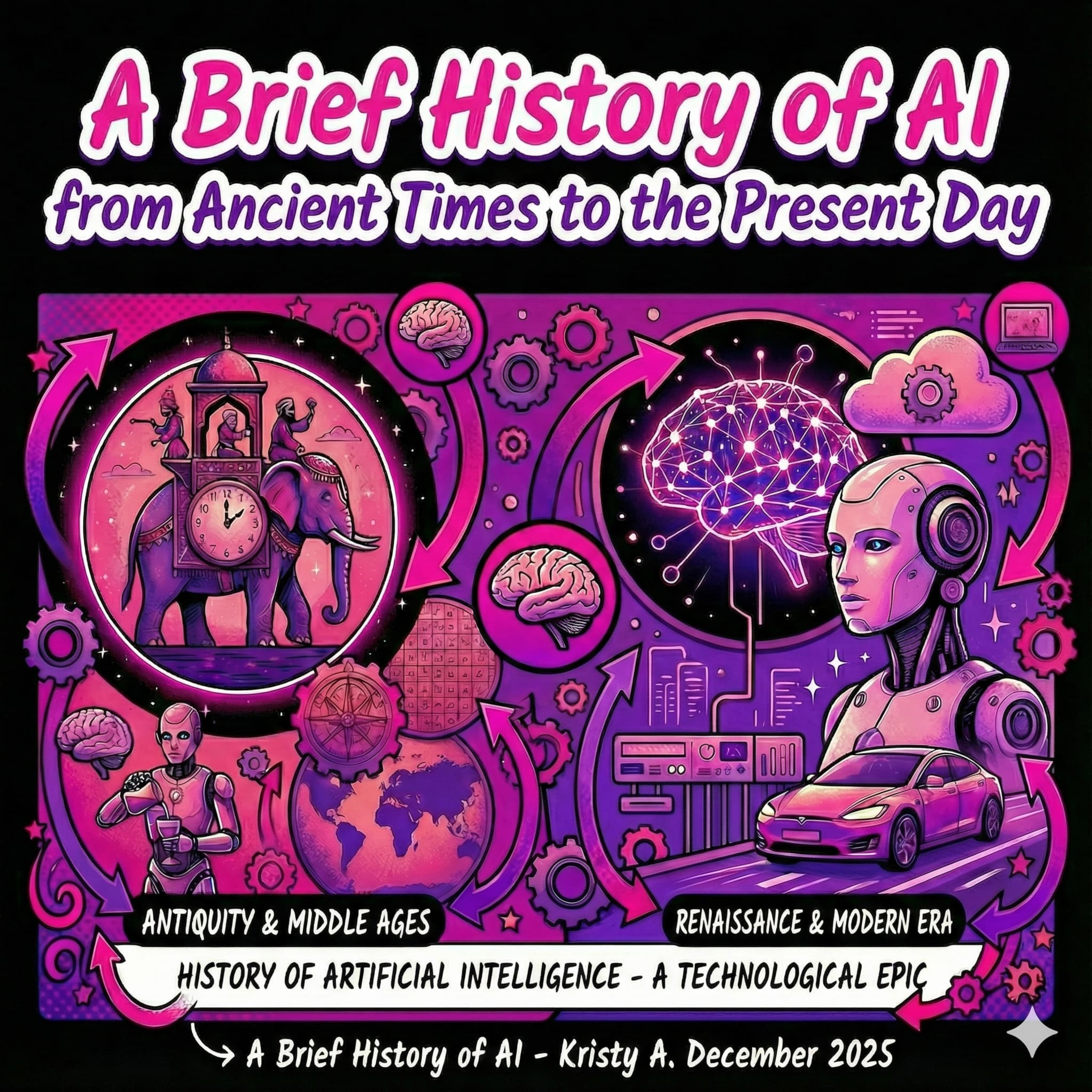
PODCAST · history
A brief history of AI from ancient times to the present day
by Kristy Anamoutou
AI didn't begin with ChatGPT. For curious minds and history geeks, this narrative podcast traces the history of artificial intelligence as a millennial human adventure across civilizations. From 8th-century BCE Greek automata to the 11th-century African Ifá binary system, from Al-Jazari's Islamic robotics to Japanese karakuri—discover how humanity dreamed of intelligent machines millennia before computers. Each episode (15-20 min) explores AI beyond pure technology: history, culture, philosophy. https://us.histoire-ia.fr/introduction
-
49
6.7 Conclusion — What This Revolution Teaches Us
What the Deep Learning Revolution Teaches Us: Conclusion and opening toward the futureFrom AlexNet to ChatGPT. From DeepMind to DeepSeek. From Mistral to African-language models. From the AI Act to silicon gardens. Six continents. Fifteen years. What does this journey teach us?Four threads run through it. Exponential acceleration — each year brings capabilities that the previous year would have judged impossible. The global race — AI has become a geopolitical issue where technological alliances reflect political alliances. The concentration of power — a few companies dominate models, data, computing. The ambivalence of creators — those who invented deep learning are among the most worried about its consequences.But each continent also has its singularity. Africa builds its own models. America created the godfathers and the giants. Asia became the center of gravity. Europe invented the rule and made the exception emerge. The Middle East made gardens bloom. Oceania seeks its place.This period leaves us a transformative technology — and the responsibility to shape it. The tools are here. The questions are posed. The choices belong to us.The journey continues — where to, we decide together.
-
48
6.6 Oceania — Archipelago of Innovation
Archipelago of Innovation: How Australia seeks its place in the AI revolutionAustralia produces one point six percent of global AI research — but only zero point two percent of patents. The Australian paradox: scientific excellence is not converting quickly enough into economic power.Publications have doubled in ten years. Patents have quadrupled. CSIRO Data61 hosts one of the largest concentrations of AI expertise in the world. But Australia does not have a large language model comparable to GPT-4 or Claude.In December 2025, the National AI Plan tried to bridge this gap. The AI Safety Institute was created. Australia joined the international network of safety institutes.But the Australian choice was different from the European one. No specific AI law. A "light" approach to attract investment.Oceania seeks its place — between scientific excellence and commercialization, between geographic isolation and global connection. The archipelago continues to build its bridges.
-
47
6.5 Middle East — Silicon Gardens
Silicon Gardens: How the desert became an artificial intelligence laboratoryIn 2017, the United Arab Emirates appointed Omar Al Olama as Minister of Artificial Intelligence. He was thirty years old. It was a world first.This was not a symbolic gesture. It was a declaration of intent.In 2019, MBZUAI became the first university in the world entirely dedicated to AI. In 2022, Falcon LLM proved the Emirates could compete with giants. In 2024, Microsoft invested one and a half billion dollars in G42, the Emirati champion. AI could contribute ninety-six billion dollars to the Emirati economy by 2030.Israel, for its part, remained the "startup nation." Wiz reached twelve billion dollars in valuation. Nvidia acquired Run:ai. Ilya Sutskever, co-founder of OpenAI, opened a laboratory in Tel Aviv.Saudi Arabia invested hundreds of billions in NEOM — a futuristic city piloted by AI.The desert has bloomed. Silicon gardens are transforming yesterday's oil into tomorrow's data.
-
46
6.4 Europe — Rule and Exception
Rule and Exception: How Europe regulated AI and made Mistral emerge from the improbableIn 2016, AlphaGo defeated the world champion of Go. In 2020, AlphaFold solved the protein folding problem. In 2024, Demis Hassabis received the Nobel Prize in Chemistry. DeepMind, founded in London, had proven that Europe could produce AI excellence.Then came the rule. On July 12, 2024, the European AI Act was published — the world's first comprehensive regulation of artificial intelligence. Europe was choosing to regulate what it did not dominate.But the exception emerged where no one expected it. In April 2023, three Frenchmen founded Mistral in Paris. Eighteen months later, the company was valued at fourteen billion dollars. The three founders became the first French AI billionaires.Europe has drawn red lines — mass facial recognition prohibited, behavioral manipulation banned. It has also proven it can innovate.Rule and exception coexist. History will tell which prevails.
-
45
6.3 Asia — The New Center of Gravity
The New Center of Gravity: How Asia became the beating heart of global artificial intelligenceIn May 2023, a Chinese company named DeepSeek was founded. Less than two years later, its models rivaled those of OpenAI — at a fraction of the cost.The world was surprised. It should not have been.China had one million six hundred seventy thousand AI-related companies. It was filing seventy percent of global AI patents. Taiwan was manufacturing ninety percent of the planet's advanced chips — the "silicon shield" that makes the island indispensable. India had become the world leader in AI skills penetration.Morris Chang invented TSMC in 1987 after being "put out to pasture" at Texas Instruments at fifty-four. Fei-Fei Li, born in China, had created ImageNet — the database that launched the deep learning revolution.Parallel paths are converging. The center of gravity is tipping. Asia is no longer the periphery of global innovation — it is becoming its heart.
-
44
6.2 Americas — Godfathers and Giants
Godfathers and Giants: How America created deep learning and became the theater of the AI raceDuring the winters of artificial intelligence — those periods when no one believed — three researchers persisted. Geoffrey Hinton in Toronto. Yoshua Bengio in Montreal. Yann LeCun in New York. They were nicknamed the "godfathers of deep learning."In 2019, they received the Turing Prize — the "Nobel of computing." In 2024, Hinton received the actual Nobel Prize in Physics. The obstinate ones had transformed the world.Then came the giants. OpenAI launched ChatGPT — one hundred million users in two months. Anthropic proposed safer AI. Google, Meta, Microsoft entered the race. Training costs reached hundreds of millions of dollars.But the godfathers also became prophets of concern. Hinton resigned from Google to sound the alarm freely. Bengio advocates for global governance. The joy of creating mingles with the anguish of what is created.Further south, Latin America leapt forward. Forty percent AI adoption. Argentina saved seventy-two billion liters of water through smart irrigation. Brazil applied AI to agriculture.The Americas created deep learning — and the questions it poses.
-
43
6.1 Africa — The Quantum Leap
The Quantum Leap: How Africa built its own models and revealed the biases of global AIThe electron, physicists say, does not cross the space between two orbits. It disappears from one and appears in the other. A quantum leap.Africa made this leap.In 2007, M-Pesa transformed global financial inclusion from Kenya — before Apple even thought of Apple Pay. In 2023, InstaDeep, founded in Tunis, was acquired by BioNTech for six hundred eighty-two million dollars — the largest acquisition of an African technology company in history.But Africa did not content itself with adopting AI. It reinvented it.Masakhane brought together more than two thousand researchers to create natural language processing tools for African languages. Intron Health developed speech recognition for African accents where Western systems failed. Awarri built the first Nigerian large language model.Timnit Gebru and Joy Buolamwini revealed that facial recognition systems erred up to thirty-five percent more for dark-skinned women. AI is not neutral — it bears the mark of its creators.Africa is no longer waiting to be included in global AI. It is building its own. The palaver tree has gone digital.
-
42
6.0 Introduction — The Deep Learning Revolution
The Deep Learning Revolution: How fifteen years upended everything we thought we knew about intelligenceOn September 30, 2012, in a bedroom at his parents' house, a Canadian doctoral student trained a neural network on two video game graphics cards. Eight days later, his system shattered all image recognition records. The world of artificial intelligence shifted.AlexNet. ChatGPT. AlphaFold. DeepSeek. Mistral. These names mark a dizzying acceleration unprecedented in the history of technology. In fifteen years, AI passed from the laboratory to the daily lives of billions of human beings. Machines learned to see, to speak, to write, to reason. They passed bar examinations. They predicted the structure of two hundred million proteins. They defeated world champions at the most complex games.But this revolution did not have just one epicenter. Africa produced more than two thousand four hundred AI companies. The Emirates appointed the world's first Minister of Artificial Intelligence. France created Mistral, the only credible European competitor to the American giants. China filed four times more AI patents than the United States. India became the world leader in AI skills penetration.You will traverse six continents. Fifteen years of dizzying acceleration. From the laboratories of Toronto to the factories of Taiwan. From the startups of Tunis to the foundries of Abu Dhabi. From the servers of San Francisco to models in African languages.And everywhere, the same question: who shapes artificial intelligence — and according to what values?The godfathers of AI have become prophets of concern. Giants are engaged in a planetary race. Regulators are trying to keep up. The summer of deep learning continues — but no one knows how it will end.Welcome to A Brief History of Artificial Intelligence, season 6.All essays are available online.
-
41
5.7 Conclusion — What the Information Age Left Us
What the Information Age Left Us: Conclusion and Opening Toward the Deep Learning RevolutionFrom the CSIRAC in Sydney to the WEIZAC in Rehovot. From the ruins of Berlin to Bletchley Park laboratories. From M-Pesa in Kenya to TSMC in Taiwan. From Dartmouth to ImageNet. Six continents. Sixty-five years. What does this crossing teach us?Four threads run through this period.The leap across the abyss. Africa jumped to mobile payments. India leaped toward software services. Taiwan invented an industrial model no one had imagined. Latecomers can become pioneers — if they invent their own path.The cycles of hope and disenchantment. AI experienced summers and winters. Unfulfilled promises triggered funding crises. But researchers who persisted during the winters prepared the following summers. Yann LeCun, Geoffrey Hinton, Yoshua Bengio — the "godfathers of AI" — worked in the shadows when no one believed.Continued invisibilization. Betty Holberton and the ENIAC programmers. Rose Dieng-Kuntz and Timnit Gebru. The Argentine ComIC pioneers. Women, minorities, and contributors from the Global South remain underrepresented in the official history — and in the teams that build AI.The convergence of parallel paths. Nakashima and Shannon. India and Japan. Taiwan and Korea. Asia now manufactures the chips that run global artificial intelligence. Paths traced for half a century lead to the same horizon.This period leaves us a question: who inherits the digital revolution?In 2006, Geoffrey Hinton relaunched neural networks. In 2009, Fei-Fei Li published ImageNet. In 2012, AlexNet proved that deep learning worked. The summer that opened would be the longest in history.But this summer inherits everything that came before — leaps and falls, frugal innovations and extinguished forges, biases that perpetuate themselves, and questions that remain open.The journey continues.
-
40
5.6 Oceania — The Antipodes of Innovation
The Antipodes of Innovation: How Geographic Isolation Became an AdvantageIn November 1949, in Sydney, a machine of two thousand vacuum tubes executed its first calculation. The CSIRAC joined an exclusive club: stored-program computers. There were only four others in the world — all in Great Britain or the United States.Australia had built the fifth.Trevor Pearcey worked "largely independently of European and American efforts." Isolation became an advantage: without access to others' solutions, he had to invent everything. In February 1948, before the machine even worked, he wrote a prophetic sentence: "It is not inconceivable that an automatic encyclopaedic service operated through the telephone system will one day exist."The Internet. In 1948.Graeme Clark had grown up with a deaf father. In 1978, he implanted the first multichannel cochlear device. Rod Saunders heard. Today, more than one million people wear a cochlear implant.WiFi? The CSIRO team developed a wireless transmission technique that became an essential component of modern networks. When fourteen tech giants tried to invalidate their patent, the CSIRO won — and collected four hundred fifty million dollars.Google Maps? Born in Sydney. Where 2 Technologies, founded by two Australians and two Danes in an apartment in Hunters Hill. Google acquired them in 2004.Atlassian? Ten thousand dollars of credit card debt in 2002. Australia's first tech unicorn.Oceania, at the antipodes of power centers, invented bridges to the entire world.
-
39
5.5 Middle East — Gardens of the Desert
Gardens of the Desert: How Necessity Made Innovation Bloom in the Middle EastNo one expects flowers in the desert. Yet that is where they grow fastest — when the rain finally comes.In 1954, a six-year-old country undertook to build a computer. Israel had just emerged from its war of independence. The borders were hostile. The economy fragile. The advisory committee included Albert Einstein — skeptical — and John von Neumann — enthusiastic. Some candidates had lost their diplomas in the Holocaust. In 1955, the WEIZAC executed its first calculation.Lotfi Zadeh was born in Baku, grew up in Tehran, emigrated to the United States. In 1965, he invented fuzzy logic — that way of representing vague concepts that humans handle intuitively. Americans were skeptical. The Japanese seized upon it. Today it is in your air conditioners, washing machines, cars.Unit 8200 — the Israeli equivalent of the NSA — became, without intending to, the world's greatest startup school. Gil Shwed built the first firewall there. Check Point, Palo Alto Networks, CyberArk — so many cybersecurity giants founded by its veterans.ICQ — "I Seek You" — was born in a Tel Aviv apartment in 1996. Four young Israelis invented instant messaging. AOL bought it for four hundred million dollars.Waze and Mobileye revolutionized navigation and autonomous driving. The "Startup Nation" exported eleven billion dollars in cybersecurity in 2021.The desert has bloomed. Necessity became invention.
-
38
5.4 Europe — Digital Reconstruction
Digital Reconstruction: How Europe Invented the Computer, Scuttled Its Future, and Rebuilt ItselfEurope invented the computer twice. The first time in secret. The second time in oblivion.In 1941, Konrad Zuse completed the Z3 in Berlin — the world's first programmable computer. The Nazi regime saw no use in it. A bombing raid destroyed it. In 1944, Tommy Flowers delivered Colossus to Bletchley Park — the first electronic computer, two years before ENIAC. He was ordered to burn the plans.Then came the Lighthill Report.In 1973, a British mathematician with no AI experience published a devastating assessment: "total failure to achieve its grandiose objectives." The government cut funding. Europe had just triggered the first "artificial intelligence winter."But Europe rebuilt itself.In Marseille, Alain Colmerauer invented Prolog — the language that would inspire the Japanese Fifth Generation project. At CERN, Tim Berners-Lee created the World Wide Web. In Finland, Linus Torvalds wrote Linux — the system that runs most of the world's servers. In France, Yann LeCun laid the foundations for convolutional neural networks — the technology behind image recognition.You will discover Donald Michie, a Bletchley Park veteran who built MENACE — a machine learning tic-tac-toe through reinforcement. Edsger Dijkstra, who invented the shortest path algorithm. DeepMind, founded in London, whose AlphaGo would beat the world Go champion.Europe invented, forgot, scuttled — and started over. Its resilience is part of its genius.
-
37
5.3 Asia — Parallel Paths
Parallel Paths: How Asia Discovered, Invented, and Dominated the Foundations of AIIn 1937, Claude Shannon defended his legendary thesis at MIT. He demonstrated that Boolean algebra could describe electrical circuits. The same year, in Tokyo, Akira Nakashima published the same discovery. Shannon cited him. Then one became a legend. The other was forgotten.Two men. Two continents. The same idea. The history of parallel paths.In 1930, Prasanta Chandra Mahalanobis invented in Calcutta a statistical measure still used every day in machine learning. In 1960, India inaugurated TIFRAC, its first locally designed computer. In 1982, Japan launched the Fifth Generation Computer Project — a dream of revolutionary computing that became "the lost generation."Then came the leap.India had COBOL programmers. The West no longer did. The "Y2K bug" became the launchpad for the Indian computer industry. TCS, Infosys, Wipro. Bangalore — the "Silicon Valley of India" — with thirty-eight percent of the country's IT exports.Morris Chang was "put out to pasture" at Texas Instruments at fifty-two. He left for Taiwan. He invented the "pure-play foundry" model — a company that manufactures chips without designing them. TSMC now enables NVIDIA, AMD, and Apple to exist without owning factories.You will discover Fei-Fei Li, born in China, creator of ImageNet — the database that launched the deep learning revolution. Kai-Fu Lee, who developed speech recognition, led Google China, and became one of the most influential AI investors.The parallel paths are converging. Asia manufactures the chips that run global artificial intelligence.
-
36
5.2 The Americas — The Forge and the Forgetting
The Forge and the Forgetting: The Summers, Winters, and Invisible Women of American Artificial IntelligenceIn 1956, twenty-one researchers gathered at Dartmouth College for an eight-week summer conference. They had an ambitious goal: create a "machine capable of simulating every aspect of human intelligence." They thought they could do it in one generation. They were wrong — by a great deal.American artificial intelligence experienced summers and winters. The Dartmouth summer, then the first winter when funding collapsed in the 1970s. The expert systems summer, then their collapse when conventional machines caught up. Finally, the deep learning summer — the one still ongoing.But the American history of AI is also a history of forgetting.In February 1946, the army presented ENIAC to the press. In the background of the photos, six women manipulated cables — Betty Holberton, Kay McNulty, and their colleagues. They were not introduced. It took fifty years for their names to be learned.You will also discover Mexico, which received its first computer in 1958 and created the first computer science master's in Latin America. Argentina and its ComIC pioneers — Clarisa Cortes, Cristina Zoltan, Liana Lew, Noemi Garcia. Brazil, which manufactured sixty-seven percent of its computers locally in 1982.And Chile. Salvador Allende. Fernando Flores who wrote to Stafford Beer. The Cybersyn project — "a sort of socialist Internet, decades ahead of its time," according to The Guardian. The futuristic operations room, destroyed by the September 11, 1973 coup.America forged artificial intelligence. It also forged forgetting.
-
35
5.1 Africa — The Digital Palaver Tree
The Digital Palaver Tree: How Africa Invented Financial Inclusion and Algorithmic BiasIn every African village, there is a tree beneath which people gather to talk, listen, and decide together. The palaver tree. A patient democracy where decisions are binding only when all parties agree. No majority vote crushing the minority. An inclusive consensus.Ubuntu: "I am because we are." This philosophy guided Nelson Mandela and Desmond Tutu. And it contains, without knowing it, the principles of distributed systems and digital consensus protocols.On March 6, 2007, a Kenyan company launched M-Pesa — "M" for mobile, "Pesa" for money in Swahili. Sending and receiving money by simple mobile phone. In 2006, less than nineteen percent of Kenyans had access to a bank account. M-Pesa brought this figure to eighty percent. Before the West invented Apple Pay, Africa was already paying by mobile.Then came Ushahidi — "testimony" in Swahili. During the 2007 electoral violence, four technologists created in three days a citizen mapping platform. One hundred thousand deployments in one hundred sixty countries since.You will discover Rose Dieng-Kuntz, the first African woman admitted to Polytechnique, a pioneer of the semantic web. Timnit Gebru, who revealed that facial recognition systems erred up to thirty-five percent for dark-skinned women — versus less than one percent for white men. Mark Shuttleworth, who named Ubuntu Linux after the philosophy that had inspired him.Africa leaped across the technological abyss. It invented mobile financial inclusion before the rest of the world. And it posed the first questions about artificial intelligence biases.The palaver tree has become digital.
-
34
5.0 Introduction — The Information Age
The Information Age: From the Ashes of the World War to Leaps Across the AbyssIn February 1948, in a Sydney laboratory, an engineer named Trevor Pearcey wrote a sentence that still resonates: "It is not inconceivable that an automatic encyclopaedic service operated through the existing telephone system will one day exist."The Internet. Predicted from Australia. Forty years before the World Wide Web.This period — from 1945 to 2010 — is when dreams became machines. Shannon's circuits took form in microprocessors. Turing's universal machine became the personal computer. Boolean logic became the Internet. And the Dartmouth dream — simulating human intelligence — passed through summers of euphoria and winters of disillusionment before being reborn, transformed.But this era was also one of leaps across the abyss.Africa, disconnected from the global telephone network, jumped directly to mobile payments. M-Pesa preceded Apple Pay. India, having missed the hardware turn, leaped toward software services — the Y2K bug became its launchpad. Taiwan invented the "pure-play foundry" and became the world's silicon shield. Israel, a six-year-old nation surrounded by enemies, built one of the world's first computers and became the "Startup Nation."You will traverse six continents. Sixty-five years of history. From the secret laboratories of Bletchley Park to the Tel Aviv apartments where ICQ was born. From the ruins of World War II to the servers of Google Maps, born in Sydney.Everywhere, the same question: who inherits the digital revolution — and who is excluded from it?The AI winter is over. The summer that opens will be the longest in history. But to understand where we are going, we must first understand where we came from.Welcome to A Brief History of AI, season 5.
-
33
4.7 Conclusion — What the Age of Revolutions and Total War Bequeathed to Us
What the Age of Revolutions Bequeathed to Us: Conclusion and Opening Toward the Information AgeFrom the African aquifers to the burned codices of Yucatan. From Ramanujan's notebooks to the secret laboratories of Bletchley Park. From Aboriginal stars to the dried springs of Baghdad. Six continents. One hundred and fifty-six years. What does this crossing teach us?Four threads run through this period. Epistemicide as policy: everywhere, knowledge was destroyed to justify domination. The exile of geniuses: Ramanujan, Al-Sabbah, Rutherford — all had to leave their homelands to flourish. The invisibilization of contributors: Nakashima, Seki, the women of Bletchley Park — erased because they did not fit the expected image. Parallel discoveries: the same truths emerge in places that know nothing of each other.This period bequeathed us binary, logic, the universal machine — and their blind spots. From Leibniz to Turing, the path is direct. But other paths could have been taken.The artificial intelligence we build today bears the imprint of this double history. It speaks the languages that were written, not those that were sung. Its corpora contain Cook's journals, not Tupaia's navigation songs.The inferno is extinguished. The ashes are still warm. What we build on these ashes depends on us.The next period — the information age — will inherit these silences. It will also inherit the possibility of repairing them.The journey continues.
-
32
4.6 Oceania — Forgotten Stars
Forgotten Stars: How Oceania Developed Humanity's First Astronomy — and Was Erased There is an emu that crosses the southern sky. You cannot see it by looking at the bright stars, but by observing the darkness between them.The Aboriginal peoples of Australia had developed what researchers call humanity's first astronomy. Sixty-five thousand years of observing the sky. Constellations in the dark spaces between stars. The Gawarrgay — the great emu — predicts the breeding seasons of the earthly bird.Polynesian navigators memorized two hundred and twenty stars to cross the Pacific without instruments. Their body-counting systems, their kinship mathematics represented algorithms before the word existed.Then came colonization. The legal fiction of terra nullius denied sixty-five thousand years of human presence. Between 1788 and 1900, the Aboriginal population collapsed by ninety percent. The Stolen Generations — children torn from their families between 1910 and 1970 — interrupted knowledge transfer.On the same soil, Ernest Rutherford was born in New Zealand, discovered the atomic nucleus, and received the Nobel Prize. Alexander Aitken, a New Zealand calculating prodigy, could multiply thirteen-digit numbers in his head.Two traditions on the same territory. And no bridge between them. Rutherford was knighted with a coat of arms bearing a Maori warrior — an aesthetic symbol, not an epistemic source.Oceania reminds us that coexistence is not dialogue, that stars can be extinguished in a single generation.
-
31
4.5 The Middle East — Dried Springs
Dried Springs: How the Middle East Bequeathed the Words and Lost the InstitutionsEvery time a computer executes an operation, it performs an algorithm. The word comes from al-Khwarizmi — a ninth-century Persian mathematician. "Algebra" comes from al-Jabr. "Arabic numerals" still carry the memory of a transmission.Words survive. Institutions die.The House of Wisdom in Baghdad was destroyed in 1258. But in the nineteenth century, the Nahda — the Arab Renaissance — tried to make the springs flow again. Rifa'a al-Tahtawi translated two thousand European works into Arabic. Muhammad Abduh reformed al-Azhar. The Bulaq Press disseminated scientific knowledge.Then colonialism, the Sykes-Picot agreement, and the fragmentation of the Arab world interrupted the momentum.Hassan Kamel Al-Sabbah was born in Lebanon in 1895. A genius of electrical engineering, he filed more than seventy patents — for General Electric, in the United States, where he had to emigrate. He designed solar turbines, photoelectric cells, and power transmission systems. He died at thirty-nine in a car accident. In Lebanon, a statue was erected. The patents remained American.In Egypt, Muhammad Ali had built engineering and medical schools, sent students to Europe. The country had the world's fifth-largest cotton industry. Then debt, the Suez Canal, and British occupation ended the modernizing momentum.The Middle East gave the world the fundamental concepts of calculation. And was prevented from continuing what it had begun.The words remain. The springs await their chance to flow again.
-
30
4.4 Europe — The Forge and the Inferno
The Forge and the Inferno: How Europe Invented Artificial Intelligence on the Ashes of the Libraries It BurnedA forge is not only a place of creation. It is also a place of fire.In 1679, Leibniz conceived the binary system. In 1854, Boole formalized the algebra of logic. In 1843, Ada Lovelace wrote the first computer program for a machine that did not exist. In 1936, Turing invented the universal machine. In 1944, Tommy Flowers completed Colossus — the first electronic computer. Europe forged all the conceptual tools of artificial intelligence.But the inferno accompanied the forge. The women of Bletchley Park made up seventy-five percent of the staff. Joan Clarke worked alongside Turing on decrypting Enigma. Mavis Batey cracked the Abwehr code at nineteen. Their names were erased for decades.In Berlin, Konrad Zuse built alone the Z3 — the world's first programmable computer — in 1941. The Nazi regime was not interested. A bombing raid destroyed it. When history was written, Zuse was barely mentioned.Colossus preceded ENIAC by two years. But the Colossus machines were destroyed after the war, their plans burned. Tommy Flowers received orders to erase everything. The history of computing ignored this first for thirty years.Refugees fleeing Nazism — Einstein, Fermi, Goedel — enriched America with what Europe was losing. European colonialism destroyed elsewhere the knowledge systems it did not recognize.Europe forged the tools of AI. It also forged them on the ashes of the libraries it burned.
-
29
4.3 Asia — Parallel Paths
Parallel Paths: How Asia Discovered the Same Truths as the West — and Was ForgottenGreat discoveries never occur just once. They emerge simultaneously, in places that know nothing of each other.In Japan's closed Edo period, Seki Takakazu discovered infinitesimal calculus independently of Newton. He presented the concept of the determinant ten years before Leibniz. His disciple Takebe Katahiro obtained the expansion of the arc sine fifteen years before Euler. They were nicknamed "Japanese Newtons" — as if Newton were the reference and they the imitation, when in fact they were walking on parallel paths toward the same summits.In 1868, the Meiji Restoration opened Japan. Reformers looked at wasan — two and a half centuries of mathematical tradition — and saw only a backward system. Within decades, this treasure was swept away in favor of Western mathematics.Akira Nakashima formulated switching circuit theory between 1934 and 1936. Shannon published the same discovery in 1938, cited him — and became a legend. Nakashima remained unknown.In colonial India, Srinivasa Ramanujan, largely self-taught, proved more than three thousand theorems that Western mathematicians took decades to understand. Prasanta Chandra Mahalanobis invented in 1930 the distance that bears his name — still used every day in machine learning.Asia teaches us that intelligence has never had only one form. That paths to truth are multiple. That we have lost other routes, other ways of arriving at the same results.Parallel paths still exist. We need only look for them.
-
28
4.2 The Americas — Lost Memories
Lost Memories: How the Americas Invented and Forgot the Foundations of Artificial IntelligenceA knot can be a memory. A memory can be burned.On July 12, 1562, a Franciscan monk named Diego de Landa ordered twenty-seven Maya codices thrown into fire — centuries of astronomical observations reduced to ashes. Of the entire Maya civilization, four books survived. Four books to bear witness to an entire library.The Maya had independently invented zero, developed positional notation, and created three interlocking calendars allowing eclipse predictions accurate to within minutes. This was a system of calculation, prediction, and world-modeling. De Landa threw it into the fire.In the Andes, the quipu — knotted cords — stored staggering quantities of data. Position of the knot, type of knot, color of the cord: a portable computer before its time. The quipucamayocs who mastered it were human processors.In Canada, one hundred and fifty thousand Indigenous children were torn from their families between 1883 and 1996. The goal: to "kill the Indian in the child." The Truth and Reconciliation Commission called this system cultural genocide.Then came 1946. The American army presented ENIAC to the press. In the background of the photos, six women were manipulating cables — Betty Holberton, Kay McNulty, and their colleagues. They were not introduced. No one asked their names. It took fifty years for them to be recognized.The Americas are a continent of lost memories — and sometimes recovered ones. The Maya zero, the Andean quipus, the ENIAC pioneers. The cords are still there. The knots are waiting to be made.
-
27
4.1 Africa — The Invisible Threads
The Invisible Threads: How Africa Wove the Foundations of Computing That Colonialism Tried to EraseThere exist transmissions that official history refuses to see. Threads of knowledge running beneath the surface of dominant narratives, invisible but never broken.In 1884, fourteen European powers partitioned Africa in Berlin as one might cut up a fabric — with no regard for the patterns already woven into it. Epistemicide accompanied colonization: systematic destruction of a people's knowledge to impose a foreign system of understanding.And yet, not all threads were severed.The Ifa system of the Yoruba rests on two hundred and fifty-six figures, each composed of eight positions taking two states — open or closed. Two states. Eight positions. We have just described exactly a computer byte. The associated literary corpus contains more than four hundred and thirty thousand verses, classified according to these categories. A database, a memory addressing system — centuries before the computer.The ethnomathematician Ron Eglash traced a troubling lineage: from Ifa to Arabic geomancy, from geomancy to European alchemists, from alchemists to Leibniz himself. The mathematician who formalized binary corresponded with missionaries who described these African traditions to him.You will discover African fractals in architecture, textiles, and hairstyles. The Timbuktu manuscripts hidden in attics during colonial occupation. Benjamin Banneker predicting eclipses and building a clock entirely from wood. Shelby Davidson inventing an automatic postal rate calculation device in 1911.Binary was not born in a European laboratory. It may have traveled from the forests of Nigeria to the salons of Hanover.The invisible threads were never broken. They await recognition.
-
26
4.0. Introduction — The Age of the Forge and the Inferno
The Age of the Forge and the Inferno: How the Age of Revolutions Created and Destroyed the Foundations of Artificial IntelligenceIn 1937, a student at MIT defended what some consider the most important master's thesis of the twentieth century. Claude Shannon demonstrated that Boolean algebra could describe how electrical circuits function. That same year, in Tokyo, an engineer named Akira Nakashima published exactly the same discovery. Shannon cited him in his paper. Then one became a legend. The other was forgotten.This double fate encapsulates the period we are now traversing — from the revolutions of 1789 to the total wars of 1945. An era when humanity forged the conceptual tools of artificial intelligence: Leibniz's binary system, Boole's algebra, Ada Lovelace's first program, Turing's universal machine, Colossus, and ENIAC.But the forge was also an inferno. Wherever Europe extended its dominion, knowledge systems were destroyed. The Maya codices, Japanese mathematical traditions, Aboriginal astronomy, the manuscripts of Timbuktu: so many ways of thinking about calculation that were swept away or forced into silence.You will meet Benjamin Banneker, a self-taught African American astronomer who predicted eclipses and challenged Jefferson's racial theories. Srinivasa Ramanujan, the Indian genius who proved three thousand theorems with almost no formal education. Seki Takakazu, the "Japanese Newton" who discovered infinitesimal calculus in the isolation of the Edo era. Betty Holberton and the ENIAC programmers, erased from photographs for fifty years.Six continents. One hundred and fifty-six years of history. And everywhere the same paradox: foundations rising while others collapse.Welcome to A Brief History of AI, season 4.
-
25
3.8. Conclusion — What the Early Modern Period Bequeathed Us
What the Early Modern Period Bequeathed Us: Conclusion and Opening Toward the Contemporary EraFrom African aquifers to the colonial archives of Mexico. From the imperial courts of Beijing to the watchmaking workshops of La Chaux-de-Fonds. From the ruins of Istanbul's observatory to Tupaia's canoes. Six continents. Three centuries of history. What does this journey teach us?In this final episode, we weave the threads connecting all the stories we have told.Four convergences run through these three centuries. Direct encounter—for the first time, civilizations separated for millennia found themselves face to face. Mirrors of discovery—Seki and Leibniz, Jyeshtadeva and Newton, the I Ching and binary, minds separated by oceans arriving at the same truths. Windows that open and close—the destroyed observatory, the forbidden printing press, the expelled Jesuits. Partial documentation—Cook's journals, but not Tupaia's songs.And six singularities. Africa revealed the aquifers of knowledge—the underground transmissions that nourished European thought. The Americas preserved forgotten logics—the tolerance for ambiguity of the tlamatinimeh. Asia demonstrated the universality of mathematical structures—bridges and mirrors. Europe formulated the program of artificial intelligence—the beast-machine, the calculus ratiocinator. The Middle East showed what happens when windows close—governance matters more than talent. Oceania embodied the missed encounter—the map misunderstood for two hundred fifty years.Four lessons emerge. Governance determines trajectory. Documentation creates history. Translation is always incomplete. Universality does not erase diversity.The Early Modern Period bequeathed us the intellectual program of artificial intelligence—and its blind spots. From Leibniz to Turing, the path is direct. But other paths could have been taken. Other paths can still be taken.The artificial intelligence we build will reflect the intelligences with which we nourish it. The Early Modern Period showed us this—through its successes as through its failures.The journey continues.
-
24
3.7. Oceania — The Map and the Song
The Map and the Song: How Early Modern Oceania Reveals What We Do Not Know How to SeeThere exist maps that cannot be read.In this episode, we discover the story of a missed encounter—between two forms of intelligence that could not translate each other.In July 1769, a Polynesian priest named Tupaia boarded the Endeavour, Captain James Cook's ship. He was no ordinary navigator. Trained at the marae of Taputapu-atea—the most important center of sacred knowledge in Eastern Polynesia—he carried in his memory a map of one hundred thirty islands scattered across seven thousand kilometers of ocean.You will discover how Tupaia attempted something extraordinary: inventing a cartographic system that would bridge his way of thinking about the world and that of Europeans. Polynesians did not measure distance like Europeans. For them, distance was measured in navigation time, not miles. Space was not an abstract grid—it was a lived, bodily experience.On the map he drew for Cook, Tupaia placed a central marker labeled "avatea"—the sun at noon. This system allowed him to translate his knowledge of maritime routes into the logic of the European compass. It was an invention—a hybrid born from the encounter between two intelligences.This map survived. For two hundred fifty years, researchers judged it confused, inaccurate, primitive. It was not until 2018 that two German academics, after six years of research, finally understood its logic. Tupaia had made no errors. He had simply written in a language no one bothered to learn.You will also learn that Papua New Guinea and Oceania harbor nearly nine hundred distinct counting systems. That Aboriginal kinship systems can be modeled using group theory. That Polynesian navigators calculated their position by feeling the rhythm of waves beneath their canoe's hull.Tupaia died in Batavia in 1770, taking with him knowledge no one had taken the time to collect. Oceania reminds us that our data corpora contain Cook's journals, but not the navigation songs. This bias is not technical. It is historical.
-
23
3.6 Middle East — Windows That Close
Windows That Close: How the Early Modern Middle East Warns Us of the Dangers of Institutional ChoicesA window can open onto the world. It can also close—sometimes for centuries.In this episode, we discover what happens when a civilization that had been at the forefront of scientific thought decides to turn its back on its own inventions.In 1577, Ottoman astronomer Taqi al-Din completed in Istanbul an observatory comparable to that of Tycho Brahe in Denmark. He was no ordinary man. He had invented an observation clock with three dials—hours, minutes, seconds—a revolutionary precision. He was the first to use decimal notation rather than the sexagesimal fractions inherited from the Babylonians. And he had designed a rudimentary steam turbine—two centuries before the Industrial Revolution.Then a comet appeared. Taqi al-Din predicted it heralded glorious conquests. A plague struck the empire instead. The religious leader—the şeyhülislam—issued a decree: countries possessing observatories were struck by catastrophes. In 1580, three years after its completion, the Istanbul observatory was demolished.You will discover the history of Ottoman printing. In 1493, Jewish refugees from Spain established a Hebrew press in Istanbul. But for Muslims, printing in Arabic characters remained forbidden for two hundred fifty years—until Ibrahim Muteferrika in 1729. While printing transformed Europe, the Ottoman world remained apart from this information revolution.And yet, innovation continued elsewhere. Persian astrolabes of the Safavid era were judged "better and more precise" than their European equivalents. Mughal celestial globes, cast using lost-wax without welding, still astonish experts. Talent had not disappeared. What was lacking was an environment to protect it.The Early Modern Middle East bequeaths us a warning: governance matters more than individual talent. Institutional choices determine civilizational trajectories. Windows closed at the wrong moment can have consequences lasting centuries.
-
22
3.5 Europe — Clocks of the Soul
Clocks of the Soul: How Early Modern Europe Formulated the Program of Artificial IntelligenceA clock can measure time. But can it think?In this episode, we discover how Early Modern Europe dared a vertiginous question—and built the conceptual framework that would one day make artificial intelligence thinkable.In 1637, René Descartes published the Discourse on Method. He declared animals to be pure machines—automata of flesh incapable of true thought. And he proposed two criteria to distinguish man from automaton: language and universal reason. These criteria strangely resemble the Turing test and the dream of artificial general intelligence.You will meet Thomas Hobbes, who declared in 1651 that "reason is nothing but reckoning." Gottfried Wilhelm Leibniz, who dreamed of a characteristica universalis—a formal language capable of expressing all thought—and a calculus ratiocinator—a reasoning machine that would resolve disputes through calculation. "Calculemus!"—Let us calculate!—such was his program.You will discover Blaise Pascal, who built at nineteen the Pascaline—the first commercially viable calculating machine. Jacques de Vaucanson, whose mechanical flute player modulated its breath like a living musician. Pierre Jaquet-Droz, whose Writer could be programmed to write any text of forty characters—the first programmable computer in history, according to some historians.And Wolfgang von Kempelen's Mechanical Turk—that chess-playing automaton that defeated Napoleon and Benjamin Franklin. It was a hoax: a hidden human manipulated the machine. But the question it posed was sincere: can one distinguish real intelligence from simulated intelligence?Early Modern Europe did not merely build machines. It built the conceptual framework of artificial intelligence—with its assumptions, its ambitions, and its blind spots. Descartes' dualism, Hobbes' mechanism, Leibniz's rationalism: these ideas still structure how we think about AI.The clocks of the soul have become silicon computers. The question remains.
-
21
3.4 Asia — Bridges and Mirrors
Bridges and Mirrors: How Early Modern Asia Revealed the Universality of Mathematical StructuresA bridge connects what was separated. A mirror reveals that the same face can appear on both sides.In this episode, we discover the great encounter of East-West knowledge—and the parallel discoveries that prove certain mathematical truths are universal.In 1581, an Italian Jesuit named Matteo Ricci arrived in China. For twenty-eight years, he learned Chinese, dressed as a Confucian scholar, and undertook with mathematician Xu Guangqi the first translation of Euclid's Elements into Chinese. This bridge remained open for nearly a century and a half, until the Jesuits' expulsion in 1723.You will meet Leibniz, fascinated by what he learned of China. In 1703, the Jesuit Joachim Bouvet revealed to him that the hexagrams of the I Ching formed a binary system—exactly what Leibniz had just published. "I cannot sufficiently admire this manner," he exclaimed. A fertile misunderstanding: Leibniz saw it as proof of reason's universality; the Chinese saw something quite different.You will discover Seki Takakazu, the "Japanese Newton." In a Japan closed to the world by sakoku, this samurai-turned-mathematician developed the theory of determinants on his own—before Leibniz published his own work. He discovered Bernoulli numbers before Bernoulli. These troubling mirrors suggest that mathematical structures are discoveries, not inventions.And Jyeshtadeva, in Kerala, who wrote around 1530 the Yuktibhasa—the first treatise expounding the concepts of infinitesimal calculus, a century before Newton and Leibniz. The question remains open: did this knowledge travel to Europe via trade routes? Or was it discovered independently?Early Modern Asia teaches us two things. First: bridges are fragile—the Rites Controversy ended the Jesuit exchange. Second: mirrors are everywhere—human intelligence, confronted with certain problems, tends to find certain solutions. This universality makes artificial intelligence possible.
-
20
3.3 Americas — Threads Knotted by Conquest
Threads Knotted by Conquest: How American Knowledge Survived Its DestructionA thread can be cut. It can also, sometimes, be reknotted.In this episode, we explore what survived of American thought after the cataclysm of conquest—and what this thought might teach us about artificial intelligence.When the conquistadors landed, they found civilizations whose knowledge systems rivaled their own. They destroyed them methodically. Thousands of manuscripts were burned. Diego de Landa, Bishop of Yucatán, boasted of having destroyed "a great number" of Mayan books. Oral traditions were interrupted. Experts were killed or forcibly converted.But fragments survived.You will discover the Codex Vergara, written around 1540 under Spanish colonization. This document preserves the calculation methods of Aztec surveyors—and reveals something astonishing: adaptive algorithms. The surveyors did not follow a single method. They chose from a repertoire of techniques according to the terrain's shape. This flexibility prefigures what computer scientists call conditional architectures.You will meet the tlamatinimeh—"those who know something"—those Nahua philosophers whose sophistication James Maffie's work has revealed. For them, the world was tlalticpac—a slippery, unstable place where truth depended on context. Two apparently contradictory propositions could be simultaneously true. This tolerance for ambiguity strangely resembles how large language models work—with probabilities, distributions, nuances.And the concept of teotl—that dynamic force flowing through all things, neither matter nor spirit, but continuous process of transformation. A relational ontology where nothing exists in isolation, where everything is defined by its relationships. The knowledge graphs of contemporary AI embody, unknowingly, this worldview.The conquistadors cut the threads. But the patterns they formed have not entirely disappeared. They await, in colonial archives, to be reknotted.
-
19
3.2 Africa — The Aquifers of Knowledge
The Aquifers of Knowledge: How Early Modern Africa Secretly Nourished European ThoughtThere exist transmissions that cannot be seen. Like water seeping into the ground and resurfacing kilometers from its source, certain knowledge traveled through underground channels that official history has not traced.In this episode, we follow a trail that ethnomathematician Ron Eglash spent years reconstructing: the one connecting the Yoruba Ifá system—those two hundred fifty-six binary configurations we encountered in Antiquity—to Leibniz's work on binary arithmetic.The lineage is troubling. African binary structures traveled to the Arab world in the form of geomancy. From there, they reached medieval Europe through alchemy. And Leibniz, who was interested in alchemy, knew these traditions. "I find that geomancy has something curious about it," he wrote. The binary we believe to be European might be an African heritage—an aquifer that crossed continents before resurfacing in our computers.You will meet Ahmed Baba, the last chancellor of the University of Sankore in Timbuktu. In 1591, the Moroccan invasion ended the Sahel's golden age. Ahmed Baba was deported to Marrakech with his library—one thousand six hundred volumes, the most modest among those of his friends, he complained. Seven hundred thousand manuscripts still lie dormant in the libraries of the Malian desert. Some contain treatises on logic, astronomy, mathematics. Scholarly Africa of the Early Modern Period remains largely to be discovered.And then the babalawos—those guardians of the Ifá system who continued, while Europe industrialized, to manipulate their two hundred fifty-six configurations. Four hundred thirty thousand memorized verses. Generations of transmission. A living algorithm, carried by human bodies.Early Modern Africa reminds us that algorithms have a genealogy—and that this genealogy has been systematically obscured. Binary was not born in a laboratory. It may have traveled from the forests of Nigeria to the salons of Hanover.Aquifers cannot be seen. But they nourish everything that grows on the surface.The essay is available here.
-
18
3.1 Introduction to the Early Modern Period
The Age of Encounters: How the Early Modern Period Formulated the Program of Artificial IntelligenceIn 1703, Gottfried Wilhelm Leibniz published an article on binary arithmetic—that system of zeros and ones upon which all our computers rest today. The same year, a French Jesuit in China revealed a troubling coincidence: the hexagrams of the I Ching, three millennia old, formed exactly the same system. Two traditions separated by oceans and millennia arrived at the same structure. It was neither transmission nor chance. It was a mirror.In this new season of Avalon, we enter the Early Modern Period—from 1492 to 1789, from the discovery of the New World to the French Revolution. Three centuries when, for the first time, civilizations that had developed separately found themselves face to face.You will meet Matteo Ricci, that Italian Jesuit who learned Chinese to teach Euclid to the Emperor of China. Tupaia, that Polynesian navigator who boarded Cook's ship with a mental map of one hundred thirty islands. Seki Takakazu, that Japanese mathematician who discovered the same theorems as Leibniz without ever having heard of him.You will discover how Descartes posed the question that still haunts artificial intelligence: can one distinguish an automaton from a thinking being? How Pascal built the first commercially viable calculating machine. How Vaucanson created a mechanical duck capable of digesting—and a flute player capable of modulating its breath.You will explore the colonial archives of Mexico, where fragments of philosophies interrupted by conquest lie dormant. The ruins of Istanbul's observatory, destroyed three years after its completion by religious authorities' decree. The libraries of the Malian desert, where seven hundred thousand manuscripts await translation.The Early Modern Period was the era of encounters—successful and missed. Bridges were built between civilizations. Windows closed at the wrong moment. Knowledge was translated; other knowledge was lost forever.The artificial intelligence we are building today is the fruit of these three centuries of encounters and misunderstandings. It carries within it the questions of Descartes and the blind spots of Cook. It speaks the languages that were written, not those that were sung.Welcome to A Brief History of AI, Season 3.
-
17
2.7 Conclusion — What the Middle Ages Bequeathed Us
What the Middle Ages Bequeathed Us: Conclusion and Opening to the RenaissanceFrom the sand libraries of Timbuktu to the stone observatories of the Yucatan. From the clockmaking workshops of Kaifeng to the scriptoria of European monasteries. From the House of Wisdom in Baghdad to the canoes crossing the Pacific. Six continents. A thousand years of history. What does this journey teach us?In this final episode, we weave together the threads that connect all the stories we have told.Five convergences run through this millennium. The sky as the first problem — everywhere, astronomy was the matrix of computation. Memory as technology — from African griots to Inca quipucamayocs, every civilization invented its devices to extend memory beyond the limits of the body. The automation of reasoning — from Llull to Al-Jazari, the dream of a machine capable of reasoning. Training as investment — ten years to become a babalawo, decades to master Polynesian navigation. The network as condition — no civilization innovated alone.And six singularities. Africa made calculation a dialogue with the invisible. The Americas made calculation a language of the cosmos. Asia made calculation a material precision. Europe made calculation a quest for certainty. The Middle East made calculation a universal translation. Oceania made calculation an embodiment.Three fundamental dimensions of intelligence emerge: abstract calculation, favored by the Middle East and Europe. Extended memory, favored by Africa and the Americas. Relational embodiment, favored by Asia and Oceania. None is complete without the others.The Middle Ages also bequeaths us two questions. How to transmit? Three modes: institutional, lineage-based, immersive. Who has the right to decide? Four forms of authority: divine, cosmic, logical, relational.There is not one single history of artificial intelligence, but several parallel histories. The Middle East gave us the algorithm. Europe gave us formal logic. Asia gave us mechanical precision. The Americas gave us cyclical thinking. Africa gave us the integration of calculation into meaning. Oceania gave us embodied intelligence.The future of artificial intelligence is plural. The Middle Ages had already taught us this. The Early Modern Era, which now opens before us, will unfold it.The journey continues.
-
16
2.6 Oceania — The Navigators of the Invisible
The Navigators of the Invisible: How Medieval Oceania Invented Technologies of the MindThere are technologies that cannot be held in the hand.In this episode, we discover another path to intelligence — a path that does not pass through ink and metal, but through the body, the voice, the waves, and the stars.Between 800 and 1200, the Polynesians reached Hawaii, Easter Island, and New Zealand. They navigated across thousands of kilometers of open ocean, without compass, without sextant, without written map.In the Marshall Islands, navigators developed rebbelib — stick charts representing not the outlines of land, but the patterns of ocean swells. The most astonishing thing: these charts were never consulted during the voyage. The navigator memorized them, then left them on the shore. At sea, crouching at the bow, he "felt" the waves with his body.We have just described the first cognitive cartography in history. Information externalized, internalized through memorization, then used in real time. This is the functioning of any intelligence system.In Australia, the songlines — dreaming tracks — are routes crossing the landscape by linking sacred sites. By singing the songs in the right order, a traveler can navigate hundreds of kilometers. This system predates Greece by at least fifty thousand years.You will discover Maori whakapapa — literally "to place layer upon layer" — a taxonomic framework that connects all phenomena: humans, animals, plants, mountains, stars. A relational database, an analytical tool, and a prediction system — without writing, without computer.And Mau Piailug, one of the last six master navigators of Micronesia in 1970. In 1976, he navigated the Hokule'a from Hawaii to Tahiti — four thousand kilometers — without any modern instrument. This voyage triggered a cultural renaissance across all of Polynesia.Intelligence, Oceania tells us, is not only a matter of calculation. It is a matter of relationship. Relationship with the body, which feels the waves. Relationship with the landscape, which carries the paths. Relationship with ancestors, whose memory lives in the songs.The navigators of the invisible did not build machines. They built systems — carried by human bodies, oral traditions, ritual practices. Technologies of the mind.True intelligence, perhaps, is not the one that calculates the fastest. It is the one that knows how to navigate the invisible.
-
15
2.5 Middle East — The Architects of Mechanical Thought
The Architects of Mechanical Thought: How the Medieval Middle East Laid the Foundations of Artificial IntelligenceEvery technological revolution has its forgotten ancestors. Artificial intelligence was born in Baghdad, in the ninth century.In this episode, we discover the architects who built, brick by brick, the conceptual edifice on which AI rests today.In 813, Caliph Al-Ma'mun founded the House of Wisdom — Bayt al-Hikma — where astronomers, mathematicians, and translators from Persia, India, Greece, and China crossed paths. It was there that Al-Khwarizmi worked, whose Latinized name would give us the word "algorithm," and whose treatise al-Jabr would give us the word "algebra."What Al-Khwarizmi invented was not a formula. It was a method: a series of step-by-step instructions, reproducible, that could be executed by someone who does not understand what they are doing. We have just described the fundamental principle of every computer program.You will meet the Banu Musa brothers, who built in 850 an automatic flute capable of playing different melodies according to the configuration of interchangeable cylinders. The first programmable machine in history — a thousand years before computers.Al-Jazari, who created in 1206 a boat carrying four mechanical musicians, an automatic waitress, and the elephant clock. "Al-Jazari precedes Leonardo da Vinci by two hundred and fifty years," historians note.Ibn al-Haytham, who invented the experimental scientific method: observe, formulate a hypothesis, design an experiment, verify the results. His method would transform European thought.Al-Kindi, who developed frequency analysis — the first automated information processing, ancestor of pattern recognition.Avicenna, who mapped the architecture of the mind — the different mental operations located in distinct regions of the brain.Averroes, whose commentaries on Aristotle would influence Thomas Aquinas and all of European scholasticism.In 1258, the Mongols destroyed the House of Wisdom. But the ideas had already traveled. They waited in the libraries of Toledo and Palermo, ready to germinate.Artificial intelligence was not born in an American laboratory. It began in Baghdad, when a Persian mathematician had the idea of describing a procedure so clear that it could be executed by anyone — or anything.
-
14
2.4 Europe — The Wheels of Reason
The Wheels of Reason: How Medieval Europe Built the First Thinking MachinesA wheel can transmit movement or transform it. It can also reproduce the path of thought in a mind.In this episode, we discover how medieval Europe invented the first reasoning machines.On the island of Majorca, around 1275, Ramon Llull conceived a strange machine. Concentric disks bearing letters and symbols, which could be rotated to generate combinations of concepts. Llull's Art rested on nine fundamental principles — goodness, greatness, duration, power, wisdom... — and rules for combining them. Llull had invented a thinking machine. Four centuries later, Leibniz would draw inspiration from it for his logical calculus.You will hear the legends of the brazen heads — those bronze automatons attributed to the greatest scholars. Albertus Magnus allegedly spent thirty years building one, before his student Thomas Aquinas destroyed it with a blow of his staff, exasperated by its chatter. These legends testified to a conviction: reasoning could be mechanized.You will visit the workshops where Richard of Wallingford completed his astronomical clock in 1336 — lunar phases, eclipses, tides of London Bridge, all with a theoretical error of seven parts per million. And the astrarium of Giovanni Dondi in Padua: seven faces, one hundred and seven gear wheels, the positions of the planets. Leonardo da Vinci drew its dials.You will discover Ockham's razor, that principle formulated by William of Ockham in the fourteenth century: "Do not multiply entities beyond necessity." This is exactly the principle that guides machine learning today: avoid overfitting, prefer simple models.And Fibonacci, who introduced Arabic numerals to Europe in 1202. Gerard of Cremona, who translated Al-Khwarizmi's Algebra — the mathematician whose name would give us the word "algorithm." Robert Grosseteste, who formulated the heart of the scientific method: generalizing observations into universal laws, then using those laws to predict.Medieval Europe bequeathed us a method — formalization — and a principle — parsimony. The wheels of the cosmos and the wheels of reason turned together.The brazen heads have fallen silent. But the wheels they set in motion still turn — in our servers, our algorithms, our learning machines.Article is available online here.
-
13
2.3. Asia — The Clocks of Heaven
The Clocks of Heaven: How Medieval Asia Mechanized Time and KnowledgeA clock is not just a measuring instrument. It is a promise: that the world obeys rules, that the future can be predicted.In this episode, we discover how medieval Asia built machines capable of reproducing the movement of the heavens — two centuries before Europe.In 725, in the capital of the Tang Dynasty, a Buddhist monk named Yi Xing completed what no one had ever achieved: a machine capable of measuring time by itself. His secret: the escapement, that mechanism which transforms continuous movement into regular pulses. Europe would not invent its own for another two centuries.Three and a half centuries later, Su Song brought this tradition to its pinnacle. His clock tower, built in Kaifeng, rose to twelve meters. It housed one hundred and thirty-three mechanical figurines sounding the hours, the oldest known chain drive, and a mechanism so complex that the Jurchen conquerors, after dismantling it, never managed to reassemble it.You will discover Bi Sheng, who invented movable type printing in 1040 — four hundred years before Gutenberg. The mathematicians Yang Hui and Zhu Shijie, who discovered Pascal's triangle five centuries before Pascal, and methods for solving polynomial equations five hundred and seventy years before Europeans.Further south, in the Indian state of Kerala, Madhava of Sangamagrama developed around 1380 the first infinite series to calculate π — the beginnings of infinitesimal calculus, two to three centuries before Newton and Leibniz.And in Samarkand, the observatory of Ulugh Beg measured stellar positions with a precision that Europe would not achieve until Tycho Brahe.These inventions circulated. The Silk Road carried ideas as much as goods. The engineer Al-Jazari, in the Middle East, synthesized traditions from China, India, Greece, and Egypt in his elephant clock — a multicultural manifesto.Medieval Asia had understood something essential: intelligence begins with precision. Breaking down, measuring, recombining — these are the fundamental operations of any algorithm. Asia had invented them in bronze, porcelain, and wooden gears.When the Jurchen dismantled the Kaifeng tower, they thought they were carrying off a clock. They were carrying off the beginnings of a revolution.
-
12
2.2 Americas — The Knots of Time
The Knots of Time: How Medieval Americas Wove the Future into Their CalculationsA knot can be an obstacle or a memory. In the medieval Andes, it was both at once — and much more.In this episode, we discover how American civilizations invented information systems of a sophistication we are only beginning to measure.Around the year 1100, in the Yucatan, a Maya scribe finished painting the Dresden Codex — one of only four Maya manuscripts to survive the conquistadors' book burnings. Sixty-five percent of its pages contain astronomical tables. And among them, a masterpiece: an eclipse prediction algorithm valid for more than five centuries, with an accuracy of 0.0002 days per year — superior to Europe's Julian calendar.You will visit El Caracol, the Chichen Itza observatory built around 906, with its twenty astronomical sight lines. And the Woodhenge of Cahokia, that circle of forty-eight red cedar posts where the sun appeared to emerge directly from Monks Mound at the equinoxes.But the most striking discovery comes from the Andes.The quipu — from the Quechua for "knot" — was the nervous system of the Inca Empire. The largest contained up to fifteen hundred cords. Each cord could carry more than fifteen hundred distinct units of information. "They were like primitive computers," notes historian Kim MacQuarrie. The quipu stored; the yupana calculated. One was the memory, the other the processor. This architecture — separating calculation from storage — is precisely that of modern computers.The ceque system of Cusco went even further. Forty-one imaginary lines radiated from the Temple of the Sun to three hundred and twenty-eight shrines. Space itself was a database.These systems foreshadow what computer scientists call distributed information systems. Knowledge was distributed among experts trained over decades, inscribed in portable objects, and materialized in the architecture of cities. When the empire fell, the experts continued to transmit their art.Redundancy ensured survival. The network outlived its nodes.The conquistadors burned the codices. But the algorithms they contained had already crossed the centuries — knotted in the memory of those who knew how to read the sky.Article is online here.
-
11
2.1 Africa — The Sand Libraries
The Sand Libraries: How Medieval Africa Inscribed Thought in MemoryThere are libraries that the wind cannot erase.In 1324, a man crossed the Sahara with a caravan so sumptuous that it shook Egypt's economy. Mansa Musa, Emperor of Mali, carried so much gold that his passage caused an inflation that lasted for decades. But the true wealth he brought back from his pilgrimage was not metallic: it was scholars, architects, books.In this episode, we discover medieval Africa — a continent of light that the West has long forgotten.You will enter the University of Sankore in Timbuktu, where twenty-five thousand students — a quarter of the city's population — studied mathematics, astronomy, logic. Between four hundred thousand and seven hundred thousand manuscripts were produced there. The largest collection since the Library of Alexandria.You will meet the griots — those hereditary historians, musicians, and genealogists. A Mandinka proverb states: "When a griot dies, it is as if a library has burned." This is not a metaphor. A griot memorized the genealogies of entire villages over centuries. This system foreshadows what computer scientists call distributed memory. Information was not centralized — it was spread across a human fabric, resilient to catastrophes.You will discover Ibn Khaldun, born in Tunis in 1332, whom economist Paul Krugman called "the fourteenth-century philosopher who essentially invented the social sciences." And Al-Hassar, who invented in the twelfth century the fraction notation we still use — with the horizontal bar separating numerator and denominator.And then the sand. Bamana geomancy, which ethnomathematician Ron Eglash described as "the most complex example of a fractal algorithm" he had encountered. These African systems were transmitted to Europe in the twelfth century. When Leibniz formalized the binary system, he knew of these traditions.Medieval Africa had invented several ways to capture knowledge: in parchment and voice, in knots and sand. These multiple libraries — some visible, others invisible — constitute the forgotten foundations of artificial intelligence.Sand fades, but thought endures — when it has found the right architecture to transmit itself.
-
10
2. Introduction to the Middle Ages
The Age of Foundations: How the Middle Ages Laid the Groundwork for Artificial IntelligenceThe official history will tell you that the Middle Ages was a dark age. A thousand years of obscurantism between the glory of Antiquity and the brilliance of the Renaissance. This history is false.Between 476 and 1492, while Europe sought light in its monasteries, the rest of the world was building the foundations of what we now call artificial intelligence. In Baghdad, a mathematician invented the algorithm. In Timbuktu, scholars compiled hundreds of thousands of manuscripts. In China, clockmakers built mechanical towers twelve meters high. In the Yucatan, astronomers calculated eclipses with greater precision than Europe. And in the Pacific, navigators crossed thousands of kilometers of ocean with no instrument but their bodies and the stars.In this new season of Avalon, we continue our journey through the forgotten roots of AI.You will discover how the word "algorithm" was born from the name of a scholar from Baghdad — Al-Khwarizmi — and how his step-by-step procedures established the fundamental principle of every computer program. How the Banu Musa brothers built the first programmable machine in history — an automatic flute playing different melodies according to the configuration of interchangeable cylinders. How Al-Jazari created the first humanoid robot, two hundred and fifty years before Leonardo da Vinci.You will explore the sand libraries of medieval Africa — those of Timbuktu, but also those of the griots, those "living libraries" who memorized genealogies spanning forty generations. The eclipse tables of the Maya, valid for five centuries. The Inca quipus, those portable databases capable of storing thousands of pieces of information in a few grams of cotton.You will meet the Chinese clockmakers and their escapement mechanism, invented two centuries before Europe. The European philosophers and their combinatory wheels, the first thinking machines. The Polynesian navigators and their stick charts, which they memorized before the voyage and then left on the shore.Six continents. A thousand years of history. And everywhere, the same quest: to give form to thought, to delegate calculation to matter, to preserve knowledge against oblivion.The Middle Ages was not a dark age. It was the age when humanity laid the foundations of artificial intelligence.Welcome to A Brief History of AI, Season 2.The companion articles are available online.
-
9
1.8 Antiquity - Conclusion
From the Lebombo caves to the tropical forests of Mesoamerica. From the workshops of imperial China to the temples of the Nile. From Yoruba shrines to Pacific atolls. Nine stories. Six continents. Fifty millennia of human history.What does this journey teach us?In this episode, we weave together the threads that connect all the stories we have told. And we discover that humanity, regardless of latitude, has asked the same fundamental questions.The dream of autonomy. From the Yoruba babalawo who calculates rather than guesses, to Su Song's 133 automata, from Talos patrolling the coast of Crete to the Polynesian navigator calculating his position in the middle of the ocean—everywhere, humans have wanted to delegate to matter what seemed reserved for the mind.The formalization of reasoning. The 256 binary configurations of the Ifá system. The Mayan Long Count calendar. Aristotle's syllogism. The algorithms of cuneiform tablets. The same intuition spans continents: thought can be broken down into steps, and these steps can be executed mechanically.The encoding of information. Before alphabetic writing, before paper, before silicon, humanity had already invented a multitude of systems for capturing information: the African binary system, the Inca quipus, the Aboriginal songlines, the Polynesian star compass.But we are also discovering what conventional history has forgotten.It forgets that binary existed in Africa two millennia before Leibniz. That the Maya invented zero a millennium before Europe. That the Babylonians practiced integral calculus fourteen centuries before medieval Europe. That the Polynesians had developed multi-sensor navigation systems millennia before our GPS. That songlines have preserved information for fifty thousand years—a duration that our digital systems have not yet proven they can match.And we open the door to the Middle Ages. Al-Jazari will build the first programmable humanoid robot. The House of Wisdom in Baghdad will preserve forgotten Greek texts. Ramon Llull will invent the first Western logic machine. The thread has never been broken.All civilizations have asked the same questions: can we delegate thought to matter? Where does the mechanical end and the living begin? Each has answered with the resources of its environment and cosmology.What we call artificial intelligence is only the latest incarnation of a thousand-year-old quest: to inscribe thought in matter, so that it survives those who conceived it.The ancients asked the question. We are still searching for the answer.The journey continues.
-
8
1.7 Middle East - Temples of Illusion
The temples of illusion: When the ancient Middle East invented the first thinking machinesThere was a time when the gods spoke. In the temples of Thebes, statues bowed their heads to designate the future pharaoh. In Babylon, superhuman guardians watched over the sacred forests. In Alexandria, the doors of the sanctuaries opened of their own accord when the faithful approached. Pilgrims marveled, prostrated themselves, and believed. They could not imagine that behind every miracle lay a mechanism.In this episode, we discover the forgotten cradle of artificial intelligence.Four thousand years ago, the scribes of Babylon engraved the first systematic procedures for solving problems in clay. Computer scientist Donald Knuth recognized this as a kind of “machine language” — an algorithm before the term existed. The sexagesimal system they invented still gives us our minutes, seconds, and hours. And a discovery in 2016 revealed that they had calculated Jupiter's trajectory using the area of a trapezoid—the beginnings of integral calculus, fourteen centuries before Europe.Meanwhile, in Egypt, priests were inventing something else: the interface. As early as 2500 BCE, statues could talk and move. Lever systems in hollow bases tilted their heads. Hidden tubes transmitted the priests' modified voices to the mouths of the idols. These statues “chose” the next ruler. They prophesied wars. The priest had become a programmer—not of code, but of belief.The Colossi of Memnon began to “sing” at sunrise after an earthquake. Centuries of pilgrims came to consult the oracle. When Emperor Septimius Severus had the cracks repaired, the singing ceased forever.It was in Alexandria that these traditions converged. Ctesibius built water clocks of unmatched accuracy for two millennia, and the first keyboard organ in history. Philo of Byzantium created a mechanical servant capable of automatically pouring wine and then water. Heron of Alexandria brought the art to its peak: the aeolipile—the first heat engine—temple doors operated by the heat of a fire, a holy water dispenser triggered by a coin—humanity's first transaction machine—and a fully programmed ten-minute mechanical theater. The Babylonians taught us that calculation can be proceduralized. The Egyptians showed us that the interface is as important as the mechanism. The Alexandrians bequeathed us automation. The next time a virtual assistant springs a response, think of the priests hidden behind the statues of Thebes. Four thousand years separate us from them. And yet we still ask the same question: what is answering me, does it think?
-
7
1.6 Europe - The Forges of the Mind in Greece
The forges of the mind: when ancient Greece dreamed of thinking machinesIn the Greek Olympus, one god stood out from the rest. While Zeus wielded lightning bolts, Hephaestus worked with metal. Lame, rejected, and solitary, the blacksmith god spent his days in the volcanic depths of his workshop. From his blackened hands came wonders.In this episode, we discover that artificial intelligence is nearly three thousand years old.Homer describes Hephaestus' creations in verses that strangely echo our current concerns. Twenty golden tripods mounted on wheels, capable of moving on their own to serve nectar to divine guests. They perceived their environment, moved autonomously, performed a specific task, then returned to their place. No wires guided them. No hand pushed them.But the most extraordinary creation remains Talos, the bronze giant. This mechanical sentinel patrolled the coast of Crete three times a day, scanning the horizon. When he spotted an enemy ship, he picked up huge rocks and threw them with deadly accuracy. A single vein ran through his body, containing ichor—the blood of the gods—closed at the heel by a bronze nail. This nail was his source of energy and his weak point. His secret switch.What do we see in this ancient tale? An automatic detection system. Autonomous decision-making. Programmed defensive action. Today's engineers would recognize the fundamental components of any robot: sensors, a processor, effectors, and an energy source. The Greeks did not have the means to build Talos. But they had designed its conceptual architecture.While poets dreamed of automatons, philosophers were developing another machine: a reasoning machine. Aristotle codified the syllogism—the logical mechanism that transforms thought into procedure.“All men are mortal. Socrates is a man. Therefore, Socrates is mortal.”“The term itself comes from the Greek sullogismos:”calculation.“ If thought follows rules, then perhaps a machine could think. Leibniz took up this torch: ”To resolve a controversy, opponents need only say: Let's calculate!"Expert systems, inference engines, the chains of reasoning in our language models—all descend from the Aristotelian syllogism.Greece has left us two legacies. On the one hand, the dream of Hephaestus: artificial bodies capable of action. On the other hand, Aristotle's project: formal minds capable of reasoning. Contemporary artificial intelligence attempts to bring these two traditions together—to house the philosopher's logic in the blacksmith's creatures.Bronze automatons still patrol the shores of our imagination. They remind us that the newest questions are sometimes the oldest in the world.
-
6
1.5 Central Europe - Arcs and Stars
Arcs and Stars: How Central Europe Measured the Sky and the EarthBefore Greek philosophers, before marble temples, there was bronze and silence. In the plains of Central Europe, peoples without writing observed the sky with a patience that we can hardly imagine. They left no texts or legends behind. They left behind objects.In this episode, we set out to discover this Europe of shadows—that of the Celts and Etruscans, the Druids and Roman surveyors.In 1999, near Nebra in Germany, treasure hunters unearthed a bronze disc. Once cleaned, it revealed gold inlays: the sun, the moon, the Pleiades. Two arcs marked the angle between the sunrises at the solstices. The Nebra disc dates from 1600 BCE. It is the oldest concrete astronomical representation ever discovered — inscribed in the UNESCO Memory of the World Register, the result of decades of systematic observation, encoded in metal.You will discover the Trundholm sun chariot, a bronze horse pulling a golden disc, rough on one side and smooth on the other, day and night. The spirals engraved on it? One hundred and seventy-seven, or almost exactly six synodic months. These peoples mastered the metonic cycle more than a millennium before the Greeks gave it a name.You will meet the druids, who passed on their knowledge exclusively by word of mouth, after twenty years of training. The ban on writing was not primitivism—it was a strategy for controlling knowledge. The Coligny calendar, engraved in Gaulish in the 2nd century, predicted the moon's positions to within a day over more than 500 years. An act of resistance against the Julian calendar imposed by Rome.While the north measured the sky, the south measured the earth. The Etruscans invented the arch and the vault, taught the Romans the alphabet and numerals. Roman surveyors, with their groma and 3-4-5 triangle, performed spatial calculation algorithms—the Pont du Gard: fifty kilometers of canal for a fourteen-meter drop. One mistake, and the water would not have flowed.The abacus—the first portable calculator in history. The word “calculate” comes from calculi, the pebbles that were moved on the counting board. Sixty million souls were administered thanks to this instrument.And then there was Caesar's automaton: during the funeral of the assassinated dictator, a wax figure rose and turned to show its twenty-three wounds to the crowd. The riot that followed forced Brutus to flee Rome. The automaton had accomplished what no speech could have done.The history of artificial intelligence does not begin with Turing. It begins with those peoples of the shadows who, without writing, learned to calculate the sky and measure the earth.The arches of the Etruscans still support our bridges. The stars of the Nebra sky disk still shine in our sky.
-
5
1.4 Asia - Bronze guardians in India
The Bronze Guardians: When Ancient India Created Spirit-Powered MachinesThere is a story told in ancient Indian texts. It tells of warrior robots guarding the sacred relics of the Buddha, flying ships crossing the skies at the speed of thought, and engineer gods forging mechanical marvels. This story is over two thousand years old.In this episode, we delve into the technical imagination of ancient India. You will meet Vishwakarma, the divine architect whose name means “he who does everything.” From his celestial workshops came the weapons of the gods—and above all, the Pushpaka Vimana, a vehicle capable of traveling “at the speed of thought.” Texts describe it sometimes as a winged chariot, sometimes as a flying palace with several floors, rising toward the clouds with a thunderous roar. You will discover Maya, the architect of demons, who built a palace so sophisticated that its crystal floors resembled water and its water basins resembled solid floors. Visitors drowned there, thinking they were walking, or stumbled, thinking they were swimming. His creations were called mâyâyantra—‘magical machines’. In ancient India, any machine sophisticated enough was, by definition, magical.But the most extraordinary story concerns the guardians of the Buddha.In the 5th century BCE, King Ajatashatru hid the relics of the enlightened sage in an underground chamber near Pataliputra. To protect them, he had warrior automata built, armed with whirling swords. Their name sounds strange to our ears: bhuta vahana yanta — “spirit-moving machines.”Where did the plans come from? Legend has it that an engineer from the Greco-Roman world, knowing that he was going to be assassinated for wanting to pass on his knowledge, hid the documents in his own flesh. His son brought his body back to India. This is how the secrets of Greek robotics are said to have crossed the seas. Two centuries later, Emperor Ashoka wanted to seize the relics. When he entered the underground chamber, the mechanical warriors rose up against him. A fierce battle ensued. According to one version, the god Vishwakarma had to intervene, shooting arrows into the automatons' bolts. This legend reflects a reality: in the 3rd century BCE, Greek ambassadors resided in Pataliputra. Ashoka's pillars bear inscriptions in ancient Greek. The exchange of knowledge between Greece and India was not a myth. What does this dive reveal? That the fundamental concepts of artificial intelligence—autonomy, decision-making, programmed action—are not Western inventions. And that the expression “spirit-moving machines” contains a forgotten wisdom: for the ancient Indians, the mechanical and the spiritual were not opposed.The bronze guardians still sleep in our collective memory. They remind us that the dream of creating artificial beings is universal, as old as our ability to shape matter.
-
4
1.3 Asia - The Empire of Automata in China
The Empire of Automata: When Ancient China Invented Thinking MachinesThree thousand years before the word “robot” was invented, a Chinese craftsman dismantled the insides of an artificial creature capable of singing, dancing, and seducing before an astonished king. The story begins in the 10th century BCE. King Mu of Zhou received a man named Yan Shi, who presented him with a life-size human figure. It was so perfectly made that the king initially mistook it for a living being. When its cheeks were pressed, it sang. When its hand was held, it danced. It walked, moved its head, and anyone would have taken it for a human being.Then the automaton winked at the royal concubines. Furious, the king ordered the immediate execution of the craftsman. How dare he present him with a creature capable of desiring his wives? Terrified, Yan Shi dismantled his creation piece by piece. Beneath the artificial skin appeared marvels: a heart, lungs, a liver, a spleen—all made of leather, wood, and lacquer. The king removes the heart: the automaton stops talking. He removes the liver: the creature becomes blind. Each organ has a specific function.This scene, recounted in a Taoist text, raises questions that still resonate today. What distinguishes a machine from a living being? Can an artificial creature experience desire?In this episode, we trace the lineage of ancient Chinese inventors.You will meet Lu Ban, the “Chinese Leonardo da Vinci,” who made a wooden bird capable of gliding for three days. Mozi, the philosopher-engineer who dissuaded an entire war with a simple demonstration on models—nine simulated attacks, nine unprecedented countermeasures. Ma Jun, who created mechanical puppet theaters and battle chariots with automated figurines. Above all, you will discover the south-pointing chariot—perhaps the most astonishing innovation. This vehicle carried a figurine whose arm always pointed south, regardless of the chariot's direction. No magnets, no compass: just a remarkably complex system of differential gears. Fifteen centuries before the automobile, the Chinese had invented the mechanism that allows our cars to turn. They used it to create an autonomous navigation system — the ancestor of our GPS. But beyond the mechanisms, it is the worldview that is striking. For the ancient Chinese, qi—the vital breath—could circulate in a body of flesh as well as in a wooden machine. Yan Shi's automaton was not a simple mechanism. It was animated, in the literal sense.This vision raises a question that our artificial intelligence forces us to confront: what makes a system think rather than calculate? Where does true autonomy begin?The Middle Kingdom did not wait for the West to dream of thinking machines. It built them.
-
3
1.2 Americas - Zero and the Stars
Zero and the Stars: How Ancient Mesoamerica Invented the Language of TimeThere is a concept without which no computer could function. Without which no algorithm could run. Without which modern mathematical thinking would be unthinkable. That concept is zero—the revolutionary idea that an absence can be represented, that a void can have value, that nothing can count.And this concept was invented in the rainforests of Mesoamerica, more than a millennium before it reached Europe.In this episode, we set out to discover a forgotten intellectual revolution.Between 300 and 400 BCE, the Olmecs—the “mother culture” of ancient Mexico—developed a shell-shaped symbol to represent nothingness. The Romans, Greeks, and Egyptians never managed to do this. The Babylonians used an empty space, but without assigning it any value. It was not until the 5th century that zero appeared in India, and several more centuries before it reached Europe.The Olmecs, followed by the Mayans, had solved the problem long before.With only three symbols—a dot for one, a bar for five, and a shell for zero—they could represent any number. Write dates spanning millions of years. Calculate the trajectories of the planets. You will discover the Long Count calendar, capable of dating events four hundred million years in the past or future. The astronomical tables that predicted the position of Venus to within 584 days, a precision that Europe would not achieve for centuries. The intertwining of the Tzolk'in and the Haab', two calendars that overlap in 52-year cycles—a temporal architecture that foreshadows our modern data structures. The priest-astronomers of Copán and Tikal were not performing magic. They were calculating. They had encoded algorithms in their codices that, when applied methodically, produced predictable, reproducible results. These are not metaphors: they are information processing systems, as legitimate as those of our computers — simply carved in stone rather than printed in silicon. This story teaches us something essential. Computing, in its essence, is not linked to electronics. It is the systematic processing of information according to defined rules. And this processing can be done with glyphs as well as transistors, with bars and dots as well as ones and zeros. The zero was not born in the laboratories of Silicon Valley. It was born under the stars of Mesoamerica, invented by astronomers who studied Venus and scribes who counted the days. Glyphs and stars still speak. You just have to know how to listen to them.The companion article is available here.
-
2
1.1 Africa - Notches and stars
Notches and stars: How Africa invented the languages of calculationForty-three thousand years ago, a human hand carved twenty-nine notches on a baboon bone in a cave in southern Africa. Twenty-nine marks—the exact length of a lunar cycle. The Lebombo bone is the oldest evidence of numerical thinking ever discovered. And it may have been created by a woman, tracking the phases of the moon in relation to her own body.In this episode, we go back to the forgotten origins of calculation.You'll discover the Ishango bone, carved twenty thousand years ago on the shores of Lake Edward, which may contain the first prime numbers in history — long before the Greeks formalized them. And Nabta Playa, that circle of standing stones in the Nubian desert, aligned with Sirius and Orion's Belt—the oldest astronomical observatory ever built, two thousand years before Stonehenge.But the most disturbing discovery comes from the Yoruba's Ifá system. Practiced for at least 2,500 years in Nigeria, this divination system uses 256 configurations obtained by binary combinations. Eight marks. Two possible states: open or closed. One or zero. Two to the power of eight equals 256. We are dealing with eight-bit coding — structurally identical to the code of the first IBM computers.The babalawo, the Ifá priest, does not guess at random. He calculates. Ethnomathematician Ron Eglash recognized it as “a pseudo-random number generator” and “a digital feedback loop.” Leibniz himself, who formalized binary in the West in the 18th century, was familiar with this system. He admired the “profound philosophical binary logic” he perceived in it.Africa also invented fractals—the geometry in which the same pattern repeats itself at different scales. Villages are organized in circles within circles. Hairstyles, textiles, and sculptures that use recursion. Sahelian windbreaks that optimize materials according to algorithms before the term even existed.And then there is memory. Babalawos memorize a corpus of several million verses. Griots recite genealogies spanning forty generations. This human memory, honed by decades of training, has survived invasions, migrations, centuries of upheaval—without electricity, without servers, without updates.Our artificial intelligence is trained on billions of texts. But it remains fragile, dependent on infrastructure. African memory systems have been functioning for millennia.Before silicon, there was bone. Before computer code, there was Ifá code. Binary is not a Western invention. It is an African heritage.
-
1
1.0 Antiquity: the forgotten origins of AI
What if everything you've been told about artificial intelligence was incomplete? The official story begins in 1956, in an American conference room, when a handful of researchers coined the term. This story is true. It is also radically incomplete. Because the dream of creating artificial beings capable of thinking, deciding, and acting—that dream did not wait for electricity to be born. It has been with humanity for millennia. In this series, we set out to discover the forgotten roots of AI. Nine stories. Six continents. Fifty thousand years of human history. You will discover that in Africa, the Yoruba Ifá system used binary coding with 256 configurations—structurally identical to the first computer codes—two thousand years before Leibniz. The Mayans invented the positional zero more than a millennium before Europe. The Incas administered an empire of ten million inhabitants using knotted ropes—perhaps the first three-dimensional database in history.You will learn that, three thousand years before the word “robot” existed, a craftsman presented the king with an android capable of singing and dancing. In India, legends tell of mechanical warriors guarding the relics of Buddha. That in Japan, the boundary between the living and the inanimate has never been clearly drawn—and that this vision changes everything about our relationship with machines. You will explore Egyptian temples where statues spoke thanks to hidden lever systems. The mythical forges of Hephaestus, where Talos, the bronze giant, already patrolled the coasts of Crete. The workshops of Alexandria, where Heron programmed entire mechanical theaters.These stories reveal a truth we had forgotten: the fundamental questions of AI—autonomy, reasoning, memory, decision-making—were asked by civilizations that had neither electricity nor silicon.Artificial intelligence is not a break with human history. It is its continuation.Welcome to the short history of AI: Antiquity.
We're indexing this podcast's transcripts for the first time — this can take a minute or two. We'll show results as soon as they're ready.
No matches for "" in this podcast's transcripts.
No topics indexed yet for this podcast.
Loading reviews...
ABOUT THIS SHOW
AI didn't begin with ChatGPT. For curious minds and history geeks, this narrative podcast traces the history of artificial intelligence as a millennial human adventure across civilizations. From 8th-century BCE Greek automata to the 11th-century African Ifá binary system, from Al-Jazari's Islamic robotics to Japanese karakuri—discover how humanity dreamed of intelligent machines millennia before computers. Each episode (15-20 min) explores AI beyond pure technology: history, culture, philosophy. https://us.histoire-ia.fr/introduction
HOSTED BY
Kristy Anamoutou
CATEGORIES
Loading similar podcasts...
Frequently Asked Questions
How many episodes does A brief history of AI from ancient times to the present day have?
A brief history of AI from ancient times to the present day currently has 49 episodes available on PodParley. New episodes are automatically indexed when they're published to the podcast feed.
What is A brief history of AI from ancient times to the present day about?
AI didn't begin with ChatGPT. For curious minds and history geeks, this narrative podcast traces the history of artificial intelligence as a millennial human adventure across civilizations. From 8th-century BCE Greek automata to the 11th-century African Ifá binary system, from Al-Jazari's Islamic...
How often does A brief history of AI from ancient times to the present day release new episodes?
A brief history of AI from ancient times to the present day has 49 episodes. Check the episode list to see recent publication dates and frequency.
Where can I listen to A brief history of AI from ancient times to the present day?
You can listen to A brief history of AI from ancient times to the present day on PodParley by clicking any episode. We provide an embedded audio player for direct listening, and you can also subscribe via your preferred podcast app using the RSS feed.
Who hosts A brief history of AI from ancient times to the present day?
A brief history of AI from ancient times to the present day is created and hosted by Kristy Anamoutou.
URL copied to clipboard!