
PODCAST · health
High Performance Physiology
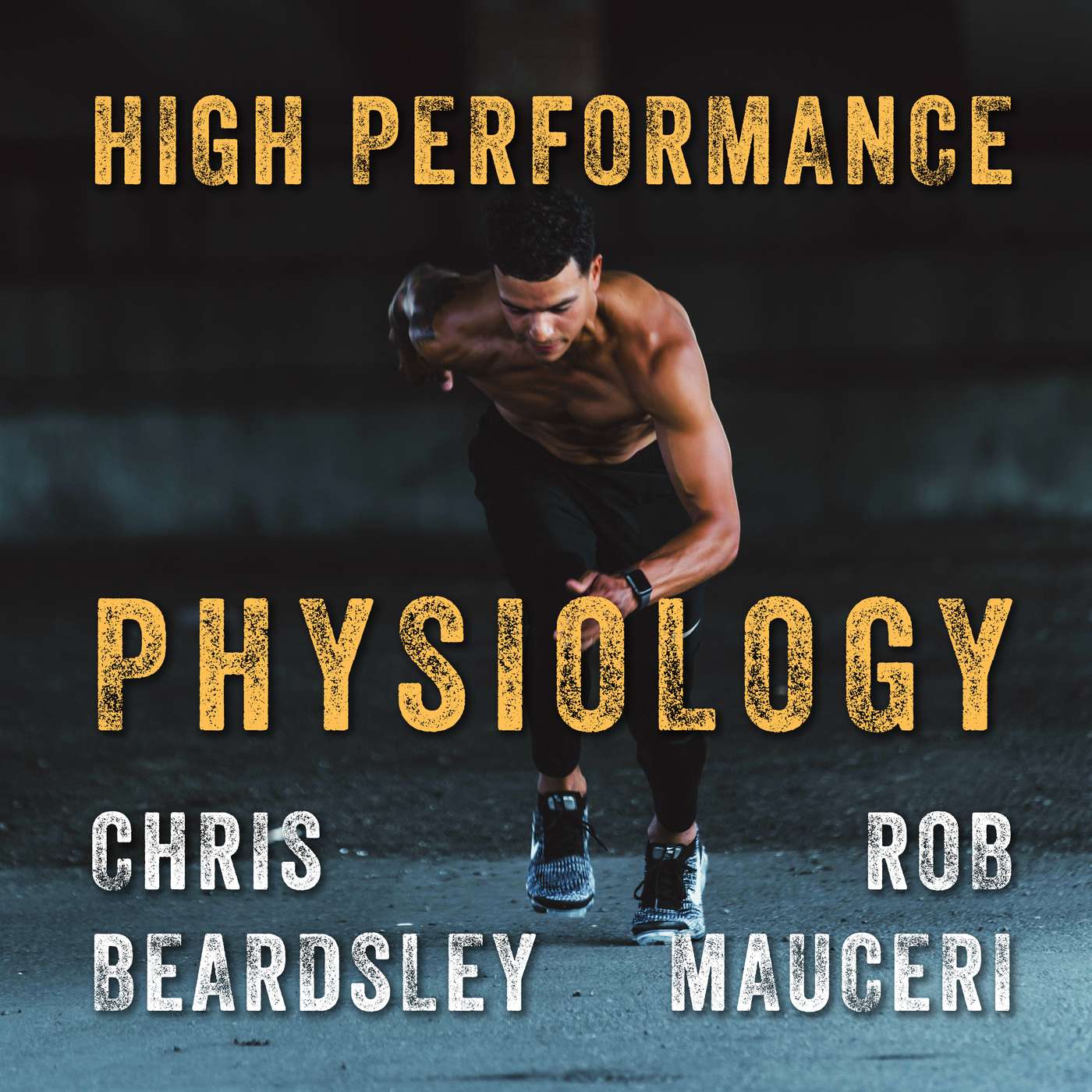
by Chris Beardsley and Rob Mauceri
The High Performance Physiology Podcast is co-hosted by Chris Beardsley and Rob Mauceri. Each episode showcases an example of how muscle physiology and biomechanics can be used to identify the best ways to train for athletic performance.
-
38
38 Clusters, RIR, and VBT
In this episode, Chris and Rob first describe how clusters, repetitions in reserve (RIR), and velocity-based training (VBT) work from a physiological perspective. Secondly, they talk about how to make use of these techniques in practice during strength training programs.
-
37
37 Warm-ups
Chris and Rob tackle the topic of warm-ups, starting with the basic exercise science concept of increasing muscle temperature before moving on to tackle the additional rationales proposed in the fitness industry, such as [1] potentiation, [2] changing psychological state to one that helps maximize adaptations, [3] practicing form or technique, and [4] making sure that the main set of the exercise is safe and comfortable to perform.
-
36
36 Contact team sports
In this episode, Chris and Rob describe how to program for contact team sports (like rugby and American football) within the context of the High Performance Physiology method four-part workout structure (high-velocity, heavy strength training, plyometrics, and supramaximal eccentrics).
-
35
35 Isometrics
In this episode, Chris and Rob explain [1] what adaptations isometrics are best suited to stimulating, and [2] how to include isometrics in a standard strength training program for stimulating those adaptations. They also talk briefly about some common misunderstandings and misapplications of isometrics in the fitness industry.
-
34
34 Study review
In this episode, Chris and Rob analyze the strength training program used in the study: "Exploring the Upper Limits of Resistance Training Volume for Muscle Hypertrophy and Strength in Trained Athletes" by Räntilä and Ahtiainen, which was published in 2026. The reason for the review is that the subjects were national-level track and field athletes, so the training program reflects what many S&C coaches are currently programming for this population. The paper is currently open access and table 1 shows the training program that we talk about.
-
33
33 Block periodization
Finally, Chris and Rob tackle block periodization, explaining why it makes very little sense for athletes in any strength or power sport. This episode references material covered in previous conversations, especially the preceding two (31 dose-response of adaptations and 32 supercompensation) as well as frequent discussions about the rate of loss of adaptations during detraining and fatigue accumulation.
-
32
32 Supercompensation
As a preparatory topic before covering block periodization, Chris and Rob explain the concept of supercompensation. Supercompensation is the observation that outcome measures (like strength, speed, power) can reduce during a high-volume training block and then rebound (supercompensate) during a subsequent deload or taper. But that does not happen because of a delayed adaptation. It happens because fatigue was accumulating during the high-volume training block and reducing the value of the outcome measure.
-
31
31 Dose response of adaptations
The dose-response of hypertrophy to workout volume is a famous phenomenon. In this episode, Chris and Rob talk about how all adaptations display dose-responses (even though they have not been as carefully studied). That affects how we program for speed, maximum strength, stretch-shortening cycle, and maximum eccentric strength.
-
30
30 Single-leg vertical jumping
Following on from the earlier episode about two-leg vertical jumping, Chris and Rob tackle single-leg vertical jumping and explain how it relates to power training (with power cleans and jump squats).
-
29
29 Training while sick (colds and flu)
Chris was sick this week so this week's episode is a short one covering some practical suggestions on how we can still get productive training sessions while suffering from either a cold or flu.
-
28
28 Combining bodybuilding and athletic training
Chris and Rob describe exactly how to combine bodybuilding with athletic preparation training for people who want to pursue multiple goals at the same time. They give three separate options depending on whether the two goals have equal weighting or whether one goal is currently more important.
-
27
27 Strength without size
In this very practical episode, Chris and Rob talk about how athletes can increase maximum strength without gaining weight (or without gaining too much muscle mass).
-
26
26 Contrast training
Following directly on from last week's podcast episode on potentiation, Chris and Rob talk about contrast training from a physiological perspective. They explain why in most cases, a more traditional approach to athletic strength training workouts (starting with high-velocity exercises, moving on to heavy strength training exercises, and finishing with plyometrics) is much better than doing contrast training methods that mix the various types of training up into complexes.
-
25
25 Potentiation
Potentiation is a temporary and reversible increase in exercise performance as a result of a previous bout of exercise (note that this is the exact opposite of the fatigue definition). In this episode, Chris and Rob explain the physiology behind potentiation and describe the most effective ways of using the various different potentiation mechanisms in strength training workouts.
-
24
24 Tendon injuries
Following on from the previous episode about muscle strain injuries, Chris and Rob talk about the physiology of tendon damage and how it likely leads to both tendinopathy and tendon ruptures. Afterwards, they describe how isometric training is probably the best training method for reducing the risk of such problems and Rob goes into detail about how he currently programs isometrics.
-
23
23 Muscle strain injury
Chris and Rob talk about how muscle strain injuries happen, and what we can do in strength training programs to help reduce the risk of them happening.
-
22
22 Sprinting muscles
Chris and Rob talk through what the literature says about the relationship between track sprinting performance and the muscle volumes of the hip extensors, hip flexors, knee extensors, knee flexors, and ankle plantar-flexors.
-
21
021 Speed training frequency
Chris and Rob continue describing how their proposed workout plan template (speed, maximum strength, stretch-shortening cycle, and eccentric strength) can work even when speed exercises are varied greatly over the week.
-
20
20 Strength qualities
Chris and Rob talk about the popular strength and conditioning idea that there multiple strength qualities across the force-velocity spectrum, from maximum strength to strength-speed to power to speed-strength to maximum speed. They also introduce the High Performance Physiology method for building strength training workouts for athletes.
-
19
019 Running economy
Endurance running performance is determined by three components: [1] maximal aerobic capacity, [2] lactate threshold, and [3] running economy. In this episode, Chris and Rob talk about how strength training can contribute to improvements in running economy.
-
18
018 Structural balance
Chris and Rob chat through what strength ratios between exercises can tell us (and what they cannot tell us) about writing athletic training programs.
-
17
017 Work capacity
Continuing from the previous two episodes about powerlifting, Chris and Rob tackle the problem of "work capacity" in this context. What does work capacity mean? What are the underlying physiological adaptations that contribute to changes in work capacity? How should we train to improve work capacity?
-
16
016 Powerlifting part 2
In this episode, Chris and Rob continue the powerlifting theme from the previous week. While the previous episode covered the main lifts, this episode is dedicated to accessory lifts to support gains in squat, bench press, and deadlift performance.
-
15
015 Powerlifting part 1
In this introductory episode, Chris and Rob explain the underlying adaptations that contribute to powerlifting performance in general terms, and then discuss basic concepts like sets and reps, progression models, potentiation prior to the lifts, and the basic purpose of the training programs from a physiological point of view.
-
14
014 Transfer of training
How do strength training programs transfer to sporting movements? What is the role of different exercises? Chris and Rob unpack the physiology and then go on to provide both positive and negative examples from existing training programs.
-
13
013 Rate of force development
Chris and Rob explain the definitions of rate of force development and explosiveness in sporting contexts before going on to talk about how to develop these qualities in strength training programs.
-
12
012 Periodization
In this long-awaited episode, Chris and Rob talk about periodization. While periodization itself is somewhat overrated, there are some benefits associated with aspects of it that can be replicated in other ways.
-
11
011 Deloads and tapers
After a short break for the holidays, Chris and Rob are back for their first episode of 2026 talking about deloads. There are two scenarios in which deloads are taken: planned and unplanned. Planned deloads are written into a training program when fatigue is expected to accumulate. Unplanned deloads are taken when fatigue accidentally accumulates.
-
10
010 One arm chin ups
Chris and Rob change the format for this episode. Rather than covering physiology and biomechanics and then talking about how that information guides strength training programs for athletic performance, they talk about their own experiences in training for a one arm chin up.
-
9
009 Sprinting
Continuing on from the previous episodes discussing vertical jumping and throwing, Chris and Rob break down the way in which we can support the sprinting movement through targeted strength training.
-
8
008 Throwing and punching
Building once again on previous episodes in which they talked about strength, speed, and power, the proximal to distal sequence, and vertical jumping, Chris and Rob now tackle how throwing and punching work, and discuss how to train to improve performance in those activities.
-
7
007 Vertical jumping
In this episode, Chris and Rob build on previous podcast discussions about strength, speed, and power as well as on the proximal to distal sequence to explain [1] how vertical jumping works, and [2] how we can structure training programs to improve vertical jump height.
-
6
006 Eccentric training
In this episode, Chris and Rob introduce eccentric training, starting with the underlying physiological adaptations and then going on to provide some commentary on practical programming. Contrary to what you will likely hear elsewhere, the important (transferable) adaptations caused by eccentric training are peripheral and not neural.
-
5
005 Stretch-shortening cycle
In this episode, Chris and Rob introduce the stretch-shortening cycle and its underlying mechanisms, focusing on how it works in fast movements. This builds on previous episodes in which they talked about speed, power, strength, and the proximal to distal sequence. Learn more about how tendons work to store and release elastic energy in fast movements.
-
4
004 Proximal to distal sequencing
After covering the basics of strength, speed, and power, Chris and Rob now address how the proximal to distal sequence works. This is a key feature of human movement and has been observed in running, jumping, and throwing, as well as more complex activities. Understanding how it works is essential for interpreting the transfer of training to sporting performance.
-
3
003 Maximum speed
Building on the previous episodes, Chris and Rob tackle the adaptations that contribute to increasing maximum speed in the context of athletic training. As always, Chris explains the physiology and Rob provides examples of how to implement that knowledge from the training programs that he is currently writing for his clients.
-
2
002 Maximum strength
Chris and Rob walk through the major physiological adaptations that contribute to increases in maximum strength and give examples of how these adaptations can be stimulated by specific elements within a strength training program. Since maximum strength is an externally-measured outcome, it cannot be stimulated to increase directly. We must instead create a range of specific underlying adaptations, each of which have their own unique stimuli.
-
1
001 Strength, speed, and power
What are strength, speed, and power? We call them athletic qualities but how are they actually improved? In this episode, Chris and Rob explain how strength and speed are each outcomes underpinned by specific, unique adaptations, while power is a second order outcome underpinned by strength and speed.
We're indexing this podcast's transcripts for the first time — this can take a minute or two. We'll show results as soon as they're ready.
No matches for "" in this podcast's transcripts.
No topics indexed yet for this podcast.
Loading reviews...
ABOUT THIS SHOW
The High Performance Physiology Podcast is co-hosted by Chris Beardsley and Rob Mauceri. Each episode showcases an example of how muscle physiology and biomechanics can be used to identify the best ways to train for athletic performance.
HOSTED BY
Chris Beardsley and Rob Mauceri
Loading similar podcasts...
Frequently Asked Questions
How many episodes does High Performance Physiology have?
High Performance Physiology currently has 38 episodes available on PodParley. New episodes are automatically indexed when they're published to the podcast feed.
What is High Performance Physiology about?
The High Performance Physiology Podcast is co-hosted by Chris Beardsley and Rob Mauceri. Each episode showcases an example of how muscle physiology and biomechanics can be used to identify the best ways to train for athletic performance.
How often does High Performance Physiology release new episodes?
High Performance Physiology has 38 episodes. Check the episode list to see recent publication dates and frequency.
Where can I listen to High Performance Physiology?
You can listen to High Performance Physiology on PodParley by clicking any episode. We provide an embedded audio player for direct listening, and you can also subscribe via your preferred podcast app using the RSS feed.
Who hosts High Performance Physiology?
High Performance Physiology is created and hosted by Chris Beardsley and Rob Mauceri.
URL copied to clipboard!