
PODCAST · marketing
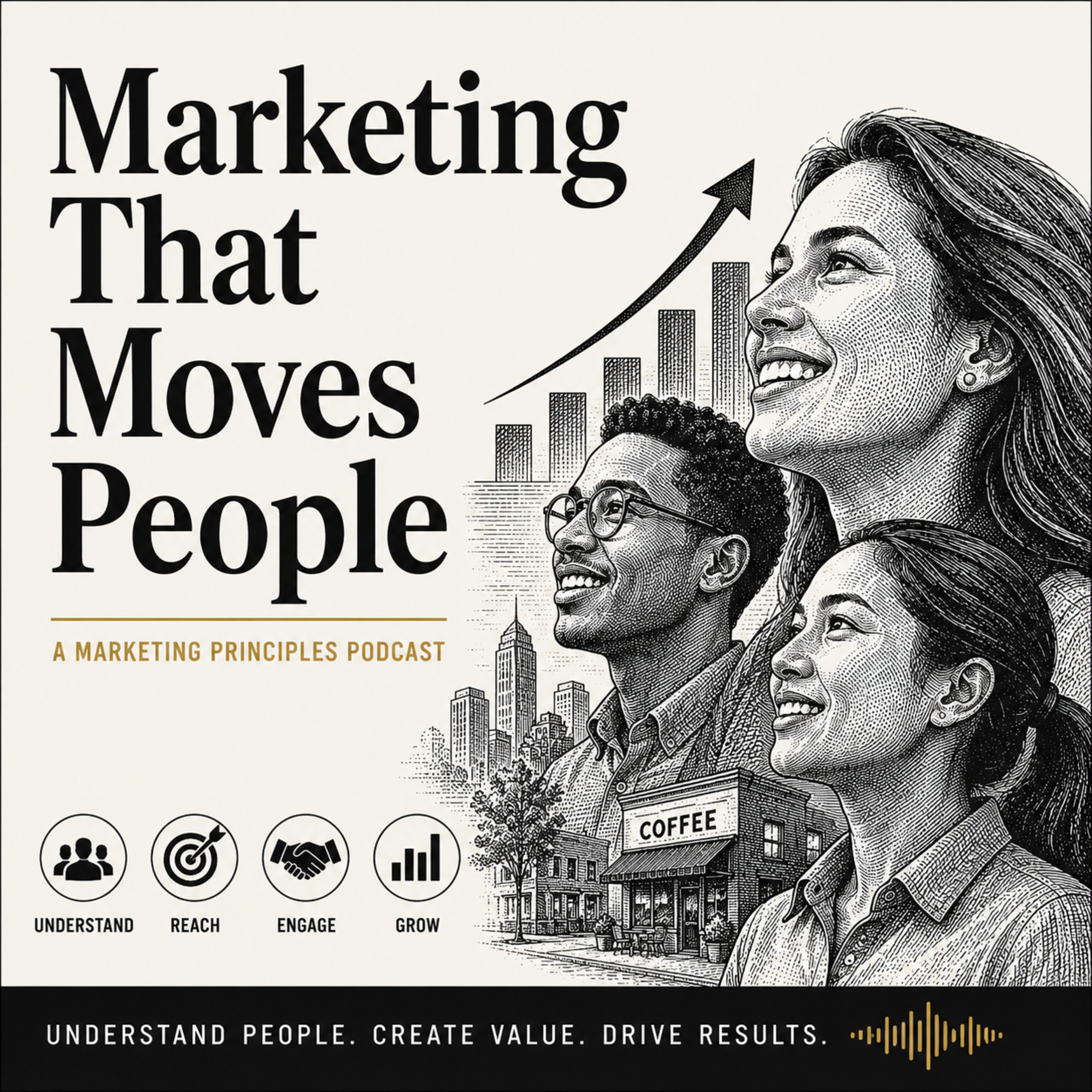
Marketing That Moves People
by Derek Dachelet, Ph.D.
Marketing That Moves People is a course podcast series designed to help students learn core marketing concepts in a convenient, engaging, and practical way. Each episode connects directly to a course module and introduces the major ideas students need before completing readings, discussions, assignments, quizzes, and in-class activities.This series explores how marketing helps organizations understand customers, create value, build strong brands, develop products and services, set prices, communicate with target audiences, use digital tools, and make better business decisions. Students will hear real-world examples from businesses they recognize, including local, regional, national, and digital companies.Rather than treating marketing as just advertising or social media, this podcast helps students see marketing as a strategic business function that affects nearly every organization. Episodes cover topics such as customer value, marketing planning, consumer behavior, market research,
Episodes
-
Inside the Decision Room Case Lab 5, Part B: Great River Outfitters — After-Action Debrief and Strategic Reflection
Students revisit their recommendation for Great River Outfitters after hearing a debrief on personalized marketing, customer choice, data partnerships, transparency, loyalty programs, brand trust, and long-term relationship value. Students decide whether to keep, revise, or replace their original...
-
Inside the Decision Room Case Lab 5, Part A: Great River Outfitters — How Personal Should Our Marketing Become?
Students enter a simulated leadership discussion at Great River Outfitters, a regional outdoor retailer deciding how to use customer data for more personalized marketing. Students recommend how the company should balance relevant offers, customer choice, transparency, marketing effectiveness, and...
-
Inside the Decision Room Case Lab 4, Part B: Driftless Dairy Co. — After-Action Debrief and Strategic Reflection
Students revisit their Fuel & Flavor digital-marketing recommendation after hearing a debrief on campaign objectives, influencer fit, geo-targeted promotion, retailer coordination, customer content, digital measurement, trial, and repeat purchase. Students decide whether to keep, revise, or…
more -
Inside the Decision Room Case Lab 4, Part A: Driftless Dairy Co. — How Should Fuel & Flavor Build Demand Online?
Students enter a simulated digital-campaign planning discussion at Driftless Dairy Co. as the company expands its Fuel & Flavor snack line into additional regional stores. Students recommend how the company should use limited digital resources to create awareness, encourage trial, support retail...
-
Inside the Decision Room Case Lab 3, Part B: Driftless Dairy Co. — After-Action Debrief and Strategic Reflection
Students revisit their Fuel & Flavor launch recommendation after hearing a debrief on product assortment, pricing, channel placement, retail execution, promotion, test-and-learn launches, and marketing control. Students decide whether to keep, revise, or replace their original recommendation and...
-
Inside the Decision Room Case Lab 3, Part A: Driftless Dairy Co. — How Should We Launch Fuel & Flavor?
Students enter a simulated launch-planning discussion at Driftless Dairy Co. The company has selected busy working adults and commuters as the first target market for Fuel & Flavor, its refrigerated cheese-snack line. Students recommend how Driftless Dairy should coordinate product assortment,...
-
Inside the Decision Room Case Lab 2, Part B: Driftless Dairy Co. — After-Action Debrief and Strategic Reflection
Students revisit their Fuel & Flavor target-market and positioning recommendation after hearing a debrief on segmentation, target-market evaluation, customer value, positioning statements, channel fit, repeat purchase behavior, and performance measurement. Students decide whether to keep, revise,...
-
Inside the Decision Room Case Lab 2, Part A: Driftless Dairy Co. — Who Should Fuel & Flavor Be For?
Students enter a simulated leadership discussion at Driftless Dairy Co. after an initial test of its Fuel & Flavor refrigerated snack line. Students must decide whether the company should target busy working adults, college students, or premium regional-food shoppers—and how the product should be...
-
Inside the Decision Room Case Lab 1, Part B: Driftless Dairy Co. — After-Action Debrief and Strategic Reflection
Students revisit their recommendation for Driftless Dairy Co. after hearing a debrief on consumer research, retailer feedback, segmentation, concept testing, pricing research, and market testing. Students decide whether to keep, revise, or replace their original recommendation and identify the...
-
Inside the Decision Room Case Lab 1, Part A: Driftless Dairy Co. — What Should We Learn Before We Launch?
Students enter a simulated leadership discussion at a regional Wisconsin cheese-food manufacturer considering a new refrigerated snack line. They must recommend whether the company should move quickly using existing information, invest in consumer research first, or use a phased...
-
Bonus Episode – Your First Marketing Job Might Not Have Marketing in the Title
Marketing careers are broader than many students realize. In this upbeat bonus episode, Dr. Derek, Emily Carter, Marcus Reed, and Tom Kessler explore entry-level jobs and early career opportunities where business graduates can use marketing skills. The hosts discuss roles such as marketing...
-
Episode 8.4 – AI Is Changing Marketing—But Should It?
Artificial intelligence is transforming marketing, but powerful tools require responsible judgment. In this final episode of Marketing That Moves People, Dr. Derek, Marcus Reed, and Priya Nair explore how AI supports content creation, customer insights, personalization, analytics, automation,...
-
Episode 8.3 – The Marketing Technology Stack
Modern marketing depends on tools that help organizations manage customer relationships, communication, automation, analytics, and data. In this episode, Dr. Derek, Marcus Reed, and Priya Nair explore marketing technology platforms, CRM systems, email marketing tools, marketing automation…
more -
Episode 8.2 – Clicks, Conversions, and Customer Behavior
Digital marketing creates a lot of data, but not every number matters equally. In this episode, Dr. Derek, Marcus Reed, and Priya Nair explore digital marketing metrics, dashboards, KPIs, funnels, click-through rates, conversion rates, bounce rates, email metrics, social media metrics, and…
more -
Episode 8.1 – How Marketers Know What Is Working
Marketing activity is not the same as marketing results. In this episode, Dr. Derek opens the final unit on marketing technology, analytics, and AI with Marcus Reed and Priya Nair. Together, they explore marketing analytics, performance metrics, vanity metrics, conversion rates, customer...
-
Episode 7.4 – Marketing Where Customers Actually Spend Time
Digital marketing is not about chasing every platform—it is about reaching customers in the places where they already spend time. In this episode, Dr. Derek, Marcus Reed, and Tom Kessler explore social media marketing, content marketing, influencer marketing, e-commerce, online reviews…
more -
Episode 7.3 – Selling, Direct Marketing, and Keeping Customers for Life
Marketing communication is not always one-way. In this episode, Dr. Derek, Marcus Reed, and Tom Kessler explore personal selling, direct marketing, and customer engagement. Listeners learn how personal selling helps customers through conversation, needs discovery, presentations, objection…
more -
Episode 7.2 – Advertising, PR, and Promotion in the Real World
Advertising, public relations, and sales promotion are three important tools in the promotion mix, but they each serve a different purpose. In this episode, Dr. Derek, Marcus Reed, and Tom Kessler explore how organizations use advertising to create paid visibility, public relations to build...
-
Episode 7.1 – How Marketing Messages Work Together
Marketing communication is more than posting ads or creating social media content. In this episode, Dr. Derek introduces Unit 7 with Marcus Reed, a digital marketing agency owner, and Tom Kessler, owner of Kessler County Market and Fuel. Together, they explore integrated marketing communications,...
-
Episode 6.4 – When Pricing Becomes Unethical
Pricing decisions affect more than revenue—they affect customer trust. In this episode, Dr. Derek, Emily Carter, and Tom Kessler examine legal, ethical, and profitability considerations in pricing. Through examples involving hidden fees, drip pricing, price gouging, discounts, fuel pricing,...
-
Episode 6.3 – Why Prices Change Online
Why do prices often end in ninety-nine, and why do online prices sometimes change from one day to the next? In this episode, Dr. Derek, Emily Carter, and Tom Kessler explore psychological pricing, dynamic pricing, and digital pricing. Through examples from convenience stores, fuel prices,...
-
Episode 6.2 – How Businesses Set Prices
How do businesses decide what to charge? In this episode, Dr. Derek, Emily Carter, and Tom Kessler walk through the pricing decision process by examining pricing objectives, costs, customer demand, perceived value, competitor prices, and final strategy. Using examples from convenience stores…
more -
Welcome to Marketing – Why Taste Isn't Always Enough
What can the Coca-Cola versus Pepsi Challenge teach us about marketing? In this welcome episode of Marketing That Moves People, Dr. Derek and Emily Carter introduce students to the power of marketing through a blind cola taste test and the famous rivalry between Coke and Pepsi. The episode…
more -
Episode 6.1 – Why Price Is More Than a Number
Price is one of the most visible marketing decisions, but it is much more than a number. In this episode, Dr. Derek, Emily Carter, and Tom Kessler introduce pricing strategy by exploring pricing objectives and common pricing methods. Through examples from convenience stores, fuel pricing…
more -
Episode 5.4 – How New Products Win or Fail
This episode breaks down why most product launches never make it, from shopper inertia and status quo bias to the challenge of displacing the same 150 everyday items consumers already trust. It also examines two classic product flop traps: awkward middle-ground offerings and overly complex…
more -
Episode 5.3 – Why Brands Matter
A brand is more than a logo, name, or slogan. In this episode, Dr. Derek, Emily Carter, and Tom Kessler explore branding, brand equity, brand loyalty, brand promises, and brand strategy. Through examples from convenience stores, retail brands, customer experience, and local business competition,...
-
Episode 5.2 – Why Products Rise, Mature, and Decline
Products do not stay the same forever. In this episode, Dr. Derek, Emily Carter, and Tom Kessler explore the product life cycle and product portfolio management. Through examples from convenience stores, smartphones, retail product assortments, and customer experience design, listeners learn how...
-
Episode 5.1 – What Are We Really Selling? Products, Services, and Experiences
A product is more than something sitting on a shelf. In this episode, Dr. Derek introduces Unit 5 on Product and Brand Strategy with new guest voices Emily Carter, a customer experience analyst, and Tom Kessler, owner of three independent rural Wisconsin gas stations. Together, they explore…
more -
Episode 4.4 – Keeping Customers After You Win Them
Marketing does not end when a customer makes a purchase. In this episode, Dr. Derek, Sarah Mitchell, and Miguel Ramirez explore customer relationship management, customer retention, personalization, customer journey mapping, and customer lifetime value. Through examples from ShadeTree Coffee and...
-
Episode 4.3 – How Brands Claim Space in the Customer's Mind
Once marketers choose a target market, they must decide how they want customers to perceive their product, service, or brand compared to competitors. In this episode, Dr. Derek, Sarah Mitchell, and Miguel Ramirez explore positioning strategies, competitive positioning, positioning statements, and...
-
Episode 4.2 – Choosing Your Best Customers
After marketers divide a market into segments, they must decide which customer groups to focus on. In this episode, Dr. Derek, Sarah Mitchell, and Miguel Ramirez explore target market selection and customer personas. Using ShadeTree Coffee and manufacturing examples, the hosts discuss how...
-
Episode 4.1 – Why Successful Marketers Don't Market to Everyone
Trying to market to everyone often means connecting deeply with no one. In this episode, Dr. Derek, Sarah Mitchell, and Miguel Ramirez introduce market segmentation and explain why marketers divide broad markets into smaller groups of customers with shared characteristics, needs, or behaviors....
-
Episode 3.4 How Businesses Buy Differently Than Consumers
Businesses are customers too, but they often make purchasing decisions very differently than individual consumers. In this episode, Dr. Derek, Sarah Mitchell, and Miguel Ramirez explore organizational buying behavior, buying centers, supplier evaluation, B2B relationships, and customer…
more -
Episode 3.2 What Customers Won't Tell You Directly
Customers do not always clearly explain what they need, want, or value. In this episode, Dr. Derek, Sarah Mitchell, and Miguel Ramirez explore how marketers collect useful information through primary research, secondary research, surveys, interviews, focus groups, observation, customer data, and...
-
Episode 3.1.5 How Marketers Turn Questions Into Answers
Good marketing decisions are not built on guesses. In this episode, Dr. Derek, Sarah Mitchell, and Miguel Ramirez introduce the marketing research process and explain how organizations gather information to make better decisions. Using ShadeTree Coffee as an example, the hosts explore how…
more -
Episode 3.3 Why Customers Buy What They Buy
Why do two customers with the same need often make completely different purchasing decisions? In this episode, Dr. Derek, Sarah Mitchell, and Miguel Ramirez explore the factors that influence consumer behavior, including psychological, social, cultural, and personal influences. Through real-world...
-
Episode 3.1 – Understanding Needs, Wants, and Customer Value
Why do people buy what they buy? In this episode, Dr. Derek, Sarah Mitchell, and Miguel Ramirez explore the differences between customer needs and wants, the principles of the marketing concept, and how organizations create customer value. Through examples from technology, retail, and small...
-
Episode 2.4 How Marketers Know What's Working
How do organizations determine whether their marketing efforts are successful? In this episode, Dr. Derek, Sarah Mitchell, and Miguel Ramirez explore marketing objectives, performance metrics, and the role of data in decision-making. Using the example of ShadeTree Coffee's second location, the...
-
Episode 2.3 – Reading the Market: What Smart Companies Watch
Successful organizations don't just focus on what's happening inside their business—they pay attention to what's happening around them. In this episode, Dr. Derek, Sarah Mitchell, and Miguel Ramirez explore environmental scanning and the external forces that influence marketing decisions. Through...
-
Episode 2.2 Finding Your Edge – The Power of SWOT Analysis
How do successful organizations evaluate their position in the marketplace? In this episode, Dr. Derek, Sarah Mitchell, and Miguel Ramirez use a real-world business scenario to explore SWOT Analysis. As ShadeTree Coffee considers opening a second location, the hosts identify strengths…
more -
Episode 2.1 Why Great Marketing Doesn't Happen by Accident
Successful marketing campaigns rarely happen by luck. In this episode, Dr. Derek, Sarah Mitchell, and Miguel Ramirez explore the role of planning in marketing success. Listeners learn the differences between strategic, tactical, and operational planning, examine the steps in the marketing…
more -
Episode 1.4 When Marketing Does Good—and When It Doesn't
Marketing has the power to inform, inspire, and create positive change—but it can also mislead consumers and damage trust when used irresponsibly. In this episode, Dr. Derek, Sarah Mitchell, and Miguel Ramirez explore real-world examples of ethical and unethical marketing, including Patagonia's...
-
Episode 1.3 The Four Decisions Every Marketer Makes
Every product launch requires a series of important decisions. In this episode, Dr. Derek, Sarah Mitchell, and Miguel Ramirez explore the Four Ps of Marketing—Product, Price, Place, and Promotion—through the launch of a fictional Nitro Cold Brew coffee product. Listeners will learn how marketers...
-
Episode 1.2 Creating Customer Value and Competitive Advantage
Why do customers choose one business over another? In this episode, Dr. Derek, Sarah Mitchell, and Miguel Ramirez explore the concepts of customer value, customer satisfaction, and competitive advantage. Through examples from manufacturing, small business, and everyday purchasing decisions, they...
-
Episode 1.1 Why Every Business Needs Marketing
Welcome to the first episode of Marketing That Moves People. In this introductory episode, Dr. Derek introduces the course, explains the purpose of the podcast series, and shares why marketing is much more than advertising, social media, or selling. Joining the conversation are Sarah Mitchell,...
We're indexing this podcast's transcripts for the first time — this can take a minute or two. We'll show results as soon as they're ready.
No matches for "" in this podcast's transcripts.
No topics indexed yet for this podcast.
Loading reviews...
ABOUT THIS SHOW
Marketing That Moves People is a course podcast series designed to help students learn core marketing concepts in a convenient, engaging, and practical way. Each episode connects directly to a course module and introduces the major ideas students need before completing readings, discussions, assignments, quizzes, and in-class activities.This series explores how marketing helps organizations understand customers, create value, build strong brands, develop products and services, set prices, communicate with target audiences, use digital tools, and make better business decisions. Students will hear real-world examples from businesses they recognize, including local, regional, national, and digital companies.Rather than treating marketing as just advertising or social media, this podcast helps students see marketing as a strategic business function that affects nearly every organization. Episodes cover topics such as customer value, marketing planning, consumer behavior, market research,
HOSTED BY
Derek Dachelet, Ph.D.
Loading similar podcasts...
Frequently Asked Questions
How many episodes does Marketing That Moves People have?
Marketing That Moves People currently has 45 episodes available on PodParley. New episodes are automatically indexed when they're published to the podcast feed.
What is Marketing That Moves People about?
Marketing That Moves People is a course podcast series designed to help students learn core marketing concepts in a convenient, engaging, and practical way. Each episode connects directly to a course module and introduces the major ideas students need before completing readings, discussions,...
How often does Marketing That Moves People release new episodes?
Marketing That Moves People has 45 episodes. Check the episode list to see recent publication dates and frequency.
Where can I listen to Marketing That Moves People?
You can listen to Marketing That Moves People on PodParley by clicking any episode. We provide an embedded audio player for direct listening, and you can also subscribe via your preferred podcast app using the RSS feed.
Who hosts Marketing That Moves People?
Marketing That Moves People is created and hosted by Derek Dachelet, Ph.D..
URL copied to clipboard!