
PODCAST · business
Selling That Solves Problems
by Jellypod
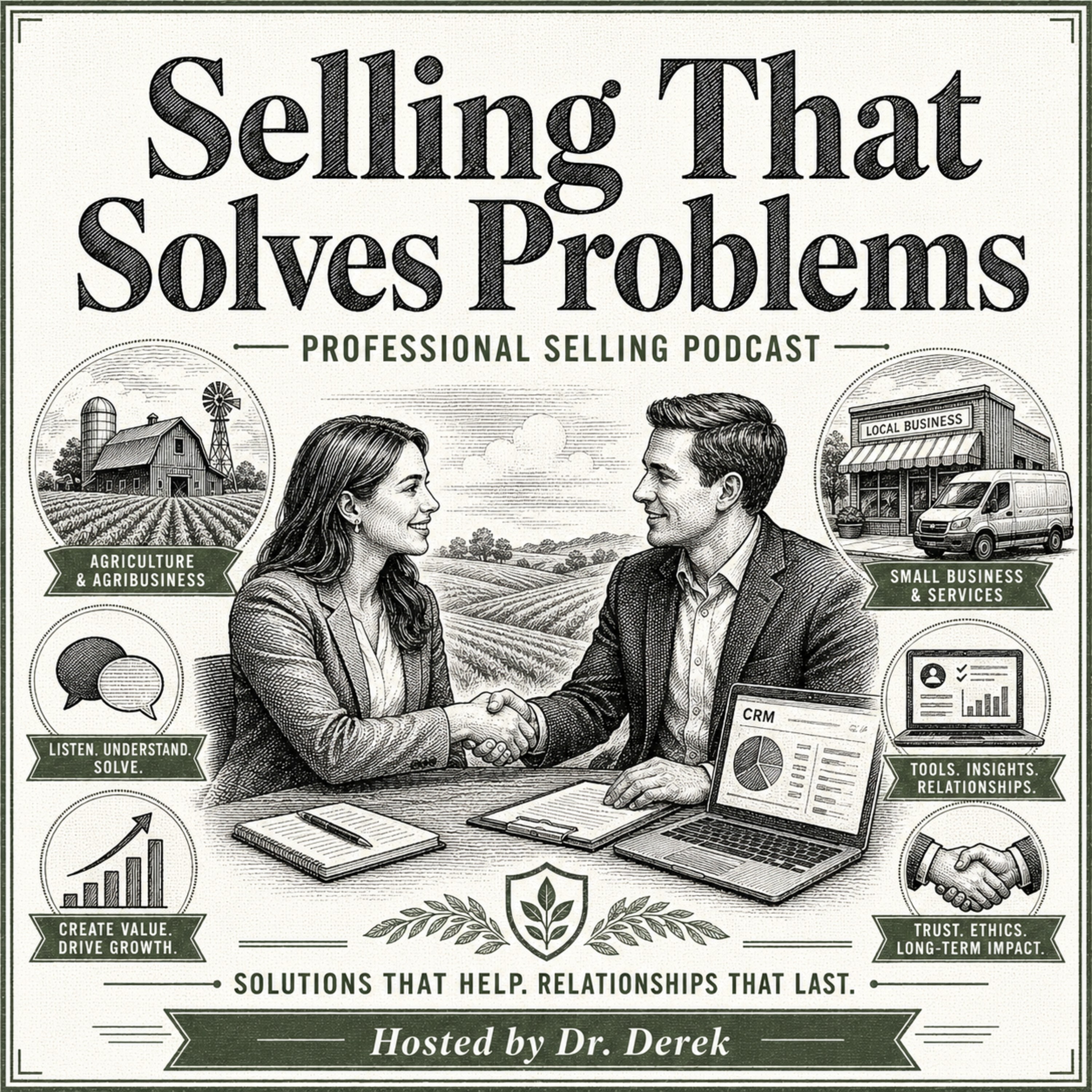
Selling That Solves Problems is a Professional Selling podcast series designed for business administration and agriculture business students. Hosted by Dr. Derek and featuring voices from agribusiness, B2B sales, small business buying, customer success, and challenging customer scenarios, the series helps students understand selling as a practical, ethical, trust-based process. Each episode focuses on real-world sales skills such as prospecting, needs discovery, consultative selling, value creation, objection handling, closing, follow-up, CRM, and responsible use of AI. The goal is to help students move beyond “sales pitches” and learn how professional salespeople solve problems, build relationships, and help customers make better decisions. (Powered by Jellypod)
-
43
Roleplay Lab 11: Full Sales Conversation Capstone
In this final Roleplay Lab episode of Selling That Solves Problems, students hear a start-to-finish sales conversation between Becca Voss and Tina Green, owner of GreenEarth Landscaping. The roleplay demonstrates how the full professional selling process connects: opening the conversation, asking discovery questions, summarizing needs, qualifying the opportunity, presenting a focused recommendation, using proof, handling adoption and cost concerns, closing for the right next commitment, confirming follow-up, and documenting the conversation in CRM. This capstone lab helps students hear what a complete, customer-centered, ethical sales conversation can sound like in practice.Recommended Course Placement: Unit 8, Module 8.2 — Practice the Sales Conversation from Start to FinishCo-hosts and Actors: Dr. Derek, Marcus Reed, Becca Voss, and Tina Green
-
42
Roleplay Lab 10: Ethical Selling When the Customer Wants a Guarantee
In this Roleplay Lab episode of Selling That Solves Problems, students hear weak and stronger versions of an ethical selling conversation between Grant Keller and Teddy Olson. Teddy asks for a guarantee that a seed and crop protection plan will outperform last year, creating pressure for Grant to overpromise. The weak version shows Grant using unsupported reassurance to protect the sale, while the stronger version demonstrates how to be honest about uncertainty, explain field-specific reasoning, discuss risk and tradeoffs, provide supportable evidence, define follow-up support, and protect long-term trust.Recommended Course Placement: Unit 7, Module 7.1 — Ethical Selling Protects the Customer and the RelationshipCo-hosts and Actors: Dr. Derek, Marcus Reed, Grant Keller, and Teddy Olson
-
41
Roleplay Lab 9: Follow-Up and CRM After the Sales Conversation
In this Roleplay Lab episode of Selling That Solves Problems, students hear weak and stronger versions of follow-up and CRM documentation after a sales conversation with Tina Green, owner of GreenEarth Landscaping. The weak version shows vague follow-up, unclear next steps, and incomplete CRM notes, while the stronger version demonstrates how to confirm the next action, identify the people involved, document customer needs and concerns, assign follow-up responsibilities, and use CRM to support customer success.Recommended Course Placement: Unit 6, Module 6.3 — CRM Helps You Remember, Follow Up, and Serve the CustomerCo-hosts and Actors: Dr. Derek, Maya Patel, Marcus Reed, and Tina Green
-
40
Roleplay Lab 8: Closing for the Right Next Commitment
In this Roleplay Lab episode of Selling That Solves Problems, students hear weak and stronger versions of a salesperson closing for the right next commitment. Becca Voss meets with Teddy Olson about a precision ag equipment upgrade, and Teddy is interested but not ready to make a final decision. The weak version shows Becca ending vaguely with “let me know,” while the stronger version demonstrates how to summarize value, clarify remaining concerns, identify decision-makers, confirm missing information, and ask for a specific next step with an action, owner, and time.Recommended Course Placement: Unit 5, Module 5.4 — Closing Is Asking for the Right Next CommitmentCo-hosts and Actors: Dr. Derek, Marcus Reed, Becca Voss, and Teddy Olson
-
39
Roleplay Lab 7: Working with a Skeptical Customer
In this Roleplay Lab episode of Selling That Solves Problems, students hear weak and stronger versions of a salesperson working with a skeptical customer. Maya Patel meets with Carla Briggs, owner of Briggs Auto & Diesel, who has been disappointed by previous vendors and is cautious about another software solution. The weak version shows Maya responding with vague reassurance and a rushed demo, while the stronger version demonstrates how to acknowledge skepticism, ask what happened before, clarify the customer’s risk concerns, narrow the conversation, provide specific proof, and earn a smaller next step.Recommended Course Placement: Unit 5, Module 5.1 — Objections Are Information, Not RejectionCo-hosts and Actors: Dr. Derek, Marcus Reed, Maya Patel, and Carla Briggs
-
38
Roleplay Lab 6: Handling the Price Objection Without Panic
In this Roleplay Lab episode of Selling That Solves Problems, students hear weak and stronger versions of a price objection conversation between Grant Keller and Teddy Olson. The weak version shows Grant defending price too quickly and moving toward discounting before understanding the concern, while the stronger version demonstrates how to clarify what the customer is comparing, connect price to field-specific value and risk, discuss options and tradeoffs, avoid overpromising, and ask for a practical next step.Recommended Course Placement: Unit 5, Module 5.2 — Handling Price Concerns Without PanicCo-hosts and Actors: Dr. Derek, Marcus Reed, Grant Keller, and Teddy Olson
-
37
Roleplay Lab 5: Show Proof, Not Just Promises
In this Roleplay Lab episode of Selling That Solves Problems, students hear weak and stronger versions of a salesperson using proof during a sales presentation. The weak version relies on vague claims such as “easy to use” and “customers like it,” while the stronger version demonstrates how to support a recommendation with a focused workflow example, adoption plan, success criteria, relevant customer example, pilot structure, and honest explanation of what the proof does and does not show.Recommended Course Placement: Unit 4, Module 4.2 — Show Proof, Not Just PromisesCo-hosts and Actors: Dr. Derek, Marcus Reed, Maya Patel, and Tina Green
-
36
Roleplay Lab 4: Presenting a Customer-Specific Recommendation
In this Roleplay Lab episode of Selling That Solves Problems, students hear weak and stronger versions of a salesperson presenting a recommendation to Tina Green, owner of GreenEarth Landscaping. The weak version shows a product-heavy recommendation that overwhelms the customer with features, while the stronger version demonstrates how to recommend a focused starting point based on the customer’s stated problem, decision criteria, adoption concerns, timing, tradeoffs, and readiness for the next step.Recommended Course Placement: Unit 3, Module 3.4 — Tailor the Recommendation to the CustomerCo-hosts and Actors: Dr. Derek, Marcus Reed, Maya Patel, and Tina Green
-
35
Roleplay Lab 3: Summarizing Needs and Qualifying the Opportunity
In this Roleplay Lab episode of Selling That Solves Problems, students hear weak and stronger versions of a conversation that moves from needs discovery into summarizing and qualifying the opportunity. The weak version shows a salesperson assuming that a customer with a problem is ready for a proposal, while the stronger version demonstrates how to summarize the customer’s real business issue, confirm understanding, ask about decision-makers, timing, budget, adoption concerns, deal blockers, and choose a next step that matches the customer’s readiness.Recommended Course Placement: Unit 2, Module 2.4 — Qualifying the OpportunityCo-hosts and Actors: Dr. Derek, Marcus Reed, Maya Patel, and Tina Green
-
34
Roleplay Lab 2: Needs Discovery Is Where Selling Really Begins
In this Roleplay Lab episode of Selling That Solves Problems, students hear weak and stronger versions of a needs discovery conversation between Becca Voss and Tina Green, owner of GreenEarth Landscaping. The weak version shows how shallow questions and early pitching can miss the real issue, while the stronger version demonstrates open-ended questions, follow-up questions, impact questions, outcome questions, decision criteria, adoption concerns, and a clear summary of customer needs before recommending a solution.Recommended Course Placement: Unit 2, Module 2.2 — Needs Discovery Is Where Selling Really BeginsCo-hosts and Actors: Dr. Derek, Marcus Reed, Becca Voss, and Tina Green
-
33
Roleplay Lab 1: Opening the Sales Conversation
In this Roleplay Lab episode of Selling That Solves Problems, students hear two versions of a salesperson opening a conversation with Tina Green, owner of GreenEarth Landscaping. The weak version shows a generic, product-centered pitch that recommends too soon, while the stronger version demonstrates a brief, relevant, respectful, customer-centered opening that earns permission to begin discovery. Students learn how to connect to the customer’s situation, avoid assumptions, respect the buyer’s time, and ask a strong first discovery question.Recommended Course Placement: Unit 1, Module 1.5 — Opening the Sales Conversation
-
32
Episode 8.3 Becoming the Kind of Salesperson Customers Trust
In this final episode of Selling That Solves Problems, Dr. Derek, Marcus Reed, Becca Voss, and Tina Green help students reflect on the full Professional Selling course and the kind of salesperson they are becoming. Students revisit the importance of customer-centered selling, communication, confidence, value creation, objection handling, closing, follow-up, CRM, ethics, reputation, responsible AI use, and employability, with a final emphasis on becoming a salesperson who helps customers make clearer, more honest, and more useful decisions.
-
31
Episode 8.2 Practice the Sales Conversation from Start to Finish
In this episode of Selling That Solves Problems, Dr. Derek, Marcus Reed, Tina Green, and Carla Briggs explain how students can practice a complete sales conversation from opening through follow-up. Students learn how to prepare for roleplays, ask discovery questions, summarize customer needs, qualify the opportunity, present a customer-specific recommendation, use proof, handle objections, discuss price, ask for the next commitment, write CRM notes, use AI for realistic practice, receive feedback, and reflect for improvement.
-
30
Episode 8.1 Put the Sales Process Together
In this episode of Selling That Solves Problems, Dr. Derek, Marcus Reed, and Tina Green help students connect the full professional selling process from prospecting and preparation through discovery, qualification, consultative recommendations, presentations, objections, negotiation, closing, follow-up, CRM, relationship management, ethics, professionalism, responsible AI use, and customer success. Students learn how each step supports customer value, trust, and better decision-making rather than functioning as disconnected sales techniques.
-
29
Episode 7.4 Your Sales Reputation Is Built One Decision at a Time
In this episode of Selling That Solves Problems, Dr. Derek, Becca Voss, Grant Keller, and Carla Briggs explain how a salesperson’s reputation is built through repeated choices before, during, and after the sale. Students learn how consistency, honesty, follow-through, responsible recommendations, clear communication, ethical boundaries, internal teamwork, digital professionalism, and responsible AI use help build long-term trust with customers, coworkers, and communities.
-
28
Episode 7.3 Use AI and Digital Tools Responsibly in Sales
In this episode of Selling That Solves Problems, Dr. Derek, Maya Patel, and Marcus Reed explain how salespeople can use AI and digital tools responsibly throughout the sales process. Students learn how AI can support prospect research, writing, discovery preparation, presentations, CRM, objections, follow-up, and roleplay practice while avoiding generic communication, inaccurate claims, fake personalization, privacy violations, unsupported proof, poor automation, bias, and overreliance on technology instead of human judgment.
-
27
Episode 7.2 Professionalism Shows Up Before, During, and After the Sale
In this episode of Selling That Solves Problems, Dr. Derek, Tina Green, and Marcus Reed explain how professionalism appears in everyday sales behaviors before, during, and after the sale. Students learn how preparation, respect for time, clear communication, responsiveness, listening, follow-through, appropriate boundaries, digital professionalism, plain language, consistency, and calm handling of mistakes or difficult situations help salespeople build trust and represent their company well.
-
26
Episode 7.1 Ethical Selling Protects the Customer and the Relationship
In this episode of Selling That Solves Problems, Dr. Derek, Marcus Reed, and Carla Briggs explain why ethical selling is essential to professional trust and long-term customer relationships. Students learn how honesty, fit, transparency, competence, confidentiality, fair competitor comparisons, responsible incentives, care with vulnerable customers, professionalism, and responsible AI use protect customers while helping salespeople avoid exaggeration, fake urgency, pressure tactics, hidden fees, unsupported claims, and recommendations that do not fit.
-
25
Episode 6.4 Customer Success Creates Future Opportunity
In this episode of Selling That Solves Problems, Dr. Derek, Becca Voss, Grant Keller, and Maya Patel explain how customer success creates future opportunity after the sale. Students learn how realistic expectations, adoption, training, follow-up, service recovery, account reviews, CRM documentation, referrals, references, testimonials, renewals, and responsible AI use help salespeople build long-term trust, professional reputation, and repeat business without pressuring customers before value has been delivered.
-
24
Episode 6.3 CRM Helps You Remember, Follow Up, and Serve the Customer
In this episode of Selling That Solves Problems, Dr. Derek, Maya Patel, and Marcus Reed explain CRM as both a software tool and a professional discipline for managing customer relationships. Students learn how CRM supports follow-up, customer memory, pipeline management, qualification, internal handoffs, customer success, data quality, privacy, AI-assisted selling, and long-term trust by helping salespeople document commitments, track next steps, and serve customers more consistently.
-
23
Episode 6.2 Relationship Management Builds Long-Term Value
In this episode of Selling That Solves Problems, Dr. Derek, Marcus Reed, and Tina Green explain how professional relationship management helps salespeople maintain trust and create long-term value after the sale. Students learn how to use CRM, purposeful follow-up, account knowledge, service awareness, customer success check-ins, account reviews, referrals, and ethical account growth to support customers without becoming pushy, generic, or overly transactional.
-
22
Episode 6.1 The Sale Is Not Over When the Customer Says Yes
In this episode of Selling That Solves Problems, Dr. Derek, Becca Voss, and Maya Patel explain why follow-up is essential after the customer agrees to move forward. Students learn how to confirm details, communicate proactively, support implementation, document commitments in CRM, manage handoffs, recover from service problems, time follow-up around the customer’s business cycle, and use AI responsibly to create clearer follow-up without replacing real relationship-building.
-
21
Episode 5.4 Closing Is Asking for the Right Next Commitment
In this episode of Selling That Solves Problems, Dr. Derek, Marcus Reed, and Becca Voss explain closing as a professional request for the right next commitment rather than a pressure tactic. Students learn how to use direct, next-step, choice, summary, and trial closes; recognize buying signals; respond when closing reveals objections; handle no professionally; create specific follow-up steps; and confirm details after the customer agrees to move forward.
-
20
Episode 5.3 Negotiation Is Not a Battle
In this episode of Selling That Solves Problems, Dr. Derek, Marcus Reed, and Carla Briggs explain negotiation as a professional conversation about value, terms, tradeoffs, and agreement rather than a battle between salesperson and buyer. Students learn how to clarify requests, protect value, trade instead of automatically conceding, adjust scope and timing, discuss payment terms, document agreements, negotiate ethically, and recognize when walking away is better than making a bad or unrealistic deal.
-
19
Episode 5.2 Handling Price Concerns Without Panic
In this episode of Selling That Solves Problems, Dr. Derek, Marcus Reed, and Tina Green explain how salespeople can respond professionally when customers raise price concerns. Students learn how to clarify whether price objections are really about budget, value, timing, comparison, trust, or cash flow; connect price to customer-specific value; compare total cost fairly; avoid quick discounting; discuss competitor pricing respectfully; and present price with confidence and clarity.
-
18
Episode 5.1 Objections Are Information, Not Rejection
In this episode of Selling That Solves Problems, Dr. Derek, Marcus Reed, Tina Green, and Carla Briggs explain why objections should be treated as information rather than rejection. Students learn how to listen, acknowledge, clarify, respond, and confirm when customers raise concerns about price, need, timing, trust, authority, current vendors, or hidden objections, while avoiding defensiveness, pressure, arguing, and quick discounting.
-
17
Episode 4.4 Present with Confidence, Clarity, and Purpose
In this episode of Selling That Solves Problems, Dr. Derek, Marcus Reed, and Maya Patel explain how to deliver a professional sales presentation with confidence, clarity, and purpose. Students learn how to open with an agenda, connect back to discovery, use plain language, manage in-person and virtual presentation delivery, read customer reactions, answer questions, respond to concerns, maintain credibility, and end with a clear next step.
-
16
Episode 4.3 Present Options, Explain Tradeoffs
In this episode of Selling That Solves Problems, Dr. Derek, Becca Voss, Grant Keller, and Carla Briggs explain how salespeople can present clear options without overwhelming the customer. Students learn how to connect options to customer decision criteria, explain tradeoffs honestly, recommend the best fit without pressuring the buyer, discuss price transparently, use comparison tools effectively, and respect the customer’s decision when they choose a different option or when no option truly fits.
-
15
Episode 4.2 Show Proof, Not Just Promises
In this episode of Selling That Solves Problems, Dr. Derek, Maya Patel, and Tina Green explain how proof strengthens a professional sales presentation. Students learn how to use demonstrations, visual aids, customer stories, testimonials, references, data, ROI estimates, service plans, samples, trials, and follow-through to support customer-specific value while avoiding feature parades, exaggerated claims, fake proof, and generic evidence that does not address the buyer’s real concerns.
-
14
Episode 4.1 Build the Sales Presentation Around the Customer
In this episode of Selling That Solves Problems, Dr. Derek, Marcus Reed, and Becca Voss explain how to build a professional sales presentation around the customer instead of a generic product pitch. Students learn how to summarize the customer’s situation, state the problem clearly, connect selected features to customer-specific value, use proof and visual aids effectively, explain tradeoffs honestly, welcome questions, and end with a clear next step.
-
13
Episode 3.4 Tailor the Recommendation to the Customer
In this episode of Selling That Solves Problems, Dr. Derek, Becca Voss, Maya Patel, and Carla Briggs explain how professional salespeople tailor recommendations to the customer’s needs, decision criteria, risk concerns, communication style, expertise level, and buying process. Students learn why the same product may create different value for different customers and how to avoid generic pitches by connecting recommendations directly to what the customer said during discovery.
-
12
Episode 3.3 Product Knowledge Is Not Enough
In this episode of Selling That Solves Problems, Dr. Derek, Maya Patel, and Grant Keller explain why product knowledge is essential but not sufficient in professional selling. Students learn how to avoid feature dumping, translate technical details into customer value, explain limitations and tradeoffs honestly, support claims with relevant proof, avoid overpromising, and use AI responsibly to practice product explanations without replacing verified expertise.
-
11
Episode 3.2 Value Is More Than Price
In this episode of Selling That Solves Problems, Dr. Derek, Marcus Reed, and Tina Green explain why value is more than price in professional selling. Students learn the difference between features, benefits, and customer-specific value; how to connect solutions to business problems; how to discuss total cost and ROI honestly; and how to support value claims with relevant proof, plain language, and buyer-centered communication.
-
10
Episode 3.1 From Needs Discovery to Consultative Selling
In this episode of Selling That Solves Problems, Dr. Derek, Becca Voss, and Grant Keller introduce consultative selling as a customer-centered approach built on discovery, expertise, trust, and ethical recommendations. Students learn how to move from needs discovery to relevant recommendations, connect product features to customer-specific value, explain tradeoffs honestly, and avoid recommending solutions before they understand the customer’s real situation.
-
9
Episode 2.4 Qualifying the Opportunity
In this episode of Selling That Solves Problems, Dr. Derek, Marcus Reed, and Maya Patel explain how salespeople determine whether a prospect is a real, ethical, and worthwhile sales opportunity. Students learn how to qualify need, impact, fit, decision roles, timing, budget, decision criteria, red flags, and next steps while using CRM and AI responsibly to organize information and prepare stronger follow-up.
-
8
Episode 2.3 Listen for What the Customer Really Means
In this episode of Selling That Solves Problems, Dr. Derek, Tina Green, and Carla Briggs explain why professional listening is central to needs discovery. Students learn how to ask follow-up and clarifying questions, paraphrase customer concerns, listen for decision criteria and hidden objections, use silence effectively, and avoid rushing into a pitch before understanding what the customer really means.
-
7
Episode 2.2 Needs Discovery Is Where Selling Really Begins
In this episode of Selling That Solves Problems, Dr. Derek, Becca Voss, and Grant Keller explain why needs discovery is one of the most important skills in professional selling. Students learn how to ask open-ended, closed-ended, follow-up, situation, problem, impact, and outcome questions; listen carefully; document customer needs in CRM; summarize what they heard; and avoid pitching before they understand the customer’s real problem, goals, timing, and decision criteria.
-
6
Episode 2.1: How Customers Decide to Buy
In this episode of Selling That Solves Problems, Dr. Derek, Marcus Reed, and Tina Green explain how customers recognize problems, search for information, evaluate options, manage risk, and decide whether to buy. Students learn why buyer behavior matters in professional selling and how understanding customer priorities, timing, decision roles, buying criteria, emotions, and risk concerns leads to stronger needs discovery and more relevant recommendations.
-
5
Episode 1.5: Opening the Sales Conversation
In this episode of Selling That Solves Problems, Dr. Derek, Tina Green, and Carla Briggs explain how to begin a professional sales conversation. Students learn why the approach should be brief, relevant, respectful, and customer-centered, and they compare weak openings with stronger approaches that use referrals, common problems, thoughtful questions, and clear reasons for continuing the conversation.
-
4
Episode 1.4: Prepare Before You Pitch
In this episode of Selling That Solves Problems, Dr. Derek, Marcus Reed, and Maya Patel explain the importance of preparation before a sales conversation. Students learn how to research prospects, use CRM history, prepare call objectives, identify decision-makers, develop useful discovery questions, anticipate objections, use AI responsibly, and avoid pitching before understanding the customer.
-
3
Episode 1.3: Prospecting Creates Future Opportunity
In this episode of Selling That Solves Problems, Dr. Derek, Becca Voss, and Marcus Reed explain why prospecting is essential to professional selling. Students learn how to identify potential customers, use referrals and trigger events, qualify prospects, build a healthy pipeline, use CRM to manage follow-up, handle rejection professionally, and use AI responsibly to prepare prospecting messages and call plans.
-
2
Episode 1.2: The Sales Process Starts with the Customer
In this episode of Selling That Solves Problems, Dr. Derek, Marcus Reed, and Tina Green explain the professional selling process and why it must be connected to the customer’s buying process. Students learn the major stages of selling, including prospecting, preparation, approach, needs discovery, presentation, objections, closing, and follow-up, while also considering how customers recognize problems, evaluate options, manage risk, and decide whether to move forward.
-
1
Episode 1.1: What Professional Selling Really Is
In this opening episode of Selling That Solves Problems, Dr. Derek, Becca Voss, and Marcus Reed introduce professional selling as a practical, ethical, trust-based process. The episode explains how professional selling differs from pressure-based selling and why good salespeople focus on preparation, discovery, value creation, listening, objections, closing, follow-up, and long-term customer relationships.
We're indexing this podcast's transcripts for the first time — this can take a minute or two. We'll show results as soon as they're ready.
No matches for "" in this podcast's transcripts.
No topics indexed yet for this podcast.
Loading reviews...
ABOUT THIS SHOW
Selling That Solves Problems is a Professional Selling podcast series designed for business administration and agriculture business students. Hosted by Dr. Derek and featuring voices from agribusiness, B2B sales, small business buying, customer success, and challenging customer scenarios, the series helps students understand selling as a practical, ethical, trust-based process. Each episode focuses on real-world sales skills such as prospecting, needs discovery, consultative selling, value creation, objection handling, closing, follow-up, CRM, and responsible use of AI. The goal is to help students move beyond “sales pitches” and learn how professional salespeople solve problems, build relationships, and help customers make better decisions. (Powered by Jellypod)
HOSTED BY
Jellypod
Loading similar podcasts...
Frequently Asked Questions
How many episodes does Selling That Solves Problems have?
Selling That Solves Problems currently has 43 episodes available on PodParley. New episodes are automatically indexed when they're published to the podcast feed.
What is Selling That Solves Problems about?
Selling That Solves Problems is a Professional Selling podcast series designed for business administration and agriculture business students. Hosted by Dr. Derek and featuring voices from agribusiness, B2B sales, small business buying, customer success, and challenging customer scenarios, the...
How often does Selling That Solves Problems release new episodes?
Selling That Solves Problems has 43 episodes. Check the episode list to see recent publication dates and frequency.
Where can I listen to Selling That Solves Problems?
You can listen to Selling That Solves Problems on PodParley by clicking any episode. We provide an embedded audio player for direct listening, and you can also subscribe via your preferred podcast app using the RSS feed.
Who hosts Selling That Solves Problems?
Selling That Solves Problems is created and hosted by Jellypod.
URL copied to clipboard!